EP0145513B1 - Nouveaux dérivés diméthylés de nitro-3 amino-4 aniline, leur procédé de préparation et leur utilisation en teinture des fibres kératiniques - Google Patents
Nouveaux dérivés diméthylés de nitro-3 amino-4 aniline, leur procédé de préparation et leur utilisation en teinture des fibres kératiniques Download PDFInfo
- Publication number
- EP0145513B1 EP0145513B1 EP84401758A EP84401758A EP0145513B1 EP 0145513 B1 EP0145513 B1 EP 0145513B1 EP 84401758 A EP84401758 A EP 84401758A EP 84401758 A EP84401758 A EP 84401758A EP 0145513 B1 EP0145513 B1 EP 0145513B1
- Authority
- EP
- European Patent Office
- Prior art keywords
- nitro
- dimethyl
- amino
- dyeing
- formula
- Prior art date
- Legal status (The legal status is an assumption and is not a legal conclusion. Google has not performed a legal analysis and makes no representation as to the accuracy of the status listed.)
- Expired
Links
- 0 CC(C*(C)C(C([N+]([O-])=O)=C1)N)C1N(*)* Chemical compound CC(C*(C)C(C([N+]([O-])=O)=C1)N)C1N(*)* 0.000 description 1
Classifications
-
- A—HUMAN NECESSITIES
- A61—MEDICAL OR VETERINARY SCIENCE; HYGIENE
- A61K—PREPARATIONS FOR MEDICAL, DENTAL OR TOILETRY PURPOSES
- A61K8/00—Cosmetics or similar toiletry preparations
- A61K8/18—Cosmetics or similar toiletry preparations characterised by the composition
- A61K8/30—Cosmetics or similar toiletry preparations characterised by the composition containing organic compounds
- A61K8/40—Cosmetics or similar toiletry preparations characterised by the composition containing organic compounds containing nitrogen
- A61K8/41—Amines
- A61K8/418—Amines containing nitro groups
-
- A—HUMAN NECESSITIES
- A61—MEDICAL OR VETERINARY SCIENCE; HYGIENE
- A61Q—SPECIFIC USE OF COSMETICS OR SIMILAR TOILETRY PREPARATIONS
- A61Q5/00—Preparations for care of the hair
- A61Q5/06—Preparations for styling the hair, e.g. by temporary shaping or colouring
- A61Q5/065—Preparations for temporary colouring the hair, e.g. direct dyes
-
- A—HUMAN NECESSITIES
- A61—MEDICAL OR VETERINARY SCIENCE; HYGIENE
- A61Q—SPECIFIC USE OF COSMETICS OR SIMILAR TOILETRY PREPARATIONS
- A61Q5/00—Preparations for care of the hair
- A61Q5/10—Preparations for permanently dyeing the hair
Definitions
- the present invention relates to new dimethyl derivatives of 3-nitro-4-amino aniline, to their preparation process and to their use in dyeing keratin fibers, and in particular human hair.
- nitroparaphenylenediamines have already been recommended, such as more particularly nitroparaphenylenediamine and 2-methyl-5-nitro-paraphenylenediamine both in direct dyeing and in oxidation dyeing.
- nitroparaphenylenediamines are poorly preserved in the reducing alkaline medium, comprising in particular sodium bisulfite, usually used in oxidation dye compositions. We therefore also sought nitroparaphenylenediamines having good conservation in a reducing alkaline medium.
- Patent application GB-A-2086408 thus describes 2-methyl-4-amino-5-nitro-5-aniline anilines satisfactory from the point of view of safety and stability in a reducing alkaline medium.
- the Applicant has also found that the hair dyes obtained using these new compounds have good weathering, light and washing stability.
- the present invention therefore relates to new dimethyl derivatives of 3-nitro-4-amino aniline as well as their preparation process.
- the invention also relates to dye compositions for keratin fibers, and in particular for human hair, containing these dimethyl derivatives of 3-amino-4-aniline, dye compositions which can be used both for direct dyeing of hair and for dyeing. by oxidation.
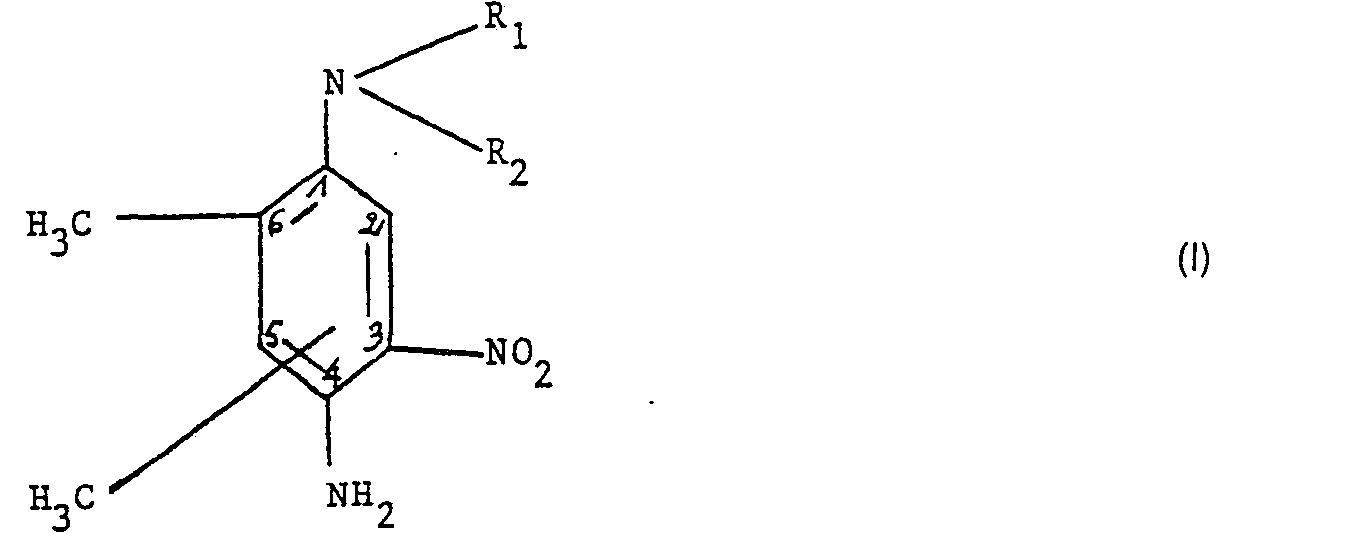
- the dimethyl derivatives of 3-amino-4-aniline according to the invention correspond to the following formula (1): in which the variable CH 3 radical can be in position 2 or 5 of the benzene ring and R 1 and R 2 denote independently of one another a hydrogen atom, a lower alkyl group, mono- or polyhydroxyalkyl lower or lower aminoalkyl, the amino group of which may be optionally mono- or disubstituted by a lower alkyl radical or by a lower mono- or polyhydroxyalkyl radical, it being understood that the two symbols R 1 and R 2 cannot be simultaneously different from hydrogen only when the mobile CH 3 radical is in position 5.
- R 1 and R 2 denote independently of one another a hydrogen atom, a lower alkyl group, mono- or polyhydroxyalkyl lower or lower aminoalkyl, the amino group of which may be optionally mono- or disubstituted by a lower alkyl radical or by a lower mono- or polyhydroxyalkyl radical, it being understood that the two symbols R 1 and R
- the lower alkyl group is an alkyl group containing 1 to 6 carbon atoms and preferably 1 to 4 carbon atoms.
- radicals R 1 and R 2 are methyl, ethyl, n-propyl, ⁇ -hydroxyethyl, ⁇ -hydroxypropyl, ⁇ -hydroxypropyl, ⁇ , ⁇ -dihydroxypropyl, (3-aminoethyl, ⁇ -aminopropyl) radicals. and 3-N, N-diethylaminoethyl.
- Preferred compounds are those in which at least one of the radicals R 1 and R 2 denotes a hydrogen atom.
- 2,5-dimethyl-3-nitro-paraphenylenediamine also synthesized, has dye properties but does not have the significant advantages of the preferred compounds. Their interesting properties seem to be due, without this interpretation being limiting, to the presence of a methyl radical in para of the group NO 2 .
- R 1 and R 2 both denote hydrogen can be prepared by nitration of the compounds of formula (II) below: in which R 1 denotes a hydrogen atom when CH 3 is in position 2 and R 1 denotes the acetyl group ( ⁇ COCH 3 ) when CH 3 is in position 5.
- radical ⁇ CH 3 When the radical ⁇ CH 3 is in position 5 with R 1 denoting -COCH 3 , it is the N, N'-diacetyl derivative of 5,6-dimethyl-paraphenylene diamine which is a known compound.
- R 1 denoting hydrogen
- it is 2,6-dimethyl-4-acetylamino aniline which is a new compound obtained by acetylation formed in water, at room temperature, in the presence sodium sulfite, 2,6-dimethyl paraphenylenediamine dihydrochloride.
- the compounds of formula (I) in which at least one of the symbols R 1 and R 2 is different from hydrogen, are prepared according to the following two procedures, depending on whether they are derivatives of dimethyl- 2,6 nitro-3 para-phenylenediamine or derivatives of dimethyl-5,6 nitro-3 para-phenylenediamine.
- alkylation of the amine in position 1 on a precursor which is p-toluene sulfonamide of 2,6-dimethyl-4-nitro aniline As alkylating agents, non-limiting examples that may be mentioned include alkyl sulfates or alkyl halides, which may or may not be substituted. After desulfonation by hydrolysis, the alkylated nitro-4 aniline is reduced to dimethylacetylation of the primary amine and then hydrolysed.
- reaction scheme is as follows: Ar denoting the p-tolyl group and R 1 having the meanings indicated in formula (I), with the exception of hydrogen.
- substitution of the more reactive amine in 1 can be carried out directly from 5,6-dimethyl-3-nitro-paraphenylenediamine by alkylation using an alkyl halide, substituted or unsubstituted , an epoxide or by opening an intermediate oxazoline-1,3 one-3.
- the dye compositions in accordance with the invention contain, in a solvent medium, at least one compound corresponding to formula (I) and can be used for the direct dyeing of keratin fibers or for the oxidation dyeing of these fibers, in which case the compounds of formula (I) confer reflections complementary to the basic coloration obtained by oxidative development of oxidation dye precursors.
- compositions contain the compounds according to the invention in proportions of between 0.001 and 5% by weight and preferably between 0.05 and 2% by weight relative to the total weight of the composition.
- the solvent medium is preferably a cosmetic vehicle generally consisting of water but it is also possible to add, in the compositions, organic solvents to dissolve compounds which are not sufficiently soluble in water.
- organic solvents such as lower alkanols such as ethanol and isopropanol, aromatic alcohols such as benzyl alcohol, polyols such as glycerol, glycols or glycol ethers such as 2-butoxyethanol or l 2-ethoxy ethanol, ethylene glycol, propylene glycol, monoethyl ether and monomethyl ether of diethyleneglycol as well as analogues and their mixtures.
- These solvents are preferably present in proportions ranging from 1 to 75% by weight and in particular from 5 to 50% by weight relative to the total weight of the composition.
- compositions can contain anionic, cationic, non-anionic, amphoteric surfactants or mixtures thereof.
- surfactants are present in the compositions of the invention in proportions of between 0.5 and 55% by weight and preferably between 4 and 40% by weight relative to the total weight of the composition.
- compositions may preferably be thickened with compounds chosen from sodium alginate, gum arabic, cellulose derivatives such as methylcellulose, hydroxyethylcellulose, hydroxypropylmethylcellulose, carboxymethylcellulose and various polymers having the thickener function such as more particularly acrylic acid derivatives. It is also possible to use mineral thickening agents such as bentonite. These thickening agents are preferably present in the proportions of between 0.5 and 10% by weight and in particular between 0.5 and 3% by weight relative to the total weight of the composition.
- compositions according to the invention can also contain various adjuvants usually used in hair dye compositions and in particular penetration agents, dispersing agents, sequestering agents, film-forming agents, buffers and perfumes.
- compositions can be in various forms such as liquid, cream, gel or any other form suitable for dyeing the hair. They can also be packaged in aerosol bottles in the presence of a propellant.
- the pH of these dye compositions can be between 3 and 11.5, preferably between 5 and 11.5. It is adjusted to the desired value using an alkalizing agent such as ammonia, sodium, potassium or ammonium carbonate, sodium or potassium hydroxides, alkanolamines such as mono, di- or triethanolamine, 2-amino-2-methyl-propanol-1, 2-amino-2-methyl-propanediol-1,3, alkylamines such as ethylamine or triethylamine or using an acidifying agent such as phosphoric, hydrochloric, tartaric, acetic, lactic or citric acids.
- an alkalizing agent such as ammonia, sodium, potassium or ammonium carbonate, sodium or potassium hydroxides
- alkanolamines such as mono, di- or triethanolamine
- 2-amino-2-methyl-propanol-1 2-amino-2-methyl-propanediol-1,3, alkylamines
- alkylamines such as e
- concentrations of these direct dyes other than the dyes of formula (I) can be between 0.001 and 5% by weight relative to the total weight of the composition.
- compositions used in a dyeing process by direct coloring, are applied to the keratin fibers for an exposure time varying from 5 to 50 minutes, then the fibers are rinsed, optionally washed, rinsed again and dried.
- compositions according to the invention can also be used in the form of hair styling lotions intended at the same time to give the hair a light coloring and to improve the behavior of styling.
- they are in the form of aqueous solutions.
- alcoholic or hydroalcoholic containing at least one cosmetic resin and their application is carried out on damp hair previously washed and rinsed which are optionally coiled and then dried.
- the cosmetic resins used in the styling lotions can be in particular polyvinylpyrrolidone, crotonic acid-vinyl acetate, vinylpyrrolidone-vinyl acetate copolymers, maleic anhydride-butylvinyl ether, maleic anhydride-methyl vinyl ether as well as any other cationic polymer , anionic, nonionic or amphoteric usually used in this type of composition.
- These cosmetic resins are included in the compositions of the invention in an amount of 0.5 to 4% by weight, and preferably from 1 to 3% by weight based on the total weight of the composition.
- compositions according to the invention constitute oxidation dyes involving revelation by an oxidant
- compounds of formula (I) in accordance with the invention are essentially used with a view to providing reflections to the final dye.
- compositions then contain, in combination with at least one nitro dye of formula (I) and optionally other nitro dyes such as those mentioned above, dye precursors by oxidation.
- para-phenylenediamines such as: para-phenylenediamine, paratoluylenediamine, 2-chloro-para-phenylenediamine, 2,6-dimethyl para-phenylenediamine, 2,6-dimethyl-3-methoxy-para-phenylenediamine, N- ( ⁇ 3-methoxyethyl) paraphenylenediamine, NN- (j3-hydroxyethyl) paraphenylenediamine, N, N- (ethyl, carbamylmethyl) 4-amino aniline, as well as their salts.
- para-phenylenediamines such as: para-phenylenediamine, paratoluylenediamine, 2-chloro-para-phenylenediamine, 2,6-dimethyl para-phenylenediamine, 2,6-dimethyl-3-methoxy-para-phenylenediamine, N- ( ⁇ 3-methoxyethyl) parapheny
- paraaminophenols for example: paraaminophenol, N-methyl paraaminophenol, chloro-2-amino-4 phenyl, chloro-3 amino-4 phenol, methyl-2 amino-4 phenol, and their salts .
- They may also contain orthoaminophenol.
- They can also contain heterocyclic derivatives, for example: 2,5-diamino pyridine, 7-amino benzomorpholine.
- compositions according to the invention may contain, in association with the precursors of dyes by oxidation, couplers well known in the state of the art.
- metadiphenols such as resorcinol, 2-methyl resorcinol
- metaaminophenols such as: metaaminophenol, 2-methyl-5-amino phenol, 2-methyl-N-methylamino- 5 phenol, methyl-2 N - ((3-hydroxyethyl) amino-5 phenol, and their salts
- metaphenylene diamines such as: (2,4-diamino) phenoxyethanol, [N- ( ⁇ -hydroxyethyl) 2-amino-4-amino] phenoxyethanol, (2,4-diamino) phenyl ⁇ , ⁇ -di-hydroxypropyl ether and their salts
- metaacylaminophenols metauridophenols
- metacarbalcoxyaminophenols such as: 2-methyl-5-acetylamino phenol, 2-methyl-5-ureido-phenol, 2-methyl-carbethoxy-5-amino-phenol.
- compositions contain, in addition to dye precursors by oxidation, reducing agents such as more particularly sodium bisulfite, sodium sulfite, thioglycolic acid, thiolactic acid, mercapto succinic acid, ascorbic acid and their salts and hydroquinone.
- reducing agents such as more particularly sodium bisulfite, sodium sulfite, thioglycolic acid, thiolactic acid, mercapto succinic acid, ascorbic acid and their salts and hydroquinone.
- the dye precursors by oxidation can be used, in the compositions of the invention, at concentrations of between 0.001 and 5% by weight and preferably between 0.03 and 2% by weight based on the total weight of the composition.
- the couplers can also be present in proportions of between 0.001 and 5% by weight, preferably between 0.015 and 2% by weight.
- the pH of these oxidation dyeing compositions is preferably between 7 and 11.5 and is adjusted using alkalizing agents defined above.
- the process for dyeing keratin fibers, in particular human hair, using revelation with an oxidant consists in applying to the hair the dye composition comprising both a dye according to the invention and the dye precursors.
- the development of the coloration can then be carried out slowly in the presence of oxygen from the air, but preferably a chemical developing system is used which is most often chosen from hydrogen peroxide, urea peroxide and parsley. In particular, a solution of hydrogen peroxide at 20 volumes is used.
- composition with the oxidizing agent has been applied to the keratin fibers, it is left to stand for 10 to 50 minutes, preferably 15 to 30 minutes, after which the keratin fibers are rinsed, they are optionally washed with shampoo , they are rinsed again and dried.
- the expected product is drained in the form of the hydrochloride.
- This hydrochloride is dissolved in 150 ml of water and basified with ammonia to precipitate 5,6-dimethyl-3-nitro-paraphenylenediamine.
- the product is drained, washed with water, recrystallized using ethyl acetate; it melts at 159 ° C.
- the sulfate is suspended in water and then 20% ammonia is added; the expected product crystallizes. After recrystallization of the alcohol at 96 °, it melts at 99 ° C.
- reaction medium After 2 hours of heating, the reaction medium is cooled, the precipitate is drained, washed with water, with alcohol and then dried. After dissolving in dimethyl sulfoxide, then reprecipitation by adding water and drying, it melts at 181 ° C.
- a suspension of 0.5 mol (90 g) of 3,6-dimethyl-3-nitro-paraphenylenediamine and of 0.75 mol (75 g) of lime carbonate in 350 ml of water is heated beforehand to 80 ° C. with stirring. and 150 ml of 96 ° alcohol. 1.2 mol (262 g) of bromoethylamine hydrobromide are gradually added, with stirring. After heating for 1 hour 30 minutes at reflux, the reaction medium is cooled and 250 ml of concentrated hydrochloric acid are poured in, the precipitate thus obtained is drained, washed with water and then with acetone.
- the salt of the expected product After dissolving in 1 liter of ice water by adding ammonia, the salt of the expected product is obtained which, after alkalization with 250 ml of 10N sodium hydroxide, leads to 4-amino-5,6-dimethyl-3 N-nitro ⁇ -aminoethylanine. After washing with water, drying and recrystallization from ethyl alcohol, the product melts at 152 ° C.
- the hydrochloride is dissolved in water, and by adding 10N sodium hydroxide in the presence of ice, an oil is obtained which precipitates. After spinning, washing with water and drying in the presence of phosphorus pentaoxide under vacuum, the product obtained is recrystallized from ethanol at 96 ° C. It melts at 98 ° C.
- This mixture applied 20 minutes at 28 ° C to naturally white hair at 90% permed, gives them, after shampooing and rinsing, a mahogany color.
- This mixture applied 20 minutes at 30 ° C to naturally white hair at 90%, gives them, after shampooing and rinsing, a golden honey coloring.
- This mixture applied 20 minutes at 30 ° C to permed hair, gives them, after shampooing and rinsing, a light golden brown color.
- This mixture applied to bleached hair 25 minutes at 30 ° C, gives them, after rinsing and shampooing, a golden brown color.
- This mixture applied 30 minutes at 28 ° C on naturally white hair at 90%, gives them, after shampooing and rinsing, a sand coloring.
- This mixture applied 25 minutes at 28 ° C to hair bleached in white, gives them, after rinsing and shampooing, a pink salmon coloring.
- This mixture applied to bleached hair for 15 minutes at 25 ° C, gives them, after rinsing and shampooing, a red copper color.
- This mixture applied 20 minutes at 28 ° C to white hair at 90% permed, gives them, after rinsing and shampooing, a medium coppery brown coloring.
- This mixture is applied 15 minutes at 30 ° C to 95% permed white hair; after rinsing and shampooing, it gives them a copper color.
- This mixture applied 20 minutes at 28 ° C to naturally white hair at 90%, gives them, after rinsing and shampooing, a light coppery brown coloring.
- This mixture applied 25 minutes at 25 ° C to hair bleached in white, gives them, after rinsing and shampooing, a mahogany coloring.
- This mixture applied 25 minutes at 20 ° C to bleached hair, gives them, after rinsing and shampooing, a golden sand coloring.
- This mixture applied 25 minutes at 25 ° C to bleached hair, gives them, after rinsing and shampooing, a coral coloring.
- This liquid composition gives a creamy gel by weight-for-weight dilution with hydrogen peroxide at 20 volumes.
- the nitro dye used namely 5.6-dimethyl-3-nitro-paraphenylenediamine, is stable in the liquid composition.
- This liquid is diluted at the time of use with an equal weight of an oxidizing milk titrating 20 volumes of hydrogen peroxide.
- the gel obtained is applied 30 minutes to brown hair and rinsed. Shampoo and dry. We then obtain hair dyed in a dark coppery blonde shade.
- the nitrated dye namely 2,6-dimethyl-3-nitro-paraphenylenediamine
Landscapes
- Health & Medical Sciences (AREA)
- Life Sciences & Earth Sciences (AREA)
- Animal Behavior & Ethology (AREA)
- General Health & Medical Sciences (AREA)
- Public Health (AREA)
- Veterinary Medicine (AREA)
- Birds (AREA)
- Epidemiology (AREA)
- Cosmetics (AREA)
- Coloring (AREA)
- Organic Low-Molecular-Weight Compounds And Preparation Thereof (AREA)
Description
- La présente invention est relative à de nouveaux dérivés diméthylés de nitro-3 amino-4 aniline, à leur procédé de préparation et à leur utilisation en teinture des fibres kératiniques, et en particulier des cheveux humains.
- Il est bien connu que pour conférer aux cheveux une coloration directe ou des reflets complémentaires dans le cas de la coloration d'oxydation, on peut utiliser des dérivés nitrés de la série benzénique. On a déjà préconisé l'utilisation de nitroparaphénylènediamines telles que plus particulièrement la nitropara- phénylènediamine et la méthyl-2 nitro-5 paraphénylènediamine tant en teinture directe qu'en teinture d'oxydation.
- La parfaite innocuité de ces nitroparaphénylènediamines a cependant été mise en doute ces dernières années et on a cherché de ce fait à remplacer ces colorants dans les compositions tinctoriales pour cheveux.
- Par ailleurs, on a constaté d'une manière générale une mauvaise conservation des nitroparaphénylènediamines dans le milieu alcalin réducteur, comprenant notamment du bisulfite de sodium, utilisé habituellement dans les compositions de teinture d'oxydation. On a donc recherché également des nitroparaphénylènediamines présentant une bonne conservation en milieu alcalin réducteur.
- La demande de brevet GB-A-2086408 décrit ainsi des méthyl-2 amino-4 nitro-5 anilines N-substituées satisfaisantes du point de vue innocuité et stabilité en milieu alcalin réducteur.
- En poursuivant ses recherches, la demanderesse a découvert de nouveaux dérivés diméthylés de nitro-3 amino-4 aniline présentant à la fois une très faible toxicité et une très bonne stabilité en solution, notamment lorsqu'ils sont utilisés dans une composition tinctoriale d'oxydation en présence d'un agent alcalin et d'un réducteur tel que le bisulfite de sodium.
- La demanderesse a constaté également que les teintures capillaires obtenues à l'aide de ces nouveaux composés présentent une bonne stabilité aux intempéries, à la lumière et au lavage.
- La présente invention a donc pour objet de nouveaux dérivés diméthylés de nitro-3 amino-4 aniline ainsi que leur procédé de préparation.
- L'invention vise également des compositions tinctoriales pour fibres kératiniques, et en particulier pour cheveux humains, contenant ces dérivés diméthylés de nitro-3 amino-4 aniline, compositions tinctoriales qui peuvent être utilisées aussi bien pour la coloration directe des cheveux que pour la coloration par voie d'oxydation.
- D'autres objets et avantages de la présente invention apparaîtront à la lecture de la description et des exemples qui suivent.
- Les dérivés diméthylés de nitro-3 amino-4 aniline selon l'invention répondent à la formule (1) suivante :

- Ces dérivés de formule (I) peuvent aussi exister sous forme de sels cosmétiquement acceptables.
- Selon l'invention, le groupe alkyle inférieur est un groupe alkyle contenant 1 à 6 atomes de carbone et de préférence 1 à 4 atomes de carbone.
- Des radicaux R1 et R2 particulièrement préférés selon l'invention sont les radicaux méthyle, éthyle, n-propyle, β-hydroxyéthyle, β-hydroxypropyle, γ-hydroxypropyle, β,γ-dihydroxypropyle, (3-aminoéthyle, γ-aminopropyle et ¡3-N,N-diéthylaminoéthyle.
- Des composés préférés sont ceux dans lesquels l'un au moins des radicaux R1 et R2 désigne un atome d'hydrogène.
- Des composés particulièrement inoffensifs et solides au lavage et à la lumière sont les composés suivants :
- - diméthyl-2,6 nitro-3 paraphénylènediamine
- - diméthyl-5,6 nitro-3 paraphénylènediamine
- - amino-4 diméthyl-2,6 nitro-3 N-méthylaniline
- - amino-4 diméthyl-5,6 nitro-3 N-p-hydroxyéthylaniline
- - amino-4 diméthyl-5,6 nitro-3 N-β,γ-dihydroxypropylaniline
- - amino-4 diméthyl-5,6 nitro-3 N-β-aminoéthylaniline
- - amino-4 diméthyl-5,6 nitro-3 N-(β-diéthylaminoéthyl) aniline.
- La diméthyl-2,5 nitro-3 paraphénylènediamine également synthétisée présente des propriétés de colorant mais ne présente pas les avantages importants des composés préférés. Leurs propriétés intéressantes semblent être dues, sans que cette interprétation soit limitative, à la présence d'un radical méthyle en para du groupement N02.
- Les composés de formule (I) dans laquelle R1 et R2 désignent tous deux de l'hydrogène, peuvent être préparés par nitration des composés de formule (II) suivante :

- Lorsque le radical ―CH3 est en position 5 avec R1 désignant -COCH3, il s'agit du dérivé N,N'- diacétylé de la diméthyl-5,6 paraphénylène diamine qui est un composé connu.
- Lorsque le radical CH3 est en position 2, R1 désignant hydrogène, il s'agit de la diméthyl-2,6 acétylamino-4 aniline qui est un composé nouveau obtenu par acétylation ménagée dans l'eau, à température ambiante, en présence de sulfite de sodium, du dichlorhydrate de diméthyl-2,6 paraphénylènediamine.
- La nitration des composés II est effectuée de façon classique. Les composés Il, après avoir été mis en solution à température ambiante, dans l'acide sulfurique à 96 %, sont traités entre - 5 et 0°C par un mélange sulfonitrique conduisant aux composés de formule III suivants :

- Les composés de formule (III) ainsi obtenus sont ensuite hydrolysés à l'aide d'acide chlorhydrique.
- Les composés de formule (I) dans laquelle l'un au moins des symboles R1 et R2 est différent de l'hydrogène, sont préparés selon les deux modes opératoires suivants, selon qu'il s'agit de dérivés de la diméthyl-2,6 nitro-3 paraphénylènediamine ou de dérivés de la diméthyl-5,6 nitro-3 paraphénylènediamine.
- II est nécessaire dans ce cas de conduire l'alkylation de l'amine en position 1 sur un précurseur qui est le p-toluène sulfonamide de la diméthyl-2,6 nitro-4 aniline. Comme agents alkylants, on peut citer à titre d'exemples non limitatifs, les sulfates d'alkyle ou les halogénures d'alkyle, substitués ou non. Après désulfonation par hydrolyse, la nitro-4 aniline alkylée est réduite en diméthylacétylation de l'amine primaire puis hydrolysée.
- Le schéma réactionnel est le suivant :


- Dans ce cas, la substitution de l'amine en 1, plus réactive, peut être conduite directement à partir de la diméthyl-5,6 nitro-3 paraphénylènediamine par alkylation à l'aide d'un halogénure d'alkyle, substitué ou non, d'un époxyde ou par ouverture d'une oxazoline-1,3 one-3 intermédiaire.
- Les compositions tinctoriales conformes à l'invention contiennent, dans un milieu solvant, au moins un composé répondant à la formule (I) et peuvent être utilisées pour la coloration directe des fibres kératiniques ou pour la coloration d'oxydation de ces fibres, auquel cas les composés de formule (I) confèrent des reflets complémentaires à la coloration de base obtenue par développement oxydant de précurseurs de colorants d'oxydation.
- Ces compositions contiennent les composés selon l'invention dans des proportions comprises entre 0,001 et 5 % en poids et de préférence entre 0,05 et 2 % en poids par rapport au poids total de la composition.
- Le milieu solvant est de préférence un véhicule cosmétique généralement constitué par de l'eau mais on peut également ajouter, dans les compositions, des solvants organiques pour solubiliser des composés qui ne seraient pas suffisamment solubles dans l'eau. Parmi ces solvants, on peut citer les alcanols inférieurs tels que l'éthanol et l'isopropanol, les alcools aromatiques comme l'alcool benzylique, les polyols tels que le glycérol, les glycols ou éthers de glycols comme le butoxy-2 éthanol ou l'éthoxy-2 éthanol, l'éthylèneglycol, le propylèneglycol, le monoethyléther et le monométhyléther du diethylenegly- col ainsi que les produits analogues et leurs mélanges. Ces solvants sont de préférence présents dans des proportions allant de 1 à 75% en poids et en particulier de 5 à 50% en poids par rapport au poids total de la composition.
- Ces compositions peuvent contenir des agents tensio-actifs anioniques, cationiques, non-anioniques, amphotères ou leurs mélanges. Ces produits tensio-actifs sont présents dans les compositions de l'invention dans des proportions comprises entre 0,5 et 55 % en poids et de préférence entre 4 et 40 % en poids par rapport au poids total de la composition.
- Les compositions peuvent être épaissies de préférence avec des composés choisis parmi l'alginate de sodium, la gomme arabique, les dérivés de la cellulose tels que la méthylcellulose, l'hydroxyéthylcellu- lose, l'hydroxypropylméthylcellulose, la carboxyméthylcellulose et les polymères divers ayant la fonction d'épaississant tels que plus particulièrement les dérivés d'acide acrylique. Il est également possible d'utiliser des agents épaississants minéraux tels que la bentonite. Ces agents épaississants sont présents de préférence dans les proportions comprises entre 0,5 et 10 % en poids et en particulier entre 0,5 et 3 % en poids par rapport au poids total de la composition.
- Les compositions selon l'invention peuvent également contenir divers adjuvants habituellement utilisés dans les compositions tinctoriales pour cheveux et en particulier des agents de pénétration, des agents dispersants, des agents séquestrants, des agents filmogènes, des tampons et des parfums.
- Ces compositions peuvent se présenter sous des formes diverses telles que liquide, crème, gel ou toute autre forme appropriée pour réaliser une teinture des cheveux. Elles peuvent en outre être conditionnées en flacons aérosols en présence d'un agent propulseur.
- Le pH de ces compositions tinctoriales peut être compris entre 3 et 11,5, de préférence entre 5 et 11,5. On l'ajuste à la valeur souhaitée à l'aide d'un agent alcalinisant tel que l'ammoniaque, le carbonate de sodium, de potassium ou d'ammonium, les hydroxydes de sodium ou de potassium, les alcanolamines telles que la mono, la di- ou la triéthanolamine, l'amino-2 méthyl-2 propanol-1, l'amino-2 méthyl-2 propanediol-1,3, les alkylamines telles que l'éthylamine ou la triéthylamine ou à l'aide d'un agent d'acidification tel que les acides phosphorique, chlorhydrique, tartrique, acétique, lactique ou citrique.
- Lorsque les compositions sont destinées à être utilisées dans un procédé de coloration directe des cheveux, elles peuvent contenir en plus des composés conformes à l'invention d'autres colorants directs tels que des colorants azoïques ou anthraquinoniques, comme par exemple la tétraamino-1,4,5,8 anthraquinone, des colorants nitrés de la série benzénique différents des composés de formule (I) et plus particulièrement les composés suivants :
- - la méthyl-2 nitro-6 aniline,
- - le méthyl-2 amino-4 nitro-5 phénol,
- - la nitro-3 N'-β-hydroxyéthylamino-4 N-méthylaniline,
- - la nitro-3 N'-β-hydroxyéthyl amino-4 N-méthyl, N-β-hydroxyéthylaniline,
- - l'amino-4 nitro-3 phénol,
- - l'amino-3 nitro-4 phénol,
- - l'amino-2 nitro-3 phénol,
- - le N-0-hydroxyéthylamino-2 nitro-5 phénol,
- - le N-β-hydroxyéthylamino-2 nitro-5 anisole,
- - la méthyl-2 nitro-5 N,N'(-β-hydroxyéthyl) paraphénylènediamine,
- - la nitro-3 N'-(β-hydroxyéthyl) amino-4 N,N-bis-((3-hydroxyéthyl) aniline,
- - la nitro-3 N'-(β-aminoéthyl) amino-4 N,N-bis-((3-hydroxyéthyl) aniline,
- - l'amino-4 méthyl-2 nitro-3 N-β-hydroxyéthylaniline,
- - le [N-(β-hydroxyéthyl) amino-4 nitro-3] phényl, β-hydroxyéthyI éther,
- - le (N-méthylamino-3 nitro-4) phényl, P-hydroxyéthyl éther.
- - l'isopropyl-2 nitro-6 aniline,
- Les concentrations de ces colorants directs autres que les colorants de formule (I) peuvent être comprises entre 0,001 et 5 % en poids par rapport au poids total de la composition.
- Ces compositions, mises en oeuvre dans un procédé de teinture par coloration directe, sont appliquées sur les fibres kératiniques pendant un temps de pose variant de 5 à 50 minutes, puis les fibres sont rincées, éventuellement lavées, rincées à nouveau et séchées.
- Les compositions selon l'invention peuvent également être mises en oeuvre sous forme de lotions capillaires de mise en plis destinées tout à la fois à conférer aux cheveux une légère coloration et à améliorer la tenue de la mise en plis. Dans ce cas, elles se présentent sous forme de solutions aqueuses. alcooliques ou hydroalcooliques renfermant au moins une résine cosmétique et leur application s'effectue sur des cheveux humides préalablement lavés et rincés qui sont éventuellement enroulés puis séchés.
- Les résines cosmétiques utilisées dans les lotions de mise en plis peuvent être en particulier la polyvinylpyrrolidone, les copolymères acide crotonique-acétate de vinyle, vinylpyrrolidone-acétate de vinyle, anhydride maléique-éther butylvinylique, anhydride maléique-éther méthylvinylique ainsi que tout autre polymère cationique, anionique, non ionique ou amphotère habituellement utilisé dans ce type de composition. Ces résines cosmétiques entrent dans les compositions de l'invention à raison de 0,5 à 4 % en poids, et de préférence de 1 à 3 % en poids sur la base du poids total de la composition.
- Lorsque les compositions selon l'invention constituent des teintures d'oxydation impliquant la révélation par un oxydant, les composés de formule (I) conformes à l'invention sont essentiellement utilisés en vue d'apporter des reflets à la teinture finale.
- Ces compositions contiennent alors en association avec au moins un colorant nitré de formule (I) et éventuellement d'autres colorants nitrés tels que ceux mentionnés ci-dessus, des précurseurs de colorants par oxydation.
- Elles peuvent contenir par exemple des paraphénylènediamines telles que : la paraphénylènediamine, la paratoluylènediamine, la chloro-2 paraphénylènediamine, la diméthyl-2,6 paraphénylènediamine, la diméthyl-2,6 méthoxy-3 paraphénylènediamine, la N-(¡3-méthoxyéthyl) paraphénylènediamine, la N.N-(j3-hydroxyéthyl) paraphénylènediamine, la N,N-(éthyl, carbamylméthyl) amino-4 aniline, ainsi que leurs sels.
- Elles peuvent également contenir des paraaminophénols, par exemple : le paraaminophénol, le N-méthyl paraaminophénol, le chloro-2-amino-4 phényl, le chloro-3 amino-4 phénol, le méthyl-2 amino-4 phénol, et leurs sels.
- Elles peuvent également contenir de l'orthoaminophénol.
- Elles peuvent aussi contenir des dérivés hétérocycliques, par exemple : la diamino-2,5 pyridine, l'amino-7 benzomorpholine.
- Les compositions selon l'invention peuvent contenir en association avec les précurseurs de colorants par oxydation, des coupleurs bien connus dans l'état de la technique.
- A titre de coupleurs, on peut citer notamment : les métadiphénols tels que la résorcine, la méthyl-2 résorcine, les métaaminophénols tels que : le métaaminophénol, le méthyl-2 amino-5 phénol, le méthyl-2 N-méthyl-amino-5 phénol, le méthyl-2 N-((3-hydroxyéthyl) amino-5 phénol, et leurs sels, les métaphénylène- diamines telles que : le (diamino-2,4) phénoxyéthanol, le [N-(β-hydroxyéthyl) amino-2 amino-4] phénoxyéthanol, le (diamino-2,4) phényl β,γ-di-hydroxypropyléther et leurs sels, les métaacylaminophénols, les métauréidophénols, les métacarbalcoxyaminophénols tels que : le méthyl-2 acétylamino-5 phénol, le méthyl-2 uréido-5 phénol, le méthyl-2 carbéthoxy-amino-5 phénol.
- On peut enfin mentionner comme autres coupleurs utilisables dans les compositions de l'invention : l'a-naphtol, les coupleurs possédant un groupement méthylène actif tels que les composés dicétoniques et les pyrazolones et les coupleurs hétérocycliques tels que la diamino-2,4-pyridine, l'hydroxy-6 benzomorpholine, l'amino-6 benzomorpholine ainsi que leurs sels.
- Ces compositions contiennent, en plus des précurseurs de colorants par oxydation, des agents réducteurs tels que plus particulièrement le bisulfite de sodium, le sulfite de sodium, l'acide thioglycoli- que, l'acide thiolactique, l'acide mercapto succinique, l'acide ascorbique et leurs sels et l'hydroquinone. Ces agents réducteurs sont présents dans des proportions comprises entre 0,05 et 3 % en poids par rapport au poids total de la composition.
- Les précurseurs de colorants par oxydation peuvent être utilisés, dans les compositions de l'invention, à des-concentrations comprises entre 0,001 et 5 % en poids et de préférence entre 0,03 et 2 % en poids sur la base du poids total de la composition. Les coupleurs peuvent également être présents dans des proportions comprises entre 0,001 et 5 % en poids, de préférence entre 0,015 et 2 % en poids. Le pH de ces compositions de teinture par oxydation est de préférence compris entre 7 et 11,5 et est ajusté à l'aide d'agents alcalinisants définis ci-dessus.
- La demanderesse a constaté que les composés conformes à l'invention étaient particulièrement stables dans de telles compositions.
- Le procédé de teinture des fibres kératiniques, en particulier des cheveux humains, mettant en oeuvre la révélation par un oxydant, consiste à appliquer sur les cheveux la composition tinctoriale comprenant à la fois un colorant selon l'invention et les précurseurs de colorants. Le développement de la coloration peut alors s'effectuer lentement en présence de l'oxygène de l'air, mais on utilise de préférence un système révélateur chimique qui est le plus souvent choisi parmi l'eau oxygénée, le peroxyde d'urée et les persels. On utilise en particulier une solution d'eau oxygénée à 20 volumes.
- Une fois que l'on a appliqué sur les fibres kératiniques la composition avec l'agent oxydant, on laisse poser pendant 10 à 50 minutes, de préférence 15 à 30 minutes, après quoi on rince les fibres kératiniques, on les lave éventuellement au shampooing, on les rince à nouveau et on sèche.
- Les exemples qui suivent sont destinés à illustrer l'invention sans présenter un caractère limitatif.
(Voir exemple de préparation 1 page 7) -

- On dissout 1,6 mole (334,6 g) de dichlorhydrate de diméthyl-2,6 paraphénylènediamine dans 1 600 ml d'eau. A cette solution on ajoute 3,36 moles (423,3 g) de sulfite de sodium en solution dans 1 600 ml d'eau puis, peu à peu, sous agitation, en maintenant la température au voisinage de 25°C, 1,68 mole (174,8 g) d'anhydride acétique. L'addition terminée on abandonne le milieu réactionnel 1 heure à température ambiante. Après refroidissement, on essore le dérivé monoacétylé qui a précipité. Il fond à 148 °C.
- On ajoute peu à peu, sous bonne agitation, 0,226 mole (40,3 g) du dérivé monoacétylé précédemment obtenu à 230 ml d'acide sulfurique à 96 % tout en maintenant la température entre 18 et 20 °C. La dissolution est complète au bout de 30 minutes. On refroidit alors cette solution à -3 °C puis on lui ajoute goutte à goutte en 45 minutes, sous bonne agitation et tout en maintenant la température entre -2 et 0 °C le mélange sulfonitrique préparé à partir de 10,5 ml d'acide nitrique (d = 1,5) et de 40 ml d'acide sulfurique à 96 %. L'addition terminée, on maintient le milieu réactionnel 1 heure à 0 °C puis on le verse sur 2 kg de glace broyée. Après neutralisation à l'aide d'ammoniaque, on essore le produit attendu qui a précipité, on le lave à l'eau et on le recristallise dans l'éthanol. Il fond à 197 °C.

- On introduit 0,04 mole (8,9 g) de diméthyl-2,6, nitro-3, acétylamino-4 aniline dans 25 ml d'acide chlorhydrique à 36 % additionnés de 10 ml d'acide acétique. Après 1 heure 1/2 de chauffage au bain-marie bouillant, on essore le produit attendu sous forme de chlorhydrate. Ce chlorhydrate est mis en solution dans 40 ml d'eau. Par addition d'ammoniaque on précipite la diméthyl-2,6 nitro-3, paraphénylènediamine. Le produit est essoré, lavé à l'eau, séché et recristallisé dans le benzène. Il fond à 124 °C.

-

- On ajoute peu à peu, sous bonne agitation, 0,085 mole (18,3 g) de diméthyl-5,6 N,N'-diacétylparaphé- nylènediamine à 85 ml d'acide sulfurique à 96 %, tout en maintenant la température entre 18 et 20 °C. La dissolution est totale au bout de 30 minutes. On refroidit cette solution à - 5 °C et on lui ajoute alors goutte à goutte en 20 minutes, tout en maintenant la température au voisinage de ―2°C. le mélange sulfonitrique préparé selon le procédé habituel, à partir de 15 ml d'acide sulfurique à 96 % et de 4 ml d'acide nitrique d = 1,5. L'addition terminée, on maintient l'agitation 1 heure au voisinage de 0 °C puis on verse le milieu réactionnel sur 0,8 kg de glace pilée. On essore le produit attendu qui a précipité, on le lave à l'eau et le sèche sous vide à 50 °C. Après recristallisation dans l'éthanol, il fond au-dessus de 260 °C.

- On chauffe 1 heure 1/2 au bain-marie bouillant 0,075 mole (19,9 g) du dérivé diacétylé préparé selon le procédé de la première étape, dans 75 ml d'acide chlorhydrique à 36 %.
- Après refroidissement du milieu, on essore le produit attendu sous forme de chlorhydrate. On dissout ce chlorhydrate dans 150 ml d'eau et on alcalinise à l'aide d'ammoniaque pour précipiter la diméthyl-5,6 nitro-3 paraphénylènediamine. Le produit est essoré, lavé à l'eau, recristallisé à l'aide d'acétate d'éthyle ; il fond à 159 °C.

-

- On dissout 0,053 mole (16,9 g) de p-toluènesulfonylamino-1 diméthyl-2,6 nitro-4 benzène préparé selon BM WEPSTER, Recueil Tr. Chimiques, Pays-Bas, 73.809 [1954] dans 120 ml de soude N/2. On ajoute peu à peu, à 20°C, 0,06 mole (6 g) de diméthylsulfate. On agite 1 heure supplémentaire.
- Après essorage et réempâtage dans l'eau du précipité, on obtient un produit qui recristallise de l'éthanol et fond à 128 °C.
- L'analyse du produit obtenu donne les résultats suivants :

- A une solution de 25 ml d'acide sulfurique à 96 % et 2,5 ml d'eau portée à 60°C, on ajoute peu à peu 0,031 mole (10,4 g) de N,N-(méthyl p-toluènesulfonyl) amino-1 diméthyl-2,6 nitro-4 benzène. Après 30 minutes de chauffage supplémentaire, le milieu réactionnel est versé sur 90 g de glace. On essore le sulfate du produit attendu.
- On met en suspension le sulfate dans l'eau puis on ajoute de l'ammoniaque à 20 % ; le produit attendu cristallise. Après recristallisation de l'alcool à 96 °, il fond à 99 °C.
- L'analyse du produit obtenu donne les résultats suivants :

- On chauffe au reflux une suspension de 15,5 g de zinc en poudre et de 0,6 g de chlorure d'ammonium. On ajoute, après avoir enlevé le chauffage, 0,02 mole (3,6 g) de diméthyl-2,6 nitro-4 N-méthylaniline de façon à maintenir le reflux. A la fin de l'addition, le milieu réactionnel est filtré bouillant sur une solution de 0,05 mole d'acide chlorhydrique dans 14 ml d'éthanol absolu ; le dichlorhydrate cristallise du filtrat. Après recristallisation d'un mélange alcool-eau, on obtient un produit blanc :
- - Masse moléculaire calculée pour C9H16N2Cl2 : 223
- - Masse moléculaire trouvée par dosage potentiométrique dans l'eau par la soude : 220.
- L'analyse du produit obtenu donne les résultats suivants :

- A une solution de 0,17 mole (38 g) de dichlorhydrate d'amino-4 diméthyl-2,6 N-méthylaniline dans 170 ml d'eau, on ajoute en une fois 0,37 mole (46,6 g) de sulfite de sodium dissous dans 170 ml d'eau puis goutte à goutte pendant 30 minutes, 0,183 mole (19 g) d'anhydride acétique, la température étant maintenue entre 18 °C et 23 °C. Après 2 heures d'agitation, on filtre et on neutralise le filtrat par de l'ammoniaque à 20 %. Après essorage, lavage à l'eau, séchage sous vide, on obtient 0,12 mole (23,3 g) du produit attendu ; il fond à 82 °C.
- - Masse moléculaire calculée pour C11H16N2O : 192,3.
- - Masse moléculaire trouvée par dosage potentiométrique dans l'acide acétique par l'acide perchlorique : 195.
- On ajoute peu à peu une solution de 5,6 ml d'acide nitrique (d = 1,50) dans 20 ml d'acide sulfurique concentré à 0,12 mole (23 g) de N-méthyl-amino-4 diméthyl-3,5 acétanilide dans 120 ml d'acide sulfurique concentré en maintenant la température à 0 °C. Après 30 minutes d'agitation supplémentaire, le milieu réactionnel est versé sur 1 kg de glace. Après neutralisation par de l'ammoniaque à 20 %, le produit attendu précipite. Essoré et recristallisé avec de l'alcool à 96 °, il fond à 133°C.
- - Masse moléculaire calculée pour C11H15N3O3 : 237
- - Masse moléculaire trouvée par dosage potentiométrique par l'acide perchlorique dans l'acide acétique : 240.
- L'analyse du produit obtenu donne les résultats suivants :

- On ajoute 0,11 mole (26,0g) de N-méthylamino-4 diméthyl-3,5 nitro-2 acétanilide à 65 ml d'acide chlorhydrique concentré. Le mélange est chauffé 1 heure à 95 °C. Après refroidissement, on essore le dichlorhydrate du produit attendu.
- Le dichlorhydrate ainsi obtenu est mis en suspension dans 400 ml d'eau. On neutralise le milieu par de l'ammoniaque à 20 %, le produit attendu cristallise. Après essorage et séchage sous vide en présence de pentaoxyde de phosphore, il est recristallisé d'un mélange cyclohexane-benzène ; il fond à 57 °C.
- - Masse moléculaire calculée pour C9H13N3O2 : 195
- - Masse moléculaire trouvée par dosage potentiométrique dans l'acide acétique par l'acide perchlorique : 195.
- L'analyse du produit obtenu donne les résultats suivants :

-

- On dissout 0,05 mole (9,1 g) de diméthyl-5,6 nitro-3 paraphénylène diamine dans 40 ml de dioxane. On ajoute 0,055 mole (5,5 g) de carbonate de calcium. On élève la température à 90 °C puis on introduit peu à peu sous agitation 0,053 mole (7,6 g) de chloroformiate de β-chloréthyle. Le chauffage est poursuivi 1 heure après la fin de l'addition. On verse le milieu réactionnel sur 200 g d'eau glacée. Le produit attendu précipite. Après essorage, réempâtage dans l'eau et recristallisation de l'éthanol à 96°, il fond à 151 °C.
- L'analyse du produit obtenu donne les résultats suivants :

- On met en suspension dans 36 ml d'alcool à 96° 0,041 7 mole (12 g) d'[amino-4 diméthyl-5,6 nitro-3 phényl] carbamate de β-chloréthyle. On ajoute peu à peu sous agitation une solution de 6,2 g de soude en pastilles à 97 % dans 15 ml d'eau ; le mélange réactionnel est porté au reflux de l'alcool. Après 2 heures de chauffage, le milieu réactionnel est versé sur 200 g d'eau glacée et acidifié par de l'acide acétique.
- Après essorage, réempâtage dans l'eau et recristallisation de l'acétate d'éthyle, le produit fond à 166°C.
- - Masse moléculaire calculée pour C10H15N3O3 : 225,25
- - Masse moléculaire trouvée par dosage potentiométrique dans l'acide acétique par l'acide perchlorique : 223.
- L'analyse du produit obtenu donne les résultats suivants :

- Préparation de l'amino-4 diméthyl-5,6 nitro-3 N-β,γ-dihydroxypropylaniline

- On chauffe au bain-marie bouillant sous agitation 0,05 mole (9 g) de diméthyl-5,6 nitro-3 paraphénylènediamine et 0,1 mole (7,4 g) de glycidol dans 18 ml d'éthanol.
- Après 2 heures de chauffage, le milieu réactionnel est refroidi, le précipité est essoré, lavé à l'eau, à l'alcool puis séché. Après dissolution dans le diméthylsulfoxyde, puis reprécipitation par ajout d'eau et séchage, il fond à 181 °C.
- L'analyse du produit obtenu donne les résultats suivants :

-

- On chauffe préalablement à 80 °C sous agitation une suspension de 0,5 mole (90 g) de diméthyl-5,6 nitro-3 paraphénylènediamine et de 0,75 mole (75 g) de carbonate de chaux dans 350 ml d'eau et 150 ml d'alcool à 96°. On ajoute peu à peu, sous agitation, 1,2 mole (262 g) de bromhydrate de bromoéthylamine. Après 1 heure 30 de chauffage au reflux, on refroidit le milieu réactionnel et on coule 250 ml d'acide chlorhydrique concentré, le précipité ainsi obtenu est essoré, lavé à l'eau puis à l'acétone. Après dissolution dans 1 litre d'eau glacée par addition d'ammoniaque, on obtient le sel du produit attendu qui, après alcalinisation par 250 ml de soude 10N, conduit à l'amino-4 diméthyl-5,6 nitro-3 N-β-aminoéthylani- line. Après lavage à l'eau, séchage et recristallisation dans l'alcool éthylique, le produit fond à 152 °C.

-

- Le chlorhydrate est dissous dans l'eau, et par addition de soude 10N en présence de glace, on obtient une huile qui précipite. Après essorage, lavage à l'eau et séchage en présence de pentaoxyde de phosphore sous vide, le produit obtenu est recristallisé de l'éthanol à 96 °C. Il fond à 98 °C.
- L'analyse du produit obtenu donne les résultats suivants :

- On prépare la composition tinctoriale suivante :

- Ce mélange, appliqué 20 minutes à 28 °C sur cheveux naturellement blancs à 90 % permanentés, leur confère, après shampooing et rinçage, une coloration acajou.
- On prépare la composition tinctoriale suivante :

- Ce mélange, appliqué 30 minutes à 28 °C sur cheveux décolorés au blanc leur confère, après shampooing et rinçage, une coloration jaune d'or clair.
- On prépare la composition tinctoriale suivante :

- Ce mélange, appliqué 25 minutes à 28 °C sur cheveux décolorés au blanc, leur confère, après shampooing et rinçage, une coloration cuivre clair.
- On prépare la composition tinctoriale suivante :

- Ce mélange, appliqué 15 minutes à 30 °C sur cheveux naturellement blancs à 90 %, leur confère, après shampooing et rinçage, une coloration beige rosé.
- On prépare le mélange tinctorial suivant :

- Ce mélange, appliqué 20 minutes à 28 °C sur cheveux décolorés au blanc, leur confère, après shampooing et rinçage, une coloration 2,5 R 8/6 selon la notation de Munsell.
- On prépare le mélange tinctorial suivant :

- Ce mélange, appliqué 20 minutes à 30 °C sur cheveux naturellement blancs à 90 %, leur confère, après shampooing et rinçage, une coloration miel doré.
- On prépare le mélange tinctorial suivant :

- Ce mélange, appliqué 20 minutes à 28 °C sur cheveux, leur confère, après shampooing et rinçage, une coloration :
- - sur cheveux décolorés au blanc 10 RP 5/8
- - sur cheveux naturellement blancs à 90 % 10 RP 3/10 selon la notation de Munsell.
- On prépare le mélange tinctorial suivant :

- Ce mélange, appliqué 30 minutes à 30 °C sur cheveux naturellement blancs à 90 %, leur confère, après shampooing et rinçage, une coloration beige rosé.
-


- Au moment de l'emploi, on ajoute 100 g d'eau oxygénée à 20 volumes.
- Ce mélange, appliqué 20 minutes à 30 °C sur des cheveux permanentés, leur confère, après shampooing et rinçage, une coloration châtain clair doré.
- On prépare la composition tinctoriale suivante :

- Au moment de l'emploi, on ajoute 100 g d'eau oxygénée à 20 volumes.
- Ce mélange, appliqué sur des cheveux décolorés 25 minutes à 30°C, leur confère, après rinçage et shampooing, une coloration châtain doré.
- On prépare le mélange tinctorial suivant :

- Ce mélange, appliqué 20 minutes à 28 °C sur cheveux décolorés, leur confère, après shampooing et rinçage, une coloration 9 R 7/5 selon la notation de Munsell.
- On prépare le mélange tinctorial suivant :


- Au moment de l'emploi, on ajoute un poids égal d'eau oxygénée à 20 volumes.
- Ce mélange, appliqué 25 minutes à 28 °C sur cheveux permanentés, leur confère, après shampooing et rinçage, une coloration châtain moyen.
- On prépare le mélange tinctorial suivant :

- Ce mélange, appliqué 30 minutes à 28 °C sur cheveux naturellement blancs à 90 %, leur confère, après shampooing et rinçage, une coloration sable.
-

- Ce mélange, appliqué 25 minutes à 28 °C sur des cheveux décolorés au blanc, leur confère, après rinçage et shampooing, une coloration saumon rose.
- On prépare la composition tinctoriale suivante :


- Ce mélange, appliqué 20 minutes à 28 °C sur des cheveux décolorés au blanc, leur confère, après rinçage et shampooing, une coloration champagne rosé.
- On prépare la composition tinctoriale suivante :

- Ce mélange, appliqué sur cheveux décolorés 15 minutes à 25 °C, leur confère, après rinçage et shampooing, une coloration cuivre rouge.
- On prépare la composition tinctoriale suivante :

- Ce mélange, appliqué 20 minutes à 28 °C sur cheveux blancs à 90 % permanentés, leur confère, après rinçage et shampooing, une coloration châtain moyen cuivré.
-


- Ce mélange est appliqué 15 minutes à 30°C sur des cheveux à 95 % blancs permanentés ; après rinçage et shampooing, il leur confère une coloration cuivre.
- On prépare la composition tinctoriale suivante :

- Ce mélange, appliqué 20 minutes à 28 °C sur des cheveux naturellement blancs à 90 %, leur confère, après rinçage et shampooing, une coloration châtain clair cuivré.
- On prépare la composition tinctoriale suivante :

- Au moment de l'emploi, on ajoute 100 g d'eau oxygénée à 20 volumes.
- Ce mélange appliqué 20 minutes à 25 °C sur des cheveux naturellement blancs à 90 % leur confère, après rinçage et shampooing, une coloration marron rouge.
- On prépare la composition tinctoriale suivante :
- Paraphénylènediamine 0,2 g

- Au moment de l'emploi, on ajoute 100 g d'eau oxygénée à 20 volumes.
- Ce mélange, appliqué 20 minutes à 30 °C sur des cheveux naturellement blancs à 90 %, leur confère, après rinçage et shampooing, une coloration brune à reflets violine.
- On prépare la composition tinctoriale suivante :

- Au moment de l'emploi, on ajoute 100 g d'eau oxygénée à 20 volumes.
- Ce mélange, appliqué 25 minutes à 25 °C sur des cheveux décolorés au blanc, leur confère, après rinçage et shampooing, une coloration acajou.
- On prépare la composition tinctoriale suivante :

- Au moment de l'emploi, on ajoute 75 g d'eau oxygénée à 20 volumes.
- Ce mélange, appliqué 25 minutes à 20 °C sur des cheveux décolorés, leur confère, après rinçage et shampooing, une coloration sable d'or.
- On prépare la composition tinctoriale suivante :

- Au moment de l'emploi, on ajoute 80 g d'eau oxygénée à 20 volumes.
- Ce mélange, appliqué 25 minutes à 25°C sur des cheveux décolorés, leur confère, après rinçage et shampooing, une coloration corail.
- On prépare la composition tinctoriale suivante :

- Au moment de l'emploi, on ajoute 100 g d'eau oxygénée à 20 volumes. Ce mélange, appliqué 20 minutes à 28 °C sur des cheveux décolorés, leur confère, après rinçage et shampooing, une coloration gris étain à reflets roses.
- On prépare la composition tinctoriale suivante :


- Cette composition liquide donne un gel crémeux par dilution poids pour poids avec de l'eau oxygénée à 20 volumes.
- Si l'on applique 30 minutes ce gel sur une chevelure blond foncé et si l'on effectue finalement un shampooing, on obtient, après séchage, une coloration de cheveux blond clair rouge cuivré.
- Le colorant nitré utilisé, à savoir la diméthyl-5,6 nitro-3 paraphénylènediamine, est stable dans la composition liquide.
- On prépare la composition tinctoriale suivante :

- On dilue ce liquide au moment de l'emploi avec un poids égal d'un lait oxydant titrant 20 volumes en eau oxygénée. Le gel obtenu est appliqué 30 minutes sur des cheveux châtain et on rince. On effectue un shampooing et on sèche. On obtient alors des cheveux teints dans une nuance blond foncé cuivré.
- On constate que dans cette composition, le colorant nitré, à savoir la diméthyl-2,6 nitro-3 paraphénylènediamine, se conserve.
utilisés sous forme libre ou sous forme de leurs sels.
Claims (19)


(See formula (I) page 31)
Priority Applications (1)
| Application Number | Priority Date | Filing Date | Title |
|---|---|---|---|
| AT84401758T ATE33131T1 (de) | 1983-09-08 | 1984-09-04 | Derivate von dimethyl-3-nitro-4-amino-anilin, verfahren zu ihrer herstellung und ihre verwendung zur faerbung von keratinischen fasern. |
Applications Claiming Priority (4)
| Application Number | Priority Date | Filing Date | Title |
|---|---|---|---|
| FR8314337 | 1983-09-08 | ||
| FR8314337A FR2551748B1 (fr) | 1983-09-08 | 1983-09-08 | Nouvelles nitroparaphenylenediamines dimethylees, leur procede de preparation et leur utilisation en teinture des fibres keratiniques |
| FR8413147A FR2569401B1 (fr) | 1984-08-23 | 1984-08-23 | Nouveaux derives dimethyles de nitro-3 amino-4 aniline, leur procede de preparation et leur utilisation en teinture des fibres keratiniques |
| FR8413147 | 1984-08-23 |
Publications (3)
| Publication Number | Publication Date |
|---|---|
| EP0145513A2 EP0145513A2 (fr) | 1985-06-19 |
| EP0145513A3 EP0145513A3 (en) | 1985-12-27 |
| EP0145513B1 true EP0145513B1 (fr) | 1988-03-23 |
Family
ID=26223575
Family Applications (1)
| Application Number | Title | Priority Date | Filing Date |
|---|---|---|---|
| EP84401758A Expired EP0145513B1 (fr) | 1983-09-08 | 1984-09-04 | Nouveaux dérivés diméthylés de nitro-3 amino-4 aniline, leur procédé de préparation et leur utilisation en teinture des fibres kératiniques |
Country Status (6)
| Country | Link |
|---|---|
| US (1) | US4736067A (fr) |
| EP (1) | EP0145513B1 (fr) |
| JP (1) | JPH0694540B2 (fr) |
| CA (1) | CA1220487A (fr) |
| DE (2) | DE145513T1 (fr) |
| DK (1) | DK429184A (fr) |
Families Citing this family (10)
| Publication number | Priority date | Publication date | Assignee | Title |
|---|---|---|---|---|
| FR2571364B1 (fr) * | 1984-10-09 | 1987-07-17 | Oreal | Nouveau procede de preparation de nitroparaphenylenediamines n,n'-disubstituees, nouvelles oxazolidones utilisees dans ce procede, nouvelles nitroparaphenylenediamines n,n'-disubstituees obtenues selon ce procede et compositions tinctoriales contenant les nitroparaphenylenediamines n,n'-disubstituees obtenues selon ledit procede |
| DE3543020A1 (de) * | 1985-12-05 | 1987-06-11 | Wella Ag | Verfahren zur herstellung von 4-(ethyl-(2'hydroxyethyl)-amino)-1-((2'-hydroxyethyl)-amino)-2-nitro-benzol |
| JPS6422972A (en) * | 1987-07-17 | 1989-01-25 | Kao Corp | Dyeing composition for keratin fiber |
| FR2715296B1 (fr) * | 1994-01-24 | 1996-04-12 | Oreal | Composition de teinture d'oxydation des fibres kératiniques comprenant une paraphénylènediamine, une métalphénylènediamine et un para-aminophénol ou un méta-aminophénol, et procédé de teinture utilisant une telle composition. |
| CA2148535A1 (fr) | 1994-06-24 | 1995-12-25 | Mu-Ill Lim | 5-mercapto-2-nitroparabenzenediamine; compositions a base de ce produit servant comme colorants capillaires |
| DE60129956T2 (de) * | 2000-06-12 | 2008-05-08 | Kao Corp. | Blondiermittel oder haarfärbemittel |
| WO2010149437A1 (fr) * | 2009-06-24 | 2010-12-29 | Unilever Plc | Composition d'après-shampooing à base de tensioactif anionique en c16-c22 et de composé gras en c16-c22 |
| WO2010149604A1 (fr) * | 2009-06-24 | 2010-12-29 | Unilever Plc | Composition d'après-shampooing à base de tensioactif anionique en c16-c22, de composé gras en c16-c22 et d'une fraction protéique anionique |
| US20110052679A1 (en) | 2009-08-25 | 2011-03-03 | Pharmaceutics International, Inc. | Solid naproxen concentrates and related dosage forms |
| WO2011111054A1 (fr) * | 2010-03-09 | 2011-09-15 | Cavinkare Pvt. Ltd, | Composition améliorée pour la teinture des cheveux |
Family Cites Families (4)
| Publication number | Priority date | Publication date | Assignee | Title |
|---|---|---|---|---|
| DE1492207B2 (de) * | 1964-04-14 | 1973-06-07 | Unilever N V, Rotterdam (Nieder lande), VU Werth, A van der, Dr Ing , Lederer, F , Dipl Chem Dr , Pat An walte, 2000 Hamburg und 8000 München | Farbstoffkombination, insbesondere zum faerben von haaren |
| US3973900A (en) * | 1971-03-29 | 1976-08-10 | Wella Ag | Hair dye |
| GB2086408B (en) * | 1980-10-16 | 1985-10-09 | Oreal | New nitro-derivatives of the benzene series the process for their preparation and their use in the dyeing of keratin fibres |
| DE3137473A1 (de) * | 1981-09-21 | 1983-04-07 | Henkel KGaA, 4000 Düsseldorf | "n-substituierte 2.4-diamino-m-xylole und diese enthaltende haarfaerbemittel" |
-
1984
- 1984-09-04 DE DE198484401758T patent/DE145513T1/de active Pending
- 1984-09-04 DE DE8484401758T patent/DE3470033D1/de not_active Expired
- 1984-09-04 EP EP84401758A patent/EP0145513B1/fr not_active Expired
- 1984-09-06 US US06/647,755 patent/US4736067A/en not_active Expired - Fee Related
- 1984-09-07 DK DK429184A patent/DK429184A/da not_active Application Discontinuation
- 1984-09-07 CA CA000462658A patent/CA1220487A/fr not_active Expired
- 1984-09-07 JP JP59187886A patent/JPH0694540B2/ja not_active Expired - Lifetime
Also Published As
| Publication number | Publication date |
|---|---|
| DE145513T1 (de) | 1986-03-20 |
| DK429184A (da) | 1985-03-09 |
| DK429184D0 (da) | 1984-09-07 |
| EP0145513A3 (en) | 1985-12-27 |
| DE3470033D1 (en) | 1988-04-28 |
| JPH0694540B2 (ja) | 1994-11-24 |
| EP0145513A2 (fr) | 1985-06-19 |
| US4736067A (en) | 1988-04-05 |
| JPS6081251A (ja) | 1985-05-09 |
| CA1220487A (fr) | 1987-04-14 |
Similar Documents
| Publication | Publication Date | Title |
|---|---|---|
| CA1102701A (fr) | Paraphenylenediamines et compositions tinctoriales pour fibres keratiniques les contenant | |
| CA1098536A (fr) | Paraphenylenediamines substituees sur le noyau en position 2 | |
| CA1211756A (fr) | Derives nitres de la serie benzenique, leur procede de preparation et leur utilisation en teinture des fibres keratiniques | |
| FR2594330A1 (fr) | Composition tinctoriale pour fibres keratiniques et en particulier pour cheveux humains, a base de nitro-anilines halogenees, procede de teinture utilisant ladite composition tinctoriale et nouvelles 2-nitroanilines halogenees utilisees | |
| EP0294669B1 (fr) | Nouvelles métaphénylènediamines,leur procédé de préparation, composés intermédiaires et utilisation de ces métaphenylènediamines en tant que coupleurs pour la teinture d'oxydation des fibres kératiniques et en particulier des cheveux humains | |
| EP0303826B1 (fr) | 2-Nitro métaphénylènediamines substituées, leur procédé de préparation et leur utilisation en teinture des fibres kératiniques et en particulier des cheveux humains | |
| EP0295474B1 (fr) | Nouvelles chlorométaphénylènediamines, leur utilisation en tant que coupleurs en teinture d'oxydation des fibres kératiniques, compositions tinctoriales pour cheveux contenant ces composés et procédé de teinture utilisant lesdites compositions | |
| CA1175070A (fr) | Nitro-paraphenylenediamines chlorees, leur procede de preparation et leur utilisation en teinture des fibres keratiniques | |
| CA1220487A (fr) | Derives dimethyles de nitro-3 amino-4 aniline, leur procede de preparation et leur utilisation en teinture des fibres keratiniques | |
| CA1213889A (fr) | Composition tinctoriale pour fibres keratiniques a base de nitro-anilines, nouvelles nitro-anilines et leur procede de preparation | |
| FR2571364A1 (fr) | Nouveau procede de preparation de nitroparaphenylenediamines n,n'-disubstituees, nouvelles oxazolidones utilisees dans ce procede, nouvelles nitroparaphenylenediamines n,n'-disubstituees obtenues selon ce procede et compositions tinctoriales contenant les nitroparaphenylenediamines n,n'-disubstituees obtenues selon ledit procede | |
| FR2566269A1 (fr) | Composition tinctoriale pour fibres keratiniques renfermant au moins une nitro-2 paraphenylenediamines n-substituee cosolubilisee et procedes de teinture de fibres keratiniques correspondants | |
| FR2580279A1 (fr) | Nouveaux nitroaminophenols, leur procede de preparation et leur utilisation en teinture des fibres keratiniques, nouveaux nitroaminobenzenes intermediaires et leur utilisation en teinture des fibres keratiniques | |
| CH670086A5 (fr) | ||
| BE1000317A4 (fr) | Compositions tinctoriales pour fibres keratiniques contenant des precurseurs de colorants par oxydation et des coupleurs heterocycliques. | |
| CH658245A5 (fr) | Procede de preparation de nitro-anilines, compositions tinctoriales pour cheveux les contenant et nitro-anilines nouvelles. | |
| CA1175069A (fr) | Composition tinctoriale pour fibres keratiniques a base de nitro-3 orthophenylenediamines, nouvelles nitro-3 orthophenylenediamines utilisees et leurs procedes de preparation | |
| EP0673926A1 (fr) | 2-nitro p-phénylènediamines soufrées en position 5, leur procédé de préparation, compositions tinctoriales les contenant et leur utilisation en teinture des fibres kératiniques | |
| CA1257611A (fr) | Dinitro-2,4, hydroxyalkyl-6 anilines, leur procede de preparation et leur utilisation en teinture des fibres keratiniques, et en particulier des cheveux humains | |
| CA1258681A (fr) | Amino-2, nitro-4,hydroxyalkyl-6 anilines, leur procede de preparation et leur utilisation en teintures des fibres keratiniques | |
| CA1254908A (fr) | Nitro-2, amino-4,hydroxyalkyl-6 anilines, leur procede de preparation et leur utilisation en teinture des fibres keratiniques, et en particulier des cheveux humains | |
| FR2569401A1 (fr) | Nouveaux derives dimethyles de nitro-3 amino-4 aniline, leur procede de preparation et leur utilisation en teinture des fibres keratiniques | |
| FR2551748A1 (fr) | Nouvelles nitroparaphenylenediamines dimethylees, leur procede de preparation et leur utilisation en teinture des fibres keratiniques | |
| LU82861A1 (fr) | Nouvelles nitro-paraphenylenediamines,leur procede de preparation et leur utilisation en teinture des fibres keratiniques | |
| BE894633A (fr) | Composition tinctoriale pour fibres keratiniques a base de nitroanilines, nouvelles nitroanilines et leur procede de preparation |
Legal Events
| Date | Code | Title | Description |
|---|---|---|---|
| PUAI | Public reference made under article 153(3) epc to a published international application that has entered the european phase |
Free format text: ORIGINAL CODE: 0009012 |
|
| AK | Designated contracting states |
Designated state(s): AT BE CH DE FR GB IT LI NL SE |
|
| PUAL | Search report despatched |
Free format text: ORIGINAL CODE: 0009013 |
|
| ITCL | It: translation for ep claims filed |
Representative=s name: JACOBACCI CASETTA & PERANI S.P.A. |
|
| AK | Designated contracting states |
Designated state(s): AT BE CH DE FR GB IT LI NL SE |
|
| TCNL | Nl: translation of patent claims filed | ||
| TCAT | At: translation of patent claims filed | ||
| 17P | Request for examination filed |
Effective date: 19851212 |
|
| DET | De: translation of patent claims | ||
| 17Q | First examination report despatched |
Effective date: 19860728 |
|
| GRAA | (expected) grant |
Free format text: ORIGINAL CODE: 0009210 |
|
| AK | Designated contracting states |
Kind code of ref document: B1 Designated state(s): AT BE CH DE FR GB IT LI NL SE |
|
| REF | Corresponds to: |
Ref document number: 33131 Country of ref document: AT Date of ref document: 19880415 Kind code of ref document: T |
|
| ITF | It: translation for a ep patent filed | ||
| GBT | Gb: translation of ep patent filed (gb section 77(6)(a)/1977) | ||
| REF | Corresponds to: |
Ref document number: 3470033 Country of ref document: DE Date of ref document: 19880428 |
|
| PLBE | No opposition filed within time limit |
Free format text: ORIGINAL CODE: 0009261 |
|
| STAA | Information on the status of an ep patent application or granted ep patent |
Free format text: STATUS: NO OPPOSITION FILED WITHIN TIME LIMIT |
|
| 26N | No opposition filed | ||
| PGFP | Annual fee paid to national office [announced via postgrant information from national office to epo] |
Ref country code: AT Payment date: 19910830 Year of fee payment: 8 |
|
| PGFP | Annual fee paid to national office [announced via postgrant information from national office to epo] |
Ref country code: SE Payment date: 19910920 Year of fee payment: 8 |
|
| PGFP | Annual fee paid to national office [announced via postgrant information from national office to epo] |
Ref country code: NL Payment date: 19910930 Year of fee payment: 8 |
|
| PG25 | Lapsed in a contracting state [announced via postgrant information from national office to epo] |
Ref country code: AT Effective date: 19920904 |
|
| PG25 | Lapsed in a contracting state [announced via postgrant information from national office to epo] |
Ref country code: SE Effective date: 19920905 |
|
| PG25 | Lapsed in a contracting state [announced via postgrant information from national office to epo] |
Ref country code: NL Effective date: 19930401 |
|
| NLV4 | Nl: lapsed or anulled due to non-payment of the annual fee | ||
| ITTA | It: last paid annual fee | ||
| EUG | Se: european patent has lapsed |
Ref document number: 84401758.2 Effective date: 19930406 |
|
| PGFP | Annual fee paid to national office [announced via postgrant information from national office to epo] |
Ref country code: GB Payment date: 19960827 Year of fee payment: 13 |
|
| PGFP | Annual fee paid to national office [announced via postgrant information from national office to epo] |
Ref country code: CH Payment date: 19960926 Year of fee payment: 13 |
|
| PGFP | Annual fee paid to national office [announced via postgrant information from national office to epo] |
Ref country code: FR Payment date: 19960930 Year of fee payment: 13 |
|
| PGFP | Annual fee paid to national office [announced via postgrant information from national office to epo] |
Ref country code: BE Payment date: 19961009 Year of fee payment: 13 |
|
| PG25 | Lapsed in a contracting state [announced via postgrant information from national office to epo] |
Ref country code: GB Free format text: LAPSE BECAUSE OF NON-PAYMENT OF DUE FEES Effective date: 19970904 |
|
| PG25 | Lapsed in a contracting state [announced via postgrant information from national office to epo] |
Ref country code: LI Free format text: LAPSE BECAUSE OF NON-PAYMENT OF DUE FEES Effective date: 19970930 Ref country code: FR Free format text: THE PATENT HAS BEEN ANNULLED BY A DECISION OF A NATIONAL AUTHORITY Effective date: 19970930 Ref country code: CH Free format text: LAPSE BECAUSE OF NON-PAYMENT OF DUE FEES Effective date: 19970930 Ref country code: BE Free format text: LAPSE BECAUSE OF NON-PAYMENT OF DUE FEES Effective date: 19970930 |
|
| BERE | Be: lapsed |
Owner name: L' OREAL Effective date: 19970930 |
|
| GBPC | Gb: european patent ceased through non-payment of renewal fee |
Effective date: 19970904 |
|
| REG | Reference to a national code |
Ref country code: CH Ref legal event code: PL |
|
| REG | Reference to a national code |
Ref country code: FR Ref legal event code: ST |
|
| PGFP | Annual fee paid to national office [announced via postgrant information from national office to epo] |
Ref country code: DE Payment date: 19990906 Year of fee payment: 16 |
|
| PG25 | Lapsed in a contracting state [announced via postgrant information from national office to epo] |
Ref country code: DE Free format text: LAPSE BECAUSE OF NON-PAYMENT OF DUE FEES Effective date: 20010601 |