EP0153779A2 - Système de traitement de données muni d'un dispositif de commande d'accès en mémoire - Google Patents
Système de traitement de données muni d'un dispositif de commande d'accès en mémoire Download PDFInfo
- Publication number
- EP0153779A2 EP0153779A2 EP85200177A EP85200177A EP0153779A2 EP 0153779 A2 EP0153779 A2 EP 0153779A2 EP 85200177 A EP85200177 A EP 85200177A EP 85200177 A EP85200177 A EP 85200177A EP 0153779 A2 EP0153779 A2 EP 0153779A2
- Authority
- EP
- European Patent Office
- Prior art keywords
- memory
- address
- cache
- segment
- processing system
- Prior art date
- Legal status (The legal status is an assumption and is not a legal conclusion. Google has not performed a legal analysis and makes no representation as to the accuracy of the status listed.)
- Granted
Links
Images




Classifications
-
- G—PHYSICS
- G06—COMPUTING OR CALCULATING; COUNTING
- G06F—ELECTRIC DIGITAL DATA PROCESSING
- G06F12/00—Accessing, addressing or allocating within memory systems or architectures
- G06F12/02—Addressing or allocation; Relocation
- G06F12/08—Addressing or allocation; Relocation in hierarchically structured memory systems, e.g. virtual memory systems
- G06F12/10—Address translation
- G06F12/1027—Address translation using associative or pseudo-associative address translation means, e.g. translation look-aside buffer [TLB]
- G06F12/1045—Address translation using associative or pseudo-associative address translation means, e.g. translation look-aside buffer [TLB] associated with a data cache
- G06F12/1063—Address translation using associative or pseudo-associative address translation means, e.g. translation look-aside buffer [TLB] associated with a data cache the data cache being concurrently virtually addressed
Definitions
- the invention relates to a data processing system comprising a processor connected to a commun address bus, a memory hierarchy comprising at least a cache memory and a local memory connected to the commun bus, a memory access controller conntected to the commun bus and via a cache address bus to the cache memory, which memory access controller comprises:
- the memory access controller which is part of the known data processing system comprises a cache controller and a translation unit.
- the processor When an access to the memory hierarchy is requested by the processor, the latter generates a virtual address which indicates the location which has to be accessed in one of the memories of the memory hierarchy. Said virtual address being first presented to the first address input of the first check unit which is part of cache controller.
- the cache controller Upon reception of a virtual address, the cache controller checks if the requested data indicated by the received virtual address is present in the cache memory which is connected thereto. This check is realized by the first check unit, which verifies if the received virtual address corresponds to one of the first indicators stored into the first storage unit.
- these indicators are formed by the addresses of the data stored in the cache memory. If the received virtual address corresponds to one of the indicators, this implies that the requested data is present in the cache memory, and a first check result signal is generated. Upon receiving a first check result signal the first enabling unit enables the access to the cache memory and the requested data is fetched from the cache memory. But if at the other hand the requested data is not present in the cache memory, a second check result signal is generated. Under control of that second check result signal the virtual address is then supplied via the commun bus to the second address input of the translation unit which is then activated. The second check unit which is part of the translation unit then checks if the requested data is present in the local memory.
- This check is realized by verifying if the virtual address received corresponds to one of the second indicators. Upon correspondence a third check result signal is generated and supplied to the second enabling unit. Said second enabling unit then enables the translation of the received virtual address into a physical address, which is then presented to the local memory in order to fetch the requested data. If the requested data is not present in the local memory, the second check unit generates a fourth check result signal.
- a drawback of the known data processing system is that the memory access controller operates sequentially i.e. that first there is checked whether or not the requested data is present in the cache memory, and then if the requested data is not present in the cache memory there is checked if it is present in the local memory.
- the virtual address has to be transferred via the commun bus to the translation unit, thus implying the request of a bus access.
- Such a bus request and the sequential checking requires execution time during which the processor has to wait, thus reducing his performance. Further the transport of the virtual address over the commun bus will increase the load of the bus.
- a data processor is therefore characterized in that the cache controller by means of his first address input and the translation unit by means of his second address input being connected in parallel to an address bus which is connected to a virtual address output of the processor, which address bus being provided for transporting the virtual address simultaneously to the cache controller and the translation unit.
- the cache controller and the translation unit are connected in parallel to an address bus which is connected to a virtual address output of the processor, the virtual addresses are now supplied simultaneously to the cache controller and the translation unit. It is thus no longer necessary to request a bus access on the commun bus in order to transfer the virtual address to the translation unit, and so execution time is saved and the commun bus is less loaded. Also this inplemsntation enables the memory access controller to execute the checking if requested data is present, sinultaneoulsy by the cache controller and the translation unit.
- a first preferred embodiment of a data processing system is characterized in that the memory access controller comprises a microcontroller which comprises a bus access signal generator connected to said second check unit and being provided for generating upon receiving the fourth check result signal a bus access signal in order to acquire access to the commun bus, said bus access signal generator being connected to said processor.
- the memory access controller is provided with a microcontroller which is activated in order to request an access to the commun bus for fetching the requested data from a further memory.
- a second preferred embodiment of a data processing system is characterized in that said memory hierarchy further comprises a main memory, and wherein the microcontroller comprises a second control input for receiving a bus access right generated by the processor upon reception of a bus access signal, said microcontroller further comprises a mapping unit connected to the address bus and provided for translating virtual addresses into map-addresses for addressing the main memory, said microcontroller also comprises third enabling means for generating an enable signal in order to access to the main memory.
- the mapping unit is activated when the requested data is not present neither in the cache memory nor in the local memory.
- the mapping unit translates the received virtual address into a map-address for addressing the main memory thus enabling to fetch the requested data from the main memory upon receiving a bus access signal.
- the so obtained hierarchy permits a more efficient use of the processor capacity.
- said translation unit being provided with first loading means, having a third control input for receiving said enable signal and being provided for loading data fetched from said main memory into said local memory under control of said enable signal, and for loading a second indicator into said second storage unit which indicates the data loaded into the local memory.
- said first check unit and said first storage unit being farmed by a content addressable memory which is connected to the address bus.
- said second check unit and said second storage unit being formed by a content addressable memory which is connected to the address bus.
- a third preferred embodiment of a data processing system is characterized in that said memory hierarchy further comprises a main memory, said main memory being partitioned into a first number of sectors and said cache memory being partitioned into a second number of sectors, said virtual address comprising a first field indicating a sector number of a sector in said cache memory, said first checking unit being provided for fetching said first field ont of said virtual address and for realizing said checking upon the content of said first field.
- the partitioning in sectors is also advantageous in that the cache memory can be loaded sector-wise so that all data which belongs to one sector is present in the cache memory.
- said sectors of the main memory and the cache memory being partitioned into a third respectively a fourth number of blocks, said virtual address comprising a second field indicating a block number of a block in said cache memory, said first storage unit comprises a presence bit memory for the storage of presence bits -indicating the blocks present in the cache memory, said first checking unit being provided for fetching said second field out of said virtual address and for realizing said checking by controlling if the presence bit of the block number indicated in said field is set in said presence bit memory.
- the partitioning of the sectors in a number of blocks enables a finer division of the content of the cache memory. Further the use of a presence bit permits a fast and easy realization of the checking upon presence of the requested date in a particular block. Thus the cache controller is only accessed if the presence of the requested data has been established by checking the presence bit.
- said second loading means being provided for loading said data block-wise into said cache memory and for setting the presence bit for the loaded block into said presence bit memory.
- the block-wise loading of the data permits an efficienter use of the cache memory and the cache controller in that for further request the data can be fetched from the cache memory if it belongs to the same block. Also the fact that the presence bit is set simultaneously to the loading improves the efficienty of the data processing system.
- a fourth preferred embodiment of a data processing system is characterized in that the memory access controller comprises register means connected to said address bus for partitioning the virtual address space occupied by the virtual addresses into a number of different regions and for providing a region number to each region obtained, said register means having a set input for enabling a programmable length of the regions to be partitioned, said register means being provided for realizing said partitioning upon the address bits of virtual addresses. Due to the fact that the virtual address space is rather large, the division in regions enables an efficienter use of the memory access controller in that it is not necessary to clear all pointer registers when a jump to for example another process or to the system library is necessary. The fact that the length of the regions is programmable permits the designer to chose the length of the different regions.
- a fifth preferred embodiment of a data processing system is characterized in that said local memory being partitionable into a variable number of segments, each of the segments being partiticnable into fixed length pages, said virtual address comprising a segment number for indicating the number of a segment and a page number field for indicating the number of a page within a segment indicated by the segment number field, said memory access controller further comprising a segment table pointer register for storing descriptors of the segments present in the local memory, each of said descriptors comprising a segment table pointer for indicating a segment table of the local memory.
- the partitioning of the local memory into a variable number of segments it is possible to chose the length of the segments in function of the length of the routines contained in the segments.
- the division into fixed length pages permits an efficient use of the available space of the lcoal memory in that no empty space due to unequal pages will remain.
- the use of descriptors permits an efficient operation of the translation unit.
- the segment descriptor describes a logical extent of the local memory.
- the page table contains page description which describes a physical extent of the local memory.
- said register means comprises for each region partitioned a register pair, said register pair comprises a segment table pointer register for storing references about the areas of the virtual address space accessible to a current process, and a segment table length register for indicating the length of the segment.
- said mapping unit has a first input connected to said register means for receiving region numbers and a second input connected to said segment table pointer register for receiving segment table pointer indications indicating the segment table for said region number in the local memory, said mapping unit being provided for generating a physical address by using the segment number field of the virtual address as an index for indicating a position in said segment table and by using the page number field as an index for indicating a position in a page table register indicated by the indexed position in said segment table.
- mapping unit This offers a practical implementation of the mapping unit.
- said descriptors comprise a protection field for indicating whether or not the access to the segment indexed by the descriptor is protected.
- segment table pointer register comprises a location for storing a protection indication in order to indicate whether or not the access to the indexed region is protected.
- protection is easily realized on region basis.
- a sixth preferred embodiment of a data processing system is characterized in that the memory access controller is connected to an I/O unit by means of the address bus, said memory access controller comprises a further mapping unit for mapping a received virtual address into a physical address for the I/0 unit. This offers the possibility to use virtual addresses for I/O operations.
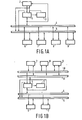
- FIG. 1A shows a block diagram of a first embodiment of a data processing system using a single Memory Access Controller (hereafter to be called MAC) according to the invention.
- the MAC(1) is placed between the processor (2) and the memory device which in this embodiment is formed by a cache memory (3) and two memory modules 6 and 7.
- the cache memory is directly connected to the MAC.
- the memory modules are connected to the processor and the MAC via a data bus (4) and an address bus (5), to which also I/O modules 8, 9 are connected.
- the MAC handles all the processor requests to memory device and completely controls the cache memory. This is a fairly straightforward solution, as all the DMA (Direct Memary Access) requests to the I/O modules use real addresses. While this is fairly straightforward for the hardware, the software has to arrange that blocks which have to be DMA'd into memory fit into consecutive real addresses, unless the DMA units can handle a scattered real memory.
- DMA Direct Memary Access
- FIG. 1B shows a block diagram of a second embodiment of a data processing system using a single MAC.
- the request to the I/O modules uses virtual addresses. This is much easier for the software to handle, but the address and data bus onto which the I/O modules hang are the address bus (10) and data bus (11) between the processor and the MAC. This is a favourable solution for a data processing system with limited modularity.
- FIG. 1C shows a block diagram of a third embodiment of a data processing system wherein several MAC's according to the invention are used.
- this third embodiment there are three units (A, B and C) each comprising a MAC (1-A, 1-B, 1-C), a cache memory (3-A, 3-B, 3-C) and a processor (2-A, 2-B, 2-C).
- Those three units are each connected to the data bus (4) and the address bus (5) of the data processing system.
- This embodiment will allow up to several MAC to work without seriously disturbing one another.
- processors each with their own MAC
- these processors could just as easily be I/O units with DMA properties.
- FIG. 1D shows a block diagram of a fourth embodiment of a data processing system wherein two MAC's according to the invention are used and wherein each unit (A, B) contains a local memory (12-A, 12- B ).
- Embodiments like this can be used if there is a way to partition the application. This can be done in many ways depending upon the complexity of the data processing system and the software.
- Some applications can be partitioned statically, e.g. a process control system where the task can be pre-assigned to a processor.
- the local memory can be used for code and to process specific data, e.g. stacks.
- the MAC provides facilities to page in and out of local memories. It monitors which page is where and interrupts when a processor requires access to a page which is marked as local and yet is not marked as being in that particular unit's local memory.
- FIG. 1E shows a block diagram of a fifth embodiment of a data processing system where two MAC's attached to one processor are used.
- the two MAC's (1-A and 1-B) are attached to the data bus 4 and the address bus 5.
- Each MAC has its own cache memory (3-A, 3-B).
- cache hit rate should be high enough (> 90%) and the descriptor cache hit rate should be better than 99.5%.
- the hit rate indicates how often a memory access is satisfied from the cache memory rather than the main memory (for example comprising the memory modules). The higher the hit rate, the closer the processor comes to ideal performance.
- FIG. 2 shows a detailed set up of how the MAC is implemented into a data processing system.
- a first group of connections of the MAC enables the interface between the microprocessor 2 and the MAC1.
- This first group of connections comprises a first address bus 32 which is connected to the MAC1, the microprocessor 2, the cache memory 3 and the address bus interface 38.
- This first address bus 32 enables the transport of the physical addres part for an address of a memory location to be accessed.
- Said first group also comprises a second address bus 35 connected between an address output of the microprocessor and an address input of the MAC.
- the second address bus applies virtual address parts generated by the microprocessor to the MAC.
- To the second address bus there is also connected a decoder 30 which decodes the presence of a virtual address on the second address bus and thereupon generates a chip-select (CS) signal which is applied to the CS input of the MAC.
- CS chip-select
- the first group of connections also comprises a first and a second connection line 39, respectively 40 connected between the microprocessor and the MAC.
- the first connection line 39 carries control signals such as for example a bus error signal, a halt signal or a data acknowledge out signal (DTACKOUT), which are generated by the MAC.
- the second connection line 40 carries further control signals which are generated by the microprocessor, such as for example a data strobe signal or a read/ write signal.
- the second connection line is further connected to the cache control 31. The function of those control signals will be disclosed with the description of the functional operation of the MAC.
- the first group further comprises a data bus 33 connected between the MAC, the cache memory, the microprocessor and a data bus interface 37.
- a second group of connections comes into play when a memory request can be satisfied from the cache memory 3.
- This second group comprises a cache address bus 36 connected between a cache address output of the MAC and an address input of the cache memory 3.
- This cache address bus transports the cache addresses generated by the MAC upon a received virtual address.
- a third connection line 34 is connected between the MAC and the cache control 31. Upon receiving, via said third connection line, a control signal such as for example a cache enable signal or a cache write enable signal, generated by the MAC, the cache control 31, which is connected to the cache memory 3, enables that cache memory for the requested access.
- a third group of connections comes into play when a memory request can not be satisfied from the cache memory.
- This third group comprises a second address bus 41, connected between an address output of the MAC for physical addresses and the address bus interface 38.
- This second address bus transports the physical address generated by the MAC upon a received virtual address. The physical address is then used to address a location in the memory module.
- This third group also comprises a fourth connection line 43 connected between a control output of the MAC and a memory module for transporting a master address strobe signal upon the generation of a physical address.
- the access to the memory module ends when it asserts a data acknowledge in signal (DTACKIN) to the MAC via a fifth control line 44.
- DTACKIN data acknowledge in signal
- the reception of such a DTACKIN signal causes the MAC to assert the DTACKOUT signal.
- a fourth group of connections comes into play in addition to delivering the requested data from the memory module.
- the MAC then fills a cache slot from the cache memory with blocks of data from the memory module, which required a series of read operations.
- the MAC sends a Physical Address Latch Enbale (PALE) signal and a Load Address Clear signal (LACLR) to the cache memory in order to clear a slot in the cache memory indicated by the physical, address generated by the MAC and thereafter load at that physical address the data originated from the memory module.
- PALE Physical Address Latch Enbale
- LACLR Load Address Clear signal
- FIG. 3 shows the architecture of a memory access controller according to the invention.
- the MAC contains three main substems, namely a cache controller 50, a translation look-aside buffer 51 and a microcontroller 52.
- the cache controller provides all the matching and control logic needed to communicate with the cache memory.
- the translation look-aside buffer is provided to translate a virtual address presented by the second address bus 35 into its physical counterpart in thelocal or main memory. These two sub-systems in particular help the overall system performance. They allow write operations to overlap with a subsequent read operation and permit memory management and cache operations to overlap a subsequent read operation and permit memory management and cache operations to overlap as well.
- the microcontroller subsystem performs several tasks, among them updating the translation look-aside buffer.
- the cache controller and the translation look-aside buffer are both connected to the second address bus 35 which carries the high order virtual addresses generated by the microprocessor.
- the microcontroller is connected to that second address bus 35, to the cache address bus 36 and to the address bus 41.
- the control signals DTACK and DS are applied via communication line 44 to the microcontroller.
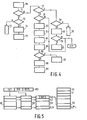
- the MAC When the MAC receives (70) a virtual address generated by the microprocessor, this virtual address is transmitted via the second address bus 35 in parallel to the cache controller 50 and to the translation look-aside buffer 51. Upon receiving a virtual address the cache controller will check (71) if this address is present in the cache memory. Therefore the supplied virtual address is inputted into a content addressable memory 53 which is part of the cache controller. (The operation of a content addressable memory is for example described in the French Patent Application No. 24 12 140)
- the content addressable memory contains the virtual addresses of all data stored in the cache memory. Thus by inputting a virtual address into the content addressable memory, there is checked whether or not the requested data is present in the cache memory. If the requested data is present in the cache memory (71Y) the protection logic 55 checks (72) if access to that data is permitted. That check is for example realized on the base of flag bits setted or forbidden address regions. If access is not permitted (N) a bus error signal is generated (73). If on the other hand access is permitted (Y) the random access memory 54 which is connected to the content addressable memory 53 completes the virtual address received in order to generate an address for addressing (74) via cache address bus 36 the cache memory.
- the cache controller then generates a DTACK out signal and the requested data is transferred (75) chanhecache memory to the microprocessor. If the cache memory does not contain the requested - data (71N) the translation look-aside buffer (TLB) is enabled (76Y). Sinultaneously on the checking realized by the cache controller the TLB checks (7) by means of his content addressable memory (56) if the requested data is present in the local memory. If the requested data is present (Y) then there is checked (78) if access to that memory location is permitted. If not (N) a bus error signal is generated 79. If the access is permitted (Y) , the page descriptor RAM (57) of the translation look-aside buffer translates (80) the received virtual address into a physical address. This physical address is then outputted after enable check (76Y) and transferred via the address bus 41 to the system memory in order to access (81) the requested data.
- TLB translation look-aside buffer
- the microcontroller of the MAC asserts (82) its halt signal and a bus error signal to acquire use of the system bus from the processor.
- the microcontroller of the MAC then translates (83) the received virtual address into a physical address and applies this physical address to the second address bus 41 upon receiving access from the microprocessor to that second bus.
- the microcontroller fetches (84) the necessary mapping information from the system memory and loads it into the translation look-aside buffer. With the mapping information on hand, the microcontroller gives up the bus to the microprocessor, which once more requests (85) the previous virtual address from the MAC.
- the translation look-aside buffer Again there is checked (86) by the translation look-aside buffer if the requested data is available and if virtual-to-physical address translation is possible. If the requested data is present (86Y) and translation is possible the requested data is transferred to the microprocessor 87. However it is possible that the requested data is not present and that no virtual-to-physical address translation is possible (86N) for exanple because the requested data is only on a disk. In that case an interrupt is sended (88) by the microcontroller to the microprocessor and the later is forced to enter the operating system's memory management routine. This routine transfers (89) the requested data from the disk into the RAM of microprocessor and, if necessary moves blocks of data from that RAM to the disk in order to make space.
- the need for a cache memory stems fran the fact that processors are inherently faster than memories, a mismatch that keeps a microprocessor from running as fast as it otherwise might.
- a designer can minimize the time a processor spends waiting and thus nudge it closer to its theoretical performance maximum.
- the microprocessor and the MAC together support a hierarchy of five levels of memory i.e.
- the registers on the MAC are used for five purposes:
- the MAC will issue a bus error signal (BERR) if any access to a register is made without using a supervisor function code.
- BERR bus error signal
- Registers on the MAC can be accessed by the microprocessor when the chip select (CS) input is active.
- the register addresses are then decoded from address signal supplied via the second address bus (35, Figure 2).
- the MAC comprises a variety of registers which will be given hereunder.
- registers define the hardware configuration of the system. Essentially they describe parameters such for example the cache size and page length.
- This register has a capacity for storingL8 bits. The first five bits of this register are used to indicate the page size of the pages stored in the main memory. One of the remaining bits is used to indicate that a check will be made on pages which are in a segment of the main memory which is marked as local to see if the page is in the required local memory.
- This register which is reset to zero on a MAC reset, defines the part of the address that selects a segment.
- the contents of the SSR is the encoded number of address bits, that are part of the segment number.
- This register specifies the cache memory organization.
- CMR Cache Mode Register
- This register is used in order to indicate the presence or absence of a cache memory.
- registers are used to divide the virtual address space into different regions.
- This register establishes which regions are active and defines the region attributes. When an access is attenpted to a region for which the enable bit is not set, a BERR will be generated.
- This register defines the boundaries of the regions in which the virtual address space is divided.
- registers contain pointers and length information to be used by the MAC, and define the location and length of the current segment table.
- registers contain the address of the segment tables currently valid. When it is loaded, all the mappings in the MAC in the relevant region are reset; i.e. the cache memory appears empty of all addresses in the region and all page descriptors in the MAC in the regions address space are invalidated.
- These registers contain the length (i.e. the number of segments) of the segment tables currently valid.
- This register contains the physical address of the MAC stack in memory.
- the pointer points to the beginning of the page containing the stack.
- the processor In a multi-processor system with local memory, the processor has to identify itself to the MAC so that the latter can check whether a local page is in the required local memory. This is done through the Processor Identification register.
- registers are used to set the interrupt vector so that the MAC can interrupt the processor. They are also used to provide information about the interrupt back to the processor.
- This memory element contains a copy of program and data which are in the memory. It is completely controlled by the MAC and is transparent to the software.
- the cache is a small, fast memory that allows the processor to see the cache access time instead of the usual system memory access time for 90% of its accesses and reduces the bus usage by 85%.
- the associated principle of the cache memory works because most words of local or main memory memory are accessed more than once within a relatively short time interval.
- the MAC automatically stores each word read by the processor in the cache memory and, if the processor tries to read that word a second time, the MAC provides the word from the cache memory instead of accessing the main memory.
- the MAC implements a write through policy i.e. the word is written into both the cache memory and the memory.
- a segment is marked as local then this refers to the local memory and not the main memory. If the bus is not available to the processor, the MAC allows the processor to proceed, and if the bus is granted before the next "cache miss" or before the next write, the processor need not be aware that there was a bus access latency time.
- Segments can be marked as non-cacheable.
- Associative caches are similar to tagged caches in that they have an identifier attached to each cache word. They differ from tagged caches in that the identifier is a content addressable memory (CAM) which holds the high order bits of the address.
- CAM content addressable memory
- Semi-associative caches are an attempt to temper the idea of an associative cache with a dose of reality. Basically a semi-associative cache adds one assunption to the idea of associative caches. The assumption is that there is a working set of memory locations which in fact is reasonably small and tends to cluster, on a medium time grain, around some points.
- a semi-associative cache In a semi-associative cache the cache itself is divided into a number of sub-caches. This number is called the set size. These sub- caches are defined by the high order address bits as shown by the following example:
- the label field defines a sub-address space of 2 words in length. Up to S, the set size, of these address spaces can be mapped into the S subdivisions of the cache memory simultaneously. Note that the mapping between one of these sub-address spaces and a sub-cache is not fixed but varies dynamically.
- Local memories can be attached to each processor in a multi- processor system.
- the MAC provides facilities to control the movement of code and data in and out these local memories. This feature is transparent to the user software.
- a demand paged virtual memory system can be implemented with one or more MAC's.
- the MAC makes a multiprocessor system practical by reducing bus utilization as a MAC can be attached to each processor.
- the MAC provides facilities for allowing DMA units to use either real or virtual addresses. In the latter case all control units which are virtual addresses mist be connected to a MAC.
- the MAC provides all the necessary memory access and control to allow true demand paged virtual memory systems to be built.
- This part of the memory requires a long access time and is provided in a well-known matter of a magnetic or optical disk.
- the disk constitutes the background memory of the system.
- the cache technique enployed by the MAC is called sector-associative.
- the main memory is partitioned into n equal- sized sectors, and the cache memory is partitioned into a number of sector-sized slots, for example 32 sector-sized slots.
- any main memory sector can occupy one of these 32 slots.
- the MAC employs a mapping procedure using a 32-position content- addressable memory (CAM) (101) to identify those sectors in the cache memory.
- CAM content- addressable memory
- the MAC Upon receiving (110) a virtual address (100), the MAC breaks (111) that virtual address into sector (SCT), block (BLC) and offset (OFFS) field.
- SCT sector
- BLC block
- ONS offset
- the MAC then verifies (112) if the sector field is present in one of the CAM's (101) positions. If that sector field is present (Y) then a cache hit occurs (113), if not a miss occurs (120). If that sector field is present, the MAC verifies (114) if the particular block within that sector is present. This verification is realized on the basis of the presence bit, and it is necessary because not every block in the sector is necessarily in the cache memory. If the requested block is present (Y), it is fetched (115) from the cache menory, if not (N) a block miss occurs (116). When a block miss has occurred, the MAC will access (117) the main memory in order to fetch the requested data block. The requested data block is then transferred (118) from the main memory to the microprocessor even as to the cache memory. After storage of that data block in the cache memory, the MAC sets (119) a presence bit in the presence bit memory (102).
- step 120 the MAC will then access (121) the main menory and transfer (122) the requested sector to the processor and the cache memory. Thereafter the sector address is loaded (123) in the CAM.
- sector associative cache memory used with the MAC is that due to the check as well on sector basis as on block basis, the cache memory is only accessed when the MAC has established the presence of the requested data in the cache memory. It is thus not necessary to access the cache to check whether the requested data is present, this is done by the MAC and thus access time is saved.
- the MAC Besides its ability of controlling a cache memory, the MAC also acts as a memory management unit and offers a large, linear virtual-address space. There are three methods of subdividing the virtual memory space managed by the MAC, i.e.
- the first method (segmentation) is illustrated in Figure 7(a).
- This first method divides the virtual-address space (100) into segments that are continuous in memory and allocated in multiples of a page size.
- a virtual address is then composed of a segment number (SN), a page number (PN) and an offset (OFFS).
- SN segment number
- PN page number
- OFFS offset
- the MAC is always provided with a segment table pointer register wherein descriptors of the most recently accessed pages are stored. Those descriptors contain inter alia the segment table pointer (STP), the page or segment-page length even as some other status information such as for example its associated subdivisions, access rights, its ability to be cached, whether it has been written to since cache, and other information.
- STP segment table pointer
- the segment table pointer register is loaded upon reception of the CS signal by the MAC.
- the segment table pointer register is used when no descriptor for the received virtual address is present in the MAC.
- the segment table pointer STP then indicates the segment table (ST) of the main memory.
- the physical address which has to be generated in order to access a location in the main memory is then generated as given hereunder.
- the segment number (SN) of the virtual address indicates a location in the segment table (ST) pointed by the segment table pointer (STP).
- STP segment table pointer
- the segment table there is stored the segment number (SN) and page number (PN) which each form a part of the physical address (105).
- the segment length which is present in the descriptor stored in the segment table pointer register is compared with the offset (OFFS) of the virtual address in order to check if segment length does not exceed the local memory capacity.
- segment length is compatible with the local memory, the offset is added to the segment basis (SN + PN) and the physical address is herewith generated.
- the second method called paging, is illustrated in Figure 7(b).
- the virtual address space (100) is divided into pages of fixed sizes, with each page configured to be for example 1, 2, 4 or 8 k byts long.
- the virtual address comprises a page number PN and an offset (OFFS).
- the MAC now comprises a page table pointer register wherein the stored page descriptors (PTP) are used to indicate the page table (PT) of the main memory.
- PTP stored page descriptors
- the page table can be seen as a translation table which translates a stored page number indicated by the page number (PN) of the virtual address into a page basis (PB).
- PN page number
- PB page basis
- the physical address 105 is then generated by adding the offset (OFFS) to the page basis.
- FIG. 7(b) there is also illustrated a second-level page table (SPT).
- SPT second-level page table
- This implementation offers a greater flexibility for forming the physical address.
- the advantage of paging is that the pages have a fixed length which implies that when a page is removed and replaced by another one, the accessible memory space will again be completely occupied.
- the third method called segmentation with paging, is illustrated in Figure 7 (c).
- the virtual address space (100) is divided into segments, but unlike the first method, the segments are not contiguous. Instead the pages can be scattered throughout the memory.
- the descriptor indicates the segment table (ST) of the main memory, while the segment number (SN) of the virtual address indicates a location in that segment table. At this location there is an indication to the page table (PT) wherein a location is indicated by the page number (PN) of the virtual address.
- the physical address is then generated by adding the offset to the page basis as given by the page table.
- the MC can partition a processor's virtual address space into four different regions.
- the four regions are defined sequentially starting from the bottom end of the virtual address space.
- the upper limit of each region is specified in turn. This inplicilty defines the lower limit of the next region. Thus if only one region is to be specified, then its upper limit is given as FFFFFFF.
- the four regions are all equivalent.
- the MAC determines the region number from the most significant bits of the applied virtual address.
- the MAC is provided with four register pairs, each pair consisting of a segment table pointer register (STPR) and a segment table length register (STLR).
- STPR segment table pointer register
- STLR segment table length register
- Each region also has an associated segment table or first level page table (see Figure 7(c)).
- the segment table defines which areas of the virtual address space are accessible to the current process.
- the definition of a current region is achieved by re-setting these registers on the MAC. If a reference is made to a region whose enable bit is reset, a bus error signal (BERR) is generated. Region definition and enabling is done via a set of dedicated registers. This offers the possibility of programming the length of the regions. The system designer may use only one or as many pieces as desired over a maximum of four regions. For example, a two-region system might have 12 pieces in region 0 and 20 pieces in region 1.
- BERR bus error signal
- a sinple system is defined as having only one region which is accessible by all function codes. Thus protection is performed by the protection bits associated with each segment. This system is configured by writing FFFFFFFF into all Region Definition Registers, thus defining the upper boundery of RO to be FFFFFFFF and the lower boundary of RO to be 00000000.
- the system memory comprises four different areas i.e. an operating system area (OS), a system library area (SL), an area for the code and data for a process A (A) and an area for the code and data for a process B (B).
- OS operating system area
- SL system library area
- A code and data
- B area for the code and data for a process B
- PRC A process A
- PRC B process B
- Region RO is used only by the privileged part of the operating system OS and contains the part of the kernel which is privileged. Thus, all segments in this region are marked with an indication that supervisor permission is needed to access them. This part of the operating system should be as small as possible, as it has access to all of memory.
- the next region, R1 is used by the supervisor. This is the part of the operating system that provides the non-privileged functions. This code is nevertheless "trusted code" and can have access to resources that are not available to user programs. While running user code this region is normally disabled.
- R2 is used as a system library (SL), available to all processes and always enabled.
- the last region, R3, is the user region.
- This region contains the process specific code and data (PRC+D).
- PRC+D process specific code and data
- the MAC is quite flexible in the range of virtual memory systems that it can support. Some systems may have a large number of large sized segment and page tables. In such systems the tables for user (task) regions may reside in virtual memory, in which case address translation for the table pointers needs to be done in order to access those tables. All table pointers should belong to a region where the translation tables themselves are in main memory. This is necessary because otherwise these tables could not be accessed and no address translation could be done.
- the MAC uses the registers to search the main memory descriptor tables.
- the MAC When regions are used, the MAC first determines the region number on the basis of the received virtual address and then accesses the segment table pointer register of that region's associated segment table. In case of a paged segment ( Figure 7(c)), the region's segment table length register determines the size of the segment. Then, using the segment field number from the virtual address as an index, the MAC accesses the segment table that is referenced by the segment table pointer register. In turn, the accessed segment descriptor contains the associated page table pointer and page length. The MAC then uses the page number field of the virtual address as an index into the page table to find the physical page basis address. It computs the physical address by linking the physical page frame address with the offset field of the virtual address.
- the MAC uses a memory which can be divided into regions and which regions can be divided into variable length segments. Those segments in turn are divided into fixed length pages. This division now enables to provide protection on segment basis; which protection has the following attributes:
- Each segment has associated with it a software protection bit. If the software protected bit is set, the BERR will be asserted when the segment is first executed. Thus it is simple to add a domain field to a segment descriptor to ensure that certain subroutines can only be called through access gates which provide additional access permission checks. Alternatively, the entries in a process's segment table can be used to restrict its address space to those entities for which is legitimately needs access.
- the MAC supports three additional attributes which are used to control the memory hierarchy. These attributes are:
- this attribute is used to force the associated page into the memory local to the processor and save bus accesses.
- This attribute if set indicates a segment that has no page table associated with it. Such segments are to be loaded and relocated in memory as a whole.
- the MAC is also provided for enabling protection at region level.
- Figure 9 shows an example of the format of a 32-bits segment descriptors in the Segment Table for a paged (non-contiguous) segment.
- Figure 10 shows an example of the format of the contiguous segments' descriptors.
- the Segment table consists of three fields viz:
- This field contains the pointer to the page table which defines the current segment. Page tables mist be aligned on long- word boundaries in memory.
- This field contains the length of the segment in pages.
- This field contains the bits which define the status of the segment. These fields comprise for example 9 bits which have the following signification:
- the three access permission bits allow the access mode if set. These bits are:
- This bit is used to indicate whether the segment is valid or not.
- this bit is set, a trap will be generated the first time the associated segment is accessed. Subsequent accesses to the segment may or may not generate a trap.
- the trap handling software should either reset this bit after the first interrupt, or should be capable of handling multiple traps. This bit is meant to provide a software filter for entry into segments.
- the final three bits define how the segment can be mapped. These are:
- the associated segment comprises semaphores or could be used by two processors or I/O units concurrently it should be so marked.
- This bit indicates that the segment has no page table. It is a segment-anly and should be mapped into memory as a whole.
- the MAC also enables protection at the level of the page table.
- Figure 11 shows an example of the format of a 32-bits page descriptor in the Page Table memory.
- the page table is split into two fields which are always used by the hardware. They contain:
- the MAC clearly allow multiple page faults while fielding a cache fault, i.e. if the MAC needs a descriptor and finds that the descriptor itself is not present in the physical memory then it will generate a BERR giving the address of the descriptor as well as the cause of the access fault.
- the only tables that need to be always present in the physical memory are those of the interrupt handling routines and the memory management routines (i.e. the tables containing pointers to the segment and page tables).
- a page fault does not indicate any error condition; rather it indicates that an action is needed. However, a page error indicates that an error has occurred; either an access was made to a segment for which the requisite permissicns were not held or that an access was made to an invalid segment.
- the MAC provides mechanisms for implementing systems with varying degrees of Protection.
- the simplest protected system would only separate user code form OS code.
- Protection is basically provided by only giving a process access to the resources it neeas. These resources include memory and I/O. Access to I/O is acccnplished by giving a process access to the necessary I/O management routines. This access can be execute-only and the entrance to these routines can be controlled via hardware in the normal manner or by putting a software "gateway" as the access point. This gateway is essentially an execute-only segment which can be marked so as to cause a trap when entered. Thus, a trusted program can be used to do the I/O access or to provide extra entry points to the calling program. For example, if a file is opened then this technique can add segments to the calling process's virtual address space, where each segment performs an I/O function. The process will only have access to these routines.
- this process will only be effective if a process is for bidden to access its segment descriptors. This is achieved by not putting the segment tables belonging to a process in a segment directly accessible to the process. Naturally this segment is accessible to the operating system and the MAC.
- Sharing of code and data can be accomplished by merely putting a segment descriptor pointing to the same page table in more than one process's segment table. Note that these segments can have different virtual addresses for the different processes. Message passing can then be easily and efficiently implemented by asking the operating system to "add" a descriptor to another process's address space.
- the MAC can be used as a MMU (Memory Management Unit) either with or without using the cache controller function.
- MMU Memory Management Unit
- the MAC comprises a cache controller and a translation look-aside buffer (Figure 3).
- the cache controller manages a semi-associative cache. It has a working set of for example 32 subcaches. These subcaches are defined not only by the address, but also implicitly by the address space.
- the MC recognizes four address spaces defined by the four regions. The distinction between the regions, in the cache controller, is made purely to allow the cache entries belonging to the separate address spaces to be invalidated for a region as a whole. If a systems dynamic working set is favourable, this will allow interrupt service routines, for instance, to remain in the cache while the processor continues a process or even changes processes.
- the cache On the reset, the cache is marked as empty and all 32 sub- caches are available to all four regions. All sub-caches which are in use by a region are automatically marked as empty whenever that region's Segment Table Pointer Register (STPR) is loaded.
- STPR Segment Table Pointer Register
- a word can only get into the cache if it has satisfied the criteria of the segment descriptor. Thus, when a word is read and it is found in the cache, it is valid if the processor has the necessary permissions. A copy of the segment permission rights is kept with the associated subcache. If a write is performed, then this is only written into the cache if the processor has write permission. The dirty bit in the MMU section of the MAC and the page table is updated.
- the information is written to the memory. Only when a subcache is already allocated for this data, is the information also written to the cache memory. If the width of the data to be written is the same as the cache width, then the relevant block presence bit is marked as valid. If the width of the write datum is not the same as the cache block width, then the presence bit is left unchanged.
- the MAC On a write the MAC will strobe the address and data into latches and start a memory write cycle. Before doing so it will check if it has the required descriptor; if not it will fetch it from memory. If it is not already set, the MAC will also set the dirty bit in both the page table in memory and the page descriptor cache on the MAC. Then it will allow the processor to proceed the asserting the DTACK signal to the processor while the memory transfer is taking place. The processar will be allowed to proceed unless it requests another memory transfer (either a cache read-miss or a write) before the first write is complete.
- another memory transfer either a cache read-miss or a write
- the cache can then vary from a minimum of 2 K bytes, 1 K blocks of 2 bytes, to 64 K bytes, 4 K blocks of 16 bytes.
- a cache of 1024 blocks of 4 words i.e. 1 K x 64
- the processor seeing a cache access time for at least 95% of the memory accesses. For example, if a cache hit or an overlapped write occur fast enough not to cause any wait states in the processor and a memory access results in 4 wait states then the average number of wait states per memory access is 0.2.
- the translation look-aside buffer performs paging control between three levels of memory. These three levels are:
- the MAC is capable of providing signals to the processor if the segment is marked as belonging to local memory. A page fault trap will be generated if the accessed page is not present in the local memory.
- the MAC can not only control paging between the system memory and the background memory but also between local memories and the system memory or background memory.
- the translation look-aside buffer (TLB) of the MAC contains descriptors for pages, for example 32, which are loaded on demand by the MAC. As in the cache, each page is identified only by its logical address.
- the TLB contains four register triplets. These consists of a Region Definition Register (RDR), a Segment Table Pointer Register (STPR) and a Segment Table Length Register (STLR). Each of these triplets define the current context of their respective regions.
- RDR Region Definition Register
- STPR Segment Table Pointer Register
- STLR Segment Table Length Register
- the page descriptors are in a fully associative descriptor cache on the MAC.
- Each descriptor consists of the following fields:
- the TLB is accessed to find its physical address. If the relevant page descriptor is not in the TLB then the MAC will use the region STPR to find it. This will be used together with the length established in the STLR register. Only if the page is not present in memory will a page fault be generated by asserting BERR.
- the MAC checks to see whether the segment number is valid, i.e. it is less than the length set in the register for the address space, relative to the lower region boundary. It also checks to see that the page number is not greater than the maximum page number in the segment descriptor. If either of these conditions is violated than a fault notification is generated. If the segment is marked as local and this check is enabled, then the page descriptor will be checked to see if the page is in the requesting processor's local memory.
- the used bit is not set in the page descriptor in memory, then it is set by the MAC.
- the BERR is set. The offending address and the reason are stored on the MAC stack in memory.
- the MSPR register on the MAC stores the physical address of the page frame in memory containing the stack. This stack is used in the following way:
- the 512 byte stack is divided in 8 sections which are indexed by the function code signals. Index 000 indicates the section for the processor, the remaining seven sections are for I/O devices.
- the processor section is used to store the faulting address and the error cause in case of an error or page fault on an attempted memory access by the processor.
- This section also contains the virtual and real addresses used in the address translation command.
- the other seven sectiohs are each divided into 8 blocks.
- Each of those (8 byte) blocks can contain an error report consisting of the faulting address plus a description of the problem.
- a "written" bit in each of those blocks is set whenever the MAC writes an error report in that block. This bit then indicates that the block contains an error report to be serviced by the processor and it can be reset by the processor only after it has handled the error.
- the MAC will write an error report in a block only when the "written" bit is not set.
- An extension of the capacity for computing the physical addresses for the processes in main memory is the MAC's ability to use virtual addresses for I/O operations, creating a "virtual" I/O. This ability is particularly important for paged virtual memory, where logically contiguous pages may not occur in consecutive locations. Without virtual I/O, disk operations, for one thing, would require complicated computations in software to read and write data that is across scattered pages. However, the controller solves this-problem by allowing a DMA controller (for example, the disk controller) to use virtual memory.
- a DMA controller for example, the disk controller
- the I/O unit indicates with a function code bit that is performing an I/O rather than a processor memory reference.
- That function code bit indicates that an address is an I/O reference, all protection checking is suspended and the remaining function code bits indicate which particular I/O controller is involved. This indication is necessary, since the controller nust report any errors caused by illegal accesses by an I/O unit, and those remaining function code bits identify the offending unit.
- a single error register in the MAC is not enough. Instead, a communication area in main memory, indexed by the I/O address, is dedicated to writing I/O error messages (the portion of memory indexed by device 0 is reserved for the processor).
- the controller When an error occurs, the controller writes an error message into the appropriate memory area. There the most significant bit of an error message field indicates whether a valid error messages exists. The field also indicates the memory region and address at which the error occurred, as well as an error message number to identify the cause. Also, the MAC aborts the transfer with a BERR signal to the peripheral.
- an I/O controller When an I/O controller receives the abort, it interrupts the processor, which in turn executes an interrupt service routine to identify the failure. This routine determines the I/O unit number and uses it as an index into the memory's communication area. There the routine searches for all valid error messages, processes them, and resets the most significant error bit.
- An important benefit of the controller is to lighten the load on the system bus, thus freeing it so that more processors can be added.
- a typical program will, on the average, read on 85% of its memory accesses and write on 15%. Since about 90% of the read accesses will be satisfied by the cache memory, the system bus is lightly loaded.
- a designer can add a few processors without significantly reducing performance. Still, with ordinary rremary controllers, a processor must wait if it tries to access a bus that is occupied. With the controller chip, however, this is not a common occurrence, since it overlaps write operations with any read operations that are resolved by the cache memory.
- Multiprocessing makes demands on software as well as hardware, and here, too, the controller distinguishes itself by letting the designer mark pages or segments of the main memory as non-cacheable. This capability is necessary when access to sections of software nust be limited to one processor at a time. When the controller encounters such a page or segment, it places the page or segment mapping information in its translation look-aside buffer, but it never places the page or segment in cache. Thus it prevents access by more than one processor at a time.
- the MAC offers a similar solution for acquiring semaphores - locations used to restrict access to a section of code to one processor at a time. Say a processor has a semaphore in its cache. If another processor attempts a semaphore action on the same semaphore, the semaphore values seen by both processors could be different. Ultimately this might result in a software crash.
- the MAC solves this problem by marking the semaphore itself as uncacheable.
- the technique that marks a segment or page as uncacheable is also useful for I/O operations.
- UART Universal Asynchronous Receiver-Transmitter
- the data will wind up in the cache as well as in the main memory.
- the processor attempts to read successive characters, it will get stale data from the cache rather than updated characters from the UART. It is necessary therefore that all data areas for devices that can change state autonomously - I/O devices and coprocessors, for example - be marked as non-cacheable.
- the MAC permits a powerful multiprocessing scheme that adds a relatively small local memory to each processor.
- the controller will check to see if that page is in a local memory and specifically within the local memory of the requesting processor. If the page is in local memory, the access takes place unhindered. If it is not. however, the controller sends a Bus Error signal to the processor, which then loads the local memory with the requested data. This is analogous to paging data from the disk to RAM, and it occurs unseen by the programmer.
Landscapes
- Engineering & Computer Science (AREA)
- Theoretical Computer Science (AREA)
- Physics & Mathematics (AREA)
- General Engineering & Computer Science (AREA)
- General Physics & Mathematics (AREA)
- Memory System Of A Hierarchy Structure (AREA)
- Debugging And Monitoring (AREA)
- Communication Control (AREA)
Applications Claiming Priority (2)
| Application Number | Priority Date | Filing Date | Title |
|---|---|---|---|
| US06/581,388 US4669043A (en) | 1984-02-17 | 1984-02-17 | Memory access controller |
| US581388 | 1984-02-17 |
Publications (3)
| Publication Number | Publication Date |
|---|---|
| EP0153779A2 true EP0153779A2 (fr) | 1985-09-04 |
| EP0153779A3 EP0153779A3 (en) | 1989-08-30 |
| EP0153779B1 EP0153779B1 (fr) | 1994-12-14 |
Family
ID=24325012
Family Applications (1)
| Application Number | Title | Priority Date | Filing Date |
|---|---|---|---|
| EP85200177A Expired - Lifetime EP0153779B1 (fr) | 1984-02-17 | 1985-02-12 | Système de traitement de données muni d'un dispositif de commande d'accès en mémoire |
Country Status (5)
| Country | Link |
|---|---|
| US (1) | US4669043A (fr) |
| EP (1) | EP0153779B1 (fr) |
| JP (1) | JPS60221851A (fr) |
| CA (1) | CA1232970A (fr) |
| DE (1) | DE3587960T2 (fr) |
Cited By (1)
| Publication number | Priority date | Publication date | Assignee | Title |
|---|---|---|---|---|
| EP0408058A3 (en) * | 1989-07-13 | 1992-09-02 | Kabushiki Kaisha Toshiba | Microprocessor |
Families Citing this family (141)
| Publication number | Priority date | Publication date | Assignee | Title |
|---|---|---|---|---|
| NL8400186A (nl) * | 1984-01-20 | 1985-08-16 | Philips Nv | Processorsysteem bevattende een aantal stations verbonden door een kommunikatienetwerk, alsmede station voor gebruik in zo een processorsysteem. |
| US5255369A (en) * | 1984-03-10 | 1993-10-19 | Encore Computer U.S., Inc. | Multiprocessor system with reflective memory data transfer device |
| GB2156554B (en) * | 1984-03-10 | 1987-07-29 | Rediffusion Simulation Ltd | Processing system with shared data |
| JPH0630075B2 (ja) * | 1984-08-31 | 1994-04-20 | 株式会社日立製作所 | キャッシュメモリを有するデータ処理装置 |
| US4884197A (en) * | 1985-02-22 | 1989-11-28 | Intergraph Corporation | Method and apparatus for addressing a cache memory |
| US4899275A (en) * | 1985-02-22 | 1990-02-06 | Intergraph Corporation | Cache-MMU system |
| US4860192A (en) * | 1985-02-22 | 1989-08-22 | Intergraph Corporation | Quadword boundary cache system |
| US5255384A (en) * | 1985-02-22 | 1993-10-19 | Intergraph Corporation | Memory address translation system having modifiable and non-modifiable translation mechanisms |
| US4933835A (en) * | 1985-02-22 | 1990-06-12 | Intergraph Corporation | Apparatus for maintaining consistency of a cache memory with a primary memory |
| US4972338A (en) * | 1985-06-13 | 1990-11-20 | Intel Corporation | Memory management for microprocessor system |
| US4868738A (en) * | 1985-08-15 | 1989-09-19 | Lanier Business Products, Inc. | Operating system independent virtual memory computer system |
| US4797853A (en) * | 1985-11-15 | 1989-01-10 | Unisys Corporation | Direct memory access controller for improved system security, memory to memory transfers, and interrupt processing |
| US4785398A (en) * | 1985-12-19 | 1988-11-15 | Honeywell Bull Inc. | Virtual cache system using page level number generating CAM to access other memories for processing requests relating to a page |
| US4758982A (en) * | 1986-01-08 | 1988-07-19 | Advanced Micro Devices, Inc. | Quasi content addressable memory |
| US4890223A (en) * | 1986-01-15 | 1989-12-26 | Motorola, Inc. | Paged memory management unit which evaluates access permissions when creating translator |
| US4755936A (en) * | 1986-01-29 | 1988-07-05 | Digital Equipment Corporation | Apparatus and method for providing a cache memory unit with a write operation utilizing two system clock cycles |
| JPS62194563A (ja) * | 1986-02-21 | 1987-08-27 | Hitachi Ltd | バツフア記憶装置 |
| JPS62206658A (ja) * | 1986-03-07 | 1987-09-11 | Hitachi Ltd | 記憶管理装置 |
| US4821185A (en) * | 1986-05-19 | 1989-04-11 | American Telephone And Telegraph Company | I/O interface system using plural buffers sized smaller than non-overlapping contiguous computer memory portions dedicated to each buffer |
| US4872111A (en) * | 1986-08-27 | 1989-10-03 | Amdahl Corporation | Monolithic semi-custom IC having standard LSI sections and coupling gate array sections |
| JPS6376034A (ja) * | 1986-09-19 | 1988-04-06 | Hitachi Ltd | 多重アドレス空間制御方式 |
| US5091846A (en) * | 1986-10-03 | 1992-02-25 | Intergraph Corporation | Cache providing caching/non-caching write-through and copyback modes for virtual addresses and including bus snooping to maintain coherency |
| US5123101A (en) * | 1986-11-12 | 1992-06-16 | Xerox Corporation | Multiple address space mapping technique for shared memory wherein a processor operates a fault handling routine upon a translator miss |
| US5045996A (en) * | 1986-11-12 | 1991-09-03 | Xerox Corporation | Multiprocessor cache memory housekeeping |
| JPS63163648A (ja) * | 1986-12-26 | 1988-07-07 | Hitachi Ltd | メモリ管理装置 |
| US4797806A (en) * | 1987-02-19 | 1989-01-10 | Gtx Corporation | High speed serial pixel neighborhood processor and method |
| US4831581A (en) * | 1987-02-24 | 1989-05-16 | Digital Equipment Corporation | Central processor unit for digital data processing system including cache management mechanism |
| US4849875A (en) * | 1987-03-03 | 1989-07-18 | Tandon Corporation | Computer address modification system with optional DMA paging |
| US4891752A (en) * | 1987-03-03 | 1990-01-02 | Tandon Corporation | Multimode expanded memory space addressing system using independently generated DMA channel selection and DMA page address signals |
| US5293597A (en) * | 1987-03-09 | 1994-03-08 | At&T Bell Laboratories | Concurrent context memory management unit |
| US4827406A (en) * | 1987-04-01 | 1989-05-02 | International Business Machines Corporation | Memory allocation for multiple processors |
| EP0288649B1 (fr) * | 1987-04-22 | 1992-10-21 | International Business Machines Corporation | Système de commande de mémoire |
| US5249276A (en) * | 1987-06-22 | 1993-09-28 | Hitachi, Ltd. | Address translation apparatus having a memory access privilege check capability data which uses mask data to select bit positions of priviledge |
| US4926317A (en) * | 1987-07-24 | 1990-05-15 | Convex Computer Corporation | Hierarchical memory system with logical cache, physical cache, and address translation unit for generating a sequence of physical addresses |
| US4959777A (en) * | 1987-07-27 | 1990-09-25 | Motorola Computer X | Write-shared cache circuit for multiprocessor system |
| US5101339A (en) * | 1987-08-10 | 1992-03-31 | Tandon Corporation | Computer address modification system using writable mapping and page stores |
| JPH02500224A (ja) * | 1987-08-10 | 1990-01-25 | タンドン コーポレーション | コンピュータ・アドレス変換装置を備えたコンピュータ・システム |
| US4954983A (en) * | 1987-10-13 | 1990-09-04 | Tektronix, Inc. | Data driver for multiple mode buffered processor-peripheral data transfer with selective return of data to processor |
| US5226147A (en) * | 1987-11-06 | 1993-07-06 | Mitsubishi Denki Kabushiki Kaisha | Semiconductor memory device for simple cache system |
| ATE109910T1 (de) * | 1988-01-20 | 1994-08-15 | Advanced Micro Devices Inc | Organisation eines integrierten cachespeichers zur flexiblen anwendung zur unterstützung von multiprozessor-operationen. |
| US5553262B1 (en) * | 1988-01-21 | 1999-07-06 | Mitsubishi Electric Corp | Memory apparatus and method capable of setting attribute of information to be cached |
| US4912630A (en) * | 1988-07-29 | 1990-03-27 | Ncr Corporation | Cache address comparator with sram having burst addressing control |
| US5142676A (en) * | 1988-12-28 | 1992-08-25 | Gte Laboratories Incorporated | Separate content addressable memories for storing locked segment addresses and locking processor identifications for controlling access to shared memory |
| US5063499A (en) * | 1989-01-09 | 1991-11-05 | Connectix, Inc. | Method for a correlating virtual memory systems by redirecting access for used stock instead of supervisor stock during normal supervisor mode processing |
| US5161219A (en) * | 1989-01-13 | 1992-11-03 | International Business Machines Corporation | Computer system with input/output cache |
| US5287482A (en) * | 1989-01-13 | 1994-02-15 | International Business Machines Corporation | Input/output cache |
| DE68923863T2 (de) * | 1989-01-13 | 1996-03-28 | Ibm | Ein-/Ausgabecachespeicherung. |
| JPH0680499B2 (ja) * | 1989-01-13 | 1994-10-12 | インターナショナル・ビジネス・マシーンズ・コーポレーション | マルチプロセッサ・システムのキャッシュ制御システムおよび方法 |
| JP3155537B2 (ja) * | 1989-01-23 | 2001-04-09 | 株式会社日立製作所 | 実記憶管理方法 |
| US5210847A (en) * | 1989-05-19 | 1993-05-11 | Compaq Computer Corporation | Noncacheable address random access memory |
| US5218677A (en) * | 1989-05-30 | 1993-06-08 | International Business Machines Corporation | Computer system high speed link method and means |
| GB9008145D0 (en) * | 1989-05-31 | 1990-06-06 | Ibm | Microcomputer system employing address offset mechanism to increase the supported cache memory capacity |
| US5233702A (en) * | 1989-08-07 | 1993-08-03 | International Business Machines Corporation | Cache miss facility with stored sequences for data fetching |
| JP2907451B2 (ja) * | 1989-08-31 | 1999-06-21 | キヤノン株式会社 | ダイレクトメモリアクセス方法および装置 |
| US5469556A (en) * | 1989-12-12 | 1995-11-21 | Harris Corporation | Resource access security system for controlling access to resources of a data processing system |
| JP2826857B2 (ja) | 1989-12-13 | 1998-11-18 | 株式会社日立製作所 | キャッシュ制御方法および制御装置 |
| US5123094A (en) * | 1990-01-26 | 1992-06-16 | Apple Computer, Inc. | Interprocessor communications includes second CPU designating memory locations assigned to first CPU and writing their addresses into registers |
| US6507909B1 (en) | 1990-02-13 | 2003-01-14 | Compaq Information Technologies Group, L.P. | Method for executing trusted-path commands |
| US5247648A (en) * | 1990-04-12 | 1993-09-21 | Sun Microsystems, Inc. | Maintaining data coherency between a central cache, an I/O cache and a memory |
| CA2045789A1 (fr) * | 1990-06-29 | 1991-12-30 | Richard Lee Sites | Instruction granulaire pour tampon de traduction de processeur a haute performance |
| JP2774862B2 (ja) * | 1990-07-16 | 1998-07-09 | 株式会社日立製作所 | Dma制御装置および情報処理装置 |
| JPH04233642A (ja) * | 1990-07-27 | 1992-08-21 | Dell Usa Corp | キャッシュアクセスと並列的にメモリアクセスを行なうプロセッサ及びそれに用いられる方法 |
| US5809309A (en) * | 1990-09-28 | 1998-09-15 | Texas Instruments Incorporated | Processing devices with look-ahead instruction systems and methods |
| US5163143A (en) * | 1990-11-03 | 1992-11-10 | Compaq Computer Corporation | Enhanced locked bus cycle control in a cache memory computer system |
| US5247642A (en) * | 1990-12-05 | 1993-09-21 | Ast Research, Inc. | Apparatus for determining cacheability of a memory address to provide zero wait state operation in a computer system |
| GB2251102B (en) * | 1990-12-21 | 1995-03-15 | Sun Microsystems Inc | Translation lookaside buffer |
| US5249283A (en) * | 1990-12-24 | 1993-09-28 | Ncr Corporation | Cache coherency method and apparatus for a multiple path interconnection network |
| US5283882A (en) * | 1991-02-22 | 1994-02-01 | Unisys Corporation | Data caching and address translation system with rapid turnover cycle |
| US5353429A (en) * | 1991-03-18 | 1994-10-04 | Apple Computer, Inc. | Cache memory systems that accesses main memory without wait states during cache misses, using a state machine and address latch in the memory controller |
| JP2778291B2 (ja) * | 1991-05-31 | 1998-07-23 | 日本電気株式会社 | アドレス変換レジスタ制御方式 |
| US5420993A (en) * | 1991-06-13 | 1995-05-30 | Unisys Corporation | Extended address translation system for pointer updating in paged memory systems |
| US5659797A (en) * | 1991-06-24 | 1997-08-19 | U.S. Philips Corporation | Sparc RISC based computer system including a single chip processor with memory management and DMA units coupled to a DRAM interface |
| GB9118312D0 (en) * | 1991-08-24 | 1991-10-09 | Motorola Inc | Real time cache implemented by dual purpose on-chip memory |
| US5895489A (en) * | 1991-10-16 | 1999-04-20 | Intel Corporation | Memory management system including an inclusion bit for maintaining cache coherency |
| US5509131A (en) * | 1991-10-22 | 1996-04-16 | Unisys Corporation | System for pointer updating across paged memory |
| US5627987A (en) * | 1991-11-29 | 1997-05-06 | Kabushiki Kaisha Toshiba | Memory management and protection system for virtual memory in computer system |
| US5875464A (en) * | 1991-12-10 | 1999-02-23 | International Business Machines Corporation | Computer system with private and shared partitions in cache |
| US5359721A (en) * | 1991-12-18 | 1994-10-25 | Sun Microsystems, Inc. | Non-supervisor mode cross address space dynamic linking |
| US5594927A (en) * | 1992-01-09 | 1997-01-14 | Digital Equipment Corporation | Apparatus and method for aligning data transferred via DMA using a barrel shifter and a buffer comprising of byte-wide, individually addressabe FIFO circuits |
| US5617554A (en) * | 1992-02-10 | 1997-04-01 | Intel Corporation | Physical address size selection and page size selection in an address translator |
| JP3219826B2 (ja) * | 1992-02-21 | 2001-10-15 | 日本電気株式会社 | 情報処理装置 |
| JPH07504527A (ja) * | 1992-03-09 | 1995-05-18 | オースペックス システムズ インコーポレイテッド | 高性能の不揮発性ram保護式の書き込みキャッシュアクセラレータシステム |
| US5428759A (en) * | 1992-03-30 | 1995-06-27 | Unisys Corporation | Associative memory system having segment and page descriptor content-addressable memories |
| US5809531A (en) * | 1992-09-21 | 1998-09-15 | Intel Corporation | Computer system for executing programs using an internal cache without accessing external RAM |
| US5566324A (en) * | 1992-12-24 | 1996-10-15 | Ncr Corporation | Computer apparatus including a main memory prefetch cache and method of operation thereof |
| CA2107056C (fr) * | 1993-01-08 | 1998-06-23 | James Allan Kahle | Methode et systeme pour accroitre la simultaneite de fonctionnement des memoires d'un ordinateur a processeurs multiples |
| EP0612013A1 (fr) * | 1993-01-21 | 1994-08-24 | Advanced Micro Devices, Inc. | Combinaison d'un tampon de pré-extraction et d'une antémémoire d'instructions |
| US5452440A (en) * | 1993-07-16 | 1995-09-19 | Zitel Corporation | Method and structure for evaluating and enhancing the performance of cache memory systems |
| JPH07168741A (ja) * | 1993-12-15 | 1995-07-04 | Toshiba Corp | ウォッチドッグタイマ装置 |
| US5550995A (en) * | 1994-01-03 | 1996-08-27 | Motorola, Inc. | Memory cache with automatic alliased entry invalidation and method of operation |
| US5535352A (en) * | 1994-03-24 | 1996-07-09 | Hewlett-Packard Company | Access hints for input/output address translation mechanisms |
| EP0674269B1 (fr) * | 1994-03-24 | 2001-12-19 | Hewlett-Packard Company, A Delaware Corporation | Mécanisme de traduction pour adresses d'entrées/sorties |
| US5636359A (en) * | 1994-06-20 | 1997-06-03 | International Business Machines Corporation | Performance enhancement system and method for a hierarchical data cache using a RAID parity scheme |
| US5960180A (en) * | 1994-09-07 | 1999-09-28 | Adaptec, Inc. | Host adapter integrated circuit having autoaccess pause |
| US5961582A (en) * | 1994-10-25 | 1999-10-05 | Acorn Technologies, Inc. | Distributed and portable execution environment |
| US5640526A (en) * | 1994-12-21 | 1997-06-17 | International Business Machines Corporation | Superscaler instruction pipeline having boundary indentification logic for variable length instructions |
| US5682527A (en) * | 1994-12-22 | 1997-10-28 | Unisys Corporation | Method and apparatus for block-level auditing and database recovery in a transaction processing system |
| EP0723230B1 (fr) * | 1995-01-23 | 2002-05-22 | Compaq Computer Corporation | Antémémoire distribuée pour système multiprocesseur à antémémoire |
| US5752275A (en) * | 1995-03-31 | 1998-05-12 | Intel Corporation | Translation look-aside buffer including a single page size translation unit |
| US5696932A (en) * | 1995-05-16 | 1997-12-09 | International Business Machines Corporation | Method and system for estimating minumun requirements on a cache in a computer based storage system |
| US5680578A (en) * | 1995-06-07 | 1997-10-21 | Advanced Micro Devices, Inc. | Microprocessor using an instruction field to specify expanded functionality and a computer system employing same |
| US5699543A (en) * | 1995-09-29 | 1997-12-16 | Intel Corporation | Profile guided TLB and cache optimization |
| US6378023B1 (en) | 1996-02-14 | 2002-04-23 | Advanced Micro Devices, Inc. | Interrupt descriptor cache for a microprocessor |
| US5926841A (en) * | 1996-03-13 | 1999-07-20 | Advanced Micro Devices, Inc. | Segment descriptor cache for a processor |
| US5864876A (en) * | 1997-01-06 | 1999-01-26 | Creative Technology Ltd. | DMA device with local page table |
| US5956754A (en) * | 1997-03-03 | 1999-09-21 | Data General Corporation | Dynamic shared user-mode mapping of shared memory |
| US6189074B1 (en) | 1997-03-19 | 2001-02-13 | Advanced Micro Devices, Inc. | Mechanism for storing system level attributes in a translation lookaside buffer |
| US6085296A (en) * | 1997-11-12 | 2000-07-04 | Digital Equipment Corporation | Sharing memory pages and page tables among computer processes |
| US6804766B1 (en) | 1997-11-12 | 2004-10-12 | Hewlett-Packard Development Company, L.P. | Method for managing pages of a designated memory object according to selected memory management policies |
| US6496916B1 (en) * | 1998-04-17 | 2002-12-17 | Agere Systems Inc. | System for flexible memory paging in partitioning memory |
| DE19835609C2 (de) * | 1998-08-06 | 2000-06-08 | Siemens Ag | Programmgesteuerte Einheit |
| US6446189B1 (en) | 1999-06-01 | 2002-09-03 | Advanced Micro Devices, Inc. | Computer system including a novel address translation mechanism |
| US6510508B1 (en) | 2000-06-15 | 2003-01-21 | Advanced Micro Devices, Inc. | Translation lookaside buffer flush filter |
| US6651132B1 (en) * | 2000-07-17 | 2003-11-18 | Microsoft Corporation | System and method for emulating the operation of a translation look-aside buffer |
| US6643759B2 (en) * | 2001-03-30 | 2003-11-04 | Mips Technologies, Inc. | Mechanism to extend computer memory protection schemes |
| US6665788B1 (en) | 2001-07-13 | 2003-12-16 | Advanced Micro Devices, Inc. | Reducing latency for a relocation cache lookup and address mapping in a distributed memory system |
| DE10335643B4 (de) * | 2003-08-04 | 2007-10-31 | Infineon Technologies Ag | Vorrichtung und Verfahren zum Steuern des Zugriffs von mehreren Datenverarbeitungseinrichtungen auf einen Speicher |
| DE102004045727B3 (de) * | 2004-09-21 | 2006-04-13 | Infineon Technologies Ag | System umfassend einen Mikrocontroller bzw. Mikroprozessor und eine Schnittstellen-Einrichtung, sowie Verfahren zum Betreiben eines derartigen Systems |
| US20060117156A1 (en) * | 2004-12-01 | 2006-06-01 | Chai Jesse C | Method and apparatus for dual protection of a protected memory block |
| US9710384B2 (en) * | 2008-01-04 | 2017-07-18 | Micron Technology, Inc. | Microprocessor architecture having alternative memory access paths |
| US8972958B1 (en) | 2012-10-23 | 2015-03-03 | Convey Computer | Multistage development workflow for generating a custom instruction set reconfigurable processor |
| US8677098B2 (en) | 2008-01-11 | 2014-03-18 | International Business Machines Corporation | Dynamic address translation with fetch protection |
| US8041923B2 (en) | 2008-01-11 | 2011-10-18 | International Business Machines Corporation | Load page table entry address instruction execution based on an address translation format control field |
| US8019964B2 (en) * | 2008-01-11 | 2011-09-13 | International Buisness Machines Corporation | Dynamic address translation with DAT protection |
| US8037278B2 (en) * | 2008-01-11 | 2011-10-11 | International Business Machines Corporation | Dynamic address translation with format control |
| US8041922B2 (en) * | 2008-01-11 | 2011-10-18 | International Business Machines Corporation | Enhanced dynamic address translation with load real address function |
| US8082405B2 (en) * | 2008-01-11 | 2011-12-20 | International Business Machines Corporation | Dynamic address translation with fetch protection |
| US8103851B2 (en) | 2008-01-11 | 2012-01-24 | International Business Machines Corporation | Dynamic address translation with translation table entry format control for indentifying format of the translation table entry |
| US8117417B2 (en) | 2008-01-11 | 2012-02-14 | International Business Machines Corporation | Dynamic address translation with change record override |
| US8095773B2 (en) | 2008-02-26 | 2012-01-10 | International Business Machines Corporation | Dynamic address translation with translation exception qualifier |
| US8621154B1 (en) | 2008-04-18 | 2013-12-31 | Netapp, Inc. | Flow based reply cache |
| US8161236B1 (en) | 2008-04-23 | 2012-04-17 | Netapp, Inc. | Persistent reply cache integrated with file system |
| US8171227B1 (en) | 2009-03-11 | 2012-05-01 | Netapp, Inc. | System and method for managing a flow based reply cache |
| US10430190B2 (en) | 2012-06-07 | 2019-10-01 | Micron Technology, Inc. | Systems and methods for selectively controlling multithreaded execution of executable code segments |
| JP6155723B2 (ja) * | 2013-03-18 | 2017-07-05 | 富士通株式会社 | レーダ装置及びプログラム |
| US10884945B2 (en) * | 2015-06-30 | 2021-01-05 | International Business Machines Corporation | Memory state indicator check operations |
| US10635307B2 (en) | 2015-06-30 | 2020-04-28 | International Business Machines Corporation | Memory state indicator |
| TW201933122A (zh) * | 2018-01-19 | 2019-08-16 | 晨星半導體股份有限公司 | 記憶體控制裝置及記憶體控制方法 |
| CN110134325A (zh) * | 2018-02-09 | 2019-08-16 | 晨星半导体股份有限公司 | 存储器控制装置及存储器控制方法 |
| US11947458B2 (en) * | 2018-07-27 | 2024-04-02 | Vmware, Inc. | Using cache coherent FPGAS to track dirty cache lines |
| US11853231B2 (en) | 2021-06-24 | 2023-12-26 | Ati Technologies Ulc | Transmission of address translation type packets |
Family Cites Families (12)
| Publication number | Priority date | Publication date | Assignee | Title |
|---|---|---|---|---|
| US3693165A (en) * | 1971-06-29 | 1972-09-19 | Ibm | Parallel addressing of a storage hierarchy in a data processing system using virtual addressing |
| US3848234A (en) * | 1973-04-04 | 1974-11-12 | Sperry Rand Corp | Multi-processor system with multiple cache memories |
| US4300192A (en) * | 1974-04-18 | 1981-11-10 | Honeywell Information Systems Inc. | Method and means for storing and accessing information in a shared access multiprogrammed data processing system |
| US4070706A (en) * | 1976-09-20 | 1978-01-24 | Sperry Rand Corporation | Parallel requestor priority determination and requestor address matching in a cache memory system |
| JPS5821352B2 (ja) * | 1979-09-17 | 1983-04-28 | 株式会社日立製作所 | バツフア・メモリ制御方式 |
| US4442484A (en) * | 1980-10-14 | 1984-04-10 | Intel Corporation | Microprocessor memory management and protection mechanism |
| JPS5786180A (en) * | 1980-11-17 | 1982-05-29 | Hitachi Ltd | Memory device having address converting mechanism |
| US4481573A (en) * | 1980-11-17 | 1984-11-06 | Hitachi, Ltd. | Shared virtual address translation unit for a multiprocessor system |
| JPS5858666A (ja) * | 1981-10-02 | 1983-04-07 | Hitachi Ltd | デ−タ処理装置 |
| US4410941A (en) * | 1980-12-29 | 1983-10-18 | Wang Laboratories, Inc. | Computer having an indexed local ram to store previously translated virtual addresses |
| US4476526A (en) * | 1981-11-27 | 1984-10-09 | Storage Technology Corporation | Cache buffered memory subsystem |
| JPS5898893A (ja) * | 1981-12-09 | 1983-06-11 | Toshiba Corp | 情報処理装置 |
-
1984
- 1984-02-17 US US06/581,388 patent/US4669043A/en not_active Expired - Lifetime
-
1985
- 1985-02-12 EP EP85200177A patent/EP0153779B1/fr not_active Expired - Lifetime
- 1985-02-12 DE DE3587960T patent/DE3587960T2/de not_active Expired - Fee Related
- 1985-02-14 CA CA000474308A patent/CA1232970A/fr not_active Expired
- 1985-02-16 JP JP60027579A patent/JPS60221851A/ja active Granted
Cited By (2)
| Publication number | Priority date | Publication date | Assignee | Title |
|---|---|---|---|---|
| EP0408058A3 (en) * | 1989-07-13 | 1992-09-02 | Kabushiki Kaisha Toshiba | Microprocessor |
| US5379394A (en) * | 1989-07-13 | 1995-01-03 | Kabushiki Kaisha Toshiba | Microprocessor with two groups of internal buses |
Also Published As
| Publication number | Publication date |
|---|---|
| EP0153779B1 (fr) | 1994-12-14 |
| JPS60221851A (ja) | 1985-11-06 |
| EP0153779A3 (en) | 1989-08-30 |
| JPH0531776B2 (fr) | 1993-05-13 |
| DE3587960T2 (de) | 1995-06-29 |
| DE3587960D1 (de) | 1995-01-26 |
| CA1232970A (fr) | 1988-02-16 |
| US4669043A (en) | 1987-05-26 |
Similar Documents
| Publication | Publication Date | Title |
|---|---|---|
| EP0153779A2 (fr) | Système de traitement de données muni d'un dispositif de commande d'accès en mémoire | |
| US5684993A (en) | Segregation of thread-specific information from shared task information | |
| US6430657B1 (en) | Computer system that provides atomicity by using a tlb to indicate whether an exportable instruction should be executed using cache coherency or by exporting the exportable instruction, and emulates instructions specifying a bus lock | |
| US4800489A (en) | Paged memory management unit capable of selectively supporting multiple address spaces | |
| US5123094A (en) | Interprocessor communications includes second CPU designating memory locations assigned to first CPU and writing their addresses into registers | |
| KR920005280B1 (ko) | 고속 캐쉬 시스템 | |
| JP3493409B2 (ja) | コンピユータ装置 | |
| EP0856798B1 (fr) | Système d'antémémoire | |
| US6189074B1 (en) | Mechanism for storing system level attributes in a translation lookaside buffer | |
| US5265227A (en) | Parallel protection checking in an address translation look-aside buffer | |
| US8417915B2 (en) | Alias management within a virtually indexed and physically tagged cache memory | |
| US4763250A (en) | Paged memory management unit having variable number of translation table levels | |
| JP4065660B2 (ja) | 機能が並列に分散された変換索引バッファ | |
| EP1471421A1 (fr) | Commandement pour instruction spéculatif de chargement | |
| US5418927A (en) | I/O cache controller containing a buffer memory partitioned into lines accessible by corresponding I/O devices and a directory to track the lines | |
| US20040117588A1 (en) | Access request for a data processing system having no system memory | |
| US5555395A (en) | System for memory table cache reloads in a reduced number of cycles using a memory controller to set status bits in the main memory table | |
| US20040117587A1 (en) | Hardware managed virtual-to-physical address translation mechanism | |
| US5715427A (en) | Semi-associative cache with MRU/LRU replacement | |
| EP0863464A1 (fr) | Mécanisme de cohérence d'antémémoire | |
| US20240070071A1 (en) | Context information translation cache | |
| US5293622A (en) | Computer system with input/output cache | |
| US20040117590A1 (en) | Aliasing support for a data processing system having no system memory | |
| US6766435B1 (en) | Processor with a general register set that includes address translation registers | |
| US12105634B2 (en) | Translation lookaside buffer entry allocation system and method |
Legal Events
| Date | Code | Title | Description |
|---|---|---|---|
| PUAI | Public reference made under article 153(3) epc to a published international application that has entered the european phase |
Free format text: ORIGINAL CODE: 0009012 |
|
| AK | Designated contracting states |
Designated state(s): DE FR GB IT |
|
| PUAL | Search report despatched |
Free format text: ORIGINAL CODE: 0009013 |
|
| AK | Designated contracting states |
Kind code of ref document: A3 Designated state(s): DE FR GB IT |
|
| 17P | Request for examination filed |
Effective date: 19900222 |
|
| 17Q | First examination report despatched |
Effective date: 19920219 |
|
| GRAA | (expected) grant |
Free format text: ORIGINAL CODE: 0009210 |
|
| AK | Designated contracting states |
Kind code of ref document: B1 Designated state(s): DE FR GB IT |
|
| REF | Corresponds to: |
Ref document number: 3587960 Country of ref document: DE Date of ref document: 19950126 |
|
| ITF | It: translation for a ep patent filed | ||
| ET | Fr: translation filed | ||
| ITPR | It: changes in ownership of a european patent |
Owner name: CAMBIO RAGIONE SOCIALE;PHILIPS ELECTRONICS N.V. |
|
| REG | Reference to a national code |
Ref country code: FR Ref legal event code: CD |
|
| PLBE | No opposition filed within time limit |
Free format text: ORIGINAL CODE: 0009261 |
|
| STAA | Information on the status of an ep patent application or granted ep patent |
Free format text: STATUS: NO OPPOSITION FILED WITHIN TIME LIMIT |
|
| 26N | No opposition filed | ||
| REG | Reference to a national code |
Ref country code: FR Ref legal event code: CD |
|
| REG | Reference to a national code |
Ref country code: GB Ref legal event code: IF02 |
|
| REG | Reference to a national code |
Ref country code: GB Ref legal event code: 746 Effective date: 20021014 |
|
| REG | Reference to a national code |
Ref country code: FR Ref legal event code: D6 |
|
| PGFP | Annual fee paid to national office [announced via postgrant information from national office to epo] |
Ref country code: FR Payment date: 20030224 Year of fee payment: 19 |
|
| PGFP | Annual fee paid to national office [announced via postgrant information from national office to epo] |
Ref country code: GB Payment date: 20030228 Year of fee payment: 19 |
|
| PGFP | Annual fee paid to national office [announced via postgrant information from national office to epo] |
Ref country code: DE Payment date: 20030416 Year of fee payment: 19 |
|
| PG25 | Lapsed in a contracting state [announced via postgrant information from national office to epo] |
Ref country code: GB Free format text: LAPSE BECAUSE OF NON-PAYMENT OF DUE FEES Effective date: 20040212 |
|
| PG25 | Lapsed in a contracting state [announced via postgrant information from national office to epo] |
Ref country code: DE Free format text: LAPSE BECAUSE OF NON-PAYMENT OF DUE FEES Effective date: 20040901 |
|
| GBPC | Gb: european patent ceased through non-payment of renewal fee |
Effective date: 20040212 |
|
| PG25 | Lapsed in a contracting state [announced via postgrant information from national office to epo] |
Ref country code: FR Free format text: LAPSE BECAUSE OF NON-PAYMENT OF DUE FEES Effective date: 20041029 |
|
| REG | Reference to a national code |
Ref country code: FR Ref legal event code: ST |