EP0162776A2 - Dérivés hétérocycliques, leurs procédés de préparation,médicaments les contenant, utiles notamment comme inhibiteurs de l'aldose réductase - Google Patents
Dérivés hétérocycliques, leurs procédés de préparation,médicaments les contenant, utiles notamment comme inhibiteurs de l'aldose réductase Download PDFInfo
- Publication number
- EP0162776A2 EP0162776A2 EP85400927A EP85400927A EP0162776A2 EP 0162776 A2 EP0162776 A2 EP 0162776A2 EP 85400927 A EP85400927 A EP 85400927A EP 85400927 A EP85400927 A EP 85400927A EP 0162776 A2 EP0162776 A2 EP 0162776A2
- Authority
- EP
- European Patent Office
- Prior art keywords
- benzothiazine
- ethyl acetate
- crystals
- chloro
- melting point
- Prior art date
- Legal status (The legal status is an assumption and is not a legal conclusion. Google has not performed a legal analysis and makes no representation as to the accuracy of the status listed.)
- Granted
Links
Classifications
-
- C—CHEMISTRY; METALLURGY
- C07—ORGANIC CHEMISTRY
- C07D—HETEROCYCLIC COMPOUNDS
- C07D213/00—Heterocyclic compounds containing six-membered rings, not condensed with other rings, with one nitrogen atom as the only ring hetero atom and three or more double bonds between ring members or between ring members and non-ring members
- C07D213/02—Heterocyclic compounds containing six-membered rings, not condensed with other rings, with one nitrogen atom as the only ring hetero atom and three or more double bonds between ring members or between ring members and non-ring members having three double bonds between ring members or between ring members and non-ring members
- C07D213/04—Heterocyclic compounds containing six-membered rings, not condensed with other rings, with one nitrogen atom as the only ring hetero atom and three or more double bonds between ring members or between ring members and non-ring members having three double bonds between ring members or between ring members and non-ring members having no bond between the ring nitrogen atom and a non-ring member or having only hydrogen or carbon atoms directly attached to the ring nitrogen atom
- C07D213/60—Heterocyclic compounds containing six-membered rings, not condensed with other rings, with one nitrogen atom as the only ring hetero atom and three or more double bonds between ring members or between ring members and non-ring members having three double bonds between ring members or between ring members and non-ring members having no bond between the ring nitrogen atom and a non-ring member or having only hydrogen or carbon atoms directly attached to the ring nitrogen atom with hetero atoms or with carbon atoms having three bonds to hetero atoms with at the most one bond to halogen, e.g. ester or nitrile radicals, directly attached to ring carbon atoms
- C07D213/62—Oxygen or sulfur atoms
- C07D213/70—Sulfur atoms
-
- A—HUMAN NECESSITIES
- A61—MEDICAL OR VETERINARY SCIENCE; HYGIENE
- A61P—SPECIFIC THERAPEUTIC ACTIVITY OF CHEMICAL COMPOUNDS OR MEDICINAL PREPARATIONS
- A61P27/00—Drugs for disorders of the senses
- A61P27/02—Ophthalmic agents
-
- A—HUMAN NECESSITIES
- A61—MEDICAL OR VETERINARY SCIENCE; HYGIENE
- A61P—SPECIFIC THERAPEUTIC ACTIVITY OF CHEMICAL COMPOUNDS OR MEDICINAL PREPARATIONS
- A61P27/00—Drugs for disorders of the senses
- A61P27/02—Ophthalmic agents
- A61P27/12—Ophthalmic agents for cataracts
-
- A—HUMAN NECESSITIES
- A61—MEDICAL OR VETERINARY SCIENCE; HYGIENE
- A61P—SPECIFIC THERAPEUTIC ACTIVITY OF CHEMICAL COMPOUNDS OR MEDICINAL PREPARATIONS
- A61P3/00—Drugs for disorders of the metabolism
- A61P3/08—Drugs for disorders of the metabolism for glucose homeostasis
-
- A—HUMAN NECESSITIES
- A61—MEDICAL OR VETERINARY SCIENCE; HYGIENE
- A61P—SPECIFIC THERAPEUTIC ACTIVITY OF CHEMICAL COMPOUNDS OR MEDICINAL PREPARATIONS
- A61P3/00—Drugs for disorders of the metabolism
- A61P3/08—Drugs for disorders of the metabolism for glucose homeostasis
- A61P3/10—Drugs for disorders of the metabolism for glucose homeostasis for hyperglycaemia, e.g. antidiabetics
-
- C—CHEMISTRY; METALLURGY
- C07—ORGANIC CHEMISTRY
- C07C—ACYCLIC OR CARBOCYCLIC COMPOUNDS
- C07C323/00—Thiols, sulfides, hydropolysulfides or polysulfides substituted by halogen, oxygen or nitrogen atoms, or by sulfur atoms not being part of thio groups
-
- C—CHEMISTRY; METALLURGY
- C07—ORGANIC CHEMISTRY
- C07D—HETEROCYCLIC COMPOUNDS
- C07D213/00—Heterocyclic compounds containing six-membered rings, not condensed with other rings, with one nitrogen atom as the only ring hetero atom and three or more double bonds between ring members or between ring members and non-ring members
- C07D213/02—Heterocyclic compounds containing six-membered rings, not condensed with other rings, with one nitrogen atom as the only ring hetero atom and three or more double bonds between ring members or between ring members and non-ring members having three double bonds between ring members or between ring members and non-ring members
- C07D213/04—Heterocyclic compounds containing six-membered rings, not condensed with other rings, with one nitrogen atom as the only ring hetero atom and three or more double bonds between ring members or between ring members and non-ring members having three double bonds between ring members or between ring members and non-ring members having no bond between the ring nitrogen atom and a non-ring member or having only hydrogen or carbon atoms directly attached to the ring nitrogen atom
- C07D213/60—Heterocyclic compounds containing six-membered rings, not condensed with other rings, with one nitrogen atom as the only ring hetero atom and three or more double bonds between ring members or between ring members and non-ring members having three double bonds between ring members or between ring members and non-ring members having no bond between the ring nitrogen atom and a non-ring member or having only hydrogen or carbon atoms directly attached to the ring nitrogen atom with hetero atoms or with carbon atoms having three bonds to hetero atoms with at the most one bond to halogen, e.g. ester or nitrile radicals, directly attached to ring carbon atoms
- C07D213/72—Nitrogen atoms
- C07D213/74—Amino or imino radicals substituted by hydrocarbon or substituted hydrocarbon radicals
-
- C—CHEMISTRY; METALLURGY
- C07—ORGANIC CHEMISTRY
- C07D—HETEROCYCLIC COMPOUNDS
- C07D215/00—Heterocyclic compounds containing quinoline or hydrogenated quinoline ring systems
- C07D215/02—Heterocyclic compounds containing quinoline or hydrogenated quinoline ring systems having no bond between the ring nitrogen atom and a non-ring member or having only hydrogen atoms or carbon atoms directly attached to the ring nitrogen atom
- C07D215/16—Heterocyclic compounds containing quinoline or hydrogenated quinoline ring systems having no bond between the ring nitrogen atom and a non-ring member or having only hydrogen atoms or carbon atoms directly attached to the ring nitrogen atom with hetero atoms or with carbon atoms having three bonds to hetero atoms with at the most one bond to halogen, e.g. ester or nitrile radicals, directly attached to ring carbon atoms
- C07D215/20—Oxygen atoms
- C07D215/22—Oxygen atoms attached in position 2 or 4
- C07D215/227—Oxygen atoms attached in position 2 or 4 only one oxygen atom which is attached in position 2
-
- C—CHEMISTRY; METALLURGY
- C07—ORGANIC CHEMISTRY
- C07D—HETEROCYCLIC COMPOUNDS
- C07D215/00—Heterocyclic compounds containing quinoline or hydrogenated quinoline ring systems
- C07D215/02—Heterocyclic compounds containing quinoline or hydrogenated quinoline ring systems having no bond between the ring nitrogen atom and a non-ring member or having only hydrogen atoms or carbon atoms directly attached to the ring nitrogen atom
- C07D215/16—Heterocyclic compounds containing quinoline or hydrogenated quinoline ring systems having no bond between the ring nitrogen atom and a non-ring member or having only hydrogen atoms or carbon atoms directly attached to the ring nitrogen atom with hetero atoms or with carbon atoms having three bonds to hetero atoms with at the most one bond to halogen, e.g. ester or nitrile radicals, directly attached to ring carbon atoms
- C07D215/36—Sulfur atoms
-
- C—CHEMISTRY; METALLURGY
- C07—ORGANIC CHEMISTRY
- C07D—HETEROCYCLIC COMPOUNDS
- C07D265/00—Heterocyclic compounds containing six-membered rings having one nitrogen atom and one oxygen atom as the only ring hetero atoms
- C07D265/28—1,4-Oxazines; Hydrogenated 1,4-oxazines
- C07D265/34—1,4-Oxazines; Hydrogenated 1,4-oxazines condensed with carbocyclic rings
- C07D265/36—1,4-Oxazines; Hydrogenated 1,4-oxazines condensed with carbocyclic rings condensed with one six-membered ring
-
- C—CHEMISTRY; METALLURGY
- C07—ORGANIC CHEMISTRY
- C07D—HETEROCYCLIC COMPOUNDS
- C07D279/00—Heterocyclic compounds containing six-membered rings having one nitrogen atom and one sulfur atom as the only ring hetero atoms
- C07D279/10—1,4-Thiazines; Hydrogenated 1,4-thiazines
- C07D279/14—1,4-Thiazines; Hydrogenated 1,4-thiazines condensed with carbocyclic rings or ring systems
- C07D279/16—1,4-Thiazines; Hydrogenated 1,4-thiazines condensed with carbocyclic rings or ring systems condensed with one six-membered ring
-
- C—CHEMISTRY; METALLURGY
- C07—ORGANIC CHEMISTRY
- C07D—HETEROCYCLIC COMPOUNDS
- C07D417/00—Heterocyclic compounds containing two or more hetero rings, at least one ring having nitrogen and sulfur atoms as the only ring hetero atoms, not provided for by group C07D415/00
- C07D417/02—Heterocyclic compounds containing two or more hetero rings, at least one ring having nitrogen and sulfur atoms as the only ring hetero atoms, not provided for by group C07D415/00 containing two hetero rings
- C07D417/04—Heterocyclic compounds containing two or more hetero rings, at least one ring having nitrogen and sulfur atoms as the only ring hetero atoms, not provided for by group C07D415/00 containing two hetero rings directly linked by a ring-member-to-ring-member bond
-
- C—CHEMISTRY; METALLURGY
- C07—ORGANIC CHEMISTRY
- C07D—HETEROCYCLIC COMPOUNDS
- C07D471/00—Heterocyclic compounds containing nitrogen atoms as the only ring hetero atoms in the condensed system, at least one ring being a six-membered ring with one nitrogen atom, not provided for by groups C07D451/00 - C07D463/00
- C07D471/02—Heterocyclic compounds containing nitrogen atoms as the only ring hetero atoms in the condensed system, at least one ring being a six-membered ring with one nitrogen atom, not provided for by groups C07D451/00 - C07D463/00 in which the condensed system contains two hetero rings
- C07D471/04—Ortho-condensed systems
-
- C—CHEMISTRY; METALLURGY
- C07—ORGANIC CHEMISTRY
- C07D—HETEROCYCLIC COMPOUNDS
- C07D513/00—Heterocyclic compounds containing in the condensed system at least one hetero ring having nitrogen and sulfur atoms as the only ring hetero atoms, not provided for in groups C07D463/00, C07D477/00 or C07D499/00 - C07D507/00
- C07D513/02—Heterocyclic compounds containing in the condensed system at least one hetero ring having nitrogen and sulfur atoms as the only ring hetero atoms, not provided for in groups C07D463/00, C07D477/00 or C07D499/00 - C07D507/00 in which the condensed system contains two hetero rings
- C07D513/04—Ortho-condensed systems
Definitions
- the present invention relates to heterocyclic derivatives of formula (I). It also relates to the processes for preparing said products and their therapeutic applications.
- the compounds of formula (I) according to the invention can be synthesized by hydrolysis in basic or acid medium of esters of formula (II): in LaqueLLe R 1 , R 2 , R 3 , R 4 , X, Y and Z are defined as above, R 'being a lower alkyl group.
- the basic agent can be Soda, Potash, sodium or potassium carbonate, sodium or potassium bicarbonate.
- the acid agent can be a usual acid such as hydrochloric acid.
- the saponification will be carried out in a hydroalcoholic or tetrahydrofuran-water or dioxam-water medium or a water-miscible solvent.
- the hydrolysis temperature will be between 25 and 100 ° C.
- a usual organic solvent such as dichloromethane, Chloroform, Benzene, Tol
- type of reaction such as dimethylformamide, for example:
- R 1 , R- 2 R 3 , R 4 , X and Y are defined as above.
- the derivatives of formula III are obtained by cyclization of the aminoesters or amino acids of formula IV: in which R 1 , R 2 , R 3 , R 4 , X and Y are defined as above, R "being hydrogen or a lower atkyl.
- R 1 , R 2 and X are defined as above; in Formula VI, R 3 and R 4 are defined as above, W represents a halogen, U represents OH, CR "or chlorine, R" being defined as above.
- R 1 , R 2 , R 3 and R 4 are defined as above, -T represents the chlorine or bromine atom.
- the compounds of formula IV are synthesized by hydrogenation of the nitro derivatives of formula VIII: in LaqueLLe R 1 , R 2 , R 3 , R 4 , X, Y and R "are defined as above
- R 1 , R 2 , X and Y are defined as above.
- compositions useful in particular for the treatment of peripheral disorders consecutive to diabetes are provided, characterized in that they contain, in association with a physiologically acceptable excipient, at least one compound of formula I or one of its non-toxic addition salts.
- the salification of the acid function can be carried out with a metal or an alkaline-earth metal, such as sodium or potassium, a base such as an amine such as dicycLohexyLamine, an amino alcohol-amino like aminoethanol or an amino acid like La Lysine.
- a metal or an alkaline-earth metal such as sodium or potassium
- a base such as an amine such as dicycLohexyLamine, an amino alcohol-amino like aminoethanol or an amino acid like La Lysine.
- salification can be done for example with an acid such as HCL, HBr or an organic acid usually used.
- Example 2 According to the procedure of Example 1, but using 25 g of 2,6-dichLoro 3-nitropyridine at 90% and 14 g of ethyl mercaptoacetate, 32.5 g of 6-chLoro 3-nitro 2 are obtained. - ethyl mercaptoacetate-pyridine in the form of a crude oil used for the subsequent step.
- Example 2 According to the procedure of Example 1, but starting from 73 g of 2,5-difluoronitrobenzene and 56 g of ethyl mercaptoacetate, after cristaLLisation of the residue in pentane, 75 g of 4-fluoro 2-nitrophenylthioacetate is obtained ethyl in the form of crystals with a melting point ⁇ 50 ° C.
- Example 2 According to the procedure of Example 1, but using 100 g of 2,3-dichloronitrobenzene and 63 g of ethyl mercaptoacetate, 22.5 g of 6-chloro 2-nitrophenylthioacetate are obtained after filtration through silica gel. ethyl in the form of a crude oil used for the next step.
- Example 2 According to the procedure of Example 1, but starting from 100 g of 2-chloro 5-methoxynitrobenzene and 68 g of ethyl mercaptoacetate, 55 g of 4-methoxy are obtained after crystallization of the residue in isopropyl ether. Ethyl 2-nitrophenylthioacetate in the form of crystals with a melting point of 75 ° C.
- Example 2 According to the procedure of Example 1, but from 50 g of 2,4-dichloro 5-trifluoromethylnitrobenzene and 23 g of ethyl mercaptoacetate, 56 g of 4-trifluoromethyl 5-chLoro 2-nitrophenylthioacetate are obtained. of ethyl in the form of crystals with a melting point of 85 ° C.
- Example 2 According to the procedure of Example 1, but using 100 g of 2,5-dichloronitrobenzene and 63 g of ethyl mercaptoacetate, 52 g of 4-chloro 2 are obtained after crystallization of the residue in a pentane-isopropyl ether mixture. -nitrophenylthioacetate in the form of crystals with a melting point of 52 ° C.
- Example 2 According to the procedure of Example 1, but using 38.4 g of 2,5-dichloronitrobenzene and 22 g of 2-mercaptopropionic acid, 32 g of 4-chtoro 2 is obtained after acidification with acetic acid. -nitrophényL ⁇ -methylacetic acid in the form of crystals of melting point 114 ° C.
- Example 2 According to the procedure of Example 1, but using 100 g of 2,4-dichloronitrobenzene and 55 g of 2-mercaptopropionic acid, after acidification with acetic acid and crystallization of the residue is obtained in an isopropyl ether mixture and pentane, 76 g of 5-chLoro 2-nitrophenylthio ⁇ -metbylacetic acid in the form of crystals with a melting point of 125 ° C.
- Example 19 According to the procedure of Example 19, but from 32 g of 4-chloro 2-nitrophenylthio ⁇ -methylacetic acid prepared in Example 14, 34 g of 4-chloro 2-nitrophényLthio ⁇ -methylacetate are obtained. ethyl in the form of a crude oil used for the next step.
- Example 19 According to the procedure of Example 19, but from 76 g 5-chloro-2-nitrophenylthio ⁇ -methylacetic acid prepared in Example 16, 72 g of ethyl 5-chloro 2-nitrophenyLthio ⁇ -methylacetate is obtained as a crude oil used for the next step.
- a solution of 49 g of ethyl 3-nitro 2-mercaptoacetate-pyridine prepared in Example 1 is hydrogenated at atmospheric pressure, in the presence of Raney nickel in 500 ml of methanol. After the absorption of the theoretical quantity of hydrogen, the catalyst is separated by filtration and the solution concentrated under vacuum, then the residue taken up in xylene is heated for 16 h at reflux. After cooling, then addition of hexane, the crystals formed are drained and then dried. 24 g of 1H-pyrido [2,3-b] [1,4] thiazine-2 (3H) -one are recovered in the form of crystals with melting point 207 ° C.
- Example 22 According to the procedure of Example 22, but starting from 30 g of 3-nitro 2-mercapto ⁇ -methylacetic acid-pyridine prepared in Example 3, 16 g of 3-methyl 1H-pyrido are recovered [2, 3-b] - [1,4] thiazine-2 (3H) -one in the form of crystals with a melting point of 178 ° C.
- Example 22 According to the procedure of Example 22, but from 33 g of ethyl 3-nitro 2-aminoacetate-pyridine, prepared in Example 4, 19 g of 1H-pyrido [2,3-b are obtained ] [1,4] pyrazine-2 (3H) -one in the form of crystals with a melting point of 278-282 ° C.
- Example 22 According to the procedure of Example 22, but from 29 g of 4-trifluoromethyl 2-nitrophenylacetate prepared in Example 5, 15 g of 6-trifluoromethyl 2H-1,4-benzothiazine-3 are recovered. (4H) -one in the form of crystals with a melting point of 190 ° C.
- Example 22 According to the procedure of Example 22, but starting from 90 g of 5-fluoro 2-nitrophenylthioacetate, prepared in Example 6, 45 g of 7-fluoro 2H-1,4-benzothiazine are obtained. 3 (4H) -one in the form of crystals with a melting point of 215 ° C.
- Example 28 According to the procedure of Example 28, but using 22.5 g of 6-chtoro 2-nitrophenylthioacetate, prepared in Example 8, 12 g of 8-chtoro 2H-1,4-benzothiazine are obtained -3 (4H) -one in the form of crystals with a melting point of 222 ° C.
- Example 28 According to the procedure of Example 28, but using 42 g of 5-chloro 2-nitrophenytthioacetate, prepared in Example 11, 23 g of 7-chloro 2H-1,4-Benzothiazine-3 are obtained. (4H) -one in the form of crystals with a melting point of 210 ° C.
- Example 28 According to the procedure of Example 28, but using 45 g of ethyl 4-methoxy 2-nitrophenyLthioacetate, prepared in Example 9, 27 g of 6-methoxy 2H-1,4-benzothiazine-3 are obtained. (4H) -one in the form of crystals with a melting point of 180-182 ° C.
- Example 28 According to the procedure of Example 28, but using 56 g of ethyl 4-trifluoromethyl 5-chloro 2-nitrophenyLthioacetate, prepared in Example 10, 30 g of 6-trifluoromethyl 7 are obtained after recrystallization from methanol -chloro 2H-1,4-benzothiazine-3 (4H) -one in the form of crystals with a melting point of 234-235 ° C.
- a solution of sodium ethylate is prepared by dissolving 4.6 g of sodium in 200 ml of absolute ethanol. To this solution, 25 g of orthoaminothiophenol are added dropwise then, at the end of the addition, the mixture is stirred for 10 min, it is cooled by an ice bath and then 24 ml of ethyl bromoacetate is added dropwise . After the end of the addition, the mixture is stirred for 3 h at room temperature and then the sodium bromide formed is filtered and the filtrate is concentrated in vacuo. The residue obtained crystallizes from Ether. The crystals drained and dried, 23 g of 2H-1,4-benzothiazazine-3 (4H) -one are obtained in the form of crystals with a melting point of 177 ° C.
- Example 34 According to the procedure of Example 34, but using 12.5 g of orthoaminothiophenol and 17 g of acid ⁇ -chlorophenylacetic, 9.7 g of 2-phenyL 2H-1,4-benzothiazine-3 ( 4H) -one in the form of crystals with a melting point of 194 ° C.
- Example 28 According to the procedure of Example 28, but using 52 g of ethyl 4-chloro 2-nitrophenylthioacetate, prepared in Example 12, 27.3 g of 6-chloro 2H-1,4-benzothiazine are obtained. -3 (4H) -one in the form of crystals with a melting point of 208 ° C.
- Example 28 According to the procedure of Example 28, but using 55 g of 4-fluoro 2-nitrophényLthio ⁇ -ethyl methyl acetate, prepared in Example 19, 31 g of 6 are obtained, after recrystallization from isopropanol. -fluoro 2-methyl 2H-1,4-benzothiazine-3 C4H) -one in the form of crystals with melting point 164 ° C.
- Example 28 According to the procedure of Example 28, but using 34 g of ethyl 4-chloro 2-nitrophenylthio a-methylacetate, prepared in Example 20, 19 g of 6-chloro 2-methyt 2H-1 are obtained. , 4-benzothiazine-3 (4H) -one in the form of crystals with a melting point of 188 ° C.
- Example 28 According to the procedure of Example 28, but using 11.5 g of ethyl 4-chloro 2-nitrophenyLthio "-phenylacetate, prepared in Example 15, 4 g of 6-chloro 2-phenyl 2H are obtained -1,4-Benzothiazine-3 (4H) -one in the form of crystals with a melting point of 216 ° C.
- Example 34 According to the procedure of Example 34, but from 90 g of orthaaminothiaphenot, 28.8 g of sodium hydroxide and 140.4 g of ethyl ⁇ -bromoisobutyrate, 112 g of 2.2 are obtained. -dimethyl 2H-1,4-benzothiazine-3 (4H) -one in the form of crystals with a melting point of 155 ° C.
- Example 34 According to the procedure of Example 34, but from 25 g of orthoaminothiophenol, 8 g of sodium hydroxide and 55 g of ethyl ⁇ -bromopara-chlorophenytacetate, 37.8 g of 2-parachLorophenyl are obtained 2H-1,4-Benzothiazine-3 (4H) -one in the form of crystals with a melting point of 198 ° C.
- Example 34 According to the procedure of Example 34, but from 25 g of orthoaminothiophenol, 8 g of sodium hydroxide and 55 g of ethyl ⁇ -bromoorthochlorophenyl acetate, 37 g of 2-orthochlorophenyl 2H-1 are obtained, 4-benzothiazine-3 (4H) -one in the form of crystals with a melting point of 200 ° C.
- Example 28 According to the procedure of Example 28, but from the mixture of 68 g of ethyl 4,5-dichLoro 2-nitrophényLthioacetate and of 2,5-dichloro 4-nitrophényLthioacetate, prepared in Example 17 , 4.5 g of 6,7-dichloro 2H-1,4-benzothiazine-3 (4H) -one are obtained in the form of crystals with a melting point of 251 ° -253 ° C.
- a solution of sodium ethylate is prepared by dissolving 4 g of sodium in 300 ml of absolute ethanol. To this solution, 21.5 g of orthoaminothiophenol are added dropwise then, after the end of the addition, the mixture is stirred for 10 min. The mixture is cooled in an ice bath, then 40 g of ethyl a-bromo a-methyl 2-pyridylacetate are added dropwise; after the end of the addition, the mixture is left to return to ambient temperature then the stirring is continued for 4 h and we let it rest overnight. The precipitate formed is drained, washed with water then with ethanot and dried. 25.3 g of 2-methyl 2-C2'-pyridyl) 2H-1,4-benzothiazine-3 (4H) -one are thus recovered in the form of crystals with a melting point of 217-219 ° G.
- Example 46 According to the procedure of Example 46, but from 142.7 g of N- (parachlorophenyl) ⁇ -chtoropropionamide, 66.4 g of 6-chLoro 3,4-dihydrocarbostyril is recovered in the form of point-point crystals melting 163-165 ° C after recrystallization from acetonitrile.
- Example 46 According to the procedure of Example 46, but starting from 90.4 g of N- (meta-fluorophenyL) ⁇ -chloropropionamide, 35.8 g of 7-fluoro 3,4-dihydrocarbostyril are obtained in the form of crystals of melting point 187-188 ° C after recrystallization from isopropanol.
- Example 46 According to the procedure of Example 46, but from 133.9 g of N- (meta-chlorophenyl) ⁇ -chloropropionamide, 56 g of 7-chloro 3,4-dihydrocarbostyril in the form of point point crystals are obtained. melting 160-165 ° C after recrystallization from acetonitrile.
- Example 34 According to the procedure of Example 34, but starting from 20.7 g of ortho-aminothiophenol, 6.7 g of sodium hydroxide and 43 g of ethyl ⁇ -bromo-para-fluorophenylacetate, 34 is obtained, 7 g of 2-para-fluorophenyl 2H-1,4-benzothiazine-3 (4H) -one in the form of crystals with a melting point of 215 ° C.
- Example 34 According to the procedure of Example 34, but from 20.7 g of ortho-aminothiophenol, 6.7 g of sodium hydroxide and 43 g of ethyl ⁇ -bromo-ortho-fluorophenylacetate, 33 is obtained, 5 g of 2-orthofluorophenyl 2H-1,4-benzothiazine-3 (4H) -one in the form of crystals with a melting point of 177 ° C.
- Example 52 According to the procedure of Example 52, but using 4.1 g of 6-chloro 1H-pyrido [2,3-b] [1,4] thiazine-2 (3H) -one prepared in Example 23, after crystallization from isopropyl ether, 3.5 g of 6-chloro 1-ethyl acetate-pyrido [2,3-b] [1,4] -thiazine-2 (3H)) are obtained in the form 105 ° C melting point crystals.
- Example 52 According to the procedure of Example 52, but from 15.7 g of 3-methyl 1H-pyrido [2,3-b] [1,4] thiazine-2 (3H) -one prepared in L ' Example 24, after re-installation in an isopropyl ether-acetone mixture, 10 g of 3-methyl 1-ethyl acetate-pyrido [2,3-b] [1,4] thiazine-2 (3H) -one are obtained in the form of crystals with a melting point of 89 ° C.
- Example 52 According to the procedure of Example 52, but starting from 12 g of 1H-pyridoC2,3-b7C1,47pyrazine-2 (3H) -one prepared in Example 25, one obtains by extraction with chloroform and crystallization in a ether-petroleum ether mixture The base which has a melting point of 142 ° C. This base is dissolved in an acetone-methanol mixture and added with hydrochloric ether until acid pH. The drained crystals formed are washed with Ether and dried.
- Example 52 According to the procedure of Example 52, but starting with 12 g of 6-trifluoromethyl 2H-1,4-benzothiazine-3 (4H) -one prepared in Example 26, after crystallization from pentane, 8 g of 6-trifluoromethyl 2H-1,4-benzothiazine-3-one 4-ethyl acetate in the form of crystals with a melting point of 60 ° C.
- Example 52 According to the procedure of Example 52, but starting from 20 g of 7-fluoro 2H-1,4-benzothiazine-3 (4H) -one prepared in Example 27, after crystallization in an ether mixture, the following is obtained -pentane, 19 g of 7-fluoro 2H-1,4-benzothiazine-3-one 4-ethyl acetate in the form of crystals with a melting point of 85 ° C.
- Example 52 According to the procedure of Example 52, but starting from 43 g of 6-fluoro 2H-1,4-benzothiaz.ine-3 (4H) -one prepared in Example 28, after crystallization, it is obtained in a mixture acetone-pentane 36 g of 6-fluoro 2H-1,4-benzothiazine-3-one 4-ethyl acetate in the form of crystals with a melting point of 80 ° C.
- Example 52 According to the procedure of Example 52, but from 12 g of 8-chloro 2H-1,4-benzothiazine-3 (4H) -one prepared in Example 29, 14 g of 8-chloro 2H are recovered -1,4-Benzothiazine-3-one 4-ethyl acetate in the form of a crude oil which can be used for the next step.
- Example 52 According to the procedure of Example 52, but from 23 g of 7-chloro 2H-1,4-benzothiazine-3 (4H) -one prepared in Example 30, 32 g of 7-chloro 2H are obtained -1,4-Benzothiazine-3-one 4-ethyl acetate in the form of crystals with a melting point of 75-78 ° C.
- Example 52 According to the procedure of Example 52, but starting from 26.9 g of 6-methoxy 2H-1,4-benzothiazine-3 (4H) -one prepared in Example 31, after crystallization in ether 24.5 g of 6-methoxy 2H-1,4-benzothiazine-3-one 4-ethyl acetate in the form of crystals with melting point 84-87 ° C.
- Example 52 According to the procedure of Example 52, but from 15.5 g of 6-trifluoromethyl-7-chloro 2H-1,4-benzothiazine-3 (4H) -one prepared in Example 32, we obtain after crystallization from pentane 13 g of 6-trifluoromethyl 2-chloro 2N-1,4-benzathiazine-3-one 4-ethyl acetate in the form of crystals with a melting point of 93 ° C.
- Example 52 According to the procedure of Example 52, but starting from 23 g of 2H-1,4-benzothiazine-3 (4H) -one prepared in Example 33, after cristaLLisation in isopropyl ether 21.8 is obtained g of 2H-1,4-benzothiazine-3-one 4-ethyl acetate in the form of crystals with melting point 43-44 ° C.
- Example 52 According to the procedure of Example 52, but from 34 g of 2-methyl 2H-1,4-benzothiazine-3 (4H) -one prepared in Example 34, after crystallization from pentane 39, 6 g of 2-methyl 2H-1,4-benzothiazine-3-one 4-ethyl acetate in the form of crystals with a melting point of 70-72 ° C.
- Example 52 According to the procedure of Example 52 but from 45.5 g of 2-phenyl 2H-1,4-benzothiazine-3 (4H) -one prepared in Example 35, 38 g of 2-phenyl are obtained. 2H-1,4-Benzothiazine-3- one 4-ethyl acetate in the form of a crude oil which can be used for the next step.
- Example 52 According to the procedure of Example 52, but starting from 27.3 g of 6-chloro 2H-1,4-benzothiazine-3 (4H) -one prepared in Example 36, it is recovered after recrystallization from pentane , 32 g of 6-chloro 2H-1,4-benzothiazine-3-one 4-ethyl acetate in the form of crystals with a melting point of 72 ° C.
- Example 52 According to the procedure of Example 52, but starting from 20 g of 6-fluoro 2-methyl 2H-1,4-benzotbiazine-3 (4H) -one prepared in Example 37, one obtains after crystallization in a isopropyl ether-pentane mixture, 13 g of 6-fluoro 2-methyl 2H-1,4-benzothiazine-3-one 4-ethyl acetate in the form of crystals with a melting point of 92 ° C.
- Example 52 According to the procedure of Example 52, but from 19 g of 6-chloro 2-methyl 2H-1,4-benzothiazine-3 (4H) -one prepared in Example 38, it is recovered after crystallization in a isopropyl ether-pentane mixture, 24 g of 6-chLoro 2-methyl 2H-1,4-benzothiazine-3-one, 4-ethyl acetate in the form of crystals with a melting point of 105 ° C.
- Example 52 According to the procedure of Example 52, but starting from 40 g of 2,2-dimethyl 2H-1,4-benzothiazine-3 (4H) -one prepared in Example 40, it is recovered after crystallization from pentane 50.1 g of 2,2-dimethyl-2H-1,4-benzothiazine-3-one 4-ethyl acetate in the form of crystals with a melting point of 60 ° C.
- Example 52 According to the procedure of Example 52, but from 37.8 g of 2-para-chlorophenyl 2H-1,4-benzothiazine-3 (4H) -one prepared in Example 41, after crystallization in an isopropyl ether-pentane-isopropanol ether mixture 25 g of 2-para chlorophenyl 2H-1,4-benzothiazine-3-one 4-ethyl acetate in the form of crystals with a melting point of 118 ° C.
- Example 52 According to the procedure of Example 52, but from 37 g of 2-ortho-chlorophenyl 2H-1,4-benzothiazine-3 (4H) -one prepared in Example 42, 44.3 g of 2-ortho-chlorophenyl 2H-1,4-benzothiazine-3-one 4-ethyl acetate in the form of a crude oil which can be used for the next step.
- Example 52 According to the procedure of Example 52, but using 4.5 g of 6,7-dichLoro 2H-1,4-benzothiazine-3 (4H) -one prepared in Example 42, after crystallization in isopropyl ether 4 g of 6,7-dichLoro 2H-1,4-benzothiazine-3-one 4-ethyl acetate in the form of crystals with a melting point of 160 ° C.
- Example 52 According to the procedure of Example 52, but starting from 9.5 g of 2-methyl 2- (2'-pyridyL) 2H-1,4-benzothiazine-3 (4H) -one prepared in Example 44 , 12 g of 2-methyl 2- (2'-pyridyl) 2H-1,4-benzothiazine-3-one 4-ethyl acetate are obtained in the form of an oil which can be used crude for the stage next.
- Example 52 According to the procedure of Example 52, but from 27.3 g of 6-fluoro 2H-1,4-benzoxazine-3 (4H) -one prepared at Example 45, 32 g of 6-fluoro 2H-1,4-benzoxazine-3-one 4-ethyl acetate are recovered in the form of crystals with a melting point of 73 ° C.
- Example 52 According to the procedure of Example 52, but from 12.8 g of 6-fluoro 3,4-dihydrocarbostyriL prepared in Example 46, 12.5 g of 6 are recovered after crystallization from an ether-pentane mixture. -luoro 3,4-dihydrocarbostyril 1-ethyl acetate in the form of crystals of melting point 82-86 ° C.
- Example 52 According to the procedure of Example 52, but starting from 33 g of 6-chLoro 3,4-dihydrocarbostyril prepared in Example 47, 30.7 g of 6-chLoro is recovered after crystallization from an ether-pentane mixture 3,4-dihydrocarbostyril 1-ethyl acetate in the form of crystals with a melting point of 72-75 ° C.
- Example 52 According to the procedure of Example 52, but from 30.8 g of 7-fluoro 3,4-dihydrocarbostyril prepared in Example 48, after 36.3 g of 7-fluoro 3 is recovered after crystallization from pentane , 4-dihydrocarbostyril 1-ethyl acetate in the form of crystals with a melting point of 75-78 ° C.
- Example 52 According to the procedure of Example 52, but from 40 g of 7-chloro 3,4-dihydrocarbostyril prepared in Example 49, one recovers after crystallization from the ether-pentane mixture 39.8 g of 7-chloro 3,4-dihydrocarbostyril 1-ethyl acetate in the form of crystals of melting point 79-83 ° C.
- Example 52 According to the procedure of Example 52, but from 34.7 g of 2-para-fluorophenyl 2H-1,4-benzothiazine-3 (4H) -one prepared in Example 50, 35 g of 2-para-fluorophenyl 2H-1,4-benzothiazine-3-one 4-ethyl acetate in the form of a crude oil which can be used for the next step.
- Example 52 According to the procedure of Example 52, but from 33 g of 2-ortho-fluorophenyl 2H-1,4-benzothiazine-3 (4H) -one prepared in Example 51, 37.4 g of 2-ortho-fluorophenyl-2H-1,4-benzothiazine-3-one 4-ethyl acetate in the form of crystals with a melting point of 118 ° C.
- Example 28 According to the procedure of Example 28, but using 72 g of ethyl 5-chloro-2-nitrophenylthio ⁇ -methylacetate, prepared in Example 21, 26.8 g of 7-chloro 2-methyl 2H are obtained. -1,4-Benzothiazine-3 (4H) -one in the form of crystals with melting point 200 ° C.
- Example 52 According to the procedure of Example 52, but starting from 19.7 g of 7-chloro 2-methyl 2H-1,4-benzothiazine-3 (4H) -one prepared in Example 82, after crystallization is obtained in Ether 20.7 g of 7-chloro 2-methyl 2H-1,4-benzothiazine-3-one 4-ethyl acetate in the form of crystals with a melting point of 112-113 ° C.
- Example 84 According to the procedure of Example 84, but starting from 15 g of 6-fluoro 2H-1,4-benzothiazine-3-one 4-ethyl acetate prepared in Example 58, one obtains after filtration on silica gel , elution with benzene and crystallization from an isopropyl ether-pentane mixture, 7.4 g of 6-fluoro 2H-1,4-benzothiazine-3-thione 4-ethyl acetate in the form of crystals of melting point 66 ° C. .
- Example 84 According to the procedure of Example 84, but starting with 32 g of 7-chloro 2H-1,4-benzothiazine-3-one 4-ethyl acetate prepared in Example 60, it is recovered after crystallization from pentane, 20.5 g of 7-chLoro 2H-1,4-benzothiazine-3-thione 4-ethyl acetate in the form of crystals with a melting point of 98 ° C.
- Example 84 According to the procedure of Example 84, but from 13 g of 6-trifluoromethyl 7-chloro 2H-1,4-benzothiazine-3-one 4-ethyl acetate prepared in Example 62, we recover after crystallization from pentane 5.1 g of 6-trifluoromethyl 7-chloro 2H-1,4-benzothiazine-3-thione 4-ethyl acetate in the form of crystals with a melting point of 83 ° C.
- Example 84 According to the procedure of Example 84, but from 23 g of 2-phenyl 2H-1,4-benzothiazine-3-one 4-ethyl acetate prepared in Example 65, 9 g of 2 are recovered. -phenyl 2H-1,4-benzothiazine-3-thione 4-ethyl acetate in the form of crystals with a melting point of 135 ° C.
- Example 84 According to the procedure of Example 84, but starting from 31 g of 6-trifLuoromethy 2H-1,4-benzothiazine-3-one 4-ethyl acetate prepared in Example 56, one obtains after recrystallization in 1 isopropanol 14 g of 6-trifluoromethyl 2H-1,4-benzothiazine-3-thione 4-ethyl acetate in the form of crystals with a melting point of 110 ° C.
- Example 84 According to the procedure of Example 84, but from 35 g of 2H-1,4-benzothiazine-3-one 4-ethyl acetate prepared in Example 63, after crystallization from the pentane mixture, the following is obtained. isopropyl ether 21 g of 2H-1,4-benzothiazine-3-thione 4-ethyl acetate in the form of crystals with a melting point of 50 ° C.
- Example 84 According to the procedure of Example 84, but from 23 g of 6-chloro 2H-1,4-benzothiazine-3-one 4-ethyl acetate prepared in Example 66, after crystallization in isopropyl ether-pentane mixture 11.5 g of 6-chLoro 2H-1,4-benzothiazine-3-thione 4-ethyl acetate in the form of crystals with a melting point of 64 ° C.
- Example 84 According to the procedure of Example 84, but from 11 g of 6-fluoro 2-methyl 2H-1,4-benzothiazine-3-one 4-ethyl acetate prepared in Example 67, 6 are obtained g of o-fluoro 2-methyl 2H-1,4-benzothiazine-3-thione 4-ethyl acetate in the form of crystals with a melting point of 91 ° C.
- Example 84 According to the procedure of Example 84, but starting from 17 g of 6-chloro 2-methyl 2H 1,4-benzothiazine-3-one 4-ethyl acetate prepared in Example 68, it is obtained after crystallization in pentane 9.5 g of 6-chloro 2-methyl 2H 1,4-benzothiazine-3-thione 4-ethyl acetate in the form of crystals with a melting point of 55 ° C.
- Example 84 According to the procedure of Example 84, but starting from 21 g of 6-chloro 2-phenyl 2H-1,4-benzothiazine-3-one 4-ethyl acetate prepared in Example 69, the following is obtained crystallization from ether 11 g of 6-chloro 2-phenyl 2H-1,4-benzothiazine-3-thione. 4-ethyl acetate in the form of crystals with a melting point of 148 ° C.
- Example 84 According to the procedure of Example 84, but starting from 25 g of 2,2-dimethyl 2H-1,4-benzothiazine-3-one 4-ethyl acetate prepared in Example 70, one obtains after crystallization in Pentane, 11.2 g of 2,2-dimethyl 2H-1,4-benzothiazine-3-thione 4-ethyl acetate in the form of crystals with melting point 82-86 ° C.
- Example 84 According to the procedure of Example 84, but starting from 17.5 g of 2-para-chlorophenyl 2H-1,4-benzothiazine-3-one 4-ethyl acetate prepared in Example 71, one obtains after crystallization from an isopropyl ether-pentane mixture 11.2 g of 2-para- chlorophenyl 2H-1,4-benzothiazine-3-thione 4-ethyl acetate in the form of crystals with a melting point of 94 ° C.
- Example 84 According to the procedure of Example 84, but starting with 4 g of 6,7-dichloro 2H-1,4-benzothiazine-3-one 4-ethyl acetate prepared in Example 73, it is obtained after crystallization in Pentane 2.4 g of 6,7-dichLoro 2H-1,4-benzothiazine-3-thione 4-ethyl acetate in the form of crystals with a melting point of 123 ° C.
- Example 84 According to the procedure of Example 84, but starting with 11.5 g of 7-chloro 2-methyl 2H-1,4-benzothiazine-3-one 4-ethyl acetate prepared in Example 83, we obtains 9.2 g of 7-chloro 2- - methyl 2H-1,4-benzothiazine-3-thione 4-ethyl acetate.
- Example 84 According to the procedure of Example 84, but starting from 32 g of 2-ortho-chlorophenyl 2H-1,4-benzothiazine-3-one 4-ethyl acetate prepared in Example 72, one obtains after recrystallization in acetonitrile 18 g of 2-ortho-chlorophenyl 2H-1,4-benzothiazine-3-thione 4-ethyl acetate in the form of crystals with a melting point of 154 ° C.
- Example 84 According to the procedure of Example 84, but from 22 g of 6-fluoro 2H-1,4-benzoxazine-3-one 4-ethyl acetate prepared in Example 75, after crystallization from the ether-pentane mixture, 13.8 g of 6-fluoro 2H-1,4-benzoxazine-3-thione 4-ethyl acetate are obtained in the form of crystals of melting point 52 ° C.
- Example 84 According to the procedure of Example 84, but from 17 g of 6-fluoro 3,4-dihydrocarbostyril 1-ethyl acetate prepared in Example 76, 6.5 g of 6-fluoro 3 are recovered, 4-dihydroquinoline 2 - thione 1-ethyl acetate in the form of crystals with a melting point of 80-82 ° C.
- Example 84 According to the procedure of Example 84, but from 20 g of 6-chloro 3,4-dihydrocarbostyril 1-ethyl acetate prepared in Example 77, 9.4 g of 6-chloro 3 are recovered, 4-dihydroquinoline 2-thione 1-ethyl acetate in the form of crystals with a melting point of 84-87 ° C.
- Example 84 According to the procedure of Example 84, but starting from 26 g of 7-ftuoro 3,4-dihydrocarbostyriL 1-ethyl acetate prepared in Example 78, 15.7 g of 7-fluoro 3 are recovered, 4-dihydroquinoline 2-thione 1-ethyl acetate in the form of crystals of melting point 76-79 ° C.
- Example 84 According to the procedure of Example 84, but from 25.5 g of 7-chloro 3,4-dihydrocarbostyril 1-ethyl acetate prepared in Example 79, 12 g of 7-chloro 3 are recovered, 4-dihydroquinoline 2-thione 1-ethyl acetate in the form of crystals of melting point 68-72 ° C.
- Example 84 According to the procedure of Example 84, but starting from 10 g of 3-methyl 1-ethyl acetate-pyrido [2,3-b] [1,4] thiazine-2 (3H) -one prepared for Example 54, 3 g of 3-methyl-1 ethyl acetate-pyrido [2,3-b] [1,4] thiazine-2 (3H) -thione are recovered in the form of crystals of melting point 100 ° C.
- Example 84 According to the procedure of Example 84, but from 23 g of 2-para-fluorophenyl 2H-1,4-benzothiazine-3-one 4-ethyl acetate prepared in Example 80, 17 g are recovered. of ethyl 2-para-fluorophenyl-2H-1,4-benzothiazine-3-thione 4-aceta.te.
- Example 84 According to the procedure of Example 84, but from 25 g of 2-ortho-fluorophenyl 2H-1,4-benzothiazine-3-one 4-ethyl acetate prepared in Example 81, 19 g are recovered of 2-ortho-fluorophenyl 2H-1,4-benzothiazine-3-thione 4-ethyl acetate in the form of crystals with a melting point of 174 ° C.
- Example 110 According to the procedure of Example 110, but using 3.5 g of 6-chloro 1-ethyl acetate-pyrido [2,3-b] thiazine-2 (3H) -one prepared in Example 53 , 2 g of 6-chloro 1-acetic acid-pyrido [2,3-b] thiazine-2 (3H) -one are obtained in the form of crystals with melting point 195-200 ° C.
- Example 110 According to the procedure of Example 110, but using 7 g of 3-methyl 1-ethyl acetate-pyrido [2,3-b] thiazine-2 (3H) one prepared in Example 54, we recover 3 g of 3-methylL 1-acetic acid-pyrido [2,3-b] -thiazine-2 (3H) one in the form of crystals with melting point 189-190 ° C.
- Example 107 A solution of 3 g of 3-methyl 1-ethyl acetate-pyrido [2,3-b] [1,4] thiazine-2 (3H) -thione prepared in Example 107 is left stirring for 24 h. in 25 ml of tetrahydrofuran and 25 ml of ethanol containing 0.5 g of sodium hydroxide dissolved in 10 ml of water. The mixture is then concentrated under vacuum, without heating, then, after addition of water, the neutrals are extracted with Ether. The aqueous phase is acidified cold with acetic acid and organic products extracted with chloroform. The dried chloroform phase, the evaporated chloroform, the residue obtained crystallizes in ether.
- Example 115 According to the procedure of Example 115, but starting with 11 g of 7-fluoro 2H-1,4-benzothiazine-3-one 4-ethyl acetate prepared in Example 57, 7 g of 7 are recovered. -fLuoro 2H-1,4-benzothiazine-3-one 4-acetic acid in the form of crystals with melting point 152-154 ° C.
- Example 115 According to the procedure of Example 115, but from 12 g of 6-fLuoro 2H-1,4-benzothiazine-3-one 4-ethyl acetate prepared in Example 58, after crystallization in toluene 7.5 g of 6-fluoro 2H-1,4-benzothiazine-3-one 4-acetic acid in the form of crystals with melting point 156-157 ° C.
- Example 117 According to the procedure of Example 117, but starting from 7.4 g of 6-fluoro 2H-1,4-benzothiazine-3-thione 4-ethyl acetate prepared in Example 85, 5 is obtained, 3 g of 6-fluoro 2H-1,4-benzothiazine-3-thione 4-acetic acid in the form of crystals with melting point 188-190 ° C.
- Example 115 According to the procedure of Example 115, but from 14 g of 8-chloro 2H-1,4-benzothiazine-3-one 4-ethyl acetate prepared in Example 59, 7.5 are obtained g of 8-chloro 2H-1,4-benzothiazine-3-one 4-acetic acid in the form of crystals with a melting point of 175-177 ° C.
- Example 115 According to the procedure of Example 115, but starting with 14.3 g of 7-chloro 2H-1,4-benzothiazine-3-one 4-ethyl acetate prepared in Example 60, 8 is recovered, 5 g of 7-chLoro 2H-1,4-benzothiazine-3-one 4-acetic acid in the form of crystals with melting point 188-190 ° C.
- Example 115 According to the procedure of Example 115, but from 17 g of ethyl 6-methoxy 2H-1,4-benzothiazine-3-one 4-acetate prepared in Example 61, it is recovered after recrystallization from L acetonitrile 8.6 g of 6-methoxy 2H-1,4-benzothiazine-3-one 4-acetic acid in the form of crystals of melting point 152-155 ° C.
- Example 115 According to the procedure of Example 115, but from 6 g of 6-trifluoromethyl 7-chloro 2H-1,4-benzothiazine-3-one 4-ethyl acetate prepared in Example 62, 4 is recovered. , 3 g of 6-trifLuorométhyL 7-chLoro 2H-1,4-benzothiazine-3-one 4-acetic acid in the form of crystals of melting point 157-159 ° C.
- Example 115 According to the procedure of Example 115, but from 14 g of 2H-1,4-benzothiazine-3-one 4-ethyl acetate prepared in Example 63, 10 g of 2H-1 are recovered, 4-benzothiazine-3- one 4-acetic acid in the form of crystals with melting point 152-154 ° C.
- Example 115 According to the procedure of Example 115, but starting from 15 g of 2-phenyl 2H-1,4-benzothiazine-3-one 4-ethyl acetate prepared in Example 65, 7.8 g are obtained of 2-phenyl 2H-1,4-benzothiazine-3-one 4-acetic acid in the form of crystals with a melting point of 155 ° -157 ° C.
- Example 117 According to the procedure of Example 117, but from 20.5 g of 7-chloro 2H-1,4-benzothiazine-3-thione 4-ethyl acetate prepared in Example 86, 8 g are obtained. of 7-chloro 2H-1,4-benzothiazine-3-thione 4-acetic acid in the form of crystals with a melting point of 181-183 ° C.
- Example 117 According to the procedure of Example 117, but from 8 g of 6-methoxy 2H-1,4-benzothiazine-3-thione 4-ethyl acetate prepared in Example 87, 5.5 g are recovered. of 6-methoxy 2H-1,4-benzothiazine-3-thione 4-acetic acid in the form of crystals of melting point 163-165 ° C.
- Example 117 According to the procedure of Example 117, but starting from 5.1 g of 6-trifluoromethyl 7-chloro 2H-1,4-benzothiazine-3-thione 4-ethyl acetate prepared in Example 88, we gets 3.5 g of 6-trifluoromethyl 7-chLoro 2H-1,4-benzothiazine-3-thione 4-acetic acid in the form of crystals with melting point 170-172 ° C.
- Example 117 According to the procedure of Example 117, but from 9 g of 2-phenyl 2H-1,4-benzothiazine-3-thione 4-ethyl acetate prepared in Example 89, 4.2 g are obtained of 2-phenyl 2H-1,4-benzothiazine-3-thione 4-acetic acid in the form of crystals with a melting point of 182-184 ° C.
- Example 117 According to the procedure of Example 117, but from 14 g of 6-trifluoromethy 2H-1,4-benzothiazine-3-thione 4-ethyl acetate prepared in Example 90, 5.5 g are recovered. of 6-trifluoromethyl 2H-1,4-benzothiazine-3-thione 4-acetic acid in the form of crystals with a melting point of 163-165 ° C.
- Example 117 According to the procedure of Example 117, but from 11 g of 2-methyl 2H-1,4-benzothiazine-3-thione 4-ethyl acetate prepared in Example 91, 4.5 g are obtained of 2-methyl 2H-1,4-benzothiazine-3-thione 4-acetic acid in the form of crystals with a melting point of 128-131 ° C.
- Example 117 According to the procedure of Example 117, but from 21 g of 2H-1,4-benzothiazine-3 thione 4-ethyl acetate prepared in Example 92, 9 g of 2H-1.4 are recovered -benzothiazine-3-thione 4-acetic acid in the form of crystals of melting point 187-188 ° C.
- Example 115 According to the procedure of Example 115, but from 9 g of 6-chloro 2H-1,4-benzothiazine-3-one 4-ethyl acetate prepared in Example 66, 5.5 g are obtained of 6-chloro 2H-1,4-benzothiazine-3-one 4 - acetic acid in the form of crystals with a melting point of 151-153 ° C.
- Example 117 According to the procedure of Example 117, but starting with 11 g of 6-chloro 2H-1,4-benzothiazine-3-thione 4-ethyl acetate prepared in Example 93, 5.2 g are recovered. of 6-chloro 2H-1,4-benzothiazine-3-thione 4-acetic acid in the form of crystals with a melting point of 186-188 ° C.
- Example 115 According to the procedure of Example 115, but from 10 g of 6-fluoro 2-methyl 2H-1,4-benzothiazine-3-one 4-ethyl acetate prepared in Example 67, 6 is recovered. , 5 g of 6-fluoro 2-methyl 2H-1,4-benzothiazine - 3-one 4-acetic acid in the form of crystals of melting point 139-141 ° C.
- Example 117 According to the procedure of Example 117, but from 6 g of 6-fluoro-2-methyl 2H-1,4-benzothiazine-3-thione 4-ethyl acetate prepared in Example 94, 3 are obtained g of 6-fLuoro 2-methyl 2H-1,4-benzothiazine-3-thione 4-acetic acid in the form of crystals with a melting point of 138-140 ° C.
- Example 115 According to the procedure of Example 115, but starting from 7 g of 6-chloro 2-methyl 2H-1,4-benzothiazine-3-one 4-acetate of ethyl prepared in Example 68, 4.9 g of 6-chloro 2-methyl 2H-1,4-benzothiazine-3-one 4-acetic acid are obtained in the form of crystals of melting point 129-131 ° vs.
- Example 115 According to the procedure of Example 115, but from 8 g of 6-chloro 2-phenyl 2H-1,4-benzothiazine-3-one 4-ethyl acetate prepared in Example 69, 5 is recovered. , 3 g of 6-chLoro 2-phenyl 2H-1,4-benzothiazine-3-one 4-acetic acid in the form of crystals of melting point 169-170 ° C.
- Example 117 According to the procedure of Example 117, but from 9 g of 6-chloro 2-methyl 2H-1,4-benzothiazine-3-thione 4-ethyl acetate prepared in Example 95, 4 is recovered. , 5 g of 6-chloro 2-methyl 2H-1,4-benzothiazine-3-thione 4-acetic acid in the form of crystals with a melting point of 126 ° -128 ° C.
- Example 115 According to the procedure of Example 115, but from 15 g of 2,2-dimethyl 2H-1,4-benzothiazine-3-one4-ethyl acetate prepared in Example 70, 12 g of 2,2-dimethyl 2H-1,4-benzothiazine-3-one 4-acetic acid in the form of crystals with a melting point of 114-116 ° C.
- Example 117 According to the procedure of Example 117, but using 11 g of 6-chloro 2-phenyl 2H-1,4-benzothiazine-3-thione 4-ethyl acetate prepared in Example 96, 4 is recovered, 5 g of 6-chloro 2-phenyL 2H-1,4-benzothiazine-3-thione 4-acetic acid in the form of crystals with melting point 199-201 ° C.
- Example 115 According to the procedure of Example 115, but from 7 g of 2-para-chlorophenyl 2H-1,4-benzothiazine-3-one 4-ethyl acetate prepared in Example 71, 5 g are recovered of 2-para-chlorophenyl 2H-1,4-benzothiazine-3-one 4-acetic acid in the form of crystals with melting point 138-140 ° C.
- Example 115 According to the procedure of Example 115, but starting with 10 g of 2-orthochLorophenyL 2H-1,4-benzothiazine-3-one 4-ethyl acetate prepared in Example 72, 6.3 g are obtained of 2- ortho-chLorophényL 2H-1,4-benzothiazine-3-one 4-acetic acid in the form of crystals of melting point 164-165 ° C.
- Example 115 According to the procedure of Example 115, but using 7.2 g of 7-chloro 2-methyl 2H-1,4-benzothiazine-3-one 4-ethyl acetate, prepared in Example 83, 3.2 g of 7-chloro 2-methyl 2H-1,4-benzothiazine-3-one 4-acetic acid are recovered in the form of crystals with a melting point of 117 ° -119 ° C.
- Example 117 According to the procedure of Example 117, but starting from 11.2 g of 2,2-dimethyl 2H-1,4-benzothiazine-3-thione 4-ethyl acetate prepared in Example 97, one obtains 5.8 g of 2,2-dimethyl 2H-1,4-benzothiazine-3-thione 4-acetic acid in the form of crystals with melting point 176-178 ° C.
- Example 117 According to the procedure of Example 117, but starting from 11.2 g of 2-para-chlorophenyl 2H-1,4-benzothiazine-3-thione 4-ethyl acetate prepared in Example 98, one obtains 5.9 g of 2-para-chlorophenyl 2H-1,4-benzothiazine-3-thione 4-acetic acid in the form of crystals with a melting point of 173-174 ° C.
- Example 117 According to the procedure of Example 117, but from 18 g of 2-orthochlorophenyl 2H-1,4-benzothiazine-3-thione 4-ethyl acetate synthesized in Example 101, 8.2 is recovered. g of 2-ortho-chlorophenyl 2H-1,4-benzothiazine-3-thione 4-acetic acid in the form of crystals of melting point 179-181 ° C.
- Example 117 According to the procedure of Example 117, but starting with 2.4 g of 6,7-dichloro 2H-1,4-benzothiazine-3-thione 4-ethyl acetate prepared in Example 99, one obtains 1 g of 6,7-dichLoro 2H-1,4-benzothiazine-3-thione 4-acetic acid in the form of crystals with a melting point of 185-187 ° C.
- Example 117 According to the procedure of Example 117, but starting from 9.2 g of 7-chloro 2-methyl 2H-1,4-benzothiazine-3-thione 4-ethyl acetate prepared in Example 100, we obtains 5 g of 7-chLoro 2-methyl 2H-1,4-benzothiazine-3-thione 4-acetic acid in the form of crystals with melting point 136-138 ° C.
- Example 115 According to the procedure of Example 115, but from 12 g of 2-methyl 2- (2'-pyridyl) 2H-1,4-benzothiazine-3-one 4-ethyl acetate prepared in Example 74 and by neutralizing at the end of the saponification with acetic acid instead of hydrochloric acid, 5.6 g of 2-methyl 2- (2'-pyndyl) 2H-1,4-benzothiazine-3 are obtained. -one 4-acetic acid in the form of crystals of melting point 194-196 ° C.
- Example 117 According to the procedure of Example 117, but using 8.8 g of 6-fluoro 2H-1,4-benzoxazine-3-thione 4-ethyl acetate prepared in Example 102, after filtration through silica gel, eluting with benzene, 1.5 g of 6-fluoro 2H-1,4-benzoxazine-3-thione 4-acetic acid in the form of crystals with a melting point of 153-155 ° C.
- Example 117 According to the procedure of Example 117, but using 6.5 g of 6-fluoro 3,4-dihydroquinoline 2-thione 1-ethyl acetate prepared in Example 103, it is obtained after recrystallisatic from acetonitrile 2.9 g of 6-fLuoro 3,4-dihydroquinoline 2-thione 1-acetic acid in the form of crystals with melting point 177-180 0 (
- Example 117 According to the procedure of Example 117, but using 9.4 g of 6-chloro 3,4-dihydroquinoline 2-thione 1-ethyl acetate prepared in Example 104, 3.5 g of 6 are recovered. -chloro 3,4-dihydroquinoline 2-thione 1-acetic acid in the form of a crystal with a melting point of 165 ° C. melting point 105 ° C.
- Example 117 According to the procedure of Example 117, but using 15.7 g of 7-fluoro 3,4-dihydroquinoline 2-thione 1-ethyl acetate prepared in Example 105, 5.8 g of 7 are recovered. -fLuoro 3 , 4-dihydroquinoLine 2-thione 1 - acetic acid in the form of crystals with melting point 154-156 ° C.
- Example 117 According to the procedure of Example 117, but starting with 12 g of 7-chloro 3,4-dihydroquinoLine 2-thione 1-ethyl acetate prepared in Example 106, it is recovered after recrystallization from a toluene mixture. acetonitrile 4 g of 7-chLoro 3,4-dihydroquinoLine 2-thione 1-acetic acid in the form of crystals of melting point 148-155 ° C.
- Example 115 According to the procedure of Example 115, but starting with 12 g of 2-para-fluorophenyl 2H-1,4-benzothiazine-3-one 4-ethyl acetate prepared in Example 80; 7 g of 2-para-fluorophenyl 2H-1,4-benzothiazine-3-one 4-acetic acid are recovered in the form of crystals with melting point 140-141 ° C.
- Example 115 According to the procedure of Example 115, but starting from 12 g of 2-ortho-fluorophenyl 2H-1,4-benzothiazine-3-one 4-ethyl acetate prepared in Example 81, we obtain 10, 2 g of 2-ortho-fLuorophényL 2H-1,4-benzothiazine-3-one 4-acetic acid in the form of crystals with melting point 162-163 ° C.
- Example 117 According to the procedure of Example 117, but starting from 12 g of 2-para-fluorophenyl 2H-1,4-benzothiazine-3-thione 4-ethyl acetate prepared in Example 108, one obtains after crystallization in a mixture of isopropyl ether and pentane 4.2 g of 2-para-fluorophenyl 2H-1,4-benzothiazine-3-thione 4-acetic acid in the form of crystals with melting point 160-161 ° C.
- Example 109 According to the procedure of Example 117, but from 19 g of 2-ortho-fluorophenyl 2H-1,4-benzothiazine-3-thione 4-ethyl acetate obtained in Example 109, recovery is obtained after crystallization in a mixture of isopropyl ether and pentane 7 g of 2-ortho-fluorophenyl 2H-1,4-benzothiazine-3-thione 4-acetic acid in the form of crystals of melting point 180-182 ° C.
- Example 2 According to the procedure of Example 1, but using 48 g of 2,5-difluoronitrobenzene and 36.2 g of acidic ⁇ -mercaptoisobutyric acid, after acidification with acetic acid, ether extraction is obtained and crystallization of the residue in a mixture of isopropyl ether and pentane 37.4 g of 4-fluoro 2-nitrophenylthio ⁇ , ⁇ '-dimethyl acetic acid in the form of crystals with a melting point of 104 ° C.
- Example 19 According to the procedure of Example 19, but from 37.4 g of 4-fluoro 2-nitrophenylthio ⁇ , ⁇ '-dimethyl acetic acid, prepared in Example 161, 38.5 g of 4-fluoro 2-nitrophenylthio ⁇ , ⁇ '-dimethyl ethyl acetate are obtained in the form of a crude oil used for the following stage.
- Example 28 According to the procedure of Example 28, but using 38.5 g of 4-fluoro 2-nitrophenylthio ⁇ , ⁇ '-dimethyl ethyl acetate, prepared in Example 162, 18.5 g of 6 are obtained. -FLuoro 2,2-dimethyl 2H-1,4-benzothiazine-3 (4H) -one in the form of crystals with melting point 176 ° C.
- Example 52 According to the procedure of Example 52, but from 18.5 g of 6-fluoro 2,2-dimethyl 2H-1,4-benzothiazine-3 (4H) -one prepared in Example 163, 25 are obtained. g of 6-fluoro 2,2-dimethyl 2H-1,4-benzothiazine-3-one 4-ethyl acetate in the form of crystals with a melting point of 78 ° C.
- Example 84 According to the procedure of Example 84, but starting from 18 g of 6-fluoro 2,2-dimethyl 2H-1,4-benzothiazine-3-one 4-ethyl acetate, prepared in Example 164, we obtained after filtration on silica gel, eluting with toluene and after crystallization from pentane, 8 g of 6-fluoro 2,2-dimethyl 2H-1,4-benzothiazine-3-thione 4-ethyl acetate in the form of crystals of melting point 60-62 ° C.
- Example 164 According to the procedure of Example 115, but starting from 7 g of 6-fluoro 2,2-dimethyl 2H-1,4-benzothiazine-3-one 4-ethyl acetate, example 164, is obtained after recrystallization in the carbon tetrachloride 4 g of 6-fluoro 2,2-dimethyl 2H-1,4-benzothiazine-3-one 4-acetic acid in the form of crystals with melting point 137-138 ° C.
- Example 117 According to the procedure of Example 117, but using 7.8 g of 6-fluoro 2,2-dimethyl 2H-1,4-benzothiazine-3-thione 4-ethyl acetate prepared in Example 165 , 5.8 g of 6-fluoro 2,2-dimethyl 2H-1,4-benzothiazine-3-thione 4-acetic acid are recovered in the form of crystals of melting point 171-172 ° C 171-172 ° C.
- the inhibitory activity of aldose reducatase is é caluée in vitro from rat lens homogenate as a source of enzyme.
- the substrate used is DL-glyceraldehyde which is transformed by aldose reductase into glycerol, in the presence of NADPH (*). This reaction is followed by spectrophotometry at 340 nm, in the absence and in the presence of the inhibitors to be tested, the variation in optical density being proportional to the oxidation of the reduced coenzyme.
- the compounds of formula I and optionally their non-toxic addition salts can be administered, in particular orally, in the form of capsules or tablets containing from 50 to 300 mg of active principle.
Landscapes
- Organic Chemistry (AREA)
- Chemical & Material Sciences (AREA)
- Health & Medical Sciences (AREA)
- Diabetes (AREA)
- Engineering & Computer Science (AREA)
- Bioinformatics & Cheminformatics (AREA)
- Public Health (AREA)
- General Health & Medical Sciences (AREA)
- Veterinary Medicine (AREA)
- Chemical Kinetics & Catalysis (AREA)
- General Chemical & Material Sciences (AREA)
- Medicinal Chemistry (AREA)
- Nuclear Medicine, Radiotherapy & Molecular Imaging (AREA)
- Pharmacology & Pharmacy (AREA)
- Life Sciences & Earth Sciences (AREA)
- Animal Behavior & Ethology (AREA)
- Ophthalmology & Optometry (AREA)
- Obesity (AREA)
- Hematology (AREA)
- Endocrinology (AREA)
- Emergency Medicine (AREA)
- Pharmaceuticals Containing Other Organic And Inorganic Compounds (AREA)
- Nitrogen- Or Sulfur-Containing Heterocyclic Ring Compounds With Rings Of Six Or More Members (AREA)
- Plural Heterocyclic Compounds (AREA)
- Nitrogen Condensed Heterocyclic Rings (AREA)
- Nitrogen And Oxygen Or Sulfur-Condensed Heterocyclic Ring Systems (AREA)
- Quinoline Compounds (AREA)
- Heterocyclic Carbon Compounds Containing A Hetero Ring Having Nitrogen And Oxygen As The Only Ring Hetero Atoms (AREA)
Abstract
Description
- La présente invention concerne des dérivés hétérocycliques de formule (I). ELLe concerne également Les procédés de préparation desdits produits et leurs applications en thérapeutique.
- Les nouveaux composés selon L'invention sont choisis parmi l'ensemble constitué par Les composés de formule générale (I) :

- Z représente L'atome de soufre mais peut représenter également L'oxygène quand Y représente le soufre ou quand X = Y = N ;
- Y représente L'atome d'oxygène ou L'atome de soufre ou un méthylène ; Y peut, en outre, représenter L'atome d'azote quand X est L'azote ;
- X représente CH ou L'atome d'azote ;
- R1 et R2 peuvent représenter l'hydrogène, un halogène, un groupement trifluorométhyle, méthoxy, thiométhyle, thiotrifluorométhyle, trifluorométhoxy ;
- R3 et R4 peuvent représenter l'hydrogène, un alkyle inférieur, un noyau phényle ou pyridyle éventuellement substitué ; on entend par "alkyle inférieur" un groupement en C1-C5 ramifié ou non.
- Les composés de formule (I) selon L'invention peuvent être synthétisés par hydrolyse en milieu basique ou acide d'esters de formule (II) :

- L'agent basique peut être La soude, La potasse, un carbonate de sodium ou potassium, un bicarbonate de sodium ou potassium. L'agent acide peut être un acide usuel comme L'acide chlorhydrique. La saponification sera conduite en milieu hydroalcoolique ou tétrahydrofuranne-eau ou dioxame-eau ou un solvant miscible à L'eau. La température d'hydrolyse sera comprise entre 25 et 100°C. Pour Les dérivés où Z = S, on utilisera optimalement La soude ou La potasse en milieu hydroalcoolique à 25°C ou Le bicarbonate de potassium en milieu hydroalcoolique à l'ébullition. Les composés de formule (II) dans lesquels Z = S sont synthétisés à partir des dérivés dans lesquels Z = 0 par action de P2S5 dans un solvant organique usuel tel que le dichlorométhane, Le chloroforme, Le benzène, Le toluène, Le xylène, La pyridine, Le tétrahydrofuranne, le dioxanne, l'acétonitrile, Le HMPT en présence ou non d'une base comme un bicarbonate de sodium ou potassium ou La triéthytamine à une température comprise entre 20 et 140°C, ou par action du réactif de Lawesson ou d'un réactif de thiolation analogue dans un solvant organique, tel que Le benzène, Le totuènes-Le xylène ou le diméthoxyéthane à une température comprise entre 20 et 140°C. optimalement,on utilisera Le P2S5 dans Le chloroforme à une température comprise entre 20 et 61°C.
- Les esters de formule II dans LesqueLs Z = 0 sont obtenus par action d'un halogénoacétate d'alkyle sur Les dérivés NH de formule III préalablement métallés à L'aide d'agents courants de métallation dans des solvants classiques pour ce type de réaction, tels que le diméthylformamide, par exempte :

- Les dérivés de formule III sont obtenus par cyclisation des aminoesters ou des aminoacides de formule IV :

- Les dérivés de formule III, dans lesquels Y = S, peuvent également être synthétisés directement par action d'un dérivé de formule V sur un halogénoacétate d'alkyle ou L'acide ou son chlorure d'acide de formule VI.


- Dans La formule V, R1, R2 et X sont définis comme ci-dessus ; dans La formule VI, R3 et R4 sont définis comme ci-dessus, W représente un halogène, U représente OH,CR" ou le chlore, R" étant défini comme ci-dessus.
- Les dérivés de formule III dans LesqueLs Y = CH2 et X = CH peuvent également être synthétisés par cyclisation à l'acide, de méthode connue en soi, par exemple Le chlorure d'aluminium, de dérivés de formule VII :

- Dans La formule VII, R1, R2, R3 et R4 sont définis comme ci-dessus,-T représente l'atome de chlore ou de brome.
- Les composés de formule IV sont synthétisés par hydrogénation des dérivés nitrés de formule VIII :

- Les dérivés de formule VIII sont obtenus par action, dans Le cas où Y = N, d'un ester de La glycine ou, dans Le cas où Y = S, d'un ester d'un acide mercaptoacétique ou de L'acide Lui-même sur Les dérivés nitrés de formule IX :

-

- SeLon L'invention, on propose des compositions thérapeutiques utiles notamment pour Le traitement des troubles périphériques consécutifs au diabète (cataracte, neuropathie), caractérisées en ce qu'eLLes renferment, en association avec un excipient physiologiquement acceptable, au moins un composé de formule I ou un de ses sels non toxiques d'addition.
- Pour tous Les dérivés de L'invention, on pourra réaliser La salification de La fonction acide par un métal ou un aLcaLino-terreux, tel que sodium ou potassium, une base telle qu'une amine comme La dicycLohexyLamine, un aminoaLcooL comme l'aminoéthanol ou un aminoacide comme La Lysine.
- Lorsque X = Y = N, La salification pourra se faire par exemple avec un acide tel que HCL, HBr ou un acide organique habitueLLement utilisé.
- D'autres caractéristiques et avantages de L'invention seront mieux compris à La Lecture qui va suivre de quelques exemples de préparation nullement limitatifs, mais donnés à titre d'illustration.
- Le tableau II ci-après donne La forme développée de certains produits.
-

- On porte au reflux durant 7 h une solution de 50 g de 3-nitro 2-chloropyridine, 38 g de mercaptoacétate d'éthyie dans 400 ml d'éthanol contenant 30 g de bicarbonate de sodium. La solution est ensuite concentrée sous vide puis, après refroidissement, Le résidu additionné d'eau et de glace est extrait à L'éther. La phase éthérée, Lavée à L'eau, est séchée et, Le solvant évaporé, on récupère un résidu qui cristallise dans L'éther isopropylique. Les cristaux sont essorés et séchés et on obtient 49 g de 3-nitro 2-mercaptoacétate d'éthyle-pyridine sous forme de cristaux de point de fusion 58°C.
-

- Selon Le mode opératoire de L'exempLe 1, mais en utiLisant 25 g de 2,6-dichLoro 3-nitropyridine à 90 % et 14 g de mercaptoacétate d'éthyle, on obtient 32,5 g de 6-chLoro 3-nitro 2-mercaptoacétate d'éthyle-pyridine sous forme d'une huile utiLisée brute pour L'étape ultérieure.
-

- SeLon Le mode opératoire de L'exempLe 1, mais en utilisant 46 g de 3-nitro 2-chLoropyridine et 32 g de 2-mercaptopropionique acide, on obtient, après acidification à L'acide acétique, 50 g de 3-nitro 2-mercapto α-méthylacétique acide-pyridine sous forme de cristaux de point de fusion 135°C.
-

- On porte au reflux durant 3 h une solution de 20 g de 3-nitro 2-chloropyridine et de 32 g de glycinate d'éthyle dans 100 ml d'éthanol. La solution est ensuite concentrée sous vide et, après refroidissement, puis addition d'eau et de glace, on extrait à L'éther. La phase éthérée est lavée à l'eau puis séchée et L'éther est évaporé sous vide. On récupère 28 g de 3-nitro 2-aminoacétate d'éthyle-pyridine sous forme d'une huile utilisée brute pour L'étape suivante.
-

- SeLon Le mode opératoire de l'exemple 1, mais en utilisant 38 g de 4-trifLuorométhyL 2-nitrochlorobenzène et 21,5 g de mercaptoacétate d'éthyle, on obtient, après distillation du résidu [E. (2 mmHg) = 155-160°Cl, 29 g de 4-trifluorométhyl 2-nitrophénylthioacétate d'éthyle sous forme de cristaux de point de fusion 42-45°C.
-

- SeLon Le mode opératoire de l'exemple 1, mais en utiLisant 83 g de 2,4-difLuoronitrobenzène et 63 g de mercaptoacétate d'éthyle, on obtient après distillation du résidu [E. (1 mmHg) = 155-160°C] 85 g de 5-fLuoro 2-nitrophénylthioacétate d'éthyle sous forme de cristaux de point de fusion 58°C.
-

- SeLon Le mode opératoire de L'exempLe 1, mais à partir de 73 g de 2,5-difluoronitrobenzène et de 56 g de mercaptoacétate d'éthyle, on obtient après cristaLLisation du résidu dans Le pentane 75 g de 4-fLuoro 2-nitrophénylthioacétate d'éthyle sous forme de cristaux de point de fusion < 50°C.
-

- SeLon Le mode opératoire de L'exempte 1, mais en utilisant 100 g de 2,3-dichloronitrobenzéne et 63 g de mercaptoacétate d'éthyle, on obtient après filtration sur gel de silice 22,5 g de 6-chLoro 2-nitrophénylthioacétate d'éthyle sous forme d'une huile utilisée brute pour L'étape suivante.
-

- SeLon Le mode opératoire de l'exemple 1, mais à partir de 100 g de 2-chLoro 5-méthoxynitrobenzène et de 68 g de mercaptoacétate d'éthyle, on obtient après cristallisation du résidu dans L'éther isopropylique 55 g de 4-méthoxy 2-nitrophénylthioacétate d'éthyle sous forme de cristaux de point de fusion 75°C.
-

- SeLon Le mode opératoire de l'exemple 1, mais à partir de 50 g de 2,4-dichloro 5-trifluorométhylnitrobenzéne et de 23 g de mercaptoacétate d'éthyle, on obtient.56 g de 4-trifluorométhyl 5-chLoro 2-nitrophénylthioacétate d'éthyle sous forme de cristaux de point de fusion 85°C.
-

- SeLon Le mode opératoire de L'exemple 1, mais en utilisant 68,8 g de 2,4-dichLoronitrobenzène et 43 g de mercaptoacétate d'éthyle, on obtient après filtration sur gel de silice 45 g de 5-chLoro 2-nitrophénylthioacétate d'éthyle sous forme de cristaux de point de fusion 48-50°C.
-

- Selon Le mode opératoire de l'exemple 1, mais en utilisant 100 g de 2,5-dichloronitrobenzène et 63 g de mercaptoacétate d'éthyle, on obtient après cristallisation du résidu dans un mélange pentane-éther isopropylique 52 g de 4-chloro 2-nitrophénylthioacétate sous forme de cristaux de point de fusion 52°C.
-

- SeLon Le mode opératoire de l'exemple 1, mais en utilisant 15,9 g de 2,5-difLuoronitrobenzène et 11 g de 2-mercaptopropionique acide, on obtient, après acidification à L'acide acétique, 21 g de 4-fLuoro 2-nitrophényLthio α-méthylacétique acide sous forme de cristaux de point de fusion 116°C.
-

- SeLon le mode opératoire de L'exempte 1, mais en utilisant 38,4 g de 2,5-dichloronitrobenzéne et 22 g de 2-mercaptopropionique acide, on obtient, après acidification à L'acide acétique, 32 g de 4-chtoro 2-nitrophényL α-méthylacétique acide sous forme de cristaux de point de fusion 114°C.
-

- A une solution de 10,5 g de 2-nitro 4-chlorothiophénol dans 100 mL d'éthanol contenant 2,2 g de soude dissoute dans 10 ml d'eau, on ajoute goutte à goutte sous agitation une solution de 14 g d'α-bromophénylacëtate d'éthyle dans 10 ml d'éthanoL. Après La fin de L'addition, L'agitation est continuée 3 h à température ambiante puis Le précipité formé est essoré, lavé par un peu d'éthanol, avec une sotution aqueuse de soude 5 %., puis à L'eau et séché. On récupère ainsi 11,5 g de 4-chloro 2-nitrophénylthio α-phénytacétate d'éthyle sous forme de cristaux de point de fusion 112°C.
-

- SeLon Le mode opératoire de L'exempLe 1, mais en utilisant 100 g de 2,4-dichloronitrobenzène et 55 g de 2-mercaptopropionique acide, on obtient, après acidification à L'acide acétique et cristalLisation du résidu dans un mélange éther isopropylique et pentane, 76 g de 5-chLoro 2-nitrophénylthio α-métbylacétique acide sous forme de cristaux de point de fusion 125°C.
-

- SeLon Le mode opératoire de l'exemple 1, mais en utilisant 93,2 g de 2,4,5-trichLoronitrobenzène et 42 g de mercaptoacétate d'éthyle, on obtient après filtration sur gel de silice 68 g d'un mélange de 4,5-dichloro 2-nitrophényLthioacétate d'éthyle et de 2,5-dichLoro 4-nitrophénylthioacététe d'éthyle qui est utilisé brut pour L'étape suivante.
-

- A une solution de 54,7 g de 4-fluoro 2-nitrophénoL dans 400 ml d'éthanol, on ajoute goutte à goutte 14 g de soude en solution dans 30 ml d'eau. Le mélange réactionnel est ensuite refroidi par un bain de glace et on additionne goutte à goutte 40 ml de chloro- acétate d'éthyle sous agitation. On laisse ensuite revenir à température ambiante, puis on agite durant 4 h et on porte ensuite au reflux toujours sous agitation quatre nouveLLes heures.
- Le mélange réactionnel est ensuite concentré sous vide, Le résidu repris par L'eau et La glace est extrait à L'éther qu'on Lave à L'eau, à La soude diluée puis encore à L'eau et qu'on sèche. L'éther évaporé, on récupère 46 g de 4-fluoro 2-nitrophénoxyacétate d'éthyle sous forme d'une huile utilisée brute à L'étape suivante.
-

- On porte au reflux durant 5 h une solution de 44,3 g de 4-fluoro 2-nitrophényLthio α-méthylacétique acide préparé à l'exemple 13 dans 300 ml d'éthanol contenant 10 ml d'acide sulfurique concentré. Le mélange réactionnel est ensuite concentré sous vide, Le résidu-repris à l'eau, extrait à L'éther qu'on lave avec une solution d'ammoniaque à 5 % puis essore à l'eau et qu'on sèche.
- Après évaporation de l'éther, on récupère 46,5 g de 4-fLuoro 2-nitro- phênylthio α-mêthyLacétate d'éthyle sous forme d'une huile qui est utilisée brute pour L'étape suivante.
-

- SeLon Le mode opératoire de l'exemple 19, mais à partir de 32 g de 4-chloro 2-nitrophénylthio α-méthylacétique acide préparé à L'exempLe 14, on obtient 34 g de 4-chloro 2-nitrophényLthio α-méthylacétate d'éthyle sous forme d'une huile utilisée brute pour L'étape suivante.
-

- SeLon Le mode opératoire de L'exempLe 19, mais à partir de 76 g 5-chloro 2- nitrophenylthio α-méthylacetique acide préparé à L'exempLe 16, on obtient 72 g de 5-chloro 2-nitrophényLthio α-méthylacétate d'éthyle sous forme d'une huile utilisée brute pour L'étape suivante.
-

- On hydrogène sous pression atmosphérique une solution de 49 g de 3-nitro 2-mercaptoacétate d'éthyle-pyridine préparés à L'exempLe 1, en présence de nickel de Raney dans 500 mL de méthanol. Après L'absorption de la quantité théorique d'hydrogène, Le catalyseur est séparé par filtration et La solution concentrée sous vide, puis Le résidu repris au xylène est chauffé 16 h au reflux. Après refroidissement, puis addition d'hexane, Les cristaux formés sont essorés puis séchés. On récupère 24 g de 1H-pyrido[2,3-b][1,4]thiazine-2 (3H)-one sous forme de cristaux de point de fusion 207°C.
-

- SeLon Le mode opératoire de L'exempLe 22, mais à partir de 14 g de 6-chloro 3-nitro 2-mercaptoacétate d'éthyle-pyridine préparés à l'exemple 2, on récupère 4,1 g de 6-chloro 1H-pyrido-[2,3-b][C1,4]thiazine-2 (3H)-one sous forme de cristaux de point de fusion 240-245°C.
-

- SeLon Le mode opératoire de l'exemple 22, mais à partir de 30 g de 3-nitro 2-mercapto α-méthylacétique acide-pyridine préparés à l'exemple 3, on récupère 16 g de 3-méthyL 1H-pyrido[2,3-b]-[1,4]thiazine-2 (3H)-one sous forme de cristaux de point de fusion 178°C.
-

- Selon Le mode opératoire de l'exemple 22, mais à partir de 33 g de 3-nitro 2-aminoacétate d'éthyle-pyridine, préparés à l'exemple 4, on obtient 19 g de 1H-pyrido[2,3-b][1,4]pyrazine-2 (3H)-one sous forme de cristaux de point de fusion 278-282°C.
-

- Selon Le mode opératoire de l'exemple 22, mais à partir de 29 g de 4-trifLuorométhyL 2-nitrophényLacétate d'éthyle préparés à l'exemple 5, on récupère 15 g de 6-trifluorométhyl 2H-1,4-benzothiazine-3 (4H)-one sous forme de cristaux de point de fusion 190°C.
-

- Selon Le mode opératoire de l'exemple 22, mais à partir de 90 g de 5-fLuoro 2-nitrophényLthioacétate d'éthyle, préparés à l'exemple 6, on obtient 45 g de 7-fluoro 2H-1,4-benzothiazine-3 (4H)-one sous forme de cristaux de point de fusion 215°C.
-

- On hydrogène sous pression atmosphérique une solution de 75 g de 4-fluoro 2-nitrophénytthioacètate d'éthyle, préparés à L'exempLe 7, en présence de nickel de Raney dans 1 litre de méthanol. Après L'absorption de La quantité théorique d'hydrogène, Le catalyseur est séparé par filtration et la solution est concentrée sous vide puis le résidu repris par 250 ml d'eau à 50°C et 60 mL d'acide chlorhydrique concentré est agité durant 30 min. Les cristaux formés sont essorés, lavés à l'eau puis au pentane et séchés. On récupère ainsi 46 g de 6-fluoro 2H-1,4-benzathiazine 3 (4H)-one sous forme de cristaux de point de fusion 189°C.
-

- SeLon Le mode opératoire de L'exempLe 28, mais en utilisant 22,5 g de 6-chtoro 2-nitrophényLthioacétate d`éthyle, préparés à L'exempLe 8, on obtient 12 g de 8-chtoro 2H-1,4-benzothiazine-3 (4H)-one sous forme de cristaux de point de fusion 222°C.
-

- SeLon Le mode opératoire de L'exempLe 28, mais en utilisant 42 g de 5-chloro 2-nitrophénytthioacétate d'éthyle, préparés à L'exempLe 11, on obtient 23 g de 7-chloro 2H-1,4-benzothiazine-3 (4H)-one sous forme de cristaux de point de fusion 210°C.
-

- SeLon Le mode opératoire de L'exempLe 28, mais en utilisant 45 g de 4-méthoxy 2-nitrophényLthioacétate d'éthyle, préparés à L'exempLe 9, on obtient 27 g de 6-méthoxy 2H-1,4-benzothiazine-3 (4H)-one sous forme de cristaux de point de fusion 180-182°C.
-

- SeLon Le mode opératoire de L'exempLe 28, mais en utilisant 56 g de 4-trifluorométhyl 5-chloro 2-nitrophényLthioacétate d'éthyle, préparés à L'exempLe 10, on obtient après recristallisation dans Le méthanol 30 g de 6-trifluorométhyl 7-chloro 2H-1,4-benzothiazine-3 (4H)-one sous forme de cristaux de point de fusion 234-235°C.
-

- On prépare une solution d'éthylate de sodium en dissolvant 4,6 g de sodium dans 200 ml d'éthanol absolu. A cette solution, on ajoute goutte à goutte 25 g d'orthoaminothiophénol puis,à La fin de L'addition, on agite durant 10 min, on refroidit par un bain de glace puis on ajoute goutte à goutte 24 ml de bromoacétate d'éthyle. Après La fin de L'addition, on agite durant 3 h à température ambiante puis on filtre Le bromure de sodium formé et Le filtrat est concentré sous vide. Le résidu obtenu cristallise dans L'éther. Les cristaux essorés et séchés, on obtient 23 g de 2H-1,4-benzothiàzine-3 (4H)-one sous forme de cristaux de point de fusion 177°C.
-

- A une solution de 37,5 g d'orthoaminothiophénol dans 100 mL d'éthanol, on additionne une solution de 24 g de soude dissoute dans Le minimum d'eau, on Laisse sous agitation 10 min, on refroidit par un bain de glace puis on ajoute goutte à goutte 45,9 g d'a-bromo- propionique acide en solution dans 50 ml d'éthanol. On Laisse le mélange réactionnel revenir à température ambiante puis on porte au reflux durant 4 h. Après concentration sous vide, on additionne de l'eau et de L'acide chlorhydrique jusqu'à pH acide et Les cristaux formés sont essorés, Lavés à l'eau puis séchés. On récupère ainsi 41,7 g de 2-méthyl 2H-1,4-benzothiazine-3 (4H)-one sous forme de cristaux de point de fusion 126-127°C.
-

- SeLon Le mode opératoire de l'exemple 34, mais en utilisant 12,5 g d'orthoaminothiophénol et 17 g d'α-chlorophénylacétique acide, on obtient 9,7 g de 2-phényL 2H-1,4-benzothiazine-3 (4H)-one sous forme de cristaux de point de fusion 194°C.
-

- SeLon Le mode opératoire de L'exempLe 28, mais en utilisant 52 g de 4-chLoro 2-nitrophényLthioacétate d'éthyle, préparés à L'exempLe 12, on obtient 27,3 g de 6-chtoro 2H-1,4-benzothiazine-3 (4H)-one sous forme de cristaux de point de fusion 208°C.
-

- SeLon le mode opératoire de L'exempLe 28, mais en utilisant 55 g de 4-fluoro 2-nitrophényLthio α-méthyiacétate d'éthyle, préparés à l'exemple 19, on obtient, après recristallisation dans l'isopropanol, 31 g de 6-fluoro 2-méthyl 2H-1,4-benzothiazine-3 C4H)-one sous forme de cristaux de point de fusion 164°C.
-

- SeLon le mode opératoire de L'exempLe 28, mais en utilisant 34 g de 4-chloro 2-nitrophénylthio a-méthylacétate d'éthyle, préparés à L'exempLe 20, on obtient 19 g de 6-chLoro 2-méthyt 2H-1,4-benzothiazine-3 (4H)-one sous forme de cristaux de point de fusion 188°C.
-

- SeLon Le mode opératoire de L'exempLe 28, mais en utilisant 11,5 g de 4-chloro 2-nitrophényLthio «-phénylacétate d'éthyle, préparés à L'exempLe 15, on obtient 4 g de 6-chloro 2-phényL 2H-1,4-benzothiazine-3 (4H)-one sous forme de cristaux de point de fusion 216°C.
-

- SeLon Le mode opératoire de L'exempLe 34, mais à partir de 90 g d'orthaaminothiaphénot, 28,8 g de soude et 140,4 g d'α-bromoiso- butyrate d'éthyle, on obtient 112 g de 2,2-diméthyl 2H-1,4-benzothiazine-3 (4H)-one sous forme de cristaux de point de fusion 155°C.
-

- SeLon Le mode opératoire de L'exempLe 34, mais à partir de 25 g d'orthoaminothiophénol, 8 g de soude et 55 g d'a-bromopara- chlorophénytacétate d'éthyle, on obtient 37,8 g de 2-parachLoro- phényl 2H-1,4-benzothiazine-3 (4H)-one sous forme de cristaux de point de fusion 198°C.
-

- SeLon Le mode opératoire de L'exempLe 34, mais à partir de 25 g d'orthoaminothiophénol, 8 g de soude et 55 g d'α-bromoorthochloro- phénylacétate d'éthyle, on obtient 37 g de 2-orthochlorophényl 2H-1,4-benzothiazine-3 (4H)-one sous forme de cristaux de point de fusion 200°C.
-

- Selon Le mode opératoire de l'exemple 28, mais à partir du mélange de 68 g de 4,5-dichLoro 2-nitrophényLthioacétate d'éthyle et de 2,5-dichloro 4-nitrophényLthioacétate d'éthyle, préparés à l'exemple 17, on obtient 4,5 g de 6,7-dichloro 2H-1,4-benzothiazine-3 (4H)-one sous forme de cristaux de point de fusion 251-253°C.
-

- On prépare une solution d'éthylate de sodium en dissolvant 4 g de sodium dans 300 ml d'éthanol absolu. A cette solution, on ajoute goutte à goutte 21,5 g d'orthoaminothiophénol puis, après La fin de L'addition, on agite durant 10 min. On refroidit par un bain de glace, puis on ajoute goutte à goutte 40 g d'a-bromo a-méthyl 2-pyridylacétate d'éthyle ; après La fin de L'addition, on Laisse revenir à température ambiante puis on continue L'agitation durant 4 h et on laisse au repos une nuit. Le précipité formé est essoré, Lavé à l'eau puis à L'éthanot et séché. On récupère ainsi 25,3 g de 2-méthyL 2-C2'-pyridyl) 2H-1,4-benzothiazine-3 (4H)-one sous forme de cristaux de point de fusion 217-219°G.
-

- On hydrogène sous pression atmosphérique une solution de 46 g de 4-fluoro 2-nitrophénoxyacétate d'éthyle, préparés à L'exempLe 18, en présence de nickel de Raney dans 500 mL de méthanol. Après L'absorption de La quantité théorique d'hydrogène, Le catalyseur est séparé par filtration et La solution est concentrée sous vide, et le résidu repris à L'éther cristallise. Les cristaux formés sont essorés, Lavés à L'éther et séchés. On obtient ainsi 28 g de 6-fluoro 2H-1,4-benzoxazine-3 (4H)-one sous forme de cristaux de point de fusion 206-207°C.
-

- A un mélange de 158 g de chlorure d'aluminium et 40 g de chlorure de sodium, on ajoute entre 180 et 220°C 31 g du N-(parafLuoro- phényl) β-chtoropropionamide puis on agite Le mélange réactionnel à cette température durant 30 min. Le mélangerêactionnet est ensuite détruit sur de La glace et Les cristaux formés sont essorés, lavés à L'eau et séchés. On récupère ainsi après recristallisation dans l'isopropanol 14 g de 6-fluaro 3,4-dihydrocarbostyril sous forme de cristaux de point de fusion 180-181°C.
-

- SeLon Le mode opératoire de L'exempLe 46, mais à partir de 142,7 g de N-(parachlorophényl) β-chtoropropionamide, on récupère 66,4 g de 6-chLoro 3,4-dihydrocarbostyril sous forme de cristaux de point de fusion 163-165°C après recristallisation dans L'acétonitriLe.
-

- SeLon le mode opératoire de l'exemple 46, mais à partir de 90,4 g de N-(méta-fLuorophényL) β-chloropropionamide, on obtient 35,8 g de 7-fluoro 3,4-dihydrocarbostyril sous forme de cristaux de point de fusion 187-188°C après recristallisation dans L'isopropanol.
-

- SeLon le mode opératoire de l'exemple 46, mais à partir de 133,9 g de N-(méta-chlorophényl) β-chloropropionamide, on obtient 56 g de 7-chloro 3,4-dihydrocarbostyril sus forme de cristaux de point de fusion 160-165°C après recristallisation dans l'acétonitrile.
-

- SeLon le mode opératoire de l'exemple 34, mais à partir de 20,7 g d'ortho-aminothiophénol, 6,7 g de soude et 43 g d'a-bromo- para-fluorophénylacétate d'éthyle, on obtient 34,7 g de 2-para-fluorophényl 2H-1,4-benzothiazine-3 (4H)-one sous forme de cristaux de point de fusion 215°C.
-

- SeLon Le mode opératoire de l'exemple 34, mais à partir de 20,7 g d'ortho-aminothiophénol, 6,7 g de soude et 43 g d'α-bromo- ortho-fluorophénylacétate d'éthyle, on obtient 33,5 g de 2-ortho- fluorophényl 2H-1,4-benzothiazine-3 (4H)-one sous forme de cristaux de point de fusion 177°C.
-

- Une solution de 12 g de 1H-pyrido[2,3-b][1,4]thiazine-2 (3H)-one préparés à l'exemple 22 dans 75 mL de diméthylformamide est ajoutée goutte à goutte à une suspension de 3,5 g d'hydrure de sodium dans 30 ml de diméthylformamide. Après La fin de l'addition, on agite durant 30 min puis on ajoute goutte à goutte 9 ml de bromoacétate d'éthyle ; quand L'addition est achevée, on agite encore durant 6 h à température ambiante, puis, après addition d'eau et de glace, on extrait à L'éther qu'on lave soigneusement à L'eau, sèche et qu'on évapore. Le résidu obtenu cristaltise dans un mélange d'éther isopropyLique et d'hexane. Les cristaux sont essorés et séchés. On obtient 9 g de 1-acétate d'éthyle-pyrido[2,3-b][1,4]thiazine-2 (3H)-one sous forme de cristaux de point de fusion 83°C.
-

- Selon le mode opératoire de l'exemple 52, mais à partir de 4,1 g de 6-chloro 1H-pyrido[2,3-b][1,4]thiazine-2 (3H)-one préparés à l'exemple 23, on obtient après cristallisation dans L'éther isopropylique 3,5 g de 6-chloro 1-acétate d'éthyle-pyrido[2,3-b][1,4]-thiazine-2 (3H))one sous forme de cristaux de point de fusion 105°C.
-

- Selon le mode opératoire de L'exemple 52, mais-à partir de 15,7 g de 3-méthyL 1H-pyrido[2,3-b][1,4]thiazine-2 (3H)-one préparés à L'exemple 24, on obtient après recnstallisation dans un mélange éther isopropylique-acétone 10 g de 3-méthyl 1-acétate d'éthyle- pyrido[2,3-b][1,4]thiazine-2 (3H)-one sous forme de cristaux de point de fusion 89°C.
-

- Selon le mode opératoire de l'exemple 52, mais à partir de 12 g de 1H-pyridoC2,3-b7C1,47pyrazine-2 (3H)-one préparés à L'exempte 25, on obtient par extraction au chloroforme et cristallisation dans un mélange éther-éther de pétrole La base qui a un point de fusion de 142°C. Cette base est dissoute dans un mélange acétone-méthanol et addtionnée d'éther chlorhydrique jusqu'à pH acide. Les cristaux formés essorés sont lavés à L'éther et séchés. On récupère ainsi 7,8 g de chlorhydrate de 1-acétate d'éthyle-pyrido[2,3-b][1,4]-pyrazine-2 (3H)-one sous forme de cristaux de point de fusion 207-210°C.
-

- Selon Le mode opératoire de l'exemple 52, mais à partir de 12 g de 6-trifluorométhyl 2H-1,4-benzothiazine-3 (4H)-one préparés à l'exemple 26, on obtient, après cristallisation dans le pentane, 8 g de 6-trifluorométhyl 2H-1,4-benzothiazine-3-one 4-acétate d'éthyle sous forme de cristaux de point de fusion 60°C.
-

- SeLon Le mode opératoire de L'exempLe 52, mais à partir de 20 g de 7-fluoro 2H-1,4-benzothiazine-3 (4H)-one préparés à l'exemple 27, on obtient, après cristallisation dans un mélange éther-pentane, 19 g de 7-fluoro 2H-1,4-benzothiazine-3-one 4-acétate d'éthyle sous forme de cristaux de point de fusion 85°C.
-

- SeLon Le mode opératoire de l'exemple 52, mais à partir de 43 g de 6-fluoro 2H-1,4-benzothiaz.ine-3 (4H)-one préparés à l'exemple 28, on obtient après cristallisation dans un mélange acétone-pentane 36 g de 6-fluoro 2H-1,4-benzothiazine-3-one 4-acétate d'éthyle sous forme de cristaux de point de fusion 80°C.
-

- Selon Le mode opératoire de l'exemple 52, mais à partir de 12 g de 8-chloro 2H-1,4-benzothiazine-3 (4H)-one préparés à L'exempLe 29, on récupère 14 g de 8-chloro 2H-1,4-benzothiazine-3-one 4-acétate d'éthyle sous forme d'une huile qu'on peut utiliser brute pour L'étape suivante.
-

- SeLon Le mode opératoire de l'exemple 52, mais à partir de 23 g de 7-chLoro 2H-1,4-benzothiazine-3 (4H)-one préparés à l'exemple 30, on obtient 32 g de 7-chloro 2H-1,4-benzothiazine-3-one 4-acétate d'éthyle sous forme de cristaux de point de fusion 75-78°C.
-

- SeLon Le mode opératoire de L'exempLe 52, mais à partir de 26,9 g de 6-méthoxy 2H-1,4-benzothiazine-3 (4H)-one préparés à L'exempte 31, on obtient après cristallisation dans l'éther 24,5 g de 6-méthoxy 2H-1,4-benzothiazine-3-one 4-acétate d'éthyle sous forme de cristaux de point de fusion 84-87°C.
- 6-trifluorométhyl 7-chloro 2H-1,4-benzothiazine-3-one 4-acétate d'éthyle

- SeLon Le mode opératoire de l'exemple 52, mais à partir de 15,5 g de 6-trifluorométhyl-7-chloro 2H-1,4-benzothiazine-3(4H)-one préparés à L'exempLe 32, on obtient après cristallisation dans Le pentane 13 g de 6-trifluorométhyl 2-chloro 2N-1,4-benzathiazine-3- one 4-acétate d'éthyle sous forme de cristaux de point de fusion 93°C.
-

- SeLon Le mode opératoire de L'exempLe 52, mais à partir de 23 g de 2H-1,4-benzothiazine-3 (4H)-one préparés à L'exempLe 33, on obtient après cristaLLisation dans L'éther isopropylique 21,8 g de 2H-1,4-benzothiazine-3-one 4-acétate d'éthyle sous forme de cristaux de point de fusion 43-44°C.
-

- SeLon le mode opératoire de l'exemple 52, mais à partir de 34 g de 2-méthyl 2H-1,4-benzothiazine-3 (4H)-one préparés à l'exemple 34, on obtient après cristallisation dans le pentane 39,6 g de 2-méthyl 2H-1,4-benzothiazine-3-one 4-acétate d'éthyle sous forme de cristaux de point de fusion 70-72°C.
-

- Selon Le mode opératoire de l'exemple 52 mais à partir de 45,5 g de 2-phényL 2H-1,4-benzothiazine-3 (4H)-one préparés à l'exemple 35, on obtient 38 g de 2-phényl 2H-1,4-benzothiazine-3- one 4-acétate d'éthyle sous forme d'une huile qu'on peut utiliser brute pour L'étape suivante.
-

- Selon Le mode operatoire de l'exemple 52, mais a partir de 27,3 g de 6-chLoro 2H-1,4-benzothiazine-3 (4H)-one préparés à L'exempLe 36, on récupère après recristallisation dans Le pentane, 32 g de 6-chloro 2H-1,4-benzothiazine-3-one 4-acétate d'éthyle sous forme de cristaux de point de fusion 72°C.
-

- SeLon Le mode opératoire de l'exemple 52, mais à partir de 20 g de 6-fLuoro 2-méthyl 2H-1,4-benzotbiazine-3 (4H)-one préparés à l'exemple 37, on obtient après cristallisation dans un mélange éther isopropylique-pentane, 13 g de 6-fluoro 2-méthyl 2H-1,4-benzothiazine-3-one 4-acétate d'éthyle sous forme de cristaux de point de fusion 92°C.
-

- SeLon Le mode opératoire de l'exemple 52, mais à partir de 19 g de 6-chloro 2-méthyl 2H-1,4-benzothiazine-3 (4H)-one préparés à L'exempLe 38, on récupère après cristallisation dans un mélange éther isopropylique-pentane, 24 g de 6-chLoro 2-méthyL 2H-1,4-benzothiazine-3-one, 4-acétate d'éthyle sous forme de cristaux de point de fusion 105°C.
-

- SeLon Le mode opératoire de L'exempLe 52, mais à partir de 6,3 g de 6-chloro 2-phényl 2H-1,4-benzothiazine-3 (4H)-one préparés à L'exempLe 39, on récupère 8 g de 6-chloro 2-phényL 2H-1,4-benzothiazine-3-one 4-acétate d'éthyle sous forme d'une huile qu'on peut utiliser brute pour L'étape suivante :
-

- SeLon Le mode opératoire de L'exempLe 52, mais à partir de 40 g de 2,2-diméthyL 2H-1,4-benzothiazine-3 (4H)-one préparés à l'exemple 40, on récupère après cristallisation dans Le pentane 50,1 g de 2,2-diméthyl-2H-1,4-benzothiazine-3-one 4-acétate d'éthyle sous forme de cristaux de point de fusion 60°C.
-

- SeLon Le mode opératoire de L'exempLe 52, mais à partir de 37,8 g de 2-para-chLorophényL 2H-1,4-benzothiazine-3 (4H)-one préparés à L'exempLe 41, on obtient après cristallisation dans un mélange éther isopropyLique-pentane-isopropanoL 25 g de 2-para-chlorophényl 2H-1,4-benzothiazine-3-one 4-acétate d'éthyle sous forme de cristaux de point de fusion 118°C.
-

- SeLon le mode opératoire de l'exemple 52, mais à partir de 37 g de 2-ortho-chlorophényl 2H-1,4-benzothiazine-3 (4H)-one préparés à L'exempLe 42, on obtient 44,3 g de 2-ortho-chlorophényl 2H-1,4-benzothiazine-3-one 4-acétate d'éthyle sous forme d'une huile qu'on peut utiliser brute pour L'étape suivante.
-

- SeLon Le mode opératoire de l'exemple 52, mais à partir de 4,5 g de 6,7-dichLoro 2H-1,4-benzothiazine-3 (4H)-one préparés à l'exemple 42, on obtient après cristallisation dans l'éther isopropylique 4 g de 6,7-dichLoro 2H-1,4-benzothiazine-3-one 4-acétate d'éthyle sous forme de cristaux de point de fusion 160°C.
-

- SeLon Le mode opératoire de l'exemple 52, mais à partir de 9,5 g de 2-méthyl 2-(2'-pyridyL) 2H-1,4-benzothiazine-3 (4H)-one préparés à l'exemple 44, on obtient 12 g de 2-méthyl 2-(2'-pyridyl) 2H-1,4-benzothiazine-3-one 4-acétate d'éthyle sous forme d'une huile qu'on peut utiliser brute pour L'étape suivante.
-

- Selon Le mode opératoire de l'exemple 52, mais à partir de 27,3 g de 6-fluoro 2H-1,4-benzoxazine-3 (4H)-one préparés à l'exemple 45, on récupère 32 g de 6-fluoro 2H-1,4-benzoxazine-3- one 4-acétate d'éthyle sous forme de cristaux de point de fusion 73°C.
-

- SeLon Le mode opératoire de L'exempLe 52, mais à partir de 12,8 g de 6-fLuoro 3,4-dihydrocarbostyriL préparésà L'exempLe 46, on récupère après cristallisation dans un mélange éther-pentane, 12,5 g de 6-fLuoro 3,4-dihydrocarbostyril 1-acétate d'éthyle sous forme de cristaux de point de fusion 82-86°C.
-

- SeLon Le mode opératoire de L'exempte 52, mais à partir de 33 g de 6-chLoro 3,4-dihydrocarbostyril préparés à l'exemple 47, on récupère après cristallisation dans un mélange éther-pentane 30,7 g de 6-chLoro 3,4-dihydrocarbostyril 1-acétate d'éthyle sous forme de cristaux de point de fusion 72-75°C.
-

- SeLon Le mode opératoire de l'exemple 52, mais à partir de 30,8 g de 7-fluoro 3,4-dihydrocarbostyril préparés à l'exemple 48, on récupère après cristallisation dans Le pentane 36,3 g de 7-fluoro 3,4-dihydrocarbostyril 1-acétate d'éthyle sous forme de cristaux de point de fusion 75-78°C.
-

- Selon Le mode opératoire de L'exempLe 52, mais à partir de 40 g de 7-chLoro 3,4-dihydrocarbostyril préparés à l'exemple 49, on récupère après cristallisation dans le mélange éther-pentane 39,8 g de 7-chloro 3,4-dihydrocarbostyril 1-acétate d'éthyle sous forme de cristaux de point de fusion 79-83°C.
-

- SeLon Le mode opératoire de L'exempLe 52, mais à partir de 34,7 g de 2-para-fluorophényl 2H-1,4-benzothiazine-3 (4H)-one préparés à L'exempLe 50, on obtient 35 g de 2-para-fluorophényl 2H-1,4-benzothiazine-3-one 4-acétate d'éthyle sous forme d'une huile qu'on peut utiliser brute pour L'étape suivante.
-

-

- SeLon Le mode opératoire de l'exemple 28, mais en utilisant 72 g de 5-chLoro 2-nitrophényLthio α-méthylacétate d'éthyle, préparés à L'exempLe 21, on obtient 26,8 g de 7-chloro 2-méthyl 2H-1,4-benzothiazine-3 (4H)-one sous forme de cristaux de point de fusion 200°C.
-

- SeLon Le mode opératoire de L'exempLe 52, mais à partir de 19,7 g de 7-chloro 2-méthyl 2H-1,4-benzothiazine-3 (4H)-one préparés à l'exemple 82, on obtient après cristallisation dans L'éther 20,7 g de 7-chloro 2-méthyl 2H-1,4-benzothiazine-3-one 4-acétate d'éthyle sous forme de cristaux de point de fusion 112-113°C.
-

-

- SeLon Le mode opératoire de l'exemple 84, mais à partir de 15 g de 6-fLuoro 2H-1,4-benzothiazine-3-one 4-acétate d'éthyle préparés à l'exemple 58, on obtient après filtration sur silicagel, élution au benzène et cristallisation dans Le mélange éther isopropylique-pentane, 7,4 g de 6-fluoro 2H-1,4-benzothiazine-3-thione 4-acétate d'éthyle sous forme de cristaux de point de fusion 66°C.
-

- SeLon Le mode opératoire de L'exempLe 84, mais à partir de 32 g de 7-chloro 2H-1,4-benzothiazine-3-one 4-acétate d'éthyle préparés à L'exempLe 60, on récupère après cristallisation dans Le pentane, 20,5 g de 7-chLoro 2H-1,4-benzothiazine-3-thione 4-acétate d'éthyle sous forme de cristaux de point de fusion 98°C.
-

- SeLon Le mode opératoire de L'exempLe 84, mais à partir de 12 g de 6-méthoxy 2H-1,4-benzothiazine-3-one 4-acétate d'éthyle préparés à L'exempLe 61, on récupère 8 g de 6-méthoxy 2H-1,4-benzothiazine-3-thione-4-acétate d'éthyle.
-

- SeLon le mode opératoire de L'exempLe 84, mais à partir de 13 g de 6-trifluorométhyl 7-chLoro 2H-1,4-benzothiazine-3-one 4-acétate d'éthyle préparés à l'exemple 62, on récupère après cristallisation dans le pentane 5,1 g de 6-trifluorométhyl 7-chloro 2H-1,4-benzothiazine-3-thione 4-acétate d'éthyle sous forme de cristaux de point de fusion 83°C.
-

- SeLon Le mode opératoire de l'exemple 84, mais à partir de 23 g de 2-phényl 2H-1,4-benzothiazine-3-one 4-acétate d'éthyle préparés à l'exemple 65, on récupère 9 g de 2-phényl 2H-1,4-benzothiazine-3-thione 4-acétate d'éthyle sous forme de cristaux de point de fusion 135°C.
-

- SeLon Le mode opératoire de l'exemple 84, mais à partir de 31 g de 6-trifLuorométhyL 2H-1,4-benzothiazine-3-one 4-acétate d'éthyle préparés à l'exemple 56, on obtient après recristallisation dans l'isopropanol 14 g de 6-trifluorométhyl 2H-1,4-benzothiazine-3-thione 4-acétate d'éthyle sous forme de cristaux de point de fusion 110°C.
-

- On porte à 80°C durant 5 h une solution de 20 g de 2-méthyl 2H-1,4-benzothiazine-3-one 4-acétate d'éthyle préparés à L'exempte 64 dans 100 ml de diméthoxyéthane en présence de 20 g de réactif de Lawesson. Le mélange réactionnel est ensuite concentré sous vide, Le résidu repris à chaud par 400 ml de cyclohexane et, après filtration, Le cyclohexane est évaporé sous vide et le résidu obtenu est filtré sur gel de silice. Par élution au toluène, on récupère 11 g de 2-méthyl 2H-1,4-benzothiazine-3-thione 4-acétate d'éthyle sous forme de cristaux de point de fusion 65°C.
-

- SeLon le mode opératoire de L'exempLe 84, mais à partir de 35 g de 2H-1,4-benzothiazine-3-one 4-acétate d'éthyle préparés à L'exempLe 63, on obtient après cristallisation dans Le mélange pentane-éther isopropylique 21 g de 2H-1,4-benzothiazine-3-thione 4-acétate d'éthyle sous forme de cristaux de point de fusion 50°C.
-

- SeLon Le mode opératoire de L'exempLe 84, mais à partir de 23 g de 6-chloro 2H-1,4-benzothiazine-3-one 4-acétate d'éthyle préparés à l'exemple 66, on obtient après cristallisation dans Le mélange éther isopropylique-pentane 11,5 g de 6-chLoro 2H-1,4-benzothiazine-3-thione 4-acétate d'éthyle sous forme de cristaux de point de fusion 64°C.
-

- SeLon Le mode opératoire de l'exemple 84, mais à partir de 11 g de 6-fluoro 2-méthyl 2H-1,4-benzothiazine-3-one 4-acétate d'éthyle préparés à L'exempLe 67, on obtient 6 g de o-fluoro 2-méthyl 2H-1,4-benzothiazine-3-thione 4-acétate d'éthyLe sous forme de cristaux de point de fusion 91°C.
-

- SeLon Le mode opératoire de l'exemple 84, mais à partir de 17 g de 6-chloro 2-méthyl 2H 1,4-benzothiazine-3-one 4-acétate d'éthyLe préparés à L'exempLe 68, on obtient après cristallisation dans le pentane 9,5 g de 6-chloro 2-méthyl 2H 1,4-benzothiazine-3-thione 4-acétate d'éthyle sous forme de cristaux de point de fusion 55°C.
-

- Selon Le mode opératoire de l'exemple 84, mais à partir de 21 g de 6-chloro 2-phényl 2H-1,4-benzothiazine-3-one 4-acétate d'éthyle préparés à l'exemple 69, on obtient après cristallisation dans L'éther 11 g de 6-chloro 2-phényl 2H-1,4-benzothiazine-3-thione.4-acétate d'éthyle sous forme de cristaux de point de fusion 148°C.
-

- Selon Le mode opératoire de L'exemple 84, mais à partir de 25 g de 2,2-diméthyl 2H-1,4-benzothiazine-3-one 4-acétate d'éthyle préparés à l'exemple 70, on obtient après cristallisation dans Le pentane,11,2 g de 2,2-diméthyl 2H-1,4-benzothiazine-3-thione 4-acétate d'éthyle sous forme de cristaux de point de fusion 82-86°C.
-

- SeLon Le mode opératoire de l'exemple 84, mais à partir de 17,5 g de 2-para-chlorophényl 2H-1,4-benzothiazine-3-one 4-acétate d'éthyle préparés à l'exemple 71, on obtient après cristallisation dans un mélange éther isopropylique-pentane 11,2 g de 2-para-chlorophényl 2H-1,4-benzothiazine-3-thione 4-acétate d'éthyle sous forme de cristaux de point de fusion 94°C.
-

- SeLon Le mode opératoire de L'exempLe 84, mais à partir de 4 g de 6,7-dichLoro 2H-1,4-benzothiazine-3-one 4-acétate d'éthyle préparés à L'exempLe 73, on obtient après cristallisation dans Le pentane 2,4 g de 6,7-dichLoro 2H-1,4-benzothiazine-3-thione 4-acétate d'éthyle sous forme de cristaux de point de fusion 123°C.
-

- Selon Le mode opératoire de L'exempLe 84, mais à partir de 11,5 g de 7-chloro 2-méthyl 2H-1,4-benzothiazine-3-one 4-acétate d'éthyle préparés à L'exempLe 83, on obtient 9,2 g de 7-chLoro 2- - méthyl 2H-1,4-benzothiazine-3-thione 4-acétate d'éthyle.
-

- SeLon Le mode opératoire de L'exempte 84, mais à partir de 32 g de 2-ortho-chlorophényl 2H-1,4-benzothiazine-3-one 4-acétate d'éthyle préparés à L'exempLe 72, on obtient après recristallisation dans l'acétonitrile 18 g de 2-ortho-chlorophényl 2H-1,4-benzothiazine-3-thione 4-acétate d'éthyle sous forme de cristaux de point de fusion 154°C.
-

- Selon Le mode opératoire de L'exempLe 84, mais à partir de 22 g de 6-fluoro 2H-1,4-benzoxazine-3-one 4-acétate d'éthyle préparés à L'exempLe 75, on obtient après cristallisation dans Le mélange éther-pentane 13,8 g de 6-fluoro 2H-1,4-benzoxazine-3-thione 4-acétate d'éthyle sous forme de cristaux de point de fusion 52°C.
-

- Selon te mode opératoire de l'exemple 84, mais à partir de 17 g de 6-fluoro 3,4-dihydrocarbostyril 1-acétate d'éthyle préparés à l'exemple 76, on récupère 6,5 g de 6-fluoro 3,4-dihydroquinoline 2-thione 1-acétate d'éthyle sous forme de cristaux de point de fusion 80-82°C.
-

- SeLon Le mode opératoire de L'exempLe 84, mais à partir de 20 g de 6-chloro 3,4-dihydrocarbostyril 1-acétate d'éthyle préparés à L'exempLe 77, on récupère 9,4 g de 6-chLoro 3,4-dihydroquinoline 2-thione 1-acétate d'éthyle sous forme de cristaux de point de fusion 84-87°C.
-

- SeLon Le mode opératoire de l'exemple 84, mais à partir de 26 g de 7-ftuoro 3,4-dihydrocarbostyriL 1-acétate d'éthyle préparés à L'exempte 78, on récupère 15,7 g de 7-fluoro 3,4-dihydroquinoline 2-thione 1-acétate d'éthyle sous forme de cristaux de point de fusion 76-79°C.
-

- Selon Le mode opératoire de L'exemple 84, mais à partir de 25,5 g de 7-chloro 3,4-dihydrocarbostyril 1-acétate d'éthyle préparés à L'exempLe 79, on récupère 12 g de 7-chloro 3,4-dihydroquinoline 2-thione 1-acétate d'éthyle sous forme de cristaux de point de fusion 68-72°C.
-

- SeLon Le mode opératoire de L'exempLe 84, mais à partir de 10 g de 3-méthyL 1-acétate d'éthyle-pyrido[2,3-b][1,4]thiazine-2 (3H)-one préparés à L'exempLe 54, on récupère 3 g de 3-méthyL 1- acétate d'éthyle-pyrido[2,3-b][1,4]thiazine-2 (3H)-thione sous forme de cristaux de point de fusion 100°C.
-

- SeLon Le mode opératoire de l'exemple 84, mais à partir de 23 g de 2-para-fluorophényl 2H-1,4-benzothiazine-3-one 4-acétate d'éthyle préparés à l'exemple 80, on récupère 17 g de 2-para-fLuorophényl-2H-1,4-benzothiazine-3-thione 4-acéta.te d'éthyle.
-

- SeLon Le mode opératoire de l'exemple 84, mais à partir de 25 g de 2-ortho-fluorophényl 2H-1,4-benzothiazine-3-one 4-acétate d'éthyle préparés à L'exempLe 81, on récupère 19 g de 2-ortho-fLuorophényl 2H-1,4-benzothiazine-3-thione 4-acétate d'éthyle sous forme de cristaux de point de fusion 174°C.
-

- On porte 10 min à 50°C une solution de 9 g de 1-acétate d'éthyle- pyrido[2,3-b]thiazine-2 (3H)-one préparés à L'exempLe 52 dans 30 mL de méthanol contenant 1,5 g de soude dissoute dans 20 mL d'eau. Le mélange réactionnel est ensuite traité au charbon actif, puis filtré et acidifié à froid par de L'acide chlorhydrique dilué, concentré sous vide de moitié puis additionné d'eau et de glace. Les cristaux formés sont essorés, Lavés 2 fois avec 10 ml d'eau puis à l'acétone et séchés. On récupère ainsi 5,5 g de 1-acide acétique-pyrido[2,3-b]thiazine-2 (3H)-one sous forme de cristaux de point de fusion 252-255°C.
-

- Selon Le mode opératoire de l'exemple 110, mais en utilisant 3,5 g de 6-chloro 1-acétate d'éthyle-pyrido[2,3-b]thiazine-2 (3H)-one préparés à L'exempLe 53, on obtient 2 g de 6-chloro 1-acide acétique-pyrido[2,3-b]thiazine-2 (3H)-one sous forme de cristaux de point de fusion 195-200°C.
-

- SeLon Le mode opératoire de L'exempLe 110, mais en utilisant 7 g de 3-méthyL 1-acétate d'éthyle-pyrido[2,3-b]thiazine-2 (3H)one préparés à L'exempLe 54, on récupère 3 g de 3-méthyL 1-acide acétique-pyrido[2,3-b]-thiazine-2 (3H)one sous forme de cristaux de point de fusion 189-190°C.
-

- On Laisse sous agitation durant 24 h une solution de 3 g de 3-méthyl 1-acétate d'éthyle-pyrido[2,3-b][1,4]thiazine-2 (3H)-thione préparés à l'exemple 107 dans 25 ml de tétrahydrofuranne et 25 ml d'éthanol contenant 0,5 g de soude dissoute dans 10 ml d'eau. Le mélange est ensuite concentré sous vide, sans chauffer, puis, après addition d'eau, Les neutres sont extraits à L'éther. La phase aqueuse est acidifiée à froid par de L'acide acétique et Les produits organiques extraits au chloroforme. La phase chloroformique séchée, Le chloroforme évaporé, Le résidu obtenu cristallise dans L'éther. Les cristaux sont essorés, lavés avec un peu d'éther et séchés. On récupère ainsi 1 g de 3-méthyl 1-acide acétique-pyrido-[2,3-b]-thiazine-2 (3H)-thione sous forme de cristaux de point de fusion 196-198°C.
-

- On chauffe durant 7 h au reflux une solution de 7,8 g de chlorhydrate de 1-acétate d'éthyle-pyrido[2,3-b][1,4]pyrazine-2 (3H)-one préparés à L'exempLe 55, dans 50 mL d'acide chlorhydrique 3N. Le mélange réactionnel est ensuite concentré sous vide et Le résidu repris à L'acétone cristallise. Les cristaux essorés, Lavés à L'acétone et séchés sont recristallisés dans L'acide acétique. On obtient ainsi 3,6 g du chlorhydrate de 1-acide acétique-pyrido-[2,3-b][1,4]pyrazine-2 (3H)-one sous forme de cristaux de point de fusion 260-265°C avec décomposition.
-

- On porte 15 min à 60°C une solution de 10,5 g de 6-trifLuorométhyL 2H-1,4-benzothiazine-3-one 4-acétate d'éthyLe préparés à L'exempLe 56, dans 20 mL d'éthanol contenant 2 g de soude dissoute dans 10 ml d'eau. Le mélange réactionnel est ensuite traité au charbon actif puis filtré et acidifié à froid par de L'acide chlorhydrique dilué. Les cristaux obtenus alors sont essorés, lavés à l'eau puis à L'éther isopropylique et séchés. On récupère ainsi 7 g de 6-trifluorométhyl 2H-1,4-benzothiazine-3-one 4-acide acétique sous forme de cristaux de point de fusion 165-167°C.
-

- SeLon Le mode opératoire de L'exempLe 115, mais à partir de 11 g de 7-fLuoro 2H-1,4-benzothiazine-3-one 4-acétate d'éthyLe préparés à l'exemple 57, on récupère 7 g de 7-fLuoro 2H-1,4-benzothiazine-3-one 4-acide acétique sous forme de cristaux de point de fusion 152-154°C.
-

- On abandonne 2 jours à température ambiante une solution de 8,7 g de 7-fluoro 2H-1,4-benzothiazine-3-thione 4-acétate d'éthyle, préparés à l'exemple 84, dans 100 ml de méthanol contenant 1,2 g de soude dissoute dans 15 ml d'eau. Le mélange réactionnel est ensuite concentré sous vide à froid puis dilué à l'eau qu'on extrait à L'éther. La phase aqueuse est ensuite acidifiée à froid par de L'acide chlorhydrique dilué et extraite à L'éther. Cette phase éthérée, lavée à l'eau, est séchée puis, après filtration, L'éther est évaporé sous vide. Le résidu obtenu cristallise dans un mélange éther-hexane. On récupère ainsi, après essorage et séchage des cristaux, 6 g de 7-fLuoro 2H-1,4-benzothiazine-3-thione 4-acide acétique sous forme de cristaux de point de fusion 156-157°C.
-

- Selon Le mode opératoire de l'exemple 115, mais à partir de 12 g de 6-fLuoro 2H-1,4-benzothiazine-3-one 4-acétate d'éthyle préparés à l'exemple 58, on obtient après cristallisation dans Le toluène 7,5 g de 6-fluoro 2H-1,4-benzothiazine-3-one 4-acide acétique sous forme de cristaux de point de fusion 156-157°C.
-

- SeLon Le mode opératoire de l'exemple 117, mais à partir de 7,4 g de 6-fluoro 2H-1,4-benzothiazine-3-thione 4-acétate d'éthyle préparés à l'exemple 85, on obtient 5,3 g de 6-fluoro 2H-1,4-benzothiazine-3-thione 4-acide acétique sous forme de cristaux de point de fusion 188-190°C.
-

- Selon Le mode opératoire de l'exemple 115, mais à partir de de 14 g de 8-chloro 2H-1,4-benzothiazine-3-one 4-acétate d'éthyle préparés à l'exemple 59, on obtient 7,5 g de 8-chloro 2H-1,4-benzothiazine-3-one 4-acide acétique sous forme de cristaux de point de fusion 175-177°C.
-

- Selon Le mode opératoire de l'exemple 115, mais à partir de 14,3 g de 7-chloro 2H-1,4-benzothiazine-3-one 4-acétate d'éthyle préparés à L'exempLe 60, on récupère 8,5 g de 7-chLoro 2H-1,4-benzothiazine-3-one 4-acide acétique sous forme de cristaux de point de fusion 188-190°C.
-

- SeLon Le mode opératoire de l'exemple 115, mais à partir de 17 g de 6-méthoxy 2H-1,4-benzothiazine-3-one 4-acétate d'éthyle préparés à L'exempte 61, on récupère après recristaLLisation dans L'acétonitrile 8,6 g de 6-méthoxy 2H-1,4-benzothiazine-3-one 4-acide acétique sous forme de cristaux de point de fusion 152-155°C.
-

- SeLon Le mode opératoire de L'exempLe 115, mais à partir de 6 g de 6-trifluorométhyl 7-chLoro 2H-1,4-benzothiazine-3- one 4-acétate d'éthyle préparés à l'exemple 62, on récupère 4,3 g de 6-trifLuorométhyL 7-chLoro 2H-1,4-benzothiazine-3-one 4-acide acétique sous forme de cristaux de point de fusion 157-159°C.
-

- SeLon Le mode opératoire de L'exempLe 115, mais à partir de 14 g de 2H-1,4-benzothiazine-3-one 4-acétate d'éthyle préparés à L'exempLe 63, on récupère 10 g de 2H-1,4-benzothiazine-3- one 4-acide acétique sous forme de cristaux de point de fusion 152-154°C.
-

- SeLon Le mode opératoire de L'exempLe 115, mais à partir de 13 g de 2-méthyl 2H-1,4-benzothiazine-3-one 4-acétate d'éthyle préparés à l'exemple 64, on obtient 8 g de 2-méthyL 2H-1,4-benzothiazine-3-one 4-acide acétique sous forme de cristaux de point de fusion 113-115°C.
-

- Selon le mode opératoire de l'exemple 115, mais à partir de 15 g de 2-phényl 2H-1,4-benzothiazine-3-one 4-acétate d'éthyle préparés à l'exemple 65, on obtient 7,8 g de 2-phényl 2H-1,4-benzothiazine-3-one 4-acide acétique sous forme de cristaux de point de fusion 155-157°C.
-

- Selon Le mode opératoire de L'exempLe 117, mais à partir de 20,5 g de 7-chloro 2H-1,4-benzothiazine-3-thione 4-acétate d'éthyle préparés à l'exemple 86, on obtient 8 g de 7-chloro 2H-1,4-benzothiazine-3-thione 4-acide acétique sous forme de cristaux de point de fusion 181-183°C.
-

- SeLon Le mode opératoire de L'exempLe 117, mais à partir de 8 g de 6-méthoxy 2H-1,4-benzothiazine-3-thione 4-acétate d'éthyle préparés à l'exemple 87, on récupère 5,5 g de 6-méthoxy 2H-1,4-benzothiazine-3-thione 4-acide acétique sous forme de cristaux de point de fusion 163-165°C.
-

- SeLon Le mode opératoire de l'exemple 117, mais à partir de 5,1 g de 6-trifluorométhyl 7-chLoro 2H-1,4-benzothiazine-3-thione 4-acétate d'éthyle préparés à l'exemple 88, on obtient 3,5 g de 6-trifluorométhyl 7-chLoro 2H-1,4-benzothiazine-3-thione 4-acide acétique sous forme de cristaux de point de fusion 170-172°C.
-

- SeLon Le mode opératoire de L'exempLe 117, mais à partir de 9 g de 2-phényL 2H-1,4-benzothiazine-3-thione 4-acétate d'éthyle préparés à L'exempLe 89, on obtient 4,2 g de 2-phényl 2H-1,4-benzothiazine-3-thione 4-acide acétique sous forme de cristaux de point de fusion 182-184°C.
-

- SeLon Le mode opératoire de L'exempLe 117, mais à partir de 14 g de 6-trifLuorométhyL 2H-1,4-benzothiazine-3-thione 4-acétate d'éthyle préparés à L'exempLe 90, on récupère 5,5 g de 6-trifluorométhyl 2H-1,4-benzothiazine-3-thione 4-acide acétique sous forme de cristaux de point de fusion 163-165°C.
-

- SeLon Le mode opératoire de l'exemple 117, mais à partir de 11 g de 2-méthyl 2H-1,4-benzothiazine-3-thione 4-acétate d'éthyhle préparés à L'exempLe 91, on obtient 4,5 g de 2-méthyl 2H-1,4-benzothiazine-3-thione 4-acide acétique sous forme de cristaux de point de fusion 128-131°C.
-

- SeLon Le mode opératoire de l'exemple 117, mais à partir de 21 g de 2H-1,4-benzothiazine-3 thione 4-acétate d'éthyle préparés à L'exempLe 92, on récupère 9 g de 2H-1,4-benzothiazine-3-thione 4-acide acétique sous forme de cristaux de point de fusion 187-188°C.
-

- Selon le mode opératoire de l'exemple 115, mais à partir de 9 g de 6-chloro 2H-1,4-benzothiazine-3-one 4-acétate d'éthyle préparés à l'exemple 66, on obtient 5,5 g de 6-chloro 2H-1,4-benzothiazine-3-one 4-acide acétique sous forme de cristaux de point de fusion 151-153°C.
-

- Selon Le mode opératoire de l'exemple 117, mais à partir de 11 g de 6-chloro 2H-1,4-benzothiazine-3-thione 4-acétate d'éthyle préparés à l'exemple 93, on récupère 5,2 g de 6-chloro 2H-1,4-benzothiazine-3-thione 4-acide acétique sous forme de cristaux de point de fusion 186-188°C.
-

- SeLon le mode opératoire de l'exemple 115, mais à partir de 10 g de 6-fluoro 2-méthyl 2H-1,4-benzothiazine-3-one 4-acétate d'éthyle péparés à l'exemple 67, on récupère 6,5 g de 6-fluoro 2-méthyl 2H-1,4-benzothiazine-3-one 4-acétique acide sous forme de cristaux de point de fusion 139-141°C.
-

- SeLon le mode opératoire de l'exemple 117, mais à partir de 6 g de 6-fluoro-2-méthyl 2H-1,4-benzothiazine-3-thione 4-acétate d'éthyle préparés L'exempLe 94, on obtient 3 g de 6-fLuoro 2-méthyl 2H-1,4-benzothiazine-3-thione 4-acétique acide sous forme de cristaux de point de fusion 138-140°C.
-

- SeLon Le mode opératoire de l'exemple 115, mais à partir de 7 g de 6-chloro 2-méthyl 2H-1,4-benzothiazine-3-one 4-acétate d'éthyle préparés à l'exemple 68, on obtient 4,9 g de 6-chloro 2-méthyl 2H-1,4-benzothiazine-3-one 4-acétique acide sous forme de cristaux de point de fusion 129-131°C.
-

- SeLon Le mode opératoire de l'exemple 115, mais à partir de 8 g de 6-chloro 2-phényl 2H-1,4-benzothiazine-3-one 4-acétate d'éthyle préparés à L'exempLe 69, on récupère 5,3 g de 6-chLoro 2-phényl 2H-1,4-benzothiazine-3-one 4-acétique acide sous forme de cristaux de point de fusion 169-170°C.
-

- SeLon Le mode opératoire de l'exemple 117, mais à partir de 9 g de 6-chloro 2-méthyl 2H-1,4-benzothiazine-3-thione 4-acétate d'éthyle préparés à l'exemple 95, on récupère 4,5 g de 6-chloro 2-méthyL 2H-1,4-benzothiazine-3-thione 4-acétique acide sous forme de cristaux de point de fusion 126-128°C.
-

- SeLon Le mode opératoire de l'exemple 115, mais à partir de 15 g de 2,2-diméthyl 2H-1,4-benzothiazine-3-one4-acétate d'éthyle préparés à l'exemple 70, on obtient 12 g de 2,2-diméthyl 2H-1,4-benzothiazine-3-one 4-acide acétique sous forme de cristaux de point de fusion 114-116°C.
-

- SeLon Le mode opératoire de L'exempLe 117, mais en utilisant 11 g de 6-chloro 2-phényL 2H-1,4-benzothiazine-3-thione 4-acétate d'éthyle préparés à l'exemple 96, on récupère 4,5 g de 6-chloro 2-phényL 2H-1,4-benzothiazine-3-thione 4-acide acétique sous forme de cristaux de point de fusion 199-201°C.
-

- SeLon le mode opératoire de l'exemple 115, mais à partir de 7 g de 2-para-chLorophényL 2H-1,4-benzothiazine-3-one 4-acétate d'éthyle préparés à l'exemple 71, on récupère 5 g de 2-para-chlorophényl 2H-1,4-benzothiazine-3-one 4-acide acétique sous forme de cristaux de point de fusion 138-140°C.
-

- SeLon Le mode opératoire de L'exempLe 115, mais à partir de 10 g de 2-orthochLorophényL 2H-1,4-benzothiazine-3-one 4-acétate d'éthyle préparés à l'exemple 72, on obtient 6,3 g de 2- ortho-chLorophényL 2H-1,4-benzothiazine-3-one 4-acide acétique sous forme de cristaux de point de fusion 164-165°C.
-

- Selon le mode opératoire de l'exemple 115, mais à partir de 7,2 g de 7-chloro 2-méthyl 2H-1,4-benzothiazine-3-one 4-acétate d'éthyle, préparés à l'exemple 83, on récupère 3,2 g de 7-chLoro 2-méthyL 2H-1,4-benzothiazine-3-one 4-acide acétique sous forme de cristaux de point de fusion 117-119°C.
-

- Selon Le mode opératoire de l'exemple 117, mais à partir de 11,2 g de 2,2-diméthyl 2H-1,4-benzothiazine-3-thione 4- acétate d'éthyle préparés à l'exemple 97, on obtient 5,8 g de 2,2-diméthyl 2H-1,4-benzothiazine-3-thione 4-acide acétique sous forme de cristaux de point de fusion 176-178°C.
-

- SeLon Le mode opératoire de l'exemple 117, mais à partir de 11,2 g de 2-para-chlorophényl 2H-1,4-benzothiazine-3-thione 4-acétate d'éthyLe préparés à l'exemple 98, on obtient 5,9 g de 2-para-chlorophényl 2H-1,4-benzothiazine-3-thione 4-acide acétique sous forme de cristaux de point de fusion 173-174°C.
-

- Selon Le mode opératoire de l'exemple 117, mais à partir de 18 g de 2-orthochlorophényl 2H-1,4-benzothiazine-3-thione 4-acétate d'éthyle synthétisés à L'exempLe 101, on récupère 8,2.g de 2-ortho-chlorophényl 2H-1,4-benzothiazine-3-thione 4-acide acétique sous forme de cristaux de point de fusion 179-181°C.
-

- Selon Le mode opératoire de l'exemple 117, mais à partir de 2,4 g de 6,7-dichloro 2H-1,4-benzothiazine-3-thione 4-acétate d'éthyle préparés à L'exempLe 99, on obtient 1 g de 6,7-dichLoro 2H-1,4-benzothiazine-3-thione 4-acide acétique sous forme de cristaux de point de fusion 185-187°C.
-

- Selon Le mode opératoire de L'exempLe 117, mais à partir de 9,2 g de 7-chLoro 2-méthyl 2H-1,4-benzothiazine-3-thione 4-acétate d'éthyle préparés à l'exemple 100, on obtient 5 g de 7-chLoro 2-méthyl 2H-1,4-benzothiazine-3-thione 4-acide acétique sous forme de cristaux de point de fusion 136-138°C.
-

- Selon Le mode opératoire de l'exemple 115, mais à partir de 12 g de 2-méthyL 2-(2'-pyridyl)2H-1,4-benzothiazine-3-one 4-acétate d'éthyle préparés à l'exemple 74 et en neutralisant à La fin de La saponification par L'acide acétique au Lieu de L'acide chlorhydrique, on obtient 5,6 g de 2-méthyl 2-(2'-pyndyl) 2H-1,4-benzothiazine-3-one 4-acide acétique sous forme de cristaux de point de fusion 194-196°C.
-

- Selon Le mode opératoire de l'exemple 117, mais en utilisant 8,8 g de 6-fluoro 2H-1,4-benzoxazine-3-thione 4-acétate d'éthyle préparés à l'exemple 102, on obtient après filtration sur gel de silice en éluant au benzène, 1,5 g de 6-fluoro 2H-1,4-benzoxazine-3-thione 4-acide acétique sous forme de cristaux de point de fusion 153-155°C.
-

- SeLon Le mode opératoire de l'exemple 117, mais en utilisant 6,5 g de 6-fluoro 3,4-dihydroquinoline 2-thione 1-acétate d'éthyle préparés à l'exemple 103, on obtient après recristallisatic dans l'acétonitrile 2,9 g de 6-fLuoro 3,4-dihydroquinoline 2-thione 1-acide acétique sous forme de cristaux de point de fusion 177-1800(
-

- Selon le mode opératoire de L'exempLe 117, mais en utilisant 9,4 g de 6-chloro 3,4-dihydroquinoline 2-thione 1-acétate d'éthyle préparés à l'exemple 104, on récupère 3,5 g de 6-chloro 3,4-dihydroquinoline 2-thione 1-acide acétique sous forme de cristau de point de fusion 165°C. de point de fusion 105°C.
-

- SeLon Le mode opératoire de L'exempLe 117, mais en utilisant 15,7 g de 7-fluoro 3,4-dihydroquinoline 2-thione 1-acétate d'éthyle préparés à L'exempLe 105, on récupère 5,8 g de 7-fLuoro 3,4-dihydroquinoLine 2-thione 1-acide acétique sous forme de cristaux de point de fusion 154-156°C.
-

- SeLon Le mode opératoire de L'exempLe 117, mais en partant de 12 g de 7-chloro 3,4-dihydroquinoLine 2-thione 1-acétate d'éthyle préparés à l'exempLe 106, on récupère après recristallisation dans un mélange toluène-acétonitrile 4 g de 7-chLoro 3,4-dihydroquinoLine 2-thione 1-acide acétique sous forme de cristaux de point de fusion 148-155°C.
-

- SeLon Le mode opératoire de l'exemple 115, mais en partant de 12 g de 2-para-fluorophényl 2H-1,4-benzothiazine-3-one 4-acétate d'éthyle préparés à L'exempLe 80; on récupère 7 g de 2- para-fluorophényl 2H-1,4-benzothiazine-3-one 4-acide acétique sous forme de cristaux de point de fusion 140-141°C.
-

- SeLon Le mode opératoire de L'exempLe 115, mais en partant de 12 g de 2-ortho-fluorophényl 2H-1,4-benzothiazine-3-one 4-acétate d'éthyle préparés à L'exempLe 81, on obtient 10,2 g de 2-ortho-fLuorophényL 2H-1,4-benzothiazine-3-one 4-acide acétique sous forme de cristaux de point de fusion 162-163°C.
-

- SeLon Le mode opératoire de l'exemple 117, mais à partir de 12 g de 2-para-fluorophényl 2H-1,4-benzothiazine-3-thione 4-acétate d'éthyle préparés à l'exemple 108, on obtient après cristallisation dans un mélange d'éther isopropylique et de pentane 4,2 g de 2-para-fluorophényl 2H-1,4-benzothiazine-3-thione 4-acide acétique sous forme de cristaux de point de fusion 160-161°C.
-

- SeLon Le mode opératoire de L'exempLe 117, mais à partir de 19 g de 2-ortho-fluorophényl 2H-1,4-benzothiazine-3-thione 4-acétate d'éthyle obtenus à L'exempte 109, on récupère après cristallisation dans un mélange d'éther isopropylique et de pentane 7 g de 2-ortho-fluorophényl 2H-1,4-benzothiazine-3-thione 4-acide acétique sous forme de cristaux de point de fusion 180-182°C.
-

- Selon le mode opératoire de l'exemple 1, mais en utiLisant 48 g de 2,5-difluoronitrobenzène et 36,2 g d'a-mercapto- isobutyrique acide, on obtient après acidification à L'acide acétique, extraction à L'éther et cristallisation du résidu dans un mélange éther isopropylique et pentane 37,4 g de 4-fluoro 2-nitrophénylthio α,α'-diméthyl acétique acide sous forme de cristaux de point de fusion 104°C.
-

- Selon Le mode opératoire de l'exemple 19, mais à partir de 37,4 g de 4-fluoro 2-nitrophénylthio α,α'-diméthyl acétique acide, préparée L'exempLe 161, on obtient 38,5 g de 4-fLuoro 2-nitrophénylthio α,α'-diméthyl acétate d'éthyle sous forme d'une huile utilisée brute pour L'étape suivante.
-

- SeLon Le mode opératoire de L'exempte 28, mais en utilisant 38,5 g de 4-fLuoro 2-nitrophénylthio α,α'-diméthyl acétate d'éthyle, préparés à L'exempLe 162, on obtient 18,5 g de 6-fLuoro 2,2-diméthyl 2H-1,4-benzothiazine-3 (4H)-one sous forme de cristaux de point de fusion 176°C.
-

- SeLon Le mode opératoire de l'exemple 52, mais à partir de 18,5 g de 6-fluoro 2,2-diméthyL 2H-1,4-benzothiazine-3 (4H)-one préparésà L'exempLe 163, on obtient 25 g de 6-fluoro 2,2-diméthyl 2H-1,4-benzothiazine-3-one 4-acétate d'éthyle sous forme de cristaux de point de fusion 78°C.
-

- Selon Le mode opératoire de L'exempLe 84, mais à partir de 18 g de 6-fluoro 2,2-diméthyl 2H-1,4-benzothiazine-3-one 4-acétate d'éthyle, préparésà l'exemple 164, on obtient après filtration sur gel de silice en éluant au toluène et après cristallisation dans Le pentane 8 g de 6-fLuoro 2,2-diméthyL 2H-1,4-benzothiazine-3-thione 4-acétate d'éthyle sous forme de cristaux de point de fusion 60-62°C.
-

- SeLon Le mode opératoire de L'exempLe 115, mais à partir de 7 g de 6-fLuoro 2,2-diméthyl 2H-1,4-benzothiazine-3-one 4-acétate d'éthyle, exemple 164, on obtient après recristallisation dans Le tétrachlorure de carbone 4 g de 6-fluoro 2,2-diméthyl 2H-1,4-benzothiazine-3-one 4-acide acétique sous forme de cristaux de point de fusion 137-138°C.
-

- SeLon le mode opératoire de l'exemple 117, mais à partir de 7,8 g de 6-fLuoro 2,2-diméthyl 2H-1,4-benzothiazine-3-thione 4-acétate d'éthyle préparé à l'exemple 165, on récupère 5,8 g de 6-fluoro 2,2-diméthyl 2H-1,4-benzothiazine-3-thione 4-acide acétique sous forme de cristaux de point de fusion 171-172°C 171-172°C.
-

- On porte au reftux durant 3 h une solution de 5,6 g de 2-orthofluorophényl 2H-1,4-benzothiazine-3-thione 4-acétate d'éthyle obtenus à l'exemple 109 et de 1,6 g de bicarbonate de potassium dans 100 ml d'éthanol et 50 ml d'eau. La solution est ensuite refroidie, additionnée d'eau et extraite à L'éther. La phase aqueuse est ensuite acidifiée à froid par de L'acide chlorhydrique 0,1 N et extraite à L'éther ; cet éther séché sur sulfate de sodium est évaporé sous vide. Le résidu obtenu cristallise, il est repris par du pentane et essoré. On récupère ainsi 3,9 g de 2-orthofluorophényl 2H-1,4-benzothiazine-3-thione 4-acide acétique sous forme de cristaux de point de fusion 180-182°C et identiques à ceux obtenus à l'exemple 160.
- L'activité inhibitrice de l'aldose réducatase est écaluée in vitro à partir d'un homogénat de cristallin de rat utilisé comme source d'enzyme. Le substrat utilisé est le DL-gly- céraldéhyde qui est transformé par l'aldose réductase en glycérol, en présence de NADPH (*). Cette réaction est suivie par spectrophotométrie à 340 nm, en L'absence et en présence des inhibiteurs à tester, La variation de densité optique étant proportionnelle à L'oxydation du coenzyme réduit.
- Les résultats figurent dans Le tableau I ci-dessous et représentent pour différents exemptes le pourcentage d'inhibition de L'activité enzymatique par rapport à L'activité témoin en fonction des différentes concentrations (M.L-1) utilisées. Pour Les dérivés Les plus actifs, La concentration inhibitrice 50 a été déterminée.


- En thérapeutique humaine, Les composés de formule I et éventuellement leurs sels d'addition non toxiques peuvent être administrés, notamment par voie orale, sous forme de gélules ou comprimés renfermant de 50 à 300 mg de principe actif.
- Ces différents composés de formule I ou leurs sels d'addition non toxiques présentent une activité inhibitrice de l'aldose réductase. ILs peuvent donc être administrés avec profit pour traiter certaines complications de La maladie diabétique (cataracte et neuropathies périphériques).
- Les prpduits des différents exemples décrits sont peu toxiques dans la mesure où les doses LétaLes 50, déterminées chez le rat par voie orale, sont toutes supérieures à 300 mg.kg-1.


Claims (15)

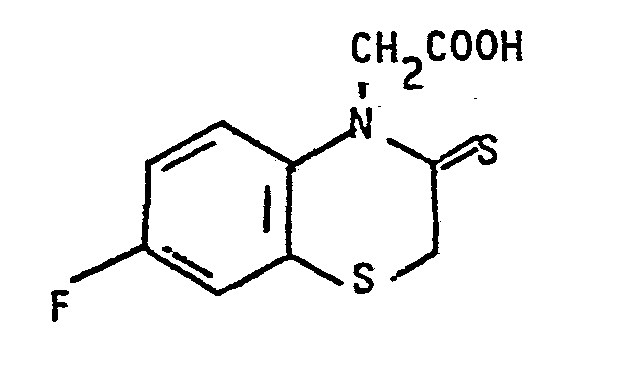
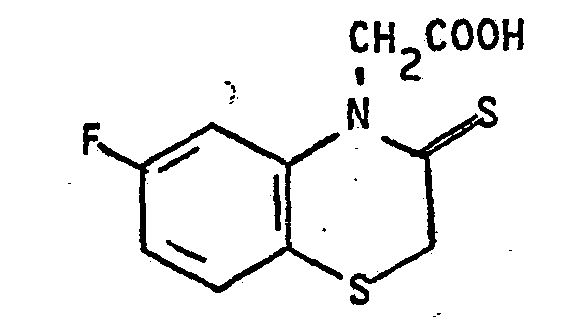


Priority Applications (1)
| Application Number | Priority Date | Filing Date | Title |
|---|---|---|---|
| AT85400927T ATE42297T1 (de) | 1984-05-18 | 1985-05-13 | Heterozyklische derivate, verfahren zu ihrer herstellung, die sie enthaltenden arzneimittel brauchbar als aldosereduktaseinhibitoren. |
Applications Claiming Priority (4)
| Application Number | Priority Date | Filing Date | Title |
|---|---|---|---|
| FR8407791 | 1984-05-18 | ||
| FR8407791A FR2564463B1 (fr) | 1984-05-18 | 1984-05-18 | Nouveaux derives heterocycliques, leurs procedes de preparation, medicaments les contenant, utiles notamment comme inhibiteurs de l'aldose reductase |
| FR8503236 | 1985-03-05 | ||
| FR8503236A FR2578542B2 (fr) | 1985-03-05 | 1985-03-05 | Nouveaux derives heterocycliques, leurs procedes de preparation, medicaments les contenant, utiles notamment comme inhibiteurs de l'aldose reductase |
Publications (3)
| Publication Number | Publication Date |
|---|---|
| EP0162776A2 true EP0162776A2 (fr) | 1985-11-27 |
| EP0162776A3 EP0162776A3 (en) | 1987-05-06 |
| EP0162776B1 EP0162776B1 (fr) | 1989-04-19 |
Family
ID=26223971
Family Applications (1)
| Application Number | Title | Priority Date | Filing Date |
|---|---|---|---|
| EP85400927A Expired EP0162776B1 (fr) | 1984-05-18 | 1985-05-13 | Dérivés hétérocycliques, leurs procédés de préparation,médicaments les contenant, utiles notamment comme inhibiteurs de l'aldose réductase |
Country Status (14)
| Country | Link |
|---|---|
| US (1) | US4755509A (fr) |
| EP (1) | EP0162776B1 (fr) |
| JP (1) | JPH0692371B2 (fr) |
| KR (1) | KR900004320B1 (fr) |
| AU (1) | AU586972B2 (fr) |
| CA (1) | CA1306747C (fr) |
| DE (1) | DE3569529D1 (fr) |
| DK (1) | DK219685A (fr) |
| ES (1) | ES8607263A1 (fr) |
| GR (1) | GR851159B (fr) |
| IE (1) | IE58312B1 (fr) |
| NZ (1) | NZ212060A (fr) |
| PH (1) | PH21118A (fr) |
| PT (1) | PT80489B (fr) |
Cited By (2)
| Publication number | Priority date | Publication date | Assignee | Title |
|---|---|---|---|---|
| EP0644194A4 (fr) * | 1993-03-29 | 1995-07-19 | Green Cross Corp | Compose a base d'acide pyridothiazineacetique, procede de production et utilisation. |
| EP0666261A1 (fr) * | 1994-02-04 | 1995-08-09 | Santen Pharmaceutical Co., Ltd. | Dérivés de thiazine ou de thiomorpholine |
Families Citing this family (12)
| Publication number | Priority date | Publication date | Assignee | Title |
|---|---|---|---|---|
| AU602641B2 (en) * | 1986-04-17 | 1990-10-18 | Senju Pharmaceutical Co., Ltd. | Thiolactam-N-acetic acid derivatives, their production and use |
| EP0290863A3 (en) * | 1987-05-09 | 1989-03-15 | Nihon Tokushu Noyaku Seizo K.K. | Benzoxazine derivative, process and intermediates for its preparation and its use as herbicide |
| IE914455A1 (en) * | 1990-12-27 | 1992-07-01 | Green Cross Corp | 1,4-benzothiazine-2-acetic acid derivatives, processes for production thereof |
| WO1994005647A1 (fr) * | 1992-08-31 | 1994-03-17 | Santen Pharmaceutical Co., Ltd. | Derive de 3-oxo-1,4-benzothiazine |
| TW274550B (fr) * | 1992-09-26 | 1996-04-21 | Hoechst Ag | |
| WO1995013269A1 (fr) * | 1993-11-12 | 1995-05-18 | Santen Pharmaceutical Co., Ltd. | Derive de 1,4-benzothiazine |
| EP0913395A1 (fr) * | 1995-12-08 | 1999-05-06 | Ube Industries, Ltd. | Composes de n-phenylcarbamate, procede de production et bactericides agricoles ou horticoles |
| US6713477B1 (en) | 2000-04-19 | 2004-03-30 | Sumitomo Pharmaceuticals Company, Limited | Hydroxamic acid derivatives |
| US7057046B2 (en) * | 2002-05-20 | 2006-06-06 | Bristol-Myers Squibb Company | Lactam glycogen phosphorylase inhibitors and method of use |
| US7098235B2 (en) | 2002-11-14 | 2006-08-29 | Bristol-Myers Squibb Co. | Triglyceride and triglyceride-like prodrugs of glycogen phosphorylase inhibiting compounds |
| EP1726587B1 (fr) * | 2004-03-02 | 2010-09-01 | Dainippon Sumitomo Pharma Co., Ltd. | Compose de benzothiazine-3-one et produit intermediaire pour celui-ci |
| BR112013027787A2 (pt) * | 2011-04-29 | 2017-06-27 | Icahn School Med Mount Sinai | compostos, composição farmacêutica, método para tratar um distúrbio proliferativo celular, método para tratar um distúrbio neurológico, métodos para inibir uma ou mais quinases, método para inibir a proliferação celular de células cancerosas, método para induzir a morte celular de células cancerosas, método para induzir a apoptose de células cancerosas, método para induzir a apoptose em uma célula e métodos para produzir compostos |
Family Cites Families (5)
| Publication number | Priority date | Publication date | Assignee | Title |
|---|---|---|---|---|
| GB1173942A (en) * | 1967-06-06 | 1969-12-10 | Bellon Labor Sa Roger | New 2,3-Dihydro-1,4-Benzoxazines |
| US3923709A (en) * | 1974-08-30 | 1975-12-02 | Monsanto Co | 3,4-Dihydro-3-oxo-2H-1,4-benzothiazines and benzoxazines |
| US4512990A (en) * | 1982-02-18 | 1985-04-23 | Syntex (U.S.A.), Inc. | Benzthiazine analogs as antiinflammatory agents |
| US4584300A (en) * | 1983-02-07 | 1986-04-22 | Santen Pharmaceutical Co., Ltd. | Platelet anti-aggregative- and calcium antagonistic -1,4-benzothiazin-3-one derivatives, compositions, and methods of use therefor |
| JPS60166674A (ja) * | 1984-02-09 | 1985-08-29 | Santen Pharmaceut Co Ltd | ベンゾチアジン誘導体 |
-
1985
- 1985-05-06 IE IE112685A patent/IE58312B1/en not_active IP Right Cessation
- 1985-05-09 PH PH32246A patent/PH21118A/en unknown
- 1985-05-13 GR GR851159A patent/GR851159B/el unknown
- 1985-05-13 NZ NZ212060A patent/NZ212060A/xx unknown
- 1985-05-13 DE DE8585400927T patent/DE3569529D1/de not_active Expired
- 1985-05-13 EP EP85400927A patent/EP0162776B1/fr not_active Expired
- 1985-05-14 CA CA000481503A patent/CA1306747C/fr not_active Expired - Fee Related
- 1985-05-14 US US06/733,685 patent/US4755509A/en not_active Expired - Fee Related
- 1985-05-15 AU AU42518/85A patent/AU586972B2/en not_active Ceased
- 1985-05-15 KR KR1019850003306A patent/KR900004320B1/ko not_active Expired
- 1985-05-16 JP JP60102788A patent/JPH0692371B2/ja not_active Expired - Lifetime
- 1985-05-17 ES ES543266A patent/ES8607263A1/es not_active Expired
- 1985-05-17 DK DK219685A patent/DK219685A/da unknown
- 1985-05-17 PT PT80489A patent/PT80489B/fr not_active IP Right Cessation
Cited By (2)
| Publication number | Priority date | Publication date | Assignee | Title |
|---|---|---|---|---|
| EP0644194A4 (fr) * | 1993-03-29 | 1995-07-19 | Green Cross Corp | Compose a base d'acide pyridothiazineacetique, procede de production et utilisation. |
| EP0666261A1 (fr) * | 1994-02-04 | 1995-08-09 | Santen Pharmaceutical Co., Ltd. | Dérivés de thiazine ou de thiomorpholine |
Also Published As
| Publication number | Publication date |
|---|---|
| PT80489A (fr) | 1985-06-01 |
| DK219685A (da) | 1985-11-19 |
| KR850008165A (ko) | 1985-12-13 |
| IE58312B1 (en) | 1993-09-08 |
| EP0162776A3 (en) | 1987-05-06 |
| JPH0692371B2 (ja) | 1994-11-16 |
| KR900004320B1 (ko) | 1990-06-22 |
| PT80489B (fr) | 1986-12-12 |
| EP0162776B1 (fr) | 1989-04-19 |
| ES8607263A1 (es) | 1986-05-16 |
| IE851126L (en) | 1985-11-18 |
| ES543266A0 (es) | 1986-05-16 |
| CA1306747C (fr) | 1992-08-25 |
| PH21118A (en) | 1987-07-27 |
| US4755509A (en) | 1988-07-05 |
| JPS6140264A (ja) | 1986-02-26 |
| NZ212060A (en) | 1989-10-27 |
| DE3569529D1 (en) | 1989-05-24 |
| AU586972B2 (en) | 1989-08-03 |
| AU4251885A (en) | 1985-11-21 |
| GR851159B (fr) | 1985-11-25 |
| DK219685D0 (da) | 1985-05-17 |
Similar Documents
| Publication | Publication Date | Title |
|---|---|---|
| EP0162776B1 (fr) | Dérivés hétérocycliques, leurs procédés de préparation,médicaments les contenant, utiles notamment comme inhibiteurs de l'aldose réductase | |
| EP0611766A1 (fr) | Dérivés de 2-amido-thiazoles polysubstitués, procédé de préparation, composition pharmaceutique et utilisation de ces dérivés pour la préparation d'un médicament | |
| FR2705095A1 (fr) | Nouveaux indoles substitués, leur procédé de préparation et les compositions pharmaceutiques qui les contiennent. | |
| EP0841330B1 (fr) | Nouveaux dérivés aminométhyl hétérocycliques, leur procédé de préparation et les compositions pharmaceutiques qui les contiennent | |
| CH628898A5 (fr) | Procede de preparation d'aza-8 purinones-6. | |
| WO2010004139A1 (fr) | Nouveaux derives de benzothiadiazines cycloalkylees, leur procede de preparation et les compositions pharmaceutiques qui les contiennent | |
| MC1255A1 (fr) | L'acide 7-methoxy-5-oxo-5h-thiazolo(2,3-b)quinazoline-2-carboxylique et ses sels,leur preparation et leurs utilisations therapeutiques | |
| EP0533827A1 (fr) | Nouveaux derives de l'oxazole, leur preparation et les compositions pharmaceutiques qui les contiennent. | |
| EP0115979A1 (fr) | Nouveaux dérivés du 1H,3H-pyrrolo (1,2-c) thiazole leur préparation et les médicaments qui les contiennent | |
| MC1143A1 (fr) | Derives de thiouree | |
| EP0099770B1 (fr) | Nouveaux dérivés d'oxazinobenzothiazine-6,6-dioxyde, leur préparation et leur application en tant que médicaments | |
| CH650254A5 (fr) | Quinolones, leurs procedes de preparation et compositions therapeutiques les contenant. | |
| FR2669633A1 (fr) | Nouveaux derives de la benzoselenazolinone, leur procede de preparation et les compositions pharmaceutiques qui les contiennent. | |
| EP0119896B1 (fr) | Nouveaux dérivés de l'amino-5 dithiole-1,2 one-3, leur préparation et les compositions médicinales qui les contiennent | |
| EP0234980A1 (fr) | Dérivés de 2-benzimidazolylalkylthio (ou sulfinyle ou sulfonyle) leur préparation et leur application en tant que médicaments | |
| MC1135A1 (fr) | Derives de thiazine | |
| RU2069212C1 (ru) | Производные имидазола | |
| EP0362006A1 (fr) | Dérivés de quinoléine, leurs procédés de préparation et les médicaments les contenant | |
| FR2578542A2 (fr) | Nouveaux derives heterocycliques, leurs procedes de preparation, medicaments les contenant, utiles notamment comme inhibiteurs de l'aldose reductase | |
| CA2022460A1 (fr) | Derives benzothiaziniques, leur preparation et leurs applications comme medicaments ou comme intermediaires de synthese de medicaments | |
| WO1982003860A1 (fr) | Derives de l'acide 1,4-thiazane-carboxylique, leurs preparation et utilisation ainsi que les compositions contenant ces derives | |
| FR2564463A1 (fr) | Nouveaux derives heterocycliques, leurs procedes de preparation, medicaments les contenant, utiles notamment comme inhibiteurs de l'aldose reductase | |
| EP0012051A1 (fr) | Dérivés d'amino-3 dioxo-2,4 (1H,3H) quinazolines, leur procédé de préparation et composition thérapeutique les contenant | |
| CA1068270A (fr) | Diamino-2,4-bromo-5 chloro-6 pyrimidines utilisables comme medicaments et procede pour leur preparation | |
| EP0099822B1 (fr) | Nouveaux 1-(2-carbalkoxy 4-(thiénylalkylamido)phénoxy) 3-amino 2-propanols, leur préparation et leurs applications en thérapeutique |
Legal Events
| Date | Code | Title | Description |
|---|---|---|---|
| PUAI | Public reference made under article 153(3) epc to a published international application that has entered the european phase |
Free format text: ORIGINAL CODE: 0009012 |
|
| AK | Designated contracting states |
Designated state(s): AT BE CH DE FR GB IT LI LU NL SE |
|
| PUAL | Search report despatched |
Free format text: ORIGINAL CODE: 0009013 |
|
| AK | Designated contracting states |
Kind code of ref document: A3 Designated state(s): AT BE CH DE FR GB IT LI LU NL SE |
|
| 17P | Request for examination filed |
Effective date: 19870527 |
|
| 17Q | First examination report despatched |
Effective date: 19880114 |
|
| GRAA | (expected) grant |
Free format text: ORIGINAL CODE: 0009210 |
|
| AK | Designated contracting states |
Kind code of ref document: B1 Designated state(s): AT BE CH DE FR GB IT LI LU NL SE |
|
| REF | Corresponds to: |
Ref document number: 42297 Country of ref document: AT Date of ref document: 19890515 Kind code of ref document: T |
|
| ITF | It: translation for a ep patent filed | ||
| ITPR | It: changes in ownership of a european patent |
Owner name: CAMBIO RAGIONE SOCIALE;LABORATOIRES UPSA S.A. |
|
| RAP2 | Party data changed (patent owner data changed or rights of a patent transferred) |
Owner name: LABORATOIRES UPSA |
|
| REF | Corresponds to: |
Ref document number: 3569529 Country of ref document: DE Date of ref document: 19890524 |
|
| GBT | Gb: translation of ep patent filed (gb section 77(6)(a)/1977) | ||
| BECH | Be: change of holder |
Free format text: 890419 LABORATOIRES *UPSA |
|
| BECN | Be: change of holder's name |
Effective date: 19890419 |
|
| PLBE | No opposition filed within time limit |
Free format text: ORIGINAL CODE: 0009261 |
|
| STAA | Information on the status of an ep patent application or granted ep patent |
Free format text: STATUS: NO OPPOSITION FILED WITHIN TIME LIMIT |
|
| 26N | No opposition filed | ||
| ITTA | It: last paid annual fee | ||
| EPTA | Lu: last paid annual fee | ||
| EAL | Se: european patent in force in sweden |
Ref document number: 85400927.1 |
|
| PGFP | Annual fee paid to national office [announced via postgrant information from national office to epo] |
Ref country code: NL Payment date: 19960422 Year of fee payment: 12 |
|
| PGFP | Annual fee paid to national office [announced via postgrant information from national office to epo] |
Ref country code: AT Payment date: 19960424 Year of fee payment: 12 |
|
| PGFP | Annual fee paid to national office [announced via postgrant information from national office to epo] |
Ref country code: LU Payment date: 19960501 Year of fee payment: 12 |
|
| PGFP | Annual fee paid to national office [announced via postgrant information from national office to epo] |
Ref country code: GB Payment date: 19960507 Year of fee payment: 12 |
|
| PGFP | Annual fee paid to national office [announced via postgrant information from national office to epo] |
Ref country code: DE Payment date: 19960524 Year of fee payment: 12 |
|
| PGFP | Annual fee paid to national office [announced via postgrant information from national office to epo] |
Ref country code: SE Payment date: 19960528 Year of fee payment: 12 Ref country code: CH Payment date: 19960528 Year of fee payment: 12 |
|
| PGFP | Annual fee paid to national office [announced via postgrant information from national office to epo] |
Ref country code: FR Payment date: 19960531 Year of fee payment: 12 |
|
| PGFP | Annual fee paid to national office [announced via postgrant information from national office to epo] |
Ref country code: BE Payment date: 19960612 Year of fee payment: 12 |
|
| PG25 | Lapsed in a contracting state [announced via postgrant information from national office to epo] |
Ref country code: LU Free format text: LAPSE BECAUSE OF NON-PAYMENT OF DUE FEES Effective date: 19970513 Ref country code: GB Effective date: 19970513 Ref country code: AT Effective date: 19970513 |
|
| PG25 | Lapsed in a contracting state [announced via postgrant information from national office to epo] |
Ref country code: SE Effective date: 19970514 |
|
| PG25 | Lapsed in a contracting state [announced via postgrant information from national office to epo] |
Ref country code: LI Free format text: LAPSE BECAUSE OF NON-PAYMENT OF DUE FEES Effective date: 19970531 Ref country code: CH Free format text: LAPSE BECAUSE OF NON-PAYMENT OF DUE FEES Effective date: 19970531 Ref country code: BE Effective date: 19970531 |
|
| BERE | Be: lapsed |
Owner name: LABORATOIRES UPSA Effective date: 19970531 |
|
| PG25 | Lapsed in a contracting state [announced via postgrant information from national office to epo] |
Ref country code: NL Effective date: 19971201 |
|
| GBPC | Gb: european patent ceased through non-payment of renewal fee |
Effective date: 19970513 |
|
| REG | Reference to a national code |
Ref country code: CH Ref legal event code: PL |
|
| PG25 | Lapsed in a contracting state [announced via postgrant information from national office to epo] |
Ref country code: FR Free format text: LAPSE BECAUSE OF NON-PAYMENT OF DUE FEES Effective date: 19980130 |
|
| EUG | Se: european patent has lapsed |
Ref document number: 85400927.1 |
|
| NLV4 | Nl: lapsed or anulled due to non-payment of the annual fee |
Effective date: 19971201 |
|
| PG25 | Lapsed in a contracting state [announced via postgrant information from national office to epo] |
Ref country code: DE Free format text: LAPSE BECAUSE OF NON-PAYMENT OF DUE FEES Effective date: 19980203 |
|
| REG | Reference to a national code |
Ref country code: FR Ref legal event code: ST |