EP0177371A1 - Méthode de fabrication d'aimants permanents - Google Patents
Méthode de fabrication d'aimants permanents Download PDFInfo
- Publication number
- EP0177371A1 EP0177371A1 EP85307158A EP85307158A EP0177371A1 EP 0177371 A1 EP0177371 A1 EP 0177371A1 EP 85307158 A EP85307158 A EP 85307158A EP 85307158 A EP85307158 A EP 85307158A EP 0177371 A1 EP0177371 A1 EP 0177371A1
- Authority
- EP
- European Patent Office
- Prior art keywords
- cooling
- alloy
- temperatures
- permanent magnet
- annealing
- Prior art date
- Legal status (The legal status is an assumption and is not a legal conclusion. Google has not performed a legal analysis and makes no representation as to the accuracy of the status listed.)
- Granted
Links
- 238000000034 method Methods 0.000 title claims abstract description 18
- 230000008569 process Effects 0.000 title claims abstract description 17
- 238000004519 manufacturing process Methods 0.000 title claims abstract description 8
- 239000000956 alloy Substances 0.000 claims abstract description 49
- 229910045601 alloy Inorganic materials 0.000 claims abstract description 48
- 238000001816 cooling Methods 0.000 claims abstract description 32
- 238000000137 annealing Methods 0.000 claims abstract description 22
- 238000005245 sintering Methods 0.000 claims abstract description 11
- 239000000203 mixture Substances 0.000 claims description 8
- 229910052761 rare earth metal Inorganic materials 0.000 claims description 6
- 238000010438 heat treatment Methods 0.000 abstract description 27
- 239000011159 matrix material Substances 0.000 abstract description 9
- 238000010583 slow cooling Methods 0.000 abstract description 9
- 229910000521 B alloy Inorganic materials 0.000 abstract description 2
- XEEYBQQBJWHFJM-UHFFFAOYSA-N Iron Chemical compound [Fe] XEEYBQQBJWHFJM-UHFFFAOYSA-N 0.000 description 12
- 229910001172 neodymium magnet Inorganic materials 0.000 description 12
- 229910052796 boron Inorganic materials 0.000 description 8
- QVGXLLKOCUKJST-UHFFFAOYSA-N atomic oxygen Chemical compound [O] QVGXLLKOCUKJST-UHFFFAOYSA-N 0.000 description 6
- 239000001301 oxygen Substances 0.000 description 6
- 229910052760 oxygen Inorganic materials 0.000 description 6
- ZOXJGFHDIHLPTG-UHFFFAOYSA-N Boron Chemical compound [B] ZOXJGFHDIHLPTG-UHFFFAOYSA-N 0.000 description 5
- 239000000463 material Substances 0.000 description 5
- 239000000843 powder Substances 0.000 description 5
- 238000010298 pulverizing process Methods 0.000 description 5
- 229920002545 silicone oil Polymers 0.000 description 5
- 238000003801 milling Methods 0.000 description 4
- YXFVVABEGXRONW-UHFFFAOYSA-N Toluene Chemical compound CC1=CC=CC=C1 YXFVVABEGXRONW-UHFFFAOYSA-N 0.000 description 3
- 229910052782 aluminium Inorganic materials 0.000 description 3
- 238000007796 conventional method Methods 0.000 description 3
- 239000007789 gas Substances 0.000 description 3
- 239000011261 inert gas Substances 0.000 description 3
- 229910052742 iron Inorganic materials 0.000 description 3
- 238000002844 melting Methods 0.000 description 3
- 230000008018 melting Effects 0.000 description 3
- VLKZOEOYAKHREP-UHFFFAOYSA-N n-Hexane Chemical compound CCCCCC VLKZOEOYAKHREP-UHFFFAOYSA-N 0.000 description 3
- XKRFYHLGVUSROY-UHFFFAOYSA-N Argon Chemical compound [Ar] XKRFYHLGVUSROY-UHFFFAOYSA-N 0.000 description 2
- 229910052779 Neodymium Inorganic materials 0.000 description 2
- 229910052786 argon Inorganic materials 0.000 description 2
- 239000010941 cobalt Substances 0.000 description 2
- 229910017052 cobalt Inorganic materials 0.000 description 2
- GUTLYIVDDKVIGB-UHFFFAOYSA-N cobalt atom Chemical compound [Co] GUTLYIVDDKVIGB-UHFFFAOYSA-N 0.000 description 2
- 230000007423 decrease Effects 0.000 description 2
- 230000006866 deterioration Effects 0.000 description 2
- 239000010419 fine particle Substances 0.000 description 2
- 229910001004 magnetic alloy Inorganic materials 0.000 description 2
- 229910052750 molybdenum Inorganic materials 0.000 description 2
- 229910052758 niobium Inorganic materials 0.000 description 2
- 230000006911 nucleation Effects 0.000 description 2
- 238000010899 nucleation Methods 0.000 description 2
- 230000003287 optical effect Effects 0.000 description 2
- 239000003960 organic solvent Substances 0.000 description 2
- 230000003647 oxidation Effects 0.000 description 2
- 238000007254 oxidation reaction Methods 0.000 description 2
- 239000002245 particle Substances 0.000 description 2
- 239000002904 solvent Substances 0.000 description 2
- 229910052719 titanium Inorganic materials 0.000 description 2
- XLYOFNOQVPJJNP-UHFFFAOYSA-N water Substances O XLYOFNOQVPJJNP-UHFFFAOYSA-N 0.000 description 2
- UOCLXMDMGBRAIB-UHFFFAOYSA-N 1,1,1-trichloroethane Chemical compound CC(Cl)(Cl)Cl UOCLXMDMGBRAIB-UHFFFAOYSA-N 0.000 description 1
- IJGRMHOSHXDMSA-UHFFFAOYSA-N Atomic nitrogen Chemical compound N#N IJGRMHOSHXDMSA-UHFFFAOYSA-N 0.000 description 1
- 229910052692 Dysprosium Inorganic materials 0.000 description 1
- YCKRFDGAMUMZLT-UHFFFAOYSA-N Fluorine atom Chemical compound [F] YCKRFDGAMUMZLT-UHFFFAOYSA-N 0.000 description 1
- 229910001047 Hard ferrite Inorganic materials 0.000 description 1
- UFHFLCQGNIYNRP-UHFFFAOYSA-N Hydrogen Chemical compound [H][H] UFHFLCQGNIYNRP-UHFFFAOYSA-N 0.000 description 1
- CTQNGGLPUBDAKN-UHFFFAOYSA-N O-Xylene Chemical compound CC1=CC=CC=C1C CTQNGGLPUBDAKN-UHFFFAOYSA-N 0.000 description 1
- XSTXAVWGXDQKEL-UHFFFAOYSA-N Trichloroethylene Chemical group ClC=C(Cl)Cl XSTXAVWGXDQKEL-UHFFFAOYSA-N 0.000 description 1
- 150000001298 alcohols Chemical class 0.000 description 1
- 229910000828 alnico Inorganic materials 0.000 description 1
- 230000004075 alteration Effects 0.000 description 1
- 230000008901 benefit Effects 0.000 description 1
- 230000000052 comparative effect Effects 0.000 description 1
- 230000006835 compression Effects 0.000 description 1
- 238000007906 compression Methods 0.000 description 1
- 238000005336 cracking Methods 0.000 description 1
- 229910001873 dinitrogen Inorganic materials 0.000 description 1
- 230000000694 effects Effects 0.000 description 1
- 238000001493 electron microscopy Methods 0.000 description 1
- 230000008030 elimination Effects 0.000 description 1
- 238000003379 elimination reaction Methods 0.000 description 1
- 239000011737 fluorine Substances 0.000 description 1
- 229910052731 fluorine Inorganic materials 0.000 description 1
- 230000004907 flux Effects 0.000 description 1
- 239000001257 hydrogen Substances 0.000 description 1
- 229910052739 hydrogen Inorganic materials 0.000 description 1
- 239000012535 impurity Substances 0.000 description 1
- 230000004048 modification Effects 0.000 description 1
- 238000012986 modification Methods 0.000 description 1
- 239000012188 paraffin wax Substances 0.000 description 1
- 229920001296 polysiloxane Polymers 0.000 description 1
- 238000004663 powder metallurgy Methods 0.000 description 1
- 238000003825 pressing Methods 0.000 description 1
- 238000010791 quenching Methods 0.000 description 1
- 230000000171 quenching effect Effects 0.000 description 1
- 150000002910 rare earth metals Chemical class 0.000 description 1
- 229910052710 silicon Inorganic materials 0.000 description 1
- UBOXGVDOUJQMTN-UHFFFAOYSA-N trichloroethylene Natural products ClCC(Cl)Cl UBOXGVDOUJQMTN-UHFFFAOYSA-N 0.000 description 1
- 239000008096 xylene Substances 0.000 description 1
Images

Classifications
-
- H—ELECTRICITY
- H01—ELECTRIC ELEMENTS
- H01F—MAGNETS; INDUCTANCES; TRANSFORMERS; SELECTION OF MATERIALS FOR THEIR MAGNETIC PROPERTIES
- H01F1/00—Magnets or magnetic bodies characterised by the magnetic materials therefor; Selection of materials for their magnetic properties
- H01F1/01—Magnets or magnetic bodies characterised by the magnetic materials therefor; Selection of materials for their magnetic properties of inorganic materials
- H01F1/03—Magnets or magnetic bodies characterised by the magnetic materials therefor; Selection of materials for their magnetic properties of inorganic materials characterised by their coercivity
- H01F1/032—Magnets or magnetic bodies characterised by the magnetic materials therefor; Selection of materials for their magnetic properties of inorganic materials characterised by their coercivity of hard-magnetic materials
- H01F1/04—Magnets or magnetic bodies characterised by the magnetic materials therefor; Selection of materials for their magnetic properties of inorganic materials characterised by their coercivity of hard-magnetic materials metals or alloys
- H01F1/047—Alloys characterised by their composition
- H01F1/053—Alloys characterised by their composition containing rare earth metals
- H01F1/055—Alloys characterised by their composition containing rare earth metals and magnetic transition metals, e.g. SmCo5
- H01F1/057—Alloys characterised by their composition containing rare earth metals and magnetic transition metals, e.g. SmCo5 and IIIa elements, e.g. Nd2Fe14B
- H01F1/0571—Alloys characterised by their composition containing rare earth metals and magnetic transition metals, e.g. SmCo5 and IIIa elements, e.g. Nd2Fe14B in the form of particles, e.g. rapid quenched powders or ribbon flakes
- H01F1/0575—Alloys characterised by their composition containing rare earth metals and magnetic transition metals, e.g. SmCo5 and IIIa elements, e.g. Nd2Fe14B in the form of particles, e.g. rapid quenched powders or ribbon flakes pressed, sintered or bonded together
- H01F1/0577—Alloys characterised by their composition containing rare earth metals and magnetic transition metals, e.g. SmCo5 and IIIa elements, e.g. Nd2Fe14B in the form of particles, e.g. rapid quenched powders or ribbon flakes pressed, sintered or bonded together sintered
Definitions
- the present invention relates to a process for manufacturing rare earth permanent magnets. More specifically, it relates to a process for manufacturing permanent magnets consisting essentially of a rare earth element, iron and boron through a particular heat treatment of a sintered body.
- Nd-Fe-B permanent magnet alloys have high residual flux density (Br) and high intrinsic coercivity (iHc), so that they have been receiving much attention as new permanent magnet materials which supplant conventional permanent magnets such as alnico magnets, hard ferrite magnets and Sm-Co magnets. See Japanese Patent Laid-Open Nos. 59-46008, 59-64733 and 59-89401, and M. Sagawa et al., "New Material for Permanent Magnets on a Base of Nd and Fe," J. Appl. Phys. 55 (6) 2083 (1984). These Nd-Fe-B magnets consist essentially of 8 - 30 at % of Nd and/or Pr, 2 - 28 at % of B and balance Fe. They may contain additional elements such as Co., Al, Dy, Nb, Ti and Mo (Japanese Patent Laid-Open No. 59-219453).
- Such permanent magnets may be prepared by powder metallurgy. Specifically speaking, component elements in a proper proportion are mixed and melted to form an ingot which is then pulverized and milled. The milled material is sintered and then heat-treated.
- the heat treatment conditions may vary depending on the types of rare earth elements and the composition of magnets, but the Nd-Fe-B sintered magnets are usually annealed at temperatures of around 600°C.
- iHc intrinsic coercivity
- These R-Fe-B alloys have (BH)max of up to about 35 MGOe, which is much higher than (BH)max of R-Co magnets which is at most about 30 MGOe.
- Nd-Fe-B permanent magnets subjected to the conventional heat treatment have intrinsic coercivity (iHc) which varies widely depending on the composition, grain size; oxygen content and sintering temperature.
- iHc intrinsic coercivity
- the conventional heat treatment fails to draw sufficiently a potential iHc which such magnet materials inherently have.
- An object of the present invention is, therefore, to provide a process for manufacturing a rare earth-iron-boron permanent magnet with high intrinsic coercivity.
- the process for manufacturing a permanent magnet according to the present invention is applicable to a magnetic alloy whose essential composition is represented by the general formula: wherein R represents Nd and/or Pr, which may be partially substituted by one or more other rare earth elements, 0 ⁇ x ⁇ 0.5, 0.02 ⁇ y ⁇ 0.3 and 4 ⁇ z ⁇ 7.5, and comprises the steps of (a) after sintering, keeping the sintered alloy at temperatures of 750 - 1000°C for 0.2 - 5 hours; (b) slowly cooling it at a cooling rate of 0.3 - 5°C/min to temperatures between room temperature and 600°C; (c) annealing it at temperatures of 550 - 700°C for 0.2 - 3 hours; and (d) rapidly cooling it at a cooling rate of 20 - 400°C/min.
- R represents Nd and/or Pr, which may be partially substituted by one or more other rare earth elements, 0 ⁇ x ⁇ 0.5, 0.02 ⁇ y ⁇ 0.3 and 4 ⁇ z ⁇ 7.5
- Cobalt serves to elevate a Curie temperature of the rare earth-iron-boron permanent magnets, but when it exceeds 0.5 in the general formula, 4 7 Ir and iHc of the magnets dramatically decreases, making them undesirable. Thus, cobalt should be 0.5 or less.
- Boron should be 0.02 - 0.3 similarly in the general formula.
- boron is lower than 0.02, the magnets do not have a high Curie temperature.
- boron exceeds 0.3, Curie temperature and 4 ⁇ Ir of the magnets decrease and there appear phases undesirable to magnetic characteristics in the magnets.
- the permanent magnet alloy may contain additional elements such as Al, Nb, Ti, Mo and Si. And it is noted that impurities inevitably contained in the alloy materials do not substantially affect the effects of the heat treatment according to the present invention.
- component elements are mixed and melted in an inert gas or a vacuum.
- Ferroboron may be used as a boron component.
- the rare earth elements are preferably last introduced into a crucible.
- the resulting ingot is pulverized and milled into fine particles. This may consist of pulverization and milling.
- the pulverization may be carried out by a stamp mill, a jaw crusher, a brown mill, a disc mill, etc., and the milling may be carried out by a jet mill, a vibration mill, a ball mill, etc. In either case, the pulverization is carried out in a non-oxidating atmosphere to prevent the oxidation of magnet alloys.
- organic solvents and inert gas are preferably used.
- the preferred organic solvents include various alcohols, hexane, trichloroethane, trichloroethylene, xylene, toluene, fluorine-containing solvents, paraffin solvents.
- An average size of the resulting fine powders is 3 - 5 ⁇ m (FSSS).
- the fine alloy powders thus prepared are compressed in a press in a magnetic field so that the resulting green body has its C-axis aligned in the same direction to show high magnetic anisotropy.
- the green body is then sintered at 1050 - 1150°C for 30 minutes - 3 hours in an inert gas such as Ar and He, or in hydrogen on in a vacuum.
- an inert gas such as Ar and He
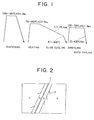
- Fig. 1 schematically shows the heat treatment of the present invention.
- the alloy is cooled to room temperature after sintering for practical reasons.
- a cooling speed does not substantially affect the intrinsic coercivity (iHc) of the final magnet. It is thus noted that the next heating step may be conducted directly after sintering without cooling down to room temperature.
- the sintered alloy is then heated to 750 - 1000°C and kept at such temperature for 0.2 - 5 hours.
- the above heating temperature is lower than 750°C or higher than 1000°C, the resulting magnet does not have sufficiently high iHc.
- the sintered alloy is slowly cooled to temperatures between room temperature and 600°C at a cooling rate of 0.3 - 5 °C/min.
- the cooling rate exceeds 5 °C/min.
- an equilibrium phase necessary for making the subsequent annealing effective cannot be obtained in the alloy, thus making it impossible to achieve sufficiently high iHc.
- the heat treatment takes too much time, making the process less economical.
- the preferred cooling speed is 0.6 - 2.0 °C/min.
- the slow cooling is preferably performed to room temperature, but it can be stopped at 600°C, and then the alloy can be cooled down to room temperature relatively rapidly at the slight expense of iHc.
- the end temperature of the slow cooling is preferably 400°C - room temperature.
- the alloy is then annealed at 550 - 700°C for 0.2 - 3 hours.
- the annealing temperature is lower than 550°C or higher than 700°C, sufficiently high iHc cannot be achieved.
- the alloy After annealing, the alloy is rapidly cooled at a cooling rate of 20 - 400 °C/min.
- the rapid cooling may be conducted in water, a silicone oil or an argon gas.
- the cooling should be as quick as possible.
- the cooling rate is higher than 400 °C/min.
- the alloy tends to have cracking, making it difficult to provide commercially valuable permanent magnets.
- the cooling rate is lower than 20 °C/min. there appears in the alloy during the cooling process a new phase which is undesirable to iHc.
- the Nd-Fe-B alloy consists essentially of a matrix (main phase) consisting of Nd 2 Fe 14 B, a B-rich second phase consisting of Nd 2 Fe 7 B 6 , and a Nd-rich third phase.
- main phase consisting of Nd 2 Fe 14 B
- B-rich second phase consisting of Nd 2 Fe 7 B 6
- Nd-rich third phase a body-centered cubic (bcc) phase
- bcc body-centered cubic
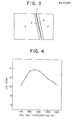
- phase a is the matrix (main phase) of Nd 2 Fe l4 B
- phase b is the body-centered cubic (bcc) phase of about 50A - about 1000A in thickness
- phase c is the Nd-rich phase of about 5A - about 700A in thickness
- d indicates a thin, fine plate of the phase b projecting into the matrix a.
- Fig. 3 The microstructure of the annealed Nd-Fe-B alloy is schematically shown by Fig. 3 in which the same symbols represent the same phases as in Fig. 2.
- the alloy heat-treated according to the present invention does not substantially differ from that annealed after sintering. It should be noted, however, that once the number of such thin, fine plates is increased by the above two steps (i) and (ii), the intrinsic coercivity of the alloy is more improved after annealing than when the alloy is annealed after sintering.
- the 01 77371 present invention is based on the finding that a combination of the above heat treatment steps (i) and (ii) and the subsequent annealing step makes it possible to improve iHc much more than the annealing step alone. It may be considered that this finding is totally unpredictable from the microstructural point of view, because the above heat treatment step (ii) serves to increase the number of the thin, fine plates d which work to lower iHc.
- An alloy having the composition of Nd (Fe 0.9 B 0.1 ) 5.5 was prepared by high-frequency melting.
- the resulting alloy ingot was pulverized by a stamp mill and a disc mill to 32 mesh or less, and then finely milled by a jet mill in a nitrogen gas to provide fine particles of 3.5-pm particle size (FSSS).
- the fine powders were pressed in a magnetic filed of 15 KOe perpendicular to the compressing direction.
- the compression pressure was 2 tons/cm 2 .
- the resulting green body was sintered at 1100°C for 2 hours in vacuo, and then cooled in a cooling zone.
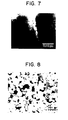
- a number of the resulting sintered alloys were respectively kept at various temperatures between 700°C and 1080°C for 1 hour (heating step), and then slowly cooled at 1.3°C/min. to 300°C. After cooling, the annealing at 600°C for 1 hour was conducted on each sample. The samples were then rapidly cooled at about 3G0 °C/min.
- iHc intrinsic coercivity
- Fig. 4 The relationship between the intrinsic coercivity (iHc) of the resulting magnets and the temperatures of the heating step is shown in Fig. 4. It is appreciated that when the heating temperature is kept between 750°C and 1000°C, the magnets' iHc are about 12 KOe or higher.
- the final magnet had the following magnetic characteristics:
- Example 2 An alloy having the same composition as in Example 1 was sintered in the same way as in Example 1.
- the resulting sintered alloy samples were heated to and kept at 850°C for 1 hour, and their slowly cooled at 1.3 °C/min. to various temperatures of 800°C, 700°C, 600°C, 500°C, 400°C, 300°C, 200°C, 100°C and room temperature.
- the slow cooling was conducted to temperatures between 800°C and 100°C, the alloy samples were cooled down to room temperature in an Ar gas flow. The slowly cooled samples were then subjected to annealing and rapid cooling as in
- the resulting magnet had the following magnetic characteristics:
- An alloy having the formula: (Nd 0.86 DY 0.14 ) (Fe 0.92 B 0.08 ) 5.4 was subjected to melting, pulverizing, milling, pressing and sintering in the same way as in Example 1.
- the resulting sintered alloy was heated to 900°C and kept at that temperature for 2 hours, and then slowly cooled to 200°C at 1 °C/min.
- the alloys thus heat-treated were subjected to annealing at various temperatures between 500°C - 750°C for 1 hour, and then rapidly cooled in a silicone oil.
- the magnetic properties of the resulting magnets are shown in Table 1 together with those by the conventional method.
- Example 2 An alloy having the formula: Nd (Fe 0.92 B 0.08 ) 5.7 was sintered in the same way as in Example 1.
- the resulting sintered alloy samples were heated to 850°C and kept at that temperature for 2 hours. They were then slowly cooled to 300°C at 0.9 °C/min. Further, they were annealed at 670°C for 1 hour and rapidly cooled in either of water, a silicone coil or an Ar gas flow.
- the resulting magnetic charcteristics are shown in Table 2.
- Example 2 An alloy having the composition of Nd (Fe 0.91 B 0.09 ) 5.6 was subjected to melting and pulverizing and milling as in Example 1.
- the fine alloy powders were pressed in an atmosphere having various oxygen concentrations to provide green bodies of various oxygen contents.
- the green bodies were sintered at 1100°C for 2 hours in vacuo.
- the sintered alloy samples were subjected to the heat treatment of the present invention and the conventional heat treatment, respectively.
- the conventional heat treatment consisted of the steps of annealing at 650°C for 1 hour and rapidly cooling in an silicone oil.
- the heat treatment of the present invention here consisted of the steps of keeping at 870°C for 1 hour, slowly cooling to 400°C at 1.5 °C/min., annealing at 650°C for 1 hour and rapidly cooling in an silicone oil.
- the magnetic properties of magnet samples obtained by the method of the present invention (A) and the conventional method (B) are shown in Table 4.
- Fig. 7 which is a TEM photomicrograph (400,000x) of one sample, the finally heat-treated samples had no irregularities of the thin, fine plates d.
- the resulting magnets had iHc ranging 9,890 - 10,500 Oe and (BH)max ranging 33.0 - 36.8 MGOe.
- Fig. 8 shows an optical photomicrograph of one heat-treated sample in which white areas represent the main phases a, gray areas the B-rich phases and dark areas the Nd-rich phases.
- Example 7 100 of the sintered samples in Example 7 were subjected to the conventional heat treatment consisting of annealing at 660°C for 1 hour and rapid cooling. Their microscopic observation revealed that there were no irregularities of the thin, fine plates d near the grain boundaries of the main phases a. However, their iHc was between 5000 - 9000 Oe, lower than the iHc of the samples heat-treated according to the present invention (Example 7).
Landscapes
- Chemical & Material Sciences (AREA)
- Crystallography & Structural Chemistry (AREA)
- Inorganic Chemistry (AREA)
- Engineering & Computer Science (AREA)
- Power Engineering (AREA)
- Hard Magnetic Materials (AREA)
- Powder Metallurgy (AREA)
Applications Claiming Priority (2)
| Application Number | Priority Date | Filing Date | Title |
|---|---|---|---|
| JP209524/84 | 1984-10-05 | ||
| JP59209524A JPS6187825A (ja) | 1984-10-05 | 1984-10-05 | 永久磁石材料の製造方法 |
Publications (2)
| Publication Number | Publication Date |
|---|---|
| EP0177371A1 true EP0177371A1 (fr) | 1986-04-09 |
| EP0177371B1 EP0177371B1 (fr) | 1990-01-03 |
Family
ID=16574215
Family Applications (1)
| Application Number | Title | Priority Date | Filing Date |
|---|---|---|---|
| EP85307158A Expired - Lifetime EP0177371B1 (fr) | 1984-10-05 | 1985-10-07 | Méthode de fabrication d'aimants permanents |
Country Status (4)
| Country | Link |
|---|---|
| US (1) | US4888068A (fr) |
| EP (1) | EP0177371B1 (fr) |
| JP (1) | JPS6187825A (fr) |
| DE (1) | DE3575232D1 (fr) |
Cited By (8)
| Publication number | Priority date | Publication date | Assignee | Title |
|---|---|---|---|---|
| EP0261579A1 (fr) * | 1986-09-16 | 1988-03-30 | Tokin Corporation | Méthode pour la fabrication d'un aimant permanent terre métal rare-fer-bore utilisant une poudre en alliage refroidi brusquement |
| WO1989002156A1 (fr) * | 1987-09-02 | 1989-03-09 | Max-Planck-Gesellschaft Zur Förderung Der Wissensc | OPTIMISATION DE LA MICROSTRUCTURE D'AIMANTS FRITTES A BASE DE Fe-Nd-B |
| US5034146A (en) * | 1986-06-26 | 1991-07-23 | Shin-Etsu Chemical Co., Ltd. | Rare earth-based permanent magnet |
| AT393178B (de) * | 1989-10-25 | 1991-08-26 | Boehler Gmbh | Permanentmagnet(-werkstoff) sowie verfahren zur herstellung desselben |
| DE4007534C1 (fr) * | 1990-03-09 | 1991-08-29 | Magnetfabrik Schramberg Gmbh & Co, 7230 Schramberg, De | |
| EP0428718A4 (en) * | 1989-06-13 | 1992-02-26 | Sps Technologies, Inc. | Improved magnetic materials and process for producing the same |
| US5244510A (en) * | 1989-06-13 | 1993-09-14 | Yakov Bogatin | Magnetic materials and process for producing the same |
| CN103489619A (zh) * | 2013-10-14 | 2014-01-01 | 北京科技大学 | 一种致密细晶钕铁硼烧结磁体的制备方法 |
Families Citing this family (19)
| Publication number | Priority date | Publication date | Assignee | Title |
|---|---|---|---|---|
| JPS6347907A (ja) * | 1986-08-18 | 1988-02-29 | Tohoku Metal Ind Ltd | 希土類磁石の製造方法 |
| DE68923695T3 (de) * | 1988-05-30 | 1999-05-06 | Kawasaki Steel Corp., Kobe, Hyogo | Gesintertes magnetisches fe-co-material und verfahren zu dessen herstellung. |
| US5114502A (en) * | 1989-06-13 | 1992-05-19 | Sps Technologies, Inc. | Magnetic materials and process for producing the same |
| JPH0354806A (ja) * | 1989-07-24 | 1991-03-08 | Shin Etsu Chem Co Ltd | 希土類永久磁石の製造方法 |
| JP2500701Y2 (ja) * | 1990-02-07 | 1996-06-12 | 日立金属株式会社 | 胃内異物吸着磁石 |
| JPH06509211A (ja) * | 1990-06-08 | 1994-10-13 | エスピーエス・テクノロジーズ・インコーポレーテッド | 改良磁性材料及びその製造方法 |
| DE69716588T2 (de) * | 1996-04-10 | 2003-06-12 | Showa Denko K.K., Tokio/Tokyo | Gusslegierung für die Herstellung von Dauermagneten mit seltenen Erden und Verfahren zur Herstellung dieser Legierung und dieser Dauermagneten |
| US5905425A (en) * | 1998-07-22 | 1999-05-18 | Dalby; Larry S. | Cow magnet |
| US6746545B2 (en) * | 2000-05-31 | 2004-06-08 | Shin-Etsu Chemical Co., Ltd. | Preparation of rare earth permanent magnets |
| JP3997413B2 (ja) | 2002-11-14 | 2007-10-24 | 信越化学工業株式会社 | R−Fe−B系焼結磁石及びその製造方法 |
| AU2003291539A1 (en) * | 2002-11-18 | 2004-06-15 | Iowa State University Research Foundation, Inc. | Permanent magnet alloy with improved high temperature performance |
| US7289011B2 (en) * | 2005-05-25 | 2007-10-30 | Animal Supplies International, Inc. | Animal pill magnet having single polarity |
| US7557685B2 (en) | 2006-09-22 | 2009-07-07 | John Nellessen | Mineral supplement cow magnet |
| JP6255977B2 (ja) * | 2013-03-28 | 2018-01-10 | Tdk株式会社 | 希土類磁石 |
| JP2015135935A (ja) * | 2013-03-28 | 2015-07-27 | Tdk株式会社 | 希土類磁石 |
| JP6142792B2 (ja) | 2013-12-20 | 2017-06-07 | Tdk株式会社 | 希土類磁石 |
| JP6142793B2 (ja) * | 2013-12-20 | 2017-06-07 | Tdk株式会社 | 希土類磁石 |
| CN108573807A (zh) * | 2017-03-09 | 2018-09-25 | 天津邦特磁性材料有限公司 | 烧结钕铁硼回火工艺 |
| CN115274295A (zh) * | 2022-09-28 | 2022-11-01 | 季华实验室 | 一种磁性薄膜、含有其的磁码组件以及制备方法 |
Citations (3)
| Publication number | Priority date | Publication date | Assignee | Title |
|---|---|---|---|---|
| US4246049A (en) * | 1978-01-19 | 1981-01-20 | Aimants Ugimag S.A. | Process for the thermal treatment of Fe-Co-Cr alloys for permanent magnets |
| US4402770A (en) * | 1981-10-23 | 1983-09-06 | The United States Of America As Represented By The Secretary Of The Navy | Hard magnetic alloys of a transition metal and lanthanide |
| US4409043A (en) * | 1981-10-23 | 1983-10-11 | The United States Of America As Represented By The Secretary Of The Navy | Amorphous transition metal-lanthanide alloys |
Family Cites Families (9)
| Publication number | Priority date | Publication date | Assignee | Title |
|---|---|---|---|---|
| JPS5964733A (ja) * | 1982-09-27 | 1984-04-12 | Sumitomo Special Metals Co Ltd | 永久磁石 |
| JPS5989401A (ja) * | 1982-11-15 | 1984-05-23 | Sumitomo Special Metals Co Ltd | 永久磁石 |
| JPS5946008A (ja) * | 1982-08-21 | 1984-03-15 | Sumitomo Special Metals Co Ltd | 永久磁石 |
| US4597938A (en) * | 1983-05-21 | 1986-07-01 | Sumitomo Special Metals Co., Ltd. | Process for producing permanent magnet materials |
| JPS59219453A (ja) * | 1983-05-24 | 1984-12-10 | Sumitomo Special Metals Co Ltd | 永久磁石材料の製造方法 |
| US4601875A (en) * | 1983-05-25 | 1986-07-22 | Sumitomo Special Metals Co., Ltd. | Process for producing magnetic materials |
| DE3587977T2 (de) * | 1984-02-28 | 1995-05-18 | Sumitomo Spec Metals | Dauermagnete. |
| JPH061726B2 (ja) * | 1984-02-28 | 1994-01-05 | 住友特殊金属株式会社 | 永久磁石材料の製造方法 |
| JPS6181605A (ja) * | 1984-09-04 | 1986-04-25 | Tohoku Metal Ind Ltd | 希土類磁石の製造方法 |
-
1984
- 1984-10-05 JP JP59209524A patent/JPS6187825A/ja active Granted
-
1985
- 1985-10-04 US US06/784,581 patent/US4888068A/en not_active Expired - Fee Related
- 1985-10-07 EP EP85307158A patent/EP0177371B1/fr not_active Expired - Lifetime
- 1985-10-07 DE DE8585307158T patent/DE3575232D1/de not_active Expired - Lifetime
Patent Citations (3)
| Publication number | Priority date | Publication date | Assignee | Title |
|---|---|---|---|---|
| US4246049A (en) * | 1978-01-19 | 1981-01-20 | Aimants Ugimag S.A. | Process for the thermal treatment of Fe-Co-Cr alloys for permanent magnets |
| US4402770A (en) * | 1981-10-23 | 1983-09-06 | The United States Of America As Represented By The Secretary Of The Navy | Hard magnetic alloys of a transition metal and lanthanide |
| US4409043A (en) * | 1981-10-23 | 1983-10-11 | The United States Of America As Represented By The Secretary Of The Navy | Amorphous transition metal-lanthanide alloys |
Non-Patent Citations (3)
| Title |
|---|
| PATENT ABSTRACTS OF JAPAN, unexamined applications, E Section, vol. 7, Nr. 178, August 6, 1983 THE PATENT OFFICE JAPANESE GOVERNMENT page 163 E 191 * JP - A - 58-85 505 (TOKYO DENKI ) * * |
| PATENT ABSTRACTS OF JAPAN, unexamined applications, E Section, vol. 7, Nr. 247, November 2, 1983 THE PATENT OFFICE JAPANESE GOVERNMENT page 105 E 208 * JP - A - 58-135 605 ( HITACHI) * * |
| PATENT ABSTRACTS OF JAPAN, unexamined applications, E Section, vol. 7, Nr. 8, 1983 THE PATENT OFFICE JAPANESE GOVERNMENT page 141 E 209 * JP - A - 58-139 406 SUMI TOMO ) * * |
Cited By (11)
| Publication number | Priority date | Publication date | Assignee | Title |
|---|---|---|---|---|
| US5034146A (en) * | 1986-06-26 | 1991-07-23 | Shin-Etsu Chemical Co., Ltd. | Rare earth-based permanent magnet |
| EP0261579A1 (fr) * | 1986-09-16 | 1988-03-30 | Tokin Corporation | Méthode pour la fabrication d'un aimant permanent terre métal rare-fer-bore utilisant une poudre en alliage refroidi brusquement |
| US4898625A (en) * | 1986-09-16 | 1990-02-06 | Tokin Corporation | Method for producing a rare earth metal-iron-boron permanent magnet by use of a rapidly-quenched alloy powder |
| US5011552A (en) * | 1986-09-16 | 1991-04-30 | Tokin Corporation | Method for producing a rare earth metal-iron-boron permanent magnet by use of a rapidly-quenched alloy powder |
| WO1989002156A1 (fr) * | 1987-09-02 | 1989-03-09 | Max-Planck-Gesellschaft Zur Förderung Der Wissensc | OPTIMISATION DE LA MICROSTRUCTURE D'AIMANTS FRITTES A BASE DE Fe-Nd-B |
| EP0428718A4 (en) * | 1989-06-13 | 1992-02-26 | Sps Technologies, Inc. | Improved magnetic materials and process for producing the same |
| US5244510A (en) * | 1989-06-13 | 1993-09-14 | Yakov Bogatin | Magnetic materials and process for producing the same |
| AT393178B (de) * | 1989-10-25 | 1991-08-26 | Boehler Gmbh | Permanentmagnet(-werkstoff) sowie verfahren zur herstellung desselben |
| DE4007534C1 (fr) * | 1990-03-09 | 1991-08-29 | Magnetfabrik Schramberg Gmbh & Co, 7230 Schramberg, De | |
| CN103489619A (zh) * | 2013-10-14 | 2014-01-01 | 北京科技大学 | 一种致密细晶钕铁硼烧结磁体的制备方法 |
| CN103489619B (zh) * | 2013-10-14 | 2016-01-20 | 北京科技大学 | 一种致密细晶钕铁硼烧结磁体的制备方法 |
Also Published As
| Publication number | Publication date |
|---|---|
| JPS6187825A (ja) | 1986-05-06 |
| US4888068A (en) | 1989-12-19 |
| DE3575232D1 (de) | 1990-02-08 |
| JPH0216368B2 (fr) | 1990-04-17 |
| EP0177371B1 (fr) | 1990-01-03 |
Similar Documents
| Publication | Publication Date | Title |
|---|---|---|
| US4888068A (en) | Process for manufacturing permanent magnet | |
| US5041172A (en) | Permanent magnet having good thermal stability and method for manufacturing same | |
| EP0304054B1 (fr) | Poudre magnétique terre rare-fer-bore et son procédé de fabrication | |
| US4975129A (en) | Permanent magnet | |
| EP0153744B1 (fr) | Procédé de fabrication d'aimants permanents | |
| EP0126802B1 (fr) | Procédé de fabrication d'un aimant permanant | |
| EP1884574B1 (fr) | Aimant permanent aux terres rares du système R-T-C-B | |
| EP0302947B1 (fr) | Aimant a base de fer-elements de terres rares et procede de production | |
| US7618497B2 (en) | R-T-B based rare earth permanent magnet and method for production thereof | |
| EP0344542B1 (fr) | Aimant fritté de Nd-Fe-B et son procédé de fabrication | |
| US4859254A (en) | Permanent magnet | |
| JPH06275414A (ja) | Nd−Fe−B系永久磁石 | |
| CN115280436A (zh) | 各向异性稀土类烧结磁体及其制造方法 | |
| EP0362805B1 (fr) | Aimant permanent et procédé de fabrication | |
| JPH0320046B2 (fr) | ||
| JPH08181009A (ja) | 永久磁石とその製造方法 | |
| JP3126199B2 (ja) | 希土類永久磁石の製造方法 | |
| JP3151265B2 (ja) | 希土類永久磁石の製造方法 | |
| JPH045739B2 (fr) | ||
| JPH06275415A (ja) | Nd−Fe−B系永久磁石 | |
| JP2004099932A (ja) | 焼結磁石用希土類合金粉末の製造方法 | |
| JP3143182B2 (ja) | 希土類永久磁石の製造方法 | |
| JP3143181B2 (ja) | 希土類永久磁石の製造方法 | |
| JP3298221B2 (ja) | 希土類―Fe―V―Ga―Al―B系焼結磁石 | |
| JP3053344B2 (ja) | 希土類磁石の製造方法 |
Legal Events
| Date | Code | Title | Description |
|---|---|---|---|
| PUAI | Public reference made under article 153(3) epc to a published international application that has entered the european phase |
Free format text: ORIGINAL CODE: 0009012 |
|
| AK | Designated contracting states |
Kind code of ref document: A1 Designated state(s): CH DE FR GB IT LI |
|
| 17P | Request for examination filed |
Effective date: 19860515 |
|
| 17Q | First examination report despatched |
Effective date: 19880505 |
|
| GRAA | (expected) grant |
Free format text: ORIGINAL CODE: 0009210 |
|
| ITF | It: translation for a ep patent filed | ||
| AK | Designated contracting states |
Kind code of ref document: B1 Designated state(s): CH DE FR GB IT LI |
|
| REF | Corresponds to: |
Ref document number: 3575232 Country of ref document: DE Date of ref document: 19900208 |
|
| ET | Fr: translation filed | ||
| PLBE | No opposition filed within time limit |
Free format text: ORIGINAL CODE: 0009261 |
|
| STAA | Information on the status of an ep patent application or granted ep patent |
Free format text: STATUS: NO OPPOSITION FILED WITHIN TIME LIMIT |
|
| 26N | No opposition filed | ||
| PGFP | Annual fee paid to national office [announced via postgrant information from national office to epo] |
Ref country code: GB Payment date: 19920925 Year of fee payment: 8 |
|
| PGFP | Annual fee paid to national office [announced via postgrant information from national office to epo] |
Ref country code: CH Payment date: 19921022 Year of fee payment: 8 |
|
| PGFP | Annual fee paid to national office [announced via postgrant information from national office to epo] |
Ref country code: FR Payment date: 19921027 Year of fee payment: 8 |
|
| ITTA | It: last paid annual fee | ||
| PGFP | Annual fee paid to national office [announced via postgrant information from national office to epo] |
Ref country code: DE Payment date: 19921222 Year of fee payment: 8 |
|
| PG25 | Lapsed in a contracting state [announced via postgrant information from national office to epo] |
Ref country code: GB Effective date: 19931007 |
|
| PG25 | Lapsed in a contracting state [announced via postgrant information from national office to epo] |
Ref country code: LI Effective date: 19931031 Ref country code: CH Effective date: 19931031 |
|
| GBPC | Gb: european patent ceased through non-payment of renewal fee |
Effective date: 19931007 |
|
| PG25 | Lapsed in a contracting state [announced via postgrant information from national office to epo] |
Ref country code: FR Effective date: 19940630 |
|
| REG | Reference to a national code |
Ref country code: CH Ref legal event code: PL |
|
| PG25 | Lapsed in a contracting state [announced via postgrant information from national office to epo] |
Ref country code: DE Effective date: 19940701 |
|
| REG | Reference to a national code |
Ref country code: FR Ref legal event code: ST |