EP0193374B1 - Copolymères thermoplastiques de polyamideimide aromatique et procédé pour leur préparation - Google Patents
Copolymères thermoplastiques de polyamideimide aromatique et procédé pour leur préparation Download PDFInfo
- Publication number
- EP0193374B1 EP0193374B1 EP86301319A EP86301319A EP0193374B1 EP 0193374 B1 EP0193374 B1 EP 0193374B1 EP 86301319 A EP86301319 A EP 86301319A EP 86301319 A EP86301319 A EP 86301319A EP 0193374 B1 EP0193374 B1 EP 0193374B1
- Authority
- EP
- European Patent Office
- Prior art keywords
- mole
- thermoplastic aromatic
- aromatic polyamideimide
- represented
- formula
- Prior art date
- Legal status (The legal status is an assumption and is not a legal conclusion. Google has not performed a legal analysis and makes no representation as to the accuracy of the status listed.)
- Expired - Lifetime
Links
- 229920002312 polyamide-imide Polymers 0.000 title claims description 52
- 125000003118 aryl group Chemical group 0.000 title claims description 26
- 238000000034 method Methods 0.000 title claims description 23
- 239000004962 Polyamide-imide Substances 0.000 title claims description 20
- 229920001169 thermoplastic Polymers 0.000 title claims description 20
- 239000004416 thermosoftening plastic Substances 0.000 title claims description 20
- 238000002360 preparation method Methods 0.000 title description 2
- 239000002253 acid Substances 0.000 claims description 18
- 238000006243 chemical reaction Methods 0.000 claims description 16
- 150000004985 diamines Chemical class 0.000 claims description 13
- 239000004952 Polyamide Substances 0.000 claims description 10
- 229920002647 polyamide Polymers 0.000 claims description 10
- 239000000203 mixture Substances 0.000 claims description 9
- SECXISVLQFMRJM-UHFFFAOYSA-N N-Methylpyrrolidone Chemical compound CN1CCCC1=O SECXISVLQFMRJM-UHFFFAOYSA-N 0.000 claims description 8
- 150000008064 anhydrides Chemical class 0.000 claims description 6
- 239000002798 polar solvent Substances 0.000 claims description 5
- 239000002243 precursor Substances 0.000 claims description 5
- FXHOOIRPVKKKFG-UHFFFAOYSA-N N,N-Dimethylacetamide Chemical compound CN(C)C(C)=O FXHOOIRPVKKKFG-UHFFFAOYSA-N 0.000 claims description 4
- 238000007363 ring formation reaction Methods 0.000 claims description 4
- 239000007790 solid phase Substances 0.000 claims description 4
- CYSGHNMQYZDMIA-UHFFFAOYSA-N 1,3-Dimethyl-2-imidazolidinon Chemical compound CN1CCN(C)C1=O CYSGHNMQYZDMIA-UHFFFAOYSA-N 0.000 claims description 2
- 150000003627 tricarboxylic acid derivatives Chemical class 0.000 claims 1
- 229920000642 polymer Polymers 0.000 description 21
- 238000000465 moulding Methods 0.000 description 15
- -1 aromatic tricarboxylic acid Chemical class 0.000 description 14
- 238000004519 manufacturing process Methods 0.000 description 13
- 239000011369 resultant mixture Substances 0.000 description 13
- ZMANZCXQSJIPKH-UHFFFAOYSA-N Triethylamine Chemical compound CCN(CC)CC ZMANZCXQSJIPKH-UHFFFAOYSA-N 0.000 description 12
- 239000000243 solution Substances 0.000 description 12
- 150000004984 aromatic diamines Chemical class 0.000 description 11
- 238000006116 polymerization reaction Methods 0.000 description 10
- 238000001125 extrusion Methods 0.000 description 9
- 239000000843 powder Substances 0.000 description 9
- 238000002844 melting Methods 0.000 description 8
- 230000000704 physical effect Effects 0.000 description 8
- VYPSYNLAJGMNEJ-UHFFFAOYSA-N Silicium dioxide Chemical compound O=[Si]=O VYPSYNLAJGMNEJ-UHFFFAOYSA-N 0.000 description 7
- 229920001577 copolymer Polymers 0.000 description 7
- 238000010438 heat treatment Methods 0.000 description 7
- 230000008018 melting Effects 0.000 description 7
- 239000002904 solvent Substances 0.000 description 7
- 238000011282 treatment Methods 0.000 description 7
- XLYOFNOQVPJJNP-UHFFFAOYSA-N water Substances O XLYOFNOQVPJJNP-UHFFFAOYSA-N 0.000 description 7
- WFDIJRYMOXRFFG-UHFFFAOYSA-N Acetic anhydride Chemical compound CC(=O)OC(C)=O WFDIJRYMOXRFFG-UHFFFAOYSA-N 0.000 description 6
- 238000001746 injection moulding Methods 0.000 description 6
- 239000000463 material Substances 0.000 description 6
- 239000010425 asbestos Substances 0.000 description 5
- 239000000835 fiber Substances 0.000 description 5
- 230000009477 glass transition Effects 0.000 description 5
- 238000002156 mixing Methods 0.000 description 5
- 239000008188 pellet Substances 0.000 description 5
- 229910052895 riebeckite Inorganic materials 0.000 description 5
- LXEJRKJRKIFVNY-UHFFFAOYSA-N terephthaloyl chloride Chemical compound ClC(=O)C1=CC=C(C(Cl)=O)C=C1 LXEJRKJRKIFVNY-UHFFFAOYSA-N 0.000 description 5
- WZCQRUWWHSTZEM-UHFFFAOYSA-N 1,3-phenylenediamine Chemical compound NC1=CC=CC(N)=C1 WZCQRUWWHSTZEM-UHFFFAOYSA-N 0.000 description 4
- NGNBDVOYPDDBFK-UHFFFAOYSA-N 2-[2,4-di(pentan-2-yl)phenoxy]acetyl chloride Chemical compound CCCC(C)C1=CC=C(OCC(Cl)=O)C(C(C)CCC)=C1 NGNBDVOYPDDBFK-UHFFFAOYSA-N 0.000 description 4
- JUJWROOIHBZHMG-UHFFFAOYSA-N Pyridine Chemical compound C1=CC=NC=C1 JUJWROOIHBZHMG-UHFFFAOYSA-N 0.000 description 4
- CDBYLPFSWZWCQE-UHFFFAOYSA-L Sodium Carbonate Chemical compound [Na+].[Na+].[O-]C([O-])=O CDBYLPFSWZWCQE-UHFFFAOYSA-L 0.000 description 4
- 229910052799 carbon Inorganic materials 0.000 description 4
- 239000011521 glass Substances 0.000 description 4
- ARCGXLSVLAOJQL-UHFFFAOYSA-N trimellitic acid Chemical compound OC(=O)C1=CC=C(C(O)=O)C(C(O)=O)=C1 ARCGXLSVLAOJQL-UHFFFAOYSA-N 0.000 description 4
- UHOVQNZJYSORNB-UHFFFAOYSA-N Benzene Chemical compound C1=CC=CC=C1 UHOVQNZJYSORNB-UHFFFAOYSA-N 0.000 description 3
- OKTJSMMVPCPJKN-UHFFFAOYSA-N Carbon Chemical compound [C] OKTJSMMVPCPJKN-UHFFFAOYSA-N 0.000 description 3
- OKKJLVBELUTLKV-UHFFFAOYSA-N Methanol Chemical compound OC OKKJLVBELUTLKV-UHFFFAOYSA-N 0.000 description 3
- ZMXDDKWLCZADIW-UHFFFAOYSA-N N,N-Dimethylformamide Chemical compound CN(C)C=O ZMXDDKWLCZADIW-UHFFFAOYSA-N 0.000 description 3
- YXFVVABEGXRONW-UHFFFAOYSA-N Toluene Chemical compound CC1=CC=CC=C1 YXFVVABEGXRONW-UHFFFAOYSA-N 0.000 description 3
- 239000000654 additive Substances 0.000 description 3
- 230000000996 additive effect Effects 0.000 description 3
- 230000015572 biosynthetic process Effects 0.000 description 3
- 239000007795 chemical reaction product Substances 0.000 description 3
- 230000000052 comparative effect Effects 0.000 description 3
- 230000018044 dehydration Effects 0.000 description 3
- 238000006297 dehydration reaction Methods 0.000 description 3
- 239000000945 filler Substances 0.000 description 3
- 150000003949 imides Chemical class 0.000 description 3
- 239000000047 product Substances 0.000 description 3
- 239000000377 silicon dioxide Substances 0.000 description 3
- 239000000126 substance Substances 0.000 description 3
- 238000003786 synthesis reaction Methods 0.000 description 3
- OISVCGZHLKNMSJ-UHFFFAOYSA-N 2,6-dimethylpyridine Chemical compound CC1=CC=CC(C)=N1 OISVCGZHLKNMSJ-UHFFFAOYSA-N 0.000 description 2
- XJCVRTZCHMZPBD-UHFFFAOYSA-N 3-nitroaniline Chemical compound NC1=CC=CC([N+]([O-])=O)=C1 XJCVRTZCHMZPBD-UHFFFAOYSA-N 0.000 description 2
- HLBLWEWZXPIGSM-UHFFFAOYSA-N 4-Aminophenyl ether Chemical compound C1=CC(N)=CC=C1OC1=CC=C(N)C=C1 HLBLWEWZXPIGSM-UHFFFAOYSA-N 0.000 description 2
- CSCPPACGZOOCGX-UHFFFAOYSA-N Acetone Chemical compound CC(C)=O CSCPPACGZOOCGX-UHFFFAOYSA-N 0.000 description 2
- 0 CC(C)(**(C)(C)N*CCCCC(***)(CC1)C1=C)N Chemical compound CC(C)(**(C)(C)N*CCCCC(***)(CC1)C1=C)N 0.000 description 2
- VEXZGXHMUGYJMC-UHFFFAOYSA-N Hydrochloric acid Chemical compound Cl VEXZGXHMUGYJMC-UHFFFAOYSA-N 0.000 description 2
- XEEYBQQBJWHFJM-UHFFFAOYSA-N Iron Chemical compound [Fe] XEEYBQQBJWHFJM-UHFFFAOYSA-N 0.000 description 2
- OFOBLEOULBTSOW-UHFFFAOYSA-N Malonic acid Chemical compound OC(=O)CC(O)=O OFOBLEOULBTSOW-UHFFFAOYSA-N 0.000 description 2
- MHABMANUFPZXEB-UHFFFAOYSA-N O-demethyl-aloesaponarin I Natural products O=C1C2=CC=CC(O)=C2C(=O)C2=C1C=C(O)C(C(O)=O)=C2C MHABMANUFPZXEB-UHFFFAOYSA-N 0.000 description 2
- SMWDFEZZVXVKRB-UHFFFAOYSA-N Quinoline Chemical compound N1=CC=CC2=CC=CC=C21 SMWDFEZZVXVKRB-UHFFFAOYSA-N 0.000 description 2
- NPXOKRUENSOPAO-UHFFFAOYSA-N Raney nickel Chemical compound [Al].[Ni] NPXOKRUENSOPAO-UHFFFAOYSA-N 0.000 description 2
- 229910000564 Raney nickel Inorganic materials 0.000 description 2
- GWEVSGVZZGPLCZ-UHFFFAOYSA-N Titan oxide Chemical compound O=[Ti]=O GWEVSGVZZGPLCZ-UHFFFAOYSA-N 0.000 description 2
- PNEYBMLMFCGWSK-UHFFFAOYSA-N aluminium oxide Inorganic materials [O-2].[O-2].[O-2].[Al+3].[Al+3] PNEYBMLMFCGWSK-UHFFFAOYSA-N 0.000 description 2
- FDQSRULYDNDXQB-UHFFFAOYSA-N benzene-1,3-dicarbonyl chloride Chemical compound ClC(=O)C1=CC=CC(C(Cl)=O)=C1 FDQSRULYDNDXQB-UHFFFAOYSA-N 0.000 description 2
- MVPPADPHJFYWMZ-UHFFFAOYSA-N chlorobenzene Chemical compound ClC1=CC=CC=C1 MVPPADPHJFYWMZ-UHFFFAOYSA-N 0.000 description 2
- 238000000748 compression moulding Methods 0.000 description 2
- 238000001914 filtration Methods 0.000 description 2
- 239000010439 graphite Substances 0.000 description 2
- 229910002804 graphite Inorganic materials 0.000 description 2
- IXCSERBJSXMMFS-UHFFFAOYSA-N hydrogen chloride Substances Cl.Cl IXCSERBJSXMMFS-UHFFFAOYSA-N 0.000 description 2
- 229910000041 hydrogen chloride Inorganic materials 0.000 description 2
- 239000007924 injection Substances 0.000 description 2
- 229910052751 metal Inorganic materials 0.000 description 2
- 239000002184 metal Substances 0.000 description 2
- 239000010445 mica Substances 0.000 description 2
- 229910052618 mica group Inorganic materials 0.000 description 2
- UMJSCPRVCHMLSP-UHFFFAOYSA-N pyridine Natural products COC1=CC=CN=C1 UMJSCPRVCHMLSP-UHFFFAOYSA-N 0.000 description 2
- 239000002516 radical scavenger Substances 0.000 description 2
- 238000006798 ring closing metathesis reaction Methods 0.000 description 2
- 229910010271 silicon carbide Inorganic materials 0.000 description 2
- 229910000029 sodium carbonate Inorganic materials 0.000 description 2
- GETQZCLCWQTVFV-UHFFFAOYSA-N trimethylamine Chemical compound CN(C)C GETQZCLCWQTVFV-UHFFFAOYSA-N 0.000 description 2
- QTWJRLJHJPIABL-UHFFFAOYSA-N 2-methylphenol;3-methylphenol;4-methylphenol Chemical compound CC1=CC=C(O)C=C1.CC1=CC=CC(O)=C1.CC1=CC=CC=C1O QTWJRLJHJPIABL-UHFFFAOYSA-N 0.000 description 1
- ASAOLTVUTGZJST-UHFFFAOYSA-N 4-(4-nitrophenoxy)aniline Chemical compound C1=CC(N)=CC=C1OC1=CC=C([N+]([O-])=O)C=C1 ASAOLTVUTGZJST-UHFFFAOYSA-N 0.000 description 1
- IJGRMHOSHXDMSA-UHFFFAOYSA-N Atomic nitrogen Chemical compound N#N IJGRMHOSHXDMSA-UHFFFAOYSA-N 0.000 description 1
- ZOXJGFHDIHLPTG-UHFFFAOYSA-N Boron Chemical compound [B] ZOXJGFHDIHLPTG-UHFFFAOYSA-N 0.000 description 1
- OYPRJOBELJOOCE-UHFFFAOYSA-N Calcium Chemical compound [Ca] OYPRJOBELJOOCE-UHFFFAOYSA-N 0.000 description 1
- 229920000049 Carbon (fiber) Polymers 0.000 description 1
- CURLTUGMZLYLDI-UHFFFAOYSA-N Carbon dioxide Chemical compound O=C=O CURLTUGMZLYLDI-UHFFFAOYSA-N 0.000 description 1
- RYGMFSIKBFXOCR-UHFFFAOYSA-N Copper Chemical compound [Cu] RYGMFSIKBFXOCR-UHFFFAOYSA-N 0.000 description 1
- IAYPIBMASNFSPL-UHFFFAOYSA-N Ethylene oxide Chemical compound C1CO1 IAYPIBMASNFSPL-UHFFFAOYSA-N 0.000 description 1
- UFHFLCQGNIYNRP-UHFFFAOYSA-N Hydrogen Chemical compound [H][H] UFHFLCQGNIYNRP-UHFFFAOYSA-N 0.000 description 1
- 239000005909 Kieselgur Substances 0.000 description 1
- CTQNGGLPUBDAKN-UHFFFAOYSA-N O-Xylene Chemical compound CC1=CC=CC=C1C CTQNGGLPUBDAKN-UHFFFAOYSA-N 0.000 description 1
- GOOHAUXETOMSMM-UHFFFAOYSA-N Propylene oxide Chemical compound CC1CO1 GOOHAUXETOMSMM-UHFFFAOYSA-N 0.000 description 1
- 239000007868 Raney catalyst Substances 0.000 description 1
- HCHKCACWOHOZIP-UHFFFAOYSA-N Zinc Chemical compound [Zn] HCHKCACWOHOZIP-UHFFFAOYSA-N 0.000 description 1
- 229910052782 aluminium Inorganic materials 0.000 description 1
- XAGFODPZIPBFFR-UHFFFAOYSA-N aluminium Chemical compound [Al] XAGFODPZIPBFFR-UHFFFAOYSA-N 0.000 description 1
- 150000001408 amides Chemical class 0.000 description 1
- 125000003277 amino group Chemical group 0.000 description 1
- HOPRXXXSABQWAV-UHFFFAOYSA-N anhydrous collidine Natural products CC1=CC=NC(C)=C1C HOPRXXXSABQWAV-UHFFFAOYSA-N 0.000 description 1
- 150000003931 anilides Chemical class 0.000 description 1
- ADCOVFLJGNWWNZ-UHFFFAOYSA-N antimony trioxide Inorganic materials O=[Sb]O[Sb]=O ADCOVFLJGNWWNZ-UHFFFAOYSA-N 0.000 description 1
- TZCXTZWJZNENPQ-UHFFFAOYSA-L barium sulfate Inorganic materials [Ba+2].[O-]S([O-])(=O)=O TZCXTZWJZNENPQ-UHFFFAOYSA-L 0.000 description 1
- 239000011324 bead Substances 0.000 description 1
- 229910052796 boron Inorganic materials 0.000 description 1
- 229910052791 calcium Inorganic materials 0.000 description 1
- 239000011575 calcium Substances 0.000 description 1
- 235000011089 carbon dioxide Nutrition 0.000 description 1
- 239000004917 carbon fiber Substances 0.000 description 1
- 150000001732 carboxylic acid derivatives Chemical class 0.000 description 1
- 239000003054 catalyst Substances 0.000 description 1
- 239000003795 chemical substances by application Substances 0.000 description 1
- 239000004927 clay Substances 0.000 description 1
- UTBIMNXEDGNJFE-UHFFFAOYSA-N collidine Natural products CC1=CC=C(C)C(C)=N1 UTBIMNXEDGNJFE-UHFFFAOYSA-N 0.000 description 1
- 150000001875 compounds Chemical class 0.000 description 1
- 230000006835 compression Effects 0.000 description 1
- 238000007906 compression Methods 0.000 description 1
- 238000009833 condensation Methods 0.000 description 1
- 230000005494 condensation Effects 0.000 description 1
- 229910052802 copper Inorganic materials 0.000 description 1
- 239000010949 copper Substances 0.000 description 1
- 229930003836 cresol Natural products 0.000 description 1
- HPYNZHMRTTWQTB-UHFFFAOYSA-N dimethylpyridine Natural products CC1=CC=CN=C1C HPYNZHMRTTWQTB-UHFFFAOYSA-N 0.000 description 1
- 229910001873 dinitrogen Inorganic materials 0.000 description 1
- 238000001035 drying Methods 0.000 description 1
- 238000005485 electric heating Methods 0.000 description 1
- 229920006351 engineering plastic Polymers 0.000 description 1
- 239000004744 fabric Substances 0.000 description 1
- 239000010419 fine particle Substances 0.000 description 1
- 239000003365 glass fiber Substances 0.000 description 1
- 150000002391 heterocyclic compounds Chemical class 0.000 description 1
- 229920006158 high molecular weight polymer Polymers 0.000 description 1
- 239000012761 high-performance material Substances 0.000 description 1
- 239000001257 hydrogen Substances 0.000 description 1
- 229910052739 hydrogen Inorganic materials 0.000 description 1
- 238000002347 injection Methods 0.000 description 1
- 239000001023 inorganic pigment Substances 0.000 description 1
- 229910052742 iron Inorganic materials 0.000 description 1
- 239000012948 isocyanate Substances 0.000 description 1
- 150000002513 isocyanates Chemical class 0.000 description 1
- 239000007788 liquid Substances 0.000 description 1
- 239000007791 liquid phase Substances 0.000 description 1
- ZLNQQNXFFQJAID-UHFFFAOYSA-L magnesium carbonate Chemical compound [Mg+2].[O-]C([O-])=O ZLNQQNXFFQJAID-UHFFFAOYSA-L 0.000 description 1
- 239000001095 magnesium carbonate Substances 0.000 description 1
- 229910000021 magnesium carbonate Inorganic materials 0.000 description 1
- 229910044991 metal oxide Inorganic materials 0.000 description 1
- 150000004706 metal oxides Chemical class 0.000 description 1
- 150000002739 metals Chemical class 0.000 description 1
- VNWKTOKETHGBQD-UHFFFAOYSA-N methane Chemical compound C VNWKTOKETHGBQD-UHFFFAOYSA-N 0.000 description 1
- 230000004048 modification Effects 0.000 description 1
- 238000012986 modification Methods 0.000 description 1
- CWQXQMHSOZUFJS-UHFFFAOYSA-N molybdenum disulfide Chemical compound S=[Mo]=S CWQXQMHSOZUFJS-UHFFFAOYSA-N 0.000 description 1
- 229910052982 molybdenum disulfide Inorganic materials 0.000 description 1
- 239000012452 mother liquor Substances 0.000 description 1
- AJFDBNQQDYLMJN-UHFFFAOYSA-N n,n-diethylacetamide Chemical compound CCN(CC)C(C)=O AJFDBNQQDYLMJN-UHFFFAOYSA-N 0.000 description 1
- 229930014626 natural product Natural products 0.000 description 1
- 239000003973 paint Substances 0.000 description 1
- 150000002989 phenols Chemical class 0.000 description 1
- 125000001997 phenyl group Chemical group [H]C1=C([H])C([H])=C(*)C([H])=C1[H] 0.000 description 1
- 239000003495 polar organic solvent Substances 0.000 description 1
- 230000001376 precipitating effect Effects 0.000 description 1
- 238000003825 pressing Methods 0.000 description 1
- WYVAMUWZEOHJOQ-UHFFFAOYSA-N propionic anhydride Chemical compound CCC(=O)OC(=O)CC WYVAMUWZEOHJOQ-UHFFFAOYSA-N 0.000 description 1
- 238000000746 purification Methods 0.000 description 1
- 229920005604 random copolymer Polymers 0.000 description 1
- 239000002994 raw material Substances 0.000 description 1
- 239000011541 reaction mixture Substances 0.000 description 1
- 238000011084 recovery Methods 0.000 description 1
- 238000001953 recrystallisation Methods 0.000 description 1
- 239000011347 resin Substances 0.000 description 1
- 229920005989 resin Polymers 0.000 description 1
- HBMJWWWQQXIZIP-UHFFFAOYSA-N silicon carbide Chemical compound [Si+]#[C-] HBMJWWWQQXIZIP-UHFFFAOYSA-N 0.000 description 1
- 239000007787 solid Substances 0.000 description 1
- HXJUTPCZVOIRIF-UHFFFAOYSA-N sulfolane Chemical compound O=S1(=O)CCCC1 HXJUTPCZVOIRIF-UHFFFAOYSA-N 0.000 description 1
- GFYHSKONPJXCDE-UHFFFAOYSA-N sym-collidine Natural products CC1=CN=C(C)C(C)=C1 GFYHSKONPJXCDE-UHFFFAOYSA-N 0.000 description 1
- 239000000454 talc Substances 0.000 description 1
- 229910052623 talc Inorganic materials 0.000 description 1
- BFKJFAAPBSQJPD-UHFFFAOYSA-N tetrafluoroethene Chemical group FC(F)=C(F)F BFKJFAAPBSQJPD-UHFFFAOYSA-N 0.000 description 1
- 239000004753 textile Substances 0.000 description 1
- 239000004408 titanium dioxide Substances 0.000 description 1
- IMFACGCPASFAPR-UHFFFAOYSA-N tributylamine Chemical compound CCCCN(CCCC)CCCC IMFACGCPASFAPR-UHFFFAOYSA-N 0.000 description 1
- ILWRPSCZWQJDMK-UHFFFAOYSA-N triethylazanium;chloride Chemical class Cl.CCN(CC)CC ILWRPSCZWQJDMK-UHFFFAOYSA-N 0.000 description 1
- YFTHZRPMJXBUME-UHFFFAOYSA-N tripropylamine Chemical compound CCCN(CCC)CCC YFTHZRPMJXBUME-UHFFFAOYSA-N 0.000 description 1
- 238000005406 washing Methods 0.000 description 1
- 239000008096 xylene Substances 0.000 description 1
- 150000003739 xylenols Chemical class 0.000 description 1
- 229910052725 zinc Inorganic materials 0.000 description 1
- 239000011701 zinc Substances 0.000 description 1
Classifications
-
- C—CHEMISTRY; METALLURGY
- C08—ORGANIC MACROMOLECULAR COMPOUNDS; THEIR PREPARATION OR CHEMICAL WORKING-UP; COMPOSITIONS BASED THEREON
- C08G—MACROMOLECULAR COMPOUNDS OBTAINED OTHERWISE THAN BY REACTIONS ONLY INVOLVING UNSATURATED CARBON-TO-CARBON BONDS
- C08G73/00—Macromolecular compounds obtained by reactions forming a linkage containing nitrogen with or without oxygen or carbon in the main chain of the macromolecule, not provided for in groups C08G12/00 - C08G71/00
- C08G73/06—Polycondensates having nitrogen-containing heterocyclic rings in the main chain of the macromolecule
- C08G73/10—Polyimides; Polyester-imides; Polyamide-imides; Polyamide acids or similar polyimide precursors
- C08G73/14—Polyamide-imides
Definitions
- the present invention relates to novel thermoplastic aromatic polyamideimides (hereinafter called PAI), being superior in heat stability and fluidity at the temperatures of 300 to 400°C, injection-moldable and having desired characteristics.
- PAI thermoplastic aromatic polyamideimides
- aromatic PAI copolymers superior in heat resistance, are generally obtainable by polycondensing an aromatic tricarboxylic acid anhydride or a derivative thereof and an aromatic diamine or a derivative thereof (e.g., Japanese Laid-Open Patent Nos. 15637/1967, 19274/1969, 2397/1970, 4077/1974, 33120/1975, etc.).
- Laid-Open Patent No. JP 13240/1974 discloses PAI copolymers wherein -Ar- is a simple material synthesized by a process consisting of the first step of the production of (these compounds are generally called aramidediamine hereinafter) by the reaction of an excess mole diamine and and the second step of the reaction between the above-obtained aramidediamine, and H2N-Ar-NH2 and the third step of the ring closure reaction of the resultant product.
- JP Laid-Open Patent No. 8894/1975 discloses a polyamide amic acid (ring-open precursor of PAI) synthesized by using two or three of -Ar- in the same manner for developing a functional film.
- PAI copolymers represented by general formula: that are synthesized from trimellitic acid chloride anhydride and 3',3''-diaminoisophthalanilide is far from practicable as engineering plastic material because its moldings are inferior in stiffness and mechanical strength despite heat resistance enough for practical use.
- the PAI copolymers synthesized by using: instead of aramidediamine: as diamine material are not substantially moldable by any screw-in-line type injection molding machine because of their inferior heat stability on melting.
- the PAI copolymers synthesized from: and a trimellitic acid chloride anhydride can only produce moldings inferior in mechanical strength although they barely permit melt-molding.
- the polymer disclosed in JP Laid-Open Patent No. 8894/1975 is a ring-open precursor of PAI copolymers, and cannot substantially be used for melt-molding because condensation water is generated in great quantities on its heat-melting.
- a purpose of the present invention is to obtain aromatic PAI copolymers superior in melt-moldability because of their high heat stability and fluidity at the temperatures of 300 to 400°C and providing well-balanced physical properties for their moldings by solving the problems of conventional ones described above.
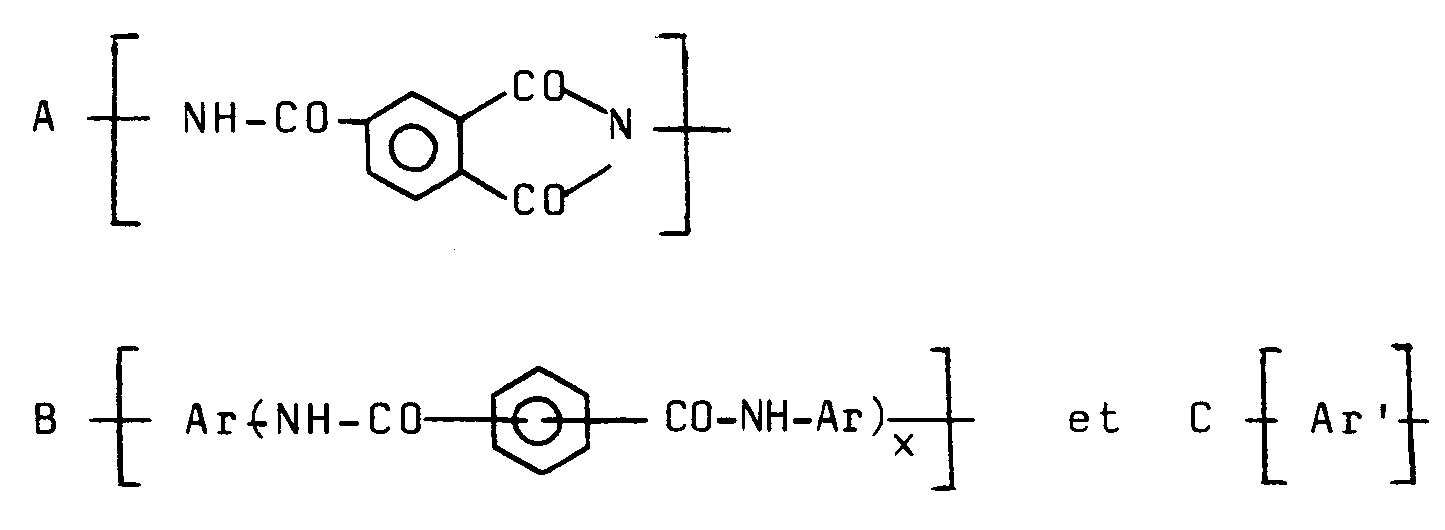
- thermoplastic aromatic polyamideimide copolymers according to the present invention comprise the structural units represented by formula wherein the radicals -Ar- are identical residual groups and (B+C) being at a ratio of 1 mole to 1 mole of A, C being at a ratio of 0.95 - 0.05 mole to 0.05 - 0.95 mole of B respectively, A and B or C being alternately interconnected and (Ar + Ar') being composed of 5 to 70 mole % of a bivalent residual group (Ar1) represented by formula and 95 to 30 mole % of a bivalent residual group (Ar2) represented by formula (wherein x is an integer from 1 to 500).
- thermoplastic PAI copolymers having structural-units represented by the formulae where Z could be a benzene residue, R could be H and X could be O. These copolymers were random copolymers as compared with the copolymers of the present invention, which show surprising advantages over the copolymers previously known from our above numbered patent application..
- thermoplastic PAI copolymers according to the present invention are mainly composed of the three units represented by the formulae A, B and C, components A and (B + C) being at a substantially-equal molar ratio, component A and B or C being alternately interconnected, and components B and C as diamine residual groups being at a ratio of 0.05 - 0.95 mole to 0.95 - 0.05 mole.
- the component Ar + Ar' of units B and C is composed of mixture of 2 components having following structures and ratios. wherein X, R1, (a) and (b) are as mentioned above.
- Unit Ar1 of (Ar + Ar') should not exceed 70 mole %. Otherwise the PAI copolymers obtained will conspicuously decrease in stiffness and mechanical strength. Unit Ar2 of (Ar + Ar') should not exceed 95 mole %. Otherwise the PAI copolymers obtained will conspicuously decrease in melt-moldability, heat characteristic or mechanical strength. So that the ratios Ar1 and Ar2 should be selected out of 5 to 70 mole %, preferably 15 to 60 mole %, and 95 to 30 mole %, preferably 85 to 40 mole % respectively.
- thermoplastic aromatic polyamideimide copolymers according to the present invention can include unit A' at the stage of an amic acid bond as ring-open precursor of imide bond in an amount less than 50 mole %, preferably less than 30 mole %, of unit A.
- unit B includes and
- PAI copolymers according to the present invention are producible by using any of a number of hitherto-proposed general production processes.
- the following three processes may be cited as representative highly-practicable ones.
- the acid chloride process is most recommendable among the aforementioned processes because of the advantages of easy preparation of raw materials and of highly-linear (less-branching structure),PAI copolymers of high degree of polymerization being readily obtainable.
- the acid chloride process for producing the PAI copolymers according to the present invention will be described hereinafter.
- dissolved in an organic polar solvent is 1 mole of an aromatic tricarboxylic acid monochloride anhydride, and 0.9 to 1.1 mole of a diamine mixture composed of 5 to 100 mole % of an aromatic diamine represented by formula I: and 95 to 0 mole % of an aromatic diamine represented by formula II: H2N-Ar'-NH2 (II) wherein Ar+Ar' is composed of 5 to 70 mole % of and 95 to 30 mole % of and (x) is an integer from 1 to 500.
- the resultant mixture is agitated at about 0.5 to 1 hour at the temperatures of from -20 to 80°C and its polymerization reaction is accelerated by adding about 0.8 to 1.2 mole of a hydrogen chloride scavenger if necessary.
- the reaction completes in 0.5 to 10 hours.
- the copolymer produced at this stage is so-called polyamide amic acid obtained by converting the greater part (e.g., 50 to 100%) of unit A of the PAI copolymers according to the present invention into a ring-open precursor amide amic acid unit:
- the organic polar solvents to be used for this first step include, N,N-dialkyl carboxylic acid amides such as N,N-dimethylacetoamide or N,N-diethylacetoamide; hetero cyclic compounds such as N-methylpyrrolidone, tetrahydrothiophene-1,1-dioxide or 1,3-dimethyl-2-imidazolidinone; and phenols such as cresol or xylenol.
- the hydrogen chloride scavengers to be added if necessary at the first step include aliphatic tertiary amines such as trimethylamine, triethylamine, tripropylamine or tributylamine; cyclic organic bases such as pyridine, lutidine, collidine or quinoline; and ethylene oxide or propylene oxide.
- the polyamide amic acid obtained at the first step undergoes the second dehydration ring-closure step for its conversion into polyamideimide copolymers according to the present invention.
- Ring closure reaction of dehydration is performed by liquid-phase process or solid-phase process.
- the former is divided into chemical dehydrator process and simple heating process.
- the chemical dehydrator process is performed by using aliphatic acid anhydrides such as acetic anhydride and propionic anhydride; P2O5; and other chemical dehydrators at the temperatures of 0 to 120°C, preferably 10 to 60°C.
- the latter is performed by heating polyamide amic acid solution at the temperatures of 50 to 400°C, preferably 100 to 250°C.
- azeotropic solvents useful for water removal such as benzene, toluene, xylene or chlorobenzene is effective.
- a polyamide amic acid polymer is separated from a polyamide amic acid solution obtained at the first step and next heat treated in solid state.
- proper conditions are generally selected out of the temperatures from 150 to 400°C and the time from 0.5 to 50 hours for securing sufficient ring closure percentage and melting fluidity. Treatment should not be continued at 250 to 400°C for an excessively long time. Otherwise the polymer itself will form a 3-dimensional bridging structure to considerably decrease in melting fluidity.
- Aromatic diamines (I) and (II) are obtained by attaching amino groups (-NH2) on the both sides of the bivalent aromatic residual groups of units B and C according to the present invention.
- a typical example of aromatic diamine (I), can be synthesized by a process consisting of producing by the reaction between at a mole ratio of 2/1 in the presence of an acid scavenger and hydrogen-reducing this dinitro compound in the presence of Raney nickel.
- Aromatic diamine (I) can be also synthesized by the reaction between and a considerable excess of and the recovery and purification of the resultant product.
- a multi-component mixture-of aromatic diamine (I) represented by general formula wherein (x) is an integer from 1 to 500 is obtained by the reaction between and excess mole of H2N-Ar-NH2 in a polar solvent.
- PAI copolymers according to the present invention are obtainable by the production processes described heretofore.
- Copolymerizable materials other than units A, B and C components can be used in combination for a reaction system in such quantities as to prevent any considerable decrease in melt-moldability and physical characteristics of the PAI copolymers to be produced according to the present invention.
- PAI copolymers Most of the imide units of the aromatic PAI copolymers according to the present invention have a closed ring structure, although some of the imide units remain an open ring amic acid bond in some cases.
- These PAI copolymers are high molecular weight polymers having a logarithmic viscosity ( ⁇ inh) more than 0.20, preferably more than 0.25 measured at a concentration of 0.5% by weight and at a temperature of 30°C in a N-methylpyrrolidone solvent, and can be used for the following various purposes.
- Compression molding is generally performed at the temperatures of 300 to 400°C and at the pressures of 50 to 500 kg/cm2 after dry blending into the powder of the PAI copolymers according to the present invention another kind of polymer, an additive, a filler and/or a reinforcer if necessary.
- Extrusion or injection molding is performed at the temperatures of 300 to 400°C supplying a dry blending mixture of a PAI copolymer according to the present invention with another kind of polymer, an additive, a filler, a reinforcer or a pellet thereof produced by using an extruder to a molding machine.
- the aromatic PAI copolymers according to the present invention are suitable for extrusion or injection molding because their heat stability and melt fluidity are balanced well at the temperatures of 300 to 400°C.
- the moldings improved more in heat deflection temperature, tensile strength, flexural strength, frictional wear resistance and other physical properties are obtainable by heat treating the heat melt-moldings of the PAI copolymers according to the present invention at high temperatures more than 200°C and less than their glass transition temperature, particularly more than 220°C and less than (the glass transition temperature -5°C), for more than 5 hours, particularly for more than 10 hours.
- Heat treatment temperature should not preferably exceed the glass transition temperature. Otherwise they will show a tendency of deformation to affect their practicability.
- Heat treatment apparatuses are not limited, and an ordinary electric heating oven is sufficient for achieving its purpose.
- a polymerization finish solution is applicable to dry or dry and wet type extruding process. And melt-molding is also possible after, if necessary, adding an appropriate additive to separated dry polymers.
- Their laminated boards are manufactured through a process consisting of impregnating a cloth or mat made from a glass, carbon, asbestos or other fiber with a polymer solution, obtaining a prepreg by the dry/heat hardening of the resultant impregnated body and pressing it at the temperatures of 200 to 400°C and at the pressures of 50 to 300 kg/cm2.
- the paints of the thermoplastic aromatic polyamideimide copolymers according to the present invention are produced by a process consisting of mixing a solvent to a polymerization finish solution if necessary and controlling the concentration of the resultant mixture for their practical use.
- the PAI copolymers according to the present invention are permitted to contain fillers such as (a) wear resistance improvers - graphite, carborundum, silica powder, molybdenum disulfide, flororesins, etc., (b) reinforcers - glass fiber, carbon fiber, boron fiber, silicon carbide fiber, carbon whisker, asbestos fiber, asbestos, metal fiber, etc., (c) non-inflammability improvers - antimony trioxide, magnesium carbonate, sodium carbonate, etc., (d) electric characteristic improvers - clay, mica, etc., (e) tracking resistance improvers - asbestos, silica, graphite, etc., (f) acid resistance improvers - barium sulfate, silica, calcium methasilicate, etc., (g) heat conductivity improvers - the powder of iron, zinc, aluminum, copper and other metals, (h) others - glass beads, glass balls, sodium carbonate, alumina, talc,
- the PAI copolymers according to the present invention are superior in melt-moldability because of their high heat stability and melt fluidity, provide well-balanced physical properties for their moldings and permit the efficient production of high-performance materials and moldings by extrusion or injection molding methods.
- the PAI copolymers composed of the structural units A, B and C represented by A, B and C being at a molar ratio of 100/30/70 are considerably superior to the conventionally-known ones composed of only structural units A and B or A and C in melting heat stability and melting moldability. They permit injection or extrusion molding because of their high heat stability and melt fluidity at the temperatures of 300 to 400°C.
- the present invention is capable of providing moldings having exceptionally-well balanced superior physical properties - a heat deflection temperature more than 287°C, a flexural strength more than 2,320 kg/cm2 and Izod impact strength more than 15 kg ⁇ cm/cm notched - after heat treatment.
- the materials and moldings of the PAI copolymers according to the present invention can be extensively used for manufacturing electric and electronic, aircraft and space unit, automotive, office machinery and other parts.
- the present invention will be described in further details in connection with their examples and comparative examples below.
- the logarithmic viscosity ( ⁇ inh) as the criterion of a molecular weight of polymers was measured at a concentration of 0.5% in an N-methyl-2-pyrrolidone solvent and at a temperature of 30°C.
- Their glass transition temperature Tg was measured by using an IB type DSC apparatus manufactured by Perkin Elmer.
- the IMAA having a purity of 99.5% was synthesized in the same manner as production example 1 except using an isophthalic acid dichloride (IPC) instead of TPC (melting point 239 - 240°C).
- IPC isophthalic acid dichloride
- the IPEA having a purity of 98.7% was synthesized in the same manner as production example 1 except using 460.3 gr. (2 mole) of 4-amino-4'-nitrodiphenyl ether instead of 276.3 gr. (2 mole) of m-nitroaniline.
- TMAC trimellitic acid monochloride anhydride
- a polymer was precipitated in a state of powder by gradually throwing the polymerization finish solution into water agitated at a high speed, washed with water sufficiently and dehydrated, dried in a hot-air drier at a temperature of 150°C for 5 hours and at a temperature of 200°C for 3 hours to obtain a polymer powder having such a logarithmic viscosity ( ⁇ inh) and such a glass transition temperature (Tg) as shown in "the characteristics of the polymers on the completion of polymerization" of Table 1.
- the copolymer obtained in Example 1 is represented by the following theoretical structural and molecular formulae:
- the pellets were compression molded (treatment temperatures 330 to 360°C, pressures 50 to 100 kg/cm2) to manufacture testpieces. They were dried in a hot-air drier at 150°C for 24 hours and heat treated at 220°C for 10 hours, at 245°C for 14 hours and 260°C for 48 hours. The results of measuring their physical properties were such as shown in column "the characteristics of heat treated moldings" of Table 1.
- Table 3 shows the results of measuring the characteristics before and after heat treatment of the testpieces obtained by the same polymerization, post-treatment, blending, extrusion and compression molding as Example 1 except using material diamines having such a composition as shown therein.
- Example 2 Supplied to the same apparatus as mentioned in Example 1 were 77.9 gr. (0.72 mole) of metaphenylenediamine (MPDA), 72.9 gr. (0.72 mole) of triethylamine and 3,000 gr. of DMAC, and the resultant mixture was agitated to obtain a uniform solution.
- the resultant reaction product was cooled in an ice bath, and 73.1 gr. (0.36 mole) of powdery TPC was added dividedly in a small amount each time at such a rate that its internal temperature does not exceed 30°C, and after the completion of addition, the resultant mixture was further subjected to reaction at a temperature of 10°C for 1 hour.
- a forerunner diamine containing mainly TMAA was synthesized.
- a polymer having: was obtained by the same procedure as described in Example 5 except that the quantities of MPDA, TPC, DDE and TMAC were changed to 77.9 gr. (0.72 mole), 109.6 gr. (0.54 mole), 144.2 gr. (0.72 mole) and 189.5 gr. (0.90 mole).
- Example 2 Supplied to the same apparatus as mentioned in Example 1 were 318 gr. (0.6 mole) IPEA synthesized in Production example 3, 64.9 gr. (0.6 mole) of MPDA and 3,000 gr. of N-methyl-2-pyrrolidone, and the resultant mixture was agitated to obtain a uniform solution.
- the resultant reaction product was cooled in an ice bath and 252.7 gr. (1.20 mole) of a trimellic acid monochloride anhydride was added dividedly in a small amount each time at such a rate that its internal temperature does not exceed 30°C, and the resultant mixture was further agitated at 30°C for 1 hour.
- the resultant reaction product was subjected to post-treatment, extrusion and molding same as in the latter part of Example 6 to obtain molded testpieces. They were put in a hot-air drier, and heat treated at 165°C for 24 hours, at 245°C for 24 hours and at 260°C for 48 hours. The following results were obtained by measuring their physcial properties:
Landscapes
- Chemical & Material Sciences (AREA)
- Health & Medical Sciences (AREA)
- Chemical Kinetics & Catalysis (AREA)
- Medicinal Chemistry (AREA)
- Polymers & Plastics (AREA)
- Organic Chemistry (AREA)
- Polymers With Sulfur, Phosphorus Or Metals In The Main Chain (AREA)
- Macromolecular Compounds Obtained By Forming Nitrogen-Containing Linkages In General (AREA)
Claims (12)
- Copolymère thermoplastique de polyamideimide aromatique, ayant une viscosité logarithmique η inh > 0,20 qui se compose principalement des unités de structure représentées par les formules

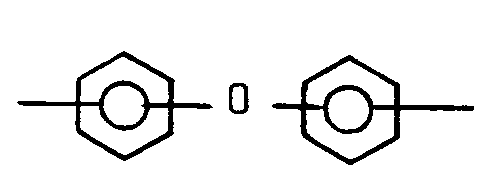
- Copolymère thermoplastique de polyamideimide aromatique selon la revendication 1, où Ar est

- Copolymère thermoplastique de polyamideimide aromatique selon la revendication 1, où Ar est
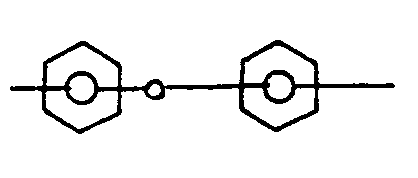
- Copolymère thermoplastique de polyamideimide aromatique selon la revendication 1 ou la revendication 2, où Ar' est

- Copolymère thermoplastique de polyamideimide aromatique selon toute revendication précédente, où Ar₁ est


- Copolymère thermoplastique de polyamideimide aromatique selon toute revendication précédente, où dans les unités représentées par B, (x) a diverses valeurs comprises entre 1 et 10.
- Copolymère thermoplastique de polyamideimide aromatique selon toute revendication 1 à 5, où (x) = 1.
- Copolymère thermoplastique de polyamideimide aromatique selon toute revendication précédente, à condition que jusqu'à 50% des unités représentées par A puissent avoir la forme de son précurseur de liaison d'acide amique A'.
- Procédé de production de copolymères thermoplastiques de polyamideimide aromatique comprenant l'étape (1) de production de l'acide amique du polyamide par la réaction de 0,9 à 1,1 moles d'un mélange de diamines composé de 5 à 95% en moles de la diamine (I) représentée par la formule



- Procédé de production de copolymères thermoplastiques de polyamideimide aromatique selon la revendication 9, où ladite diamine (I) est


- Procédé de production de copolymères thermoplastiques de polyamideimide aromatique selon la revendication 9 ou la revendication 10, où lesdits solvants polaires organiques sont choisis parmi N,N-diméthylacétoamide, N-méthylpyrrolidone et 1,3-diméthyl-2-imidazolidinone.
- Procédé de production de copolymères thermoplastiques de polyamideimide aromatique selon l'une quelconque des revendications 9 à 11, où ladite réaction de cyclisation de ladite étape (2) est accomplie à des températures de 150 à 400°C en phase solide.
Applications Claiming Priority (2)
| Application Number | Priority Date | Filing Date | Title |
|---|---|---|---|
| JP34537/85 | 1985-02-25 | ||
| JP60034537A JPS61195127A (ja) | 1985-02-25 | 1985-02-25 | 熱可塑性芳香族ポリアミドイミド共重合体 |
Publications (3)
| Publication Number | Publication Date |
|---|---|
| EP0193374A2 EP0193374A2 (fr) | 1986-09-03 |
| EP0193374A3 EP0193374A3 (en) | 1988-07-13 |
| EP0193374B1 true EP0193374B1 (fr) | 1994-04-13 |
Family
ID=12417032
Family Applications (1)
| Application Number | Title | Priority Date | Filing Date |
|---|---|---|---|
| EP86301319A Expired - Lifetime EP0193374B1 (fr) | 1985-02-25 | 1986-02-24 | Copolymères thermoplastiques de polyamideimide aromatique et procédé pour leur préparation |
Country Status (4)
| Country | Link |
|---|---|
| US (1) | US4831104A (fr) |
| EP (1) | EP0193374B1 (fr) |
| JP (1) | JPS61195127A (fr) |
| DE (1) | DE3689775T2 (fr) |
Families Citing this family (19)
| Publication number | Priority date | Publication date | Assignee | Title |
|---|---|---|---|---|
| US4968780A (en) * | 1988-06-28 | 1990-11-06 | Amoco Corporation | Polyamide, polyimide, and polyamide-imide polymers of diamino-t-butylbenzene |
| US5021517A (en) * | 1989-04-28 | 1991-06-04 | The United States Of America As Represented By The Secretary Of The Air Force | Process for the fabrication of rodlike polymer reinforced molecular composites into shaped articles |
| EP0483196A1 (fr) * | 1989-07-26 | 1992-05-06 | Akzo N.V. | Diamines a empechement sterique et polymeres prepares a partir de ces diamines |
| JPH0768348B2 (ja) * | 1989-12-21 | 1995-07-26 | 株式会社巴川製紙所 | ポリアミドイミド系ブロック共重合体の製造法 |
| JPH03234731A (ja) * | 1990-02-09 | 1991-10-18 | Teijin Ltd | 全芳香族ポリアミド及びその成型物 |
| US5464385A (en) * | 1990-06-27 | 1995-11-07 | Royce Medical Company | Walker with open heel |
| JP4584014B2 (ja) * | 2005-04-25 | 2010-11-17 | 日立マグネットワイヤ株式会社 | 耐部分放電性絶縁塗料、絶縁電線、及びそれらの製造方法 |
| KR20140057360A (ko) | 2011-08-29 | 2014-05-12 | 티코나 엘엘씨 | 고유동성 액정 중합체 조성물 |
| TW201319022A (zh) | 2011-08-29 | 2013-05-16 | Ticona Llc | 芳族醯胺化合物 |
| WO2013032979A1 (fr) | 2011-08-29 | 2013-03-07 | Ticona Llc | Polymérisation à l'état fondu de polymères cristallins liquides à faible viscosité à l'état fondu |
| US8906258B2 (en) | 2011-08-29 | 2014-12-09 | Ticona Llc | Heat-resistant liquid crystalline polymer composition having a low melting temperature |
| TW201319223A (zh) | 2011-08-29 | 2013-05-16 | Ticona Llc | 高流量液晶聚合物組合物 |
| TW201313884A (zh) | 2011-08-29 | 2013-04-01 | Ticona Llc | 液晶聚合物之固態聚合 |
| US8852730B2 (en) | 2011-08-29 | 2014-10-07 | Ticona Llc | Melt-extruded substrate for use in thermoformed articles |
| WO2013032975A1 (fr) | 2011-08-29 | 2013-03-07 | Ticona Llc | Polymère cristallin liquide thermotrope à viscosité à faible cisaillement améliorée |
| WO2013032967A1 (fr) | 2011-08-29 | 2013-03-07 | Ticona Llc | Pièces coulées au moule formées à partir d'un polymère cristallin liquide |
| WO2014130275A2 (fr) | 2013-02-22 | 2014-08-28 | Ticona Llc | Composition de polymères haute performance présentant des propriétés d'écoulement améliorées |
| CN105358657A (zh) | 2013-06-07 | 2016-02-24 | 提克纳有限责任公司 | 高强度热致液晶聚合物 |
| US10106702B2 (en) * | 2016-06-06 | 2018-10-23 | Cymer-Dayton, Llc | PAI-based coating compositions |
Family Cites Families (4)
| Publication number | Priority date | Publication date | Assignee | Title |
|---|---|---|---|---|
| US3984375A (en) * | 1963-12-12 | 1976-10-05 | Westinghouse Electric Corporation | Aromatic amide-imide polymers |
| US4313868A (en) * | 1980-04-30 | 1982-02-02 | Standard Oil Company (Indiana) | Glass filled polyamide-imide phthalamide copolymer |
| JPS5891724A (ja) * | 1981-11-26 | 1983-05-31 | Toray Ind Inc | 熱可塑性ポリアミドイミド共重合体 |
| JPS5891727A (ja) * | 1981-11-26 | 1983-05-31 | Toray Ind Inc | 耐熱性樹脂成形品の製造方法 |
-
1985
- 1985-02-25 JP JP60034537A patent/JPS61195127A/ja active Pending
-
1986
- 1986-02-24 DE DE3689775T patent/DE3689775T2/de not_active Expired - Fee Related
- 1986-02-24 EP EP86301319A patent/EP0193374B1/fr not_active Expired - Lifetime
-
1987
- 1987-07-31 US US07/080,630 patent/US4831104A/en not_active Expired - Lifetime
Also Published As
| Publication number | Publication date |
|---|---|
| US4831104A (en) | 1989-05-16 |
| EP0193374A2 (fr) | 1986-09-03 |
| DE3689775T2 (de) | 1994-09-29 |
| EP0193374A3 (en) | 1988-07-13 |
| DE3689775D1 (de) | 1994-05-19 |
| JPS61195127A (ja) | 1986-08-29 |
Similar Documents
| Publication | Publication Date | Title |
|---|---|---|
| EP0193374B1 (fr) | Copolymères thermoplastiques de polyamideimide aromatique et procédé pour leur préparation | |
| JPS62225530A (ja) | 熱可塑的に加工できる芳香族ポリアミドの製造方法 | |
| EP0017422B1 (fr) | Copolymères polyamide-imide thermoplastiques et procédé de préparation | |
| JPS62156130A (ja) | ポリアミドおよびその用途 | |
| JPS61195128A (ja) | 成形用ポリアミドイミド共重合体の製造方法 | |
| JP2005120001A (ja) | フッ化ジニトロモノマー、フッ化ジアミンモノマーおよびフッ化ジアミンモノマーから調製されたフッ化ポリアミドとフッ化ポリイミド | |
| JPH0742355B2 (ja) | 熱可塑性芳香族ポリアミドイミド共重合体 | |
| JPH0125331B2 (fr) | ||
| JPH0531574B2 (fr) | ||
| JPH0297527A (ja) | 熱可塑性芳香族ポリアミドイミド共重合体 | |
| JPS62209137A (ja) | 熱可塑性芳香族ポリアミドイミド共重合体 | |
| JP2512803B2 (ja) | 芳香族ポリアミド | |
| JPH01149830A (ja) | 熱可塑性芳香族ポリイミド重合体 | |
| JPH01292034A (ja) | ポリ(アミドベンゾオキサゾール)樹脂の製造方法 | |
| JPH0551015B2 (fr) | ||
| JP3688097B2 (ja) | 結晶性樹脂組成物 | |
| JPS61136522A (ja) | 熱可塑性芳香族ポリアミドイミド重合体 | |
| JPS60190425A (ja) | 結晶性ポリアミド系樹脂の製造方法 | |
| JPH0531575B2 (fr) | ||
| JPH0757804B2 (ja) | 熱可塑性芳香族ポリアミドイミド共重合体 | |
| JPS62177020A (ja) | 熱可塑性芳香族ポリアミド共重合体 | |
| JPH0331731B2 (fr) | ||
| JPH0551016B2 (fr) | ||
| JPH0331730B2 (fr) | ||
| JPS63221124A (ja) | ポリアミド |
Legal Events
| Date | Code | Title | Description |
|---|---|---|---|
| PUAI | Public reference made under article 153(3) epc to a published international application that has entered the european phase |
Free format text: ORIGINAL CODE: 0009012 |
|
| AK | Designated contracting states |
Kind code of ref document: A2 Designated state(s): DE FR GB NL |
|
| PUAL | Search report despatched |
Free format text: ORIGINAL CODE: 0009013 |
|
| AK | Designated contracting states |
Kind code of ref document: A3 Designated state(s): DE FR GB NL |
|
| 17P | Request for examination filed |
Effective date: 19880905 |
|
| 17Q | First examination report despatched |
Effective date: 19900823 |
|
| GRAA | (expected) grant |
Free format text: ORIGINAL CODE: 0009210 |
|
| RBV | Designated contracting states (corrected) |
Designated state(s): DE FR GB |
|
| AK | Designated contracting states |
Kind code of ref document: B1 Designated state(s): DE FR GB |
|
| REF | Corresponds to: |
Ref document number: 3689775 Country of ref document: DE Date of ref document: 19940519 |
|
| ET | Fr: translation filed | ||
| PLBE | No opposition filed within time limit |
Free format text: ORIGINAL CODE: 0009261 |
|
| STAA | Information on the status of an ep patent application or granted ep patent |
Free format text: STATUS: NO OPPOSITION FILED WITHIN TIME LIMIT |
|
| 26N | No opposition filed | ||
| PGFP | Annual fee paid to national office [announced via postgrant information from national office to epo] |
Ref country code: FR Payment date: 20010213 Year of fee payment: 16 |
|
| PGFP | Annual fee paid to national office [announced via postgrant information from national office to epo] |
Ref country code: GB Payment date: 20010221 Year of fee payment: 16 Ref country code: DE Payment date: 20010221 Year of fee payment: 16 |
|
| REG | Reference to a national code |
Ref country code: GB Ref legal event code: IF02 |
|
| PG25 | Lapsed in a contracting state [announced via postgrant information from national office to epo] |
Ref country code: GB Free format text: LAPSE BECAUSE OF NON-PAYMENT OF DUE FEES Effective date: 20020224 |
|
| PG25 | Lapsed in a contracting state [announced via postgrant information from national office to epo] |
Ref country code: DE Free format text: LAPSE BECAUSE OF NON-PAYMENT OF DUE FEES Effective date: 20020903 |
|
| GBPC | Gb: european patent ceased through non-payment of renewal fee |
Effective date: 20020224 |
|
| PG25 | Lapsed in a contracting state [announced via postgrant information from national office to epo] |
Ref country code: FR Free format text: LAPSE BECAUSE OF NON-PAYMENT OF DUE FEES Effective date: 20021031 |
|
| REG | Reference to a national code |
Ref country code: FR Ref legal event code: ST |