EP0196174A2 - Moyens pour la synthèse séquentielle organique en phase solide et les méthodes de leurs emplois - Google Patents
Moyens pour la synthèse séquentielle organique en phase solide et les méthodes de leurs emplois Download PDFInfo
- Publication number
- EP0196174A2 EP0196174A2 EP86301587A EP86301587A EP0196174A2 EP 0196174 A2 EP0196174 A2 EP 0196174A2 EP 86301587 A EP86301587 A EP 86301587A EP 86301587 A EP86301587 A EP 86301587A EP 0196174 A2 EP0196174 A2 EP 0196174A2
- Authority
- EP
- European Patent Office
- Prior art keywords
- subunits
- linked
- particles
- synthesis
- particle
- Prior art date
- Legal status (The legal status is an assumption and is not a legal conclusion. Google has not performed a legal analysis and makes no representation as to the accuracy of the status listed.)
- Granted
Links
Images

Classifications
-
- C—CHEMISTRY; METALLURGY
- C07—ORGANIC CHEMISTRY
- C07K—PEPTIDES
- C07K1/00—General methods for the preparation of peptides, i.e. processes for the organic chemical preparation of peptides or proteins of any length
- C07K1/04—General methods for the preparation of peptides, i.e. processes for the organic chemical preparation of peptides or proteins of any length on carriers
-
- B—PERFORMING OPERATIONS; TRANSPORTING
- B01—PHYSICAL OR CHEMICAL PROCESSES OR APPARATUS IN GENERAL
- B01J—CHEMICAL OR PHYSICAL PROCESSES, e.g. CATALYSIS OR COLLOID CHEMISTRY; THEIR RELEVANT APPARATUS
- B01J19/00—Chemical, physical or physico-chemical processes in general; Their relevant apparatus
- B01J19/0046—Sequential or parallel reactions, e.g. for the synthesis of polypeptides or polynucleotides; Apparatus and devices for combinatorial chemistry or for making molecular arrays
-
- B—PERFORMING OPERATIONS; TRANSPORTING
- B01—PHYSICAL OR CHEMICAL PROCESSES OR APPARATUS IN GENERAL
- B01J—CHEMICAL OR PHYSICAL PROCESSES, e.g. CATALYSIS OR COLLOID CHEMISTRY; THEIR RELEVANT APPARATUS
- B01J2219/00—Chemical, physical or physico-chemical processes in general; Their relevant apparatus
- B01J2219/00274—Sequential or parallel reactions; Apparatus and devices for combinatorial chemistry or for making arrays; Chemical library technology
- B01J2219/00277—Apparatus
- B01J2219/00279—Features relating to reactor vessels
- B01J2219/00281—Individual reactor vessels
- B01J2219/00295—Individual reactor vessels the reactor vessels having pervious side walls
- B01J2219/00297—"Tea bags"
-
- B—PERFORMING OPERATIONS; TRANSPORTING
- B01—PHYSICAL OR CHEMICAL PROCESSES OR APPARATUS IN GENERAL
- B01J—CHEMICAL OR PHYSICAL PROCESSES, e.g. CATALYSIS OR COLLOID CHEMISTRY; THEIR RELEVANT APPARATUS
- B01J2219/00—Chemical, physical or physico-chemical processes in general; Their relevant apparatus
- B01J2219/00274—Sequential or parallel reactions; Apparatus and devices for combinatorial chemistry or for making arrays; Chemical library technology
- B01J2219/00277—Apparatus
- B01J2219/00452—Means for the recovery of reactants or products
- B01J2219/00454—Means for the recovery of reactants or products by chemical cleavage from the solid support
-
- B—PERFORMING OPERATIONS; TRANSPORTING
- B01—PHYSICAL OR CHEMICAL PROCESSES OR APPARATUS IN GENERAL
- B01J—CHEMICAL OR PHYSICAL PROCESSES, e.g. CATALYSIS OR COLLOID CHEMISTRY; THEIR RELEVANT APPARATUS
- B01J2219/00—Chemical, physical or physico-chemical processes in general; Their relevant apparatus
- B01J2219/00274—Sequential or parallel reactions; Apparatus and devices for combinatorial chemistry or for making arrays; Chemical library technology
- B01J2219/00277—Apparatus
- B01J2219/00457—Dispensing or evacuation of the solid phase support
- B01J2219/00459—Beads
- B01J2219/00461—Beads and reaction vessel together
-
- B—PERFORMING OPERATIONS; TRANSPORTING
- B01—PHYSICAL OR CHEMICAL PROCESSES OR APPARATUS IN GENERAL
- B01J—CHEMICAL OR PHYSICAL PROCESSES, e.g. CATALYSIS OR COLLOID CHEMISTRY; THEIR RELEVANT APPARATUS
- B01J2219/00—Chemical, physical or physico-chemical processes in general; Their relevant apparatus
- B01J2219/00274—Sequential or parallel reactions; Apparatus and devices for combinatorial chemistry or for making arrays; Chemical library technology
- B01J2219/00277—Apparatus
- B01J2219/00497—Features relating to the solid phase supports
- B01J2219/005—Beads
-
- B—PERFORMING OPERATIONS; TRANSPORTING
- B01—PHYSICAL OR CHEMICAL PROCESSES OR APPARATUS IN GENERAL
- B01J—CHEMICAL OR PHYSICAL PROCESSES, e.g. CATALYSIS OR COLLOID CHEMISTRY; THEIR RELEVANT APPARATUS
- B01J2219/00—Chemical, physical or physico-chemical processes in general; Their relevant apparatus
- B01J2219/00274—Sequential or parallel reactions; Apparatus and devices for combinatorial chemistry or for making arrays; Chemical library technology
- B01J2219/00277—Apparatus
- B01J2219/0054—Means for coding or tagging the apparatus or the reagents
- B01J2219/00542—Alphanumeric characters
-
- B—PERFORMING OPERATIONS; TRANSPORTING
- B01—PHYSICAL OR CHEMICAL PROCESSES OR APPARATUS IN GENERAL
- B01J—CHEMICAL OR PHYSICAL PROCESSES, e.g. CATALYSIS OR COLLOID CHEMISTRY; THEIR RELEVANT APPARATUS
- B01J2219/00—Chemical, physical or physico-chemical processes in general; Their relevant apparatus
- B01J2219/00274—Sequential or parallel reactions; Apparatus and devices for combinatorial chemistry or for making arrays; Chemical library technology
- B01J2219/00277—Apparatus
- B01J2219/0054—Means for coding or tagging the apparatus or the reagents
- B01J2219/00554—Physical means
- B01J2219/00558—Cuts-out
-
- B—PERFORMING OPERATIONS; TRANSPORTING
- B01—PHYSICAL OR CHEMICAL PROCESSES OR APPARATUS IN GENERAL
- B01J—CHEMICAL OR PHYSICAL PROCESSES, e.g. CATALYSIS OR COLLOID CHEMISTRY; THEIR RELEVANT APPARATUS
- B01J2219/00—Chemical, physical or physico-chemical processes in general; Their relevant apparatus
- B01J2219/00274—Sequential or parallel reactions; Apparatus and devices for combinatorial chemistry or for making arrays; Chemical library technology
- B01J2219/00583—Features relative to the processes being carried out
- B01J2219/0059—Sequential processes
-
- B—PERFORMING OPERATIONS; TRANSPORTING
- B01—PHYSICAL OR CHEMICAL PROCESSES OR APPARATUS IN GENERAL
- B01J—CHEMICAL OR PHYSICAL PROCESSES, e.g. CATALYSIS OR COLLOID CHEMISTRY; THEIR RELEVANT APPARATUS
- B01J2219/00—Chemical, physical or physico-chemical processes in general; Their relevant apparatus
- B01J2219/00274—Sequential or parallel reactions; Apparatus and devices for combinatorial chemistry or for making arrays; Chemical library technology
- B01J2219/00583—Features relative to the processes being carried out
- B01J2219/00592—Split-and-pool, mix-and-divide processes
-
- B—PERFORMING OPERATIONS; TRANSPORTING
- B01—PHYSICAL OR CHEMICAL PROCESSES OR APPARATUS IN GENERAL
- B01J—CHEMICAL OR PHYSICAL PROCESSES, e.g. CATALYSIS OR COLLOID CHEMISTRY; THEIR RELEVANT APPARATUS
- B01J2219/00—Chemical, physical or physico-chemical processes in general; Their relevant apparatus
- B01J2219/00274—Sequential or parallel reactions; Apparatus and devices for combinatorial chemistry or for making arrays; Chemical library technology
- B01J2219/00583—Features relative to the processes being carried out
- B01J2219/00596—Solid-phase processes
-
- B—PERFORMING OPERATIONS; TRANSPORTING
- B01—PHYSICAL OR CHEMICAL PROCESSES OR APPARATUS IN GENERAL
- B01J—CHEMICAL OR PHYSICAL PROCESSES, e.g. CATALYSIS OR COLLOID CHEMISTRY; THEIR RELEVANT APPARATUS
- B01J2219/00—Chemical, physical or physico-chemical processes in general; Their relevant apparatus
- B01J2219/00274—Sequential or parallel reactions; Apparatus and devices for combinatorial chemistry or for making arrays; Chemical library technology
- B01J2219/00718—Type of compounds synthesised
- B01J2219/0072—Organic compounds
- B01J2219/00725—Peptides
-
- C—CHEMISTRY; METALLURGY
- C40—COMBINATORIAL TECHNOLOGY
- C40B—COMBINATORIAL CHEMISTRY; LIBRARIES, e.g. CHEMICAL LIBRARIES
- C40B40/00—Libraries per se, e.g. arrays, mixtures
- C40B40/04—Libraries containing only organic compounds
- C40B40/10—Libraries containing peptides or polypeptides, or derivatives thereof
-
- C—CHEMISTRY; METALLURGY
- C40—COMBINATORIAL TECHNOLOGY
- C40B—COMBINATORIAL CHEMISTRY; LIBRARIES, e.g. CHEMICAL LIBRARIES
- C40B50/00—Methods of creating libraries, e.g. combinatorial synthesis
- C40B50/14—Solid phase synthesis, i.e. wherein one or more library building blocks are bound to a solid support during library creation; Particular methods of cleavage from the solid support
-
- C—CHEMISTRY; METALLURGY
- C40—COMBINATORIAL TECHNOLOGY
- C40B—COMBINATORIAL CHEMISTRY; LIBRARIES, e.g. CHEMICAL LIBRARIES
- C40B60/00—Apparatus specially adapted for use in combinatorial chemistry or with libraries
- C40B60/14—Apparatus specially adapted for use in combinatorial chemistry or with libraries for creating libraries
-
- C—CHEMISTRY; METALLURGY
- C40—COMBINATORIAL TECHNOLOGY
- C40B—COMBINATORIAL CHEMISTRY; LIBRARIES, e.g. CHEMICAL LIBRARIES
- C40B70/00—Tags or labels specially adapted for combinatorial chemistry or libraries, e.g. fluorescent tags or bar codes
-
- Y—GENERAL TAGGING OF NEW TECHNOLOGICAL DEVELOPMENTS; GENERAL TAGGING OF CROSS-SECTIONAL TECHNOLOGIES SPANNING OVER SEVERAL SECTIONS OF THE IPC; TECHNICAL SUBJECTS COVERED BY FORMER USPC CROSS-REFERENCE ART COLLECTIONS [XRACs] AND DIGESTS
- Y02—TECHNOLOGIES OR APPLICATIONS FOR MITIGATION OR ADAPTATION AGAINST CLIMATE CHANGE
- Y02P—CLIMATE CHANGE MITIGATION TECHNOLOGIES IN THE PRODUCTION OR PROCESSING OF GOODS
- Y02P20/00—Technologies relating to chemical industry
- Y02P20/50—Improvements relating to the production of bulk chemicals
- Y02P20/55—Design of synthesis routes, e.g. reducing the use of auxiliary or protecting groups
-
- Y—GENERAL TAGGING OF NEW TECHNOLOGICAL DEVELOPMENTS; GENERAL TAGGING OF CROSS-SECTIONAL TECHNOLOGIES SPANNING OVER SEVERAL SECTIONS OF THE IPC; TECHNICAL SUBJECTS COVERED BY FORMER USPC CROSS-REFERENCE ART COLLECTIONS [XRACs] AND DIGESTS
- Y10—TECHNICAL SUBJECTS COVERED BY FORMER USPC
- Y10T—TECHNICAL SUBJECTS COVERED BY FORMER US CLASSIFICATION
- Y10T428/00—Stock material or miscellaneous articles
- Y10T428/13—Hollow or container type article [e.g., tube, vase, etc.]
- Y10T428/1334—Nonself-supporting tubular film or bag [e.g., pouch, envelope, packet, etc.]
- Y10T428/1345—Single layer [continuous layer]
Definitions
- the present invention relates to organic synthesis, and more specifically to those syntheses that are carried out on a solid phase support and in which a plurality of chemically similar subunits are coupled to the solid phase to form a sequence of subunits.
- polypeptide analogs containing a variety of single amino acid substitutions at a given point, or polypeptides shortened at the carboxyl-terminus in the polypeptide chain until now, a separate synthesis for each of those polypeptides was required. This is true even though all of the deprotecting, washing, neutralization, and coupling steps for each polypeptide are identical except at the position varied.
- the present invention contemplates a means for carrying out a sequential solid phase organic synthesis to form a reaction product molecule that contains a plurality of reacted subunits.
- that means comprises a foraminous container that encloses a known quantity of reactive particles. Each of those reactive particles is of a size that is larger then any of the foraminae.
- the particles contain a known amount of covalently linked organic synthesis reactive functionality that is capable of reacting during the organic synthesis being performed.
- the container and the particles are substantially insoluble in water and in organic solvents, do not react with any chemicals used in the synthesis, and in particularly preferred practice are non-reactive with hydrogen fluoride.
- a particularly preferred synthesis means contains a known quantity of solid support particles, which are preferably hydrophobic, solid phase resin beads, enclosed therein. Those particles have a known amount of identical organic synthesis subunits covalently linked to the particles by selectively severable covalent bonds.
- each of the subunits contains a functional group that is capable of reacting during the organic synthesis but is protected from so reacting by a selectively removable, covalently linked protecting group.
- Particularly preferred subunits are selected from the group consisting of (i) an.alpha amino group-protected amino acid residue and (ii) an alpha amino group-protected and reactive side chain protected amino acid residue.
- Methods of carrying out sequential, solid phase organic syntheses to form a reaction product containing a plurality of desired reacted subunits of a predetermined sequence are also contemplated.
- Another aspect of the methods contemplates the steps of:
- Another aspect of this invention is a method for simultaneously covelently bonding a subunit to each of a plurality of particle-linked subunits without intermingling subunit. This method comprises the steps of:
- the present invention provides several benefits and advantages.
- a particular advantage of this invention is that several particle-linked subunit sequences that require the addition of one or more of the same subunits may be reacted together without inseparable intermingling of the particle-linked subunit sequences.
- Another benefit of the present invention is that 10-20 milligram quantities of each of hundreds subunit sequences may be routinely prepared in a one-month period of time or less at a minimum of expense.
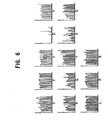
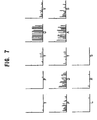
- Each of the thirteen bar graphs has a horizontal line on the ordinate that represents 100 percent binding of the monoclonal antibody to the natural sequence.
- the capital letters below each graph are the single letter code for each residue position in the sequence.
- Each vertical line in each graph represents the binding of the monoclonal antibody to a polypeptide antigen prepared with the amino acid residue noted below the graph replaced by another amino acid residue; the order of replacing amino acid residues in each graph being in the order of decreasing hydrophobicity, from left to right in each graph, and using the single letter amino acid code: W, F, L, I, Y, V, C, M, P, A, E, G, R, H, D, T, K, Q, S, N.
- the present invention contemplates a means for carrying out a solid phase organic synthesis to form a reaction product molecule containing a plurality of reacted subunits present in a known sequence of subunits.
- Solid phase organic synthesis is the preparation of organic molecules such as polypeptides and oligo- or polynucleotides on a solid phase support such as particles of resin, glass or glass-resin composites.
- organic molecules such as polypeptides and oligonucleotides prepared by such techniques as utilized in this invention contain two or more subunits such as amino acid or nucleotide residues reacted together by peptide or phosphate bonds, respectively, to form a covalently linked sequence of subunits in which the sequence is known from the reaction conditions employed; i.e., the order in which subunits of known identity were reacted.
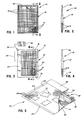
- Each synthesis means shown generally in the Figures by the numeral 10, is comprised of a foraminous container 12 that encloses a known quantity of solid phase synthesis particles 14.
- the container does not chemically react with and is substantially insoluble in water, acids such as 6 normal sulfuric acid and anhydrous hydrogen fluoride, bases such as 10 normal sodium hydroxide, and organic solvents such as acetone, benzene, toluene, xylene, ethyl acetate, dimethyl sulfoxide, methylene chloride, chloroform, dimethyl acetamide, N-methyl pyrrolidone, dimethyl formamide and the like.
- the container is substantially inert to reaction or dissolution with common laboratory liquids.
- Suitable containers are preferably prepared from polymerized ethylene, propylene and mixtures thereof. Stainless steel and polytetrafluoroethylene may also be utilized as the containers.
- Each container 12 includes a sufficient number of foraminae or openings 16 to permit ready entrance and exit of solvent and solute molecules at the reaction temperature, which is typically that of the ambient air of a laboratory.
- the container is prepared from a woven polypropylene mesh, and the foraminae 16 are the interstices between the woven fibers.
- suitably inactive perforate or porous materials can be readily employed, such as a perforated sheet or a non-woven fabric sheet material.
- the foraminae 16 are of a size that is smaller than any of the enclosed reactive particles 14.
- the particles 14 are of a size that is larger than any of the foraminae.
- Exemplary polypropylene mesh is available having interstices of about 35 to about 100 microns.
- the mesh foraminae 16 are of a size to retain particles 14 that are retained on a 140 to a 400 standard sieve mesh. More preferably, particles 14 are retained within the foraminae that are retained on a 200 to 400 standard sieve mesh.
- the foraminae 16 are large enough to permit draining of all solvents used during a solid phase synthesis within a time period of about five minutes, and more preferably, within a time period of about three minutes, the draining times being measured at the temperature of the organic reaction. While containers 12 shown in Figures 1-4 are each illustrated as being substantially completely foraminous (i.e., each being formed substantially entirely from mesh materials) it is to be understood synthesis means embodying the principles disclosed herein can be partially foraminous if desired.
- the containers 12 enclose the reactive particles 14 and to do so are sealed by a closure means after a quantity of such particles is placed therewithin.
- closure means include stitching 20 (see embodiment of Figure 1), weaving or stapling the container closed with a material that is as substantially inert to the reaction conditions employed as is the container itself.
- Exemplary of such materials are filaments of polymerized ethylene, propylene, ethylene-co-propylene polymers and stainless steel.
- containers such as those made from polypropylene mesh are heat-sealed closed, and the closure means is thus a substantially continuous heat-seal, such as shown at 18, 20 and 22 in the embodiment of Figures 3 and 4.
- the containers also preferably include a means for identification 30.
- the identification means may be a portion of the container such as a flattened, heat-sealed surface at 22 ( Figure 3) that extends from or is a portion of the container.
- a tab 30 capable of bearing indicia that may be integral to the synthesis means or may be separately affixed to a container by a means such as heat-sealing or a filament 36 that is substantially inert to the reaction conditions, as described hereinbefore, may also be used.
- the containers 12 may also be identified by cuts or notches 38 placed in a heat sealed edge.
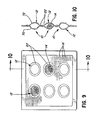
- a plurality of synthesis means 10 may also be integrally formed with each other from preferably heat-sealable sheets 70 and 72, at least one of which is foraminous, as is shown in Figures 9 and 10.
- Each of the synthesis means so formed may be the same size, smaller or larger than the previously described individual synthesis means, and contain particles 14 similar to those already described.
- the sheets 70 and 72 utilized to form the plurality of synthesis means are formed from polypylene, polyethylene or a polyethylene-polypropylene copolymer mesh, and are heat-sealed at 22 to form the integral plurality of individual synthesis means containers 12.
- a suitable surface capable of bearing indicia may be formed by heat sealing the peripheral edges of the foraminous sheets 70 and 72.
- the mesh of the sheets 70 and 72 provides the foraminae 16 for the containers 12.
- a container of a synthesis means of this invention encloses a known quantity of solid phase synthesis particles 14.
- the particles 14 may be comprised of one or more constituents and include a covalently linked reactive functionality or a subunit covalently linked to the particle by a selectively severable bond.
- particles are also referred to in the art as solid supports.
- solid supports The phrases “particle” and “solid support” and their plurals are used interchangeably herein.
- solid supports containing covalently linked reactive functionalities have been described in the chemical and biochemical literature, and any such support may be utilized so long as the solid support is insoluble in water, in the before-mentioned organic solvents and is substantially chemically inert to the reaction conditions utilized, as discussed before for the containers.
- the solid support preferably swells in the solvents utilized during the synthesis due to physical, rather than chemical processes.
- the solid supports typically fall into one of three general types, each of which is discussed below.
- the polymerized resins are generally in the form of porous beads.
- the hydrophobic polymerized styrene cross-linked with divinyl benzene (typically at about 0.5 to about 2 weight percent) resins are the most often utilized, especially for polypeptide syntheses.
- the resin beads so prepared are further reacted to provide a known quantity of a benzyl moiety as a portion of the polymerized resin.
- the benzyl moiety contains a reactive functional group through which the subunits of the sequence to be synthesized may be covalently linked by a selectively severable bond.
- the reactive benzyl moieties are typically added after the resin bead has been synthesized by reaction of a polymerized styrene moiety, such resins are herein generally described as polymerized styrene cross-linked with divinyl benzene and including a known amount of polymerized vinyl benzyl moiety.
- the reactive functionality of the benzyl moiety is typically selected from the group consisting of aminobenzyl and halobenzyl such as chlorobenzyl.
- Polymerized, cross-linked styrene resins containing chlorobenzyl moieties are sometimes referred to in the art as chloromethyl styrene resins, while resins containing aminobenzyl moieties are sometimes referred to as amino-styrene or aminomethyl-styrene resins.
- subunit/particle link formed between a particle containing aminobenzyl moiety and a carboxylic acid is not readily cleavable under usual conditions of synthesis.
- such particles are used with severable linking groups between the particle and first linked subunit, where a free subunit reaction product is desired to be recovered.
- Additional useful resin particles are those materials referred to by East et al., J. Immunol., 17, 519-525 (1980) as macroreticular resins. Those resins are said to be prepared from cross-linked polystyrene and to include a reactive aminobenzyl moiety. The described resin particles contain pores of a large enough cross-section to permit entry of antibodies and immunoreaction of those antibodies with the synthesized polypeptide.
- the macroreticular resins were reported to be obtained from Rohm & Haas under the trademark designation XE-225A.
- Resins containing a known amount of chlorobenzyl moieties may be purchased from Sigma Chemical Co., St. Louis, MO under the trademark names Merrifield's Peptide Resin. (chlorpmethylated co-polystyrene divinylbenzene). Such materials are typically supplied containing about 0.1 to about 2 milliequivalents of chlorine per gram of particle.
- the aminobenzyl group may be prepared from polymerized styrene cross-linked with divinyl benzene by reaction with N-(hydroxymethyl)phthalimide under Friedel-Crafts conditions followed by hydrazinolysis of the phthalimide group as is described by Kent Merrifield, Israel J. Chem., 17, 243-247 (1978). Particles containing reactive aminobenzyl moieties are also commercially available from Pierce Chemical Company of Rockford IL and are reported to contain about 0.3 to about 0.7 millimoles of aminobenzyl moiety per gram of particles.
- polystyrene-based particles are frequently used in the synthesis of polypeptides in which the carboxyl-terminal amino acid residue (subunit) is bonded through a selectively severable covalent bond to the polymerized, reactive vinyl benzyl moeity of the resin.
- Benzyl ester bonds between the polystyrene-based particle and subunit are stable in the presence of relatively mild acids, but sever when treated with strong acids such as hydrofluoric acd or a mixture of acetic and hydrobromic acids.
- Polypeptide syntheses are typically carried out using mild acid-sensitive protecting groups on the alpha amino groups such as N-tert-butoxycarbonyl (BOC), while using other, strong acid-sensitive protecting groups on reactive side chains.
- a newly developed disulfide-containing linking group that may be bonded to a benzylamine of a before-described resin particle may be utilized to alleviate some of the difficulties encountered in using HF to sever the polypeptide reaction product and to remove side chain protecting groups.
- a precursor to that linking group is represented by the formula: wherein BOC is tert-butoxycarbonyl, and x is a numeral having the value of zero or one, such that when x is zero, the parenthesized CH 2 group is absent.
- the carboxyl group of the linking group is bonded to the amino group of a polymerized vinyl benzyl moiety of a reactive resin-containing particle using standard peptide amide bond-forming techniques such as via the anhydride or with dicyclohexylcarbodiimide.
- the BOC group is thereafter removed using mild acid as is well known, the resulting ammonium salt is neutralized to provide a free primary amine and the resulting free primary amine-containing particles are rinsed to remove any excess base-containing reagent used in the neturalization step.
- the first amino acid subunit is thereafter coupled through its carboxylic acid group to the free primary amine to form a particle-linked subunit.
- the amino acid residue is linked to the resin through an amide bond between the carboxyl group of the amino acid and the amino group of the disulfide-containing linking group that is itself bonded by an amide bond to the polymerized vinyl benzyl moiety of the resin.
- the resulting linking group written in the direction from left to right and from the amino acid residue toward the benzyl moiety, is represented by the formula: where x is as before-described.
- linking group with any amino acid that may be designated "Z" coupled through its carboxyl group and with the particle bonded through its polymerized vinyl benzyl moiety may be written as described above:
- a particular benefit of using the above-described linking group is that its amide and disulfide bonds are stable to contact with HF and other strong acids used to selectively remove amino acid side chains. Consequently, such acids may be used to remove the side chains of the polypeptide reaction product while that reaction product is still linked to the resin particle. That selective removal permits the removed side chain protecting groups to be rinsed away from the reaction product-linked resin particle and thereby provides easier purification of the polypeptide reaction product.
- the polypeptide-linked resin particle is thereafter contacted with a disulfide bond-breaking agent to selectively sever the polypeptide reaction product from the resin particle.
- the severed polypeptide reaction product may thereafter be recovered in relatively pure form using standard procedures such as extraction of the severed reaction product/particle mixture formed with an aqueous composition containing 5% acetic acid.
- the extracted composition may thereafter be lyophilized to provide the reaction product.
- the reaction product may also be further purified as is known prior to its ultimate recovery.
- reagents are well known to be useful for breaking the disulfide bond.
- exemplary reagents include sodium borohydride, 2-mercaptoethanol, 2-mercaptoethylamine, dithiothreitol and dithioerythritol.
- Mercaptan-containing carboxylic acids having two to three carbon atoms and their alkali metal and ammonium salts are also useful.
- Those reagents include thioglycolic acid, thiolactic acid and 3-mercaptopropionic acid.
- Exemplary salts include sodium thioglycolate, potassium thiolactate, ammonium 3-mercaptopropionate and (2-hydroxyethyl)ammonium thioglycolate.
- the disulfide-containing BOC-protected linking group precursor may be prepared by standard techniques. For example 2-aminoethyl disulfide may be reacted with two moles of 2-(tert-butoxycarbonyloxylmino)-2-phenylacetonitrile or N-(tert-butoxycarbonyloxy)phthalimide or a similar reagent to form bis-N-BOC-2-aminoethyl disulfide. That disulfide may then be reacted with thioglycolic acid or 3-mercaptopropionic acid to form the precursor shown above.
- the polyacrylamide-based resin particles are relatively more hydrophilic than are the polystyrene-based resin particles and are usually used with polar aprotic solvents.
- exemplary solvents include dimethylformamide, dimethylacetamide, N-methylpyrrolidone and the like.
- a second group of solid supports is based on silica-containing particles such as porous glass beads and silica gel.
- silica-containing particles such as porous glass beads and silica gel.
- Parr and Grohmann, Angew. Chem. internal. Ed., 11, 314-315 (1972) reported on the use of the reaction product of trichloro-[3-(4-chloromethylphenyl]propyllsilane and porous glass beads (sold under the trademark PORASIL E by Waters Associates, Framingham, MA) as solid support for polypeptide syntheses.
- the third general type of useful solid support may be termed composites in that they are constituted by two major ingredients, a resin and another material that is also substantially inert to the organic synthesis reaction conditions employed.
- a synthesis means of this invention may also be provided as a previously described container that encloses a known amount of particles having a known amount of organic synthesis subunits linked thereto by selectively severable covalent bonds.
- Each of such subunits that is farthest from (distal to) the particle/subunit link contains a functional group capable of reacting during the organic synthesis but that is protected from so reacting by a selectively removable, covalently linked protecting group.
- 5'-O-dimethoxytrityl-protected nucleosides linked to particles by 3'-O-succinyl linkages are commercially available from Biosearch of San Rafael, CA. Those commercially available particles are available wherein the succinyl linking groups are also bonded to (a) 20-60 micron silica particles by (3-aminopropyl)-diethoxysiloxane groups; (b) supports of polymerized styrene cross-linked with either 1 or 2 percent divinyl benzene that include polymerized vinyl aminobenzyl moieties (also referred to as amino-polystyrene); and (c) 10 percent cross-linked polydimethylacrylamide-based-resins that include glycylethylenediamino linkages (also referred to as amino-polydimethylacrylamide).
- the nucleosides of such particles also typically include appropriate protecting groups for the ring substituents such as N-benzyl and N-
- Particle-linked, selectively severable subunits that themselves contain protected reactive functional groups are provided in known amounts Inked to the particles by the manufacturer.
- Sigma Chemical Company provides protected, nucleoside-containing particles prepared from a resin similar to the before-described succinylated amino-polystyrene resin that contain 0.1 to 0.2 millimoles of nucleoside per gram of particle.
- resin particles of polymerized styrene cross-linked with divinyl benzene and including a known amount of polymerized vinyl benzyl moiety that contain linked amino acid residue subunits having protected reactive functionalities such as N-tert-butoxycarbonyl-protected alpha amino (BOC-protected) groups are provided by several suppliers. Exemplary of such suppilers are Applied Biosystems, Inc. of Foster City CA, Vega Biotechnologies, Inc. of Arlington AZ and Chemical Dynamics of Rahway NJ. Each particulate material is supplied with a statement as to the amount of linked amino acid residue present in the particles.
- the particles of the synthesis means described before in this section each had a plurality of a single organic synthesis subunit linked to it.
- Those subunits such as a 5'-dimethoxytrityl-protected nucleoside or BOC-protected amino acid residue being the only subunit linked to the particle are also per force, the subunits farthest (distal) from the particle/subunit link.
- This invention also contemplates individual synthesis means enclosing particles that contain identical sequences of two or more reacted subunits (reaction products) that are linked to the particles by one selectively severable covalent bond per sequence.
- Such particles thus contain a reacted subunit that is linked to the particle; i.e., that is proximal to the particle, and a subunit that is farthest from the particle; i.e., that is distal to the particle. Since both single subunits linked to the particles and subunit-containing reaction product sequences linked to the particles contain distal subunits, both types of particles are usually referred to hereinafter as subunit-linked particles, and the subunits and reaction product sequences are usually referred to as particle-linked subunits.
- the synthesis means of the present invention are utilized in methods for the solid phase preparation of reaction products that contain a sequence of reacted subunits that are chemically similar such as amino acids or nucleic acids used to prepare polypeptides and oligo- or polynucleotides, respectively.
- Those preparations may utilize the naturally occurring subunits such as the twenty L-alpha amino acids and five sugar-linked bases usually found in RNA and DNA sequences.
- the methods of this invention are not limited to the use of naturally occurring subunits.
- appropriately protected D-alpha amino acids, achiral amino acids such as beta alanine or 4-aminobutyric acid and synthetic nucleic acid derivatives such as 5-flurouridine may be used as subunits in syntheses of polypeptides, and oligo-and polynucleic acids, respectively.
- Those syntheses may begin with a container that encloses reactive particles that contain a reactive functionality or particles having selectively severable, covalently linked subunits that include a selectively removable protecting group covalently linked to a subunit reactive functional group.
- the synthesis means may be used individually for each synthesis, or an admixture of a plurality of such means may be utilized.
- the increase in yield was due to the fact that some resin particles of the Merrifield-type synthesis became adhered to the reservoir walls and were therefore not adequately contacted by the reaction solutions. Since the synthesis means are relatively large and heavy entities as compared to individual resin particles, the synthesis means did not become adhered to the reservoir walls, and were therefore easily contacted by each of the reaction solutions, thereby assuring that each of the particles therewithin was adequately contacted and bathed by those solutions.
- a synthesis means as described hereinbefore includes a container that encloses reactive particles that contain a reactive functionality. It is to be understood that each particle typically contains a plurality of reactive functionalities.
- First subunits such as an amino acid or nucleoside derivative are reacted with the reactive functionalities to form a selectively severable covalent bond between the first subunits and the particles to thereby form a synthesis means that contains particle-linked subunits.
- the first subunits include a first functional group that reacts with the reactive functionality of the particles and a second reactive functional group that is protected from reaction by a selectively removable, covalently bonded protecting group such as BOC or dimethoxytrityl.
- Other reactive groups that may be present on the subunit such as the reactive amino acid side chains, amino or hydroxyl groups of nucleic acid bases and sugars are also covalently bonded to selectively removable protecting groups that are not removed by the reactions of the sequential syntheses.
- the protecting groups of the second-named reactive functional groups are removed as by contact with a mild acid solution to form a synthesis means containing particle-linked subunits having free reactive functional groups.
- the free reactive functional groups are amines.
- the reactive functional groups are 5'-hydroxyl groups.
- the synthesis means containing its particle-linked subunits having free reactive functional groups is then admixed with an excess of identical, known other subunits that contain (i) a functional group such as a carboxyl or phosphatyl group that is capable of reacting with the free reactive groups of the particle-linked subunits, and (ii) a second functional group such as an alpha amine or a 5'-hydroxyl that is covalently linked to a selectively removable protecting group such as a BOC or trityl group.
- a functional group such as a carboxyl or phosphatyl group that is capable of reacting with the free reactive groups of the particle-linked subunits
- a second functional group such as an alpha amine or a 5'-hydroxyl that is covalently linked to a selectively removable protecting group such as a BOC or trityl group.
- the excess of subunit admixed may vary from about 0.1 mole to twnety or more moles. More typically, an excess of about 3 to about 10 moles over the amount of free reactive functional group is utilized.
- the particle-linked free reactive groups and the admixed functional groups are reacted to form covalent bonds (coupled) such as peptide and phosphate bonds, and thereby form particle-linked subunit reaction products.
- covalent bonds such as peptide and phosphate bonds
- Those reaction products contain a selectively removable protecting group on the subunits distal from the particle/subunit linkages.
- the bond-forming reaction between the particle-linked free reactive functionality and the admixed subunit reactive functional group proceeds by means of an activated bond, typically on the admixed subunit.
- that activated bond is in an amino acid anhydryde that is admixed with the synthesis means.
- Other subunits containing activated, reactive functional groups includee p-nitrophenyl and N-hydroxysuccinimido esters of amiao acids. Bond activation may also occur in situ through the use of a carbodiimide such as dicyclohexylcarbodiimide and the like as are well known.
- Unreacted subunits are separated from the particle-linked reaction products. Such separations are well known solid/liquid phase separations. The separation is typically followed by one or more rinses.
- the protecting groups of the subunits distal from the particle/subunit linkage are selectively removed to form further particle-linked reaction products containing free reactive functional groups.
- the distal protecting groups are the same as those present on the first subunit, the same removal steps are employed, including the before-discussed neutralization and rinse steps for polypeptide syntheses.
- steps analogous to the above steps of admixing identical, known reactive subunits, coupling those subunits to the particle-linked subunits, separating excess, uncoupled subunits and deprotecting the distal protecting groups are repeated serially until particle-linked reaction products containing the desired number and identity (sequence) of reacted subunits are synthesized.
- the selectively severable bond between the first-named subunits and the particles is severed to form free reaction products and reacted particles.
- a strong acid such as anhydrous hydrofluoric acid (HF) that is condensed from the gas phase into a reaction vessel containing the synthesis means.
- HF hydrofluoric acid
- side chain protecting groups are also removed at this step where HF is used.
- the severed, free reaction product sequences are separated from the reacted particles. This step is typically carried out by extraction using an aqueous composition that contains about 5 to aobut 50 percent acetic acid.
- Recovery techniques are well known in the art and include drying of the extract as by freeze drying, passage over desalting columns followed by drying, and the like.
- the invention further contemplates use of a plurality of synthesis means each of which encloses a known amount of particles that have a known amount of organic synthesis subunits present as single subunits or as a sequence of reacted subunits (subunit reaction products), with the distal subunit of each particle containing a reactive functional group capable of reacting during the organic synthesis but that is protected from so reacting by a removable, covalently linked protecting group.
- Each of the plurality of synthesis means may enclose subunits or reaction products that are the same, or that are different. However, the subunits or reaction products within each of the synthesis means are the same.
- an admixture contains a plurality of the before-described synthesis means that enclose subunit-linked particles in which each subunit that is distal from the particle/subunit link contains a reactive functional group capable of reacting during the organic synthesis, but that is protected from so reacting by a selectively removable, covalently linked protecting group.
- the particles have identical subunits or subunit reaction products linked to them, while in other embodiments, the subunits or reaction product sequences differ so that the chemical identity of the linked subunits differ.
- the protecting group bonded to the distal reactive group is selectively removed to form an admixture containing a plurality of synthesis means that enclose particle-linked subunits having free reactive groups.
- the alpha amino BOC or 5'-O-dimethoxytrityl groups are removed from all of the particle-linked subunits of the admixture.
- the free reactive group-containing admixture so formed is admixed with an excess of identical subunits to form a new admixture.
- Each of those subunits contains (i) a second reactive functional group capable of reacting with the free reactive group of the particle-linked subunits, and (ii) reactive groups identical to the first-named, free reactive functional groups, formed above, that are protected from reacting by selectively removable protecting groups.
- those last-named selectively removable protecting groups are the same as the first-named protecting groups; i.e., BOC and 5'-O-dimethoxytrityl.
- Covalent bonds are formed between the free reactive groups of the particle-linked subunits and the second reactive groups of the admixed subunits to couple the admixed subunit to the particle and form an admixture of a plurality of synthesis means that enclose particle-linked subunit reaction products whose distal subunits (last-bonded subunits) contain selectively removable, protected reactive functional groups.
- the admixed, identical subunits are BOC-protectd alpha amino acid anhydrides.
- similar BOC-protected or otherwise protected alpha amino acids in acid form may be admixed and the covalent bonds formed as described before.
- DCC is well known to be useful for forming covalent bonds between the 5'-hydroxyl group of particle-linked nucleosides and nucleotides with the 3'-phosphate groups of 5 1- O-protected nucleic acid subunits.
- Use of activated phosphate esters analogous to the activated carboxylate esters are also well known in the art.
- the admixed, unreacted subunits are separated form the particle-linked reaction products of the admxiture of synthesis means, as discussed before.
- the synthesis means of the admixture are separated from each other, and the linked reaction products recovered as already described. That separation may occur after only one subunit has been added to the reaction product sequence, or one or more identical further subunits may be added to each reaction product prior to that separation.
- the synthesis in which with the leucine residue (108 from the amino-terminus) was changed to each of the other 19 amino acid residues may be used as exemplary of the total syntheses performed and of the general method.
- twenty synthesis means made of material inert to the reactants and solvents used in solid phase peptide synthesis e.g., polypropylene, polyethylene, etc.
- each enclosing a given quantity of a particle-linked, alpha amine-protected amino acid residue e.g., 50 mg of BOC-Ser-resin
- the particles used were resin beads fabricated of polymerized styrene cross-linked with divinyl benzene and containing polymerized vinyl benzyl moieties.
- the synthesis means were placed in one reaction vessel, and all the steps of the various syntheses were carried out identically except for the coupling steps used to add the amino acid residues at the variation point of interest; i.e., 108-Leu.
- the 20 different synthesis means were separated from each other and removed from the reaction vessel following selective removal of the protecting group of the distal residue [the BOC of the particle linked arginine (R) of the BOC-RS sequence].
- the individual synthesis means were then placed into different containers separately holding each of the twenty activated amino acids of interest (BOC amino acid anhydrides).
- the reactive carboxyl group of each of those amino acids was then bonded to the free amino groups on each of the particle-linked dipeptide reaction products to form tripeptide-linked reaction products having a distal protected reactive group (BOC-alpha amine).
- BOC-alpha amine distal protected reactive group
- deprotection and freeing of the protected arginine alpha amino group prior to the coupling step need not be carried out prior to the separation and removal of the individual synthesis means. Those steps may be carried out in each of the reaction vessels used to add the differing amino acid residues.
- the synthesis means were returned to a single reaction vessel, and the synthesis was continued until its completion for the entire 13-subunit sequence.
- the polypeptides were then separately severed from the resin using standard procedures, and were purified, characterized, and used in enzyme-linked immunosorbant assays.
- this method may also be similarly used if a variety of totally different peptide sequences are desired, and that it is not limited to polypeptide antigens.
- glycines could be added to each of the ten sequences using only one set of deprotection, neutralization, and coupling steps, rather than ten sets of such steps.
- one or more of the synthesis means may be removed and another, particular amino acid residue added to those reaction product sequences that required the particular amino acid residue to be bonded to an amino group of glycine, and so on.
- the methods of this invention may also be carried out on a still larger scale in which hundreds of synthesis means are utilized per synthesis.
- hundreds of synthesis means are utilized per synthesis.
- relatively large numbers of synthesis means e.g., about 25 to one hundered or more, are utilized at one time, it is frequently convenient to group together synthesis means containing related reaction products.
- a device for making such groups is shown in Figure 5.
- the device of Figure 5 is generally designated by the numeral 50 and is a foraminous container or envelope that includes a resealable closure means 52.
- the envelope 50 is preferably of a generally rectangular shape and is comprised of first 60 and second 62 opposing webs, at least one of which is foraminous.
- the webs 60 and 62 are partially secured together at their peripheries such as by heat sealing at 64, with each web further secured to resealable closure means 52 whereby the closure means defines a mouth of the envelope 50 which communicates with the interior therof.
- the resealable closure means is comprised of a male element 54 and a female element 56 that matingly engage and cooperate to close the envelope when those elements are pressed together in a face-to-face relation.
- the male and female elements 54 and 56 are preferably in a generally parallel, superimposed relation.
- the first web 60 is operably connected to the male element 54 adjacent the mouth 66 of the envelope 50.
- the second web 62 is operably connected to the female element 56 adjacent to the envelope mcuth.
- the webs 60 and 62 and closure means 52 are preferably fabricated from polymers of propylene, ethylene or mixtures thereof. The webs are preferably connected to the respective elements 54 and 56 of the closure means by heat sealing.
- Exemplary closure means are illustrated in U.S. Patent No. 4,354,541 whose appropriate disclosures are incorporated herein by reference.
- the so-called hook and loop fastening means of U.S. Patent No. 3,009,235, whose disclosures are also incorporated herein by reference, are also useful in which use the hook portions correspond to the male element 54 while the loop portions correspond to the female element 56 of the closure means.
- the male and female matingly engagable closure means of plastic bags sold under the trademark ZIP LOCK by Dow Chemical are also useful herein.
- the envelope and its closure means are made of materials that are substantially chemically inert to the reaction conditions utilized in the sequential organic synthesis. Again, materials made from polymerized ethylene, propylene and their mixtures are preferred. A surface capable of bearing identifying indicia such as at 68 is also preferably included.
- the foraminae 58 defined by webs 60 and 62 of the envelope 50 are at least equal in size to the size of the foraminae 16 defined by each of the plurality of individual synthesis means 10 positionable with envelope 50, and are preferably larger, but not so large that the individual synthesis means 10 may pass through them.
- the foraminae 58 are sized large enough to allow drainage of fluids such as solvents used in the synthetic reactions within a period of 5 minutes at the synthesis temperature, while retaining the individual synthesis means 10 within the envelope; i.e., the foraminae are small enough to prevent the passage of a synthesis means therethrough.
- a number of generably rectangular envelopes have been prepared using woven polypropylene cloth having generally square mesh interstices of about 0.5 millimeters per edge as the webs 60 and 62 of the envelope.
- the closure means 52 from a ZIP LOCK bag was cut from the the remainder of that bag.
- the male element portion 54 of the closure means was heat sealed to first envelope web 60, with the female element portion 56 of the closure means being heat sealed to the second web 62.
- the two webs 60 and 62 were then secured by heat sealing along their peripheries at 64 to provide a substantially continuous closure means around three edges of the envelope.
- an admixture of synthesis means 10 is provided. Of that admixture of synthesis means 10, some or all of the synthesis means 10 may be placed into one or more foraminous envelopes 50. One or more of the synthesis means 10 of the admixture may also be provided for simultaneous synthesis, but not positioned in the foraminous envelope 50. Thus, a portion of the admixture of synthesis means 10 may be positioned within the foraminous envelope 50. This is shown in Figure 5 wherein the envelope contains four synthesis means. The envelope is then sealed as by pressing the male 54 and female 56 elements into mating engagement.
- a new admixture may be formed that contains at least one envelope containing a plurality of synthesis means and additional synthesis means.
- the additional synthesis means may be free, or all or a portion of them may be enclosed in one or more additional envelopes.
- the new admixture is admixed with identical subunits to be coupled to the particles of the synthesis means, including particle-linked reaction product, and that subunit is coupled as preveiously described.
- the envelope is unsealed, the desired synthesis means is separated from the others in the envelope, and is removed from the envelope. The subunits of removed synthesis means are then reacted as desired, and the synthesis means may be placed back into the envelope. The envelope is resealed, and one or more further subunit additions or other reactions are carried out.
- the 160 related sequences discussed before may be prepared in 13 envelopes containing twenty synthesis means per envelope.
- 11 envelopes contain synthesis means whose reaction products have the sequence BOC-RS-particle, one envelope contains the reaction sequence BOC-ZS-particle, and another BOC-RZ-particle; where Z is one of the twenty naturally occurring amino acid residues.
- One of the eleven envelopes with the BOC-RS-particle reaction product sequence is then separated from the other twelve envelopes. It is opened, its synthesis means are separated and removed, and each is separately reacted with each of the twenty natural amino acids to form the sequence BOC-ZRS-particle, where Z is as above.
- the other twelve envelopes are reacted together in a single vessel to add the desired 108-Leu residue. Thereafter ten of those reaction product sequences have the sequence BOC-LRS-particle, one subunit reaction product has the sequence BOC-LZD-particle, while the last envelope contains subunit sequence reaction products having the sequence BOC-LRZ-particle, where Z is as before-defined.
- One of the ten envelopes with the sequence BOC-LRS-particle is thereafter withdrawn from the vessel. It is opened, its synthesis means are separated and removed, and are reacted separately to couple each of the twenty amino acids to its sequence.
- the individual synthesis means whose sequences are BOC-ZRS-particle are returned to their envelope, and that envelope and the remaining eleven envelopes are placed into a single reaction vessel.
- the next subunit amino acid residue of the sequence, serine (S) is coupled to the subunit reaction product sequences within all of those eleven envelopes.
- related or unrelated sequences may be prepared by providing twenty envelopes, one for each of the usual twenty amino acids.
- a plurality of the before-described synthesis means, each bearing an identifying indicia is placed into the one of twenty envelopes designated to be used where one of the twenty amino acid residues is to be added to synthesis means particles.
- the desired subunit is then added to the particles of each synthesis means following the previously described methods. After that addition, and preferably prior to the deprotection step, the synthesis means are removed from the envelope and sorted as to the identity of the next subunit to be added.
- next subunits are grouped together and placed into one or more appropriate envelopes.
- the next subunits are then added to all of the particles of the synthesis means of a given envelope following deprotection and the other usual steps that may be suitable for the type of sequence, e.g., polypeptide or polynucleotide, that is being prepared.
- indicia on the synthesis means and envelopes may be readable by a human, as where numerical or letter indicia are utilized.
- machine-readable codes such as a code of lines, a binary code of zeros and ones as read by a digital computer, a code based upon cut out shapes as shown at 38 in Figure 3, and the like may be utilized.
- SMPS simultaneous multiple peptide synthesis
- Figures 1-4 illustrate the type of synthesis means used in their preparation.
- the final wash step prior to commencement of the synthesis effectively removed the small amount of fine resin particles. It was found that removal of resin fines could also be accomplished by using the synthesis means to contain the chloromethyl resin during the cesium salt procedure that was utilized to couple the first BOC-protected amino acid residue. Gisin, Helv. Chem., Acta, 56, 1476-1482 (1973).
- Figure 6 An indication of the extent of binding of the various analogs relative to the control polypeptides with antibodies produced by a single monoclonal cell line are represented in Figure 6.
- Figure 7 shows decreases in binding relative to the control polypeptide. As is seen from Figure 6, there was no significant difference in the binding relative to the control sequence corresponding to residues 98-110 of HAl for any amino acid variation at positions 98(Y), 99(P), 100(Y), 102(V), 103(P), 105 (Y), 107 (S), 108(L), 109(R), or 110(S).
- a method of this invention using small, solvent permeable synthesis means that contain the individual polypeptide resin particles, effectively isolated the individual, different polypeptide-linked particles from each other during synthesis. That isolation and prevention of intermingling of amino acid residue subunit-linked particles by enclosure of particles containing amino acid residues of different identities in containers of separate synthesis means permitted simultaneous synthesis of all of the nineteen non-redundant, related single replacement polypeptide sequences, except for the nineteen steps at which the single replacement residues were polypeptide-bonded to the sequences.
- Polypropylene mesh (0.74 micron interstices, Spectrum Medical Industries, Inc.) containers were prepared, having approximate dimensions of 20 millimeters (mm) x 25 mm, using a 4 mm track width heat sealer (TEW Electric Heating Equipment Co., Inc.). After sealing two parallel sides together, the bottom of the packet was sealed along a line drawn by a colored marking pen (Sanford black, red, and blue sold under the trademark "SHARPIES”) used to color code a series of containers.
- a colored marking pen Sanford black, red, and blue sold under the trademark "SHARPIES”
- BOC-amino acid resin was prepared following usual procedures as described before, and utilized a commercially available chloromethyl styrene resin having a known amount of chloromethyl groups (reactive benzyl moieties), BOC-protected amino acids and cesium chloride. When a larger amount of peptide was desired containers with larger dimensions were easily made.
- the synthesis means so prepared were used directly for multiple analog peptide syntheses (MAPS); i.e., syntheses in which many analogs of a particular peptide are produced simultaneously.
- the synthesis means are also useful for simultaneous multiple peptide syntheses (SMPS); i.e., syntheses in which many different peptides are produced simultaneously.
- SMPS simultaneous multiple peptide syntheses
- the previously described envelopes are particularly useful for both SMPS and MAPS.
- All alpha amino-protected BOC-amino acids were pure by thin layer chromatography, optical rotation and melting point.
- the following side chain protecting groups were used: O-benzyl for aspartic acid, glutamic acid, serine, and threonine; N-(ortho-chlorobenzyloxycarbonyl) for lysine; O-(meta-bromobenzyloxycarbonyl) for tyrosine; N g- tosyl for arginine; N-im-dinitrophenyl for histidine and para-methoxybenzyl for cysteine.
- Asparagine and glutamine were coupled in the presence of N-hydroxylbenztriazole [Hruby et al., An g ew. Chem. Int. Ed. Engl. 10, 336-339 (1971)].
- a Vega model 250c Using a Vega model 250c, a Biosearch SAM-II peptide synthesizer, or completely manual methods forty to eighty individual synthesis means containing desired, starting polypeptide-linked resins were carried through their common BOC removal, wash, and neutralization steps. As many as 100 peptides can be synthesized simultaneously per machine using a SAM-II synthesizer.
- the synthesis means containing neutralized, free alpha amine reactive group peptide-linked particles were removed from the reaction vessel and added solutions of their point variant protected amino acid present as symmetrical anhydrides [Wieland et al., Angew. Chem. Int. Ed. Engl., 10, 336-339 (1971)1.
- the coupling steps were carried out for a period of 60 minutes with stirring at room temperature.
- the particle-linked reaction product-containing synthesis means were returned to the reaction vessel, and the synthesis was continued through additional cycles of common rinse, deprotection, neutralization, and coupling steps until the syntheses were completed.
- the particle-enclosing containers were washed thoroughly, dried, and weighed to give an initial indication the extent of of coupling completion.
- the resulting protected peptide reaction products were then severed from the particles using conventional hydrogen fluoride/anisole procedures [Houghten et al., Int. J. Pep. Prot. Res., 16, 311-320 (1980)] in a vessel modified to allow cleavage of twenty synthesis means-containing peptide resins at once.
- the severed peptide reaction products were separated from the resin particles by extraction with 5% acetic acid.
- the separated polypeptide reaction products were collected either by direct lyophilization, or by desalting by passage through a SEPHADEX G-10 (Pharmacia Fine Chemicals, Piscataway, NJ) followed by lyophilization.
- the crude peptide reaction products so obtained were characterized by HPLC, and were found to have an average purity of 84% (65%-94%).
- the H?LC system used consisted of two Beckman 110A pumps controlled by a Beckman 421 controller, a Bio-Rad As-48 automatic sample injector with a 20 microliter loop, an Alltech ODS-3 5 micron particle size 4.6 mm I.D. x 25 centimeter column, a Hitachi 100-20 variable wavelength spectrophotometer set at 220 nm and a Shimadzu C-R3A chromatopac integrator/recorder.
- the mobile phase consisted of a linear gradient of 20% Acetonitrile/80% H 2 O/0.1% trifluoroacetic acid (TFA) going to 80% Acetonitrile/20% H 2 0/0.1% TFA in 20 minutes. The flow rate was 1.0 milliters per minute.
- amino acid compositions of the individual peptides were determined using an LKB mode 4150 amino acid analyzer following the hydrolysis of the individual peptide reaction products in constant boiling HCL for 24 hours at 110°C. Values from amino acid analyses were all between +10 % of theory.
- Spleen cells from those mice were fused with SP2/0 myeloma cells with polyethylene glycol 1500 (Baker).
- the fused cells were resuspended in 400 ml of Dulbecco's high-glucose minimal essential medium containing 10% fetal calf serum, 100 micromolar (uM) hypoxanthine, 1.0 uM methotrexate, and 16 uM thymidine, and were plated and grown onto 30 microtiter plates as described by Niman and Elder, Proc. Natl. Acad., Sci. USA, 77, 4524-4528 (1980).
- the hybridoma denominated 20CO 1 was used [Wilson et al., Cell, 37, 767-778 (1984).
- ELISAs for determination of the percentage of binding of the analogs relative to the control peptide were carried out with 10 nanomoles of each peptide adsorbed to separate wells of 96 well microtiter plates (Costar 1/2 area EIA plates). Peptides were adsorbed to microtiter plates by admixture and maintainence (incubation) in pH 9.6 carbonate/bicarbonate buffer at room temperature for eight hours. The plates were then washed 10 times with de-ionized water to remove unbound peptide.
- Blocking to prevent non-specific adsorption of the anti-sera was accomplished by incubating the plates with 100 microliters (ul)/well of 1% bovine serum albumin in phosphate buffered saline (BSA/PBS) for 1 hour at 37° C.
- BSA/PBS phosphate buffered saline
- Monoclonal antibodies were bound to the peptides at a 1:10 dilution of cell-free supernatant in 1% BSA/PBS using a volume of 25 ul/well, and were incubated at 37° C for 1 hour. Following 10 washes with de-ionized water to remove unbound antibody, horseradish peroxidase-conjugated rabbit antimouse IgG (Zymed Laboratories, Burlingame, CA) was added to each well at a dilution of 1:3000 in 1% BSA/PBS, and was incubated for 1 hour at 37°C. Excess conjugate antibody was removed by washing as before with de-ionized water.
- the amount of conjugated antibody bound in each well was quantitated by reaction for twenty minutes with an aliquot from a freshly prepared developing solution of 24 milligrams o-phenylenediamine (Pitman-Moore, Inc., Washington Crossing, NJ) and 1.0 ml 3% hydrogen peroxide in 50 ml de-ionized water. The resulting color was read at 495 nanometers (nm) by a Titertek M ultiscan spectrophotometer (Flow Laboratories, Melbourne, Australia). Representative binding curves were determined by varying the amount of antigen adsorbed to the plate through serial two-fold dilutions down a row of wells of peptide added to the top well of the plate, and completing the assay as described above.
Landscapes
- Chemical & Material Sciences (AREA)
- Organic Chemistry (AREA)
- Medicinal Chemistry (AREA)
- Molecular Biology (AREA)
- Biochemistry (AREA)
- Biophysics (AREA)
- General Health & Medical Sciences (AREA)
- Genetics & Genomics (AREA)
- Health & Medical Sciences (AREA)
- Life Sciences & Earth Sciences (AREA)
- Proteomics, Peptides & Aminoacids (AREA)
- Analytical Chemistry (AREA)
- Chemical Kinetics & Catalysis (AREA)
- Peptides Or Proteins (AREA)
- Saccharide Compounds (AREA)
- Organic Low-Molecular-Weight Compounds And Preparation Thereof (AREA)
- Addition Polymer Or Copolymer, Post-Treatments, Or Chemical Modifications (AREA)
- Solid-Sorbent Or Filter-Aiding Compositions (AREA)
Priority Applications (1)
| Application Number | Priority Date | Filing Date | Title |
|---|---|---|---|
| AT86301587T ATE49603T1 (de) | 1985-03-25 | 1986-03-06 | Mittel fuer sequentielle organische synthese in fester phase und diese verwendende methoden. |
Applications Claiming Priority (2)
| Application Number | Priority Date | Filing Date | Title |
|---|---|---|---|
| US06/715,654 US4631211A (en) | 1985-03-25 | 1985-03-25 | Means for sequential solid phase organic synthesis and methods using the same |
| US715654 | 1985-03-25 |
Publications (3)
| Publication Number | Publication Date |
|---|---|
| EP0196174A2 true EP0196174A2 (fr) | 1986-10-01 |
| EP0196174A3 EP0196174A3 (en) | 1988-07-27 |
| EP0196174B1 EP0196174B1 (fr) | 1990-01-17 |
Family
ID=24874947
Family Applications (1)
| Application Number | Title | Priority Date | Filing Date |
|---|---|---|---|
| EP86301587A Expired - Lifetime EP0196174B1 (fr) | 1985-03-25 | 1986-03-06 | Moyens pour la synthèse séquentielle organique en phase solide et les méthodes de leurs emplois |
Country Status (7)
| Country | Link |
|---|---|
| US (1) | US4631211A (fr) |
| EP (1) | EP0196174B1 (fr) |
| JP (2) | JP2894688B2 (fr) |
| AT (1) | ATE49603T1 (fr) |
| AU (1) | AU594327B2 (fr) |
| CA (1) | CA1242701A (fr) |
| DE (1) | DE3668321D1 (fr) |
Cited By (20)
| Publication number | Priority date | Publication date | Assignee | Title |
|---|---|---|---|---|
| US5202418A (en) * | 1990-02-02 | 1993-04-13 | Ceskoslovenska Akademie Ved | Method of performing multiple synthesis of peptides on solid carrier |
| US5565173A (en) * | 1992-10-08 | 1996-10-15 | Warner-Lambert Company | Apparatus and method for multiple simultaneous synthesis |
| WO1996036436A1 (fr) * | 1995-04-25 | 1996-11-21 | Irori | Matrices programmables a distance et dotees de memoires, et leur utilisation |
| US5582801A (en) * | 1992-10-08 | 1996-12-10 | Warner-Lambert Company | Apparatus for multiple simultaneous synthesis |
| WO1997015390A1 (fr) * | 1995-10-26 | 1997-05-01 | University Of Hertfordshire | Particles codees destinees permettant de suivre des sequences de procedes industriels lors de la preparation de banques de composes combinatoires |
| WO1997012680A3 (fr) * | 1995-10-03 | 1997-08-21 | Irori | Matrices a memoires, capteurs a memoires et utilisations correspondantes |
| WO1997030784A1 (fr) * | 1996-02-24 | 1997-08-28 | The University Court Of The University Of St. Andrews | Microreacteur |
| US5702672A (en) * | 1992-10-08 | 1997-12-30 | Warner-Lambert Company | Apparatus and method for multiple simultaneous synthesis |
| US5714127A (en) * | 1992-10-08 | 1998-02-03 | Warner-Lambert Company | System for multiple simultaneous synthesis |
| WO1999004895A1 (fr) * | 1997-07-24 | 1999-02-04 | Argonaut Technologies, Inc. | Compositions de stockage et d'administration de particules reactives en phase solide et technique d'utilisation |
| US5925562A (en) * | 1995-04-25 | 1999-07-20 | Irori | Remotely programmable matrices with memories |
| US6025129A (en) * | 1995-04-25 | 2000-02-15 | Irori | Remotely programmable matrices with memories and uses thereof |
| US6100026A (en) * | 1995-04-25 | 2000-08-08 | Irori | Matrices with memories and uses thereof |
| US6284459B1 (en) | 1995-04-25 | 2001-09-04 | Discovery Partners International | Solid support matrices with memories and combinatorial libraries therefrom |
| US6319668B1 (en) | 1995-04-25 | 2001-11-20 | Discovery Partners International | Method for tagging and screening molecules |
| US6340588B1 (en) | 1995-04-25 | 2002-01-22 | Discovery Partners International, Inc. | Matrices with memories |
| US6352854B1 (en) | 1995-04-25 | 2002-03-05 | Discovery Partners International, Inc. | Remotely programmable matrices with memories |
| US6372428B1 (en) | 1995-04-25 | 2002-04-16 | Discovery Partners International, Inc. | Remotely programmable matrices with memories |
| US7179591B2 (en) * | 1999-05-05 | 2007-02-20 | Robert S. Foote | Method and apparatus for combinatorial chemistry |
| EP1970070A2 (fr) * | 2002-06-07 | 2008-09-17 | Xigen S.A. | Inhibiteurs peptidiques perméables aux cellules de la voie de transduction de signal JNK |
Families Citing this family (465)
| Publication number | Priority date | Publication date | Assignee | Title |
|---|---|---|---|---|
| US4701304A (en) * | 1985-04-19 | 1987-10-20 | Applied Protein Technologies, Inc. | Apparatus for automated synthesis of peptides |
| US20060008806A1 (en) * | 1986-07-17 | 2006-01-12 | University Of Washington | Method for producing novel DNA sequence with biological activity |
| US4794150A (en) * | 1987-03-11 | 1988-12-27 | Samuel Steel | Synthesis of peptide analogs |
| SE8701628D0 (sv) * | 1987-04-16 | 1987-04-16 | Erling Norrby | Medel for analys mm |
| US5258454A (en) * | 1988-09-01 | 1993-11-02 | Riso National Laboratory | Peptide synthesis method and solid support for use in the method |
| US5744101A (en) * | 1989-06-07 | 1998-04-28 | Affymax Technologies N.V. | Photolabile nucleoside protecting groups |
| US5547839A (en) * | 1989-06-07 | 1996-08-20 | Affymax Technologies N.V. | Sequencing of surface immobilized polymers utilizing microflourescence detection |
| US6309822B1 (en) | 1989-06-07 | 2001-10-30 | Affymetrix, Inc. | Method for comparing copy number of nucleic acid sequences |
| US6919211B1 (en) | 1989-06-07 | 2005-07-19 | Affymetrix, Inc. | Polypeptide arrays |
| US6416952B1 (en) | 1989-06-07 | 2002-07-09 | Affymetrix, Inc. | Photolithographic and other means for manufacturing arrays |
| US6955915B2 (en) | 1989-06-07 | 2005-10-18 | Affymetrix, Inc. | Apparatus comprising polymers |
| US5424186A (en) * | 1989-06-07 | 1995-06-13 | Affymax Technologies N.V. | Very large scale immobilized polymer synthesis |
| US5527681A (en) * | 1989-06-07 | 1996-06-18 | Affymax Technologies N.V. | Immobilized molecular synthesis of systematically substituted compounds |
| US5143854A (en) | 1989-06-07 | 1992-09-01 | Affymax Technologies N.V. | Large scale photolithographic solid phase synthesis of polypeptides and receptor binding screening thereof |
| US6346413B1 (en) | 1989-06-07 | 2002-02-12 | Affymetrix, Inc. | Polymer arrays |
| US6406844B1 (en) | 1989-06-07 | 2002-06-18 | Affymetrix, Inc. | Very large scale immobilized polymer synthesis |
| US6551784B2 (en) | 1989-06-07 | 2003-04-22 | Affymetrix Inc | Method of comparing nucleic acid sequences |
| US5800992A (en) | 1989-06-07 | 1998-09-01 | Fodor; Stephen P.A. | Method of detecting nucleic acids |
| EP0485517A1 (fr) * | 1989-08-11 | 1992-05-20 | Yale University | Synthese de glycosides ayant une stereochimie predeterminee |
| US6031074A (en) * | 1989-08-25 | 2000-02-29 | National Institutes Of Health | Automated Peptide design and synthesis |
| US6506558B1 (en) * | 1990-03-07 | 2003-01-14 | Affymetrix Inc. | Very large scale immobilized polymer synthesis |
| US5252296A (en) * | 1990-05-15 | 1993-10-12 | Chiron Corporation | Method and apparatus for biopolymer synthesis |
| US5965695A (en) * | 1990-05-15 | 1999-10-12 | Chiron Corporation | Modified peptide and peptide libraries with protease resistance, derivatives thereof and methods of producing and screening such |
| IE66205B1 (en) * | 1990-06-14 | 1995-12-13 | Paul A Bartlett | Polypeptide analogs |
| RU2145233C1 (ru) * | 1990-07-02 | 2000-02-10 | Дзе Аризона Борд оф Риджентс | Неупорядоченная библиотека пептидов, способ ее получения и способ идентификации пептида, синтезированного твердофазным синтезом |
| US5650489A (en) * | 1990-07-02 | 1997-07-22 | The Arizona Board Of Regents | Random bio-oligomer library, a method of synthesis thereof, and a method of use thereof |
| AU668347B2 (en) * | 1990-11-21 | 1996-05-02 | Torrey Pines Institute For Molecular Studies | Synthesis of equimolar multiple oligomer mixtures, especially of oligopeptide mixtures |
| US6197529B1 (en) | 1990-11-21 | 2001-03-06 | Torrey Pines Institute For Molecular Studies | Linear substituted oligoalkyleneimine libraries |
| EP0834575B1 (fr) | 1990-12-06 | 2001-11-28 | Affymetrix, Inc. (a Delaware Corporation) | Identification d'acides nucléiques dans des échantillons |
| DE69132531T2 (de) * | 1990-12-06 | 2001-09-13 | Affymetrix, Inc. (N.D.Ges.D.Staates Delaware) | Verbindungen und ihre Verwendung in einer binären Synthesestrategie |
| US5175266A (en) * | 1991-04-19 | 1992-12-29 | Triplex Pharmaceutical Corporation | Nucleosides and oligonucleosides with a phosphate-free internucleoside backbone and process for preparing the same |
| ZA924244B (en) * | 1991-06-18 | 1993-12-10 | Lilly Co Eli | Rapid synthesis and screening of peptide mimetics |
| US5186824A (en) * | 1991-09-04 | 1993-02-16 | Large Scale Biology Corporation | System for solid phase reactions |
| US5770358A (en) * | 1991-09-18 | 1998-06-23 | Affymax Technologies N.V. | Tagged synthetic oligomer libraries |
| US5639603A (en) * | 1991-09-18 | 1997-06-17 | Affymax Technologies N.V. | Synthesizing and screening molecular diversity |
| US5610274A (en) * | 1991-11-20 | 1997-03-11 | Cpg, Inc. | Production and use of magnetic porous inorganic materials |
| US6468740B1 (en) | 1992-11-05 | 2002-10-22 | Affymetrix, Inc. | Cyclic and substituted immobilized molecular synthesis |
| US6943034B1 (en) | 1991-11-22 | 2005-09-13 | Affymetrix, Inc. | Combinatorial strategies for polymer synthesis |
| US6849462B1 (en) | 1991-11-22 | 2005-02-01 | Affymetrix, Inc. | Combinatorial strategies for polymer synthesis |
| US5939524A (en) * | 1991-12-09 | 1999-08-17 | The Scripps Research Institute | Platelet GPIII P1A1 and P1A2 epitopes, their preparation and use |
| US5541061A (en) * | 1992-04-29 | 1996-07-30 | Affymax Technologies N.V. | Methods for screening factorial chemical libraries |
| US5585275A (en) * | 1992-09-02 | 1996-12-17 | Arris Pharmaceutical Corporation | Pilot apparatus for peptide synthesis and screening |
| US5591646A (en) * | 1992-09-02 | 1997-01-07 | Arris Pharmaceutical | Method and apparatus for peptide synthesis and screening |
| KR100310939B1 (ko) * | 1992-10-01 | 2002-06-20 | 추후제출 | 태그로암호화한복합조합화학라이브러리 |
| US5565324A (en) * | 1992-10-01 | 1996-10-15 | The Trustees Of Columbia University In The City Of New York | Complex combinatorial chemical libraries encoded with tags |
| US6503759B1 (en) | 1992-10-01 | 2003-01-07 | The Trustees Of Columbia University In The City Of New York | Complex combinatorial chemical libraries encoded with tags |
| US5721099A (en) * | 1992-10-01 | 1998-02-24 | Trustees Of Columbia University In The City Of New York | Complex combinatorial chemical libraries encoded with tags |
| US6380163B1 (en) * | 1992-12-22 | 2002-04-30 | Baxter International Inc. | Peritoneal dialysis solutions with polypeptides |
| US6864048B2 (en) * | 1993-04-28 | 2005-03-08 | Affymetrix, Inc. | Factorial chemical libraries |
| US5846731A (en) * | 1993-06-17 | 1998-12-08 | Torry Pines Institute For Molecular Studies | Peralkylated oligopeptide mixtures |
| US5480971A (en) * | 1993-06-17 | 1996-01-02 | Houghten Pharmaceuticals, Inc. | Peralkylated oligopeptide mixtures |
| US5440016A (en) * | 1993-06-18 | 1995-08-08 | Torrey Pines Institute For Molecular Studies | Peptides of the formula (KFmoc) ZZZ and their uses |
| US6087186A (en) | 1993-07-16 | 2000-07-11 | Irori | Methods and apparatus for synthesizing labeled combinatorial chemistry libraries |
| CN1154640C (zh) * | 1993-10-01 | 2004-06-23 | 纽约市哥伦比亚大学理事 | 用标示物编码的多元组合化学库 |
| US5922545A (en) * | 1993-10-29 | 1999-07-13 | Affymax Technologies N.V. | In vitro peptide and antibody display libraries |
| US5503805A (en) * | 1993-11-02 | 1996-04-02 | Affymax Technologies N.V. | Apparatus and method for parallel coupling reactions |
| US6165778A (en) * | 1993-11-02 | 2000-12-26 | Affymax Technologies N.V. | Reaction vessel agitation apparatus |
| US6287787B1 (en) | 1993-11-24 | 2001-09-11 | Torrey Pines Institute For Molecular Studies | Dimeric oligopeptide mixture sets |
| US7034110B2 (en) | 1994-01-05 | 2006-04-25 | Arqule, Inc. | Method of identifying chemical compounds having selected properties for a particular application |
| US5593853A (en) * | 1994-02-09 | 1997-01-14 | Martek Corporation | Generation and screening of synthetic drug libraries |
| US6936477B2 (en) * | 1994-04-13 | 2005-08-30 | The Trustees Of Columbia University In The City Of New York | Complex combinatorial chemical libraries encoded with tags |
| US5846841A (en) * | 1994-05-20 | 1998-12-08 | Selectide Corporation | Motif Libraries |
| US7323298B1 (en) * | 1994-06-17 | 2008-01-29 | The Board Of Trustees Of The Leland Stanford Junior University | Microarray for determining the relative abundances of polynuceotide sequences |
| US7625697B2 (en) * | 1994-06-17 | 2009-12-01 | The Board Of Trustees Of The Leland Stanford Junior University | Methods for constructing subarrays and subarrays made thereby |
| US7378236B1 (en) | 1994-06-17 | 2008-05-27 | The Board Of Trustees Of The Leland Stanford Junior University | Method for analyzing gene expression patterns |
| US6124448A (en) * | 1994-08-17 | 2000-09-26 | The Rockfeller University | Nucleic acid primers and probes for the mammalian OB gene |
| US6309853B1 (en) | 1994-08-17 | 2001-10-30 | The Rockfeller University | Modulators of body weight, corresponding nucleic acids and proteins, and diagnostic and therapeutic uses thereof |
| US6350730B1 (en) | 1994-08-17 | 2002-02-26 | The Rockefeller University | OB polypeptides and modified forms as modulators of body weight |
| US6001968A (en) | 1994-08-17 | 1999-12-14 | The Rockefeller University | OB polypeptides, modified forms and compositions |
| US6124439A (en) * | 1994-08-17 | 2000-09-26 | The Rockefeller University | OB polypeptide antibodies and method of making |
| US6471956B1 (en) | 1994-08-17 | 2002-10-29 | The Rockefeller University | Ob polypeptides, modified forms and compositions thereto |
| US6048837A (en) * | 1994-08-17 | 2000-04-11 | The Rockefeller University | OB polypeptides as modulators of body weight |
| US5645996A (en) * | 1994-08-24 | 1997-07-08 | Torrey Pines Institute For Molecular Studies | Melittin-related polypeptides, mixture sets and libraries thereof |
| US5582997A (en) * | 1994-08-24 | 1996-12-10 | Torrey Pines Institute For Molecular Studies | Lysine/leucine polypeptides, mixture sets and libraries thereof |
| US7597886B2 (en) * | 1994-11-07 | 2009-10-06 | Human Genome Sciences, Inc. | Tumor necrosis factor-gamma |
| US7820798B2 (en) * | 1994-11-07 | 2010-10-26 | Human Genome Sciences, Inc. | Tumor necrosis factor-gamma |
| US5712171A (en) | 1995-01-20 | 1998-01-27 | Arqule, Inc. | Method of generating a plurality of chemical compounds in a spatially arranged array |
| US6329139B1 (en) | 1995-04-25 | 2001-12-11 | Discovery Partners International | Automated sorting system for matrices with memory |
| US6331273B1 (en) | 1995-04-25 | 2001-12-18 | Discovery Partners International | Remotely programmable matrices with memories |
| US5741462A (en) * | 1995-04-25 | 1998-04-21 | Irori | Remotely programmable matrices with memories |
| US6017496A (en) * | 1995-06-07 | 2000-01-25 | Irori | Matrices with memories and uses thereof |
| US5751629A (en) * | 1995-04-25 | 1998-05-12 | Irori | Remotely programmable matrices with memories |
| US6416714B1 (en) * | 1995-04-25 | 2002-07-09 | Discovery Partners International, Inc. | Remotely programmable matrices with memories |
| US5747453A (en) | 1995-06-06 | 1998-05-05 | Alza Corporation | Method for increasing the electrotransport flux of polypeptides |
| IT1285405B1 (it) * | 1995-06-06 | 1998-06-03 | Alza Corp | Modificazione di farmaci polipeptidici per accrescere il flusso per elettrotrasporto. |
| US7235394B1 (en) | 1995-08-29 | 2007-06-26 | Washington University | Functional DNA clone for hepatitis C virus (HCV) and uses thereof |
| US6127116A (en) | 1995-08-29 | 2000-10-03 | Washington University | Functional DNA clone for hepatitis C virus (HCV) and uses thereof |
| US7888466B2 (en) | 1996-01-11 | 2011-02-15 | Human Genome Sciences, Inc. | Human G-protein chemokine receptor HSATU68 |
| US6528324B1 (en) | 1996-03-22 | 2003-03-04 | Ontogen Corporation | Apparatus for pre-determined mass sorting of positional-encoded solid phase synthesis supports |
| US6777217B1 (en) | 1996-03-26 | 2004-08-17 | President And Fellows Of Harvard College | Histone deacetylases, and uses related thereto |
| US6333189B1 (en) | 1996-06-06 | 2001-12-25 | Alza Corporation | Method of making an electrotransport device |
| US5922608A (en) * | 1996-07-31 | 1999-07-13 | Beckman Instruments, Inc. | Macromolecule sequencing packet and method of use |
| ATE412740T1 (de) | 1996-08-16 | 2008-11-15 | Human Genome Sciences Inc | Menschliches alpha-endokin |
| EP2065396A1 (fr) | 1996-08-30 | 2009-06-03 | Human Genome Sciences, Inc. | Interleukine-19 |
| US6183988B1 (en) | 1996-10-02 | 2001-02-06 | The General Hospital Corporation | Leukocyte-specific protein and gene, and methods of use thereof |
| US5798035A (en) * | 1996-10-03 | 1998-08-25 | Pharmacopeia, Inc. | High throughput solid phase chemical synthesis utilizing thin cylindrical reaction vessels useable for biological assay |
| PT939804E (pt) | 1996-10-25 | 2005-11-30 | Human Genome Sciences Inc | Neutroquina alfa |
| US6413724B1 (en) | 1996-10-28 | 2002-07-02 | Versicor, Inc. | Solid phase and combinatorial library syntheses of fused 2,4-pyrimidinediones |
| US6025371A (en) * | 1996-10-28 | 2000-02-15 | Versicor, Inc. | Solid phase and combinatorial library syntheses of fused 2,4-pyrimidinediones |
| JP4469026B2 (ja) | 1996-10-31 | 2010-05-26 | ヒューマン ジノーム サイエンシーズ,インコーポレイテッド | Streptococcus pneumoniaeの抗原およびワクチン |
| PT1012274E (pt) | 1997-01-28 | 2007-08-14 | Craig A Rosen | Receptor 4 contendo um domínio de morte (dm4; receptor de morte 4), membro da super-família do ftn e ligação a liart (ap02) |
| US6262269B1 (en) | 1997-02-04 | 2001-07-17 | Trega Biosciences, Inc. | 4-Substituted-quinoline derivatives and 4-substituted-quinoline combinatorial libraries |
| US5969102A (en) | 1997-03-03 | 1999-10-19 | St. Jude Children's Research Hospital | Lymphocyte surface receptor that binds CAML, nucleic acids encoding the same and methods of use thereof |
| US7338759B1 (en) | 1997-03-04 | 2008-03-04 | Washington University | HCV variants |
| US5925618A (en) * | 1997-03-06 | 1999-07-20 | American Cyanamid Company | Peptides useful as somatostatin antagonists |
| US6045755A (en) * | 1997-03-10 | 2000-04-04 | Trega Biosciences,, Inc. | Apparatus and method for combinatorial chemistry synthesis |
| ATE487737T1 (de) | 1997-05-30 | 2010-11-15 | Human Genome Sciences Inc | 32 humane sekretierte proteine |
| CA2295991A1 (fr) | 1997-06-11 | 1998-12-17 | Human Genome Sciences, Inc. | Recepteur humain tr9 du facteur de necrose tumorale |
| GB9722131D0 (en) | 1997-10-20 | 1997-12-17 | Medical Res Council | Method |
| CA2309541C (fr) | 1997-11-03 | 2011-01-11 | Human Genome Sciences, Inc. | Vegi, un inhibiteur de l'angiogenese et de la croissance tumorale |
| ATE472599T1 (de) * | 1997-11-21 | 2010-07-15 | Human Genome Sciences Inc | Chemokin alpha-5 |
| BR9907183A (pt) | 1998-01-23 | 2003-06-10 | Versicor Inc | Colet neas combinatórias de oxazolidinona, composições e processos de preparação |
| AU3072799A (en) | 1998-03-19 | 1999-10-11 | Human Genome Sciences, Inc. | Cytokine receptor common gamma chain like |
| US6537504B1 (en) | 1998-04-06 | 2003-03-25 | Li Young | Method and apparatus for concurrent and sequential multi-step reactions for producing a plurality of different chemical compounds |
| GB9808783D0 (en) * | 1998-04-25 | 1998-06-24 | Central Research Lab Ltd | Labelling of small articles |
| US6573245B1 (en) | 1998-04-28 | 2003-06-03 | Galenica Pharmaceuticals, Inc. | Modified polysaccharide adjuvant-protein antigen conjugates, the preparation thereof and the use thereof |
| US6872535B2 (en) * | 1998-05-20 | 2005-03-29 | Aventis Pharmaceuticals Inc. | Three-dimensional array of supports for solid-phase parallel synthesis and method of use |
| US20070178475A1 (en) * | 1998-09-17 | 2007-08-02 | Nehls Michael C | Novel human polynucleotides and polypeptides encoded thereby |
| AU6394399A (en) * | 1998-09-18 | 2000-04-10 | Rockefeller University, The | Lynx, a novel family of receptor ligands in the central nervous system, corresponding nucleic acids and proteins and uses thereof |
| US6545264B1 (en) | 1998-10-30 | 2003-04-08 | Affymetrix, Inc. | Systems and methods for high performance scanning |
| US6773911B1 (en) * | 1998-11-23 | 2004-08-10 | Amgen Canada Inc. | Apoptosis-inducing factor |
| US6570003B1 (en) * | 2001-01-09 | 2003-05-27 | Lexion Genetics Incorporated | Human 7TM proteins and polynucleotides encoding the same |
| US6451969B1 (en) | 1999-01-15 | 2002-09-17 | The Burnham Institute | Methods for inhibiting tumor metastasis, and peptides useful therfor |
| US6315957B1 (en) | 1999-01-15 | 2001-11-13 | Pharmacopeia, Inc. | Article comprising a filter pocket-plate |
| ATE294155T1 (de) | 1999-01-22 | 2005-05-15 | Pharmacore Inc | Eine methode zur herstellung von verbindungen der formel 1 und derivaten |
| AU3501700A (en) | 1999-02-26 | 2000-09-14 | Human Genome Sciences, Inc. | Human endokine alpha and methods of use |
| EP1173460B1 (fr) | 1999-03-02 | 2009-09-16 | Life Technologies Corporation | Compositions et methodes de clonage recombinatoire d'acides nucleiques |
| US6169044B1 (en) * | 1999-04-28 | 2001-01-02 | International Paper Company | Container for the selective scavenging of citrus juice components |
| US20020110809A1 (en) * | 1999-04-30 | 2002-08-15 | Nehls Michael C. | Novel human polynucleotides and polypeptides encoded thereby |
| US20020095031A1 (en) * | 1999-05-04 | 2002-07-18 | Nehls Michael C. | Novel human polynucleotides and polypeptides encoded thereby |
| GB9919558D0 (en) | 1999-08-18 | 1999-10-20 | Hoechst Schering Agrevo Gmbh | Fungicidal compounds |
| US20020165376A1 (en) * | 1999-12-22 | 2002-11-07 | Walke D. Wade | Novel human proteases and polynucleotides encoding the same |
| US20030050464A1 (en) * | 2000-07-28 | 2003-03-13 | Yi Hu | Novel human proteases and polynucleotides encoding the same |
| US7374933B2 (en) * | 2000-04-12 | 2008-05-20 | Lexicon Pharmaceuticals, Inc. | Human metalloprotease and polynucleotides encoding the same |
| US6716614B1 (en) | 1999-09-02 | 2004-04-06 | Lexicon Genetics Incorporated | Human calcium dependent proteases, polynucleotides encoding the same, and uses thereof |
| US20020151047A1 (en) * | 2001-01-08 | 2002-10-17 | Yi Hu | Novel human protease and polynucleotides encoding the same |
| US20050153323A1 (en) * | 2000-07-28 | 2005-07-14 | Yi Hu | Novel human proteases and polynucleotides encoding the same |
| US6448388B1 (en) | 2000-08-16 | 2002-09-10 | Lexicon Genetics Incorporated | Human proteases and polynucleotides encoding the same |
| US20080003673A1 (en) * | 1999-09-02 | 2008-01-03 | Alejandro Abuin | Novel human proteases and polynucleotides encoding the same |
| US6867291B1 (en) * | 2000-09-15 | 2005-03-15 | Lexicon Genetics Incorporated | Human hemicentin proteins and polynucleotides encoding the same |
| US6790660B1 (en) | 2001-09-18 | 2004-09-14 | Lexicon Genetics Incorporated | Human kielin-like proteins and polynucleotides encoding the same |
| US6841377B1 (en) * | 2001-06-13 | 2005-01-11 | Lexicon Genetics Incorporated | Human kinase and polynucleotides encoding the same |
| US6759527B2 (en) | 2001-03-20 | 2004-07-06 | Lexicon Genetics Incorporated | Human kinase and polynucleotides encoding the same |
| US6541252B1 (en) | 2000-05-19 | 2003-04-01 | Lexicon Genetics Incorporated | Human kinases and polynucleotides encoding the same |
| US6586230B1 (en) | 2000-10-27 | 2003-07-01 | Lexicon Genetics Incorporated | Human kinase and polynucleotides encoding the same |
| US6797510B1 (en) * | 2001-05-24 | 2004-09-28 | Lexicon Genetics Incorporated | Human kinases and polynucleotides encoding the same |
| US20080050809A1 (en) * | 1999-09-28 | 2008-02-28 | Alejandro Abuin | Novel human kinases and polynucleotides encoding the same |
| US6511840B1 (en) | 2000-06-15 | 2003-01-28 | Lexicon Genetics Incorporated | Human kinase proteins and polynucleotides encoding the same |
| US8183339B1 (en) | 1999-10-12 | 2012-05-22 | Xigen S.A. | Cell-permeable peptide inhibitors of the JNK signal transduction pathway |
| US20040082509A1 (en) | 1999-10-12 | 2004-04-29 | Christophe Bonny | Cell-permeable peptide inhibitors of the JNK signal transduction pathway |
| US6815538B2 (en) * | 2000-03-20 | 2004-11-09 | Lexicon Genetics Incorporated | Human secreted proteins and polynucleotides encoding the same |
| US20080213878A1 (en) * | 1999-10-19 | 2008-09-04 | Gregory Donoho | Novel human membrane proteins and polynucleotides encoding the same |
| WO2001042287A2 (fr) * | 1999-12-07 | 2001-06-14 | Lexicon Genetics Incorporated | Nouvelles proteines membranaires humaines et polynucleotides codant pour ces proteines |
| AU785082B2 (en) | 1999-12-07 | 2006-09-14 | Lexicon Pharmaceuticals, Inc. | Novel human kinase proteins and polynucleotides encoding the same |
| AU784486B2 (en) | 1999-12-09 | 2006-04-13 | Lexicon Genetics Incorporated | Novel human proteases and polynucleotides encoding the same |
| US6692947B2 (en) * | 1999-12-13 | 2004-02-17 | Lexicon Genetics Incorporated | Human transferase proteins and polynucleotides encoding the same |
| AU783901B2 (en) * | 1999-12-22 | 2005-12-22 | Lexicon Pharmaceuticals, Inc. | Human membrane proteins and polynucleotides encoding the same having Homology to CD20 Proteins and IGE Receptors |
| JP2004502402A (ja) * | 2000-01-06 | 2004-01-29 | レキシコン・ジェネティクス・インコーポレーテッド | 新規ヒトプロテアーゼおよびそれをコードするポリヌクレオチド |
| WO2001051634A1 (fr) * | 2000-01-12 | 2001-07-19 | Lexicon Genetics Incorporated | Nouvelles proteines membranaires humaines et polynucleotides codant pour ces proteines |
| CA2397789C (fr) * | 2000-01-18 | 2010-10-19 | Lexicon Genetics Incorporated | Nouvelle proteine kinase humaine et polynucleotides codant pour cette proteine |
| CA2397783A1 (fr) * | 2000-01-18 | 2001-07-26 | Lexicon Genetics Incorporated | Proteines du recepteur humain gaba et polynucleotides codant pour ces proteines |
| AU5311701A (en) * | 2000-01-26 | 2001-08-20 | Lexicon Genetics Inc | Novel human neurexin-like proteins and polynucleotides encoding the same |
| EP1250433A1 (fr) * | 2000-01-28 | 2002-10-23 | Lexicon Genetics Incorporated | Proteines membranaires humaines et polynucleotides codant pour ces proteines |
| EP1301600A2 (fr) * | 2000-01-28 | 2003-04-16 | Lexicon Genetics Incorporated | Enzymes humaines et polynucleotides les codant |
| US6625546B2 (en) | 2000-02-03 | 2003-09-23 | Nanoscale Combinatorial Synthesis, Inc. | Structure identification methods using mass measurements |
| EP1257579B1 (fr) * | 2000-02-04 | 2009-08-05 | Lexicon Pharmaceuticals, Inc. | Nouvelles proteines membranaires humaines et les polynucleotides les codant |
| AU3665901A (en) * | 2000-02-04 | 2001-08-14 | Lexicon Genetics Incorporated | Novel human enzymes and polynucleotides encoding the same |
| AU3690801A (en) | 2000-02-11 | 2001-08-20 | Lexicon Genetics Incorporated | Human proteases and polynucleotides encoding the same |
| AU2001238503A1 (en) * | 2000-02-17 | 2001-08-27 | Lexicon Genetics Incorporated | Novel human thrombospondin repeat proteins and polynucleotides encoding the same |
| US6531309B1 (en) | 2000-02-29 | 2003-03-11 | Lexicon Genetics Incorporated | Human transporter proteins and polynucleotides encoding the same |
| US6555669B2 (en) * | 2000-02-29 | 2003-04-29 | Lexicon Genetics Incorporated | Human transferase proteins and polynucleotides encoding the same |
| US20030129724A1 (en) | 2000-03-03 | 2003-07-10 | Grozinger Christina M. | Class II human histone deacetylases, and uses related thereto |
| WO2001066744A2 (fr) * | 2000-03-06 | 2001-09-13 | Lexicon Genetics Incorporated | Nouvelles proteines transporteuses humaines et polynucleotides codant ces dernieres |
| EP1263967A2 (fr) | 2000-03-10 | 2002-12-11 | Lexicon Genetics Incorporated | Nouveaux recepteurs kinases couples a la proteine g et polynucleotides les codant |
| US20020081595A1 (en) * | 2000-03-13 | 2002-06-27 | Yi Hu | Novel human phospholipases and polynucleotides encoding the same |
| US20040033600A1 (en) * | 2001-03-21 | 2004-02-19 | Palli Subba Reddy | Ecdysone receptor-based inducible gene expression system |
| CA2404896A1 (fr) * | 2000-04-03 | 2001-10-11 | Lexicon Genetics Incorporated | Proteine humaine du canal ionique et polynucleotides la codant |
| JP2004511205A (ja) | 2000-04-25 | 2004-04-15 | レキシコン・ジェネティクス・インコーポレーテッド | 新規ヒトキナーゼプロテインおよびそれをコードするポリヌクレオチド |
| JP2003533205A (ja) * | 2000-05-12 | 2003-11-11 | レキシコン・ジェネティクス・インコーポレーテッド | 新規ヒトリポカリン相同体およびそれをコードするポリヌクレオチド |
| WO2001088133A2 (fr) * | 2000-05-18 | 2001-11-22 | Lexicon Genetics Incorporated | Nouveaux homologues humains de semaphorine et polynucleotides codant ceux-ci |
| AU2001274923A1 (en) * | 2000-05-23 | 2001-12-03 | Lexicon Genetics Incorporated | Novel human thrombospondin-like proteins and polynucleotides encoding the same |
| US6790667B1 (en) * | 2000-05-30 | 2004-09-14 | Lexicon Genetics Incorporated | Human mitochondrial proteins and polynucleotides encoding the same |
| US20030031675A1 (en) | 2000-06-06 | 2003-02-13 | Mikesell Glen E. | B7-related nucleic acids and polypeptides useful for immunomodulation |
| US6703495B2 (en) * | 2000-06-07 | 2004-03-09 | Lexicon Genetics Incorporated | Polynucleotides encoding human transporter protein |
| US20040168209A1 (en) * | 2000-06-12 | 2004-08-26 | Alejandro Abuin | Novel murine polynucleotide sequences and mutant cells and mutant animals defined thereby |
| EP2431054A3 (fr) | 2000-06-15 | 2013-03-06 | Human Genome Sciences, Inc. | Facteur delta de nécrose de tumeur humaine et epsilon |
| PT2281843T (pt) | 2000-06-16 | 2017-01-02 | Human Genome Sciences Inc | Anticorpos que se ligam imunoespecificamente a blys |
| AU7151601A (en) * | 2000-06-27 | 2002-01-08 | Lexicon Genetics Inc | Novel human gaba receptors and polynucleotides encoding the same |
| CA2416691A1 (fr) * | 2000-07-21 | 2002-01-31 | Incyte Genomics, Inc. | Proteases |
| US6887685B1 (en) * | 2000-07-25 | 2005-05-03 | Lexicon Genetics Incorporated | Human thymosin protein and polynucleotides encoding the same |
| WO2002012294A2 (fr) | 2000-08-08 | 2002-02-14 | St. Jude Children's Research Hospital | Acides nucleiques de streptocoque de groupe b, polypeptides, compositions therapeutiques et vaccins correspondants |
| JP5052732B2 (ja) | 2000-08-14 | 2012-10-17 | アメリカ合衆国 | 遺伝的免疫化のための免疫原性を強化するHIVEnv、Gag、およびPolの改変 |
| US20020076780A1 (en) * | 2000-08-16 | 2002-06-20 | Turner C. Alexander | Novel human ion channel proteins and polynucleotides encoding the same |
| WO2002016435A2 (fr) * | 2000-08-22 | 2002-02-28 | Lexicon Genetics Incorporated | Proteines humaines 7tm et polynucleotides codant ces proteines |
| ATE334208T1 (de) * | 2000-08-22 | 2006-08-15 | Lexicon Genetics Inc | Menschliche proteasen und für diese kodierende polynukleotide |
| AU2001285326A1 (en) * | 2000-08-31 | 2002-03-13 | Lexicon Genetics Incorporated | Human kinase proteins and polynucleotides encoding the same |
| WO2002020753A2 (fr) * | 2000-09-01 | 2002-03-14 | Lexicon Genetics Incorporated | Nouvelle proteine transporteur gaba humaine et polynucleotides codant pour cette derniere |
| RU2187813C2 (ru) * | 2000-09-11 | 2002-08-20 | Меркулова Екатерина Александровна | Способ диагностики патологии клеточного иммунитета при хронических вирусных инфекциях |
| US20020094530A1 (en) * | 2000-09-18 | 2002-07-18 | Nicolette Charles A. | Method to identify antibody targets |
| WO2002026981A2 (fr) * | 2000-09-27 | 2002-04-04 | Lexicon Genetics Incorporated | Nouvelles proteines inhibitrices de la protease humaine et polynucleotides codant celles-ci |
| CA2423942A1 (fr) * | 2000-09-27 | 2002-04-04 | Lexicon Genetics Incorporated | Nouvelles proteines a echange ionique et polynucleotides codant pour ces proteines |
| US6777232B1 (en) | 2000-10-02 | 2004-08-17 | Lexicon Genetics Incorporated | Human membrane proteins and polynucleotides encoding the same |
| US8105825B2 (en) | 2000-10-03 | 2012-01-31 | Intrexon Corporation | Multiple inducible gene regulation system |
| AU2002213183A1 (en) | 2000-10-12 | 2002-04-22 | Lexicon Genetics Incorporated | Human kinases and polynucleotides encoding the same |
| US7001763B1 (en) | 2000-10-17 | 2006-02-21 | Lexicon Genetics Incorporated | Human semaphorin proteins and polynucleotides encoding the same |
| CA2427113A1 (fr) * | 2000-10-27 | 2002-09-12 | Lexicon Genetics Incorporated | Proteines humaines 7tm et polynucleotides nouveaux codant lesdites proteines |
| EP1330524A2 (fr) * | 2000-10-30 | 2003-07-30 | Lexicon Genetics Incorporated | Nouvelles proteines humaines 7tm et polynucleotides codant pour ces proteines |
| AU3087502A (en) * | 2000-11-01 | 2002-05-15 | Lexicon Genetics Inc | Novel human proteases and polynucleotides encoding the same |
| CA2429519A1 (fr) * | 2000-11-15 | 2002-06-27 | Lexicon Genetics Incorporated | Nouvelles proteines humaines secretees et polynucleotides les codant |
| WO2002042438A2 (fr) | 2000-11-20 | 2002-05-30 | Lexicon Genetics Incorporated | Nouvelles kinases humaines et polynucleotides codant pour celles-ci |
| JP2004515481A (ja) | 2000-12-06 | 2004-05-27 | ファーマコア,インコーポレイテッド | 固体支持体上の4級アミノ酸 |
| JP2004517622A (ja) * | 2000-12-11 | 2004-06-17 | レキシコン・ジェネティクス・インコーポレーテッド | 新規ヒトキナーゼ及び該キナーゼをコードするポリヌクレオチド |
| CA2431210A1 (fr) * | 2000-12-12 | 2002-06-20 | Lexicon Genetics Incorporated | Nouvelles kinases humaines et polynucleotides les codant |
| US6583269B1 (en) * | 2000-12-18 | 2003-06-24 | Lexicon Genetics Incorporated | Human protease inhibitor and polynucleotides encoding the same |
| AU2002227377A1 (en) * | 2000-12-20 | 2002-07-01 | Lexicon Pharmaceuticals, Inc. | Human ion channel protein and polynucleotides encoding the same |
| US6852844B1 (en) | 2000-12-20 | 2005-02-08 | Lexicon Genetics Incorporated | Human protocadherin proteins and polynucleotides encoding the same |
| WO2002059325A2 (fr) * | 2000-12-27 | 2002-08-01 | Lexicon Genetics Incorporated | Nouvelles kinases humaines et polynucleotides codant ces kinases |
| WO2002068626A2 (fr) * | 2000-12-28 | 2002-09-06 | Lexicon Genetics Incorporated | Nouvelles proteines humaines liees au canal ionique et polynucleotides codant pour ces proteines |
| US20020115844A1 (en) * | 2001-01-05 | 2002-08-22 | Yu Xuanchuan Sean | Novel human lipase and polynucleotides encoding the same |
| EP1407029A2 (fr) * | 2001-01-23 | 2004-04-14 | Lexicon Genetics Incorporated | Nouvelles kinases humaines et polynucleotides codant pour celles-ci |
| EP1356059A1 (fr) * | 2001-01-24 | 2003-10-29 | Lexicon Genetics Incorporated | Lipase humaine et polynucleotides codant pour cette lipase |
| WO2002063002A2 (fr) * | 2001-02-02 | 2002-08-15 | Lexicon Genetics Incorporated | Nouvelle proteine transporteuse humaine et polynucleotides la codant |
| EP1683865A3 (fr) | 2001-02-02 | 2006-10-25 | Eli Lilly & Company | Protéines de mammifères en particulier CD200 |
| WO2002064612A2 (fr) | 2001-02-09 | 2002-08-22 | Human Genome Sciences, Inc. | Recepteur de chemokine de la g-proteine humaine (ccr5) hdgnr10 |
| CA2438505A1 (fr) * | 2001-02-14 | 2002-09-12 | Genzyme Corporation | Ligands peptidiques modifies |
| JP4955904B2 (ja) | 2001-02-20 | 2012-06-20 | イントレキソン コーポレーション | 新規エクジソン受容体/無脊椎動物レチノイドx受容体−ベースの誘導性遺伝子発現システム |
| WO2002066614A2 (fr) | 2001-02-20 | 2002-08-29 | Rheogene Holdings, Inc. | Recepteurs x de retinoides chimeriques et utilisations de ceux-ci dans un nouveau systeme d'expression de gene inductible fonde sur un recepteur d'ecdysone |
| EP1373470B1 (fr) | 2001-02-20 | 2013-04-24 | Intrexon Corporation | Nouveaux recepteurs de mutants de substitution et utilisation de ceux-ci dans un systeme d'expression genique inductible a base de recepteurs nucleaires |
| WO2002066624A2 (fr) * | 2001-02-20 | 2002-08-29 | Lexicon Genetics Incorporated | Nouvelle protease humaine et polynucleotides codant pour ladite protease |
| EP1534738B1 (fr) | 2001-02-20 | 2012-06-20 | Intrexon Corporation | Nouveaux recepteurs a mutant de substitution et utilisation de ceux-ci dans un systeme d'expression de gene inductible fonde sur un recepteur nucleaire |
| AU2002308306B2 (en) | 2001-02-23 | 2007-03-01 | Dsm Ip Assets B.V. | Genes encoding proteolytic enzymes from aspargilli |
| WO2002070020A2 (fr) | 2001-03-02 | 2002-09-12 | University Of Western Ontario | Precurseurs polymeres de composes radiomarques et methodes de fabrication et d'utilisation de ceux-ci |
| ATE497603T1 (de) | 2001-03-02 | 2011-02-15 | Gpc Biotech Ag | Drei-hybrid-assaysystem |
| JP3929250B2 (ja) * | 2001-03-08 | 2007-06-13 | 株式会社ルネサステクノロジ | 半導体装置 |
| WO2002072603A2 (fr) * | 2001-03-12 | 2002-09-19 | Lexicon Genetics Incorporated | Nouvelles proteines dectine humaines et polynucleotides les codant |
| JP2004535781A (ja) * | 2001-03-12 | 2004-12-02 | レキシコン・ジェネティクス・インコーポレーテッド | 新規ヒトefgファミリータンパクおよびそれをコードするポリヌクレオチド |
| US20020164627A1 (en) * | 2001-03-12 | 2002-11-07 | Wilganowski Nathaniel L. | Novel human transporter proteins and polynucleotides encoding the same |
| US6994995B1 (en) * | 2001-03-16 | 2006-02-07 | Lexicon Genetics Incorporated | Human synaptotagmin and polynucleotides encoding the same |
| CA2443516A1 (fr) * | 2001-04-06 | 2002-10-17 | Lexicon Genetics Incorporated | Kinases humaines et polynucleotides codant pour celles-ci |
| EP1383880A1 (fr) * | 2001-04-06 | 2004-01-28 | Lexicon Genetics Incorporated | Nouvelle kinase humaine et polynucleotides codant ces dernieres |
| US6887462B2 (en) | 2001-04-09 | 2005-05-03 | Chiron Corporation | HSA-free formulations of interferon-beta |
| US6644173B2 (en) * | 2001-04-11 | 2003-11-11 | Keuring, Incorporated | Beverage filter cartridge holder |
| JP2004536579A (ja) | 2001-04-13 | 2004-12-09 | ヒューマン ジノーム サイエンシーズ, インコーポレイテッド | 血管内皮増殖因子2 |
| WO2002083706A1 (fr) | 2001-04-16 | 2002-10-24 | Lexicon Genetics Incorporated | Acide nucleique codant pour une adenylosuccinate synthetase humaine |
| AU2002259011A1 (en) * | 2001-04-30 | 2002-11-11 | Lexicon Genetics Incorporated | Novel human nuclear transporters and polynucleotides encoding the same |
| US7244853B2 (en) | 2001-05-09 | 2007-07-17 | President And Fellows Of Harvard College | Dioxanes and uses thereof |
| JP2004537986A (ja) * | 2001-05-09 | 2004-12-24 | レキシコン・ジェネティクス・インコーポレーテッド | 新規キナーゼおよびそれをコードするポリヌクレオチド |
| US7064189B2 (en) | 2001-05-25 | 2006-06-20 | Human Genome Sciences, Inc. | Antibodies that immunospecifically bind to trail receptors |
| US20020193585A1 (en) * | 2001-05-25 | 2002-12-19 | Walke D. Wade | Novel human transporter proteins and polynucleotides encoding the same |
| JP2005500829A (ja) | 2001-05-29 | 2005-01-13 | レキシコン・ジェネティクス・インコーポレーテッド | 新規ヒト水酸化酵素及び該酵素をコードするポリヌクレオチド |
| EP1406645A4 (fr) * | 2001-06-14 | 2005-02-16 | Lexicon Genetics Inc | Nouvelles proteines transporteuses humaines et polynucleotides codant pour ces proteines |
| WO2003004609A2 (fr) * | 2001-07-03 | 2003-01-16 | Lexicon Genetics Incorporated | Nouvelles proteines humaines de type kieline et polynucleotides encodant ces dernieres |
| EP1451147A4 (fr) | 2001-07-24 | 2007-06-06 | Pharmacore Inc | Derives d'amino acides |
| US6867189B2 (en) * | 2001-07-26 | 2005-03-15 | Genset S.A. | Use of adipsin/complement factor D in the treatment of metabolic related disorders |
| EP1425382A4 (fr) * | 2001-08-14 | 2004-10-06 | Lexicon Genetics Inc | Nouvelles proteines collagenes humaines et polynucleotides les codant |
| IL160307A0 (en) | 2001-08-31 | 2004-07-25 | Univ Rockefeller | Phosphodiesterase activity and regulation of phosphodiesterase 1-b-mediated signaling in brain |
| US20070020622A1 (en) * | 2001-09-14 | 2007-01-25 | Invitrogen Corporation | DNA Polymerases and mutants thereof |
| MXPA04002810A (es) * | 2001-09-26 | 2005-06-06 | Rheogene Holdings Inc | Acidos nucleicos receptores de ecdisona de saltarilla, polipeptidos, y sus usos. |
| US7919269B2 (en) * | 2001-09-26 | 2011-04-05 | Intrexon Corporation | Whitefly ecdysone receptor nucleic acids, polypeptides, and uses thereof |
| AU2002337312A1 (en) | 2001-10-25 | 2003-05-06 | Medical Research Council | Molecules |
| US7842498B2 (en) | 2001-11-08 | 2010-11-30 | Bio-Rad Laboratories, Inc. | Hydrophobic surface chip |
| US20060258581A1 (en) * | 2001-11-21 | 2006-11-16 | Reed John C | Methods and composition for derepressions of IAP-inhibited caspase |
| US20050119176A1 (en) * | 2001-11-21 | 2005-06-02 | The Burnham Institute | Methods and compositions for derepression of IAP-inhibited caspase |
| US6911426B2 (en) * | 2001-11-21 | 2005-06-28 | The Burnham Institute | Methods and compositions for derepression of IAP-inhibited caspase |
| CH696701A5 (de) * | 2001-12-18 | 2007-10-15 | Hoffmann La Roche | Verfahren zum Testen eines Mittels auf dessen Fähigkeit, die Heparanaseaktivität zu hemmen. |
| IL162838A0 (en) | 2002-01-04 | 2005-11-20 | Univ Rockefeller | Compositions and methods for prevention and treatment peptide-of amyloid- related disorders |
| WO2003057725A2 (fr) * | 2002-01-09 | 2003-07-17 | University Of Lausanne | Inhibiteurs peptidiques, a permeabilite cellulaire, du processus de transduction du signal jnk |
| AU2003209340A1 (en) * | 2002-01-18 | 2003-09-02 | Bristol-Myers Squibb Company | Predictor sets for tyrosine kinase pathways |
| US6861523B2 (en) | 2002-02-08 | 2005-03-01 | Torrey Pines Institute For Molecular Studies | 1,3,5- trisubstituted-1,3,5-triazine-2,4,6-trione compounds and libraries |
| US8802618B2 (en) * | 2002-03-08 | 2014-08-12 | Board Of Regents, The University Of Texas System | Controlled modulation of amino acid side chain length of peptide antigens |
| AU2003213819C1 (en) | 2002-03-11 | 2010-03-04 | Molecular Insight Pharmaceuticals, Inc. | Technetium-dipyridine complexes, and methods of use thereof |
| AU2003218456A1 (en) * | 2002-04-01 | 2003-10-20 | Human Genome Sciences, Inc. | Antibodies that specifically bind to gmad |
| WO2003086458A1 (fr) | 2002-04-12 | 2003-10-23 | Medimmune, Inc. | Anticorps anti-interleukine-9 recombinants |
| DE60333629D1 (de) * | 2002-05-21 | 2010-09-16 | Dsm Ip Assets Bv | Neue phospholipasen und deren verwendungen |
| AU2003274463B2 (en) | 2002-06-10 | 2009-10-29 | University Of Rochester | Gene differentially expressed in breast and bladder cancer and encoded polypeptides |
| US7893218B2 (en) | 2003-06-16 | 2011-02-22 | Stowers Institute For Medical Research | Antibodies that specifically bind SOST peptides |
| US20030231986A1 (en) * | 2002-06-18 | 2003-12-18 | Eastman Kodak Company | Micro-array identification means |
| CA2492654A1 (fr) * | 2002-07-16 | 2004-01-22 | University Of South Florida | Proteine immunosuppressive humaine |
| WO2004009775A2 (fr) | 2002-07-19 | 2004-01-29 | Targacept, Inc. | Methodes et compositions associees a des sous-unites de recepteurs nicotiniques chimeriques |
| CN1675355A (zh) * | 2002-08-19 | 2005-09-28 | 帝斯曼知识产权资产管理有限公司 | 新颖的脂肪酶及其用途 |
| CA2497338A1 (fr) | 2002-08-30 | 2004-03-18 | Japan Science And Technology Corporation | Procede de disruption genique ciblee, genome de bacterie hyperthermostable et puce genomique utilisant un tel procede |
| JP3447009B1 (ja) * | 2002-10-29 | 2003-09-16 | 實 平垣 | 構築物用構成体およびその製造方法 |
| MXPA05005900A (es) | 2002-12-03 | 2005-08-29 | Bayer Cropscience Sa | Derivados plaguicidas de 1-aril-3-amidoxima-pirazoles. |
| JP4839462B2 (ja) * | 2002-12-03 | 2011-12-21 | メリアル・リミテッド | 農薬組成物 |
| DK1581467T3 (en) | 2002-12-09 | 2016-11-28 | Massachusetts Inst Technology | LIGANDS FOR METALS AND IMPROVED METAL CATALYZED PROCEDURES BASED ON THERE |
| US20040180368A1 (en) * | 2002-12-23 | 2004-09-16 | Affymetrix, Inc. | Method for producing a high density nucleic acid array using activators |
| JP2006518997A (ja) * | 2003-01-21 | 2006-08-24 | ブリストル−マイヤーズ スクイブ カンパニー | 新規アシルコエンザイムa:モノアシルグリセロールアシルトランスフェラーゼ−3(mgat3)をコードするポリヌクレオチドおよびその用途 |
| RS53108B (sr) | 2003-02-05 | 2014-06-30 | Bayer Cropscience Ag. | Amino-1,3,5-triazini n-zamenjeni sa hiralnim bicikličnim radikalima, proces za njihovu pripremu, njihova jedinjenja i njihova primena kao herbicida i regulatora rasta biljaka |
| US7304161B2 (en) | 2003-02-10 | 2007-12-04 | Intrexon Corporation | Diaclhydrazine ligands for modulating the expression of exogenous genes in mammalian systems via an ecdysone receptor complex |
| US7456315B2 (en) | 2003-02-28 | 2008-11-25 | Intrexon Corporation | Bioavailable diacylhydrazine ligands for modulating the expression of exogenous genes via an ecdysone receptor complex |
| WO2005027856A2 (fr) * | 2003-03-17 | 2005-03-31 | Cengent Therapeutics | Inhibiteurs du facteur letal du charbon |
| AU2004229501B2 (en) | 2003-04-11 | 2011-08-18 | Medimmune, Llc | Recombinant IL-9 antibodies and uses thereof |
| JP5265869B2 (ja) | 2003-05-02 | 2013-08-14 | ザ ユニバーシティー オブ ウェスタン オンタリオ | 放射性医薬化合物の合成に有用な補欠分子族 |
| US20060035242A1 (en) | 2004-08-13 | 2006-02-16 | Michelitsch Melissa D | Prion-specific peptide reagents |
| EP2824190A1 (fr) | 2003-09-09 | 2015-01-14 | Integrigen, Inc. | Procédés et compositions pour la génération de gènes d'anticorps humains de lignée germinale |
| US7371381B2 (en) * | 2003-12-12 | 2008-05-13 | Amgen Inc. | Anti-galanin antibodies and uses thereof |
| DE602004022985D1 (de) * | 2003-12-24 | 2009-10-15 | Bayer Cropscience Ag | Regulation des pflanzenwachstums |
| EP1710310A4 (fr) | 2003-12-30 | 2007-02-21 | Suntory Ltd | Nouveau streptococcus mutans de type serum et utilisation de celui-ci |
| EP2388017B1 (fr) | 2004-02-24 | 2014-12-24 | The General Hospital Corporation | Radiofluoration catalytique |
| US7973139B2 (en) * | 2004-03-26 | 2011-07-05 | Human Genome Sciences, Inc. | Antibodies against nogo receptor |
| CN1961070A (zh) | 2004-04-22 | 2007-05-09 | 泰勒克里斯生物治疗学公司 | 重组修饰的纤溶酶 |
| US7935510B2 (en) | 2004-04-30 | 2011-05-03 | Intrexon Corporation | Mutant receptors and their use in a nuclear receptor-based inducible gene expression system |
| US20050261474A1 (en) * | 2004-05-20 | 2005-11-24 | Mixture Sciences, Inc. | Method of support-based chemical synthesis |
| CA2572032C (fr) | 2004-06-26 | 2012-12-04 | Merial Limited | Pesticides elabores a base de 1- aryl- aminopyrrol |
| EP2479277B1 (fr) | 2004-07-22 | 2015-09-02 | Five Prime Therapeutics, Inc. | L'utilisation de MGD-CSF dans le traitement de maladie d'Alzheimer |
| EP1797113B1 (fr) | 2004-09-27 | 2014-11-26 | GOVERNMENT OF THE UNITED STATES OF AMERICA, as represented by THE SECRETARY, DEPARTMENT OF HEALTH AND HUMAN SERVICES | Vaccins optimises pour obtenir une protection contre le virus ebola et autres virus |
| JP4667007B2 (ja) | 2004-11-02 | 2011-04-06 | サントリーホールディングス株式会社 | リグナン配糖化酵素およびその利用 |
| WO2007001448A2 (fr) | 2004-11-04 | 2007-01-04 | Massachusetts Institute Of Technology | Particules polymeres revetues a diffusion regulee comme vecteurs efficaces d'administration par voie orale de produits biopharmaceutiques |
| BRPI0518942A2 (pt) | 2004-12-07 | 2008-12-16 | Merial Ltd | 1-fenil-3-piperazina-pirazàis e composiÇÕes pesticidas de matÉria dos mesmos |
| MX2007006715A (es) | 2004-12-07 | 2007-08-14 | Merial Ltd | Derivados de 5-aminopirazol como compuestos pesticidas. |
| US7408030B2 (en) * | 2005-01-13 | 2008-08-05 | North Carolina State University | Purification of immunoglobulins using affinity chromatography and peptide ligands |
| US7402730B1 (en) | 2005-02-03 | 2008-07-22 | Lexicon Pharmaceuticals, Inc. | Knockout animals manifesting hyperlipidemia |
| EA200701752A1 (ru) * | 2005-02-18 | 2008-04-28 | Сурфейс Логикс Инк. | Способ получения усовершенствованных фармакокинетических соединений, включающих функциональные остатки или группы, и фармацевтические композиции, содержащие эти соединения |
| CN102351862A (zh) * | 2005-02-18 | 2012-02-15 | 表面线段公司 | 药动学改善的化合物 |
| US20070003535A1 (en) * | 2005-03-17 | 2007-01-04 | Reed John C | Methods and compositions for derepression of IAP-inhibited caspase |
| CA2601400A1 (fr) | 2005-03-19 | 2006-09-28 | Medical Research Council | Ameliorations dans ou concernant le traitement et la prevention d'infections virales |
| US8999289B2 (en) | 2005-03-22 | 2015-04-07 | President And Fellows Of Harvard College | Treatment of protein degradation disorders |
| WO2006102547A2 (fr) | 2005-03-23 | 2006-09-28 | Bio-Rad Laboratories, Inc. | Procede destine a purifier des proteines |
| CN101238214A (zh) * | 2005-05-19 | 2008-08-06 | 拜尔先灵制药股份公司 | 使用改进的调节表达系统治疗疾病 |
| PE20061416A1 (es) * | 2005-05-19 | 2007-01-26 | Schering Ag | Sistema de expresion genetica que comprende un interferon-beta |
| US20080076729A1 (en) * | 2005-05-19 | 2008-03-27 | Schering Aktiengesellachaft | Interferon-beta gene therapy using an improved, regulated expression system |
| US20070179113A1 (en) * | 2005-05-19 | 2007-08-02 | Schering Aktiengesellachaft | GM-CSF gene therapy for Crohn's disease using an improved regulated expression system |
| WO2007005898A2 (fr) * | 2005-07-05 | 2007-01-11 | Cornell Research Foundation, Inc. | Blocage de l'emigration des leucocytes et de l'inflammation par le blocage de cd99l2 |
| EP1904652A2 (fr) * | 2005-07-08 | 2008-04-02 | Brystol-Myers Squibb Company | Polymorphismes de nucleotides simples associes a l'oedeme dose-dependant, et leurs procedes d'utilisation |
| US20070202512A1 (en) * | 2005-08-19 | 2007-08-30 | Bristol-Myers Squibb Company | Human single nucleotide polymorphisms associated with dose-dependent weight gain and methods of use thereof |
| US8945573B2 (en) | 2005-09-08 | 2015-02-03 | The Henry M. Jackson Foundation For The Advancement Of Military Medicine, Inc. | Targeted identification of immunogenic peptides |
| US8080517B2 (en) * | 2005-09-12 | 2011-12-20 | Xigen Sa | Cell-permeable peptide inhibitors of the JNK signal transduction pathway |
| WO2007031098A1 (fr) * | 2005-09-12 | 2007-03-22 | Xigen S.A. | Inhibiteurs peptidiques permeables aux cellules de la voie de transduction de signal jnk |
| US7312079B1 (en) | 2005-10-06 | 2007-12-25 | Lexicon Pharmaceuticals, Inc. | Variants of FAM3C |
| ES2514316T3 (es) | 2005-11-22 | 2014-10-28 | Novartis Vaccines And Diagnostics, Inc. | Partículas similares a virus (VLPs) de Norovirus y Sapovirus |
| WO2007070682A2 (fr) | 2005-12-15 | 2007-06-21 | Massachusetts Institute Of Technology | Systeme de criblage de particules |
| US8222423B2 (en) | 2006-02-14 | 2012-07-17 | Dana-Farber Cancer Institute, Inc. | Bifunctional histone deacetylase inhibitors |
| WO2007095584A2 (fr) | 2006-02-14 | 2007-08-23 | The President And Fellows Of Harvard College | Inhibiteurs de l'histone desacetylase |
| KR20090034297A (ko) * | 2006-02-16 | 2009-04-07 | 더 거번먼트 오브 더 유나이티드 스테이츠 오브 어메리카 애즈 레프리젠티드 바이 더 세크러터리 오브 더 디파트먼트 오브 헬쓰 앤드 휴먼 써비시즈 | 인플루엔자에 대한 항바이러스제 및 백신 |
| US8492098B2 (en) | 2006-02-21 | 2013-07-23 | The Trustees Of Tufts College | Methods and arrays for target analyte detection and determination of reaction components that affect a reaction |
| US11237171B2 (en) | 2006-02-21 | 2022-02-01 | Trustees Of Tufts College | Methods and arrays for target analyte detection and determination of target analyte concentration in solution |
| CA2648099C (fr) | 2006-03-31 | 2012-05-29 | The Brigham And Women's Hospital, Inc | Systeme pour l'administration ciblee d'agents therapeutiques |
| US8304451B2 (en) * | 2006-05-03 | 2012-11-06 | President And Fellows Of Harvard College | Histone deacetylase and tubulin deacetylase inhibitors |
| JP5630998B2 (ja) | 2006-05-15 | 2014-11-26 | マサチューセッツ インスティテュート オブ テクノロジー | 機能的粒子のためのポリマー |
| WO2007150030A2 (fr) | 2006-06-23 | 2007-12-27 | Massachusetts Institute Of Technology | Synthèse microfluidique de nanoparticules organiques |
| US20080004410A1 (en) * | 2006-06-30 | 2008-01-03 | Yu-Chin Lai | Hydrophilic macromonomers having alpha,beta-conjugated carboxylic terminal group and medical devices incorporating same |
| US7572618B2 (en) | 2006-06-30 | 2009-08-11 | Bristol-Myers Squibb Company | Polynucleotides encoding novel PCSK9 variants |
| ES2548759T3 (es) | 2006-08-24 | 2015-10-20 | Surface Logix, Inc. | Compuestos farmacocinéticamente mejorados |
| EP2061900A2 (fr) | 2006-08-25 | 2009-05-27 | Oncotherapy Science, Inc. | Marqueurs pronostiques et cibles thérapeutiques s'appliquant au cancer du poumon |
| EP2354254A1 (fr) | 2006-09-06 | 2011-08-10 | Ortho-McNeil Pharmaceutical, Inc. | Biomarqueurs permettant d'évaluer la réponse de traitement C-met |
| NZ575804A (en) | 2006-09-13 | 2012-01-12 | Univ Columbia | Undercarboxylated/uncarboxylated osteocalcin increases beta-cell proliferation, insulin secretion, insulin sensitivity, glucose tolerance and decreases fat mass |
| CA2665709C (fr) * | 2006-10-11 | 2018-04-03 | Janssen Pharmaceutica N.V. | Compositions et procedes pour le traitement et le diagnostic du syndrome du colon irritable |
| US20110294782A1 (en) | 2006-11-10 | 2011-12-01 | Massachusetts Institute Of Technology | Small molecule pak inhibitors |
| DE102006059941A1 (de) | 2006-12-19 | 2008-06-26 | Bayer Cropscience Ag | Substituierte 2,4-Diamino-1,3,5-triazine, Verfahren zu deren Herstellung und deren Verwendung als Herbizide und Pflanzenwachstumsregulatoren |
| EP1938686A1 (fr) * | 2006-12-29 | 2008-07-02 | Bayer CropScience AG | Acides de 1-(3-pyridinyl)pyrazol-4-yl acétique substitués, procédé pour leur préparation et leur utilisation comme herbicide et comme agent régulateur de la croissance des plantes |
| EP3345607B1 (fr) | 2006-12-29 | 2022-10-26 | Ossifi-Mab LLC | Procédés de modification de croissance osseuse par administration d'antagoniste ou d'agoniste sost ou wise |
| EP2114427B1 (fr) | 2007-01-30 | 2014-06-25 | New York University | Peptides destinés à être utilisés dans un traitement d'états associés à de l'oxyde nitrique |
| EP2134830A2 (fr) | 2007-02-09 | 2009-12-23 | Massachusetts Institute of Technology | Bioréacteur oscillant pour la culture de cellules |
| US20080261226A1 (en) * | 2007-02-15 | 2008-10-23 | Rengang Wang | Biomarkers of neurodegenerative disease |
| JP2010523595A (ja) | 2007-04-04 | 2010-07-15 | マサチューセッツ インスティテュート オブ テクノロジー | ポリ(アミノ酸)ターゲッティング部分 |
| US8822409B2 (en) | 2007-06-20 | 2014-09-02 | Phylogica Limited | Compositions and uses thereof for the treatment of acute respiratory distress syndrome (ARDS) and clinical disorders associated with therewith |
| CA2695505A1 (fr) | 2007-08-06 | 2009-02-12 | Burnham Institute For Medical Research | Znf206 : nouveau regulateur du renouvellement automatique et de la pluripotence de cellules souches embryonnaires |
| WO2009028158A1 (fr) | 2007-08-24 | 2009-03-05 | Oncotherapy Science, Inc. | Oncogène dkk1 en tant que cible thérapeutique pour un cancer et marqueur de diagnostic |
| JP5503540B2 (ja) | 2007-08-30 | 2014-05-28 | トラスティーズ・オブ・タフツ・カレッジ | 溶液中の分析物濃度を決定する方法 |
| EP2207890A4 (fr) * | 2007-10-05 | 2010-12-15 | Barofold Inc | Traitement sous haute pression d'interférons agrégés |
| JP2011500569A (ja) | 2007-10-12 | 2011-01-06 | マサチューセッツ インスティテュート オブ テクノロジー | ワクチンナノテクノロジー |
| EP2052604A1 (fr) | 2007-10-24 | 2009-04-29 | Bayer CropScience AG | Sel du 2-lodo-N-[(4-methoxy-6-methyl-1,3,5-triazin-2-yl)carbamoyl] benzolsulfonamide, son procédé de fabrication, et son utilisation en tant qu'herbicide et régulateurs de croissance |
| US20110262508A1 (en) | 2007-11-07 | 2011-10-27 | Paul Michael Watt | Antimicrobial compositions, formulations and uses thereof |
| JP5539896B2 (ja) * | 2007-11-29 | 2014-07-02 | グリフオルス・セラピユーテイクス・インコーポレーテツド | 組換え的に改変されたプラスミン |
| EP2065374A1 (fr) | 2007-11-30 | 2009-06-03 | Bayer CropScience AG | Dérivés de 2-(benzyl- et 1H-pyrazol-4-ylmethyl)sulfinyl-thiazole en tant qu'herbicides et régulateurs de la croissance de plantes |
| EP2065373A1 (fr) | 2007-11-30 | 2009-06-03 | Bayer CropScience AG | Dérivés de chirale 3-(benzylsulfinyl)-5,5-dimethyl-4,5-dihydroisoxazole et dérivés de 5,5-dimethyl-3-[(1H-pyrazol-4-ylmethyl) sulfinyl]-4,5-dihydroisoxazole, leur procédé de fabrication ainsi que leur utilisation en tant qu'herbicides et régulateurs de croissance des plantes |
| DE102008006005A1 (de) | 2008-01-25 | 2009-07-30 | Bayer Cropscience Ag | Herbizide Verbindungen auf Basis von N-Azinyl-N'-pyridylsulfonyl-harnstoffen |
| EP2072512A1 (fr) | 2007-12-20 | 2009-06-24 | Bayer CropScience AG | Composés herbicides à base d'urées N-azinyl-N'-pyridylsulfonyl |
| AU2008344534A1 (en) | 2007-12-28 | 2009-07-09 | Suntory Holdings Limited | Lignan hydroxylase |
| EP2103216A1 (fr) | 2008-03-19 | 2009-09-23 | Bayer CropScience AG | Sels de 3-(5,6-dihydro-1,4,2-dioxazine-3-yl)-N-[(4,6-diméthoxypyrimidine-2-yl)carbamoyl] pyridine-2-sulfonamide choisis, leur procédé de fabrication et leur utilisation en tant qu'herbicides et régulateurs de croissance des plantes |
| EP2260102A1 (fr) | 2008-03-25 | 2010-12-15 | Novartis Forschungsstiftung, Zweigniederlassung Friedrich Miescher Institute For Biomedical Research | Traitement du cancer par régulation à la baisse de frizzled-4 et/ou frizzled-1 |
| EP2110019A1 (fr) | 2008-04-19 | 2009-10-21 | Bayer CropScience AG | Composés herbicides à base de N-azinyl-N'-pyridylsulfonylurées |
| SG157299A1 (en) | 2008-05-09 | 2009-12-29 | Agency Science Tech & Res | Diagnosis and treatment of kawasaki disease |
| WO2009148896A2 (fr) | 2008-05-29 | 2009-12-10 | Nuclea Biotechnologies, LLC | Anticorps anti-phospho-akt |
| WO2009143864A1 (fr) * | 2008-05-30 | 2009-12-03 | Xigen S.A. | Utilisation d'inhibiteurs peptidiques perméables aux cellules de la voie de transduction du signal jnk pour le traitement de maladies digestives inflammatoires chroniques ou non chroniques |
| WO2009143865A1 (fr) * | 2008-05-30 | 2009-12-03 | Xigen S.A. | Utilisation d'inhibiteurs peptidiques des voies de traduction du signal jnk perméables aux cellules pour le traitement de diverses maladies |
| WO2009149199A2 (fr) * | 2008-06-04 | 2009-12-10 | Talecris Biotherapeutics, Inc. | Composition, méthode et nécessaire pour la préparation de plasmine |
| AU2009274549B2 (en) * | 2008-07-23 | 2014-05-01 | Dana-Farber Cancer Institute, Inc. | Deacetylase inhibitors and uses thereof |
| US20100075862A1 (en) * | 2008-09-23 | 2010-03-25 | Quanterix Corporation | High sensitivity determination of the concentration of analyte molecules or particles in a fluid sample |
| US8222047B2 (en) | 2008-09-23 | 2012-07-17 | Quanterix Corporation | Ultra-sensitive detection of molecules on single molecule arrays |
| US20100075439A1 (en) * | 2008-09-23 | 2010-03-25 | Quanterix Corporation | Ultra-sensitive detection of molecules by capture-and-release using reducing agents followed by quantification |
| US8343497B2 (en) | 2008-10-12 | 2013-01-01 | The Brigham And Women's Hospital, Inc. | Targeting of antigen presenting cells with immunonanotherapeutics |
| US8343498B2 (en) | 2008-10-12 | 2013-01-01 | Massachusetts Institute Of Technology | Adjuvant incorporation in immunonanotherapeutics |
| US8591905B2 (en) | 2008-10-12 | 2013-11-26 | The Brigham And Women's Hospital, Inc. | Nicotine immunonanotherapeutics |
| US8277812B2 (en) | 2008-10-12 | 2012-10-02 | Massachusetts Institute Of Technology | Immunonanotherapeutics that provide IgG humoral response without T-cell antigen |
| US7794146B1 (en) * | 2008-11-17 | 2010-09-14 | Geddis Cheryl J | Ultrasonic cleaning pouch system |
| WO2010072228A1 (fr) | 2008-12-22 | 2010-07-01 | Xigen S.A. | Nouvelles constructions transporteuses et molécules conjuguées cargo/transporteuses |
| PT2403865E (pt) | 2009-03-03 | 2015-11-18 | Grifols Therapeutics Inc | Métodos de preparação de plasminogénio |
| WO2010100247A1 (fr) | 2009-03-06 | 2010-09-10 | Novartis Forschungsstiftung, Zweigniederlassung, Friedrich Miescher Institute For Biomedical Research | Nouvelle thérapie contre l'anxiété |
| GB0904957D0 (en) | 2009-03-23 | 2009-05-06 | Univ Erasmus Medical Ct | Tumour gene profile |
| EP2241323A1 (fr) | 2009-04-14 | 2010-10-20 | Novartis Forschungsstiftung, Zweigniederlassung Friedrich Miescher Institute For Biomedical Research | Tenascine-W et cancers du cerveau |
| BRPI1012036A2 (pt) | 2009-05-27 | 2017-10-10 | Selecta Biosciences Inc | nanocarreadores que possuem componentes com diferentes taxas de liberação |
| US8691790B2 (en) * | 2009-07-27 | 2014-04-08 | James Layne Boucher | Therapy of neurological inflammatory diseases with (5'-deoxy-5'-adenosyl) cobamamide, recombinant human growth hormone, interleukins IL-1, IL-6, IL-11, epidermal growth factor, and physiotherapy |
| WO2011019393A2 (fr) | 2009-08-11 | 2011-02-17 | President And Fellows Of Harvard College | Inhibiteurs de hdac classe- et isoforme-spécifiques et utilisations de ceux-ci |
| EP2470660A4 (fr) | 2009-08-27 | 2013-03-20 | Pastoral Greenhouse Gas Res Ltd | Séquence génomique complète du methanobrevibacter ruminantium méthanogène |
| EP2292266A1 (fr) | 2009-08-27 | 2011-03-09 | Novartis Forschungsstiftung, Zweigniederlassung | Traitement du cancer en modulant la copine III |
| US20120244170A1 (en) | 2009-09-22 | 2012-09-27 | Rafal Ciosk | Treating cancer by modulating mex-3 |
| WO2011045352A2 (fr) | 2009-10-15 | 2011-04-21 | Novartis Forschungsstiftung | Tyrosine kinase de la rate et cancers du cerveau |
| US20120213801A1 (en) | 2009-10-30 | 2012-08-23 | Ekaterina Gresko | Phosphorylated Twist1 and cancer |
| GB0919733D0 (en) | 2009-11-11 | 2009-12-30 | Univ Edinburgh | Immune system modulating composition |
| WO2011060242A2 (fr) | 2009-11-13 | 2011-05-19 | Talecris Biotherapeutics, Inc. | Préparations contenant le facteur de von willebrand (vwf) et procédés, coffrets et utilisations s'y rapportant |
| JP5457813B2 (ja) * | 2009-12-16 | 2014-04-02 | ルネサスエレクトロニクス株式会社 | Adpll回路、半導体装置及び携帯情報機器 |
| EP2525808A2 (fr) | 2010-01-19 | 2012-11-28 | The Trustees Of Columbia University In The City Of New York | Emploi de l'ostéocalcine dans le traitement de troubles de la reproduction chez le mâle |
| US8236574B2 (en) | 2010-03-01 | 2012-08-07 | Quanterix Corporation | Ultra-sensitive detection of molecules or particles using beads or other capture objects |
| CN103026232B (zh) | 2010-03-01 | 2015-02-04 | 匡特里克斯公司 | 扩大用于检测分子或颗粒的测定法中的动态范围的方法和系统 |
| US8415171B2 (en) | 2010-03-01 | 2013-04-09 | Quanterix Corporation | Methods and systems for extending dynamic range in assays for the detection of molecules or particles |
| US9678068B2 (en) | 2010-03-01 | 2017-06-13 | Quanterix Corporation | Ultra-sensitive detection of molecules using dual detection methods |
| WO2011107586A1 (fr) | 2010-03-05 | 2011-09-09 | Novartis Forschungsstiftung, Zweigniederlassung, Friedrich Miescher Institute For Biomedical Research, | Smoc1, ténascine-c et cancers du cerveau |
| EP2561076A1 (fr) | 2010-04-19 | 2013-02-27 | Novartis Forschungsstiftung, Zweigniederlassung Friedrich Miescher Institute For Biomedical Research | Modulation de xrn1 |
| CA2798739A1 (fr) | 2010-05-26 | 2011-12-01 | Selecta Biosciences, Inc. | Compositions de nanovecteurs comportant un adjuvant decouple |
| US20130089538A1 (en) | 2010-06-10 | 2013-04-11 | Novartis Forschungsstiftung, Zweigniederlassung Friedrich Miescher Institute forBiomedical Researh | Treating cancer by modulating mammalian sterile 20-like kinase 3 |
| WO2011160653A1 (fr) | 2010-06-21 | 2011-12-29 | Xigen S.A. | Nouvelles molécules inhibant jnk |
| EP2614080A1 (fr) | 2010-09-10 | 2013-07-17 | Novartis Forschungsstiftung, Zweigniederlassung Friedrich Miescher Institute For Biomedical Research | Twist1 phosphorylé et métastase |
| WO2012038744A2 (fr) | 2010-09-22 | 2012-03-29 | Genome Research Limited | Détection de mutations |
| WO2012048721A1 (fr) | 2010-10-14 | 2012-04-19 | Xigen S.A. | Utilisation d'inhibiteurs peptidiques, aptes à pénétrer dans les cellules, de la voie de transduction du signal jnk pour le traitement de maladies oculaires inflammatoires chroniques ou non-chroniques |
| EP2640738A1 (fr) | 2010-11-15 | 2013-09-25 | Novartis Forschungsstiftung, Zweigniederlassung Friedrich Miescher Institute For Biomedical Research | Agents antifongiques |
| US9952237B2 (en) | 2011-01-28 | 2018-04-24 | Quanterix Corporation | Systems, devices, and methods for ultra-sensitive detection of molecules or particles |
| WO2012126765A1 (fr) | 2011-03-18 | 2012-09-27 | Bayer Cropscience Ag | (3r,4r)-4-cyan-3,4-diphénylbutanoates substitués, procédé de préparation desdits composés et leur utilisation en tant qu'herbicides et régulateurs de la croissance des plantes |
| JP2014516919A (ja) | 2011-03-18 | 2014-07-17 | バイエル・インテレクチユアル・プロパテイー・ゲー・エム・ベー・ハー | 置換された4−シアノ−3−(2,6−ジフルオロフェニル)−4−フェニルブタン酸化合物、それの製造方法ならびに除草剤および植物成長調節剤としてのそれらの使用 |
| WO2012142301A2 (fr) | 2011-04-12 | 2012-10-18 | Quanterix Corporation | Procédé de détermination d'un protocole de traitement et/ou d'un pronostic de rétablissement d'un patient à la suite d'un traumatisme cérébral |
| US9181553B2 (en) | 2011-06-06 | 2015-11-10 | Novartis Forschungsstiftung Zweigniederlassung Friedrich Miescher Institute For Biomedical Research | Method of treatment of breast cancers over-expressing the SHP2 signature genes |
| JP5906314B2 (ja) | 2011-07-15 | 2016-04-20 | バイエル・インテレクチュアル・プロパティ・ゲゼルシャフト・ミット・ベシュレンクテル・ハフツングBayer Intellectual Property GmbH | 2,3−ジフェニル−バレロニトリル誘導体、それらを製造する方法並びに除草剤及び植物成長調節剤としてのそれらの使用 |
| KR20140050698A (ko) | 2011-07-29 | 2014-04-29 | 셀렉타 바이오사이언시즈, 인크. | 체액성 및 세포독성 t 림프구(ctl) 면역 반응을 발생시키는 합성 나노운반체 |
| JP6014904B2 (ja) | 2011-07-29 | 2016-10-26 | 国立大学法人徳島大学 | Erap1由来ペプチド及びその使用 |
| AU2012327878A1 (en) | 2011-10-28 | 2014-05-29 | Patrys Limited | PAT-LM1 epitopes and methods for using same |
| WO2013064462A1 (fr) | 2011-10-31 | 2013-05-10 | Bayer Intellectual Property Gmbh | 4-cyan-3-phényl-4-(pyridin-3-yl)butanoates substitués, procédé de production desdits composés, et utilisation desdits composés comme herbicides et régulateurs de la croissance des plantes |
| US20140294732A1 (en) | 2011-11-08 | 2014-10-02 | Novartis Forschungsstiftung, Zweigniederlassung, Friedrich Miescher Institute | Early diagnostic of neurodegenerative diseases |
| US20140314787A1 (en) | 2011-11-08 | 2014-10-23 | Novartis Forschungsstiftung, Zweigniederlassung, Friedrich Miescher Institute | Treatment for neurodegenerative diseases |
| CN104271155A (zh) | 2011-11-14 | 2015-01-07 | 诺华股份有限公司 | 聚阴离子卡波姆和Env多肽的免疫原性复合物及其制造方法和用途 |
| GB201120711D0 (en) | 2011-12-01 | 2012-01-11 | Univ Erasmus Medical Ct | Method for classifying tumour cells |
| AR089249A1 (es) | 2011-12-19 | 2014-08-06 | Bayer Ip Gmbh | 4-ciano-3-fenil-4-(piridin-3-il)butanoatos sustituidos, procedimientos para su preparacion y su uso como herbicidas y como reguladores del crecimiento de plantas |
| WO2013091670A1 (fr) | 2011-12-21 | 2013-06-27 | Xigen S.A. | Nouvelles molécules inhibitrices de jnk pour le traitement de diverses maladies |
| WO2013102825A1 (fr) | 2012-01-02 | 2013-07-11 | Novartis Ag | Cdcp1 et cancer du sein |
| MX2014011488A (es) | 2012-03-23 | 2015-05-11 | Univ Queensland | Agente inmunomodulador y usos para el mismo. |
| US20150266961A1 (en) | 2012-03-29 | 2015-09-24 | Novartis Forschungsstiftung, Zweigniederlassung, Fridrich Miescher Institute | Inhibition of interleukin-8 and/or its receptor cxcr1 in the treatment of her2/her3-overexpressing breast cancer |
| US20150218238A1 (en) | 2012-06-29 | 2015-08-06 | Novartis Forschungsstiftung, Zweigniederlassung Friedrich Miescher Institute For Biomedical Resear | Treating diseases by modulating a specific isoform of mkl1 |
| WO2014006114A1 (fr) | 2012-07-05 | 2014-01-09 | Novartis Forschungsstiftung, Zweigniederlassung Friedrich Miescher Institute For Biomedical Research | Nouveau traitement pour maladies neurodégénératives |
| US9932626B2 (en) | 2013-01-15 | 2018-04-03 | Quanterix Corporation | Detection of DNA or RNA using single molecule arrays and other techniques |
| EP2954048A1 (fr) | 2013-02-08 | 2015-12-16 | Friedrich Miescher Institute for Biomedical Research | Nouveaux procédés pour l'introduction ciblée de virus dans des cellules |
| US9127024B2 (en) | 2013-03-15 | 2015-09-08 | Intrexon Corporation | Boron-containing diacylhydrazines |
| WO2014152497A2 (fr) | 2013-03-15 | 2014-09-25 | The Trustees Of Columbia University In The City Of New York | Ostéocalcine en tant que traitement de troubles cognitifs |
| AR096517A1 (es) | 2013-06-07 | 2016-01-13 | Bayer Cropscience Ag | Derivados de 5-hidroxi-2,3-difenilpentanonitrilo sustituido, procedimientos para su preparación y su uso como herbicidas y/o reguladores del crecimiento de las plantas |
| KR20160023669A (ko) | 2013-06-26 | 2016-03-03 | 자이겐 인플라메이션 리미티드 | 다양한 질병의 치료를 위한 jnk 신호 전달 경로의 세포 투과성 펩타이드 억제자의 새로운 용도 |
| WO2015197097A1 (fr) | 2014-06-26 | 2015-12-30 | Xigen Inflammation Ltd. | Nouvelle utilisation pour des molécules inhibitrices de la jnk, pour le traitement de diverses maladies |
| WO2014206427A1 (fr) | 2013-06-26 | 2014-12-31 | Xigen Inflammation Ltd. | Nouvelle utilisation d'inhibiteurs de peptides à perméabilité cellulaire dans la voie de transduction du signal jnk pour le traitement de diverses maladies |
| ES2761587T3 (es) | 2013-08-07 | 2020-05-20 | Friedrich Miescher Institute For Biomedical Res | Nuevo método de cribado para el tratamiento de la ataxia de Friedreich |
| AU2014202830A1 (en) | 2014-05-23 | 2015-12-10 | The Walter And Eliza Hall Institute Of Medical Research | Bak binding proteins |
| US20170137824A1 (en) | 2014-06-13 | 2017-05-18 | Indranil BANERJEE | New treatment against influenza virus |
| BR112016030359A2 (pt) | 2014-07-04 | 2020-10-27 | Bayer Cropscience Aktiengesellschaft | derivados de 5-hidroxi-2-heteroaril-3-fenilpentanonitrila substituídos, processos para a sua preparação e seu uso como herbicidas e/ou reguladores do crescimento de plantas |
| AU2015317862A1 (en) | 2014-09-17 | 2017-04-06 | Intrexon Corporation | Boron-containing diacylhydrazine compounds |
| EP3197557A1 (fr) | 2014-09-24 | 2017-08-02 | Friedrich Miescher Institute for Biomedical Research | Lats et cancer du sein |
| JP7175608B2 (ja) | 2014-11-19 | 2022-11-21 | ザ トラスティーズ オブ コロンビア ユニバーシティ イン ザ シティ オブ ニューヨーク | 加齢に伴うフレイルのための治療としてのオステオカルシン |
| US20180348224A1 (en) | 2015-10-28 | 2018-12-06 | Friedrich Miescher Institute For Biomedical Resear Ch | Tenascin-w and biliary tract cancers |
| WO2017207395A1 (fr) | 2016-06-02 | 2017-12-07 | Bayer Cropscience Aktiengesellschaft | Isothiazolopyridones, procédés pour leur préparation et leur utilisation comme fongicides |
| CN109195974A (zh) | 2016-06-02 | 2019-01-11 | 拜耳作物科学股份公司 | 异噻唑并吡啶酮、其制备方法及其用作除草剂和/或植物生长调节剂的用途 |
| BR112019002733A2 (pt) | 2016-08-11 | 2019-05-14 | Bayer Cropscience Ag | derivados de pirazolinil substituídos, processos para sua preparação e seu uso como herbicidas e/ou reguladores de crescimento da planta |
| CN110072531A (zh) | 2016-10-19 | 2019-07-30 | 阿维夫公司 | 用于治疗心血管相关疾病的爱帕琳的新型聚乙二醇化的脂质体制剂 |
| GB201619713D0 (en) * | 2016-11-22 | 2017-01-04 | Swedish Biomimetics 3000 Ltd | Elongate solid phase body |
| EP3648605A1 (fr) | 2017-07-03 | 2020-05-13 | Bayer CropScience Aktiengesellschaft | Nouveaux bicycles à base isothiazolo, leurs procédés de préparation et leur utilisation en tant qu'herbicides et/ou régulateurs de croissance des plantes |
| CN111031799A (zh) | 2017-07-03 | 2020-04-17 | 拜耳作物科学股份公司 | 新的取代的异噻唑并吡啶酮、其制备方法及其用作除草剂和/或植物生长调节剂的用途 |
| EP3668969A1 (fr) | 2017-08-18 | 2020-06-24 | Friedrich Miescher Institute for Biomedical Research | Nouveaux procédés pour l'introduction ciblée de virus dans des cellules et des tissus |
| SG11202107720UA (en) | 2019-01-31 | 2021-08-30 | Agency Science Tech & Res | Cnx/erp57 inhibitor for use in the treatment or prevention of cancer |
| US20230382978A1 (en) | 2020-10-15 | 2023-11-30 | The United States Of America, As Represented By The Secretary, Department Of Health & Human Services | Antibody specific for sars-cov-2 receptor binding domain and therapeutic methods |
| WO2022087274A1 (fr) | 2020-10-21 | 2022-04-28 | The United States Of America, As Represented By The Secretary, Department Of Health And Human Services | Anticorps qui neutralisent l'activité de l'interféron de type i (ifn) |
| CN117321076A (zh) | 2021-02-19 | 2023-12-29 | 美国卫生及公众服务部代表 | 中和SARS-CoV-2的单结构域抗体 |
Family Cites Families (8)
| Publication number | Priority date | Publication date | Assignee | Title |
|---|---|---|---|---|
| US3544404A (en) * | 1968-01-05 | 1970-12-01 | Burlington Industries Inc | Method of making polypropylene bags |
| US4304692A (en) * | 1978-07-24 | 1981-12-08 | Armour Pharmaceutical Company | Synthesis of biologically active peptides |
| US4226857A (en) * | 1979-03-30 | 1980-10-07 | Beckman Instruments, Inc. | Synthetic peptides having pituitary growth hormone releasing activity |
| US4282143A (en) * | 1980-06-13 | 1981-08-04 | American Home Products Corporation | Octapeptides lowering growth hormone |
| FR2485003A1 (fr) * | 1980-06-23 | 1981-12-24 | Clin Midy | Appareillage automatise utilisable pour la synthese des peptides en phase solide |
| US4483964A (en) * | 1983-06-20 | 1984-11-20 | Chiron Corporation | Reactor system and method for polynucleotide synthesis |
| US4507433A (en) * | 1983-10-07 | 1985-03-26 | The Johns Hopkins University | Preparation of oligodeoxyribonucleoside alkyl or arylphosphonates |
| EP0164206B1 (fr) * | 1984-05-02 | 1988-11-02 | Brendan James Hamill | Appareil pour la synthèse d'oligonucléotides |
-
1985
- 1985-03-25 US US06/715,654 patent/US4631211A/en not_active Expired - Lifetime
-
1986
- 1986-03-06 AT AT86301587T patent/ATE49603T1/de not_active IP Right Cessation
- 1986-03-06 DE DE8686301587T patent/DE3668321D1/de not_active Expired - Lifetime
- 1986-03-06 EP EP86301587A patent/EP0196174B1/fr not_active Expired - Lifetime
- 1986-03-19 AU AU54904/86A patent/AU594327B2/en not_active Expired
- 1986-03-24 CA CA000504886A patent/CA1242701A/fr not_active Expired
- 1986-03-25 JP JP61067024A patent/JP2894688B2/ja not_active Expired - Lifetime
-
1998
- 1998-09-24 JP JP10269380A patent/JP3090908B2/ja not_active Expired - Lifetime
Cited By (29)
| Publication number | Priority date | Publication date | Assignee | Title |
|---|---|---|---|---|
| US5338831A (en) * | 1990-02-02 | 1994-08-16 | Academy Of Sciences Of The Czech Republic Changed From Ceskoslovenska Akademie Ved | Method of making multiple synthesis of peptides on solid support |
| US5342585A (en) * | 1990-02-02 | 1994-08-30 | Academy Of Sciences Of The Czech Republic | Apparatus for making multiple synthesis of peptides on solid support |
| US5202418A (en) * | 1990-02-02 | 1993-04-13 | Ceskoslovenska Akademie Ved | Method of performing multiple synthesis of peptides on solid carrier |
| US5702672A (en) * | 1992-10-08 | 1997-12-30 | Warner-Lambert Company | Apparatus and method for multiple simultaneous synthesis |
| US5565173A (en) * | 1992-10-08 | 1996-10-15 | Warner-Lambert Company | Apparatus and method for multiple simultaneous synthesis |
| US5567391A (en) * | 1992-10-08 | 1996-10-22 | Warner-Lambert Company | Apparatus for multiple simultaneous synthesis |
| US5582801A (en) * | 1992-10-08 | 1996-12-10 | Warner-Lambert Company | Apparatus for multiple simultaneous synthesis |
| US5593642A (en) * | 1992-10-08 | 1997-01-14 | Warner-Lambert Company | Apparatus for multiple simultaneous synthesis |
| US5612002A (en) * | 1992-10-08 | 1997-03-18 | Warner-Lambert Company | Apparatus and method for multiple simultaneous synthesis |
| US5714127A (en) * | 1992-10-08 | 1998-02-03 | Warner-Lambert Company | System for multiple simultaneous synthesis |
| US6319668B1 (en) | 1995-04-25 | 2001-11-20 | Discovery Partners International | Method for tagging and screening molecules |
| US6352854B1 (en) | 1995-04-25 | 2002-03-05 | Discovery Partners International, Inc. | Remotely programmable matrices with memories |
| US6372428B1 (en) | 1995-04-25 | 2002-04-16 | Discovery Partners International, Inc. | Remotely programmable matrices with memories |
| US6340588B1 (en) | 1995-04-25 | 2002-01-22 | Discovery Partners International, Inc. | Matrices with memories |
| WO1996036436A1 (fr) * | 1995-04-25 | 1996-11-21 | Irori | Matrices programmables a distance et dotees de memoires, et leur utilisation |
| US5925562A (en) * | 1995-04-25 | 1999-07-20 | Irori | Remotely programmable matrices with memories |
| US5961923A (en) * | 1995-04-25 | 1999-10-05 | Irori | Matrices with memories and uses thereof |
| US6025129A (en) * | 1995-04-25 | 2000-02-15 | Irori | Remotely programmable matrices with memories and uses thereof |
| US6100026A (en) * | 1995-04-25 | 2000-08-08 | Irori | Matrices with memories and uses thereof |
| US6284459B1 (en) | 1995-04-25 | 2001-09-04 | Discovery Partners International | Solid support matrices with memories and combinatorial libraries therefrom |
| WO1997012680A3 (fr) * | 1995-10-03 | 1997-08-21 | Irori | Matrices a memoires, capteurs a memoires et utilisations correspondantes |
| EP1018365A3 (fr) * | 1995-10-26 | 2000-10-11 | University Of Hertfordshire | Particules codées destinées à la poursuite des séquences de procédés lors de la préparation de biblothèques de composés combinatoires |
| WO1997015390A1 (fr) * | 1995-10-26 | 1997-05-01 | University Of Hertfordshire | Particles codees destinees permettant de suivre des sequences de procedes industriels lors de la preparation de banques de composes combinatoires |
| WO1997030784A1 (fr) * | 1996-02-24 | 1997-08-28 | The University Court Of The University Of St. Andrews | Microreacteur |
| WO1999004895A1 (fr) * | 1997-07-24 | 1999-02-04 | Argonaut Technologies, Inc. | Compositions de stockage et d'administration de particules reactives en phase solide et technique d'utilisation |
| US7179591B2 (en) * | 1999-05-05 | 2007-02-20 | Robert S. Foote | Method and apparatus for combinatorial chemistry |
| US7550410B2 (en) | 1999-05-05 | 2009-06-23 | Foote Robert S | Method and apparatus for combinatorial chemistry |
| US8193336B2 (en) | 1999-05-05 | 2012-06-05 | Foote Robert S | Method and apparatus for combinatorial chemistry |
| EP1970070A2 (fr) * | 2002-06-07 | 2008-09-17 | Xigen S.A. | Inhibiteurs peptidiques perméables aux cellules de la voie de transduction de signal JNK |
Also Published As
| Publication number | Publication date |
|---|---|
| JPS61275296A (ja) | 1986-12-05 |
| EP0196174B1 (fr) | 1990-01-17 |
| US4631211A (en) | 1986-12-23 |
| JP3090908B2 (ja) | 2000-09-25 |
| DE3668321D1 (de) | 1990-02-22 |
| AU5490486A (en) | 1986-10-02 |
| CA1242701A (fr) | 1988-10-04 |
| EP0196174A3 (en) | 1988-07-27 |
| ATE49603T1 (de) | 1990-02-15 |
| JPH11180995A (ja) | 1999-07-06 |
| AU594327B2 (en) | 1990-03-08 |
| JP2894688B2 (ja) | 1999-05-24 |
Similar Documents
| Publication | Publication Date | Title |
|---|---|---|
| US4631211A (en) | Means for sequential solid phase organic synthesis and methods using the same | |
| US5556762A (en) | Scanning synthetic peptide combinatorial libraries: oligopeptide mixture sets having a one predetermined residue at a single, predetermined position, methods of making and using the same | |
| Jung et al. | Multiple peptide synthesis methods and their applications. New synthetic methods (87) | |
| FI102833B (fi) | Menetelmä peptidin tai proteiinin syntetisoimiseksi ja menetelmässä kä yttökelpoinen polystyreeniketjuilla oksastettu polymeerisubstraatti | |
| Houghten | General method for the rapid solid-phase synthesis of large numbers of peptides: specificity of antigen-antibody interaction at the level of individual amino acids. | |
| EP0417157B1 (fr) | Procede general de production et de selection de peptides ayant des proprietes specifiques | |
| US5420246A (en) | Peptide mixtures | |
| US4794150A (en) | Synthesis of peptide analogs | |
| US5026773A (en) | Apparatus for a solid phase synthesis of peptide analogs | |
| US5373053A (en) | Peptide synthesis method and solid support for use in the method | |
| JPS62120399A (ja) | 抗原決定ペプチド及びそれらの製造方法 | |
| US5225533A (en) | General method for producing and selecting peptides with specific properties | |
| EP0710245B1 (fr) | Bibliotheques d'oligoalkyleneimine a substitution lineaire | |
| Fox | Multiple peptide synthesis | |
| Paul et al. | Structural control of immunogenicity: I. Synthesis of oligo-L-lysine peptides and their mono-ε-DNP derivatives | |
| Houghten et al. | Rapid Synthesis of Opioid Peptides | |
| CS260642B1 (cs) | Způsob výroby etbylamidu lO desGly, 6-D-Tle LH-RH |
Legal Events
| Date | Code | Title | Description |
|---|---|---|---|
| PUAI | Public reference made under article 153(3) epc to a published international application that has entered the european phase |
Free format text: ORIGINAL CODE: 0009012 |
|
| AK | Designated contracting states |
Kind code of ref document: A2 Designated state(s): AT BE CH DE FR GB IT LI LU NL SE |
|
| PUAL | Search report despatched |
Free format text: ORIGINAL CODE: 0009013 |
|
| AK | Designated contracting states |
Kind code of ref document: A3 Designated state(s): AT BE CH DE FR GB IT LI LU NL SE |
|
| 17P | Request for examination filed |
Effective date: 19880723 |
|
| 17Q | First examination report despatched |
Effective date: 19890418 |
|
| GRAA | (expected) grant |
Free format text: ORIGINAL CODE: 0009210 |
|
| AK | Designated contracting states |
Kind code of ref document: B1 Designated state(s): AT BE CH DE FR GB IT LI LU NL SE |
|
| REF | Corresponds to: |
Ref document number: 49603 Country of ref document: AT Date of ref document: 19900215 Kind code of ref document: T |
|
| ITF | It: translation for a ep patent filed | ||
| REF | Corresponds to: |
Ref document number: 3668321 Country of ref document: DE Date of ref document: 19900222 |
|
| ET | Fr: translation filed | ||
| PLBE | No opposition filed within time limit |
Free format text: ORIGINAL CODE: 0009261 |
|
| STAA | Information on the status of an ep patent application or granted ep patent |
Free format text: STATUS: NO OPPOSITION FILED WITHIN TIME LIMIT |
|
| 26N | No opposition filed | ||
| ITTA | It: last paid annual fee | ||
| EPTA | Lu: last paid annual fee | ||
| EAL | Se: european patent in force in sweden |
Ref document number: 86301587.1 |
|
| REG | Reference to a national code |
Ref country code: GB Ref legal event code: IF02 |
|
| PGFP | Annual fee paid to national office [announced via postgrant information from national office to epo] |
Ref country code: GB Payment date: 20050310 Year of fee payment: 20 |
|
| PGFP | Annual fee paid to national office [announced via postgrant information from national office to epo] |
Ref country code: SE Payment date: 20050316 Year of fee payment: 20 Ref country code: FR Payment date: 20050316 Year of fee payment: 20 |
|
| PGFP | Annual fee paid to national office [announced via postgrant information from national office to epo] |
Ref country code: LU Payment date: 20050318 Year of fee payment: 20 Ref country code: BE Payment date: 20050318 Year of fee payment: 20 Ref country code: AT Payment date: 20050318 Year of fee payment: 20 |
|
| PGFP | Annual fee paid to national office [announced via postgrant information from national office to epo] |
Ref country code: CH Payment date: 20050321 Year of fee payment: 20 |
|
| PGFP | Annual fee paid to national office [announced via postgrant information from national office to epo] |
Ref country code: NL Payment date: 20050322 Year of fee payment: 20 Ref country code: IT Payment date: 20050322 Year of fee payment: 20 |
|
| PGFP | Annual fee paid to national office [announced via postgrant information from national office to epo] |
Ref country code: DE Payment date: 20050324 Year of fee payment: 20 |
|
| PG25 | Lapsed in a contracting state [announced via postgrant information from national office to epo] |
Ref country code: GB Free format text: LAPSE BECAUSE OF EXPIRATION OF PROTECTION Effective date: 20060305 |
|
| PG25 | Lapsed in a contracting state [announced via postgrant information from national office to epo] |
Ref country code: NL Free format text: LAPSE BECAUSE OF EXPIRATION OF PROTECTION Effective date: 20060306 |
|
| REG | Reference to a national code |
Ref country code: GB Ref legal event code: PE20 |
|
| REG | Reference to a national code |
Ref country code: CH Ref legal event code: PL |
|
| NLV7 | Nl: ceased due to reaching the maximum lifetime of a patent |
Effective date: 20060306 |
|
| EUG | Se: european patent has lapsed | ||
| BE20 | Be: patent expired |
Owner name: *SCRIPPS CLINIC AND RESEARCH FOUNDATION Effective date: 20060306 |