EP0200408B1 - 5-Lipoxygenase-Inhibitoren - Google Patents
5-Lipoxygenase-Inhibitoren Download PDFInfo
- Publication number
- EP0200408B1 EP0200408B1 EP86302746A EP86302746A EP0200408B1 EP 0200408 B1 EP0200408 B1 EP 0200408B1 EP 86302746 A EP86302746 A EP 86302746A EP 86302746 A EP86302746 A EP 86302746A EP 0200408 B1 EP0200408 B1 EP 0200408B1
- Authority
- EP
- European Patent Office
- Prior art keywords
- carbon atoms
- benzothiazine
- dioxide
- methyl
- formula
- Prior art date
- Legal status (The legal status is an assumption and is not a legal conclusion. Google has not performed a legal analysis and makes no representation as to the accuracy of the status listed.)
- Expired - Lifetime
Links
- 0 *C1OC(C(C(C2C=CCCC22)O*)N(*)S2(=O)=O)=NN1 Chemical compound *C1OC(C(C(C2C=CCCC22)O*)N(*)S2(=O)=O)=NN1 0.000 description 3
Classifications
-
- C—CHEMISTRY; METALLURGY
- C07—ORGANIC CHEMISTRY
- C07D—HETEROCYCLIC COMPOUNDS
- C07D417/00—Heterocyclic compounds containing two or more hetero rings, at least one ring having nitrogen and sulfur atoms as the only ring hetero atoms, not provided for by group C07D415/00
- C07D417/02—Heterocyclic compounds containing two or more hetero rings, at least one ring having nitrogen and sulfur atoms as the only ring hetero atoms, not provided for by group C07D415/00 containing two hetero rings
- C07D417/04—Heterocyclic compounds containing two or more hetero rings, at least one ring having nitrogen and sulfur atoms as the only ring hetero atoms, not provided for by group C07D415/00 containing two hetero rings directly linked by a ring-member-to-ring-member bond
-
- A—HUMAN NECESSITIES
- A61—MEDICAL OR VETERINARY SCIENCE; HYGIENE
- A61P—SPECIFIC THERAPEUTIC ACTIVITY OF CHEMICAL COMPOUNDS OR MEDICINAL PREPARATIONS
- A61P37/00—Drugs for immunological or allergic disorders
- A61P37/08—Antiallergic agents
-
- A—HUMAN NECESSITIES
- A61—MEDICAL OR VETERINARY SCIENCE; HYGIENE
- A61P—SPECIFIC THERAPEUTIC ACTIVITY OF CHEMICAL COMPOUNDS OR MEDICINAL PREPARATIONS
- A61P43/00—Drugs for specific purposes, not provided for in groups A61P1/00-A61P41/00
Definitions
- This invention relates to certain substituted-4-hydroxy- and 4-acyloxy-2H-1,2-benzothiazine 1,1-dioxides having at the 3-position a 2-substituted-1,3,4-oxadiazol-5-yl or a 2-substituted-tetrazol-5-yl group which demonstrate selective 5-lipoxygenase (5-LO) pathway inhibitory activity.
- Arachidonic acid is the biological precursor of a group of endogenous metabolites, the leukotrienes. Said metabolites arise via the action of arachidonate lipoxygenases and give rise to allergic reactions. 5-Lipoxygenase, for example, catalyzes the oxygenation of arachidonic acid at C5. This is the first step in the biosynthesis of slow reacting substance of anaphylaxis (SRS-A), a bronchoconstrictive agent believed to cause allergic asthma in man.
- SRS-A slow reacting substance of anaphylaxis
- 1,2-benzothiazines Although discovery of the antiinflammatory activity of 1,2-benzothiazines has given rise to intensive investigation of said compounds, especially of the 1,1-dioxide derivatives thereof wherein the substituent at the 3-position is a substituted carboxamide, few people have synthesised 1,2-benzothiazines having a heterocyclic moiety at the 3-position.
- GB-A-1492716 and GB-A-1492718 disclose certain 1,2-benzothiazine 1,1-dioxides having a 2-(1,2,4-oxadiazol-3-yl) substituent, as anti-inflammatory agents, however no one appears to have disclosed the use of 1,2-benzothiazines as inhibitors of 5-lipoxygenase.
- the 5-LO inhibitors of this invention have formulae I and II wherein, in formula I, R1 is alkyl having form 1 to 8 carbon atoms or -(CH2) m -O-(CH2) n -OR6 where m is an integer from 1 to 4, n is an integer from 2 to 4 and R6 is alkyl having from one to six carbon atoms; R2 is hydrogen, alkanoyl having from 2 to 15 atoms, cycloalkylcarbonyl having from 3 to 8 carbon atoms in the cycloalkyl moiety, benzoyl or benzoyl being ring substituted with F, Cl, Br, I, CF3, CH3, NO2 or CH3O; and R3 is alkyl having from 1 to 15 carbon atoms, cycloalkyl having from 3 to 8 carbon atoms, phenyl or phenyl substituted with F, Cl, Br; I, CF3, CH3, NO2 or CH3O; and wherein in formula II, R1 is as defined above
- Preferred compounds of the invention are those of formula I wherein R1 is alkyl having from 1 to 4 carbon atoms or methoxyethoxymethyl; R2 is hydrogen, alkanoyl having from 2 to 15 carbon atoms, benzoyl, cyclohexylcarbonyl or methoxybenzoyl; and R3 is alkyl having from 7 to 15 carbon atoms, phenyl, methoxyphenyl, tolyl or cyclohexyl; and of formula II, wherein R1 is alkyl having from 1 to 3 carbon atoms or methoxyethoxymethyl; R4 is hydrogen, acetyl or benzoyl; and R5 is hydrogen, alkyl having 7 to 15 carbon atoms, benzyl, methylbenzyl or methoxybenzyl.
- Particularly preferred compounds of formula I are those wherein R1 is ethyl; R2 is acetyl, cyclohexylcarbonyl, or benzoyl or R3 is alkyl having from 7 to 11 carbon atoms, phenyl or tolyl.
- Particularly preferred compounds of formula II are those wherein R1 is ethyl; R4 is acetyl; and R5 is alkyl having from 8 to 10 carbon atoms or methylbenzyl.
- the compounds of this invention are prepared from N-cyanomethylsaccharin [2-cyanomethyl-1,2-benzisothiazol-3 (2H)-one 1,1-dioxide] by the abbreviated reaction sequence presented below:
- N-cyanomethylsaccharin (III) is converted to o-carboalkoxy-N-cyanomethylbenzenesulfonamide (IV) by cleavage of the cyclic imide by reaction with an alkali metal alkoxide of 1-4 carbon atoms in a C 1-4 alkanol solvent.
- Sodium methoxide-methanol represents the preferred system for the cleavage reaction.
- the molar ratio of cyclic imide to alkali metal alkoxide varies from 1:1.5 to 1:0.5.
- the molar ratio of said reactants is not critical. However, in practice, molar ratios of from 1:1.1 to 1:1.05 are favored.
- Methanol is generally used as solvent regardless of the alkali metal alkoxide used.
- the reaction is conducted at a temperature of below room temperature and preferably at from 5-10° C in order to minimize side reactions.
- the product (IV) is isolated by neutralization of the reaction mixture, desirably below room temperature, e.g. from 10-15° C, and the precipitated solid recovered.
- the second step involves alkylation of the sulfonamide moiety of (IV) with the appropriate halide, R1-X, wherein X is iodo, chloro or bromo in the presence of an acid acceptor and in a reaction-inert solvent.
- the reactants are generally reacted together in stoichiometric or approximately stoichiometric amounts at a temperature of from 25° to 5° C.
- Suitable reaction-inert solvents i.e., those which do not react to any degree with the reactants and/or products in such a manner as to significantly reduce the yield of a given reaction. Representative of such solvents are acetone, water, N,N-dimethylformamide, methylene chloride, chloroform and mixtures thereof.
- acid acceptor is somewhat dependent upon the solvent system used. It is desirable, in order to achieve optimum removal of by-product from the reaction, to use an acid acceptor which is soluble in the solvent system used. However, acid acceptors which are insoluble in the solvent can also be used.
- Aqueous systems are the more versatile systems in that both inorganic and organic acid acceptors can be used.
- tertiary amines such as triethylamine, pyridine, N-methylmorpholine, N-ethylpiperidine and N,N-dimethylaniline are suitable acid acceptors.
- Aqueous systems permit use of the aforementioned bases and also of inorganic bases such as alkali metal hydroxides and carbonates. Inorganic bases can, of course be used in non-aqueous solvents.
- the inorganic bases enumerated above can be used as acid acceptors in N,N-dimethylformamide as those skilled in the art will recognize.
- the compounds of formula (IV) and N-substituted derivatives of formula (IV) compounds can, if desired, be isolated by known procedures, or they can be converted to the cyclic compound of formula (V). It is generally preferred to at least obtain the formula (IV) compound in concentrated form before cyclizing it to a formula (V) compound.
- the cyclization of formula (IV) compounds is readily accomplished by means of alkali metal (C 1-4 )alkoxide (C 1-4 )alkanol and especially of sodium (or potassium) methoxide-methanol in a hydrocarbon solvent such as toluene, benzene, xylene, n-hexane at about room temperature.
- the cyclized formula (V) compounds are recovered by known procedures as by concentration of the reaction, addition of water to the concentrate followed by acidification thereof and removal of the product by filtration if precipitation thereof occurred, or by extraction with an appropriate water-immiscible solvent. Alternatively, the reaction is not concentrated but is extracted with water and the extract then acidified.
- the azide ion can be derived from a variety of sources. The only criterion appears to be that the particular source chosen be capable of releasing azide ion under the conditions; i.e., solvent, temperature, of a given reaction. Suitable sources of azide ions are inorganic and organic azides. In the case of organic azides, the organic moiety must be strongly electron withdrawing in nature.
- azide ions are metal azides, especially alkali metal azides, trialkylsilyl azides having from one to four carbon atoms in each of the alkyl groups, such as trimethylsilyl azide and triethylsilyl azide, tetra-n-butylammonium azide, tetramethylguanidinium azide, hydrazoic acid, ammonium azide, trifluoromethylazide, N,N-dimethylanilinium azide, N-methyl-morpholinium azide and triethylammonium azide.
- metal azides especially alkali metal azides, trialkylsilyl azides having from one to four carbon atoms in each of the alkyl groups, such as trimethylsilyl azide and triethylsilyl azide, tetra-n-butylammonium azide, tetramethylguanidinium azide, hydrazoic acid, ammonium azide, trifluoromethylazi
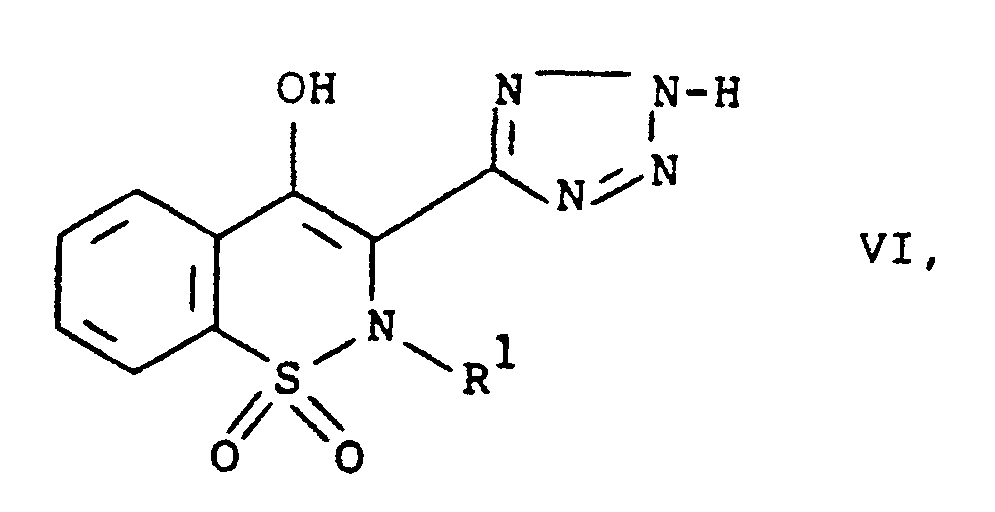
- the molar ratio of azide to cyano reactant of formula (VI) is generally held in the range of from 1:1 to 6:1. Higher ratios can be used but are generally accompanied by reduced yields of the desired tetrazole product. In practice, molar ratios of 2:1 have been found to afford high yields of the desired tetrazol-5-yl compounds of formula (VI).
- the presence of from 1 to 5 moles of ammonium chloride or of acid addition salts of amines to azide reactant during the reaction is desirable.
- the acid addition salts of primary, secondary and tertiary amines can be used.
- the nature of the acid portion of the acid addition salt is immaterial to the operability of this process. However, certain acid addition salts are favored over others for such reasons as availability, ease of preparation and solubility in the reaction mixture. The suitability of a given amine acid addition salt is easily determined by carrying out the process of this invention using the particular amine acid addition salt.
- acid addition salts are the salts with mineral acids and organic acids such as alkane sulfonic acids such as methane and ethane sulfonic acids, p-toluenesulfonic acid, benzene-sulfonic acid, napthalenesulfonic acids, alkanoic acids such as acetic, n-butyric, octanoic, benzoic and substituted benzoic acids and cation exchange resins.
- alkane sulfonic acids such as methane and ethane sulfonic acids, p-toluenesulfonic acid, benzene-sulfonic acid, napthalenesulfonic acids, alkanoic acids such as acetic, n-butyric, octanoic, benzoic and substituted benzoic acids and cation exchange resins.
- the preferred amine acid addition salts are the hydrochloride salts of tertiary amines such as triethylamine, tri-n-propylamine, tri-n-butylamine, trimethylamine, N,N-dimethylaniline, N-methylpiperidine and N-methyl-morpholine because of the satisfactory conversions of nitrile to tetrazole they afford in this process.
- tertiary amines such as triethylamine, tri-n-propylamine, tri-n-butylamine, trimethylamine, N,N-dimethylaniline, N-methylpiperidine and N-methyl-morpholine because of the satisfactory conversions of nitrile to tetrazole they afford in this process.
- ammonium chloride is especially preferred.
- Suitable reaction-inert solvents for this process are N,N-dimethyl formamide (DMF), halogenated hydrocarbons such as trichloroethanes, chloroform, and methylene chloride, ethers such as dioxane, tetrahydrofuran, dimethyl and diethyl ethers of ethyleneglycol and diethylene glycol, macrocylcic polyethers (crown compounds), benzene, xylene, tetralin and pyridine.
- DMF N,N-dimethyl formamide
- halogenated hydrocarbons such as trichloroethanes, chloroform, and methylene chloride
- ethers such as dioxane, tetrahydrofuran, dimethyl and diethyl ethers of ethyleneglycol and diethylene glycol
- macrocylcic polyethers macrocylcic polyethers (crown compounds)
- benzene xylene,
- the solvent should desirably be one which completely dissolves all reactants. As one skilled in the art appreciates, complete solubility is, however, not necessary. Partial solubility of reactants in the solvent system is sufficient to permit reaction to occur at an acceptable rate.
- the reaction is generally conducted over the range of from 20° C to 110° C.
- the favored temperature range is from 25° C to 80° C and the preferred range from 40° C to 70° C.
- Temperature is not a critical factor and lower or higher temperatures can be employed. Lower temperatures, of course, require longer reaction times than do the higher temperatures. Temperatures above about 110° C. are usually avoided to minimize decomposition of reactants and products.
- the reaction period depends in part upon the reactants and the solvent system used. As a general rule, the reaction is completed in periods ranging from 2 to 24 hours.
- the tetrazole compounds of formula (VI) are converted to oxadiazoles of formula (I) via the Huisgen reaction.
- This reaction comprises acylation of the tetrazole (VI) to produce a compound of formula (II-A) or (II).
- Said acylation is carried out under standard acylation conditions using the appropriate acid, acyl halide or acyl anhydride.
- Suitable solvents for the acylation reaction are aromatic hydrocarbons such as benzene, toluene or xylene; chlorinated hydrocarbons such as dichloromethane and chloroform.
- the acylating agent is a liquid, e.g.
- acetic anhydride it is advantageously used in excess to serve both as reactant and solvent.
- the reaction is conducted at temperatures ranging from 5°-25° C in order to avoid thermal fragmentation of the tetrazole derivative with loss of nitrogen and ultimate formation of a 1,3,4-oxadizole derivative.
- Acylation with the appropriate acyl halide is carried out in the presence of an acid acceptor such as pyridine, triethylamine, N-methylmorpholine or N,N-dimethylaniline, at temperatures of from 5°-25° C, in a solvent such as those enumerated above.
- an acid acceptor such as pyridine, triethylamine, N-methylmorpholine or N,N-dimethylaniline
- an excess of the acid acceptor e.g. pyridine
- Acylation with an acid is conducted in a solvent such as those enumerated above and in the presence of a dehydrative coupling agent such as dicyclohexylcarbodiimide according to known procedures.
- the acylation products are isolated, if desired, by conventional methods as by filtration or, if not solid forms, by concentration of the reaction mixture to an oil.
- the oily product obtained can be obtained as a solid, or as crystals, by addition of n-hexane or other solvent.
- an acyl halide is used as acylating agent in the presence of an excess of acid acceptor, the products are conveniently recovered by diluting the reaction mixture with aqueous acid, e.g. dilute hydrochloric acid, and removal of the solid product by filtration.
- excess acid acceptor is not used, dilution of the reaction mixture with an organic solvent and extraction of the resulting solution with aqueous acid (e.g. dilute HCl) and water affords the acylated product.
- Mono- or diacylated products are produced depending upon the stoichiometric ration of acylating agent to tetrazole reactant of formula (VI).
- the use of up to one equivalent of acylating agent per mole of formula (VI) compound affords the monoacyl derivative as principal product.
- Greater amounts of acylating agent favor diacylation; i.e., at the 4-hydroxy group and at the tetrazolyl group.
- the use of two or more equivalents favors diacylation.
- An alternative procedure for acylating formula (VI) compounds comprises reacting said compounds with the appropriate carboxylic acid in the presence of a dehydrative coupling agent such as carbodiimide, ethoxyacetylene, alpha-chlorovinyl ethyl ether, N,N'-carbonyldiimidazole, N-hydroxysuccinimide and 2-ethyl-5-(3-sulfophenyl)-1,2-oxazole-betaine.
- a dehydrative coupling agent such as carbodiimide, ethoxyacetylene, alpha-chlorovinyl ethyl ether, N,N'-carbonyldiimidazole, N-hydroxysuccinimide and 2-ethyl-5-(3-sulfophenyl)-1,2-oxazole-betaine.
- Preferred as coupling agent is dicyclohexylcarbodiimide.
- formula (VI) compound and appropriate acid are reacted in a reaction-inert solvent such as toluene or xylene, at the reflux temperature in the presence of dicyclohexylcarbodiimide.
- a reaction-inert solvent such as toluene or xylene
- excesses of carbodiimide and acid based on the formula (VI) compound, are used.
- mole ratios of formula (VIII) compound to acid to dicyclohexylcarbodiimide of 1:3:3 have been found satisfactory.
- the 4-acyl derivatives of compounds of formula (I) are readily converted to the corresponding 4-hydroxy derivatives by alkaline hydrolysis, especially by use of alkali metal alkoxides in an alkanol solvent corresponding to the alkanol from which the alkoxide is derived.
- the hydrolysis occurs at room temperature.
- the 4-hydroxy derivative is recovered by removal of the solvent and adjustment of the pH of an aqueous mixture of the residue to about 1.5.
- the 4-hydroxy formula (I) compounds thus obtained can then be reacylated with a different acylating agent, if desired.
- the reacylation is carried out according to the conditions described above.
- the isolated compounds of formula (II) are transformed to formula (I) compounds by heating to an elevated temperature, e.g. from 80°-150° C, in a reaction-inert solvent such as toluene, benzene, xylene, acyl anhydride (excess).
- elevated temperature e.g. from 80°-150° C
- a reaction-inert solvent such as toluene, benzene, xylene, acyl anhydride (excess).
- Lower temperatures require too large a heating period to be practical. Higher temperatures can, of course, be used but afford no advantage.
- the oxadizole compounds are recovered by concentration of the reaction mixture, cooling the concentrate to precipitate a solid which is filtered off.
- the acylation products of formula (II) need not be isolated prior to converting them to oxadiazoles of formula (I).
- the conversion of formula (VI) to formula (I) compounds can be carried out in situ without isolation of the intermediate compounds of formula (II-B).
- the reaction comprises acylating the tetrazole of formula (VI), generally with excess acylating agent, e.g. from 2-5 fold excess, over that required to produce the diacyl derivative at an elevated temperature.
- excess acylating agent e.g. from 2-5 fold excess
- Suitable solvents are N,N-dimethylformamide, N,N-diethylformamide, N-methyl-2-pyrrolidone, dimethylsulfoxide, toluene and xylene.
- the reaction is conducted at ambient temperature until complete or substantially complete.
- Potassium carbonate is favored as acid acceptor when N,N-dimethylformamide is used as solvent.
- other acid acceptors inorganic and organic in nature, such as sodium carbonate, alkali metal hydrides or alkoxides; tertiary amines such as pyridine, triethylamine, N-methylmorpholine can also be used.
- the products are isolated by known procedures as, for example, by dilution with water or dilute aqueous acid followed by filtration of the product.
- a mixture of the 2-aralkyl and 1-aralkyl isomers is generally obtained.
- the isomers are separated by taking advantage of their solubility differences.
- the 5-LO inhibiting activity of the compounds of this invention is tested by a cell culture assay which determines the effect of said compounds on the metabolism of arachidonic acid and, therefore, their ability to inhibit the activity of 5-LO.
- the procedure is described by Jakschick et al., Prostaglandins 16 , 733-748 (1978).
- the compounds of formulae I and II are effective agents for the prophylactic and therapeutic treatment of bronchoconstrictive and pulmonary diseases in man.
- said compounds are administered via the oral, parenteral or topical routes.
- the compounds may be administered per se but are preferably administered in the form of a composition, that is, in combination with a pharmaceutically acceptable carrier, which compositions may also comprise excipients, flavors, adjuvants, etc. in keeping with good pharmaceutical practice.
- compositions may be in the form of solid, semi-solid or liquid dosage forms; such as, for instance, tablets, capsules, pills, powders, suppositories, solutions, elixirs, syrups, suspensions, creams, lozenges, pastes and sprays.
- the chosen route of administration of the herein described 5-LO inhibitors determines the form of composition to be used.
- the therapeutically effective compounds of this invention are present in such dosage forms at concentration levels ranging from 0.5% to 90% by weight of the total composition; i.e., in amount sufficient to provide the desired unit dose.
- the 5-LO inhibitor compounds of this invention may be administered in single or multiple doses.
- the particular route of administration and the dosage regimen will be determined by the attending physician in keeping with the condition of the individual to be treated and said individual's response to the treatment.
- doses of from 10 mg to 1000 mg per day in single or multiple doses are sufficient.
- doses of from 5 mg to 750 mg per day are used in single or multiple doses.
- dosage levels below the lower limit of the aforesaid range may be more than adequate, while in other cases still larger doses may be employed without causing any harmful or deleterious side effects to occur provided that such higher dose levels are first divided into several smaller doses that are to be administered throughout the day.
- tablets containing various excipients such as sodium citrate, calcium carbonate and dicalcium phosphate may be employed along with various disintegrants such as starch and preferably potato or tapioca starch, alginic acid and certain complex silicates, together with binding agents such as polyvinylpyrrolidone, sucrose, gelatin and acacia. Additionally, lubricating agents such as magnesium sterate, sodium lauryl sulfate and talc are often very useful for tabletting purposes.
- Solid compositions of a similar type may also be employed as fillers in soft and hard-filled gelatin capsules; preferred materials in this connection would also include lactose or milk sugar as well as high molecular weight polyethylene glycols.
- the essential active ingredient therein may be combined with various sweetening or flavoring agents, coloring matter or dyes, and, if so desired, emulsifying and/or suspending agents as well, together with such diluents as water, ethanol, propylene glycol, glycerin and combinations thereof.
- solutions in either sesame or peanut oil or in aqueous propylene glycol may be employed, as well as sterile aqueous solutions of the corresponding water-soluble alkali metal or alkaline-earth metal salts previously enumerated.
- aqueous solutions should be suitably buffered if necessary and the liquid diluent first rendered isotonic with sufficient saline or glucose.
- These particular solutions are especially suitable for intravenous, intramuscular and subcutaneous injection purposes.
- Example 7 The product of Example 7 was hydrolyzed according to the procedure of Example 4 to give the above-named hydroxy derivative in 90% yield.
- step (b) The 4-hydroxy compound of step (a) was benzoylated according to the procedure of Example 6 to give the title product in 72% yield.
- Example 16 (a) A mixture of the product of Example 16 (0.6 g) and benzoic anhydride (1.20 g) in xylene (20 ml) was refluxed for 12 hours then concentrated to a viscous oil, which was dissolved in dichloromethane (50 ml) and washed with 20% NaOH aqueous solution to remove starting material. The organic layer was washed with water, dried over sodium sulfate and concentrated to give a solid which was recrystallized from toluene to afford 0.587 g (83.1%) of the title product.
- the wet solids were recrystallized from toluene (150 ml) to give 4-hydroxy-3-[(2-benzyl)tetrazol-5-yl]-2-methyl-1,2-benzothiazine 1,1-dioxide (16.70 g).
- the mother liquor contains the said compound and its 1-benzyl isomer. It was concentrated to an oil (6.03 g), which was treated with acetic anhydride (30 ml) at 110° C. for 1.5 hours, concentrated and crystallized in toluene (30 ml), to afford 4-acetoxy-3-[(2-benzyl)-tetrazol-5-yl]-2-methyl-1,2-benzothiazine 1,1-dioxide (1.31 g).
- Example 18 A mixture of the 1-benzyl isomer of Example 18 and acetic anhydride (100 ml) was refluxed for ten minutes then concentrated under reduced pressure to an oil. Addition of toluene (65 ml) to said oil afforded the title product as crystals (5.52 g; 76%; overall yield of 20% based upon the reactant of Example 18). It is identical to the product of Example 19.
- a dry solid pharmaceutical composition is prepared by blending the following materials together in the proportions by weight specified below:
- each tablet being of such size that it contains 100 mg of the active ingredient.
- Other tablets are also prepared in a similar manner containing 5, 10, 25 and 50 mg of the active ingredient, respectively, by merely using the appropriate amount of the appropriate 5-LO inhibitor compound in each case.
- a dry solid pharmaceutical composition is prepared by combining the following materials together in the proportions by weight indicated below:
- the dried solid mixture so prepared is then thoroughly agitated so as to obtain a powdered product that is completely uniform.
- Soft elastic and hard-filled gelatin capsules containing this pharmaceutical composition are then prepared, employing a sufficient quantity of material in each case so as to provide each capsule with 250 mg of the active ingredient.
Landscapes
- Chemical & Material Sciences (AREA)
- Organic Chemistry (AREA)
- Health & Medical Sciences (AREA)
- General Health & Medical Sciences (AREA)
- Veterinary Medicine (AREA)
- Bioinformatics & Cheminformatics (AREA)
- Chemical Kinetics & Catalysis (AREA)
- General Chemical & Material Sciences (AREA)
- Medicinal Chemistry (AREA)
- Nuclear Medicine, Radiotherapy & Molecular Imaging (AREA)
- Engineering & Computer Science (AREA)
- Pharmacology & Pharmacy (AREA)
- Life Sciences & Earth Sciences (AREA)
- Animal Behavior & Ethology (AREA)
- Public Health (AREA)
- Pulmonology (AREA)
- Immunology (AREA)
- Pharmaceuticals Containing Other Organic And Inorganic Compounds (AREA)
- Plural Heterocyclic Compounds (AREA)
- Heterocyclic Carbon Compounds Containing A Hetero Ring Having Nitrogen And Oxygen As The Only Ring Hetero Atoms (AREA)
- Acyclic And Carbocyclic Compounds In Medicinal Compositions (AREA)
- Medicines Containing Material From Animals Or Micro-Organisms (AREA)
- Medicines That Contain Protein Lipid Enzymes And Other Medicines (AREA)
- Food Preservation Except Freezing, Refrigeration, And Drying (AREA)
- Nitrogen- Or Sulfur-Containing Heterocyclic Ring Compounds With Rings Of Six Or More Members (AREA)
- Agricultural Chemicals And Associated Chemicals (AREA)
- Preparation Of Compounds By Using Micro-Organisms (AREA)
- Saccharide Compounds (AREA)
- Organic Low-Molecular-Weight Compounds And Preparation Thereof (AREA)
Claims (15)
- Verbindung mit der Formel I oder II

R² Wasserstoff, Alkanoyl mit 2 bis 15 Kohlenstoffatomen, Cycloalkylcarbonyl nmit 3 bis 8 Kohlenstoffatomen in der Cycloalkyl-Einheit, Benzoyl oder mit F, Cl, Br, I, CF₃, CH₃, NO₂ oder CH₃O ringsubstituiertes Benzoyl ist;
R³ Alkyl mit 1 bis 15 Kohlenstoffatomen, Cycloalkyl mit 3 bis 8 Kohlenstoffatomen, Phenyl oder mit F, Cl, Br, I, CF₃, CH₃, NO₂ oder CH₃O substituiertes Phenyl ist;
R⁴ Wasserstoff, Alkanoyl mit 2 bis 15 Kohlenstoffatomen, Benzoyl oder mit F, Cl, Br, I, CF₃, CH₃, NO₂, CH₃O ringsubstituiertes Benzoyl ist; und
R⁵ Wasserstoff, Alkyl mit 1 bis 15 Kohlenstoffatomen, Alkanoyl mit 2 bis 16 Kohlenstoffatomen, Cycloalkylcarbonyl mit 3 bis 8 Kohlenstoffatomen in der Cycloalkyl-Einheit, Phenyl-(C₁-C₄-alkyl) oder Benzoyl ist, wobei dieses Phenylalkyl oder Benzoyl fakultativ mit F, Cl, Br, I, CF₃, NO₂, CH₃ oder CH₃O ringsubstituiert sein kann. - Verbindung gemäß Anspruch 1 mit der Formel I, worin R¹ Alkyl mit 1 bis 3 Kohlenstoffatomen ist, R² Wasserstoff, Alkanoyl mit 2 bis 10 Kohlenstoffatomen, Benzoyl oder Cyclohexylcarbonyl ist und R³ Alkyl mit 7 bis 15 Kohlenstoffatomen, Phenyl oder Tolyl ist.
- Verbindung gemäß Anspruch 2, worin R² Wasserstoff, Benzoyl, Acetyl oder Cyclohexylcarbonyl ist.
- Verbindung gemäß Anspruch 3, worin R¹ Ethyl ist, R² Acetyl ist und R³ Phenyl oder m-Tolyl ist.
- Verbindung gemäß Anspruch 3, worin R¹ Ethyl ist, R² Cyclohexylcarbonyl ist und R³ Phenyl ist.
- Verbindung gemäß Anspruch 3, worin R¹ Methyl ist, R² Cyclohexylcarbonyl ist und R³ Nonyl ist.
- Verbindung gemäß Anspruch 3, worin R¹ Ethyl ist, R² Benzoyl ist und R³ Phenyl ist.
- Verbindung gemäß Anspruch 1 mit der Formel II, worin R¹ Alkyl mit 1 bis 3 Kohlenstoffatomen ist, R⁴ Acetyl ist und R⁵ Alkyl mit 8 bis 10 Kohlenstoffatomen, Methylbenzyl oder Methoxybenzyl ist.
- Verbindung gemäß Anspruch 8, worin R¹ Ethyl ist, R⁴ Acetyl ist und R⁵ Nonyl ist.
- Verbindung gemäß Anspruch 8, worin R¹ n-Propyl ist, R⁴ Acetyl ist und R⁵ 4-Methoxybenzyl ist.
- Verbindung gemäß Anspruch 8, worin R¹ Ethyl ist, R⁴ Acetyl ist und R⁵ 3-Methylbenzyl ist.
- Verbindung gemäß Anspruch 1 mit der Formel II, worin R¹ Methyl, Ethyl oder n-Propyl ist und R⁴ und R⁵ jeweils Wasserstoff bedeuten.
- Verbindung gemäß Anspruch 1 zur Verwendung bei der Behandlung des respiratorischen Distress-Syndroms bei erwachsenen Säugern.
- Pharmazeutische Zusammensetzung, die eine Verbindung gemäß Anspruch 1 in einem pharmazeutisch annehmbaren Träger umfaßt.
- Verbindung mit der Formel VI
Priority Applications (1)
| Application Number | Priority Date | Filing Date | Title |
|---|---|---|---|
| AT86302746T ATE69446T1 (de) | 1985-04-16 | 1986-04-14 | 5-lipoxygenase-inhibitoren. |
Applications Claiming Priority (2)
| Application Number | Priority Date | Filing Date | Title |
|---|---|---|---|
| JP60080666A JPS61238785A (ja) | 1985-04-16 | 1985-04-16 | 1、2―ベンゾチアジン類 |
| JP80666/85 | 1985-04-16 |
Publications (2)
| Publication Number | Publication Date |
|---|---|
| EP0200408A1 EP0200408A1 (de) | 1986-11-05 |
| EP0200408B1 true EP0200408B1 (de) | 1991-11-13 |
Family
ID=13724685
Family Applications (1)
| Application Number | Title | Priority Date | Filing Date |
|---|---|---|---|
| EP86302746A Expired - Lifetime EP0200408B1 (de) | 1985-04-16 | 1986-04-14 | 5-Lipoxygenase-Inhibitoren |
Country Status (21)
| Country | Link |
|---|---|
| US (1) | US4694080A (de) |
| EP (1) | EP0200408B1 (de) |
| JP (1) | JPS61238785A (de) |
| AT (1) | ATE69446T1 (de) |
| AU (1) | AU562532B2 (de) |
| CA (1) | CA1277318C (de) |
| DD (4) | DD269385A5 (de) |
| DE (1) | DE3682424D1 (de) |
| DK (1) | DK170086A (de) |
| ES (2) | ES8800218A1 (de) |
| FI (1) | FI87353C (de) |
| GR (1) | GR860977B (de) |
| HU (1) | HU207862B (de) |
| IE (1) | IE59041B1 (de) |
| IL (1) | IL78501A (de) |
| NZ (1) | NZ215821A (de) |
| PH (1) | PH22452A (de) |
| PL (2) | PL149788B1 (de) |
| PT (1) | PT82385B (de) |
| YU (2) | YU45012B (de) |
| ZA (1) | ZA862790B (de) |
Family Cites Families (3)
| Publication number | Priority date | Publication date | Assignee | Title |
|---|---|---|---|---|
| US3303189A (en) * | 1965-03-11 | 1967-02-07 | Smith Kline French Lab | 2, 1-benzothiazine-2, 2-dioxides |
| US3987038A (en) * | 1975-05-21 | 1976-10-19 | Warner-Lambert Company | Process for the preparation of {1-[5-(4-hydroxy-2H-1,2-benzothiazin-3-yl)-1,2,4-oxadiazol-3-yl]methyl}ethanone S,S-dioxide |
| US3957772A (en) * | 1975-05-21 | 1976-05-18 | Warner-Lambert Company | Process for the preparation of 4-hydroxy-3-(5-methyl-3-isoxazolylcarbamoyl)-2-methyl-2h-1,2-benzothiazine 1,1-dioxide |
-
1985
- 1985-04-16 JP JP60080666A patent/JPS61238785A/ja active Granted
-
1986
- 1986-03-19 US US06/841,509 patent/US4694080A/en not_active Expired - Fee Related
- 1986-04-14 EP EP86302746A patent/EP0200408B1/de not_active Expired - Lifetime
- 1986-04-14 AT AT86302746T patent/ATE69446T1/de not_active IP Right Cessation
- 1986-04-14 GR GR860977A patent/GR860977B/el unknown
- 1986-04-14 PT PT82385A patent/PT82385B/pt not_active IP Right Cessation
- 1986-04-14 DE DE8686302746T patent/DE3682424D1/de not_active Expired - Lifetime
- 1986-04-14 NZ NZ215821A patent/NZ215821A/xx unknown
- 1986-04-14 CA CA000506537A patent/CA1277318C/en not_active Expired - Lifetime
- 1986-04-15 ES ES554005A patent/ES8800218A1/es not_active Expired
- 1986-04-15 FI FI861587A patent/FI87353C/fi not_active IP Right Cessation
- 1986-04-15 AU AU56100/86A patent/AU562532B2/en not_active Ceased
- 1986-04-15 IE IE97986A patent/IE59041B1/en not_active IP Right Cessation
- 1986-04-15 DK DK170086A patent/DK170086A/da not_active Application Discontinuation
- 1986-04-15 HU HU861575A patent/HU207862B/hu not_active IP Right Cessation
- 1986-04-15 YU YU608/86A patent/YU45012B/xx unknown
- 1986-04-15 IL IL78501A patent/IL78501A/xx not_active IP Right Cessation
- 1986-04-15 ZA ZA862790A patent/ZA862790B/xx unknown
- 1986-04-16 DD DD86314100A patent/DD269385A5/de not_active IP Right Cessation
- 1986-04-16 PL PL1986268860A patent/PL149788B1/pl unknown
- 1986-04-16 DD DD86314099A patent/DD273257A5/de not_active IP Right Cessation
- 1986-04-16 DD DD86289231A patent/DD258010A5/de not_active IP Right Cessation
- 1986-04-16 DD DD86314101A patent/DD269386A5/de not_active IP Right Cessation
- 1986-04-16 PL PL1986258986A patent/PL149169B1/pl unknown
- 1986-04-16 PH PH33663A patent/PH22452A/en unknown
-
1987
- 1987-05-16 ES ES557555A patent/ES8802519A1/es not_active Expired
- 1987-06-15 YU YU1110/87A patent/YU44631B/xx unknown
Also Published As
Similar Documents
| Publication | Publication Date | Title |
|---|---|---|
| EP0288189A1 (de) | Leucotrien-Antagonisten | |
| US5541209A (en) | Method of treating or preventing cardiac arrhythmia employing an N-substituted heterocyclic derivative | |
| WO1997042179A1 (en) | Antibacterial agents | |
| HUT77609A (hu) | Azolszármazékok, az ezeket tartalmazó gyógyszerkészítmények és a vegyületek intermedierjei | |
| JPH01503233A (ja) | 製薬活性化合物 | |
| EP0295051A2 (de) | Herstellung von Oxophthalazinylessigsäuren mit einer Benzothiazol- oder einer anderen heterocyclischen Seitenkette | |
| IE902245L (en) | Benzamide derivatives | |
| EP0034116A2 (de) | N-(3-Phenoxy-2-hydroxypropyl)benzimidazol-1-alkanamine | |
| JPS5916871A (ja) | スルホンアミド系ベンズアミド類 | |
| JPH0536436B2 (de) | ||
| JPH054383B2 (de) | ||
| US4694080A (en) | 2H-1,2-benzothiazine derivatives | |
| EP0325375B1 (de) | 1H-Indazol-3-Essigsäure als Aldose-Reduktase-Inhibitoren | |
| JP2873417B2 (ja) | フェニルアルカン酸エステル中間体の製造方法 | |
| JPS6254308B2 (de) | ||
| KR880000249B1 (ko) | 5-리폭시게나제 억제제의 제조방법 | |
| JP3302647B2 (ja) | フェニルアルカン酸エステルの塩酸塩、およびその製造方法 | |
| FR2576900A1 (fr) | Derives de cyclohepto-imidazole 2-substitue, agents anti-ulcereux et procede pour leur preparation | |
| KR880000248B1 (ko) | 5-리폭시게나제 억제제의 제조방법 | |
| JP2728357B2 (ja) | ベンジリデン誘導体 | |
| JPS61268680A (ja) | 新規なイソオキサゾール誘導体 | |
| US4755523A (en) | Abietamide derivatives | |
| JP2967231B2 (ja) | 1,4―チアジン誘導体 | |
| KR910000443B1 (ko) | 할로알킬 티아졸의 제조방법 및 이 방법으로 제조한 할로알킬 티아졸 | |
| CA2022460A1 (fr) | Derives benzothiaziniques, leur preparation et leurs applications comme medicaments ou comme intermediaires de synthese de medicaments |
Legal Events
| Date | Code | Title | Description |
|---|---|---|---|
| PUAI | Public reference made under article 153(3) epc to a published international application that has entered the european phase |
Free format text: ORIGINAL CODE: 0009012 |
|
| 17P | Request for examination filed |
Effective date: 19860417 |
|
| AK | Designated contracting states |
Kind code of ref document: A1 Designated state(s): AT BE CH DE FR GB IT LI LU NL SE |
|
| PUAB | Information related to the publication of an a document modified or deleted |
Free format text: ORIGINAL CODE: 0009199EPPU |
|
| PUAF | Information related to the publication of a search report (a3 document) modified or deleted |
Free format text: ORIGINAL CODE: 0009199SEPU |
|
| R17D | Deferred search report published (corrected) |
Effective date: 19861210 |
|
| RA1 | Application published (corrected) |
Date of ref document: 19861210 Kind code of ref document: A1 |
|
| 17Q | First examination report despatched |
Effective date: 19890222 |
|
| GRAA | (expected) grant |
Free format text: ORIGINAL CODE: 0009210 |
|
| AK | Designated contracting states |
Kind code of ref document: B1 Designated state(s): AT BE CH DE FR GB IT LI LU NL SE |
|
| REF | Corresponds to: |
Ref document number: 69446 Country of ref document: AT Date of ref document: 19911115 Kind code of ref document: T |
|
| REF | Corresponds to: |
Ref document number: 3682424 Country of ref document: DE Date of ref document: 19911219 |
|
| ET | Fr: translation filed | ||
| ITF | It: translation for a ep patent filed | ||
| PLBE | No opposition filed within time limit |
Free format text: ORIGINAL CODE: 0009261 |
|
| STAA | Information on the status of an ep patent application or granted ep patent |
Free format text: STATUS: NO OPPOSITION FILED WITHIN TIME LIMIT |
|
| 26N | No opposition filed | ||
| EPTA | Lu: last paid annual fee | ||
| EAL | Se: european patent in force in sweden |
Ref document number: 86302746.2 |
|
| PGFP | Annual fee paid to national office [announced via postgrant information from national office to epo] |
Ref country code: SE Payment date: 19960307 Year of fee payment: 11 Ref country code: DE Payment date: 19960307 Year of fee payment: 11 |
|
| PGFP | Annual fee paid to national office [announced via postgrant information from national office to epo] |
Ref country code: GB Payment date: 19960309 Year of fee payment: 11 |
|
| PGFP | Annual fee paid to national office [announced via postgrant information from national office to epo] |
Ref country code: FR Payment date: 19960312 Year of fee payment: 11 |
|
| PGFP | Annual fee paid to national office [announced via postgrant information from national office to epo] |
Ref country code: NL Payment date: 19960313 Year of fee payment: 11 |
|
| PGFP | Annual fee paid to national office [announced via postgrant information from national office to epo] |
Ref country code: BE Payment date: 19960328 Year of fee payment: 11 |
|
| PGFP | Annual fee paid to national office [announced via postgrant information from national office to epo] |
Ref country code: LU Payment date: 19960401 Year of fee payment: 11 |
|
| PGFP | Annual fee paid to national office [announced via postgrant information from national office to epo] |
Ref country code: AT Payment date: 19960405 Year of fee payment: 11 |
|
| PGFP | Annual fee paid to national office [announced via postgrant information from national office to epo] |
Ref country code: CH Payment date: 19960521 Year of fee payment: 11 |
|
| PG25 | Lapsed in a contracting state [announced via postgrant information from national office to epo] |
Ref country code: LU Free format text: LAPSE BECAUSE OF NON-PAYMENT OF DUE FEES Effective date: 19970414 Ref country code: GB Effective date: 19970414 Ref country code: AT Effective date: 19970414 |
|
| PG25 | Lapsed in a contracting state [announced via postgrant information from national office to epo] |
Ref country code: SE Effective date: 19970415 |
|
| PG25 | Lapsed in a contracting state [announced via postgrant information from national office to epo] |
Ref country code: LI Free format text: LAPSE BECAUSE OF NON-PAYMENT OF DUE FEES Effective date: 19970430 Ref country code: CH Free format text: LAPSE BECAUSE OF NON-PAYMENT OF DUE FEES Effective date: 19970430 Ref country code: BE Effective date: 19970430 |
|
| BERE | Be: lapsed |
Owner name: PFIZER CORP. Effective date: 19970430 |
|
| PG25 | Lapsed in a contracting state [announced via postgrant information from national office to epo] |
Ref country code: NL Effective date: 19971101 |
|
| GBPC | Gb: european patent ceased through non-payment of renewal fee |
Effective date: 19970414 |
|
| REG | Reference to a national code |
Ref country code: CH Ref legal event code: PL |
|
| PG25 | Lapsed in a contracting state [announced via postgrant information from national office to epo] |
Ref country code: FR Free format text: LAPSE BECAUSE OF NON-PAYMENT OF DUE FEES Effective date: 19971231 |
|
| PG25 | Lapsed in a contracting state [announced via postgrant information from national office to epo] |
Ref country code: DE Free format text: LAPSE BECAUSE OF NON-PAYMENT OF DUE FEES Effective date: 19980101 |
|
| NLV4 | Nl: lapsed or anulled due to non-payment of the annual fee |
Effective date: 19971101 |
|
| EUG | Se: european patent has lapsed |
Ref document number: 86302746.2 |
|
| REG | Reference to a national code |
Ref country code: FR Ref legal event code: ST |
|
| PG25 | Lapsed in a contracting state [announced via postgrant information from national office to epo] |
Ref country code: IT Free format text: LAPSE BECAUSE OF NON-PAYMENT OF DUE FEES Effective date: 20050414 |