EP0200547B1 - Article moulé à haut degré d'orientation en polyéthylène de poids moléculaire très élevé et son procédé de fabrication - Google Patents
Article moulé à haut degré d'orientation en polyéthylène de poids moléculaire très élevé et son procédé de fabrication Download PDFInfo
- Publication number
- EP0200547B1 EP0200547B1 EP86303290A EP86303290A EP0200547B1 EP 0200547 B1 EP0200547 B1 EP 0200547B1 EP 86303290 A EP86303290 A EP 86303290A EP 86303290 A EP86303290 A EP 86303290A EP 0200547 B1 EP0200547 B1 EP 0200547B1
- Authority
- EP
- European Patent Office
- Prior art keywords
- molecular
- molded article
- ultrahigh
- weight
- polyethylene
- Prior art date
- Legal status (The legal status is an assumption and is not a legal conclusion. Google has not performed a legal analysis and makes no representation as to the accuracy of the status listed.)
- Expired
Links
Images

Classifications
-
- B—PERFORMING OPERATIONS; TRANSPORTING
- B29—WORKING OF PLASTICS; WORKING OF SUBSTANCES IN A PLASTIC STATE IN GENERAL
- B29C—SHAPING OR JOINING OF PLASTICS; SHAPING OF MATERIAL IN A PLASTIC STATE, NOT OTHERWISE PROVIDED FOR; AFTER-TREATMENT OF THE SHAPED PRODUCTS, e.g. REPAIRING
- B29C55/00—Shaping by stretching, e.g. drawing through a die; Apparatus therefor
- B29C55/005—Shaping by stretching, e.g. drawing through a die; Apparatus therefor characterised by the choice of materials
-
- D—TEXTILES; PAPER
- D01—NATURAL OR MAN-MADE THREADS OR FIBRES; SPINNING
- D01F—CHEMICAL FEATURES IN THE MANUFACTURE OF ARTIFICIAL FILAMENTS, THREADS, FIBRES, BRISTLES OR RIBBONS; APPARATUS SPECIALLY ADAPTED FOR THE MANUFACTURE OF CARBON FILAMENTS
- D01F6/00—Monocomponent artificial filaments or the like of synthetic polymers; Manufacture thereof
- D01F6/02—Monocomponent artificial filaments or the like of synthetic polymers; Manufacture thereof from homopolymers obtained by reactions only involving carbon-to-carbon unsaturated bonds
- D01F6/04—Monocomponent artificial filaments or the like of synthetic polymers; Manufacture thereof from homopolymers obtained by reactions only involving carbon-to-carbon unsaturated bonds from polyolefins
-
- B—PERFORMING OPERATIONS; TRANSPORTING
- B29—WORKING OF PLASTICS; WORKING OF SUBSTANCES IN A PLASTIC STATE IN GENERAL
- B29K—INDEXING SCHEME ASSOCIATED WITH SUBCLASSES B29B, B29C OR B29D, RELATING TO MOULDING MATERIALS OR TO MATERIALS FOR MOULDS, REINFORCEMENTS, FILLERS OR PREFORMED PARTS, e.g. INSERTS
- B29K2023/00—Use of polyalkenes or derivatives thereof as moulding material
- B29K2023/04—Polymers of ethylene
- B29K2023/06—PE, i.e. polyethylene
-
- B—PERFORMING OPERATIONS; TRANSPORTING
- B29—WORKING OF PLASTICS; WORKING OF SUBSTANCES IN A PLASTIC STATE IN GENERAL
- B29K—INDEXING SCHEME ASSOCIATED WITH SUBCLASSES B29B, B29C OR B29D, RELATING TO MOULDING MATERIALS OR TO MATERIALS FOR MOULDS, REINFORCEMENTS, FILLERS OR PREFORMED PARTS, e.g. INSERTS
- B29K2223/00—Use of polyalkenes or derivatives thereof as reinforcement
- B29K2223/04—Polymers of ethylene
- B29K2223/06—PE, i.e. polyethylene
-
- B—PERFORMING OPERATIONS; TRANSPORTING
- B29—WORKING OF PLASTICS; WORKING OF SUBSTANCES IN A PLASTIC STATE IN GENERAL
- B29K—INDEXING SCHEME ASSOCIATED WITH SUBCLASSES B29B, B29C OR B29D, RELATING TO MOULDING MATERIALS OR TO MATERIALS FOR MOULDS, REINFORCEMENTS, FILLERS OR PREFORMED PARTS, e.g. INSERTS
- B29K2995/00—Properties of moulding materials, reinforcements, fillers, preformed parts or moulds
- B29K2995/0037—Other properties
- B29K2995/0088—Molecular weight
Definitions
- This invention relates to a highly oriented molded article of ultrahigh-molecular-weight polyethylene and a process for producing the molded article.
- Ultrahigh-molecular-weight polyethylene has superior impact strength, abrasion resistance, chemical resistance and tensile strength to general-purpose polyethylenes, and has been gaining increasing acceptance as engineering plastics. It is difficult however to fabricate it by extrusion or injection molding because it has a much higher melt viscosity, and therefore lower flow-ability, than the general purpose polyethylenes. In most cases, the high-molecular-weight polyethylene is fabricated by compression molding, and articles of limited forms, such as rods, are presently produced from it by extrusion at low speeds.
- JP-B-9765/1962 proposed a process for producing monofilaments of high-density polyethylene by drawing at a high ratio, which comprises incorporating a high boiling additive having a higher melting point than polyethylene in an amount of 20 to 150 % in the polyethylene, preparing a high-concentration dispersion of the mixture, forming a primary fibrous material from it, and hot-drawing the fibrous material to 3 to 15 times the original length while leaving 5 to 25 % of the additive in it.
- This patent document only discloses general-purpose high-density polyethylene having an MFR of 0.7 to 5.0 g/10. min.
- the draw ratio used is 3.4 to 11.6 and the drawn filaments have a tensile strength of 0.3 to 1.2 N/tax (3.5 to 13.6 g/d).
- the patent document gives a description on the effect of drafting during spinning, but the experimental results shown there indicate that as the draft, i.e. the spinning speed, increases, the maximum draw ratio decreases, and with it, the tensile strength of the product decreases. It is seen therefore that with polyethylene having such a degree of polymerization corresponding to an MFR of 0.7 to 5.0 g/10 min., an increase in draft does not contribute to improved tensile strength.
- GB-A-2051667 proposed a process which comprises spinning a solution of linear polyethylene having a molecular weight of at least 400,000 which is higher than the molecular weights of general-purpose polyethylenes, and drawing the spun filaments at such a temperature that the drawn filaments have a modulus of at least 20 GPa.
- This process enables the production of monofilaments having higher tenacity and modulus of elasticity than drawn filament of the general-purpose high-density polyethylene.
- the polymer concentration of the solution of high-molecular-weight polyethylene is 1 to 50 % by weight. However, in the actual examples disclosed, the concentration is 8 % by weight at the highest.
- GB-A-1,100,497 proposes a process which comprises dissolving a linear or branched, non-crosslinked polymer in a non-polymerizable compound in a concentration of 2 to 33 % by weight, extruding the solution downwardly from a spinneret into non-heated air to cool the extrudate by the non-heated air and lower its temperature, thereby separating the polymer from the solution and forming filaments, and winding up the filaments without evaporating the solvent.
- Example 21 of this document discloses the spinning of a 3% naphthalene solution of polyethylene ACX (a product of Allied Chemical Corp., U. S. A. which it is said has a molecular weight between 1,000,000 and 3,000,000).
- this patent document also fails to disclose an example of using a high-concentration solution of ultrahigh-molecular-weight polyethylene.
- the solution has a low polymer concentration, even when the filaments are wound up at high speeds under the application of a draft, the yield of the final product is low, and the amount of the solvent to be recovered is too large.
- EP-A-64167 proposes a process which is an improvement over the process disclosed in GB-A-2051667.
- This process comprises dissolving polyethylene in a first non-volatile solvent, spinning the solution, extracting the first solvent from the filaments by using a second volatile solvent, drawing the filaments before or after the extraction, and thereafter, removing the second solvent by drying.
- concentration of the polymer in the first solvent is 2 to 15 % by weight, preferably 4 to 10 % by weight.
- this process also uses a spinning solution having a relatively low polymer concentration.
- the structural requirements which the gel filaments (xerogel) with very little porosity obtained by such a process are that they should be unoriented undrawn filaments having a crystalline orientation function, measured by broad-angle X-ray diffractometry, of less than 0.2, preferably less than 0.1, a crystallinity index, measured by broad-angle X-ray diffraction, of less than 80 %, preferably less than 75 %, and the size of spherulites crossing the diameters of the filaments has a partial deviation of less than 0.25.
- Dr. Smith stated in an argument submitted during the examination of JP-A-15408/1981 corresponding to the above U. S. Patent that to obtain drawn filaments having high tenacity, gel-like filaments containing a solvent having a polymer concentration of generally less than 25 % by weight, preferably less than 10 % by weight, should be cooled without substantially evaporating the solvent.
- Dr. Smith stated that for the production of filaments of high tenacity, crystallization should be performed in such low polymer concentrations as to prevent the increase of the concentration of the spinning solution attributed to the evaporation of the solvent.
- Mitsuhashi et al. (Papers for 1984 Meeting of Research Institute for Polymeric Materials for Fibers, pages 107-113) state a gel film obtained by crystallization of a solution having a concentration of 15 % or less assumes a long period structure of about 10nm (100 ⁇ ) as a result of observing its X-ray small-angle scattering, and that the dry gel film evidently has a porous structure based on a lamellar structure as determined by observation under an electron microscope. It was also determined by a similar method of observation that the dry gel film obtained from the solution having a concentration of at least 15 % by weight has a long period structure of about 20nm (200 ⁇ ) and a dense spherulitic structure.
- the article concludes that as the concentration of polyethylene increases, the lamellar structure changes to spherulites in which the molecular chains (tie molecules) get into spaces between the crystalline lamellae.
- the paper goes on to state that a dry gel film having a few number of entangled molecular chains (tie molecules) obtained by crystallization from a solution having a concentration of 15 % by weight or less shows good drawability, whereas a dry gel film obtained by crystallization from a high-concentration solution has a large number of such tie molecules, and as a result of abrupt increase of the stress in the drawing step, the draw ratio to be reached is lowered and the film fractures, with the result that the properties of the product become saturated early.
- US-A-4,545,950 discloses a process which comprises melt-kneading ultrahigh-molecular-weight polyethylene with a paraffinic wax having a melting point, determined by the DSC method, of 40 to 120°C at a temperature of 180 to 280°C, extruding the mixture from a spinning die under a draft at a draft ratio of not less than 2, solidifying the resulting unstretched extrudate, and stretching it at a stretch ratio of at least 3.
- the extrudate from the spinning die is solidified before it is stretched.
- the polyethylene but also the paraffinic wax in it is solidified.
- the ultrahigh-molecular weight polyethylene used in the process of this invention has an intrinsic viscosity [ ⁇ ], measured in decal in at 135°C, of at least 5 dl/g, preferably 7 to 30 dl/g. If the intrinsic viscosity is less than 5 dl/g, stretched molded articles having excellent tensile strength cannot be obtained even if high draft ratios are used during or before drawing. There is no particular upper limit to the intrinsic viscosity. However, if the intrinsic viscosity exceeds 30 dl/g, the melt viscosity of the polymer in a high concentration is very high. The polymer therefore tends to have poor melt-spinnability because of the occurrence of melt fracture, etc. during extrusion.
- the ultrahigh-molecular-weight polyethylene is among those polyethylenes which are obtained by the so-called Ziegler polymerization of ethylene with or without a small amount (for example, not more than 10 mole %) of another alpha-olefin such as propylene, 1-butene, 4-methyl-1-pentene or 1-hexene and which have a very high molecular weight.
- another alpha-olefin such as propylene, 1-butene, 4-methyl-1-pentene or 1-hexene and which have a very high molecular weight.
- the solvent used in this invention which can dissolve the ultrahigh-molecular weight polyethylene preferably has a boiling point above its melting point + 20°C and a melting point below room temperature.
- the advantage of the solvent having a melting point below room temperature is that even when cooled to below room temperature, it does not solidify, and can be fully removed in a stretching step or a washing step to be described. Accordingly, the amount of the residual solvent can be reduced, and stretched molded articles having excellent tensile strength or creep properties can be obtained.
- the solvent include aliphatic hydrocarbons such as n-nonane, n-decane, n-undecane, n-dodecane, n-tetradecane, n-octadecane, liquid paraffin and kerosene; aromatic hydrocarbon solvents or hydrogenated derivatives thereof, such as xylene, tetralin, butylbenzene, p-cymene, cyclohexylbenzene, diethylbenzene, pentylbenzene, dodecylbenzene, bicyclohexyl, decalin, methylnaphthalene and ethylnaphthalene; halogenated hydrocarbons such as 1,1,2,2-tetrachloroethane, pentachloroethane, hexachloroethane, 1,2,3-trichloroethane, hexachloroethane, 1,2,3-trichlor
- a high-concentration molding solution prepared from 15 to 80 parts by weight of the ultrahigh-molecular-weight polyethylene and 20 to 85 parts by weight of the solvent is extruded from a molding die at a temperature sufficient to maintain the molding solution in solution.
- the amount of the solvent is below 20 parts by weight, it is difficult to dissolve the polymer. At the same time, the molding solution attains a high melt viscosity and is extremely difficult to melt-extrude. Furthermore, the extruded unstretched article has marked surface roughening and is liable to break on stretching. On the other hand, if the amount of the solvent exceeds 85 parts by weight, the number of points of entanglements of the molecular chains is small, and a sufficient tensile force cannot be maintained in the molding line. Consequently, stretched articles having high modulus and tensile strength cannot be obtained in the subsequent stretching step at any stretch ratio. Furthermore, the solution of such a low concentration has a reduced viscosity and poor moldability, and a large amount of the solvent must be recovered after use. The operation on the whole therefore becomes complex.
- the high-concentration spinning solution used in the process of this invention contains the ultrahigh-molecular-weight polyethylene in an amount of preferably 15 to 75 parts by weight, especially preferably 15 to 70 parts by weight, and correspondingly, the solvent in an amount of preferably 85 to 25 parts by weight, especially preferably 85 to 30 parts by weight.
- the high-concentration spinning solution cannot be obtained by simply mixing the ultrahigh-molecular-weight polyethylene and the solvent and heating the mixture at a temperature above the melting point of the ultrahigh-molecular-weight polyethylene.
- Such a high-concentration and uniform solution can be obtained, as described in EP-A-135,253, by heating the ultrahigh-molecular-weight polyethylene and the solvent while mixing them, swelling the ultrahigh-molecular-weight polyethylene with the solvent at a temperature equal to the lowest swelling temperature (°C) of the mixture of the polyethylene and the solvent or above but lower than the melting point of the polyethylene, and further heating the mixture with stirring.
- the concentrated uniform solution of the ultrahigh-molecular-weight polyethylene obtained by this method has the advantage that even when it is once cooled for crystallization, a uniform solution can again be formed by simply heating the mixture of the polyethylene and the solvent. Another advantage is that since the viscosity of the concentrated solution of the ultrahigh-molecular-weight polyethylene is not extremely low as compared with a solution of general-purpose polyethylene, the solution can be sufficiently transported by using an ordinary screw extruder.
- the unstretched molded article can be obtained by feeding the solution into a screw extruder or the like and extruding it from a die.
- the temperature at which the ultrahigh-molecular-weight polyethylene solution is extruded from the die is not particularly restricted if it is below the boiling point of the solvent and is sufficient to maintain the concentrated solution containing the polyethylene and the solvent in the state of solution. It varies depending upon the type of the solvent, but is preferably within the range of 140°C to 250°C, more preferably from 150°C to 220°C.
- the extrusion is carried out at a temperature at which the state of solution cannot be maintained, surface roughening and melt fracture occur in the second step under a draft, and a uniform pre-oriented molded article cannot be obtained. If the extruding temperature is above 250°C, the molecules of the ultrahigh-molecular-weight polyethylene might be degraded.
- the extrudate from the molding die in the first step is taken up at a draft ratio of at least 6.
- the draft in this invention denotes the drawing, in the solution state, of the concentrated solution of the polyethylene extruded from the die.
- the ratio of the extruding speed v o of the concentrated solution in the die orifice and the speed v of taking up the solidified pre-oriented molded article is defined as the draft ratio.
- the draft ratio varies depending upon the concentration and temperature of the concentrated solution and the molecular weight of the polyethylene, but is at least 6, preferably 6 to 200. If the draft ratio is less than 6, it is impossible to produce a sufficiently uniform highly oriented pre-oriented molded article, that is a pre-oriented molded article which can give a stretched molded article having high modulus and high tensile strength in the next drawing step.
- There is no particular upper limit to the draft ratio but the upper limit is naturally set by the concentration of the solution and the operating conditions.
- the extrudate is cooled during or after the take-up operation. Cooling may be effected with air or water. If in the case of cooling the extrudate with water during the take-up, the air gap, i.e. the distance between the die and the water surface, is too small, the polyethylene crystallizes without undergoing drafting. Desirably, therefore, the air gap is usually adjusted to at least 20 cm.
- the cooling temperature is not particularly limited if it is below the temperature at which the polyethylene crystallizes. Usually, the desirable temperature is 0 to 80°C.
- the pre-oriented molded article can be produced by applying a predetermined draft to the concentrated solution of ultrahigh-molecular-weight polyethylene in step (2) of the process of this invention, and by stretching it to at least 3 times, preferably 5 to 20 times, a stretched molded article of ultrahigh-molecular-weight polyethylene having high modulus and tensile strength can be obtained.
- the pre-oriented molded article of this invention preferably has a degree of orientation, determined by X-ray diffractometry, of at least 0.85.
- the degree of orientation according to x-ray diffractometry may be measured by a method using a half-value width H°, and can be defined as follows.
- the pre-oriented molded article of this invention does not permit substantial observation of a lamellar porous structure in its electron micrograph.
- the presence or absence of a lamellar porous structure can be easily determined by observation under an electron microscope at a magnification of about 3000.
- the pre-oriented molded article of this invention corresponds to an intermediate for the production of gel fibers or xerogels. It is believed that the pre-oriented molded article of this invention differs from the gel fibers or xerogels in at least one of the following points.
- the pre-oriented molded article of this invention is highly oriented. Furthermore, unlike the gel fibers, the pre-oriented molded article of this invention does not permit observation of a lamellar porous structure under an electron microscope.
- the pre-oriented molded article of this invention does not substantially contain a paraffinic wax having a melting point, determined by the DSC method, of 40 to 120°C. Because of this, the pre-oriented molded article of this invention shows the excellent crimp properties shown above.
- the pre-oriented molded article is then stretched at a stretch ratio of at least 3 in the third step. If the stretch ratio is less than 3, the degree of crystallization by orientation of the ultrahigh-molecular-weight polyethylene is low, and a stretched molded article of high modulus and tensile strength cannot be obtained. Furthermore, since stretching unevenness occurs in the stretched molded article, its appearance is frequently degraded.
- the stretching temperature is usually from 60°C to less than (the melting point of the pre-oriented molded article + 30°C), preferably from 90°C to (the melting point of the pre-oriented molded article S + 20°C). If it is lower than 60°C, stretching at a high ratio sometimes cannot be achieved. If it exceeds the melting point of the pre-oriented molded article plus 30°C, the pre-oriented molded article is softened, and although it can be stretched, a stretched molded article of high modulus and tensile strength is unlikely to be formed although the pre-oriented molded article can be stretched.
- the heat medium during stretching is air, steam or a solvent, stretched molded articles having high modulus and tensile strength can be obtained.
- Stretching may be once or a plurality of times.
- the final stretching speed is not particularly limited, but in view of productivity, it is preferably at least 3 m/min., particularly at least 10 m/min.
- the stretched molded articles of the ultrahigh-molecular-weight polyethylene which are produced by the process of this invention show nearly equal modulus and tensile strength to stretched filaments spun from a conventional dilute solution of ultrahigh-molecular-weight polyethylene, and a higher degree of orientation which is at least 0.94, preferably 0.95. Consequently, the stretched molded articles of this invention have better weatherability and heat aging resistance.
- the use of the pre-oriented molded articles of this invention gives a stretched molded article, in various forms such as a filament, a tape or a film, having high tensile modulus and strength and excellent creep properties.
- the resulting stretched molded article has a tensile modulus of preferably 20 GPa, more preferably 30 GPa, and a tensile strength of preferably at least 1.0 GPa, and more preferably at least 1.5 GPa.
- the stretched molded articles of this invention are suitably used in the form of multifilaments, monofilaments, tapes, etc. in fishing nets and ropes such as floating nets, aquaculture ropes, mooring nets and anchor nets, ropes for ships such as hawsers, tag ropes, job marking ropes, and ropes for yachts; ropes for use on land such as ropes for agricultural jobs, job marking ropes, packaging nets for trucks, ropes for water skis and ropes for tent edges, cords for electric appliances, brakes for automobiles and autocycles, air conditioning, and cords for opening and closing trunks, fishing lines, parachutes, ropes for fixing rigs for submarine oil excavation and pendant ropes thereof, and interior cords such as curtains and blinds; and in the form of woven fabrics woven from such filaments, in the fields where conventional drawn filaments are used, and as reinforcing fibrous materials for composites;
- the ultrahigh-molecular-weight polyethylene used in this invention may contain additives usually incorporated in polyolefins such as heat stabilizers, weatherability stabilizers, pigments, dyes and inorganic fillers, in amounts which do not detract from the objects of this invention.
- the process of this invention it is possible to produce stretched molded articles of high modulus and tensile strength, which by the conventional method of spinning ultrahigh-molecular-weight polyethylene, can only be obtained from a solution having a very low polymer concentration. Accordingly, the process of this invention has the advantage that unlike the method using a low-concentration solution, the recovery of a large amount of solvent is not necessary at the time of molding, and the molding speed can be made high.
- the conventional low-concentration gel fibers may stick to each other on a feed guide or bobbin when a plurality of such fibers are taken up. This defect is eliminated in the filaments of this invention since they are highly oriented.
- the extrudate from the molding die is taken up while applying a draft to give a molded article having the excellent properties as described above. This is surprising in view of the previous thought that the application of a draft would be very detrimental to the various properties of the final molded products.
- the process of this invention starts from a high-concentration solution, it is easy to remove the solvent, and the shape retention of the molded article after the stretching operation is excellent.
- the process of this invention is suitable for the production of stretched molded articles having a large sectional area, for example a large-diameter filament or tape or a film.
- the concentration (S %) of the ultrahigh-molecular-weight polyethylene was determined as follows: A portion of the polyethylene solution was taken out and allowed to cool, and then its weight (W T , g) was measured. Decalin was then removed from the solution by decantation, and the residue was dried. The weight (W P , g) of the dry solid product was measured. S (%) is calculated in accordance with the following formula.
- the concentration of the ultrahigh-molecular-weight polyethylene in the solution so determined was 20 % by weight.
- the ultrahigh-molecular-weight polyethylene solution prepared by the above method was extruded from a plunger-type extruder fitted with a die having a diameter of 2 mm at a temperature of 180°C at a rate of 0.785 cc/min.
- the extruded polyethylene strand was taken up at room temperature with an air gap of about 50 cm, and then introduced into a water tank to crystallize it completely.
- the draft ratio at this time was adjusted as shown in Table 1 by varying the take-up speed.
- the pre-oriented filament taken up was immersed in 1000 cc, per gram of the pre-oriented filament, of hexane and left to stand at room temperature for one day to remove decalin.
- the pre-oriented filament stripped of decal in was then dried overnight at room temperature under reduced pressure.
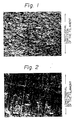
- the density and the degree of orientation by X-ray diffraction of the dried pre-oriented filament were measured, and the filament was also observed under an electron microscope. The results are shown in Table 1.
- Electron micrographs (3000X) of the filaments obtained in Runs Nos. 2 and 5 are shown in Figures 1 and 2, respectively.
- Figure 1 unevenness based on the lamellar structure was clearly observed in Figure 1, and it shows a porous structure.
- the porous structure was not observed in Figure 2, and the filament shows a dense structure.
- the pre-oriented filament obtained as above was drawn by three godet rollers in two stages in a stretching tank containing n-decane as a heat medium.
- a first stretching tank was kept at 110°C, and a second stretching tank, at 130°C.
- the available length of each of the tanks was 50 cm.
- the filament was stretched at different stretch ratios as shown in Table 2 by setting the rotating speed of a first godet roll at 0.5 m/min., and changing the rotating speed of a third godet roll.
- the rotating speed of a second godet roll was properly selected within a range which permitted stable stretching.
- the stretch ratio was calculated from the rotating ratio of the first godet roll and the third godet roll.
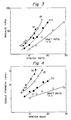
- the condition (draft ratio) for preparation of the pre-oriented filament, and the tensile modulus and tensile strength of the stretched filament are shown in Table 2.
- the relation between stretch ratios and moduli are shown in Figure 3, and the relation between stretch ratios and tensile strengths, in Figure 4.
- the modulus and tensile strength were measured at room temperature (23°C) by an Instron universal tester (Model 1123, made by Instron Company). At this time, the length of the sampe between clamps was adjusted to 250 mm, and the pulling speed, to 250 mm/min.
- the modulus was an initial modulus calculated by using the inclination of the tangent of the initial slope.
- the cross-sectional area of the filament necessary for calculation was calculated from the filament weight and its density which was measured by the density gradient method.
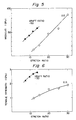
- the draft ratios, and the moduli and tensile strengths at various stretch ratios are shown in Table 4, and the relation between the stretch ratio and the modulus is shown in Figure 5, and the relation between the stretch ratio and the tensile strength, in Figure 6.
- Runs Nos. 21 to 31 the strength of the filament was markedly improved by the effect of the drafting.
- Example 2 a spinning solution of ultrahigh-molecular-weight polyethylene (intrinsic viscosity: 17.0 dl/g) having a final polymer concentration of 4 % by weight was prepared in the same way as described in Example 1.
- the spinning solution was spun by the method of Example 2, and then stretched by the method of Example 1 to give an oriented filament.
- the pre-oriented filament under a draft had a poor ability to retain its shape. It shrank in the water tank, and the filament diameter periodically varied and did not become uniform.
- the draft ratios and the moduli and tensile strength at various stretch ratios are shown in Table 4; the relation between the stretch ratios and the moduli, in Figure 7; and the relation between the stretch ratios and the tensile strengths, in Figure 8.
- Example 1 a spinning solution of polyethylene (intrinsic viscosity: 2.5 dl/g) having a final polymer concentration of 30 % by weight was prepared in the same way as described in Example 1.
- the spinning solution was spun and then stretched by the method of Example 1 to give an oriented filament.
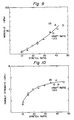
- the draft ratios and the moduli and tensile strength at various stretch ratios are shown in Table 5; the relation between the stretch ratios and the moduli, in Figure 9; and the relation between the stretch ratios and the tensile strengths, in Figure 10.
- the polymer concentration of the solution was 54.5 % by weight.
- the spinning solution was spun by a spinning machine equipped with an extruder with a screw diameter of 25 mm having a spinning nozzle with a diameter of 2 mm.
- the spinning temperature was 180°C, and the draft ratio was 58.1.
- the resulting pre-oriented filament was drawn by four godet rolls in two stages in stretching tanks containing n-decane as a heat medium, and subsequent in one stage in a stretching tank containing triethylene glycol as a heat medium (in three stages in total).
- a first stretching tank was kept at 120°C; a second stretching tank, at 130°C; and a third stretching tank, at 137°C.
- the available length of each of the tanks was 50 cm.
- the rotating speed of a first godet roll was set at 0.5 m/min., and by changing the rotating speed of a fourth godet roll, filaments having different stretch ratios were obtained.
- the rotating speeds of a second and a third godet roll were properly chosen within a range which permitted stable stretching.
- the stretch ratio was calculated from the rotation ratio of the first godet roll and the fourth godet roll. Table 6 shows the tensile molduli and tensile strengths at varying stretch ratios.
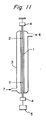
- the ambient temperature of the sample was adjusted to 80°C by a silicone oil circulating through the inlet 7 and outlet 6 of the glass double tube 3.
- the elongation of the sample was determined by observing the positions of two upper and lower indicator lines 2 (apart from each other by a distance of about 10 cm) attached to the sample with a cathet ometer through glass, and removing the effect of the grip from the relative position.
Landscapes
- Engineering & Computer Science (AREA)
- Mechanical Engineering (AREA)
- Chemical & Material Sciences (AREA)
- Chemical Kinetics & Catalysis (AREA)
- General Chemical & Material Sciences (AREA)
- Textile Engineering (AREA)
- Artificial Filaments (AREA)
- Shaping By String And By Release Of Stress In Plastics And The Like (AREA)
Claims (11)
- Procédé pour produire un article moulé pré-orienté en polyéthylène à poids moléculaire, ultra élevé, qui comporte :(1) l'extrusion d'une solution de moulage à haute concentration composée de 15 à 80 parties en poids de polyéthylène à poids moléculaire ultra élevé ayant une viscosité intrinsèque, mesurée dans la décaline à 135°C, d'au moins 5 dl/g et de 85 à 20 parties en poids d'un solvant capable de dissoudre ledit polyéthylène à partir d'une matrice de moulage à une température à laquelle la solution de moulage reste en solution, et(2) le tirage du produit d'extrusion avec un rapport de traction d'au moins 6, et le refroidissement du produit d'extrusion durant ou après le tirage afin de cristalliser le polyéthylène dans le produit d'extrusion et de former un article moulé pré-orienté.
- Procédé selon la revendication 1, dans lequel le polyéthylène à poids moléculaire ultra élevé a une viscosité intrinsèque comprise entre 7 et 30 dl/g.
- Procédé selon la revendication 1 ou 2 dans lequel la solution de moulage concentrée comporte entre 15 et 75 parties en poids du polyéthylène à poids moléculaire ultra élevé et entre 85 et 25 parties en poids du solvant.
- Procédé selon la revendication 1, 2 ou 3, dans lequel le solvant a un point d'ébullition supérieur au point de fusion du polyéthylène, et un point de fusion inférieur à 40°C.
- Procédé selon l'une quelconque des revendications précédentes, dans lequel la température à laquelle la solution de moulage reste une solution est comprise entre 140 et 250°C.
- Procédé selon l'une quelconque des revendications précédentes dans lequel la cristallisation se produit durant le tirage.
- Procédé pour préparer un article moulé étiré qui comporte le procédé de l'une quelconque des revendications précédentes et l'étape additionnelle d'étirage de l'article moulé pré-orienté avec un rapport d'étirement d'au moins 3.
- Procédé selon la revendication 7 dans lequel le rapport d'étirement est compris entre 5 et 20.
- Article moulé pré-orienté en polyéthylène de poids moléculaire ultra élevé, caractérisé par :(A) le fait qu'il est composé de polyéthylène de poids moléculaire ultra élevé ayant une viscosité intrinsèque, déterminée dans la décaline a 135°C, d'au moins 5 dl/g,(B) le fait qu'il a un degré d'orientation, déterminé par diffractométrie aux rayons X, d'au moins 0,8, et(C) le fait qu'il a une propriété de fluage telle qu'un produit de l'article moulé ayant un degré d'orientation d'environ 0,97 présente une élongation qui n'est pas supérieure à 2% dans une atmosphère à 80°C à 1000 secondes après l'application d'une charge élevée qui correspond à 20% d'une charge de rupture à vitesse de contrainte de 100%/min à 23°C.
- Article moulé pré-orienté selon la revendication 9, qui ne contient pas substantiellement une cire paraffinique ayant un point de fusion, déterminé par le procédé de calorimètrie différentielle à balayage, entre 40 et 120°C.
- Article moulé pré-orienté selon la revendication 9 ou 10, qui ne permet pas substantiellement l'observation d'une structure poreuse lamellaire dans sa micrographie électronique.
Applications Claiming Priority (2)
| Application Number | Priority Date | Filing Date | Title |
|---|---|---|---|
| JP60092356A JPH06102846B2 (ja) | 1985-05-01 | 1985-05-01 | 超高分子量ポリエチレン延伸物の製造方法 |
| JP92356/85 | 1985-05-01 |
Publications (3)
| Publication Number | Publication Date |
|---|---|
| EP0200547A2 EP0200547A2 (fr) | 1986-11-05 |
| EP0200547A3 EP0200547A3 (en) | 1988-01-13 |
| EP0200547B1 true EP0200547B1 (fr) | 1991-07-03 |
Family
ID=14052117
Family Applications (1)
| Application Number | Title | Priority Date | Filing Date |
|---|---|---|---|
| EP86303290A Expired EP0200547B1 (fr) | 1985-05-01 | 1986-04-30 | Article moulé à haut degré d'orientation en polyéthylène de poids moléculaire très élevé et son procédé de fabrication |
Country Status (4)
| Country | Link |
|---|---|
| US (1) | US5106563A (fr) |
| EP (1) | EP0200547B1 (fr) |
| JP (1) | JPH06102846B2 (fr) |
| DE (1) | DE3680022D1 (fr) |
Cited By (49)
| Publication number | Priority date | Publication date | Assignee | Title |
|---|---|---|---|---|
| EP2112259A1 (fr) | 2008-04-22 | 2009-10-28 | DSM IP Assets B.V. | Tissus résistant à l'abrasion |
| WO2010106143A1 (fr) | 2009-03-20 | 2010-09-23 | Dsm Ip Assets B.V. | Filet pour l'aquaculture |
| WO2010122099A1 (fr) | 2009-04-23 | 2010-10-28 | Dsm Ip Assets B.V. | Feuille comprimée |
| WO2011015619A1 (fr) | 2009-08-06 | 2011-02-10 | Dsm Ip Assets B.V. | Article de traitement chirurgical à base de hppe |
| WO2011015485A1 (fr) | 2009-08-04 | 2011-02-10 | Dsm Ip Assets B.V. | Fibres revêtues de résistance élevée |
| WO2011045321A1 (fr) | 2009-10-12 | 2011-04-21 | Dsm Ip Assets B.V. | Feuille souple, procédé de fabrication de cette feuille, et applications correspondantes |
| WO2011073405A1 (fr) | 2009-12-17 | 2011-06-23 | Dsm Ip Assets B.V. | Câble électrique |
| WO2011138286A1 (fr) | 2010-05-06 | 2011-11-10 | Dsm Ip Assets B.V. | Article comprenant des bandes en polymère |
| WO2012013738A1 (fr) | 2010-07-29 | 2012-02-02 | Dsm Ip Assets B.V. | Article balistique résistant |
| WO2012032082A1 (fr) | 2010-09-08 | 2012-03-15 | Dsm Ip Assets B.V. | Article résistant à un impact balistique multiple |
| WO2012066136A1 (fr) | 2010-11-18 | 2012-05-24 | Dsm Ip Assets B.V. | Générateurs électriques souples |
| WO2012076728A1 (fr) | 2010-12-10 | 2012-06-14 | Dsm Ip Assets B.V. | Elément de hppe et son procédé de fabrication |
| WO2012080317A1 (fr) | 2010-12-14 | 2012-06-21 | Dsm Ip Assets B.V. | Matériau pour radômes et procédé de fabrication associé |
| WO2012080274A1 (fr) | 2010-12-14 | 2012-06-21 | Dsm Ip Assets B.V. | Bande et produits la contenant |
| EP2481847A1 (fr) | 2011-01-31 | 2012-08-01 | DSM IP Assets B.V. | Fibre haute résistance stabilisée contre les UV |
| WO2012113727A1 (fr) | 2011-02-24 | 2012-08-30 | Dsm Ip Assets B.V. | Processus d'étirage à étapes multiples permettant d'étirer des objets allongés polymères |
| WO2012119981A1 (fr) | 2011-03-04 | 2012-09-13 | Dsm Ip Assets B.V. | Radôme géodésique |
| WO2012126885A1 (fr) | 2011-03-22 | 2012-09-27 | Dsm Ip Assets B.V. | Radôme gonflable |
| WO2012140017A1 (fr) | 2011-04-12 | 2012-10-18 | Dsm Ip Assets B.V. | Système barrière |
| WO2012139934A1 (fr) | 2011-04-13 | 2012-10-18 | Dsm Ip Assets B.V. | Fibre d'uhmwpe à comportement au fluage optimisé |
| WO2012152871A1 (fr) | 2011-05-10 | 2012-11-15 | Dsm Ip Assets B.V. | Fil, procédé de fabrication du fil, et produits contenant le fil |
| WO2013000995A1 (fr) | 2011-06-28 | 2013-01-03 | Dsm Ip Assets B.V. | Filet résistant aux prédateurs aquatiques |
| WO2013024148A1 (fr) | 2011-08-18 | 2013-02-21 | Dsm Ip Assets B.V. | Fil résistant à l'abrasion |
| WO2013037811A1 (fr) | 2011-09-12 | 2013-03-21 | Dsm Ip Assets B.V. | Paroi de radôme composite |
| WO2013076124A1 (fr) | 2011-11-21 | 2013-05-30 | Dsm Ip Assets B.V. | Fibre de polyoléfine |
| WO2013092626A1 (fr) | 2011-12-19 | 2013-06-27 | Dsm Ip Assets B.V. | Matériau composite flexible et utilisation de celui-ci, procédé de fabrication d'un matériau composite flexible |
| WO2013120983A1 (fr) | 2012-02-16 | 2013-08-22 | Dsm Ip Assets B.V. | Procédé d'amélioration de la coloration d'un article en uhmwpe, article coloré et produits contenant l'article |
| WO2013128006A2 (fr) | 2012-03-01 | 2013-09-06 | Dsm Ip Assets B.V. | Procédé et dispositif permettant d'imprégner une corde avec un matériau liquide |
| WO2013135609A1 (fr) | 2012-03-12 | 2013-09-19 | Dsm Ip Assets B.V. | Câble ombilical |
| WO2013139784A1 (fr) | 2012-03-20 | 2013-09-26 | Dsm Ip Assets B.V. | Fibre polyoléfinique |
| WO2013149990A1 (fr) | 2012-04-03 | 2013-10-10 | Dsm Ip Assets B.V. | Fil polymérique et procédé de fabrication |
| WO2013186206A1 (fr) | 2012-06-11 | 2013-12-19 | Dsm Ip Assets B.V. | Objet à forme sans fin |
| WO2014012898A2 (fr) | 2012-07-17 | 2014-01-23 | Dsm Ip Assets B.V. | Produit résistant à l'abrasion |
| WO2014057035A1 (fr) | 2012-10-11 | 2014-04-17 | Dsm Ip Assets B.V. | Système de transfert de puissance sans fil |
| WO2014056982A1 (fr) | 2012-10-11 | 2014-04-17 | Dsm Ip Assets B.V. | Vaisseau de production ou de forage au large |
| WO2015086627A2 (fr) | 2013-12-10 | 2015-06-18 | Dsm Ip Assets B.V. | Chaîne comprenant des maillons polymères et un espaceur |
| WO2016001158A1 (fr) | 2014-07-01 | 2016-01-07 | Dsm Ip Assets B.V. | Structures comprenant des fibres polymères |
| WO2016189116A1 (fr) | 2015-05-28 | 2016-12-01 | Dsm Ip Assets B.V. | Maillon de chaîne hybride |
| WO2016189120A1 (fr) | 2015-05-28 | 2016-12-01 | Dsm Ip Assets B.V. | Maillon de chaîne en polymère |
| EP3202702A1 (fr) | 2016-02-02 | 2017-08-09 | DSM IP Assets B.V. | Procédé de cintrage d'un élément de traction sur une poulie |
| WO2018002229A1 (fr) | 2016-07-01 | 2018-01-04 | Dsm Ip Assets B.V. | Composite hybride multicouche |
| WO2019012129A1 (fr) | 2017-07-14 | 2019-01-17 | Dsm Ip Assets B.V. | Fil chargé homogène |
| WO2019121209A1 (fr) | 2017-12-18 | 2019-06-27 | Dsm Ip Assets B.V. | Article moulé pare-balles |
| WO2019121204A1 (fr) | 2017-12-18 | 2019-06-27 | Dsm Ip Assets B.V. | Article moulé incurvé résistant aux balles |
| WO2019166574A1 (fr) | 2018-03-01 | 2019-09-06 | Dsm Ip Assets B.V. | Tissu résistant à l'abrasion |
| WO2020178227A1 (fr) | 2019-03-01 | 2020-09-10 | Dsm Ip Assets B.V. | Composant d'implant médical comprenant un biotextile composite et procédé de fabrication |
| WO2020178228A1 (fr) | 2019-03-01 | 2020-09-10 | Dsm Ip Assets B.V. | Procédé de fabrication d'un biotextile composite et implant médical comprenant ledit biotextile composite |
| WO2022049038A1 (fr) | 2020-09-01 | 2022-03-10 | Dsm Ip Assets B.V. | Feuille composite de polyuréthane, procédé de fabrication d'une telle feuille composite et son utilisation dans la fabrication d'un implant médical |
| WO2025099405A1 (fr) | 2023-11-08 | 2025-05-15 | Fibre Extrusion Technology Limited | Procédé de production de fil avec techniques d'extraction de solvant spéciales et fils obtenus selon le procédé |
Families Citing this family (27)
| Publication number | Priority date | Publication date | Assignee | Title |
|---|---|---|---|---|
| US5286435A (en) * | 1986-02-06 | 1994-02-15 | Bridgestone/Firestone, Inc. | Process for forming high strength, high modulus polymer fibers |
| JP2541567B2 (ja) * | 1987-07-21 | 1996-10-09 | 三井石油化学工業株式会社 | 補強用繊維材料 |
| JP2557459B2 (ja) * | 1987-09-08 | 1996-11-27 | 三井石油化学工業株式会社 | 牽引用ロープ |
| US5180636A (en) * | 1987-09-08 | 1993-01-19 | Mitsui Petrochemical Industries Ltd. | Rope for traction |
| JP2548292B2 (ja) * | 1988-04-04 | 1996-10-30 | 三井石油化学工業株式会社 | 漁網および漁網牽引用ロープ |
| US5654497A (en) * | 1992-03-03 | 1997-08-05 | Lockheed Martin Energy Systems, Inc. | Motor vehicle fuel analyzer |
| TW408134B (en) * | 1995-07-18 | 2000-10-11 | Mitsui Chemicals Inc | Microporous film of high molecular weight polyolefin and process for producing same |
| NL1010399C1 (nl) * | 1998-10-26 | 2000-04-27 | Dsm Nv | Werkwijze voor het vervaardigen van een vormdeel. |
| US6723267B2 (en) | 1998-10-28 | 2004-04-20 | Dsm N.V. | Process of making highly oriented polyolefin fiber |
| ATE248937T1 (de) * | 1999-08-11 | 2003-09-15 | Toyo Boseki | Hochfeste polyethylenfasern und deren verwendung |
| US6448359B1 (en) * | 2000-03-27 | 2002-09-10 | Honeywell International Inc. | High tenacity, high modulus filament |
| WO2004021771A2 (fr) * | 2002-09-09 | 2004-03-18 | Atlantic Gillnet Supply, Inc. | Cordage sans danger pour les baleines |
| BRPI0418300B8 (pt) | 2004-01-01 | 2021-07-27 | Dsm Ip Assets Bv | fio de multifilamentos de polietileno de alto desempenho e processo para fabricação do mesmo |
| WO2006010522A1 (fr) * | 2004-07-27 | 2006-02-02 | Dsm Ip Assets B.V. | Produit de reparation chirurgicale allonge a base de filaments de pehpm |
| DE602005023231D1 (de) * | 2004-09-03 | 2010-10-07 | Honeywell Int Inc | Polyethylengarne |
| BRPI0914237A2 (pt) | 2008-06-23 | 2015-11-03 | Dsm Ip Assets Bv | rede de carga |
| US20100063213A1 (en) * | 2008-09-05 | 2010-03-11 | Fredrickson Glenn H | Gel-processed polyolefin compositions |
| US9623626B2 (en) | 2012-02-28 | 2017-04-18 | Dsm Ip Assets B.V. | Flexible composite material and use hereof, process for making a flexible composite material |
| EA032464B1 (ru) | 2013-05-23 | 2019-05-31 | ДСМ АйПи АССЕТС Б.В. | Свмпэ-волокно |
| EP3068933B1 (fr) | 2013-11-12 | 2019-08-14 | DSM IP Assets B.V. | Tissus résistant à l'abrasion |
| WO2016041954A1 (fr) | 2014-09-16 | 2016-03-24 | Dsm Ip Assets B.V. | Radôme à structure en treillis comprenant une feuille polymère |
| HUE059920T2 (hu) * | 2014-10-31 | 2023-01-28 | Hardwire Llc | Puha ballisztikus ellenálló páncélzat |
| KR20180013917A (ko) | 2015-05-28 | 2018-02-07 | 디에스엠 아이피 어셋츠 비.브이. | 하이브리드 체인 링크 |
| WO2019012130A1 (fr) | 2017-07-14 | 2019-01-17 | Dsm Ip Assets B.V. | Fil rempli de manière homogène |
| CN108560063B (zh) * | 2018-02-07 | 2020-12-08 | 浙江千禧龙纤特种纤维股份有限公司 | 一种uhmwpe纤维溶解和混炼工艺 |
| WO2019170769A1 (fr) | 2018-03-06 | 2019-09-12 | Dsm Ip Assets B.V. | Fibres ostéoconductrices, implant médical les comprenant et procédés de fabrication |
| KR20200135989A (ko) * | 2018-03-23 | 2020-12-04 | 셀라니즈 세일즈 저머니 게엠베하 | 무기 산 제거제를 함유하는 폴리올레핀 겔 가공 조성물 및 이를 사용하는 방법 |
Family Cites Families (12)
| Publication number | Priority date | Publication date | Assignee | Title |
|---|---|---|---|---|
| NL142204B (nl) * | 1965-02-01 | 1974-05-15 | Tno | Werkwijze voor het vervaardigen van kunstmatige draden uit warmtegevoelige polymeren en aldus verkregen draden. |
| NL177759B (nl) * | 1979-06-27 | 1985-06-17 | Stamicarbon | Werkwijze ter vervaardiging van een polyetheendraad, en de aldus verkregen polyetheendraad. |
| EP0070322B1 (fr) * | 1981-02-03 | 1988-04-27 | Mitsubishi Denki Kabushiki Kaisha | Unite d'affichage a cristaux liquides |
| US4413110A (en) * | 1981-04-30 | 1983-11-01 | Allied Corporation | High tenacity, high modulus polyethylene and polypropylene fibers and intermediates therefore |
| AU549453B2 (en) * | 1981-04-30 | 1986-01-30 | Allied Corporation | High tenacity, high modulus, cyrstalline thermoplastic fibres |
| US4551296A (en) * | 1982-03-19 | 1985-11-05 | Allied Corporation | Producing high tenacity, high modulus crystalline article such as fiber or film |
| US4455273A (en) * | 1982-09-30 | 1984-06-19 | Allied Corporation | Producing modified high performance polyolefin fiber |
| JPS59223307A (ja) * | 1983-05-30 | 1984-12-15 | Kuraray Co Ltd | ポリオレフイン繊維用原液の調製法 |
| JPH0246053B2 (ja) * | 1983-06-16 | 1990-10-12 | Kogyo Gijutsu Incho | Chokobunshiryohoriechirenyoekinoseizohoho |
| EP0135253B2 (fr) * | 1983-06-16 | 1993-04-21 | Agency Of Industrial Science And Technology | Procédé de production d'une composition à base de polyéthylène à poids moléculaire très élevé |
| JPS6034614A (ja) * | 1983-07-28 | 1985-02-22 | Kuraray Co Ltd | 高強力繊維の紡糸原液調製法 |
| US4663101A (en) * | 1985-01-11 | 1987-05-05 | Allied Corporation | Shaped polyethylene articles of intermediate molecular weight and high modulus |
-
1985
- 1985-05-01 JP JP60092356A patent/JPH06102846B2/ja not_active Expired - Lifetime
-
1986
- 1986-04-30 DE DE8686303290T patent/DE3680022D1/de not_active Expired - Lifetime
- 1986-04-30 EP EP86303290A patent/EP0200547B1/fr not_active Expired
-
1989
- 1989-09-13 US US07/406,172 patent/US5106563A/en not_active Expired - Lifetime
Cited By (54)
| Publication number | Priority date | Publication date | Assignee | Title |
|---|---|---|---|---|
| EP2112259A1 (fr) | 2008-04-22 | 2009-10-28 | DSM IP Assets B.V. | Tissus résistant à l'abrasion |
| EP2868788A1 (fr) | 2008-04-22 | 2015-05-06 | DSM IP Assets B.V. | Tissu résistant à l'abrasion |
| WO2010106143A1 (fr) | 2009-03-20 | 2010-09-23 | Dsm Ip Assets B.V. | Filet pour l'aquaculture |
| WO2010122099A1 (fr) | 2009-04-23 | 2010-10-28 | Dsm Ip Assets B.V. | Feuille comprimée |
| WO2011015485A1 (fr) | 2009-08-04 | 2011-02-10 | Dsm Ip Assets B.V. | Fibres revêtues de résistance élevée |
| WO2011015619A1 (fr) | 2009-08-06 | 2011-02-10 | Dsm Ip Assets B.V. | Article de traitement chirurgical à base de hppe |
| WO2011045321A1 (fr) | 2009-10-12 | 2011-04-21 | Dsm Ip Assets B.V. | Feuille souple, procédé de fabrication de cette feuille, et applications correspondantes |
| WO2011045325A1 (fr) | 2009-10-12 | 2011-04-21 | Dsm Ip Assets B.V. | Procédé de fabrication d'une feuille souple rétrécissant faiblement |
| WO2011073405A1 (fr) | 2009-12-17 | 2011-06-23 | Dsm Ip Assets B.V. | Câble électrique |
| WO2011138286A1 (fr) | 2010-05-06 | 2011-11-10 | Dsm Ip Assets B.V. | Article comprenant des bandes en polymère |
| WO2012013738A1 (fr) | 2010-07-29 | 2012-02-02 | Dsm Ip Assets B.V. | Article balistique résistant |
| WO2012032082A1 (fr) | 2010-09-08 | 2012-03-15 | Dsm Ip Assets B.V. | Article résistant à un impact balistique multiple |
| WO2012066136A1 (fr) | 2010-11-18 | 2012-05-24 | Dsm Ip Assets B.V. | Générateurs électriques souples |
| WO2012076728A1 (fr) | 2010-12-10 | 2012-06-14 | Dsm Ip Assets B.V. | Elément de hppe et son procédé de fabrication |
| WO2012080317A1 (fr) | 2010-12-14 | 2012-06-21 | Dsm Ip Assets B.V. | Matériau pour radômes et procédé de fabrication associé |
| WO2012080274A1 (fr) | 2010-12-14 | 2012-06-21 | Dsm Ip Assets B.V. | Bande et produits la contenant |
| EP2481847A1 (fr) | 2011-01-31 | 2012-08-01 | DSM IP Assets B.V. | Fibre haute résistance stabilisée contre les UV |
| WO2012113727A1 (fr) | 2011-02-24 | 2012-08-30 | Dsm Ip Assets B.V. | Processus d'étirage à étapes multiples permettant d'étirer des objets allongés polymères |
| WO2012119981A1 (fr) | 2011-03-04 | 2012-09-13 | Dsm Ip Assets B.V. | Radôme géodésique |
| WO2012126885A1 (fr) | 2011-03-22 | 2012-09-27 | Dsm Ip Assets B.V. | Radôme gonflable |
| WO2012140017A1 (fr) | 2011-04-12 | 2012-10-18 | Dsm Ip Assets B.V. | Système barrière |
| WO2012139934A1 (fr) | 2011-04-13 | 2012-10-18 | Dsm Ip Assets B.V. | Fibre d'uhmwpe à comportement au fluage optimisé |
| WO2012152871A1 (fr) | 2011-05-10 | 2012-11-15 | Dsm Ip Assets B.V. | Fil, procédé de fabrication du fil, et produits contenant le fil |
| WO2013000995A1 (fr) | 2011-06-28 | 2013-01-03 | Dsm Ip Assets B.V. | Filet résistant aux prédateurs aquatiques |
| WO2013024148A1 (fr) | 2011-08-18 | 2013-02-21 | Dsm Ip Assets B.V. | Fil résistant à l'abrasion |
| WO2013037811A1 (fr) | 2011-09-12 | 2013-03-21 | Dsm Ip Assets B.V. | Paroi de radôme composite |
| WO2013076124A1 (fr) | 2011-11-21 | 2013-05-30 | Dsm Ip Assets B.V. | Fibre de polyoléfine |
| EP3156525A1 (fr) | 2011-11-21 | 2017-04-19 | DSM IP Assets B.V. | Fils de fibre de polyoléfine |
| WO2013092626A1 (fr) | 2011-12-19 | 2013-06-27 | Dsm Ip Assets B.V. | Matériau composite flexible et utilisation de celui-ci, procédé de fabrication d'un matériau composite flexible |
| WO2013120983A1 (fr) | 2012-02-16 | 2013-08-22 | Dsm Ip Assets B.V. | Procédé d'amélioration de la coloration d'un article en uhmwpe, article coloré et produits contenant l'article |
| WO2013128006A2 (fr) | 2012-03-01 | 2013-09-06 | Dsm Ip Assets B.V. | Procédé et dispositif permettant d'imprégner une corde avec un matériau liquide |
| WO2013135609A1 (fr) | 2012-03-12 | 2013-09-19 | Dsm Ip Assets B.V. | Câble ombilical |
| WO2013139784A1 (fr) | 2012-03-20 | 2013-09-26 | Dsm Ip Assets B.V. | Fibre polyoléfinique |
| WO2013149990A1 (fr) | 2012-04-03 | 2013-10-10 | Dsm Ip Assets B.V. | Fil polymérique et procédé de fabrication |
| WO2013186206A1 (fr) | 2012-06-11 | 2013-12-19 | Dsm Ip Assets B.V. | Objet à forme sans fin |
| WO2014012898A2 (fr) | 2012-07-17 | 2014-01-23 | Dsm Ip Assets B.V. | Produit résistant à l'abrasion |
| WO2014057035A1 (fr) | 2012-10-11 | 2014-04-17 | Dsm Ip Assets B.V. | Système de transfert de puissance sans fil |
| WO2014056982A1 (fr) | 2012-10-11 | 2014-04-17 | Dsm Ip Assets B.V. | Vaisseau de production ou de forage au large |
| WO2015086627A2 (fr) | 2013-12-10 | 2015-06-18 | Dsm Ip Assets B.V. | Chaîne comprenant des maillons polymères et un espaceur |
| WO2016001158A1 (fr) | 2014-07-01 | 2016-01-07 | Dsm Ip Assets B.V. | Structures comprenant des fibres polymères |
| WO2016189116A1 (fr) | 2015-05-28 | 2016-12-01 | Dsm Ip Assets B.V. | Maillon de chaîne hybride |
| WO2016189120A1 (fr) | 2015-05-28 | 2016-12-01 | Dsm Ip Assets B.V. | Maillon de chaîne en polymère |
| EP3202702A1 (fr) | 2016-02-02 | 2017-08-09 | DSM IP Assets B.V. | Procédé de cintrage d'un élément de traction sur une poulie |
| WO2017134123A1 (fr) | 2016-02-02 | 2017-08-10 | Dsm Ip Assets B.V. | Procédé pour courber un élément de tension sur une poulie |
| WO2018002229A1 (fr) | 2016-07-01 | 2018-01-04 | Dsm Ip Assets B.V. | Composite hybride multicouche |
| WO2019012129A1 (fr) | 2017-07-14 | 2019-01-17 | Dsm Ip Assets B.V. | Fil chargé homogène |
| EP4733455A2 (fr) | 2017-07-14 | 2026-04-29 | Avient Protective Materials B.V. | Fil rempli de maniere homogene |
| WO2019121209A1 (fr) | 2017-12-18 | 2019-06-27 | Dsm Ip Assets B.V. | Article moulé pare-balles |
| WO2019121204A1 (fr) | 2017-12-18 | 2019-06-27 | Dsm Ip Assets B.V. | Article moulé incurvé résistant aux balles |
| WO2019166574A1 (fr) | 2018-03-01 | 2019-09-06 | Dsm Ip Assets B.V. | Tissu résistant à l'abrasion |
| WO2020178227A1 (fr) | 2019-03-01 | 2020-09-10 | Dsm Ip Assets B.V. | Composant d'implant médical comprenant un biotextile composite et procédé de fabrication |
| WO2020178228A1 (fr) | 2019-03-01 | 2020-09-10 | Dsm Ip Assets B.V. | Procédé de fabrication d'un biotextile composite et implant médical comprenant ledit biotextile composite |
| WO2022049038A1 (fr) | 2020-09-01 | 2022-03-10 | Dsm Ip Assets B.V. | Feuille composite de polyuréthane, procédé de fabrication d'une telle feuille composite et son utilisation dans la fabrication d'un implant médical |
| WO2025099405A1 (fr) | 2023-11-08 | 2025-05-15 | Fibre Extrusion Technology Limited | Procédé de production de fil avec techniques d'extraction de solvant spéciales et fils obtenus selon le procédé |
Also Published As
| Publication number | Publication date |
|---|---|
| JPS61252312A (ja) | 1986-11-10 |
| US5106563A (en) | 1992-04-21 |
| EP0200547A3 (en) | 1988-01-13 |
| DE3680022D1 (de) | 1991-08-08 |
| EP0200547A2 (fr) | 1986-11-05 |
| JPH06102846B2 (ja) | 1994-12-14 |
Similar Documents
| Publication | Publication Date | Title |
|---|---|---|
| US5106563A (en) | Process for producing highly oriented molded article of ultra-high-molecular-weight polyethylene | |
| US4902460A (en) | Process for preparation of molecularly oriented, silane-crosslinked ultra-high-molecular-weight polyethylene molded article | |
| US4422993A (en) | Process for the preparation of filaments of high tensile strength and modulus | |
| KR910004698B1 (ko) | 개선된 초기신도를 갖는 폴리올레핀섬유 및 그 제조방법 | |
| Bashir et al. | Melt drawing as a route to high performance polyethylene | |
| Hoogsteen et al. | Gel-spun polyethylene fibres: Part 2 Influence of polymer concentration and molecular weight distribution on morphology and properties | |
| US4968765A (en) | Molecularly oriented molded body of ultra-high-molecular-weight ethylene/polyene copolymer | |
| US5115067A (en) | Molecularly oriented molded body of ultra-high-molecular weight ethylene/α-olefin copolymer | |
| KR900006037B1 (ko) | 견인 로프 | |
| KR910008668B1 (ko) | 필라멘트 집합체 및 그것으로 구성된 망 | |
| EP0135253B1 (fr) | Procédé de production d'une composition à base de polyéthylène à poids moléculaire très élevé | |
| US5430119A (en) | Stretched molded article of ultra-high-molecular weight polypropylene and process for the preparation of the same | |
| JPS62257414A (ja) | 超高分子量ポリエチレンの高配向成形物およびその製造法 | |
| JP2599750B2 (ja) | ロープ | |
| KR960000939B1 (ko) | 초고분자량 폴리프로필렌의 연신성형체 및 그의 제조방법 | |
| JP2599751B2 (ja) | 窓ブラインド用紐 | |
| EP0310423A1 (fr) | Article moulé étiré en copolymère d'éthylène/alpha-oléfine de très haut poids moléculaire ayant une haute énergie de rupture et procédé pour sa production | |
| JP2537962B2 (ja) | 補強材に適したポリビニルアルコ―ル繊維 | |
| JPH04249819A (ja) | プルスイッチ作動用紐 | |
| JPH086205B2 (ja) | 超高分子量エチレン・プロピレン共重合体の分子配向成形体 | |
| Mackley et al. | Die-free spinning: A method for producing high performance polyethylene fibres and tapes | |
| JPH05230732A (ja) | 高分子量ポリオレフィンの多段延伸方法及び延伸装置 | |
| JPH089802B2 (ja) | 超高分子量エチレン−α−オレフィン共重合体の分子配向成形体 | |
| JPH05140816A (ja) | 高分子量ポリオレフイン延伸物の製造方法 | |
| JP2557461B2 (ja) | 係留用ロープ |
Legal Events
| Date | Code | Title | Description |
|---|---|---|---|
| PUAI | Public reference made under article 153(3) epc to a published international application that has entered the european phase |
Free format text: ORIGINAL CODE: 0009012 |
|
| AK | Designated contracting states |
Kind code of ref document: A2 Designated state(s): DE FR GB IT NL |
|
| PUAL | Search report despatched |
Free format text: ORIGINAL CODE: 0009013 |
|
| AK | Designated contracting states |
Kind code of ref document: A3 Designated state(s): DE FR GB IT NL |
|
| 17P | Request for examination filed |
Effective date: 19880622 |
|
| 17Q | First examination report despatched |
Effective date: 19890519 |
|
| GRAA | (expected) grant |
Free format text: ORIGINAL CODE: 0009210 |
|
| AK | Designated contracting states |
Kind code of ref document: B1 Designated state(s): DE FR GB IT NL |
|
| ITF | It: translation for a ep patent filed | ||
| ET | Fr: translation filed | ||
| REF | Corresponds to: |
Ref document number: 3680022 Country of ref document: DE Date of ref document: 19910808 |
|
| PLBI | Opposition filed |
Free format text: ORIGINAL CODE: 0009260 |
|
| 26 | Opposition filed |
Opponent name: DSM N.V. Effective date: 19920331 |
|
| NLR1 | Nl: opposition has been filed with the epo |
Opponent name: DSM N.V. |
|
| PGFP | Annual fee paid to national office [announced via postgrant information from national office to epo] |
Ref country code: FR Payment date: 19970409 Year of fee payment: 12 |
|
| PGFP | Annual fee paid to national office [announced via postgrant information from national office to epo] |
Ref country code: GB Payment date: 19970421 Year of fee payment: 12 |
|
| PGFP | Annual fee paid to national office [announced via postgrant information from national office to epo] |
Ref country code: DE Payment date: 19970509 Year of fee payment: 12 |
|
| APAC | Appeal dossier modified |
Free format text: ORIGINAL CODE: EPIDOS NOAPO |
|
| RDAG | Patent revoked |
Free format text: ORIGINAL CODE: 0009271 |
|
| STAA | Information on the status of an ep patent application or granted ep patent |
Free format text: STATUS: PATENT REVOKED |
|
| PGFP | Annual fee paid to national office [announced via postgrant information from national office to epo] |
Ref country code: NL Payment date: 19980428 Year of fee payment: 13 |
|
| 27W | Patent revoked |
Effective date: 19980129 |
|
| GBPR | Gb: patent revoked under art. 102 of the ep convention designating the uk as contracting state |
Free format text: 980129 |
|
| NLR2 | Nl: decision of opposition | ||
| REG | Reference to a national code |
Ref country code: FR Ref legal event code: CD |
|
| APAH | Appeal reference modified |
Free format text: ORIGINAL CODE: EPIDOSCREFNO |