EP0201111A2 - Procédé de fabrication d'un dispositif semi-conducteur utilisant une implantation - Google Patents
Procédé de fabrication d'un dispositif semi-conducteur utilisant une implantation Download PDFInfo
- Publication number
- EP0201111A2 EP0201111A2 EP86200352A EP86200352A EP0201111A2 EP 0201111 A2 EP0201111 A2 EP 0201111A2 EP 86200352 A EP86200352 A EP 86200352A EP 86200352 A EP86200352 A EP 86200352A EP 0201111 A2 EP0201111 A2 EP 0201111A2
- Authority
- EP
- European Patent Office
- Prior art keywords
- region
- conductivity type
- layer
- ion
- resist
- Prior art date
- Legal status (The legal status is an assumption and is not a legal conclusion. Google has not performed a legal analysis and makes no representation as to the accuracy of the status listed.)
- Withdrawn
Links
Images

Classifications
-
- H—ELECTRICITY
- H10—SEMICONDUCTOR DEVICES; ELECTRIC SOLID-STATE DEVICES NOT OTHERWISE PROVIDED FOR
- H10P—GENERIC PROCESSES OR APPARATUS FOR THE MANUFACTURE OR TREATMENT OF DEVICES COVERED BY CLASS H10
- H10P76/00—Manufacture or treatment of masks on semiconductor bodies, e.g. by lithography or photolithography
- H10P76/20—Manufacture or treatment of masks on semiconductor bodies, e.g. by lithography or photolithography of masks comprising organic materials
- H10P76/204—Manufacture or treatment of masks on semiconductor bodies, e.g. by lithography or photolithography of masks comprising organic materials of organic photoresist masks
- H10P76/2049—Ion beam lithography processes
-
- H—ELECTRICITY
- H10—SEMICONDUCTOR DEVICES; ELECTRIC SOLID-STATE DEVICES NOT OTHERWISE PROVIDED FOR
- H10P—GENERIC PROCESSES OR APPARATUS FOR THE MANUFACTURE OR TREATMENT OF DEVICES COVERED BY CLASS H10
- H10P30/00—Ion implantation into wafers, substrates or parts of devices
- H10P30/20—Ion implantation into wafers, substrates or parts of devices into semiconductor materials, e.g. for doping
- H10P30/202—Ion implantation into wafers, substrates or parts of devices into semiconductor materials, e.g. for doping characterised by the semiconductor materials
- H10P30/204—Ion implantation into wafers, substrates or parts of devices into semiconductor materials, e.g. for doping characterised by the semiconductor materials into Group IV semiconductors
-
- H—ELECTRICITY
- H10—SEMICONDUCTOR DEVICES; ELECTRIC SOLID-STATE DEVICES NOT OTHERWISE PROVIDED FOR
- H10P—GENERIC PROCESSES OR APPARATUS FOR THE MANUFACTURE OR TREATMENT OF DEVICES COVERED BY CLASS H10
- H10P30/00—Ion implantation into wafers, substrates or parts of devices
- H10P30/20—Ion implantation into wafers, substrates or parts of devices into semiconductor materials, e.g. for doping
- H10P30/21—Ion implantation into wafers, substrates or parts of devices into semiconductor materials, e.g. for doping of electrically active species
- H10P30/212—Through-implantation
-
- H—ELECTRICITY
- H10—SEMICONDUCTOR DEVICES; ELECTRIC SOLID-STATE DEVICES NOT OTHERWISE PROVIDED FOR
- H10P—GENERIC PROCESSES OR APPARATUS FOR THE MANUFACTURE OR TREATMENT OF DEVICES COVERED BY CLASS H10
- H10P30/00—Ion implantation into wafers, substrates or parts of devices
- H10P30/20—Ion implantation into wafers, substrates or parts of devices into semiconductor materials, e.g. for doping
- H10P30/22—Ion implantation into wafers, substrates or parts of devices into semiconductor materials, e.g. for doping using masks
-
- H—ELECTRICITY
- H10—SEMICONDUCTOR DEVICES; ELECTRIC SOLID-STATE DEVICES NOT OTHERWISE PROVIDED FOR
- H10P—GENERIC PROCESSES OR APPARATUS FOR THE MANUFACTURE OR TREATMENT OF DEVICES COVERED BY CLASS H10
- H10P50/00—Etching of wafers, substrates or parts of devices
- H10P50/73—Etching of wafers, substrates or parts of devices using masks for insulating materials
-
- H—ELECTRICITY
- H10—SEMICONDUCTOR DEVICES; ELECTRIC SOLID-STATE DEVICES NOT OTHERWISE PROVIDED FOR
- H10P—GENERIC PROCESSES OR APPARATUS FOR THE MANUFACTURE OR TREATMENT OF DEVICES COVERED BY CLASS H10
- H10P76/00—Manufacture or treatment of masks on semiconductor bodies, e.g. by lithography or photolithography
- H10P76/40—Manufacture or treatment of masks on semiconductor bodies, e.g. by lithography or photolithography of masks comprising inorganic materials
- H10P76/408—Manufacture or treatment of masks on semiconductor bodies, e.g. by lithography or photolithography of masks comprising inorganic materials characterised by their sizes, orientations, dispositions, behaviours or shapes
- H10P76/4085—Manufacture or treatment of masks on semiconductor bodies, e.g. by lithography or photolithography of masks comprising inorganic materials characterised by their sizes, orientations, dispositions, behaviours or shapes characterised by the processes involved to create the masks
-
- Y—GENERAL TAGGING OF NEW TECHNOLOGICAL DEVELOPMENTS; GENERAL TAGGING OF CROSS-SECTIONAL TECHNOLOGIES SPANNING OVER SEVERAL SECTIONS OF THE IPC; TECHNICAL SUBJECTS COVERED BY FORMER USPC CROSS-REFERENCE ART COLLECTIONS [XRACs] AND DIGESTS
- Y10—TECHNICAL SUBJECTS COVERED BY FORMER USPC
- Y10S—TECHNICAL SUBJECTS COVERED BY FORMER USPC CROSS-REFERENCE ART COLLECTIONS [XRACs] AND DIGESTS
- Y10S438/00—Semiconductor device manufacturing: process
- Y10S438/975—Substrate or mask aligning feature
-
- Y—GENERAL TAGGING OF NEW TECHNOLOGICAL DEVELOPMENTS; GENERAL TAGGING OF CROSS-SECTIONAL TECHNOLOGIES SPANNING OVER SEVERAL SECTIONS OF THE IPC; TECHNICAL SUBJECTS COVERED BY FORMER USPC CROSS-REFERENCE ART COLLECTIONS [XRACs] AND DIGESTS
- Y10—TECHNICAL SUBJECTS COVERED BY FORMER USPC
- Y10S—TECHNICAL SUBJECTS COVERED BY FORMER USPC CROSS-REFERENCE ART COLLECTIONS [XRACs] AND DIGESTS
- Y10S438/00—Semiconductor device manufacturing: process
- Y10S438/978—Semiconductor device manufacturing: process forming tapered edges on substrate or adjacent layers
Definitions
- This invention relates to methods of manufacturing a semiconductor device using a beam of ions, particularly but not exclusively for the manufacture of bipolar transistors and insulated-gate field-effect transistors, for example in integrated circuits.
- source, drain and channel regions of a p channel depletion mode field-effect transistor are formed in an n type silicon body by implantation of boron ions from a source of boron and platinum, the platinum ions present in the beam being stopped by a trapping layer of aluminium at the body surface.
- FET field-effect transistor
- This I.E.E.E. Transactions article also describes the quite separate use of a beam of silicon ions from a gold-silicon liquid-metal-alloy source for ion-beam lithography to expose a layer of ion-sensitive resist in an area where a gate of an n channel enhancement mode field-effect transistor (FET) is to be formed from an underlying molybdenum or polycrystalline silicon layer on a thin silicon dioxide layer at a major surface of the device body.
- FET n channel enhancement mode field-effect transistor
- the non-exposed area of the layer of resist is removed by developing, and the exposure pattern is transferred into the underlying molybdenum or polycrystalline silicon layer by plasma or reactive ion etching so as to form a metal-on-oxide-on-semiconductor (MOS) insulated gate of the FET.
- MOS metal-on-oxide-on-semiconductor
- a method of manufacturing a semiconductor device in which ions are implanted into a region of a semiconductor device body by deflecting in a pattern across a major surface of the body a beam of ions which are of sufficient energy to be implanted in the body, is characterised in that the implantation into said region is effected through a layer of ion-sensitive resist provided on the major surface of the body, which layer is exposed by the ion beam in the area overlying said region of the body at the same time as the implantation occurs into said region, after which the non-exposed area of the layer is removed by developing the resist, and the ion-exposed area of the resist layer is then used as a mask during a subsequent processing step in the manufacture of the device.
- the present invention is based on the recognition that it can be advantageous in semiconductor device manufacture to define a mask pattern of resist using the same processing step as is used to define the same pattern for an implanted region underlying the mask pattern and that this can be achieved in a particularly simple manner using an ion beam to expose an area of ion-sensitive resist at the same time as at least some of said ions are implanted into the desired region through the layer of resist.
- the pattern of the underlying implanted region is automatically aligned with and corresponds to the pattern of the mask formed from the ion-sensitive resist.
- the automatic alignment obtained using an ion-beam in this manner in accordance with the invention results directly in the same pattern for the implanted region and for the resist area which is to be used as a mask during a subsequent processing step in the device manufacture.
- Conventional processes for achieving automatic alignment normally result directly in a pattern which is the inverse (i.e. of complementary shape) to that of a resist area defined not using ion-beam lithography.
- Specific examples of two such conventional processes are given in United Kingdom patent applications (GB-A) 1355806 and 2024504, in which metal layer patterns are formed with complementary shape to photoresist patterns.
- the implanted region is formed with a complementary shape to the metal layer pattern by dopant implantation around the metal layer pattern
- an implanted region is formed by implantation around the photoresist area so as to have a complementary shape to the photoresist area and therefore the same shape as the metal layer pattern which is to be used subseqently as a mask in the device manufacture. Therefore, compared with these known processes, a significant reduction in the number of processing steps necessary to provide an implanted region and a mask having the same pattern can be achieved in accordance with the present invention.
- the ion-exposed area of the resist layer may be used as a mask for localising various treatments, e.g. etching or/and doping, during subsequent processing steps.
- the beam may comprise ions of a dopant characteristic of one conductivity type which are implanted to form a region of the one conductivity type, and the ion-exposed area of the resist layer may be used as a mask to define (either directly or indirectly) at least partly the lateral extent of a region of the opposite conductivity type which is formed in a part of the body beside the region of said one conductivity type.
- Such regions of said one and said opposite conductivity type may be employed in different forms in various devices.
- the region of said opposite conductivity type may be a source or drain region of a field-effect transistor, and the implanted region of said one conductivity type may be sufficiently highly doped to prevent the occurrence of a parasitic channel of said opposite conductivity type below an insulating layer around the active regions of the transistor.
- the device may comprise a bipolar transistor an emitter region of which may be provided by, for example, said region of the opposite conductivity type, and the implanted region of said one conductivity type may form a highly doped portion of a base region which laterally surrounds the emitter region.
- the semiconductor device body illustrated at an early stage of manufacture in Figure I comprises a main body portion 1 of semiconductor material (for example p type monocrystalline silicon) having an insulating layer 2 (for example of thermally-grown silicon dioxide) at its upper major surface. Ions are implanted into a region 3 (shown in broken outline in Figure 1) by deflecting a narrow focussed ion beam 4 across the upper major surface. In the situation illustrated in Figure 1, at least some of the ions of the beam 4 are of sufficient energy to be implanted in the semiconductor body portion 1 after penetrating the insulating layer 2 and an overlying layer 5.
- semiconductor material for example p type monocrystalline silicon
- insulating layer 2 for example of thermally-grown silicon dioxide
- the pattern of the region 3 into which the ions are implanted is written in the body by controlling the movement of the narrow beam 4 across the upper major surface; when it is desired to form implanted regions which are not connected with each other in the implantation pattern, a shutter may be used or the beam may be widely deflected adjacent its source in known manner to prevent the beam 4 from reaching the device body.
- the beam 4 may consist of ions of a single chemical species or two or more chemical species, depending on the particular ion source used for the beam.
- the beam 4 in Figure 1 is deflected in an annular or grid-like pattern to form an annular or grid-like implanted region 3 in the semiconductor body portion 1.
- the dotted arrows 4' in Figure 1 illustrate the beam 4 after it has been deflected around from the left-hand side of Figure 1 to the right-hand side.
- the implanted ions of the beam 4 may be dopant atoms characteristic of one conductivity type (either n type or p type) in the semiconductor body portion 1 or may be atoms with different characteristics (for example, forming carrier-recombination centres in the semiconductor material).
- the implanted region 3 may be annealed in known manner during or/and after the implantation.
- the implantation into the region 3 is effected through a layer 5 of ion-sensitive resist provided on the upper major surface of the device body. Therefore, at the same time as the implantation occurs into the region 3, the layer 5 is exposed by the ion beam 4 in the area overlying the region 3.
- This ion-exposed area of the layer 5 is designated by the reference 5a in Figure 1 and has a pattern corresponding to that of the region 3.
- the exposure and implantation may be carried out in such conditions that one species of the ions is implanted in the body portion 1 while another species which has a different mass and range is stopped in the resist layer 5 (or possibly the insulating layer 2) depending on its thickness.
- the non-exposed area of the layer 5 is subsequently removed by developing in known manner in a developing solution which dissolves the non-exposed area at least more rapidly than the ion-exposed area 5a.
- the resulting structure having a window in the resist layer 5 is illustrated in Figure 2.
- the remaining ion-exposed area 5a of the resist layer 5 is then used as a mask during a subsequent processing step in the manufacture of the device.
- Figure 3 illustrates the use of the resist area 5a as an etchant mask to localise removal of the insulating layer 2 during an etching step to form a window 6 in the layer 2 at the semiconductor device body surface.
- the layer 2 is removed in this manner from an area not overlying the implanted region 3.
- the resist area 5a may be dissolved away before effecting subsequent processing steps, or it may be retained for a further processing step.
- dopant may be introduced into the body portion I via the window 6 in the insulating layer 2 either after or before the resist area 5a is removed.
- the resist area 5a serves as a mask to define at least partly the lateral extent of this further dopant introduction.
- the dopant introduction is masked solely by the insulating layer 2 the pattern of which has been defined by the resist area 5a.
- the resist area 5a may be adequate to act wholly as the dopant mask or may act as the mask in combination with the underlying layer 2. In some device manufacturing processes, the resist area 5a may even be used as a dopant mask before or instead of its use as an etchant mask.
- the ion beam 4 may comprise boron ions which are implanted to form a more highly doped p type grid pattern 3 in a p type body portion 1.
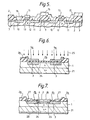
- the ion-exposed grid-shaped area 5a of the layer 5 is used as an etchant mask to define in a thick (so-called "field") insulating layer 2 a plurality of windows 6 at each of which an insulated-gate field-effect transistor (10 to 12) is formed. Two such windows 6 are illustrated in Figures 4 and 5.
- the resist area 5a may be removed before forming any of the parts 10 to 12 of these transistors.
- a thin insulating layer may be provided at the semiconductor surface exposed in the windows 6, and a stripe 13 of material for forming the gate of the transistor is then provided locally on the thin insulating layer 12 across each window 6 so as to divide the window 6 into two separate areas where the separate source and drain regions 10 and 11 are to be formed.
- Opposite conductivity type determining dopant (for example arsenic) is then introduced into the p type body portion 1 at the windows 6 to form n type source and drain regions 10 and 11 which are located beside the p type grid region 3.
- the lateral extent of these source and drain regions 10 and 11 is defined directly by the window pattern of the insulating layer 2 (and therefore indirectly by the ion-exposed resist area 5a) and by the insulated gate stripe 13.
- This dopant introduction may be effected by flooding the upper major surface of the device body with a wide beam 9 of arsenic ions, as illustrated in Figure 4.
- the parts 10 to 12 of the transistors may be provided in known manner.
- the gate insulating layer 12 may be of silicon dioxide thermally grown at the silicon surface in the windows 6.
- the gate stripe 13 may comprise (either separately or in combination) metal or metal silicide or polycrystalline silicon doped either before or during the formation of the source and drain regions 10 and 11.
- the source and drain regions may be formed by implantation through the areas of the insulating layer 12 not masked by the gate stripe 13 (as illustrated in Figure 4), or these areas of the insulating layer 12 may be removed before forming the source and drain regions by implantation or diffusion.
- a further insulating layer may then be deposited, after which contact windows are opened in the insulating layer structure for contacting the gates 13 and source and drain regions 10 and 11.
- a metallization pattern 15 is then provided to contact the gates 13 and source and drain regions 10 and 11 and to interconnect the transistors in a desired circuit configuration.
- the grid region 3, with which the overlying field insulating layer pattern 2 has been automatically aligned, is sufficiently highly doped to prevent the occurrence of parasitic channels (of the same conductivity type as the source and drain regions 10 and 11) below the parts of the insulating layer 2 between the windows 6 at which the transistors 10 to 13 are located.
- the conductive channel of each transistor is formed in the normal manner below its insulated gate 13 between its source and drain zones 10 and 11.
- the ion beam 4 may again comprise boron ions which are implanted to form a highly doped p type annular portion of the transistor base region in an n type body portion 1.
- the body portion 1 may be an n type silicon epitaxial layer 1 on a more highly doped n type substrate 21.
- the resist layer 5 which is exposed by means of the beam 4 during the implantation may be present on an insulating layer 2 which in the form shown in Figure 6 has parts 2a and 2b of different thicknesses and a stepped upper major surface.
- the insulating layer 2 is thinner (part 2b) at an area where the base and emitter regions of the transistor are to be formed.
- the beam 4 is deflected in an annular pattern to form an annular ion-exposed resist area 5a over an annular implanted region 3.
- the inner periphery of the implanted region 3 is defined by the ion beam 4 and so is aligned with the inner periphery of the resist area 5a, whereas the outer periphery of the region 3 is defined by the inner periphery of the thick part 2a of the insulating layer 2; the ion-exposed resist area 5a overlaps this thick part 2a.
- Figure 6 illustrates a processing step after the resist layer 5 has been developed to form the resist mask 5a.
- this step at least the resist area 5a and the thick insulating layer part 2a are used as a mask while introducing both p and n type dopants into the area of the body portion 1 laterally surrounded by the p type region 3 so as to form an active base region 23 and an emitter region 24 of the transistor.
- the area of the thin insulating layer part 2b not covered by the resist area 5a may be removed (by etching using the resist area 5a as an etchant mask) before effecting these dopant introductions.
- the whole upper major surface of the device body is flooded with a wide beam 25 of n type dopant ions (e.g. arsenic) to provide the emitter region 24 at the window in the resist area 5a.
- n type dopant ions e.g. arsenic
- the active base region 23 may be provided in a similar manner using a wide beam of boron ions, either before or after the arsenic implantation.
- the implanted structure may be heated subsequently to anneal the implants and to diffuse slightly the implanted dopants in the body portion 1 to obtain optimum doping profiles for the regions 3, 23 and 24.
- the regions 23 and 24 may be formed entirely by dopant diffusion (without using implantation) into the body portion 1 after removing the area of the thin insulating layer part 2b not covered by the resist area 5a.
- An emitter contact window 6 may be formed by etching away the area of the thin insulating layer part 2b not covered by the resist area 5a while using the resist area 5a as an etchant mask. Base contact windows are also opened by etching away an area of the thin insulating layer part 2b adjacent the thick insulating layer part 2a. Subsequently an emitter and base metallization pattern 26,27 is provided at the upper major surface, and the bottom surface of the substrate 21 may be metallised to form a collector electrode 28. In this device, the region 3 forms a base contact region which laterally surrounds the opposite conductivity type emitter region 24 formed at the window in the resist area 5a.
- the beam 4 is deflected in an annular or grid-like pattern so as to define a non-exposed window area bounded by the ion-exposed resist area 5a and to form an ion-implanted region 3 which laterally surrounds a non-implanted area of the body portion 1.
- the invention may be used to form discrete ion-exposed resist areas 5a which are bounded by grid-like or annular non-exposed areas and below which discrete implanted regions 3 are formed laterally surrounded by grid-like or annular non-implanted areas of the body portion.
- implanted regions 3 may be formed in a layer, for example a silicon layer, at the device body surface instead of in the underlying semiconductor body portion 1.
- a wide variety of different device structures and patterns may be formed for the implanted regions 3 and resist areas 5a.
- the ion-exposed resist areas 5a are used subsequently as etchant and/or dopant masks.
- the resist areas 5a may be used as masks in quite different processing steps.
- a metal layer may be deposited over the resist area 5a and over the remainder of the device body surface not covered by the resist area 5a, after which the resist area 5a may be removed to lift off the part of the metal layer on the area 5a and to leave the remaining part of the metal layer on the device body surface.
- This remaining part of the metal layer may provide an electrode pattern in the semiconductor device and/or it may itself be used as a mask in a subsequent processing step.
- the gates 13 may be formed after the source and drain regions 10 and 11 in the manufacture of the field-effect transistors of Figures 4 and 5.
- a focussed narrow beam comprising arsenic ions may be deflected to form the source and drain regions 10 and 11 by implantation while at the same time exposing an ion-sensitive resist layer on the body surface; the area of the resist overlying the (non-implanted) channel area between the regions 10 and 11 is not exposed by this beam.
- a conductive layer may be deposited over the upper surface including the remaining ion-exposed areas of the resist which are then subsequently removed to lift off the overlying parts of the conductive layer and to leave remaining parts which provide the gates 13.
Landscapes
- Bipolar Transistors (AREA)
- Drying Of Semiconductors (AREA)
- Insulated Gate Type Field-Effect Transistor (AREA)
- Electron Beam Exposure (AREA)
- Element Separation (AREA)
Applications Claiming Priority (2)
| Application Number | Priority Date | Filing Date | Title |
|---|---|---|---|
| GB8506489 | 1985-03-13 | ||
| GB08506489A GB2172427A (en) | 1985-03-13 | 1985-03-13 | Semiconductor device manufacture using a deflected ion beam |
Publications (2)
| Publication Number | Publication Date |
|---|---|
| EP0201111A2 true EP0201111A2 (fr) | 1986-11-12 |
| EP0201111A3 EP0201111A3 (fr) | 1988-08-17 |
Family
ID=10575916
Family Applications (1)
| Application Number | Title | Priority Date | Filing Date |
|---|---|---|---|
| EP86200352A Withdrawn EP0201111A3 (fr) | 1985-03-13 | 1986-03-07 | Procédé de fabrication d'un dispositif semi-conducteur utilisant une implantation |
Country Status (4)
| Country | Link |
|---|---|
| US (1) | US5037767A (fr) |
| EP (1) | EP0201111A3 (fr) |
| JP (1) | JPS61247023A (fr) |
| GB (1) | GB2172427A (fr) |
Cited By (1)
| Publication number | Priority date | Publication date | Assignee | Title |
|---|---|---|---|---|
| EP0476801A3 (fr) * | 1990-09-20 | 1992-04-01 | Mitsubishi Denki Kabushiki Kaisha | Fabrication de dispositifs semi-conducteurs pour implantation dans une résine thermodurcissable |
Families Citing this family (9)
| Publication number | Priority date | Publication date | Assignee | Title |
|---|---|---|---|---|
| US5384268A (en) * | 1993-01-22 | 1995-01-24 | United Microelectronics Corporation | Charge damage free implantation by introduction of a thin conductive layer |
| JPH08316168A (ja) * | 1995-05-24 | 1996-11-29 | Nec Corp | 半導体装置の製造方法 |
| JP3003542B2 (ja) * | 1995-05-24 | 2000-01-31 | 日本電気株式会社 | 半導体装置の製造方法 |
| US7238597B2 (en) * | 2002-09-27 | 2007-07-03 | Brontek Delta Corporation | Boron ion delivery system |
| US6767809B2 (en) | 2002-11-19 | 2004-07-27 | Silterra Malayisa Sdn. Bhd. | Method of forming ultra shallow junctions |
| KR101379410B1 (ko) | 2006-11-22 | 2014-04-11 | 소이텍 | 3-5족 반도체 재료들의 대량생산을 위한 설비 |
| RU2399115C1 (ru) * | 2009-08-13 | 2010-09-10 | Открытое акционерное общество "Восход"-Калужский радиоламповый завод | СПОСОБ ИОННОГО ЛЕГИРОВАНИЯ БОРОМ ОБЛАСТЕЙ p-n ПЕРЕХОДА ПОЛУПРОВОДНИКОВЫХ ПРИБОРОВ И ИНТЕГРАЛЬНЫХ СХЕМ |
| US8372737B1 (en) * | 2011-06-28 | 2013-02-12 | Varian Semiconductor Equipment Associates, Inc. | Use of a shadow mask and a soft mask for aligned implants in solar cells |
| FR3003687B1 (fr) * | 2013-03-20 | 2015-07-17 | Mpo Energy | Procede de dopage de plaques de silicium |
Family Cites Families (16)
| Publication number | Priority date | Publication date | Assignee | Title |
|---|---|---|---|---|
| GB1355806A (en) * | 1970-12-09 | 1974-06-05 | Mullard Ltd | Methods of manufacturing a semiconductor device |
| US3950188A (en) * | 1975-05-12 | 1976-04-13 | Trw Inc. | Method of patterning polysilicon |
| US4140547A (en) * | 1976-09-09 | 1979-02-20 | Tokyo Shibaura Electric Co., Ltd. | Method for manufacturing MOSFET devices by ion-implantation |
| GB2024504B (en) * | 1978-06-29 | 1982-10-20 | Philips Electronic Associated | Manufacture of integrated circuits |
| US4347654A (en) * | 1980-06-18 | 1982-09-07 | National Semiconductor Corporation | Method of fabricating a high-frequency bipolar transistor structure utilizing permeation-etching |
| JPS58131A (ja) * | 1981-06-24 | 1983-01-05 | Mitsubishi Electric Corp | 表面保護膜のエツチング方法 |
| US4398964A (en) * | 1981-12-10 | 1983-08-16 | Signetics Corporation | Method of forming ion implants self-aligned with a cut |
| GB2117175A (en) * | 1982-03-17 | 1983-10-05 | Philips Electronic Associated | Semiconductor device and method of manufacture |
| JPS5941870A (ja) * | 1982-08-25 | 1984-03-08 | Toshiba Corp | 半導体装置の製造方法 |
| JPS59119728A (ja) * | 1982-12-24 | 1984-07-11 | Toshiba Corp | 半導体装置の製造方法 |
| NL8301262A (nl) * | 1983-04-11 | 1984-11-01 | Philips Nv | Werkwijze voor het vervaardigen van een halfgeleiderinrichting, waarbij met behulp van ionenimplantatie patronen worden aangebracht in een laag siliciumnitride. |
| US4566937A (en) * | 1984-10-10 | 1986-01-28 | The United States Of America As Represented By The United States Department Of Energy | Electron beam enhanced surface modification for making highly resolved structures |
| US4601778A (en) * | 1985-02-25 | 1986-07-22 | Motorola, Inc. | Maskless etching of polysilicon |
| US4748103A (en) * | 1986-03-21 | 1988-05-31 | Advanced Power Technology | Mask-surrogate semiconductor process employing dopant protective region |
| GB2190790B (en) * | 1986-05-12 | 1989-12-13 | Plessey Co Plc | Improvements in transistors |
| JPH0797606B2 (ja) * | 1986-10-22 | 1995-10-18 | 株式会社日立製作所 | 半導体集積回路装置の製造方法 |
-
1985
- 1985-03-13 GB GB08506489A patent/GB2172427A/en not_active Withdrawn
-
1986
- 1986-03-07 EP EP86200352A patent/EP0201111A3/fr not_active Withdrawn
- 1986-03-10 JP JP61050696A patent/JPS61247023A/ja active Pending
-
1989
- 1989-09-29 US US07/415,398 patent/US5037767A/en not_active Expired - Fee Related
Cited By (4)
| Publication number | Priority date | Publication date | Assignee | Title |
|---|---|---|---|---|
| EP0476801A3 (fr) * | 1990-09-20 | 1992-04-01 | Mitsubishi Denki Kabushiki Kaisha | Fabrication de dispositifs semi-conducteurs pour implantation dans une résine thermodurcissable |
| US5300445A (en) * | 1990-09-20 | 1994-04-05 | Mitsubishi Denki Kabushiki Kaisha | Production method of an HEMT semiconductor device |
| US5387529A (en) * | 1990-09-20 | 1995-02-07 | Mitsubishi Denki Kabushiki Kaisha | Production method of a MESFET semiconductor device |
| EP0706202A3 (fr) * | 1990-09-20 | 1996-05-22 | Mitsubishi Electric Corp |
Also Published As
| Publication number | Publication date |
|---|---|
| US5037767A (en) | 1991-08-06 |
| JPS61247023A (ja) | 1986-11-04 |
| GB8506489D0 (en) | 1985-04-17 |
| EP0201111A3 (fr) | 1988-08-17 |
| GB2172427A (en) | 1986-09-17 |
Similar Documents
| Publication | Publication Date | Title |
|---|---|---|
| US4394182A (en) | Microelectronic shadow masking process for reducing punchthrough | |
| US4149307A (en) | Process for fabricating insulated-gate field-effect transistors with self-aligned contacts | |
| US4912053A (en) | Ion implanted JFET with self-aligned source and drain | |
| JP3521246B2 (ja) | 電界効果トランジスタおよびその製造方法 | |
| US4798810A (en) | Method for manufacturing a power MOS transistor | |
| CZ62997A3 (en) | Process for producing gated semiconductor device mos with limited number of masks | |
| US4975382A (en) | Method of making a self-aligned field-effect transistor by the use of a dummy-gate | |
| EP0136632A2 (fr) | Procédé à masque unique pour l'implantation des régions de source et de drain auto-alignées, afin de former une structure CMOS | |
| US4398964A (en) | Method of forming ion implants self-aligned with a cut | |
| US5037767A (en) | Method of manufacturing a semiconductor device by ion implantation through an ion-sensitive resist | |
| US4214359A (en) | MOS Devices having buried terminal zones under local oxide regions | |
| US4114256A (en) | Reliable metal-to-junction contacts in large-scale-integrated devices | |
| US5677213A (en) | Method for forming a semiconductor device having a shallow junction and a low sheet resistance | |
| JPH023269A (ja) | 集積回路の製造方法 | |
| US4675981A (en) | Method of making implanted device regions in a semiconductor using a master mask member | |
| EP0874389B1 (fr) | Méthode de fabrication de transistors MOSFET à l'aide d'implantations inclinées | |
| US6800528B2 (en) | Method of fabricating LDMOS semiconductor devices | |
| JPH09223797A (ja) | 半導体装置の製造方法 | |
| US20020102785A1 (en) | Method for forming shallow junctions by increasing width of photoresist and using implanting through poly film | |
| US5187117A (en) | Single diffusion process for fabricating semiconductor devices | |
| EP0008774A1 (fr) | Procédé de fabrication d'un dispositif dans une plaquette en silicium | |
| JP2931243B2 (ja) | 半導体素子の製造方法 | |
| EP0851478B1 (fr) | Procédé de fabrication de régions d'isolation d'oxyde | |
| US4685194A (en) | Direct moat self-aligned field oxide technique | |
| JPH08107064A (ja) | 半導体装置の製造方法 |
Legal Events
| Date | Code | Title | Description |
|---|---|---|---|
| PUAI | Public reference made under article 153(3) epc to a published international application that has entered the european phase |
Free format text: ORIGINAL CODE: 0009012 |
|
| AK | Designated contracting states |
Kind code of ref document: A2 Designated state(s): DE FR GB NL |
|
| PUAL | Search report despatched |
Free format text: ORIGINAL CODE: 0009013 |
|
| RAP3 | Party data changed (applicant data changed or rights of an application transferred) |
Owner name: N.V. PHILIPS' GLOEILAMPENFABRIEKEN Owner name: PHILIPS ELECTRONIC AND ASSOCIATED INDUSTRIES LIMIT |
|
| AK | Designated contracting states |
Kind code of ref document: A3 Designated state(s): DE FR GB NL |
|
| 17P | Request for examination filed |
Effective date: 19890209 |
|
| 17Q | First examination report despatched |
Effective date: 19910121 |
|
| STAA | Information on the status of an ep patent application or granted ep patent |
Free format text: STATUS: THE APPLICATION IS DEEMED TO BE WITHDRAWN |
|
| RAP3 | Party data changed (applicant data changed or rights of an application transferred) |
Owner name: N.V. PHILIPS' GLOEILAMPENFABRIEKEN Owner name: PHILIPS ELECTRONICS UK LIMITED |
|
| 18D | Application deemed to be withdrawn |
Effective date: 19911029 |
|
| RIN1 | Information on inventor provided before grant (corrected) |
Inventor name: DANIEL, PETER JAMES |