EP0207244B2 - Verfahren zur Herstellung einer Kupferfolie durch elektrolytische Abscheidung. - Google Patents
Verfahren zur Herstellung einer Kupferfolie durch elektrolytische Abscheidung. Download PDFInfo
- Publication number
- EP0207244B2 EP0207244B2 EP86105554A EP86105554A EP0207244B2 EP 0207244 B2 EP0207244 B2 EP 0207244B2 EP 86105554 A EP86105554 A EP 86105554A EP 86105554 A EP86105554 A EP 86105554A EP 0207244 B2 EP0207244 B2 EP 0207244B2
- Authority
- EP
- European Patent Office
- Prior art keywords
- electrolyte
- activated carbon
- treated
- electrolysis
- temp
- Prior art date
- Legal status (The legal status is an assumption and is not a legal conclusion. Google has not performed a legal analysis and makes no representation as to the accuracy of the status listed.)
- Expired - Lifetime
Links
Images


Classifications
-
- C—CHEMISTRY; METALLURGY
- C25—ELECTROLYTIC OR ELECTROPHORETIC PROCESSES; APPARATUS THEREFOR
- C25D—PROCESSES FOR THE ELECTROLYTIC OR ELECTROPHORETIC PRODUCTION OF COATINGS; ELECTROFORMING; APPARATUS THEREFOR
- C25D1/00—Electroforming
- C25D1/04—Wires; Strips; Foils
-
- H—ELECTRICITY
- H05—ELECTRIC TECHNIQUES NOT OTHERWISE PROVIDED FOR
- H05K—PRINTED CIRCUITS; CASINGS OR CONSTRUCTIONAL DETAILS OF ELECTRIC APPARATUS; MANUFACTURE OF ASSEMBLAGES OF ELECTRICAL COMPONENTS
- H05K1/00—Printed circuits
- H05K1/02—Details
- H05K1/09—Use of materials for the conductive, e.g. metallic pattern
Definitions
- the invention relates to a continuous process for producing an electrodeposited copper foil.
- electrodeposited copper foils have generally been used in copper-clad laminates.
- Such foils are obtained by an electrolytic method which comprises rotating a cathode drum in a glue- or the like added electrolyte passing through an electrolytic cell to electrodeposit copper on the rotating cathode drum, and then continuously peeling the thus electrodeposited copper foil therefrom while rotating the drum.
- the electrodeposited copper foils produced by the prior art method are not greatly improved in mechanical properties by annealing at a temperature of as low as about 170°C, and the foils are less endurable to folding than wrought copper foils.
- the prior art electrodeposited copper foils have an elongation of only about 3.0% or less at elevated temperature (for example, in an atmosphere at 180° C), and they are classified into Classes 1 to 4 depending on their performances in accordance with IPC-CF-150E whicn is ANSI Standard on copper foils. Particularly, Class 4 is required to have an elongation of at least 4% at 180°C by annealing. It has been considered difficult for the copper foils to have an elongation of at least 4% at 180 °C without annealing.
- prior art electrodeposited copper foils are probable to crack in the step of preparing printed circuit boards, particularly multilayer printed circuit boards, due to the application of heat stress to the foils in this step, and they are not so reliable as to be used in the preparation of flexible print circuit boards for which the folding endurance is important.
- the present inventors had made tests several ten times in attempts to produce electrodeposited copper foils which are not cracked under the application of heat stress thereto or can have a high elongation at elevated temperature (180°C, for example) in accordance with the requirements prescribed by MIL-P-5510C.
- the present invention resides in a continuous process for producing an electrodeposited copper foil which comprises electrolyzing a copper ion-containing electrolyte which consists of 50-100 g/l of copper ion and a member selected from the group consisting of 80-180 gl of sulfuric acid, 5-50 gl of hydrochloric acid, and a borofluoride in an amount corresponding to a pH value of 0.1-2.0 the electrolyzing being carried out at an electrolyte temperature of 40-60°C and a current density of 30-120A/dm 2 whereby at least 60 vol.% of said electrolyte has been continuously treated with activated carbon by passing through an activated carbon column at a velocity of 5-100 cm.s. said electrolyte being continuously subjected to said electrolyzing step within 20 minutes after said treatment with activated carbon.
- the operating conditions to produce an electrodeposited copper foil are in particular as follows:
- electrodeposited copper foils it is required to use a copper ion-containing electrolyte at least 60 vol.% of which has been treated with activated carbon. In a case where less than 60 vol.% of the electrolyte has been so treated, electrodeposited copper foils having a high elongation at elevated temperature will not be obtained. In addition, it is necessary to use the electrolyte having been treated activated carbon, within 20 minutes after said treatment. If this electrolyte is used more than 20 minutes later than said treatment then electrodeposited copper foils having high elongation at elevated temperature will not be obtained.
- electrolytes so treated are not intended to be subjected to electrolysis within 20 minutes after said treatment, but are usually stored for at least one day.
- numerals 1 to 6 indicate a line for introducing an electrolyte, a tower packed with activated carbon, an electrolytic cell, a cathode drum, insoluble anodes and an electrodeposited copper foil, respectively.
- the symbol "arrow” indicates the direction in which electrolyte flows.
- the process for producing electrodeposited copper foils of this invention is almost the same as the prior art process in that these processes comprise continuous electrode-position, put the former is clearly characterized by passing at least a specific proportion of an electrolyte through an activated carbon-packed layer, for example at a velocity of 30 cm/s or less, immediately before electrolysis and then subjecting both the activated carbon-treated portion and the remainder of the electrolyte to electrolysis within 20 minutes of said treatment with activated carbon, the electrolyzing being carried out at an electrolyte temperature of 40-60°C an a current density of 30-120 A/dm 2 .
- a fixed amount of an electrolyte introduced through a line 1 for supplying an electrolyte is passed into an activated carbon-packed tower 2 where the specific amount of the electrolyte is treated with the activated carbon.
- the specific portion of the electrolyte is then passed, together with the rest of the electrolyte, into an electrolytic cell where the whole of the electrolyte is electrolyzed within 20 minutes after said treatment with activated carbon. It is necessary in this electrolysis that at least 60 vol.% of the electrolyte in the electrolytic cell 3 have previously been treated and the activated carbon-treated portion of the electrolyte, together with the rest thereof, be subjected to electrolysis within 20 minutes after said treatment with activated carbon.
- the electrolysis is carried out using the cathode drum 4 and the insoluble anodes 5 to deposit copper foil 6 on the cathode drum 4.
- the composition of the electrolyte, the time for the electrolysis, the current density, the temperature of the electrolytic bath, and the like are suitably determined as desired.
- the electrodeposited copper foil 6 on the cathode drum 4 is peeled off and then used for copper-clad laminates and the like.
- the electrodeposited copper foils thus formed are different from the prior art one because of both the effect of purification of an electrolyte with activated carbon and the effect which is considered to be attributed to the oxidation-reduction of metal cation in the electrolyte, and they are satisfactory in every mechanical property as compared with conventional electrodeposited copper foils and exhibit the same or excellent properties even as compared with wrought copper foils. Further, they are greatly increased particularly in elongation at elevated temperature and are extremely satisfactory in folding endurance after heating (hereinafter sometimes referred to "post-heating folding endurance") as compared with the conventional electrodeposited copper foils.
- electrolysis was effected at a solution temperature of 45 °C and a current density of 50 A/dm 2 and also under the following conditions.
- the electrolysis was continuously carried out using electrolyte 90 vol.% of which was continuously treated with activated carbon at a velocity of 20 cm/s. The portion of the electrolyte thus treated was subjected, together with the rest thereof, to electrolysis 10 minutes after said treatment.
- Example 1 The procedure of Example 1 was followed except that an acidic copper sulfate solution comprising 320 g/l of copper sulfate (CuSO 4 ⁇ 5H 2 O) and 130 g/l of sulfuric acid was used as the electrolyte, and the electrolysis thereof was carried out at a solution temperature of 50 °C, a current density of 80 A/dm 2 while continuously treating 80% of the electrolyte with activated carbon at a velocity of 35 cm/sec and subjecting the thus treated portion of the electrolyte, together with the rest thereof, to electrolysis 5 minutes after said treatment with activated carbon.
- an acidic copper sulfate solution comprising 320 g/l of copper sulfate (CuSO 4 ⁇ 5H 2 O) and 130 g/l of sulfuric acid was used as the electrolyte, and the electrolysis thereof was carried out at a solution temperature of 50 °C, a current density of 80 A/dm 2 while continuously treating 80% of the electrolyte with activated
- Example 1 The procedure of Example 1 was followed except that an acidic copper sulfate solution comprising 380 g/l of copper sulfate (CuSO 4 ⁇ 5H 2 O) and 150 g/l of sulfuric acid was used as the electrolyte, and the electrolysis thereof was carried out at a solution temperature of 55 °C, a current density of 100 A/dm 2 while continuously treating 70% of the electrolyte with activated carbon at a velocity of 50 cm/sec and subjecting the thus treated portion of the electrolyte, together with the rest thereof, to electrolysis three minutes after said treatment with activated carbon.
- an acidic copper sulfate solution comprising 380 g/l of copper sulfate (CuSO 4 ⁇ 5H 2 O) and 150 g/l of sulfuric acid was used as the electrolyte, and the electrolysis thereof was carried out at a solution temperature of 55 °C, a current density of 100 A/dm 2 while continuously treating 70% of the electrolyte with activated carbon at
- Example 2 Following the procedure of Example 1, but using as the electrolyte an acidic copper chloride solution comprising 110 g/l of cupric chloride (CuCl 2 ) and 20 g/l of hydrochloric acid and carrying out the electrolysis of the chloride solution at a solution temperature of 55° C, a current density of 80 A/dm 2 while continuously treating 70% of the electrolyte with activated carbon at a velocity of 50 cm/sec and subjecting the thus treated portion of the electrolyte, together with the rest thereof, to electrolysis 10 minutes after said treatment with activated carbon.
- CuCl 2 cupric chloride
- hydrochloric acid a current density of 80 A/dm 2
- Example 2 Following the procedure of Example 1, but using as the electrolyte an acidic copper chloride solution comprising 140 g/l of cupric chloride (CuCl 2 ) and 10 g/l of hydrochloric acid and carrying out the electrolysis of the chloride solution at a solution temperature of 45 °C, a current density of 50 A/dm 2 while continuously treating 90% of the electrolyte with activated carbon at a velocity of 20 cm/sec and subjecting the thus treated portion of the electrolyte, together with the rest thereof, to electrolysis 5 minutes after said treatment with activated carbon.
- CuCl 2 cupric chloride
- hydrochloric acid a current density of 50 A/dm 2
- Example 1 The procedure of Example 1 was followed except that no treatment with activated carbon was done, to obtain comparative 35 ⁇ m-thick electrodeposited copper foils which exhibited tensile strength, elongation and MIT folding endurance at room temperature (23° C), after heating at 180° C for one hour and at elevated temperature (180° C), respectively, as shown in Table 1.
- Table 1 the microscopic photographs (1000 magnifications) of metallographs of said copper foils as received and after heating, are indicated in Figs. 3(a) and 3(b), respectively.
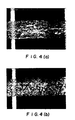
- wrought copper foils 35 ⁇ m-thick wrought copper foils (wrought copper foils TPC-35 for use in printed circuits, produced by Mitsui Mining & Smelting Co., Ltd.) exhibited tensile strength, elongation and MIT folding endurance at room temperature, after heating at 180° C for one hour and at elevated temperature (180° C), respectively, as shown in Table 1. Further, the microscopic photographs (1000 magnifications) of metallographs of said wrought copper foils as received and after heating, are indicated in Figs. 4(a) and 4(b), respectively. Examples and Comparative Examples Tensile strength (Kg/mm 2 ) Elongation (%) MIT Folding endurance (cycles) Example 1 Room temp.
- the electrodeposited copper foils of this invention meets all the requirements in Classes 1 to 4 prescribed in IPC-CF-150E and exhibits their folding endurance which is in the preferable range.
- the comparative el odeposited copper foils of Comparative Example 1 do not satisfy the elongation (room temp.) of Class 2 and the elongations (elev. temp.) of Classes 3 and 4; they are required to be heat treated, and also exhibit low folding endurance as compared with those obtained in Example 1.
- the wrought copper foils obtained in Comparative Example 2 do not satisfy the elongation (room temp.) of Classes 1 to 4, are required to be heat treated, and exhibit low folding endurance as compared with those obtained in Example 1.
- Example 1 The metallographs of copper foils (as received and after heating) of Example 1 and Comparative Examples 1-2 are shown in Figs. 2(a), 2(b), 3(a), 3(b), 4(a) and 4(b), respectively, from which it is evident that the electrodeposited copper foils of Example 1, after heated at 180 ° C for one hour, form macrocrystals, being different from the electrodeposited copper foils of Comparative Example 1 (refer to Fig. 2(b)), but similar to the wrought copper foils of Comparative Example 2.
- the copper foils of Example 1 exhibit an elongation (post-heating) of as high as 19% and are much improved in folding endurance which is required in flexible printed circuit boards.
- an acidic copper sulfate solution comprising 280 g/l of copper sulfate (CuSO 4 • 5H 2 O) and 100 g/l of sulfuric acid, was subjected to electrolysis at a solution temperature of about 50° C and a current density of 50-150 A/dm 2 and under the following further conditions.
- the electrolysis was continuously carried out while using the electrolyte which had continuously been partly or wholly treated with activated carbon at a velocity of 30 cm/sec.
- the partial or whole electrolyte so treated with activated carbon was used in the electrolysis 5 minutes after said treatment, thereby obtaining 35 ⁇ m-thick electrodeposited copper foils.
- Table 2 indicates the elongations (at elevated temperature, 180°C) of the thus obtained elecodeposited copper foils and the portion of the electrolyte treated with activated carbon. Examples and Comp. Examples The portion of electrolyte treated with activated carbon (vol.%) Elongation (elev. temp.) (%) Comp. Example 3 0 2.0 Comp. Example 4 40 3.5 Example 6 60 12.5 Example 7 80 27.0 Example 8 100 35.0
- An acidic copper sulfate solution comprising 280 g/l of copper sulfate (CuSO 4 ⁇ 5H 2 O) and 100 g/l of sulfuric acid was used as the electrolyte.
- the electrolyte was continuously electrolyzed at a solution temperature of about 50°C, a current density of 50 A/dm 2 while at least 80 vol.% of the electrolyte was continuously treated with activated carbon at a velocity of 30 cm/s. thereby obtaining 35 ⁇ m-thick electrodeposited copper foils.
- the electrodeposited copper foils of Examples 9-11 obtained by electrolyzing the electrolyte the specific portion of which was treated with activated carbon within 20 minutes before electrolysis, exhibit high elongations (elev. temp.); on the other hand, the electrolytic copper foil of Comparative Example 5, obtained by electrolyzing the electrolyte the specific portion of which was treated with activated carbon 30 minutes before electrolysis, exhibit low elongation (elev. temp.).
- This substantiates that it is necessary in this invention to electrolyze an electrolyte the specific portion (at least 60 vol.%) of which is treated with activated carbon within 20 minutes before the electrolysis.
- the electrodeposited copper foils obtained according to this invention exhibit high tensile strength and elongation at room temperature and elevated temperature and, therefore, they may be used for multilayer printed circuit boards without generating cracks in the heated process and they are satisfactory in folding endurance. Thus, they may highly reliably be used even in the preparation of flexible printed circuit boards.
Landscapes
- Chemical & Material Sciences (AREA)
- Engineering & Computer Science (AREA)
- Chemical Kinetics & Catalysis (AREA)
- Electrochemistry (AREA)
- Materials Engineering (AREA)
- Metallurgy (AREA)
- Organic Chemistry (AREA)
- Electrolytic Production Of Metals (AREA)
- Carbon And Carbon Compounds (AREA)
- Electroplating Methods And Accessories (AREA)
- Physical Vapour Deposition (AREA)
- Fixed Capacitors And Capacitor Manufacturing Machines (AREA)
- Parts Printed On Printed Circuit Boards (AREA)
- Cosmetics (AREA)
- Non-Silver Salt Photosensitive Materials And Non-Silver Salt Photography (AREA)
- Fats And Perfumes (AREA)
- Electroplating And Plating Baths Therefor (AREA)
Claims (2)
- Kontinuierliches Verfahren zum Herstellung einer elektrolytisch abgeschiedenen Kupferfolie, umfassend:
Elektrolysieren eines Kupferionen enthaltenden Elektrolyten, der aus 50-100 g/l Salzsäure und 80-180 g/l Schwefelsäure, oder 5-50 g/l Salzsäure und einem Borfluorid in einer Menge, die einem pH-Wert von 0,1-2,0 entspricht, besteht, wobei das Elektrolysieren bei einer Elektrolyttemperatur von 40-60°C und einer Stromdichte von 30-120 A/dm2 durchgeführt wird, und wobei mindestens 60 Vol.% des Elektrolyten kontinuierlich mit Aktivkchle dadurch behandelt wurden, in dem sie mit einer Geschwingkeit von 5-100 cm/s durch eine Aktivkohlesäule geleitet wurden, und der Elektrolyt kontinuierlich dem Elektrolysieren innerhalb von 20 Minuten nach der Behandlung mit Aktivkohle unterworfen wird. - Verfahren nach Anspruch 1, wobei die Kupferionen von Kupfer(II)sulfat oder Kupfer(II)chlorid stammt.
Priority Applications (1)
| Application Number | Priority Date | Filing Date | Title |
|---|---|---|---|
| AT86105554T ATE82333T1 (de) | 1985-07-05 | 1986-04-22 | Kupferfolie, durch elektrolytische abscheidung hergestellt. |
Applications Claiming Priority (2)
| Application Number | Priority Date | Filing Date | Title |
|---|---|---|---|
| JP146623/85 | 1985-07-05 | ||
| JP60146623A JPS6210291A (ja) | 1985-07-05 | 1985-07-05 | 電解銅箔 |
Publications (4)
| Publication Number | Publication Date |
|---|---|
| EP0207244A2 EP0207244A2 (de) | 1987-01-07 |
| EP0207244A3 EP0207244A3 (en) | 1988-05-25 |
| EP0207244B1 EP0207244B1 (de) | 1992-11-11 |
| EP0207244B2 true EP0207244B2 (de) | 1999-03-31 |
Family
ID=15411921
Family Applications (1)
| Application Number | Title | Priority Date | Filing Date |
|---|---|---|---|
| EP86105554A Expired - Lifetime EP0207244B2 (de) | 1985-07-05 | 1986-04-22 | Verfahren zur Herstellung einer Kupferfolie durch elektrolytische Abscheidung. |
Country Status (7)
| Country | Link |
|---|---|
| EP (1) | EP0207244B2 (de) |
| JP (1) | JPH0610181A (de) |
| AT (1) | ATE82333T1 (de) |
| DE (1) | DE3687089T3 (de) |
| ES (1) | ES8708151A1 (de) |
| FI (1) | FI862842L (de) |
| NO (1) | NO862041L (de) |
Families Citing this family (9)
| Publication number | Priority date | Publication date | Assignee | Title |
|---|---|---|---|---|
| US4837764A (en) * | 1987-03-26 | 1989-06-06 | Bunker Ramo Corporation | Programmable apparatus and method for testing computer peripherals |
| US4956053A (en) * | 1988-05-26 | 1990-09-11 | Olin Corporation | Apparatus and process for the production of micro-pore free high ductility metal foil |
| US5431803A (en) * | 1990-05-30 | 1995-07-11 | Gould Electronics Inc. | Electrodeposited copper foil and process for making same |
| US6123788A (en) * | 1993-04-19 | 2000-09-26 | Electrocopper Products Limited | Copper wire and process for making copper wire |
| TW432124B (en) | 1996-05-13 | 2001-05-01 | Mitsui Mining & Amp Smelting C | Electrolytic copper foil with high post heat tensile strength and its manufacturing method |
| TW336325B (en) * | 1996-05-24 | 1998-07-11 | Electrocopper Products Ltd | Copper wire and process for making copper wire |
| JP3670179B2 (ja) * | 1999-11-11 | 2005-07-13 | 三井金属鉱業株式会社 | キャリア箔付電解銅箔及びそのキャリア箔付電解銅箔を用いた銅張積層板 |
| JP3521074B2 (ja) * | 2000-01-06 | 2004-04-19 | 三井金属鉱業株式会社 | 電解銅箔の物性検査方法 |
| JP2004269950A (ja) * | 2003-03-07 | 2004-09-30 | Mitsui Mining & Smelting Co Ltd | 電解銅箔の製造方法 |
Family Cites Families (3)
| Publication number | Priority date | Publication date | Assignee | Title |
|---|---|---|---|---|
| CH494824A (de) * | 1969-07-10 | 1970-08-15 | Fluehmann Werner | Verfahren zur elektrolytischen Abscheidung von Kupfer hoher Duktilität |
| GB8333752D0 (en) * | 1983-12-19 | 1984-01-25 | Thorpe J E | Matte surface on metal layer |
| JPS6152387A (ja) * | 1984-08-17 | 1986-03-15 | Fukuda Kinzoku Hakufun Kogyo Kk | 高温加熱時の伸び率が優れた電解銅箔の製造方法 |
-
1986
- 1986-04-22 DE DE3687089T patent/DE3687089T3/de not_active Expired - Lifetime
- 1986-04-22 EP EP86105554A patent/EP0207244B2/de not_active Expired - Lifetime
- 1986-04-22 AT AT86105554T patent/ATE82333T1/de not_active IP Right Cessation
- 1986-05-22 NO NO862041A patent/NO862041L/no unknown
- 1986-06-06 ES ES556394A patent/ES8708151A1/es not_active Expired
- 1986-07-04 FI FI862842A patent/FI862842L/fi not_active Application Discontinuation
-
1993
- 1993-02-22 JP JP5054589A patent/JPH0610181A/ja active Pending
Also Published As
| Publication number | Publication date |
|---|---|
| NO862041L (no) | 1987-01-06 |
| DE3687089T2 (de) | 1993-03-18 |
| DE3687089T3 (de) | 1999-10-07 |
| EP0207244A3 (en) | 1988-05-25 |
| ES8708151A1 (es) | 1987-07-01 |
| EP0207244A2 (de) | 1987-01-07 |
| DE3687089D1 (de) | 1992-12-17 |
| ATE82333T1 (de) | 1992-11-15 |
| ES556394A0 (es) | 1987-07-01 |
| FI862842A0 (fi) | 1986-07-04 |
| FI862842A7 (fi) | 1987-01-06 |
| EP0207244B1 (de) | 1992-11-11 |
| FI862842L (fi) | 1987-01-06 |
| JPH0610181A (ja) | 1994-01-18 |
Similar Documents
| Publication | Publication Date | Title |
|---|---|---|
| EP0709494B1 (de) | Verfahren zur Oberflächen-Aufrauhung von Kupferfolie | |
| JP3058445B2 (ja) | 特性の調整された、印刷回路基板用の電着された箔並びにそれを製造するための方法及び電解槽溶液 | |
| EP0862665B1 (de) | Verfahren zur elektrolytischen abscheidung von metallschichten | |
| EP0841412B1 (de) | Elektrolytkupferfolie mit hoher zugspannung und verfahren zu deren herstellung | |
| EP0778361B1 (de) | Kupferfolie für Leiterplatte, Verfahren und Gegenstand zur Herstellung | |
| JP2001505955A (ja) | 銅層の電解析出方法 | |
| JP2001247994A (ja) | 電着された銅箔およびこれを低塩素イオン濃度の電解質溶液を用いて製造する方法 | |
| EP0207244B1 (de) | Kupferfolie, durch elektrolytische Abscheidung hergestellt | |
| JPWO2008108341A1 (ja) | 表面粗化銅板の製造方法及び装置、並びに表面粗化銅板 | |
| EP0495468B1 (de) | Verfahren zur Herstellung behandelter Kupfer-Folien, daraus hergestellte Produkte sowie Elektrolyt zur Verwendung in einem solchen Verfahren | |
| US4187166A (en) | Method of removing copper ions from a bath containing same | |
| JPS63310989A (ja) | 電解銅箔の製造方法 | |
| JPH0649958B2 (ja) | 電解銅箔の製造方法 | |
| JP3943214B2 (ja) | 銀を含む電解銅箔 | |
| US3660251A (en) | Method for the electrolytical deposition of highly ductile copper | |
| JPH08283886A (ja) | フレキシブル配線板用電解銅箔 | |
| KR910007950B1 (ko) | 전해동박 | |
| JPH01104791A (ja) | アルミニウム電解箔の製造方法 | |
| Lee et al. | Evaluating and monitoring nucleation and growth in copper foil | |
| JPH0432155B2 (de) | ||
| CA1180677A (en) | Bath and process for high speed nickel electroplating | |
| DE4412253A1 (de) | Elektrolytische Abscheidung von Palladium oder Palladiumlegierungen | |
| US2623848A (en) | Process for producing modified electronickel | |
| EP0417880B1 (de) | Verfahren zur Behandlung einer Kupferfolienoberfläche | |
| JP2732972B2 (ja) | リフロー錫またはリフロー錫合金めっき浴 |
Legal Events
| Date | Code | Title | Description |
|---|---|---|---|
| PUAI | Public reference made under article 153(3) epc to a published international application that has entered the european phase |
Free format text: ORIGINAL CODE: 0009012 |
|
| AK | Designated contracting states |
Kind code of ref document: A2 Designated state(s): AT BE CH DE FR GB IT LI LU NL SE |
|
| RAP1 | Party data changed (applicant data changed or rights of an application transferred) |
Owner name: MITSUI MINING & SMELTING CO., LTD. |
|
| RIN1 | Information on inventor provided before grant (corrected) |
Inventor name: FUJIKI, MAKOTO Inventor name: UENO, KUNIKI Inventor name: HIRASAWA, YUTAKA C/O MITSUI MINING & SMELTING CO. Inventor name: NABEKURA, KAZUYOSHI |
|
| PUAL | Search report despatched |
Free format text: ORIGINAL CODE: 0009013 |
|
| AK | Designated contracting states |
Kind code of ref document: A3 Designated state(s): AT BE CH DE FR GB IT LI LU NL SE |
|
| 17P | Request for examination filed |
Effective date: 19880809 |
|
| 17Q | First examination report despatched |
Effective date: 19890918 |
|
| GRAA | (expected) grant |
Free format text: ORIGINAL CODE: 0009210 |
|
| AK | Designated contracting states |
Kind code of ref document: B1 Designated state(s): AT BE CH DE FR GB IT LI LU NL SE |
|
| PG25 | Lapsed in a contracting state [announced via postgrant information from national office to epo] |
Ref country code: IT Free format text: LAPSE BECAUSE OF FAILURE TO SUBMIT A TRANSLATION OF THE DESCRIPTION OR TO PAY THE FEE WITHIN THE PRE;WARNING: LAPSES OF ITALIAN PATENTS WITH EFFECTIVE DATE BEFORE 2007 MAY HAVE OCCURRED AT ANY TIME BEFORE 2007. THE CORRECT EFFECTIVE DATE MAY BE DIFFERENT FROM THE ONE RECORDED.SCRIBED TIME-LIMIT Effective date: 19921111 Ref country code: CH Effective date: 19921111 Ref country code: BE Effective date: 19921111 Ref country code: AT Effective date: 19921111 Ref country code: LI Effective date: 19921111 Ref country code: NL Effective date: 19921111 |
|
| REF | Corresponds to: |
Ref document number: 82333 Country of ref document: AT Date of ref document: 19921115 Kind code of ref document: T |
|
| REF | Corresponds to: |
Ref document number: 3687089 Country of ref document: DE Date of ref document: 19921217 |
|
| ET | Fr: translation filed | ||
| REG | Reference to a national code |
Ref country code: CH Ref legal event code: PL |
|
| NLV1 | Nl: lapsed or annulled due to failure to fulfill the requirements of art. 29p and 29m of the patents act | ||
| PG25 | Lapsed in a contracting state [announced via postgrant information from national office to epo] |
Ref country code: LU Free format text: LAPSE BECAUSE OF NON-PAYMENT OF DUE FEES Effective date: 19930430 |
|
| PLBI | Opposition filed |
Free format text: ORIGINAL CODE: 0009260 |
|
| 26 | Opposition filed |
Opponent name: CIRCUIT FOIL LUXEMBOURG S.A. Effective date: 19930806 |
|
| EAL | Se: european patent in force in sweden |
Ref document number: 86105554.9 |
|
| APAC | Appeal dossier modified |
Free format text: ORIGINAL CODE: EPIDOS NOAPO |
|
| APAA | Appeal reference recorded |
Free format text: ORIGINAL CODE: EPIDOS REFN |
|
| APAC | Appeal dossier modified |
Free format text: ORIGINAL CODE: EPIDOS NOAPO |
|
| PLAW | Interlocutory decision in opposition |
Free format text: ORIGINAL CODE: EPIDOS IDOP |
|
| PLAW | Interlocutory decision in opposition |
Free format text: ORIGINAL CODE: EPIDOS IDOP |
|
| PUAH | Patent maintained in amended form |
Free format text: ORIGINAL CODE: 0009272 |
|
| STAA | Information on the status of an ep patent application or granted ep patent |
Free format text: STATUS: PATENT MAINTAINED AS AMENDED |
|
| 27A | Patent maintained in amended form |
Effective date: 19990331 |
|
| AK | Designated contracting states |
Kind code of ref document: B2 Designated state(s): AT BE CH DE FR GB IT LI LU NL SE |
|
| REG | Reference to a national code |
Ref country code: CH Ref legal event code: AEN Free format text: AUFRECHTERHALTUNG DES PATENTES IN GEAENDERTER FORM |
|
| ET3 | Fr: translation filed ** decision concerning opposition | ||
| REG | Reference to a national code |
Ref country code: GB Ref legal event code: IF02 |
|
| PGFP | Annual fee paid to national office [announced via postgrant information from national office to epo] |
Ref country code: SE Payment date: 20020405 Year of fee payment: 17 |
|
| PGFP | Annual fee paid to national office [announced via postgrant information from national office to epo] |
Ref country code: GB Payment date: 20020417 Year of fee payment: 17 |
|
| PG25 | Lapsed in a contracting state [announced via postgrant information from national office to epo] |
Ref country code: GB Free format text: LAPSE BECAUSE OF NON-PAYMENT OF DUE FEES Effective date: 20030422 |
|
| PG25 | Lapsed in a contracting state [announced via postgrant information from national office to epo] |
Ref country code: SE Free format text: LAPSE BECAUSE OF NON-PAYMENT OF DUE FEES Effective date: 20030423 |
|
| EUG | Se: european patent has lapsed | ||
| GBPC | Gb: european patent ceased through non-payment of renewal fee |
Effective date: 20030422 |
|
| PGFP | Annual fee paid to national office [announced via postgrant information from national office to epo] |
Ref country code: FR Payment date: 20050408 Year of fee payment: 20 |
|
| PGFP | Annual fee paid to national office [announced via postgrant information from national office to epo] |
Ref country code: DE Payment date: 20050414 Year of fee payment: 20 |
|
| APAH | Appeal reference modified |
Free format text: ORIGINAL CODE: EPIDOSCREFNO |
|
| PLAB | Opposition data, opponent's data or that of the opponent's representative modified |
Free format text: ORIGINAL CODE: 0009299OPPO |