EP0207465A2 - Aluminiumnitridsinterkörper und Verfahren zu seiner Herstellung - Google Patents
Aluminiumnitridsinterkörper und Verfahren zu seiner Herstellung Download PDFInfo
- Publication number
- EP0207465A2 EP0207465A2 EP86108787A EP86108787A EP0207465A2 EP 0207465 A2 EP0207465 A2 EP 0207465A2 EP 86108787 A EP86108787 A EP 86108787A EP 86108787 A EP86108787 A EP 86108787A EP 0207465 A2 EP0207465 A2 EP 0207465A2
- Authority
- EP
- European Patent Office
- Prior art keywords
- earth metal
- sintered body
- compound
- aluminum nitride
- aluminum
- Prior art date
- Legal status (The legal status is an assumption and is not a legal conclusion. Google has not performed a legal analysis and makes no representation as to the accuracy of the status listed.)
- Granted
Links
- PMHQVHHXPFUNSP-UHFFFAOYSA-M copper(1+);methylsulfanylmethane;bromide Chemical compound Br[Cu].CSC PMHQVHHXPFUNSP-UHFFFAOYSA-M 0.000 title claims abstract description 60
- 238000002360 preparation method Methods 0.000 title description 5
- 238000005245 sintering Methods 0.000 claims abstract description 51
- 150000001875 compounds Chemical class 0.000 claims abstract description 40
- 229910052784 alkaline earth metal Inorganic materials 0.000 claims abstract description 29
- 150000001342 alkaline earth metals Chemical class 0.000 claims abstract description 29
- 229910052761 rare earth metal Inorganic materials 0.000 claims abstract description 29
- 150000002910 rare earth metals Chemical class 0.000 claims abstract description 29
- 230000007704 transition Effects 0.000 claims abstract description 24
- 229910052782 aluminium Inorganic materials 0.000 claims abstract description 20
- -1 aluminum compound Chemical class 0.000 claims abstract description 20
- 239000000203 mixture Substances 0.000 claims abstract description 16
- 238000000465 moulding Methods 0.000 claims abstract description 13
- 230000000737 periodic effect Effects 0.000 claims abstract description 13
- 238000002156 mixing Methods 0.000 claims abstract description 5
- XAGFODPZIPBFFR-UHFFFAOYSA-N aluminium Chemical compound [Al] XAGFODPZIPBFFR-UHFFFAOYSA-N 0.000 claims abstract 2
- 239000000843 powder Substances 0.000 claims description 50
- 239000002245 particle Substances 0.000 claims description 26
- 238000000034 method Methods 0.000 claims description 17
- QVGXLLKOCUKJST-UHFFFAOYSA-N atomic oxygen Chemical compound [O] QVGXLLKOCUKJST-UHFFFAOYSA-N 0.000 claims description 12
- 239000001301 oxygen Substances 0.000 claims description 12
- 229910052760 oxygen Inorganic materials 0.000 claims description 12
- 229910052719 titanium Inorganic materials 0.000 claims description 6
- 229910052791 calcium Inorganic materials 0.000 claims description 5
- 239000000126 substance Substances 0.000 claims description 5
- 229910052726 zirconium Inorganic materials 0.000 claims description 5
- 229910052788 barium Inorganic materials 0.000 claims description 4
- 229910052804 chromium Inorganic materials 0.000 claims description 4
- 229910052735 hafnium Inorganic materials 0.000 claims description 4
- 229910052742 iron Inorganic materials 0.000 claims description 4
- 229910052748 manganese Inorganic materials 0.000 claims description 4
- 229910052759 nickel Inorganic materials 0.000 claims description 4
- 150000004767 nitrides Chemical class 0.000 claims description 4
- 229910052712 strontium Inorganic materials 0.000 claims description 4
- 229910052720 vanadium Inorganic materials 0.000 claims description 4
- 229910052727 yttrium Inorganic materials 0.000 claims description 4
- 229910052684 Cerium Inorganic materials 0.000 claims description 3
- KRHYYFGTRYWZRS-UHFFFAOYSA-M Fluoride anion Chemical compound [F-] KRHYYFGTRYWZRS-UHFFFAOYSA-M 0.000 claims description 3
- 229910052746 lanthanum Inorganic materials 0.000 claims description 3
- 238000004519 manufacturing process Methods 0.000 abstract description 13
- 239000000654 additive Substances 0.000 description 36
- 239000000463 material Substances 0.000 description 29
- 230000000996 additive effect Effects 0.000 description 23
- 230000000052 comparative effect Effects 0.000 description 23
- VTYYLEPIZMXCLO-UHFFFAOYSA-L Calcium carbonate Chemical compound [Ca+2].[O-]C([O-])=O VTYYLEPIZMXCLO-UHFFFAOYSA-L 0.000 description 10
- 239000012298 atmosphere Substances 0.000 description 10
- IJGRMHOSHXDMSA-UHFFFAOYSA-N Atomic nitrogen Chemical compound N#N IJGRMHOSHXDMSA-UHFFFAOYSA-N 0.000 description 9
- 229910001873 dinitrogen Inorganic materials 0.000 description 9
- GWEVSGVZZGPLCZ-UHFFFAOYSA-N titanium dioxide Inorganic materials O=[Ti]=O GWEVSGVZZGPLCZ-UHFFFAOYSA-N 0.000 description 9
- 239000012188 paraffin wax Substances 0.000 description 8
- 238000007731 hot pressing Methods 0.000 description 7
- 239000012535 impurity Substances 0.000 description 7
- OKTJSMMVPCPJKN-UHFFFAOYSA-N Carbon Chemical compound [C] OKTJSMMVPCPJKN-UHFFFAOYSA-N 0.000 description 6
- MCMNRKCIXSYSNV-UHFFFAOYSA-N Zirconium dioxide Chemical compound O=[Zr]=O MCMNRKCIXSYSNV-UHFFFAOYSA-N 0.000 description 6
- 229910052799 carbon Inorganic materials 0.000 description 6
- 229910000019 calcium carbonate Inorganic materials 0.000 description 5
- 238000011835 investigation Methods 0.000 description 5
- 239000011812 mixed powder Substances 0.000 description 5
- 206010030924 Optic ischaemic neuropathy Diseases 0.000 description 4
- 239000011575 calcium Substances 0.000 description 4
- 230000000694 effects Effects 0.000 description 4
- 239000008187 granular material Substances 0.000 description 4
- 238000013001 point bending Methods 0.000 description 4
- PNEYBMLMFCGWSK-UHFFFAOYSA-N aluminium oxide Inorganic materials [O-2].[O-2].[O-2].[Al+3].[Al+3] PNEYBMLMFCGWSK-UHFFFAOYSA-N 0.000 description 3
- 239000011230 binding agent Substances 0.000 description 3
- 229910052593 corundum Inorganic materials 0.000 description 3
- 239000013078 crystal Substances 0.000 description 3
- QDOXWKRWXJOMAK-UHFFFAOYSA-N dichromium trioxide Chemical compound O=[Cr]O[Cr]=O QDOXWKRWXJOMAK-UHFFFAOYSA-N 0.000 description 3
- JEIPFZHSYJVQDO-UHFFFAOYSA-N iron(III) oxide Inorganic materials O=[Fe]O[Fe]=O JEIPFZHSYJVQDO-UHFFFAOYSA-N 0.000 description 3
- 239000004065 semiconductor Substances 0.000 description 3
- 229910001845 yogo sapphire Inorganic materials 0.000 description 3
- 238000010586 diagram Methods 0.000 description 2
- 238000000227 grinding Methods 0.000 description 2
- OYPRJOBELJOOCE-UHFFFAOYSA-N Calcium Chemical compound [Ca] OYPRJOBELJOOCE-UHFFFAOYSA-N 0.000 description 1
- BVKZGUZCCUSVTD-UHFFFAOYSA-L Carbonate Chemical compound [O-]C([O-])=O BVKZGUZCCUSVTD-UHFFFAOYSA-L 0.000 description 1
- 241001573498 Compacta Species 0.000 description 1
- 229910052692 Dysprosium Inorganic materials 0.000 description 1
- 229910052691 Erbium Inorganic materials 0.000 description 1
- 229910052688 Gadolinium Inorganic materials 0.000 description 1
- 229910002651 NO3 Inorganic materials 0.000 description 1
- 229910052779 Neodymium Inorganic materials 0.000 description 1
- NHNBFGGVMKEFGY-UHFFFAOYSA-N Nitrate Chemical compound [O-][N+]([O-])=O NHNBFGGVMKEFGY-UHFFFAOYSA-N 0.000 description 1
- MUBZPKHOEPUJKR-UHFFFAOYSA-N Oxalic acid Chemical compound OC(=O)C(O)=O MUBZPKHOEPUJKR-UHFFFAOYSA-N 0.000 description 1
- 229910052772 Samarium Inorganic materials 0.000 description 1
- ATJFFYVFTNAWJD-UHFFFAOYSA-N Tin Chemical compound [Sn] ATJFFYVFTNAWJD-UHFFFAOYSA-N 0.000 description 1
- 229910052769 Ytterbium Inorganic materials 0.000 description 1
- 150000001341 alkaline earth metal compounds Chemical class 0.000 description 1
- AZDRQVAHHNSJOQ-UHFFFAOYSA-N alumane Chemical class [AlH3] AZDRQVAHHNSJOQ-UHFFFAOYSA-N 0.000 description 1
- 238000005452 bending Methods 0.000 description 1
- 229910052790 beryllium Inorganic materials 0.000 description 1
- 230000015572 biosynthetic process Effects 0.000 description 1
- 239000003086 colorant Substances 0.000 description 1
- 238000004040 coloring Methods 0.000 description 1
- 238000010292 electrical insulation Methods 0.000 description 1
- 230000002708 enhancing effect Effects 0.000 description 1
- RSEIMSPAXMNYFJ-UHFFFAOYSA-N europium(III) oxide Inorganic materials O=[Eu]O[Eu]=O RSEIMSPAXMNYFJ-UHFFFAOYSA-N 0.000 description 1
- 239000007789 gas Substances 0.000 description 1
- 230000017525 heat dissipation Effects 0.000 description 1
- 239000003779 heat-resistant material Substances 0.000 description 1
- 230000002706 hydrostatic effect Effects 0.000 description 1
- XLYOFNOQVPJJNP-UHFFFAOYSA-M hydroxide Chemical compound [OH-] XLYOFNOQVPJJNP-UHFFFAOYSA-M 0.000 description 1
- 229910052741 iridium Inorganic materials 0.000 description 1
- 229910052749 magnesium Inorganic materials 0.000 description 1
- 238000002844 melting Methods 0.000 description 1
- 230000008018 melting Effects 0.000 description 1
- 229910052750 molybdenum Inorganic materials 0.000 description 1
- 229910052758 niobium Inorganic materials 0.000 description 1
- 239000012299 nitrogen atmosphere Substances 0.000 description 1
- 229910052762 osmium Inorganic materials 0.000 description 1
- 229910052763 palladium Inorganic materials 0.000 description 1
- 229910052697 platinum Inorganic materials 0.000 description 1
- 150000002909 rare earth metal compounds Chemical class 0.000 description 1
- 229910052702 rhenium Inorganic materials 0.000 description 1
- 229910052703 rhodium Inorganic materials 0.000 description 1
- 229910052707 ruthenium Inorganic materials 0.000 description 1
- 229910052715 tantalum Inorganic materials 0.000 description 1
- 239000010409 thin film Substances 0.000 description 1
- 229910052723 transition metal Inorganic materials 0.000 description 1
- 150000003624 transition metals Chemical class 0.000 description 1
- 229910052721 tungsten Inorganic materials 0.000 description 1
- VWQVUPCCIRVNHF-UHFFFAOYSA-N yttrium atom Chemical compound [Y] VWQVUPCCIRVNHF-UHFFFAOYSA-N 0.000 description 1
Images




Classifications
-
- C—CHEMISTRY; METALLURGY
- C04—CEMENTS; CONCRETE; ARTIFICIAL STONE; CERAMICS; REFRACTORIES
- C04B—LIME, MAGNESIA; SLAG; CEMENTS; COMPOSITIONS THEREOF, e.g. MORTARS, CONCRETE OR LIKE BUILDING MATERIALS; ARTIFICIAL STONE; CERAMICS; REFRACTORIES; TREATMENT OF NATURAL STONE
- C04B35/00—Shaped ceramic products characterised by their composition; Ceramics compositions; Processing powders of inorganic compounds preparatory to the manufacturing of ceramic products
- C04B35/515—Shaped ceramic products characterised by their composition; Ceramics compositions; Processing powders of inorganic compounds preparatory to the manufacturing of ceramic products based on non-oxide ceramics
- C04B35/58—Shaped ceramic products characterised by their composition; Ceramics compositions; Processing powders of inorganic compounds preparatory to the manufacturing of ceramic products based on non-oxide ceramics based on borides, nitrides, i.e. nitrides, oxynitrides, carbonitrides or oxycarbonitrides or silicides
- C04B35/581—Shaped ceramic products characterised by their composition; Ceramics compositions; Processing powders of inorganic compounds preparatory to the manufacturing of ceramic products based on non-oxide ceramics based on borides, nitrides, i.e. nitrides, oxynitrides, carbonitrides or oxycarbonitrides or silicides based on aluminium nitride
Definitions
- the present invention relates to a sintered body of aluminum nitride and a process for preparing the same, more particularly to a sintered body of aluminum nitride which is dense and excellent in thermal conductivity and a process for preparing the same.
- AfN having the above-described properties usually has no melting point and decomposes at a high temperature of not lower than 2200 °C, and therefore, it is used in the form of a sintered body except for the use as thin films.
- Said AIN sintered body is usually prepared by molding and sintering an AlN powder.
- AlN powder when used singly, sinterability thereof is not good, and therefore, it is impossible to obtain a sintered body which is dense or has a high density except for the case where the hot pressing method is employed. Therefore, in the case of sintering under atmospheric pressure, it is generally practiced to add an oxide of a rare earth metal or an oxide of an alkaline earth metal as a sintering aids to the AlN powder for the purpose of making sintered body denser.
- An object of the present invention is to provide an AlN sintered body having a hgih density and a high thermal conductivity and a process for preparing the same by solving the above-described problems that have existed heretofore.
- the present inventors have investigated extensively into the relationships of sintering additives to be added to AlN powders and to densities and thermal conductivities of the resulting sintered bodies, which led to the following findings.
- the aluminum nitride sintered body of the present invention comprises;
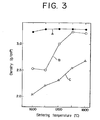
- Fig. l, Fig. 3, Fig. 7 and Fig. 9 are characteristic diagrams showing the relationships of the sintering temperature of AlN sintered bodies prepared in Examples 94, 95, 96, 97 and 98 and Comparative Examples 19, 20, 21, 22 and 23 to the densities thereof; and
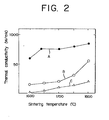
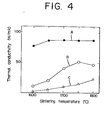
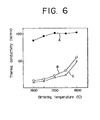
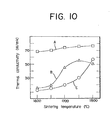
- Fig. 2, Fig. 4, Fig. 6, Fig. 8 and Fig. 10 are characteristic diagrams showing the relationships of the sintering temperature of AIN sintered bodies prepared in Examples 94, 95, 96, 97 and 98, and Comparative Examples 19, 20, 21, 22 and 23, to the thermal conductivities thereof.
- the microscopic investigation of the AIN sintered body of the present invention shows that in the boundary area of AlN crystal particles, there are formed compounds such as an aluminum compound of a rare earth metal and/or an aluminum compound of an alkaline earth metal and/or an oxides of an aluminum compound of a rare earth metal and an alkaline earth metal and/or an oxyfluoride thereof, and compounds containing a transition element of Groups IVa, Va, VIa, VIIa and VIII in the periodic table.
- a rare earth metal contained therein is, e.g., yttrium (Y)
- said oxides of aluminum compounds thereof are compounds such as 3Y 2 O 3 ⁇ -5Al 2 O 3 , Y 2 O 3 ⁇ Al 2 O 3 and the like, and also if YF 3 is added, besides the compounds composed of Y 2 O 3 and Al 2 O 3 , there is formed YOF.
- said alkaline earth element is, e.g., calcium (Ca)
- said alkaline earth element is, e.g., calcium (Ca)
- there are produced compounds such as 6Al 2 O 3 ⁇ CaO, 2Al2O 3 ⁇ CaO, Al2O 3 ⁇ -CaO and the like.
- the composition ratio of the principal component, AIN crystal particles is preferably 80 to 99.98 % by weight relative to the whole. If this composition ratio is less than 80 % by weight, the characteristics of AIN itself cannot be obtained sufficiently, whereas if the ratio exceeds 99.98 % by weight, it becomes difficult to allow the additives to achieve their effects sufficiently.
- the gist of the preparative method of the present invention comprises mixing the principal component of aluminum nitride with, as a first additive, at least one compound selected from the group consisting of the compounds containing a rare earth metal and/or an alkaline earth metal, and as a second additive, at least one element selected from the group consisting of a transition element of Groups IVa, Va, VIa, VIIa and VIII in the periodic table or a compound containing the above elements; and then molding and sintering the mixture.
- AIN powder which is a principal component
- the use of one which contains 0.001 to 7 % by weight of oxygen is particularly preferable, when sinterability and thermal conductivity being taken into account.
- a rare earth metal to be contained in the first additive there may be mentioned Y, La, Ce, Sm, Dy, Nd, Gd, Pr, Ho, Er, Yb, etc., and particularly, Y, La and Ce are preferable.
- an alkaline earth metal there may be mentioned Be, Mg, Ca, Sr, Ba, etc., and particularly, Ca, Sr and Ba are preferable.
- Be, Mg, Ca, Sr, Ba, etc., and particularly, Ca, Sr and Ba are preferable.
- One kind or two or more kinds of these elements are added to said AlN powder.
- a compound of these elements an oxide, a nitride, a fluoride, and a substance which is converted into a compound mentioned above by sintering are preferable.
- a substance which is converted into e.g., an oxide by sintering there may be mentioned a carbonate, a nitrate, an oxalate, a hydroxide, etc. of these elements.
- any element contained in the second additive any element may be used so long as it belongs to Groups IVa (Ti, Zr and Hf), Va (V, Nb and Ta), VIa (Cr, Mo and W) or VIIa (Mn and Re), or VIII (Fe, Co, Ni, Ru, Rh, Pd, Os, Ir and Pt), and as is the case with said first additive, one kind or two or more kinds of the above-mentioned elements is (or are) added to said AIN powder as a compound powder.
- the use of an element of Group VIa i.e.
- Ti, Zr or Hf gives an AIN sintered body which has not only a high density and a good thermal conductivity but also an extremely high strength. Among them, Zr and Ti are particularly preferred.
- transition elements if one which belongs to the fourth period, or Ti, V, Cr, Mn, Fe, Co or Ni, is used, at a sintering temperature lower than conventional temperatures, e.g., at 1600 to 1650 °C, there can be produced an AIN sintered body which has a high density and a good thermal conductivity.
- the above-mentioned first and second additives are preferably added in the range of 0.01 to 18 % by weight and 0.01 to 15 % by weight, more preferably in the range of 0.01 to 15 % by weight and 0.01 to 10 % by weight, respectively, in terms of oxides of respective elements.
- the total amount of both the additives is preferably 0.02 to 20 % by weight, more preferably 0.02 to 18 % by weight. If the amounts of the additives are less than 0.01 % by weight for each of them, the additives do not exert their effects sufficiently, whereas the amounts are excessively great, not only the thermal resistance and the high strength property are deteriorated but also the thermal conductivity is lowered, which is not preferable. If the amount of the second additive is great, there is a danger of the electrical insulating properties of products being disadvantageously lowered.
- All the average particle diameters of the AIN powder and powders of the first and second additives are not more than 5 um, preferably not more than 4 ⁇ m.
- a powder composed of a rare earth metal compound and/or an alkaline earth metal compound described above, and at least one element selected from the group consisting of Groups IVa to VIII in the periodic table or a compound containing the above elements is added, as sintering additive, to an AlN powder, in a predetermined amount, followed by blending using a ball mill, etc.
- the atmospheric pressure sintering method, the hot pressing method, etc. can be employed.
- the atmospheric pressure sitnering method is employed, a binder is added to the powder mixture, and the resulting mixture is kneaded, granulated, sized, and then molded.
- a molding method press-molding using a molding die, hydrostatic pressure press-molding, sheet forming, etc. can be applied. And then, a molded piece is heated under a stream of N 2 gas to remove the binder, followed by atmospheric pressure sintering.
- the sintering temperature is normally set at 1650 to 1800 °C, however, this depends on the kinds of additives used.
- a principal cause of enhancing the thermal conductivity is that in the AlN sintered body of the present invention, the oxynitride of Al (AION) and polytype of AlN (27R type) are hard to be formed.
- AION oxynitride of Al
- 27R type polytype of AlN
- AION and 27R type is influenced by the purity of AlN powder, atmosphere in a sintering furnace, and the kind and amount to be added of sintering aids.
- comparison of the sintered bodies prepared using the same AlN powder and under the same experimental conditions shows that compared with the case where a conventional oxide of a rare earth metal and an oxide of an alkaline earth metal are added, the sintered body of the present invention has evidently less or no AION and 27 R type formed therein.
- sintering proceeds by producing liduid phase at a lower temperature than when an oxide of a rare earth metal or an oxide of an alkaline earth metal are added singly.
- the sintered body of the present invention is colored by incorporating a transition element which is the second additive, and moreover, the tone can be varied depending the kinds of elements to be added, amounts and combinations thereof.
- the molar ratio of A l/N in an AIN material is not necessarily 1, and in many cases, rich in Al. Therefore, when such a material is used, the color of a sintered body becomes grey or black.
- the richer in Al the material is, the more the blackening proceeds on one hand and the lower the thermal conductivity becomes on the other hand.
- the simultaneous addition of an alkaline earth metal and/or a rare earth metal and a transition metal makes it possible to prepare a sintered body having various colors by suitably selecting the kind or combination of elements to be added while preserving a high thermal conductivity through the use of an AlN material of which the molar ratio of Al/N is close to 1 and which has a small amount of impurities.
- an AlN material of which the molar ratio of Al/N is close to 1 and which has a small amount of impurities.
- the addition of Cr 2 O 3 , etc. develops a dark grey color
- Ti0 2 develops a brown color.
- AlN sintered body showing a desired color.
- the AlN sintered body thus colored has such advantages as being higher in thermal emissivity, whereby the property of heat dissipation is further improved, a light which becomes a factor of an error of a semiconductor circuit is shielded and being able to avoid sintering uneveness, etc. during preparation by coloring, whereby the appearance of products can be enhanced.
- This green compact was heated up to 700 °C under an atmosphere of nitrogen gas to remove the paraffin. Further, the resulting compact was placed in a container made of carbon, and under nitrogen gas atmosphere, subjected to atmospheric pressure sintering at 1800 °C for 2 hours. The density of the resulting AIN sintered body was measured. Further, a disc having a diameter of 10 mm and a thickness of 2.5 mm was prepared by grinding from the sintered body, and the thermal conductivity was measured by laser-flash method using the disc as a specimen.
- AlN sintered bodies were prepared similarly to Example 1 described above, and the density, thermal conductivity and 3-point bending strength thereof were also measured. The results are shown in Table 1 together with the particle diameter and oxygen content of each AIN powder, and the kind of additives, particle diameter and amount to be added of each additive.
- Example 13 To the AlN powder used in Example 13, there were added 0.5 % by weight of CaCO 3 having an average particle diameter of 2 ⁇ m and 3.0 % by weight of ZrO 2 having an average particle diameter of 3.0 um, and the mixture was ground and mixed using a ball mill to prepare a material. Next, the material powder was press-molded under a pressure of 300 kg/cm 2 into a green compact of 50 x 50 x 8 mm. And then, the green compact was placed in a carbon die and subjected to hot pressing sintering under nitrogen gas atmosphere at a temperature of 1800 °C and under a pressure of 400 kg/cm 2 for one hour. Similarly to Example 1, the density, thermal conductivity and 3-point bending strength of the resulting sintered bodies were measured, and the results are shown in Table 2.
- AIN sintered bodies were prepared similarly to the above-mentioned Example 29, followed by measuring respective densities, thermal conductivities and 3-point bending strengths. The results are shown in Table 2, together with the particle diameter and oxygen content of each AlN powder, the kind of additives, particle diameter, amount to be added of each additive, and the color of each sintered body.
- this green compact was heated up to 700 °C under nitrogen atmosphere to remove the paraffin. Then, the resulting green compact was received into a carbon container, and subjected to atmospheric pressure sintering under nitrogen gas atmosphere, at 1700 °C for 2 hours to prepare an AlN sintered body.
- AIN sintered bodies were prepared similarly to the above-described Example 34, followed by measuring respective densities and thermal conductivities. The results are shown in Table 3, together with the particle diameter and oxygen content of each AlN powder, the kind of additives, particle diameter and amount to be added of each additive.
- AlN sintered bodies were prepared similarly to the above-mentioned Example 34, and respective densities and thermal conductivities were measured similarly. The results are shown in Table 4, together with the particle diameter and oxygen content of each AlN powder, and the kind and amount to be added of each sintering additive.
- Example 2 To the AlN powder used in Example 1, there were added 1.5 % by weight of Y 2 0 3 having an average particle diameter of 2.5 ⁇ m and 1.5 % by weight of NiO having an average particle diameter of 2.5 ⁇ m, and the mixture was ground and mixed using a ball mill to prepare a material. Next, the material powder was press-molded under a pressure of 500 kg/cm 2 into a green compact having a diameter of 12 mm and a thickness of 10 mm. And then, the green compact was placed in a carbon die and sujected to hot pressing sintering under nitrogen gas atmosphere at a temperature of 1700 °C and under a pressure of 400 kg/cm2 for one hour. Similarly to Example 1, the density and thermal conductivity of the resulting sintered body were measured, and the results are shown in Table 5.
- AlN sintered bodies were prepared similarly to the above-mentioned Example 91, followed by measuring respective densities and thermal conductivities. The results are shown in Table 5, together with the particle diameter and oxygen content of each AlN powder, the kind of additives, particle diameter and amount to be added of each additive.
- the resulting green compacts were placed in a carbon container, and subjected to atmospheric pressure sintering under an atmosphere of nitrogen gas, at 1600 °C, 1650 °C, 1700 °C, 1750 °C and 1800 °C for 2 hours to prepare 5 kinds of AIN sintered bodies.
- Example 94 Five kinds of AlN sintered bodies were prepared similarly to Example 94 except for the use of a material prepared by adding 5 % by weight of Y 2 0 3 to the same AlN powder as used in the above-mentioned Example 94.
- Example 94 Five kinds of AlN sintered bodies were prepared similarly to Example 94 except for the use of a material prepared by adding 5 % by weight of Ti0 2 to the same AIN powder as used in the above-mentioned Example 94.
- Example 94 of the present invention As to the AlN sintered bodies of Example 94 of the present invention and Comparative examples 19 and 20, the investigation of the relationships of the densities and the thermal conductivities to sintering temperature was carried out to give the characteristic drawings shown in Fig. 1 and Fig. 2.
- a in Fig. 1 and Fig. 2 is a characteristic curve of Example 94 of the present invention
- B is a characteristic curve of Comparative Example 19
- C is a characteristic curve of Comparative Example 20.
- the AlN sintered bodies of the present invention can attain enhanced densities and increased thermal conductivities at lower temperatures, and the manufacturing costs thereof can be controlled to lower levels than those of conventional AlN sintered bodies.
- the resulting green compacts were placed in a carbon container, and subjected to atmospheric pressure sintering under nitrogen gas atmosphere at 1600 °C, 1650 °C, 1700 °C, 1750 °C and 1800 °C for 2 hours to prepare 5 kinds of AIN sintered bodies.
- Example 95 Five kinds of A1N sintered bodies were prepared similarly to Example 95 except for the use of a material prepared by adding 4 % by weight of CaCO 3 in terms of CaO to the same AlN powder as used in the above-mentioned Example 95.
- Example 95 of the present invention the investigation of the relationships of the densities and the thermal conductivities to sintering temperature was carried out to give the characteristic drawings shown in Fig. 3 and Fig. 4.
- a in Fig. 3 and Fig. 4 is a characteristic curve of Example 95 of the present invention
- B is a characteristic curve of Comparative Example 21
- C is a characteristic curve of Comparative Example 20 described hereinbefore.
- the AlN sintered bodies of the present invention can attain enhanced densities and increased thermal conductivities at lower temperatures, and the manufacturing costs thereof can be controlled to lower levels than those of conventional AIN sintered bodies.
- Example 94 Five kinds of AlN sintered bodies were obtained by preparing green compacts and making sintered bodies at various temperatures similarly to Example 94 except for the addition of 5 % by weight of mixed powder of NiO and Y 2 0 3 (weight ratio * 1 : 1) to the same AlN powder as used in Example 94.
- Example 96 Five kinds of AlN sintered bodies were prepared similarly to Example 96 except for the use of a material prepared by adding ]5 % by weight of NiO alone to the same AIN powder as used in the above-mentioned Example 96
- Example 96 of the present invention As to the AlN sintered bodies of Example 96 of the present invention and Comparative examples 19 and 22, the investigation of the relationships of the densities and the thermal conductivities to the sintering temperature was carried out to give the characteristic drawings shown in Fig. 5 and Fig. 6.
- a in Fig. 5 and Fig. 6 is a characteristic curve of Example 96 of the present invention
- B is a characteristic curve of Comparative example 19
- C is a characteristic curve of Comparative example 22 described hereinbefore.
- Example 97 of the present invention As to the AlN sintered bodies of Example 97 of the present invention and Comparative examples 21 and 22, the investigation of the relationships of the densities and the thermal conductivities to the sintering temperature was carried out to give the characteristic drawings shown in Fig. 7 and Fig. 8.
- a in Fig. 7 or Fig. 8 is a characteristic curve of Example 97 of the present invention
- B is a characteristic curve of Comparative example 21
- C is a characteristic curve of Comparative example 22, respectively.
- the sintering temperature can be lowered to a great extent, and a high density and a good conductivity can be achieved; therefore, the manufacturing cost thereof can be controlled to a lower level than those of conventional AIN sintered bodies.
- the aluminum nitride sintered bodies of the present invention are excellent products having a high density and a good thermal conductivity.
- said second additive such properties as being extremely strong, being capable of being sintered at low temperatures, etc. can be given thereto.
- the present sintered bodies can be colored variously, which widens the range of use thereof as well as makes it possible to avoid lowering in yield thereof caused by non-uniformity in sintering, etc. Consequently, the industrial value thereof is extremely high and useful particularly for heat dissipating boards of semiconductor devices.
Landscapes
- Engineering & Computer Science (AREA)
- Chemical & Material Sciences (AREA)
- Ceramic Engineering (AREA)
- Manufacturing & Machinery (AREA)
- Materials Engineering (AREA)
- Structural Engineering (AREA)
- Organic Chemistry (AREA)
- Ceramic Products (AREA)
- Compositions Of Oxide Ceramics (AREA)
Priority Applications (1)
| Application Number | Priority Date | Filing Date | Title |
|---|---|---|---|
| EP91113211A EP0455277B1 (de) | 1985-06-28 | 1986-06-27 | Aluminiumnitridsinterkörper und Verfahren zu seiner Herstellung |
Applications Claiming Priority (8)
| Application Number | Priority Date | Filing Date | Title |
|---|---|---|---|
| JP14016685 | 1985-06-28 | ||
| JP140166/85 | 1985-06-28 | ||
| JP21140385 | 1985-09-25 | ||
| JP211401/85 | 1985-09-25 | ||
| JP21140185 | 1985-09-25 | ||
| JP211403/85 | 1985-09-25 | ||
| JP61009010A JPH0717454B2 (ja) | 1985-06-28 | 1986-01-21 | 窒化アルミニウム焼結体およびその製造方法 |
| JP9010/86 | 1986-01-21 |
Related Child Applications (1)
| Application Number | Title | Priority Date | Filing Date |
|---|---|---|---|
| EP91113211.6 Division-Into | 1991-08-06 |
Publications (3)
| Publication Number | Publication Date |
|---|---|
| EP0207465A2 true EP0207465A2 (de) | 1987-01-07 |
| EP0207465A3 EP0207465A3 (en) | 1988-05-11 |
| EP0207465B1 EP0207465B1 (de) | 1992-04-15 |
Family
ID=27455077
Family Applications (1)
| Application Number | Title | Priority Date | Filing Date |
|---|---|---|---|
| EP86108787A Expired - Lifetime EP0207465B1 (de) | 1985-06-28 | 1986-06-27 | Aluminiumnitridsinterkörper und Verfahren zu seiner Herstellung |
Country Status (3)
| Country | Link |
|---|---|
| US (1) | US4883780A (de) |
| EP (1) | EP0207465B1 (de) |
| DE (2) | DE3684821D1 (de) |
Cited By (9)
| Publication number | Priority date | Publication date | Assignee | Title |
|---|---|---|---|---|
| US4833108A (en) * | 1987-03-28 | 1989-05-23 | Narumi China Corporation | Sintered body of aluminum nitride |
| US4843038A (en) * | 1986-11-13 | 1989-06-27 | Narumi China Corporation | Black sintered body of aluminum nitride and process for producing the same |
| DE3910161A1 (de) * | 1988-03-31 | 1989-10-12 | Taiyo Yuden Kk | Verfahren zur herstellung von nitridkeramischen formstuecken |
| EP0431834A1 (de) * | 1989-11-30 | 1991-06-12 | Kabushiki Kaisha Toshiba | Lichtabweisender Sinterkörper aus Aluminiumnitrid und Verfahren zu seiner Herstellung |
| EP0443490A1 (de) * | 1990-02-19 | 1991-08-28 | KERAMONT ITALIA S.p.A. | Feuerfeste und elektrisch leitende keramische Zusammensetzungen und Verfahren zu ihrer Herstellung |
| EP0452871A1 (de) | 1990-04-17 | 1991-10-23 | Sumitomo Electric Industries, Ltd. | Wärmeleitender gefärbter Aluminiumnitrid-Sinterkörper und Verfahren zu seiner Herstellung |
| EP0470501A3 (en) * | 1990-08-07 | 1992-09-02 | Sumitomo Electric Industries, Ltd. | Thermal conductive colored aluminum nitride sintered body and method of preparing the same |
| WO1992017618A1 (en) * | 1991-03-26 | 1992-10-15 | The Australian National University | Abrasive compact composed mainly of cubic boron nitride and method of making same |
| DE102017124404A1 (de) | 2017-10-19 | 2019-04-25 | rtw RÖNTGEN-TECHNIK DR. WARRIKHOFF GmbH & Co. KG | Yttrium-beschichtetes Aluminiumnitrid-Pulver, dessen Herstellung und Verwendung |
Families Citing this family (15)
| Publication number | Priority date | Publication date | Assignee | Title |
|---|---|---|---|---|
| US5219803A (en) * | 1988-05-16 | 1993-06-15 | Sumitomo Electric Industries, Ltd. | Sintered body of aluminum nitride |
| US5264388A (en) * | 1988-05-16 | 1993-11-23 | Sumitomo Electric Industries, Inc. | Sintered body of aluminum nitride |
| US5292552A (en) * | 1989-12-20 | 1994-03-08 | Sumitomo Electric Industries, Ltd. | Method for forming metallized layer on an aluminum nitride sintered body |
| JPH03261663A (ja) * | 1990-03-01 | 1991-11-21 | Shin Etsu Chem Co Ltd | 窒化アルミニウム焼結体の製造方法 |
| US5212125A (en) * | 1990-11-20 | 1993-05-18 | The Carborundum Company | Process for sintering aluminum nitride using organometallic compounds |
| WO1993004998A1 (en) * | 1991-09-12 | 1993-03-18 | The Dow Chemical Company | Method of making co-fired, multilayer substrates |
| US5541145A (en) * | 1993-12-22 | 1996-07-30 | The Carborundum Company/Ibm Corporation | Low temperature sintering route for aluminum nitride ceramics |
| US5424261A (en) * | 1993-12-22 | 1995-06-13 | The Carborundum Company | Low temperature sintering route for aluminum nitride ceramics |
| US5773377A (en) * | 1993-12-22 | 1998-06-30 | Crystalline Materials Corporation | Low temperature sintered, resistive aluminum nitride ceramics |
| JP3662955B2 (ja) * | 1994-09-16 | 2005-06-22 | 株式会社東芝 | 回路基板および回路基板の製造方法 |
| JPH0881267A (ja) * | 1994-09-16 | 1996-03-26 | Toshiba Corp | 窒化アルミニウム焼結体、その製造方法と窒化アルミニウム回路基板、その製造方法 |
| DE69601670T2 (de) * | 1995-07-19 | 1999-11-11 | Tokuyama Corp., Tokuya | Aluminiumnitrid-Verbindungsstruktur |
| US5888446A (en) * | 1998-01-15 | 1999-03-30 | International Business Machines Corporation | Method of forming an aluminum nitride article utilizing a platinum catalyst |
| JP4812144B2 (ja) | 1998-07-22 | 2011-11-09 | 住友電気工業株式会社 | 窒化アルミニウム焼結体及びその製造方法 |
| CN112759402A (zh) * | 2021-03-16 | 2021-05-07 | 福建臻璟新材料科技有限公司 | 一种高强度黑色氮化铝陶瓷的制备工艺 |
Family Cites Families (8)
| Publication number | Priority date | Publication date | Assignee | Title |
|---|---|---|---|---|
| JPS5855377A (ja) * | 1981-09-28 | 1983-04-01 | 株式会社東芝 | 窒化アルミニウム焼結体の製造方法 |
| DE3333406A1 (de) * | 1982-09-17 | 1984-03-22 | Tokuyama Soda K.K., Tokuyama, Yamaguchi | Feines aluminiumnitridpulver, verfahren zu seiner herstellung und es enthaltendes mittel |
| DE3247985C2 (de) * | 1982-12-24 | 1992-04-16 | W.C. Heraeus Gmbh, 6450 Hanau | Keramischer Träger |
| US4605633A (en) * | 1982-12-30 | 1986-08-12 | Corning Glass Works | Reaction sintered multiphase ceramic |
| CA1235001A (en) * | 1982-12-30 | 1988-04-12 | Thomas P. Deangelis | Reaction sintered cermet |
| JPS60151281A (ja) * | 1984-01-19 | 1985-08-09 | 日本電気株式会社 | 窒化アルミニウム焼結体 |
| EP0176737B1 (de) * | 1984-09-28 | 1989-08-09 | Kabushiki Kaisha Toshiba | Verfahren zur Herstellung von leicht sinterfähigem Aluminiumnitridpulver |
| JP2969400B2 (ja) * | 1991-11-07 | 1999-11-02 | 株式会社トータル・パーキング・センター | 多層階式車庫 |
-
1986
- 1986-06-27 DE DE8686108787T patent/DE3684821D1/de not_active Expired - Lifetime
- 1986-06-27 DE DE3650264T patent/DE3650264T2/de not_active Expired - Fee Related
- 1986-06-27 EP EP86108787A patent/EP0207465B1/de not_active Expired - Lifetime
-
1988
- 1988-02-11 US US07/157,150 patent/US4883780A/en not_active Expired - Lifetime
Cited By (11)
| Publication number | Priority date | Publication date | Assignee | Title |
|---|---|---|---|---|
| US4843038A (en) * | 1986-11-13 | 1989-06-27 | Narumi China Corporation | Black sintered body of aluminum nitride and process for producing the same |
| US4833108A (en) * | 1987-03-28 | 1989-05-23 | Narumi China Corporation | Sintered body of aluminum nitride |
| DE3910161A1 (de) * | 1988-03-31 | 1989-10-12 | Taiyo Yuden Kk | Verfahren zur herstellung von nitridkeramischen formstuecken |
| EP0431834A1 (de) * | 1989-11-30 | 1991-06-12 | Kabushiki Kaisha Toshiba | Lichtabweisender Sinterkörper aus Aluminiumnitrid und Verfahren zu seiner Herstellung |
| US5126293A (en) * | 1989-11-30 | 1992-06-30 | Kabushiki Kaisha Koshiba | Light-shielding a delta n sintered body and method of manufacturing the same |
| EP0443490A1 (de) * | 1990-02-19 | 1991-08-28 | KERAMONT ITALIA S.p.A. | Feuerfeste und elektrisch leitende keramische Zusammensetzungen und Verfahren zu ihrer Herstellung |
| EP0452871A1 (de) | 1990-04-17 | 1991-10-23 | Sumitomo Electric Industries, Ltd. | Wärmeleitender gefärbter Aluminiumnitrid-Sinterkörper und Verfahren zu seiner Herstellung |
| US5306679A (en) * | 1990-04-17 | 1994-04-26 | Sumitomo Electric Industries, Ltd. | Heat conductive colored aluminum nitride sintered body |
| EP0470501A3 (en) * | 1990-08-07 | 1992-09-02 | Sumitomo Electric Industries, Ltd. | Thermal conductive colored aluminum nitride sintered body and method of preparing the same |
| WO1992017618A1 (en) * | 1991-03-26 | 1992-10-15 | The Australian National University | Abrasive compact composed mainly of cubic boron nitride and method of making same |
| DE102017124404A1 (de) | 2017-10-19 | 2019-04-25 | rtw RÖNTGEN-TECHNIK DR. WARRIKHOFF GmbH & Co. KG | Yttrium-beschichtetes Aluminiumnitrid-Pulver, dessen Herstellung und Verwendung |
Also Published As
| Publication number | Publication date |
|---|---|
| EP0207465A3 (en) | 1988-05-11 |
| DE3684821D1 (de) | 1992-05-21 |
| DE3650264D1 (de) | 1995-04-13 |
| US4883780A (en) | 1989-11-28 |
| DE3650264T2 (de) | 1995-08-24 |
| EP0207465B1 (de) | 1992-04-15 |
Similar Documents
| Publication | Publication Date | Title |
|---|---|---|
| EP0207465B1 (de) | Aluminiumnitridsinterkörper und Verfahren zu seiner Herstellung | |
| US4746637A (en) | Aluminum nitride sintered body and process for producing the same | |
| EP0455277A2 (de) | Aluminiumnitridsinterkörper und Verfahren zu seiner Herstellung | |
| CA1186346A (en) | Sintered bodies of aluminum nitride | |
| US5001089A (en) | Aluminum nitride sintered body | |
| EP0147101B1 (de) | Aluminiumnitrid-Sinterkeramikkörper mit hoher Wärmeleitfähigkeit | |
| EP0166073B1 (de) | Gesinterter Aluminiumnitridkörper | |
| EP0303249B1 (de) | Verfahren zur Herstellung eines supraleitenden Oxyds und Verfahren zur Herstellung eines gemischten Oxydpulvers, das das Vorprodukt dieses supraleitenden Oxyds ist | |
| CA1193618A (en) | Highly heat-conductive ceramic material | |
| EP1921052A1 (de) | Halbleiterkeramikzusammensetzung | |
| JPH0649613B2 (ja) | 窒化アルミニウム焼結体およびその製造方法 | |
| JPH0712981B2 (ja) | 窒化アルミニウム焼結体の製造方法 | |
| EP0358777B1 (de) | VERFAHREN ZUR HERSTELLUNG KERAMISCHER SUPRALEITER AUF BASIS VON Bi-Ca-Sr-Cu-O, Tl-Ca-Sr-Cu-O UND Tl-Ba-Ca-Cu-O. | |
| JP2647347B2 (ja) | 窒化アルミニウム焼結体放熱板の製造方法 | |
| JP2647346B2 (ja) | 窒化アルミニウム焼結体放熱板の製造方法 | |
| KR940007596B1 (ko) | 초전도 세라믹의 제조방법 | |
| JPH0788256B2 (ja) | 窒化アルミニウム焼結体の製造方法 | |
| JP2735645B2 (ja) | 黒色窒化アルミニウム焼結体 | |
| JP2883234B2 (ja) | 窒化珪素質焼結体 | |
| JP2772581B2 (ja) | 黒色窒化アルミニウム質焼結体 | |
| JP2704194B2 (ja) | 黒色窒化アルミニウム焼結体 | |
| JP2751230B2 (ja) | 鉛を含むBi系超電導酸化物焼結体の製造法 | |
| JPH0648641B2 (ja) | サーミスタ用組成物 | |
| JP2858994B2 (ja) | 窒化アルミニウム質焼結体の製造方法 | |
| JP2762280B2 (ja) | 焼結体 |
Legal Events
| Date | Code | Title | Description |
|---|---|---|---|
| PUAI | Public reference made under article 153(3) epc to a published international application that has entered the european phase |
Free format text: ORIGINAL CODE: 0009012 |
|
| AK | Designated contracting states |
Kind code of ref document: A2 Designated state(s): DE FR GB NL SE |
|
| PUAL | Search report despatched |
Free format text: ORIGINAL CODE: 0009013 |
|
| AK | Designated contracting states |
Kind code of ref document: A3 Designated state(s): DE FR GB NL SE |
|
| 17P | Request for examination filed |
Effective date: 19881011 |
|
| 17Q | First examination report despatched |
Effective date: 19900115 |
|
| GRAA | (expected) grant |
Free format text: ORIGINAL CODE: 0009210 |
|
| AK | Designated contracting states |
Kind code of ref document: B1 Designated state(s): DE FR GB NL SE |
|
| XX | Miscellaneous (additional remarks) |
Free format text: TEILANMELDUNG 91113211.6 EINGEREICHT AM 27/06/86. |
|
| REF | Corresponds to: |
Ref document number: 3684821 Country of ref document: DE Date of ref document: 19920521 |
|
| ET | Fr: translation filed | ||
| PLBE | No opposition filed within time limit |
Free format text: ORIGINAL CODE: 0009261 |
|
| STAA | Information on the status of an ep patent application or granted ep patent |
Free format text: STATUS: NO OPPOSITION FILED WITHIN TIME LIMIT |
|
| 26N | No opposition filed | ||
| EAL | Se: european patent in force in sweden |
Ref document number: 86108787.2 |
|
| REG | Reference to a national code |
Ref country code: GB Ref legal event code: 746 Effective date: 19981010 |
|
| REG | Reference to a national code |
Ref country code: FR Ref legal event code: D6 |
|
| REG | Reference to a national code |
Ref country code: GB Ref legal event code: IF02 |
|
| PGFP | Annual fee paid to national office [announced via postgrant information from national office to epo] |
Ref country code: FR Payment date: 20020610 Year of fee payment: 17 |
|
| PGFP | Annual fee paid to national office [announced via postgrant information from national office to epo] |
Ref country code: SE Payment date: 20020611 Year of fee payment: 17 |
|
| PGFP | Annual fee paid to national office [announced via postgrant information from national office to epo] |
Ref country code: GB Payment date: 20020626 Year of fee payment: 17 |
|
| PGFP | Annual fee paid to national office [announced via postgrant information from national office to epo] |
Ref country code: NL Payment date: 20020628 Year of fee payment: 17 |
|
| PGFP | Annual fee paid to national office [announced via postgrant information from national office to epo] |
Ref country code: DE Payment date: 20020702 Year of fee payment: 17 |
|
| PG25 | Lapsed in a contracting state [announced via postgrant information from national office to epo] |
Ref country code: GB Free format text: LAPSE BECAUSE OF NON-PAYMENT OF DUE FEES Effective date: 20030627 |
|
| PG25 | Lapsed in a contracting state [announced via postgrant information from national office to epo] |
Ref country code: SE Free format text: LAPSE BECAUSE OF NON-PAYMENT OF DUE FEES Effective date: 20030628 |
|
| PG25 | Lapsed in a contracting state [announced via postgrant information from national office to epo] |
Ref country code: NL Free format text: LAPSE BECAUSE OF NON-PAYMENT OF DUE FEES Effective date: 20040101 Ref country code: DE Free format text: LAPSE BECAUSE OF NON-PAYMENT OF DUE FEES Effective date: 20040101 |
|
| EUG | Se: european patent has lapsed | ||
| GBPC | Gb: european patent ceased through non-payment of renewal fee |
Effective date: 20030627 |
|
| PG25 | Lapsed in a contracting state [announced via postgrant information from national office to epo] |
Ref country code: FR Free format text: LAPSE BECAUSE OF NON-PAYMENT OF DUE FEES Effective date: 20040227 |
|
| NLV4 | Nl: lapsed or anulled due to non-payment of the annual fee |
Effective date: 20040101 |
|
| REG | Reference to a national code |
Ref country code: FR Ref legal event code: ST |