EP0218332B1 - Mélanges de polymères de butène-1 et films - Google Patents
Mélanges de polymères de butène-1 et films Download PDFInfo
- Publication number
- EP0218332B1 EP0218332B1 EP86306199A EP86306199A EP0218332B1 EP 0218332 B1 EP0218332 B1 EP 0218332B1 EP 86306199 A EP86306199 A EP 86306199A EP 86306199 A EP86306199 A EP 86306199A EP 0218332 B1 EP0218332 B1 EP 0218332B1
- Authority
- EP
- European Patent Office
- Prior art keywords
- polymer
- butene
- melt flow
- film
- polymer blend
- Prior art date
- Legal status (The legal status is an assumption and is not a legal conclusion. Google has not performed a legal analysis and makes no representation as to the accuracy of the status listed.)
- Expired - Lifetime
Links
- VXNZUUAINFGPBY-UHFFFAOYSA-N 1-Butene Chemical compound CCC=C VXNZUUAINFGPBY-UHFFFAOYSA-N 0.000 title claims abstract description 70
- 229920002959 polymer blend Polymers 0.000 title claims abstract description 23
- 229920006254 polymer film Polymers 0.000 title description 4
- 229920000642 polymer Polymers 0.000 claims abstract description 38
- 229920001155 polypropylene Polymers 0.000 claims abstract description 18
- 239000000203 mixture Substances 0.000 claims description 39
- 239000000155 melt Substances 0.000 claims description 27
- 238000002144 chemical decomposition reaction Methods 0.000 claims description 7
- 239000003999 initiator Substances 0.000 claims description 6
- 150000003254 radicals Chemical class 0.000 claims description 6
- VGGSQFUCUMXWEO-UHFFFAOYSA-N Ethene Chemical compound C=C VGGSQFUCUMXWEO-UHFFFAOYSA-N 0.000 claims description 3
- 239000005977 Ethylene Substances 0.000 claims description 3
- QQONPFPTGQHPMA-UHFFFAOYSA-N propylene Natural products CC=C QQONPFPTGQHPMA-UHFFFAOYSA-N 0.000 claims description 3
- 125000004805 propylene group Chemical group [H]C([H])([H])C([H])([*:1])C([H])([H])[*:2] 0.000 claims description 3
- 239000000758 substrate Substances 0.000 claims description 3
- 239000012792 core layer Substances 0.000 claims description 2
- 238000007789 sealing Methods 0.000 abstract description 11
- 230000003287 optical effect Effects 0.000 abstract description 2
- 229920001748 polybutylene Polymers 0.000 description 13
- -1 Polybutylene Polymers 0.000 description 12
- 239000004743 Polypropylene Substances 0.000 description 11
- 238000005336 cracking Methods 0.000 description 11
- 238000009826 distribution Methods 0.000 description 10
- 239000000463 material Substances 0.000 description 7
- 150000002978 peroxides Chemical class 0.000 description 7
- 238000002474 experimental method Methods 0.000 description 6
- 229920001577 copolymer Polymers 0.000 description 5
- 238000000034 method Methods 0.000 description 5
- XLYOFNOQVPJJNP-UHFFFAOYSA-N water Substances O XLYOFNOQVPJJNP-UHFFFAOYSA-N 0.000 description 5
- 238000010504 bond cleavage reaction Methods 0.000 description 4
- 230000015556 catabolic process Effects 0.000 description 4
- 238000000576 coating method Methods 0.000 description 4
- 238000006731 degradation reaction Methods 0.000 description 4
- 238000001125 extrusion Methods 0.000 description 4
- 229920001519 homopolymer Polymers 0.000 description 4
- 230000007017 scission Effects 0.000 description 4
- 239000000126 substance Substances 0.000 description 4
- 239000013032 Hydrocarbon resin Substances 0.000 description 3
- 239000012141 concentrate Substances 0.000 description 3
- UODXSCCNACAPCE-UHFFFAOYSA-N draft:flumetramide Chemical compound C1=CC(C(F)(F)F)=CC=C1C1OCC(=O)NC1 UODXSCCNACAPCE-UHFFFAOYSA-N 0.000 description 3
- 229920006270 hydrocarbon resin Polymers 0.000 description 3
- 238000002156 mixing Methods 0.000 description 3
- 239000002952 polymeric resin Substances 0.000 description 3
- 238000012545 processing Methods 0.000 description 3
- 229920003002 synthetic resin Polymers 0.000 description 3
- QVGXLLKOCUKJST-UHFFFAOYSA-N atomic oxygen Chemical compound [O] QVGXLLKOCUKJST-UHFFFAOYSA-N 0.000 description 2
- 239000013043 chemical agent Substances 0.000 description 2
- 238000005227 gel permeation chromatography Methods 0.000 description 2
- 229920001684 low density polyethylene Polymers 0.000 description 2
- 239000004702 low-density polyethylene Substances 0.000 description 2
- 238000004519 manufacturing process Methods 0.000 description 2
- 229910052760 oxygen Inorganic materials 0.000 description 2
- 239000001301 oxygen Substances 0.000 description 2
- 229920005989 resin Polymers 0.000 description 2
- 239000011347 resin Substances 0.000 description 2
- 238000012360 testing method Methods 0.000 description 2
- DSCFFEYYQKSRSV-UHFFFAOYSA-N 1L-O1-methyl-muco-inositol Natural products COC1C(O)C(O)C(O)C(O)C1O DSCFFEYYQKSRSV-UHFFFAOYSA-N 0.000 description 1
- DMWVYCCGCQPJEA-UHFFFAOYSA-N 2,5-bis(tert-butylperoxy)-2,5-dimethylhexane Chemical compound CC(C)(C)OOC(C)(C)CCC(C)(C)OOC(C)(C)C DMWVYCCGCQPJEA-UHFFFAOYSA-N 0.000 description 1
- OMPJBNCRMGITSC-UHFFFAOYSA-N Benzoylperoxide Chemical compound C=1C=CC=CC=1C(=O)OOC(=O)C1=CC=CC=C1 OMPJBNCRMGITSC-UHFFFAOYSA-N 0.000 description 1
- 239000004215 Carbon black (E152) Substances 0.000 description 1
- CURLTUGMZLYLDI-UHFFFAOYSA-N Carbon dioxide Chemical compound O=C=O CURLTUGMZLYLDI-UHFFFAOYSA-N 0.000 description 1
- 239000002390 adhesive tape Substances 0.000 description 1
- 238000000149 argon plasma sintering Methods 0.000 description 1
- 230000003542 behavioural effect Effects 0.000 description 1
- 235000011089 carbon dioxide Nutrition 0.000 description 1
- 238000005266 casting Methods 0.000 description 1
- 239000011248 coating agent Substances 0.000 description 1
- 230000001143 conditioned effect Effects 0.000 description 1
- 238000001816 cooling Methods 0.000 description 1
- 230000007547 defect Effects 0.000 description 1
- 230000007812 deficiency Effects 0.000 description 1
- 230000002950 deficient Effects 0.000 description 1
- 230000000593 degrading effect Effects 0.000 description 1
- 230000002939 deleterious effect Effects 0.000 description 1
- 229920005676 ethylene-propylene block copolymer Polymers 0.000 description 1
- 239000000945 filler Substances 0.000 description 1
- 229930195733 hydrocarbon Natural products 0.000 description 1
- 150000002430 hydrocarbons Chemical class 0.000 description 1
- 230000000977 initiatory effect Effects 0.000 description 1
- 239000010410 layer Substances 0.000 description 1
- 230000014759 maintenance of location Effects 0.000 description 1
- 238000002844 melting Methods 0.000 description 1
- 230000008018 melting Effects 0.000 description 1
- 238000012986 modification Methods 0.000 description 1
- 230000004048 modification Effects 0.000 description 1
- 239000000178 monomer Substances 0.000 description 1
- 238000000465 moulding Methods 0.000 description 1
- 238000010525 oxidative degradation reaction Methods 0.000 description 1
- 230000001590 oxidative effect Effects 0.000 description 1
- 229920006280 packaging film Polymers 0.000 description 1
- 239000012785 packaging film Substances 0.000 description 1
- 238000004806 packaging method and process Methods 0.000 description 1
- 238000005453 pelletization Methods 0.000 description 1
- 230000000704 physical effect Effects 0.000 description 1
- 230000000750 progressive effect Effects 0.000 description 1
- 229920005653 propylene-ethylene copolymer Polymers 0.000 description 1
- 239000002904 solvent Substances 0.000 description 1
Images
Classifications
-
- B—PERFORMING OPERATIONS; TRANSPORTING
- B32—LAYERED PRODUCTS
- B32B—LAYERED PRODUCTS, i.e. PRODUCTS BUILT-UP OF STRATA OF FLAT OR NON-FLAT, e.g. CELLULAR OR HONEYCOMB, FORM
- B32B27/00—Layered products comprising a layer of synthetic resin
- B32B27/32—Layered products comprising a layer of synthetic resin comprising polyolefins
-
- B—PERFORMING OPERATIONS; TRANSPORTING
- B32—LAYERED PRODUCTS
- B32B—LAYERED PRODUCTS, i.e. PRODUCTS BUILT-UP OF STRATA OF FLAT OR NON-FLAT, e.g. CELLULAR OR HONEYCOMB, FORM
- B32B27/00—Layered products comprising a layer of synthetic resin
- B32B27/06—Layered products comprising a layer of synthetic resin as the main or only constituent of a layer, which is next to another layer of the same or of a different material
- B32B27/08—Layered products comprising a layer of synthetic resin as the main or only constituent of a layer, which is next to another layer of the same or of a different material of synthetic resin
-
- C—CHEMISTRY; METALLURGY
- C08—ORGANIC MACROMOLECULAR COMPOUNDS; THEIR PREPARATION OR CHEMICAL WORKING-UP; COMPOSITIONS BASED THEREON
- C08L—COMPOSITIONS OF MACROMOLECULAR COMPOUNDS
- C08L23/00—Compositions of homopolymers or copolymers of unsaturated aliphatic hydrocarbons having only one carbon-to-carbon double bond; Compositions of derivatives of such polymers
- C08L23/02—Compositions of homopolymers or copolymers of unsaturated aliphatic hydrocarbons having only one carbon-to-carbon double bond; Compositions of derivatives of such polymers not modified by chemical after-treatment
- C08L23/18—Homopolymers or copolymers of hydrocarbons having four or more carbon atoms
- C08L23/20—Homopolymers or copolymers of hydrocarbons having four or more carbon atoms having four to nine carbon atoms
-
- C—CHEMISTRY; METALLURGY
- C09—DYES; PAINTS; POLISHES; NATURAL RESINS; ADHESIVES; COMPOSITIONS NOT OTHERWISE PROVIDED FOR; APPLICATIONS OF MATERIALS NOT OTHERWISE PROVIDED FOR
- C09J—ADHESIVES; NON-MECHANICAL ASPECTS OF ADHESIVE PROCESSES IN GENERAL; ADHESIVE PROCESSES NOT PROVIDED FOR ELSEWHERE; USE OF MATERIALS AS ADHESIVES
- C09J123/00—Adhesives based on homopolymers or copolymers of unsaturated aliphatic hydrocarbons having only one carbon-to-carbon double bond; Adhesives based on derivatives of such polymers
- C09J123/02—Adhesives based on homopolymers or copolymers of unsaturated aliphatic hydrocarbons having only one carbon-to-carbon double bond; Adhesives based on derivatives of such polymers not modified by chemical after-treatment
- C09J123/18—Homopolymers or copolymers of hydrocarbons having four or more carbon atoms
- C09J123/20—Homopolymers or copolymers of hydrocarbons having four or more carbon atoms having four to nine carbon atoms
-
- B—PERFORMING OPERATIONS; TRANSPORTING
- B32—LAYERED PRODUCTS
- B32B—LAYERED PRODUCTS, i.e. PRODUCTS BUILT-UP OF STRATA OF FLAT OR NON-FLAT, e.g. CELLULAR OR HONEYCOMB, FORM
- B32B2270/00—Resin or rubber layer containing a blend of at least two different polymers
-
- B—PERFORMING OPERATIONS; TRANSPORTING
- B32—LAYERED PRODUCTS
- B32B—LAYERED PRODUCTS, i.e. PRODUCTS BUILT-UP OF STRATA OF FLAT OR NON-FLAT, e.g. CELLULAR OR HONEYCOMB, FORM
- B32B2307/00—Properties of the layers or laminate
- B32B2307/70—Other properties
- B32B2307/718—Weight, e.g. weight per square meter
-
- C—CHEMISTRY; METALLURGY
- C08—ORGANIC MACROMOLECULAR COMPOUNDS; THEIR PREPARATION OR CHEMICAL WORKING-UP; COMPOSITIONS BASED THEREON
- C08L—COMPOSITIONS OF MACROMOLECULAR COMPOUNDS
- C08L2666/00—Composition of polymers characterized by a further compound in the blend, being organic macromolecular compounds, natural resins, waxes or and bituminous materials, non-macromolecular organic substances, inorganic substances or characterized by their function in the composition
- C08L2666/02—Organic macromolecular compounds, natural resins, waxes or and bituminous materials
- C08L2666/04—Macromolecular compounds according to groups C08L7/00 - C08L49/00, or C08L55/00 - C08L57/00; Derivatives thereof
-
- Y—GENERAL TAGGING OF NEW TECHNOLOGICAL DEVELOPMENTS; GENERAL TAGGING OF CROSS-SECTIONAL TECHNOLOGIES SPANNING OVER SEVERAL SECTIONS OF THE IPC; TECHNICAL SUBJECTS COVERED BY FORMER USPC CROSS-REFERENCE ART COLLECTIONS [XRACs] AND DIGESTS
- Y10—TECHNICAL SUBJECTS COVERED BY FORMER USPC
- Y10T—TECHNICAL SUBJECTS COVERED BY FORMER US CLASSIFICATION
- Y10T428/00—Stock material or miscellaneous articles
- Y10T428/28—Web or sheet containing structurally defined element or component and having an adhesive outermost layer
- Y10T428/2813—Heat or solvent activated or sealable
- Y10T428/2817—Heat sealable
- Y10T428/2826—Synthetic resin or polymer
-
- Y—GENERAL TAGGING OF NEW TECHNOLOGICAL DEVELOPMENTS; GENERAL TAGGING OF CROSS-SECTIONAL TECHNOLOGIES SPANNING OVER SEVERAL SECTIONS OF THE IPC; TECHNICAL SUBJECTS COVERED BY FORMER USPC CROSS-REFERENCE ART COLLECTIONS [XRACs] AND DIGESTS
- Y10—TECHNICAL SUBJECTS COVERED BY FORMER USPC
- Y10T—TECHNICAL SUBJECTS COVERED BY FORMER US CLASSIFICATION
- Y10T428/00—Stock material or miscellaneous articles
- Y10T428/31504—Composite [nonstructural laminate]
- Y10T428/31855—Of addition polymer from unsaturated monomers
- Y10T428/31909—Next to second addition polymer from unsaturated monomers
- Y10T428/31913—Monoolefin polymer
Definitions
- the present invention relates to butene-1 polymer blends and films made from such blends. More particularly, the invention relates to a butene-1 polymer blend having a unique molecular weight distribution which can be used to provide film having a unique combination of good hot tack, low heat sealing temperature and high clarity.
- Polybutylene film as known commercially, has deficiencies in hot tack and processing behavior, as well as clarity. It had been thought that the cause of this unfavorable balance of properties was inherent in the polybutylene itself. However, we have surprisingly found that a polymer blend having a unique molecular weight distribution can be used to provide film of improved hot tack, reduced heat sealing temperature and improved clarity.
- Hot tack may be defined as the bonding strength between two pieces of polymer film immediately after their having been joined together by application of heat and while the polymer is in a semi-molten solidifying state. Films are often made into packages which are sealed by applying heat to contacting surfaces. The seal must attain sufficient strength to contain the material within the package. Not only does the weight of packaged material or product contribute to a tendency for seals to release but, in addition, the pressure of air used to assist in transport of the product may exert additional pressure against the seal.
- low heat seal initiation temperature is desired so that a film may be sealed at a relatively low temperature.
- Commonly used seal layers such as propylene-ethylene copolymer, melt at a high temperature relative to the main packaging film, i.e. it has a high heat sealing temperature.
- butene-1 polymer films for packaging have been deficient in one or more of these desired properties.
- Japanese Patent J-53034834 discloses a transparent strong adhesive tape attained by tackifying one surface of biaxially drawn films comprising polymer mixtures containing 20 to 80% by weight of polypropylene and 80 to 20% by weight of polybutylene having a molecular weight of 500 to 20,000, which gives good transparency to the film.
- US-A-3,198,779 discloses a process for producing a synthetic hydrocarbon resin which comprises thermally cracking a butene-1 polymer resin with a molecular weight of at least 50,000 and an isotactic content of at least 10% by weight by introducing the butene-1 polymer resin into a thermocracking zone at a temperature from 250 to 450 o C under a pressure of from 0.13 Pa to 3.3 kPa (0.001 to 25 mm Hg) and under non-oxidizing conditions and maintaining the butene-1 polymer resin in the zone until the molecular weight of the resulting hydrocarbon resin is within the range of 3,000 to 45,000 and recovering the resin from this cracking zone.
- the resulting hydrocarbon resins are useful as wax substitutes, they have low molecular weights and the advantage of good solubility in hydrocarbon solvents.
- the resins are used in the production of coatings resulting in superior flexible coatings which will not crack upon flexure of the substrate to which the coating is applied.
- the present invention provides polymer blends comprising (i) a first butene-1 polymer with a melt flow of from 0.5 to 1.0g/10 min (ASTM D1238, Condition E at 190 o C) and (ii) a second butene-1 polymer with a melt flow from 150 to 250g/10 min obtained by chemical degradation using a free radical initiator, the weight proportion (i):(ii) being from 70:30 to 95:5.
- the invention also provides polymer blends comprising (i) a first butene-1 polymer with a melt flow of from 0.5 to 1.0g/10 min, (ii) a second butene-1 polymer with a melt flow from 150 to 250g/10 min obtained by chemical degradation using a free radical initiator, and (iii) a propylene polymer with a melt flow of 0.5 to 5. 0g/10 min, the weight proportion (i):(ii):(iii) being from 75:10:15 to 45:25:30.
- the blend of (i) and (ii) is most conveniently made by chemical degradation (also known as chemical cracking or random scission by chemical means) of a portion of a reactor butene-1 polymer and blending back the cracked portion with the original parent reactor polymer.
- chemical degradation also known as chemical cracking or random scission by chemical means
- the resulting blends have been shown to possess a unique molecular weight distribution not present in either the pure uncracked or cracked polymers, such unique molecular weight distribution manifesting itself in unusual combinations of processing behavior and physical properties of film fabricated from the blend.
- the blends of the invention are based on the ability of butene-1 polymers to undergo random scission of molecules in a chemical cracking process. Such cracked polymer when blended with an uncracked butene-1 polymer produces a unique and valuable combination of processing behavior and mechanical, optical and thermal properties of film made from the blend. Good hot tack, low heat sealing temperature and high clarity as well as improved processibility are simultaneously achieved in these films. Heretofore it has been thought that achieving this combination of properties in butene-1 polymers was impossible due to their inherent nature. We have surprisingly discovered that the blends of the invention, although still retaining the chemical nature of butene-1 polymers, achieve this desirable combination of properties by a significant modification of the molecular weight distribution from that of normally manufactured butene-1 polymers.
- butene-1 polymers that are employed in accordance with the invention are butene-1 homopolymers or copolymers of butene-1 with at least one copolymerisable monomer.
- Preferred copolymers contain ethylene or propylene as comonomer.
- blends of the invention containing only the butene-1 polymers (i) and (ii) which are preferred are those wherein the melt flow of (i) is about 0.7g/10 min, the melt flow of (ii) is about 200, and the weight proportion (i): (ii) is from 75:25 to 90:10, especially about 85:15.
- Such blends preferably have a melt flow of 2 to 25, especially 8 to 15, g/10 min.
- melt flow of (i) is about 0. 7g/l0 min
- melt flow of (ii) is about 200g/10 min
- weight proportion of (i):(ii):(iii) is from 65:15:20 to 55:20:25, especially about 60:17.5:22.5.
- melt flow of 2 to 5 especially about 2.5,g/10 min.
- the second butene-1 polymer (ii) is obtained by chemical degradation of a higher molecular weight butene-1 polymer, preferably the first butene-1 polymer (i).
- the process is comparable to that undergone by other polymers, particularly polypropylene.
- a basic concept of accomplishing such degradation by utilizing peroxides is described in US-A-3,144,436, where a free radical initiator is introduced into a polymer melt in the absence of oxygen in a screw extruder.
- US-A-3,940,379 discloses a method for the degradation of propylene polymers to increase their melt flow rate which comprises contacting a propylene polymer with oxygen and an organic or inorganic peroxide, melting and working the resulting mixture in a high shear zone, and recovering an essentially odor-free propylene polymer.
- US-A-4,061,694 discloses the manufacture of propylene polymer molding compositions of improved impact strength by subjecting block copolymers of ethylene and propylene to controlled oxidative degradation under conditions essentially similar to those of US-A-3940379.
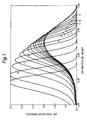
- Figure 1 shows (as the bottom curve) the molecular weight distribution (MWD) of a reactor butene-1 polymer (PB 8A) having a melt index of 0.84 dg/min. Also shown are the MWD's of the degraded products obtained by degrading the reactor polybutene-1 over a wide range of cracking levels, from low to high (curves marked A to L). The plots are in the gel permeation chromatography (GPC) format where equal areas represent equal weights of polymer independent of the location of an area on the figure and all plots have been normalized to enclose equal total areas. Thus certain important features of the MWD changes occurring with the cracking process may be easily seen.
- GPC gel permeation chromatography
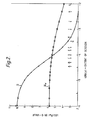
- FIG. 1 shows the corresponding plots of logarithm of the molecular weight average (weight average, M w) and the Q-value (ratio of M w to the number molecular weight average, M n) for the cracked products A to L.
- the Q-value is a measure of the breadth of the MWD, and it can be seen that progressive cracking of the reactor polybutene-1 both reduces M w and narrows the MWD.
- a cracked product corresponding to curve H was selected for blending with the parent reactor polybutene-1. It is seen from Figure 1 that H has totally lost the high molecular weight tail above one million MW, whereas it has not appreciably increased its low molecular weight tail. Overall, it has increased it MWD in the mid-range, with an appreciable shift in peak location to lower MW. H shows a melt index of over 200 dg/min compared to that of the parent polybutene-1 of 0.84 dg/min. From Figure 2, it is seen that M w and Q of H are 136,000 and 3.32 compared to 622,000 and 10.20 respectively, of the parent polymer.
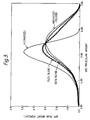
- Figure 3 reproduces the MWD's of H and the parent polybutene-1 and, in addition, the MWD's of two blends made from these components; a 90/10 blend (parent polymer/H) and a 75/25 blend by weight, embodiment of the blends of this invention. It is seen that the MWD's of the blends are uniquely different from those of the components and this difference works most advantageously.
- the retention of most of the original high molecular tail of the parent polymer preserves the good film mechanical properties of polybutene-1, at the same time retaining the melt elasticity required for melt strength.
- melt viscosity is reduced by the peak shift to lower values, and also the relative increase in free molecular ends improves self-adhesion (hot tack) and heat sealing properties because of improved molecular mobility across the interface of contacted services.
- Clarity is most likely improved by the increased molecular mobility reducing the number of light scattering defects in the surface as well as in the interior of the film.
- this improvement of molecular mobility does not depend on an increase in low molecular weight tail, as evidenced by Figure 3, so that the deleterious influence of such excessive tail on mechanical properties and solubility is absent in these blends.
- the invention also provides films of the polymer blends of the components (i) and (ii), or (i), (ii) and (iii).
- the invention further provides a laminate comprising a propylene polymer (homo- or co-polymer) or blend as a substrate or core layer and a film of a polymer blend of components (i), (ii) and (iii) on one or both surfaces thereof.
- Such laminates have improved hot tack, low heat-sealing temperature and high clarity.
- PC peroxide concentrate
- PB butene-1 polymer
- Extrusion on a 1.9 cm (3/4 inch) CW Brabender extruder was done at conditions of 160 RPM, 150 o C (Zone 1) and 170 o C (Zones 2 to 4).
- a butene-1 homopolymer (BR 24) was chemically degraded by extrusion at peroxide concentrate levels of 0.1, 0.5, 1, 2, 3, 4, 5, 6, 7, 8, 9, 12 and 15% by weight.
- the extruded strands were manually collected after passing through a bath and conditioned overnight at room temperature and pelletized the following day.
- Blended undegraded to degraded PB at ratios of 90:10 and 75:25 were compared. Heat seal as well as processability was significantly improved in the blends as compared to the undegraded PB.
- PC at 3, 6, 12 and 15% by weight levels was used to chemically degrade PB 8A.
- Table 1 shows that the melt flow in excess of 200g/10 min was attained when PB 8A was chemically degraded at 15% PC levels.
- Blends with undegraded to degraded PB at ratios of 90:10 and 75:25 are melt blended via 1.9 cm (3/4 inch) Brabender extruder with conditions of 150 o C starting temperature, 170 o C die temperature with an extruder RPM of 160.
- Film casting was done through a 3.2 cm (1.25 inch) Brabender extruder with variable adjustment and Killion die. Operating conditions for all blends were 200 o C (Zone 1), 220 o C (Zones 2 to 5). Chill roll temperature was 16 o C whereas extruder, chill and take-up roll RPM were 8, 18 and 18. The film thickness produced was 38 ⁇ m (1.5 mils) except for material blend 13 shown in Table 1, which 51 ⁇ m (2 mils). The film thickness was adjusted to 38 ⁇ m (1.5 mils) by reducing the extruder RPM from 8 to 6. All of the conditions were maintained. The film clarity was greatly improved in the 75:25 (15% PC) blend.
- Cast films were tested for self-adhesion through a heated band sealer at 0.14 MPa at (20 psi) sealing pressure. At a water pressure of 25.4 cm (10 inches), hot tack was rated at varying sealing temperatures and dwelling time. Table 2 categorizes the rating into “passed” and “failure”. Self-adhesion on film was considered “passed” if the seal did not split apart along a length greater than 0.3 cm of the sealed opening at a specified height of water.
- RT tensile film seals of 5 materials (blend numbers 1, 8, 9, 12 and 13) 4 peeled apart at less than 0.45 kg (1 pound) yield load. Only material blend 13 (75:25 containing chemically degraded component with 15% PC) survived a much higher load.
- Table 4 provides a comparison of the sealability of the blend versus a conventional blend for polypropylene coatings.
- Hot tack strength is shown in cm (inches) of water based on 25 ⁇ m (1 mil) cast film with sealing conditions: 0.28 MPa (40 psi) pressure, 2 second dwell time and two-sided heated. Sealing temperature ranges were from 71 to 104 o C (160 o F to 220 o F).
- the blend compositions were of approximately the same melt flows, two being standard polybutylene/polypropylene blends and the third a unique molecular weight distribution blend of a polybutylene (i), a chemically degraded polybutylene (ii) and a polypropylene (iii).
- the unique molecular weight distribution blend has resulted in super clear optics and a hot tack strength of 380 cm (15 inches) consistently from 71 to 104 o C (160 o F to 220 o F).
- the seal strength of the unique molecular weight distribution blend at 82 o C (180 o F) or greater is more acceptable than that of the first two conventional blends, so that the unique molecular weight distribution blend results in excellent hots tack strength and good seal strength while having excellent clarity.
- PB 8A, PB 8B, BR 2A, PP 5A and PP 5B are all commercially available polymers, namely Shell “DURAFLEX” PB 8640 Copolymer, Shell “DURAFLEX” PB 8240 Copolymer, Shell “DURAFLEX” BR 200 Homopolymer, Shell Polypropylene PP 5820 Homopolymer and Shell Polypropylene PP 5520, respectively.
Landscapes
- Chemical & Material Sciences (AREA)
- Organic Chemistry (AREA)
- Health & Medical Sciences (AREA)
- Chemical Kinetics & Catalysis (AREA)
- Medicinal Chemistry (AREA)
- Polymers & Plastics (AREA)
- Compositions Of Macromolecular Compounds (AREA)
- Manufacture Of Macromolecular Shaped Articles (AREA)
- Laminated Bodies (AREA)
Claims (13)
- Mélange polymère comprenant (i) un premier polymère de butène-1 ayant un indice de fluidité à l'état fondu de 0,5 à 1,0 g/10 min (ASTM D1238, condition E à 190°C) et (ii) un deuxième polymère de butène-1 ayant un indice de fluidité à l'état fondu de 150 à 250 g/10 min, obtenu par dégradation chimique réalisée au moyen d'un composé générateur de radicaux libres, la proportion en poids (i):(ii) étant de 70:30 à 95:5.
- Mélange polymère selon la revendication 1, dans lequel (i) et/ou (ii) contient l'éthylène ou le propylène comme comonomère.
- Mélange polymère selon la revendication 1 ou 2, pour lequel l'indice de fluidité à l'état fondu de (i) est d'environ 0.7 g/10 min, l'indice de fluidité à l'état fondu de (ii) est d'environ 200 g/10 min et la proportion en poids (i):(ii) est de 75:25 à 90:10.
- Mélange polymère selon la revendication 1, 2 ou 3, dans lequel la proportion en poids (i):(ii) est d'environ 85:15.
- Mélange polymère selon l'une quelconque des revendications 1 à 4, ayant un indice de fluidité à l'état fondu de 2 à 25 g/10 min.
- Mélange polymère selon la revendication 5, pour lequel le indice de fluidité à l'état fondu est de 8 à 15 g/10 min.
- Mélange polymère comprenant (i) un premier polymère de butène-1 ayant un indice de fluidité à l'état fondu de 0,5 à 1,0 g/10 min, (ii) un deuxième polymère de butène-1 ayant un indice de fluidité à l'état fondu de 150 à 250 g/10 min, obtenu par dégradation chimique réalisée au moyen d'un composé générateur de radicaux libres et (iii) un polymère de propylène ayant un indice de fluidité à l'état fondu de 0,5 à 5,0 g/10 min, la proportion en poids (i):(ii):(iii) étant de 75:10:15 à 45:25:30.
- Mélange polymère selon la revendication 7, dans lequel (i) et/ou (ii) contient l'éthylène ou le propylène comme comonomère.
- Mélange polymère selon la revendication 7 ou 8, pour lequel l'indice de fluidité à l'état fondu de (i) est d'environ 0,7 g/10 min, l'indice de fluidité à l'état fondu de (ii) est d'environ 200 g/10 min et la proportion en poids (i):(ii):(iii) est de 65:15:20 à 55:20:25.
- Mélange polymère selon la revendication 7, 8 ou 9, dans lequel la proportion en poids (i):(ii):(iii) est d'environ 60:17,5:22,5.
- Mélange polymère selon l'une quelconque des revendications 7 à 10, ayant un indice de fluidité à l'état fondu de 2 à 5 g/10 min, de préférence environ 2,5 g/10 min.
- Film d'un mélange polymère tel que revendiqué dans l'une quelconque des revendications précédentes.
- Stratifié comprenant un film d'un polymère de propylène ou d'un mélange de celui-ci comme substrat ou couche centrale et un film d'un mélange polymère, tel que revendiqué dans l'une quelconque des revendications 7 à 11, sur une ou les deux surface(s) du substrat.
Priority Applications (1)
| Application Number | Priority Date | Filing Date | Title |
|---|---|---|---|
| AT86306199T ATE68511T1 (de) | 1985-08-30 | 1986-08-11 | Mischungen von buten-1-polymeren und filme. |
Applications Claiming Priority (2)
| Application Number | Priority Date | Filing Date | Title |
|---|---|---|---|
| US770911 | 1985-08-30 | ||
| US06/770,911 US4677025A (en) | 1985-08-30 | 1985-08-30 | Unique molecular weight distribution polybutylene blend and film |
Publications (3)
| Publication Number | Publication Date |
|---|---|
| EP0218332A2 EP0218332A2 (fr) | 1987-04-15 |
| EP0218332A3 EP0218332A3 (en) | 1989-02-15 |
| EP0218332B1 true EP0218332B1 (fr) | 1991-10-16 |
Family
ID=25090095
Family Applications (1)
| Application Number | Title | Priority Date | Filing Date |
|---|---|---|---|
| EP86306199A Expired - Lifetime EP0218332B1 (fr) | 1985-08-30 | 1986-08-11 | Mélanges de polymères de butène-1 et films |
Country Status (6)
| Country | Link |
|---|---|
| US (1) | US4677025A (fr) |
| EP (1) | EP0218332B1 (fr) |
| JP (1) | JPH0715033B2 (fr) |
| AT (1) | ATE68511T1 (fr) |
| CA (1) | CA1292823C (fr) |
| DE (1) | DE3682016D1 (fr) |
Families Citing this family (20)
| Publication number | Priority date | Publication date | Assignee | Title |
|---|---|---|---|---|
| JPS6137833A (ja) * | 1984-07-31 | 1986-02-22 | Mitsui Petrochem Ind Ltd | 結晶性1−ブテン系重合体組成物 |
| US4960820A (en) * | 1988-05-24 | 1990-10-02 | Shell Oil Company | Compositions and articles using high melt flow poly-1-butene and polypropylene blends |
| AU640225B2 (en) * | 1990-05-02 | 1993-08-19 | Shell Oil Company | Improved thermoplastic process |
| USH1213H (en) * | 1990-05-17 | 1993-07-06 | Shell Oil Company | Polypropylene-polybutylene shrink film compositions |
| US5221715A (en) * | 1990-09-21 | 1993-06-22 | Shell Oil Company | Poly(1-butene)resin composition |
| USH1274H (en) | 1991-03-29 | 1994-01-04 | Shell Oil Company | Polypropylene-polybutylene heat sealable laminated packaging film with improved optics |
| US5302442A (en) * | 1992-03-09 | 1994-04-12 | Mobil Oil Corporation | Heat sealable base films |
| US5359004A (en) * | 1992-06-05 | 1994-10-25 | Shell Oil Company | Cocracked polymer blend and products produced therefrom |
| US5318842A (en) * | 1992-12-03 | 1994-06-07 | Himont Incorporated | Biaxially oriented propylene polymer film or sheet articles |
| US5443898A (en) * | 1993-06-29 | 1995-08-22 | Fiberweb North America, Inc. | Nonwoven webs and method of making same |
| DE602004002965T2 (de) * | 2003-08-12 | 2007-06-14 | Basell Poliolefine Italia S.R.L. | Bestrahlte buten-1-polymere enthaltende zusammensetzungen |
| EP2181155B1 (fr) * | 2007-08-22 | 2011-01-19 | Basell Poliolefine Italia S.R.L. | Compositions de polyoléfine souple avec aptitude améliorée à la mise en oeuvre |
| US8173748B1 (en) | 2010-12-17 | 2012-05-08 | Exxonmobil Research And Engineering Company | Heat-seal resin and package formed therefrom |
| PT3266824T (pt) * | 2016-07-07 | 2022-04-06 | Basell Poliolefine Italia Srl | Composição polimérica de buteno-1 tendo um índice de fluidez elevado |
| PL3266825T3 (pl) * | 2016-07-07 | 2022-05-09 | Basell Poliolefine Italia S.R.L. | Kompozycja polimerowa butenu-1 o wysokim wskaźniku szybkości płynięcia |
| WO2019025581A1 (fr) | 2017-08-04 | 2019-02-07 | Basell Poliolefine Italia S.R.L. | Polymère de butène-1 à indice de fluidité élevé |
| JP7034252B2 (ja) * | 2017-08-04 | 2022-03-11 | バーゼル・ポリオレフィン・イタリア・ソチエタ・ア・レスポンサビリタ・リミタータ | 高い溶融流量を有するブテン-1重合体組成物 |
| EP3661972B1 (fr) * | 2017-08-04 | 2024-03-27 | Basell Poliolefine Italia S.r.l. | Composition de polymère butène-1 présentant un indice de fluidité élevé |
| WO2019025582A1 (fr) | 2017-08-04 | 2019-02-07 | Basell Poliolefine Italia S.R.L. | Polymère de butène-1 à indice de fluidité élevé |
| DE202018006974U1 (de) * | 2018-07-23 | 2025-01-23 | Silgan White Cap Manufacturing Gmbh | Gefäßverschluss mit Dichtungselement |
Family Cites Families (23)
| Publication number | Priority date | Publication date | Assignee | Title |
|---|---|---|---|---|
| US3144436A (en) * | 1961-01-04 | 1964-08-11 | Du Pont | Process for degrading stereoregular polymers |
| US3230288A (en) * | 1961-09-01 | 1966-01-18 | Phillips Petroleum Co | Method of pyrolyzing, blending and extruding a 1-olefin polymer |
| BE624847A (fr) * | 1961-11-15 | |||
| US3341621A (en) * | 1963-05-31 | 1967-09-12 | Eastman Kodak Co | Thermally degraded block copolymers of propylene and 1-butene |
| US3862265A (en) * | 1971-04-09 | 1975-01-21 | Exxon Research Engineering Co | Polymers with improved properties and process therefor |
| JPS5148196B2 (fr) * | 1972-03-11 | 1976-12-18 | ||
| US4001172A (en) * | 1972-04-03 | 1977-01-04 | Exxon Research And Engineering Company | Polymers with improved properties and process therefor |
| DE2254128C3 (de) * | 1972-11-04 | 1975-08-14 | Chemische Werke Huels Ag, 4370 Marl | Thermoplastische Formmasse aus Polybuten-I |
| US3940379A (en) * | 1973-05-21 | 1976-02-24 | Dart Industries, Inc. | Process for controlled degradation of propylene polymers |
| US3898209A (en) * | 1973-11-21 | 1975-08-05 | Exxon Research Engineering Co | Process for controlling rheology of C{HD 3{B {30 {0 polyolefins |
| US4087486A (en) * | 1975-05-15 | 1978-05-02 | Standard Oil Company (Indiana) | Polypropylene composition containing EPR |
| GB1516420A (en) * | 1975-08-28 | 1978-07-05 | Mitsubishi Chem Ind | Tacky polyolefin films |
| US4061694A (en) * | 1976-12-21 | 1977-12-06 | Dart Industries Inc. | Low temperature impact strength molding compositions |
| US4112208A (en) * | 1977-07-06 | 1978-09-05 | Eastman Kodak Company | Peroxide treated substantially amorphous polyolefins useful as pressure-sensitive adhesives |
| JPS5334834A (en) * | 1977-09-19 | 1978-03-31 | Toyobo Co Ltd | Adhesive tape having good cutting properties |
| US4125662A (en) * | 1977-10-03 | 1978-11-14 | Mobil Oil Corporation | Packaging film with improved heat sealability |
| CA1178414A (fr) * | 1978-02-08 | 1984-11-27 | Toyo Boseki Kabushiki Kaisha (Trading Under The Name Of Toyobo Co., Ltd.) | Materiau d'emballage etanche |
| US4275120A (en) * | 1979-10-05 | 1981-06-23 | Mobil Oil Corporation | Heat sealable packaging film comprising propylene polymer substrate and olefin surface layer blend of polybutene-1 and an ethylene or a propylene copolymer |
| US4298722A (en) * | 1980-03-11 | 1981-11-03 | E. I. Du Pont De Nemours And Company | Fractionable, elastomeric poly (1-butene) |
| US4359495A (en) * | 1981-02-25 | 1982-11-16 | Shell Oil Company | Retort-sterilizable pouch |
| US4387185A (en) * | 1981-02-25 | 1983-06-07 | Shell Oil Company | Cracked blend of propylene copolymer and E/VA |
| US4378451A (en) * | 1981-09-14 | 1983-03-29 | Eastman Kodak Company | High flow rate polyolefin extrusion coating compositions |
| US4375531A (en) * | 1982-01-11 | 1983-03-01 | Northern Petrochemical Company | High impact visbroken polymeric blends |
-
1985
- 1985-08-30 US US06/770,911 patent/US4677025A/en not_active Expired - Lifetime
-
1986
- 1986-07-02 CA CA 512871 patent/CA1292823C/fr not_active Expired - Lifetime
- 1986-08-11 DE DE8686306199T patent/DE3682016D1/de not_active Expired - Lifetime
- 1986-08-11 EP EP86306199A patent/EP0218332B1/fr not_active Expired - Lifetime
- 1986-08-11 AT AT86306199T patent/ATE68511T1/de not_active IP Right Cessation
- 1986-08-29 JP JP20191486A patent/JPH0715033B2/ja not_active Expired - Lifetime
Also Published As
| Publication number | Publication date |
|---|---|
| DE3682016D1 (de) | 1991-11-21 |
| ATE68511T1 (de) | 1991-11-15 |
| EP0218332A3 (en) | 1989-02-15 |
| JPS6257441A (ja) | 1987-03-13 |
| EP0218332A2 (fr) | 1987-04-15 |
| US4677025A (en) | 1987-06-30 |
| JPH0715033B2 (ja) | 1995-02-22 |
| CA1292823C (fr) | 1991-12-03 |
Similar Documents
| Publication | Publication Date | Title |
|---|---|---|
| EP0218332B1 (fr) | Mélanges de polymères de butène-1 et films | |
| US4882229A (en) | Blends of high molecular weight polybutylene with low density polyethylene | |
| EP0414778B1 (fr) | Film oriente a faible coefficient de frottement | |
| CN109996678B (zh) | 多层膜和包含其的层制品和制品 | |
| JP3296820B2 (ja) | ポリオレフィン配合物の改良処理 | |
| EP0321220B1 (fr) | Matériau soudable à chaud, facile à ouvrir | |
| EP0222789B1 (fr) | Composition thermoplastique comprenant un copolymere a base d'ethylene et d'anhydride maleique, et articles industriels obtenus a partir d'une telle composition | |
| AU629499B2 (en) | Opaque, laminated and stretched products, and method for making them | |
| US4481336A (en) | Olefinic block copolymers of ethylene propylene and 1-butene | |
| JP3492436B2 (ja) | 包装用に好適なポリオレフィンフィルム | |
| EP0172646B1 (fr) | Films étirés multicouches de polypropylène | |
| JPS58194935A (ja) | 押出ラミネ−ト用組成物 | |
| EP0315238B1 (fr) | Films biorientés en copolymères éthylène/alpha-oléfines | |
| JPH10237239A (ja) | 熱成形用樹脂組成物及びシート | |
| KR20000040595A (ko) | 열봉합성 및 가공성이 우수한 압출 라미네이션용 수지 조성물 | |
| JPS60180818A (ja) | ポリエチレンを基礎とするポリマーコンパウンドからのインフレートフイルムの製造法 | |
| JPS6036549A (ja) | ラミネ−ト用エチレン系重合体組成物 | |
| EP1608506B1 (fr) | Films multicouches | |
| JPH03175029A (ja) | 少なくともポリエチレン層とエラストマー層とからなる製品の製造方法および該方法により得られる製品 | |
| JPS6351454B2 (fr) | ||
| JP4158259B2 (ja) | 押出ラミネート用樹脂組成物およびそれよりなるフィルム | |
| FR2819815A1 (fr) | Composition a base de copolymeres statistique du propylene, procede pour leur fabrication et feuilles multicouches thermoscellables les contenant | |
| JPH11279342A (ja) | 樹脂組成物 | |
| JP3324085B2 (ja) | 多層フィルム | |
| JPH06501049A (ja) | エチレン共重合体を含む組成物およびそのフィルム |
Legal Events
| Date | Code | Title | Description |
|---|---|---|---|
| PUAI | Public reference made under article 153(3) epc to a published international application that has entered the european phase |
Free format text: ORIGINAL CODE: 0009012 |
|
| AK | Designated contracting states |
Kind code of ref document: A2 Designated state(s): AT BE CH DE FR GB IT LI LU NL SE |
|
| PUAL | Search report despatched |
Free format text: ORIGINAL CODE: 0009013 |
|
| AK | Designated contracting states |
Kind code of ref document: A3 Designated state(s): AT BE CH DE FR GB IT LI LU NL SE |
|
| 17P | Request for examination filed |
Effective date: 19890415 |
|
| 17Q | First examination report despatched |
Effective date: 19901106 |
|
| GRAA | (expected) grant |
Free format text: ORIGINAL CODE: 0009210 |
|
| AK | Designated contracting states |
Kind code of ref document: B1 Designated state(s): AT BE CH DE FR GB IT LI LU NL SE |
|
| REF | Corresponds to: |
Ref document number: 68511 Country of ref document: AT Date of ref document: 19911115 Kind code of ref document: T |
|
| ITF | It: translation for a ep patent filed | ||
| ET | Fr: translation filed | ||
| REF | Corresponds to: |
Ref document number: 3682016 Country of ref document: DE Date of ref document: 19911121 |
|
| PLBE | No opposition filed within time limit |
Free format text: ORIGINAL CODE: 0009261 |
|
| STAA | Information on the status of an ep patent application or granted ep patent |
Free format text: STATUS: NO OPPOSITION FILED WITHIN TIME LIMIT |
|
| PG25 | Lapsed in a contracting state [announced via postgrant information from national office to epo] |
Ref country code: LU Free format text: LAPSE BECAUSE OF NON-PAYMENT OF DUE FEES Effective date: 19920831 |
|
| 26N | No opposition filed | ||
| PGFP | Annual fee paid to national office [announced via postgrant information from national office to epo] |
Ref country code: FR Payment date: 19940809 Year of fee payment: 9 |
|
| PGFP | Annual fee paid to national office [announced via postgrant information from national office to epo] |
Ref country code: AT Payment date: 19940812 Year of fee payment: 9 |
|
| PGFP | Annual fee paid to national office [announced via postgrant information from national office to epo] |
Ref country code: CH Payment date: 19940815 Year of fee payment: 9 |
|
| PGFP | Annual fee paid to national office [announced via postgrant information from national office to epo] |
Ref country code: DE Payment date: 19940816 Year of fee payment: 9 |
|
| PGFP | Annual fee paid to national office [announced via postgrant information from national office to epo] |
Ref country code: SE Payment date: 19940817 Year of fee payment: 9 |
|
| PGFP | Annual fee paid to national office [announced via postgrant information from national office to epo] |
Ref country code: NL Payment date: 19940831 Year of fee payment: 9 |
|
| PGFP | Annual fee paid to national office [announced via postgrant information from national office to epo] |
Ref country code: BE Payment date: 19941012 Year of fee payment: 9 |
|
| EAL | Se: european patent in force in sweden |
Ref document number: 86306199.0 |
|
| PGFP | Annual fee paid to national office [announced via postgrant information from national office to epo] |
Ref country code: GB Payment date: 19950731 Year of fee payment: 10 |
|
| PG25 | Lapsed in a contracting state [announced via postgrant information from national office to epo] |
Ref country code: AT Effective date: 19950811 |
|
| PG25 | Lapsed in a contracting state [announced via postgrant information from national office to epo] |
Ref country code: SE Effective date: 19950812 |
|
| PG25 | Lapsed in a contracting state [announced via postgrant information from national office to epo] |
Ref country code: LI Effective date: 19950831 Ref country code: CH Effective date: 19950831 Ref country code: BE Effective date: 19950831 |
|
| BERE | Be: lapsed |
Owner name: SHELL OIL CY Effective date: 19950831 |
|
| PG25 | Lapsed in a contracting state [announced via postgrant information from national office to epo] |
Ref country code: NL Effective date: 19960301 |
|
| REG | Reference to a national code |
Ref country code: CH Ref legal event code: PL |
|
| PG25 | Lapsed in a contracting state [announced via postgrant information from national office to epo] |
Ref country code: FR Effective date: 19960430 |
|
| NLV4 | Nl: lapsed or anulled due to non-payment of the annual fee |
Effective date: 19960301 |
|
| PG25 | Lapsed in a contracting state [announced via postgrant information from national office to epo] |
Ref country code: DE Effective date: 19960501 |
|
| EUG | Se: european patent has lapsed |
Ref document number: 86306199.0 |
|
| REG | Reference to a national code |
Ref country code: FR Ref legal event code: ST |
|
| PG25 | Lapsed in a contracting state [announced via postgrant information from national office to epo] |
Ref country code: GB Effective date: 19960811 |
|
| GBPC | Gb: european patent ceased through non-payment of renewal fee |
Effective date: 19960811 |
|
| PG25 | Lapsed in a contracting state [announced via postgrant information from national office to epo] |
Ref country code: IT Free format text: LAPSE BECAUSE OF NON-PAYMENT OF DUE FEES;WARNING: LAPSES OF ITALIAN PATENTS WITH EFFECTIVE DATE BEFORE 2007 MAY HAVE OCCURRED AT ANY TIME BEFORE 2007. THE CORRECT EFFECTIVE DATE MAY BE DIFFERENT FROM THE ONE RECORDED. Effective date: 20050811 |