EP0224794B1 - Neue cyclische Aminderivate, diese Verbindungen enthaltende Arzneimittel und Verfahren zu ihrer Herstellung - Google Patents
Neue cyclische Aminderivate, diese Verbindungen enthaltende Arzneimittel und Verfahren zu ihrer Herstellung Download PDFInfo
- Publication number
- EP0224794B1 EP0224794B1 EP86116002A EP86116002A EP0224794B1 EP 0224794 B1 EP0224794 B1 EP 0224794B1 EP 86116002 A EP86116002 A EP 86116002A EP 86116002 A EP86116002 A EP 86116002A EP 0224794 B1 EP0224794 B1 EP 0224794B1
- Authority
- EP
- European Patent Office
- Prior art keywords
- group
- general formula
- compound
- hereinbefore
- ethyl
- Prior art date
- Legal status (The legal status is an assumption and is not a legal conclusion. Google has not performed a legal analysis and makes no representation as to the accuracy of the status listed.)
- Expired - Lifetime
Links
- 0 CCC1C(CCCC2C(C)(C*)CCCC2)C1 Chemical compound CCC1C(CCCC2C(C)(C*)CCCC2)C1 0.000 description 8
- KVXDWMYOGNHLQX-VNWVSWPHSA-N C/C=C\C(CCNCC1)=C1/C=C(/C)\C(C)=C Chemical compound C/C=C\C(CCNCC1)=C1/C=C(/C)\C(C)=C KVXDWMYOGNHLQX-VNWVSWPHSA-N 0.000 description 1
Classifications
-
- C—CHEMISTRY; METALLURGY
- C07—ORGANIC CHEMISTRY
- C07D—HETEROCYCLIC COMPOUNDS
- C07D401/00—Heterocyclic compounds containing two or more hetero rings, having nitrogen atoms as the only ring hetero atoms, at least one ring being a six-membered ring with only one nitrogen atom
- C07D401/02—Heterocyclic compounds containing two or more hetero rings, having nitrogen atoms as the only ring hetero atoms, at least one ring being a six-membered ring with only one nitrogen atom containing two hetero rings
-
- C—CHEMISTRY; METALLURGY
- C07—ORGANIC CHEMISTRY
- C07D—HETEROCYCLIC COMPOUNDS
- C07D223/00—Heterocyclic compounds containing seven-membered rings having one nitrogen atom as the only ring hetero atom
- C07D223/14—Heterocyclic compounds containing seven-membered rings having one nitrogen atom as the only ring hetero atom condensed with carbocyclic rings or ring systems
- C07D223/16—Benzazepines; Hydrogenated benzazepines
-
- A—HUMAN NECESSITIES
- A61—MEDICAL OR VETERINARY SCIENCE; HYGIENE
- A61P—SPECIFIC THERAPEUTIC ACTIVITY OF CHEMICAL COMPOUNDS OR MEDICINAL PREPARATIONS
- A61P9/00—Drugs for disorders of the cardiovascular system
- A61P9/06—Antiarrhythmics
-
- A—HUMAN NECESSITIES
- A61—MEDICAL OR VETERINARY SCIENCE; HYGIENE
- A61P—SPECIFIC THERAPEUTIC ACTIVITY OF CHEMICAL COMPOUNDS OR MEDICINAL PREPARATIONS
- A61P9/00—Drugs for disorders of the cardiovascular system
- A61P9/10—Drugs for disorders of the cardiovascular system for treating ischaemic or atherosclerotic diseases, e.g. antianginal drugs, coronary vasodilators, drugs for myocardial infarction, retinopathy, cerebrovascula insufficiency, renal arteriosclerosis
-
- A—HUMAN NECESSITIES
- A61—MEDICAL OR VETERINARY SCIENCE; HYGIENE
- A61P—SPECIFIC THERAPEUTIC ACTIVITY OF CHEMICAL COMPOUNDS OR MEDICINAL PREPARATIONS
- A61P9/00—Drugs for disorders of the cardiovascular system
- A61P9/12—Antihypertensives
-
- C—CHEMISTRY; METALLURGY
- C07—ORGANIC CHEMISTRY
- C07D—HETEROCYCLIC COMPOUNDS
- C07D401/00—Heterocyclic compounds containing two or more hetero rings, having nitrogen atoms as the only ring hetero atoms, at least one ring being a six-membered ring with only one nitrogen atom
- C07D401/02—Heterocyclic compounds containing two or more hetero rings, having nitrogen atoms as the only ring hetero atoms, at least one ring being a six-membered ring with only one nitrogen atom containing two hetero rings
- C07D401/06—Heterocyclic compounds containing two or more hetero rings, having nitrogen atoms as the only ring hetero atoms, at least one ring being a six-membered ring with only one nitrogen atom containing two hetero rings linked by a carbon chain containing only aliphatic carbon atoms
-
- C—CHEMISTRY; METALLURGY
- C07—ORGANIC CHEMISTRY
- C07D—HETEROCYCLIC COMPOUNDS
- C07D403/00—Heterocyclic compounds containing two or more hetero rings, having nitrogen atoms as the only ring hetero atoms, not provided for by group C07D401/00
- C07D403/02—Heterocyclic compounds containing two or more hetero rings, having nitrogen atoms as the only ring hetero atoms, not provided for by group C07D401/00 containing two hetero rings
- C07D403/06—Heterocyclic compounds containing two or more hetero rings, having nitrogen atoms as the only ring hetero atoms, not provided for by group C07D401/00 containing two hetero rings linked by a carbon chain containing only aliphatic carbon atoms
-
- C—CHEMISTRY; METALLURGY
- C07—ORGANIC CHEMISTRY
- C07D—HETEROCYCLIC COMPOUNDS
- C07D491/00—Heterocyclic compounds containing in the condensed ring system both one or more rings having oxygen atoms as the only ring hetero atoms and one or more rings having nitrogen atoms as the only ring hetero atoms, not provided for by groups C07D451/00 - C07D459/00, C07D463/00, C07D477/00 or C07D489/00
- C07D491/02—Heterocyclic compounds containing in the condensed ring system both one or more rings having oxygen atoms as the only ring hetero atoms and one or more rings having nitrogen atoms as the only ring hetero atoms, not provided for by groups C07D451/00 - C07D459/00, C07D463/00, C07D477/00 or C07D489/00 in which the condensed system contains two hetero rings
- C07D491/04—Ortho-condensed systems
-
- Y—GENERAL TAGGING OF NEW TECHNOLOGICAL DEVELOPMENTS; GENERAL TAGGING OF CROSS-SECTIONAL TECHNOLOGIES SPANNING OVER SEVERAL SECTIONS OF THE IPC; TECHNICAL SUBJECTS COVERED BY FORMER USPC CROSS-REFERENCE ART COLLECTIONS [XRACs] AND DIGESTS
- Y02—TECHNOLOGIES OR APPLICATIONS FOR MITIGATION OR ADAPTATION AGAINST CLIMATE CHANGE
- Y02P—CLIMATE CHANGE MITIGATION TECHNOLOGIES IN THE PRODUCTION OR PROCESSING OF GOODS
- Y02P20/00—Technologies relating to chemical industry
- Y02P20/50—Improvements relating to the production of bulk chemicals
- Y02P20/55—Design of synthesis routes, e.g. reducing the use of auxiliary or protecting groups
Definitions
- the present invention thus relates to the new cyclic amine derivatives of the above general formula I, their enantiomers, their diastereomers, their acid addition salts, in particular for pharmaceutical use, their physiologically compatible acid addition salts with inorganic or organic acids, processes for their preparation and medicaments containing these compounds.
- the reaction is advantageously carried out in a solvent or solvent mixture such as acetone, diethyl ether, methylformamide, dimethylformamide, dimethyl sulfoxide, benzene, chlorobenzene, tetrahydrofuran, benzene / tetrahydrofuran, dioxane or in an excess of the compounds of general formulas II and / or 111 used and, if appropriate, in the presence an acid-binding agent, for example an alcoholate such as potassium tert-butoxide, an alkali metal hydroxide such as sodium or potassium hydroxide, an alkali metal carbonate such as potassium carbonate, an alkali metal amide such as sodium amide, an alkali metal hydride such as sodium hydride, a tertiary organic base such as triethylamine or pyridine, the latter at the same time can also serve as a solvent, or a reaction accelerator such as potassium iodide, depending on the reactivity of the nucle
- the optional subsequent removal of a protective radical used is preferably carried out hydrolytically in an aqueous solvent, for example in water, isopropanol / water, tetrahydrofuran / water or dioxane / water, in the presence of an acid such as hydrochloric acid or sulfuric acid or in the presence of an alkali base such as sodium hydroxide or potassium hydroxide at temperatures between 0 and 100 ° C, preferably at the boiling point of the reaction mixture.
- an aqueous solvent for example in water, isopropanol / water, tetrahydrofuran / water or dioxane / water, in the presence of an acid such as hydrochloric acid or sulfuric acid or in the presence of an alkali base such as sodium hydroxide or potassium hydroxide at temperatures between 0 and 100 ° C, preferably at the boiling point of the reaction mixture.
- a benzyl radical is preferably split off hydrogenolytically, for example using hydrogen in the presence of a catalyst such as palladium / carbon in a solvent such as methanol, ethanol, ethyl acetate or glacial acetic acid, optionally with the addition of an acid such as hydrochloric acid at temperatures between 0 and 50 ° C., but preferably at Room temperature, and a hydrogen pressure of I to 7 bar, but preferably from 3 to 5 bar.
- a catalyst such as palladium / carbon
- a solvent such as methanol, ethanol, ethyl acetate or glacial acetic acid
- an acid such as hydrochloric acid
- the hydrogenation is preferably in a solvent or solvent mixture such as methanol, ethanol, ethyl acetate or glacial acetic acid preferably with catalytically excited hydrogen, for example with hydrogen in the presence of platinum or palladium / carbon, optionally in the presence of a base such as an alcoholate, for example sodium methylate, at a hydrogen pressure from 1 to 7 bar, but preferably from 3 to 5 bar, and at temperatures between 0 and 75 ° C, but preferably at temperatures between 20 and 50 ° C.
- a solvent or solvent mixture such as methanol, ethanol, ethyl acetate or glacial acetic acid preferably with catalytically excited hydrogen, for example with hydrogen in the presence of platinum or palladium / carbon, optionally in the presence of a base such as an alcoholate, for example sodium methylate, at a hydrogen pressure from 1 to 7 bar, but preferably from 3 to 5 bar, and at temperatures between 0 and 75 ° C, but preferably at temperatures between 20 and 50
- any benzyloxy group that may be present can be converted into the corresponding hydroxyl group.
- the reaction is advantageously carried out in a solvent or solvent mixture such as methylformamide, dimethylformamide, dimethyl sulfoxide, benzene, chlorobenzene, tetrahydrofuran, benzoI / tetrahydrofuran or dioxane in the presence of an acid-binding agent, for example an alcoholate such as potassium tert-butylate, an alkali metal hydroxide such as sodium or potassium hydroxide , an alkali carbonate such as potassium carbonate, an alkali amide such as sodium amide or an alkali hydride such as sodium hydride is advantageously carried out at temperatures between 0 and 150 ° C., preferably at temperatures between 0 and 50 ° C.
- a solvent or solvent mixture such as methylformamide, dimethylformamide, dimethyl sulfoxide, benzene, chlorobenzene, tetrahydrofuran, benzoI / tetrahydrofuran or dioxane in the
- the optional subsequent removal of a protective radical used is preferably carried out hydrolytically in an aqueous solvent, for example in water, isopropanol / water, tetrahydrofuran / water or dioxane / water, in the presence of an acid such as hydrochloric acid or sulfuric acid or in the presence of an alkali base such as sodium hydroxide or potassium hydroxide at temperatures between 0 and 100 ° C, preferably at the boiling point of the reaction mixture.
- an aqueous solvent for example in water, isopropanol / water, tetrahydrofuran / water or dioxane / water, in the presence of an acid such as hydrochloric acid or sulfuric acid or in the presence of an alkali base such as sodium hydroxide or potassium hydroxide at temperatures between 0 and 100 ° C, preferably at the boiling point of the reaction mixture.
- a benzyl radical is preferably split off hydrogenolytically, for example using hydrogen in the presence of a catalyst such as palladium / carbon in a solvent such as methanol, ethanol, ethyl acetate or glacial acetic acid, optionally with the addition of an acid such as hydrochloric acid at temperatures between 0 and 50 ° C., but preferably at Room temperature, and a hydrogen pressure of I to 7 bar, but preferably from 3 to 5 bar.
- a catalyst such as palladium / carbon
- a solvent such as methanol, ethanol, ethyl acetate or glacial acetic acid
- an acid such as hydrochloric acid
- any benzyloxy group that may be present can be converted into the corresponding hydroxyl group.
- the reaction is conveniently carried out with a sulfur-introducing agent such as phosphorus pentasulfide or 2,4-bis (4-methoxyphenyl) -1,3-dithia-2,4-diphosphetane-2,4-disulfide in a solvent such as toluene or xylene at temperatures between 50 and 150 ° C, for example at the boiling point of the reaction mixture.
- a sulfur-introducing agent such as phosphorus pentasulfide or 2,4-bis (4-methoxyphenyl) -1,3-dithia-2,4-diphosphetane-2,4-disulfide
- a solvent such as toluene or xylene
- the reaction is carried out in the presence of a suitable reducing agent such as a metal hydride, for example sodium borohydride, in a suitable solvent such as water / methanol or methanol / ether, at temperatures between 0 and 80 ° C., but preferably at temperatures between 15 and 40 ° C.
- a suitable reducing agent such as a metal hydride, for example sodium borohydride
- a suitable solvent such as water / methanol or methanol / ether
- the reduction is preferably carried out with a metal hydride such as lithium aluminum hydride or diborane or with a complex of borane and a thioether, for example with borane-dimethyl sulfide complex, in a suitable solvent such as diethyl ether or tetrahydrofuran at temperatures between 0 and 50 ° C., but preferably at temperatures between 10 and 25 ° C.
- a metal hydride such as lithium aluminum hydride or diborane or with a complex of borane and a thioether, for example with borane-dimethyl sulfide complex
- a suitable solvent such as diethyl ether or tetrahydrofuran
- the oxidation is preferably carried out with an oxidizing agent such as potassium permanganate, selenium dioxide or sodium dichromate in a suitable solvent or solvent mixture such as water, water / dioxane, glacial acetic acid, water / acetic acid or acetic anhydride at temperatures between 0 and 100 ° C., preferably at temperatures between 20 and 80 ° C, performed.
- an oxidizing agent such as potassium permanganate, selenium dioxide or sodium dichromate
- a suitable solvent or solvent mixture such as water, water / dioxane, glacial acetic acid, water / acetic acid or acetic anhydride at temperatures between 0 and 100 ° C., preferably at temperatures between 20 and 80 ° C, performed.
- the hydrogenation is carried out in a solvent or solvent mixture such as methanol, ethanol, ethyl acetate or glacial acetic acid, preferably with catalytically excited hydrogen, for example with hydrogen in the presence of platinum or palladium / carbon, at a hydrogen pressure of 1 to 7 bar, but preferably of 3 to 5 bar , and at temperatures between 0 and 75 ° C, but preferably at temperatures between 20 and 50 ° C.
- a solvent or solvent mixture such as methanol, ethanol, ethyl acetate or glacial acetic acid
- the subsequent reduction of the nitro compound is preferably carried out in a solvent such as water, water / ethanol, methanol, glacial acetic acid, ethyl acetate or dimethylformamide, advantageously with hydrogen in the presence of a hydrogenation catalyst such as Raney nickel, platinum or palladium / carbon, with metals such as iron, tin or zinc in the presence of an acid, with salts such as iron (11) sulfate, tin (II) chloride or sodium dithionite or with hydrazine in the presence of Raney nickel at temperatures between 0 and 50 ° C., but preferably at room temperature.
- a hydrogenation catalyst such as Raney nickel, platinum or palladium / carbon
- metals such as iron, tin or zinc
- salts such as iron (11) sulfate, tin (II) chloride or sodium dithionite or with hydrazine in the presence of Raney nickel at temperatures between 0 and 50 ° C., but preferably
- the subsequent acylation is conveniently carried out in a solvent such as methylene chloride, chloroform, carbon tetrachloride, ether, tetrahydrofuran, dioxane, benzene, toluene, acetonitrile or dimethylformamide, preferably with a reactive derivative of the acid, for example with methanesulfonic acid chloride, ethanesulfonic acid chloride, n-propanesulfonic acid chloride, acanidridyl chloride, acetyl chloride Propionic anhydride, and optionally in the presence of an inorganic base such as sodium carbonate or a tertiary organic base such as triethylamine or pyridine, which can simultaneously serve as a solvent, at temperatures between -25 ° C and 100 ° C, but preferably at temperatures between -10 ° C and the boiling point of the solvent used.
- a solvent such as methylene chloride, chloroform, carbon te
- the compounds of general formula 1 obtained since they have at least one chiral center, can be separated into their diastereomers, for example by column chromatography, and into their enantiomers, for example by column chromatography on a chiral phase or by crystallization with optically active acids, since they have at least one chiral center.
- optically active acids since they have at least one chiral center.
- the compounds of general formula I obtained can furthermore be converted into their acid addition salts, in particular for their pharmaceutical use, into their physiologically tolerable acid addition salts with inorganic or organic acids.
- Suitable acids are, for example, hydrochloric acid, hydrobromic acid, sulfuric acid, phosphoric acid, acetic acid, lactic acid, citric acid, tartaric acid, succinic acid, maleic acid or fumaric acid.
- a starting compound of the general formula II is obtained by reacting a corresponding benzazepine with a corresponding halogen compound and optionally by subsequent reaction with a corresponding amine.
- the corresponding benzazepine of the general formula V which is unsubstituted in the 3-position is obtained by cyclization of a corresponding compound, for example by cyclization of a compound of the general formula or the general formula optionally subsequent catalytic hydrogenation and or reduction of the carbonyl group, for example with sodium borohydride / glacial acetic acid (see EP-AI 0.007.070, EP-AI 0.065.229 and EP-AI 0.109.639) and / or oxidation, for example with selenium dioxide.
- a compound of the general formulas IV and VII to XI used as the starting material is preferably obtained by reacting a corresponding halogen compound with a corresponding amine and optionally subsequent quaternization and / or elimination of protective residues which are used to protect hydroxyl and / or amino groups.
- the new compounds of the general formula I and their physiologically tolerable acid addition salts with inorganic or organic acids have valuable pharmacological properties, in particular with low central side effects, a particularly long-lasting heart rate-lowering effect and a reduction in the heart's 02 requirement.
- the effect of the substances to be examined on the heart rate was examined per dose in 2 rats with an average weight of 250-300 g.
- the rats were anesthetized with pentobarbital (50 mg / kg i.p. and 20 mg / kg s.c.).
- pentobarbital 50 mg / kg i.p. and 20 mg / kg s.c.
- the substances to be examined were injected into the jugular vein in aqueous solution (0.1 ml / 100 g).
- the blood pressure was measured via a cannula embedded in a carotid artery and the heart rate was recorded from an EKG (II or III lead) derived with needle electrodes.
- the heart rate of the animals in the control period was between 350 and 400 beats / minutes (bpm).
- the compounds produced according to the invention have no toxic side effects in therapeutic doses. For example, with intravenous administration of substances A and D even in a high dose of 20 mg / kg to mice, apart from a small sedation, no toxic side effects were observed.
- the compounds produced according to the invention are suitable for the treatment of sinus tachycardias of various origins and for the prophylaxis and therapy of ischemic heart diseases.
- the dosage required to achieve a corresponding effect is advantageously 0.01 to 0.2 mg / kg body weight once or twice a day, preferably 0.03 to 0.15 mg / kg body weight.
- the active ingredient, corn starch, milk sugar and polyvinyl pyrrolidone are mixed and moistened with water.
- the moist mixture is pressed through a sieve with a mesh size of 1.5 mm and dried at approx. 45 ° C.
- the dry granules are passed through a sieve with a mesh size of 1.0 mm and mixed with magnesium stearate.
- the finished mixture is pressed into tablets on a tablet press with stamps of 7 mm in diameter, which are provided with a partial notch. Tablet weight: 120 mg
- the active ingredient, corn starch, milk sugar and polyvinylpyrrolidone are mixed well and moistened with water.
- the moist mass is pressed through a sieve with an I mm mesh size, dried at approx. 45 ° C and then the granules are passed through the same sieve.
- domed dragee cores with a diameter of 6 mm are pressed on a tablet machine.
- the dragee cores thus produced are coated in a known manner with a layer consisting essentially of sugar and talc.
- the finished coated tablets are polished with wax. Dragé weight: 130 mg
- the active substance is dissolved in water for injection purposes in a suitable preparation vessel and the solution is made isotonic with sorbitol.
- the solution After filtration through a membrane filter, the solution is poured into cleaned and sterilized ampoules with N 2 gassing and autoclaved in flowing steam for 20 minutes.
- the hard fat is melted.
- the ground active substance is homogeneously dispersed in the melt at 38 ° C. It is cooled to 35 ° C and poured into weakly pre-cooled suppository molds.
- Dest. Water is heated to 70 ° C. Hydroxyethyl cellulose, benzoic acid and tartaric acid are dissolved therein with stirring. It is cooled to room temperature and the glycerin and the sorbitol solution are added with stirring. The active ingredient is added at room temperature and stirred until completely dissolved. Subsequently, the juice is evacuated with stirring.
Landscapes
- Chemical & Material Sciences (AREA)
- Organic Chemistry (AREA)
- Health & Medical Sciences (AREA)
- Engineering & Computer Science (AREA)
- Bioinformatics & Cheminformatics (AREA)
- General Health & Medical Sciences (AREA)
- Chemical Kinetics & Catalysis (AREA)
- General Chemical & Material Sciences (AREA)
- Medicinal Chemistry (AREA)
- Nuclear Medicine, Radiotherapy & Molecular Imaging (AREA)
- Heart & Thoracic Surgery (AREA)
- Pharmacology & Pharmacy (AREA)
- Life Sciences & Earth Sciences (AREA)
- Animal Behavior & Ethology (AREA)
- Cardiology (AREA)
- Public Health (AREA)
- Veterinary Medicine (AREA)
- Vascular Medicine (AREA)
- Urology & Nephrology (AREA)
- Pharmaceuticals Containing Other Organic And Inorganic Compounds (AREA)
- Hydrogenated Pyridines (AREA)
- Plural Heterocyclic Compounds (AREA)
- Organic Low-Molecular-Weight Compounds And Preparation Thereof (AREA)
- Heterocyclic Carbon Compounds Containing A Hetero Ring Having Nitrogen And Oxygen As The Only Ring Hetero Atoms (AREA)
- Other In-Based Heterocyclic Compounds (AREA)
- Nitrogen Condensed Heterocyclic Rings (AREA)
- Pyridine Compounds (AREA)
- Pyrrole Compounds (AREA)
- Nitrogen And Oxygen Or Sulfur-Condensed Heterocyclic Ring Systems (AREA)
- Acyclic And Carbocyclic Compounds In Medicinal Compositions (AREA)
Description
- In der EP A 0 065 229 und in der EP A 0 161 599 werden bereits Benzazepin- und Benzdiazepinderivate, die in 3-Stellung durch einen Phenylalkylaminoalkylrest substituiert sind, wobei die zu dem Phenylkern benachbarte Methylengruppe durch eine gegebenenfalls durch eine Benzylgruppe oder eine Alkylgruppe mit 1 bis 3 Kohlenstoffatomen substituierte Iminogruppe, ein Sauerstoff- oder Schwefelatom, eine Sulfinyl- oder Sulfonylgruppe ersetzt sein kann, und deren physiologisch verträgliche Säureadditionssalze beschrieben, welche wertvolle pharmakologische Eigenschaften aufweist, nämlich neben einer milden blutdrucksenkenden Wirkung insbesondere eine selektive herzfrequenzsenkende Wirkung.
- Überraschenderweise wurde nun gefunden, daß die neuen cyclischen Aminderivate der allgemeinen Formel

- Gegenstand der vorliegenden Erfindung sind somit die neuen cyclischen Aminderivate der obigen allgemeinen Formel I, deren Enantiomeren, deren Diastereomeren, deren Säureadditionssalze, insbesondere für die pharmazeutische Verwendung deren physiologisch verträgliche Säureadditionssalze mit anorganischen oder organischen Säuren, Verfahren zu ihrer Herstellung und diese Verbindungen enthaltende Arzneimittel.
- In der obigen allgemeinen Formel bedeuten
- A eine -CH2-CH2-, -CH=CH-,


- B eine Methylen-, Carbonyl- oder Thiocarbonylgruppe oder
- A eine -CO-CO- oder

- E eine gegebenenfalls durch eine Alkylgruppe mit 1 bis 3 Kohlenstoffatomen substituierte geradkettige Alkylengruppe mit 1 bis 3 Kohlenstoffatomen,
- G eine gegebenenfalls durch eine Alkylgruppe mit 1 bis 3 Kohlenstoffatomen substituierte geradkettige Alkylengruppe mit 1 bis 5 Kohlenstoffatomen, wobei die zu dem Phenylkern benachbarte Methylengruppe einer gegebenenfalls durch eine Alkylgruppe substituierten geradkettigen Alkylengruppe mit 3 bis 5 Kohlenstoffatomen durch ein Sauerstoff- oder Schwefelatom, eine Imino-, Methylimino-, Sulfinyl-oder Sulfonylgruppe ersetzt sein kann,
- R1 ein Wasserstoff- oder Halogenatom, eine Trifluormethyl-, Nitro-, Amino-, Alkylamino-, Dialkylamino-, Alkyl-, Hydroxy-, Alkoxy- oder Phenylalkoxygruppe, wobei jeder Alkylteil jeweils bis 3 Kohlenstoffatome enthalten kann,
- R2 ein Wasserstoffatom oder Halogenatom, eine Hydroxy-, Alkoxy-, Phenylalkoxy- oder Alkylgruppe, wobei jeder Alkylteil jeweils I bis 3 Kohlenstoffatome enthalten kann, oder
- R1 und R2 zusammen eine Alkylendioxygruppe mit I oder 2 Kohlenstoffatomen,
- R3 ein Wasserstoff- oder Halogenatom, eine Alkyl- oder Alkoxygruppe mit jeweils I bis 3 Kohlenstoffatomen im Alkylteil, eine Hydroxy-, Nitro-, Cyano- oder Trifluormethylgruppe,
- R4 ein Wasserstoffatom, eine Alkoxy-, Alkansulfonyloxy-, Amino-, Alkylamino- oder Dialkylaminogruppe mit jeweils I bis 3 Kohlenstoffatomen in jedem Alkylteil, oder eine Alkanoylaminogruppe mit 2 oder 3 Kohlenstoffatomen im Alkanoylteil oder
- R3 und R4 zusammen eine Alkylendioxygruppe mit I oder 2 Kohlenstoffatomen,
- Rs ein Wasserstoff- oder Halogenatom, eine Hydroxy-, Alkyl- oder Alkoxygruppe mit jeweils I bis 3 Kohlenstoffatomen im Alkylteil,
- m die Zahl I, 2, 3, 4 oder 5 und
- n die Zahl 0, I oder 2, wobei jedoch n + m die Zahl 3, 4 oder 5 darstellen muß.
- Für die bei der Definition der Reste eingangs erwähnten Bedeutungen kommt beispielsweise für R1 die des Wasserstoff-, Fluor-, Chlor- oder Bromatoms, der Methyl-, Ethyl-, n-Propyl-, Isopropyl- , Trifluormethyl-, Hydroxy-, Methoxy-, Ethoxy-, n-Propoxy-, Isopropoxy-, Nitro-, Amino-, Methylamino- , Ethylamino-, n-Propylamino-, Isopropylamino-, Dimethylamino-, Diethylamino-, Di-n-propylamino-, Diisopropylamino-, Methyl-ethylamino-, Methyl-n-propylämino-, Methyl-isopropylamino-, Ethyl-n-propylamino-, Benzyloxy-, I-Phenylethoxy-, I-Phenylpropoxy-, 2-Phenylethoxy- oder 3-Phenylpropoxygruppe, für R2 die des Wasserstoff-, Chlor- oder Bromatoms, der Methyl-, Ethyl-, n-Propyl-, Isopropyl-, Hydroxy-, Methoxy-, Ethoxy-, n-Propoxy-, Isopropoxy-, Benzyloxy-, I-Phenylethoxy-, 2-Phenylethoxy-, 2-Phenylpropoxy- oder 3-Phenylpropoxygruppe oder zusammen mit R1 die der Methylendioxy- oder Ethylendioxygruppe,
- für R3 die des Wasserstoff-, Fluor-, Chlor- oder Bromatoms, der Methyl-, Ethyl-, n-Propyl-, Isopropyl- , Hydroxy-, Methoxy-, Ethoxy-, n-Propoxy-, Isopropoxy-, Nitro-, Cyano- oder Trifluormethylgruppe,
- für R4 die des Wasserstoffatoms, der Methoxy-, Ethoxy-, n-Propoxy-, Isopropoxy-, Methansulfonyloxy-, Ethansulfonyloxy-, n-Propansulfonyloxy-, Amino-, Methylamino-, Ethylamino-, n-Propylamino-, Isopropylamino-, Dimethylamino-, Diethylamino-, Di-n-propylamino-, Diisopropylamino-, Methylethylamino-, Methyl-n-propylamino-, Methyl-isopropylamino-, Ethyl-n-propylamino-, Acetylamino- oder Propionylaminogruppe oder zusammen mit R3 die der Methylendioxy- oder Ethylendioxygruppe,
- für R5 die des Wasserstoff-, Chlor- oder Bromatoms, der Methyl-, Ethyl-, n-Propyl-, Isopropyl-, Hydroxy-, Methoxy-, Ethoxy-, n-Propoxy- oder Isopropoxygruppe,
- für E die der Methylen-, Äthylen-, n-Propylen-, Ethyliden-, n-Propyliden-, n-Butyliden-, 2-Methyl-n-propyliden-, I-Methyl-ethylen-, I-Ethyl-ethylen-, 2-Methyl-ethylen-, 2-Ethyl-ethylen-, I-n-Propyl-ethylen-, I-Methyl-n-propylen, 2-Methyl-n-propylen-, 3-Methyl-n-propylen-, I-Ethyl-n-propylen-, 2-n-Propyl-n-propylen- oder 3-Ethyl-n-propylengruppe und
- für G die der Methylen-, Ethyliden-, n-Propyliden-, n-Butyliden-, 2-Methyl-propyliden-, Ethylen-, I-Methyl-ethylen-, I-Ethyl-ethylen-, I-Propyl-ethylen-, 2-Methyl-ethylen-, 2-Ethyl-ethylen-, n-Propylen-, n-Butylen-, n-Pentylen-, I-Methyl-n-propylen-, I-Methyl-n-butylen-, I-Methyl-n-pentylen, I-Ethyl-n-propylen-, 2-Ethyl-n-propylen-, I-Ethyl-n-butylen-, Ethylenoxy-, n-Propylenoxy-, n-Butylenoxy-, Ethylenthio-, n-Propylenthio-, n-Butylenthio-, Ethylensulfinyl-, Ethylensulfonyl-, n-Propylensulfinyl-, n-Propylensulfonyl-, n-Butylensulfinyl-, Ethylenamino-, n-Propylenamino-, n-Butylenamino-, N-Methylethylenamino-, N-Methyl-n-propylenamino- oder N-Methyl-n-butylenaminogruppe in Betracht.
- Erfindungsgemäß fallen somit folgende Verbindungen unter die vorstehend genannte allgemeine Formel I:
- 3-[(N-(2-(3,4-Dimethoxy-phenyl)-ethyl)-piperidin-3-yl)-methyl]-7,8-dimethoxy-1,3,4,5-tetrahydro-2H-3- benzazepin-2-on
- 3-[(N-(2-(3,4-Dimethoxy-phenyl)-ethyl)-piperidin-3-yl)-methyl]-7,8-dimethoxy-1,3-dihydro-2H-3-benzazepin-2-on
- 3-[(N-(2-(3,4-Dimethoxy-phenyl)-ethyl)-piperidin-3-yl)-methyl]-7,8-dimethoxy-2,3,4,5-tetrahydro-IH-3- benzazepin
- 3-[(N-(2-(3,4-Dimethoxy-phenyl)-ethyl)-piperidin-3-yl)-methyl]-7,8-dimethoxy-1,3,4,5-tetrahydro-2H-3- benzazepin-2-thion
- 3-[(N-(2-(3,4-Dimethoxy-phenyl)-ethyl)-piperidin-3-yl)-methyl]-7,8-dimethoxy-1,3,4,5-tetrahydro-2H-3- benzazepin-1,2-dion
- 3-[(N-(2-(3,4-Dimethoxy-phenyl)-ethyl)-piperidin-3-yl)-methyl]-7,8-dimethoxy-1-hydroxy-1,3,4,5-te- trahydro-2H-3-benzazepin-2-on
- 3-[(N-(2-(4-Amino-phenyl)-ethyl)-piperidin-3-yl)-methyl]-7,8-dimethoxy-1,3,4,5-tetrahydro-2H-3-benzazepin-2-on
- 3-[(N-(2-(4-Acetamino-phenyl)-ethyl)-piperidin-3-yl)-methyl]-7,8-dimethoxy-1,3,4,5-tetrahydro-2H-3- benzazepin-2-on
- 3-[(N-(3-(4-Amino-3,5-dibrom-phenoxy)-propyl)-piperidin-3-yl)-methyl]-7,8-dimethoxy-1,3,4,5-tetrahy- dro-2H-3-benzazepin-2-on
- 3-[(N-(2-(3,4-Dimethoxy-phenyl)-ethyl)-piperidin-3-yl)-methyl]-7,8-methylendioxy-1,3,4,5-tetrahydro-2H-3-benzazepin-2-on
- 3-[(N-(3,4-Dimethoxy-benzyl)-piperidin-3-yl)-methyl]-7,8-methylendioxy-1,3,4,5-tetrahydro-2H-3-benzazepin-2-on
- 3-[(N-(2-Phenylethyl)-piperidin-3-yl)-methyl]-7,8-dimethoxy-1,3,4,5-tetrahydro-2H-3-benzazepin-2-on 3-[(N-(2-(3-Nitro-4-acetamino-phenyl)-ethyl)-piperidin-3-yl)-methyl]-7,8-dimethoxy-1,3,4,5-tetrahydro-2H-3-benzazepin-2-on
- 3-[(N-(2-(3,4,5-Trimethoxy-phenyl)-ethyl)-piperidin-3-yl)-methyl]-7,8-dimethoxy-1,3,4,5-tetrahydro-2H-3-benzazepin-2-on
- 3-[(N-(3-(4-Methoxy-phenyl)-propyl)-piperidin-3-yl)-methyl]-7,8-dimethoxy-1,3,4,5-tetrahydro-2H-3- benzazepin-2-on
- 3-[(N-(2-(4-Methoxy-phenyl)-ethyl)-piperidin-3-yl)-methyl]-7,8-dimethoxy-1,3,4,5-tetrahydro-2H-3- benzazepin-2-on
- 3-[(N-(2-(4-Nitro-phenyl)-ethyl)-piperidin-3-yl)-methyl]-7,8-dimethoxy-1,3,4,5-tetrahydro-2H-3-benzazepin-2-on
- 3-[(N-(2-(3-Methyl-phenyl)-ethyl)-piperidin-3-yl)-methyl]-7,8-dimethoxy-1,3,4,5-tetrahydro-2H-3-benzazepin-2-on
- 3-[(N-(2-(3-Methoxy-phenyl)-ethyl)-piperidin-3-yl)-methyl]-7,8-dimethoxy-1,3,4,5-tetrahydro-2H-3- benzazepin-2-on
- 3-[(N-(2-(4-Methyl-phenyl)-ethyl)-piperidin-3-yl)-methyl]-7,8-dimethoxy-1,3,4,5-tetrahydro-2H-3-benzazepin-2-on
- 3-[(N-(3-(4-Brom-phenyl)-propyl)-piperidin-3-yl)-methyl]-7,8-dimethoxy-1,3,4,5-tetrahydro-2H-3-benzazepin-2-on
- 3-[(N-(2-(3,4-Dimethoxy-phenyl)-ethyl)-piperidin-3-yl)-methyl]-7,8-dimethoxy-1,3-dihydro-2H-3-benzazepin-2-on
- 3-[(N-(2-(3,4-Dimethoxy-phenyl)-ethyl)-piperidin-2-yl)-ethyl-2]-7,8-dimethoxy-1,3,4,5-tetrahydro-2H-3-benzazepin-2-on
- 3-[(N-(2-(3,4-Dimethoxy-phenyl)-ethyl)-hexahydro-azepin-2-yl)-ethyl-2]-7,8-dimethoxy-1,3,4,5-te- trahydro-2H-3-benzazepin-2-on
- 3-[(N-(3-(4-Amino-3,5-dibrom-phenoxy)-propyl)-hexahydro-azepin-3-yl)-methyl]-7,8-dimethoxy-1,3,4,5-tetrahydro-2H-3-benzazepin-2-on
- 3-[(N-(2-(3,4-Dimethoxy-phenyl)-ethyl)-hexahydro-azepin-2-yl)-ethyl-2]-7,8-dimethoxy-1,3-dihydro-2H-3-benzazepin2-on
- 3-[(N-(2-(3,4-Methylendioxy-phenyl)-ethyl)-piperidin-3-yl)-methyl]-7,8-methylendioxy-1,3,4,5-tetrahy- dro-2H-3-benzazepin-2-on
- 3-[(N-(3,4-Dichlor-benzyl)-piperidin-3-yl)-methyl]-7,8-methylendioxy-1,3,4,5-tetrahydro-2H-3-benzazepin-2-on
- 3-[(N-(2-(3,4-Dimethoxy-phenyl)-ethyl)-pyrrolidin-3-yl)-methyl]-7,8-dimethoxy-1,3-dihydro-2H-3-benzazepin-2-on
- 3-[(N-(2-(3,4-Dimethoxy-phenyl)-ethyl)-pyrrolidin-3-yl)-methyl]-7,8-dimethoxy-1,3,4,5-tetrahydro-2H-3-benzazepin-2-on
- 3-[(N-(3-(3-Methoxy-phenoxy)-propyl)-piperidin-3-yl)-methyl]-7,8-methylendioxy-1,3,4,5-tetrahydro-2H-3-benzazepin-2-on
- 3-[(N-(3-(3-Methyl-phenoxy)-propyl)-piperidin-3-yl)-methyl]-7,8-methylendioxy-1,3,4,5-tetrahydro-2H-3-benzazepin-2-on
- 3-[(N-(2-(4-Amino-3,5-dichlor-phenyl)-ethyl)-piperidin-3-yl)-methyl]-7,8-dimethoxy-1,3,4,5-tetrahydro-2H-3-benzazepin-2-on
- 3-[(N-(3-(3,4-Methylendioxy-phenoxy)-propyl)-piperidin-3-yl)-methyl]-7,8-methylendioxy-1,3,4,5-te- trahydro-2H-3-benzazepin-2-on
- 3-[(N-(4-(4-Methoxy-phenyl)-butyl)-piperidin-3-yl)-methyl]-7,8-methylendioxy-1,3,4,5-tetrahydro-2H-3-benzazepin-2-on
- 3-[(N-(2-(4-Methoxy-phenyl)-ethyl)-piperidin-3-yl)-methyl]-7,8-methylendioxy-1,3,4,5-tetrahydro-2H-3-benzazepin-2-on
- 3-[(N-(2-(Phenoxy)-ethyl)-piperidin-3-yl)-methyl]-7,8-methylendioxy-1,3,4,5-tetrahydro-2H-3-benzazepin-2-on
- 3-[(N-(2-(4-Methoxy-phenyl)-ethyl)-piperidin-2-yl)-ethyl-2]-7,8-methylendioxy-1,3,4,5-tetrahydro-2H-3-benzazepin-2-on
- 3-[(N-(4-Methoxy-phenyl)-methyl)-piperidin-2-yl)-ethyl-2]-7,8-methylendioxy-1,3,4,5-tetrahydro-2H-3- benzazepin-2-on
- 3-[(N-(3,4-Dimethoxy-phenyl)-methyl)-piperidin-2-yl)-ethyl-2]-7,8-methylendioxy-1,3,4,5-tetrahydro-2H-3-benzazepin-2-on
- 3-[(N-(2-(4-Nitro-phenyl)-ethyl)-piperidin-2-yl)-ethyl-2]-7,8-methylendioxy-1,3,4,5-tetrahydro-2H-3- benzazepin-2-on
- 3-[(N-(2-(3-Trifluormethylphenyl)-ethyl)-piperidin-3-yl)-methyl]-7,8-dimethoxy-1,3,4,5-tetrahydro-2H-3-benzazepin-2-on
- 3-[(N-(3-(3,5-Dimethoxy-phenoxy)-propyl)-piperidin-3-yl)-methyl]-7,8-methylendioxy-1,3,4,5-tetrahy- dro-2H-3-benzazepin-2-on
- 3-[(N-(2-(3-Methoxy-4-methansulfonyloxy-phenyl)-ethyl)-piperidin-3-yl)-methyl]-7,8-dimethoxy-1,3,4,5-tetrahydro-2H-3-benzazepin-2-on
- 3-[(N-(2-(4-Benzyloxy-3-methoxy-phenyl)-ethyl)-piperidin-3-yl)-methyl]-7,8-dimethoxy-1,3,4,5-tetrahy- dro-2H-3-benzazepin-2-on
- 3-[N-(2-(2-Fluorphenyl)-ethyl)-piperidin-3-yl)-methyl]-7,8-dimethoxy-1,3,4,5-tetrahydro-2H-3-benzazepin-2-on
- 3-[N-(2-(4-Fluorphenyl)-ethyl)-piperidin-3-yl)-methyl]-7,8-dimethoxy-1,3,4,5-tetrahydro-2H-3-benzazepin-2-on
- 3-[(N-(2-(3,4-Dimethoxy-phenyl)-ethyl)-hexahydro-azepin-2-yl)-ethyl-2]-1,3,4,5-tetrahydro-2H-3-benzazepin-2-on
- 3-[(N-(2-(4-Amino-phenyl)-ethyl)-piperidin-2-yl)-ethyl-2]-7,8-dimethoxy-1,3,4,5-tetrahydro-2H-3-benzazepin-2-on
- 3-[(N-(3-(4-Amino-3,5-dibrom-phenoxy)-propyl)-piperidin-2-yl)-ethyl-2]-7,8-dimethoxy-1,3,4,5-tetrahy- dro-2H-3-benzazepin-2-on
- 3-[(N-(3,4-Dimethoxy-benzyl)-piperidin-2-yl)-ethyl-2]-7,8-dimethoxy-1,3,4,5-tetrahydro-2H-3-benzazepin-2-on
- 3-[(N-(2-Phenylethyl)-piperidin-2-yl)-ethyl-2]-7,8-dimethoxy-1,3,4,5-tetrahydro-2H-3-benzazepin-2-on
- 3-[(N-(2-(3,4,5-Trimethoxy-phenyl)-ethyl)-piperidin-2-yl)-ethyl-2]-7,8-dimethoxy-1,3,4,5-tetrahydro-2H-3-benzazepin-2-on
- 3-[(N-(3-(4-Methoxy-phenyl)-propyl)-piperidin-2-yl)-ethyl-2]-7,8-dimethoxy-1,3,4,5-tetrahydro-2H-3- benzazepin-2-on
- 3-[(N-(2-(4-Methoxy-phenyl)-ethyl)-piperidin-2-yl)-ethyl-2]-7,8-dimethoxy-1,3,4,5-tetrahydro-2H-3- benzazepin-2-on
- 3-[(N-(2-(4-Nitro-phenyl)-ethyl)-piperidin-2-yl)-ethyl-2]-7,8-dimethoxy-1,3,4,5-tetrahydro-2H-3-benzazepin-2-on
- 3-[(N-(2-(3-Methyl-phenyl)-ethyl)-piperidin-2-yl)-ethyl-2]-7,8-dimethoxy-1,3,4,5-tetrahydro-2H-3-benzazepin-2-on
- 3-[(N-(2-(3-Methoxy-phenyl)-ethyl)-piperidin-2-yl)-ethyl-2]-7,8-dimethoxy-1,3,4,5-tetrahydro-2H-3- benzazepin-2-on
- 3-[(N-(2-(4-Methyl-phenyl)-ethyl)-piperidin-2-yl)-ethyl-2]-7,8-dimethoxy-1,3,4,5-tetrahydro-2H-3- benzazepin-2-on
- 3-[(N-(3-(4-Brom-phenyl)-propyl)-piperidin-2-yl)-ethyl-2]-7,8-dimethoxy-1,3,4,5-tetrahydro-2H-3-benzazepin-2-on
- 3-[(N-(2-(3,4-Dimethoxy-phenyl)-ethyl)-piperidin-2-yl)-ethyl-2]-7,8-dimethoxy-1,3,4,5-tetrahydro-2H-3-benzazepin-2-on
- 3-[(N-(2-(3,4-Dimethoxy-phenyl)-ethyl)-piperidin-3-yl)-methyl]-7-methoxy-1,3,4,5-tetrahydro-2H-3- benzazepin-2-on
- 3-[(N-(2-(3,4-Dimethoxy-phenyl)-ethyl)-piperidin-3-yl)-methyl]-7-trifluormethyl-1,3,4,5-tetrahydro-2H-3-benzazepin-2-on
- 3-[(N-(2-(3,4-Dimethoxy-phenyl)-ethyl)-piperidin-3-yl)-methyl]-7-methylamino-1,3,4,5-tetrahydro-2H-3-benzazepin-2-on
- 3-[(N-(2-(3,4-Dimethoxy-phenyl)-ethyl)-piperidin-3-yl)-methyl]-7-dimethylamino-1,3,4,5-tetrahydro-2H-3-benzazepin-2-on
- 3-[(N-(2-(3,4-Dimethoxy-phenyl)-ethyl)-piperidin-3-yl)-methyl]-7,8-dichlor-1,3,4,5-tetrahydro-2H-3- benzazepin-2-on
- 3-[(N-(2-(3,4-Dimethoxy-phenyl)-ethyl)-piperidin-3-yl)-methyl]-7-methylamino-8-methoxy-1,3,4,5-te- trahydro-2H-3-benzazepin-2-on
- 3-[(N-(2-(3,4-Dimethoxy-phenyl)-ethyl)-piperidin-3-yl)-methyl]-7-brom-8-methoxy-1,3,4,5-tetrahydro-2H-3-benzazepin-2-on
- 3-[(N-(2-(3,4-Dimethoxy-phenyl)-ethyl)-piperidin-3-yl)-methyl]-7-chlor-8-methoxy-1,3,4,5-tetrahydro-2H-3-benzazepin-2-on
- 3-[(N-(2-(3,4-Dimethoxy-phenyl)-ethyl)-piperidin-3-yl)-methyl]-7-hydroxy-8-methoxy-1,3,4,5-tetrahy- dro-2H-3-benzazepin-2-on
- 3-[(N-(2-Phenylethyl)-piperidin-3-yl)-methyl]-7-methoxy-1,3,4,5-tetrahydro-2H-3-benzazepin-2-on
- 3-[(N-(2-Phenylethyl)-piperidin-3-yl)-methyl]-7-trifluormethyl-1,3,4,5-tetrahydro-2H-3-benzazepin-2- on
- 3-[(N-(2-Phenylethyl)-piperidin-3-yl)-methyl]-7-methylamino-1,3,4,5-tetrahydro-2H-3-benzazepin-2-on
- 3-[(N-(2-Phenylethyl)-piperidin-3-yl)-methyl]-7-dimethylamino-1,3,4,5-tetrahydro-2H-3-benzazepin-2- on
- 3-[(N-(2-Phenylethyl)-piperidin-3-yl)-methyl]-7,8-dichlor-1,3,4,5-tetrahydro-2H-3-benzazepin-2-on
- 3-[(N-(2-Phenylethyl)-piperidin-3-yl)-methyl]-7-methylamino-8-methoxy-1,3,4,5-tetrahydro-2H-3-benzazepin-2-on
- 3-[(N-(2-Phenylethyl)-piperidin-3-yl)-methyl]-7-brom-8-methoxy-1,3,4,5-tetrahydro-2H-3-benzazepin-2-on
- 3-[(N-(2-Phenylethyl)-piperidin-3-yl)-methyl]-7-chlor-8-methoxy-1,3,4,5-tetrahydro-2H-3-benzazepin-
- 3-[(N-(2-Phenylethyl)-piperidin-3-yl)-methyl]-7-hydroxy-8-methoxy-1,3,4,5-tetrahydro-2H-3-benzazepin-2-on
- 3-[(N-(3-(3,4-Dimethoxy-phenyl)-propyl)-piperidin-3-yl)-methyl]-7,8-dimethoxy-1,3,4,5-tetrahydro-2H-1,3-benzodiazepin-2-on
- 3-[(N-(2-(3,4-Dimethoxy-phenyl)-ethyl)-piperidin-3-yl)-methyl]-7,8-dimethoxy-1,3,4,5-tetrahydro-2H-1,3-benzodiazepin-2-on
- 3-[(N-(2-(3,4-Methylendioxy-phenyl)-ethyl)-piperidin-3-yl)-methyl]-7,8-dimethoxy-1,3,4,5-tetrahydro-2H-1,3-benzodiazepin-2-on
- 3-[(N-(2-(3-Methoxy-phenyl)-ethyl)-piperidin-3-yl)-methyl]-7,8-dimethoxy-1,3,4,5-tetrahydro-2H-1,3-benzodiazepin-2-on
- 3-[(N-(2-(4-Methoxy-phenyl)-ethyl)-piperidin-3-yl)-methyl]-7,8-dimethoxy-1,3,4,5-tetrahydro-2H-1,3-benzodiazepin-2-on
- 3-[(N-(2-(2-Methoxy-phenyl)-ethyl)-piperidin-3-yl)-methyl]-7,8-dimethoxy-1,3,4,5-tetrahydro-2H-1,3-benzodiazepin-2-on
- 3-[(N-(2-(N-(3,4-Dimethoxy-phenyl)-methylamino)-ethyl))-piperidin-3-yl)-methyl]-7,8-dimethoxy-1,3,4,5-tetrahydro-2H-1,3-benzodiazepin-2-on
- 3-[(N-(3-(3,4-Dimethoxy-phenylthio)-propyl)-piperidin-3-yl)-methyl]-7,8-dimethoxy-1,3,4,5-tetrahydro-2H-3-benzazepin-2-on
- 3-[(N-(2-Phenylthioethyl)-piperidin-3-yl)-methyl]-7,8-dimethoxy-1,3,4,5-tetrahydro-2H-3-benzazepin-2-on
- 3-[(N-(2-Phenylaminoethyl)-piperidin-3-yl)-methyl]-7,8-dimethoxy-1,3,4,5-tetrahydro-2H-3-benzazepin-2-on
- 3-[(N-(2-Phenoxyethyl)-piperidin-3-yl)-methyl]-7,8-dimethoxy-1,3,4,5-tetrahydro-2H-3-benzazepin-2- on
- 3-[(N-(2-(3,5-Dichlor-4-methoxy-phenoxy)-ethyl)-piperidin-3-yl)-methyl]-7,8-dimethoxy-1,3,4,5-te- trahydro-2H-3-benzazepin-2-on
- 3-[(N-(2-(3,4-Dimethoxy-phenylamino)-ethyl)-piperidin-3-yl)-methyl]-7,8-dimethoxy-1,3,4,5-tetrahydro-2H-3-benzazepin-2-on
- 3-[(N-(3-(3,4-Dimethoxy-phenylsulfinyl)-propyl)-piperidin-3-yl)-methyl]-7,8-dimethoxy-1,3,4,5-tetrahy- dro-2H-3-benzazepin-2-on
- 3-[(N-(3-(3,4-Dimethoxy-phenylsulfonyl)-propyl)-piperidin-3-yl)-methyl]-7,8-dimethoxy-1,3,4,5-tetrahy- dro-2H-3-benzazepin-2-on
- 3-[(N-(3-(4-Dimethylamino-phenoxy)-propyl)-piperidin-3-yl)-methyl]-7,8-dimethoxy-1,3,4,5-tetrahydro-2H-3-benzazepin-2-on
- 3-[(N-(2-(4-Amino-3,5-dibrom-phenylsulfonyl)-ethyl)-piperidin-3-yl)-methyl]-7,8-dimethoxy-1,3,4,5-te- trahydro-2H-3-benzazepin-2-on
- 3-[(N-(2-(4-Amino-3,5-dibrom-phenylsulfinyl)-ethyl)-piperidin-3-yl)-methyl]-7,8-dimethoxy-1,3,4,5-te- trahydro-2H-3-benzazepin-2-on
- 3-[(N-(2-(4-Amino-3,5-dibrom-phenylthio)-ethyl)-piperidin-3-yl)-methyl]-7,8-dimethoxy-1,3,4,5-tetrahy- dro-2H-3-benzazepin-2-on
- 3-[(N-(2-(3,4-Dichlor-phenoxy)-ethyl)-piperidin-3-yl)-methyl]-7,8-dimethoxy-1,3,4,5-tetrahydro-2H-3- benzazepin-2-on
- 3-[(N-(2-(3,4-Dimethoxy-phenoxy)-ethyl)-piperidin-3-yl)-methyl]-7,8-dimethoxy-1,3,4,5-tetrahydro-2H-3-benzazepin-2-on
- 3-[(N-(3-(N-Phenyl-N-methyl-amino)-propyl)-piperidin-3-yl)-methyl]-7,8-dimethoxy-1,3,4,5-tetrahydro-2H-3-benzazepin-2-on
- 3-[(N-(2-(4-Methoxy-phenoxy)-ethyl)-piperidin-3-yl)-methyl]-7,8-dimethoxy-1,3,4,5-tetrahydro-2H-3- benzazepin-2-on
- 3-[(N-(2-(3,4-Methylendioxy-phenoxy)-ethyl)-piperidin-3-yl)-methyl]-7,8-dimethoxy-1,3,4,5-tetrahydro-2H-3-benzazepin-2-on
- 3-[(N-(3-(4-Amino-3,5-dichlor-phenylamino)-propyl)-piperidin-3-yl)-methyl]-7,8-dimethoxy-1,3,4,5-te- trahydro-2H-3-benzazepin-2-on
- 3-[(N-(2-(4-Hydroxy-3-methoxy-phenyl)-ethyl)-piperidin-3-yl)-methyl]-7,8-dimethoxy-1,3,4,5-tetrahy- dro-2H-3-benzazepin-2-on
- 3-[(N-(2-(3,4-Dimethoxy-phenyl)-ethyl)-pyrrolidin-3-yl)-methyl]-7,8-dimethoxy-1,3,4,5-tetrahydro-2H-3-benzazepin-2-on
- 3-[(N-(2-(3,4-Dimethoxy-phenyl)-ethyl)-pyrrolidin-2-yl)-ethyl-2]-7,8-dimethoxy-1,3,4,5-tetrahydro-2H-3-benzazepin-2-on
- 3-[(N-(3-(4-Amino-3,5-dibrom-phenoxy)-propyl)-pyrrolidin-3-yl)-methyl]-7,8-dimethoxy-1,3,4,5-te- trahydro-2H-3-benzazepin-2-on
- 3-[(N-(3-(4-Methoxy-phenyl)-propyl)-pyrrolidin-3-yl)-methyl]-7,8-dimethoxy-1,3,4,5-tetrahydro-2H-3- benzazepin-2-on
- 3-[(N-(2-(4-Methoxy-phenyl)-ethyl)-pyrrolidin-3-yl)-methyl]-7,8-dimethoxy-1,3,4,5-tetrahydro-2H-3- benzazepin-2-on
- 3-[(N-(2-(3-Methyl-phenyl)-ethyl)-pyrrolidin-3-yl)-methyl]-7,8-dimethoxy-1,3,4,5-tetrahydro-2H-3- benzazepin-2-on
- 3-[(N-(2-(3-Methoxy-phenyl)-ethyl)-pyrrolidin-3-yl)-methyl]-7,8-dimethoxy-1,3,4,5-tetrahydro-2H-3- benzazepin-2-on
- 3-[(N-(2-(4-Nitro-phenyl)-ethyl)-pyrrolidin-3-yl)-methyl]-7,8-dimethoxy-1,3,4,5-tetrahydro-2H-3-benzazepin-2-on
- 3-[(N-(3-(4-Brom-phenyl)-propyl)-pyrrolidin-3-yl)-methyl]-7,8-dimethoxy-1,3,4,5-tetrahydro-2H-3-benzazepin-2-on
- 3-[(N-(3-(4-Brom-phenyl)-propyl)-hexahydro-azepin-3-yl)-methyl]-7,8-dimethoxy-1,3,4,5-tetrahydro-2H-3-benzazepin-2-on
- 3-[(N-(2-(4-Nitro-phenyl)-ethyl)-hexahydro-azepin-3-yl)-methyl]-7,8-dimethoxy-1,3,4,5-tetrahydro-2H-3-benzazepin-2-on
- 3-[(N-(2-(4-Methoxy-phenyl)-ethyl)-hexahydro-azepin-3-yl)-methyl]-7,8-dimethoxy-1,3,4,5-tetrahydro-2H-3-benzazepin-2-on
- 3-[(N-(2-(4-Methyl-phenyl)-ethyl)-hexahydro-azepin-3-yl)-methyl]-7,8-dimethoxy-1,3,4,5-tetrahydro-2H-3-benzazepin-2-on
- 3-[(N-(2-Phenylethyl)-hexahydro-azepin-3-yl)-methyl]-7,8-dimethoxy-1,3,4,5-tetrahydro-2H-3-benzazepin-2-on
- 3-[(N-(2-Phenylethyl)-hexahydro-azepin-2-yl)-ethyl-2]-7,8-dimethoxy-1,3,4,5-tetrahydro-2H-3-benzazepin-2-on
- 3-[(N-(2-(3-Methyl-phenyl)-ethyl)-hexahydro-azepin-2-yl)-ethyl-2]-7,8-methylendioxy-1,3,4,5-tetrahy- dro-2H-3-benzazepin-2-on
- 3-[(N-(2-(4-Fluor-phenyl)-ethyl)-hexahydro-azepin-2-yl)-ethyl-2]-7,8-methylendioxy-1,3,4,5-tetrahy- dro-2H-3-benzazepin-2-on
deren Enantiomere, deren Diastereomere und deren Säureadditionssalze. - Bevorzugte Verbindungen der obigen allgemeinen Formel sind jedoch diejenigen, in denen
- A, B, m und n wie eingangs definiert sind, wobei jedoch m + n die Zahl 3, 4 oder 5 darstellen muß,
- E eine Methylen- oder Ethylengruppe,
- G eine n-Alkylengruppe mit 1 bis 4 Kohlenstoffatomen, wobei die zu dem Phenylkern benachbarte Methylengruppe einer n-Propylen- oder n-Butylengruppe durch ein Sauerstoff- oder Schwefelatom, eine Imino-, Methylimino-, Sulfinyl- oder Sulfonylgruppe ersetzt sein kann,
- R1 ein Wasserstoff-, Fluor-, Chlor- oder Bromatom, eine Hydroxy-, Methoxy-, Trifluormethyl-, Methylamino- oder Dimethylaminogruppe,
- R2 ein Wasserstoff-, Chlor- oder Bromatom oder eine Methoxygruppe oder
- R1 und R2 zusammen eine Methylendioxygruppe,
- R3 ein Wasserstoff-, Fluor-, Chlor- oder Bromatom, eine Methyl-, Hydroxy-, Methoxy- oder Nitrogruppe,
- R4 ein Wasserstoffatom, eine Methoxy-, Methansulfonyloxy-, Amino- oder Acetylaminogruppe oder
- R3 und R4 zusammen eine Methylendioxygruppe und
- Rs ein Wasserstoff-, Chlor- oder Bromatom oder eine Methoxygruppe.
- Besonders bevorzugte Verbindungen der allgemeinen Formel sind jedoch diejenigen, in denen m und n wie eingangs definiert sind, wobei jedoch m + n die Zahl 3, 4 oder 5 darstellen muß,
- A eine -CH2-CH2- oder -CH=CH-Gruppe und B eine Methylen- oder Carbonylgruppe oder
- A eine -CO-CO-Gruppe und B eine Methylengruppe,
- E eine Methylen- oder Ethylengruppe,
- G eine n-Alkylengruppe mit 2 bis 4 Kohlenstoffatomen, wobei die zu dem Phenylkern benachbarte Methylengruppe einer n-Propylen- oder n-Butylengruppe durch ein Sauerstoffatom ersetzt sein kann,
- R1 ein Wasserstoffatom oder eine Methoxygruppe,
- R2 ein Wasserstoffatom oder eine Methoxygruppe oder
- Ri und R2 zusammen eine Methylendioxygruppe,
- R3 ein Wasserstoffatom, eine Methyl-, Hydroxy- oder Methoxygruppe,
- R4 ein Wasserstoffatom oder eine Methoxygruppe oder
- R3 und R4 zusammen eine Methylendioxygruppe und
- Rs ein Wasserstoffatom bedeuten, deren Enantiomere, deren Diastereomere und deren Säureadditionssalze.
- Erfindungsgemäß erhält man die neuen Verbindungen der allgemeinen Formel nach folgenden Verfahren:
- a.) Umsetzung einer Verbindung der allgemeinen Formel

- A, B, E, m und n wie eingangs definiert sind,
- Ri' einen durch einen Schutzrest geschützte Hydroxy-, Amino- oder Alkylaminogruppe darstellt oder die für R1 eingangs erwähnten Bedeutungen besitzt und
- R2' einen durch einen Schutzrest geschützte Hydroxygruppe darstellt oder die für R2 eingangs erwähnten Bedeutungen besitzt, mit einer Verbindung der allgemeinen Formel

- Rs', R4' und Rs' die für Rs, R4 und R5 eingangs erwänten Bedeutungen besitzen, wobei jedoch die in den Resten R3 bis R5 enthaltenen Hydroxy-, Amino- oder Alkylaminogruppen durch einen Schutzrest geschützt sein können, und
- U eine nukleophile Austrittsgruppe wie ein Halogenatom oder eine Sulfonyloxygruppe, z.B. ein Chlor-, Brom- oder Jodatom, die Methansulfonyloxy-, p-Toluolsulfonyloxy- oder Ethoxysulfonyloxygruppe, darstellt und gegebenenfalls anschließende Abspaltung eines verwendeten Schutzrestes.
- Als Schutzrest für eine Hydroxygruppe kommt beispielsweise die Trimethylsilyl-, Acetyl-, Benzoyl-, Benzyl- oder Tetrahydropyranylgruppe und
als Schutzrest für eine Amino- oder Alkylaminogruppe die Acetyl-, Benzoyl-, Ethoxycarbonyl- oder Benzylgruppe in Betracht. - Die Umsetzung wird zweckmäßigerweise in einem Lösungsmittel oder Lösungsmittelgemisch wie Aceton, Diethylether, Methylformamid, Dimethylformamid, Dimethylsulfoxid, Benzol, Chlorbenzol, Tetrahydrofuran, Benzol/Tetrahydrofuran, Dioxan oder in einem Überschuß der eingesetzten Verbindungen der allgemeinen Formeln II und/oder 111 und gegebenenfalls in Gegenwart eines säurebindenden Mittels, z.B. eines Alkoholats wie Kalium-tert.butylat, eines Alkalihydroxids wie Natrium- oder Kaliumhydroxid, eines Alkalicarbonats wie Kaliumcarbonat, eines Alkaliamids wie Natriumamid, eines Alkalihydrids wie Natriumhydrid, einer tertiären organischen Base wie Triethylamin oder Pyridin, wobei die letzteren gleichzeitig auch als Lösungsmittel dienen können, oder eines Reaktionsbeschleunigers wie Kaliumjodid je nach der Reaktionsfähigkeit des nukleophil austauschbaren Restes zweckmäßigerweise bei Temperaturen zwischen 0 und 150°C, vorzugsweise bei Temperaturen zwischen 50 und 120°C, z.B. bei der Siedetemperatur des verwendeten Lösungsmittels, durchgeführt. Die Umsetzung kann jedoch auch ohne Lösungsmittel durchgeführt werden. Besonders vorteilhaft wird die Umsetzung jedoch in Gegenwart einer tertiären organischen Base oder eines Überschusses des eingesetzten Amins der allgemeinen Formel III durchgeführt.
- Die gegebenenfalls anschließende Abspaltung eines verwendeten Schutzrestes erfolgt vorzugsweise hydrolytisch in einem wässrigen Lösungsmittel, z.B. in Wasser, Isopropanol/Wasser, Tetrahydrofuran/Wasser oder Dioxan/Wasser, in Gegenwart einer Säure wie Salzsäure oder Schwefelsäure oder in Gegenwart einer Alkalibase wie Natriumhydroxid oder Kaliumhydroxid bei Temperaturen zwischen 0 und 100°C, vorzugsweise bei der Siedetemperatur des Reaktionsgemisches. Die Abspaltung eines Benzylrestes erfolgt jedoch vorzugsweise hydrogenolytisch, z.B. mit Wasserstoff in Gegenwart eines Katalysators wie Palladium/Kohle in einem Lösungsmittel wie Methanol, Ethanol, Essigsäureethylester oder Eisessig gegebenenfalls unter Zusatz einer Säure wie Salzsäure bei Temperaturen zwischen 0 und 50°C, vorzugsweise jedoch bei Raumtemperatur, und einem Wasserstoffdruck von I bis 7 bar, vorzugsweise jedoch von 3 bis 5 bar.
- b.) Zur Herstellung von Verbindungen der allgemeinen Formel I, in der G mit Ausnahme der eine Sulfenyl-, Sulfinyl- oder Sulfonylgruppe enthaltenden Reste die für G eingangs erwähnten Bedeutungen besitzt, A die -CH2-CH2-Gruppe, B die Methylen- oder Carbonylgruppe und m + n die Zahl 4 darstellen:
- Hydrierung einer Verbindung der allgemeinen Formel

- Ri bis R5 und E wie eingangs definiert sind,
- G' mit Ausnahme der ein Schwefelatom, eine Sulfinyl- oder Sulfonylgruppe enthaltenden Reste die für G eingangs erwähnten Bedeutungen besitzt,
- A' die -CH=CH- oder -CH2CH2-Gruppe und
- B' die Methylen- oder Carbonylgruppe darstellen.
- Die Hydrierung wird vorzugsweise in einem Lösungsmittel oder Lösungsmittelgemisch wie Methanol, Ethanol, Essigsäureethylester oder Eisessig vorzugsweize mit katalytisch angeregtem Wasserstoff, z.B. mit Wasserstoff in Gegenwart von Platin oder Palladium/ Kohle, gegebenenfalls in Gegenwart einer Base wie eines Alkoholats, z.B. Natriummethylat, bei einem Wasserstoffdruck von 1 bis 7 bar, vorzugsweise jedoch von 3 bis 5 bar, und bei Temperaturen zwischen 0 und 75°C, vorzugsweise jedoch bei Temperaturen zwischen 20 und 50°C, durchgeführt.
- Bei der Umsetzung kann eine gegebenenfalls vorhandene Benzyloxygruppe in die entsprechende Hydroxygruppe übergeführt werden.
- c.) Zur Herstellung von Verbindungen der allgemeinen Formel I, in der B die Carbonyl- oder Methylengruppe darstellt:
- Umsetzung einer Verbindung der allgemeinen Formel

- R1' eine durch einen Schutzrest geschützte Hydroxy-, Amino- oder Alkylaminogruppe darstellt oder die für R1 eingangs erwähnten Bedeutungen besitzt,
- R2' eine durch einen Schutzrest geschützte Hydroxygruppe darstellt oder die für R2 eingangs erwähnten Bedeutungen besitzt, und
- B' eine Carbonyl- oder Methylengruppe darstellt, mit einer Verbindung der allgemeinen Formel

- E, G, m und n wie eingangs definiert sind,
- Rs', R4' und Rs' die für Rs, R4 und R5 eingangs erwähnten Bedeutungen besitzen, wobei jedoch die in den Resten R3 bis R5 enthaltenen Hydroxy-, Amino- oder Alkylaminogruppen durch einen Schutzrest geschützt sein können, und
- V eine nukleophile Austrittsgruppe wie ein Halogenatom oder eine Sulfonyloxygruppe, z.B. ein Chlor-, Brom- oder Jodatom, die Methansulfonyloxy-, p-Toluolsulfonyloxy- oder Ethoxysulfonyloxygruppe, darstellt und gegebenenfalls anschließende Abspaltung eines verwendeten Schutzrestes.
- Als Schutzrest für eine Hydroxygruppe kommt beispielsweise die Trimethylsilyl-, Acetyl-, Benzoyl-, Benzyl- oder Tetrahydropyranylgruppe und
als Schutzrest für eine Amino- oder Alkylaminogruppe die Acetyl-, Benzoyl-, Ethoxycarbonyl- oder Benzylgruppe in Betracht. - Die Umsetzung wird zweckmäßigerweise in einem Lösungsmittel oder Lösungsmittelgemisch wie Methylformamid, Dimethylformamid, Dimethylsulfoxid, Benzol, Chlorbenzol, Tetrahydrofuran, BenzoI/Tetrahydrofuran oder Dioxan in Gegenwart eines säurebindenden Mittels, z.B. eines Alkoholats wie Kalium-tert.butylat, eines Alkalihydroxids wie Natrium- oder Kaliumhydroxid, eines Alkalicarbonats wie Kaliumcarbonat, eines Alkaliamids wie Natriumamid oder eines Alkalihydrids wie Natriumhydrid zweckmäßigerweise bei Temperaturen zwischen 0 und 150°C, vorzugsweise bei Temperaturen zwischen 0 und 50°C, durchgeführt.
- Die gegebenenfalls anschließende Abspaltung eines verwendeten Schutzrestes erfolgt vorzugsweise hydrolytisch in einem wässrigen Lösungsmittel, z.B. in Wasser, Isopropanol/Wasser, Tetrahydrofuran/Wasser oder Dioxan/Wasser, in Gegenwart einer Säure wie Salzsäure oder Schwefelsäure oder in Gegenwart einer Alkalibase wie Natriumhydroxid oder Kaliumhydroxid bei Temperaturen zwischen 0 und 100°C, vorzugsweise bei der Siedetemperatur des Reaktionsgemisches. Die Abspaltung eines Benzylrestes erfolgt jedoch vorzugsweise hydrogenolytisch, z.B. mit Wasserstoff in Gegenwart eines Katalysators wie Palladium/Kohle in einem Lösungsmittel wie Methanol, Ethanol, Essigsäureethylester oder Eisessig gegebenenfalls unter Zusatz einer Säure wie Salzsäure bei Temperaturen zwischen 0 und 50°C, vorzugsweise jedoch bei Raumtemperatur, und einem Wasserstoffdruck von I bis 7 bar, vorzugsweise jedoch von 3 bis 5 bar.
- Bei der Umsetzung kann eine gegebenenfalls vorhandene Benzyloxygruppe in die entsprechende Hydroxygruppe übergeführt werden.
- d) Zur Herstellung von Verbindungen der allgemeinen Formel I, in der A eine -CH2CH2- oder - CH=CH-Gruppe und B eine Thiocarbonylgruppe darstellen:
- Umsetzung einer Verbindung der allgemeinen Formel

- R1 bis Rs, E, G, m und n wie eingangs definiert sind und A' eine -CH2-CH2- oder -CH=CH-Gruppe darstellt, mit einem schwefeleinführenden Mittel.
- Die Umsetzung wird mit einem schwefeleinführenden Mittel wie Phosphorpentasulfid oder 2,4-Bis(4-methoxyphenyl)-1,3-dithia-2,4-diphosphetan-2,4-disulfid zweckmäßigerweise in einem Lösungsmittel wie Toluol oder Xylol bei Temperaturen zwischen 50 und 150°C, z.B. bei der Siedetemperatur des Reaktionsgemisches, durchgeführt.
- e) Zur Herstellung von Verbindungen der allgemeinen Formel I, in der A eine

- Reduktion einer Verbindung der allgemeinen Formel

- Die Umsetzung wird in Gegenwart eines geeigneten Reduktionsmittels wie einem Metallhydrid, z.B. Natriumborhydrid, in einem geeigneten Lösungsmittel wie Wasser/Methanol oder Methanol/Ether, bei Temperaturen zwischen 0 und 80°C, vorzugsweise jedoch bei Temperaturen zwischen 15 und 40°C, durchgeführt.
- f) Zur Herstellung von Verbindungen der allgemeinen Formel I, in der A eine -CH2-CH2- oder - CH=CH- und B eine Methylengruppe darstellen:
- Reduktion einer Verbindung der allgemeinen Formel

- Ri bis R5, E, G, m und n wie eingangs definiert sind und A' eine -CH2-CH2- oder -CH=CH-Gruppe darstellt.
- Die Reduktion wird vorzugsweise mit einem Metallhydrid wie Lithiumaluminiumhydrid oder Diboran oder mit einem Komplex aus Boran und einem Thioäther, z.B. mit Boran-Dimethylsulfid-Komplex, in einem geeigneten Lösungsmittel wie Diäthyläther oder Tetrahydrofuran bei Temperaturen zwischen 0 und 50°C, vorzugsweise jedoch bei Temperaturen zwischen 10 und 25°C, durchgeführt.
- g) Zur Herstellung von Verbindungen der allgemeinen Formel in der A die -COCO-Gruppe darstellt: Oxidation einer Verbindung der allgemeinen Formel

- Die Oxidation wird vorzugsweise mit einem Oxidationsmittel wie Kaliumpermanganat, Selendioxid oder Natriumdichromat in einem geeigneten Lösungsmittel oder Lösungsmittelgemiscü wie Wasser, Wasser/Dioxan, Eisessig, Wasser/Essigsäure oder Acetanhydrid bei Temperaturen zwischen 0 und 100°C, vorzugsweise bei Temperaturen zwischen 20 und 80°C, durchgeführt.
- h) Zur Herstellung von Verbindungen der allgemeinen Formel I, in der G mit Ausnahme der ein Schwefelatom, eine Sulfinyl- oder Sulfonylgruppe enthaltenden Reste die für G eingangs erwähnten Bedeutungen besitzt, A die -CH2-CH2Gruppe und B die Methylen- oder Carbonylgruppe darstellen:
- Hydrierung einer Verbindung der allgemeinen Formel

- Die Hydrierung wird in einem Lösungsmittel oder Lösungsmittelgemisch wie Methanol, Ethanol, Essigsäureethylester oder Eisessig vorzugsweise mit katalytisch angeregtem Wasserstoff, z.B. mit Wasserstoff in Gegenwart von Platin oder Palladium/ Kohle, bei einem Wasserstoffdruck von 1 bis 7 bar, vorzugsweise jedoch von 3 bis 5 bar, und bei Temperaturen zwischen 0 und 75°C, vorzugsweise jedoch bei Temperaturen zwischen 20 und 50°C, durchgeführt.
- Enthält eine Verbindung der allgemeinen Formel XI eine Benzyloxygruppe, so wird diese bei der Reduktion in die entsprechende Hydroxygruppe überführt.
- Erhält man erfindungsgemäß eine Verbindung der allgemeinen Formel I, in der R1 und/oder R3 eine Nitrogruppe darstellt, so kann diese mittels Reduktion in eine entsprechende Aminoverbindung der allgemeinen Formel übergeführt werden oder
- eine Verbindung der allgemeinen Formel I, in der R4 eine Hydroxy- oder Aminogruppe darstellt, so kann diese mittels Acylierung in eine entsprechende Alkansulfonyloxy- oder Alkanoylaminoverbindung der allgemeinen Formel übergeführt werden.
- Die nachträgliche Reduktion der Nitroverbindung wird vorzugsweise in einem Lösungsmittel wie Wasser, Wasser/äthanol, Methanol, Eisessig, Essigsäureäthylester oder Dimethylformamid zweckmäßigerweise mit Wasserstoff in Gegenwart eines Hydrierungskatalysators wie Raney-Nickel, Platin oder Palladium/Kohle, mit Metallen wie Eisen, Zinn oder Zink in Gegenwart einer Säure, mit Salzen wie Eisen(11)sulfat, Zinn(II)-chlorid oder Natriumdithionit oder mit Hydrazin in Gegenwart von Raney-Nickel bei Temperaturen zwischen 0 und 50°C, vorzugsweise jedoch bei Raumtemperatur, durchgeführt.
- Die nachträgliche Acylierung wird zweckmäßigerweise in einem Lösungsmittel wie Methylenchlorid, Chloroform, Tetrachlorkohlenstoff, Äther, Tetrahydrofuran, Dioxan, Benzol, Toluol, Acetonitril oder Dimethylformamid vorzugsweise mit einem reaktiven Derivat der Säure, beispielsweise mit Methansulfonsäurechlorid, Ethansulfonsäurechlorid, n-Propansulfonsäurechlorid, Acetylchlorid, Acetanhydrid oder Propionsäureanhydrid, und gegebenenfalls in Gegenwart einer anorganischen Base wie Natriumkarbonat oder einer tertiären organischen Base wie Triäthylamin oder Pyridin, welche gleichzeitig als Lösungsmittel dienen können, bei Temperaturen zwischen -25°C und 100°C, vorzugsweise jedoch bei Temperaturen zwischen -10°C und der Siedetemperatur des verwendeten Lösungsmittels, durchgeführt.
- Die erhaltenen Verbindungen der allgemeinen Formel 1 lassen sich, da diese mindestens ein chirales Zentrum besitzen, mittels üblichen Methoden in ihre Diastereomeren, beispielsweise durch Säulenchromatographie, und in ihre Enantiomeren auftrennen, beispielsweise durch Säulenchromatographie an einer chiralen Phase oder durch Kristallisation mit optisch aktiven Säuren, z.B. mit D- oder L-Monomethylweinsäure, D- oder L-Diacetylweinsäure, D- oder L-Weinsäure, D- oder L-Milchsäure oder D- oder L-Camphersäure.
- Die erhaltenen Verbindungen der allgemeinen Formel I lassen sich ferner in ihre Säureadditionssalze, insbesondere für ihre pharmazeutische Anwendung in ihre physiologisch verträglichen Säureadditionssalze mit anorganischen oder organischen Säuren überführen. Als Säuren kommen hierbei beispielsweise Salzsäure, Bromwasserstoffsäure, Schwefelsäure, Phosphorsäure, Essigsäure, Milchsäure, Zitronensäure, Weinsäure, Bernsteinsäure, Maleinsäure oder Fumarsäure in Betracht.
- Die als Ausgangsstoffe verwendeten Verbindungen der allgemeinen Formeln II bis XI sind teilweise literaturbekannt bzw. man erhält sie nach an sich bekannten Verfahren.
- So erhält man beispielsweise eine Ausgangsverbindung der allgemeinen Formel II durch Umsetzung eines entsprechenden Benzazepins mit einer entsprechenden Halogenverbindung und gegebenenfalls durch anschließende Umsetzung mit einem entsprechenden Amin. Das hierfür erforderliche in 3-Stellung unsubstituierte entsprechende Benzazepin der allgemeinen Formel V erhält man durch Cyclisierung einer entsprechenden Verbindung, z.B. durch Cyclisierung einer Verbindung der allgemeinen Formel


- Eine als Ausgangsstoff verwendete Verbindung der allgemeinen Formeln IV und VII bis XI erhält man vorzugsweise durch Umsetzung einer entsprechenden Halogenverbindung mit einem entsprechenden Amin und gegebenenfalls anschließende Quarternierung und/oder Abspaltung von Schutzresten, die zum Schutz von Hydroxy- und/oder Aminogruppen verwendet werden.
- Wie bereits eingangs erwähnt, weisen die neuen Verbindungen der allgemeinen Formel I und deren physiologisch verträgliche Säureadditionssalze mit anorganischen oder organischen Säuren wertvolle pharmakologische Eigenschaften auf, insbesondere bei geringen zentralen Nebenwirkungen eine besonders lang anhaltende herzfrequenzsenkende Wirkung sowie eine Herabsetzung des 02-Bedarfs des Herzens.
- Beispielsweise wurden die Verbindungen
- A = 3-[(N-(2-(3,4-Dimethoxy-phenyl)-ethyl)-piperidin-3-yl)-methyl]-7,8-dimethoxy-1,3,4,5-tetrahy- dro-2H-3-benzazepin-2-on,
- B = 3-[(N-(2-(3-Methyl-phenyl)-ethyl)-piperidin-3-yl)-methyl]-7,8-dimethoxy-1,3,4,5-tetrahydro-2H-3-benzazepin-2-on,
- C = 3-[(N-(3-(4-Methoxy-phenyl)-propyl)-piperidin-3-yl)-methyl]-7,8-dimethoxy-1,3,4,5-tetrahydro-2H-3-benzazepin-2-on und
- D = 3-[(N-(2-(3,4-Dimethoxy-phenyl)-ethyl)-piperidin-2-yl)-ethyl-2]-7,8-dimethoxy-1,3,4,5-tetrahy- dro-2H-3-benzazepin-2-on
- auf ihre biologischen Eigenschaften wie folgt untersucht:
- Die Wirkung der zu untersuchenden Substanzen auf die Herzfrequenz wurde pro Dosis an 2 Ratten mit einem durchschnittlichen Gewicht von 250-300 g untersucht. Hierzu wurden die Ratten mit Pentobarbital (50 mg/kg i.p. und 20 mg/kg s.c.) narkotisiert. Die zu untersuchenden Substanzen wurden in wäßriger Lösung in die Vena jugularis injiziert (0,1 ml/100 g).
- Der Blutdruck wurde über in eine A. carotis eingebundene Kanüle gemessen und die Herzfrequenz wurde aus einem mit Nadelelektroden abgeleiteten EKG (II. oder III. Ableitung) registriert. Die Herzfrequenz der Tiere in der Kontrollperiode lagen zwischen 350 und 400 Schlägen/Minuten (S/min).
- Die nachfolgende Tabelle enthält die gefundenen Werte:

- Die erfindungsgemäß hergestellten Verbindungen weisen in therapeutischen Dosen keinerlei toxische Nebenwirkungen auf. So konnten beipielsweise bei einer intravenösen Applikation der Substanz A und D auch in einer hohen Dosis von 20 mg/kg an Mäusen, außer einer geringen Sedation keine toxischen Nebenwirkungen beobachtet werden.
- Aufgrund ihrer pharmakologischen Eigenschaften eignen sich die erfindungsgemäß hergestellen Verbindungen zur Behandlung von Sinustachykardien verschiedener Genese und zur Prophylaxe und Therapie ischämischer Herzerkrankungen.
- Die zur Erzielung einer entsprechenden Wirkung erforderlichen Dosierung beträgt zweckmäßigerweise ein- bis zweimal täglich 0,01 bis 0,2 mg/kg Körpergewicht, vorzugsweise 0,03 bis 0,15 mg/kg Körpergewicht. Hierzu lassen sich die erfindungsgemäß hergestellten Verbindungen der allgemeinen For mel 1 sowie ihre physiologisch verträglichen Säureadditionssalze mit anorganischen oder organischen Säuren, gegebenenfalls in Kombination mit anderen Wirksubstanzen, zusammen mit einem oder mehreren inerten üblichen Trägerstoffen und/oder Verdünnungsmitteln, z.B. mit Maisstärke, Milchzucker, Rohrzucker, mikrokristalliner Zellulose, Magnesiumstearat, Polyvinylpyrrolidon, Zitronensäure, Weinsäure, Wasser, Wasser/Äthanol, Wasser/Glycerin, Wasser/Sorbit, Wasser/Polyäthylenglykol, Propylenglykol, Carboxymethylcellulose oder fetthaltige Substanzen wie Hartfett oder deren geeignete Gemische, in übliche galenische Zubereitungen wie Tabletten, Dragees, Kapseln, Pulver, Suspensionen, Tropfen, Ampullen, Säfte oder Zäpfchen einarbeiten.
- Die nachfolgenden Beispiele sollen die Erfindung näher erläutern:
- Ein Gemisch von 40,3 g (0,35 Mol) 3-(Hydroxymethyl)-piperidin, 97,4 ml (0,70 Mol) Triethylamin und 40,3 ml (0,35 Mol) Benzylchlorid wird innerhalb von 30 Minuten auf 95°C erhitzt und 2 Stunden bei dieser Temperatur belassen. Das abgekühlte Reaktionsgemisch wird in einer Mischung aus 2 molarer Natronlauge und Essigester gelöst. Die organische Phase wird mit Wasser gewaschen, abgetrennt, über Magnesiumsulfat getrocknet und im Vakuum eingedampft.
- Ausbeute: 57,2 g (79,6 % der Theorie),
- Rf-Wert: 0,45 (Aluminiumoxid neutral, Laufmittel: 3 % Ethanol in Methylenchlorid).
- Zu 400 ml 48%iger Bromwasserstoffsäure gibt man unter starkem Rühren 55,1 g (0,268 Mol) N-Benzyl-3-(hydroxymethyl)-piperidin und erhitzt I Stunde unter Rückfluß. Anschließend wird bis zur Sättigung Bromwasserstoff eingeleitet (ca. I Stunde), eine weitere Stunde unter Rückfluß erhitzt und über Nacht stehen gelassen. Anschließend wird unter Eiskühlung mit festem Kaliumcarbonat neutralisiert und dann mit Methylenchlorid extrahiert. Die organische Phase wird über Magnesiumsulfat getrocknet und im Vakuum eingedampft.
- Ausbeute: 52,0 g (72,2 % der Theorie),
- Rf-Wert: 0,85 (Aluminiumoxid neutral, Laufmittel: Methylenchlorid).
- 17,54 g (0,08 Mol) 7,8-Dimethoxy-1,3-dihydro-2H-3-benzazepin-2-on werden in 150 ml Dimethylsulfoxid suspendiert und unter Rühren mit 8,98 g (0,08 Mol) Kalium-tert.butylat versetzt. Nach 45 Minuten wird zu der erhaltenen Lösung unter Rühren 21,45 g (0,08 Mol) N-Benzyl-3-(brommethyl)-piperidin, gelöst in 50 ml Dimethylsulfoxid, zugetropft. Nach 2 Stunden gießt man auf Eiswasser. Die wässrige Phase wird 3 x mit je 150 ml Essigester extrahiert. Die vereinigten organischen Phasen werden mit Wasser gewaschen, über Magnesiumsulfat getrocknet, im Vakuum eingedampft und über 800 g Aluminiumoxid (neutral, Aktivität II-III) mit Methylenchlorid und anschließend mit steigenden Anteilen von Ethanol (bis 3 %) gereinigt.
- Ausbeute: 14,3 g (44 % der Theorie),
- Rf-Wert: 0,35 (Aluminiumoxid neutral, Laufmittel: I % Ethanol in Methylenchlorid).
- 14,3 g (0,0352 Mol) 3-[(N-Benzyl-piperidin-3-yl)-methyl]-7,8-dimethoxy-1,3-dihydro-2H-3-benzazepin-2-on werden in 120 ml Eisessig in Anwesenheit von 1,5 g 10%iger Palladium/Kohle 4 Stunden bei 50°C und 5 bar Wasserstoff hydriert. Anschliessend wird der Katalysator abgesaugt, der Eisessig im Vakuum abdestilliert und der Rückstand nach Zugabe von Wasser mit Kaliumcarbonat neutralisiert. Der schmierige Niederschlag wird mit Methylenchlorid extrahiert, die organische Phase über Magnesiumsulfat getrocknet und im Vakuum eingedampft.
- Ausbeute: 9,3 g (83 % der Theorie),
- Schmelzpunkt: 152-156°C.
- 2,2 g (0,01 Mol) 7,8-Dimethoxy-1,3-dihydro-2H-3-benzazepin-2-on werden in 10 ml Dimethylsulfoxid suspendiert und unter Rühren mit 1,12 g (0,01 Mol) Kalium-tert.butylat versetzt. Nach 60 Minuten wird zu der erhaltenen Lösung unter Rühren 1,3 g (0,01 Mol) 3-Picolylchlorid, gelöst in 10 ml Dimethylsulfoxid, zugetropft. Nach 1 Stunde gießt man auf Eiswasser. Die Wasserphase wird 2 x mit Essigester extrahiert. Die vereinigten organischen Phasen werden mit Wasser gewaschen, über Magnesiumsulfat getrocknet, im Vakuum eingedampft und über 200 g Aluminiumoxid (neutral, Aktivität II-III) mit Methylenchlorid und anschließend mit steigenden Anteilen von Ethanol (bis 0,8 %) gereinigt.
- Ausbeute: 1,4 g (45,2 % der Theorie),
- Schmelzpunkt: 144-146°C.
- Ein Gemisch von 1,1 g (0,0035 Mol) 3-[(Pyridin-3-yl)-methyl]- 7,8-dimethoxy-i,3-dihydro-2H-3-benzazepin-2-on und 2-(3,4-Dimethoxyphenyl)-ethylbromid wird 6 Stunden auf 110°C erhitzt. Das abgekühlte Reaktionsgemisch wird in wenig Methanol/Methylenchlorid gelöst und unter starkem Rühren in 200 ml Diethylether getropft. Der entstandene Niederschlag wird abgesaugt und getrocknet.
- Ausbeute: 1,6 g (80 % der Theorie),
- Schmelzpunkt: 147-150°C.
- Ein Gemisch von 2,30 g (0,02 Mol) 3-(Hydroxymethyl)-piperidin, 5,5 ml (0,04 Mol) Triethylamin und 4,90 g (0,02 Mol) 2-(3,4-Dimethoxy-phenyl)-ethylbromid wird 2 Stunden unter Rückfluß erhitzt. Das abgekühlte Reaktionsgemisch wird in einem Gemisch aus 2 molarer Natronlauge und Methylenchlorid gelöst. Die organische Phase wird mit Wasser gewaschen, abgetrennt, über Magnesiumsulfat getrocknet, im Vakuum eingedampft und über 300 g Aluminiumoxid (neutral, Aktivität II-III) mit Methylenchlorid und anschließend mit steigenden Anteilen Ethanol (bis 2 %) gereinigt.
- Ausbeute: 4,4 g (78,7 % der Theorie),
- Schmelzpunkt: 87,5-89°C.
- 4,4 g (0,0157 Mol) N-[2-(3,4-Dimethoxy-phenyl)-ethyl]-3-(hydroxymethyl)-piperidin werden in 70 ml Tetrachlorkohlenstoff gelöst und auf 0°C abgekühlt. Anschließend wird 1,63 ml (0,0173 Mol) Phosphortribromid zugegeben, wobei sofort ein voluminöser Niederschlag ausfällt. Man rührt 15 Stunden bei Raumtemperatur, versetzt das Gemisch mit Wasser und neutralisiert mit 2 molarer Natronlauge. Die organische Phase wird abgetrennt, mit Wasser gewaschen, über Magnesiumsulfat getrocknet, im Vakuum eingedampft und über 310 g Aluminiumoxid (neutral, Aktivität II-III) mit Methylenchlorid und anschließend mit steigenden Anteilen von Ethanol (bis 5 %) gereinigt.
- Ausbeute: 2,0 g (37,2 % der Theorie),
- Rf-Wert: 0,5 (Aluminiumoxid neutral, Laufmittel: 2 % Ethanol in Methylenchlorid).
- 33,9 g (0,3 Mol) Caprolactam werden in 200 ml absolutem Dimethylsulfoxid und 100 ml absolutem Tetramethylharnstoff gelöst und mit 14,4 g (0,33 Mol) 55%iger Natriumhydrid-ÖI-Dispersion portionsweise versetzt. Der entstehende gallertartige Niederschlag wird 2 Stunden bei Raumtemperatur gerührt. Anschließend werden 38 g = 34,4 ml (0,3 Mol) Benzylchlorid zugetropft, 2 Stunden wird bei Raumtemperatur gerührt und anschließend auf Eiswasser gegossen. Die wässrige Phase wird 2 mal mit Essigester ausgeschüttelt. Die organischen Phasen werden vereinigt, 4 mal mit Wasser gewaschen, über Magnesiumsulfat getrocknet und im Vakuum eingeengt. Der verbleibende Rückstand wird im Vakuum destilliert. Ausbeute: 49,9 g (81,8 % der Theorie),
- Kpo,27 mm Hg: 110-114°C
- Zu 33,9 g = 47,1 ml (0,33 Mol) Diisopropylamin in 450 ml absolutem Äther werden unter Rühren und Stickstoff bei -60°C 180 ml 1,6 molare Butyllithium-Lösung in n-Hexan zugegeben. Anschließend tropft man unter weiterer Kühlung 48,8 g (0,24 Mol) N-Benzyl-carpolactam, gelöst in 150 ml absolutem Ether, zu. Nach 10-minütigem Rühren entfernt man das Kältebad und leitet 15 Minuten lang Kohlendioxid ein. Das Reaktionsgemisch wird auf Eis gegossen, die ätherische Phase abgetrennt und 2 mal mit 2 molarer Natronlauge ausgeschüttelt. Die wässrig-alkoholischen Phasen werden vereinigt, mit Ether ausgeschüttelt, mit konzentrierter Salzsäure angesäuert und 2 mal mit Methylenchlorid ausgeschüttelt. Die vereinigten Methylenchlorid-Phasen werden über Magnesiumsulfat getrocknet und das Lösungsmittel im Vakuum abdestilliert.
- Ausbeute: 15,7 g (26,5 % der Theorie),
- IR-Spektrum (Methylenchlorid): 1735 und 1600 cm-1 (CO)
- Zu 6,84 g (0,18 Mol) Lithiumaluminiumhydrid in 300 ml absolutem Tetrahydrofuran werden 14,8 g (0,06 Mol) I-Benzyl-caprolactam-3-carbonsäure, gelöst in 300 ml absolutem Tetrahydrofuran, getropft. Danach wird 6 Stunden unter Rückfluß erhitzt, anschließend unter Eiswasserkühlung mit 6,8 ml Wasser, 6,8 ml 2-molarer Natronlauge und 21 ml Wasser versetzt. Der Niederschlag wird abgesaugt, mit Tetrahydrofuran nachge waschen und das Filtrat im Vakuum eingeengt. Der Rückstand wird säulenchromatographisch über Aluminiumoxid N (Aktivität II, Elutionsmittel: Methylenchlorid) gereinigt.
- Ausbeute: 8,4 g (63,8 % der Theorie),
- IR-Spektrum (Methylenchlorid): 3620 cm-1 (OH)
- 8,3 g (0,038 Mol) I-Benzyl-3-hydroxymethyl-hexahydro-azepin werden in 200 ml Tetrachlorkohlenstoff gelöst und mit 16 ml Phosphortribromid versetzt. 6 Stunden wird bei Raumtemperatur gerührt, anschließend unter Eiswasserkühlung mit Wasser zersetzt und mit 2-molarer Natronlauge schwach alkalisch gestellt. Die wässrige Lösung wird abgetrennt und 2 mal mit Methylenchlorid ausgeschüttelt. Die organischen Phasen werden vereinigt, über Magnesiumsulfat getrocknet und im Vakuum eingeengt. Ausbeute: 8,9 g (82 % der Theorie).
- Zu einer Lösung von 4,4 g (0,02 Mol) 7,8-Dimethoxy-1,3-dihydro-2H-3-benzazepin-2-on in 100 ml absolutem Dimethylsulfoxid gibt man 2,3 g (0,02 Mol) Kalium-tert.butylat. Nach 30-minütigem Rühren bei Raumtemperatur versetzt man mit 5,6 g (0,020 Mol) I-Benzyl-3-brommethyl-hexahydro-azepin und rührt 2 Stunden bei Raumtemperatur. Das Reaktionsgemisch wird in Essigester gelöst und mehrmals mit Wasser ausgeschüttelt. Die organische Phase wird über Magnesiumsulfat getrocknet und im Vakuum eingeengt. Der Rückstand wird säulenchromatographisch über Aluminiumoxid N (Aktivität II, Elutionsmittel: Methylenchlorid, Methylenchlorid + 0,3 % Äthanol) gereinigt.
- Ausbeute: 4,2 g (50 % der Theorie),
- IR-Spektrum (Methylenchlorid): i655 cm-1 (CO)
- 4,2 g (0,01 Mol) 3-[(N-Benzyl-hexahydro-azepin-3-yl)-methyl]-7,8-dimethoxy-1,3-dihydro-2H-3-benzazepin-2-on werden in 100 ml Eisessig in Anwesenheit von 0,5 g 10%igem Palladium-Kohle 14 Stunden bei 50 psi und 50°C hydriert. Der Katalysator wird abgesaugt und der Eisessig im Vakuum abdestilliert. Der Rückstand wird in Wasser aufgenommen, mit 2-molarer Natronlauge alkalisch gestellt und mehrmals mit Methylenchlorid ausgeschüttelt. Der organische Extrakt wird über Magnesiumsulfat getrocknet und im Vakuum eingeengt. Die säulenchromatographische Reinigung erfolgt über Aluminiumoxid N (Aktivität II, Elutionsmittel: Methylenchlorid + I % Äthanol).
- Ausbeute: 2,6 g (78,2 % der Theorie),
- IR-Spektrum (Methylenchlorid): 1650 cm-1 (CO)
- Zu 50 ml konzentrierter Schwefelsäure werden bei 0°C 9,2 g = 9 ml (0,05 Mol) Cyclohexanon-2-essigsäureethylester getropft. Anschließend werden 3,25 g (0,05 Mol) Natriumazid portionsweise zugegeben. Nach 10-stündigem Rühren bei 0°C wird das Reaktionsgemisch auf Eiswasser gegossen und mit konzentriertem Ammoniak unter weiterer Kühlung neutralisiert. Nach Sättigung der Lösung mit Natriumchlorid wird mehrmals mit n-Butanol, dem 10 % Methylenchlorid zugesetzt werden, extrahiert. Der Extrakt wird im Vakuum eingeengt und der Rückstand über Aluminiumoxid N (Aktivität 11, Elutionsmittel: Methylenchlorid + 0,5 % Äthanol) säulenchromatographisch getrennt.
- Ausbeute: 5,7 g (56,6 % der Theorie),
- Schmelzpunkt: 108-109°C.
- Zu 2,6 g (0,06 Mol) Lithiumaluminiumhydrid in 100 ml absolutem Dioxan werden unter Rühren und Rückfluß 5,6 g (0,028 Mol) 7-Carbethoxymethyl-caprolactam, gelöst in 50 ml absolutem Dioxan, getropft. 18 Stunden wird unter Rückfluß gekocht und anschließend unter Eiswasserkühlung mit 2,3 ml Wasser, 2,3 ml 15%iger Natronlauge und 6,9 ml Wasser versetzt. Der Niederschlag wird abgesaugt und mit Ether gewaschen. Das Filtrat wird im Vakuum eingeengt, der Rückstand in Ether gelöst und mit etherischer Salzsäure gefällt.
- Ausbeute: 3 g (59,6 % der Theorie),
- Schmelzpunkt: 75°C.
- 2,9 g (0,016 Mol) 2-(2-Hydroxyethyl)-hexahydro-azepin-hydrochlorid werden mit konzentrierter Natronlauge freigesetzt, in Methylenchlorid aufgenommen und nach Trocknung über Magnesiumsulfat eingeengt. Der Rückstand wird mit 3,9 g (0,016 Mol) 2-(3,4-Dimethoxy-phenyl)-ethylbromid in 10 ml Triethylamin 2 Stunden unter Rückfluß gekocht. Nach Abkühlung wird das Reaktionsgemisch mit 2-molarer Natronlauge/Methylenchlorid versetzt. Die abgetrennte alkalische Phase wird 2 mal mit Methylenchlorid ausgeschüttelt und die vereinigten organischen Phasen über Magnesiumsulfat getrocknet. Das Lösungsmittel wird im Vakuum abdestilliert und der Rückstand säulenchromatographisch über Aluminiumoxid N (Aktivität II, Elutionsmittel: Methylenchlorid) gereinigt.
- Ausbeute: 3,7 g (75,2 % der Theorie)
- Zu 2,9 g (9,4 mMol) N-[2-(3,4-Dimethoxy-phenyl)-ethyl]-2-(2-hydroxyethyl)-hexahydro-azepin in 100 ml Tetrachlorkohlenstoff werden unter Eiswasserkühlung 4 ml Phosphortribromid getropft und 15 Stunden bei Raumtemperatur gerührt. Anschließend wird unter Eiswasserkühlung mit Wasser zersetzt und mit 2-molarer Natronlauge schwach alkalisch gestellt. Die wässrig-alkalische Lösung wird abgetrennt und 2 mal mit Methylenchlorid ausgeschüttelt. Die vereinigten organischen Lösungen werden über Magnesiumsulfat getrocknet und im Vakuum eingeengt.
- Ausbeute: 3,6 g (100 % der Theorie).
- 5,36 g (0,050 Mol) Pyridin-3-aldehyd und 5,26 g (0,050 Mol) Aminoacetaldehyd-dimethylacetal werden in 80 ml Ethanol in Anwesenheit von 0,8 g 10%igem Palladium/Aktivkohle 2 Stunden bei 20°C und 5 bar hydriert. Anschließend wird der Katalysator abgesaugt und das Ethanol im Vakuum abdestilliert.
- Ausbeute: 9,4 g (96 % der Theorie),
- Rf-Wert: 0,25 (Aluminiumoxid, Laufmittel: 2% Ethanol in Methylenchlorid).
- 7,85 g (0,040 Mol) (Pyridin-3-yl)-methylamino-N-acetaldehyd-dimethylacetal und 4,4 g (0,044 Mol) Triethylamin werden in 50 ml Methylenchlorid gelöst. Unter Eiskühlung werden zu dieser Mischung 8,58 g (0,040 Mol) 3,4-Dimethoxy-phenylessigsäurechlorid zugetropft und I Stunde bei 20°C gerührt. Anschließend extrahiert man 3 mal mit Wasser und trocknet die organische Phase über Magnesiumsulfat, welche anschließend eingeengt wird.
- Ausbeute: 12,6 g (84 % der Theorie)
- Rf-Wert: 0,5 (auf Kieselgel, Laufmittel: 5 % Ethanol in Methylenchlorid).
- 3,74 g (0,010 Mol) 3,4-Dimethoxy-phenylessigsäure-N-(acetaldehyd-dimethylacetal)-N-[(pyridin-3-yl)-methyl]-amid werden in 10 ml konzentrierter Salzsäure und 10 ml Eisessig gelöst und 60 Stunden bei 20°C gerührt. Anschließend wird auf Eiswasser gegossen, mit 25%iger Natronlauge neutralisiert und 2 mal mit Methylenchlorid extrahiert. Die organische Phase wird über Magnesiumsulfat getrocknet, abfiltriert und einrotiert.
- Ausbeute: 1,85 g (60 % der Theorie),
- Schmelzpunkt: 144-146°C (aus Aceton).
- Zu 25,5 g (0,3 Mol) 2-Pyrrolidon in 300 ml absolutem Dimethylsulfoxid werden-portionsweise 14,4 g (0,33 Mol) 50%ige Natriumhydrid-Dispersion in 01 eingetragen. Anschließend wird 5 Stunden bei 40 bis 50°C gerührt und bei 25-30°C 56,4 g = 39,2 ml (0,33 Mol) Benzylbromid zugetropft. Nach 10-stündigem Rühren bei Raumtemperatur wird das Reaktionsgemisch in 500 ml Essigester gelöst und mehrmals mit Wasser ausgeschüttelt. Die organische Phase wird abgetrennt über Magnesiumsulfat getrocknet und das Lösungsmittel im Vakuum entfernt. Der erhaltene Rückstand wird über 900 g Aluminiumoxid (neutral, Aktivität II) mit Methylenchlorid und 0,1 % Ethanol gereinigt.
- Ausbeute: 35,6 g (67,7 % der Theorie),
- Rf-Wert: 0,77 (Aluminiumoxid, neutral, Laufmittel: 5 % Ethanol in Methylenchlorid).
- Zu 28,3 g = 39,3 ml (0,28 Mol) Diisopropylamin in 400 ml absolutem Ether werden unter Rühren und unter Stickstoff bei -60°C 150 ml 1,6 molare Butyllithium-Lösung in n-Hexan gegeben. Hierzu tropft man 35,1 g (0,2 Mol) N-Benzyl-2-pyrrolidon, gelöst in 150 ml absolutem Ether, bei -60°C. Man entfernt das Kältebad und leitet 15 Minuten trockenes Kohlendioxid ein. Nach 10-minütigem Rühren wird auf Eis gegossen, die organische Phase abgetrennt und 2 mal mit 2 molarer Natronlauge ausgeschüttelt. Die vereinigten wässrigen Phasen werden einmal mit Ether ausgeschüttelt und anschließend unter Kühlung mit konzentrierter Salzsäure angesäuert. Die wässrige Phase wird 2 mal mit Methylenchlorid ausgeschüttelt und nach dem Trocknen der organischen Phase über Magnesiumsulfat im Vakuum eingeengt.
- Ausbeute: 35 g (79,8 % der Theorie),
- Rf-Wert: 0,42 (Kieselgel, Laufmittel: 5 % Ethanol in Methylenchlorid).
- Zu 12,2 g (0,32 Mol) Lithiumaluminiumhydrid in 350 ml absolutem Tetrahydrofuran tropft man unter Rühren 35 g (0,16 Mol) N-Benzyl-2-pyrrolidon-3-carbonsäure, gelöst in 250 ml absolutem Tetrahydrofuran. Nach 6-stündigem Erhitzen unter Rückfluß versetzt man unter Eiswasserkühlung mit 18,2 ml Wasser, 12,2 ml 15%Iger Natriumlauge und 36,6 ml Wasser. Der entstandene Niederschlag wird abgesaugt und mit Tetrahydrofuran gewaschen. Die vereinigten Filtrate werden im Vakuum eingeengt und der erhaltene Rückstand über 900 g Aluminiumoxid (neutral, Aktivität II) mit Methylenchlorid und anschließend mit steigenden Anteilen von Ethanol (bis 2 %).
- Ausbeute: 16 g (52,3 % der Theorie),
- Rf-Wert: 0,42 (Aluminiumoxid, neutral, Laufmittel: 5 % Ethanol in Methylenchlorid).
- 14 g (0,073 Mol) N-Benzyl-3-hydroxymethyl-pyrrolidin werden 7 Stunden lang bei 50°C und 5 bar in 300 ml Methanol und in Gegenwart von 1,5 g 20%igem Palladiumhydroxid/Aktivkohle hydriert. Anschließend wird der Katalysator abgesaugt und das Filtrat im Vakuum eingeengt.
- Ausbeute: 7,3 g (99 % der Theorie),
- Massenspektrum: Molpeak 101
- 3 g (0,03 Mol) 3-Hydroxymethyl-pyrrolidin und 7,5 g 2-(3,4-Dimethoxy-phenyl)-ethylbromid werden in 20 ml Triethylamin 7 Stunden bei 100°C erhitzt. Anschließend wird das überschüssige Triethylamin im Vakuum abdestilliert und der erhaltene Rückstand in Methylenchlorid und 6 molarer Natronlauge gelöst. Die organische Phase wird abgetrennt, über Magnesiumsulfat getrocknet und im Vakuum eingeengt. Anschließend wird der erhaltene Rückstand über 400 g Aluminiumoxid (neutral, Aktivität II) mit Methylenchlorid und mit steigenden Anteilen von Ethanol (bis 1 %) gereinigt.
- Ausbeute: 5,4 g (67,8 % der Theorie),
- Rf-Wert: 0,41 (Aluminiumoxid, neutral, Laufmittel: 5 % Ethanol in Methylenchlorid).
- 1,3 g (0,005 Mol) N-[2-(3,4-Dimethoxy-phenyl)-ethyl]-3-hydroxymethyl-pyrrolidin werden in 10 ml Pyridin gelöst, mit 1,05 g (0,0055 Mol) p-Toluolsulfonsäurechlorid versetzt und 6 Stunden bei Raumtemperatur gerührt. Anschließend wird das überschüssige Pyridin im Vakuum abdestilliert, der erhaltene Rückstand in Methylenchlorid gelöst und die organische Phase mit Eiswasser ausgeschüttelt. Nach dem Trocknen der organischen Phase über Magnesiumsulat wird im Vakuum eingeengt.
- Ausbeute: 1,4 g (66,7 % der Theorie),
- Rf-Wert: 0,40 (Aluminiumoxid, neutral, Laufmittel: 2 % Ethanol in Methylenchlorid).
- Ein Gemisch von 6,37 g (0,020 Mol) 3-[(Piperidin-3-yl)-methyl]-7,8-dimethoxy-I,3,4,5-tetrahydro-2H-3-benzazepin-2-on, 5,6 ml (0,040 Mol) Triethylamin und 4,90 g (0,020 Mol) 2-(3,4-Dimethoxy-phenyl)-ethylbromid wird 2 Stunden unter Rückfluß erhitzt. Die anfängliche Suspension geht in eine klare Lösung über und beginnt nach etwa 30 Minuten gallertartig auszufallen. Das abgekühlte Reaktionsgemisch wird in einem Gemisch aus 2 molarer Natronlauge und Methylenchlorid gelöst. Die organische Phase wird abgetrennt, mit Wasser gewaschen, über Magnesiumsulfat getrocknet, im Vakuum eingedampft und über 800 g Aluminiumoxid (neutral, Aktivität II-III) mit Methylenchlorid und anschließend mit steigenden Anteilen von Ethanol (bis 2 %) gereinigt. Aus einer Lösung in Aceton wird mit methanolischer Salzsäure das Hydrochlorid gefällt.
- Ausbeute: 6,2 g (59,7 % der Theorie),
- Schmelzpunkt: 218-219°C
- Ber.:C64,79H7,57N5,40
- Gef.:64,887,555,21
- 3,7 g (0,0067 Mol) 3-[(N-(2-(3,4-Dimethoxy-phenyl)-ethyl)- pyridinium-3-yl)-methyl]-7,8-dimethoxy-1,3-dihydro-2H-3-benzazepin-2-on-bromid werden in 70 ml Methanol in Anwesenheit von 0,7 g Platindioxid 3 Stunden bei Raumtemperatur und 5 bar hydriert. Der Katalysator wird abgesaugt, das Methanol im Vakuum abdestilliert und der Rückstand in wenig Methanol gelöst und mit Aceton versetzt. Der Niederschlag wird abgesaugt und getrocknet.
- Ausbeute: 2,7 g (71,4 % der Theorie),
- Schmelzpunkt: 225-227°C
- Ber.:C59,68H6,98N4,97
- Gef.:59,457,105,00
- 1,01 g (0,005 Mol) 7,8-Dimethoxy-1,3-dihydro-2H-3-benzazepin-2-on werden in 10 ml Dimethylsulfoxid suspendiert und unter Rühren mit 0,56 g (0,005 Mol) Kalium-tert.butylat versetzt. Nach 45 Minuten wird zu der erhaltenen Lösung unter Rühren 1,7 g (0,005 Mol) N-[2-(3,4-Dimethoxy-phenyl)-ethyl]-3-(brommethyl)-piperidin, gelöst in 5 ml Dimethylsulfoxid, zugetropft. Nach 40 Minuten gießt man auf Eiswasser. Die wässrige Phase wird 3 mal mit Essigester extrahiert. Die vereinigten organischen Phasen werden mit Wasser gewaschen, über Magnesiumsulfat getrocknet, im Vakuum eingedampft und über 200 g Aluminiumoxid (neutral, Aktivität II-III) mit Methylenchlorid und anschließend mit steigenden Anteilen von Ethanol (bis 0,5 %) gereinigt. Aus einer Lösung in Aceton wird mit methanolischer Salzsäure das Hydrochlorid gefällt.
- Ausbeute: 0,62 g (23,9 % der Theorie),
- Schmelzpunkt: 117-121°C
- Ber.:C65,04H7,21N5,42
- Gef.:64,867,185,35
- Eine Lösung von 0,96 g (0,002 Mol) 3-[(N-(2-(3,4-Dimethoxy-phenyl)-ethyl)-piperidin-3-yl)-methyl]-7,8-dimethoxy-1,3,4,5-tetrahydro-2H-3-benzazepin-2-on in 20 ml Tetrahydrofuran wird unter Stickstoff zu einer Lösung von 0,24 ml (0,002 Mol) Bortrifluoridetherat und 0,3 ml (0,003 Mol) Borandimethylsulfidkomplex (10 molare Lösung in Toluol) zugetropft und anschließend 3 Stunden unter Rückfluß gekocht. Das abgekühlte Reaktionsgemisch wird tropfenweise mit Methanol versetzt. Dann werden 2 ml methanolische Salzsäure zugegeben und 2 Stunden unter Rückfluß erhitzt. Das Methanol und Tetrahydrofuran wird abdestilliert und der Rückstand nach Zugabe von Wasser mit 2 molarer Natronlauge neutralisiert. Der schmierige Niederschlag wird mit Methylenchlorid extrahiert. Die organische Phase wird über Magnesiumsulfat getrocknet, im Vakuum eingedampft und über 50 g Aluminiumoxid (neutral, Aktivität II-III) mit Methylenchlorid und anschließend mit steigenden Anteilen von Ethanol (bis 0,5 %) gereinigt. Aus einer Lösung in Aceton wird mit methanolischer Salzsäure das Dihydrochlorid gefällt.
- Ausbeute: 0,28 g (27,7 % der Theorie),
- Schmelzpunkt: 238-240°C
- Ber.:C62,09H7,81N5,17
- Gef.:61,887,845,42
- 1,4 g (0,0029 Mol) 3-[(N-(2-(3,4-Dimethoxy-phenyl)-ethyl)-piperidin-3-yl)-methyl]-7,8-dimethoxy-1,3,4,5-tetrahydro-2H-3-benzazepin-2-on und 0,41 g (0,0018 Mol) Phosphorpentasulfid werden in 20 ml Pyridin 3 Stunden auf 100°C erhitzt. Nach Einengung im Vakuum wird der erhaltene Rückstand über 120 g Aluminiumoxid (neutral, Aktivität II-III) mit Essigester-Cyclohexan (80/20) gereinigt. Aus einer Lösung in Aceton wird mit methanolischer Salzsäure das Hydrochlorid gefällt.
- Ausbeute: 0,47 g (30,3 % der Theorie),
- Schmelzpunkt: 206-207°C
- Ber.:C62,84H7,35N5,24S5,99
- Gef.:62,547,435,356,15
- 3,8 g (0,0079 Mol) 3-[(N-(2-(3,4-Dimethoxy-phenyl)-ethyl)-piperidin-3-yl)-methyl]-7,8-dimethoxy-1,3,4,5-tetrahydro-2H-3-benzazepin-2-on werden bei 70°C zu einer Suspension von 1,4 g (0,0128 Mol) Selendioxid und 0,8 g Kieselgur in Dioxan/Wasser gegeben und 16 Stunden am Rückfluß gekocht. Nach dem Abkühlen wird mit wenig Ethanol verdünnt und abgesaugt. Das Filtrat wird im Vakuum eingedampft und über 310 g Aluminiumoxid (neutral, Aktivität II-III) mit Methylenchlorid und steigenden Anteilen von Ethanol (bis I %) gereinigt.
- Ausbeute: 2,15 g (54,8 % der Theorie),
- Schmelzpunkt: 130-132°C
- Ber.:C67,72H7,31N5,64
- Gef.:67,537,145,65
- 0,70 g (0,0014 Mol) 3-[(N-(2-(3,4-Dimethoxy-phenyl)-ethyl)-piperidin-3-yl)-methyl]-7,8-dimethoxy-1,3,4,5-tetrahydro-2H-3-benzazepin-1,2-dion werden in einem Gemisch aus Methanol-Wasser (95:5) gelöst, mit 0,060 g (0,0016 Mol) Natriumborhydrid versetzt und bei Raumtemperatur 20 Minuten gerührt. Danach wird mit 2 molarer Salzsäure angesäuert, mit Ammoniak neutralisiert und mit Methylenchlorid extrahiert. Die organische Phase wird über Magnesiumsulfat getrocknet, im Vakuum eingedampft und der erhaltene Rückstand über 100 g Aluminiumoxid (neutral, Aktivität II-III) mit Methylenchlorid und anschließend mit steigenden Anteilen von Ethanol (bis 15 %) gereinigt. Aus einer Lösung in Aceton wird mit metha-
- nolischer Salzsäure das Hydrochlorid gefällt.
- Ausbeute: 0,47 g (62,3 % der Theorie),
- Schmelzpunkt: 118-124°C
- Ber.:C62,85H7,35N5,24
- Gef.:62,607,395,30
- 1,7 g (0,0036 Mol) 3-[(N-(2-(4-Nitro-phenyl)-ethyl)-piperidin-3-yl)-methyl]-7,8-dimethoxy-1,3,4,5-te- trahydro-2H-3-benzazepin-2-on werden in 40 ml Methanol in Anwesenheit von 0,3 g 10%iger Palladium/Kohle 2 Stunden bei Raumtemperaur und 5 bar Wasserstoff hydriert. Anschließend wird der Katalysator abgesaugt und das Methanol im Vakuum abdestilliert. Aus einer Lösung des erhaltenen Rückstandes in Aceton wird mit methanolischer Salzsäure das Hydrochlorid gefällt.
- Ausbeute: 1,1 g (59,8 % der Theorie),
- Schmelzpunkt: 236-240°C
- Ber.:C61,17H7,31N8,23
- Gef.:60,857,638,12
- 0,88 g (0,002 Mol) 3-[(N-(2-(4-Amino-phenyl)-ethyl)-piperidin-3-yl)-methyl]-7,8-dimethoxy-1,3,4,5-te- trahydro-2H-3-benzazepin-2-on und 0,3 ml (0,0022 Mol) Triethylamin werden in ml Methylenchlorid gelöst und unter Rühren 0,16 ml (0,0022 Mol) Acetylchlorid zugetropft. Nach 30 Minuten versetzt man mit Wasser. Die wässrige Phase wird 3 x mit Methylenchlorid extrahiert. Die organische Phase wird über Magnesiumsulfat getrocknet und im Vakuum eingedampft. Aus einer Lösung des erhaltenen Rückstandes in Aceton wird mit methanolischer Salzsäure das Hydrochlorid gefällt.
- Ausbeute: 0,61 g (59,1 % der Theorie),
- Schmelzpunkt: 187-192°C
- Ber.:C65,16H7,42N8,14
- Gef.:64,957,457,94
- Hergestellt aus 3-[(Piperidin-3-yl)-methyl]-7,8-dimethoxy-1,3,4,5-tetrahydro-2H-3-benzazepin-2-on und 3-(4-Amino-3,5-dibrom-phenoxy)-propylchlorid analog Beispiel I.
- Ausbeute: 20,4 % der Theorie,
- Schmelzpunkt: > 95°C (Zers.)
- Ber.:C49,00H5,48N6,35Br24,15
- Gef.:49,125,805,8324,00
- Hergestellt aus 3-[(Piperidin-3-yl)-methyl]-7,8-methylendioxy-1,3,4,5-tetrahydro-2H-3-benzazepin-2-on und 2-(3,4-Dimethoxy-phenyl)-ethylbromid analog Beispiel I.
- Ausbeute: 31,7 % der Theorie,
- Schmelzpunkt: 142-143°C
- Ber.:C64,47H7,01N5,57
- Gef.:64,367,175,42
- Hergestellt aus 3-[(Piperidin-3-yl)-methyl]-7,8-methylendioxy-1,3,4,5-tetrahydro-2H-3-benzazepin-2-on und 3,4-Dimethoxy-benzylchlorid analog Beispiel I.
- Ausbeute: 30,7 % der Theorie,
- Schmelzpunkt: 135°C (Zers.)
- Ber.:C63,68H6,80N5,73
- Gef.:63,457,025,41
- Hergestellt aus 3-[(Piperidin-3-yl)-methyl]-7,8-dimethoxy-1,3,4,5-tetrahydro-2H-3-benzazepin-2-on und 2-Phenylethylbromid analog Beispiel I.
- Ausbeute: 43,5 % der Theorie,
- Schmelzpunkt: 241-243°C
- Ber.:C68,03H7,69N6,10
- Gef.:67,897,896,36
- Hergestellt aus 3-[(Piperidin-3-yl)-methyl]-7,8-dimethoxy-1,3,4,5-tetrahydro-2H-3-benzazepin-2-on und 2-(3-Nitro-4-acetamino-phenyl)-ethylbromid analog Beispiel I.
- Ausbeute: 22,3 % der Theorie,
- Schmelzpunkt: > 173°C (Zers.)
- Ber.:C59,94H6,65N9,99
- Gef.:59,926,779,98
- Hergestellt aus 3-[(Piperidin-3-yl)-methyl]-7,8-dimethoxy-1,3,4,5-tetrahydro-2H-3-benzazepin-2-on und 2-(3,4,5-Trimethoxy-phenyl)-ethylbromid analog Beispiel I.
- Ausbeute: 22,6 % der Theorie,
- Schmelzpunkt: 135-137°C
- Ber.:C63,53H7,53N5,10
- Gef.:63,507,825,09
- Hergestellt aus 3-[(Piperidin-3-yl)-methyl]-7,8-dimethoxy-1,3,4,5-tetrahydro-2H-3-benzazepin-2-on und 3-(4-Methoxy-phenyl)-propylbromid analog Beispiel I.
- Ausbeute: 29,4 % der Theorie,
- Schmelzpunkt: 215-218°C
- Ber.:C66,85H7,81N5,57
- Gef.:66,677,655,53
- Eine Suspension von 0,06 g (0,0016 Mol) Lithiumaluminiumhydrid in 20 ml absolutem Tetrahydrofuran wird mit 0,31 g (0,00065 Mol) 3-[(N-(2-(3,4-Dimethoxy-phenyl)-ethyl)-piperidin-3-yl)-methyl]-7,8-dimethoxy-1,3-dihydro-2H-3-benzazepin-2-on versetzt und anschließend I Stunde bei Raumtemperatur gerührt. Unter Eiswasserkühlung wird mit 10%iger Ammoniumchlorid-Lösung versetzt und der gebildete Niederschlag abgesaugt. Das Filtrat wird im Vakuum eingeengt, der Rückstand über 30 g Aluminiumoxid (neutral, Aktivität II-III) mit Methylenchlorid gereinigt.
- Ausbeute: 0,05 g (16.5 % der Theorie),
- Rf-Wert: 0,5 (Aluminiumoxid, Laufmittel: 2 % Ethanol in Methylenchlorid)
- Ber.:C72,07H8,21N6,00
- Gef.:71,908,395,89
- Hergestellt aus 3-[(Piperidin-3-yl)-methyl]-7,8-dimethoxy-1,3,4,5-tetrahydro-2H-3-benzazepin-2-on und 2-(4-Methoxy-phenyl)-ethylbromid analog Beispiel I.
- Ausbeute:19,8 % der Theorie,
- Schmelzpunkt: 227-230°C
- Ber.:C66,31H7,63N5,73
- Gef.:66,467,575,73
- Hergestellt aus 3-[(Piperidin-3-yl)-methyl]-7,8-dimethoxy-1,3,4,5-tetrahydro-2H-3-benzazepin-2-on und 2-(4-Nitro-phenyl)-ethylbromid analog Beispiel I.
- Ausbeute: 66,8 % der Theorie,
- Schmelzpunkt: 239-245°C
- Ber.:C61,91H6,80N8,34
- Gef.:62,256,668,23
- Hergestellt aus 3-[(Piperidin-3-yl)-methyl]-7,8-dimethoxy-1,3,4,5-tetrahydro-2H-3-benzazepin-2-on und 2-(3-Methyl-phenyl)-ethylbromid analog Beispiel I.
- Ausbeute: 38,1 % der Theorie,
- Schmelzpunkt: 234-237°C
- Ber.:C68,55H7,88N5,92
- Gef.:68,687,876,14
- Hergestellt aus 3-[(Piperidin-3-yl)-methyl]-7,8-dimethoxy-1,3,4,5-tetrahydro-2H-3-benzazepin-2-on und 2-(3-Methoxy-phenyl)-ethylbromid analog Beispiel I.
- Ausbeute: 23,7 % der Theorie, Schmelzpunkt: 199-202°C
- Ber.:C66,31H7,63N5,73
- Gef.:66,617,595,91
- Hergestellt aus 3-[(Piperidin-3-yl)-methyl]-7,8-dimethoxy-1,3,4,5-tetrahydro-2H-3-benzazepin-2-on und 2-(4-Methyl-phenyl)-ethylbromid analog Beispiel I.
- Ausbeute: 34,7 % der Theorie,
- Schmelzpunkt: 233-236°C
- Ber.:C68,55H7,88N5,92
- Gef.:68,307,895,84
- Hergestellt aus 3-[(Piperidin-3-yl)-methyl]-7,8-dimethoxy-1,3,4,5-tetrahydro-2H-3-benzazepin-2-on und 3-(4-Brom-phenyl)-propylbromid analog Beispiel I.
- Ausbeute: 34,8 % der Theorie,
- Schmelzpunkt: 100-104°C
- Ber.:C58,75H6,57N5,08Br14,48
- Gef.:58,406,664,7914,21
- Hergestellt aus 7,8-Methylendioxy-1,3-dihydro-2H-3-benzazepin-2-on und N-[2-(3,4-Dimethoxyphenyl)-ethyl]-3-(brom-methyl)-piperidin analog Beispiel 3.
- Ausbeute: 8,6 % der Theorie,
- Schmelzpunkt: 199-201°C
- Ber.:C64,73H6,64N5,59
- Gef.:64,776,555,57
- Hergestellt aus 3-[(Piperidin-2-yl)-ethyl-2]-7,8-dimethoxy-1,3,4,5-tetrahydro-2H-3-benzazepin-2-on und 2-(3,4-Dimethoxy-phenyl)-ethylbromid analog Beispiel I.
- Ausbeute: 23,8 % der Theorie,
- Schmelzpunkt: 113-115°C
- Ber.:C65,33H7,75N5,26
- Gef.:65,117,675,04
- 660 mg (2 mMol) 3-[(Hexahydro-azepin-3-yl)-methyl]-7,8-dimethoxy-1,3,4,5-tetrahydro-2H-3-benzazepin-2-on und 540 mg (2,2 mMol) 2-(3,4-Dimethoxyphenyl)-ethylbromid werden in 3 ml Triethylamin I Stunde unter Rückfluß gekocht. Das Reaktionsgemisch wird abgekühlt, in Methylenchlorid und 2-molarer Natronlauge aufgenommen. Die alkalische Phase wird abgetrennt und 2 mal mit Methylenchlorid aus- geschüttelt. Die vereinigten organischen Phasen werden über Magnesiumsulfat getrocknet und im Yakuum eingeengt. Die säulenchromatographische Reinigung erfolgt über 100 g Aluminiumoxid (Aktivität II, Elutionsmittel: Methylenchlorid + 0,3 % Äthanol). Die erhaltenen Fraktionen werden im Vakuum eingeengt, der Rückstand in Aceton gelöst und mit etherischer Salzsäure wird das Hydrochlorid gefällt. Ausbeute: 600 mg (56,3 % der Theorie),
- Schmelzpunkt: 164-165°C
- Ber.:C65,33H7,75N5,25
- Gef.:65,127,595,22
- Hergestellt aus 1,2 g (3,6 mMol) 3-[(Hexahydro-azepin-3-yl)- methyl]-7,8-dimethoxy-1,3,4,5-tetrahy- dro-2H-3-benzazepin-2-on und 1,36 g (3,96 mMol) 3-(4-Amino-3,5-dibrom-phenoxy)-propylchlorid in 5 ml Triethylamin analog Beispiel 26.
- Ausbeute: 350 mg (13,7 % der Theorie),
- Schmelzpunkt: 134-136°C
- Ber.:C47,22H5,52Br22,42N5,36
- Gef.:47,405,8622,225,49
- Hergestellt aus 3,6 g (9,4 mMol) 2-(2-Bromethyl)-I-[2-(3,4-dimethoxy-phenyl)-ethyl]-hexahydro-azepin und 2,06 g (9,4 mMol) 7,8-Dimethoxy-1,3-dihydro-2H-3-benzazepin-2-on analog Beispiel 3. Ausbeute: 1,3 g (27,2 % der Theorie),
- Öl, IR-Spektrum (Methylenchlorid): 1655 cm-1 (CO)
- Ber.:C70,83H7,93N5,51
- Gef.:70,567,805,27
- 1,2 g (2,36 mMol) 3-[N-(2-(3,4-Dimethoxy-phenyl)-ethyl)-hexahydro-azepin-2-yl)-ethyl-2]-7,8-dimethoxy-1,3-dihydro-2H-3-benzazepin-2-on werden in 80 ml Eisessig und 4 Stunden bei 45°C und 5 bar in Anwesenheit von I g 10%igem Palladium/Aktivkohle (10 %) hydriert. Der Katalysator wird abgesaugt, das Filtrat im Vakuum eingeengt, der Rückstand in 100 ml Methylenchlorid gelöst und einmal mit 50 ml 2 n Natronlauge ausgeschüttelt. Die organische Phase wird über Magnesiumsulfat getrocknet und im Vakuum eingeengt. Die Reinigung erfolgt säulenchromatographisch über 100 g Aluminiumoxid (neutral, Elutionsmittel: Methylenchlorid + I % Äthanol).
- Ausbeute: 200 mg (17 % der Theorie),
- Ber.:C70,56H8,29N5,49
- Gef.:70,608,345,37
- IR-Spektrum (Methylenchlorid): 1650 cm-1 (CO)
- Hergestellt aus 3-[(Piperidin-3-yl)-methyl]-7,8-methylendioxy-1,3,4,5-tetrahydro-2H-3-benzazepin-2-on und 2-(3,4-Methylendioxy-phenyl)-ethylbromid analog Beispiel I.
- Ausbeute: 85,7 % der Theorie,
- Schmelzpunkt: 234-235°C
- Ber.:C66,73H6,03N5,99
- Gef.:66,586,315,94
- Hergestellt aus 3-[(Piperidinyl-3-yl)-methyl]-7,8-methylendioxy-1,3,4,5-tetrahydro-2H-3-benzazepin-2-on und 3,4-Dichlor-benzylchlorid analog Beispiel I.
- Ausbeute: 80 % der Theorie,
- Schmelzpunkt: 240-242°C
- Ber.:C57,90H5,47N5,63
- Gef.:57,775,355,46
- 0,79 g (3,6 mMol) 7,8-Dimethoxy-1,3-dihydro-2H-3-benzazepin-2-on werden in 30 ml absolutem Dimethylsulfoxid suspendiert und mit 160 ml (3,6 mMol) 55%iger Natriumhydrid-Dispersion in Öl versetzt. Nach 2-stündigem Rühren bei Raumtemperatur und 1/2-stündigem Rühren bei 40°C versetzt man mit 1,3 g (3 mMol) N-[2-(3,4-Dimethoxy-phenyl)-ethyl]-3-tosyloxy-methyl-pyrrolidin und erwärmt 3 Stunden lang auf 50 bis 55°C. Anschließend wird die abgekühlte Reaktionsmischung in Essigester gelöst, mehrmals mit Wasser und anschließend 2 mal mit 25%iger Essigsäure ausgeschüttelt. Der erhaltene saure Extrakt wird mit 6 molarer Natronlauge alkalisch gestellt und 2 mal mit Methylenchlorid ausgeschüttelt. Nach dem Trocknen der organischen Phase wird das Lösungsmittel im Vakuum entfernt und der erhaltene Rückstand über 100 g Aluminiumoxid (neutral, Aktivität II) mit Methylenchlorid und anschließend mit steigenden Anteilen von Ethanol (bis 2 %) gereinigt.
- Ausbeute: 270 mg (19,3 % der Theorie),
- IR-Spektrum (Methylenchlorid): 1655 cm-i (CO)
- Ber.:C69,50H7,35N6,00
- Gef.:69,377,386,12
- Hergestellt aus 3-[(N-(2-(3,4-Dimethoxy-phenyl)-ethyl)-pyrrolidin-3-yl)-methyl]-7,8-dimethoxy-1,3-dihydro-2H-3-benzazepin-2-on analog Beispiel 29.
- Ausbeute: 21,7 % der Theorie,
- IR-Spektrum (Methylenchlorid): 1650 cm-1 (CO)
- Ber.:C69,29H7,75N5,98
- Gef.:69,207,845,92
- Hergestellt aus 3-[(Piperidin-3-yl)-methyl]-7,8-methylendioxy-1,3,4,5-tetrahydro-2H-3-benzazepin-2-on und 3-(3-Methoxy-phenoxy)-propylchlorid analog Beispiel I.
- Ausbeute: 42 % der Theorie,
- Schmelzpunkt: 135-138°C
- Ber.:C64,46H7,01N5,57
- Gef.:64,467,025,57
- Hergestellt aus 3-[(Piperidin-3-yl)-methyl]-7,8-methylendioxy-1,3,4,5-tetrahydro-2H-3-benzazepin-2-on und 3-(3-Methyl-phenoxy)-propylchlorid analog Beispiel I.
- Ausbeute: 34 % der Theorie,
- Schmelzpunkt: 122-124°C
- Ber.:C65,36H7,32N5,65
- Gef.:65,017,615,64
- Hergestellt aus 3-[(Piperidin-3-yl)-methyl]-7,8-dimethoxy-1,3,4,5-tetrahydro-2H-3-benzazepin-2-on und 2-(4-Amino-3,5-dichlor-phenyl)-ethylbromid analog Beispiel I.
- Ausbeute: 60 % der Theorie,
- Schmelzpunkt: 137-140°C
- Ber.:C57,03H5,58N6,98
- Gef.:57,275,826,59
- Hergestellt aus 3-[(Piperidin-3-yl)-methyl]-7,8-methylendioxy-1,3,4,5-tetrahydro-2H-3-benzazepin-2-on und 3-(3,4-Methylendioxy-phenoxy)-propylchlorid analog Beispiel I.
- Ausbeute: 39,9 % der Theorie,
- Schmelzpunkt: 127-129°C
- Ber.:C62,92H6,43N5,42
- Gef.:62,986,415,05
- Hergestellt aus 3-[(Piperidin-3-yl)-methyl]-7,8-methylendioxy-1,3,4,5-tetrahydro-2H-3-benzazepin-2-on und 4-(4-Methoxy-phenyl)-butylbromid analog Beispiel I.
- Ausbeute: 42 % der Theorie,
- Schmelzpunkt: 158-163°C
- Ber.:C67,12H7,44N5,59
- Gef.:66,987,275,51
- Hergestellt aus 3-[(Piperidin-3-yl)-methyl]-7,8-methylendioxy-1,3,4,5-tetrahydro-2H-3-benzazepin-2-on und 2-(4-Methoxy-phenyl)-ethylchlorid in Dimethylformamid/Kaliumcarbonat bei 120°C analog Beispiel I.
- Ausbeute: 55,6 % der Theorie,
- Schmelzpunkt: 226-228°C
- Ber.:C66,02H7,03N5,92
- Gef.:66,187,035,87
- Hergestellt aus 3-[(Piperidin-3-yl)-methyl]-7,8-methylendioxy-1,3,4,5-tetrahydro-2H-3-benzazepin-2-on und 2-Phenoxy-ethylbromid analog Beispiel I.
- Ausbeute: 55,7 % der Theorie,
- Schmelzpunkt: 124-127°C
- Ber.:C64,16H6,98N6,10
- Gef.:64,427,026,14
- Hergestellt aus 3-[(Piperidin-2-yl)-ethyl-2]-7,8-methylendioxy-1,3,4,5-tetrahydro-2H-3-benzazepin-2-on und 2-(4-Methoxy-phenyl)-ethylbromid analog Beispiel I.
- Ausbeute: 34,6 % der Theorie,
- Schmelzpunkt: 110-115°C
- Ber.:C66,58H7,24N5,75
- Gef.:66,507,185,70
- Hergestellt aus 3-[(Piperidin-2-yl)-ethyl-2]-7,8-methylendioxy-1,3,4,5-tetrahydro-2H-3-benzazepin-2-on und 4-Methoxy-benzylbromid analog Beispiel I.
- Ausbeute: 52 % der Theorie,
- Schmelzpunkt: 148-152°C
- Ber.:C66,02H7,03N5,92
- Gef.:65,907,105,98
- Hergestellt aus 3-[(Piperidin-2-yl)-ethyl-2]-7,8-methylendioxy-1,3,4,5-tetrahydro-2H-3-benzazepin-2-on und 3,4-Dimethoxy-benzylbromid analog Beispiel I.
- Ausbeute: 27 % der Theorie,
- Schmelzpunkt: 138-140°C
- Ber.:C59,23H6,42N5,11
- Gef.:59,406,495,23
- Hergestellt aus 3-[(Piperidin-2-yl)-ethyl-2]-7,8-methylendioxy-1,3,4,5-tetrahydro-2H-3-benzazepin-2-on und 2-(4-Nitro-phenyl)-ethylbromid analog Beispiel I.
- Ausbeute: 22 % der Theorie,
- Schmelzpunkt: 130-132°C
- Ber.:C62,20H6,43N8,37
- Gef.:62,166,578,32
- Hergestellt aus 3-[(Piperidin-3-yl)-methyl]-7,8-dimethoxy-1,3,4,5-tetrahydro-2H-3-benzazepin-2-on und 2-(3-Trifluormethyl-phenyl)-ethylbromid analog Beispiel I.
- Ausbeute: 32 % der Theorie,
- Schmelzpunkt: ab 150°C (Zers.)
- Ber.:C61,53H6,50N5,32
- Gef.:61,706,425,27
- Rf-Wert: 0,36 (Kieselgel, Methylenchlorid/Methanol = 10/1)
- Hergestellt aus 3-[(Piperidin-3-yl)-methyl]-7,8-methylendioxy-1,3,4,5-tetrahydro-2H-3-benzazepin-2-on und 3-(3,5-Dimethoxy-phenoxy)-propylchlorid analog Beispiel I.
- Ausbeute: 46,4 % der Theorie,
- Schmelzpunkt: 102-107°C
- Ber.:C63,09H7,00N5,25
- Gef.:62,966,865,50
- Hergestellt aus 3-[(Piperidin-2-yl)-ethyl-2]-7,8-dimethoxy-2H-3-benzazepin-2-on und 2-Phenylethylbromid analog Beispiel I.
- Ausbeute: 37 % der Theorie,
- Schmelzpunkt: 130-132°C
- Ber.:C68,55H7,88N5,92
- Gef.:68,427,975,75
- Hergestellt aus 3-[(Piperidin-2-yl)-ethyl-2]-7,8-dimethoxy-2H-3-benzazepin-2-on und 3-(4-Methoxyphenyl)-propylbromid analog Beispiel I.
- Ausbeute: 43 % der Theorie,
- Schmelzpunkt: 109-112°C
- Ber.:C67,36H7,99N5,42
- Gef.:67,197,885,38
- Hergestellt aus 3-[(Piperidin-2-yl)-ethyl-2]-7,8-dimethoxy-2H-3-benzazepin-2-on und 2-(3-Methylphenyl)-ethylbromid analog Beispiel I.
- Ausbeute: 31 % der Theorie,
- Schmelzpunkt: 124-126°C
- Ber.:C69,04H8,07N5,75
- Gef.:68,917,695,72
- Hergestellt aus 3-[(Piperidin-2-yl)-ethyl-2]-7,8-dimethoxy-2H-3-benzazepin-2-on und 2-(4-Methoxyphenyl)-ethylbromid analog Beispiel I.
- Ausbeute: 48 % der Theorie,
- Schmelzpunkt: 112-114°C
- Ber.:C66,85H7,81N5,57
- Gef.:66,697,865,65
- Hergestellt aus 3-[(Piperidin-2-yl)-ethyl-2]-7,8-dimethoxy-2H-3-benzazepin-2-on und 2-(4-Nitrophenyl)-ethylbromid analog Beispiel I.
- Ausbeute: 8 % der Theorie,
- Schmelzpunkt: 126-128°C
- Ber.:C62,59H7,00N8,11
- Gef.:62,566,918,16
- Hergestellt aus 3-[(Piperidin-2-yl)-ethyl-2]-7,8-dimethoxy-2H-3-benzazepin-2-on und 2-(4-Methylphenyl)-ethylbromid analog Beispiel I.
- Ausbeute: 23 % der Theorie,
- Schmelzpunkt: 109-111°C
- Ber.:C69,04H8,07N5,75
- Gef.:68,847,906,03
- Hergestellt aus 3-[(Piperidin-2-yl)-ethyl-2]-7,8-dimethoxy-2H-3-benzazepin-2-on und 2-(3-Methoxyphenyl)-ethylbromid analog Beispiel I.
- Ausbeute: 25 % der Theorie,
- Schmelzpunkt: 125-127°C
- Ber.:C66,85H7,81N5,57
- Gef.:65,687,675,20
- Hergestellt aus 3-[(Piperidin-2-yl)-ethyl-2]-7,8-dimethoxy-2H-3-benzazepin-2-on und 2-(3,4,5-Trimethoxyphenyl)-ethylbromid analog Beispiel I.
- Ausbeute: 15 % der Theorie,
- Schmelzpunkt: 138-140°C
- Ber.:C63,98H7,70N4,97
- Gef.:63,747,554,65
- Hergestellt aus 3-[(N-(2-(3-Methoxy-4-hydroxy-phenyl)-ethyl)-piperidin-3-yl)-methyl]-7,8-dimethoxy-1,3,4,5-tetrahydro-2H-3-benzazepin-2-on-hydrochlorid und Methansulfonsäurechlorid analog Beispiel 9.
- Ausbeute: 66 % der Theorie,
- Schmelzpunkt: 202-204°C
- Ber.:C57,67H6,74N4,80S5,50
- Gef.:57,726,914,876,31
- Hergestellt aus 3-[(Piperidin-3-yl)-methyl]-7,8-dimethoxy-1,3,4,5-tetrahydro-2H-3-benzazepin-2-on und 2-(4-Benzyloxy-3-methoxy-phenyl)-ethylbromid analog Beispiel I.
- Ausbeute: 56 % der Theorie,
- Schmelzpunkt: 216-217°C
- Ber.:C68,61H7,28N4,71
- Gef.:68,807,384,73
- Hergestellt aus 3-[(N-(2-(4-Benzyloxy-3-methoxy-phenyl)-ethyl)-piperidin-3-yl)-methyl]-7,8-dimethoxy-1,3,4,5-tetrahydro-2H-3-benzazepin-2-on in Eisessig analog Beispiel 8.
- Ausbeute: 77 % der Theorie,
- Schmelzpunkt: 173-175°C
- Ber.:C69,21H7,74N5,98
- Gef.:69,077,796,06
- Hergestellt aus 3-[(Piperidin-3-yl)-methyl]-7,8-dimethoxy-1,3,4,5-tetrahydro-2H-3-benzazepin-2-on und 2-(2-Fluorphenyl)-ethylbromid analog Beispiel I.
- Ausbeute: 49 % der Theorie,
- Schmelzpunkt: ab 210°C
- Ber.:C60,82H6,87N5,46
- Gef.:60,886,735,60
- Rf-Wert: 0,33 (Kieselgel, Methylenchlorid/Methanol = 10/1)
- Hergestellt aus 3-[(Piperidin-3-yl)-methyl]-7,8-dimethoxy-1,3,4,5-tetrahydro-2H-3-benzazepin-2-on und 2-(4-Fluorphenyl)-ethylbromid analog Beispiel I.
- Ausbeute: 56 % der Theorie,
- Schmelzpunkt: 245°C (Zers.)
- Ber.:C65,47H7,18N5,87
- Gef.:65,787,255,99 Rf-Wert: 0,31 (Kieselgel, Methylenchlorid/Methanol =10/l)
-

- Der Wirkstoff, Maisstärke, Milchzucker und Polyvinylpyrrolidon werden gemischt und mit Wasser befeuchtet. Die feuchte Mischung wird durch ein Sieb mit 1,5 mm-Maschenweite gedrückt und bei ca. 45°C getrocknet. Das trockene Granulat wird durch ein Sieb mit 1,0 mm-Maschenweite geschlagen und mit Magnesiumstearat vermischt. Die fertige Mischung preßt man auf einer Tablettenpresse mit Stempeln von 7 mm Durchmesser, die mit einer Teilkerbe versehen sind, zu Tabletten. Tablettengewicht: 120 mg
-

- Der Wirkstoff, Maisstärke, Milchzucker und Polyvinylpyrrolidon werden gut gemischt und mit Wasser befeuchtet. Die feuchte Masse drückt man durch ein Sieb mit I mm-Maschenweite, trocknet bei ca. 45°C und schlägt das Granulat anschließend durch dasselbe Sieb. Nach dem Zumischen von Magnesiumstearat werden auf einer Tablettiermaschine gewölbte Drageekerne mit einem Durchmesser von 6 mm gepreßt. Die so hergestellten Drageekerne werden auf bekannte Weise mit einer Schicht überzogen, die im wesentlichen aus Zucker und Talkum besteht. Die fertigen Dragees werden mit Wachs poliert. Dragéegewicht:130 mg
-

- In einem geeigneten Ansatzgefäß wird der Wirkstoff in Wasser für Injektionszwecke gelöst und die Lösung mit Sorbit isotonisch gestellt.
- Nach Filtration über einem Membranfilter wird die Lösung unter N2-Begasung in gereinigte und sterilisierte Ampullen abgefüllt und 20 Minuten im strömenden Wasserdampf autoklaviert.
-
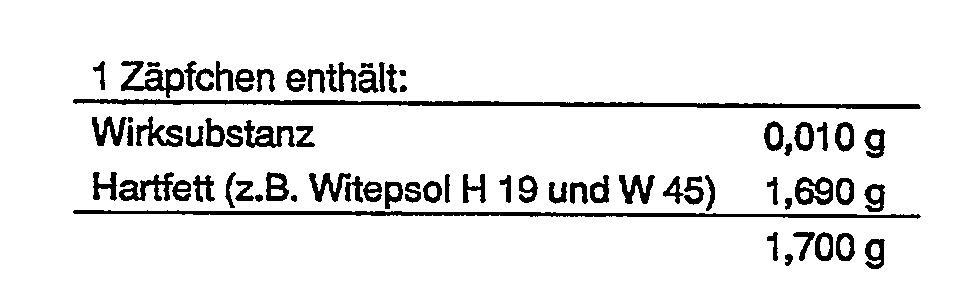
- Das Hartfett wird geschmolzen. Bei 38°C wird die gemahlene Wirksubstanz in der Schmelze homogen dispergiert. Es wird auf 35°C abgekühlt und in schwach vorgekühlte Suppositorienformen ausgegossen.
-

- Dest. Wasser wird auf 70°C erhitzt. Hierin wird unter Rühren Hydroxyethylcellulose, Benzoesäure und Weinsäure gelöst. Es wird auf Raumtemperatur abgekühlt und hierbei das Glycerin und die Sorbitlösung unter Rühren zugegeben. Bei Raumtemperatur wird der Wirkstoff zugegeben und bis zur völligen Auflösung gerührt. Anschließend wird zur Entlüftung des Saftes unter Rühren evakuiert.
Claims (13)


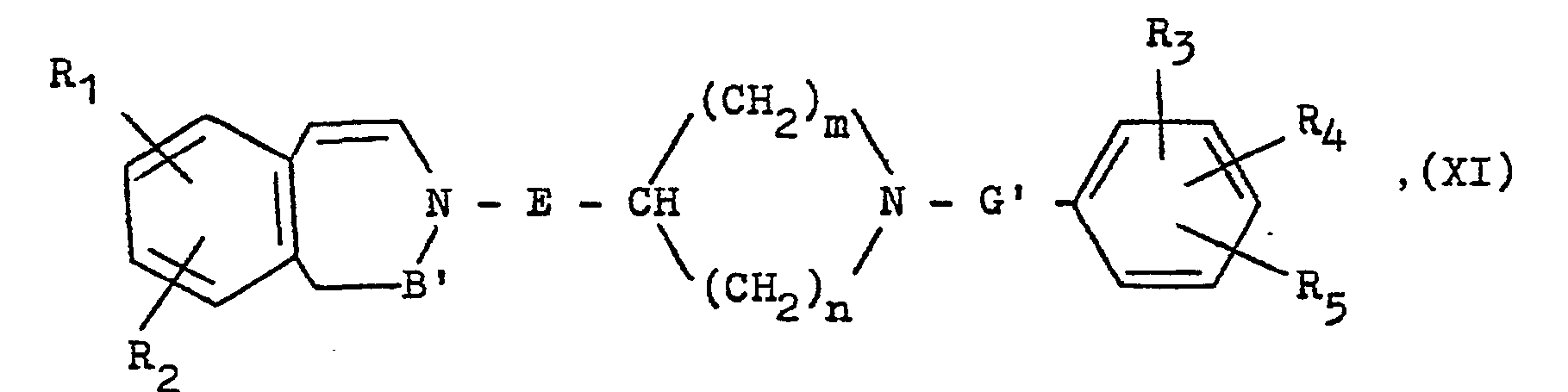
Priority Applications (1)
| Application Number | Priority Date | Filing Date | Title |
|---|---|---|---|
| AT86116002T ATE56447T1 (de) | 1985-11-27 | 1986-11-18 | Neue cyclische aminderivate, diese verbindungen enthaltende arzneimittel und verfahren zu ihrer herstellung. |
Applications Claiming Priority (2)
| Application Number | Priority Date | Filing Date | Title |
|---|---|---|---|
| DE3541811 | 1985-11-27 | ||
| DE19853541811 DE3541811A1 (de) | 1985-11-27 | 1985-11-27 | Neue cyclische aminderivate, diese verbindungen enthaltende arzneimittel und verfahren zu ihrer herstellung |
Publications (3)
| Publication Number | Publication Date |
|---|---|
| EP0224794A2 EP0224794A2 (de) | 1987-06-10 |
| EP0224794A3 EP0224794A3 (en) | 1988-10-19 |
| EP0224794B1 true EP0224794B1 (de) | 1990-09-12 |
Family
ID=6286902
Family Applications (1)
| Application Number | Title | Priority Date | Filing Date |
|---|---|---|---|
| EP86116002A Expired - Lifetime EP0224794B1 (de) | 1985-11-27 | 1986-11-18 | Neue cyclische Aminderivate, diese Verbindungen enthaltende Arzneimittel und Verfahren zu ihrer Herstellung |
Country Status (25)
| Country | Link |
|---|---|
| EP (1) | EP0224794B1 (de) |
| JP (1) | JPH0625128B2 (de) |
| KR (1) | KR950007589B1 (de) |
| AT (1) | ATE56447T1 (de) |
| AU (1) | AU589712B2 (de) |
| CA (1) | CA1321194C (de) |
| CZ (1) | CZ410391A3 (de) |
| DD (1) | DD256132A5 (de) |
| DE (2) | DE3541811A1 (de) |
| DK (1) | DK174564B1 (de) |
| ES (1) | ES2018152B3 (de) |
| FI (1) | FI88299C (de) |
| GR (1) | GR3001107T3 (de) |
| HK (1) | HK123993A (de) |
| HU (1) | HU196787B (de) |
| IE (1) | IE59487B1 (de) |
| IL (1) | IL80758A (de) |
| MX (1) | MX9202813A (de) |
| NO (1) | NO168034C (de) |
| NZ (1) | NZ218412A (de) |
| PH (1) | PH22944A (de) |
| PT (1) | PT83815B (de) |
| SU (1) | SU1442073A3 (de) |
| UA (1) | UA8034A1 (de) |
| ZA (1) | ZA868933B (de) |
Cited By (5)
| Publication number | Priority date | Publication date | Assignee | Title |
|---|---|---|---|---|
| DE3717561A1 (de) * | 1987-05-25 | 1988-12-08 | Thomae Gmbh Dr K | Indol-, isochinolin- und benzazepinderivate, diese verbindungen enthaltende arzneimittel und verfahren zu ihrer herstellung |
| EP1666042A2 (de) | 2000-04-13 | 2006-06-07 | Boehringer Ingelheim Pharma GmbH & Co. KG | Arzneimittelkombination enthaltend Cilobradine und eine herzwirksame Verbindung, z.B. Telmisartan |
| EP1762179A1 (de) | 2005-09-07 | 2007-03-14 | Boehringer Ingelheim Vetmedica Gmbh | Methode zur Verbesserung der Qualität der Diagnostik in der Echokardiographie |
| WO2013024036A1 (en) | 2011-08-12 | 2013-02-21 | Boehringer Ingelheim Vetmedica Gmbh | Funny current (if) inhibitors for use in a method of treating and preventing heart failure in feline |
| WO2014122248A1 (en) | 2013-02-11 | 2014-08-14 | Boehringer Ingelheim Vetmedica Gmbh | Kit-of-parts |
Families Citing this family (5)
| Publication number | Priority date | Publication date | Assignee | Title |
|---|---|---|---|---|
| CA1298427C (en) * | 1987-03-13 | 1992-03-31 | Johannes Adrianus Maria Van Broekhoven | Process for removing palladium catalyst remnants from copolymers of carbon monoxide with one or more olefinically unsaturated compounds |
| FI95572C (fi) * | 1987-06-22 | 1996-02-26 | Eisai Co Ltd | Menetelmä lääkeaineena käyttökelpoisen piperidiinijohdannaisten tai sen farmaseuttisen suolan valmistamiseksi |
| FR2634207B1 (fr) * | 1988-07-12 | 1990-09-07 | Synthelabo | Derives de ((piperidinyl-4)methyl) benzazepines, leur preparation et leur application en therapeutique |
| ES2211846T3 (es) * | 2002-07-25 | 2004-07-16 | BOEHRINGER INGELHEIM PHARMA GMBH & CO.KG | Uso de cilobradina o sus sales farmaceuticamente aceptables para el tratamiento o la prevencion de la insuficiencia cardiaca. |
| US20040138306A1 (en) | 2002-07-25 | 2004-07-15 | Boehringer Ingelheim Pharma Gmbh & Co. Kg | Use of a specific cyclic amine derivative or the pharmaceutically acceptable salts thereof for the treatment or prevention of heart failure |
Family Cites Families (4)
| Publication number | Priority date | Publication date | Assignee | Title |
|---|---|---|---|---|
| DE2639718C2 (de) * | 1976-09-03 | 1987-03-05 | Dr. Karl Thomae Gmbh, 7950 Biberach | 1-[6,7-Dimethoxy-3,4-dihydro-2H-isochinolin-1-on-2-yl]-3-[N-methyl-N-(2-(3,4-dimethoxy-phenyl)-äthyl)-amino]-propan, dessen physiologisch verträgliche Säureadditionssalze und diese Verbindungen enthaltende Arzneimittel |
| CH645632A5 (en) * | 1977-01-01 | 1984-10-15 | Thomae Gmbh Dr K | Arylalkylamines |
| DE3119874A1 (de) * | 1981-05-19 | 1982-12-09 | Dr. Karl Thomae Gmbh, 7950 Biberach | "benzazepinderivate, ihre herstellung und ihre verwendung als arzneimittel" |
| DE3418271A1 (de) * | 1984-05-17 | 1985-11-21 | Dr. Karl Thomae Gmbh, 7950 Biberach | Neue benzazepinderivate, diese verbindungen enthaltende arzneimittel und verfahren zu ihrer herstellung |
-
1985
- 1985-11-27 DE DE19853541811 patent/DE3541811A1/de not_active Withdrawn
-
1986
- 1986-11-11 SU SU864028479A patent/SU1442073A3/ru active
- 1986-11-11 UA UA4028479A patent/UA8034A1/uk unknown
- 1986-11-18 DE DE8686116002T patent/DE3674159D1/de not_active Expired - Lifetime
- 1986-11-18 EP EP86116002A patent/EP0224794B1/de not_active Expired - Lifetime
- 1986-11-18 ES ES86116002T patent/ES2018152B3/es not_active Expired - Lifetime
- 1986-11-18 AT AT86116002T patent/ATE56447T1/de not_active IP Right Cessation
- 1986-11-25 FI FI864785A patent/FI88299C/fi not_active IP Right Cessation
- 1986-11-25 CA CA000523713A patent/CA1321194C/en not_active Expired - Lifetime
- 1986-11-25 IL IL80758A patent/IL80758A/xx not_active IP Right Cessation
- 1986-11-25 DD DD86296626A patent/DD256132A5/de not_active IP Right Cessation
- 1986-11-26 DK DK198605683A patent/DK174564B1/da not_active IP Right Cessation
- 1986-11-26 NO NO864744A patent/NO168034C/no not_active IP Right Cessation
- 1986-11-26 PT PT83815A patent/PT83815B/pt unknown
- 1986-11-26 JP JP61281636A patent/JPH0625128B2/ja not_active Expired - Lifetime
- 1986-11-26 KR KR1019860009986A patent/KR950007589B1/ko not_active Expired - Lifetime
- 1986-11-26 IE IE311086A patent/IE59487B1/en not_active IP Right Cessation
- 1986-11-26 ZA ZA868933A patent/ZA868933B/xx unknown
- 1986-11-26 HU HU864901A patent/HU196787B/hu unknown
- 1986-11-26 NZ NZ218412A patent/NZ218412A/xx unknown
- 1986-11-27 PH PH34532A patent/PH22944A/en unknown
- 1986-11-27 AU AU65764/86A patent/AU589712B2/en not_active Expired
-
1990
- 1990-11-26 GR GR90400965T patent/GR3001107T3/el unknown
-
1991
- 1991-12-27 CZ CS914103A patent/CZ410391A3/cs unknown
-
1992
- 1992-06-12 MX MX9202813A patent/MX9202813A/es unknown
-
1993
- 1993-11-11 HK HK1239/93A patent/HK123993A/xx not_active IP Right Cessation
Cited By (7)
| Publication number | Priority date | Publication date | Assignee | Title |
|---|---|---|---|---|
| DE3717561A1 (de) * | 1987-05-25 | 1988-12-08 | Thomae Gmbh Dr K | Indol-, isochinolin- und benzazepinderivate, diese verbindungen enthaltende arzneimittel und verfahren zu ihrer herstellung |
| EP1666042A2 (de) | 2000-04-13 | 2006-06-07 | Boehringer Ingelheim Pharma GmbH & Co. KG | Arzneimittelkombination enthaltend Cilobradine und eine herzwirksame Verbindung, z.B. Telmisartan |
| EP1762179A1 (de) | 2005-09-07 | 2007-03-14 | Boehringer Ingelheim Vetmedica Gmbh | Methode zur Verbesserung der Qualität der Diagnostik in der Echokardiographie |
| WO2013024036A1 (en) | 2011-08-12 | 2013-02-21 | Boehringer Ingelheim Vetmedica Gmbh | Funny current (if) inhibitors for use in a method of treating and preventing heart failure in feline |
| WO2013024023A1 (en) | 2011-08-12 | 2013-02-21 | Boehringer Ingelheim Vetmedica Gmbh | Taste masked pharmaceutical composition |
| EP3318247A1 (de) | 2011-08-12 | 2018-05-09 | Boehringer Ingelheim Vetmedica GmbH | Geschmacksmaskierte pharmazeutische zusammensetzung |
| WO2014122248A1 (en) | 2013-02-11 | 2014-08-14 | Boehringer Ingelheim Vetmedica Gmbh | Kit-of-parts |
Also Published As
Similar Documents
| Publication | Publication Date | Title |
|---|---|---|
| EP0292840B1 (de) | Neue cyclische Aminderivate, diese Verbindungen enthaltende Arzneimittel und Verfahren zu ihrer Herstellung | |
| US4737495A (en) | (2H)-3-benzazepin-2-ones, their pharmaceutical compositions and their pharmaceutical uses | |
| EP0269968A2 (de) | Heteroaromatische Aminderivate, diese Verbindungen enthaltende Arzneimittel und Verfahren zu ihrer Herstellung | |
| EP0161604A2 (de) | Neue Aminotetralinderivate, diese Verbindungen enthaltende Arzneimittel und Verfahren zu ihrer Herstellung | |
| MC1491A1 (fr) | Nouveaux composes bicycliques,procedes pour les preparer et formules pharmaceutiques contenant ces composes | |
| EP0259793B1 (de) | Neue Naphthylderivate, diese Verbindungen enthaltende Arzneimittel und Verfahren zu ihrer Herstellung | |
| EP0224794A2 (de) | Neue cyclische Aminderivate, diese Verbindungen enthaltende Arzneimittel und Verfahren zu ihrer Herstellung | |
| EP0161599A2 (de) | Neue Benzazepinderivate, diese Verbindungen enthaltende Arzneimittel und Verfahren zu ihrer Herstellung | |
| EP0259782B1 (de) | Neue Naphtalin- und Indanderivate, diese Verbindungen enthaltende Arzneimittel und Verfahren zu deren Herstellung | |
| DE10201240A1 (de) | Substituierte Alkyluracile und ihre Verwendung | |
| EP0213293B1 (de) | In 11-Stellung substituierte 5,11-Dihydro-6H-pyrido-[2,3-b][1,4]benzodiazepin-6-one, Verfahren zur ihrer Herstellung und diese Verbindungen enthaltende Arzneimittel | |
| EP0332064A2 (de) | Neue Benzocycloheptenderivate, diese Verbindungen enthaltende Arzneimittel und Verfahren zu deren Herstellung | |
| EP0146787B1 (de) | Indolderivate, diese Verbindungen enthaltende Arzneimittel und Verfahren zu ihrer Herstellung | |
| DE2852088A1 (de) | Substituierte pyrrolidine, verfahren zu ihrer herstellung, ihre verwendung und sie enthaltende arzneimittel | |
| DE3519735A1 (de) | Neue heteroaromatische aminderivate, diese verbindungen enthaltende arzneimittel und verfahren zu ihrer herstellung | |
| EP0109636B1 (de) | Benzazepinderivate, ihre Herstellung und ihre Verwendung als Arzneimittel | |
| DE3522552A1 (de) | Neue heteroaromatische aminderivate, diese verbindungen enthaltende arzneimittel und verfahren zu ihrer herstellung |
Legal Events
| Date | Code | Title | Description |
|---|---|---|---|
| PUAI | Public reference made under article 153(3) epc to a published international application that has entered the european phase |
Free format text: ORIGINAL CODE: 0009012 |
|
| AK | Designated contracting states |
Kind code of ref document: A2 Designated state(s): AT BE CH DE ES FR GB GR IT LI LU NL SE |
|
| PUAL | Search report despatched |
Free format text: ORIGINAL CODE: 0009013 |
|
| AK | Designated contracting states |
Kind code of ref document: A3 Designated state(s): AT BE CH DE ES FR GB GR IT LI LU NL SE |
|
| 17P | Request for examination filed |
Effective date: 19890322 |
|
| 17Q | First examination report despatched |
Effective date: 19890915 |
|
| GRAA | (expected) grant |
Free format text: ORIGINAL CODE: 0009210 |
|
| AK | Designated contracting states |
Kind code of ref document: B1 Designated state(s): AT BE CH DE ES FR GB GR IT LI LU NL SE |
|
| REF | Corresponds to: |
Ref document number: 56447 Country of ref document: AT Date of ref document: 19900915 Kind code of ref document: T |
|
| REF | Corresponds to: |
Ref document number: 3674159 Country of ref document: DE Date of ref document: 19901018 |
|
| ITF | It: translation for a ep patent filed | ||
| GBT | Gb: translation of ep patent filed (gb section 77(6)(a)/1977) | ||
| ET | Fr: translation filed | ||
| PLBE | No opposition filed within time limit |
Free format text: ORIGINAL CODE: 0009261 |
|
| STAA | Information on the status of an ep patent application or granted ep patent |
Free format text: STATUS: NO OPPOSITION FILED WITHIN TIME LIMIT |
|
| REG | Reference to a national code |
Ref country code: GR Ref legal event code: FG4A Free format text: 3001107 |
|
| 26N | No opposition filed | ||
| ITTA | It: last paid annual fee | ||
| EPTA | Lu: last paid annual fee | ||
| EAL | Se: european patent in force in sweden |
Ref document number: 86116002.6 |
|
| REG | Reference to a national code |
Ref country code: GB Ref legal event code: IF02 |
|
| PGFP | Annual fee paid to national office [announced via postgrant information from national office to epo] |
Ref country code: DE Payment date: 20051110 Year of fee payment: 20 Ref country code: FR Payment date: 20051110 Year of fee payment: 20 |
|
| PGFP | Annual fee paid to national office [announced via postgrant information from national office to epo] |
Ref country code: CH Payment date: 20051114 Year of fee payment: 20 Ref country code: NL Payment date: 20051114 Year of fee payment: 20 Ref country code: SE Payment date: 20051114 Year of fee payment: 20 |
|
| PGFP | Annual fee paid to national office [announced via postgrant information from national office to epo] |
Ref country code: AT Payment date: 20051115 Year of fee payment: 20 Ref country code: LU Payment date: 20051115 Year of fee payment: 20 |
|
| PGFP | Annual fee paid to national office [announced via postgrant information from national office to epo] |
Ref country code: ES Payment date: 20051121 Year of fee payment: 20 Ref country code: GB Payment date: 20051121 Year of fee payment: 20 |
|
| PGFP | Annual fee paid to national office [announced via postgrant information from national office to epo] |
Ref country code: IT Payment date: 20051122 Year of fee payment: 20 |
|
| PGFP | Annual fee paid to national office [announced via postgrant information from national office to epo] |
Ref country code: GR Payment date: 20051125 Year of fee payment: 20 |
|
| PGFP | Annual fee paid to national office [announced via postgrant information from national office to epo] |
Ref country code: BE Payment date: 20051216 Year of fee payment: 20 |
|
| PG25 | Lapsed in a contracting state [announced via postgrant information from national office to epo] |
Ref country code: GB Free format text: LAPSE BECAUSE OF EXPIRATION OF PROTECTION Effective date: 20061117 |
|
| PG25 | Lapsed in a contracting state [announced via postgrant information from national office to epo] |
Ref country code: NL Free format text: LAPSE BECAUSE OF EXPIRATION OF PROTECTION Effective date: 20061118 |
|
| PG25 | Lapsed in a contracting state [announced via postgrant information from national office to epo] |
Ref country code: ES Free format text: LAPSE BECAUSE OF EXPIRATION OF PROTECTION Effective date: 20061120 |
|
| REG | Reference to a national code |
Ref country code: GB Ref legal event code: PE20 |
|
| REG | Reference to a national code |
Ref country code: CH Ref legal event code: PL |
|
| NLV7 | Nl: ceased due to reaching the maximum lifetime of a patent |
Effective date: 20061118 |
|
| EUG | Se: european patent has lapsed | ||
| REG | Reference to a national code |
Ref country code: ES Ref legal event code: FD2A Effective date: 20061120 |
|
| BE20 | Be: patent expired |
Owner name: KARL *THOMAE G.M.B.H. Effective date: 20061118 |