EP0224794B1 - Dérivés amines cycliques, médicaments contenant ces composés et leur procédé de préparation - Google Patents
Dérivés amines cycliques, médicaments contenant ces composés et leur procédé de préparation Download PDFInfo
- Publication number
- EP0224794B1 EP0224794B1 EP86116002A EP86116002A EP0224794B1 EP 0224794 B1 EP0224794 B1 EP 0224794B1 EP 86116002 A EP86116002 A EP 86116002A EP 86116002 A EP86116002 A EP 86116002A EP 0224794 B1 EP0224794 B1 EP 0224794B1
- Authority
- EP
- European Patent Office
- Prior art keywords
- group
- general formula
- compound
- hereinbefore
- ethyl
- Prior art date
- Legal status (The legal status is an assumption and is not a legal conclusion. Google has not performed a legal analysis and makes no representation as to the accuracy of the status listed.)
- Expired - Lifetime
Links
- 0 CCC1C(CCCC2C(C)(C*)CCCC2)C1 Chemical compound CCC1C(CCCC2C(C)(C*)CCCC2)C1 0.000 description 8
- KVXDWMYOGNHLQX-VNWVSWPHSA-N C/C=C\C(CCNCC1)=C1/C=C(/C)\C(C)=C Chemical compound C/C=C\C(CCNCC1)=C1/C=C(/C)\C(C)=C KVXDWMYOGNHLQX-VNWVSWPHSA-N 0.000 description 1
Classifications
-
- C—CHEMISTRY; METALLURGY
- C07—ORGANIC CHEMISTRY
- C07D—HETEROCYCLIC COMPOUNDS
- C07D401/00—Heterocyclic compounds containing two or more hetero rings, having nitrogen atoms as the only ring hetero atoms, at least one ring being a six-membered ring with only one nitrogen atom
- C07D401/02—Heterocyclic compounds containing two or more hetero rings, having nitrogen atoms as the only ring hetero atoms, at least one ring being a six-membered ring with only one nitrogen atom containing two hetero rings
-
- C—CHEMISTRY; METALLURGY
- C07—ORGANIC CHEMISTRY
- C07D—HETEROCYCLIC COMPOUNDS
- C07D223/00—Heterocyclic compounds containing seven-membered rings having one nitrogen atom as the only ring hetero atom
- C07D223/14—Heterocyclic compounds containing seven-membered rings having one nitrogen atom as the only ring hetero atom condensed with carbocyclic rings or ring systems
- C07D223/16—Benzazepines; Hydrogenated benzazepines
-
- A—HUMAN NECESSITIES
- A61—MEDICAL OR VETERINARY SCIENCE; HYGIENE
- A61P—SPECIFIC THERAPEUTIC ACTIVITY OF CHEMICAL COMPOUNDS OR MEDICINAL PREPARATIONS
- A61P9/00—Drugs for disorders of the cardiovascular system
- A61P9/06—Antiarrhythmics
-
- A—HUMAN NECESSITIES
- A61—MEDICAL OR VETERINARY SCIENCE; HYGIENE
- A61P—SPECIFIC THERAPEUTIC ACTIVITY OF CHEMICAL COMPOUNDS OR MEDICINAL PREPARATIONS
- A61P9/00—Drugs for disorders of the cardiovascular system
- A61P9/10—Drugs for disorders of the cardiovascular system for treating ischaemic or atherosclerotic diseases, e.g. antianginal drugs, coronary vasodilators, drugs for myocardial infarction, retinopathy, cerebrovascula insufficiency, renal arteriosclerosis
-
- A—HUMAN NECESSITIES
- A61—MEDICAL OR VETERINARY SCIENCE; HYGIENE
- A61P—SPECIFIC THERAPEUTIC ACTIVITY OF CHEMICAL COMPOUNDS OR MEDICINAL PREPARATIONS
- A61P9/00—Drugs for disorders of the cardiovascular system
- A61P9/12—Antihypertensives
-
- C—CHEMISTRY; METALLURGY
- C07—ORGANIC CHEMISTRY
- C07D—HETEROCYCLIC COMPOUNDS
- C07D401/00—Heterocyclic compounds containing two or more hetero rings, having nitrogen atoms as the only ring hetero atoms, at least one ring being a six-membered ring with only one nitrogen atom
- C07D401/02—Heterocyclic compounds containing two or more hetero rings, having nitrogen atoms as the only ring hetero atoms, at least one ring being a six-membered ring with only one nitrogen atom containing two hetero rings
- C07D401/06—Heterocyclic compounds containing two or more hetero rings, having nitrogen atoms as the only ring hetero atoms, at least one ring being a six-membered ring with only one nitrogen atom containing two hetero rings linked by a carbon chain containing only aliphatic carbon atoms
-
- C—CHEMISTRY; METALLURGY
- C07—ORGANIC CHEMISTRY
- C07D—HETEROCYCLIC COMPOUNDS
- C07D403/00—Heterocyclic compounds containing two or more hetero rings, having nitrogen atoms as the only ring hetero atoms, not provided for by group C07D401/00
- C07D403/02—Heterocyclic compounds containing two or more hetero rings, having nitrogen atoms as the only ring hetero atoms, not provided for by group C07D401/00 containing two hetero rings
- C07D403/06—Heterocyclic compounds containing two or more hetero rings, having nitrogen atoms as the only ring hetero atoms, not provided for by group C07D401/00 containing two hetero rings linked by a carbon chain containing only aliphatic carbon atoms
-
- C—CHEMISTRY; METALLURGY
- C07—ORGANIC CHEMISTRY
- C07D—HETEROCYCLIC COMPOUNDS
- C07D491/00—Heterocyclic compounds containing in the condensed ring system both one or more rings having oxygen atoms as the only ring hetero atoms and one or more rings having nitrogen atoms as the only ring hetero atoms, not provided for by groups C07D451/00 - C07D459/00, C07D463/00, C07D477/00 or C07D489/00
- C07D491/02—Heterocyclic compounds containing in the condensed ring system both one or more rings having oxygen atoms as the only ring hetero atoms and one or more rings having nitrogen atoms as the only ring hetero atoms, not provided for by groups C07D451/00 - C07D459/00, C07D463/00, C07D477/00 or C07D489/00 in which the condensed system contains two hetero rings
- C07D491/04—Ortho-condensed systems
-
- Y—GENERAL TAGGING OF NEW TECHNOLOGICAL DEVELOPMENTS; GENERAL TAGGING OF CROSS-SECTIONAL TECHNOLOGIES SPANNING OVER SEVERAL SECTIONS OF THE IPC; TECHNICAL SUBJECTS COVERED BY FORMER USPC CROSS-REFERENCE ART COLLECTIONS [XRACs] AND DIGESTS
- Y02—TECHNOLOGIES OR APPLICATIONS FOR MITIGATION OR ADAPTATION AGAINST CLIMATE CHANGE
- Y02P—CLIMATE CHANGE MITIGATION TECHNOLOGIES IN THE PRODUCTION OR PROCESSING OF GOODS
- Y02P20/00—Technologies relating to chemical industry
- Y02P20/50—Improvements relating to the production of bulk chemicals
- Y02P20/55—Design of synthesis routes, e.g. reducing the use of auxiliary or protecting groups
Definitions
- the present invention thus relates to the new cyclic amine derivatives of the above general formula I, their enantiomers, their diastereomers, their acid addition salts, in particular for pharmaceutical use, their physiologically compatible acid addition salts with inorganic or organic acids, processes for their preparation and medicaments containing these compounds.
- the reaction is advantageously carried out in a solvent or solvent mixture such as acetone, diethyl ether, methylformamide, dimethylformamide, dimethyl sulfoxide, benzene, chlorobenzene, tetrahydrofuran, benzene / tetrahydrofuran, dioxane or in an excess of the compounds of general formulas II and / or 111 used and, if appropriate, in the presence an acid-binding agent, for example an alcoholate such as potassium tert-butoxide, an alkali metal hydroxide such as sodium or potassium hydroxide, an alkali metal carbonate such as potassium carbonate, an alkali metal amide such as sodium amide, an alkali metal hydride such as sodium hydride, a tertiary organic base such as triethylamine or pyridine, the latter at the same time can also serve as a solvent, or a reaction accelerator such as potassium iodide, depending on the reactivity of the nucle
- the optional subsequent removal of a protective radical used is preferably carried out hydrolytically in an aqueous solvent, for example in water, isopropanol / water, tetrahydrofuran / water or dioxane / water, in the presence of an acid such as hydrochloric acid or sulfuric acid or in the presence of an alkali base such as sodium hydroxide or potassium hydroxide at temperatures between 0 and 100 ° C, preferably at the boiling point of the reaction mixture.
- an aqueous solvent for example in water, isopropanol / water, tetrahydrofuran / water or dioxane / water, in the presence of an acid such as hydrochloric acid or sulfuric acid or in the presence of an alkali base such as sodium hydroxide or potassium hydroxide at temperatures between 0 and 100 ° C, preferably at the boiling point of the reaction mixture.
- a benzyl radical is preferably split off hydrogenolytically, for example using hydrogen in the presence of a catalyst such as palladium / carbon in a solvent such as methanol, ethanol, ethyl acetate or glacial acetic acid, optionally with the addition of an acid such as hydrochloric acid at temperatures between 0 and 50 ° C., but preferably at Room temperature, and a hydrogen pressure of I to 7 bar, but preferably from 3 to 5 bar.
- a catalyst such as palladium / carbon
- a solvent such as methanol, ethanol, ethyl acetate or glacial acetic acid
- an acid such as hydrochloric acid
- the hydrogenation is preferably in a solvent or solvent mixture such as methanol, ethanol, ethyl acetate or glacial acetic acid preferably with catalytically excited hydrogen, for example with hydrogen in the presence of platinum or palladium / carbon, optionally in the presence of a base such as an alcoholate, for example sodium methylate, at a hydrogen pressure from 1 to 7 bar, but preferably from 3 to 5 bar, and at temperatures between 0 and 75 ° C, but preferably at temperatures between 20 and 50 ° C.
- a solvent or solvent mixture such as methanol, ethanol, ethyl acetate or glacial acetic acid preferably with catalytically excited hydrogen, for example with hydrogen in the presence of platinum or palladium / carbon, optionally in the presence of a base such as an alcoholate, for example sodium methylate, at a hydrogen pressure from 1 to 7 bar, but preferably from 3 to 5 bar, and at temperatures between 0 and 75 ° C, but preferably at temperatures between 20 and 50
- any benzyloxy group that may be present can be converted into the corresponding hydroxyl group.
- the reaction is advantageously carried out in a solvent or solvent mixture such as methylformamide, dimethylformamide, dimethyl sulfoxide, benzene, chlorobenzene, tetrahydrofuran, benzoI / tetrahydrofuran or dioxane in the presence of an acid-binding agent, for example an alcoholate such as potassium tert-butylate, an alkali metal hydroxide such as sodium or potassium hydroxide , an alkali carbonate such as potassium carbonate, an alkali amide such as sodium amide or an alkali hydride such as sodium hydride is advantageously carried out at temperatures between 0 and 150 ° C., preferably at temperatures between 0 and 50 ° C.
- a solvent or solvent mixture such as methylformamide, dimethylformamide, dimethyl sulfoxide, benzene, chlorobenzene, tetrahydrofuran, benzoI / tetrahydrofuran or dioxane in the
- the optional subsequent removal of a protective radical used is preferably carried out hydrolytically in an aqueous solvent, for example in water, isopropanol / water, tetrahydrofuran / water or dioxane / water, in the presence of an acid such as hydrochloric acid or sulfuric acid or in the presence of an alkali base such as sodium hydroxide or potassium hydroxide at temperatures between 0 and 100 ° C, preferably at the boiling point of the reaction mixture.
- an aqueous solvent for example in water, isopropanol / water, tetrahydrofuran / water or dioxane / water, in the presence of an acid such as hydrochloric acid or sulfuric acid or in the presence of an alkali base such as sodium hydroxide or potassium hydroxide at temperatures between 0 and 100 ° C, preferably at the boiling point of the reaction mixture.
- a benzyl radical is preferably split off hydrogenolytically, for example using hydrogen in the presence of a catalyst such as palladium / carbon in a solvent such as methanol, ethanol, ethyl acetate or glacial acetic acid, optionally with the addition of an acid such as hydrochloric acid at temperatures between 0 and 50 ° C., but preferably at Room temperature, and a hydrogen pressure of I to 7 bar, but preferably from 3 to 5 bar.
- a catalyst such as palladium / carbon
- a solvent such as methanol, ethanol, ethyl acetate or glacial acetic acid
- an acid such as hydrochloric acid
- any benzyloxy group that may be present can be converted into the corresponding hydroxyl group.
- the reaction is conveniently carried out with a sulfur-introducing agent such as phosphorus pentasulfide or 2,4-bis (4-methoxyphenyl) -1,3-dithia-2,4-diphosphetane-2,4-disulfide in a solvent such as toluene or xylene at temperatures between 50 and 150 ° C, for example at the boiling point of the reaction mixture.
- a sulfur-introducing agent such as phosphorus pentasulfide or 2,4-bis (4-methoxyphenyl) -1,3-dithia-2,4-diphosphetane-2,4-disulfide
- a solvent such as toluene or xylene
- the reaction is carried out in the presence of a suitable reducing agent such as a metal hydride, for example sodium borohydride, in a suitable solvent such as water / methanol or methanol / ether, at temperatures between 0 and 80 ° C., but preferably at temperatures between 15 and 40 ° C.
- a suitable reducing agent such as a metal hydride, for example sodium borohydride
- a suitable solvent such as water / methanol or methanol / ether
- the reduction is preferably carried out with a metal hydride such as lithium aluminum hydride or diborane or with a complex of borane and a thioether, for example with borane-dimethyl sulfide complex, in a suitable solvent such as diethyl ether or tetrahydrofuran at temperatures between 0 and 50 ° C., but preferably at temperatures between 10 and 25 ° C.
- a metal hydride such as lithium aluminum hydride or diborane or with a complex of borane and a thioether, for example with borane-dimethyl sulfide complex
- a suitable solvent such as diethyl ether or tetrahydrofuran
- the oxidation is preferably carried out with an oxidizing agent such as potassium permanganate, selenium dioxide or sodium dichromate in a suitable solvent or solvent mixture such as water, water / dioxane, glacial acetic acid, water / acetic acid or acetic anhydride at temperatures between 0 and 100 ° C., preferably at temperatures between 20 and 80 ° C, performed.
- an oxidizing agent such as potassium permanganate, selenium dioxide or sodium dichromate
- a suitable solvent or solvent mixture such as water, water / dioxane, glacial acetic acid, water / acetic acid or acetic anhydride at temperatures between 0 and 100 ° C., preferably at temperatures between 20 and 80 ° C, performed.
- the hydrogenation is carried out in a solvent or solvent mixture such as methanol, ethanol, ethyl acetate or glacial acetic acid, preferably with catalytically excited hydrogen, for example with hydrogen in the presence of platinum or palladium / carbon, at a hydrogen pressure of 1 to 7 bar, but preferably of 3 to 5 bar , and at temperatures between 0 and 75 ° C, but preferably at temperatures between 20 and 50 ° C.
- a solvent or solvent mixture such as methanol, ethanol, ethyl acetate or glacial acetic acid
- the subsequent reduction of the nitro compound is preferably carried out in a solvent such as water, water / ethanol, methanol, glacial acetic acid, ethyl acetate or dimethylformamide, advantageously with hydrogen in the presence of a hydrogenation catalyst such as Raney nickel, platinum or palladium / carbon, with metals such as iron, tin or zinc in the presence of an acid, with salts such as iron (11) sulfate, tin (II) chloride or sodium dithionite or with hydrazine in the presence of Raney nickel at temperatures between 0 and 50 ° C., but preferably at room temperature.
- a hydrogenation catalyst such as Raney nickel, platinum or palladium / carbon
- metals such as iron, tin or zinc
- salts such as iron (11) sulfate, tin (II) chloride or sodium dithionite or with hydrazine in the presence of Raney nickel at temperatures between 0 and 50 ° C., but preferably
- the subsequent acylation is conveniently carried out in a solvent such as methylene chloride, chloroform, carbon tetrachloride, ether, tetrahydrofuran, dioxane, benzene, toluene, acetonitrile or dimethylformamide, preferably with a reactive derivative of the acid, for example with methanesulfonic acid chloride, ethanesulfonic acid chloride, n-propanesulfonic acid chloride, acanidridyl chloride, acetyl chloride Propionic anhydride, and optionally in the presence of an inorganic base such as sodium carbonate or a tertiary organic base such as triethylamine or pyridine, which can simultaneously serve as a solvent, at temperatures between -25 ° C and 100 ° C, but preferably at temperatures between -10 ° C and the boiling point of the solvent used.
- a solvent such as methylene chloride, chloroform, carbon te
- the compounds of general formula 1 obtained since they have at least one chiral center, can be separated into their diastereomers, for example by column chromatography, and into their enantiomers, for example by column chromatography on a chiral phase or by crystallization with optically active acids, since they have at least one chiral center.
- optically active acids since they have at least one chiral center.
- the compounds of general formula I obtained can furthermore be converted into their acid addition salts, in particular for their pharmaceutical use, into their physiologically tolerable acid addition salts with inorganic or organic acids.
- Suitable acids are, for example, hydrochloric acid, hydrobromic acid, sulfuric acid, phosphoric acid, acetic acid, lactic acid, citric acid, tartaric acid, succinic acid, maleic acid or fumaric acid.
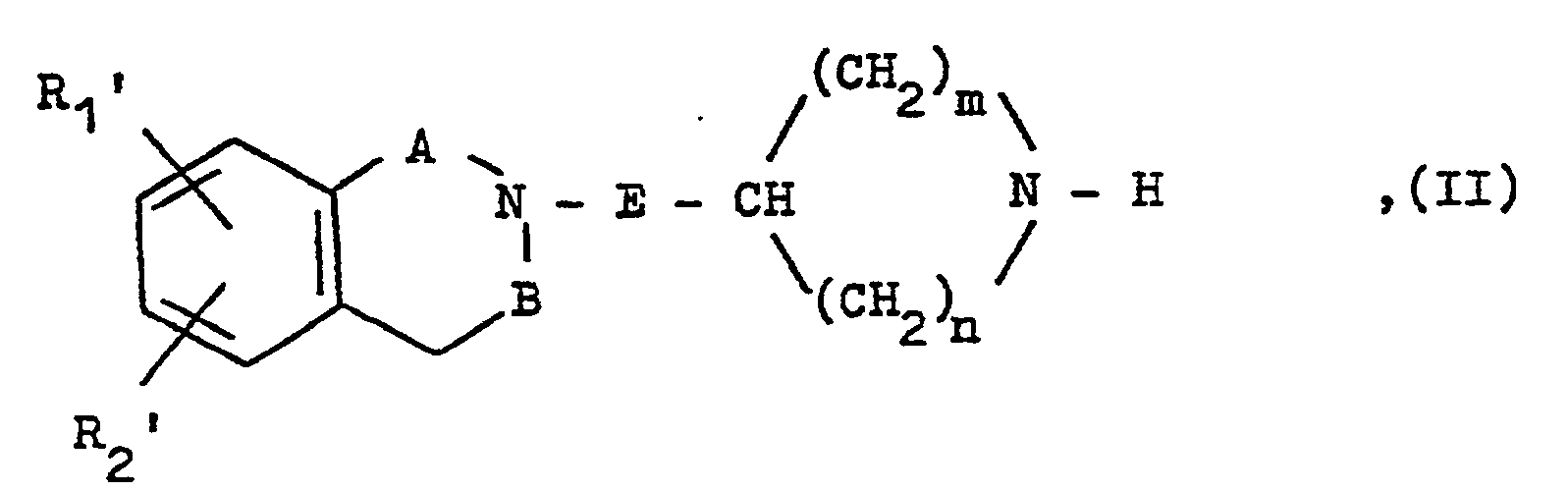
- a starting compound of the general formula II is obtained by reacting a corresponding benzazepine with a corresponding halogen compound and optionally by subsequent reaction with a corresponding amine.
- the corresponding benzazepine of the general formula V which is unsubstituted in the 3-position is obtained by cyclization of a corresponding compound, for example by cyclization of a compound of the general formula or the general formula optionally subsequent catalytic hydrogenation and or reduction of the carbonyl group, for example with sodium borohydride / glacial acetic acid (see EP-AI 0.007.070, EP-AI 0.065.229 and EP-AI 0.109.639) and / or oxidation, for example with selenium dioxide.
- a compound of the general formulas IV and VII to XI used as the starting material is preferably obtained by reacting a corresponding halogen compound with a corresponding amine and optionally subsequent quaternization and / or elimination of protective residues which are used to protect hydroxyl and / or amino groups.
- the new compounds of the general formula I and their physiologically tolerable acid addition salts with inorganic or organic acids have valuable pharmacological properties, in particular with low central side effects, a particularly long-lasting heart rate-lowering effect and a reduction in the heart's 02 requirement.
- the effect of the substances to be examined on the heart rate was examined per dose in 2 rats with an average weight of 250-300 g.
- the rats were anesthetized with pentobarbital (50 mg / kg i.p. and 20 mg / kg s.c.).
- pentobarbital 50 mg / kg i.p. and 20 mg / kg s.c.
- the substances to be examined were injected into the jugular vein in aqueous solution (0.1 ml / 100 g).
- the blood pressure was measured via a cannula embedded in a carotid artery and the heart rate was recorded from an EKG (II or III lead) derived with needle electrodes.
- the heart rate of the animals in the control period was between 350 and 400 beats / minutes (bpm).
- the compounds produced according to the invention have no toxic side effects in therapeutic doses. For example, with intravenous administration of substances A and D even in a high dose of 20 mg / kg to mice, apart from a small sedation, no toxic side effects were observed.
- the compounds produced according to the invention are suitable for the treatment of sinus tachycardias of various origins and for the prophylaxis and therapy of ischemic heart diseases.
- the dosage required to achieve a corresponding effect is advantageously 0.01 to 0.2 mg / kg body weight once or twice a day, preferably 0.03 to 0.15 mg / kg body weight.
- the active ingredient, corn starch, milk sugar and polyvinyl pyrrolidone are mixed and moistened with water.
- the moist mixture is pressed through a sieve with a mesh size of 1.5 mm and dried at approx. 45 ° C.
- the dry granules are passed through a sieve with a mesh size of 1.0 mm and mixed with magnesium stearate.
- the finished mixture is pressed into tablets on a tablet press with stamps of 7 mm in diameter, which are provided with a partial notch. Tablet weight: 120 mg
- the active ingredient, corn starch, milk sugar and polyvinylpyrrolidone are mixed well and moistened with water.
- the moist mass is pressed through a sieve with an I mm mesh size, dried at approx. 45 ° C and then the granules are passed through the same sieve.
- domed dragee cores with a diameter of 6 mm are pressed on a tablet machine.
- the dragee cores thus produced are coated in a known manner with a layer consisting essentially of sugar and talc.
- the finished coated tablets are polished with wax. Dragé weight: 130 mg
- the active substance is dissolved in water for injection purposes in a suitable preparation vessel and the solution is made isotonic with sorbitol.
- the solution After filtration through a membrane filter, the solution is poured into cleaned and sterilized ampoules with N 2 gassing and autoclaved in flowing steam for 20 minutes.
- the hard fat is melted.
- the ground active substance is homogeneously dispersed in the melt at 38 ° C. It is cooled to 35 ° C and poured into weakly pre-cooled suppository molds.
- Dest. Water is heated to 70 ° C. Hydroxyethyl cellulose, benzoic acid and tartaric acid are dissolved therein with stirring. It is cooled to room temperature and the glycerin and the sorbitol solution are added with stirring. The active ingredient is added at room temperature and stirred until completely dissolved. Subsequently, the juice is evacuated with stirring.
Landscapes
- Chemical & Material Sciences (AREA)
- Organic Chemistry (AREA)
- Health & Medical Sciences (AREA)
- Engineering & Computer Science (AREA)
- Bioinformatics & Cheminformatics (AREA)
- General Health & Medical Sciences (AREA)
- Chemical Kinetics & Catalysis (AREA)
- General Chemical & Material Sciences (AREA)
- Medicinal Chemistry (AREA)
- Nuclear Medicine, Radiotherapy & Molecular Imaging (AREA)
- Heart & Thoracic Surgery (AREA)
- Pharmacology & Pharmacy (AREA)
- Life Sciences & Earth Sciences (AREA)
- Animal Behavior & Ethology (AREA)
- Cardiology (AREA)
- Public Health (AREA)
- Veterinary Medicine (AREA)
- Vascular Medicine (AREA)
- Urology & Nephrology (AREA)
- Pharmaceuticals Containing Other Organic And Inorganic Compounds (AREA)
- Hydrogenated Pyridines (AREA)
- Plural Heterocyclic Compounds (AREA)
- Organic Low-Molecular-Weight Compounds And Preparation Thereof (AREA)
- Pyrrole Compounds (AREA)
- Other In-Based Heterocyclic Compounds (AREA)
- Nitrogen Condensed Heterocyclic Rings (AREA)
- Pyridine Compounds (AREA)
- Heterocyclic Carbon Compounds Containing A Hetero Ring Having Nitrogen And Oxygen As The Only Ring Hetero Atoms (AREA)
- Acyclic And Carbocyclic Compounds In Medicinal Compositions (AREA)
- Nitrogen And Oxygen Or Sulfur-Condensed Heterocyclic Ring Systems (AREA)
Claims (13)






Priority Applications (1)
| Application Number | Priority Date | Filing Date | Title |
|---|---|---|---|
| AT86116002T ATE56447T1 (de) | 1985-11-27 | 1986-11-18 | Neue cyclische aminderivate, diese verbindungen enthaltende arzneimittel und verfahren zu ihrer herstellung. |
Applications Claiming Priority (2)
| Application Number | Priority Date | Filing Date | Title |
|---|---|---|---|
| DE19853541811 DE3541811A1 (de) | 1985-11-27 | 1985-11-27 | Neue cyclische aminderivate, diese verbindungen enthaltende arzneimittel und verfahren zu ihrer herstellung |
| DE3541811 | 1985-11-27 |
Publications (3)
| Publication Number | Publication Date |
|---|---|
| EP0224794A2 EP0224794A2 (fr) | 1987-06-10 |
| EP0224794A3 EP0224794A3 (en) | 1988-10-19 |
| EP0224794B1 true EP0224794B1 (fr) | 1990-09-12 |
Family
ID=6286902
Family Applications (1)
| Application Number | Title | Priority Date | Filing Date |
|---|---|---|---|
| EP86116002A Expired - Lifetime EP0224794B1 (fr) | 1985-11-27 | 1986-11-18 | Dérivés amines cycliques, médicaments contenant ces composés et leur procédé de préparation |
Country Status (25)
| Country | Link |
|---|---|
| EP (1) | EP0224794B1 (fr) |
| JP (1) | JPH0625128B2 (fr) |
| KR (1) | KR950007589B1 (fr) |
| AT (1) | ATE56447T1 (fr) |
| AU (1) | AU589712B2 (fr) |
| CA (1) | CA1321194C (fr) |
| CZ (1) | CZ410391A3 (fr) |
| DD (1) | DD256132A5 (fr) |
| DE (2) | DE3541811A1 (fr) |
| DK (1) | DK174564B1 (fr) |
| ES (1) | ES2018152B3 (fr) |
| FI (1) | FI88299C (fr) |
| GR (1) | GR3001107T3 (fr) |
| HK (1) | HK123993A (fr) |
| HU (1) | HU196787B (fr) |
| IE (1) | IE59487B1 (fr) |
| IL (1) | IL80758A (fr) |
| MX (1) | MX9202813A (fr) |
| NO (1) | NO168034C (fr) |
| NZ (1) | NZ218412A (fr) |
| PH (1) | PH22944A (fr) |
| PT (1) | PT83815B (fr) |
| SU (1) | SU1442073A3 (fr) |
| UA (1) | UA8034A1 (fr) |
| ZA (1) | ZA868933B (fr) |
Cited By (5)
| Publication number | Priority date | Publication date | Assignee | Title |
|---|---|---|---|---|
| DE3717561A1 (de) * | 1987-05-25 | 1988-12-08 | Thomae Gmbh Dr K | Indol-, isochinolin- und benzazepinderivate, diese verbindungen enthaltende arzneimittel und verfahren zu ihrer herstellung |
| EP1666042A2 (fr) | 2000-04-13 | 2006-06-07 | Boehringer Ingelheim Pharma GmbH & Co. KG | Composition contenant cilobradine et un agent cardiaque, par exemple telmisartan |
| EP1762179A1 (fr) | 2005-09-07 | 2007-03-14 | Boehringer Ingelheim Vetmedica Gmbh | Méthode pour l'amélioration de la qualité de diagnostic dans l'échocardiographie |
| WO2013024036A1 (fr) | 2011-08-12 | 2013-02-21 | Boehringer Ingelheim Vetmedica Gmbh | Inhibiteurs du drôle de courant (courant if) destinés à être utilisés dans un procédé de traitement et de prévention de l'insuffisance cardiaque chez les félins |
| WO2014122248A1 (fr) | 2013-02-11 | 2014-08-14 | Boehringer Ingelheim Vetmedica Gmbh | Kit d'éléments |
Families Citing this family (5)
| Publication number | Priority date | Publication date | Assignee | Title |
|---|---|---|---|---|
| CA1298427C (fr) * | 1987-03-13 | 1992-03-31 | Johannes Adrianus Maria Van Broekhoven | Methode pour separer les residus d'un catalyseur au palladium de copolymeres de monoxyde de carbone et de composes renfermant une ou plusieurs fonctions olefiniques |
| FI95572C (fi) * | 1987-06-22 | 1996-02-26 | Eisai Co Ltd | Menetelmä lääkeaineena käyttökelpoisen piperidiinijohdannaisten tai sen farmaseuttisen suolan valmistamiseksi |
| FR2634207B1 (fr) * | 1988-07-12 | 1990-09-07 | Synthelabo | Derives de ((piperidinyl-4)methyl) benzazepines, leur preparation et leur application en therapeutique |
| US20040138306A1 (en) | 2002-07-25 | 2004-07-15 | Boehringer Ingelheim Pharma Gmbh & Co. Kg | Use of a specific cyclic amine derivative or the pharmaceutically acceptable salts thereof for the treatment or prevention of heart failure |
| DE60200160T2 (de) * | 2002-07-25 | 2004-11-04 | Boehringer Ingelheim Pharma Gmbh & Co. Kg | Verwendung von Cilobradine oder pharmazeutisch akzeptablen Salze zur Behandlung oder Prävention von Herzversagen |
Family Cites Families (4)
| Publication number | Priority date | Publication date | Assignee | Title |
|---|---|---|---|---|
| DE2639718C2 (de) * | 1976-09-03 | 1987-03-05 | Dr. Karl Thomae Gmbh, 7950 Biberach | 1-[6,7-Dimethoxy-3,4-dihydro-2H-isochinolin-1-on-2-yl]-3-[N-methyl-N-(2-(3,4-dimethoxy-phenyl)-äthyl)-amino]-propan, dessen physiologisch verträgliche Säureadditionssalze und diese Verbindungen enthaltende Arzneimittel |
| CH645632A5 (en) * | 1977-01-01 | 1984-10-15 | Thomae Gmbh Dr K | Arylalkylamines |
| DE3119874A1 (de) * | 1981-05-19 | 1982-12-09 | Dr. Karl Thomae Gmbh, 7950 Biberach | "benzazepinderivate, ihre herstellung und ihre verwendung als arzneimittel" |
| DE3418271A1 (de) * | 1984-05-17 | 1985-11-21 | Dr. Karl Thomae Gmbh, 7950 Biberach | Neue benzazepinderivate, diese verbindungen enthaltende arzneimittel und verfahren zu ihrer herstellung |
-
1985
- 1985-11-27 DE DE19853541811 patent/DE3541811A1/de not_active Withdrawn
-
1986
- 1986-11-11 SU SU864028479A patent/SU1442073A3/ru active
- 1986-11-11 UA UA4028479A patent/UA8034A1/uk unknown
- 1986-11-18 ES ES86116002T patent/ES2018152B3/es not_active Expired - Lifetime
- 1986-11-18 DE DE8686116002T patent/DE3674159D1/de not_active Expired - Lifetime
- 1986-11-18 EP EP86116002A patent/EP0224794B1/fr not_active Expired - Lifetime
- 1986-11-18 AT AT86116002T patent/ATE56447T1/de not_active IP Right Cessation
- 1986-11-25 FI FI864785A patent/FI88299C/fi not_active IP Right Cessation
- 1986-11-25 DD DD86296626A patent/DD256132A5/de not_active IP Right Cessation
- 1986-11-25 CA CA000523713A patent/CA1321194C/fr not_active Expired - Lifetime
- 1986-11-25 IL IL80758A patent/IL80758A/xx not_active IP Right Cessation
- 1986-11-26 IE IE311086A patent/IE59487B1/en not_active IP Right Cessation
- 1986-11-26 NZ NZ218412A patent/NZ218412A/xx unknown
- 1986-11-26 KR KR1019860009986A patent/KR950007589B1/ko not_active Expired - Lifetime
- 1986-11-26 JP JP61281636A patent/JPH0625128B2/ja not_active Expired - Lifetime
- 1986-11-26 PT PT83815A patent/PT83815B/pt unknown
- 1986-11-26 ZA ZA868933A patent/ZA868933B/xx unknown
- 1986-11-26 NO NO864744A patent/NO168034C/no not_active IP Right Cessation
- 1986-11-26 DK DK198605683A patent/DK174564B1/da not_active IP Right Cessation
- 1986-11-26 HU HU864901A patent/HU196787B/hu unknown
- 1986-11-27 PH PH34532A patent/PH22944A/en unknown
- 1986-11-27 AU AU65764/86A patent/AU589712B2/en not_active Expired
-
1990
- 1990-11-26 GR GR90400965T patent/GR3001107T3/el unknown
-
1991
- 1991-12-27 CZ CS914103A patent/CZ410391A3/cs unknown
-
1992
- 1992-06-12 MX MX9202813A patent/MX9202813A/es unknown
-
1993
- 1993-11-11 HK HK1239/93A patent/HK123993A/xx not_active IP Right Cessation
Cited By (7)
| Publication number | Priority date | Publication date | Assignee | Title |
|---|---|---|---|---|
| DE3717561A1 (de) * | 1987-05-25 | 1988-12-08 | Thomae Gmbh Dr K | Indol-, isochinolin- und benzazepinderivate, diese verbindungen enthaltende arzneimittel und verfahren zu ihrer herstellung |
| EP1666042A2 (fr) | 2000-04-13 | 2006-06-07 | Boehringer Ingelheim Pharma GmbH & Co. KG | Composition contenant cilobradine et un agent cardiaque, par exemple telmisartan |
| EP1762179A1 (fr) | 2005-09-07 | 2007-03-14 | Boehringer Ingelheim Vetmedica Gmbh | Méthode pour l'amélioration de la qualité de diagnostic dans l'échocardiographie |
| WO2013024036A1 (fr) | 2011-08-12 | 2013-02-21 | Boehringer Ingelheim Vetmedica Gmbh | Inhibiteurs du drôle de courant (courant if) destinés à être utilisés dans un procédé de traitement et de prévention de l'insuffisance cardiaque chez les félins |
| WO2013024023A1 (fr) | 2011-08-12 | 2013-02-21 | Boehringer Ingelheim Vetmedica Gmbh | Composition pharmaceutique à goût masqué |
| EP3318247A1 (fr) | 2011-08-12 | 2018-05-09 | Boehringer Ingelheim Vetmedica GmbH | Composition pharmaceutique au goût masqué |
| WO2014122248A1 (fr) | 2013-02-11 | 2014-08-14 | Boehringer Ingelheim Vetmedica Gmbh | Kit d'éléments |
Also Published As
Similar Documents
| Publication | Publication Date | Title |
|---|---|---|
| EP0292840B1 (fr) | Dérivés d'amines cycliques, médicaments le contenant et procédé de leur préparation | |
| US4737495A (en) | (2H)-3-benzazepin-2-ones, their pharmaceutical compositions and their pharmaceutical uses | |
| EP0269968A2 (fr) | Dérivés d'amine hétéroaromatiques, médicaments les contenant et leur procédé de préparation | |
| EP0161604A2 (fr) | Dérivés d'aminotétraline, médicaments contenant ces composés et procédé pour leur préparation | |
| MC1491A1 (fr) | Nouveaux composes bicycliques,procedes pour les preparer et formules pharmaceutiques contenant ces composes | |
| EP0259793B1 (fr) | Dérivés naphtyliques, médicaments contenant ces composés et leurs procédés de préparation | |
| EP0224794A2 (fr) | Dérivés amines cycliques, médicaments contenant ces composés et leur procédé de préparation | |
| EP0161599A2 (fr) | Dérivés de benzazépine, médicaments contenant les composés et procédé pour leur préparation | |
| EP0259782B1 (fr) | Dérivés de naphtalène et de l'indane, médicaments contenant ces composés et leurs procédés de préparation | |
| DE10201240A1 (de) | Substituierte Alkyluracile und ihre Verwendung | |
| EP0213293B1 (fr) | 5,11-Dihydro-6H-pyrido[2,3-b][1,4]benzodiazépine-6-ones substituées en position 11, procédé pour leur préparation et médicament les contenant | |
| EP0332064A2 (fr) | Dérivés du benzocycloheptène, médicament contenant ces composés et procédé de leur préparation | |
| EP0146787B1 (fr) | Dérivés d'indole, médicaments contenant ces composés et procédé pour leur preparation | |
| DE2852088A1 (de) | Substituierte pyrrolidine, verfahren zu ihrer herstellung, ihre verwendung und sie enthaltende arzneimittel | |
| DE3519735A1 (de) | Neue heteroaromatische aminderivate, diese verbindungen enthaltende arzneimittel und verfahren zu ihrer herstellung | |
| EP0109636B1 (fr) | Dérivés de benzazépine, leur procédé de préparation et leur application comme médicaments | |
| DE3522552A1 (de) | Neue heteroaromatische aminderivate, diese verbindungen enthaltende arzneimittel und verfahren zu ihrer herstellung |
Legal Events
| Date | Code | Title | Description |
|---|---|---|---|
| PUAI | Public reference made under article 153(3) epc to a published international application that has entered the european phase |
Free format text: ORIGINAL CODE: 0009012 |
|
| AK | Designated contracting states |
Kind code of ref document: A2 Designated state(s): AT BE CH DE ES FR GB GR IT LI LU NL SE |
|
| PUAL | Search report despatched |
Free format text: ORIGINAL CODE: 0009013 |
|
| AK | Designated contracting states |
Kind code of ref document: A3 Designated state(s): AT BE CH DE ES FR GB GR IT LI LU NL SE |
|
| 17P | Request for examination filed |
Effective date: 19890322 |
|
| 17Q | First examination report despatched |
Effective date: 19890915 |
|
| GRAA | (expected) grant |
Free format text: ORIGINAL CODE: 0009210 |
|
| AK | Designated contracting states |
Kind code of ref document: B1 Designated state(s): AT BE CH DE ES FR GB GR IT LI LU NL SE |
|
| REF | Corresponds to: |
Ref document number: 56447 Country of ref document: AT Date of ref document: 19900915 Kind code of ref document: T |
|
| REF | Corresponds to: |
Ref document number: 3674159 Country of ref document: DE Date of ref document: 19901018 |
|
| ITF | It: translation for a ep patent filed | ||
| GBT | Gb: translation of ep patent filed (gb section 77(6)(a)/1977) | ||
| ET | Fr: translation filed | ||
| PLBE | No opposition filed within time limit |
Free format text: ORIGINAL CODE: 0009261 |
|
| STAA | Information on the status of an ep patent application or granted ep patent |
Free format text: STATUS: NO OPPOSITION FILED WITHIN TIME LIMIT |
|
| REG | Reference to a national code |
Ref country code: GR Ref legal event code: FG4A Free format text: 3001107 |
|
| 26N | No opposition filed | ||
| ITTA | It: last paid annual fee | ||
| EPTA | Lu: last paid annual fee | ||
| EAL | Se: european patent in force in sweden |
Ref document number: 86116002.6 |
|
| REG | Reference to a national code |
Ref country code: GB Ref legal event code: IF02 |
|
| PGFP | Annual fee paid to national office [announced via postgrant information from national office to epo] |
Ref country code: DE Payment date: 20051110 Year of fee payment: 20 Ref country code: FR Payment date: 20051110 Year of fee payment: 20 |
|
| PGFP | Annual fee paid to national office [announced via postgrant information from national office to epo] |
Ref country code: CH Payment date: 20051114 Year of fee payment: 20 Ref country code: NL Payment date: 20051114 Year of fee payment: 20 Ref country code: SE Payment date: 20051114 Year of fee payment: 20 |
|
| PGFP | Annual fee paid to national office [announced via postgrant information from national office to epo] |
Ref country code: AT Payment date: 20051115 Year of fee payment: 20 Ref country code: LU Payment date: 20051115 Year of fee payment: 20 |
|
| PGFP | Annual fee paid to national office [announced via postgrant information from national office to epo] |
Ref country code: ES Payment date: 20051121 Year of fee payment: 20 Ref country code: GB Payment date: 20051121 Year of fee payment: 20 |
|
| PGFP | Annual fee paid to national office [announced via postgrant information from national office to epo] |
Ref country code: IT Payment date: 20051122 Year of fee payment: 20 |
|
| PGFP | Annual fee paid to national office [announced via postgrant information from national office to epo] |
Ref country code: GR Payment date: 20051125 Year of fee payment: 20 |
|
| PGFP | Annual fee paid to national office [announced via postgrant information from national office to epo] |
Ref country code: BE Payment date: 20051216 Year of fee payment: 20 |
|
| PG25 | Lapsed in a contracting state [announced via postgrant information from national office to epo] |
Ref country code: GB Free format text: LAPSE BECAUSE OF EXPIRATION OF PROTECTION Effective date: 20061117 |
|
| PG25 | Lapsed in a contracting state [announced via postgrant information from national office to epo] |
Ref country code: NL Free format text: LAPSE BECAUSE OF EXPIRATION OF PROTECTION Effective date: 20061118 |
|
| PG25 | Lapsed in a contracting state [announced via postgrant information from national office to epo] |
Ref country code: ES Free format text: LAPSE BECAUSE OF EXPIRATION OF PROTECTION Effective date: 20061120 |
|
| REG | Reference to a national code |
Ref country code: GB Ref legal event code: PE20 |
|
| REG | Reference to a national code |
Ref country code: CH Ref legal event code: PL |
|
| NLV7 | Nl: ceased due to reaching the maximum lifetime of a patent |
Effective date: 20061118 |
|
| EUG | Se: european patent has lapsed | ||
| REG | Reference to a national code |
Ref country code: ES Ref legal event code: FD2A Effective date: 20061120 |
|
| BE20 | Be: patent expired |
Owner name: KARL *THOMAE G.M.B.H. Effective date: 20061118 |