EP0226171A2 - Polymerisatdispersionen, Verfahren zu ihrer Herstellung, sowie deren Anwendung als Bindemittel - Google Patents
Polymerisatdispersionen, Verfahren zu ihrer Herstellung, sowie deren Anwendung als Bindemittel Download PDFInfo
- Publication number
- EP0226171A2 EP0226171A2 EP86117167A EP86117167A EP0226171A2 EP 0226171 A2 EP0226171 A2 EP 0226171A2 EP 86117167 A EP86117167 A EP 86117167A EP 86117167 A EP86117167 A EP 86117167A EP 0226171 A2 EP0226171 A2 EP 0226171A2
- Authority
- EP
- European Patent Office
- Prior art keywords
- weight
- polymer
- component
- polymer dispersions
- aqueous
- Prior art date
- Legal status (The legal status is an assumption and is not a legal conclusion. Google has not performed a legal analysis and makes no representation as to the accuracy of the status listed.)
- Granted
Links
- 0 CC(C*c1ccc(C(*)=O)c(C)c1)*c(cc1)cc(C(O2)=O)c1C2=O Chemical compound CC(C*c1ccc(C(*)=O)c(C)c1)*c(cc1)cc(C(O2)=O)c1C2=O 0.000 description 2
Images
Classifications
-
- C—CHEMISTRY; METALLURGY
- C09—DYES; PAINTS; POLISHES; NATURAL RESINS; ADHESIVES; COMPOSITIONS NOT OTHERWISE PROVIDED FOR; APPLICATIONS OF MATERIALS NOT OTHERWISE PROVIDED FOR
- C09D—COATING COMPOSITIONS, e.g. PAINTS, VARNISHES OR LACQUERS; FILLING PASTES; CHEMICAL PAINT OR INK REMOVERS; INKS; CORRECTING FLUIDS; WOODSTAINS; PASTES OR SOLIDS FOR COLOURING OR PRINTING; USE OF MATERIALS THEREFOR
- C09D151/00—Coating compositions based on graft polymers in which the grafted component is obtained by reactions only involving carbon-to-carbon unsaturated bonds; Coating compositions based on derivatives of such polymers
- C09D151/003—Coating compositions based on graft polymers in which the grafted component is obtained by reactions only involving carbon-to-carbon unsaturated bonds; Coating compositions based on derivatives of such polymers grafted on to macromolecular compounds obtained by reactions only involving unsaturated carbon-to-carbon bonds
-
- C—CHEMISTRY; METALLURGY
- C08—ORGANIC MACROMOLECULAR COMPOUNDS; THEIR PREPARATION OR CHEMICAL WORKING-UP; COMPOSITIONS BASED THEREON
- C08F—MACROMOLECULAR COMPOUNDS OBTAINED BY REACTIONS ONLY INVOLVING CARBON-TO-CARBON UNSATURATED BONDS
- C08F283/00—Macromolecular compounds obtained by polymerising monomers on to polymers provided for in subclass C08G
- C08F283/10—Macromolecular compounds obtained by polymerising monomers on to polymers provided for in subclass C08G on to polymers containing more than one epoxy radical per molecule
Definitions
- the invention relates to aqueous dispersions based on crosslinkable polymers and ⁇ , ⁇ -olefinically unsaturated monomers for the production of crosslinkable coatings on surfaces, their production and their use, in particular for stoving coatings and paints.
- Carboxy-functional self-curing polymers which additionally contain epoxy groups, for example prepared in accordance with DE-Offenlegungsschrift 28 11 913, in combination with melamine resins in "metallic basecoat” formulations (according to DE-Offenlegungsschrift 33 01 729) give well-adhering coatings which, however, have unfavorable properties for example with regard to storage in water. This applies in particular to the build-up of paints under so-called repair conditions, with further paint layers being applied to already painted substrates at low curing temperatures.
- the polymers mentioned cannot be adequately rheologically controlled with thickeners.
- this is a very crucial disadvantage because of the rheological properties must be set specifically for the different areas of application.
- the rheological properties of metallic base coat lacquers are one of the most important properties, since the rapid fixation of the flaky pigments is decisive for the metallic appearance of the lacquer applied.
- polymer dispersions e.g., the polymer dispersions with the self-curing polymers mentioned above, which are described in the previously mentioned DE-Laid-Open Nos. 31 28 025 and 31 28 062, when combined with reactive melamine resins in aqueous "metallic base coat" coatings do not improve the desired combination of properties of interlayer adhesion and water storage stability. On the contrary, there is usually a combination of poor interlayer adhesion and insufficient water storage stability. In addition, this mixture cannot be thickened sufficiently with conventional thickeners based on polyacrylates, polyethylene oxide, polyvinyl alcohols, cellulose ethers and others.
- Self-curing carboxy-functional polymers are those which each contain at least one carboxy group and one epoxy group in the molecule, the carboxyl group (s) of which are (are) neutralized with salt-forming substances, which prevents premature reaction with the epoxy groups present. They are generally in the form of aqueous systems.
- the object of the invention was therefore to develop aqueous binder dispersions which, in addition to excellent adhesion properties on various substrates or in the case of multi-layer lacquer structures between the individual layers in aqueous lacquer systems, also have very good water storage stability, in particular under so-called Repair conditions, and can be adequately controlled rheologically by thickeners.
- the invention therefore relates to stable aqueous polymer dispersions based on A) 1 to 99% by weight of a carboxy-functional polymer which additionally contains epoxy groups, B) 1 to 99% by weight of a polymer composed of at least one ⁇ , ⁇ -olefinically unsaturated monomer , wherein the polymer B) has been prepared in the presence of the polymer A), C) 0 to 20% by weight of anionic or nonionic emulsifiers or a mixture of both or protective colloids, the quantitative data relating to the solids content of component A) to C), and optionally other conventional additives, the sum of all components always being 100%.
- the invention further relates to a process for the preparation of these polymer dispersions, characterized in that 1 to 99% by weight of at least one ⁇ , ⁇ -olefinically unsaturated monomer in the presence of A) 1 to 99% by weight in an aqueous system B) a carboxy-functional polymer which additionally contains epoxy groups and from C) 0 to 20% by weight of anionic or non-ionic emulsifiers or a mixture of both or protective colloids, the quantitative data relating to the solids content of components A) to C), and polymerized in the presence of further additives, if appropriate, at a temperature between 0 and 150 ° C.
- Aqueous systems can be real or colloidal solutions and / or dispersions.
- polymerization of non-crosslinking vinyl monomers in the aqueous dispersion or solution of an uncrosslinked self-curing carboxy-functional polymer can produce water-soluble or water-dispersible polymers.
- the hydrophilic or also the hydrophobic properties and the hardness or flexibility can be set in a targeted manner by a suitable choice of components A) and B).
- reactive vinyl monomers it is first possible to prepare polymers which are dispersible in water and which, after application to a substrate, are then preferably converted into the crosslinked state by means of an appropriate aftertreatment.
- Suitable polymers of component A) are those as described, for example, in German Offenlegungsschriften 2,811,913 and 3,301,729. Reference is hereby made to these references, including the preferred embodiments disclosed therein.
- the carboxy-functional polymers are then reacted by reacting a) halogen-free polycarboxylic acid units, b) salt-forming substances from the group alkali, alkaline earth metal and quaternary ammonium salts, organic bases and / or ammonia, cl) OH-containing polymers with an OH number of 20 to 300, preferably 40 to 200 and / or c2) epoxy compounds and subsequent solution and / or dispersion in water.
- the polymers contain at least 3 of the 4 units listed above.
- the molecular weight of such compounds A) is advantageously in the weight average Jf from 2000 to 100,000, preferably 6,000 to 50,000 (gel chromatography, polystyrene standard).
- Their acid number in water is generally 1 to 200, preferably 5 to 150 (based on 100% resin).
- the iodine number is usually below 50, preferably below 20 and particularly preferably below 5.
- the compounds (cl) preferably have OH numbers in the range from 50 to 130.
- the solids ratio of polycarboxylic anhydride mixture (a) to (cl) is generally between 50:50 and 10:90, preferably 40:60 to 15:85;
- epoxidized oils e.g. those based on soybean oil, linseed oil, tall oil and / or ricin oil with epoxy numbers from 1 to 50, preferably from 2 to 25 and in particular 3 to 15.
- the epoxy groups of component c2) react with the COOH groups to form an ester a) and cl) reaction mixtures obtained.
- the ratio of the free carboxyl group equivalent of this reaction mixture to the epoxide group equivalent of c2) is generally 3: 1 to 1: 3, preferably 1.25: 1 to 1: 1.25.
- ß-olefinically unsaturated monomers come into question, and practically all radical-polymerizable monomers, although the usual restrictions apply to copolymerizations, which are determined by the Q and e scheme according to Alfrey and Price or by the copolymerization parameters (see e.g. Brandrup, Immergut, Polymer Handbook, 2nd ed. (1975) John Wiley & Sohn, New York).
- hydrophilic monomers for component B) is possible for carrying out the polymerizations according to the invention, but is not generally necessary.
- Suitable ⁇ , 0-olefinically unsaturated monomers (B) are:
- B1 is, for example, (meth) acrylic acid, methyl (meth) acrylate, ethyl (meth) acrylate, propyl (meth) acrylate, the various butyl (meth) acrylates, 2-ethylhexyl (meth) acrylate, esters of (meth ) acrylic acid with polyhydric alcohols such as ethyl glycol, 1,2-propylene glycol or 1,3-propylene glycol, 1,4-butylene glycol, trimethylolpropane, glycerol, such as hydroxyethyl or hydroxypropyl (meth) acrylate; Reaction products of (meth) acrylic acid with terminal epoxides, such as hexene oxide or dodecane oxide or with glycidyl esters such as ®Cardura E (glycidyl ester of "versatic acid”); Aminoalkyl compounds such as methylaminoethyl (me),
- B2 dicarboxylic acids, such as maleic acid, fumaric acid, itaconic acid, sorbic acid or their mono- and diesters with OR 2 or (R 4 O) r R 5 as the ester radical, where R 2 , R 4 , R 5 and r have the meaning given above; further derivatives as described above under B1) (amides, N-alkylolamides, nitriles etc.);
- vinyl compounds other than B3
- vinyl ethers for example methyl, ethyl vinyl ether or alkyl vinyl ether having 3 to 6 carbon atoms
- Allyl ethers such as allyl glycidyl ether
- N-vinyl pyrrolidone N-vinyl pyrrolidone
- vinyl aromatic monomers such as styrene, a-methylstyrene, vinyl toluene, vinyl pyridine;
- halogen-containing in particular chlorine- or fluorine-containing monomers, such as vinyl chloride, vinylidene chloride, hexafluoropropene, perfluorohexylethylene, 2-hydroperfluoroethyl allyl ether, 2-hydroperfluoropropyl allyl ether;
- B7) monomers with isocyanate groups such as isocyanatoethyl (meth) acrylate, and corresponding derivatives with blocked isocyanate groups; furthermore vinyl urethanes obtained by reacting vinyl isocyanate with conventional capping agents; Examples of this last group are: N-vinylcarbamic acid tert-butyl ester, N-vinylcarbamic acid cyclohexyl ester, N-vinylcarbamic acid-ß-caprolactam adduct.
- isocyanate groups such as isocyanatoethyl (meth) acrylate, and corresponding derivatives with blocked isocyanate groups; furthermore vinyl urethanes obtained by reacting vinyl isocyanate with conventional capping agents; Examples of this last group are: N-vinylcarbamic acid tert-butyl ester, N-vinylcarbamic acid cyclohexyl ester, N-vinylcarbamic acid-ß-caprolactam
- B8) monomers of the type multiple, preferably two to three times ethylenically unsaturated compounds such as divinylbenzene, ethanediol di (meth) acrylate, propanediol di (meth) acrylate, butanediol di (meth) acrylate, hexanediol di (meth) acrylate, glycerol tri (meth) acrylate, pentaerythri - Toltri (meth) acrylate and diallyl phthalate.
- ethylenically unsaturated compounds such as divinylbenzene, ethanediol di (meth) acrylate, propanediol di (meth) acrylate, butanediol di (meth) acrylate, hexanediol di (meth) acrylate, glycerol tri (meth) acrylate, pentaerythri - Toltri
- These polyethylenically unsaturated monomers are only used together with at least one monomer B1) to B7); their amount is generally 0.01 to 20 wt .-%, based on the total amount of monomers B).
- the addition of these monomers, which act as crosslinking agents, makes it possible to prepare dispersions with partially or completely crosslinked particles.
- Mixtures of the individual representatives can also be used within the above groups B1) to B8).
- the use of the ⁇ , ⁇ -olefinically unsaturated compounds of group B1) is preferred.
- monomer units with functional groups are present in the binder according to the invention.
- Monomers with functional groups are to be understood as meaning those which, in addition to their olefinic double bond, with which they are copolymerized into the resulting copolymer during the preparation of the binder, also carry chemical groups which act at a later point in time, preferably after the finished lacquer has been applied thermal or radiation energy and / or catalysts, with chemical groups of the same or a different type, in such a way that crosslinking takes place.
- Examples of chemical groups which can be used and which can lead to crosslinking in the applied lacquer are carboxylic acid, sulfonic acid, hydroxyl, amino, amido, keto, aldehyde, lactam, lactone, isocyanate and epoxy groups. Copolymerizable monomers which carry such functional groupings are known. Some of these crosslinking groups are already present in component A) (carboxyl, hydroxyl and epoxy groups). In order to achieve the highest possible crosslinking density, it is also expedient to use comonomers which contain correspondingly reactive groups in the context of component B).
- hydroxalkyl (meth) acrylates examples include hydroxalkyl (meth) acrylates, N-alkylol (meth) acrylates, glycidyl (meth) acrylates, isocyanatoalkyl (meth) acrylates.
- the amount of these comonomers within component B) is generally 0 to 60% by weight, preferably 0.5 to 40% by weight.
- the quantitative ratios of components A) and B) can vary within wide limits. Preferably 5 to 95 wt .-%, in particular 10 to 69 wt .-% and especially 25 to 45% by weight of component A) with 95 to 5% by weight, in particular 90 to 31% by weight and especially 75 to 55% by weight of monomers B), the quantitative ratios based on the total solids content of component A ) and B) are related.
- the self-curing component A) is generally used in the form of a 5 to 65% by weight aqueous system.
- Preferred dispersion copolymers can, as monomer units, based on the amount of component B), up to 100% by weight of methyl methacrylate and / or n-butyl acrylate, 0 to 20% by weight of hydroxyethyl methacrylate, 0 to 20% by weight of glycidyl methacrylate and 0 to 20 % By weight of acrylic acid and / or methacrylic acid, the sum of the monomer units always being 100%.
- a mixing ratio which is 15 to 80% by weight of methyl methacrylate, 15 to 50% by weight of n-butyl acrylate, 0 to 15% by weight of hydroxyethyl methacrylate, 0 to 15% by weight of glycidyl methacrylate and 0 to 5% by weight is particularly preferred.
- -% contains acrylic acid and / or methacrylic acid as monomer units.
- the polymerization process according to the invention is preferably carried out as an emulsion polymerization in an aqueous medium at temperatures in the range between 0 and 150, preferably 20 and 100, in particular 40 and 90 ° C.
- the carboxy-functional polymer A) is polymerized with the vinyl monomers B), preferably with the addition of a polymerization initiator and, if appropriate, other conventional additives such as emulsifiers and / or protective colloids and molecular weight regulators.
- the aqueous medium of the polymerization batch can originate from the aqueous systems of component A), but in general water is also added to the batch in order to achieve the best conditions for the emulsion polymerization.
- the polymerization can be carried out in such a way that the carboxy-functional polymer A) as an aqueous System to which the entire amount of water present in the polymerization has been added, together with part of an initiator and optionally an emulsifier and a molecular weight regulator, and is preheated to the desired polymerization temperature, whereupon the monomer mixture B) and the rest of the initiator are added slowly becomes.
- the solids content in the polymer dispersions obtained is generally 5 to 75, preferably 10 to 65 percent by weight.
- the value for the average molecular weight M of the polymer w obtained is generally 50,000 to 10 million, preferably 75,000 to 1 million, based on the polystyrene standard gel chromatogram.
- Percarbonates peresters such as tert-butyl perpivalate, peroctoate, benzoyl peroxide, o-methoxybenzoyl peroxide, dichlorobenzyl peroxide, azodiisobutyronitrile, and in particular peroxy compounds or aliphatic azo compounds, for example, come into consideration as free-radical initiators.
- the initiator can be water-soluble and / or monomer-soluble. For example, sodium, potassium, ammonium peroxydisulfate or sodium, potassium, Ammonium peroxydisulfate redox systems with sodium, potassium, ammonium sulfides, sulfites or other reducing agents.
- the amount of the polymerization initiator is generally 0.01 to 10, preferably 0.02 to 5, in particular 0.05 to 3% by weight, based on the total amount of the vinyl monomers B).
- the polymerization can be carried out in the presence or absence of an emulsifier and / or a protective colloid.
- Anionic and / or nonionic emulsifiers may be used.
- anionic emulsifiers are the alkali metal and ammonium salts of sulfuric acid half-esters of alkylphenols or the abovementioned alcohols or else alkyl or aryl sulfonate, preferably the alkali metal salts of sulfuric acid half-ester of a nonylphenol reacted with 4 to 5 mol of ethylene oxide, sodium lauryl sulfate, sodium sulfonate and sodium lauryl chain ethoxylate contains up to 12 carbon atoms.
- a nonionic emulsifier of the type of an ethoxylated alkylphenol or fatty alcohol for example nonylphenol with 4 to 30 mol of ethylene oxide, can be used in a mixture with the anionic emulsifier.
- the amount of the anionic emulsifier is 0 to 15% by weight, based on the vinyl monomers B).
- a "fluorosurfactant” can be used as an emulsifier, the term “fluorosurfactant” being understood to mean surface-active compounds which, as hydrophobic constituents, contain perfluoroalkyl radicals having 2 to 20 carbon atoms or perfluoroaralkyl radicals in the molecule, for example perfluoroalkylsulfonic acids, perfluoroaralkylsulfonic acids, langketti ge perfluoroalkyl carboxylic acids, perfluoroalkanephosphonic acids -phosphinic acids, each having 1 to 15 carbon atoms in the alkane radical, the salts of these acids, perfluoroalkyl sulfates and perfluoroaralkyl sulfate.
- perfluoroalkyl radicals having 2 to 20 carbon atoms or perfluoroaralkyl radicals in the molecule
- perfluoroalkylsulfonic acids perfluoroaralkylsulfonic acids
- the molecular weight of the polymers can be reduced in a known manner by using molecular weight regulators such as mercaptans, halogen-containing compounds and other radical-transferred substances.
- molecular weight regulators such as mercaptans, halogen-containing compounds and other radical-transferred substances.
- the polymer dispersions according to the invention are self-crosslinking.
- the binder dispersion according to the invention which carries one or more of the functional monomer units mentioned, is mixed in the coating formulation with a further low molecular weight, oligomeric and / or polymeric compound which likewise carries functional groups.
- the binder crosslinking also takes place in the case of external crosslinking, preferably when baking, and preferably by reaction between the polymer dispersion according to the invention and the added foreign component. It cannot always be ruled out that both components can also react and / or network with themselves.
- Crosslinking foreign components are, for example, aminoplast resins, in particular melamine-formaldehyde resins, phenolic plastics resins, acrylate resins, isocyanates or blocked isocyanate resins, ie isocyanate resins with blocked isocyanate group, which with or without the action of Catalysts, such as maleic, citric, phosphoric, alkyl phosphoric acid, p-toluenesulfonic acid and / or naphthalenedisulfonic acid, in the presence of binder copolymers, which preferably carry hydroxyl, amide or carboxyl groups, can give highly crosslinked coatings when stoved.
- Acrylic resins and / or methyl etherified melamine resins are particularly preferably used as crosslinking components.
- the polymer dispersions according to the invention are suitable for versatile use, e.g. for the production of coating systems curing at room temperature or at elevated temperature. Not only can they be crosslinked externally, they can also be combined and are generally compatible with other aqueous plastic dispersions, e.g. Thermoplastics based on polyvinyl acetate, vinyl chloride, acrylic and / or methacrylic polymers, polyvinyl ether, chloroprene, acrylonitrile and ethylene-butadiene-styrene copolymers.
- Thermoplastics based on polyvinyl acetate, vinyl chloride, acrylic and / or methacrylic polymers, polyvinyl ether, chloroprene, acrylonitrile and ethylene-butadiene-styrene copolymers.
- dispersions of such copolymers which have been made more polar by copolymerization of the abovementioned monomers with functional monomers, such as hydroxyalkyl acrylates or methacrylates. If appropriate, the dispersions are used together with dispersion auxiliaries.
- the polymer dispersions according to the invention can also be combined with substances with a thickening action based on polyacrylates, hydroxyethyl celluloses, polyvinyl alcohols, etc., so that any desired adjustment of the rheological properties is possible. So-called reactive diluents can also be used.
- the polymer dispersions according to the invention can be applied to a wide variety of substrates, provided they withstand the curing temperatures of the coating.
- Suitable documents are e.g. Ceramics, wood, glass, concrete, plastics, preferably metal, such as iron, tin, titanium, copper, aluminum, steel, brass, bronze, magnesium or the like, the documents, if appropriate, by suitable mechanical and / or chemical pretreatment or can be made more corrosion resistant.
- metal substrates e.g. Ceramics, wood, glass, concrete, plastics, preferably metal, such as iron, tin, titanium, copper, aluminum, steel, brass, bronze, magnesium or the like
- the documents adhere extremely well to a wide variety of metal substrates without an adhesion-promoting primer or intermediate layer.
- the good adhesion of these paints corresponds to the values GT OA to GT 1A according to the test regulations according to DIN 53 151.
- these coatings which can be made glossy or matt as desired, can be deformed very well, have high weather resistance and excellent chemical
- the dispersions according to the invention are suitable for the production of corrosion-protective coatings and / or intermediate coatings for a very wide range of applications, in particular as resistant coatings and matt coatings, and also metallic coating layers.
- the layer thicknesses of the individual lacquer coatings for the basecoat are generally 10-40, preferably 15-25 ⁇ m, while the top layer generally has thicknesses of 20-70, preferably 30-50 microns.
- the binder mixture is applied to a prepared surface, e.g. sprayed onto a car body provided with a filler, air-dried, and then coated with a topcoat. Both layers are then processed in one operation, e.g. Baked for 10 - 40 min at 100 - 180 ° C, the temperature being related to the baking time.
- the dispersions according to the invention are also suitable for the coating and lining of objects which come into contact with fuels and solvents, and also for protective coatings against atmospheric influences, such as road markings, components for electrotechnical purposes or their elements, in particular for electrical conductors, and for coatings of thermally stressed objects.
- the dispersions according to the invention are also outstandingly suitable for single-layer coating.
- sheets coated with the binders according to the invention can subsequently be deformed by deep drawing, folding, profiling, embossing or the like without appreciably affecting the other favorable properties.
- the adhesive coating layer can remain unchanged, but it can also serve as an intermediate layer, that is to say as a base for further coatings, which in turn can consist of the same or another conventional coating material.
- the dis according to the invention are suitable persions also for use in electrocoating.
- water-dilutable adhesives can also be used as binders for textile, organic and / or inorganic materials. They are also suitable for use with curable molding compounds, casting resins, putties, cellular or porous materials such as foams and as an insulating varnish.
- T means parts by weight and% by weight.
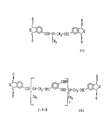
- the polycarboxylic acid component a) in each case was an anhydride mixture prepared by reacting trimellitic anhydride with 1,2-propanediol, thus consisting of trimellitic anhydride and anhydrides of the formulas (1) and (2) (see formula sheet) and as OH- Group-containing component c) each polyester, prepared as described in DE-OS 28 11 913, used.
- trimellitic anhydride 1536 g of trimellitic anhydride (TMSA) were melted in a 4 l reaction vessel with the addition of 80 g of xylene. 2.5 g of sodium tungstophosphoric acid were added and the mixture was heated to 190.degree. 308 g of 1,2-propanediol were then added to the melt and the batch was heated to 200 ° C. in the course of 1 to 1.5 hours. The reaction temperature was raised to 220 ° C and held until the elimination of water was complete. After about 4 hours, the amount of water was about 150 to 160 ml.
- TMSA trimellitic anhydride
- reaction mixture was then cooled to about 180 ° C. and the xylene was distilled off using a water jet vacuum. After cooling, about 1680 g of a solid, yellowish resin were obtained.
- 355 parts of the (39%) aqueous dispersion from 1a) were mixed with 452 parts of water in a reactor equipped with a stirrer, reflux condenser, internal thermometer and metering devices for the monomers and the initiator, and the mixture was stirred at 80 ° C. heated and a solution of 0.5 T ammonium peroxydisulfate in 35 T water was added. 5 minutes after the addition of the initiator, 35 parts of a monomer mixture of 165 parts of methyl methacrylate, 142 parts of n-butyl acrylate and 24 parts of hydroxyethyl acrylate were added and, after a further 15 minutes of prepolymerization, the remaining amount of monomer was metered in over 2 hours.
- Example 1b was repeated with the difference that glycidyl methacrylate was now used instead of hydroxyethyl acrylate. This also resulted in a stable dispersion with a solids content of approximately 40%.
- Example 1b 705 parts of the aqueous (32% strength) dispersions from 3a) and 196 parts of water were introduced into a reactor as in Example 1b). This mixture was heated to 80 ° C. with stirring and a solution of 0.5 T ammonium peroxydisulfate in 35 T water was added. 5 minutes after the addition of the initiator, 35 parts of a monomer mixture of 125 parts of methyl methacrylate, 94 parts of n-butyl acrylate and 17 parts of hydroxymethyl methacrylate were added and the mixture was further processed as described in Example 1b. The result was a stable dispersion with a solids content of approximately 40%.
- Example 3b was repeated with the difference that glycidyl methacrylate instead of hydroxyethyl methacrylate was used.
- the result is a stable dispersion with approximately 40% solids content.
- V3 14 parts of a monomer emulsion composed of 652 parts of water, 21 parts of a 50% strength aqueous solution of an alkylarylpolyglycol ether sulfate sodium salt (( R ) Hostapal BV from Hoechst AG) and 1.75 parts of ammonium peroxydisulfate were added to a reaction vessel such as Example 1b) Dissolved 536 T water and heated to 80 ° C.
- a reaction vessel such as Example 1b
- the mixture was brought to a pH of 8 using about 80 parts of a 25% strength aqueous dimethylaminoethanol solution , 0 - 8.2 set.
- the result was an aqueous dispersion with a finished material content of approximately 50%.
- binder solutions or dispersions of the examples mentioned were diluted with water to a solids content of 25% and tested in this form.
- the pigmented and unpigmented paints according to 5A) and 5B) were tested as follows:
- Body panels were primed using the cataphoretic electrocoating process and baked at 180 ° C. within 20 minutes.
- the primed sheets were then coated with a stoving filler based on a commercially available polyester resin (( R ) Alftalat VAN 1951 from Hoechst AG) and a likewise commercially available butyl etherified melamine resin (( R ) Maprenal MF 590 from Hoechst AG) and again within 20 Hardened for minutes at 160 ° C.
- the pigmented and unpigmented basecoats according to 5A) and 5B) were then applied to the sheets prepared in this way in a dry film thickness of 10 to 15 ⁇ m.
- the lacquer surfaces were coated with a 2K clear lacquer, a mixture of a commercially available OH group-containing acrylate resin (( R ) M acrynal SM 510n from Hoechst AG) and one as well commercially available aliphatic polyisocyanate ( (R) Desmodur N / 75% strength from Bayer AG), coated in a dry film thickness of approx. 35 ⁇ m.
- the coated sheets with a 4-layer paint structure were baked at 135 ° C for 20 minutes.
- the rheology of the paints must be adjustable to ensure that the paints can be applied properly. This does not succeed in cases V1, V2 and V4 with thickeners according to the prior art.
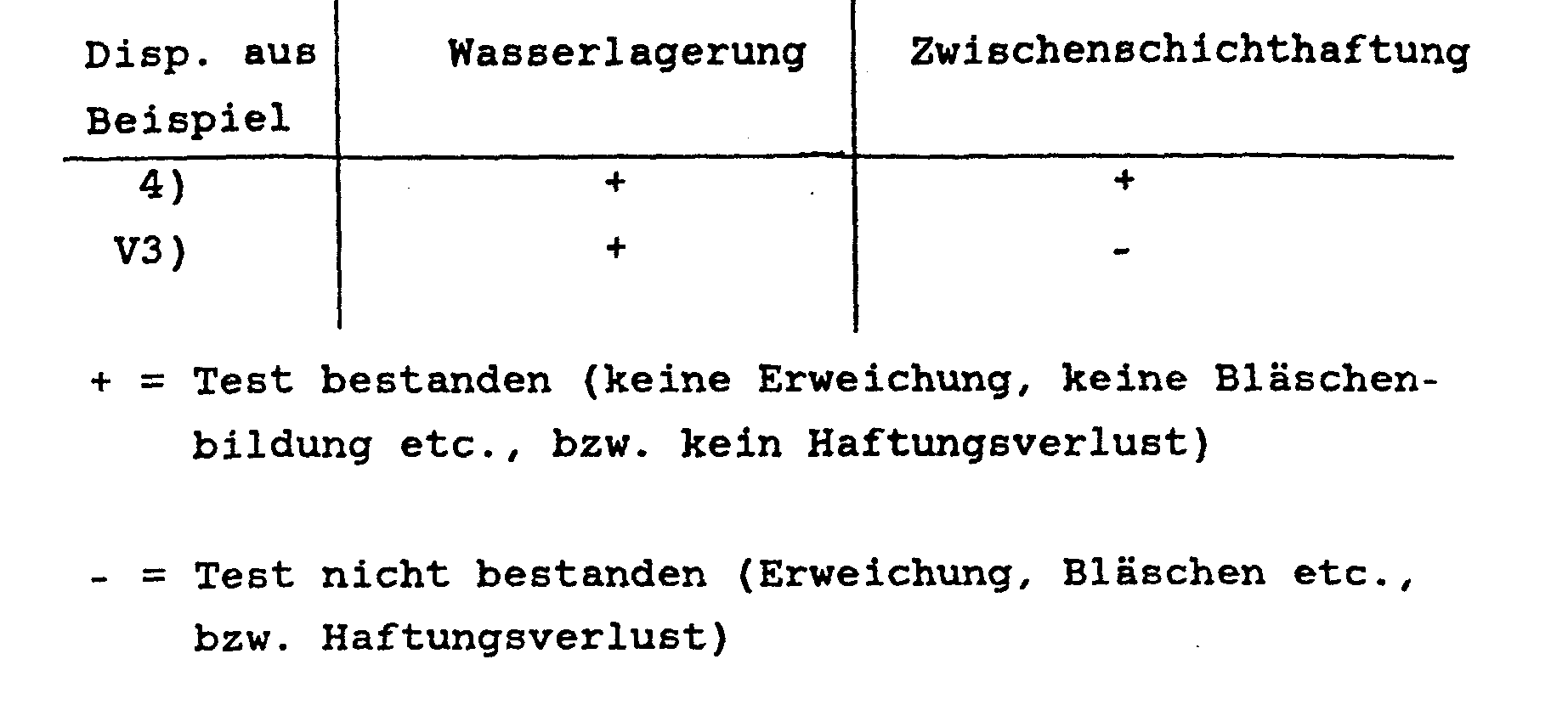
- Test failed softening, bubbles etc. or loss of liability
- Example 4 A The binder dispersions of Example 4 and Comparative Example V3) described above were diluted with water to a solids content of 25% and tested in this form.
- A 304 parts of the binder dispersions of Examples 4) and V3) described under 6) A are mixed with 220 parts of a pigment paste consisting of 600 parts of commercially available titanium dioxide pigment (Kronos ( R ) CL 310 titanium company, Frankfurt), 50 parts of butylglycol and 300 parts of a second , 4% aqueous solution of a commercially available polyacrylate thickener (Viscalex ( R ) HV 30 from Allied Colloids, England) and diluted with water to a solids content of 17%. The uni basecoats are then adjusted to a pH of 7.2 with triethylamine.
- a pigment paste consisting of 600 parts of commercially available titanium dioxide pigment (Kronos ( R ) CL 310 titanium company, Frankfurt), 50 parts of butylglycol and 300 parts of a second , 4% aqueous solution of a commercially available polyacrylate thickener (Viscalex ( R ) HV 30 from Allied Colloids, England) and diluted
Landscapes
- Chemical & Material Sciences (AREA)
- Organic Chemistry (AREA)
- Chemical Kinetics & Catalysis (AREA)
- Polymers & Plastics (AREA)
- Medicinal Chemistry (AREA)
- Health & Medical Sciences (AREA)
- Materials Engineering (AREA)
- Wood Science & Technology (AREA)
- Engineering & Computer Science (AREA)
- Life Sciences & Earth Sciences (AREA)
- Paints Or Removers (AREA)
- Polymerisation Methods In General (AREA)
- Graft Or Block Polymers (AREA)
- Adhesives Or Adhesive Processes (AREA)
- Addition Polymer Or Copolymer, Post-Treatments, Or Chemical Modifications (AREA)
- Compositions Of Macromolecular Compounds (AREA)
Abstract
Description
- Polymerisatdispersionen, Verfahren zu ihrer Herstellung, sowie deren Anwendung als Bindemittel.
- Die Erfindung betrifft wäßrige Dispersionen auf Basis von vernetzbaren Polymerisaten und α,ß-olefinisch ungesättigten Monomeren für die Herstellung von vernetzbaren Beschichtungen auf Oberflächen, ihre Herstellung und ihre Verwendung, insbesondere für Einbrennbeschichtungen und Lacke.
- Hochreaktive Polymerisatdispersionen wie in den DE-Offenlegungsschriften 31 28 025 und 31 28 062 beschrieben, ergeben zwar witterungsbeständige Beschichtungen, insbesondere in Kombination mit reaktiven Harzen wie Melaminharzen. Sie zeigen aber z.B. bei Einsatz in Mehrschichtlackierungen nur unzureichende Haftungseigenschaften auf bzw. zwischen den einzelnen Lackschichten.
- Carboxyfunktionelle selbsthärtende Polymerisate, die zusätzlich Epoxygruppen enthalten, beispielsweise hergestellt entsprechend der DE-Offenlegungsschrift 28 11 913 ergeben in Kombination mit Melaminharzen in "metallic- basecoat"-Rezepturen (nach der DE-Offenlegungsschrift 33 01 729) gut haftende Beschichtungen, die allerdings ungünstige Eigenschaften beispielsweise bezüglich der Lagerung in Wasser aufweisen. Insbesondere gilt dies für den Aufbau von Lacken unter sogenannten Reparaturbedingungen, wobei bei niedrigen Härtungstemperaturen weitere Lackschichten auf bereits lackierte Untergründe aufgebracht werden.
- Grundsätzlich sind aber die genannten Polymerisate nicht ausreichend mit Verdickern rheologisch zu kontrollieren. Im Fall einer Anwendung als Bindemittel ist dies ein ganz entscheidender Nachteil, da die rheologischen Eigenschaften für die verschiedenen Einsatzgebiete gezielt eingestellt werden müssen. So sind die rheologischen Eigenschaften bei den metallic-base-coat-Lacken eine der wichtigsten Eigenschaften überhaupt, da hier die rasche Fixierung der blättchenförmigen Pigmente entscheidend für das metallische Aussehen des aufgebrachten Lackes ist.
- Abmischungen von Polymerisatdispersionen, z.B. etwa der in den bereits genannten DE-Offenlegungsschriften 31 28 025 und 31 28 062 beschriebenen Polymerisatdispersionen mit den oben angeführten selbsthärtenden Polymeren ergeben bei Kombination mit reaktiven Melaminharzen in wäßrigen "metallic-base-coat"-Beschichtungen keine Verbesserung der an sich gewünschten Eigenschaftskombination von Zwischenschichthaftung und Wasserlagerstabilität. Im Gegenteil, es tritt in der Regel eine Kombination aus schlechter Zwischenschichthaftung und ungenügender Wasserlagerstabilität auf. Diese Mischung ist außerdem mit üblichen Verdickern auf Basis Polyacrylaten, Polyethylenoxid, Polyvinylalkoholen, Celluloseäthern und anderen nicht ausreichend verdickbar.
- Als selbsthärtende carboxyfunktionelle Polymerisate werden solche bezeichnet, die im Molekül jeweils mindestens eine Carboxygruppe und eine Epoxigruppe enthalten, deren Carboxylgruppe(n) aber mit salzbildenden Substanzen neutralisiert ist (sind), wodurch eine vorzeitige Reaktion mit den vorhandenen Epoxigruppen verhindert wird. Sie liegen im allgemeinen als wäßrige Systeme vor.
- Die Aufgabe bestand also erfindungsgemäß darin, wäßrige Bindemitteldispersionen zu entwickeln, die in wäßrigen Lacksystemen neben ausgezeichneten Haftungseigenschaften auf verschiedenen Substraten bzw. bei Mehrschichtlackaufbauten zwischen den einzelnen Schichten auch eine sehr gute Wasserlagerstabilität, insbesondere unter sogenannten Reparaturbedingungen, aufweisen und rheologisch durch Verdicker ausreichend kontrollierbar sind.
- Gegenstand der Erfindung sind daher stabile wäßrige Polymerisatdispersionen auf Basis von A) 1 bis 99 Gew.- % eines carboxyfunktionellen Polymerisats, das zusätzlich Epoxygruppen enthält, B) 1 bis 99 Gew.-% eines Polymerisates aus mindestens einem a,ß-olefinisch ungesättigten Monomeren, wobei das Polymerisat B) in Gegenwart des Polymerisats A) hergestellt worden ist, C) 0 bis 20 Gew.-% anionischer oder nicht-ionischer Emulgatoren oder eines Gemisches von beiden oder Schutzkolloiden, wobei sich die Mengenangaben auf den Festkörperanteil der Komponenten A) bis C) beziehen, sowie gegebenenfalls weiteren üblichen Zusätzen, wobei die Summe aller Komponenten stets 100 % ist.
- Die Erfindung betrifft weiterhin ein Verfahren zur Herstellung dieser Polymerisatdispersionen, dadurch gekennzeichnet, daß man in einem wäßrigen System B) 1 bis 99 Gew.-% mindestens eines α,ß-olefinisch ungesättigten Monomeren in Gegenwart von A) 1 bis 99 Gew.-% eines carboxyfunktionellen Polymerisats, das zusätzlich Epoxygruppen enthält und von C) 0 bis 20 Gew.-% anionischer oder nicht-ionischer Emulgatoren oder eines Gemisches von beiden oder Schutzkolloiden, wobei sich die Mengenangaben auf den Festkörperanteil der Komponenten A) bis C) beziehen, sowie in Gegenwart gegebenenfalls weiterer Zusätze, bei einer Temperatur zwischen 0 und 150°C polymerisiert.
- Wäßrige Systeme können dabei echte oder kolloidale Lösungen und/oder Dispersionen sein.
- Es ist als überraschend anzusehen, daß es unter Einsatz beispielsweise der carboxyfunktionellen Polymerisate nach der DE-Offenlegungsschrift 28 11 913 möglich ist, wäßrige Bindemitteldispersionen herzustellen und daraus einen "metallic-base-coat"-Lack zu formulieren, der rheologisch gut kontrollierbar ist und der nach dem Auftrag eine gute Zwischenschichthaftung bei ausgezeichneter Wasserlagerstabilität aufweist.
- Durch Wahl geeigneter Ausgangssubstanzen ist ein Einstellen von Polymerisateigenschaften innerhalb weiter Grenzen möglich. Beispielsweise können durch Polymerisation nicht vernetzend wirkender Vinylmonomerer in der wäßrigen Dispersion oder Lösung eines unvernetzten selbsthärtenden carboxyfunktionellen Polymeren wasserlösliche bzw. in Wasser dispergierfähige Polymerisate hergestellt werden. Dabei können beispielsweise die hydrophilen oder auch die hydrophoben Eigenschaften und die Härte bzw. die Flexibilität durch geeignete Wahl der Komponenten A) und B) gezielt eingestellt werden. Weiterhin können durch den Einbau reaktiver Vinylmonomerer zunächst in Wasser dispergierfähige Polymerisate hergestellt werden, die dann bevorzugt nach dem Aufbringen auf ein Substrat über eine entsprechende Nachbehandlung in den vernetzten Zustand überführt werden.
- Geeignete Polymere der Komponente A) sind solche, wie sie beispielsweise in der DE-Offenlegungsschriften 2.811.913 und 3.301.729 beschrieben sind. Auf diese Literaturstellen einschließlich der darin offenbarten bevorzugten Ausführungsformem wird hiermit Bezug genommen. Die carboxyfunktionellen Polymeren werden hiernach durch Umsetzung von a) halogenfreien Polycarbonsäureeinheiten, b) salzbildenden Substanzen der Gruppe Alkali, Erdalkali und quartäre Ammoniumsalze, organische Basen und/oder Ammoniak, cl) OH-Gruppen enthaltenden Polymeren mit einer OH-Zahl von 20 bis 300, vorzugsweise 40 bis 200 und/oder c2) Epoxidverbindungen und anschließender Lösung und/oder Dispergierung in Wasser hergestellt. In den Polymeren sind mindestens 3 der 4 vorstehend angeführten Einheiten enthalten.
- Das Molekulargewicht derartiger Verbindungen A) liegt im Gewichtsmittel Jf zweckmäßigerweise bei 2000 bis 100 000, w vorzugsweise 6000 bis 50 000 (Gelchromatographie, Polystyrol-Standard). Ihre Säurezahl in Wasser beträgt im allgemeinen 1 bis 200, vorzugsweise 5 bis 150 (bezogen auf 100 %iges Harz). Die Jodzahl liegt zumeist unterhalb von 50, vorzugsweise unterhalb von 20 und besonders bevorzugt unterhalb von 5.
- Bevorzugt handelt es sich bei den Ausgangsstoffen a) bis c2) zur Herstellung der Komponente A, um folgende Verbindungen:
- a) ein Trimellithsäure-Einheiten enthaltendes Polycarbonsäureanhydridgemisch entsprechend den Formeln (1) und (2) des anliegenden Formelblattes sowie den Formeln (II) bis (V) des Formelblattes der DE-Offenlegungsschrift 3 301 729, das sich z.B. durch Umsetzung von Trimellithsäureanhydrid mit den entsprechenden zwei-und/oder höherwertigen Alkoholen in üblicher Weise herstellen läßt. Die Säurezahl (in Wasser) dieser Verbindungen (a) liegt zumeist zwischen 10 und 1000, vorzugsweise zwischen 100 und 800;
- b) organische Basen, wie aliphatische sekundäre und/oder tertiäre Amine, beispielsweise Diisopropanolamin, sowie Trimethyl,- Triäthyl- und Tripropylamin. Auch können gemischt-substituierte Basen, z.B. N,N-Dimethylcyclohexylamin, N-Methyl-morpholin sowie hydroxylgruppenhaltige Basen, z.B. N,N-Dimethyl- und N,N-Diäthylaminoäthanol verwendet werden. Die verwendete Basenmenge beträgt im allgemeinen 50 bis 120 %, vorzugsweise 55 bis 100 %, bezogen auf die zur Neutralisation der der Komponente A, vorhandenen freien Carboxylgruppen;
- cl) Polyester mit freien OH-Gruppen. Sie können aus Polycarbonsäuren wie Phthal-, Isophthal-, Terephthal-, Trimellith-, Pyromellith-, Malein-, Fumar-, Endomethylentetrahydrophthal-, Hexahydrophthalsäure, Bernstein-, Adipin-, Kork-, Azelain-, Sebacinsäure, alkylsubstituierten Derivaten dieser Säuren sowie deren möglichen Anhydriden hergestellt werden. Geeignete Alkoholkomponenten der Polyester sind die auf diesem Gebiet bekannten aliphatischen und/oder cycloaliphatischen Polyole mit 2 bis 4 OH-Gruppen pro Molekül, wie Äthylenglykol, die Propandiole, Butandiole, Pentandiole, Neopentylglykol, Hexandiole, Diäthylenglykol, Glycerin, Trimethyloläthan, Trimethylolpropan, Pentaerythrit und Dipentaerythrit. Die genannten Säuren und Alkohole können teilweise durch Monocarbonsäuren bzw. einwertige Alkohole in an sich bekannter Weise ersetzt sein. Die Komponenten sowie die Polyester können jeweils einzeln oder im Gemisch eingesetzt werden. Weiterhin geeignet sind Polymerisationsprodukte, die z.B. durch Copolymerisation von olefinisch ungesättigten monomeren Verbindungen, von denen mindestens eine auch Hydroxylgruppen enthalten muß, hergestellt werden. Beispiele für derartige Verbindungen sind polymerisierbare Ester organischer Säuren mit 2 - 20 C-Atomen wie Vinylester, z.B. Vinylacetat, Vinylpropionat, Vinylbutyrat, Vinylisobutyrat, Vinylbenzoat, Ester der Acryl- und Methacrylsäure mit einwertigen Alkoholen mit 1 bis 10 C-Atomen wie Methyl-, Äthyl-, die verschiedenen Propyl-, Butyl-, Hexyl- sowie 2-Äthylhexylacrylate und -methacrylate, die Dialkylester der Malein- und Fumarsäure wie Dimethyl-, Diäthyl- und Diallylmaleat bzw. -fumarat. Mischpolymerisierbare äthylenisch ungesättigte hydroxylgruppenhaltige Monomere sind z.B. Hydroxyalkylacrylate und -methacrylate wie 2-Hydroxyäthyl-, 2-Hydroxypropyl-, 3-Hydroxypropyl- und 4-Hydroxybutylacrylat oder -methacrylat. Es können auch Mischungen von den genannten Estern eingesetzt werden. Geeignet sind ferner äthylenisch ungesättigte monolefinische Kohlenwasserstoffe wie Styrol, a-Methlstyrol, Vinyltoluol.
- Die Verbindungen (cl) besitzen bevorzugt OH-Zahlen im Bereich von 50 bis 130.
- Das Festkörperverhältnis von Polycarbonsäureanhydridgemisch (a) zu (cl) liegt im allgemeinen zwischen 50:50 und 10:90, vorzugsweise 40:60 bis 15:85;
- c2) epoxydierte Öle, z.B. solche auf Basis von Soja-, Lein-, Tall- und/oder Ricinenöl mit Epoxyzahlen von 1 bis 50, vorzugsweise von 2 bis 25 und insbesondere 3 bis 15. Die Epoxydgruppen der Komponente c2) reagieren unter Esterbildung mit den COOH-Gruppen der aus a) und cl) erhaltenen Reaktionsgemische. Das Verhältnis des freien Carboxylgruppenäquivalents dieses Reaktionsgemisches zu dem Epoxydgruppenäquivalent von c2) beträgt im allgemeinen 3 : 1 bis 1 : 3, vorzugsweise 1,25 : 1 bis 1 : 1,25.
- Als Komponente B) kommen aß-olefinisch ungesättigte Monomere, und zwar praktisch alle radikalisch polymerisierbaren Monomeren in Frage, wobei jedoch für Copolymerisationen die üblichen Einschränkungen gelten, die durch das Q- und e-Schema nach Alfrey und Price bzw. durch die Copolymerisationsparameter vorgegeben sind (vgl. z.B. Brandrup, Immergut, Polymer Handbook, 2nd ed. (1975) John Wiley & Sohn, New York).
- Der Einsatz hydrophiler Monomerer für die Komponente B) ist für die Durchführung der erfindungsgemäßen Polymerisationen möglich, aber nicht generell notwendig.
- Als geeignete a,0-olefinisch ungesättigte Monomere (B) seien hier beispielsweise genannt:
- B1) Acrylat- und Methacrylat (=(Meth)acrylat)-Monomere der allgemeinen Formel

- R 1 = H, Methyl;


- = CN;
- = glycidylgruppenhaltiger Acylrest mit vorzugsweise 1 bis 6 C-Atomen, insbesondere der

- Vertreter von B1) sind beispielsweise (Meth)acrylsäure, Methyl(meth)acrylat, Ethyl(meth)acrylat, Propyl(meth)-acrylat, die verschiedenen Butyl(meth)acrylate, 2-Ethylhexyl(meth)acrylat, Ester von (Meth)acrylsäure mit mehrwertigen Alkoholen wie Ethylglykol, Propylenglykol-1,2 oder Propylenglykol-1,3, Butylenglykol-1,4, Trimethylolpropan, Glycerin, wie Hydroxyethyl- oder Hydroxypropyl(meth)acrylat; Umsetzungsprodukte von (Meth)acrylsäure mit endständigen Epoxiden, wie Hexenoxid oder Dodecanoxid oder mit Glycidylestern wie ®Cardura E (Glycidylester der "Versaticsäure"); Aminoalkylverbindungen, wie Methylaminoethyl (meth) acrylat und tert.-Butylaminoethyl(meth)acrylat; N-Alkylol-(meth)acrylamide wie N-Methylol(meth)acrylamid sowie entsprechende Ether, wie N-Methylol(meth)acrylamid- methyl-, -ethyl- oder -butylether; (Meth)acrylnitril; Glycidyl(meth)acrylat;
- B2) Dicarbonsäuren, wie Maleinsäure, Fumarsäure, Itaconsäure, Sorbinsäure oder deren Mono- und Diester mit OR2 oder (R4O)rR5 als Esterrest, wobei R2, R4, R5 und r die obige Bedeutung haben; ferner weitere Derivate wie vorstehend unter B1) beschrieben (Amide, N-Alkylolamide, Nitrile etc.);
- B3) Vinylester von aliphatischen Carbonsäuren mit 2 bis 20 C-Atomen, vorzugsweise 2 bis 12 C-Atomen, wie Vinylacetat, Vinylpropionat, Vinylester verzweigter (Cg-C12)-Carbonsäuren, wie Versaticsäurevinylester, Linolsäurevinylester;
- B4) Vinylverbindungen (andere als B3), wie Vinylether, beispielsweise Methyl-, Ethylvinylether oder Alkylvinylether mit 3 bis 6 C-Atomen; Allylether wie Allylglycidylether; N-Vinylpyrrolidon;
- B5) vinylaromatische Monomere wie Styrol, a-Methylstyrol, Vinyltoluol, Vinylpyridin;
- B6) halogenhaltige, insbesondere chlor- oder fluorhaltige Monomere, wie Vinylchlorid, Vinylidenchlorid, Hexafluorpropen, Perfluorhexylethylen, 2-Hydroperfluorethylallylether, 2-Hydroperfluorpropylallylether;
- B7) Monomere mit Isocyanatgruppen, wie Isocyanatoethyl-(meth)acrylat sowie entsprechende Derivate mit verkappten Isocyanatgruppen; weiterhin Vinylurethane, erhalten durch Umsatz von Vinylisocyanat mit üblichen Verkappungsmitteln; Beispiele für diese letzte Gruppe sind: N-Vinylcarbaminsäure-tert.-butylester, N-Vinylcarbaminsäure-cyclohexylester, N-Vinylcarbaminsäure- ß-Caprolactam-Addukt.
- B8) Monomere vom Typ mehrfach, vorzugsweise zwei bis dreifach ethylenisch ungesättigter Verbindungen wie Divinylbenzol, Ethandioldi(meth)acrylat, Propandioldi-(meth)acrylat, Butandioldi(meth)acrylat, Hexandioldi-(meth)acrylat, Glycerintri(meth)acrylat, Pentaerythri- toltri(meth)acrylat und Diallylphthalat. Diese mehrfach ethylenisch ungesättigten Monomeren werden nur zusammen mit mindestens einem Monomeren B1) bis B7) eingesetzt; ihre Menge beträgt im allgemeinen 0,01 bis 20 Gew.-%, bezogen auf die Gesamtmenge der Monomeren B). Durch den Zusatz dieser als Vernetzer wirkenden Monomeren sind Dispersionen mit teilweise oder vollständig vernetzten Partikeln herstellbar.
- Innerhalb der obigen Gruppen B1) bis B8) können auch Gemische der einzelnen Vertreter eingesetzt werden. Bevorzugt ist erfindungsgemäß der Einsatz, der a,ß-olefinisch ungesättigten Verbindungen der Gruppe B1).
- Um Vernetzungsreaktionen im Lack bei der Filmbildung durchführen zu können, ist es zweckmäßig, daß sowohl im Falle der Selbstvernetzung als auch im Falle der Fremdvernetzung Monomereinheiten mit funktionellen Gruppen in dem erfindungsgemäßen Bindemittel vorhanden sind. Unter Monomeren mit funktionellen Gruppen sind solche zu verstehen, die neben ihrer olefinischen Doppelbindung, mit der sie bei der Bindemittelherstellung in das entstehende Copolymerisat einpolymerisiert werden, zusätzlich noch chemische Gruppierungen tragen, die zu einem späteren Zeitpunkt, bevorzugt nach dem Aufbringen des fertigen Lackes unter Einwirkung von thermischer oder Strahlungsenergie und/oder Katalysatoren, mit chemischen Gruppierungen der gleichen oder einer anderen Art umgesetzt werden können, in der Weise, daß eine Vernetzung erfolgt. Beispiele für einsetzbare chemische Gruppierungen, die im aufgebrachten Lack zu Vernetzungen führen können, sind Carbonsäure-, Sulfosäure-, Hydroxy-, Amino-, Amido-, Keto-, Aldehyd-, Lactam-, Lacton-, Isocyanat- und Epoxygruppen. Copolymerisationsfähige Monomere, die derartige funktionelle Gruppierungen tragen, sind bekannt. Ein Teil dieser vernetzend wirkenden Gruppierungen ist bereits in der-Komponente A) vorhanden (Carboxyl-, Hydroxyl- und Epoxidgruppen). Um eine möglichst hohe Vernetzungsdichte zu erreichen, werden auch im Rahmen der Komponente B) zweckmäßigerweise Comonomere eingesetzt, die entsprechend reaktive Gruppen enthalten. Beispiele hierfür sind Hydroxalkyl(meth)acrylate, N-alkylol(meth)acrylate, Glycidyl(meth)acrylate, Isocyanatoalkyl(meth)acrylate. Die Menge dieser Comonomeren innerhalb der Komponente B) beträgt im allgemeinen 0 bis 60 Gew.-%, vorzugsweise 0,5 bis 40 Gew.-%.
- Die Mengenverhältnisse der Komponenten A) und B) können in weiten Grenzen schwanken. Vorzugsweise werden 5 bis 95 Gew.-%, insbesondere 10 bis 69 Gew.-% und speziell 25 bis 45 Gew.-% der Komponente A) mit 95 bis 5 Gew.-%, insbesondere 90 bis 31 Gew.-% und speziell 75 bis 55 Gew.-% der Monomeren B) umgesetzt, wobei die Mengenverhältnisse auf den Gesamtfeststoffgehalt der Komponenten A) und B) bezogen sind. Die selbsthärtende Komponente A) gelangt dabei im allgemeinen in Form eines 5 bis 65 Gew.-%igen wäßrigen Systems zum Einsatz.
- Bevorzugte Dispersionscopolymerisate können als Monomereinheiten, bezogen auf die Menge der Komponente B) bis zu 100 Gew.-% Methylmethacrylat und/oder n-Butylacrylat, 0 bis 20 Gew.-% Hydroxyethylmethacrylat, 0 bis 20 Gew.-% Glycidylmethacrylat und 0 bis 20 Gew.-% Acrylsäure und/oder Methacrylsäure enthalten, wobei die Summe der Monomereinheiten stets 100 % ist. Besonders bevorzugt ist ein Mischungsverhältnis, das 15 bis 80 Gew.-% Methylmethacrylat, 15 bis 50 Gew.-% n-Butylacrylat, 0 bis 15 Gew.-% Hydroxyethylmethacrylat, 0 bis 15 Gew.-% Glycidylmethacrylat und 0 bis 5 Gew.-% Acrylsäure und/oder Methacrylsäure als Monomereinheiten enthält.
- Das erfindungsgemäße Polymerisationsverfahren wird vorzugsweise als Emulsionspolymerisation in wäßrigem Medium bei Temperaturen im Bereich zwischen 0 und 150, vorzugsweise 20 und 100, insbesondere 40 und 90°C durchgeführt. Hierbei wird das carboxyfunktionelle Polymere A) mit den Vinylmonomeren B) vorzugsweise unter Zusatz eines Polymerisationsinitiators und gegebenenfalls weiterer üblicher Zusätze wie Emulgatoren und/oder Schutzkolloiden sowie Molekulargewichtsreglern polymerisiert. Das wäßrige Medium des Polymerisationsansatzes kann aus den wäßrigen Systemen der Komponente A) stammen, im allgemeinen wird jedoch noch Wasser dem Ansatz zugegeben, um die besten Bedingungen für die Emulsionspolymerisation zu erreichen.
- Die Polymerisation kann in der Weise durchgeführt werden, indem das carboxyfunktionelle Polymere A) als wäßriges System, dem die gesamte Menge des bei der Polymerisation anwesenden Wassers zugegeben worden ist, zusammen mit einem Teil eines Initiators und gegebenenfalls einem Emulgator und einem Molekulargewichtsregler vorgelegt und auf die gewünschte Polymerisationstemperatur vorgeheizt wird, worauf das Monomerengemisch B) sowie der Rest des Initiators langsam zugegeben wird. Es ist jedoch auch möglich, jeweils ein Teil des Wassers, des carboxyfunktionellen Polymeren A) und gegebenenfalls des Emulgators vorzulegen und aus dem verbleibenden Wasser, den verbleibenden Anteilen der Komponente A), den Vinylmonomeren B) und gegebenenfalls einem Emulgator eine Voremulsion herzustellen, die dann in die auf Polymerisationstemperatur vorgeheizte und mit einem Polymerisationsinitiator versehene Vorlage langsam zugegeben wird. Die Zulaufzeit beträgt im allgemeinen 30 bis 180 Minuten. Nach Beendigung des Zulaufs des Monomerengemisches wird der gesamte Ansatz noch für 1 bis 3 Stunden bei 60 bis 90°C, vorzugsweise bei 70 bis 85°C nachgerührt, wobei gegebenenfalls weiterer Initiator zugesetzt wird, um einen vollständigen Umsatz der Vinylmonomeren zu erzielen. Der Feststoffanteil in den erhaltenen Polymerisatdispersionen beträgt im allgemeinen 5 bis 75, vorzugsweise 10 bis 65 Gewichtsprozent. Der Wert für das mittlere Molekulargewicht M des erhaltenen Polymerisats w beträgt im allgemeinen 50 000 bis 10 Millionen, vorzugsweise 75 000 bis 1 Million, bezogen auf Polystyrol Standard-Gelchromatogramm.
- Als radikalbildende Initiatoren kommen beispielsweise Percarbonate, Perester wie tert.-Butylperpivalat, Peroctoat, Benzoylperoxyd, o-Methoxybenzoylperoxyd, Dichlorbenzylperoxyd, Azodiisobuttersäuredinitril, insbesondere aber Peroxyverbindungen oder aliphatische Azoverbindungen in Frage. Der Initiator kann wasserlöslich und/oder monomerlöslich sein. Bevorzugt sind z.B. Natrium-, Kalium-, Ammoniumperoxydisulfat bzw. Natrium-, Kalium-, Ammoniumperoxydisulfat-Redoxysteme mit Natrim-, Kalium-, Ammoniumsulfiden, -sulfiten oder anderen Reduktionsmitteln. Die Menge des Polymerisationsinitiators beträgt im allgemeinen 0,01 bis 10, vorzugsweise 0,02 bis 5, insbesondere 0,05 bis 3 Gew.-%, bezogen auf die Gesamtmenge der Vinylmonomeren B).
- Die Polymerisation kann in Gegenwart oder Abwesenheit eines Emulgators und/oder eines Schutzkolloids durchgeführt werden. Dabei kommen gegebenenfalls anionische und/oder nicht-ionische Emulgatoren zum Einsatz. Beispiele für anionische Emulgatoren sind die Alkali- und Ammoniumsalze von Schwefelsäurehalbestern von Alkylphenolen oder den obengenannten Alkoholen oder auch Alkyl- oder Arylsulfonat, vorzugsweise die Alkalisalze des Schwefelsäurehalbesters eines mit 4 bis 5 Mol Äthylenoxyd umgesetzten Nonylphenols, Natriumlaurylsulfat, Natriumlauryläthoxylatsulfat und sekundäre Natriumalkansulfonate, deren Kohlenstoffkette 8 bis 12 C-Atome enthält.
- Ferner kann zur Erhöhung der Stabilität der wäßrigen Copolymerisat-Dispersion zusätzlich ein nicht-ionischer Emulgator vom Typ eines äthoxylierten Alkylphenols oder Fettalkohols zum Beispiel Nonylphenol mit 4 bis 30 Mol Äthylenoxyd in Mischung mit dem anionischen Emulgator eingesetzt werden.
- Die Menge des anionischen Emulgators beträgt 0 bis 15 Gew.-%, bezogen auf die Vinylmonomeren B).
- Weiterhin kann als Emulgator ein "Fluortensid" verwendet werden, wobei unter dem Begriff "Fluortensid" oberflächenaktive Verbindungen verstanden werden, die als hydrophobe Bestandteile Perfluoralkylreste mit 2 bis 20 C-Atomen oder Perfluoraralkylreste im Molekül enthalten z.B. Perfluoralkylsulfonsäuren, Perfluoraralkylsulfonsäuren, langkettige Perfluoralkylcarbonsäuren, Perfluoralkanphosphonsäuren -phosphinsäuren, mit jeweils 1 bis 15 C-Atomen im Alkanrest, die Salze dieser Säuren, Perfluoralkylsulfate und Perfluoraralkylsulfat.
- Durch den Einsatz von Molekulargewichtsreglern wie Mercaptane, halogenhaltige Verbindungen und andere radikal- übertragene Substanzen kann das Molekulargewicht der Polymerisate in bekannter Weise herabgesetzt werden. Bevorzugt sind Butylmercatan, Octylmercaptan, Dodecylmercaptan, Tetrakismercaptoacetylpentaerythrit, Chloroform, Bromoform, Trichloräthylen, Trichlorbrommethan, Tetrachlorkohlenstoff und Toluol.
- Die erfindungsgemäßen Polymerisatdispersionen sind selbstvernetzend. Daneben besteht auch noch die Möglichkeit der zusätzlichen Fremdvernetzung. Hierzu wird die erfindungsgemäße Bindemitteldispersion, die eine oder mehrere der genannten funktionellen Monomereinheiten trägt, bei der Lackformulierung mit einer weiteren niedermolekularen, oligomeren und/oder polymeren Verbindung vermischt, die ebenfalls funktionelle Gruppierungen trägt.
- Die Bindemittelvernetzung erfolgt auch bei der Fremdvernetzung, vorzugsweise beim Einbrennen, und zwar bevorzugt durch Reaktion zwischen der erfindungsgemäßen Polymerisatdispersion und der zugesetzten Fremdkomponente. Dabei kann nicht immer ausgeschlossen werden, daß beide Komponenten auch noch mit sich selbst Reaktionen und/oder Vernetzungen eingehen können.
- Vernetzende Fremdkomponenten sind beispielsweise Aminoplastharze, insbesondere Melamin-Formaldehyd-Harze, Phenolplastharze, Acrylat-Harze, Isocyanate oder verkappte Isocyanat-Harze, d.h. Isocyanat-Harze mit blockierter Isocyanatgruppe, die mit oder ohne Einwirkung von Katalysatoren, wie Malein-, Zitronen-, Phosphor-, Alkylphosphorsäure, p-Toluolsulfonsäure und/oder Naphthalindisulfonsäure, in Gegenwart von Bindemittelcopolymerisaten, die bevorzugt Hydroxyl-, Amid- oder Carboxylgruppen tragen, beim Einbrennen hochvernetzte Beschichtungen ergeben können. Besonders bevorzugt werden Acrylharze und/oder methylverätherte Melaminharze als fremdvernetzende Komponenten eingesetzt.
- Aufgrund ihres chemischen Aufbaus sind die erfindungsgemäßen Polymerisatdispersionen für eine vielseitige Anwendung geeignet, z.B. zur Herstellung von bei Raumtemperatur oder bei erhöhter Temperatur härtenden Beschichtungssystemen. Sie sind nicht nur fremdvernetzbar, sondern auch kombinierbar und im allgemeinen verträglich mit anderen wäßrigen Kunststoffdispersionen, z.B. Thermoplasten auf Basis von Polyvinylacetat, -vinylchlorid, Acryl- und/oder Methacryl-Polymerisaten, Polyvinyläther, -chloropren, -acrylnitril und Äthylen-Butadien-Styrol-Copolymerisaten. Besonders verträglich sind sie mit Dispersionen solcher Copolymerisate, die durch Copolymerisation der vorstehend genannten Monomeren mit funktionellen Monomeren, wie Hydroxyalkylacrylaten bzw. -methacrylaten, stärker polar gemacht wurden. Gegebenenfalls werden die Dispersionen zusammen mit Dispersionshilfsmitteln eingesetzt.
- Die erfindungsgemäßen Polymerdispersionen sind auch kombinierbar mit verdickend wirkenden Substanzen auf Basis von Polyacrylaten, Hydroxyethylcellulosen, Polyvinylalkoholen u.a., so daß jede gewünschte Einstellung der rheologischen Eigenschaften möglich ist. Auch sogenannte Reaktivverdünner können eingesetzt werden.
- Mit den erfindungsgemäßen Polymerdispersionen, die eine ausgezeichnete Stabilität gegenüber UV-Strahlung aufweisen, können unpigmentierte, pigmentierte oder mit anderen Zusatzstoffen versehene Beschichtungssysteme, wie z.B. Lacke, hergestellt werden, die gegebenenfalls auch unter der Einwirkung von Katalysatoren bereits bei Raumtemperatur genügend rasch härten und dann Überzüge mit ausgezeichneten mechanischen Eigenschaften liefern. Man erhält dabei Filme mit hoher mechanischer Festigkeit und hoher chemischer Beständigkeit. Übliche Lackzusatzstoffe sind beispielsweise in der DE-Offenlegungsschrift 3.301.729 beschrieben.
- Die erfindungsgemäßen Polymerdispersionen lassen sich auf die verschiedensten Unterlagen aufbringen, sofern diese den Härtungstemperaturen des Überzugs standhalten. Geeignete Unterlagen sind z.B. Keramik, Holz, Glas, Beton, Kunststoffe, vorzugsweise Metall, wie Eisen, Zinn, Titan, Kupfer, Aluminium, Stahl, Messing, Bronze, Magnesium oder dergleichen, wobei die Unterlagen gegebenenfalls noch durch geeignete mechanische und/oder chemische Vorbehandlung haftfreudiger bzw. korrosionsbeständiger gemacht werden können. Jedoch haften sie ausgezeichnet auf den verschiedensten Metallunterlagen ohne haftvermittelnde Grundierung bzw. Zwischenschicht. Die gute Haftung dieser Lackierungen entspricht den Werten GT OA bis GT 1A nach den Prüfvorschriften gemäß DIN 53 151. Außerdem lassen sich diese Überzüge, die je nach Wunsch glänzend oder matt eingestellt werden können, sehr gut verformen, weisen hohe Wetterbeständigkeit und ausgezeichnete chemische Beständigkeit auf.
- Die erfindungsgemäßen Dispersionen sind für die Herstellung von korrosionsschützenden Überzügen und/oder Zwischenbeschichtungen für die verschiedensten Anwendungsgebiete geeignet, insbesondere als resistente Lackierungen und Mattlackierungen, sowie metallic Lackkieungen. Die Schichtdicken der einzelnen Lacküberzüge betragen beim Basislack im allgemeinen 10 - 40, vorzugsweise 15 - 25 µm, während die Deckschicht im allgemeinen Stärken von 20 - 70, vorzugsweise 30 - 50 µm aufweist.
- Beispielsweise wird bei der Herstellung von Uni- oder Metallic-Lackschichten die Bindemittelmischung auf eine vorbereitete Fläche aufgebracht, z.B. auf eine mit einem Füller versehene Automobilkarosserie aufgespritzt, an der Luft-getrocknet, und anschließend mit einem Decklack überzogen. Beide Schichten werden dann in einem Arbeitsgang, z.B. während 10 - 40 min bei 100 - 180°C eingebrannt, wobei die Temperatur in Relation zu der Einbrennzeit steht.
- Weiter eignen sich die erfindungsgemäßen Dispersionen für die Beschichtung und Auskleidung von Gegenständen, die mit Treibstoffen und Lösungsmitteln in Berührung kommen, ausserdem für Schutzüberzüge gegen atmosphärische Einflüsse, wie Straßenmarkierungen, Bauteile für elektrotechnische Zwecke bzw. deren Elemente, insbesondere für elektrische Leiter, sowie für Beschichtungen von thermisch beanspruchten Gegenständen.
- Aufgrund ihrer günstigen Eigenschaften sind die erfindungsgemäßen Dispersionen auch hervorragend für die Einschichtlackierung geeignet. Je nach Wahl der Komponenten können mit den erfindungsgemäßen Bindemitteln bechichtete Bleche nachträglich durch Tiefziehen, Abkanten, Profilieren, Prägen oder dergleichen ohne nennenswerte Beeinträchtigung der übrigen günstigen Eigenschaften verformt werden. Die haftende Überzugsschicht kann unverändert bleiben, sie kann aber auch als Zwischenschicht, also als Unterlage für weitere Überzüge dienen, die wiederum aus demselben oder einem anderen üblichen Beschichtungsmaterial bestehen können.
- Wegen ihrer guten Verdünnbarkeit und ihrer anderen günstigen Eigenschaften eignen sich die erfindungsgemäßen Dispersionen auch zur Verwendung für die Elektrotauchlackierung.
- Eine weitere Möglichkeit ist ihre Verwendung für wasserverdünnbare Klebstoffe. Auch als Bindemittel für textile, organische und/oder anorganische Materialien sind sie einsetzbar. Sie sind auch zur Verwendung für härtbare Formmassen, Gießharze, Kitte, zellige oder poröse Stoffe, wie Schaumstoffe und als Isolierlack geeignet.
- In den folgenden Vorschriften und Beispielen bedeuten jeweils, wenn nicht anders angegeben, T Gewichtsteile und % Gewichtsprozent. Wasser bedeutet stets entionisiertes Wasser, SZ Säurezahl, OHZ OH-Zahl. Wenn nicht anders angegeben, wurden als Polycarbonsäure-Komponente a) jeweils Anhydridgemische, hergestellt durch Umsetzung von Trimellitsäureanhydrid mit Propandiol-1,2, bestehend somit aus Trimellitsäureanhydrid und Anhydriden der Formeln (1) und (2) (siehe Formelblatt) und als OH-Gruppen enthaltende Komponente c ) jeweils Polyester, hergestellt, wie in der DE-OS 28 11 913 beschrieben, eingesetzt.
- In einem 4 1 Reaktionsgefäß wurden 1536 g Trimellithsäureanhydrid (TMSA) unter Zugabe von 80 g Xylol aufgeschmolzen. Es wurden 2,5 g Natrium-Wolframatophosphorsäure zugesetzt und der Ansatz auf 190°C erhitzt. Danach wurden 308 g Propandiol-1,2 in die Schmelze gegeben und der Ansatz innerhalb von 1 bis 1,5 Stunden auf 200°C erwärmt. Die Reaktionstemperatur wurde auf 220°C erhöht und so lange gehalten, bis die WasserAbspaltung beendet war. Nach ca. 4 h betrug die Wassermenge ca. 150 bis 160 ml.
- Das Reaktionsgemisch wurde dann auf ca. 180°C abgekühlt und das Xylol mittels Wasserstrahlvakuum abdestilliert. Nach Abkühlen wurden ca. 1680 g eines festen, gelblichen Harzes erhalten.
- Folgende Kennzahlen wurden gefunden:

- Die GPC-Analyse lieferte folgende Zusammensetzung:

- In eine Lösung von 127 T eines Polyesters auf Basis Terephthalsäure, Isophthalsäure, Trimellithsäure, Ethylenglykol, Neopentylglykol und Hexandiol (OHZ = 107) in 70 T Methyläthylketon wurden 100 T des vorstehend beschriebenen Anhydrid-Gemisches, das in 30 T Aceton bei 50°C homogenisiert worden war, innerhalb einer Stunde zugetropft. Bei 90°C wurde so lange gerührt, bis das Reaktionsgemisch eine Säurezahl in Wasser von 197 (bezogen auf 100 %iges Harz) erreicht hatte. Danach wurden noch 15 T Wasser zugemischt. Nach 6stündigem Rühren bei 80 - 90°C betrug die Säurezahl in Butanol 180 (100 %iges Harz). Die Gemischtemperatur wurde auf 60°C gesenkt und 133 T eines epoxydierten Leinöls (Epoxyzahl = 8,9) innerhalb von 2 Stunden zugetropft. Die Mischung wurde so lange gerührt, bis die Säurezahl in Butanol auf 90 abgesunken war. Danach wurde eine Mischung von 56 T Dimethylaminoäthanol in 540 T Wasser eingerührt. Es wurde eine hellgelbe, opaleszierende Lösung erhalten, aus der bei 0,1 bar und 40°C das organische Lösungsmittel abdestilliert wurde. Nach Filtration wurde eine gelbliche, praktisch klare wäßrige Harzlösung erhalten. Festkörpergehalt (1 h bei 125°C) ca. 39 %; pH-Wert ca. 6.
- 355 T der (39 %igen) wäßrigen Dispersion aus 1a) wurden in einem Reaktor, der mit Rührer, Rückflußkühler, Innenthermometer und Dosiervorrichtungen für die Monomeren sowie den Initiator ausgerüstet war, mit 452 T Wasser gemischt, die Mischung unter Rühren auf 80°C erwärmt und eine Lösung von 0,5 T Ammoniumperoxydisulfat in 35 T Wasser zugesetzt. 5 Minuten nach der Zugabe des Initiators wurden 35 T einer Monomerenmischung aus 165 T Methylmethacrylat, 142 T n-Butylacrylat und 24 T Hydroxyethylacrylat zugesetzt und nach weiteren 15 Minuten Vorpolymerisation die verbliebene Monomermenge über 2 Stunden zudosiert. 10 Minuten nach Beendigung der Zugabe wurden weitere 0,2 T Ammoniumperoxydisulfat, gelöst in 10 T Wasser, innerhalb von 10 Minuten zugesetzt und der Ansatz noch 2 Stunden bei 80°C gerührt, um vollständigen Umsatz zu erzielen. Es resultierte eine stabile wäßrige Dispersion mit ca. 40 % Feststoffgehalt.
- Beispiel 1b wurde wiederholt mit dem Unterschied, daß anstelle Hydroxyethylacrylat nunmehr Glycidylmethacrylat eingesetzt wurde. Es resultierte ebenfalls eine stabile Dispersion mit ca. 40 % Feststoffgehalt.
- 100 T Anhydrid-Gemisch (SZ/H 0 = 486) in 108 T Xylol, 141 T eines Polyesters (OHZ = 88) in 70 T Methyläthylketon wurden wie in Beispiel la zur Reaktion gebracht, bis das Reaktionsgemisch eine Säurezahl in Wasser von 165 (100 %iges Harz) erreicht hatte. Danach wurden 12 T Wasser zugemischt und nach 6stündigem Rühren bei 80 - 90°C eine Säurezahl in Butanol von 168 (100 %iges Harz) erreicht. Die Gemischtemperatur wurde auf 60°C gesenkt und nach Zugabe von 0,3 T Lithiumbenzoat 132 T eines epoxydierten Leinöls (Epoxidzahl = 8,7) innerhalb von 2 Stunden zugetropft und die Mischung so lange gerührt, bis die Säurezahl in Butanol auf 86,5 abgesunken war. Anschließend wurde eine Mischung von 42 T Dimethylamin (60 %ig in Wasser) in 860 T Wasser eingerührt. Es wurde eine hellgelbe, opaleszierende Lösung erhalten, aus der bei 0,1 bar und 40°C das organische Lösungsmittel abdestilliert wurde. Nach Filtration wurde eine gelbliche, praktisch klare wäßrige Harzlösung erhalten. Festkörpergehalt (1 Stunde bei 125°C) ca. 32 %; pH-Wert ca. 6.
- In einem Reaktor wie in Beispiel 1b) wurden 705 T der wäßrigen (32 %igen) Dispersionen aus 3a) und 196 T Wasser gefüllt. Diese Mischung wurde unter Rühren auf 80°C erwärmt und eine Lösung von 0,5 T Ammoniumperoxydisulfat in 35 T Wasser zugesetzt. 5 Minuten nach der Zugabe des Initiators wurden 35 T einer Monomerenmischung aus 125 T Methylmethacrylat, 94 T n-Butylacrylat und 17 T Hydroxymethylmethacrylat zugesetzt und die Mischung wie in Beispiel 1b beschrieben weiter verarbeitet. Es resultierte eine stabile Dispersion mit ca. 40 % Feststoffgehalt.
- Beispiel 3b wurde mit dem Unterschied wiederholt, daß Glycidylmethacrylat anstelle Hydroxyethylmethacrylat eingesetzt wurde.
- Es resultiert eine stabile Dispersion mit ca. 40 % Feststoffgehalt.
- V1) Für die nachfolgende Bindemittelprüfung wurde die Harzlösung des Beispiels 1a) eingesetzt.
- V2) Für die nachfolgende Bindemittelprüfung wurde die Harzlösung des Beispiels 3a) eingesetzt.
- V3) In einem Reaktionsgefäß wie Beispiel 1b) wurden 14 T einer Monomeremulsion aus 652 T Wasser, 21 T einer 50 %igen wäßrigen Lösung eines Alkylarylpolyglykolethersulfat-Natriumsalzes ( (R) Hostapal BV der Fa. Hoechst AG) sowie 1,75 T Ammoniumperoxydisulfat in 536 T Wasser gelöst und auf 80°C erwärmt. In diese Mischung wurden weitere 80 T einer 50 %igen wäßrigen Lösung des genannten Alkylarylpolyglykolethersulfat-Natriumsalzes, 22 T N-Methylolacrylamid, 44 T Methacrylsäure, 55 T Glycidylmethacrylat, 110 T Hydroxyäthylmethacrylat, 550 T Methylmethacrylat, 550 T n-Butylacrylat sowie 3 T Ammoniumperoxydisulfat gegeben. Nach ca. 10 Minuten wurde der Rest der Monomeremulsion über 3 Stunden zudosiert. Im Anschluß daran wurde die Ter:- peratur auf 85°C erhöht und 2 Stunden nachgerührt, SZ 22. Nach dem Abkühlen auf 20°C wurde der Ansatz mit ca. 80 T einer 25 %igen wäßrigen Dimethylaminoethanollösung auf einen pH-Wert von 8,0 - 8,2 eingestellt. Es resultierte eine wäßrige Dispersion mit einem Fertstoffgehalt von ca. 50 %.
- V4) 100 T der Dispersion aus dem Vergleichsbeispiel V3 (50 % Feststoff) wurden mit 156,3 T der Dispersion aus Beispiel 3a) (32 % Feststoff) unter Rühren gemischt, wobei eine wäßrige Bindemitteldispersion mit ca. 39 % Feststoffgehalt resultierte.
- 5) Die vorstehend beschriebenen Bindemitteldispersionen der Beispiele 1 bis 4 sowie der Vergleichsbeispiele V1-V4 wurde in folgender Weise geprüft:
- Die Bindemittellösungen bzw. -Dispersionen der genannten Beispiele wurden mit Wasser auf einen Feststoffgehalt von 25 % verdünnt und in dieser Form geprüft.
- 5 T einer handelsüblichen Aluminiumpaste (Stapa Hydrolac WH 33 n.l. der Firma Eckart, Fürth/Bayern mit einem Feststoffgehalt von 65 % und einer durchschnittlichen Teilchengröße der Aluminiumflitter von 11 µm wurden mit 5 T Ethylenglykolmonobutylether und 0,01 T eines handelsüblichen Netzmittels ((R) Genapol PF 20 der Firma Hoechst AG) 20 Minuten mittels eines Schnellrührers bei einer Umfangsgeschwindigkeit von 5 m/s dispergiert. 10 T der erhaltenen Aluminium-Dispersion wurde mit jeweils 100 T der nach 5A) erhaltenen Bindemitteldispersionen gemischt, woraus sich ein Feststoffgehalt von jeweils 25,6 % ergab mit einer Auslaufzeit nach DIN 53 211 (23°C) von 13 Sekunden.
- Die pigmentierten und nichtpigmentierten Lacke gemäß 5A) und 5B) wurden wie folgt geprüft:
- Karosseriebleche wurden nach dem Kataphorese-Elektrotauchlackier-Verfahren grundiert und innerhalb 20 Minuten bei 180°C eingebrannt. Die grundierten Bleche wurden anschließend mit einem Einbrennfüller auf Basis eines handelsüblichen Polyesterharzes ( (R) Alftalat VAN 1951 der Firma Hoechst AG) und eines ebenfalls handelsüblichen Butyl-veretherten Melaminharzes ( (R) Maprenal MF 590 der Firma Hoechst AG) beschichtet und abermals innerhalb 20 Minuten bei 160°C gehärtet. Auf die derart vorbereiteten Bleche wurden anschließend die pigmentierten und unpigmentierten Basislacke gemäß 5A) und 5B) in einer Trockenfilmstärke von 10 bis 15 µm aufgebracht.
- Nach Trocknung (5 Minuten) bei Raumtemperatur (23°C 55 % relativer Luftfeuchte) wurden die Lackoberflächen mit einem 2K-Klarlack, einer Mischung eines handelsüblichen OH-gruppenhaltigen Acrylatharzes ( (R) Macrynal SM 510n der Firma Hoechst AG) und eines ebenfalls handelsüblichen aliphatischen Polyisocyanats ((R)Desmodur N/75 %ig der Firma Bayer AG), in einer Trockenfilmstärke von ca. 35 µm beschichtet. Die beschichteten Bleche mit 4-schichtigem Lackaufbau wurden für 20 Minuten bei 135°C eingebrannt.
- Nach 16 Stunden Lagerung bei Raumtemperatur wurden die beschichteten Bleche einer Wasserlagerung von 120 Stunden in Wasser von 40°C unterzogen und anschließend die Lackierungen auf Bläschenbildungen, Verfärbung, Oberflächenstörungen, Glanzverlust und Haftungsverlust untersucht. Die Prüfergebnisse sind in Tabelle 1 aufgeführt.

- Bezüglich der Bewertung siehe Legende bei Tabelle 2
- Um eine einwandfreie Applizierbarkeit der Lacke zu gewährleisten, muß die Rheologie der Lacke einstellbar sein. Dies gelingt nicht in den Fällen V1, V2 und V4 mit Verdickern entsprechend dem Stand der Technik.
- Ein weiterer Satz Bleche wurde, ohne den Klarlack anzuschleifen, ein zweites Mal mit dem jeweils entsprechenden pigmentierten und unpigmentierten Basislack in der oben erwähnten Weise beschichtet und anschließend ein Einbrennklarlack aufgebracht, aufgebaut aus einem handelsüblichen, fremdvernetzenden Acrylharz ( Synthacryl SC 303 der Firma Hoechst AG) und einem Butyl-veretherten Melaminharz (Maprenal MF 650, Firma Hoechst AG), der zusätzlich 3 % eines Katalysators in Form von p-Toluolsulfonsäure, berechnet auf festes butyliertes Melaminharz, enthielt. Diese mit jeweils 6 Lackschichten versehenen Prüfbleche wurden für 45 Minuten bei 80°C eingebrannt. Dieser Test simulierte den Einsatz der erfindungsgemäßen Polymerisate als Reparaturlacke in einer Automobilfabrik. Diese Prüfbleche wurden dem oben erwähnten Testschema unterzogen. Bei der Auswertung der Prüfung wurde besonders auf die Zwischenschichthaftung zwischen dem 2K-Polyurethanklarlack und der darauffolgenden Basisschicht geachtet. Die Prüfergebnisse sind in Tabelle 2 aufgeführt.

- + : Test bestanden (keine Erweichung, keine Bläschen etc. bzw. kein Haftungsverlust)
- - : Test nicht bestanden (Erweichung, Bläschen etc. bzw. Haftungsverlust)
- 6) A Die vorstehend beschriebenen Bindemitteldispersionen des Beispiels 4 und Vergleichsbeispiels V3) wurden mit Wasser auf einen Feststoffgehalt von 25 % verdünnt und in dieser Form geprüft.
- 6) B Rezeptur für pigmentierte, metallfreie Basislacke (sogen. uni-Basislacke)
- 304 T der unter 6) A beschriebenen Bindemitteldispersionen der Beispiele 4) und V3) werden mit 220 T einer Pigmentpaste, bestehend aus 600 T handelsüblichem Titandioxyd Pigment (Kronos(R)CL 310 Titangesellschaft, Frankfurt), 50 T Butylglykol und 300 T einer 2,4 %igen, wäßrigen Lösung eines handelsüblichen Polyacrylatverdickers (Viscalex(R)HV 30 der Fa. Allied Colloids, England) gemischt und mit Wasser zu einem Feststoffgehalt von 17 % verdünnt. Die uni-Basislacke werden anschließend mit Triethylamin auf einen pH-Wert von 7,2 eingestellt.
- 6) C Prüfungen
- Die pigmentierten uni-Basislacke gemäß 6) B werden nach 5) C appliziert und geprüft. Die Prüfergebnisse sind in Tabelle 3 zusammengefaßt.

Claims (15)
Priority Applications (1)
| Application Number | Priority Date | Filing Date | Title |
|---|---|---|---|
| AT86117167T ATE76414T1 (de) | 1985-12-14 | 1986-12-09 | Polymerisatdispersionen, verfahren zu ihrer herstellung, sowie deren anwendung als bindemittel. |
Applications Claiming Priority (2)
| Application Number | Priority Date | Filing Date | Title |
|---|---|---|---|
| DE3544337 | 1985-12-14 | ||
| DE19853544337 DE3544337A1 (de) | 1985-12-14 | 1985-12-14 | Polymerisatdispersionen, verfahren zu ihrer herstellung, sowie deren anwendung als bindemittel |
Publications (3)
| Publication Number | Publication Date |
|---|---|
| EP0226171A2 true EP0226171A2 (de) | 1987-06-24 |
| EP0226171A3 EP0226171A3 (en) | 1989-08-16 |
| EP0226171B1 EP0226171B1 (de) | 1992-05-20 |
Family
ID=6288490
Family Applications (1)
| Application Number | Title | Priority Date | Filing Date |
|---|---|---|---|
| EP86117167A Expired - Lifetime EP0226171B1 (de) | 1985-12-14 | 1986-12-09 | Polymerisatdispersionen, Verfahren zu ihrer Herstellung, sowie deren Anwendung als Bindemittel |
Country Status (15)
| Country | Link |
|---|---|
| US (1) | US4981885A (de) |
| EP (1) | EP0226171B1 (de) |
| JP (1) | JPH0813869B2 (de) |
| KR (1) | KR940010968B1 (de) |
| AR (1) | AR245169A1 (de) |
| AT (1) | ATE76414T1 (de) |
| AU (1) | AU590369B2 (de) |
| BR (1) | BR8606156A (de) |
| CA (1) | CA1297606C (de) |
| DE (2) | DE3544337A1 (de) |
| ES (1) | ES2042490T3 (de) |
| FI (1) | FI90555C (de) |
| MX (1) | MX164417B (de) |
| PT (1) | PT83925B (de) |
| ZA (1) | ZA869372B (de) |
Cited By (5)
| Publication number | Priority date | Publication date | Assignee | Title |
|---|---|---|---|---|
| EP0260447A3 (en) * | 1986-08-19 | 1990-04-11 | Herberts Gesellschaft Mit Beschrankter Haftung | Aqueous coating composition, process for its preparation and its use |
| EP0561343A1 (de) * | 1992-03-16 | 1993-09-22 | Kawasaki Steel Corporation | Bindersystem für den Gebrauch beim Spritzgiessen von sinterfähigen Pulvern und dieses Bindersystem enthaltende Formmasse |
| US5708072A (en) * | 1993-12-06 | 1998-01-13 | Vianova Resins Aktiengesellschaft | Process for the preparation of water-dilutable coating binders, and the use thereof |
| US5824733A (en) * | 1994-04-30 | 1998-10-20 | Wacker-Chemie Gmbh | Aqueous coating product and a process for producing multiple layer paint coatings whose perceived color varies with the angle from which they are viewed |
| EP0808333B2 (de) † | 1995-02-07 | 2002-10-23 | Bollig & Kemper GmbH & Co. KG | Mikrogel |
Families Citing this family (18)
| Publication number | Priority date | Publication date | Assignee | Title |
|---|---|---|---|---|
| JPH0623238B2 (ja) * | 1986-04-08 | 1994-03-30 | 日本ゼオン株式会社 | アクリレ−ト系エラストマ−加硫性組成物 |
| US5120889A (en) * | 1989-12-14 | 1992-06-09 | National Starch And Chemical Investment Holding Corporation | Method for manufacturing binder for lead storage battery glass (fiber) mats |
| US5405879A (en) * | 1991-04-05 | 1995-04-11 | Nippon Carbide Kogyo Kabushiki Kaisha | Aqueous dispersion of acrylic polymer |
| US5286415A (en) * | 1992-12-28 | 1994-02-15 | Advanced Products, Inc. | Water-based polymer thick film conductive ink |
| JPH06346020A (ja) * | 1993-06-03 | 1994-12-20 | Mitsui Saitetsuku Kk | 缶外面水性樹脂組成物 |
| JP3644080B2 (ja) * | 1994-08-17 | 2005-04-27 | 大同特殊鋼株式会社 | モータ用部品及びその塗装方法 |
| DE19644176A1 (de) * | 1996-10-24 | 1998-04-30 | Belland Ag | Packung, enthaltend einen trockenen alkalischen Feststoff |
| US6187374B1 (en) | 1998-09-02 | 2001-02-13 | Xim Products, Inc. | Coatings with increased adhesion |
| US6409814B1 (en) | 2000-04-19 | 2002-06-25 | E. I. Du Pont De Nemours And Company | Pigment preparations and water-borne effect base coats prepared therewith |
| US6528582B2 (en) | 2000-05-16 | 2003-03-04 | Neste Resins Canada | Method of preparing co-polymer particles |
| US6245853B1 (en) * | 2000-05-16 | 2001-06-12 | Neste Resins Canada | Method of preparing co-polymer particles |
| CN1846030A (zh) * | 2003-09-04 | 2006-10-11 | 皇家飞利浦电子股份有限公司 | 道路标志系统 |
| EP3037488B1 (de) | 2004-10-20 | 2022-10-05 | Swimc Llc | Beschichtungszusammensetzung für dosen und verfahren zur beschichtung |
| CN101636457B (zh) * | 2007-03-22 | 2012-07-25 | 关西涂料株式会社 | 水基涂料组合物及多层涂膜形成方法 |
| JP5424184B2 (ja) * | 2007-10-11 | 2014-02-26 | 関西ペイント株式会社 | 水性塗料組成物 |
| MX2016000069A (es) | 2013-07-02 | 2016-03-01 | Valspar Sourcing Inc | Composiciones de revestimiento para articulos de envasado tales como envases de alimentos y bebidas. |
| WO2015002958A1 (en) | 2013-07-02 | 2015-01-08 | Valspar Sourcing, Inc. | Coating compositions for packaging articles such as food and beverage containers |
| KR101549791B1 (ko) * | 2013-09-30 | 2015-09-02 | 주식회사 엘지화학 | 아크릴계 광학 필름, 이를 포함하는 편광판 |
Family Cites Families (14)
| Publication number | Priority date | Publication date | Assignee | Title |
|---|---|---|---|---|
| US3386939A (en) * | 1964-11-27 | 1968-06-04 | Du Pont | Acrylic dispersions for wire enamels |
| BE823039A (fr) * | 1973-12-06 | 1975-04-01 | Peintures en poudre contenant des particules metalliques | |
| DE2408298C3 (de) * | 1974-02-21 | 1980-08-21 | Basf Ag, 6700 Ludwigshafen | Verfahren zur flächenhaften Beschichtung von festen Substraten und seine Anwendung |
| US3953644A (en) * | 1974-12-20 | 1976-04-27 | Ford Motor Company | Powa--method for coating and product |
| JPS5922722B2 (ja) * | 1975-09-12 | 1984-05-29 | 関西ペイント株式会社 | エマルジヨン組成物 |
| JPS595350B2 (ja) * | 1976-01-30 | 1984-02-03 | 三井東圧化学株式会社 | メタリック調塗膜の形成方法 |
| JPS52108488A (en) * | 1976-03-08 | 1977-09-10 | Kao Corp | Preparation of liquid resin dispersions |
| SE441599B (sv) * | 1976-05-11 | 1985-10-21 | Scm Corp | Ymppolymerkomposition av ett epoxidharts och etenisk omettad additionspolymeriserbar monomer och forfarande for framstellning derav |
| DE2851962A1 (de) * | 1978-03-18 | 1980-06-19 | Hoechst Ag | Verwendung eines wasserloeslichen reaktiven bindemittels fuer klebstoffe |
| DE2811913A1 (de) * | 1978-03-18 | 1980-02-21 | Hoechst Ag | Wasserloesliche reaktive polymerenmischung |
| DE3128062A1 (de) * | 1981-07-16 | 1983-02-03 | Hoechst Ag, 6000 Frankfurt | Waessrige copolymerisat-dispersionen, verfahren zu ihrer herstellung und verwendung der dispersionen |
| US4444923A (en) * | 1982-12-30 | 1984-04-24 | Mobil Oil Corporation | Process for preparing aqueous coatings comprising dispersible epoxy resin-acid polymer ester |
| US4564648A (en) * | 1984-09-21 | 1986-01-14 | E. I. Du Pont De Nemours And Company | Epoxy graft acrylic water-based primer surfaces |
| US4579887A (en) * | 1985-02-26 | 1986-04-01 | The Dow Chemical Company | Non-aqueous dispersions of relatively high molecular weight epoxy resins |
-
1985
- 1985-12-14 DE DE19853544337 patent/DE3544337A1/de not_active Withdrawn
-
1986
- 1986-12-09 DE DE8686117167T patent/DE3685415D1/de not_active Expired - Fee Related
- 1986-12-09 ES ES86117167T patent/ES2042490T3/es not_active Expired - Lifetime
- 1986-12-09 EP EP86117167A patent/EP0226171B1/de not_active Expired - Lifetime
- 1986-12-09 AT AT86117167T patent/ATE76414T1/de not_active IP Right Cessation
- 1986-12-11 FI FI865060A patent/FI90555C/fi not_active IP Right Cessation
- 1986-12-11 BR BR8606156A patent/BR8606156A/pt not_active IP Right Cessation
- 1986-12-11 AR AR86306149A patent/AR245169A1/es active
- 1986-12-12 CA CA000525165A patent/CA1297606C/en not_active Expired - Fee Related
- 1986-12-12 ZA ZA869372A patent/ZA869372B/xx unknown
- 1986-12-12 PT PT83925A patent/PT83925B/pt not_active IP Right Cessation
- 1986-12-12 AU AU66481/86A patent/AU590369B2/en not_active Ceased
- 1986-12-12 MX MX4646A patent/MX164417B/es unknown
- 1986-12-13 KR KR1019860010687A patent/KR940010968B1/ko not_active Expired - Fee Related
- 1986-12-13 JP JP61295775A patent/JPH0813869B2/ja not_active Expired - Lifetime
-
1989
- 1989-08-23 US US07/397,770 patent/US4981885A/en not_active Expired - Lifetime
Cited By (5)
| Publication number | Priority date | Publication date | Assignee | Title |
|---|---|---|---|---|
| EP0260447A3 (en) * | 1986-08-19 | 1990-04-11 | Herberts Gesellschaft Mit Beschrankter Haftung | Aqueous coating composition, process for its preparation and its use |
| EP0561343A1 (de) * | 1992-03-16 | 1993-09-22 | Kawasaki Steel Corporation | Bindersystem für den Gebrauch beim Spritzgiessen von sinterfähigen Pulvern und dieses Bindersystem enthaltende Formmasse |
| US5708072A (en) * | 1993-12-06 | 1998-01-13 | Vianova Resins Aktiengesellschaft | Process for the preparation of water-dilutable coating binders, and the use thereof |
| US5824733A (en) * | 1994-04-30 | 1998-10-20 | Wacker-Chemie Gmbh | Aqueous coating product and a process for producing multiple layer paint coatings whose perceived color varies with the angle from which they are viewed |
| EP0808333B2 (de) † | 1995-02-07 | 2002-10-23 | Bollig & Kemper GmbH & Co. KG | Mikrogel |
Also Published As
| Publication number | Publication date |
|---|---|
| FI90555B (fi) | 1993-11-15 |
| US4981885A (en) | 1991-01-01 |
| ZA869372B (en) | 1987-08-26 |
| DE3544337A1 (de) | 1987-06-19 |
| FI90555C (fi) | 1994-02-25 |
| JPH0813869B2 (ja) | 1996-02-14 |
| DE3685415D1 (de) | 1992-06-25 |
| EP0226171A3 (en) | 1989-08-16 |
| AU6648186A (en) | 1987-06-18 |
| AR245169A1 (es) | 1993-12-30 |
| ES2042490T3 (es) | 1993-12-16 |
| KR940010968B1 (ko) | 1994-11-21 |
| MX164417B (es) | 1992-08-12 |
| BR8606156A (pt) | 1987-09-22 |
| PT83925B (pt) | 1989-06-30 |
| ATE76414T1 (de) | 1992-06-15 |
| FI865060L (fi) | 1987-06-15 |
| FI865060A0 (fi) | 1986-12-11 |
| KR870005683A (ko) | 1987-07-06 |
| CA1297606C (en) | 1992-03-17 |
| AU590369B2 (en) | 1989-11-02 |
| PT83925A (de) | 1987-01-01 |
| JPS62141013A (ja) | 1987-06-24 |
| EP0226171B1 (de) | 1992-05-20 |
Similar Documents
| Publication | Publication Date | Title |
|---|---|---|
| EP0226171B1 (de) | Polymerisatdispersionen, Verfahren zu ihrer Herstellung, sowie deren Anwendung als Bindemittel | |
| EP1173491B1 (de) | Polymer | |
| DE69311589T2 (de) | Wässrige Farblackmischung und eine diese verwendende Beschichtungsmethode | |
| DE69016264T2 (de) | Wässerige Beschichtungsmittel für Kraftfahrzeuge. | |
| DE69332667T2 (de) | Wässrige beschichtungszusammensetzungen mit verbesserter pigmentorientierung | |
| DE3874836T2 (de) | Waermehaertende pulvrige beschichtungszusammensetzung. | |
| EP1185568B1 (de) | Polymer | |
| EP0674672B2 (de) | Wässrige polymerdispersionen für klarlacke | |
| DE3628124A1 (de) | Waessriges ueberzugsmittel, verfahren zu seiner herstellung und dessen verwendung | |
| EP0391271A2 (de) | Wässriges hitzehärtbares überzugsmittel auf Polyester- und Acrylbasis, Verfahren zu dessen Herstellung und dessen Verwendung | |
| EP0473148A1 (de) | Wasserverdünnbares Copolymerisat, dessen Herstellung und Verwendung, sowie wässrige Überzugsmittel | |
| EP0071071B2 (de) | Verfahren zur Herstellung einer wässrigen Copolymerisat-Dispersion und Verwendung dieser Dispersion | |
| DE60023010T2 (de) | Elektrotauchlack-zusammensetzung und verfahren zum elektrotauchlackieren eines substrats | |
| DE2633267B2 (de) | Mit Polyester modifiziertes Vinylpolymeres, Verfahren zu seiner Herstellung und Verwendung | |
| EP1554323B1 (de) | Phosphonsäuremodifizierte mikrogeldispersion | |
| EP0663428A2 (de) | Beschichtungsverfahren und Überzugsmittel unter Verwendung von Polybutenen | |
| DE69508405T2 (de) | Wasserdispergierbares acryl-pfropfcopoloymer, verfahren zu dessen herstellung lund wässriges anstrichmittel | |
| EP0496079A2 (de) | Wasserverdünnbare Lackbindemittel auf der Basis von Acrylatcopolymerisaten | |
| DE3832142A1 (de) | Verfahren zur herstellung eines mehrschichtigen, schuetzenden und/oder dekorativen ueberzugs und wasserverduennbare beschichtungszusammensetzungen | |
| WO1995016720A1 (de) | Wässrige polymerdispersionen, wässrige lacke auf basis dieser polymerdispersionen und verfahren zur lackierung von automobilkarosserien | |
| WO1993023177A1 (de) | Verfahren zur herstellung einer zweischichtigen lackierung und für dieses verfahren geeignete wässrige lacke | |
| DE2515705A1 (de) | Copolymerisatloesung aus acrylharz | |
| WO1990002159A1 (de) | Verfahren zur herstellung von lagerstabilen, wasserverdünnbaren überzugsmitteln und verwendung | |
| DE10247847A1 (de) | Phosphonsäuremodifizierte Mikrogeldispersion | |
| DE1644810A1 (de) | UEberzugsmittel und Lacke |
Legal Events
| Date | Code | Title | Description |
|---|---|---|---|
| PUAI | Public reference made under article 153(3) epc to a published international application that has entered the european phase |
Free format text: ORIGINAL CODE: 0009012 |
|
| AK | Designated contracting states |
Kind code of ref document: A2 Designated state(s): AT BE CH DE ES FR GB IT LI NL SE |
|
| PUAL | Search report despatched |
Free format text: ORIGINAL CODE: 0009013 |
|
| RHK1 | Main classification (correction) |
Ipc: C08F283/10 |
|
| AK | Designated contracting states |
Kind code of ref document: A3 Designated state(s): AT BE CH DE ES FR GB IT LI NL SE |
|
| 17P | Request for examination filed |
Effective date: 19891207 |
|
| 17Q | First examination report despatched |
Effective date: 19910328 |
|
| GRAA | (expected) grant |
Free format text: ORIGINAL CODE: 0009210 |
|
| AK | Designated contracting states |
Kind code of ref document: B1 Designated state(s): AT BE CH DE ES FR GB IT LI NL SE |
|
| REF | Corresponds to: |
Ref document number: 76414 Country of ref document: AT Date of ref document: 19920615 Kind code of ref document: T |
|
| ITF | It: translation for a ep patent filed | ||
| REF | Corresponds to: |
Ref document number: 3685415 Country of ref document: DE Date of ref document: 19920625 |
|
| ET | Fr: translation filed | ||
| GBT | Gb: translation of ep patent filed (gb section 77(6)(a)/1977) | ||
| PLBE | No opposition filed within time limit |
Free format text: ORIGINAL CODE: 0009261 |
|
| STAA | Information on the status of an ep patent application or granted ep patent |
Free format text: STATUS: NO OPPOSITION FILED WITHIN TIME LIMIT |
|
| 26N | No opposition filed | ||
| REG | Reference to a national code |
Ref country code: ES Ref legal event code: FG2A Ref document number: 2042490 Country of ref document: ES Kind code of ref document: T3 |
|
| EAL | Se: european patent in force in sweden |
Ref document number: 86117167.6 |
|
| PGFP | Annual fee paid to national office [announced via postgrant information from national office to epo] |
Ref country code: FR Payment date: 19971124 Year of fee payment: 12 |
|
| PGFP | Annual fee paid to national office [announced via postgrant information from national office to epo] |
Ref country code: NL Payment date: 19971130 Year of fee payment: 12 |
|
| PGFP | Annual fee paid to national office [announced via postgrant information from national office to epo] |
Ref country code: GB Payment date: 19971204 Year of fee payment: 12 |
|
| PGFP | Annual fee paid to national office [announced via postgrant information from national office to epo] |
Ref country code: ES Payment date: 19971209 Year of fee payment: 12 |
|
| PGFP | Annual fee paid to national office [announced via postgrant information from national office to epo] |
Ref country code: SE Payment date: 19971211 Year of fee payment: 12 |
|
| PGFP | Annual fee paid to national office [announced via postgrant information from national office to epo] |
Ref country code: CH Payment date: 19971218 Year of fee payment: 12 |
|
| PGFP | Annual fee paid to national office [announced via postgrant information from national office to epo] |
Ref country code: BE Payment date: 19971230 Year of fee payment: 12 |
|
| PG25 | Lapsed in a contracting state [announced via postgrant information from national office to epo] |
Ref country code: GB Free format text: LAPSE BECAUSE OF NON-PAYMENT OF DUE FEES Effective date: 19981209 |
|
| PG25 | Lapsed in a contracting state [announced via postgrant information from national office to epo] |
Ref country code: SE Free format text: LAPSE BECAUSE OF NON-PAYMENT OF DUE FEES Effective date: 19981210 |
|
| PG25 | Lapsed in a contracting state [announced via postgrant information from national office to epo] |
Ref country code: LI Free format text: LAPSE BECAUSE OF NON-PAYMENT OF DUE FEES Effective date: 19981231 Ref country code: CH Free format text: LAPSE BECAUSE OF NON-PAYMENT OF DUE FEES Effective date: 19981231 Ref country code: BE Free format text: LAPSE BECAUSE OF NON-PAYMENT OF DUE FEES Effective date: 19981231 |
|
| BERE | Be: lapsed |
Owner name: HOECHST A.G. Effective date: 19981231 |
|
| PG25 | Lapsed in a contracting state [announced via postgrant information from national office to epo] |
Ref country code: NL Free format text: LAPSE BECAUSE OF NON-PAYMENT OF DUE FEES Effective date: 19990701 |
|
| GBPC | Gb: european patent ceased through non-payment of renewal fee |
Effective date: 19981209 |
|
| REG | Reference to a national code |
Ref country code: CH Ref legal event code: PL |
|
| PG25 | Lapsed in a contracting state [announced via postgrant information from national office to epo] |
Ref country code: FR Free format text: LAPSE BECAUSE OF NON-PAYMENT OF DUE FEES Effective date: 19990831 |
|
| NLV4 | Nl: lapsed or anulled due to non-payment of the annual fee |
Effective date: 19990701 |
|
| REG | Reference to a national code |
Ref country code: FR Ref legal event code: ST |
|
| PG25 | Lapsed in a contracting state [announced via postgrant information from national office to epo] |
Ref country code: ES Free format text: LAPSE BECAUSE OF NON-PAYMENT OF DUE FEES Effective date: 19991210 |
|
| PGFP | Annual fee paid to national office [announced via postgrant information from national office to epo] |
Ref country code: AT Payment date: 20001027 Year of fee payment: 15 |
|
| PG25 | Lapsed in a contracting state [announced via postgrant information from national office to epo] |
Ref country code: AT Free format text: LAPSE BECAUSE OF NON-PAYMENT OF DUE FEES Effective date: 20011209 |
|
| REG | Reference to a national code |
Ref country code: ES Ref legal event code: FD2A Effective date: 20000114 |
|
| PGFP | Annual fee paid to national office [announced via postgrant information from national office to epo] |
Ref country code: DE Payment date: 20041202 Year of fee payment: 19 |
|
| PG25 | Lapsed in a contracting state [announced via postgrant information from national office to epo] |
Ref country code: IT Free format text: LAPSE BECAUSE OF NON-PAYMENT OF DUE FEES;WARNING: LAPSES OF ITALIAN PATENTS WITH EFFECTIVE DATE BEFORE 2007 MAY HAVE OCCURRED AT ANY TIME BEFORE 2007. THE CORRECT EFFECTIVE DATE MAY BE DIFFERENT FROM THE ONE RECORDED. Effective date: 20051209 |
|
| PG25 | Lapsed in a contracting state [announced via postgrant information from national office to epo] |
Ref country code: DE Free format text: LAPSE BECAUSE OF NON-PAYMENT OF DUE FEES Effective date: 20060701 |