EP0232964A2 - Im nahen Infrarot empfindliche Phthalocyanin-Polymer-Mischungen - Google Patents
Im nahen Infrarot empfindliche Phthalocyanin-Polymer-Mischungen Download PDFInfo
- Publication number
- EP0232964A2 EP0232964A2 EP87300173A EP87300173A EP0232964A2 EP 0232964 A2 EP0232964 A2 EP 0232964A2 EP 87300173 A EP87300173 A EP 87300173A EP 87300173 A EP87300173 A EP 87300173A EP 0232964 A2 EP0232964 A2 EP 0232964A2
- Authority
- EP
- European Patent Office
- Prior art keywords
- phthalocyanine
- polymer
- polymer composition
- infrared sensitive
- solvent
- Prior art date
- Legal status (The legal status is an assumption and is not a legal conclusion. Google has not performed a legal analysis and makes no representation as to the accuracy of the status listed.)
- Granted
Links
- 239000000203 mixture Substances 0.000 title claims abstract description 125
- 229920000642 polymer Polymers 0.000 title claims abstract description 97
- 239000002904 solvent Substances 0.000 claims abstract description 57
- 230000003287 optical effect Effects 0.000 claims abstract description 46
- 239000000539 dimer Chemical class 0.000 claims abstract description 29
- 230000008859 change Effects 0.000 claims abstract description 22
- HUVXQFBFIFIDDU-UHFFFAOYSA-N aluminum phthalocyanine Chemical class [Al+3].C12=CC=CC=C2C(N=C2[N-]C(C3=CC=CC=C32)=N2)=NC1=NC([C]1C=CC=CC1=1)=NC=1N=C1[C]3C=CC=CC3=C2[N-]1 HUVXQFBFIFIDDU-UHFFFAOYSA-N 0.000 claims abstract description 17
- 238000010438 heat treatment Methods 0.000 claims abstract description 12
- 230000035945 sensitivity Effects 0.000 claims abstract description 7
- 230000009477 glass transition Effects 0.000 claims abstract description 5
- -1 poly(vinylacetal) Polymers 0.000 claims description 97
- IZMHKHHRLNWLMK-UHFFFAOYSA-M chloridoaluminium Chemical group Cl[Al] IZMHKHHRLNWLMK-UHFFFAOYSA-M 0.000 claims description 52
- 229920002451 polyvinyl alcohol Polymers 0.000 claims description 45
- IEQIEDJGQAUEQZ-UHFFFAOYSA-N phthalocyanine Chemical compound N1C(N=C2C3=CC=CC=C3C(N=C3C4=CC=CC=C4C(=N4)N3)=N2)=C(C=CC=C2)C2=C1N=C1C2=CC=CC=C2C4=N1 IEQIEDJGQAUEQZ-UHFFFAOYSA-N 0.000 claims description 44
- 238000010521 absorption reaction Methods 0.000 claims description 35
- 239000000758 substrate Substances 0.000 claims description 28
- 229940081735 acetylcellulose Drugs 0.000 claims description 19
- 229920002301 cellulose acetate Polymers 0.000 claims description 19
- 238000000034 method Methods 0.000 claims description 14
- 239000011248 coating agent Substances 0.000 claims description 10
- 238000000576 coating method Methods 0.000 claims description 10
- SMEGJBVQLJJKKX-HOTMZDKISA-N [(2R,3S,4S,5R,6R)-5-acetyloxy-3,4,6-trihydroxyoxan-2-yl]methyl acetate Chemical compound CC(=O)OC[C@@H]1[C@H]([C@@H]([C@H]([C@@H](O1)O)OC(=O)C)O)O SMEGJBVQLJJKKX-HOTMZDKISA-N 0.000 claims description 9
- 238000001035 drying Methods 0.000 claims description 8
- 229910052739 hydrogen Inorganic materials 0.000 claims description 5
- 239000001257 hydrogen Substances 0.000 claims description 5
- 125000003545 alkoxy group Chemical group 0.000 claims description 4
- 238000002360 preparation method Methods 0.000 claims description 4
- WKBOTKDWSSQWDR-UHFFFAOYSA-N Bromine atom Chemical compound [Br] WKBOTKDWSSQWDR-UHFFFAOYSA-N 0.000 claims description 3
- GDTBXPJZTBHREO-UHFFFAOYSA-N bromine Substances BrBr GDTBXPJZTBHREO-UHFFFAOYSA-N 0.000 claims description 3
- 229910052794 bromium Inorganic materials 0.000 claims description 3
- QEBHBRUSOHBKAJ-UHFFFAOYSA-M bromoaluminum Chemical group Br[Al] QEBHBRUSOHBKAJ-UHFFFAOYSA-M 0.000 claims description 3
- 229910052801 chlorine Inorganic materials 0.000 claims description 3
- 239000000460 chlorine Substances 0.000 claims description 3
- 239000007787 solid Substances 0.000 claims description 3
- ZAMOUSCENKQFHK-UHFFFAOYSA-N Chlorine atom Chemical compound [Cl] ZAMOUSCENKQFHK-UHFFFAOYSA-N 0.000 claims description 2
- OAKJQQAXSVQMHS-UHFFFAOYSA-N Hydrazine Chemical compound NN OAKJQQAXSVQMHS-UHFFFAOYSA-N 0.000 claims description 2
- 239000004952 Polyamide Substances 0.000 claims description 2
- 125000000217 alkyl group Chemical group 0.000 claims description 2
- 125000002915 carbonyl group Chemical group [*:2]C([*:1])=O 0.000 claims description 2
- 125000005708 carbonyloxy group Chemical group [*:2]OC([*:1])=O 0.000 claims description 2
- 229920001577 copolymer Polymers 0.000 claims description 2
- 125000004093 cyano group Chemical group *C#N 0.000 claims description 2
- 229920013821 hydroxy alkyl cellulose Polymers 0.000 claims description 2
- 125000002768 hydroxyalkyl group Chemical group 0.000 claims description 2
- 125000000449 nitro group Chemical group [O-][N+](*)=O 0.000 claims description 2
- 229920002647 polyamide Polymers 0.000 claims description 2
- 229920000647 polyepoxide Polymers 0.000 claims description 2
- 239000004814 polyurethane Substances 0.000 claims description 2
- 229920002635 polyurethane Polymers 0.000 claims description 2
- 125000002887 hydroxy group Chemical group [H]O* 0.000 claims 3
- SYKNUAWMBRIEKB-UHFFFAOYSA-N [Cl].[Br] Chemical group [Cl].[Br] SYKNUAWMBRIEKB-UHFFFAOYSA-N 0.000 claims 1
- 125000004435 hydrogen atom Chemical class [H]* 0.000 claims 1
- 238000002310 reflectometry Methods 0.000 abstract description 13
- 238000002835 absorbance Methods 0.000 abstract description 9
- 239000010408 film Substances 0.000 description 71
- ZMXDDKWLCZADIW-UHFFFAOYSA-N N,N-Dimethylformamide Chemical compound CN(C)C=O ZMXDDKWLCZADIW-UHFFFAOYSA-N 0.000 description 39
- LFQSCWFLJHTTHZ-UHFFFAOYSA-N Ethanol Chemical compound CCO LFQSCWFLJHTTHZ-UHFFFAOYSA-N 0.000 description 21
- 238000000862 absorption spectrum Methods 0.000 description 18
- 239000010410 layer Substances 0.000 description 17
- 239000011521 glass Substances 0.000 description 15
- 239000012046 mixed solvent Substances 0.000 description 12
- 239000000243 solution Substances 0.000 description 12
- LBGCRGLFTKVXDZ-UHFFFAOYSA-M ac1mc2aw Chemical compound [Al+3].[Cl-].C12=CC=CC=C2C(N=C2[N-]C(C3=CC=CC=C32)=N2)=NC1=NC([C]1C=CC=CC1=1)=NC=1N=C1[C]3C=CC=CC3=C2[N-]1 LBGCRGLFTKVXDZ-UHFFFAOYSA-M 0.000 description 8
- 229910052782 aluminium Inorganic materials 0.000 description 8
- 235000019441 ethanol Nutrition 0.000 description 8
- 239000000463 material Substances 0.000 description 8
- XLYOFNOQVPJJNP-UHFFFAOYSA-N water Substances O XLYOFNOQVPJJNP-UHFFFAOYSA-N 0.000 description 8
- XAGFODPZIPBFFR-UHFFFAOYSA-N aluminium Chemical class [Al] XAGFODPZIPBFFR-UHFFFAOYSA-N 0.000 description 7
- 230000015572 biosynthetic process Effects 0.000 description 7
- 230000006399 behavior Effects 0.000 description 5
- 239000013078 crystal Substances 0.000 description 5
- AHXBXWOHQZBGFT-UHFFFAOYSA-M 19631-19-7 Chemical compound N1=C(C2=CC=CC=C2C2=NC=3C4=CC=CC=C4C(=N4)N=3)N2[In](Cl)N2C4=C(C=CC=C3)C3=C2N=C2C3=CC=CC=C3C1=N2 AHXBXWOHQZBGFT-UHFFFAOYSA-M 0.000 description 4
- 239000004809 Teflon Substances 0.000 description 4
- 229920006362 Teflon® Polymers 0.000 description 4
- MDPILPRLPQYEEN-UHFFFAOYSA-N aluminium arsenide Chemical compound [As]#[Al] MDPILPRLPQYEEN-UHFFFAOYSA-N 0.000 description 4
- 239000012528 membrane Substances 0.000 description 4
- 239000011148 porous material Substances 0.000 description 4
- 239000002356 single layer Substances 0.000 description 4
- 230000003381 solubilizing effect Effects 0.000 description 4
- YMWUJEATGCHHMB-UHFFFAOYSA-N Dichloromethane Chemical compound ClCCl YMWUJEATGCHHMB-UHFFFAOYSA-N 0.000 description 3
- 239000011230 binding agent Substances 0.000 description 3
- 239000013081 microcrystal Substances 0.000 description 3
- 108091008695 photoreceptors Proteins 0.000 description 3
- 229920002120 photoresistant polymer Polymers 0.000 description 3
- 238000001228 spectrum Methods 0.000 description 3
- IAZDPXIOMUYVGZ-UHFFFAOYSA-N Dimethylsulphoxide Chemical compound CS(C)=O IAZDPXIOMUYVGZ-UHFFFAOYSA-N 0.000 description 2
- 239000004354 Hydroxyethyl cellulose Substances 0.000 description 2
- 229920000663 Hydroxyethyl cellulose Polymers 0.000 description 2
- YNAVUWVOSKDBBP-UHFFFAOYSA-N Morpholine Chemical compound C1COCCN1 YNAVUWVOSKDBBP-UHFFFAOYSA-N 0.000 description 2
- JUJWROOIHBZHMG-UHFFFAOYSA-N Pyridine Chemical compound C1=CC=NC=C1 JUJWROOIHBZHMG-UHFFFAOYSA-N 0.000 description 2
- 238000002441 X-ray diffraction Methods 0.000 description 2
- RKFMOTBTFHXWCM-UHFFFAOYSA-M [AlH2]O Chemical compound [AlH2]O RKFMOTBTFHXWCM-UHFFFAOYSA-M 0.000 description 2
- ILXDAXZQNSOSAE-UHFFFAOYSA-N [AlH3].[Cl] Chemical compound [AlH3].[Cl] ILXDAXZQNSOSAE-UHFFFAOYSA-N 0.000 description 2
- 238000013019 agitation Methods 0.000 description 2
- 239000007864 aqueous solution Substances 0.000 description 2
- 230000006378 damage Effects 0.000 description 2
- 230000003247 decreasing effect Effects 0.000 description 2
- 238000000151 deposition Methods 0.000 description 2
- 230000008021 deposition Effects 0.000 description 2
- 238000001704 evaporation Methods 0.000 description 2
- 230000008020 evaporation Effects 0.000 description 2
- 238000010571 fourier transform-infrared absorption spectrum Methods 0.000 description 2
- 125000004356 hydroxy functional group Chemical group O* 0.000 description 2
- 230000010365 information processing Effects 0.000 description 2
- 239000002245 particle Substances 0.000 description 2
- 229920000075 poly(4-vinylpyridine) Polymers 0.000 description 2
- 229920000191 poly(N-vinyl pyrrolidone) Polymers 0.000 description 2
- 229920001225 polyester resin Polymers 0.000 description 2
- 239000004645 polyester resin Substances 0.000 description 2
- 230000008569 process Effects 0.000 description 2
- 238000001953 recrystallisation Methods 0.000 description 2
- 239000004065 semiconductor Substances 0.000 description 2
- 238000003756 stirring Methods 0.000 description 2
- IMROMDMJAWUWLK-UHFFFAOYSA-N Ethenol Chemical compound OC=C IMROMDMJAWUWLK-UHFFFAOYSA-N 0.000 description 1
- 238000005033 Fourier transform infrared spectroscopy Methods 0.000 description 1
- FYYHWMGAXLPEAU-UHFFFAOYSA-N Magnesium Chemical compound [Mg] FYYHWMGAXLPEAU-UHFFFAOYSA-N 0.000 description 1
- ZOKXTWBITQBERF-UHFFFAOYSA-N Molybdenum Chemical compound [Mo] ZOKXTWBITQBERF-UHFFFAOYSA-N 0.000 description 1
- SECXISVLQFMRJM-UHFFFAOYSA-N N-Methylpyrrolidone Chemical compound CN1CCCC1=O SECXISVLQFMRJM-UHFFFAOYSA-N 0.000 description 1
- 239000004373 Pullulan Substances 0.000 description 1
- 229920001218 Pullulan Polymers 0.000 description 1
- 206010070834 Sensitisation Diseases 0.000 description 1
- 238000002679 ablation Methods 0.000 description 1
- 235000019593 adhesiveness Nutrition 0.000 description 1
- 150000001298 alcohols Chemical class 0.000 description 1
- AZDRQVAHHNSJOQ-UHFFFAOYSA-N alumane Chemical class [AlH3] AZDRQVAHHNSJOQ-UHFFFAOYSA-N 0.000 description 1
- 239000004411 aluminium Substances 0.000 description 1
- 150000001414 amino alcohols Chemical class 0.000 description 1
- 238000004458 analytical method Methods 0.000 description 1
- 238000000149 argon plasma sintering Methods 0.000 description 1
- 238000000498 ball milling Methods 0.000 description 1
- 230000005540 biological transmission Effects 0.000 description 1
- 125000001309 chloro group Chemical group Cl* 0.000 description 1
- 239000006185 dispersion Substances 0.000 description 1
- 230000003028 elevating effect Effects 0.000 description 1
- 150000002170 ethers Chemical class 0.000 description 1
- 150000008282 halocarbons Chemical class 0.000 description 1
- 229910052736 halogen Inorganic materials 0.000 description 1
- 229930195733 hydrocarbon Natural products 0.000 description 1
- 150000002430 hydrocarbons Chemical class 0.000 description 1
- 150000002431 hydrogen Chemical class 0.000 description 1
- 235000019447 hydroxyethyl cellulose Nutrition 0.000 description 1
- 238000003384 imaging method Methods 0.000 description 1
- 150000002576 ketones Chemical class 0.000 description 1
- 231100000053 low toxicity Toxicity 0.000 description 1
- 229910052749 magnesium Inorganic materials 0.000 description 1
- 239000011777 magnesium Substances 0.000 description 1
- LBAIJNRSTQHDMR-UHFFFAOYSA-N magnesium phthalocyanine Chemical compound [Mg].C12=CC=CC=C2C(N=C2NC(C3=CC=CC=C32)=N2)=NC1=NC([C]1C=CC=CC1=1)=NC=1N=C1[C]3C=CC=CC3=C2N1 LBAIJNRSTQHDMR-UHFFFAOYSA-N 0.000 description 1
- 238000004519 manufacturing process Methods 0.000 description 1
- 239000011159 matrix material Substances 0.000 description 1
- 230000007246 mechanism Effects 0.000 description 1
- 229910052751 metal Inorganic materials 0.000 description 1
- 239000002184 metal Substances 0.000 description 1
- 229920003240 metallophthalocyanine polymer Polymers 0.000 description 1
- 229910052750 molybdenum Inorganic materials 0.000 description 1
- 239000011733 molybdenum Substances 0.000 description 1
- 230000000877 morphologic effect Effects 0.000 description 1
- 239000003960 organic solvent Substances 0.000 description 1
- SJHHDDDGXWOYOE-UHFFFAOYSA-N oxytitamium phthalocyanine Chemical compound [Ti+2]=O.C12=CC=CC=C2C(N=C2[N-]C(C3=CC=CC=C32)=N2)=NC1=NC([C]1C=CC=CC1=1)=NC=1N=C1[C]3C=CC=CC3=C2[N-]1 SJHHDDDGXWOYOE-UHFFFAOYSA-N 0.000 description 1
- YRZZLAGRKZIJJI-UHFFFAOYSA-N oxyvanadium phthalocyanine Chemical class [V+2]=O.C12=CC=CC=C2C(N=C2[N-]C(C3=CC=CC=C32)=N2)=NC1=NC([C]1C=CC=CC1=1)=NC=1N=C1[C]3C=CC=CC3=C2[N-]1 YRZZLAGRKZIJJI-UHFFFAOYSA-N 0.000 description 1
- 239000006132 parent glass Substances 0.000 description 1
- 229920003229 poly(methyl methacrylate) Polymers 0.000 description 1
- 229920000728 polyester Polymers 0.000 description 1
- 229920005596 polymer binder Polymers 0.000 description 1
- 239000002491 polymer binding agent Substances 0.000 description 1
- 239000004926 polymethyl methacrylate Substances 0.000 description 1
- 230000002035 prolonged effect Effects 0.000 description 1
- 235000019423 pullulan Nutrition 0.000 description 1
- UMJSCPRVCHMLSP-UHFFFAOYSA-N pyridine Natural products COC1=CC=CN=C1 UMJSCPRVCHMLSP-UHFFFAOYSA-N 0.000 description 1
- 239000010453 quartz Substances 0.000 description 1
- 230000002441 reversible effect Effects 0.000 description 1
- 230000008313 sensitization Effects 0.000 description 1
- VYPSYNLAJGMNEJ-UHFFFAOYSA-N silicon dioxide Inorganic materials O=[Si]=O VYPSYNLAJGMNEJ-UHFFFAOYSA-N 0.000 description 1
- 238000004611 spectroscopical analysis Methods 0.000 description 1
- 238000004528 spin coating Methods 0.000 description 1
- 238000003860 storage Methods 0.000 description 1
- 239000000126 substance Substances 0.000 description 1
- 239000010409 thin film Substances 0.000 description 1
- 238000002233 thin-film X-ray diffraction Methods 0.000 description 1
- WFKWXMTUELFFGS-UHFFFAOYSA-N tungsten Chemical compound [W] WFKWXMTUELFFGS-UHFFFAOYSA-N 0.000 description 1
- 229910052721 tungsten Inorganic materials 0.000 description 1
- 239000010937 tungsten Substances 0.000 description 1
- 238000007740 vapor deposition Methods 0.000 description 1
Images



Classifications
-
- G—PHYSICS
- G02—OPTICS
- G02F—OPTICAL DEVICES OR ARRANGEMENTS FOR THE CONTROL OF LIGHT BY MODIFICATION OF THE OPTICAL PROPERTIES OF THE MEDIA OF THE ELEMENTS INVOLVED THEREIN; NON-LINEAR OPTICS; FREQUENCY-CHANGING OF LIGHT; OPTICAL LOGIC ELEMENTS; OPTICAL ANALOGUE/DIGITAL CONVERTERS
- G02F1/00—Devices or arrangements for the control of the intensity, colour, phase, polarisation or direction of light arriving from an independent light source, e.g. switching, gating or modulating; Non-linear optics
- G02F1/01—Devices or arrangements for the control of the intensity, colour, phase, polarisation or direction of light arriving from an independent light source, e.g. switching, gating or modulating; Non-linear optics for the control of the intensity, phase, polarisation or colour
- G02F1/0147—Devices or arrangements for the control of the intensity, colour, phase, polarisation or direction of light arriving from an independent light source, e.g. switching, gating or modulating; Non-linear optics for the control of the intensity, phase, polarisation or colour based on thermo-optic effects
-
- G—PHYSICS
- G11—INFORMATION STORAGE
- G11B—INFORMATION STORAGE BASED ON RELATIVE MOVEMENT BETWEEN RECORD CARRIER AND TRANSDUCER
- G11B7/00—Recording or reproducing by optical means, e.g. recording using a thermal beam of optical radiation by modifying optical properties or the physical structure, reproducing using an optical beam at lower power by sensing optical properties; Record carriers therefor
- G11B7/24—Record carriers characterised by shape, structure or physical properties, or by the selection of the material
- G11B7/241—Record carriers characterised by shape, structure or physical properties, or by the selection of the material characterised by the selection of the material
- G11B7/242—Record carriers characterised by shape, structure or physical properties, or by the selection of the material characterised by the selection of the material of recording layers
- G11B7/244—Record carriers characterised by shape, structure or physical properties, or by the selection of the material characterised by the selection of the material of recording layers comprising organic materials only
- G11B7/246—Record carriers characterised by shape, structure or physical properties, or by the selection of the material characterised by the selection of the material of recording layers comprising organic materials only containing dyes
- G11B7/248—Record carriers characterised by shape, structure or physical properties, or by the selection of the material characterised by the selection of the material of recording layers comprising organic materials only containing dyes porphines; azaporphines, e.g. phthalocyanines
-
- Y—GENERAL TAGGING OF NEW TECHNOLOGICAL DEVELOPMENTS; GENERAL TAGGING OF CROSS-SECTIONAL TECHNOLOGIES SPANNING OVER SEVERAL SECTIONS OF THE IPC; TECHNICAL SUBJECTS COVERED BY FORMER USPC CROSS-REFERENCE ART COLLECTIONS [XRACs] AND DIGESTS
- Y10—TECHNICAL SUBJECTS COVERED BY FORMER USPC
- Y10S—TECHNICAL SUBJECTS COVERED BY FORMER USPC CROSS-REFERENCE ART COLLECTIONS [XRACs] AND DIGESTS
- Y10S430/00—Radiation imagery chemistry: process, composition, or product thereof
- Y10S430/145—Infrared
-
- Y—GENERAL TAGGING OF NEW TECHNOLOGICAL DEVELOPMENTS; GENERAL TAGGING OF CROSS-SECTIONAL TECHNOLOGIES SPANNING OVER SEVERAL SECTIONS OF THE IPC; TECHNICAL SUBJECTS COVERED BY FORMER USPC CROSS-REFERENCE ART COLLECTIONS [XRACs] AND DIGESTS
- Y10—TECHNICAL SUBJECTS COVERED BY FORMER USPC
- Y10S—TECHNICAL SUBJECTS COVERED BY FORMER USPC CROSS-REFERENCE ART COLLECTIONS [XRACs] AND DIGESTS
- Y10S430/00—Radiation imagery chemistry: process, composition, or product thereof
- Y10S430/146—Laser beam
-
- Y—GENERAL TAGGING OF NEW TECHNOLOGICAL DEVELOPMENTS; GENERAL TAGGING OF CROSS-SECTIONAL TECHNOLOGIES SPANNING OVER SEVERAL SECTIONS OF THE IPC; TECHNICAL SUBJECTS COVERED BY FORMER USPC CROSS-REFERENCE ART COLLECTIONS [XRACs] AND DIGESTS
- Y10—TECHNICAL SUBJECTS COVERED BY FORMER USPC
- Y10S—TECHNICAL SUBJECTS COVERED BY FORMER USPC CROSS-REFERENCE ART COLLECTIONS [XRACs] AND DIGESTS
- Y10S430/00—Radiation imagery chemistry: process, composition, or product thereof
- Y10S430/165—Thermal imaging composition
Definitions
- This invention is generally directed to near-infrared sensitive materials, and more particularly, the present invention relates to certain novel substituted aluminum phthalocyanine-polymer compositions which are sensitive to near-infrared wavelengths and thus are useful with solid-state diode laser systems.
- Such optical information processing includes, for example, high-speed laser-beam printers and optical information storage systems.
- near-infrared sensitive photoresists are required for use with computer-aided solid-state diode laser-beam exposure systems.
- solid-state diode lasers are widely used because of ease of availability. These lasers, including a gallium aluminum arsenide laser, mostly operate in wavelengths from 750 to 870 nm(nanometers). Thus the near-infrared sensitive materials must have high sensitivity in these wavelengths.
- the materials must be able to be applied to form thin, smooth films of high mechanical strength, high adhesiveness to the given substrate, and high optical quality.
- Phthalocyanine compounds are known to be of very low toxicity, thermally and photochemically stable. And their crystals are able to be converted into a near-infrared sensitive form from the near-infrared insensitive form.
- Some near-infrared sensitive materials containing phthalocyanine crystal in a near-infrared sensitive form dispersed in a polymer binder are already known.
- Titanylphthalocyanine photoreceptor devices are disclosed in DENSHISHASHIN GAKKAI-SHI, Vol.25, No.3, l986, wherein the infrared sensitive charge generator layer consists of infrared sensitive alphatitanylphthalocyanine microcrystals dispersed in the resinous binder.
- All of the above near-infrared sensitive materials containing phthalocyanine compounds belong to a class of dispersed type compositions. Thus, they have small particles of phthalocyanine crystals dispersed therein, meaning that they are not of high homogeneity or of high optical quality. More particularly stated, they are not highly absorbing at near-infrared wavelengths due to light scattering caused by the small phthalocyanine particles.
- a near-infrared sensitive material must be substantially homogeneous and of high optical quality to be truly useful. Therefore, the phthalocyanine compound being used to this aim must be very soluble into a solvent and a binder polymer, and yet be sensitive at near-infrared wavelengths when it is incorporated in the composition, although the phthalocyanine molecule itself is not sensitive at these wavelengths.
- a still further object of the present invention is to provide near-infrared sensitive phthalocyanine- polymer compositions wherein the optical properties of said phthalocyanine-polymer compositions, namely, absorbance and/or reflectivity, are capable of being thermally changed.
- Another object of the present invention is to provide near-infrared sensitive phthalocyanine-polymer compositions wherein the changes of the optical properties of said phthalocyanine-polymer compositions are capable of being thermally fixed.
- a further object of the present invention is to provide near-infrared sensitive phthalocyanine-polymer compositions which are thermally and photochemically stable enough to be used as archival optical information recording media on which information can be recorded by means of solid state diode lasers.
- near-infrared sensitive phthalocyanine compositions which meet the above objects. These substantially homogeneous compositions comprise a substituted aluminum phthalocyanine and a polymer, and it seems that in the near-infrared sensitive compositions of the invention dimer or dimer aggregates of the substituted aluminum phthalocyanine are responsible for the near-infrared sensitivity.
- step (A) can be carried out using a good solvent both for the phthalocyanine and the polymer. If this is done then there must be an intermediate stage of treating the coated phthalocyanine-polymer composition with a solvent which is a moderately good solvent for the phthalocyanine and a good solvent for the polymer, or with the vapor of such a solvent; then follows the final stage of drying the treated phthalocyanine-polymer composition below the Tg of the polymer.
- a double layer of the phthalocyanine and the polymer may be coated on the substrate a double layer of the phthalocyanine and the polymer, this double layer then being subjected to the intermediate and final stages referred to in the preceding paragraph.
- phthalocyanines having central aluminum derivatives are particularly suitable for use in preparing near-infrared sensitive phthalocyanine-polymer compositions.
- a substituted aluminum phthalocyanine has sufficiently high solubility in an organic solvent, and furthermore, strong tendency to form dimers and/or dimer aggregates which are responsible for the sensitivity in the near-infrared wavelengths.
- Molar absorption coefficients of substituted aluminum phthalocyanine dimers at 830 nm were measured and found to be values between 6 ⁇ l04 and 9 ⁇ l04 liter ⁇ mole ⁇ 1 ⁇ cm ⁇ 1. These large values mean that a composition only l micron thick and containing l5 % by weight of the phthalocyanine will absorb about 90 % of energy off incident light at 830 nm.
- Substituted aluminum phthalocyanines which can be preferably used in the present invention have the formula wherein X is selected from the group consisting of chlorine, bromine, hydroxy, alkoxy from C1 to C4 or carbonyloxy from C1 to C4, and Y1, Y2, Y3 and Y4 are selected from the group consisting of hydrogen, chlorine, bromine, hydroxy, alkyl from C1 to C6, hydroxyalkyl from C1 to C6, alkoxy from C1 to C6, amino, amide from C1 to C6, nitro, cyano and/or carbonyl from C1 to C4.
- the polymer having at least one component capable of forming hydrogen bonding stabilizes the dimer structure, and determines the temperatures of dimer destruction and fixation of the change of optical properties of the composition.
- a preferable polymer to be used in this invention is selected from the group consisting of poly(vinylalcohol), poly(vinylacetal), hydroxyalkyl cellulose, acetyl cellulose, poly(saccharide), poly(vinylpyridine), poly(vinylpyrrolidone), polyepoxide, poly(bis-epoxide), polyurethane, polyamide, or their copolymers.
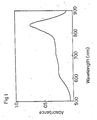
- the chloroaluminum phthalocyanine-poly(vinylalcohol) composition prepared by coating on a substrate solution in a mixed solvent of ethyl alcohol and water (l:l in volume) which is a very good solvent to said poly(vinylalcohol) and a solvent of not so high solubilizing power to chloroaluminum phthalocyanine does show strong absorption in near-infrared wavelengths (Fig. l).
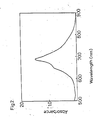
- chloroaluminum chlorophthalocyanine-acetyl cellulose composition prepared by coating a solution in dimethylformamide, which is a very good common solvent both to the chloroaluminum chlorophthalocyanine and the acetyl cellulose, does not show strong absorption in near-infrared wavelengths (Fig. 2).
- the suitable solvent in this invention may be a single solvent or a mixed solvent prepared from two or more solvents.
- a good to moderately good solvent may be selected from the group consisting of dimethylsulfoxide, dimethylformamide, N-methylpyrolidone and pyridine, alcohols, aminoalcohols, ketones, and cellosolves.
- Poor solvent may be selected from the group consisting of water, hydrocarbons, halogenated hydrocarbons, ethers and diethers.
- the near-infrared insensitive composition can be transformed into the near-infrared sensitive form by treating with a solvent or with a solvent vapor, wherein the solvent has the relatively low solubilizing power to the phthalocyanine compared to that of good solvent.
- the near-infrared insensitive chloroaluminum chlorophthalocyanine-acetyl cellulose once it was formed from the very good mutual solvent dimethylformamide (Fig. 2), was transformed into the near-infrared sensitive form by treating with ethyl alcohol vapor (Fig. 4).
- ethyl alcohol softened the matrix polymer, acetyl cellulose, and induced the formation of dimers or dimer aggregates of the chloroaluminum chlorophthalocyanine since ethyl alcohol is a moderately good solvent having lower solubilizing power than that of dimethylformamide for chloroaluminum chlorophthalocyanine .
- a double layer of a substituted aluminum phthalocyanine and a polymer can be made into a near-infrared sensitive single layer by treating with a solvent or with a solvent vapor, wherein the solvent has a relatively low solubilizing power compared to that of good solvent.
- the double layer did not show strong absorption in the near-infrared wavelength spectrum.
- the double layer could be successfully made into a single layer by treatment with the vapor of a mixed solvent of ethyl alcohol and water (l:l in volume).
- the resultant single layer had an intense absorption in near-infrared wavelengths.
- the thickness of the near-infrared insensitive composition or the double layers which can be converted into the near-infrared sensitive composition by the solvent treatment methods is preferably less than 3 microns, more preferably less than l micron, and most preferably less than 0.5 microns, since the solvent must diffuse into the composition or into the double layer to make a homogeneous and wet composition to induce formation of dimers and/or dimer aggregates of the phthalocyanine.
- dimers and/or dimer aggregates of substituted aluminum phthalocyanine in a near-infrared sensitive composition was investigated by us and is evidenced by Fourier Transform Infra-Red and Thin Film X-ray Diffraction analyses.
- the near-infrared insensitive chloroaluminum chlorophthalocyanine-acetyl cellulose composition (Fig. 2) showed an aluminum-chlorine stretching band at 440 cm ⁇ 1 in Fourier Transform Infra-Red absorption spectrum and substantially no diffraction peaks due to crystalline phthalocyanine in the X-ray diffraction spectrum.
- the result means that the present near-infrared insensitive composition contains exclusively a monomeric form of chloroaluminum chlorophthalocyanine.
- the near-infrared sensitive chloroaluminum chlorophthalocyanine-acetyl cellulose composition did not show the aluminum-chlorine stretching band at 440 cm ⁇ 1 in Fourier Transform Infra-Red absorption spectrum. Instead, the composition showed new absorption at 310 cm ⁇ 1 which is ascribed to phthalocyanine ring deformation band. And, substantially no diffraction peak due to crystalline phthalocyanine in X-ray diffraction spectrum was observed. The result means that the present near-infrared sensitive composition contains exclusively dimers and/or dimer aggregates of chloroaluminum chlorophthalocyanine. We believe that the dimer has a face-to-face, chlorine-bridged structure.
- phthalocyanine concentration must be employed, although the appropriate phthalocyanine concentration depends on which substituted aluminum phthalocyanine, polymer and solvent are being used.
- the concentration of the phthalocyanine is preferably less than 60 % by weight of the composition, more preferably less than 40%, and most preferably less than 20 %.
- the present near-infrared sensitive phthalocyanine-polymer compositions are highly absorbing in near-infrared wavelengths.
- the absorbed energy is capable of being used in some photochemical process if energy-accepting molecules are present (for example, sensitization) or is simply converted into heat.
- the heat thus evolved can change optical properties of the phthalocyanine-polymer composition, namely, absorbance and/or reflectivity, by elevating the temperature of the composition above the T g (Glass Transition Temperature) of the polymer.
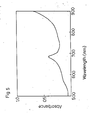
- the chloroaluminum phthalocyanine-poly(vinylalcohol) near-infrared sensitive composition (Fig. l) was heated above the T g of the poly(vinylalcohol).
- the absorption spectrum of the composition after heating is shown in Fig. 5.
- the strong absorption around 830 nm (Fig. l) disappeared.
- This change of optical properties of the composition occurs only above the "threshold temperature" T g .
- Figs. 6 (a) and (b) show temperature dependences of changes of absorbance and reflectivity of the composition; here the T g of poly(vinylalcohol) is about 85 °C.
- T f Fixation Temperature
- the composition becomes insoluble to a solvent.
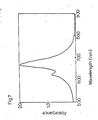
- a solvent for example, the chloroaluminum phthalocyanine-poly(vinylalcohol) composition heated at 200 °C (Fig. 7) was found to be insoluble in the mixed solvent of ethyl alcohol and water (l:l in volume) which was used to prepare the original composition.
- the phthalocyanine-polymer compositions are useful as near-infrared sensitive photoresists which give negative images when they are exposed to near-infrared laser light having such energy that elevates temperature of the exposed part of the composition above T f . If excess laser beam energy is applied to the composition, then ablation occurs. In such case, the composition, in turn, is regarded as a near-infrared photoresist of a positive type.
- the phthalocyanine-polymer compositions, both of unheated and heated to cause thermal fixation are very stable to temperature (when unheated below T g ) and to light.
- Chloroaluminum phthalocyanine-poly(vinylalcohol) composition before and after exposure to 830 nm laser beam which could have caused thermal fixation of change of optical properties, showed only a 2 % additional change of optical properties after being left in an environment of 60 °C and 90 % relative humidity for l000 hours.
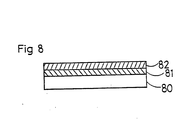
- Fig. 8 shows a cross sectional view of a preferred embodiment of such an optical information recording medium containing a substrate 80; a near-infrared sensitive phthalocyanine-polymer recording layer 8l; and a reflecting layer 82.
- Fig. l shows an absorption spectrum of the film. A strong absorption peak was observed around 830 nm with absorption co-efficient of about 9 ⁇ l04 liter ⁇ mole ⁇ 1 ⁇ cm ⁇ 1 calculated for the dimer.
- Example l Following generally Example l, except that 0.l g of chloroaluminum chlorophthalocyanine was used, a film of the phthalocyanine-poly(vinylalcohol) composition was prepared on a glass substrate. In absorption spectra, the films, as prepared and heated, showed almost the same behavior as the films of the chloroaluminum phthalocyanine-poly(vinylalcohol) composition of Example l.
- Example l Following generally Example l, except that 0.05 g of hydroxyaluminum phthalocyanine was used, a film of the hydroxyaluminum phthalocyanine-poly(vinylalcohol) composition was prepared on a glass substrate. The absorption spectrum of the film as prepared was almost the same as that of the film of chloroaluminum phthalocyanine-poly(vinylalcohol) composition (Example l).
- Example l Following generally Example l, except that 0.05 g of acetoxyaluminum phthalocyanine was used, a film of the acetoxyaluminum phthalocyanine-poly(vinylalcohol) composition was prepared on a glass substrate.
- the absorption spectrum of the film as prepared was different only in the magnitude of absorption from that of the film of chloroaluminum phthalocyanine-poly(vinylalcohol) composition (Example l).
- Example l Following generally Example l, except that 0.05 g of bromoaluminum phthalocyanine was used, a film of the bromoaluminum phthalocyanine-poly(vinylalcohol) composition was prepared on a glass substrate. In absorption spectra,the films, as prepared and heated, showed almost the same behavior as the films of chloroaluminum phthalocyanine-poly(vinylalcohol) composition (Example l).
- Example l Following generally Example l, except that 0.5 g of hydroxyethyl cellulose was used, a film of the chlroloaluminum phthalocyanine-hydroxyethyl cellulose composition was prepared on a glass substrate. In absorption spectra, the films, as prepared and heated, showed almost the same behavior as the films of chloroaluminum phthalocyanine-poly(vinylalcohol) composition (Example l).
- Example l Following generally Example l, except that 0.5 g of poly(N-vinylpyrrolidone) was used, a film of the chloroaluminum phthalocyanine-poly(N-vinylpyrrolidone) composition was prepared on a glass substrate. The film showed almost the same absorption as that of the film of chloroaluminum phthalocyanine-poly(vinylalcohol) composition (Example l).
- Example l Following generally Example l, except that 0.5 g of poly(4-vinylpyridine) was used, a film of the chloroaluminum phthalocyanine-poly(4-vinylpyridine) composition was prepared on a glass substrate. The film showed almost the same absorption as that of the film of chloroaluminum phthalocyanine-poly(vinylalcohol) composition (Example l).
- the "threshold" temperature of thermal fixation of change of optical properties in this polymer is about 250 °C, much higher than that in poly(vinylalcohol).
- chloroaluminum chlorophthalocyanine and 0.5 g of poly(saccharide) were dissolved into 9.5 g of a mixed solvent of dimethylformamide and water (80:20 in volume), and a film of the chloroaluminum chlorophthalocyanine-poly(saccharide) composition was prepared on a glass substrate by following the procedures in Example l.
- chloroaluminum chlorophthalocyanine and 0.2 g of poly(vinylalcohol) were stirred and dissolved into 9.5 g of dimethylformamide, some of the phthalocyanine remained insoluble.
- a film of the chloroaluminum chlorophthalocyanine-poly(vinylalcohol) composition was prepared on a glass substrate by following the procedures in Example l. The thickness of the film was about 0.3 microns.
- the film having an intense absorption around 830 nm was obtained by ethyl alcohol vapor treatment for 30 min.
- chloroaluminum chlorophthalocyanine and 0.2 g of acetyl cellulose were stirred and dissolved into 9.5 g of dimethylformamide, some of the phthalocyanine remained insoluble.
- a film of the chloroaluminum chlorophthalocyanine-acetyl cellulose composition was prepared on a glass substrate by following the procedures in Example l. The thickness of the film was about 0.4 microns.
- the film having an intense absorption around 830 nm was obtained by ethyl alcohol vapor treatment for 30 min. (Fig. 4).
- Chloroaluminum phthalocyanine was charged to a vessel made of molybdenum or tungsten. The vessel was placed in a vacuum chamber and then connected to a source of current. A glass substrate was placed just above a evaporation vessel. The vacuum chamber was evacuated to about l0 ⁇ 5 torr. Current was applied to the vessel to raise the temperature to about 500°C. Evaporation of chloroaluminum phthalocyanine was continued until the thickness reached l000 angstroms with a deposition rate of about 5 angstroms ⁇ sec ⁇ 1. Deposition was monitored with a quartz oscillator thickness sensor.
- the vapor-deposited chloroaluminum phthalocyanine film did not have an intense absorption in wavelengths longer than 800 nm.
- the film was over-coated with poly(vinylalcohol) thin film of 2500 angstroms thickness which was formed by spin coating an aqueous solution of poly(vinylalcohol) (2.5 weight %). This over-coated, thus double layered film again did not show a strong absorption in near-infrared wavelengths.
- the over-coated film was exposed to a vapor of a mixed solvent of ethyl alcohol and water (l:l in volume) for 30 min.
- the resultant film had a strong absorption around 830 nm.
- Thermal and optical properties of the film was almost same as those of the film prepared in Example l.
- the vapor-treated film was found to be a single layer of the aluminum phthalocyanine-poly(vinylalcohol) composition, since the film was completely soluble and removable with water.
- Example l Following generally Example l, except that a bar-coater was used instead of spin coater, a film of the chloroaluminum phthalocyanine-poly(vinylalcohol) composition was prepared on a glass substrate. The thickness of the film was about l micron.
- the film showed essentially the same absorption except for intensity as that of the film of chloroaluminum phthalocyanine-poly(vinylalcohol) composition prepared in Example l.
- the film was subjected to exposure to a focused and pulsed laser beam of 830 nm which was emitted from gallium aluminum arsenide laser.
- the exposure was performed with a laser output power of about 2 mW and with about 200 nanoseconds exposure time.
- the film was rinsed with water after exposure.
- the part of the film exposed to laser beam was insoluble, while the unexposed part was soluble. As a result, negative images were developed.
- the film had an intense absorption in near-infrared wavelengths, absorption maximum at 830 nm with absorbance of 0.25.
- the optical recording medium thus obtained was subjected to exposure to a focused and pulsed laser beam of 830 nm which was emitted from gallium aluminum arsenide laser.
- the exposure was performed through the substrate with a laser output power of about 2 mW and about 200 or 500 nanoseconds exposure time.
- the reflectivity of the exposed part of the optical recording medium was monitored to know whether recording was successful.
- the exposed part of the optical recording medium showed marked increase in reflectivity, which means that the absorption at 830 nm of the exposed part was decreased, thus increasing the out-coming reflection from the aluminum reflective layer.
- optical recording media before and after exposure to the laser beam showed only 2 % of additional change in optical properties after being left in an environment of 60 °C and 90 % relative humidity for l000 hrs.
- the film having an intense absorption around 830 nm was obtained by ethylalcohol vapor treatment for 30 min.
- the film had both an intense absorption and reflection in near-infrared wavelengths. Absorption maximum was at 830 nm with absorbance of 0.45 and reflectivity at 830 nm was about 2l % which was high enough to be able to focus the laser beam on the film.
- the film was subjected to exposure to a focused and pulsed laser beam of 830 nm which was emitted from gallium aluminum arsenide laser.
- the exposure was performed through the substrate with a laser output power of about 2 mW or 7 mW and about 500 nanoseconds exposure time. Reflectivity of the exposed part of the optical recording medium was monitored to know whether recording was successful.
- the part of the optical recording medium exposed to 2 mW laser beam showed an increase in reflectivity.
- the part of the optical recording medium exposed to 7 mW laser beam showed a marked decrease in reflectivity; decreased from 2l % to 7 %.
- the exposed part turned out to be ablated by observation with a microscope.
- the optical recording media before and after exposure to the laser beam showed only 2 % of additional change of optical properties after being left in an environment of 60 °C and 90 % relative humidity for l000 hrs.
Landscapes
- Physics & Mathematics (AREA)
- Nonlinear Science (AREA)
- General Physics & Mathematics (AREA)
- Optics & Photonics (AREA)
- Optical Record Carriers And Manufacture Thereof (AREA)
- Thermal Transfer Or Thermal Recording In General (AREA)
Applications Claiming Priority (4)
| Application Number | Priority Date | Filing Date | Title |
|---|---|---|---|
| JP3672/86 | 1986-01-13 | ||
| JP367286 | 1986-01-13 | ||
| JP6077886 | 1986-03-20 | ||
| JP60778/86 | 1986-03-20 |
Publications (4)
| Publication Number | Publication Date |
|---|---|
| EP0232964A2 true EP0232964A2 (de) | 1987-08-19 |
| EP0232964A3 EP0232964A3 (en) | 1989-05-10 |
| EP0232964B1 EP0232964B1 (de) | 1991-03-13 |
| EP0232964B2 EP0232964B2 (de) | 1994-06-01 |
Family
ID=26337306
Family Applications (1)
| Application Number | Title | Priority Date | Filing Date |
|---|---|---|---|
| EP87300173A Expired - Lifetime EP0232964B2 (de) | 1986-01-13 | 1987-01-09 | Im nahen Infrarot empfindliche Phthalocyanin-Polymer-Mischungen |
Country Status (3)
| Country | Link |
|---|---|
| US (1) | US4816386A (de) |
| EP (1) | EP0232964B2 (de) |
| DE (1) | DE3768519D1 (de) |
Cited By (14)
| Publication number | Priority date | Publication date | Assignee | Title |
|---|---|---|---|---|
| EP0313943A3 (en) * | 1987-10-20 | 1990-05-23 | Mitsui Toatsu Chemicals Inc. | 1,2-naphtalocyanine near-infrared absorbent and recording/display materials using same |
| EP0337209A3 (en) * | 1988-04-01 | 1990-07-25 | Mitsui Toatsu Chemicals, Incorporated | Alkylphthalocyanine near-infrared absorbers and recording/display materials using the same |
| EP0335302A3 (en) * | 1988-03-30 | 1990-11-22 | Rohm Gmbh | Apparatus for the reversible storage of data |
| EP0414966A1 (de) * | 1988-07-08 | 1991-03-06 | Minnesota Mining And Manufacturing Company | Aufzeichnungsmedium für optische Scheibe mit von der Mikrostruktur herstammender Unhomogenität oder Anisotropie |
| EP0379276A3 (de) * | 1989-01-17 | 1991-06-12 | Teijin Limited | Auswischbares optisches Aufzeichnungsmedium und Verfahren zum Schreiben, Lesen und/oder Auswischen in diesem Medium |
| WO1991012610A3 (en) * | 1990-02-07 | 1991-10-03 | Hoechst Celanese Corp | Stabilization of optical information storage media by incorporation of nitrogen containing compounds |
| EP0451718A1 (de) * | 1990-04-07 | 1991-10-16 | MITSUI TOATSU CHEMICALS, Inc. | Optisches Aufzeichnungsmedium vom einmalig beschreibbaren Compact-Disc-Typ |
| EP0462368A1 (de) * | 1990-06-19 | 1991-12-27 | MITSUI TOATSU CHEMICALS, Inc. | Speicherkarte für optische Daten |
| EP0416632A3 (en) * | 1989-09-08 | 1992-01-02 | Unitika Ltd. | Organic nonlinear optical material |
| EP0478052A1 (de) * | 1990-09-24 | 1992-04-01 | Akzo Nobel N.V. | Flüssig-Kristalline und infra-rot-empfindliche-flüssig-Kristalline Polyester zur Verwendung in optischer Daten-speicherung, Verfahren zur Bereitung derselben und Gerät, das infra-rot-empfindliches Polyester enthält |
| US5215800A (en) * | 1989-01-17 | 1993-06-01 | Teijin Limited | Erasable optical recording medium and method for writing, reading and/or erasing thereof |
| US5283094A (en) * | 1991-04-26 | 1994-02-01 | Mitsui Toatsu Chemicals, Inc. | Optical recording medium |
| WO1994019387A1 (en) * | 1993-02-18 | 1994-09-01 | Eastman Chemical Company | Water-dissipatable polyesters and amides containing near infrared fluorescent compounds copolymerized therein |
| US5423432A (en) * | 1993-12-30 | 1995-06-13 | Eastman Chemical Company | Water-dissipatable polyesters and amides containing near infrared fluorescent compounds copolymerized therein |
Families Citing this family (25)
| Publication number | Priority date | Publication date | Assignee | Title |
|---|---|---|---|---|
| US5494793A (en) * | 1986-12-15 | 1996-02-27 | British Technology Group Usa Inc. | Monomeric phthalocyanine reagents |
| DE3643770A1 (de) * | 1986-12-20 | 1988-06-30 | Basf Ag | Mono- und disubstituierte phthalocyanine |
| US5346670A (en) * | 1986-12-24 | 1994-09-13 | British Technology Group U.S.A. Inc. | Phthalocyanine and tetrabenztriazaporphyrin reagents |
| JP2564642B2 (ja) * | 1989-02-20 | 1996-12-18 | 日本製紙株式会社 | 光記録体 |
| JP2642776B2 (ja) * | 1990-09-10 | 1997-08-20 | 三田工業株式会社 | 情報記録媒体及び情報記録方法 |
| US5210122A (en) * | 1991-04-24 | 1993-05-11 | General Electric Company | Near-infrared stabilized copolyestercarbonate compositions |
| US5146087A (en) * | 1991-07-23 | 1992-09-08 | Xerox Corporation | Imaging process with infrared sensitive transparent receiver sheets |
| ES2095494T3 (es) * | 1991-11-08 | 1997-02-16 | Eastman Chem Co | Metodo para marcar materiales termoplasticos con fluoroforos en el infrarrojo. |
| US5424171A (en) * | 1992-04-03 | 1995-06-13 | Pioneer Electronic Corporation | Optical recording medium |
| US6766953B1 (en) | 1992-05-01 | 2004-07-27 | Hewlett-Packard Development Company, L.P. | Tape indicia on clear film media |
| US5252698A (en) * | 1992-10-09 | 1993-10-12 | Sri International | Metal ion porphyrin-containing poly(azine) |
| US5312896A (en) * | 1992-10-09 | 1994-05-17 | Sri International | Metal ion porphyrin-containing poly(imide) |
| US6020436A (en) * | 1993-03-09 | 2000-02-01 | The Chromaline Corporation | Photosensitive resin composition |
| JPH06325414A (ja) * | 1993-05-17 | 1994-11-25 | Pioneer Electron Corp | 反射率制御方法 |
| JP3396118B2 (ja) * | 1995-11-02 | 2003-04-14 | オリンパス光学工業株式会社 | 屈折率分布型光学素子及び屈折率分布型光学素子を用いた光学機器 |
| US5990197A (en) * | 1996-10-28 | 1999-11-23 | Eastman Chemical Company | Organic solvent based ink for invisible marking/identification |
| US6138913A (en) * | 1997-11-05 | 2000-10-31 | Isotag Technology, Inc. | Security document and method using invisible coded markings |
| WO1999060430A1 (en) * | 1998-05-15 | 1999-11-25 | Toyo Boseki Kabushiki Kaisha | Infrared absorption filter |
| US6149719A (en) * | 1998-10-28 | 2000-11-21 | Hewlett-Packard Company | Light sensitive invisible ink compositions and methods for using the same |
| US6644764B2 (en) | 1998-10-28 | 2003-11-11 | Hewlett-Packard Development Company, L.P. | Integrated printing/scanning system using invisible ink for document tracking |
| US6969549B1 (en) | 1999-11-19 | 2005-11-29 | Hewlett-Packard Development Company, L.P. | Techniques to prevent leakage of fluorescing signals through print media or indicia tape |
| US6386671B1 (en) | 1999-12-29 | 2002-05-14 | Hewlett-Packard Company | Orientation independent indicia for print media |
| US20060153608A1 (en) * | 2005-01-10 | 2006-07-13 | Xerox Corporation | System and method for determining printing media is appropriate for use in a printer/copier |
| KR100565475B1 (ko) * | 2005-08-22 | 2006-03-30 | 씨엠에스테크놀로지(주) | 근적외선 흡수 조성물 |
| KR102803852B1 (ko) * | 2019-03-13 | 2025-05-02 | 삼성전자주식회사 | 센서 및 전자 장치 |
Family Cites Families (12)
| Publication number | Priority date | Publication date | Assignee | Title |
|---|---|---|---|---|
| CH572087A5 (de) * | 1973-02-28 | 1976-01-30 | Ciba Geigy Ag | |
| US4241355A (en) * | 1977-09-29 | 1980-12-23 | Rca Corporation | Ablative optical recording medium |
| GB2066489B (en) * | 1979-11-29 | 1983-10-19 | Rca Corp | Ablative optical recording medium |
| US4347173A (en) * | 1980-06-06 | 1982-08-31 | Westinghouse Electric Corp. | Opaque black dye for color coding of wire enamels, varnishes and synthetic resins |
| US4311775A (en) * | 1980-10-06 | 1982-01-19 | Eastman Kodak Company | Novel phthalocyanine pigments and electrophotographic uses thereof |
| US4311623A (en) * | 1981-03-20 | 1982-01-19 | The United States Of America As Represented By The Secretary Of The Navy | Blue-gray low infrared emitting coating |
| US4426434A (en) * | 1981-06-23 | 1984-01-17 | Nippon Telegraph & Telephone Public Corp. | Electrophotographic photoreceptor and preparation thereof |
| JPS5856892A (ja) * | 1981-10-01 | 1983-04-04 | Ricoh Co Ltd | 光学的情報記録媒体 |
| US4444861A (en) * | 1981-12-15 | 1984-04-24 | Ashai Kasei Kogyo Kabushiki Kaisha | Photo sensitive article for electrophotography containing charge transfer material |
| US4492750A (en) * | 1983-10-13 | 1985-01-08 | Xerox Corporation | Ablative infrared sensitive devices containing soluble naphthalocyanine dyes |
| US4529688A (en) * | 1983-10-13 | 1985-07-16 | Xerox Corporation | Infrared sensitive phthalocyanine compositions |
| US4605607A (en) * | 1985-04-08 | 1986-08-12 | Celanese Corporation | Optical data storage medium having organometallic chromophore/polymer coordinated information layer |
-
1987
- 1987-01-05 US US07/000,303 patent/US4816386A/en not_active Expired - Fee Related
- 1987-01-09 EP EP87300173A patent/EP0232964B2/de not_active Expired - Lifetime
- 1987-01-09 DE DE8787300173T patent/DE3768519D1/de not_active Expired - Fee Related
Cited By (16)
| Publication number | Priority date | Publication date | Assignee | Title |
|---|---|---|---|---|
| EP0313943A3 (en) * | 1987-10-20 | 1990-05-23 | Mitsui Toatsu Chemicals Inc. | 1,2-naphtalocyanine near-infrared absorbent and recording/display materials using same |
| EP0335302A3 (en) * | 1988-03-30 | 1990-11-22 | Rohm Gmbh | Apparatus for the reversible storage of data |
| EP0337209A3 (en) * | 1988-04-01 | 1990-07-25 | Mitsui Toatsu Chemicals, Incorporated | Alkylphthalocyanine near-infrared absorbers and recording/display materials using the same |
| US5582774A (en) * | 1988-04-01 | 1996-12-10 | Mitsui Toatsu Chemicals, Incorporated | Alkylphthalocyanine near-infrared absorbers and recording/display materials using the same |
| EP0414966A1 (de) * | 1988-07-08 | 1991-03-06 | Minnesota Mining And Manufacturing Company | Aufzeichnungsmedium für optische Scheibe mit von der Mikrostruktur herstammender Unhomogenität oder Anisotropie |
| EP0379276A3 (de) * | 1989-01-17 | 1991-06-12 | Teijin Limited | Auswischbares optisches Aufzeichnungsmedium und Verfahren zum Schreiben, Lesen und/oder Auswischen in diesem Medium |
| US5215800A (en) * | 1989-01-17 | 1993-06-01 | Teijin Limited | Erasable optical recording medium and method for writing, reading and/or erasing thereof |
| EP0416632A3 (en) * | 1989-09-08 | 1992-01-02 | Unitika Ltd. | Organic nonlinear optical material |
| WO1991012610A3 (en) * | 1990-02-07 | 1991-10-03 | Hoechst Celanese Corp | Stabilization of optical information storage media by incorporation of nitrogen containing compounds |
| EP0451718A1 (de) * | 1990-04-07 | 1991-10-16 | MITSUI TOATSU CHEMICALS, Inc. | Optisches Aufzeichnungsmedium vom einmalig beschreibbaren Compact-Disc-Typ |
| EP0462368A1 (de) * | 1990-06-19 | 1991-12-27 | MITSUI TOATSU CHEMICALS, Inc. | Speicherkarte für optische Daten |
| EP0478052A1 (de) * | 1990-09-24 | 1992-04-01 | Akzo Nobel N.V. | Flüssig-Kristalline und infra-rot-empfindliche-flüssig-Kristalline Polyester zur Verwendung in optischer Daten-speicherung, Verfahren zur Bereitung derselben und Gerät, das infra-rot-empfindliches Polyester enthält |
| US5525265A (en) * | 1990-09-24 | 1996-06-11 | Akzo Nobel N.V. | Liquid crystalline and infrared-sensitive liquid-crystalline polyesters |
| US5283094A (en) * | 1991-04-26 | 1994-02-01 | Mitsui Toatsu Chemicals, Inc. | Optical recording medium |
| WO1994019387A1 (en) * | 1993-02-18 | 1994-09-01 | Eastman Chemical Company | Water-dissipatable polyesters and amides containing near infrared fluorescent compounds copolymerized therein |
| US5423432A (en) * | 1993-12-30 | 1995-06-13 | Eastman Chemical Company | Water-dissipatable polyesters and amides containing near infrared fluorescent compounds copolymerized therein |
Also Published As
| Publication number | Publication date |
|---|---|
| US4816386A (en) | 1989-03-28 |
| EP0232964B1 (de) | 1991-03-13 |
| EP0232964B2 (de) | 1994-06-01 |
| DE3768519D1 (de) | 1991-04-18 |
| EP0232964A3 (en) | 1989-05-10 |
Similar Documents
| Publication | Publication Date | Title |
|---|---|---|
| EP0232964B1 (de) | Im nahen Infrarot empfindliche Phthalocyanin-Polymer-Mischungen | |
| US4529688A (en) | Infrared sensitive phthalocyanine compositions | |
| Gu et al. | Optical recording performance of thin films of phthalocyanine compounds | |
| JPS6387282A (ja) | 光学的記録用媒体 | |
| Chen et al. | Optical and recording properties of copper phthalocyanine films | |
| US4950579A (en) | Optical disc recording medium having a microstructure-derived inhomogeneity or anisotropy | |
| JPH0342272A (ja) | 情報記録方法 | |
| JPS6236878B2 (de) | ||
| Sporer | Laser marking process in an oriented dye film | |
| JPH0550994B2 (de) | ||
| GB2066489A (en) | Ablative optical recording medium | |
| JPS5816888A (ja) | 半導体レーザ記録フイルム | |
| JPH0662010B2 (ja) | 融除型光学記録媒体 | |
| JP2555050B2 (ja) | 相変化型光記録媒体 | |
| JPH0696347B2 (ja) | 光学記録体 | |
| JP5395022B2 (ja) | パターン形成方法 | |
| JP2564292B2 (ja) | 光学的記録媒体 | |
| JPH02196689A (ja) | 光記録媒体 | |
| NL7908829A (nl) | Informatieregistratiedrager. | |
| Bräuchle | Photochemical laser studies in polymer films using holography | |
| EP0381210A2 (de) | Optisches Aufzeichnungsmedium und Verfahren zu seiner Herstellung | |
| Friend et al. | Multifunctional organic-inorganic nanocomposites for photonics | |
| JPS61179792A (ja) | 光熱変換記録媒体 | |
| JPS59144056A (ja) | 光学記録媒体およびその製造方法 | |
| JP2001281796A (ja) | 有機光記録媒体および光記録再生装置 |
Legal Events
| Date | Code | Title | Description |
|---|---|---|---|
| PUAI | Public reference made under article 153(3) epc to a published international application that has entered the european phase |
Free format text: ORIGINAL CODE: 0009012 |
|
| AK | Designated contracting states |
Kind code of ref document: A2 Designated state(s): BE CH DE FR GB IT LI NL |
|
| PUAL | Search report despatched |
Free format text: ORIGINAL CODE: 0009013 |
|
| AK | Designated contracting states |
Kind code of ref document: A3 Designated state(s): BE CH DE FR GB IT LI NL |
|
| 17P | Request for examination filed |
Effective date: 19890814 |
|
| 17Q | First examination report despatched |
Effective date: 19891116 |
|
| GRAA | (expected) grant |
Free format text: ORIGINAL CODE: 0009210 |
|
| AK | Designated contracting states |
Kind code of ref document: B1 Designated state(s): BE CH DE FR GB IT LI NL |
|
| REF | Corresponds to: |
Ref document number: 3768519 Country of ref document: DE Date of ref document: 19910418 |
|
| ITF | It: translation for a ep patent filed | ||
| ET | Fr: translation filed | ||
| PLBI | Opposition filed |
Free format text: ORIGINAL CODE: 0009260 |
|
| 26 | Opposition filed |
Opponent name: IMPERIAL CHEMICAL INDUSTRIES PLC Effective date: 19911130 |
|
| NLR1 | Nl: opposition has been filed with the epo |
Opponent name: IMPERIAL CHEMICAL INDUSTRIES PLC |
|
| PLAB | Opposition data, opponent's data or that of the opponent's representative modified |
Free format text: ORIGINAL CODE: 0009299OPPO |
|
| R26 | Opposition filed (corrected) |
Opponent name: IMPERIAL CHEMICAL INDUSTRIES PLC Effective date: 19911130 |
|
| PUAH | Patent maintained in amended form |
Free format text: ORIGINAL CODE: 0009272 |
|
| STAA | Information on the status of an ep patent application or granted ep patent |
Free format text: STATUS: PATENT MAINTAINED AS AMENDED |
|
| 27A | Patent maintained in amended form |
Effective date: 19940601 |
|
| AK | Designated contracting states |
Kind code of ref document: B2 Designated state(s): BE CH DE FR GB IT LI NL |
|
| REG | Reference to a national code |
Ref country code: CH Ref legal event code: AEN |
|
| NLR2 | Nl: decision of opposition | ||
| ITF | It: translation for a ep patent filed | ||
| ET3 | Fr: translation filed ** decision concerning opposition | ||
| NLR3 | Nl: receipt of modified translations in the netherlands language after an opposition procedure | ||
| PGFP | Annual fee paid to national office [announced via postgrant information from national office to epo] |
Ref country code: BE Payment date: 19960306 Year of fee payment: 10 |
|
| PG25 | Lapsed in a contracting state [announced via postgrant information from national office to epo] |
Ref country code: BE Effective date: 19970131 |
|
| BERE | Be: lapsed |
Owner name: TORAY INDUSTRIES INC. Effective date: 19970131 |
|
| PGFP | Annual fee paid to national office [announced via postgrant information from national office to epo] |
Ref country code: DE Payment date: 19991231 Year of fee payment: 14 |
|
| PGFP | Annual fee paid to national office [announced via postgrant information from national office to epo] |
Ref country code: GB Payment date: 20000105 Year of fee payment: 14 |
|
| PGFP | Annual fee paid to national office [announced via postgrant information from national office to epo] |
Ref country code: CH Payment date: 20000110 Year of fee payment: 14 |
|
| PGFP | Annual fee paid to national office [announced via postgrant information from national office to epo] |
Ref country code: FR Payment date: 20000112 Year of fee payment: 14 |
|
| PGFP | Annual fee paid to national office [announced via postgrant information from national office to epo] |
Ref country code: NL Payment date: 20000131 Year of fee payment: 14 |
|
| PG25 | Lapsed in a contracting state [announced via postgrant information from national office to epo] |
Ref country code: GB Free format text: LAPSE BECAUSE OF NON-PAYMENT OF DUE FEES Effective date: 20010109 |
|
| PG25 | Lapsed in a contracting state [announced via postgrant information from national office to epo] |
Ref country code: LI Free format text: LAPSE BECAUSE OF NON-PAYMENT OF DUE FEES Effective date: 20010131 Ref country code: CH Free format text: LAPSE BECAUSE OF NON-PAYMENT OF DUE FEES Effective date: 20010131 |
|
| PG25 | Lapsed in a contracting state [announced via postgrant information from national office to epo] |
Ref country code: NL Free format text: LAPSE BECAUSE OF NON-PAYMENT OF DUE FEES Effective date: 20010801 |
|
| GBPC | Gb: european patent ceased through non-payment of renewal fee |
Effective date: 20010109 |
|
| REG | Reference to a national code |
Ref country code: CH Ref legal event code: PL |
|
| PG25 | Lapsed in a contracting state [announced via postgrant information from national office to epo] |
Ref country code: FR Free format text: LAPSE BECAUSE OF NON-PAYMENT OF DUE FEES Effective date: 20010928 |
|
| NLV4 | Nl: lapsed or anulled due to non-payment of the annual fee |
Effective date: 20010801 |
|
| PG25 | Lapsed in a contracting state [announced via postgrant information from national office to epo] |
Ref country code: DE Free format text: LAPSE BECAUSE OF NON-PAYMENT OF DUE FEES Effective date: 20011101 |
|
| REG | Reference to a national code |
Ref country code: FR Ref legal event code: ST |
|
| PG25 | Lapsed in a contracting state [announced via postgrant information from national office to epo] |
Ref country code: IT Free format text: LAPSE BECAUSE OF NON-PAYMENT OF DUE FEES Effective date: 20050109 |