EP0258657A1 - Transistorvaraktoranordnung für dynamische Halbleiterspeicher - Google Patents
Transistorvaraktoranordnung für dynamische Halbleiterspeicher Download PDFInfo
- Publication number
- EP0258657A1 EP0258657A1 EP87111193A EP87111193A EP0258657A1 EP 0258657 A1 EP0258657 A1 EP 0258657A1 EP 87111193 A EP87111193 A EP 87111193A EP 87111193 A EP87111193 A EP 87111193A EP 0258657 A1 EP0258657 A1 EP 0258657A1
- Authority
- EP
- European Patent Office
- Prior art keywords
- layer
- varactor
- polysilicon layer
- teos
- field effect
- Prior art date
- Legal status (The legal status is an assumption and is not a legal conclusion. Google has not performed a legal analysis and makes no representation as to the accuracy of the status listed.)
- Granted
Links
Images



Classifications
-
- H—ELECTRICITY
- H10—SEMICONDUCTOR DEVICES; ELECTRIC SOLID-STATE DEVICES NOT OTHERWISE PROVIDED FOR
- H10B—ELECTRONIC MEMORY DEVICES
- H10B12/00—Dynamic random access memory [DRAM] devices
- H10B12/30—DRAM devices comprising one-transistor - one-capacitor [1T-1C] memory cells
- H10B12/31—DRAM devices comprising one-transistor - one-capacitor [1T-1C] memory cells having a storage electrode stacked over the transistor
-
- H—ELECTRICITY
- H10—SEMICONDUCTOR DEVICES; ELECTRIC SOLID-STATE DEVICES NOT OTHERWISE PROVIDED FOR
- H10B—ELECTRONIC MEMORY DEVICES
- H10B12/00—Dynamic random access memory [DRAM] devices
- H10B12/01—Manufacture or treatment
- H10B12/02—Manufacture or treatment for one transistor one-capacitor [1T-1C] memory cells
- H10B12/03—Making the capacitor or connections thereto
- H10B12/033—Making the capacitor or connections thereto the capacitor extending over the transistor
-
- Y—GENERAL TAGGING OF NEW TECHNOLOGICAL DEVELOPMENTS; GENERAL TAGGING OF CROSS-SECTIONAL TECHNOLOGIES SPANNING OVER SEVERAL SECTIONS OF THE IPC; TECHNICAL SUBJECTS COVERED BY FORMER USPC CROSS-REFERENCE ART COLLECTIONS [XRACs] AND DIGESTS
- Y10—TECHNICAL SUBJECTS COVERED BY FORMER USPC
- Y10S—TECHNICAL SUBJECTS COVERED BY FORMER USPC CROSS-REFERENCE ART COLLECTIONS [XRACs] AND DIGESTS
- Y10S257/00—Active solid-state devices, e.g. transistors, solid-state diodes
- Y10S257/90—MOSFET type gate sidewall insulating spacer
Definitions
- the invention relates to a transistor varactor arrangement for dynamic semiconductor memories on a doped silicon substrate.
- the basic structure for dynamic semiconductor memories also called DRAMs, consists of a transistor varactor cell.
- the transistor is designed as a MOS-FET and can be controlled from the outside via externally contacted source and gate regions. Its drain region is electrically connected to an electrode side of the varactor, the second electrode side of which is to be influenced from the outside by a contacted connection.
- the varactors are usually made planar, which means that the varactor consists of a doped layer of the silicon substrate and a planar polysilicon layer with a separating dielectric layer.
- the "stacked capacitor” consists of two polysilicon layers with a separating dielectric layer, which are no longer planar, but the gate electrode of the field effect transistor overlap stors.
- a "stacked capacitor” is constructed from a two-layer polysilicon structure with a silicon nitride layer Si3N4 (mostly poly Si-Si3N4-poly Si or Al).
- CCB cell capacitor-coupled bit line cell
- the concept of a CCB cell is in the publication of the IEEE Journal of Solid State Circuits, Volume SC-20, No. 1, "A Capacitance-Coupled Bit Line Cell” by Masao Taguchi, Satoshi Ando, Shimpei Hijiya, Tetsuo Nakamura, Seiji Enomoto and Takashi Yabu (page 210 to page 215).
- the basic idea of this cell lies in a capacitively coupled connection of the source or drain region.
- the structure of the structure is explained in more detail in FIG. 1 of this publication; it consists of a three-layer polysilicon structure door.
- the first layer forms the gate electrode
- the second and third layers form the varactor with a separating dielectric layer.
- the object of the invention is to increase the integration density by means of a cell concept of the transistor varactor arrangement and to produce this transistor varactor arrangement by a simple method.
- a transistor varactor arrangement for dynamic semiconductor memories on a doped silicon substrate consisting of at least one field effect transistor with the source and drain region lying in the doped silicon substrate and a gate electrode covered on all sides with insulating layers, the source region of which can be contacted directly from the outside by a connection, - At least one varactor overlapping the gate electrode of the field effect transistor, which is designed as a "stacked capacitor", which consists of two doped polysilicon layers with a separating dielectric layer, the top polysilicon layer of which can be contacted from the outside and overlaps the lower polysilicon layer and the side flanks of the lower polysilicon layer and that Covered gate electrode and is insulated from the connection to the source region by an insulation layer on the side walls of the upper doped polysilicon layer and whose lower polysilicon layer partially overlaps the gate electrode and is insulated from the gate electrode (G) by oxide layers and which is connected to the drain region of the field effect transistor.
- the lower side of the gate electrode is covered with a dielectric layer and the other sides of the gate electrode are covered with covered with a silicon oxide layer, the gate electrode is also covered with a nitride, Teos (tetraethyl orthosilicate) or Teos nitride layer.
- SU substrate area
- LOG insulating layers
- LOCOS method loc al o s ilicon xidation of generated.
- a dielectric layer (D1) is then applied to the cell array (Z) and the gate electrodes (G) of the field effect transistors are produced from a doped polysilicon layer at the desired locations.
- An oxide layer (O1) is deposited over
- the gate electrodes (G) should be surrounded on all sides by insulating layers due to the increase in the integration density, the side surfaces (O2) are now covered with an oxide coat using the spacer technology (deposition of silicon oxide over the entire surface and anisotropic etching back, i.e., oxide remains on the side flanks) encapsulated.
- a thin teos tetraethyl orthosilicate
- nitride or teos / nitride layer (TS1) is deposited over the entire cell field (Z) including the gate electrodes (G) insulated on all sides.
- this layer serves to structure the second polysilicon layer still to be applied by means of an etching process without etching into the source regions of the cell field, which should not be covered with the second polysilicon layer.
- the Teos (tetraethyl orthoslikate), nitride or Teos / nitride layer (TS1) is removed where the second polysilicon layer still to be produced should have electrical contact with the substrate (SU) of the cell field (Z). This area is also referred to as "buried contact” (BC) because it no longer has any external connection options.
- teos, nitride or teos / nitride layer is also removed from the areas adjacent to the "buried contact” (BC), so that even if the photo technology is misaligned, the "buried contact” (BC) manufactures, the subsequent contact area is completely etched free.
- FIG. 2 A polysilicon layer (P1) is deposited on the Teos (tetraethyl orthosilicate), nitride or Teos / nitride layer (TS1) of the cell field (Z), which later forms the lower electrode of the varactor.
- This polysilicon layer (P1) is made conductive by a flat implantation or by another doping process and then structured in such a way that the Gate electrode of the field effect transistor is partially covered.
- the source region (S) in the cell field which is located between the gate electrodes (G) by an implantation or another doping method, and the drain region (D) doped under the "buried contact” (BC) by diffusion of the doped polysilicon layer (P1).
- a second polysilicon layer (P2) is then deposited over the entire cell field (Z) and doped with a doping method.
- the doped polysilicon layer (P2) forms the varactor together with the dielectric layer (D2) and the doped polysilicon layer (P1) in a later process step, which is also referred to as a "stacked capacitor" due to its design.
- the insulation layer (BPSG) is removed in the area of the connection contacts (K).
- the contact hole for the connection contact (K) to the source region (S) may overlap over the gate electrode (G), it may be larger than the later contact area to the source area (S). Even if the photo technology that produces the connection contact K is misaligned, the entire surface between the oxide side surfaces (02) of the gate electrodes (G) can therefore be used as a contact surface.
- FIG. 5 For the subsequent etching process of the doped polysilicon layer (P2) in the region of the subsequent connection contact (K) over the source region (S), another Teos, nitride or TeosNitrid harsh (TS2) is deposited by a CVD process via the cell field (Z) and removed via an isotropic etching process over the subsequent connection contact (K) of the source region (S).
- the doped polysilicon layer (P2) in the region of the connection contact (K) of the source region (S) can now be removed in a further etching process without damaging the remaining polysilicon layer (P2).
- the etching process stops only on the dielectric layer (D1) and the Teos nitride layer (TS1).
- the flanks of the upper doped polysilicon layer (P2) are oxidized into the region of the subsequent connection contact (K) of the source region (S). Oxidation of the source diffusion region (S) in this process step is prevented by the Teos, nitride or Teos / nitride layer (TS1) or the dielectric layer (D1).
- a short anisotropic etching then removes the Teos (tetraethyl orthosilicate), nitride or Teos nitride layer (TS2) itself and any thin oxide on it. Any remaining oxides in the area of the connection contacts (K) are etched away and finally the connection contacts (K) are metallized.
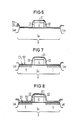
- FIG. 6 All process steps in Figure 1 except for the last are also carried out here. Since the peripheral region (P) does not have a "stacked capacitor", no "buried contact” (BC) is required and the Teos (tetraethylorthosilicate), nitride or Teos / nitride layer (TS1) forms a closed surface over the peripheral area (P).
- BC buried contact
- Teos tetraethylorthosilicate
- nitride or Teos / nitride layer (TS1) forms a closed surface over the peripheral area (P).
- the method steps correspond to those in FIG. 2 with the following exceptions. Since there is no varactor in the peripheral region (P), the doped polysilicon layer (P1) can be removed completely here. Instead of diffusing out the doped polysilicon layer (P1), which was used in FIG. 1 to dope the drain region (D), the source region (S) and drain region (D) are doped together by means of a doping method such as an implantation.
- FIG. 8 The process steps carried out in FIG. 8 again correspond to those in FIG. 3, but the doped polysilicon layer (P2) for the varactor is used, as are the teos (tetraethyl orthosilicate), nitride or teos / nitride layer (TS1) and the dielectric layer (D1). removed in the area of the source (S) and drain area (D).
- P2 doped polysilicon layer
- This layer prevents oxidation of the source-drain diffusion region (S, D) in the connection contacts (K) during the oxidation to isolate the flanks of the polysilicon layer (P2) in FIG. 5.
- connection contacts (K) of the source (S) and drain area (D) in the periphery (P) are etched away and finally the connection contacts (K) are metallized.
Landscapes
- Engineering & Computer Science (AREA)
- Manufacturing & Machinery (AREA)
- Semiconductor Memories (AREA)
- Semiconductor Integrated Circuits (AREA)
Abstract
Description
- Die Erfindung betrifft eine Transistorvaraktoranordnung für dynamische Halbleiterspeicher auf einem dotierten Siliziumsubstrat.
- Die Grundstruktur für die dynamischen Halbleiterspeicher auch DRAMs genannt, besteht aus einer Transistorvaraktorzelle. Der Transistor ist als MOS-FET konzipiert und ist über nach außen kontaktierte Source- und Gategebiete von außen steuerbar. Sein Draingebiet ist elektrisch mit einer Elektrodenseite des Varaktors verbunden, dessen zweite Elektrodenseite durch einen kontaktierten Anschluß von außen zu beeinflussen ist. Bei Packungsdichten von Transistoren- und Varaktoren im 1 Megabitbereich werden die Varaktoren meist planar ausgeführt, dies bedeutet, der Varaktor besteht aus einer dotierten Schicht des Siliziumsubstrats und einer planaren Polysiliziumschicht mit einer trennenden Dielektrikumsschicht. Zur Erhöhung der Packungsdichte bei dynamischen Speichern (DRAMs) sind aus Gründen der kleineren zur Verfügung stehenden Zellflächen und der aufgrund der Störsicherheit erforderlichen Kapazitätsgrößen von 30 bis 50 fF neue Überlegungen für die Ausgestaltung der Varaktoren notwendig. Eine Möglichkeit diese Forderungen, also verringerter Platzbedarf und eine Mindestkapazität des Varaktors, besteht in dem Konzept den Varaktor als "stacked capacitor" aufzubauen. Der "stacked capacitor" besteht aus zwei Polysiliziumschichten mit einer trennenden Dielektrikumsschicht, die nicht mehr planar ausgebildet sind, sondern die Gateelektrode des Feldeffekttransi stors überlappen.
- Es ist bekannt, daß mit dem Konzept des "stacked capacitor" der Integrationsgrad der dynamischen Halbleiterspeicher zu erhöhen ist, siehe IEEE Transaction on Electron Devices, Vol. ED-27, Nr. 8, August 1980, "A 5 V Only 16 kbit Stacked-Capacitor Mos Ram" von Mitsumasa Koyanagi, Yoshio Sakai, Masamichi Ishihara, Masanori Tazunoki und Norikazu Hashimoto (Seite 1596 bis Seite 1601). Ein "stacked capacitor" ist entsprechend dieser Veröffentlichung aus einer zweischichtigen Polysiliziumstruktur mit einer Siliziumnitridschicht Si₃N₄ (meist Poly Si-Si₃N₄-Poly Si oder Al) aufgebaut. In Figur 1 dieser Veröffentlichung werden drei "stacked capacitor" Zellstrukturen aufgeführt: A) "top capacitor", B) "intermediate capacitor" und C) "bottom capacitor". Bei den Ausführungsformen A und B werden die Gateelektroden von den "stacked capacitor" teilweise überlappt. Im Fall A ist die Dreischichtstruktur eine Poly Si-Si₃N₄-Al-Schicht im Fall B eine Poly Si-Si₃N₄ und wiederum eine Poly Si-Schicht. Im dritten Fall C dem "bottom capacitor" bedeckt die Gateelektrode teilweise den "stacked capacitor" der wiederum aus einer Poly Si-Si₃N₄-Poly Si-Struktur besteht.
- In der Vergangenheit sind weitere verschiedene Zellstrukturen zur Erhöhung des Integrationsgrades gefunden worden, wie beispielsweise die CCB-Zelle (capacitance-coupled Bit Line Zelle). Das Konzept einer CCB-Zelle ist in der Veröffentlichung des IEEE Journal of Solid State Circuits, Volume SC-20, Nr. 1, "A Capacitance-Coupled Bit Line Cell" von Masao Taguchi, Satoshi Ando, Shimpei Hijiya, Tetsuo Nakamura, Seiji Enomoto und Takashi Yabu (Seite 210 bis Seite 215) aufgeführt. Der Grundgedanke dieser Zelle liegt in einem kapazitiv gekoppelten Anschluß des Source- oder Draingebietes. In Figur 1 dieser Veröffentlichung ist der Strukturaufbau näher erläutert, er besteht aus einer dreischichtigen Polysiliziumstruk tur. Die erste Schicht bildet die Gateelektrode, die zweite und dritte Schicht den Varaktor mit einer trennenden Dielektrikumsschicht.
- Eine andere Möglichkeit den Integrationsgrad zu erhöhen ist aus IEEE Electron Device Letters, Volume EDL-5, Nr. 5, May 1984, "A Three-Dimensional Folded Dynamic RAM in Beam-Recrystallized Polysilicon" von J. C. Sturm, M. D. Giles und J. F. Gibbons (Seite 151 bis Seite 153), bekannt. Hierbei wird die Transistorvaraktoranordnung dadurch komprimiert, daß ein Teil der einen Polysiliumschicht des Varaktors die andere u-förmig umfaßt und der Transistor über der zweiten Polysiliziumschicht des Varaktors angeordnet ist (siehe Figur 1 und Figur 2). Diese Anordnung wird auch als dynamische "folded" RAM-Zelle bezeichnet.
- Weitere Möglichkeiten ergeben sich aus der Verwendung der "Hi-C" RAM-Zelle (high capacity RAM Zelle) siehe SZE, VLSI Technology, (Seite 476 - Seite 478). Es wird dabei eine Arsen und eine tiefer gehende Borimplantation unter dem Varaktor vorgenommen, um bei verringerten Zellflächen die Kapazität des Varaktors möglichst groß zu halten. Aufgrund der ausgeführten Implantationen ergibt sich eine zusätzlich ausgeprägte Sperrschichtkapazität, die die Ladungskapazität des Varaktors erhöht. Bei der Herstellung eines "stacked capacitor" in einer Transistorvaraktorzelle müssen bisher aufgrund von Justiertoleranzen der einzelnen Schichten zueinander und aufgrund der Maßhaltigkeit der Strukturübertragung gewisse Designabstände zwischen den verschiedenen Schichten eingehalten werden. Geschieht dies nicht, so besteht die Gefahr eines Kurzschlusses zwischen den Schichten. Beim Konzept der CCB Zelle besteht aufgrund der kapazitiven Ankopplung des Source oder Draingebiets die Gefahr einer Spannungsüberhöhung zwischen den Anschlüssen des Transistors in dem Augenblick, wo sich das Potential auf dem kapazitiven Anschlußkontakt verändert. Dies ist besonders kritisch bei Kanallängen von 0,7 bis 1 µm der Transistoren.
- Der Erfindung liegt die Aufgabe zugrunde, durch ein Zellkonzept der Transistorvaraktoranordnung die Integrationsdichte zu erhöhen und durch ein einfaches Verfahren diese Transistorvaraktoranordnung herzustellen.
- Diese Aufgabe wird erfindungsgemäß dadurch gelöst, daß eine Transistorvaraktoranordnung für dynamische Halbleiterspeicher auf einem dotierten Siliziumsubstrat verwendet wird, bestehend aus
- mindestens einem Feldeffekttransistor mit in dem dotierten Siliziumsubstrat liegenden Source- und Draingebiet und einer allseitig mit Isolierschichten bedeckten Gateelektrode, dessen Sourcegebiet direkt durch einen Anschluß von außen kontaktierbar ist,
- mindestens einem die Gateelektrode des Feldeffekttransistors überlappenden Varaktor, der als "stacked capacitor" ausgebildet ist, der aus zwei dotierten Polysiliziumschichten mit einer trennenden Dielektrikumsschicht besteht, dessen oberste Polysiliziumschicht von außen kontaktierbar ist und die untere Polysiliziumschicht und die Seitenflanken der unteren Polysiliziumschicht überlappt und die Gateelektrode überdeckt und durch eine Isolationsschicht an den Seitenwänden der oberen dotierten Polysiliziumschicht gegen den Anschluß zum Sourcegebiet isoliert ist und dessen untere Polysiliziumschicht die Gateelektrode teilweise überlappt und durch Oxidschichten gegen die Gateelektrode (G) isoliert ist und die mit dem Draingebiet des Feldeffekttransistors verbunden ist. - Um die Integrationsdichte zu erhöhen ist die untere Seite der Gateelektrode mit einer Dielektrikumschicht bedeckt und die anderen Seiten der Gateelektrode sind mit einer Siliziumoxidschicht bedeckt, weiterhin ist die Gateelektrode mit einer Nitrid, Teos (Tetraethylorthosilikat) oder Teos-Nitridschicht bedeckt.
- Weitere Ausgestaltungen der Erfindung, insbesondere zu ihrer Realisierung ergeben sich aus den Unteransprüchen.
- Die mit der Erfindung erzielten Vorteile bestehen insbesondere in einem Kapazitätsgewinn des Varaktors durch die größere Überlappungsflächen der zwei Polysiliziumschichten des Varaktors. Durch ein einfaches Herstellungsverfahren werden alle Designgrößen mit Ausnahme des Überlappungsabstandes der oberen und unteren Polysiliziumschicht des Varaktors unabhängig von den Justiertoleranzen der Phototechnik.
- In den Figuren 1 bis 10 wird das Verfahren zur Herstellung der erfindungsgemäßen Transistorvaraktoranordnung näher beschrieben. Es zeigen dabei
- Figur 1 bis 5 Schnitte durch ein Zellenfeld zum Verfahren der Transistorvaraktoranordnung und
- die Figur 6 bis 10 Transistoren in dem Peripheriebereich, die gleichzeitig mit dem angegebenen Verfahren hergestellt werden.
- Figur 1: Ausgangspunkt des Verfahrens bildet das Substratgebiet (SU). Hierauf werden, um die späteren aktiven Gebiete untereinander elektrisch zu trennen, Isolierschichten (LOG) mit Hilfe von örtlich gezielten lokalen Oxidationen LOCOS-Verfahren = local oxidation of silicon erzeugt. Auf dem Zellenfeld (Z) wird anschließend eine Dielektrikumsschicht (D1) aufgetragen und die Gateelektroden (G) der Feldeffekttransistoren aus einer dotierten Polysiliziumschicht an den gewünschten Stellen erzeugt. Über der Polysiliziumschicht der Gateelektroden (G) wird eine Oxidschicht (O1) abgeschieden, die zusammen mit den Gateelektroden (G) strukturiert wird.
- Da aufgrund der Erhöhung der Integrationsdichte die Gateelektroden (G) allseitig von Isolierschichten umgeben sein sollen werden nun mit Hilfe der Spacertechnik (Abscheidung von Siliziumoxid ganzflächig und anisotropes Zurückätzen, das heißt, an den Seitenflanken bleibt Oxid stehen) die Seitenflächen (O2) mit einem Oxidmantel eingekapselt. Mit Hilfe eines CVD (chemical vapour deposition = Abscheidung aus der Gasphase)-Prozesses wird über dem gesamten Zellenfeld (Z) einschließlich der allseitig isolierten Gateelektroden (G) eine dünne Teos (Tetraethylorthosilikat), Nitrid oder Teos/Nitridschicht (TS1) abgeschieden. Diese Schicht dient im weiteren Verfahrensablauf dazu, die zweite noch aufzubringende Polysiliziumschicht durch einen Ätzvorgang zu strukturieren ohne in die Sourcegebiete des Zellenfeldes, die nicht mit der zweiten Polysiliziumschicht bedeckt werden sollen hineinzuätzen. Die Teos (Tetraethylorthoslikat), Nitrid oder Teos/Nitridschicht (TS1) wird dort entfernt, wo die zweite noch zu erzeugende Polysiliziumschicht elektrisch Kontakt zum Substrat (SU) des Zellenfeldes (Z) haben soll. Dieser Bereich wird auch als "buried contact" (BC) bezeichnet, da er nach außen keine Anschlußmöglichkeit mehr besitzt. Dabei wird zugelassen, daß die Teos, Nitrid oder Teos/Nitridschicht (TS1) auch an den am "buried contact" (BC) angrenzenden Gebieten entfernt wird, so daß auch bei einer Dejustierung der Phototechnik, die den "buried contact" (BC) herstellt, die spätere Kontaktfläche ganz freigeätzt wird.
- Figur 2: Auf die Teos (Tetraethylorthosilikat), Nitrid oder Teos/Nitridschicht (TS1) des Zellenfeldes (Z) wird eine Polysiliziumschicht (P1) abgeschieden, die später jeweils die untere Elektrode des Varaktors bildet. Durch eine flache Implantation oder durch ein anderes Dotierungsverfahren wird diese Polysiliziumschicht (P1) leitfähig gemacht und anschließend so strukturiert, daß die Gateelektrode des Feldeffekttransistors teilweise überdeckt wird. Zur Leitfähigkeit von Source-(S) und Drain (D)-Gebiet des Feldeffekttransistors wird das Source-Gebiet (S) im Zellenfeld, das sich zwischen den Gateelektroden (G) befindet durch eine Implantation oder ein anderes Dotierungsverfahren und das Draingebiet (D) unter dem "buried contact" (BC) durch Ausdiffusion der dotierten Polysiliziumschicht (P1) dotiert.
- Figur 3: Im nächsten Verfahrensschritt, wird die zwischen der dotierten Polysiliziumschicht (P1) und der im weiteren Verfahrensablauf aufzubringenden Polysiliziumschicht (P2) des Varaktors erforderliche Dielektriumsschicht (D2) durch einen Oxidationsvorgang oder durch einen CVD (= chemical vapour deposition = Abscheidung aus der Gasphase)-Prozeß über das gesamte Zellenfeld (Z) abgeschieden. Es wird anschließend über das gesamte Zellenfeld (Z) eine zweite Polysiliziumschicht (P2) abgeschieden und mit einem Dotierungsverfahren dotiert. Die dotierte Polysiliziumschicht (P2) bildet nach ihrer Strukturierung in einem späteren Verfahrensschritt zusammen mit der Dielektrikumsschicht (D2) und der dotierten Polysiliziumschicht (P1) den Varaktor, der aufgrund seiner Bauform auch als "stacked capacitor" bezeichnet wird.
- Figur 4: Im weiteren Verfahrensablauf wird über einen CVD (= chemical vapour deposition = Abscheidung aus der Gasphase)-Prozeß eine Teos (Tetraethylorthosilikat) und eine Bor-Phosphor-Silikatglasschicht (BPSG) als Isolationsschicht abgeschieden, wobei die Bor-Phosphor-Silikatglasschicht (BPSG) dazu dient, die auf dem Zellenfeld (Z) durch die bisherigen Verfahrensschritte entstandenen Kantenstrukturen für die abschließende Anschlußmetallisierung abzurunden. Die Isolationsschicht (BPSG) wird im Bereich der Anschlußkontakte (K) wieder entfernt. Das Kontaktloch für den Anschlußkontakt (K) zum Sourcegebiet (S) darf dabei über die Gateelektrode (G) überlappen, es kann größer sein als die spätere Kontaktfläche zum Source gebiet (S). Auch bei einer Dejustierung der Phototechnik, die den Anschlußkontakt K herstellt, kann deshalb die ganze Fläche zwischen den Oxidseitenflächen (02) der Gateelektroden (G) als Kontaktfläche genutzt werden.
- Figur 5: Für den nachfolgenden Ätzvorgang der dotierten Polysiliziumschicht (P2) im Bereich des späteren Anschlußkontaktes (K) über dem Sourcegebiet (S) wird über das Zellenfeld (Z) eine weitere Teos, Nitrid oder TeosNitridschicht (TS2) durch einen CVD-Prozeß abgeschieden und über einen isotropen Ätzvorgang über dem späteren Anschlußkontakt (K) des Sourcegebietes (S) entfernt. Nun kann in einem weiteren Ätzvorgang die dotierte Polysiliziumschicht (P2) im Bereich des Anschlußkontaktes (K) des Sourcegebietes (S) entfernt werden ohne die übrige Polysiliziumschicht (P2) zu beschädigen. Der Ätzvorgang stoppt ausschließlich auf der Dielektrikumsschicht (D1) und der Teos-Nitridschicht (TS1). Damit die obere dotierte Poliumsiliziumschicht (P2) nicht elektrisch mit dem Anschlußkontakt (K) des Sourcegebietes (S) verbunden ist, werden die Flanken der oberen dotierten Polysiliziumschicht (P2) in den Bereich des späteren Anschlußkontaktes (K) des Sourcegebietes (S) aufoxidiert. Eine Aufoxidation des Source Diffusionsgebietes (S) bei diesem Verfahrensschritt wird durch die Teos, Nitrid oder Teos/Nitridschicht (TS1) bzw. die Dielektrikumsschicht (D1) verhindert. Durch eine kurze anisotrope Ätzung wird anschließend die Teos (Tetraethylorthosilikat), Nitrid oder Teos-Nitridschicht (TS2) selbst und ein evtl. dünnes Oxid darauf entfernt. Noch vorhandene Restoxide im Bereich der Anschlußkontakte (K) werden weggeätzt und abschließend die Anschlußkontakte (K) metallisiert.
- Figur 6: Alle Verfahrensschritte in Figur 1 bis auf den letzten werden ebenfalls hier durchgeführt. Da der Peripheriebereich (P) keinen "stacked capacitor" aufweist, ist auch kein "buried contact" (BC) erforderlich und die Teos (Tetraethylorthosilikat), Nitrid oder Teos/Nitrid schicht (TS1) bildet eine geschlossene Oberfläche über dem Peripheriebereich (P).
- Figur 7: Die Verfahrensschritte entsprechen mit folgenden Ausnahmen denen in Figur 2. Da in dem Peripherierbereich (P) kein Varaktor untergebracht ist, kann die dotierte Polysiliziumschicht (P1) hier wieder ganz entfernt werden. Statt einer Ausdiffusion der dotierten Polysiliziumschicht (P1), die in Figur 1 zur Dotierung des Draingebietes (D) diente wird das Sourcegebiet (S) und Draingebiet (D) gemeinsam durch ein Dotierungsverfahren wie zum Beispiel einer Implantation dotiert.
- Figur 8: Die in Figur 8 durchgeführten Verfahrensschritte, entsprechen wiederum denen in Figur 3, jedoch wird die dotierte Polysiliziumschicht (P2) für den Varaktor ebenso wie die Teos (Tetraethylorthosilikat), Nitrid oder Teos/Nitridschicht (TS1) und die Dielektrikumsschicht (D1) im Bereich des Source (S) und Draingebietes (D) entfernt.
- Figur 9: Im weiteren Verfahrensablauf wird mit Hilfe eines CVD (= chemical vapour deposition = Abscheidung aus der Gasphase)-Prozesses eine Teos (Tetraethylorthosilikat) und eine Bor-Phosphor-Silikatglasschicht (BPSG) als Isolationsschicht abgeschieden und in den Bereichen der späteren Anschlußkontakte (K) für das Source (S) und Drain (D)-Gebiet wieder entfernt.
- Figur 10: Für den nachfolgenden Ätzvorgang der dotierten Polysiliziumschicht (P2) über dem Sourcegebiet (S) des Zellenfeldes (Z) in Figur 5 wird über dem Peripheriebereich (P) eine weitere Teos (Tetraethylorthosilikat), Nitrid oder Teos-Nitridschicht (TS2) durch einen CVD (= chemical vapour deposition = Abscheidung aus der Gasphase)-Prozeß abgeschieden. Diese Schicht verhindert eine Aufoxidation des Source-Drain-Diffusionsgebietes (S, D) in den Anschlußkontakten (K) bei der Oxidation zur Isolation der Flanken der Polysiliziumschicht (P2) in Figur 5. Durch eine kurze anisotrope Ätzung wird anschließend die Teos (Tetraethylorthosilikat), Nitrid oder Teos/Nitridschicht (TS2) selbst und ein eventuell dünnes Oxid auf dieser entfernt. Vorhandene Restoxide im Bereich der späteren Anschlußkontakte (K) des Source (S) und Drainbereichs (D) in der Peripherie (P) werden weggeätzt und abschließend die Anschlußkontakte (K) metallisiert.
Claims (8)
mindestens einem Feldeffekttransistor mit in dem dotierten Siliziumsubstrat liegenden Source (S)- und Drain (D)-Gebiet und einer allseitig mit Isolierschichten bedeckten Gateelektrode (G), dessen Sourcegebiet (S) direkt durch einen Anschluß (K) von außen kontaktierbar ist,
mindestens einem die Gateelektrode (G) des Feldeffekttransistors überlappenden Varaktor, der als "stacked capacitor" ausgebildet ist, der aus zwei dotierten Polysiliziumschichten (P1, P2) mit einer trennenden Dielektrikumsschicht (D2) besteht, dessen oberste Polysiliziumschicht (P2) von außen kontaktierbar ist und die untere Polysiliziumschicht (P1) und die Seitenflanken der unteren Polysiliziumschicht (P1) überlappt und die Gateelektrode (G) überdeckt, und durch eine Isolationsschicht an den Seitenwänden der oberen dotierten Polysiliziumschicht (P2) gegen den Anschluß (K) zum Sourcegebiet (S) isoliert ist und dessen untere Polysiliziumschicht (P1) die Gateelektrode (G) teilweise überlappt, und durch Oxidschichten (01, 02) gegen die Gateelektrode (G) isoliert ist, und die mit dem Draingebiet (D) des Feldeffekttransistors verbunden ist.
Priority Applications (1)
| Application Number | Priority Date | Filing Date | Title |
|---|---|---|---|
| AT87111193T ATE79202T1 (de) | 1986-08-22 | 1987-08-03 | Transistorvaraktoranordnung fuer dynamische halbleiterspeicher. |
Applications Claiming Priority (2)
| Application Number | Priority Date | Filing Date | Title |
|---|---|---|---|
| DE3628500 | 1986-08-22 | ||
| DE3628500 | 1986-08-22 |
Publications (2)
| Publication Number | Publication Date |
|---|---|
| EP0258657A1 true EP0258657A1 (de) | 1988-03-09 |
| EP0258657B1 EP0258657B1 (de) | 1992-08-05 |
Family
ID=6307933
Family Applications (1)
| Application Number | Title | Priority Date | Filing Date |
|---|---|---|---|
| EP87111193A Expired - Lifetime EP0258657B1 (de) | 1986-08-22 | 1987-08-03 | Transistorvaraktoranordnung für dynamische Halbleiterspeicher |
Country Status (7)
| Country | Link |
|---|---|
| US (1) | US4855801A (de) |
| EP (1) | EP0258657B1 (de) |
| JP (1) | JP2628494B2 (de) |
| KR (1) | KR920005702B1 (de) |
| AT (1) | ATE79202T1 (de) |
| DE (1) | DE3780885D1 (de) |
| HK (1) | HK8895A (de) |
Cited By (11)
| Publication number | Priority date | Publication date | Assignee | Title |
|---|---|---|---|---|
| DE3842474A1 (de) * | 1988-06-07 | 1989-12-14 | Samsung Electronics Co Ltd | Stapelkondensator-dram und verfahren zur herstellung derselben |
| EP0386947A3 (de) * | 1989-03-06 | 1991-02-13 | STMicroelectronics, Inc. | Dynamische Speicherzelle mit wahlfreiem Zugriff |
| EP0443439A3 (en) * | 1990-02-23 | 1991-10-02 | Institut Fur Halbleiterphysik | One-transistor-storage cell device and method for making the same |
| GB2242782A (en) * | 1990-04-04 | 1991-10-09 | Gold Star Electronics | Process and structure for a transistor-capacitor cell |
| EP0401113A3 (de) * | 1989-05-31 | 1992-07-29 | Fujitsu Limited | Halbleiteranordnung und Verfahren zu deren Herstellung |
| DE4203565A1 (de) * | 1991-02-08 | 1992-08-13 | Mitsubishi Electric Corp | Dram und verfahren zu dessen herstellung |
| EP0512463A1 (de) * | 1991-05-03 | 1992-11-11 | Micron Technology, Inc. | Verfahren zur Herstellung von dynamischer Speichern mit wahlfreiem Zugriff |
| US5272103A (en) * | 1991-02-08 | 1993-12-21 | Mitsubishi Denki Kabushiki Kaisha | DRAM having a large dielectric breakdown voltage between an adjacent conductive layer and a capacitor electrode and method of manufacture thereof |
| US5286998A (en) * | 1989-05-31 | 1994-02-15 | Fujitsu Limited | Semiconductor device having two transistors forming a memory cell and a peripheral circuit, wherein the impurity region of the first transistor is not subjected to an etching atmosphere |
| DE4330471C1 (de) * | 1993-09-08 | 1994-10-20 | Siemens Ag | Herstellverfahren für ein Bitleitungskontaktloch einer Speicherzelle |
| GB2294807A (en) * | 1994-11-02 | 1996-05-08 | Mosel Vitelic Inc | Self-registered capacitor bottom plate local interconnect scheme for DRAM |
Families Citing this family (34)
| Publication number | Priority date | Publication date | Assignee | Title |
|---|---|---|---|---|
| JPH0789569B2 (ja) * | 1986-03-26 | 1995-09-27 | 株式会社日立製作所 | 半導体集積回路装置及びその製造方法 |
| US5191402A (en) * | 1986-10-27 | 1993-03-02 | Seiko Epson Corporation | Semiconductor device having an inter-layer insulating film disposed between two wiring layers |
| US5612557A (en) * | 1986-10-27 | 1997-03-18 | Seiko Epson Corporation | Semiconductor device having an inter-layer insulating film disposed between two wiring layers |
| JP2602219B2 (ja) * | 1987-02-06 | 1997-04-23 | 株式会社日立製作所 | 半導体記憶装置 |
| KR920007787B1 (ko) * | 1987-06-09 | 1992-09-17 | 세이꼬 엡슨 가부시끼가이샤 | 반도체 장치 및 그 제조방법 |
| DE3856143T2 (de) * | 1987-06-17 | 1998-10-29 | Fujitsu Ltd | Verfahren zum Herstellen einer dynamischen Speicherzelle mit wahlfreiem Zugriff |
| US5650647A (en) * | 1987-06-17 | 1997-07-22 | Fujitsu Limited | Dynamic random access memory device and method of producing same |
| KR100212098B1 (ko) * | 1987-09-19 | 1999-08-02 | 가나이 쓰도무 | 반도체 집적회로 장치 및 그 제조 방법과 반도체 집적 회로 장치의 배선기판 및 그 제조 방법 |
| JPH0828427B2 (ja) * | 1988-09-14 | 1996-03-21 | 三菱電機株式会社 | 半導体装置およびその製造方法 |
| JP2633650B2 (ja) * | 1988-09-30 | 1997-07-23 | 株式会社東芝 | 半導体記憶装置およびその製造方法 |
| JP2904533B2 (ja) * | 1989-03-09 | 1999-06-14 | 株式会社東芝 | 半導体装置の製造方法 |
| US5162249A (en) * | 1989-04-03 | 1992-11-10 | Hyundai Electronics Industries Co., Ltd. | Method of making semiconductor memory device having a double stacked capacitor |
| NL8900989A (nl) * | 1989-04-20 | 1990-11-16 | Philips Nv | Halfgeleiderinrichting met een in een kunststof omhulling ingebed halfgeleiderlichaam. |
| KR940005729B1 (ko) * | 1989-06-13 | 1994-06-23 | 삼성전자 주식회사 | 디램셀의 제조방법 및 구조 |
| JPH06105726B2 (ja) * | 1989-10-13 | 1994-12-21 | 三菱電機株式会社 | 半導体集積回路装置 |
| US5006481A (en) * | 1989-11-30 | 1991-04-09 | Sgs-Thomson Microelectronics, Inc. | Method of making a stacked capacitor DRAM cell |
| US5116776A (en) * | 1989-11-30 | 1992-05-26 | Sgs-Thomson Microelectronics, Inc. | Method of making a stacked copacitor for dram cell |
| US5037772A (en) * | 1989-12-13 | 1991-08-06 | Texas Instruments Incorporated | Method for forming a polysilicon to polysilicon capacitor |
| US5290729A (en) * | 1990-02-16 | 1994-03-01 | Mitsubishi Denki Kabushiki Kaisha | Stacked type capacitor having a dielectric film formed on a rough surface of an electrode and method of manufacturing thereof |
| US5229314A (en) * | 1990-05-01 | 1993-07-20 | Mitsubishi Denki Kabushiki Kaisha | Method of manufacturing field effect transistor having a multilayer interconnection layer therein with tapered sidewall insulation |
| KR950008385B1 (ko) * | 1990-05-24 | 1995-07-28 | 삼성전자주식회사 | 반도체 소자의 워드라인 형성방법 |
| KR960006880B1 (ko) * | 1990-05-24 | 1996-05-23 | 가부시키가이샤 도시바 | 반도체 기억장치 |
| US5061646A (en) * | 1990-06-29 | 1991-10-29 | Motorola, Inc. | Method for forming a self-aligned bipolar transistor |
| EP0469555B1 (de) * | 1990-07-31 | 1996-04-17 | Nec Corporation | Ladungsspeicherelektrode eines Kondensators und Methode zu deren Herstellung |
| JPH0521744A (ja) * | 1991-07-10 | 1993-01-29 | Sony Corp | 半導体記憶装置のキヤパシタおよびその製造方法 |
| US5134085A (en) * | 1991-11-21 | 1992-07-28 | Micron Technology, Inc. | Reduced-mask, split-polysilicon CMOS process, incorporating stacked-capacitor cells, for fabricating multi-megabit dynamic random access memories |
| US5525534A (en) * | 1992-03-13 | 1996-06-11 | Fujitsu Limited | Method of producing a semiconductor device using a reticle having a polygonal shaped hole |
| US5338700A (en) * | 1993-04-14 | 1994-08-16 | Micron Semiconductor, Inc. | Method of forming a bit line over capacitor array of memory cells |
| US5498562A (en) * | 1993-04-07 | 1996-03-12 | Micron Technology, Inc. | Semiconductor processing methods of forming stacked capacitors |
| US6083831A (en) | 1996-03-26 | 2000-07-04 | Micron Technology, Inc. | Semiconductor processing method of forming a contact pedestal, of forming a storage node of a capacitor |
| US6268779B1 (en) * | 1999-03-19 | 2001-07-31 | Telefonaktiebolaget Lm Ericsson (Publ) | Integrated oscillators and tuning circuits |
| US6667539B2 (en) | 2001-11-08 | 2003-12-23 | International Business Machines Corporation | Method to increase the tuning voltage range of MOS varactors |
| US20070075364A1 (en) * | 2005-09-30 | 2007-04-05 | Analog Power Intellectual Properties Limited | Power MOSFETs and methods of making same |
| US8921977B2 (en) * | 2011-12-21 | 2014-12-30 | Nan Ya Technology Corporation | Capacitor array and method of fabricating the same |
Citations (3)
| Publication number | Priority date | Publication date | Assignee | Title |
|---|---|---|---|---|
| US4356040A (en) * | 1980-05-02 | 1982-10-26 | Texas Instruments Incorporated | Semiconductor device having improved interlevel conductor insulation |
| EP0112670A1 (de) * | 1982-12-20 | 1984-07-04 | Fujitsu Limited | Halbleiterspeicheranordnung aus gestapelten Speicherzellen vom Kondensatortyp |
| EP0161850A1 (de) * | 1984-04-28 | 1985-11-21 | Fujitsu Limited | Halbleiterspeicheranordnung aus gestapelten Speicherzellen vom Kondensatortyp und Verfahren zu ihrer Herstellung |
Family Cites Families (4)
| Publication number | Priority date | Publication date | Assignee | Title |
|---|---|---|---|---|
| US4649406A (en) * | 1982-12-20 | 1987-03-10 | Fujitsu Limited | Semiconductor memory device having stacked capacitor-type memory cells |
| JPS6055637B2 (ja) * | 1983-06-14 | 1985-12-05 | 東洋リノリユ−ム株式会社 | 床材の裏面処理方法 |
| JPS616858A (ja) * | 1984-06-20 | 1986-01-13 | Matsushita Electric Ind Co Ltd | 半導体記憶装置およびその製造方法 |
| JPS61123181A (ja) * | 1984-11-15 | 1986-06-11 | Fujitsu Ltd | 半導体装置の製造方法 |
-
1987
- 1987-07-16 US US07/074,334 patent/US4855801A/en not_active Expired - Lifetime
- 1987-08-03 DE DE8787111193T patent/DE3780885D1/de not_active Expired - Lifetime
- 1987-08-03 EP EP87111193A patent/EP0258657B1/de not_active Expired - Lifetime
- 1987-08-03 AT AT87111193T patent/ATE79202T1/de not_active IP Right Cessation
- 1987-08-21 JP JP62209113A patent/JP2628494B2/ja not_active Expired - Lifetime
- 1987-08-22 KR KR1019870009231A patent/KR920005702B1/ko not_active Expired
-
1995
- 1995-01-19 HK HK8895A patent/HK8895A/xx not_active IP Right Cessation
Patent Citations (4)
| Publication number | Priority date | Publication date | Assignee | Title |
|---|---|---|---|---|
| US4356040A (en) * | 1980-05-02 | 1982-10-26 | Texas Instruments Incorporated | Semiconductor device having improved interlevel conductor insulation |
| US4356040B1 (de) * | 1980-05-02 | 1991-12-10 | Texas Instruments Inc | |
| EP0112670A1 (de) * | 1982-12-20 | 1984-07-04 | Fujitsu Limited | Halbleiterspeicheranordnung aus gestapelten Speicherzellen vom Kondensatortyp |
| EP0161850A1 (de) * | 1984-04-28 | 1985-11-21 | Fujitsu Limited | Halbleiterspeicheranordnung aus gestapelten Speicherzellen vom Kondensatortyp und Verfahren zu ihrer Herstellung |
Non-Patent Citations (1)
| Title |
|---|
| IEEE TRANSACTIONS ON ELECTRON DEVICES, Band ED-29, Nr. 3, März 1982, Seiten 368-376, New York, US; K. OHTA et al.: "Quadruply self-aligned stacked high-capacitance RAM using Ta2O5 high-density VLSI dynamic memory" * |
Cited By (13)
| Publication number | Priority date | Publication date | Assignee | Title |
|---|---|---|---|---|
| DE3842474A1 (de) * | 1988-06-07 | 1989-12-14 | Samsung Electronics Co Ltd | Stapelkondensator-dram und verfahren zur herstellung derselben |
| EP0386947A3 (de) * | 1989-03-06 | 1991-02-13 | STMicroelectronics, Inc. | Dynamische Speicherzelle mit wahlfreiem Zugriff |
| US5286998A (en) * | 1989-05-31 | 1994-02-15 | Fujitsu Limited | Semiconductor device having two transistors forming a memory cell and a peripheral circuit, wherein the impurity region of the first transistor is not subjected to an etching atmosphere |
| EP0401113A3 (de) * | 1989-05-31 | 1992-07-29 | Fujitsu Limited | Halbleiteranordnung und Verfahren zu deren Herstellung |
| EP0443439A3 (en) * | 1990-02-23 | 1991-10-02 | Institut Fur Halbleiterphysik | One-transistor-storage cell device and method for making the same |
| GB2242782B (en) * | 1990-04-04 | 1994-02-16 | Gold Star Electronics | Process and structure for a transistor-capacitor cell |
| GB2242782A (en) * | 1990-04-04 | 1991-10-09 | Gold Star Electronics | Process and structure for a transistor-capacitor cell |
| US5272103A (en) * | 1991-02-08 | 1993-12-21 | Mitsubishi Denki Kabushiki Kaisha | DRAM having a large dielectric breakdown voltage between an adjacent conductive layer and a capacitor electrode and method of manufacture thereof |
| DE4203565A1 (de) * | 1991-02-08 | 1992-08-13 | Mitsubishi Electric Corp | Dram und verfahren zu dessen herstellung |
| EP0512463A1 (de) * | 1991-05-03 | 1992-11-11 | Micron Technology, Inc. | Verfahren zur Herstellung von dynamischer Speichern mit wahlfreiem Zugriff |
| DE4330471C1 (de) * | 1993-09-08 | 1994-10-20 | Siemens Ag | Herstellverfahren für ein Bitleitungskontaktloch einer Speicherzelle |
| GB2294807A (en) * | 1994-11-02 | 1996-05-08 | Mosel Vitelic Inc | Self-registered capacitor bottom plate local interconnect scheme for DRAM |
| GB2294807B (en) * | 1994-11-02 | 1998-10-21 | Mosel Vitelic Inc | Self-registered capacitor bottom plate local interconnect scheme for dram |
Also Published As
| Publication number | Publication date |
|---|---|
| DE3780885D1 (de) | 1992-09-10 |
| EP0258657B1 (de) | 1992-08-05 |
| US4855801A (en) | 1989-08-08 |
| ATE79202T1 (de) | 1992-08-15 |
| KR880003429A (ko) | 1988-05-17 |
| JP2628494B2 (ja) | 1997-07-09 |
| KR920005702B1 (ko) | 1992-07-13 |
| JPS6373553A (ja) | 1988-04-04 |
| HK8895A (en) | 1995-01-27 |
Similar Documents
| Publication | Publication Date | Title |
|---|---|---|
| EP0258657B1 (de) | Transistorvaraktoranordnung für dynamische Halbleiterspeicher | |
| DE4332074C2 (de) | Halbleiterspeichereinrichtung und Verfahren zu ihrer Herstellung | |
| DE4408764C2 (de) | Halbleiterspeicheranordnung | |
| EP0744771B1 (de) | Verfahren zur Herstellung einer DRAM-Speicherzelle mit vertikalem Transistor | |
| DE4127967C2 (de) | MOS-Transistor mit Gate-Drain-Elektrodenüberlapp und Verfahren zu seiner Herstellung | |
| DE4028488C2 (de) | Verfahren zur Herstellung einer Halbleiterspeichervorrichtung | |
| DE4007582C2 (de) | Verfahren zum Herstellen von mindestens zwei Kontakten in einem Halbleiterbauelement | |
| DE3785317T2 (de) | Matrix hoher Packungsdichte aus dynamischen VMOS RAM. | |
| DE4142961A1 (de) | Dram-speicheranordnung | |
| DE4301690A1 (de) | ||
| EP0744772A1 (de) | DRAM-Speicherzelle mit vertikalem Transistor und Verfahren zur Herstellung derselben | |
| DE10324491A1 (de) | Herstellungsverfahren für Dual-Workfunction-Logikbauelemente in vertikalen DRAM-Prozessen | |
| EP0282629B1 (de) | Dreidimensionale 1-Transistorzellenanordung für dynamische Halbleiterspeicher mit Grabenkondensator und Verfahren zur Herstellung des Bitleitungskontaktes | |
| DE69609224T2 (de) | Kondensator für eine integrierte Schaltung mit leitendem Graben | |
| EP0875937A2 (de) | DRAM-Zellenanordnung und Verfahren zu deren Herstellung | |
| DE3931711A1 (de) | Dynamische random-access-speicherzelle und verfahren zur herstellung | |
| DE4327813C2 (de) | Verfahren zur Herstellung eines DRAM's | |
| DE2921010A1 (de) | Verfahren zur herstellung von sowie strukturen fuer vlsi-schaltungen mit hoher dichte | |
| DE4109299C2 (de) | Halbleiterspeichereinrichtung und Herstellungsverfahren hierfür | |
| DE10109564A1 (de) | Grabenkondensator und Verfahren zu seiner Herstellung | |
| DE10012198B4 (de) | Zylindrisches Kondensatorbauelement mit innenseitigem HSG-Silicium und Verfahren zu seiner Herstellung | |
| DE4130890A1 (de) | Verfahren zur herstellung eines kondensators unter verwendung des feldeffekttransistor-prozesses und mit hilfe des verfahrens hergestellte struktur | |
| EP0925607B1 (de) | Verfahren zur herstellung einer dram-zellenanordnung | |
| DE4135178A1 (de) | Dram-speicheranordnung | |
| EP0263941B1 (de) | Speicherzellenanordnung für dynamische Halbleiterspeicher |
Legal Events
| Date | Code | Title | Description |
|---|---|---|---|
| PUAI | Public reference made under article 153(3) epc to a published international application that has entered the european phase |
Free format text: ORIGINAL CODE: 0009012 |
|
| AK | Designated contracting states |
Kind code of ref document: A1 Designated state(s): AT DE FR GB IT NL |
|
| 17P | Request for examination filed |
Effective date: 19880506 |
|
| 17Q | First examination report despatched |
Effective date: 19910207 |
|
| GRAA | (expected) grant |
Free format text: ORIGINAL CODE: 0009210 |
|
| AK | Designated contracting states |
Kind code of ref document: B1 Designated state(s): AT DE FR GB IT NL |
|
| REF | Corresponds to: |
Ref document number: 79202 Country of ref document: AT Date of ref document: 19920815 Kind code of ref document: T |
|
| REF | Corresponds to: |
Ref document number: 3780885 Country of ref document: DE Date of ref document: 19920910 |
|
| ET | Fr: translation filed | ||
| ITF | It: translation for a ep patent filed | ||
| GBT | Gb: translation of ep patent filed (gb section 77(6)(a)/1977) | ||
| PLBE | No opposition filed within time limit |
Free format text: ORIGINAL CODE: 0009261 |
|
| STAA | Information on the status of an ep patent application or granted ep patent |
Free format text: STATUS: NO OPPOSITION FILED WITHIN TIME LIMIT |
|
| 26N | No opposition filed | ||
| PGFP | Annual fee paid to national office [announced via postgrant information from national office to epo] |
Ref country code: AT Payment date: 19960724 Year of fee payment: 10 |
|
| PGFP | Annual fee paid to national office [announced via postgrant information from national office to epo] |
Ref country code: NL Payment date: 19960821 Year of fee payment: 10 |
|
| PG25 | Lapsed in a contracting state [announced via postgrant information from national office to epo] |
Ref country code: AT Free format text: LAPSE BECAUSE OF NON-PAYMENT OF DUE FEES Effective date: 19970803 |
|
| PG25 | Lapsed in a contracting state [announced via postgrant information from national office to epo] |
Ref country code: NL Free format text: LAPSE BECAUSE OF NON-PAYMENT OF DUE FEES Effective date: 19980301 |
|
| NLV4 | Nl: lapsed or anulled due to non-payment of the annual fee |
Effective date: 19980301 |
|
| REG | Reference to a national code |
Ref country code: GB Ref legal event code: IF02 |
|
| PGFP | Annual fee paid to national office [announced via postgrant information from national office to epo] |
Ref country code: GB Payment date: 20050725 Year of fee payment: 19 |
|
| PGFP | Annual fee paid to national office [announced via postgrant information from national office to epo] |
Ref country code: FR Payment date: 20060817 Year of fee payment: 20 |
|
| PGFP | Annual fee paid to national office [announced via postgrant information from national office to epo] |
Ref country code: IT Payment date: 20060831 Year of fee payment: 20 |
|
| PGFP | Annual fee paid to national office [announced via postgrant information from national office to epo] |
Ref country code: DE Payment date: 20061017 Year of fee payment: 20 |
|
| GBPC | Gb: european patent ceased through non-payment of renewal fee |
Effective date: 20060803 |
|
| PG25 | Lapsed in a contracting state [announced via postgrant information from national office to epo] |
Ref country code: GB Free format text: LAPSE BECAUSE OF NON-PAYMENT OF DUE FEES Effective date: 20060803 |