EP0261381A2 - Ethylen und Alpha-Cyanacrylate enthaltende Copolymere - Google Patents
Ethylen und Alpha-Cyanacrylate enthaltende Copolymere Download PDFInfo
- Publication number
- EP0261381A2 EP0261381A2 EP87111794A EP87111794A EP0261381A2 EP 0261381 A2 EP0261381 A2 EP 0261381A2 EP 87111794 A EP87111794 A EP 87111794A EP 87111794 A EP87111794 A EP 87111794A EP 0261381 A2 EP0261381 A2 EP 0261381A2
- Authority
- EP
- European Patent Office
- Prior art keywords
- cyanoacrylates
- ethylene
- copolymers according
- copolymers
- cooch2
- Prior art date
- Legal status (The legal status is an assumption and is not a legal conclusion. Google has not performed a legal analysis and makes no representation as to the accuracy of the status listed.)
- Withdrawn
Links
Classifications
-
- C—CHEMISTRY; METALLURGY
- C08—ORGANIC MACROMOLECULAR COMPOUNDS; THEIR PREPARATION OR CHEMICAL WORKING-UP; COMPOSITIONS BASED THEREON
- C08F—MACROMOLECULAR COMPOUNDS OBTAINED BY REACTIONS ONLY INVOLVING CARBON-TO-CARBON UNSATURATED BONDS
- C08F210/00—Copolymers of unsaturated aliphatic hydrocarbons having only one carbon-to-carbon double bond
- C08F210/02—Ethene
Definitions
- ⁇ -Cyanoacrylates are monomers that can be polymerized anionically and radically. Because of their special property of spontaneously polymerizing with water or other bases using an anionic mechanism, they have been used for decades as so-called "instant adhesives". Only a few applications other than those which result from the high degree of anionic polymerization are known.
- Copolymers of ⁇ -cyanoacrylates with a number of allyl and vinyl compounds made by radical copolymerization have been used to determine the copolymerization parameters.
- Copolymers of ethylene and ⁇ -cyanoacrylates are not yet known.
- the present invention relates to copolymers of ethylene and ⁇ -cyanoacrylates.
- ⁇ -cyanoacrylates are meant esters of ⁇ -cyanoacrylic acid of the formula (I) where the radical R is a substituted or unsubstituted, linear, branched or cyclic alkyl radical having 1-20 C atoms.
- ⁇ -cyanoacrylates used according to the invention are methyl-, ethyl-, iso- or n-propyl-, n-, iso- or tert-butyl-, cyclohexyl-, 2-ethyl-hexyl-, ethoxiethyl-, tetrahydrofurfuryl- , Allyl or haloalkyl- ⁇ -cyanoacrylates. Of course, their mixtures can also be used.
- copolymers which contain (a) ethylene and (b) ⁇ -cyanoacrylates in a: b> 1 molar ratio are the subject of the present invention.
- Another object of the present invention is a process for the preparation of copolymers containing ethylene and ⁇ -cyanoacrylates, which is characterized thereby is characterized in that ethylene and ⁇ -cyanoacrylates are polymerized in the presence of radical initiators and, if appropriate, other additives at elevated pressure and elevated temperature.
- Free radical initiators are compounds which can decompose into free radical fragments at elevated temperature. Examples include certain azo compounds, peroxides, oxygen or substituted diphenylethanes.
- Radical initiators which do not themselves start the anionic polymerization of the ⁇ -cyanoacrylate are preferred.
- examples include azo compounds such as azoisobutyronitrile or azoisobutyric acid diesters, dialkyl peroxides such as di-tert-butyl peroxide, 2,2-bis (t-butyl peroxy) butane or dicumyl peroxide, perketals such as 3,3,6,6,9,9-hexamethyl-1 , 2,4,5-tetraoxo-cyclononane or 1,1-bis (t-butylperoxy) cyclohexane, alkyl acyl peroxides such as tert-butyl perneodecanoate, t-amyl perpivalate or t-butyl perbenzoate, diacyl peroxides such as diisononanoyl peroxide, dilauryl peroxide or dibenzoyl peroxide Bis-4-chloro
- Additional additives are understood to mean, for example, solvents or substances influencing the polymerization kinetics, such as, for example, B. Regulator.
- solvents or substances influencing the polymerization kinetics such as, for example, B. Regulator.
- the most suitable solvents are those which do not start the anionic polymerization of the ⁇ -cyanoacrylates. These are aliphatic, cycloaliphatic or aromatic hydrocarbons, which can be substituted or unsubstituted.
- Solvents which have a low transfer constant such as, for example, aliphatic, cycloaliphatic and aromatic hydrocarbons, are preferably used.
- N-Hexane, isooctane, neopentane, cyclohexane, toluene, ethylbenzene, isopropylbenzene, t-butylbenzene or chlorobenzene are particularly preferred.
- the polymers of the invention are best made at elevated pressure.
- a pressure of more than 50 bar has proven to be expedient.
- a pressure of more than 100 bar is preferred, a pressure of more than 500 bar being particularly preferred.
- a pressure of more than 1,000 bar is very particularly preferred.
- the polymerization is preferably carried out in the presence of a solvent below a pressure of 1,000 bar.
- An upper pressure limit is not made possible by the method according to the invention, but by the technical possibilities fixed. In general, the pressure will be less than 10,000 bar.
- the copolymers according to the invention are best produced at elevated temperature, a temperature range from 20 ° C. to 300 ° C. having proven successful. A temperature of 70 ° C. to 250 ° C. is preferred. A temperature range of 150 ° C. to 230 ° C. is particularly preferred.
- radically copolymerizable monomers (c) are olefins such as propylene, butene-1, butadiene, isobutene, norbornadiene or longer-chain ⁇ -olefins, vinyl compounds such as vinyl acetate, vinyl 2-ethylhexanoate, isopropenylacetate, vinylbenzoate, vinyl chloride, vinylidene chloride or vinylmethyl sulfide, styrenes such as styrene , ⁇ -methylstyrene, vinyltoluene or ⁇ -acetoxistyrene, maleic acid, acrylic acid, methacrylic acid and their esters such as ethyl acrylate, methyl methacrylate, 2-ethylhexyl acrylate, glycidyl acrylate or ethoxyethyl acrylate, allyl compounds such as allyl acetate, allyl chloride or allylphenyl ether,
- the copolymers according to the invention are thermoplastic or elastic, which also determines their use.
- those copolymers according to the invention which, because of their composition, have an elastomeric character, are particularly suitable for the production of rubber articles, while the thermoplastic copolymers according to the invention are suitable for the production of injection molded articles, adhesives, coatings or films.
- the initiator consumption is very high. There is a risk that the ACN, which itself acts as a regulator, will fail in the autoclave. The result of this is that at this moment the amount of initiator is so high that there is a sudden polymerization of the ethylene (risk of explosion).
- ECA also acts as a controller, as examples 3 and 4 show. However, the initiator consumption increases only slightly.
Landscapes
- Chemical & Material Sciences (AREA)
- Health & Medical Sciences (AREA)
- Chemical Kinetics & Catalysis (AREA)
- Medicinal Chemistry (AREA)
- Polymers & Plastics (AREA)
- Organic Chemistry (AREA)
- Addition Polymer Or Copolymer, Post-Treatments, Or Chemical Modifications (AREA)
- Pharmaceuticals Containing Other Organic And Inorganic Compounds (AREA)
- Adhesives Or Adhesive Processes (AREA)
Abstract
Description
- α-Cyanacrylate sind Monomere, die anionisch und radikalisch polymerisierbar sind. Sie werden wegen ihrer besonderen Eigenschaft, mit Wasser oder anderen Basen spontan nach einem anionischen Mechanismus zu polymerisieren, seit Jahrzehnten als sogenannte "Sekundenklebstoffe" verwendet. Andere Anwendungen als solche, welche sich aus der hohen anionischen Polymerisationsfreudigkeit ergeben, sind bisher nur wenige bekannt geworden.
- Copolymere von α-Cyanacrylaten mit einer Reihe von Allyl- und Vinylverbindungen, hergestellt durch radikalische Copolymerisation, wurden zur Bestimmung der Copolymerisationsparameter verwendet. [J. B. Kinsinger et al., J. Appl. Polym. Sci., 9, 429 (1965); T. Otsu, B. Yamada, Makromol. Ch., 110, 297 (1967).]
- Es gelang jedoch nicht, Olefine in größerem als äquimolarem Anteil mit α-Cyanacrylaten zu copolymerisieren. Einige Olefine sind überhaupt nicht reaktiv, und beim Versuch der Copolymerisation entsteht α-Cyanacrylat-Homopolymer.
- Copolymere aus Ethylen und α-Cyanacrylaten sind bisher nicht bekannt.
- Gegenstand der vorliegenden Erfindung sind Copolymere aus Ethylen und α-Cyanacrylaten. Unter α-Cyanacrylaten werden Ester der α-Cyanacrylsäure der Formel (I) verstanden,

- Insbesondere Copolymere, die (a) Ethylen und (b) α-Cyanacrylate im Molverhältnis a:b > 1 enthalten, sind Gegenstand der vorliegenden Erfindung.
- Ein weiterer Gegenstand der vorliegenden Erfindung ist ein Verfahren zur Herstellung von Copolymeren, die Ethylen und α-Cyanacrylate enthalten, das dadurch gekenn zeichnet ist, daß Ethylen und α-Cyanacrylate in Gegenwart von Radikalinitiatoren und gegebenenfalls weiteren Zusätzen bei erhöhtem Druck und erhöhter Temperatur polymerisiert werden.
- Unter Radikalinitiatoren sind solche Verbindungen zu verstehen, die bei erhöhter Temperatur zu radikalischen Bruchstücken zerfallen können. Beispiele dafür sind bestimmte Azoverbindungen, Peroxide, Sauerstoff oder substituierte Diphenylethane.
- Bevorzugt werden solche Radikalinitiatoren, die die anionische Polymerisation des α-Cyanacrylats selbst nicht starten. Beispiele dafür sind Azoverbindungen wie Azoisobuttersäuredinitril oder Azoisobuttersäurediester, Dialkylperoxide wie Di-tert.-butylperoxid, 2,2-Bis-(t-butylperoxi)butan oder Dicumylperoxid, Perketale wie 3,3,6,6,9,9-Hexamethyl-1,2,4,5-tetraoxo-cyclononan oder 1,1-Bis(t-butylperoxi)cyclohexan, Alkylacylperoxide wie tert.-Butyl-perneodecanoat, t-Amylperpivalat oder t-Butyl-perbenzoat, Diacylperoxide wie Diisononanoylperoxid, Dilaurylperoxid, Dibenzoylperoxid oder Bis-4-chlorbenzoylperoxid, Sulfonylperoxide wie Acetylcyclohexansulfonylperoxid, Percarbonate wie Diisopropylperoxodicarbonat, Diisotridecylperoxodicarbonat, Bis-(4-tert.-butylcyclohexyl)peroxodicarbonat oder Dicetylperoxodicarbonat. Kohlenwasserstoffe wie 3,4-Dimethyl-3,4-diphenylhexan oder 2,3-Dimethyl-2,3-diphenylbutan sind besonders geeignet.
- Unter weiteren Zusätzen werden zum Beispiel Lösungsmittel verstanden oder die Polymerisationskinetik beeinflussende Substanzen, wie z. B. Regler. Als Lösungsmittel kommen vor allem solche in Frage, die die anionische Polymerisation der α-Cyanacrylate nicht starten. Dies sind aliphatische, cycloaliphatische oder aromatische Kohlenwasserstoffe, die substituiert oder unsubstituiert sein können.
- Bevorzugt werden Lösungsmittel verwendet, welche eine niedrige Übertragungskonstante besitzen, wie beispielsweise aliphatische, cycloaliphatische und aromatische Kohlenwasserstoffe.
- Besonders bevorzugt werden n-Hexan, Isooctan, Neopentan, Cyclohexan, Toluol, Ethylbenzol, Isopropylbenzol, t-Butylbenzol oder Chlorbenzol.
- Die erfindungsgemäßen Polymere werden am besten bei erhöhtem Druck hergestellt. Dabei hat sich ein Druck von mehr als 50 bar als zweckmäßig erwiesen hat.
- Bevorzugt ist ein Druck von mehr als 100 bar, besonders bevorzugt ein Druck von mehr als 500 bar. Ganz besonders bevorzugt ist ein Druck von mehr als 1.000 bar.
- Unterhalb eines Drucks von 1.000 bar wird die Polymerisation vorzugsweise in Anwesenheit eines Lösungsmittels durchgeführt.
- Eine obere Druckgrenze wird nicht durch das erfindungsgemäße Verfahren, sondern durch die technischen Möglich keiten festgelegt. Im allgemeinen wird der Druck weniger als 10.000 bar betragen.
- Die erfindungsgemäßen Copolymere werden am besten bei erhöhter Temperatur hergestellt, wobei sich ein Temperaturbereich von 20° C bis 300° C bewährt hat. Bevorzugt wird eine Temperatur von 70° C bis 250° C. Besonders bevorzugt wird ein Temperaturbereich von 150° C bis 230° C.
- Ein weiterer Gegenstand der vorliegenden Erfindung sind einheitliche, amorphe, elastomere Copolymere mit Monomereinheiten von (a) Ethylen, (b) α-Cyanacrylat und (c) weiteren radikalisch copolymerisierbaren Monomeren im Molverhältnis [2 bis 200 (a)] : [m(b) + n(c)], wobei n = 0 bis 0.2, (m+n) = 1.0 und das Verhältnis von [(a)] : [(b) + (c)] von [2 bis 200] : [1] ist.
- Besonders bevorzugt sind solche mit einem Verhältnis von [(a)] : [(b) + (c)] von [2 bis 20] : [1].
- Weitere radikalisch copolymerisierbare Monomere (c) sind Olefine wie Propylen, Buten-1, Butadien, Isobuten, Norbornadien oder längerkettige α-Olefine, Vinylverbindungen wie Vinylacetat, Vinyl-2-ethylhexanoat, Isopropenylacetat, Vinylbenzoat, Vinylchlorid, Vinylidenchlorid oder Vinylmethylsulfid, Styrole wie Styrol, α-Methylstyrol, Vinyltoluol oder α-Acetoxistyrol, Maleinsäure, Acrylsäure, Methacrylsäure und deren Ester wie Ethylacrylat, Methylmethacrylat, 2-Ethylhexylacrylat, Glycidylacrylat oder Ethoxiethylacrylat, Allylverbindungen wie Allylacetat, Allylchlorid oder Allylphenyl ether, Maleinsäureanhydrid, mehrfunktionelle Monomere wie Divinylbenzol, Acrylsäureanhydrid, Methacrylsäureanhydrid oder 1,4-Butandioldimethacrylat.
- Bevorzugt werden als weitere radikalisch copolymerisierbare Monomere (c) solche der Formel (II)
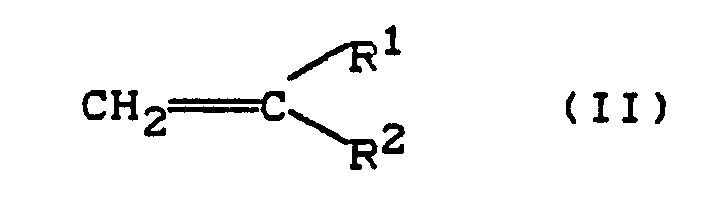
-COOH, -CONH₂, -COOCH₂CH₂OH,
- Die erfindungsgemäßen Copolymere sind je nach Zusammensetzung thermoplastisch oder elastisch, wonach sich auch ihre Verwendung richtet.
- So sind jene erfindungsgemäßen Copolymere, welche aufgrund ihrer Zusammensetzung Elastomercharakter haben, vor allem zur Herstellung von Gummiartikeln geeignet, während die erfindungsgemäßen thermoplastischen Copolymere zur Herstellung von Spritzgußartikeln, Klebstoffen, Beschichtungen oder Folien geeignet sind.
- In einem kontinuierlich durchströmten stopfbuchslosen 700 ml-Hochdruckrührautoklaven mit idealer Rückvermischung wurden die in der Tabelle 1 aufgeführten Monomerströme durch Zugabe von PO (tert.-Butylperisooctanoat) bei einem Reaktionsdruck von 1.850 bar (Beispiel 2-4) bzw. 2.100 bar (Vergleichsbeispiel 1) copolymerisiert. In einem nachgeschalteten Entspannungsabscheider wurde das Copolymerisat von unumgesetzten Monomeren befreit. Die Reaktionstemperatur wurde über die Initiatormenge kontrolliert. Als Molekulargewichtsregler wurde bei Versuch 2 Propanal (PRAL) zur Absenkung der Molmassen zudosiert. Die Versuchsparameter und Produkteigenschaften sind in der Tabelle 1 dargestellt.
- Der Initiatorverbrauch ist sehr hoch. Es besteht die Gefahr, daß das ACN, das selbst als Regler wirkt, im Autoklaven ausfällt. Dies hat zur Folge, daß in diesem Moment die Initiatormenge so hoch ist, daß es zu einer schlagartigen Polymerisation des Ethylens kommt (Explosionsgefahr).
- Auch ECA wirkt wie Beispiele 3 und 4 zeigen, als Regler. Jedoch steigt der Initiatorverbrauch nur geringfügig an.

Claims (8)

R ein C₁-C₂₀-Alkylrest ist.

-COOH, -CONH₂, -COOCH₂CH₂OH,

R² Wasserstoff oder Methyl bedeuten.
Applications Claiming Priority (2)
| Application Number | Priority Date | Filing Date | Title |
|---|---|---|---|
| DE3628903 | 1986-08-26 | ||
| DE19863628903 DE3628903A1 (de) | 1986-08-26 | 1986-08-26 | Ethylen und (alpha)-cyanacrylate enthaltende copolymere |
Publications (2)
| Publication Number | Publication Date |
|---|---|
| EP0261381A2 true EP0261381A2 (de) | 1988-03-30 |
| EP0261381A3 EP0261381A3 (de) | 1990-09-05 |
Family
ID=6308159
Family Applications (1)
| Application Number | Title | Priority Date | Filing Date |
|---|---|---|---|
| EP19870111794 Withdrawn EP0261381A3 (de) | 1986-08-26 | 1987-08-14 | Ethylen und Alpha-Cyanacrylate enthaltende Copolymere |
Country Status (5)
| Country | Link |
|---|---|
| US (1) | US4783515A (de) |
| EP (1) | EP0261381A3 (de) |
| JP (1) | JPS6357616A (de) |
| DE (1) | DE3628903A1 (de) |
| NO (1) | NO873384L (de) |
Families Citing this family (4)
| Publication number | Priority date | Publication date | Assignee | Title |
|---|---|---|---|---|
| EP0610508B1 (de) * | 1992-06-09 | 1996-10-16 | Mitsubishi Jidosha Kogyo Kabushiki Kaisha | Verfahren zur erkennung von fehlzündungen durch drehzahländerung der kurbelwelle |
| DE19680971B4 (de) * | 1995-10-20 | 2005-04-28 | Hitachi Ltd | Vorrichtung und Verfahren zum Steuern eines Verbrennungsmotors für ein Kraftfahrzeug |
| US6425704B2 (en) | 2000-01-07 | 2002-07-30 | Closure Medical Corporation | Adhesive applicators with improved applicator tips |
| US6616019B2 (en) | 2001-07-18 | 2003-09-09 | Closure Medical Corporation | Adhesive applicator with improved applicator tip |
Family Cites Families (8)
| Publication number | Priority date | Publication date | Assignee | Title |
|---|---|---|---|---|
| US2765297A (en) * | 1952-05-21 | 1956-10-02 | Borden Co | Polymerization of ethylene with promoted catalysts |
| FR1337619A (fr) * | 1961-10-18 | 1963-09-13 | Basf Ag | Procédé pour la production de copolymères d'éthylène et d'isocyanate de vinyle ou d'isocyanate d'isopropényle |
| US3884888A (en) * | 1969-06-02 | 1975-05-20 | Du Pont | Functionally substituted terpolymers and tetrapolymers of {60 -olefins and process for manufacturing functional substituted copolymers |
| US3796687A (en) * | 1969-06-02 | 1974-03-12 | Du Pont | Functionally substituted terpolymers and tetrapolymers of alpha-olefins and process for manufacturing functional substituted copolymers |
| US3903055A (en) * | 1972-12-21 | 1975-09-02 | Johnson & Johnson | Method for initiating polymerization of cyanoacrylate monomers and comonomer blends thereof to give reproducible and predetermined gel/transition time characteristics |
| JPS6037836B2 (ja) * | 1977-08-05 | 1985-08-28 | 東亞合成株式会社 | 接着剤組成物 |
| JPS5647471A (en) * | 1979-09-28 | 1981-04-30 | Japan Synthetic Rubber Co Ltd | Instantaneous adhesive composition |
| AT365623B (de) * | 1980-03-10 | 1982-02-10 | Teroson Gmbh | Cyanoacrylat-klebstoffzusammensetzung |
-
1986
- 1986-08-26 DE DE19863628903 patent/DE3628903A1/de not_active Withdrawn
-
1987
- 1987-08-12 NO NO873384A patent/NO873384L/no unknown
- 1987-08-14 EP EP19870111794 patent/EP0261381A3/de not_active Withdrawn
- 1987-08-14 US US07/085,146 patent/US4783515A/en not_active Expired - Fee Related
- 1987-08-21 JP JP62206601A patent/JPS6357616A/ja active Pending
Also Published As
| Publication number | Publication date |
|---|---|
| NO873384D0 (no) | 1987-08-12 |
| US4783515A (en) | 1988-11-08 |
| JPS6357616A (ja) | 1988-03-12 |
| EP0261381A3 (de) | 1990-09-05 |
| NO873384L (no) | 1988-02-29 |
| DE3628903A1 (de) | 1988-03-03 |
Similar Documents
| Publication | Publication Date | Title |
|---|---|---|
| EP0460936A1 (de) | Methanol-Copolymerisation von Äthylen | |
| EP0463761A2 (de) | Copolymerisation von Ethylen mit Kohlenmonoxyd und einem Comonomer | |
| US3773699A (en) | Process employing a redox catalyst system for manufacturing linked ethylene vinyl grafted copolymer dispersions | |
| US3749756A (en) | Preparation method of carboxylated polymer | |
| DE3404742A1 (de) | Verfahren zur herstellung von copolymerisaten des ethylens mit carboxylgruppenhaltigen comonomeren in einem 2-zonen-reaktor bei druecken oberhalb 500 bar | |
| US3383372A (en) | Ethylene/glycidyl ester copolymers | |
| US4210739A (en) | Internally plasticized vinyl chloride copolymer composition | |
| EP0400056B1 (de) | Verfahren zur herstellung eines elastomerhaltigen vinylchloridpfropfcopolymerisats | |
| DE60225206T2 (de) | Halbkontinuierliche bimodale Emulsionspolymerisation | |
| DE3628903A1 (de) | Ethylen und (alpha)-cyanacrylate enthaltende copolymere | |
| DE60000719T2 (de) | Polymerisationsverfahren unter verwendung verdünnter multikomponenten ströme | |
| US3736305A (en) | Production of copolymers of ethylene | |
| EP0003735B1 (de) | Initiatormischungen bestehend aus organischen Peroxiden und substituierten Diphenyläthanen und Verfahren zur Phlegmatisierung organischer Peroxide durch die Herstellung solcher Mischungen | |
| JPS6128685B2 (de) | ||
| EP0681593B1 (de) | Pfropf- und core-shell-copolymerisate mit verbesserter phasenanbindung zwischen pfropfgrundlage und aufgepfropfter polymerphase | |
| EP0483476B1 (de) | Verfahren zur Niedrigtemperaturherstellung von Isopropenyl-Alpha,Alphadimethyl-Benzylisocyanat-Pfropflatizes | |
| EP0534237B1 (de) | Ethylenhomopolymerisate und -copolymerisate sowie ein Verfahren zu ihrer Herstellung | |
| KR100608962B1 (ko) | 잔류 공단량체 함량이 낮은 에틸렌/(메트)아크릴레이트공중합체 | |
| JPH01156309A (ja) | エチレン系共重合体の製造方法 | |
| EP0539988B1 (de) | Pfropfcopolymerisate mit verbesserter Phasenanbindung zwischen Pfropfgrundlage und aufgepfropfter Polymerphase | |
| DE2623503C2 (de) | Verfahren zur Pfropfung von Vinylchlorid auf Äthylen-Vinylacetat- bzw. -Alkylacrylat-Copolymerisate | |
| US4064198A (en) | Process for the manufacture of shaped articles by graft polymerization | |
| US3998912A (en) | Manufacture of graft copolymers | |
| US5183855A (en) | Graft copolymer based on an ultrahigh-molecular-weight polyethylene and an ethylene copolymer | |
| US3496151A (en) | Ethylene copolymers and a process for their manufacture |
Legal Events
| Date | Code | Title | Description |
|---|---|---|---|
| PUAI | Public reference made under article 153(3) epc to a published international application that has entered the european phase |
Free format text: ORIGINAL CODE: 0009012 |
|
| 17P | Request for examination filed |
Effective date: 19870814 |
|
| AK | Designated contracting states |
Kind code of ref document: A2 Designated state(s): AT BE CH DE ES FR GB IT LI NL |
|
| PUAL | Search report despatched |
Free format text: ORIGINAL CODE: 0009013 |
|
| AK | Designated contracting states |
Kind code of ref document: A3 Designated state(s): AT BE CH DE ES FR GB IT LI NL |
|
| 17Q | First examination report despatched |
Effective date: 19910821 |
|
| STAA | Information on the status of an ep patent application or granted ep patent |
Free format text: STATUS: THE APPLICATION HAS BEEN WITHDRAWN |
|
| 18W | Application withdrawn |
Withdrawal date: 19911105 |
|
| R18W | Application withdrawn (corrected) |
Effective date: 19911105 |
|
| RIN1 | Information on inventor provided before grant (corrected) |
Inventor name: BARTL, HERBERT, DR. Inventor name: WANICZEK, HELMUT, DR. Inventor name: HERWIG, JENS, DR. |