EP0261981B1 - Composition résineuse photosensible - Google Patents
Composition résineuse photosensible Download PDFInfo
- Publication number
- EP0261981B1 EP0261981B1 EP87308504A EP87308504A EP0261981B1 EP 0261981 B1 EP0261981 B1 EP 0261981B1 EP 87308504 A EP87308504 A EP 87308504A EP 87308504 A EP87308504 A EP 87308504A EP 0261981 B1 EP0261981 B1 EP 0261981B1
- Authority
- EP
- European Patent Office
- Prior art keywords
- group
- derivative
- vinyl acetate
- mole
- vinyl
- Prior art date
- Legal status (The legal status is an assumption and is not a legal conclusion. Google has not performed a legal analysis and makes no representation as to the accuracy of the status listed.)
- Expired
Links
- 239000011342 resin composition Substances 0.000 title claims description 30
- 229920002689 polyvinyl acetate Polymers 0.000 claims description 76
- 239000011118 polyvinyl acetate Substances 0.000 claims description 76
- XTXRWKRVRITETP-UHFFFAOYSA-N Vinyl acetate Chemical class CC(=O)OC=C XTXRWKRVRITETP-UHFFFAOYSA-N 0.000 claims description 60
- -1 aminophenyl group Chemical group 0.000 claims description 58
- IMROMDMJAWUWLK-UHFFFAOYSA-N Ethenol Chemical group OC=C IMROMDMJAWUWLK-UHFFFAOYSA-N 0.000 claims description 25
- 238000006116 polymerization reaction Methods 0.000 claims description 17
- 125000000391 vinyl group Chemical group [H]C([*])=C([H])[H] 0.000 claims description 17
- 238000007127 saponification reaction Methods 0.000 claims description 16
- 229920002554 vinyl polymer Polymers 0.000 claims description 16
- 150000001875 compounds Chemical class 0.000 claims description 13
- 125000000217 alkyl group Chemical group 0.000 claims description 12
- 125000004435 hydrogen atom Chemical group [H]* 0.000 claims description 12
- 150000001242 acetic acid derivatives Chemical class 0.000 claims description 9
- 229920001577 copolymer Polymers 0.000 claims description 8
- 125000001997 phenyl group Chemical group [H]C1=C([H])C([H])=C(*)C([H])=C1[H] 0.000 claims description 8
- 125000005843 halogen group Chemical group 0.000 claims description 5
- 125000003710 aryl alkyl group Chemical group 0.000 claims description 4
- 125000002887 hydroxy group Chemical group [H]O* 0.000 claims description 4
- 150000001450 anions Chemical class 0.000 claims description 3
- 125000003917 carbamoyl group Chemical group [H]N([H])C(*)=O 0.000 claims description 3
- 125000006501 nitrophenyl group Chemical group 0.000 claims description 3
- 125000004036 acetal group Chemical group 0.000 claims description 2
- RTZKZFJDLAIYFH-UHFFFAOYSA-N ether Substances CCOCC RTZKZFJDLAIYFH-UHFFFAOYSA-N 0.000 claims description 2
- 229910052736 halogen Inorganic materials 0.000 claims description 2
- 150000002367 halogens Chemical class 0.000 claims description 2
- XLYOFNOQVPJJNP-UHFFFAOYSA-N water Substances O XLYOFNOQVPJJNP-UHFFFAOYSA-N 0.000 description 52
- NBIIXXVUZAFLBC-UHFFFAOYSA-N Phosphoric acid Chemical compound OP(O)(O)=O NBIIXXVUZAFLBC-UHFFFAOYSA-N 0.000 description 38
- LAQYHRQFABOIFD-UHFFFAOYSA-N 2-methoxyhydroquinone Chemical compound COC1=CC(O)=CC=C1O LAQYHRQFABOIFD-UHFFFAOYSA-N 0.000 description 32
- 239000000243 solution Substances 0.000 description 31
- 239000000203 mixture Substances 0.000 description 30
- 239000007864 aqueous solution Substances 0.000 description 25
- 229910000147 aluminium phosphate Inorganic materials 0.000 description 19
- QLAJNZSPVITUCQ-UHFFFAOYSA-N 1,3,2-dioxathietane 2,2-dioxide Chemical compound O=S1(=O)OCO1 QLAJNZSPVITUCQ-UHFFFAOYSA-N 0.000 description 17
- 230000000052 comparative effect Effects 0.000 description 17
- 230000004304 visual acuity Effects 0.000 description 17
- CNCOEDDPFOAUMB-UHFFFAOYSA-N N-Methylolacrylamide Chemical compound OCNC(=O)C=C CNCOEDDPFOAUMB-UHFFFAOYSA-N 0.000 description 16
- 239000011347 resin Substances 0.000 description 13
- 229920005989 resin Polymers 0.000 description 13
- RYLOLRAYISQACV-UHFFFAOYSA-N 4-[2-(1-methylpyridin-1-ium-4-yl)ethenyl]benzaldehyde Chemical compound C1=C[N+](C)=CC=C1C=CC1=CC=C(C=O)C=C1 RYLOLRAYISQACV-UHFFFAOYSA-N 0.000 description 12
- 238000007650 screen-printing Methods 0.000 description 12
- JOXIMZWYDAKGHI-UHFFFAOYSA-N toluene-4-sulfonic acid Chemical compound CC1=CC=C(S(O)(=O)=O)C=C1 JOXIMZWYDAKGHI-UHFFFAOYSA-N 0.000 description 12
- LFQSCWFLJHTTHZ-UHFFFAOYSA-N Ethanol Chemical compound CCO LFQSCWFLJHTTHZ-UHFFFAOYSA-N 0.000 description 11
- 230000035945 sensitivity Effects 0.000 description 9
- CSCPPACGZOOCGX-UHFFFAOYSA-N Acetone Chemical compound CC(C)=O CSCPPACGZOOCGX-UHFFFAOYSA-N 0.000 description 8
- HGINCPLSRVDWNT-UHFFFAOYSA-N Acrolein Chemical compound C=CC=O HGINCPLSRVDWNT-UHFFFAOYSA-N 0.000 description 8
- 239000000047 product Substances 0.000 description 8
- 239000002904 solvent Substances 0.000 description 8
- MLUCVPSAIODCQM-NSCUHMNNSA-N crotonaldehyde Chemical compound C\C=C\C=O MLUCVPSAIODCQM-NSCUHMNNSA-N 0.000 description 6
- MLUCVPSAIODCQM-UHFFFAOYSA-N crotonaldehyde Natural products CC=CC=O MLUCVPSAIODCQM-UHFFFAOYSA-N 0.000 description 6
- DNTMQTKDNSEIFO-UHFFFAOYSA-N n-(hydroxymethyl)-2-methylprop-2-enamide Chemical compound CC(=C)C(=O)NCO DNTMQTKDNSEIFO-UHFFFAOYSA-N 0.000 description 6
- ZTQSAGDEMFDKMZ-UHFFFAOYSA-N Butyraldehyde Chemical compound CCCC=O ZTQSAGDEMFDKMZ-UHFFFAOYSA-N 0.000 description 5
- 239000002253 acid Substances 0.000 description 5
- 239000004677 Nylon Substances 0.000 description 4
- 239000003513 alkali Substances 0.000 description 4
- 125000004432 carbon atom Chemical group C* 0.000 description 4
- 238000006243 chemical reaction Methods 0.000 description 4
- 235000019441 ethanol Nutrition 0.000 description 4
- 125000001495 ethyl group Chemical group [H]C([H])([H])C([H])([H])* 0.000 description 4
- 239000003999 initiator Substances 0.000 description 4
- QSHDDOUJBYECFT-UHFFFAOYSA-N mercury Chemical compound [Hg] QSHDDOUJBYECFT-UHFFFAOYSA-N 0.000 description 4
- 229910052753 mercury Inorganic materials 0.000 description 4
- 229920001778 nylon Polymers 0.000 description 4
- 229940117958 vinyl acetate Drugs 0.000 description 4
- RYHBNJHYFVUHQT-UHFFFAOYSA-N 1,4-Dioxane Chemical compound C1COCCO1 RYHBNJHYFVUHQT-UHFFFAOYSA-N 0.000 description 3
- 239000012046 mixed solvent Substances 0.000 description 3
- 239000000126 substance Substances 0.000 description 3
- VVBLNCFGVYUYGU-UHFFFAOYSA-N 4,4'-Bis(dimethylamino)benzophenone Chemical compound C1=CC(N(C)C)=CC=C1C(=O)C1=CC=C(N(C)C)C=C1 VVBLNCFGVYUYGU-UHFFFAOYSA-N 0.000 description 2
- XNKONQDITDQDQB-UHFFFAOYSA-M 4-[2-[1-(2-hydroxyethyl)pyridin-1-ium-4-yl]ethenyl]benzaldehyde;chloride Chemical compound [Cl-].C1=C[N+](CCO)=CC=C1C=CC1=CC=C(C=O)C=C1 XNKONQDITDQDQB-UHFFFAOYSA-M 0.000 description 2
- HRPVXLWXLXDGHG-UHFFFAOYSA-N Acrylamide Chemical compound NC(=O)C=C HRPVXLWXLXDGHG-UHFFFAOYSA-N 0.000 description 2
- 206010034972 Photosensitivity reaction Diseases 0.000 description 2
- PPBRXRYQALVLMV-UHFFFAOYSA-N Styrene Chemical compound C=CC1=CC=CC=C1 PPBRXRYQALVLMV-UHFFFAOYSA-N 0.000 description 2
- 238000006359 acetalization reaction Methods 0.000 description 2
- 238000000149 argon plasma sintering Methods 0.000 description 2
- HUMNYLRZRPPJDN-UHFFFAOYSA-N benzaldehyde Chemical compound O=CC1=CC=CC=C1 HUMNYLRZRPPJDN-UHFFFAOYSA-N 0.000 description 2
- 125000001797 benzyl group Chemical group [H]C1=C([H])C([H])=C(C([H])=C1[H])C([H])([H])* 0.000 description 2
- 125000000484 butyl group Chemical group [H]C([*])([H])C([H])([H])C([H])([H])C([H])([H])[H] 0.000 description 2
- 239000003795 chemical substances by application Substances 0.000 description 2
- 238000004132 cross linking Methods 0.000 description 2
- 239000000839 emulsion Substances 0.000 description 2
- 125000004051 hexyl group Chemical group [H]C([H])([H])C([H])([H])C([H])([H])C([H])([H])C([H])([H])C([H])([H])* 0.000 description 2
- 150000002500 ions Chemical class 0.000 description 2
- 125000002496 methyl group Chemical group [H]C([H])([H])* 0.000 description 2
- 238000011907 photodimerization Methods 0.000 description 2
- 230000036211 photosensitivity Effects 0.000 description 2
- 238000007639 printing Methods 0.000 description 2
- 125000001436 propyl group Chemical group [H]C([*])([H])C([H])([H])C([H])([H])[H] 0.000 description 2
- OHVLMTFVQDZYHP-UHFFFAOYSA-N 1-(2,4,6,7-tetrahydrotriazolo[4,5-c]pyridin-5-yl)-2-[4-[2-[[3-(trifluoromethoxy)phenyl]methylamino]pyrimidin-5-yl]piperazin-1-yl]ethanone Chemical compound N1N=NC=2CN(CCC=21)C(CN1CCN(CC1)C=1C=NC(=NC=1)NCC1=CC(=CC=C1)OC(F)(F)F)=O OHVLMTFVQDZYHP-UHFFFAOYSA-N 0.000 description 1
- KZEVSDGEBAJOTK-UHFFFAOYSA-N 1-(2,4,6,7-tetrahydrotriazolo[4,5-c]pyridin-5-yl)-2-[5-[2-[[3-(trifluoromethoxy)phenyl]methylamino]pyrimidin-5-yl]-1,3,4-oxadiazol-2-yl]ethanone Chemical compound N1N=NC=2CN(CCC=21)C(CC=1OC(=NN=1)C=1C=NC(=NC=1)NCC1=CC(=CC=C1)OC(F)(F)F)=O KZEVSDGEBAJOTK-UHFFFAOYSA-N 0.000 description 1
- HMUNWXXNJPVALC-UHFFFAOYSA-N 1-[4-[2-(2,3-dihydro-1H-inden-2-ylamino)pyrimidin-5-yl]piperazin-1-yl]-2-(2,4,6,7-tetrahydrotriazolo[4,5-c]pyridin-5-yl)ethanone Chemical compound C1C(CC2=CC=CC=C12)NC1=NC=C(C=N1)N1CCN(CC1)C(CN1CC2=C(CC1)NN=N2)=O HMUNWXXNJPVALC-UHFFFAOYSA-N 0.000 description 1
- HJKLEAOXCZIMPI-UHFFFAOYSA-N 2,2-diethoxyethanamine Chemical compound CCOC(CN)OCC HJKLEAOXCZIMPI-UHFFFAOYSA-N 0.000 description 1
- BTJPUDCSZVCXFQ-UHFFFAOYSA-N 2,4-diethylthioxanthen-9-one Chemical compound C1=CC=C2C(=O)C3=CC(CC)=CC(CC)=C3SC2=C1 BTJPUDCSZVCXFQ-UHFFFAOYSA-N 0.000 description 1
- HTSRQGZFAAUHFZ-UHFFFAOYSA-N 2-(1-methylpyridin-1-ium-2-yl)-3-phenylprop-2-enal;hydrochloride Chemical compound Cl.C[N+]1=CC=CC=C1C(C=O)=CC1=CC=CC=C1 HTSRQGZFAAUHFZ-UHFFFAOYSA-N 0.000 description 1
- VCRXFJRDPUXVEY-UHFFFAOYSA-N 2-(1-methylquinolin-1-ium-2-yl)-3-phenylprop-2-enal;hydrochloride Chemical compound Cl.C1=CC2=CC=CC=C2[N+](C)=C1C(C=O)=CC1=CC=CC=C1 VCRXFJRDPUXVEY-UHFFFAOYSA-N 0.000 description 1
- VZSRBBMJRBPUNF-UHFFFAOYSA-N 2-(2,3-dihydro-1H-inden-2-ylamino)-N-[3-oxo-3-(2,4,6,7-tetrahydrotriazolo[4,5-c]pyridin-5-yl)propyl]pyrimidine-5-carboxamide Chemical compound C1C(CC2=CC=CC=C12)NC1=NC=C(C=N1)C(=O)NCCC(N1CC2=C(CC1)NN=N2)=O VZSRBBMJRBPUNF-UHFFFAOYSA-N 0.000 description 1
- LDXJRKWFNNFDSA-UHFFFAOYSA-N 2-(2,4,6,7-tetrahydrotriazolo[4,5-c]pyridin-5-yl)-1-[4-[2-[[3-(trifluoromethoxy)phenyl]methylamino]pyrimidin-5-yl]piperazin-1-yl]ethanone Chemical compound C1CN(CC2=NNN=C21)CC(=O)N3CCN(CC3)C4=CN=C(N=C4)NCC5=CC(=CC=C5)OC(F)(F)F LDXJRKWFNNFDSA-UHFFFAOYSA-N 0.000 description 1
- SMZOUWXMTYCWNB-UHFFFAOYSA-N 2-(2-methoxy-5-methylphenyl)ethanamine Chemical compound COC1=CC=C(C)C=C1CCN SMZOUWXMTYCWNB-UHFFFAOYSA-N 0.000 description 1
- NIXOWILDQLNWCW-UHFFFAOYSA-N 2-Propenoic acid Natural products OC(=O)C=C NIXOWILDQLNWCW-UHFFFAOYSA-N 0.000 description 1
- SXAMGRAIZSSWIH-UHFFFAOYSA-N 2-[3-[2-(2,3-dihydro-1H-inden-2-ylamino)pyrimidin-5-yl]-1,2,4-oxadiazol-5-yl]-1-(2,4,6,7-tetrahydrotriazolo[4,5-c]pyridin-5-yl)ethanone Chemical compound C1C(CC2=CC=CC=C12)NC1=NC=C(C=N1)C1=NOC(=N1)CC(=O)N1CC2=C(CC1)NN=N2 SXAMGRAIZSSWIH-UHFFFAOYSA-N 0.000 description 1
- WZFUQSJFWNHZHM-UHFFFAOYSA-N 2-[4-[2-(2,3-dihydro-1H-inden-2-ylamino)pyrimidin-5-yl]piperazin-1-yl]-1-(2,4,6,7-tetrahydrotriazolo[4,5-c]pyridin-5-yl)ethanone Chemical compound C1C(CC2=CC=CC=C12)NC1=NC=C(C=N1)N1CCN(CC1)CC(=O)N1CC2=C(CC1)NN=N2 WZFUQSJFWNHZHM-UHFFFAOYSA-N 0.000 description 1
- JQMFQLVAJGZSQS-UHFFFAOYSA-N 2-[4-[2-(2,3-dihydro-1H-inden-2-ylamino)pyrimidin-5-yl]piperazin-1-yl]-N-(2-oxo-3H-1,3-benzoxazol-6-yl)acetamide Chemical compound C1C(CC2=CC=CC=C12)NC1=NC=C(C=N1)N1CCN(CC1)CC(=O)NC1=CC2=C(NC(O2)=O)C=C1 JQMFQLVAJGZSQS-UHFFFAOYSA-N 0.000 description 1
- YJLUBHOZZTYQIP-UHFFFAOYSA-N 2-[5-[2-(2,3-dihydro-1H-inden-2-ylamino)pyrimidin-5-yl]-1,3,4-oxadiazol-2-yl]-1-(2,4,6,7-tetrahydrotriazolo[4,5-c]pyridin-5-yl)ethanone Chemical compound C1C(CC2=CC=CC=C12)NC1=NC=C(C=N1)C1=NN=C(O1)CC(=O)N1CC2=C(CC1)NN=N2 YJLUBHOZZTYQIP-UHFFFAOYSA-N 0.000 description 1
- FXWFZIRWWNPPOV-UHFFFAOYSA-N 2-aminobenzaldehyde Chemical compound NC1=CC=CC=C1C=O FXWFZIRWWNPPOV-UHFFFAOYSA-N 0.000 description 1
- CMWKITSNTDAEDT-UHFFFAOYSA-N 2-nitrobenzaldehyde Chemical compound [O-][N+](=O)C1=CC=CC=C1C=O CMWKITSNTDAEDT-UHFFFAOYSA-N 0.000 description 1
- YLZOPXRUQYQQID-UHFFFAOYSA-N 3-(2,4,6,7-tetrahydrotriazolo[4,5-c]pyridin-5-yl)-1-[4-[2-[[3-(trifluoromethoxy)phenyl]methylamino]pyrimidin-5-yl]piperazin-1-yl]propan-1-one Chemical compound N1N=NC=2CN(CCC=21)CCC(=O)N1CCN(CC1)C=1C=NC(=NC=1)NCC1=CC(=CC=C1)OC(F)(F)F YLZOPXRUQYQQID-UHFFFAOYSA-N 0.000 description 1
- QJNKRLXEVGOXGC-UHFFFAOYSA-N 4-[2-(1-methylquinolin-1-ium-4-yl)ethenyl]benzaldehyde Chemical compound C12=CC=CC=C2[N+](C)=CC=C1C=CC1=CC=C(C=O)C=C1 QJNKRLXEVGOXGC-UHFFFAOYSA-N 0.000 description 1
- JQUYGVLBFJZXKF-UHFFFAOYSA-M 4-[2-[4-(2,2-dimethoxyethoxy)phenyl]ethenyl]-1-methylpyridin-1-ium;4-methylbenzenesulfonate Chemical compound CC1=CC=C(S([O-])(=O)=O)C=C1.C1=CC(OCC(OC)OC)=CC=C1C=CC1=CC=[N+](C)C=C1 JQUYGVLBFJZXKF-UHFFFAOYSA-M 0.000 description 1
- CONKBQPVFMXDOV-QHCPKHFHSA-N 6-[(5S)-5-[[4-[2-(2,3-dihydro-1H-inden-2-ylamino)pyrimidin-5-yl]piperazin-1-yl]methyl]-2-oxo-1,3-oxazolidin-3-yl]-3H-1,3-benzoxazol-2-one Chemical compound C1C(CC2=CC=CC=C12)NC1=NC=C(C=N1)N1CCN(CC1)C[C@H]1CN(C(O1)=O)C1=CC2=C(NC(O2)=O)C=C1 CONKBQPVFMXDOV-QHCPKHFHSA-N 0.000 description 1
- 206010000060 Abdominal distension Diseases 0.000 description 1
- NIXOWILDQLNWCW-UHFFFAOYSA-M Acrylate Chemical compound [O-]C(=O)C=C NIXOWILDQLNWCW-UHFFFAOYSA-M 0.000 description 1
- NLHHRLWOUZZQLW-UHFFFAOYSA-N Acrylonitrile Chemical compound C=CC#N NLHHRLWOUZZQLW-UHFFFAOYSA-N 0.000 description 1
- NLXLAEXVIDQMFP-UHFFFAOYSA-N Ammonium chloride Substances [NH4+].[Cl-] NLXLAEXVIDQMFP-UHFFFAOYSA-N 0.000 description 1
- VHUUQVKOLVNVRT-UHFFFAOYSA-N Ammonium hydroxide Chemical compound [NH4+].[OH-] VHUUQVKOLVNVRT-UHFFFAOYSA-N 0.000 description 1
- CPELXLSAUQHCOX-UHFFFAOYSA-M Bromide Chemical compound [Br-] CPELXLSAUQHCOX-UHFFFAOYSA-M 0.000 description 1
- VEXZGXHMUGYJMC-UHFFFAOYSA-M Chloride anion Chemical compound [Cl-] VEXZGXHMUGYJMC-UHFFFAOYSA-M 0.000 description 1
- VGGSQFUCUMXWEO-UHFFFAOYSA-N Ethene Chemical compound C=C VGGSQFUCUMXWEO-UHFFFAOYSA-N 0.000 description 1
- 239000005977 Ethylene Substances 0.000 description 1
- CERQOIWHTDAKMF-UHFFFAOYSA-M Methacrylate Chemical compound CC(=C)C([O-])=O CERQOIWHTDAKMF-UHFFFAOYSA-M 0.000 description 1
- CERQOIWHTDAKMF-UHFFFAOYSA-N Methacrylic acid Chemical compound CC(=C)C(O)=O CERQOIWHTDAKMF-UHFFFAOYSA-N 0.000 description 1
- MKYBYDHXWVHEJW-UHFFFAOYSA-N N-[1-oxo-1-(2,4,6,7-tetrahydrotriazolo[4,5-c]pyridin-5-yl)propan-2-yl]-2-[[3-(trifluoromethoxy)phenyl]methylamino]pyrimidine-5-carboxamide Chemical compound O=C(C(C)NC(=O)C=1C=NC(=NC=1)NCC1=CC(=CC=C1)OC(F)(F)F)N1CC2=C(CC1)NN=N2 MKYBYDHXWVHEJW-UHFFFAOYSA-N 0.000 description 1
- NIPNSKYNPDTRPC-UHFFFAOYSA-N N-[2-oxo-2-(2,4,6,7-tetrahydrotriazolo[4,5-c]pyridin-5-yl)ethyl]-2-[[3-(trifluoromethoxy)phenyl]methylamino]pyrimidine-5-carboxamide Chemical compound O=C(CNC(=O)C=1C=NC(=NC=1)NCC1=CC(=CC=C1)OC(F)(F)F)N1CC2=C(CC1)NN=N2 NIPNSKYNPDTRPC-UHFFFAOYSA-N 0.000 description 1
- AFCARXCZXQIEQB-UHFFFAOYSA-N N-[3-oxo-3-(2,4,6,7-tetrahydrotriazolo[4,5-c]pyridin-5-yl)propyl]-2-[[3-(trifluoromethoxy)phenyl]methylamino]pyrimidine-5-carboxamide Chemical compound O=C(CCNC(=O)C=1C=NC(=NC=1)NCC1=CC(=CC=C1)OC(F)(F)F)N1CC2=C(CC1)NN=N2 AFCARXCZXQIEQB-UHFFFAOYSA-N 0.000 description 1
- JUJWROOIHBZHMG-UHFFFAOYSA-N Pyridine Chemical group C1=CC=NC=C1 JUJWROOIHBZHMG-UHFFFAOYSA-N 0.000 description 1
- SMWDFEZZVXVKRB-UHFFFAOYSA-N Quinoline Chemical group N1=CC=CC2=CC=CC=C21 SMWDFEZZVXVKRB-UHFFFAOYSA-N 0.000 description 1
- 244000028419 Styrax benzoin Species 0.000 description 1
- 235000000126 Styrax benzoin Nutrition 0.000 description 1
- QAOWNCQODCNURD-UHFFFAOYSA-L Sulfate Chemical compound [O-]S([O-])(=O)=O QAOWNCQODCNURD-UHFFFAOYSA-L 0.000 description 1
- 235000008411 Sumatra benzointree Nutrition 0.000 description 1
- VTDSXGMZORQXAC-UHFFFAOYSA-M [Br-].C(C)[N+]1=C(C=CC2=CC=CC=C12)C=CC1=CC=C(C=C1)C=O Chemical compound [Br-].C(C)[N+]1=C(C=CC2=CC=CC=C12)C=CC1=CC=C(C=C1)C=O VTDSXGMZORQXAC-UHFFFAOYSA-M 0.000 description 1
- 0 [O-][N+](*I)(CCC1)c2c1cccc2 Chemical compound [O-][N+](*I)(CCC1)c2c1cccc2 0.000 description 1
- 239000003377 acid catalyst Substances 0.000 description 1
- 239000004411 aluminium Substances 0.000 description 1
- 229910052782 aluminium Inorganic materials 0.000 description 1
- XAGFODPZIPBFFR-UHFFFAOYSA-N aluminium Chemical compound [Al] XAGFODPZIPBFFR-UHFFFAOYSA-N 0.000 description 1
- QGZKDVFQNNGYKY-UHFFFAOYSA-N ammonia Natural products N QGZKDVFQNNGYKY-UHFFFAOYSA-N 0.000 description 1
- 235000011114 ammonium hydroxide Nutrition 0.000 description 1
- 238000004458 analytical method Methods 0.000 description 1
- QVGXLLKOCUKJST-UHFFFAOYSA-N atomic oxygen Chemical compound [O] QVGXLLKOCUKJST-UHFFFAOYSA-N 0.000 description 1
- 229960002130 benzoin Drugs 0.000 description 1
- RWCCWEUUXYIKHB-UHFFFAOYSA-N benzophenone Chemical compound C=1C=CC=CC=1C(=O)C1=CC=CC=C1 RWCCWEUUXYIKHB-UHFFFAOYSA-N 0.000 description 1
- 239000012965 benzophenone Substances 0.000 description 1
- 230000008033 biological extinction Effects 0.000 description 1
- 230000015572 biosynthetic process Effects 0.000 description 1
- ZNAAXKXXDQLJIX-UHFFFAOYSA-N bis(2-cyclohexyl-3-hydroxyphenyl)methanone Chemical compound C1CCCCC1C=1C(O)=CC=CC=1C(=O)C1=CC=CC(O)=C1C1CCCCC1 ZNAAXKXXDQLJIX-UHFFFAOYSA-N 0.000 description 1
- VYHBFRJRBHMIQZ-UHFFFAOYSA-N bis[4-(diethylamino)phenyl]methanone Chemical compound C1=CC(N(CC)CC)=CC=C1C(=O)C1=CC=C(N(CC)CC)C=C1 VYHBFRJRBHMIQZ-UHFFFAOYSA-N 0.000 description 1
- 208000024330 bloating Diseases 0.000 description 1
- 229910052794 bromium Inorganic materials 0.000 description 1
- CQEYYJKEWSMYFG-UHFFFAOYSA-N butyl acrylate Chemical compound CCCCOC(=O)C=C CQEYYJKEWSMYFG-UHFFFAOYSA-N 0.000 description 1
- 239000007795 chemical reaction product Substances 0.000 description 1
- 229910052801 chlorine Inorganic materials 0.000 description 1
- 239000000460 chlorine Substances 0.000 description 1
- 238000006482 condensation reaction Methods 0.000 description 1
- 230000003247 decreasing effect Effects 0.000 description 1
- 230000007547 defect Effects 0.000 description 1
- ISAOCJYIOMOJEB-UHFFFAOYSA-N desyl alcohol Natural products C=1C=CC=CC=1C(O)C(=O)C1=CC=CC=C1 ISAOCJYIOMOJEB-UHFFFAOYSA-N 0.000 description 1
- 150000005690 diesters Chemical class 0.000 description 1
- 230000000694 effects Effects 0.000 description 1
- 125000001033 ether group Chemical group 0.000 description 1
- UHESRSKEBRADOO-UHFFFAOYSA-N ethyl carbamate;prop-2-enoic acid Chemical compound OC(=O)C=C.CCOC(N)=O UHESRSKEBRADOO-UHFFFAOYSA-N 0.000 description 1
- 235000019382 gum benzoic Nutrition 0.000 description 1
- 150000004820 halides Chemical class 0.000 description 1
- 229910052740 iodine Inorganic materials 0.000 description 1
- 230000001678 irradiating effect Effects 0.000 description 1
- FPYJFEHAWHCUMM-UHFFFAOYSA-N maleic anhydride Chemical compound O=C1OC(=O)C=C1 FPYJFEHAWHCUMM-UHFFFAOYSA-N 0.000 description 1
- 238000004519 manufacturing process Methods 0.000 description 1
- 229910052751 metal Inorganic materials 0.000 description 1
- 239000002184 metal Substances 0.000 description 1
- WSFSSNUMVMOOMR-NJFSPNSNSA-N methanone Chemical compound O=[14CH2] WSFSSNUMVMOOMR-NJFSPNSNSA-N 0.000 description 1
- 238000000034 method Methods 0.000 description 1
- 125000006178 methyl benzyl group Chemical group 0.000 description 1
- CXKWCBBOMKCUKX-UHFFFAOYSA-M methylene blue Chemical compound [Cl-].C1=CC(N(C)C)=CC2=[S+]C3=CC(N(C)C)=CC=C3N=C21 CXKWCBBOMKCUKX-UHFFFAOYSA-M 0.000 description 1
- 229960000907 methylthioninium chloride Drugs 0.000 description 1
- 239000011259 mixed solution Substances 0.000 description 1
- 125000004923 naphthylmethyl group Chemical group C1(=CC=CC2=CC=CC=C12)C* 0.000 description 1
- 238000006386 neutralization reaction Methods 0.000 description 1
- 229910052760 oxygen Inorganic materials 0.000 description 1
- 239000001301 oxygen Substances 0.000 description 1
- QNGNSVIICDLXHT-UHFFFAOYSA-N para-ethylbenzaldehyde Natural products CCC1=CC=C(C=O)C=C1 QNGNSVIICDLXHT-UHFFFAOYSA-N 0.000 description 1
- FZUGPQWGEGAKET-UHFFFAOYSA-N parbenate Chemical compound CCOC(=O)C1=CC=C(N(C)C)C=C1 FZUGPQWGEGAKET-UHFFFAOYSA-N 0.000 description 1
- 125000001147 pentyl group Chemical group C(CCCC)* 0.000 description 1
- VLTRZXGMWDSKGL-UHFFFAOYSA-M perchlorate Chemical compound [O-]Cl(=O)(=O)=O VLTRZXGMWDSKGL-UHFFFAOYSA-M 0.000 description 1
- 125000000286 phenylethyl group Chemical group [H]C1=C([H])C([H])=C(C([H])=C1[H])C([H])([H])C([H])([H])* 0.000 description 1
- NBIIXXVUZAFLBC-UHFFFAOYSA-K phosphate Chemical compound [O-]P([O-])([O-])=O NBIIXXVUZAFLBC-UHFFFAOYSA-K 0.000 description 1
- 229940085991 phosphate ion Drugs 0.000 description 1
- 239000012264 purified product Substances 0.000 description 1
- 125000001453 quaternary ammonium group Chemical group 0.000 description 1
- 150000003242 quaternary ammonium salts Chemical group 0.000 description 1
- 150000003839 salts Chemical class 0.000 description 1
- 239000007787 solid Substances 0.000 description 1
- 238000006467 substitution reaction Methods 0.000 description 1
- 239000000758 substrate Substances 0.000 description 1
- 230000008961 swelling Effects 0.000 description 1
- 150000005691 triesters Chemical class 0.000 description 1
- 238000000870 ultraviolet spectroscopy Methods 0.000 description 1
- HGBOYTHUEUWSSQ-UHFFFAOYSA-N valeric aldehyde Natural products CCCCC=O HGBOYTHUEUWSSQ-UHFFFAOYSA-N 0.000 description 1
Classifications
-
- G—PHYSICS
- G03—PHOTOGRAPHY; CINEMATOGRAPHY; ANALOGOUS TECHNIQUES USING WAVES OTHER THAN OPTICAL WAVES; ELECTROGRAPHY; HOLOGRAPHY
- G03F—PHOTOMECHANICAL PRODUCTION OF TEXTURED OR PATTERNED SURFACES, e.g. FOR PRINTING, FOR PROCESSING OF SEMICONDUCTOR DEVICES; MATERIALS THEREFOR; ORIGINALS THEREFOR; APPARATUS SPECIALLY ADAPTED THEREFOR
- G03F7/00—Photomechanical, e.g. photolithographic, production of textured or patterned surfaces, e.g. printing surfaces; Materials therefor, e.g. comprising photoresists; Apparatus specially adapted therefor
- G03F7/004—Photosensitive materials
- G03F7/038—Macromolecular compounds which are rendered insoluble or differentially wettable
- G03F7/0388—Macromolecular compounds which are rendered insoluble or differentially wettable with ethylenic or acetylenic bands in the side chains of the photopolymer
-
- G—PHYSICS
- G03—PHOTOGRAPHY; CINEMATOGRAPHY; ANALOGOUS TECHNIQUES USING WAVES OTHER THAN OPTICAL WAVES; ELECTROGRAPHY; HOLOGRAPHY
- G03F—PHOTOMECHANICAL PRODUCTION OF TEXTURED OR PATTERNED SURFACES, e.g. FOR PRINTING, FOR PROCESSING OF SEMICONDUCTOR DEVICES; MATERIALS THEREFOR; ORIGINALS THEREFOR; APPARATUS SPECIALLY ADAPTED THEREFOR
- G03F7/00—Photomechanical, e.g. photolithographic, production of textured or patterned surfaces, e.g. printing surfaces; Materials therefor, e.g. comprising photoresists; Apparatus specially adapted therefor
- G03F7/004—Photosensitive materials
- G03F7/038—Macromolecular compounds which are rendered insoluble or differentially wettable
Definitions
- the present invention relates to a photosensitive resin composition. More particularly, it relates to a photosensitive resin composition which is not affected by oxygen, capable of image formation, has an excellent sensitivity, water resistance, solvent resistance, acid resistance, alkali resistance, water developing property, and resolving power and can be used for the production of screen printing plates, second originaJs, planographs, reliefs, plano-intaglios, television fluorescent screens and the like, and for the precision metal processing of printed circuit substrates with resist images and the like.
- a photosensitive resin compound comprising a saponified poly(vinyl acetate) and a styrylpyridinium salt compound or styrylquinolinium salt compound is known (see Japanese Patent Publication No. 1306/85).
- This photosensitive resin compound has a high sensitivity, but has the following drawback. That is, the photoreaction of this photosensitive resin is a photocrosslinking reaction caused by the photodimerization of a styrylpyridinium salt compound or styrylquinolinium salt compound grafted to the saponified poly(vinyl acetate).
- the amount of the hydroxyl group contained in the saponified poly(vinyl acetate) in the photosensitive layer is not varied by irradiation, and therefore, has a disadvantage in that a high resolving power cannot be obtained because a significant swelling thereof occurs upon water development due to a poor water resistance at parts which have been hardened by irradiation.
- the styrylquinolinium salt compound and the styrylpyridinium salt compound also are disadvantageous in that a satisfactory water resistance can not be obtained, probably because they contain a quaternary ammonium, salt, or the cross linking rate by photodimerization can not be increased to a satisfactory extent even if the rate at which the styrylpyridinium salt compound and the styrylquinolinium salt compound, are introduced is increased.
- Another prior art discloses a photosensitive resin compound obtained from, a saponified poly(vinyl acetate) and an N-methyloacrylamide or N-methylolmethacrylamide (see Japanese Patent Publication No. 5923/74). Further, a photosensitive resin compound obtained from a saponified polyvinyl acetate and acrolein or crotonaldehyde is known (see Japanese Unexamined Patent Publication No. 54-138091.
- This photosensive resin composition comprising a saponified poly(vinyl acetate) and an N-methylolacrylamide or N-methylolmethacrylamide or acrolein or crotonaldehyde has an excellent water resistance, but has the defects of a low resolving power and low sensitivity, or the like.
- a photosensitive resin compound having a high sensitivity and excellent water resistance, solvent resistance and resolving power can be obtained by combining and introducing one or more of at least one of a styrylpyridinium salt compound or a styrylquinolinium salt compound and at least one of a N-methylolacrylamide or N-methylolmethacrylamide, acrolein or crotonaldehyde into the saponified poly(vinyl acetate).
- the prior object of this invention is to provide a photosensitive resin composition which can be water developed, has an excellent water resistance, solvent resistance, acid resistance, alkali resistance and resolving power and a high sensitivity, to eliminate the drawbacks of the art mentioned above.
- a photosensitive resin composition which comprises a photosensitive saponified poly(vinyl acetate) derivative containing in the backbone of a saponified poly(vinyl acetate) derivative at least one of a first group of photosensitive units which are represented by the general formula (I) wherein represents a vinyl alcohol residue in the backbone of the saponified polyvinyl acetate derivative;
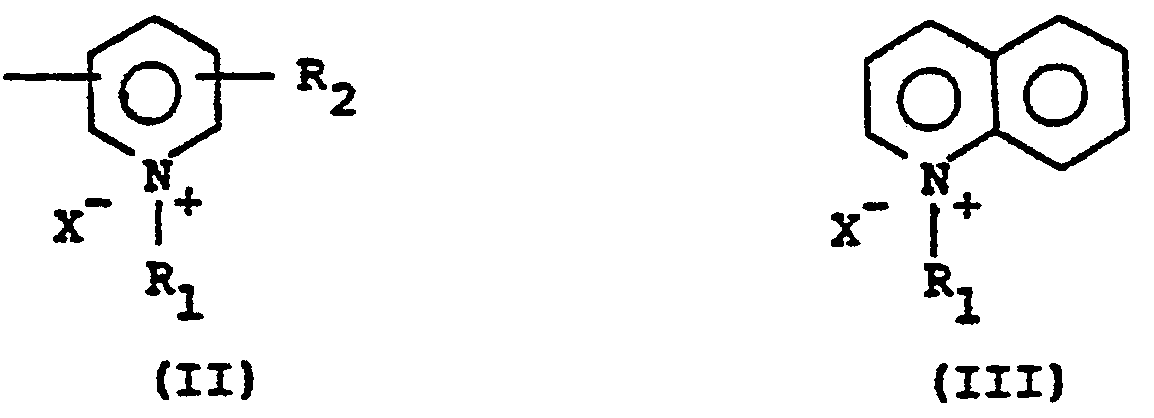
- Y represents a member selected from the groups consisting of the following general formulae (II) and (III) (II) (III)
- m denotes an integer of 1 - 6;
- n denotes 0 or 1;
- R 1 represents a member selected from a hydrogen atom, an unsubstituted alkyl and an unsubstituted aralkyl group, a hydroxyl group, a carbamoyl group, an ether bond and an unsaturated bond;
- R 2 represents a member selected from a hydrogen atom and a lower alkyl group; and
- the photosensitive resin composition of this invention comprises, as mentioned above, containing in the saponified poly(vinyl acetate) derivative photosensitive units selected from the first group thereof and photosensitive units selected from the second group thereof.
- the photosensitive units in the first group are bonded to a vinyl alcohol unit in the backbone of the saponified poly(vinyl acetate) and are represented by the general formula (I).
- the groups having the general formulae (II) and (III), which are respectively represented by Y in the aforementioned formula (I), are a pyridinium salt residue and a quinolinium salt residue and are generally included in quaternary ammonium salt residues.
- R 1 is selected from a hydrogen atom; an unsubstituted alkyl group, preferably having 1 - 6 carbon atoms, more preferably 1 - 4 carbon atoms, such as a methyl group, an ethyl group, a propyl group, a butyl group, a pentyl group, a hexyl group or the like; an unsubstituted aralkyl group such as a benzyl group; a phenylethyl group, a methylbenzyl group, a naphthylmethyl group or the like; and an alkyl group and aralkyl group having at least one member selected from a hydroxy group, a carbamoyl group, an ether group and an unsaturated bond (e.g. double bond).
- R 2 is selected from a hydrogen atom and a lower alkyl group, preferably an alkyl group having 1 - 6 carbon atoms, more preferably 1 - 4 carbon atoms, such as a methyl group, an ethyl group, a propyl group, a butyl group, a hexyl group or the like; and X- represents an anion such as a chlorine ion, a bromine ion, a sulfate ion, a phosphate ion, a perchlorate ion, a methoxysul- fate ion, p-toluenesulfonate ion, a hydroborofluorate ion or the like.
- the photosensitive units in the second group are bonded to a vinyl alcohol unit of the backbone of the saponified poly(vinyl acetate) derivative and are represented by the general formulae (IV) and (V).
- R 3 represents a member selected from a hydrogen atom, a lower alkyl group, a nitrophenyl group, a halogen atom, an aminophenyl group and a phenyl group
- R4, Rs and R 6 respectively represent a member selected from a hydrogen atom, a lower alkyl group, a halogen atom, and a phenyl group
- t 1 denotes 0 or 1.
- benzophenone a benzoin alkyl ether, Rose Bengal, Methylene Blue, hydroxycyclohexyl phenyl ketone, a thioxantone derivative, Michler's ketone, 4,4'-bisdiethylaminobenzophenone, benzyl, benzyl dimethyl ketal and the like can be used.
- the saponified poly(vinyl acetate) derivative is selected from a saponification product (a) of a copolymer of vinyl acetate and at least one of an ethylenic unsaturated compound such as butyl acrylate, vinyl hexylate, vinyl 2,2'-di-butylhexylate, acrylic acid, methacrylic acid, acrylamide, N-methylolacrylamide, styrene, ethylene, propylene, maleic anhydride, acrylonitrile and the like, a saponification product of a poly(vinyl acetate) (b), an acetalization product of a saponification product (a) or (b) with butyl aldehyde, nitrobenzaldehyde, formaldehyde, benzaldehyde, aminobenzaldehyde, aminoacetaldehyde diethyl acetal or the like, or a mixture of at least two selected from a saponification product (a
- the vinyl acetate unit of the saponified copolymer (a) prior to saponification is preferably in a proportion of 50 - 100 mole% to the total vinyl units. If the amount of the vinyl acetate unit is 50 mole% or less, the saponified copolymer (a) is not preferred because of the insolubility thereof in water.
- the acetalized product (c) is preferably substituted by an acetal group in an amount of 0 - 50 mole% of the vinyl alcohol unit of the saponified product (a) or (b). If the substitution ratio (acetalization ratio) is 50 mole% or more, the acetalized product (c) is not preferred because of the insolubility thereof in water.
- the amount of the vinyl alcohol unit contained in the saponified poly(vinyl acetate) derivative is preferably in a proportion of 50 - 100 mole% to the amount of the vinyl structural units. If the vinyl alcohol unit is 50 mole% or less, the saponified poly(vinyl acetate) derivative is not preferred because of the insolubility thereof in water.
- the polymerization degree of the saponified poly(vinyl acetate) derivative is preferably in the range of 300 - 400.
- 0.1 - 20 mole%, more preferably 0.5 - 15 mole%, of the vinyl alcohol unit contained in the vinyl structural units of the saponified poly(vinyl acetate) derivative is substituted by the first group of the aforementioned photosensitive units and 0.1 - 40 mole%, preferably 1 - 30 mole% of the vinyl alcohol unit contained in the vinyl structural units of the saponified poly(vinyl acetate) derivative is substituted by the second group of the aforementioned photosensitive units.
- the photosensitivity is often unsatisfactory. If the amount is 20 mole% or more, the photosensitivity is not significantly increased but the viscosity of the resin solution is extensively omcreased. so that the solution becomes idfficult use. Furthermore, if the amount of the photosensitive units of the second group is less than 0.1 mole%, the water resistance of the obtained hardness resin is unsatisfactory. If the amount is 40 mole% or more, water development of the photosensitive resin composition obtained becomes difficult and the resolving power is poor.
- the amount of the vinyl alcohol structural unit is preferably in a proportion of 50 - 99.8 mole%, more preferably 60 - 95 mole%, to the amount of the vinyl structural unit as the backbone of the saponified poly(vinyl acetate) derivative (photosensitive resin of this invention) substituted by the first group of the photosensitive units and the second group of the photosensitive units. If the amount of the vinyl alcohol structural unit is 50 mole% or less, the derivative is not preferred because of the insolubility thereof in water. If the amount is 99.8 mole% or more, the number of crosslinking points by photocrosslinking becomes too small to obtain a good image.
- Photosensitive resin compositions comprising a saponified poly(vinyl acetate) derivative containing in the backbone thereof only the photosensitive units in the first group, already known in the art, have a high sensitivity but an unsatisfactory water resistance at the image parts even when irradiated with active light, and the image parts are considerably swollen when water is used as a developing solution, which degrades the resolving power, and thus cannot be used with an aqueous ink.
- Photosensitive resin compositions comprising a saponified poly(vinyl acetate) derivative containing in the backbone thereof only the photosensitive units in the second group, already known in the art, have an excellent water resistance of the image parts formed by irradiating active light and thus can be used with an aqueous ink.
- the sensitivity and resolving power thereof are low, probably due to light scattering of the irradiated light in the photosensitive layer.
- the photosensitive resin composition comprising a saponified poly(vinyl acetate) derivative containing the photosensitive units in the first and second groups has a high sensitivity and an extraordinarily high resolving power. This may be because of the following effects:
- a photosensitive resin composition (A) comprising a photosensitive resin composition (B) of this invention, a saponified polyvinyl acetate derivative (C) containing photosensitive units of the first group and an ethylenic unsaturated compound (D) in which a photopolymerization initiator has been dissolved is very sensitive and has an excellent water resistance, solvent resistance, water-containing solvent resistance, acid resistance, alkali resistance, resolving power and wearing property on printing, compared with those of a photosensitive resin composition (E) comprising only a saponified poly(vinyl acetate) derivative (C) containing photosensitive units of the first group and an ethylenic unsaturated compound (D) in which a photopolymerization initiator has been dissolved.
- the photosensitive resin comprises photosensitive units of the first and second groups, so that the saponified poly(vinyl acetate) derivative (C) containing the photosensitive units of the first group and the ethylenic unsaturated compound (D) in which a photopolymerization initiator has been dissolved are capable of forming a satisfactorily tight photocrosslinking through the photosensitive resin composition (B) of this invention.
- a photosensitive resin composition (F) comprising a photosensitive resin composition (B) of this invention and an ethylenic unsaturated compound (D) in which a photopolymerization initiator has been dissolved is very sensitive and has an excellent water resistance, solvent resistance, water-containing solvent resistance, acid resistance, alkali resistance, resolving power and wearing property on printing as compared with those of a photosensitive resin composition (A) mentioned above.
- the photosensitive resin composition of this invention has a high sensitivity and can be developed by water, since the photosensitive units of the first group represented by the general formula (I) and the photosensitive units of the second group represented by the general formulae (IV) and (V) have been introduced into the saponified poly(vinyl acetate) derivative.
- This composition can also form images having an excellent water resistance, solvent resistance, and resolving power.
- a saponified polyvinyl acetate derivative [A] (having a polymerization degree of 1,800 and a saponification degree of 88 mole%) was dissolved in 900 g of water.
- aqueous solution were dissolved 10 g (3.0 x 10- 2 mole) of N-methyl-4-(p-formylstyryl)pyridinium methosulfate and 30 g (3.0 x 10- 1 mole) of N-methylolacrylamide.
- the pH value was adjusted to 2.5 by phosphoric acid.
- 1 g of 1% aqueous methoxyhydroquinone solution had been added, the mixture was reacted at 60 ° C for 20 hours.
- the photosensitive resin on the photosensitive plate for screen printing (A) was dissolved again in water and purified by re-precipitating in acetone.
- UV spectroscopy and bromometric analysis of the purified product showed that the vinyl alcohol unit substituted by N-methyl-4-(p-formylstyryl)pyridinium methosulfate was in a proportion of 2.8 mole% to the vinyl alcohol unit contained in the saponified polyvinyl acetate derivative [A] and that the vinyl alcohol unit substituted by N-methylol acrylamide was in a proportion of 15 mole% to the vinyl alcohol unit contained in the saponified poly(vinyl acetate) derivative [A].
- 100 g of the saponified polyvinyl acetate derivative [A] (having a polymerization degree of 1,800 and a saponification degree of 88 mole%) was dissolved in 900 g of water.
- 900 g of water 100 g was dissolved 111 g (3.3 x 10- 1 mole) of N-methyl-4-(p-formylstyryl)pyridinium methosulfate.
- the pH value was adjusted to 2.5 by phosphoric acid, and upon reaction at 60 ° C for 20 hours, the solution was gelated.
- a saponified poly(vinyl acetate) derivative [B] [saponified copolymer of vinyl acetate/vinyl hexylate (95% mole%/5 mole%) having a vinyl alcohol content per vinyl structural units in the backbone of 75 mole% and a polymerization degree of 1,800] was dissolved in 10% aqueous dioxane solution.
- aqueous solution were dissolved 5 g (1.1 x 10- 2 mole) of N-methyl-4- ⁇ 2-[4-(2,2-dimethoxyethoxy) phenyl]ethenyl ⁇ quinolinium methosulfate and 20 g (1.7 x 10- 1 mole) of N-methylolmethacrylamide.
- a saponified poly(vinyl acetate) derivative [E] [butyralization product of the saponified poly(vinyl acetate) having a vinyl alcohol content substituted by butyraldehyde per vinyl structural units in the backbone of 8 mole%, a vinyl alcohol content per vinyl structural units in the backbone of 90 mole% and a polymerization degree of 1,800 was dissolved in 10% aqueous ethanol solution.
- aqueous solution were dissolved 8 g (2.2 x 10- 2 mole) of N-ethyl-2-(p-formylstyryl)quinolinium bromide and 25 g (2.5 x 10- 1 mole) of N-methylolacrylamide.
- a saponified poly(vinyl acetate) derivative manufactured by the Nippon Synthetic Chemical Industry Co., Ltd., having a polymerization degree of 500 and a saponification degree of 88 mole% was dissolved in 800 g of water.
- aqueous solution were dissolved 4.0 g (1.2 x 10- 1 mole) of N-methyl-4-(p-formylstyryl) pyridinium methosulfate and 40 g (4.0 x 10- 1 mole) of N-methylolacrylamide.
- the pH value was adjusted to 2.5 by p-toluenesulfonic acid.
- 1 g of 1% aqueous methoxyhydroquinone solution had been added, the mixture was reacted at 60 ° C for 20 hours to give a solution (referred to hereinafter as component A).
- the composition obtained by mixing 100 g of component A, 100 g of component B and 30 g of component C was coated on a screen printing plate (nylon, 250 mesh) in a thickness of 15 and dried.
- a negative film and a Kodak Step Tablet No. 2 were placed on the photosensitive plate obtained, and light was irradiated for 1 minute with a 3 kW ultra-high pressure mercury light located at the height of 1 m from the plate.
- the photosensitive plate was developed with water. The exposed area was left while the non-exposed area was washed away, whereby an image was formed.
- a saponified poly(vinyl acetate) derivative manufactured by The Nippon Synthetic Chemical Industry Co., Ltd., having a polymerization degree of 500 and a saponification degree of 88 mole% was dissolved in 800 g of water.
- aqueous solution was dissolved 4.0 g (1.2 x 10- 1 mole) of N-methyl-4-(p-formylstyryl) pyridinium methosulfate.
- the pH value was adjusted to 2.5 by phosphoric acid, and the mixture was reacted at 60 ° C for 20 hours to give a solution (referred to hereinafter as component D).
- composition obtained by mixing 100 g of component D and 100 g and 30 g of components B and C as mentioned in Example 7 were coated on a screen printing plate (nylon, 250 mesh) in a thickness of 15 ⁇ and dried.
- a negative film and a Kodak Step Tablet No. 2 were placed on the photosensitive plate obtained, and light was irradiated for 1 minute with a 3 kW ultra-high pressure mercury light located at the height of 1 m from the plate. Then, the photosensitive plate was developed with water. The exposed area was left while the non-exposed area was washed away, whereby an image was formed.
- a saponified poly(vinyl acetate) derivative manufactured by The Nippon Synthetic Chemical Industry Co., Ltd., having a polymerization degree of 500 and a saponification degree of 88 mole% and dissolved in 800 g of water.
- aqueous solution was dissolved 53 g (5.2 x 10- 1 mole) of N-methylolacrylamide.
- the pH value was adjusted to 2.5 by phosphoric acid.
- the pH value was adjusted to 2.5 by p-toluenesulfonic acid.
- component E After 1 g of 1% aqueous methoxyhydroquinone solution had been added, the mixture was reacted at 60°C for 20 hours to give a solution (referred to hereinafter as component E).
- composition obtained by mixing 100 g component E and 100 g and 30 g of components B and C as mentioned in Example 7 were coated on a screen printing plate (nylon, 250 mesh) in a thickness of 15 ⁇ and dried.
- a negative film and a Kodak Step Tablet No. 2 were placed on the photosensitive plate obtained, and light was irradiated for 90 seconds with a 3 kW ultra-high pressure mercury light located at the height of 1 m from the plate. Then, the photosensitive plate was developed with water. The exposed area was left while the non-exposed area was washed away, whereby an image was formed.
Landscapes
- Physics & Mathematics (AREA)
- Spectroscopy & Molecular Physics (AREA)
- General Physics & Mathematics (AREA)
- Addition Polymer Or Copolymer, Post-Treatments, Or Chemical Modifications (AREA)
Claims (9)




Applications Claiming Priority (2)
| Application Number | Priority Date | Filing Date | Title |
|---|---|---|---|
| JP61224997A JPH0762048B2 (ja) | 1986-09-25 | 1986-09-25 | 感光性樹脂 |
| JP224997/86 | 1986-09-25 |
Publications (3)
| Publication Number | Publication Date |
|---|---|
| EP0261981A2 EP0261981A2 (fr) | 1988-03-30 |
| EP0261981A3 EP0261981A3 (en) | 1988-06-29 |
| EP0261981B1 true EP0261981B1 (fr) | 1990-05-16 |
Family
ID=16822467
Family Applications (1)
| Application Number | Title | Priority Date | Filing Date |
|---|---|---|---|
| EP87308504A Expired EP0261981B1 (fr) | 1986-09-25 | 1987-09-25 | Composition résineuse photosensible |
Country Status (4)
| Country | Link |
|---|---|
| US (1) | US4891300A (fr) |
| EP (1) | EP0261981B1 (fr) |
| JP (1) | JPH0762048B2 (fr) |
| DE (1) | DE3762782D1 (fr) |
Families Citing this family (17)
| Publication number | Priority date | Publication date | Assignee | Title |
|---|---|---|---|---|
| KR910008300B1 (ko) * | 1988-06-20 | 1991-10-12 | 태평양화학 주식회사 | 자외선 흡수제가 결합된 양이온성 수지 및 그 제조방법 |
| JPH0713099B2 (ja) * | 1988-12-14 | 1995-02-15 | 工業技術院長 | 感光性ポリビニルアルコール誘導体 |
| GB2226564B (en) * | 1988-12-16 | 1993-03-17 | Sericol Group Ltd | Photopolymerisable polyvinyl alcohols and compositions containing them |
| DE3924811A1 (de) * | 1989-07-27 | 1991-01-31 | Hoechst Ag | Pfropfpolymerisat mit ungesaettigten seitenketten, dieses enthaltendes lichtempfindliches gemisch sowie daraus hergestelltes aufzeichnungsmaterial |
| DE3928825A1 (de) * | 1989-08-31 | 1991-03-07 | Hoechst Ag | Pfropfpolymerisat mit ungesaettigten seitenketten, dieses enthaltendes lichtempfindliches gemisch sowie daraus hergestelltes aufzeichnungsmaterial |
| GB2263699B (en) * | 1992-02-03 | 1995-11-29 | Sericol Ltd | Photopolymerizable alcohols and compositions containing them |
| US5358999A (en) * | 1992-05-29 | 1994-10-25 | Ulano Corporation | Process for preparation of photosensitive compositions of stilbazolium quaternary |
| US5445916A (en) * | 1992-06-02 | 1995-08-29 | Ulano Corporation | Photosensitive compositions |
| TW272976B (fr) * | 1993-08-06 | 1996-03-21 | Ciba Geigy Ag | |
| TW573220B (en) * | 1999-06-07 | 2004-01-21 | Goo Chemical Co Ltd | Aqueous emulsion-type photosensitive resin composition |
| JP3654422B2 (ja) * | 2000-01-31 | 2005-06-02 | 三菱製紙株式会社 | 感光性組成物および感光性平版印刷版材料 |
| JP3992550B2 (ja) * | 2002-07-04 | 2007-10-17 | 國宏 市村 | 感活性エネルギー線樹脂組成物、感活性エネルギー線樹脂フィルム及び該フィルムを用いるパターン形成方法 |
| US20040209361A1 (en) * | 2003-04-18 | 2004-10-21 | Hemperly John J. | UV-cross-linked PVA-based polymer particles for cell culture |
| US7544381B2 (en) * | 2003-09-09 | 2009-06-09 | Boston Scientific Scimed, Inc. | Lubricious coatings for medical device |
| US20070129748A1 (en) * | 2005-12-07 | 2007-06-07 | Tracee Eidenschink | Selectively coated medical balloons |
| CN103279010B (zh) * | 2013-06-20 | 2015-07-08 | 浙江荣生科技有限公司 | 一种双固化单组份丝网印刷感光胶的制备方法 |
| US9389512B2 (en) | 2014-09-30 | 2016-07-12 | Eastman Kodak Company | Forming conductive metal patterns using water-soluble polymers |
Family Cites Families (10)
| Publication number | Priority date | Publication date | Assignee | Title |
|---|---|---|---|---|
| US4001016A (en) * | 1971-05-25 | 1977-01-04 | Agfa-Gevaert, A.G. | Polymers which can be cross-linked by photopolymerization |
| US3825430A (en) * | 1972-02-09 | 1974-07-23 | Minnesota Mining & Mfg | Light-sensitive composition and method |
| US4272620A (en) * | 1978-08-09 | 1981-06-09 | Agency Of Industrial Science And Technology | Polyvinyl alcohol-styrylpyridinium photosensitive resins and method for manufacture thereof |
| JPS56147804A (en) * | 1980-04-17 | 1981-11-17 | Agency Of Ind Science & Technol | Photosensitive resin material for forming fluorescent surface of cathode ray tube |
| JPS59166945A (ja) * | 1982-10-25 | 1984-09-20 | Nippon Kankoushi Kogyo Kk | 水現像方式高遮光性感光シ−ト |
| JPS59154442A (ja) * | 1983-02-22 | 1984-09-03 | Oji Paper Co Ltd | 画像形成用感光性フイルム |
| JPS59199706A (ja) * | 1983-04-28 | 1984-11-12 | Agency Of Ind Science & Technol | 感光性樹脂の製造方法 |
| JPS6029740A (ja) * | 1983-07-29 | 1985-02-15 | Toshiba Corp | カラ−フィルタ用レジスト |
| JPS6187150A (ja) * | 1984-09-11 | 1986-05-02 | Agency Of Ind Science & Technol | 感光性樹脂組成物 |
| JPS6187153A (ja) * | 1984-09-11 | 1986-05-02 | Agency Of Ind Science & Technol | 感光性樹脂組成物 |
-
1986
- 1986-09-25 JP JP61224997A patent/JPH0762048B2/ja not_active Expired - Fee Related
-
1987
- 1987-09-23 US US07/099,959 patent/US4891300A/en not_active Expired - Lifetime
- 1987-09-25 DE DE8787308504T patent/DE3762782D1/de not_active Expired - Fee Related
- 1987-09-25 EP EP87308504A patent/EP0261981B1/fr not_active Expired
Also Published As
| Publication number | Publication date |
|---|---|
| DE3762782D1 (de) | 1990-06-21 |
| JPH0762048B2 (ja) | 1995-07-05 |
| EP0261981A2 (fr) | 1988-03-30 |
| JPS6381101A (ja) | 1988-04-12 |
| EP0261981A3 (en) | 1988-06-29 |
| US4891300A (en) | 1990-01-02 |
Similar Documents
| Publication | Publication Date | Title |
|---|---|---|
| US4891300A (en) | Saponified polyvinyl acetate derivatives which are photosensitive resin compositions | |
| US5437932A (en) | High speed aqueous solvent developable photopolymer compositions | |
| US4339524A (en) | Photosensitive resinous materials containing stilbazolium groups | |
| US7220533B2 (en) | Photosensitive resin composition, photosensitive element using the same, method for producing resist pattern, and method for producing printed wiring board | |
| EP0081964B1 (fr) | Composition polymère photosensible | |
| JPS6013803A (ja) | ポリビニルアルコ−ルのアシル化方法 | |
| US6087066A (en) | Polyvinyl acetals having imido groups and use thereof in photosensitive compositions | |
| JPS61230138A (ja) | 感光性樹脂組成物 | |
| GB1568104A (en) | Water-developable photopolymerizable compositions | |
| US3898087A (en) | Photopolymerizable compositions containing aminimides | |
| US4221859A (en) | Photopolymerizable composition with oxalic acid photoinitiator | |
| JPH02105803A (ja) | 置換スルホネート基を有する重合体化合物、この重合体化合物を含む感放射線性組成物および重合体化合物の製造方法 | |
| US6140018A (en) | Photosensitive resin and composition thereof derived from saponified poly(vinyl acetate) and pattern formation method | |
| US6248498B1 (en) | Photosensitive resin composition | |
| US3523792A (en) | Process for the photopolymerisation of ethylenically unsaturated monomers | |
| JPS6118736B2 (fr) | ||
| EP2019128A1 (fr) | Composition de résine photosensible servant à fabriquer un film photosensible et un pochoir pour sérigraphie | |
| CA1195595A (fr) | Solution de gravure sur pellicules en polymere | |
| EP4229482B1 (fr) | Photopolymère à base d'acétate de polyvinyle | |
| JP3320076B2 (ja) | 高分子化合物 | |
| JPH0369099B2 (fr) | ||
| JPH0451046A (ja) | 感光性樹脂組成物及びその感度調節方法 | |
| DE1807451A1 (de) | Photopolymerisationsverfahren | |
| JPS63177125A (ja) | 感光性樹脂組成物 | |
| JPH0336423B2 (fr) |
Legal Events
| Date | Code | Title | Description |
|---|---|---|---|
| PUAI | Public reference made under article 153(3) epc to a published international application that has entered the european phase |
Free format text: ORIGINAL CODE: 0009012 |
|
| 17P | Request for examination filed |
Effective date: 19871022 |
|
| AK | Designated contracting states |
Kind code of ref document: A2 Designated state(s): DE GB |
|
| PUAL | Search report despatched |
Free format text: ORIGINAL CODE: 0009013 |
|
| AK | Designated contracting states |
Kind code of ref document: A3 Designated state(s): DE GB |
|
| 17Q | First examination report despatched |
Effective date: 19881020 |
|
| GRAA | (expected) grant |
Free format text: ORIGINAL CODE: 0009210 |
|
| AK | Designated contracting states |
Kind code of ref document: B1 Designated state(s): DE GB |
|
| REF | Corresponds to: |
Ref document number: 3762782 Country of ref document: DE Date of ref document: 19900621 |
|
| PLBE | No opposition filed within time limit |
Free format text: ORIGINAL CODE: 0009261 |
|
| STAA | Information on the status of an ep patent application or granted ep patent |
Free format text: STATUS: NO OPPOSITION FILED WITHIN TIME LIMIT |
|
| 26N | No opposition filed | ||
| PGFP | Annual fee paid to national office [announced via postgrant information from national office to epo] |
Ref country code: GB Payment date: 20010807 Year of fee payment: 15 |
|
| PGFP | Annual fee paid to national office [announced via postgrant information from national office to epo] |
Ref country code: DE Payment date: 20010920 Year of fee payment: 15 |
|
| REG | Reference to a national code |
Ref country code: GB Ref legal event code: IF02 |
|
| PG25 | Lapsed in a contracting state [announced via postgrant information from national office to epo] |
Ref country code: GB Free format text: LAPSE BECAUSE OF NON-PAYMENT OF DUE FEES Effective date: 20020925 |
|
| PG25 | Lapsed in a contracting state [announced via postgrant information from national office to epo] |
Ref country code: DE Free format text: LAPSE BECAUSE OF NON-PAYMENT OF DUE FEES Effective date: 20030401 |
|
| GBPC | Gb: european patent ceased through non-payment of renewal fee |
Effective date: 20020925 |