EP0262833B1 - Wärmefixierwalze zur Verwendung in einem Kopiergerät und Verfahren zu ihrer Herstellung - Google Patents
Wärmefixierwalze zur Verwendung in einem Kopiergerät und Verfahren zu ihrer Herstellung Download PDFInfo
- Publication number
- EP0262833B1 EP0262833B1 EP87308128A EP87308128A EP0262833B1 EP 0262833 B1 EP0262833 B1 EP 0262833B1 EP 87308128 A EP87308128 A EP 87308128A EP 87308128 A EP87308128 A EP 87308128A EP 0262833 B1 EP0262833 B1 EP 0262833B1
- Authority
- EP
- European Patent Office
- Prior art keywords
- roller
- resistor
- heat
- film
- layer
- Prior art date
- Legal status (The legal status is an assumption and is not a legal conclusion. Google has not performed a legal analysis and makes no representation as to the accuracy of the status listed.)
- Expired - Lifetime
Links
- 238000004519 manufacturing process Methods 0.000 title claims description 4
- 238000000034 method Methods 0.000 title description 11
- 239000010408 film Substances 0.000 claims description 39
- 239000012212 insulator Substances 0.000 claims description 28
- 239000000463 material Substances 0.000 claims description 26
- 238000005507 spraying Methods 0.000 claims description 16
- 229910052782 aluminium Inorganic materials 0.000 claims description 12
- XAGFODPZIPBFFR-UHFFFAOYSA-N aluminium Chemical compound [Al] XAGFODPZIPBFFR-UHFFFAOYSA-N 0.000 claims description 12
- 239000004411 aluminium Substances 0.000 claims description 11
- 239000011248 coating agent Substances 0.000 claims description 9
- 238000000576 coating method Methods 0.000 claims description 9
- 230000000873 masking effect Effects 0.000 claims description 8
- 229920005989 resin Polymers 0.000 claims description 8
- 239000011347 resin Substances 0.000 claims description 8
- YCKRFDGAMUMZLT-UHFFFAOYSA-N Fluorine atom Chemical compound [F] YCKRFDGAMUMZLT-UHFFFAOYSA-N 0.000 claims description 7
- 229910052731 fluorine Inorganic materials 0.000 claims description 7
- 239000011737 fluorine Substances 0.000 claims description 7
- 229910000679 solder Inorganic materials 0.000 claims description 6
- 229920006362 Teflon® Polymers 0.000 claims description 5
- 239000010409 thin film Substances 0.000 claims description 5
- PNEYBMLMFCGWSK-UHFFFAOYSA-N aluminium oxide Inorganic materials [O-2].[O-2].[O-2].[Al+3].[Al+3] PNEYBMLMFCGWSK-UHFFFAOYSA-N 0.000 claims description 4
- 229920002050 silicone resin Polymers 0.000 claims description 4
- RYGMFSIKBFXOCR-UHFFFAOYSA-N Copper Chemical compound [Cu] RYGMFSIKBFXOCR-UHFFFAOYSA-N 0.000 claims description 3
- 229910001374 Invar Inorganic materials 0.000 claims description 3
- 229910052596 spinel Inorganic materials 0.000 claims description 3
- 239000011029 spinel Substances 0.000 claims description 3
- 238000004804 winding Methods 0.000 claims description 3
- 239000011295 pitch Substances 0.000 description 20
- 229910052751 metal Inorganic materials 0.000 description 14
- 239000002184 metal Substances 0.000 description 14
- 238000009826 distribution Methods 0.000 description 9
- CPLXHLVBOLITMK-UHFFFAOYSA-N Magnesium oxide Chemical compound [Mg]=O CPLXHLVBOLITMK-UHFFFAOYSA-N 0.000 description 4
- 238000010438 heat treatment Methods 0.000 description 4
- 230000007423 decrease Effects 0.000 description 3
- 230000003247 decreasing effect Effects 0.000 description 3
- 239000007921 spray Substances 0.000 description 3
- PXHVJJICTQNCMI-UHFFFAOYSA-N Nickel Chemical compound [Ni] PXHVJJICTQNCMI-UHFFFAOYSA-N 0.000 description 2
- 230000015572 biosynthetic process Effects 0.000 description 2
- 238000003754 machining Methods 0.000 description 2
- 239000000395 magnesium oxide Substances 0.000 description 2
- 229910001120 nichrome Inorganic materials 0.000 description 2
- 238000007790 scraping Methods 0.000 description 2
- 229910001220 stainless steel Inorganic materials 0.000 description 2
- 239000010935 stainless steel Substances 0.000 description 2
- 239000000919 ceramic Substances 0.000 description 1
- 239000003795 chemical substances by application Substances 0.000 description 1
- 238000005520 cutting process Methods 0.000 description 1
- 238000010586 diagram Methods 0.000 description 1
- 238000002474 experimental method Methods 0.000 description 1
- 230000017525 heat dissipation Effects 0.000 description 1
- 238000007733 ion plating Methods 0.000 description 1
- 230000004048 modification Effects 0.000 description 1
- 238000012986 modification Methods 0.000 description 1
- 229910052759 nickel Inorganic materials 0.000 description 1
- 238000010433 powder painting Methods 0.000 description 1
- 230000005855 radiation Effects 0.000 description 1
- 238000004904 shortening Methods 0.000 description 1
- 238000004544 sputter deposition Methods 0.000 description 1
- 238000007740 vapor deposition Methods 0.000 description 1
Images


Classifications
-
- G—PHYSICS
- G03—PHOTOGRAPHY; CINEMATOGRAPHY; ANALOGOUS TECHNIQUES USING WAVES OTHER THAN OPTICAL WAVES; ELECTROGRAPHY; HOLOGRAPHY
- G03G—ELECTROGRAPHY; ELECTROPHOTOGRAPHY; MAGNETOGRAPHY
- G03G15/00—Apparatus for electrographic processes using a charge pattern
- G03G15/20—Apparatus for electrographic processes using a charge pattern for fixing, e.g. by using heat
- G03G15/2003—Apparatus for electrographic processes using a charge pattern for fixing, e.g. by using heat using heat
- G03G15/2014—Apparatus for electrographic processes using a charge pattern for fixing, e.g. by using heat using heat using contact heat
- G03G15/2053—Structural details of heat elements, e.g. structure of roller or belt, eddy current, induction heating
-
- H—ELECTRICITY
- H05—ELECTRIC TECHNIQUES NOT OTHERWISE PROVIDED FOR
- H05B—ELECTRIC HEATING; ELECTRIC LIGHT SOURCES NOT OTHERWISE PROVIDED FOR; CIRCUIT ARRANGEMENTS FOR ELECTRIC LIGHT SOURCES, IN GENERAL
- H05B3/00—Ohmic-resistance heating
- H05B3/0095—Heating devices in the form of rollers
-
- Y—GENERAL TAGGING OF NEW TECHNOLOGICAL DEVELOPMENTS; GENERAL TAGGING OF CROSS-SECTIONAL TECHNOLOGIES SPANNING OVER SEVERAL SECTIONS OF THE IPC; TECHNICAL SUBJECTS COVERED BY FORMER USPC CROSS-REFERENCE ART COLLECTIONS [XRACs] AND DIGESTS
- Y10—TECHNICAL SUBJECTS COVERED BY FORMER USPC
- Y10T—TECHNICAL SUBJECTS COVERED BY FORMER US CLASSIFICATION
- Y10T29/00—Metal working
- Y10T29/49—Method of mechanical manufacture
- Y10T29/49002—Electrical device making
- Y10T29/49082—Resistor making
- Y10T29/49083—Heater type
-
- Y—GENERAL TAGGING OF NEW TECHNOLOGICAL DEVELOPMENTS; GENERAL TAGGING OF CROSS-SECTIONAL TECHNOLOGIES SPANNING OVER SEVERAL SECTIONS OF THE IPC; TECHNICAL SUBJECTS COVERED BY FORMER USPC CROSS-REFERENCE ART COLLECTIONS [XRACs] AND DIGESTS
- Y10—TECHNICAL SUBJECTS COVERED BY FORMER USPC
- Y10T—TECHNICAL SUBJECTS COVERED BY FORMER US CLASSIFICATION
- Y10T428/00—Stock material or miscellaneous articles
- Y10T428/13—Hollow or container type article [e.g., tube, vase, etc.]
- Y10T428/1352—Polymer or resin containing [i.e., natural or synthetic]
- Y10T428/1355—Elemental metal containing [e.g., substrate, foil, film, coating, etc.]
Definitions
- the present invention relates to a thermal fixing roller for use in an electronic copying machine, and more particularly, to a thermal fixing roller for thermally fixing a dry type developing agent consisting principally of colored toner and resin on a support in an electronic copying machine.
- a heater is provided on the inside of a metallic support of cylindrical shape, and the surface of the thermal fixing roller is heated by this heater.
- the heat-up time that is, the time period necessitated from start of the copying machine until the copying machine becomes available is long, and it takes about 1 to 2 minutes.
- a thermal fixing roller of the so-called planar heat-generating resistor type, in which a planar heat-generating resistor is provided on a surface of a support for the purpose of shortening the above-mentioned heat-up time, an electric current is passed from one end of the resistor towards the other end, and the roller surface is directly heated by Joule's heat generated at this time.
- this planar heater is uniform over its entire length and the opposite end portions of the heater are liable to be cooled as compared to its central portion, surface temperature distribution in the axial direction of the thermal fixing roller is such that the temperature at the opposite end portions of the roller is lower than that at the central portion. Consequently, it becomes difficult to attain a uniform picture.
- the thickness of the resistor film is thin, for example, 50 ⁇ m, it is extremely difficult to scrape this film up to a desired thickness, and therefore, temperature distribution on a roller surface is liable to become uneven.
- the object of the present invention is to provide a low cost thermal fixing roller with surface temperature distribution on the roller substantially uniform.
- a thermal fixing roller is characterised in that the resistor has a portion in a region of the roller needing a higher heat generating rate formed narrower in width than a portion in a remaining region needing a lower heat generating rate.
- a current is passed through the belt-like heat-generating resistor to heat the resistor by Joule's heat of the current.
- the resistance is made larger at the opposite end portions of the roller than its central portion by varying the pitch of the heat-generating resistor in the above-described manner, thereby a heat-generating rate at the opposite end portions is made larger than that at the central portion to make the heat-generating rate balance with the heat-dissipating rate from the opposite end portions, and the temperature distribution on the roller surface is made to be uniform over its entire length.
- the resistor is formed by providing a belt-like heat-generating resistor layer together with a groove or grooves formed in a helix manner on the surface of the insulative support, and an anti-adhesion layer is provided on the surfaces of these, in which a cross-section configuration of the groove taken along a plane containing the axis of the support is formed in a rectangular shape.
- the invention further provides a method for manufacturing the roller having the characteristics above defined consisting of the steps of winding a masking wire material having a rectangular cross-section in a helix manner around a surface of a cylindrical insulative support, forming a heat-generating resistor layer on the surface of the wound assembly, thereafter removing the wire material to form a groove at its trace, and then forming an anti-adhesion layer on the surface of the grooved assembly.
- reference character P0 designates a metallic hollow pipe. On the surface of this pipe P0 is formed an insulator layer 1 as shown in Fig. 2, and further, on the surface of the insulator layer 1 is formed a heat-generating resistor 2.
- This insulator layer is a thin film formed by plasma spray-coating alumina (Al2O3), spinel (Al2O3 ⁇ MgO) or the like, and its thickness is, for example, 200 ⁇ m.
- the heat-generating resistor 2 is formed in the following manner. At first, a masking wire material, for example, a metal wire 4 is wound in a spiral manner around the surface of the insulator layer 1 as shown in Fig. 3.
- a masking wire material for example, a metal wire 4 is wound in a spiral manner around the surface of the insulator layer 1 as shown in Fig. 3.
- this metal wire 4 it is preferable to use, for instance, an Invar wire of 0.6 mm in diameter for the purpose of preventing thermal expansion of the masking wire material upon thermal spray coating, but a copper wire could be used under a high tension.
- a pitch P of the metal wire 4 is successively narrowed in the order of a central portion 10c, a side portion 10b and an end portion 10a of the thermal fixing roller 10, and for instance, a pitch P1 of the end portion 10a is 4 mm, a pitch P2 of the side portion 10b is 5 mm and a pitch P3 of the central portion 10c is 6 mm.
- resistor material such as, for instance, nichrome, stainless steel, nickel, aluminium or aluminium solder is thermally spray-coated on the roller by means of a thermal spray-coating gun G, and thereby the heat-generating resistor 2 is formed.
- This resistor 2 is like a thin film, and its thickness d is, for instance, 40 ⁇ m.
- an anti-adhesion film 3 is formed on the surface of the roller, and this film 3 is formed up to a thickness t of, for example, 50 ⁇ m by fluorine resin or silicone resin coating.
- the surface of the anti-adhesion film 3 is smoothened by grinding, also an electric power feeding section 6 is provided at one end of the hollow pipe P0, another electric power feeding section 7 is provided at the other end, and these electric power feeding sections 6 and 7 are respectively connected to the opposite ends of the heat-generating resistor 2.
- the roller surface temperature rises due to Joule's heat, and since the pitch P of the heat-generating resistor 2 is successively narrowed in the order of the central portion 10c, the side portion 10b and the end portion 10a of the thermal fixing roller 10, in other words, the pitches P1 and P2 of the portions where a highest heat-generating rate and a higher heat generating rate are respectively necessitated, are smaller than the pitch P3 of the other portion, the roller surface temperature becomes uniform over its entire length.
- the pitch P of the resistor 2 is chosen such that the pitch P1 at an end portion 10a of the roller 10 is 4 mm, the pitch P2 at a side portion 10b is 5 mm and the pitch P3 at a central portion 10c is 6 mm, then because of the above-mentioned relation, the proportions of the resistances r becomes such that representing the proportion of the resistance at the end portion 10a is taken to be 1, that at the side portion 10b becomes 0.64 and that at the central portion 10c becomes 0.44.
- the current (power) feed to the heat-generating resistor 2 is effected continuously during a heat-up time, thereafter even if it is effected intermittently, the necessary roller surface temperature can be maintained.
- the resistance of the heat generating resistor 2 is chosen to be 10 ⁇ and a voltage of 100 V is applied thereto in the above-described embodiment, consumed electric power is 1 KW, the heat-up time up to 200°C is 10 seconds, and thus the heat-up time can be greatly shortened as compared to the heretofore known roller.
- a method for forming a belt-like heat-generating resistor in a helix manner it may be conceived to form a resistor film by coating resistor material over the entire surface of the insulator layer of the roller and then cutting a groove in this resistor film in a helix manner, but in this method, in order to perfectly separate adjacent resistor portions from each other, it is necessary to cut the groove somewhat deeply, that is, to an extent that the groove may dig in the insulator layer.
- the anti-adhesion film 3 is formed by coating fluorine resin on the resistor 2, the surface of the film 3 would naturally take a flat condition, and so, the above-mentioned problems relating to the grinding work would not occur.
- the present invention is not limited to the above-described preferred embodiment, but, for instance, the belt-like heat-generating resistor could be formed in a double helix shape.
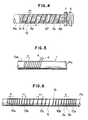
- a metal wire 4 is wound in a double spiral shape around a surface of an insulator layer 1, aluminium solder or the like is spray coated thereon a form a heat-generating resistor 2, and thereafter when the metal wire 4 is removed, grooves 5 of a double helix shape would remain at the trace of the metal wire 4.
- pitches P3, P2 and P1 of the grooves 5 decrease successively from a central portion 10c of the roller towards its end portions 10a.
- This resistor 2 consists of a foward path resistor 2a and a backward path 2b as shown in Fig. 4, and one ends of these resistors 2a and 2b are electrically connected at a connecting portion 2c.
- an anti-adhesion film 3 is formed on the roller surface, and also in order to achieve simplification of wirings within a copying machine, electric power feeding sections 6 and 7 are provided at one end of a hollow pipe P0. Then the forward path resistor 2a is connected to the electric power feeding section 6, and the backward path resistor 2b is connected to the electric power feeding section 7.
- the current which has reached the connecting portion 2c is diverted at this point to flow through the backward path resistor 2b, and similarly to the above-mentioned process, it flows in the direction of arrow A7 while generating Joule's heat and a magnetic field and reaches the electric power feeding section 7.
- the magnetic field generated around the resistor 2a and the magnetic field generated around the resistor 2b would offset each other, and after all, the magnetic field around the resistors 2a and 2b, that is, around the heat-generating resistor 2 would almost disappear.
- the anti-adhesion film 3 becomes tough, also its surface becomes flat, and electrical safety is improved.
- the belt-like heat-generating resistor is formed in a spiral shape, if the pitch of the heat-generating resistor is gradually decreased from the central portion of the roller towards the opposite end portions, then the resistance at the opposite end portions becomes larger than the resistance at the central portion.
- a heat generating rate would be increased from the central portion of the roller towards the end portions, hence it can be balanced with heat dissipation from the opposite end portions, after all the surface temperature distribution in the axial direction of the roller becomes as represented by a straight line N in Fig. 8, and the entire roller surface is held at a uniform temperature.
- the belt-like heat-generating resistor is formed in a double helix shape, one ends of the helices are electrically connected to each other and the other ends of the spirals are respectively connected to separate electric power feeding sections, then when an electric current is fed from the electric power feeding section through the heat-generating resistor, the electric current reciprocates on the roller surface while flowing in a spiral manner.
- the magnetic fields generated in association with the forwards and backwards electric currents would offset each other and disappear, and so, a magnetic field is almost not present on the surface of the thermal fixing roller.
- reference numeral 10 designates an insulative support prepared by forming an insulator layer 1 on a surface of a metallic hollow pipe P0.
- This insulator layer 1 is a thin film formed by plasma spray coating alumina or magnesia alumina spinel (Mg Al2 O4), and its thickness is, for example, 200 ⁇ m.
- this insulator layer 1 On the surface of this insulator layer 1 is helically wound a masking wire material having a rectangular cross-section, for instance, a metal wire 4 having a cross-section of 0.1 mm in width by 0.3 mm in length, so as to come into surface contact with each other.
- a masking wire material having a rectangular cross-section, for instance, a metal wire 4 having a cross-section of 0.1 mm in width by 0.3 mm in length, so as to come into surface contact with each other.
- an Invar wire or a copper wire having a rectangular cross-section could be employed.
- heat-generating resistor material such as, for instance, nichrome, stainless steel, aluminium, aluminium solder, etc. is thermally spray-coated by making use of a thermal spray-coating gun on the insulator layer 1 having the metal wire 4 wound therearound and thereby the heat-generating resistor layer 2 is formed.
- heat-generating resistor material such as, for instance, nichrome, stainless steel, aluminium, aluminium solder, etc.
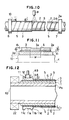
- a cross-section configuration of the groove 5 taken along a plane containing an axis C of the insulative support 10 is a rectangular shape of 30 ⁇ m in width by 0.3 mm in length, and the respective portions 2d and 2e of the heat-generating resistor 2 are perfectly separated by this groove 5.
- the heat-generating resistor portions 2d and 2e and the groove 5 are subjected to spray coating of fluorine resin or silicone resin by means of a powder painting gun P, and thereby an anti-adhesion layer 3 is formed.
- the thickness d 2 of the anti-adhesion layer 3 on resistor portions 2d,e is, for example, 100 ⁇ m, and the thickness d 3 of said layer above the groove 5 is, for example, 90 ⁇ m.
- the difference d 4 between the thickness d 2 and the thickness d3 is only 10 ⁇ m.
- the groove width W has been reduced considerably compared with that resulting from use of masking wire of circular cross section.
- the surface of the anti-adhesion layer 3 is ground to smooth the surface of the roller 10, and electric power feeding sections 6 and 7 are disposed at the end portions of the thermal fixing roller 10.
- the anti-adhesion layer as used according to the present invention could be composed of a lower layer consisting of a mechanically strong insulator layer, for instance a ceramic layer and an upper layer consisting of a Teflon® layer. If such provision is made, the mechanically weak Teflon® layer can be protected by the lower insulator layer, and also, the Teflon® layer can be formed thin. In addition, even if the Teflon® layer is made thin, the surface of the anti-adhesion layer can be easily flattened because the insulator layer lies thereunder.
- An insulator layer 1 is formed on a surface of a metallic hollow pipe P0 supported by a bearing 22, then a belt-like heat-generating resistor 2 and a groove 5 are formed alternately in a spiral shape on the surface of the insulator layer 1, and on the surface of this heat-generating resistor 2 is formed an anti-adhesion layer 3 by coating fluorine resin or silicone resin.
- a slip ring 11 is formed in a true round shape by machining, and in a central portion of its outer circumference is formed a recess 11a adapted to come into contact with a collector 12.
- the thickness T of the opposite end portions 11b and 11c of the slip ring 11 is made thicker than the thickness t of the anti-adhesion layer 3, and an end surface 11d of the end portion 11b continues to the surface of the anti-adhesion layer 3 via a smoothly curved surface.
- paper-sheets S would never enter between the slip ring 11 and the collector 12, and hence occurrence of fire can be prevented.
- the slip ring is preliminarily formed in a true round shape by machining, a slip ring having an excellent roundness can be obtained.
- the slip ring is fitted after formation of the anti-adhesion film, the slip ring is not subjected to heating upon formation of the anti-adhesion film, and hence it would not be oxidized. Accordingly, the resistance at this portion would not be increased, and therefore, stable power feeding can be achieved.
Landscapes
- Physics & Mathematics (AREA)
- General Physics & Mathematics (AREA)
- Fixing For Electrophotography (AREA)
- Control Of Resistance Heating (AREA)
Claims (23)
- Thermische Fixiertrommel zum Einsatz in einem Kopiergerät, enthaltend einen bandförmigen, wärmeerzeugenden Widerstand (2), der schraubenförmig um die Oberfläche eines zylindrischen Isolierträgers (1) gewickelt ist, dadurch gekennzeichnet, daß in einem Bereich dieser Trommel dieser Widerstand einen Teil (10a) aufweist, der eine höhere Wärmeentwicklung benötigt und schmäler ausgebildet ist, als ein Teil (10c), der in dem restlichen Bereich ausgebildet ist und eine geringere Wärmeentwicklung benötigt.
- Trommel gemäß Anspruch 1, dadurch gekennzeichnet, daß auf der Oberfläche dieses Isolierträgers eine Isolierschicht (1) ausgeformt ist.
- Trommel gemäß Anspruch 2, dadurch gekennzeichnet, daß diese Isolierschicht in der Form eines dünnen Films ausgebildet ist.
- Trommel gemäß Anspruch 2 oder 3, dadurch gekennzeichnet, daß diese Isolierschicht durch Plasmaspritzbeschichten mit Aluminiumoxid oder Magnesiumaluminat gebildet wird.
- Trommel gemäß einem der vorstehenden Ansprüche, dadurch gekennzeichnet, daß der Widerstand eine Doppelschraubenform (2a, 2b) aufweist, wobei die ersten Enden (2c) dieser Schraubenform elektrisch miteinander verbunden sind und ihre zweiten Enden jeweils gesondert an elektrische Stromzuführungsabschnitte (6, 7) angeschlossen sind.
- Trommel gemäß einem beliebigen der vorstehenden Ansprüche, dadurch gekennzeichnet, daß der Widerstand in der Form eines dünnen Films ausgebildet ist.
- Trommel gemäß einem beliebigen der vorstehenden Ansprüche, dadurch gekennzeichnet, daß der Widerstand durch thermisches Spritzbeschichten mit Widerstandsmaterial gebildet wird.
- Trommel gemäß einem beliebigen der Ansprüche 1 bis 6, dadurch gekennzeichnet, daß der Widerstand durch Plasmaspritzbeschichten mit Widerstandsmaterial gebildet wird.
- Trommel gemäß einem beliebigen der Ansprüche 1 bis 6, dadurch gekennzeichnet, daß der Widerstand durch thermisches Spritzbeschichten mit Widerstandsmaterial mit Luft gebildet wird.
- Trommel gemäß Anspruch 1, dadurch gekennzeichnet, daß der Widerstand durch schraubenförmiges Wickeln eines Abdeckdrahtmaterials (4) auf die Außenfläche des Isolierträgers, sodann thermisches Aufspritzen eines Widerstandsmaterials, und schließlich Abwickeln dieses Drahtmaterials gebildet wird.
- Trommel gemäß Anspruch 10, dadurch gekennzeichnet, daß der Querschnitt einer Nut (5), die durch das Abwickeln dieses Drahtmaterials entsteht, in einer durch eine Achse dieser Isolierschicht verlaufenden Ebene rechteckig ist.
- Trommel gemäß Anspruch 10 oder 11, dadurch gekennzeichnet, daß es sich bei dem Drahtmaterial um Invardraht oder Kupferdraht handelt.
- Verfahren zur Fertigung einer thermischen Fixiertrommel gemäß Anspruch 11 oder 12, gekennzeichnet durch die folgenden Schritte: Schraubenförmiges Wickeln eines Abdeckdrahtmaterials (4) mit rechteckigem Querschnitt auf die Oberfläche eines zylindrischen Isolierträgers (1), dann Ausbilden des wärmeerzeugenden Widerstands (2) auf der Oberfläche des Trägers und auf dem Drahtmaterial, anschließend Abwickeln des Drahtmaterials unter Hinterlassen der Nut (5) mit rechteckigem Querschnitt, und dann Ausbilden eines Antiadhäsionsfilms (3) auf dem Widerstand und der Nut.
- Trommel gemäß einem beliebigen der Ansprüche 1 bis 12, dadurch gekennzeichnet, daß es sich bei dem Widerstandsmaterial um Aluminium oder Aluminiumlot handelt.
- Trommel gemäß einem beliebigen der Ansprüche 1 bis 12, dadurch gekennzeichnet, daß der Widerstand mit einem Isolierfilm (1N) überdeckt ist.
- Trommel gemäß Anspruch 15, dadurch gekennzeichnet, daß dieser Isolierfilm mit einem Antiadhäsionsfilm (3) beschichtet ist.
- Trommel gemäß einem beliebigen der Ansprüche 1 bis 12 oder 14, dadurch gekennzeichnet, daß der Widerstand mit einem Antiadhäsionsfilm (3) überdeckt ist.
- Trommel gemäß Anspruch 17, dadurch gekennzeichnet, daß dieser Antiadhäsionsfilm aus einer Schicht Fluorharz oder Silikonharz besteht.
- Trommel gemäß Anspruch 17 oder 18, dadurch gekennzeichnet, daß dieser Antiadhäsionsfilm am wärmeerzeugenden Widerstand Nute von 500 µm oder weniger Breite füllt und die Dicke dieses Films 50 µm oder weniger beträgt.
- Trommel gemäß Anspruch 16 oder 17, dadurch gekennzeichnet, daß sich dieser Antiadhäsionsfilm aus einer unteren Lage, bestehend aus einer Isolierschicht, und einer oberen Lage, bestehend aus einer Teflon®-Schicht zusammensetzt.
- Trommel gemäß einem beliebigen der Ansprüche 16 bis 20, dadurch gekennzeichnet, daß an einem Endteil dieses Widerstands ein Schleifring (11) vorgesehen ist, wobei der Antiadhäsionsfilm den restlichen Teil des Widerstands überdeckt.
- Trommel gemäß Anspruch 21, dadurch gekennzeichnet, daß der Schleifring ein Endteil (11b, 11c) aufweist, das dicker ist als diese Antiadhäsionsschicht.
- Trommel gemäß Anspruch 21 oder 22, dadurch gekennzeichnet, daß der Schleifring in seiner äußeren Umfangsfläche eine mittige Aussparung (11a) aufweist.
Applications Claiming Priority (6)
| Application Number | Priority Date | Filing Date | Title |
|---|---|---|---|
| JP224333/86 | 1986-09-22 | ||
| JP61224333A JPH0636121B2 (ja) | 1986-09-22 | 1986-09-22 | 複写機用熱定着ロ−ル |
| JP310093/86 | 1986-12-29 | ||
| JP61310093A JPH077232B2 (ja) | 1986-12-29 | 1986-12-29 | 複写機用熱定着ロ−ル |
| JP61310092A JPH077231B2 (ja) | 1986-12-29 | 1986-12-29 | 複写機用熱定着ロ−ルおよびその製造方法 |
| JP310092/86 | 1986-12-29 |
Publications (3)
| Publication Number | Publication Date |
|---|---|
| EP0262833A2 EP0262833A2 (de) | 1988-04-06 |
| EP0262833A3 EP0262833A3 (en) | 1989-04-19 |
| EP0262833B1 true EP0262833B1 (de) | 1992-10-14 |
Family
ID=27330883
Family Applications (1)
| Application Number | Title | Priority Date | Filing Date |
|---|---|---|---|
| EP87308128A Expired - Lifetime EP0262833B1 (de) | 1986-09-22 | 1987-09-15 | Wärmefixierwalze zur Verwendung in einem Kopiergerät und Verfahren zu ihrer Herstellung |
Country Status (4)
| Country | Link |
|---|---|
| US (1) | US4743940A (de) |
| EP (1) | EP0262833B1 (de) |
| CA (1) | CA1269697A (de) |
| DE (1) | DE3782224T2 (de) |
Families Citing this family (28)
| Publication number | Priority date | Publication date | Assignee | Title |
|---|---|---|---|---|
| JPH02308291A (ja) * | 1989-05-24 | 1990-12-21 | Onoda Cement Co Ltd | 複写機用熱定着ロール及びその製造方法 |
| US5211789A (en) * | 1990-07-11 | 1993-05-18 | Hughes Aircraft Company | Optical cable composite-material bobbin with grooved base layer |
| US6007971A (en) * | 1992-09-09 | 1999-12-28 | Minnesota Mining And Manufacturing | Apparatus, system, and method for processing photothermographic elements |
| US5245392A (en) * | 1992-10-02 | 1993-09-14 | Xerox Corporation | Donor roll for scavengeless development in a xerographic apparatus |
| JPH06186877A (ja) * | 1992-10-21 | 1994-07-08 | Ricoh Co Ltd | 定着装置 |
| US5616263A (en) * | 1992-11-09 | 1997-04-01 | American Roller Company | Ceramic heater roller |
| WO1994011791A1 (en) * | 1992-11-09 | 1994-05-26 | American Roller Company | Charge donor roller with blended ceramic layer |
| US5408070A (en) * | 1992-11-09 | 1995-04-18 | American Roller Company | Ceramic heater roller with thermal regulating layer |
| JPH08194401A (ja) * | 1994-11-16 | 1996-07-30 | Brother Ind Ltd | 定着用加熱ローラ |
| US5660934A (en) * | 1994-12-29 | 1997-08-26 | Spray-Tech, Inc. | Clad plastic particles suitable for thermal spraying |
| US5722025A (en) * | 1995-10-24 | 1998-02-24 | Minolta Co., Ltd. | Fixing device |
| US5659867A (en) * | 1995-11-28 | 1997-08-19 | Hewlett-Packard Company | Instant-on fuser roller structure |
| US6762396B2 (en) | 1997-05-06 | 2004-07-13 | Thermoceramix, Llc | Deposited resistive coatings |
| EP0881550B1 (de) * | 1997-05-30 | 2004-01-02 | Kyocera Corporation | Heizrolle zum Fixieren von Toner |
| US6091480A (en) * | 1997-07-17 | 2000-07-18 | 3M Innovative Properties Company | Film removal mechanism for use with a thermal drum processor system |
| US5946025A (en) * | 1997-09-29 | 1999-08-31 | Imation Corp. | Thermal drum processor assembly with roller mounting assembly for a laser imaging device |
| US6160983A (en) * | 1998-05-20 | 2000-12-12 | Hewlett-Packard Company | Heated fuser roller |
| KR19990084089A (ko) * | 1999-09-13 | 1999-12-06 | 박영선 | 대형 스크린용 수직렌즈 성형을 위한 성형 로울러의제작방법 및 성형로울러를 이용한 수직렌즈 성형장치 |
| WO2002059936A2 (en) | 2000-11-29 | 2002-08-01 | Thermoceramix, Inc. | Resistive heaters and uses thereof |
| KR20030040815A (ko) * | 2001-11-16 | 2003-05-23 | 삼성전자주식회사 | 전자사진 화상형성장치의 정착롤러 |
| US6991003B2 (en) * | 2003-07-28 | 2006-01-31 | M.Braun, Inc. | System and method for automatically purifying solvents |
| DE10353973B4 (de) * | 2003-11-19 | 2006-08-17 | Beru Ag | Verfahren zum Herstellen eines keramischen Glühstiftes für eine keramische Glühkerze |
| DE10355043A1 (de) | 2003-11-25 | 2005-06-23 | Watlow Electric Manufacturing Co., St. Louis | Verfahren zum Befestigen eines elektrischen Leiters auf einem Flächenelement, sowie Heißkanalelement, insbesondere für eine Kunststoff-Spritzeinrichtung |
| JP5015745B2 (ja) * | 2007-12-07 | 2012-08-29 | 株式会社リコー | 定着装置、および画像形成装置 |
| US20100012353A1 (en) * | 2008-07-18 | 2010-01-21 | Erel Milshtein | Elongated semiconductor devices, methods of making same, and systems for making same |
| US10477622B2 (en) * | 2012-05-25 | 2019-11-12 | Watlow Electric Manufacturing Company | Variable pitch resistance coil heater |
| CN113959578B (zh) * | 2021-10-18 | 2024-10-11 | 中冶赛迪技术研究中心有限公司 | 一种铸坯接触式连续测温装置及其制作方法 |
| JP7885004B2 (ja) * | 2022-04-06 | 2026-07-06 | キヤノン株式会社 | 定着部材及び定着装置 |
Family Cites Families (11)
| Publication number | Priority date | Publication date | Assignee | Title |
|---|---|---|---|---|
| CH354833A (de) * | 1957-02-22 | 1961-06-15 | Siemens Ag | Schleifringkörper für elektrische Maschinen |
| US3546433A (en) * | 1969-02-25 | 1970-12-08 | Electronic Control Systems Inc | Roll heater device |
| US4109135A (en) * | 1977-04-25 | 1978-08-22 | Sperry Rand Corporation | High efficiency fuser roll assembly for xerographic material |
| US4395109A (en) * | 1979-06-11 | 1983-07-26 | Tokyo Shibaura Denki Kabushiki Kaisha | Fixing device for electronic duplicator machine |
| DE3109164A1 (de) * | 1981-03-11 | 1982-09-30 | Hoechst Ag, 6000 Frankfurt | Fixiervorrichtung |
| DE3323068A1 (de) * | 1983-06-27 | 1985-01-03 | Hoechst Ag, 6230 Frankfurt | Walzenfixiervorrichtung mit einem walzenpaar |
| DE3339463A1 (de) * | 1983-10-31 | 1985-05-09 | Hoechst Ag, 6230 Frankfurt | Walze zum andruecken eines blattes an eine heizflaeche |
| JPS60131784A (ja) * | 1983-12-19 | 1985-07-13 | キヤノン株式会社 | ヒ−トロ−ラ− |
| JPS60254587A (ja) * | 1984-05-30 | 1985-12-16 | 京セラミタ株式会社 | 感光体ドラムの保温ヒ−タ |
| US4724305A (en) * | 1986-03-07 | 1988-02-09 | Hitachi Metals, Ltd. | Directly-heating roller for fuse-fixing toner images |
| US4776070A (en) * | 1986-03-12 | 1988-10-11 | Hitachi Metals, Ltd. | Directly-heating roller for fixing toner images |
-
1987
- 1987-09-15 EP EP87308128A patent/EP0262833B1/de not_active Expired - Lifetime
- 1987-09-15 US US07/096,735 patent/US4743940A/en not_active Expired - Fee Related
- 1987-09-15 DE DE8787308128T patent/DE3782224T2/de not_active Expired - Fee Related
- 1987-09-21 CA CA000547370A patent/CA1269697A/en not_active Expired
Non-Patent Citations (2)
| Title |
|---|
| Patent Abstracts of Japan, vol.7, no. 57 (P-181)(1202), March 9, 1983; & JP-A-57 202 576 * |
| PATENT ABSTRACTS OF JAPAN; vol. 9, no. 239 (P-391) (1962), September 25, 1985; & JP-A-60 91 376 (KIYOUSERA K.K.) 22-05-1985 * |
Also Published As
| Publication number | Publication date |
|---|---|
| CA1269697A (en) | 1990-05-29 |
| US4743940A (en) | 1988-05-10 |
| EP0262833A2 (de) | 1988-04-06 |
| EP0262833A3 (en) | 1989-04-19 |
| DE3782224D1 (de) | 1992-11-19 |
| DE3782224T2 (de) | 1993-02-25 |
Similar Documents
| Publication | Publication Date | Title |
|---|---|---|
| US4743940A (en) | Thermal fixing roller for use in a copying machine and method for manufacturing the same | |
| EP0336028B1 (de) | Beheizbare Rolle für die Elektrofotografie | |
| EP0240730B1 (de) | Direkt beheizte Walze zur Wärmefixierung von Tonerbildern | |
| US5915147A (en) | Image fixing device, image forming apparatus providing the image fixing device and rotor used in the image fixing device and having induction coil inside | |
| US5065193A (en) | Heat fixing roll for copying machine, method of producing the same and electronic copying machine provided with the same | |
| US4874927A (en) | Heating roll for fixing toner | |
| DE4208165A1 (de) | Waermefixiervorrichtung | |
| WO2010056281A1 (en) | Plasticating barrel with integrated exterior heater layer | |
| EP0501788B1 (de) | Patronenheizkörper | |
| US4314172A (en) | Current transfer brush | |
| US5932125A (en) | Roller for fixing toner and method for manufacturing same | |
| JPS6378188A (ja) | 複写機用熱定着ロ−ル | |
| JP2651590B2 (ja) | 熱定着ローラの製造方法 | |
| JPH11282297A (ja) | 熱定着用ローラ | |
| JP3245337B2 (ja) | 加熱用ヒータ及び定着用ヒートローラ及び定着装置 | |
| JP3439927B2 (ja) | 筒状ヒータ | |
| JP3281750B2 (ja) | 円筒状ヒータ及び定着用ヒートローラ | |
| JP3762100B2 (ja) | 管状発熱体およびこれを用いた定着用ヒートローラ | |
| EP0447206A2 (de) | Kathodenheizer für Magnetrone | |
| JPH08110723A (ja) | 定着用加熱ローラ | |
| JPS59189381A (ja) | 複写機の熱定着装置 | |
| JP3314140B2 (ja) | 定着用ヒートローラ | |
| JPH077231B2 (ja) | 複写機用熱定着ロ−ルおよびその製造方法 | |
| JPH08292674A (ja) | 加熱ローラの製造方法 | |
| JP2601854Y2 (ja) | 円筒状セラミックヒータ |
Legal Events
| Date | Code | Title | Description |
|---|---|---|---|
| PUAI | Public reference made under article 153(3) epc to a published international application that has entered the european phase |
Free format text: ORIGINAL CODE: 0009012 |
|
| AK | Designated contracting states |
Kind code of ref document: A2 Designated state(s): CH DE FR GB LI |
|
| PUAL | Search report despatched |
Free format text: ORIGINAL CODE: 0009013 |
|
| 17P | Request for examination filed |
Effective date: 19890107 |
|
| AK | Designated contracting states |
Kind code of ref document: A3 Designated state(s): CH DE FR GB LI |
|
| 17Q | First examination report despatched |
Effective date: 19910521 |
|
| GRAA | (expected) grant |
Free format text: ORIGINAL CODE: 0009210 |
|
| AK | Designated contracting states |
Kind code of ref document: B1 Designated state(s): CH DE FR GB LI |
|
| PG25 | Lapsed in a contracting state [announced via postgrant information from national office to epo] |
Ref country code: FR Free format text: THE PATENT HAS BEEN ANNULLED BY A DECISION OF A NATIONAL AUTHORITY Effective date: 19921014 |
|
| REF | Corresponds to: |
Ref document number: 3782224 Country of ref document: DE Date of ref document: 19921119 |
|
| ET | Fr: translation filed | ||
| PLBE | No opposition filed within time limit |
Free format text: ORIGINAL CODE: 0009261 |
|
| STAA | Information on the status of an ep patent application or granted ep patent |
Free format text: STATUS: NO OPPOSITION FILED WITHIN TIME LIMIT |
|
| PG25 | Lapsed in a contracting state [announced via postgrant information from national office to epo] |
Ref country code: GB Effective date: 19930915 |
|
| PG25 | Lapsed in a contracting state [announced via postgrant information from national office to epo] |
Ref country code: LI Effective date: 19930930 Ref country code: CH Effective date: 19930930 |
|
| 26N | No opposition filed | ||
| GBPC | Gb: european patent ceased through non-payment of renewal fee |
Effective date: 19930915 |
|
| REG | Reference to a national code |
Ref country code: CH Ref legal event code: PL |
|
| REG | Reference to a national code |
Ref country code: FR Ref legal event code: ST |
|
| PGFP | Annual fee paid to national office [announced via postgrant information from national office to epo] |
Ref country code: DE Payment date: 19951127 Year of fee payment: 9 |
|
| PG25 | Lapsed in a contracting state [announced via postgrant information from national office to epo] |
Ref country code: DE Effective date: 19970603 |