EP0264847B1 - Matériau photographique à l'halogénure d'argent - Google Patents
Matériau photographique à l'halogénure d'argent Download PDFInfo
- Publication number
- EP0264847B1 EP0264847B1 EP87115148A EP87115148A EP0264847B1 EP 0264847 B1 EP0264847 B1 EP 0264847B1 EP 87115148 A EP87115148 A EP 87115148A EP 87115148 A EP87115148 A EP 87115148A EP 0264847 B1 EP0264847 B1 EP 0264847B1
- Authority
- EP
- European Patent Office
- Prior art keywords
- silver halide
- mole
- photographic material
- carbon atoms
- group
- Prior art date
- Legal status (The legal status is an assumption and is not a legal conclusion. Google has not performed a legal analysis and makes no representation as to the accuracy of the status listed.)
- Expired
Links
Classifications
-
- G—PHYSICS
- G03—PHOTOGRAPHY; CINEMATOGRAPHY; ANALOGOUS TECHNIQUES USING WAVES OTHER THAN OPTICAL WAVES; ELECTROGRAPHY; HOLOGRAPHY
- G03C—PHOTOSENSITIVE MATERIALS FOR PHOTOGRAPHIC PURPOSES; PHOTOGRAPHIC PROCESSES, e.g. CINE, X-RAY, COLOUR, STEREO-PHOTOGRAPHIC PROCESSES; AUXILIARY PROCESSES IN PHOTOGRAPHY
- G03C1/00—Photosensitive materials
- G03C1/005—Silver halide emulsions; Preparation thereof; Physical treatment thereof; Incorporation of additives therein
- G03C1/04—Silver halide emulsions; Preparation thereof; Physical treatment thereof; Incorporation of additives therein with macromolecular additives; with layer-forming substances
- G03C1/053—Polymers obtained by reactions involving only carbon-to-carbon unsaturated bonds, e.g. vinyl polymers
Definitions
- This invention relates to a silver halide photographic material comprising a support and at least one photosensitive silver halide emulsion layer containing photosensitive silver halide grains, whereby the photographic material further contains a polymer capable of providing a cation site, and particularly, to a silver halide photographic material having good granularity, high sensitivity and excellent fixability.
- the image quality of a silver halide photographic material is determined by sharpness and granularity. It is known that granularity is generally improved by increasing the iodine content of silver halide. Furthermore, increasing the iodine content of silver halide results in an increased efficiency of absorption of blue light. However, the increasing iodine content of silver halide, the speed of fixation becomes drastically delayed and a problem of poor fixation arises. This leads to a marked degradation of image quality. It has been strongly desired to solve this problem.
- FR-A-2 331 817 discloses a silver halide photographic material comprising a support, at least one photosensitive silver halide emulsion layer, a layer containing a developer inhibitor and a layer containing a polymer compound wherein Ri, R 2 and R 3 of this compound are selected from the group comprising alkyl, aryl, aralkyl and carboxylic groups.
- Object of the invention is to provide a silver halide photographic material having good granularity, high sensitivity and a fast fixing speed.
- a silver halide photographic material comprising a support and at least one photosensitive silver halide emulsion layer containing photosensitive silver halide grains, the photographic material further contains a polymer capable of providing a cation site, characterized in that the silver halide grains have an average iodine content of at least 3 mole%, whereby the polymer capable of providing a cation site in a fixing solution is represented by the following general formula (I) wherein A represents a unit of an ethylenically unsaturated monomer; L represents a divalent group having 1 to about 12 carbon atoms; R 1 represents a hydrogen atom or an alkyl group having 1 to about 6 carbon atoms; R 2 , R 3 and R 4 are identical or different and only one of R 2 , R 3 and R 4 is a hydrogen atom and the others each represent an alkyl group having 1 to about 20 carbon atoms, an aral
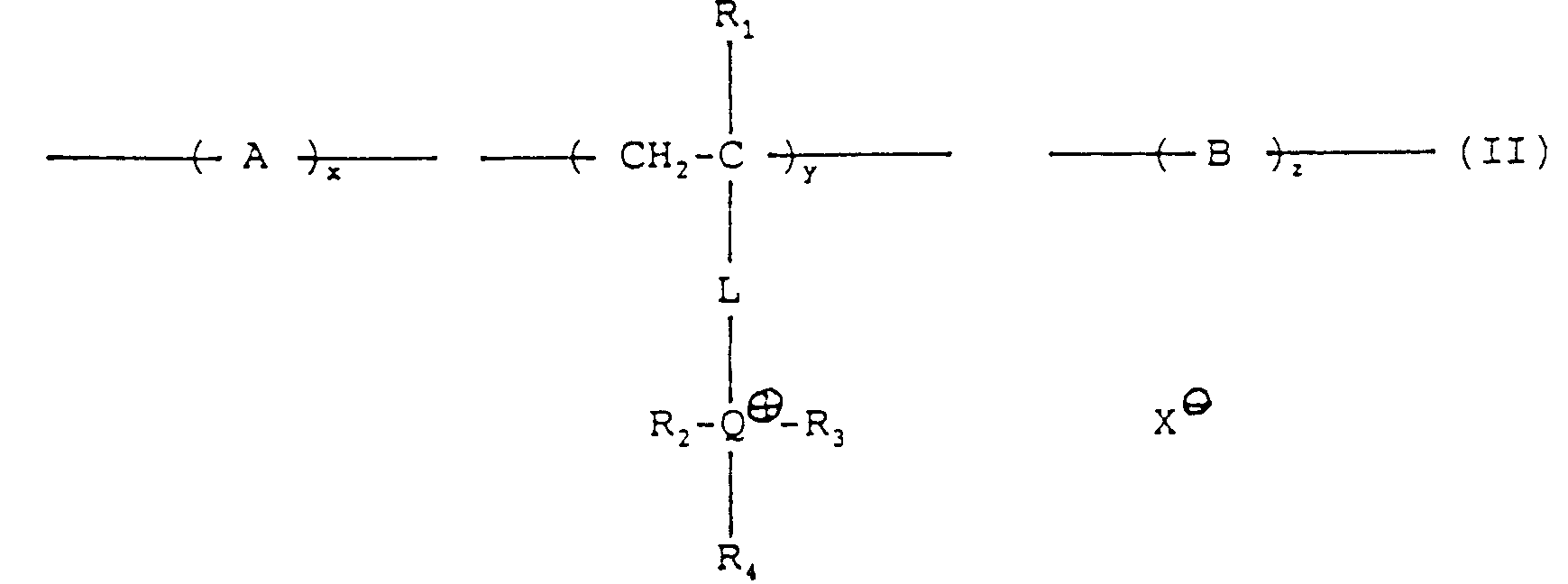
- a silver halide photographic material comprising a support and at least one photosensitive silver halide emulsion layer containing photosensitive silver halide grains, the photographic material further contains a polymer capable of providing a cation site, characterized in that the silver halide grains have an average iodine content of at least 3 mole%, wherein the polymer capable of providing a cation site in a fixing solution is a crosslinked polymer latex represented by the following general formula (II) wherein A represents a unit of an ethylenically unsaturated monomer; B represents a structural unit having copolymerized therein a copolymerizable monomer having at least two ethylenically unsaturated groups; L represents a divalent group having 1 to about 12 carbon atoms; X represents an anion; R 1 represents a hydrogen atom or an alkyl group having 1 to about 6 carbon atoms; R 2 , R 3 and R 4
- the silver halide grains in the photographic emulsion used in the photographic material of this invention may have regularly-shaped crystals such as cubic, hexahedral, dodecahedral or tetradecahedral crystals, or irregularly-shaped crystals such as spherical or plate-like crystals, or crystals having a combination of these shapes. They may also be plate like grains having an aspect ratio of at least 5 described in Research Disclosure, Vo. 225, pages 20-58 (January, 1983).
- They may also have an epitaxial structure, or they may be grains of a multilayer structure having different compositions (for example, being comprised of layers of different proportions of halogens) between the interior and the surface of the grains.
- these silver halide grains have an average size of at least 0.5 am, more preferably 0.7 to 5.0 I.Lm.
- the particle size distribution may be broad or narrow.
- An emulsion having a narrow particle size distribution is known as a monodisperse emulsion.
- the grains may have a dispersion coefficient of not more than 20%, preferably not more than 15%.
- the dispersion coefficient, as used herein, is the quotient of the standard deviation divided by the average grain size.
- photographic emulsions may be prepared, for example, by using the methods described in P. Glafkides, Chimie at Physique Photographique, 1967, published by Paul Montel Company, G.F. Duffin, Photographic Emulsion Chemistry, 1966, published by the Focal Press, and V.L. Zelikman, Making and Coating Photographic Emulsion, 1964, published by The Focal Press. Specifically, any of the acidic method, the neutral method, the ammonia method, etc. may be used.
- the reaction of a soluble silver salt with a soluble halogen salt may be effected by a one-side mixing method, a simultaneous mixing method, or a combination of these.
- photosensitive silver halide grains may be any of silver chloride, silver bromide, silver iodide, silver iodobromide, silver chlorobromide and silver chloroiodide.
- the average iodine content is at least 3, preferably 8 to 40 mole% per mole of all silver halide.
- the preferred amount of silver coated on the photographic material of this invention is 1 to 20 g/m 2 , especially 2 to 10 g/ m 2 .
- the total amount of iodine (Agl) contained in the silver halide photographic material is at lease 4 x 10- 3 mole/m 2 , especially 6 x 10- 3 mole/m 2 to 4 x 10- 2 mole/m 2 .
- a cadmium salt, a zinc salt, a lead salt, a thallium salt, an iridium salt or its complex salt, a rhodium salt or its complex salt, an iron salt or its complex salt may be present during the stage or forming silver halide grains or during physical ripening.
- the polymer capable of providing a cation site in a fixing solution is preferably an anion conversion polymer.
- Known ammonium salt (or phosphonium salt) polymers may be used as the anion conversion polymer.
- Ammonium salt (or phosphonium salt) polymers are widely known as mordant polymers or antistatic agent polymers.
- aqueous dispersion latexes described in JP-A-166940/84, U.S. Patent 3,958,995, and JP-A-142339/80, 126027/79, 155835/79, 30328/78 and 92274/79; the polyvinyl pyridinium salts described in U.S. Patents 2,548,564, 3,148,061 and 3,756,814; the water-soluble ammonium salt polymer described in U.S. Patent 3,709,690; and the water-insoluble ammonium salt polymer described in U.S. Patent 3,898,088.
- Preferred anion conversion polymers are represented by the following general formula (I). wherein A represents a unit of an ethylenically unsaturated monomer; L represents a divalent group having 1 to about 12 carbon atoms; R 1 represents a hydrogen atom or an alkyl group having 1 to about 6 carbon atoms; R 2 , R 3 and R 4 are identical or different and only one of R 2 , R 3 and R 4 is a hydrogen atom and the others each represent an alkyl group having 1 to about 20 carbon atoms, an aralkyl group having 7 to about 20 carbon atoms, or two of R 2 , R 3 and R 4 may be linked to one another to form a cyclic structure together with Q; Q ist N or P; X e represents an anion; x is 0 to about 90 mole%; and y is about 10 to 100 mole%.
- A represents a unit of an ethylenically unsaturated monomer
- L represents a divalent group having 1 to about 12 carbon
- Examples of the ethylenically unsaturated monomer in A include olefins such as ethylene, propylene, 1-butene, vinyl chloride, vinylidene chloride, isobutene and vinyl bromide; dienes such as butadiene, isoprene and chloroprene; ethylenically unsaturated esters of fatty acids or aromatic carboxylic acids such as vinyl acetate, allyl acetate, vinyl propionate, vinyl butyrate and vinyl benzoate; esters of ethylenically unsaturated acids such as methyl methacrylate, butyl methacrylate, tert-butyl methacrylate, cyclohexyl methacrylate, benzyl methacrylate, phenyl methacrylate, octyl methacrylate, amyl acrylate, 2-ethylhexyl acrylate, benzyl acrylate, dibutyl maleate, diethy
- R 1 is preferably a hydrogen atom or a methyl group.
- L is preferably a divalent group represented by From the standpoint of alkali resistance, are more preferred. In particular, is preferred from the standpoint of emulsion polymerizability.
- R 5 represents an alkylene group such as a methylene, ethylene, trimethylene, or tetramethylene group, an arylene group, or an aralkylene group, for example, a group represented by the formula
- R 7 represents an alkylene group having 0 to about 6 carbon atoms
- R 6 represents a hydrogen atom or a group selected from the groups defining R 2
- n is an integer of 1 or 2.
- Q is preferably N from the standpoint of the toxicity of the starting material.
- X e is an anion, for example, a halogen ion such as a chlorine or bromine ion, an alkylsulfate ion such as a methylsulfate or ethylsulfate ion, an alkyl or arylsulfonate ion such as a methanesulfonate, ethanesulfonate, benzenesulfonate or p-toluenesulfonate ion, a nitrate ion, an acetate ion and a sulfate ion.
- a halogen ion such as a chlorine or bromine ion
- an alkylsulfate ion such as a methylsulfate or ethylsulfate ion
- an alkyl or arylsulfonate ion such as a methanesulfonate, ethane
- the alkyl and aralkyl groups for R 2 , R 3 and R 4 include substituted and unsubstituted alkyl and aralkyl groups.
- alkyl group examples include unsubstituted alkyl groups such as a methyl, ethyl, propyl, isopropyl, t-butyl, hexyl, cyclohexyl, 2-ethylhexyl or dodecyl groups, and substituted alkyl groups such as alkoxyalkyl groups (e.g., methoxymethyl, methoxybutyl, ethoxyethyl, butoxyethyl and vinyloxyethyl groups), cyanoalkyl groups (e.g., a 2-cyanoethyl or 3-cyanopropyl groups), halogenated alkyl groups (such as 2-fluoroethyl, 2-chloroethyl, and perfluoropropyl groups), alkoxycarbonylalkyl groups (e.g., an ethoxycarbonylmethyl group), an allyl group, a 2-butenyl group, and a propargy
- aralkyl group examples include unsubstituted aralkyl groups such as benzyl, phenethyl, diphenylmethyl and naphthylmethyl groups; and substituted aralkyl groups such as alkylaralkyl groups (e.g., 4-methylbenzyl, 2,5-dimethylbenzyl, 4-isopropylbenzyl and 4-octylbenzyl groups), alkoxyaralkyl groups (e.g., 4-methoxybenzyl, 4-pentachloropropenyloxybenzyl and 4-ethoxybenzyl groups), cyanoaralkyl groups (e.g., 4-cyanobenzyl and 4-(4-cyanophenyl)benzyl groups), and halogenated aralkyl groups (e.g., 4-chlorobenzyl, 3-chlorobenzyl, 4-bromobenzyl and 4-(4-chlorophenyl)benzyl groups).
- the alkyl group preferably contains from 1 to 12 carbon atoms, and the aralkyl group preferably contains from 7 to 14 carbon atoms.
- R 8 represents a hydrogen atom or a group selected from the groups represented by R 4 , and n is an integer of 2 to 12
- a + b an integer of 2 to 7
- R 9 and R 10 represent a hydrogen atom, or an alkyl group having 1 to 6 carbon atoms
- R 2 when there are two R 2 groups, they may be identical or different
- R 2 groups when there are two R 2 groups, they may be identical or different
- R 2 , R 4 , R 6 , Q and X e are as defined with regard to general formula (I).
- the y component may be a mixture of two or more components.
- x is preferably 20 to 60 mole%, and y is preferably 40 to 80 mole%.
- the above polymer is used as an aqueous crosslinked polymer latex obtained by copolymerizing a monomer having at least two, preferably 2 to 4, ethylenically unsaturated group(s) to prevent the polymer from moving from the desired layer to another layer or to a processing liquor and thus to avoid photographically deleterious effects.
- a structure represented by the following general formula (II) is preferred as the structure of the aqueous crosslinked polymer latex.
- A represents a unit of an ethylenically unsaturated monomer
- B represents a structural unit having copolymerized therein a copolymerizable monomer having at least two ethylenically unsaturated groups
- L represents an anion
- R 1 represents a hydrogen atom or an alkyl group having 1 to about 6 carbon atoms
- R 2 , R 3 and R 4 are the same or different and each represents an alkyl group having 1 to about 20 carbon atoms, an aralkyl group having 7 to about 20 carbon atoms, and wherein only one of R 2 , R 3 and R 4 in formula (II) is a hydrogen atom, or two of R 2 , R 3 and R 4 may be linked to one another to form a cyclic structure together with Q
- Q is N or P
- x is 0 to about 90 mole%
- B represents a structural unit having copolymerized therein a copolymerizable monomer containing at least two ethylenically unsaturated groups.
- B include ethylene glycol dimethacrylate, diethylene glycol dimethacrylate, neopentyl glycol dimethacrylate, tetramethylene glycol dimethacrylate, pentaerythritol tetramethacrylate, trimethylolpropane trimethacrylate, ethylene glycol diacrylate, dethylene glycol diacrylate, neopentyl glycol diacrylate, tetramethylene glycol diacrylate, trimethylolpropane triacrylate, allyl methaycrylate, allyl acrylate, diallyl phthalate, methylenebisacrylamide, methylenebis- methacrylamide, trivinylcyclohexane, divinylbenzene, N,N-bis(vinylbenzyl)-N,N-
- the polymer latex has a particle diameter of 10 to 1000 nm, preferably 10 to 300 nm.
- the amount of the polymer capable of providing a cation site in a fixing solution is at least 0.1, preferably 0.3 to 100, more preferably 0.5 to 30, as units of cation site per mole of the total iodine in the photographic material.
- the polymer capable of providing a cation site may be added to a photosensitive layer or a non-photosensitive layer. Preferably, it is added to a non-photosensitive layer provided between a support and a photosensitive layer.
- Preferred polymers capable of providing a cation site have high ability to capture an iodine ion.
- Binders which can be used for the emulsion layers and other layers in the silver halide photographic material of the invention include, for example, proteins such as gelatin and casein; cellulose compounds such as carboxymethyl cellulose and hydroxyethyl cellulose; sugar derivatives such as agar, dextran, sodium alginate and starch derivatives; and synthetic hydrophilic colloids such as polyvinyl alcohol, poly-N-vinylpyrrolidone, polyacrylic acid copolymers and polyacrylamides, and derivatives of partially hydrolyzed products thereof.
- Gelatin as referred to herein, denotes lime-treated gelatin, acid-treated gelatin and enzyme-treated gelatin.
- the photographic material of this invention may contain the alkyl acrylate-type latexes described in U.S.-A-3,411,911 and 3,411,912 and JP-B-5331/70 in layer constituting the photograph material.
- the emulsion used in the photosensitive silver halide emulsion layer in this invention is chemically sensitized.
- a sulfur sensitizing method using a compound containing sulfur capable of reacting with a silver ion or active gelatin, a reductive sensitizing method using a reducing substance, a noble metal sensitizing method using a compound of gold or another noble metal may be used singly or in combination.
- sulfur sensitizers are thiosulfates, thioureas, thiazoles, and rhodanines.
- reductive sensitizers that can be used include stannous salts, amines, hydrazine derivatives, formamidinesulfinic acid and silane compounds.
- gold complex salts and complex salts of metals of Group VIII of the periodic table such as platinum, iridium and palladium may be used.
- Various stabilizer compounds may be included in the photographic material of this invention. They include, for example, azoles such as benzothiazolium salts, nitroindazoles, triazoles, benzotriazoles, benzimidazoles (particularly, nitro- or halogen-substituted products); heterocyclic mercapto compounds such as mercaptothiazoles, mercaptobenzothiazoles, mercaptobenzimidazoles, mercaptothiadiazoles, mercaptotetrazoles (particularly 1-phenyl-5-mercaptotetrazole) and mercaptopyridines; the aforesaid heterocyclic mercapto compounds which have a water-soluble salt such as a carboxyl group or a sulfonic acid group; thioketo compounds such as oxazolinethion; azaindenes such as tetrazaindenes (particularly 4-hydroxy- substituted (1,3,3a,7)tetraza
- the photographic emulsion layers or other constituent layers of the photographic material of this invention may contain surface-active agents for various purposes, for example, as coating aids or for slipperiness improvement, static prevention, emulsification and dispersion, adhesion prevention and improvement of photographic characteristics (such as acceleration of development, contrast increasing or sensitization).
- the surface-active agents include nonionic surface-active agents such as saponin (steroidal), alkylene oxide derivatives (such as polyethylene glycol, polyethylene glycol/polypropylene glycol condensate, polyethylene glycol alkyl ethers, polyethylene glycol alkyl aryl ethers, polyethylene glycol esters, polyethylene glycol sorbitan esters, polyalkylene glycol alkylamides or amides, or polyethylene oxide adducts of silicones), glycidol derivatives (such as alkenylsuccinic acid polyglycerides, alkyl phenol polyglycerides), fatty acid esters of polyhydric alcohols, and alkyl esters of sugars; anionic surface-active agents containing an acid group such as a carboxy group; a sulfo group, a phospho group, a sulfate ester group or a phosphate ester group, for example, alkylcarboxylic acid salts, alky
- the polyoxyethylene-type surface-active agents used in this invention preferably have at least two oxyethylene groups, more preferably 2 to 100 oxyethylene groups.
- Especially preferred surface-active agents of the polyoxyethylene type are those represented by the following general formulae (111-1), (111-2) and (111-3).
- R 1 represents a hydrogen atom, or a substituted or unsubstituted alkyl, alkenyl or aryl group having 1 to 30 carbon atoms.
- A represents -O-, -S-, -COO-, or (wherein R 15 represents a hydrogen atom or a substituted or unsubstituted alkyl group).
- R 2 is the same as R 1 or R 1 -A- defined hereinabove.
- R 3 , R 4 , R 8 , R 10 , R 12 and R 14 represent a hydrogen atom, a substituted or unsubstituted alkyl group, an aryl group, an alkoxy group, a halogen atom, an acyl group, an amide group, a sulfonamide group, a carbamoyl group or a sulfamoyl group.
- R 7 , R 9 , R 11 and R 13 represent a substituted or unsubstituted alkyl group, an aryl group, an alkoxy group, a halogen group, an acyl group, an amide group, a sulfonamide group, a carbamoyl group or a sulfamoyl group.
- R 5 and R 6 represent a hydrogen atom, a substituted or unsubstituted alkyl group, an aryl group or a heterocyclic ring.
- R 5 and R 6 , or R 7 and R 8 , or R 9 and R 10 , or R 11 and R 12 , or R 13 and R 14 may be linked to each other to form a substituted or unsubstituted ring.
- n1, n2, n3 and n4 are the average degree of polymerization of ethylene oxide and is a number of 2 to 100.
- m is the average degree of polymerization and is a number of 5 to 50.
- the amount of the polyoxyethylene-type surfactant used in this invention differs depending upon the type and form of the photographic material of this invention, the method of coating, etc. Generally, it is at least 6.0 mg, advantageously at least 60 mg, per mole of silver in the photographic material.
- the polyoxyethylene-type surfactant is added to the photosensitive emulsion layer of the photographic material of the invention, but may also be added to a non-photosensitive layer.
- Hardening agents such as higher-molecular-weight hardening agents having diffusion resistance as described in JP-A-142524/81, and low-molecular-weight hardening agents to be exemplified below, may be used.
- aldehyde compounds such as mucochloric acid, mucobromic acid, formaldehyde, dimethylolurea, trimethylolmelamine, glyoxal, 2,3-dihyroxy-5-methyl-1,4-dioxane and glutaraldehyde
- active vinyl compounds such as divinylsulfone, methylenebismaleimide, 5-acetyl-1,3-diacryloyl- hexahydro-s-triazine, 1,3,5-triacryloyl-hexahydro-s-triazine, 1,3,5-trivinylsulfonyl-hexahydro-s-triazine, bis-(vinylsulfony
- the photographic emulsion of this invention may be spectrally sensitized with methine dyes and other dyes.
- Dyes used include, for example, cyanine dyes, merocyanine dyes, compound cyanine dyes, compound merocyanine dyes, holopolar cyanine dyes, hemicyanine dyes, styryl dyes and hemioxonol dyes. Cyanine dyes, merocyanine dyes and compound merocyanine dyes are especially useful. These dyes may contain any of the rings which are usually utilized in the cyanine dyes as basic heterocyclic rings.
- Examples of such basic heterocyclic rings are pyrroline, oxazoline, thiazoline, pyrrole, oxazole, thiazole, selenazole, imidazole, tetrazole and pyridine rings; rings resulting from fusion of alicyclic hydrocarbon rings benzoxazole, naphthoxazole, benzothiazole, naphthothiazole, benzoselenazole, benzimidazole and quinoline rings. These rings may be substituted on a carbon atom.
- the merocyanine dyes or compound merocyanine dyes may contain 5- or 6-membered heterocyclic rings such as pyrazolin-5-one, thiohydantoin, 2-thiooxazolidine-2,4-dione, thiazolidine-2,4-dione, rhodanine and thiobarbituric acid rings as rings having a ketomethylene structure.
- the amount of the sensitizing dyes used in this invention is preferably 1 x 10- 6 to 5 x 10- 3 mole per mole of silver.
- the photographic emulsion used in this invention may contain a color image-forming coupler, i.e., a compound which forms a dye by reaction with the oxidation product of an aromatic amine (usually primary amines) developing agent (to be abbreviated as the coupler).
- the coupler has a hydrophobic group, called a ballast group, in the molecule and is non-diffusible.
- the coupler may be tetra-equivalent or di-equivalent to the silver ion. It may contain a colored coupler imparting a color correction effect or a coupler releasing a developer inhibitor upon development (so-called DIR coupler).
- the coupler may also be such that the product of the coupling reaction is colorless.
- Known closed-chain ketomethylene-type couplers may be used as a yellow-forming coupler.
- Benzoyl acetanilide-type and pivaloyl acetanilide-type compounds are advantageous.
- Pyrazolone compounds, indazolone-type compounds, cyanoacetyl compounds, may be used as magenta couplers.
- the pyrazolone compounds are especially advantageous.
- Phenolic compounds and naphtholic compounds may be used as cyan couplers.
- a protective layer in the silver halide photographic material of this invention is composed of a hydrophilic colloid.
- hydrophilic colloids may be the same as those described hereinabove.
- the protective layer may be single-layered or multi-layered.
- a matting agent and/or a smoothening agent may be added to the emulsion layer or the protective layer in the silver halide photographic material of this invention.
- preferred matting agents are organic compounds, for example, water-dispersible vinyl polymers such as polymethyl methacrylate having a suitable particle diameter (0.3 to 5 /1.m of a diameter, or at least 2 times, particularly 4 times, as large as the thickness of the protective layer), and inorganic compounds such as silver halides and strontium barium sulfate.
- the smoothening agent is useful for preventing adhesion troubles as is the case with the matting agent, and are also effective for improving frictional characteristics which have to do with camera adaptability at the time of photographing or projecting motion picture films.
- preferred smoothening agents include liquid paraffins, waxes such as higher fatty acid esters, poly- fluorinated hydrocarbons or derivatives thereof, and silicones such as polyalkylpolysiloxanes, polyaryl- polysiloxanes, polyalkylarylpolysiloxanes, or alkylene oxide adducts of these.
- an interlayer, a filter layer, etc. may be formed on the silver halide photographic material of this invention.
- Examples of the silver halide photographic material of the invention include a radiographic material, a lithographic material, a black-white photographic material, a color negative photographic material, a color reversal photographic material and a color paper.
- the negative photographic material is preferred.
- additives may be used in the photographic material of this invention.
- examples include a development accelerator, a fluorescent bleaching agent, a color antifoggant, and an ultraviolet absorber. Specific examples of these additives are disclosed, for example, in Research Disclosure, No. 176, pages 28 to 30 (RD-17643, 1978).
- Fixing agents which are used for the fixing bath in this invention include thiosulfates such as sodium thiosulfate, ammonium thiosulfate; thiocyanates such as sodium thiocyanate, ammonium thiocyanate; thioether compounds such as ethylenebisthioglycolic acid, 3,6-dithia-1,8-octanediol; and water-soluble silver halide dissolving agents such as thioureas. They can be used singly or as a mixture thereof. Also, a combination of the fixing agent and a halide such as potasium iodide described in JP-A-155354/80 can be used in this invention. The use of a thiosulfate, in particular, ammonium thiosulfate is preferred.
- the amount of the fixing agent is preferably from about 0.3 mol to 3 mol, and more preferably from about 0.5 mol to 2.0 mol, per liter of processing solution.
- the pH range of the fix solution in this invention is preferably about 3 to 10, and more preferably from about 4 to 9. If the pH is lower than this range, the deterioration of the liquid is accelerated.
- hydrochloric acid sulfuric acid, nitric acid, acetic acid, hydrogencarbonates, ammonia, potassium hydroxide, sodium hydroxide, sodium carbonate, potassium carbonate may be added to the liquid.
- Examples of the fixing solution for processing the photographic material include Fujifix, Super Fujifix, Fuji DP Fix and Super Fuji Fix DP F-6, Kodak Fixer Konifix, Konifix Rapid; and other fixing solutions available under the tradenames Olifix, Myfix, Niwafix, Nissan Rapid Fixer F, Nissan Rapid Fixer P, Panfix F, Panfix P, Myrol F and Oriental QF.
- Potassium bromide, potassium iodide and silver nitrate were added to an aqueous solution of gelatin with vigorous stirring to prepare thick plate-like silver iodobromide (average iodine content 4 mole%) having an average grain diameter of 1 /1.m. Thereafter, the silver iodobromide was rinsed by an ordinary precipitation method, and then chemically sensitized by a gold-sulfuric acid sensitizing method using chloroauric acid and sodium thiosulfate to prepare a photosensitive silver iodobromide emulsion A.
- Silver halide emulsions B (average iodine content 8 mole%) and C (average iodine content 13 mole%) were prepared in the same way as in the preparation of the silver halide emulsion A except that the amount of potassium iodide was altered.
- a silver halide emulsion D (average iodine content 0 mole%) was prepared as above except using no potassium iodide.
- Samples 1 to 12 were prepared by successively providing layers of the following formulations on a triacetyl cellulose support from the support side.
- Amount of silver coated 5.5 g/m2
- Granularity was rms granularity (at the part having an optical density of 0.8) with an aperture diameter of 48 microns.
- the rms granularity is described at pages 619-620 of The Theory of the Photographic Process edited by T.H. James, Macmillan, (1977).
- the fixing time was varied, and the transmittance of each sample after drying was measured by a spectrophotometer.
- the time at which the transmittance was substantially 100% for a non-exposed area of a negative working emulsion was defined as the fixation termination time.
- Coated samples 13 to 20 were prepared as above but with mixing the emulsions A to D described in Example 1 in the proportions set forth in Table 2.
- the layer construction was the same as in Example 1, but the following dyes were added to the lowermost layer.
- Emulsion B in Example 1 was used.
- Samples 21 to 30 were prepared by successively providing layers of the following formulations on a triacetylcellulose support from the support side.
- Amount of silver coated described in Table 3.
- Sensitizing dye 2.5 mg/1 g of Ag
- Matting agent fine particles (average size 3 microns) of polymethyl methacrylate 0.13 mg/m2
- Hardening agent 1,2-bis(vinylsulfonylacetamide)-ethane 1.05 x 10⁻⁴ mole/m2
- Emulsions B and C of Example 1 were used.
- Coated samples 31 to 37 were prepared by successively providing layers of the following formulations on a triacetyl cellulose support from the support side.
- Amount of silver coated (emulsion B) 2 g/ m 2
- Amount of silver coated (emulsion C) 4.5 g/m2
- the fixation termination time was measured as in Example 1.
- the following fixing solution 2 was used as a fixing solution.
- Each of the samples had a swelling ratio of 180%.
- E-2 which is not a latex was less effective than E-1 which is a latex.
Landscapes
- Chemical & Material Sciences (AREA)
- Chemical Kinetics & Catalysis (AREA)
- Physics & Mathematics (AREA)
- Spectroscopy & Molecular Physics (AREA)
- Engineering & Computer Science (AREA)
- Materials Engineering (AREA)
- General Physics & Mathematics (AREA)
- Silver Salt Photography Or Processing Solution Therefor (AREA)
Claims (7)

Applications Claiming Priority (2)
| Application Number | Priority Date | Filing Date | Title |
|---|---|---|---|
| JP247111/86 | 1986-10-17 | ||
| JP61247111A JPH0734104B2 (ja) | 1986-10-17 | 1986-10-17 | ハロゲン化銀写真感光材料 |
Publications (3)
| Publication Number | Publication Date |
|---|---|
| EP0264847A2 EP0264847A2 (fr) | 1988-04-27 |
| EP0264847A3 EP0264847A3 (en) | 1989-07-19 |
| EP0264847B1 true EP0264847B1 (fr) | 1992-12-30 |
Family
ID=17158598
Family Applications (1)
| Application Number | Title | Priority Date | Filing Date |
|---|---|---|---|
| EP87115148A Expired EP0264847B1 (fr) | 1986-10-17 | 1987-10-16 | Matériau photographique à l'halogénure d'argent |
Country Status (4)
| Country | Link |
|---|---|
| US (1) | US4812391A (fr) |
| EP (1) | EP0264847B1 (fr) |
| JP (1) | JPH0734104B2 (fr) |
| DE (1) | DE3783314T2 (fr) |
Families Citing this family (4)
| Publication number | Priority date | Publication date | Assignee | Title |
|---|---|---|---|---|
| JPS63257751A (ja) * | 1987-04-15 | 1988-10-25 | Fuji Photo Film Co Ltd | ハロゲン化銀カラ−写真感光材料 |
| JPS63305345A (ja) * | 1987-06-05 | 1988-12-13 | Fuji Photo Film Co Ltd | ハロゲン化銀写真感光材料 |
| DE3772982D1 (de) * | 1987-06-16 | 1991-10-17 | Agfa Gevaert Nv | Photographisches element enthaltend ein polymeres phosphoniumbeizmittel. |
| US20100152364A1 (en) * | 2008-12-12 | 2010-06-17 | The Goodyear Tire & Rubber Company | Polymers, rubber compositions, and tires |
Family Cites Families (15)
| Publication number | Priority date | Publication date | Assignee | Title |
|---|---|---|---|---|
| US3411912A (en) * | 1965-04-21 | 1968-11-19 | Eastman Kodak Co | Novel polymers and their use in photographic applications |
| US3898088A (en) * | 1973-09-26 | 1975-08-05 | Eastman Kodak Co | Photographic elements containing polymeric mordants |
| US3958995A (en) * | 1974-11-19 | 1976-05-25 | Eastman Kodak Company | Photographic elements containing cross-linked mordants and processes of preparing said elements |
| US4055429A (en) * | 1975-11-13 | 1977-10-25 | Eastman Kodak Company | Inhibitor barrier layers for photographic materials |
| JPS5265423A (en) * | 1975-11-26 | 1977-05-30 | Fuji Photo Film Co Ltd | Photographic paper |
| JPS599899B2 (ja) * | 1976-09-01 | 1984-03-06 | 富士写真フイルム株式会社 | 写真要素 |
| DE2946465A1 (de) * | 1979-11-17 | 1981-06-11 | Agfa-Gevaert Ag, 5090 Leverkusen | Neue polymere, verfahren zu ihrer herstellung und ihre verwendung zur herstellung fotografischer emulsionen sowie fotografische materialien |
| JPH0230008B2 (ja) * | 1981-04-28 | 1990-07-04 | Konishiroku Photo Ind | Kankoseiharogenkaginnyuzai |
| JPS5952237A (ja) * | 1982-09-03 | 1984-03-26 | Konishiroku Photo Ind Co Ltd | ハロゲン化銀乳剤 |
| JPS59166940A (ja) * | 1983-03-14 | 1984-09-20 | Fuji Photo Film Co Ltd | ポリマ−ラテツクスを含む写真感光材料 |
| JPS59219745A (ja) * | 1983-05-27 | 1984-12-11 | Fuji Photo Film Co Ltd | 写真要素 |
| JPS60115935A (ja) * | 1983-11-28 | 1985-06-22 | Fuji Photo Film Co Ltd | 高分子ラテツクスを含む写真感光材料 |
| JPS60143331A (ja) * | 1983-12-29 | 1985-07-29 | Fuji Photo Film Co Ltd | ハロゲン化銀写真感光材料 |
| JPH0666029B2 (ja) * | 1984-03-09 | 1994-08-24 | 富士写真フイルム株式会社 | 写真感光材料 |
| US4745048A (en) * | 1985-06-07 | 1988-05-17 | Fuji Photo Film Co., Ltd. | Silver halide color photographic material and method of processing the same using an improved desilvering accelerator |
-
1986
- 1986-10-17 JP JP61247111A patent/JPH0734104B2/ja not_active Expired - Lifetime
-
1987
- 1987-10-16 EP EP87115148A patent/EP0264847B1/fr not_active Expired
- 1987-10-16 DE DE8787115148T patent/DE3783314T2/de not_active Expired - Fee Related
- 1987-10-19 US US07/109,888 patent/US4812391A/en not_active Expired - Lifetime
Also Published As
| Publication number | Publication date |
|---|---|
| JPH0734104B2 (ja) | 1995-04-12 |
| US4812391A (en) | 1989-03-14 |
| DE3783314D1 (de) | 1993-02-11 |
| EP0264847A3 (en) | 1989-07-19 |
| JPS63101841A (ja) | 1988-05-06 |
| DE3783314T2 (de) | 1993-04-22 |
| EP0264847A2 (fr) | 1988-04-27 |
Similar Documents
| Publication | Publication Date | Title |
|---|---|---|
| US4607004A (en) | Silver halide color photographic light-sensitive material | |
| JPS5941178B2 (ja) | 写真感光材料 | |
| US4751174A (en) | Silver halide photographic material with light-insensitive silver halide emulsion layer | |
| US4673632A (en) | Hardening method for gelatin | |
| EP0125405B2 (fr) | Matériel à l'halogénure d'argent sensible à la lumière | |
| JPS5941177B2 (ja) | 写真感光材料 | |
| JPH0677130B2 (ja) | ハロゲン化銀写真感光材料 | |
| EP0264847B1 (fr) | Matériau photographique à l'halogénure d'argent | |
| JPS61249047A (ja) | ハロゲン化銀写真感光材料 | |
| US4772545A (en) | High speed silver halide photographic materials | |
| JPH0518090B2 (fr) | ||
| JP2520600B2 (ja) | 保存安定性のよいハロゲン化銀写真感光材料の製造方法 | |
| US5015562A (en) | Light-sensitive silver halide element containing modant, dye and sonic polymer | |
| US5001044A (en) | Silver halide photographic element | |
| US5104778A (en) | Silver halide photosensitive material | |
| JPH07109491B2 (ja) | ハロゲン化銀写真感光材料 | |
| JPS63249839A (ja) | ハロゲン化銀写真感光材料 | |
| JPH07111561B2 (ja) | ハロゲン化銀写真感光材料 | |
| JPH0256651B2 (fr) | ||
| JPH0392844A (ja) | ハロゲン化銀写真感光材料 | |
| JPS62275242A (ja) | 直接ポジ用ハロゲン化銀感光材料 | |
| JPS62262040A (ja) | 高感度ハロゲン化銀写真感光材料 | |
| JPS60108838A (ja) | ハロゲン化銀写真乳剤 | |
| JPH03122633A (ja) | ハロゲン化銀写真感光材料 | |
| JPH03140951A (ja) | ハロゲン化銀写真感光材料 |
Legal Events
| Date | Code | Title | Description |
|---|---|---|---|
| PUAI | Public reference made under article 153(3) epc to a published international application that has entered the european phase |
Free format text: ORIGINAL CODE: 0009012 |
|
| AK | Designated contracting states |
Kind code of ref document: A2 Designated state(s): BE DE FR GB |
|
| 17P | Request for examination filed |
Effective date: 19880826 |
|
| PUAL | Search report despatched |
Free format text: ORIGINAL CODE: 0009013 |
|
| AK | Designated contracting states |
Kind code of ref document: A3 Designated state(s): BE DE FR GB |
|
| 17Q | First examination report despatched |
Effective date: 19910328 |
|
| GRAA | (expected) grant |
Free format text: ORIGINAL CODE: 0009210 |
|
| AK | Designated contracting states |
Kind code of ref document: B1 Designated state(s): BE DE FR GB |
|
| PG25 | Lapsed in a contracting state [announced via postgrant information from national office to epo] |
Ref country code: FR Effective date: 19921230 Ref country code: BE Effective date: 19921230 |
|
| REF | Corresponds to: |
Ref document number: 3783314 Country of ref document: DE Date of ref document: 19930211 |
|
| EN | Fr: translation not filed | ||
| PLBE | No opposition filed within time limit |
Free format text: ORIGINAL CODE: 0009261 |
|
| STAA | Information on the status of an ep patent application or granted ep patent |
Free format text: STATUS: NO OPPOSITION FILED WITHIN TIME LIMIT |
|
| 26N | No opposition filed | ||
| REG | Reference to a national code |
Ref country code: GB Ref legal event code: IF02 |
|
| PGFP | Annual fee paid to national office [announced via postgrant information from national office to epo] |
Ref country code: GB Payment date: 20021016 Year of fee payment: 16 |
|
| PGFP | Annual fee paid to national office [announced via postgrant information from national office to epo] |
Ref country code: DE Payment date: 20021017 Year of fee payment: 16 |
|
| PG25 | Lapsed in a contracting state [announced via postgrant information from national office to epo] |
Ref country code: GB Free format text: LAPSE BECAUSE OF NON-PAYMENT OF DUE FEES Effective date: 20031016 |
|
| PG25 | Lapsed in a contracting state [announced via postgrant information from national office to epo] |
Ref country code: DE Free format text: LAPSE BECAUSE OF NON-PAYMENT OF DUE FEES Effective date: 20040501 |
|
| GBPC | Gb: european patent ceased through non-payment of renewal fee |
Effective date: 20031016 |