EP0268975A2 - Verfahren zur Herstellung von mono-, bi- und tricyclischen Aminosäuren, Zwischenprodukte dieses Verfahrens sowie ein Verfahren zu deren Herstellung - Google Patents
Verfahren zur Herstellung von mono-, bi- und tricyclischen Aminosäuren, Zwischenprodukte dieses Verfahrens sowie ein Verfahren zu deren Herstellung Download PDFInfo
- Publication number
- EP0268975A2 EP0268975A2 EP87116920A EP87116920A EP0268975A2 EP 0268975 A2 EP0268975 A2 EP 0268975A2 EP 87116920 A EP87116920 A EP 87116920A EP 87116920 A EP87116920 A EP 87116920A EP 0268975 A2 EP0268975 A2 EP 0268975A2
- Authority
- EP
- European Patent Office
- Prior art keywords
- alkyl
- hydrogen
- formula
- radicals
- aryl
- Prior art date
- Legal status (The legal status is an assumption and is not a legal conclusion. Google has not performed a legal analysis and makes no representation as to the accuracy of the status listed.)
- Granted
Links
- 150000001875 compounds Chemical class 0.000 title claims abstract description 33
- 238000000034 method Methods 0.000 title claims description 21
- 238000002360 preparation method Methods 0.000 title claims description 8
- 150000001413 amino acids Chemical class 0.000 title description 2
- 229910052739 hydrogen Inorganic materials 0.000 claims abstract description 36
- 239000001257 hydrogen Substances 0.000 claims abstract description 36
- 125000003710 aryl alkyl group Chemical group 0.000 claims abstract description 11
- 125000004435 hydrogen atom Chemical class [H]* 0.000 claims abstract description 11
- 125000003118 aryl group Chemical group 0.000 claims abstract description 10
- 125000004433 nitrogen atom Chemical group N* 0.000 claims abstract description 8
- 229910052799 carbon Inorganic materials 0.000 claims abstract description 7
- 125000004432 carbon atom Chemical group C* 0.000 claims abstract description 7
- 229910052757 nitrogen Inorganic materials 0.000 claims abstract description 7
- 239000003638 chemical reducing agent Substances 0.000 claims abstract description 6
- 125000004430 oxygen atom Chemical group O* 0.000 claims abstract description 6
- 125000000623 heterocyclic group Chemical group 0.000 claims abstract description 5
- 238000004519 manufacturing process Methods 0.000 claims abstract description 4
- 125000002950 monocyclic group Chemical group 0.000 claims abstract description 4
- OKTJSMMVPCPJKN-UHFFFAOYSA-N Carbon Chemical compound [C] OKTJSMMVPCPJKN-UHFFFAOYSA-N 0.000 claims description 20
- 150000003254 radicals Chemical class 0.000 claims description 19
- 125000004178 (C1-C4) alkyl group Chemical group 0.000 claims description 18
- UFHFLCQGNIYNRP-UHFFFAOYSA-N Hydrogen Chemical compound [H][H] UFHFLCQGNIYNRP-UHFFFAOYSA-N 0.000 claims description 17
- -1 nitro, methylenedioxy Chemical group 0.000 claims description 17
- DMEGYFMYUHOHGS-UHFFFAOYSA-N heptamethylene Natural products C1CCCCCC1 DMEGYFMYUHOHGS-UHFFFAOYSA-N 0.000 claims description 12
- KDLHZDBZIXYQEI-UHFFFAOYSA-N Palladium Chemical compound [Pd] KDLHZDBZIXYQEI-UHFFFAOYSA-N 0.000 claims description 11
- 125000004169 (C1-C6) alkyl group Chemical group 0.000 claims description 10
- 125000001495 ethyl group Chemical group [H]C([H])([H])C([H])([H])* 0.000 claims description 9
- RGSFGYAAUTVSQA-UHFFFAOYSA-N Cyclopentane Chemical compound C1CCCC1 RGSFGYAAUTVSQA-UHFFFAOYSA-N 0.000 claims description 8
- 150000002431 hydrogen Chemical class 0.000 claims description 8
- LFQSCWFLJHTTHZ-UHFFFAOYSA-N Ethanol Chemical compound CCO LFQSCWFLJHTTHZ-UHFFFAOYSA-N 0.000 claims description 7
- 239000007868 Raney catalyst Substances 0.000 claims description 7
- 229910000564 Raney nickel Inorganic materials 0.000 claims description 7
- 125000001797 benzyl group Chemical group [H]C1=C([H])C([H])=C(C([H])=C1[H])C([H])([H])* 0.000 claims description 7
- VRQDPNKOUPEWOC-UHFFFAOYSA-N spiro[bicyclo[2.2.2]octane-3,3'-piperidine] Chemical compound C1CCNCC21C(CC1)CCC1C2 VRQDPNKOUPEWOC-UHFFFAOYSA-N 0.000 claims description 7
- XDTMQSROBMDMFD-UHFFFAOYSA-N Cyclohexane Chemical compound C1CCCCC1 XDTMQSROBMDMFD-UHFFFAOYSA-N 0.000 claims description 6
- 150000001721 carbon Chemical group 0.000 claims description 6
- 229910052736 halogen Inorganic materials 0.000 claims description 6
- 150000002367 halogens Chemical class 0.000 claims description 6
- BASFCYQUMIYNBI-UHFFFAOYSA-N platinum Chemical compound [Pt] BASFCYQUMIYNBI-UHFFFAOYSA-N 0.000 claims description 6
- RWRDLPDLKQPQOW-UHFFFAOYSA-N tetrahydropyrrole Substances C1CCNC1 RWRDLPDLKQPQOW-UHFFFAOYSA-N 0.000 claims description 6
- 125000000229 (C1-C4)alkoxy group Chemical group 0.000 claims description 5
- 125000002887 hydroxy group Chemical group [H]O* 0.000 claims description 5
- 125000002496 methyl group Chemical group [H]C([H])([H])* 0.000 claims description 5
- 125000001424 substituent group Chemical group 0.000 claims description 5
- 125000004209 (C1-C8) alkyl group Chemical group 0.000 claims description 4
- 125000000094 2-phenylethyl group Chemical group [H]C1=C([H])C([H])=C(C([H])=C1[H])C([H])([H])C([H])([H])* 0.000 claims description 4
- 125000001255 4-fluorophenyl group Chemical group [H]C1=C([H])C(*)=C([H])C([H])=C1F 0.000 claims description 4
- 125000004217 4-methoxybenzyl group Chemical group [H]C1=C([H])C(=C([H])C([H])=C1OC([H])([H])[H])C([H])([H])* 0.000 claims description 4
- 125000004172 4-methoxyphenyl group Chemical group [H]C1=C([H])C(OC([H])([H])[H])=C([H])C([H])=C1* 0.000 claims description 4
- 125000000484 butyl group Chemical group [H]C([*])([H])C([H])([H])C([H])([H])C([H])([H])[H] 0.000 claims description 4
- 239000003054 catalyst Substances 0.000 claims description 4
- 125000004093 cyano group Chemical group *C#N 0.000 claims description 4
- 125000000113 cyclohexyl group Chemical group [H]C1([H])C([H])([H])C([H])([H])C([H])(*)C([H])([H])C1([H])[H] 0.000 claims description 4
- 125000001511 cyclopentyl group Chemical group [H]C1([H])C([H])([H])C([H])([H])C([H])(*)C1([H])[H] 0.000 claims description 4
- 125000001449 isopropyl group Chemical group [H]C([H])([H])C([H])(*)C([H])([H])[H] 0.000 claims description 4
- 125000000740 n-pentyl group Chemical group [H]C([H])([H])C([H])([H])C([H])([H])C([H])([H])C([H])([H])* 0.000 claims description 4
- UMRZSTCPUPJPOJ-KNVOCYPGSA-N norbornane Chemical compound C1C[C@H]2CC[C@@H]1C2 UMRZSTCPUPJPOJ-KNVOCYPGSA-N 0.000 claims description 4
- 229910052763 palladium Inorganic materials 0.000 claims description 4
- 125000001997 phenyl group Chemical group [H]C1=C([H])C([H])=C(*)C([H])=C1[H] 0.000 claims description 4
- 125000001436 propyl group Chemical group [H]C([*])([H])C([H])([H])C([H])([H])[H] 0.000 claims description 4
- 229920006395 saturated elastomer Polymers 0.000 claims description 4
- 239000012279 sodium borohydride Substances 0.000 claims description 4
- 229910000033 sodium borohydride Inorganic materials 0.000 claims description 4
- 125000006763 (C3-C9) cycloalkyl group Chemical group 0.000 claims description 3
- 230000002378 acidificating effect Effects 0.000 claims description 3
- 229910017052 cobalt Inorganic materials 0.000 claims description 3
- 239000010941 cobalt Substances 0.000 claims description 3
- GUTLYIVDDKVIGB-UHFFFAOYSA-N cobalt atom Chemical compound [Co] GUTLYIVDDKVIGB-UHFFFAOYSA-N 0.000 claims description 3
- 229910052697 platinum Inorganic materials 0.000 claims description 3
- 229910052703 rhodium Inorganic materials 0.000 claims description 3
- 239000010948 rhodium Substances 0.000 claims description 3
- MHOVAHRLVXNVSD-UHFFFAOYSA-N rhodium atom Chemical compound [Rh] MHOVAHRLVXNVSD-UHFFFAOYSA-N 0.000 claims description 3
- LMBFAGIMSUYTBN-MPZNNTNKSA-N teixobactin Chemical compound C([C@H](C(=O)N[C@@H]([C@@H](C)CC)C(=O)N[C@@H](CO)C(=O)N[C@H](CCC(N)=O)C(=O)N[C@H]([C@@H](C)CC)C(=O)N[C@@H]([C@@H](C)CC)C(=O)N[C@@H](CO)C(=O)N[C@H]1C(N[C@@H](C)C(=O)N[C@@H](C[C@@H]2NC(=N)NC2)C(=O)N[C@H](C(=O)O[C@H]1C)[C@@H](C)CC)=O)NC)C1=CC=CC=C1 LMBFAGIMSUYTBN-MPZNNTNKSA-N 0.000 claims description 3
- 125000003762 3,4-dimethoxyphenyl group Chemical group [H]C1=C([H])C(OC([H])([H])[H])=C(OC([H])([H])[H])C([H])=C1* 0.000 claims description 2
- 125000006283 4-chlorobenzyl group Chemical group [H]C1=C([H])C(=C([H])C([H])=C1Cl)C([H])([H])* 0.000 claims description 2
- 229910000761 Aluminium amalgam Inorganic materials 0.000 claims description 2
- WKBOTKDWSSQWDR-UHFFFAOYSA-N Bromine atom Chemical compound [Br] WKBOTKDWSSQWDR-UHFFFAOYSA-N 0.000 claims description 2
- ZAMOUSCENKQFHK-UHFFFAOYSA-N Chlorine atom Chemical compound [Cl] ZAMOUSCENKQFHK-UHFFFAOYSA-N 0.000 claims description 2
- PMPVIKIVABFJJI-UHFFFAOYSA-N Cyclobutane Chemical compound C1CCC1 PMPVIKIVABFJJI-UHFFFAOYSA-N 0.000 claims description 2
- DGAQECJNVWCQMB-PUAWFVPOSA-M Ilexoside XXIX Chemical compound C[C@@H]1CC[C@@]2(CC[C@@]3(C(=CC[C@H]4[C@]3(CC[C@@H]5[C@@]4(CC[C@@H](C5(C)C)OS(=O)(=O)[O-])C)C)[C@@H]2[C@]1(C)O)C)C(=O)O[C@H]6[C@@H]([C@H]([C@@H]([C@H](O6)CO)O)O)O.[Na+] DGAQECJNVWCQMB-PUAWFVPOSA-M 0.000 claims description 2
- YNAVUWVOSKDBBP-UHFFFAOYSA-N Morpholine Chemical group C1COCCN1 YNAVUWVOSKDBBP-UHFFFAOYSA-N 0.000 claims description 2
- GPRLTFBKWDERLU-UHFFFAOYSA-N bicyclo[2.2.2]octane Chemical group C1CC2CCC1CC2 GPRLTFBKWDERLU-UHFFFAOYSA-N 0.000 claims description 2
- MCQRPQCQMGVWIQ-UHFFFAOYSA-N boron;methylsulfanylmethane Chemical compound [B].CSC MCQRPQCQMGVWIQ-UHFFFAOYSA-N 0.000 claims description 2
- LRJRPHROCLHMHK-UHFFFAOYSA-N boron;n,n-dimethylmethanamine Chemical compound [B].CN(C)C LRJRPHROCLHMHK-UHFFFAOYSA-N 0.000 claims description 2
- NNTOJPXOCKCMKR-UHFFFAOYSA-N boron;pyridine Chemical compound [B].C1=CC=NC=C1 NNTOJPXOCKCMKR-UHFFFAOYSA-N 0.000 claims description 2
- GDTBXPJZTBHREO-UHFFFAOYSA-N bromine Substances BrBr GDTBXPJZTBHREO-UHFFFAOYSA-N 0.000 claims description 2
- 229910052794 bromium Inorganic materials 0.000 claims description 2
- 239000000460 chlorine Substances 0.000 claims description 2
- 229910052801 chlorine Inorganic materials 0.000 claims description 2
- 125000000582 cycloheptyl group Chemical group [H]C1([H])C([H])([H])C([H])([H])C([H])([H])C([H])(*)C([H])([H])C1([H])[H] 0.000 claims description 2
- 125000004210 cyclohexylmethyl group Chemical group [H]C([H])(*)C1([H])C([H])([H])C([H])([H])C([H])([H])C([H])([H])C1([H])[H] 0.000 claims description 2
- WJTCGQSWYFHTAC-UHFFFAOYSA-N cyclooctane Chemical compound C1CCCCCCC1 WJTCGQSWYFHTAC-UHFFFAOYSA-N 0.000 claims description 2
- 239000004914 cyclooctane Substances 0.000 claims description 2
- 125000004851 cyclopentylmethyl group Chemical group C1(CCCC1)C* 0.000 claims description 2
- 125000004188 dichlorophenyl group Chemical group 0.000 claims description 2
- MJGFBOZCAJSGQW-UHFFFAOYSA-N mercury sodium Chemical compound [Na].[Hg] MJGFBOZCAJSGQW-UHFFFAOYSA-N 0.000 claims description 2
- 125000001624 naphthyl group Chemical group 0.000 claims description 2
- TVMXDCGIABBOFY-UHFFFAOYSA-N octane Chemical group CCCCCCCC TVMXDCGIABBOFY-UHFFFAOYSA-N 0.000 claims description 2
- 125000003854 p-chlorophenyl group Chemical group [H]C1=C([H])C(*)=C([H])C([H])=C1Cl 0.000 claims description 2
- 125000001037 p-tolyl group Chemical group [H]C1=C([H])C(=C([H])C([H])=C1*)C([H])([H])[H] 0.000 claims description 2
- 229910052708 sodium Inorganic materials 0.000 claims description 2
- 239000011734 sodium Substances 0.000 claims description 2
- 229910001023 sodium amalgam Inorganic materials 0.000 claims description 2
- BEOOHQFXGBMRKU-UHFFFAOYSA-N sodium cyanoborohydride Chemical compound [Na+].[B-]C#N BEOOHQFXGBMRKU-UHFFFAOYSA-N 0.000 claims description 2
- JVBXVOWTABLYPX-UHFFFAOYSA-L sodium dithionite Chemical compound [Na+].[Na+].[O-]S(=O)S([O-])=O JVBXVOWTABLYPX-UHFFFAOYSA-L 0.000 claims description 2
- NPXOKRUENSOPAO-UHFFFAOYSA-N Raney nickel Chemical compound [Al].[Ni] NPXOKRUENSOPAO-UHFFFAOYSA-N 0.000 claims 1
- 125000000753 cycloalkyl group Chemical group 0.000 abstract description 4
- 125000000217 alkyl group Chemical group 0.000 abstract 3
- HEDRZPFGACZZDS-MICDWDOJSA-N Trichloro(2H)methane Chemical compound [2H]C(Cl)(Cl)Cl HEDRZPFGACZZDS-MICDWDOJSA-N 0.000 description 13
- 238000005160 1H NMR spectroscopy Methods 0.000 description 6
- YMWUJEATGCHHMB-UHFFFAOYSA-N Dichloromethane Chemical compound ClCCl YMWUJEATGCHHMB-UHFFFAOYSA-N 0.000 description 6
- XEKOWRVHYACXOJ-UHFFFAOYSA-N Ethyl acetate Chemical compound CCOC(C)=O XEKOWRVHYACXOJ-UHFFFAOYSA-N 0.000 description 6
- PXHVJJICTQNCMI-UHFFFAOYSA-N Nickel Chemical compound [Ni] PXHVJJICTQNCMI-UHFFFAOYSA-N 0.000 description 6
- 239000003921 oil Substances 0.000 description 6
- RTZKZFJDLAIYFH-UHFFFAOYSA-N Diethyl ether Chemical compound CCOCC RTZKZFJDLAIYFH-UHFFFAOYSA-N 0.000 description 5
- 239000000203 mixture Substances 0.000 description 5
- 0 CN(*)C1(ON=C(*)C(*)(*)C1(*)*)I Chemical compound CN(*)C1(ON=C(*)C(*)(*)C1(*)*)I 0.000 description 4
- VEXZGXHMUGYJMC-UHFFFAOYSA-N Hydrochloric acid Chemical compound Cl VEXZGXHMUGYJMC-UHFFFAOYSA-N 0.000 description 4
- CDBYLPFSWZWCQE-UHFFFAOYSA-L Sodium Carbonate Chemical compound [Na+].[Na+].[O-]C([O-])=O CDBYLPFSWZWCQE-UHFFFAOYSA-L 0.000 description 4
- QAOWNCQODCNURD-UHFFFAOYSA-N Sulfuric acid Chemical compound OS(O)(=O)=O QAOWNCQODCNURD-UHFFFAOYSA-N 0.000 description 4
- WYURNTSHIVDZCO-UHFFFAOYSA-N Tetrahydrofuran Chemical compound C1CCOC1 WYURNTSHIVDZCO-UHFFFAOYSA-N 0.000 description 4
- BWHMMNNQKKPAPP-UHFFFAOYSA-L potassium carbonate Chemical compound [K+].[K+].[O-]C([O-])=O BWHMMNNQKKPAPP-UHFFFAOYSA-L 0.000 description 4
- QTBSBXVTEAMEQO-UHFFFAOYSA-N Acetic acid Chemical compound CC(O)=O QTBSBXVTEAMEQO-UHFFFAOYSA-N 0.000 description 3
- 125000000882 C2-C6 alkenyl group Chemical group 0.000 description 3
- ZMANZCXQSJIPKH-UHFFFAOYSA-N Triethylamine Chemical compound CCN(CC)CC ZMANZCXQSJIPKH-UHFFFAOYSA-N 0.000 description 3
- 239000002253 acid Substances 0.000 description 3
- 125000002252 acyl group Chemical group 0.000 description 3
- 238000006243 chemical reaction Methods 0.000 description 3
- ZKBUGUZPMZDNRT-UHFFFAOYSA-N ethyl 3-bromo-2-hydroxyiminopropanoate Chemical compound CCOC(=O)C(CBr)=NO ZKBUGUZPMZDNRT-UHFFFAOYSA-N 0.000 description 3
- 238000001914 filtration Methods 0.000 description 3
- 125000006413 ring segment Chemical group 0.000 description 3
- 229910052717 sulfur Inorganic materials 0.000 description 3
- AZUYLZMQTIKGSC-UHFFFAOYSA-N 1-[6-[4-(5-chloro-6-methyl-1H-indazol-4-yl)-5-methyl-3-(1-methylindazol-5-yl)pyrazol-1-yl]-2-azaspiro[3.3]heptan-2-yl]prop-2-en-1-one Chemical compound ClC=1C(=C2C=NNC2=CC=1C)C=1C(=NN(C=1C)C1CC2(CN(C2)C(C=C)=O)C1)C=1C=C2C=NN(C2=CC=1)C AZUYLZMQTIKGSC-UHFFFAOYSA-N 0.000 description 2
- BMYNFMYTOJXKLE-UHFFFAOYSA-N 3-azaniumyl-2-hydroxypropanoate Chemical compound NCC(O)C(O)=O BMYNFMYTOJXKLE-UHFFFAOYSA-N 0.000 description 2
- HBAQYPYDRFILMT-UHFFFAOYSA-N 8-[3-(1-cyclopropylpyrazol-4-yl)-1H-pyrazolo[4,3-d]pyrimidin-5-yl]-3-methyl-3,8-diazabicyclo[3.2.1]octan-2-one Chemical class C1(CC1)N1N=CC(=C1)C1=NNC2=C1N=C(N=C2)N1C2C(N(CC1CC2)C)=O HBAQYPYDRFILMT-UHFFFAOYSA-N 0.000 description 2
- 102100030988 Angiotensin-converting enzyme Human genes 0.000 description 2
- FERIUCNNQQJTOY-UHFFFAOYSA-N Butyric acid Chemical compound CCCC(O)=O FERIUCNNQQJTOY-UHFFFAOYSA-N 0.000 description 2
- HEDRZPFGACZZDS-UHFFFAOYSA-N Chloroform Chemical compound ClC(Cl)Cl HEDRZPFGACZZDS-UHFFFAOYSA-N 0.000 description 2
- VYPSYNLAJGMNEJ-UHFFFAOYSA-N Silicium dioxide Chemical compound O=[Si]=O VYPSYNLAJGMNEJ-UHFFFAOYSA-N 0.000 description 2
- 125000003282 alkyl amino group Chemical group 0.000 description 2
- 230000015572 biosynthetic process Effects 0.000 description 2
- 238000004587 chromatography analysis Methods 0.000 description 2
- 239000012230 colorless oil Substances 0.000 description 2
- XBDQKXXYIPTUBI-UHFFFAOYSA-N dimethylselenoniopropionate Natural products CCC(O)=O XBDQKXXYIPTUBI-UHFFFAOYSA-N 0.000 description 2
- 150000002148 esters Chemical class 0.000 description 2
- QQXQAEWRSVZPJM-UHFFFAOYSA-N ethyl 1h-indole-2-carboxylate Chemical compound C1=CC=C2NC(C(=O)OCC)=CC2=C1 QQXQAEWRSVZPJM-UHFFFAOYSA-N 0.000 description 2
- IIEWJVIFRVWJOD-UHFFFAOYSA-N ethyl cyclohexane Natural products CCC1CCCCC1 IIEWJVIFRVWJOD-UHFFFAOYSA-N 0.000 description 2
- 125000004494 ethyl ester group Chemical group 0.000 description 2
- 229910052500 inorganic mineral Inorganic materials 0.000 description 2
- 238000001990 intravenous administration Methods 0.000 description 2
- BDAGIHXWWSANSR-UHFFFAOYSA-N methanoic acid Natural products OC=O BDAGIHXWWSANSR-UHFFFAOYSA-N 0.000 description 2
- 239000011707 mineral Substances 0.000 description 2
- 235000010755 mineral Nutrition 0.000 description 2
- VLKZOEOYAKHREP-UHFFFAOYSA-N n-Hexane Chemical compound CCCCCC VLKZOEOYAKHREP-UHFFFAOYSA-N 0.000 description 2
- 229910000027 potassium carbonate Inorganic materials 0.000 description 2
- 150000003147 proline derivatives Chemical class 0.000 description 2
- 150000003839 salts Chemical class 0.000 description 2
- 239000000741 silica gel Substances 0.000 description 2
- 229910002027 silica gel Inorganic materials 0.000 description 2
- 229910000029 sodium carbonate Inorganic materials 0.000 description 2
- 238000007920 subcutaneous administration Methods 0.000 description 2
- YLQBMQCUIZJEEH-UHFFFAOYSA-N tetrahydrofuran Natural products C=1C=COC=1 YLQBMQCUIZJEEH-UHFFFAOYSA-N 0.000 description 2
- 125000006526 (C1-C2) alkyl group Chemical group 0.000 description 1
- 125000006536 (C1-C2)alkoxy group Chemical group 0.000 description 1
- RYHBNJHYFVUHQT-UHFFFAOYSA-N 1,4-Dioxane Chemical compound C1COCCO1 RYHBNJHYFVUHQT-UHFFFAOYSA-N 0.000 description 1
- MAJDZIKJXAZISN-UHFFFAOYSA-N 1-(3-bicyclo[2.2.2]octanylidenemethyl)pyrrolidine Chemical compound C1CCCN1C=C1C(CC2)CCC2C1 MAJDZIKJXAZISN-UHFFFAOYSA-N 0.000 description 1
- YMFVUVMIQQNRRO-UHFFFAOYSA-N 1-(cyclohexylidenemethyl)pyrrolidine Chemical compound C1CCCN1C=C1CCCCC1 YMFVUVMIQQNRRO-UHFFFAOYSA-N 0.000 description 1
- UUUHXMGGBIUAPW-UHFFFAOYSA-N 1-[1-[2-[[5-amino-2-[[1-[5-(diaminomethylideneamino)-2-[[1-[3-(1h-indol-3-yl)-2-[(5-oxopyrrolidine-2-carbonyl)amino]propanoyl]pyrrolidine-2-carbonyl]amino]pentanoyl]pyrrolidine-2-carbonyl]amino]-5-oxopentanoyl]amino]-3-methylpentanoyl]pyrrolidine-2-carbon Chemical compound C1CCC(C(=O)N2C(CCC2)C(O)=O)N1C(=O)C(C(C)CC)NC(=O)C(CCC(N)=O)NC(=O)C1CCCN1C(=O)C(CCCN=C(N)N)NC(=O)C1CCCN1C(=O)C(CC=1C2=CC=CC=C2NC=1)NC(=O)C1CCC(=O)N1 UUUHXMGGBIUAPW-UHFFFAOYSA-N 0.000 description 1
- OSWFIVFLDKOXQC-UHFFFAOYSA-N 4-(3-methoxyphenyl)aniline Chemical compound COC1=CC=CC(C=2C=CC(N)=CC=2)=C1 OSWFIVFLDKOXQC-UHFFFAOYSA-N 0.000 description 1
- IIQFBBQJYPGOHJ-UHFFFAOYSA-N 4-(cyclohexen-1-yl)morpholine Chemical compound C1CCCC(N2CCOCC2)=C1 IIQFBBQJYPGOHJ-UHFFFAOYSA-N 0.000 description 1
- WQSGOPRYLPXKNG-UHFFFAOYSA-N 4-cyclopentylmorpholine Chemical compound C1CCCC1N1CCOCC1 WQSGOPRYLPXKNG-UHFFFAOYSA-N 0.000 description 1
- XVMSFILGAMDHEY-UHFFFAOYSA-N 6-(4-aminophenyl)sulfonylpyridin-3-amine Chemical compound C1=CC(N)=CC=C1S(=O)(=O)C1=CC=C(N)C=N1 XVMSFILGAMDHEY-UHFFFAOYSA-N 0.000 description 1
- 239000005541 ACE inhibitor Substances 0.000 description 1
- HBGCAHKOEHPIIZ-UEJAWUTJSA-N C(C)OC([C@H]1NCCC1(C)C)=O.C(C)OC([C@H]1NCC(C1)(CC)CC)=O.C(C)OC([C@H]1NCC(C1)(C)C)=O.C(C)OC([C@H]1NC(CC1)(C)C)=O Chemical compound C(C)OC([C@H]1NCCC1(C)C)=O.C(C)OC([C@H]1NCC(C1)(CC)CC)=O.C(C)OC([C@H]1NCC(C1)(C)C)=O.C(C)OC([C@H]1NC(CC1)(C)C)=O HBGCAHKOEHPIIZ-UEJAWUTJSA-N 0.000 description 1
- DROCBUDYUFGOOI-UHFFFAOYSA-N C1NC(CC12CCCC2)C(=O)OCC.C2NC(CC21CCCCC1)C(=O)OCC Chemical compound C1NC(CC12CCCC2)C(=O)OCC.C2NC(CC21CCCCC1)C(=O)OCC DROCBUDYUFGOOI-UHFFFAOYSA-N 0.000 description 1
- ZSSIESFSVYAMNT-UHFFFAOYSA-N CCC=C(CCCCC)C(=O)OC Chemical compound CCC=C(CCCCC)C(=O)OC ZSSIESFSVYAMNT-UHFFFAOYSA-N 0.000 description 1
- 101150041968 CDC13 gene Proteins 0.000 description 1
- ZAFNJMIOTHYJRJ-UHFFFAOYSA-N Diisopropyl ether Chemical compound CC(C)OC(C)C ZAFNJMIOTHYJRJ-UHFFFAOYSA-N 0.000 description 1
- AVXURJPOCDRRFD-UHFFFAOYSA-N Hydroxylamine Chemical compound ON AVXURJPOCDRRFD-UHFFFAOYSA-N 0.000 description 1
- 206010020772 Hypertension Diseases 0.000 description 1
- HCUARRIEZVDMPT-UHFFFAOYSA-N Indole-2-carboxylic acid Chemical compound C1=CC=C2NC(C(=O)O)=CC2=C1 HCUARRIEZVDMPT-UHFFFAOYSA-N 0.000 description 1
- 230000006181 N-acylation Effects 0.000 description 1
- 238000005481 NMR spectroscopy Methods 0.000 description 1
- 108090000882 Peptidyl-Dipeptidase A Proteins 0.000 description 1
- UIIMBOGNXHQVGW-DEQYMQKBSA-M Sodium bicarbonate-14C Chemical compound [Na+].O[14C]([O-])=O UIIMBOGNXHQVGW-DEQYMQKBSA-M 0.000 description 1
- NINIDFKCEFEMDL-UHFFFAOYSA-N Sulfur Chemical compound [S] NINIDFKCEFEMDL-UHFFFAOYSA-N 0.000 description 1
- WETWJCDKMRHUPV-UHFFFAOYSA-N acetyl chloride Chemical compound CC(Cl)=O WETWJCDKMRHUPV-UHFFFAOYSA-N 0.000 description 1
- 239000012346 acetyl chloride Substances 0.000 description 1
- 230000021736 acetylation Effects 0.000 description 1
- 238000006640 acetylation reaction Methods 0.000 description 1
- 150000007513 acids Chemical class 0.000 description 1
- 125000004442 acylamino group Chemical group 0.000 description 1
- 229940044094 angiotensin-converting-enzyme inhibitor Drugs 0.000 description 1
- 150000008064 anhydrides Chemical class 0.000 description 1
- 230000003276 anti-hypertensive effect Effects 0.000 description 1
- 150000005840 aryl radicals Chemical class 0.000 description 1
- QVGXLLKOCUKJST-UHFFFAOYSA-N atomic oxygen Chemical compound [O] QVGXLLKOCUKJST-UHFFFAOYSA-N 0.000 description 1
- 125000000043 benzamido group Chemical group [H]N([*])C(=O)C1=C([H])C([H])=C([H])C([H])=C1[H] 0.000 description 1
- 238000009835 boiling Methods 0.000 description 1
- 150000001732 carboxylic acid derivatives Chemical class 0.000 description 1
- 150000008280 chlorinated hydrocarbons Chemical class 0.000 description 1
- 238000009833 condensation Methods 0.000 description 1
- 230000005494 condensation Effects 0.000 description 1
- 239000000470 constituent Substances 0.000 description 1
- 125000000392 cycloalkenyl group Chemical group 0.000 description 1
- 239000002934 diuretic Substances 0.000 description 1
- 229940030606 diuretics Drugs 0.000 description 1
- 239000003814 drug Substances 0.000 description 1
- 230000008030 elimination Effects 0.000 description 1
- 238000003379 elimination reaction Methods 0.000 description 1
- 239000003480 eluent Substances 0.000 description 1
- 150000002081 enamines Chemical class 0.000 description 1
- 125000004185 ester group Chemical group 0.000 description 1
- ZGJRMRYAXWQBAU-KIYNQFGBSA-N ethyl (2s)-4-phenylpyrrolidine-2-carboxylate Chemical compound C1N[C@H](C(=O)OCC)CC1C1=CC=CC=C1 ZGJRMRYAXWQBAU-KIYNQFGBSA-N 0.000 description 1
- ICSDVKZLQZMVSF-UHFFFAOYSA-N ethyl 8a-morpholin-4-yl-4,4a,5,6,7,8-hexahydro-1,2-benzoxazine-3-carboxylate Chemical compound C1CCCC2CC(C(=O)OCC)=NOC21N1CCOCC1 ICSDVKZLQZMVSF-UHFFFAOYSA-N 0.000 description 1
- 235000019253 formic acid Nutrition 0.000 description 1
- 238000001640 fractional crystallisation Methods 0.000 description 1
- NPZTUJOABDZTLV-UHFFFAOYSA-N hydroxybenzotriazole Substances O=C1C=CC=C2NNN=C12 NPZTUJOABDZTLV-UHFFFAOYSA-N 0.000 description 1
- 230000001077 hypotensive effect Effects 0.000 description 1
- 125000000814 indol-3-yl group Chemical group [H]C1=C([H])C([H])=C2N([H])C([H])=C([*])C2=C1[H] 0.000 description 1
- 239000003112 inhibitor Substances 0.000 description 1
- 239000000543 intermediate Substances 0.000 description 1
- 230000005923 long-lasting effect Effects 0.000 description 1
- KHNGVUACYGTMPC-UHFFFAOYSA-N methyl 1,2,3,3a,4,5,6,6a-octahydrocyclopenta[b]pyrrole-2-carboxylate Chemical compound C1CCC2NC(C(=O)OC)CC21 KHNGVUACYGTMPC-UHFFFAOYSA-N 0.000 description 1
- WIXSTSUIRWXKKB-UHFFFAOYSA-N methyl 3-bromo-2-hydroxyiminopropanoate Chemical compound COC(=O)C(CBr)=NO WIXSTSUIRWXKKB-UHFFFAOYSA-N 0.000 description 1
- XSCPEXMDQKNRGK-UHFFFAOYSA-N methyl 7a-morpholin-4-yl-4a,5,6,7-tetrahydro-4h-cyclopenta[e]oxazine-3-carboxylate Chemical compound C1CCC2CC(C(=O)OC)=NOC21N1CCOCC1 XSCPEXMDQKNRGK-UHFFFAOYSA-N 0.000 description 1
- 125000002911 monocyclic heterocycle group Chemical group 0.000 description 1
- 239000003960 organic solvent Substances 0.000 description 1
- 229910052760 oxygen Inorganic materials 0.000 description 1
- 239000001301 oxygen Substances 0.000 description 1
- 125000002924 primary amino group Chemical group [H]N([H])* 0.000 description 1
- 108090000765 processed proteins & peptides Proteins 0.000 description 1
- 235000019260 propionic acid Nutrition 0.000 description 1
- IUVKMZGDUIUOCP-BTNSXGMBSA-N quinbolone Chemical compound O([C@H]1CC[C@H]2[C@H]3[C@@H]([C@]4(C=CC(=O)C=C4CC3)C)CC[C@@]21C)C1=CCCC1 IUVKMZGDUIUOCP-BTNSXGMBSA-N 0.000 description 1
- 230000006340 racemization Effects 0.000 description 1
- 239000011541 reaction mixture Substances 0.000 description 1
- 239000011593 sulfur Substances 0.000 description 1
- 238000003786 synthesis reaction Methods 0.000 description 1
- 125000000999 tert-butyl group Chemical group [H]C([H])([H])C(*)(C([H])([H])[H])C([H])([H])[H] 0.000 description 1
- 230000002588 toxic effect Effects 0.000 description 1
- 231100000563 toxic property Toxicity 0.000 description 1
- 229910052723 transition metal Inorganic materials 0.000 description 1
- 150000003624 transition metals Chemical class 0.000 description 1
- 125000005270 trialkylamine group Chemical group 0.000 description 1
- 230000000304 vasodilatating effect Effects 0.000 description 1
Classifications
-
- C—CHEMISTRY; METALLURGY
- C07—ORGANIC CHEMISTRY
- C07D—HETEROCYCLIC COMPOUNDS
- C07D207/00—Heterocyclic compounds containing five-membered rings not condensed with other rings, with one nitrogen atom as the only ring hetero atom
- C07D207/02—Heterocyclic compounds containing five-membered rings not condensed with other rings, with one nitrogen atom as the only ring hetero atom with only hydrogen or carbon atoms directly attached to the ring nitrogen atom
- C07D207/04—Heterocyclic compounds containing five-membered rings not condensed with other rings, with one nitrogen atom as the only ring hetero atom with only hydrogen or carbon atoms directly attached to the ring nitrogen atom having no double bonds between ring members or between ring members and non-ring members
- C07D207/10—Heterocyclic compounds containing five-membered rings not condensed with other rings, with one nitrogen atom as the only ring hetero atom with only hydrogen or carbon atoms directly attached to the ring nitrogen atom having no double bonds between ring members or between ring members and non-ring members with hetero atoms or with carbon atoms having three bonds to hetero atoms with at the most one bond to halogen, e.g. ester or nitrile radicals, directly attached to ring carbon atoms
- C07D207/12—Oxygen or sulfur atoms
-
- C—CHEMISTRY; METALLURGY
- C07—ORGANIC CHEMISTRY
- C07D—HETEROCYCLIC COMPOUNDS
- C07D209/00—Heterocyclic compounds containing five-membered rings, condensed with other rings, with one nitrogen atom as the only ring hetero atom
- C07D209/02—Heterocyclic compounds containing five-membered rings, condensed with other rings, with one nitrogen atom as the only ring hetero atom condensed with one carbocyclic ring
- C07D209/52—Heterocyclic compounds containing five-membered rings, condensed with other rings, with one nitrogen atom as the only ring hetero atom condensed with one carbocyclic ring condensed with a ring other than six-membered
-
- A—HUMAN NECESSITIES
- A61—MEDICAL OR VETERINARY SCIENCE; HYGIENE
- A61P—SPECIFIC THERAPEUTIC ACTIVITY OF CHEMICAL COMPOUNDS OR MEDICINAL PREPARATIONS
- A61P9/00—Drugs for disorders of the cardiovascular system
- A61P9/12—Antihypertensives
-
- C—CHEMISTRY; METALLURGY
- C07—ORGANIC CHEMISTRY
- C07D—HETEROCYCLIC COMPOUNDS
- C07D207/00—Heterocyclic compounds containing five-membered rings not condensed with other rings, with one nitrogen atom as the only ring hetero atom
- C07D207/02—Heterocyclic compounds containing five-membered rings not condensed with other rings, with one nitrogen atom as the only ring hetero atom with only hydrogen or carbon atoms directly attached to the ring nitrogen atom
- C07D207/04—Heterocyclic compounds containing five-membered rings not condensed with other rings, with one nitrogen atom as the only ring hetero atom with only hydrogen or carbon atoms directly attached to the ring nitrogen atom having no double bonds between ring members or between ring members and non-ring members
- C07D207/10—Heterocyclic compounds containing five-membered rings not condensed with other rings, with one nitrogen atom as the only ring hetero atom with only hydrogen or carbon atoms directly attached to the ring nitrogen atom having no double bonds between ring members or between ring members and non-ring members with hetero atoms or with carbon atoms having three bonds to hetero atoms with at the most one bond to halogen, e.g. ester or nitrile radicals, directly attached to ring carbon atoms
- C07D207/16—Carbon atoms having three bonds to hetero atoms with at the most one bond to halogen, e.g. ester or nitrile radicals
-
- C—CHEMISTRY; METALLURGY
- C07—ORGANIC CHEMISTRY
- C07D—HETEROCYCLIC COMPOUNDS
- C07D209/00—Heterocyclic compounds containing five-membered rings, condensed with other rings, with one nitrogen atom as the only ring hetero atom
- C07D209/02—Heterocyclic compounds containing five-membered rings, condensed with other rings, with one nitrogen atom as the only ring hetero atom condensed with one carbocyclic ring
- C07D209/04—Indoles; Hydrogenated indoles
- C07D209/30—Indoles; Hydrogenated indoles with hetero atoms or with carbon atoms having three bonds to hetero atoms with at the most one bond to halogen, directly attached to carbon atoms of the hetero ring
- C07D209/42—Carbon atoms having three bonds to hetero atoms with at the most one bond to halogen, e.g. ester or nitrile radicals
-
- C—CHEMISTRY; METALLURGY
- C07—ORGANIC CHEMISTRY
- C07D—HETEROCYCLIC COMPOUNDS
- C07D209/00—Heterocyclic compounds containing five-membered rings, condensed with other rings, with one nitrogen atom as the only ring hetero atom
- C07D209/56—Ring systems containing three or more rings
- C07D209/96—Spiro-condensed ring systems
-
- C—CHEMISTRY; METALLURGY
- C07—ORGANIC CHEMISTRY
- C07D—HETEROCYCLIC COMPOUNDS
- C07D265/00—Heterocyclic compounds containing six-membered rings having one nitrogen atom and one oxygen atom as the only ring hetero atoms
- C07D265/02—1,2-Oxazines; Hydrogenated 1,2-oxazines
Definitions
- the invention relates to a process for the preparation of compounds of the formula I.
- R represents hydrogen, (C1-C6) alkyl or (C7-C9) aralkyl
- R1 to R5 are the same or different, independently of one another, hydrogen, (C1-C8) alkyl, (C3-Co) cycloalkyl, (C3-C9) cycloalkyl- (C1-C4) alkyl, (C3-C9) cycloalkenyl - (C1-C4) -alkyl, (C6-C12) -aryl- (C1-C-) -alkyl or (C C-C12) -aryl, the latter two substituents in the aryl part in each case by (C1-C4) -alkyl, (C1-C4) alkoxy, hydroxy, halogen, nitro, methylenedioxy and / or cyano may be mono-, di- or tri-substituted or in which each
- Possible reducing agents are: Hydrogen in the presence of a catalyst such as palladium black, palladium on activated carbon, platinum on activated carbon, rhodium on activated carbon, Raney nickel or Raney cobalt in a lower alcohol (such as (C1-C4) alkanol) or a lower carboxylic acid (such as formic acid, acetic acid) , Propionic acid or butyric acid) with or without the addition of a mineral acid such as hydrochloric acid, hydrobromic acid or sulfuric acid as well as sodium borohydride, sodium cyanoborohydride, sulfited sodium borohydride (NaBH2S3), borane-dimethyl sulfide, borane-pyridine, borane-trimethylamine, sodium dithionite, sodium in a lower alcohol (such as (C1-C4) alkanol), sodium amalgam or aluminum amalgam, but preferably reducing agents such as hydrogen in the presence of a catalyst such as palladium black, palladium
- the synthesis can be carried out between -20 ° C and the boiling point of the reaction mixture, preferably between 20 ° C and 60 ° C.
- the H2 pressure in the reaction is 1 ⁇ 105 to 2 ⁇ 107 N ⁇ m ⁇ 2, preferably 1 ⁇ 105 to 5 ⁇ 106 N ⁇ m ⁇ 2.
- a preferred embodiment is characterized in that compounds of the formula I are prepared in which R has the meaning given above, R1 to R5 are the same or different and are independently hydrogen, methyl, ethyl, propyl, isopropyl, tert. Butyl, n-pentyl, cyclopentyl, cyclohexyl, cycloheptyl, cyclopentylmethyl, cyclopentylethyl, cyclohexylmethyl, phenyl, naphthyl, 4-methoxyphenyl, 4-fluorophenyl, 4-chlorophenyl, 3,4-dimethoxyphenyl, 3,4-methylenedioxyphenyl, 3,4- Mean dichlorophenyl, p-tolyl, benzyl, 4-methoxybenzyl, 4-chlorobenzyl, phenethyl, 2-phenylpropyl or 1-phenylpropyl, or in which each of the radicals R1 and
- R has the meaning given above, but especially hydrogen, tert.
- R has the meaning given above, but especially hydrogen, tert.
- the process according to the invention provides the compounds of the formula I as mixtures of enantiomers or diastereomers or as pure diastereomers. Mixtures formed can be separated into the constituents for suitable mixtures of enantiomers by suitable processes known per se, such as fractional crystallization or chromatography for diastereomers, or formation of diastereomeric salts, if appropriate suitable derivatives.
- Compounds of formula I, wherein R is (C1-C6) alkyl or (C7-C9) aralkyl can be known in a conventional manner under hydrogenolytic, acidic or basic conditions, for example with mineral acid such as hydrochloric acid, hydrobromic acid or sulfuric acid at 0 ° up to 150 ° C, preferably at 60 ° to 120 ° C. or with hydrogen in the presence of a transition metal catalyst, for example Raney nickel or palladium on activated carbon, in compounds of the formula I in which R is hydrogen.
- a transition metal catalyst for example Raney nickel or palladium on activated carbon
- the invention further relates to a process for the preparation of compounds of the formula II, characterized in that a compound of the formula III with a compound of formula IV wherein R represents hydrogen, (C1-C6) alkyl or (C7-C9) aralkyl, R1 to R5 are the same or different and are independently hydrogen, (C1-C8) alkyl, (C3-C9) cycloalkyl, (C3-C9) cycloalkyl- (C1-C4) alkyl, (C5-C9) - Cycloakenyl- (C1-C4) alkyl, (C6-C12) aryl- (C1-C4) alkyl or (C6-C12) aryl, the latter two substituents each in the aryl part by (C1-C4) alkyl , (C1-C4) alkoxy, hydroxy, halogen, nitro, methylenedioxy and / or cyano may be mono-, di- or tri-substitute
- the reaction is carried out in an aprotic organic solvent, preferably an ether such as e.g. Diethyl ether, diisopropyl ether, tetrahydrofuran or dioxane or a chlorinated hydrocarbon such as e.g. Dichloromethane or chloroform in the presence of a weak base such as sodium bicarbonate, sodium carbonate, potassium carbonate or a trialkylamine or pyridine in a temperature range from -40 ° C to 100 ° C, preferably from 0 ° to 50 ° C.
- a weak base such as sodium bicarbonate, sodium carbonate, potassium carbonate or a trialkylamine or pyridine in a temperature range from -40 ° C to 100 ° C, preferably from 0 ° to 50 ° C.
- the compounds of the formula I are valuable intermediates in the production of pharmaceuticals, in particular inhibitors of the "angiotensin converting enzyme” (ACE).
- ACE angiotensin converting enzyme
- Such ACE inhibitors are, for example, substituted acyl derivatives of the formula VI in which R, R1 to R3 are as defined above, R4 and R5 are hydrogen and acyl is, for example, a radical of the formula VII, wherein R8 is hydrogen, (C1-C6) alkyl optionally substituted by amino, (C1-C4) acylamino or benzoylamino can be (C2-C6) alkenyl, (C5-C9) cycloalkyl, (C5-C9) cycloalkenyl, (C5-C7) cycloalkyl- (C1-C4) alkyl, aryl or partially hydrogenated aryl, each can be substituted by (C1-C2) alkyl, (C1-C2) alkoxy or halogen, aryl- (C1-C4) -alkyl, the aryl radical of which may be substituted as defined above, a mono- or bicyclic heterocycle radical with 5 to 7 or 8 to 10
- Compounds of the formula VI can be, for example, by N-acylation of suitable esters of the compounds of the formula I, such as, for example, benzyl or tert-butyl esters with compounds of the formula acyl-OH, in which acyl is as defined above and then hydrogenolytic, acidic or basic Elimination of the ester groups are produced.
- suitable esters of the compounds of the formula I such as, for example, benzyl or tert-butyl esters with compounds of the formula acyl-OH, in which acyl is as defined above and then hydrogenolytic, acidic or basic Elimination of the ester groups are produced.
- esters of the compounds of the formula I with compounds of the formula acyl-OH is preferably carried out by known methods in peptide chemistry. Especially preference is given to processes which offer adequate protection against racemization, such as, for example, the DCC / HOBt method or the alkanephosphonic anhydride method described in US Pat. No. 4,331,592.
- the compounds of formula VI have a long-lasting, intensive hypotensive effect. They are well absorbed after oral administration and can be used to combat high blood pressure of various origins and used alone or in combination with other antihypertensive, vasodilating or diuretically active compounds.
- the application can be intravenous, subcutaneous or oral, oral administration is preferred.
- the dose for oral administration is usually 0.01 to 10 mg / kg day. It can also be increased in severe cases, since no toxic properties have been observed to date. A lowering of the dose is also possible and is particularly advisable if diuretics are administered at the same time.
- the single dose should be between 0.1 and 250 ⁇ / day.
Landscapes
- Chemical & Material Sciences (AREA)
- Organic Chemistry (AREA)
- Health & Medical Sciences (AREA)
- Life Sciences & Earth Sciences (AREA)
- General Health & Medical Sciences (AREA)
- Cardiology (AREA)
- Chemical Kinetics & Catalysis (AREA)
- General Chemical & Material Sciences (AREA)
- Medicinal Chemistry (AREA)
- Nuclear Medicine, Radiotherapy & Molecular Imaging (AREA)
- Bioinformatics & Cheminformatics (AREA)
- Pharmacology & Pharmacy (AREA)
- Engineering & Computer Science (AREA)
- Animal Behavior & Ethology (AREA)
- Heart & Thoracic Surgery (AREA)
- Public Health (AREA)
- Veterinary Medicine (AREA)
- Pharmaceuticals Containing Other Organic And Inorganic Compounds (AREA)
- Organic Low-Molecular-Weight Compounds And Preparation Thereof (AREA)
- Heterocyclic Carbon Compounds Containing A Hetero Ring Having Nitrogen And Oxygen As The Only Ring Hetero Atoms (AREA)
- Indole Compounds (AREA)
- Pyrrole Compounds (AREA)
- Low-Molecular Organic Synthesis Reactions Using Catalysts (AREA)
- Preparation Of Compounds By Using Micro-Organisms (AREA)
Abstract
R für Wasserstoff, Alkyl oder Aralkyl steht und
R¹ bis R⁵ gleiche oder verschiedene Reste Wasserstoff,
(subst.) Alkyl, Cycloalkyl oder (subst.) Aryl bedeuten oder in welcher jeweils die Reste R¹ und R², R² und R³ sowie R⁴ und
R⁵ zusammen mit dem (den) sie tragenden Kohlenstoffatom(en) ein mono- oder bicyclisches Ringsystem bilden und die übrigen Reste Wasserstoff sind, wobei eine Verbindung der Formel II

R und R¹ bis R⁵ oben genannte Bedeutung haben und R⁶ und R⁷ Alkyl oder Aralkyl bedeuten oder zusammen mit dem sie tragenden Stickstoffatom einen Heterocyclus bilden, der zusätzlich ein Sauerstoffatom enthalten kann, mit einem Reduktionsmittel behandelt wird.
Description
- Prolinderivate der Formel I sind aus der Literatur bekannt. Ein Verfahren zu ihrer Herstellung ist in EP-A 132 580 beschrieben.
- Überraschenderweise wurde nun ein Verfahren zur Herstellung von Prolinderivaten gefunden, daß sich besonders durch seine einfache Durchführbarkeit auszeichnet.
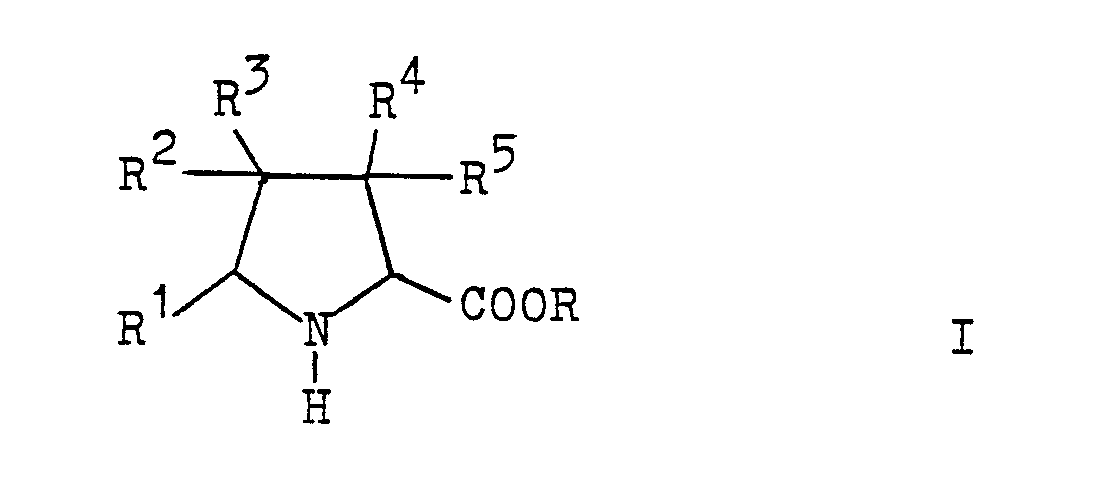
- Die Erfindung betrifft ein Verfahren zur Herstellung von Verbindungen der Formel I

R für Wasserstoff, (C₁-C₆)-Alkyl oder (C₇-C₉)-Aralkyl steht, und
R¹ bis R⁵ gleich oder verschieden sind unabhängig voneinander Wasserstoff, (C₁-C₈)-Alkyl, (C₃-C₉)-Cycloalkyl, (C₃-C₉)-Cycloalkyl-(C₁-C₄)-alkyl, (C₃-C₉)-Cycloalkenyl-(C₁-C₄)-alkyl, (C₆-C₁₂)-Aryl-(C₁-C₄)-alkyl oder (C₆-C₁₂)-Aryl, wobei die beiden letztgenannten Substituenten jeweils im Arylteil durch (C₁-C₄)-Alkyl, (C₁-C₄)-Alkoxy, Hydroxy, Halogen, Nitro, Methylendioxy und/oder Cyano mono-, di- oder trisubstituiert sein können, bedeuten
oder in welcher
jeweils die Reste R¹ und R², R² und R³ sowie R⁴ und R⁵ zusammen mit dem sie tragenden Kohlenstoffatom bzw. mit den beiden sie tragenden Kohlenstoffatomen ein 4- bis 10- gliedriges gesättigtes oder ungesättigtes mono- oder bicyclisches carbocyclisches Ringsystem bilden und die übrigen Reste Wasserstoff sind,
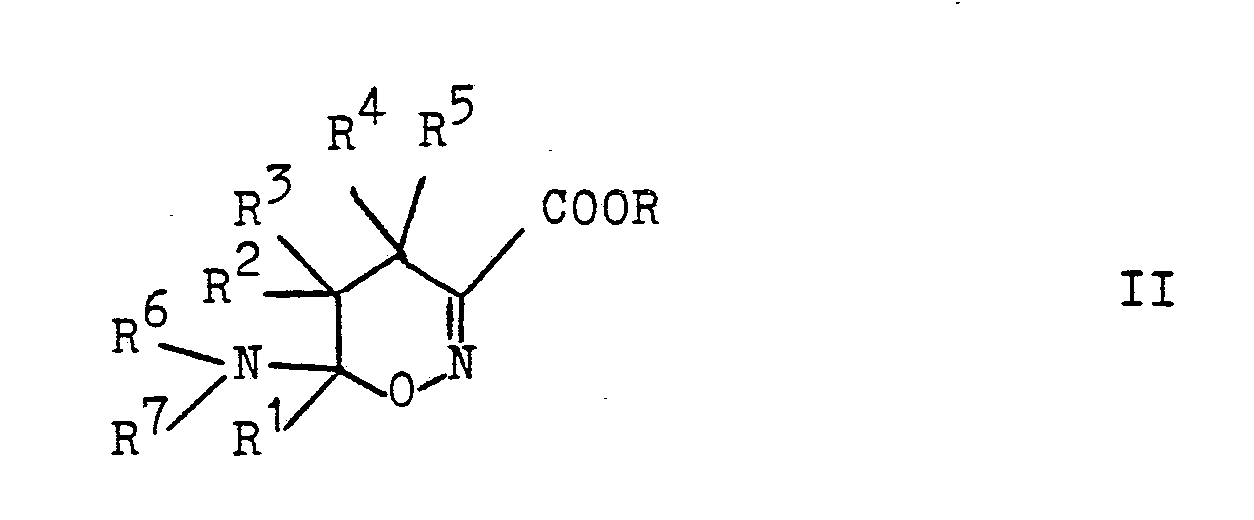
das dadurch gekennzeichnet ist, daß man eine Verbindung der Formel II
R und R¹ bis R⁵ gleich oder verschieden sind und die obengenannte Bedeutung haben, und
R⁶ und R⁷ (C₁-C₆)-Alkyl, (C₇-C₉)-Aralkyl bedeuten, oder
R⁶ und R⁷ zusammen mit dem sie tragenden Stickstoffatom einen 5- bis 10-gliedrigen Heterocyclus bilden, der zusätzlich ein Sauerstoffatom enthalten kann,
mit einem Reduktionsmittel behandelt. - Als Reduktionsmittel kommen in Betracht:
Wasserstoff in Gegenwart eines Katalysators wie Palladiummohr, Palladium auf Aktivkohle, Platin auf Aktivkohle, Rhodium auf Aktivkohle, Raney-nickel oder Raney-Kobalt in einem niederen Alkohol (wie (C₁-C₄)-Alkanol) oder einer niederen Carbonsäure (wie Ameisensäure, Essigsäure, Propionsäure oder Buttersäure) mit oder ohne Zusatz einer Mineralsäure wie z.B. Chlorwasserstoffsäure, Bromwasserstoffsäure oder Schwefelsäure sowie Natriumborhydrid, Natriumcyanborhydrid, sulfitiertes Natriumborhydrid (NaBH₂S₃), Boran-Dimethylsulfid, Boran-Pyridin, Boran-Trimethylamin, Natriumdithionit, Natrium in einem niederen Alkohol (wie (C₁-C₄)-Alkanol), Natriumamalgam oder Aluminiumamalgam, vorzugsweise jedoch Reduktionsmittel wie Wasserstoff in Gegenwart eines Katalysators wie Palladiummohr, Palladium auf Aktivkohle, Platin auf Aktivkohle, Rhodium auf Aktivkohle, Raney-nickel oder Raney-Kobalt. - Die Synthese kann zwischen -20°C und dem Siedepunkt des Reaktionsgemisches, vorzugsweise zwischen 20°C und 60°C durchgeführt werden. Der H₂-Druck beträgt bei der Reaktion 1·10⁵ bis 2·10⁷ N·m⁻², vorzugsweise 1·10⁵ bis 5·10⁶ N·m⁻².
- Eine bevorzugte Ausführungsform ist dadurch gekennzeichnet, daß Verbindungen der Formel I hergestellt werden, in welcher R die obengenannte Bedeutung hat,
R¹ bis R⁵ gleich oder verschieden sind und unabhängig voneinander Wasserstoff, Methyl, Ethyl, Propyl, Isopropyl, tert. Butyl, n-Pentyl, Cyclopentyl, Cyclohexyl, Cycloheptyl, Cyclopentylmethyl, Cyclopentylethyl, Cyclohexylmethyl, Phenyl, Napthyl, 4-Methoxyphenyl, 4-Fluorphhenyl, 4-Chlorphenyl, 3,4-Dimethoxyphenyl, 3,4-Methylendioxyphenyl, 3,4-Dichlorphenyl, p-Tolyl, Benzyl, 4-Methoxybenzyl, 4-Chlorbenzyl, Phenethyl, 2-Phenylpropyl oder 1-Phenylpropyl bedeuten,
oder in welcher
jeweils die Reste R¹ und R², R² und R³ sowie R⁴ und R⁵ in der oben definierten Weise einen Cyclobutan-, Cyclopentan-, Cyclohexan-, Cycloheptan-, Cyclooctan-, Bicyclo[2.2.1]heptan- oder Bicyclo[2.2.2]octan-Ring bilden, wobei die übrigen Reste Wasserstoff sind. - Besonders bevorzugt ist eine Ausführungsform, die dadurch gekennzeichnet ist, daß Verbindungen der Formel I hergestellt werden, in welcher
R die obengenannte Bedeutung hat, insbesondere aber Wasserstoff, tert. Butyl oder Benzyl bedeutet und worin
einer oder zwei der Reste R¹ bis R⁵ unabhängig voneinander Methyl, Ethyl, Propyl, Isopropyl, n-Pentyl, Cyclopentyl, Cyclohexyl, Phenyl, 4-Methoxyphenyl, 4-Fluorphenyl, Benzyl, Phenethyl oder 4-Methoxybenzyl und die übrigen Wasserstoff bedeuten, oder
jeweils die Reste R¹ und R² sowie R² und R³ mit dem sie tragenden Kohlenstoffatom bzw. mit den beiden sie tragenden Kohlenstoffatomen einen Cyclopentan-, Cyclohexan-, Cycloheptan-, Bicyclo[2.2.1]heptan- oder Bicyclo[2.2.2]-octan-Ring bilden, wobei die übrigen Reste Wasserstoff bedeuten. - Das erfindungsgemäße Verfahren liefert je nach Durchführung und Art der Substituenten R¹ bis R⁵ die Verbindungen der Formel I als Gemische von Enantiomeren oder Diastereomeren oder als reine Diastereomere. Entstehende Gemische können durch geeignete, an sich bekannte Verfahren wie fraktionierte Kristallisation oder Chromatographie für Diastereomere, oder Bildung von diastereomeren Salzen, gegebenenfalls von geeigneten Derivaten, für Enantiomerengemische in die Bestandteile getrennt werden.
- Ganz besonders vorteilhaft können nach dem erfindungsgemäßen Verfahren die folgenden Verbindungen der Formel I hergestellt werden.
cis-Octahydro[1H]indol-2-exo-carbonsäure-ethylester
cis-Octahydro[1H]indol-2-endo-carbonsäure-ethylester
trans-Octahydro[1H]indol-2-α-carbonsäure-ethylester
trans-Octahydro[1H]indol-2-β-carbonsäure-ethylester
cis-Octahydrocyclopenta[b]pyrrol-2-exo-carbonsäure-ethylester
cis-Octahydrocyclopenta[b]pyrrol-2-endo-carbonsäure-ethylester
trans-Octahydrocyclopenta[b]pyrrol-2-α-carbonsäure-ethylester
trans-Octahydrocyclopenta[b]pyrrol-2-β-carbonsäure-ethylester
2-Aza-spiro[4,5]decan-3-carbonsäure-ethylester
2-Aza-spiro[4,4]nonan-3-carbonsäure-ethylester
Spiro[bicyclo[2.2.2]octan-2,3ʹ-pyrrolidin]-5-exo-carbonsäure-ethylester
Spiro[bicyclo[2.2.2]octan-2,3ʹ-pyrrolidin]-5-endo-carbonsäure-ethylester
Spiro[bicyclo[2.2.1]heptan-2,3ʹ-pyrrolidin]-5-exo-carbonsäure-ethylester
cis-exo-3-Azatricyclo[5.2.1.02,6]decan-4-exo-carbonsäure-ethylester
cis-exo-3-Azatricyclo[5.2.1.02,6]decan-4-endo-carbonsäure-ethylester
cis-endo-3-Azatricyclo[5.2.1.02,6]decan-4 endo-carbonsäure-ethylester
cis-endo-3-Azatricyclo[5.2.1.02,6]decan-4-exo-carbonsäure-ethylester
cis-Decahydrocyclohepta[b]pyrrol-2-exo-carbonsäure-ethylester
cis-Decahydrocyclohepta[b]pyrrol-2-endo-carbonsäure-ethylester
trans-Decahydrocyclohepta[b]pyrrol-2-α-carbonsäure-ethylester
trans-Decahydrocyclohepta[b]pyrrol-2-β-carbonsäure-ethylester
1-Aza-spiro[4,5]decan-2-carbonsäure-ethylester
1-Aza-spiro[4,4]nonan-2-carbonsäure-ethylester
4,5-cis-Diethylprolin-ethylester
4,5-cis-Dimethylprolin-ethylester
5,5-Dimethylprolin-ethylester
4,4-Dimethylprolin-ethylester
4,4-Diethylprolin-ethylester
3,3-Dimethylprolin-ethylester
4,5-cis-Diphenylprolin-ethylester
4-Phenylprolin-ethylester
sowie die entsprechenden freien Säuren. - Verbindungen der Formel I, worin R (C₁-C₆)-Alkyl oder (C₇-C₉)-Aralkyl bedeutet, können in an sich bekannter Weise unter hydrogenolytischen, sauren oder basischen Bedingungen, beispielsweise mit Mineralsäure wie Chlorwasserstoffsäure, Bromwasserstoffsäure oder Schwefelsäure bei 0° bis 150°C, vorzugsweise bei 60° bis 120°C oder mit Wasserstoff in Gegenwart eines Übergangsmetallkatalysators, z.B. Raney-Nickel oder Palladium auf Aktivkohle, in Verbindungen der Formel I, worin R wasserstoff bedeutet, überführt werden.
- In J. Chem. Soc. Chem. Commun 1979, 1089 ist die Herstellung einer Verbindung der Formel II beschrieben, worin R Ethyl bedeutet, R¹ und R² gemeinsam eine -[CH₂]₄-Kette bilden, R³ bis R⁵ für Wasserstoff und R⁶ und R⁷ mit dem sie tragenden Stickstoffatom für einen Morpholinring stehen. Weitere Umsetzungen sind nicht offenbart.
- Mit Ausnahme dieser genannten Verbindung sind die Verbindungen der Formel II neu und ebenfalls Gegenstand der Erfindung.
- Die Erfinding betrifft weiterhin ein Verfahren zur Herstellung von Verbindungen der Formel II, dadurch gekennzeichnet, daß man eine Verbindung der Formel III


R für Wasserstoff, (C₁-C₆)-Alkyl oder (C₇-C₉)-Aralkyl steht,
R¹ bis R⁵ gleich oder verschieden sind und unabhängig voneinander Wasserstoff, (C₁-C₈)-Alkyl, (C₃-C₉)-Cycloalkyl, (C₃-C₉)-Cycloalkyl-(C₁-C₄)-alkyl, (C₅-C₉)-Cycloakenyl-(C₁-C₄)-alkyl, (C₆-C₁₂)-Aryl-(C₁-C₄)-alkyl oder (C₆-C₁₂)-Aryl, wobei die beiden letztgenannten Substituenten jeweils im Arylteil durch (C₁-C₄)-Alkyl, (C₁-C₄)-Alkoxy, Hydroxy, Halogen, Nitro, Methylendioxy und/oder Cyano mono-, di- oder trisubstituert sein können, bedeuten
oder worin
jeweils die Reste R¹ und R², R² und R³ sowie R⁴ und R⁵ zusammen mit dem sie tragenden Kohlenstoffatom bzw. mit den beiden sie tragenden Kohlenstoffatomen ein 4- bis 10-gliedriges gesättigtes oder ungesättigtes mono- oder bicyclisches carbocyclisches Ringsystem bilden und die übrigen Reste Wasserstoff sind,
R⁶ und R⁷ (C₁-C₄)-Alkyl, (C₇-C₉)-Aralkyl bedeuten, oder
R⁶ und R⁷ zusammen mit dem sie tragenden Stickstoffatom einen 5- bis 10-gliedrigen Heterocyclus bilden, der zusätzlich ein Sauerstoffatom enthalten kann, und
X Chlor oder Brom bedeutet, umsetzt. - Die Umsetzung wird in einem aprotischen organischen Lösungsmittel, vorzugsweise einem Ether wie z.B. Diethylether, Diisopropylether, Tetrahydrofuran oder Dioxan oder einem chlorierten Kohlenwasserstoff wie z.B. Dichlormethan oder Chloroform in Gegenwart einer schwachen Base wie beispielsweise Natriumhydrogencarbonat, Natriumcarbonat, Kaliumcarbonat oder einem Trialkylamin oder Pyridin in einem Temperaturbereich von -40°C bis 100°C, vorzugsweise von 0° bis 50°C durchgeführt.
- Die Verbindungen der Formel III sind aus G. Cook, Enamines (Marcel Decker, New York und London, 1969) bekannt. Verbindungen der Formel IV erhält man aus Verbindungen der Formel V

R, R⁴, R⁵ und X wie oben definiert sind, durch Umsetzung mit Hydroxylamin, wie in J. Chem. Soc. Commun 1979, 1089 beschrieben. - Die Verbindungen der Formel I sind wertvolle Zwischenprodukte bei der Herstellung von Pharmazeutika, insbesondere von Inhibitoren der "Angiotensin Converting Enzym" (ACE). Verbindungen dieses Typs sind beispielsweise aus der EP-A-50 800 bekannt oder sind auch Gegenstand der deutschen Patentanmeldung P 31 51 690.4. Solche ACE-Inhibitoren sind beispielsweise substituierte Acylderivate der Formel VI


R⁸ Wasserstoff, (C₁-C₆)-Alkyl, das gegebenenfalls durch Amino, (C₁-C₄)-Acylamino oder Benzoylamino substituiert sein kann, (C₂-C₆)-Alkenyl, (C₅-C₉)-Cycloalkyl, (C₅-C₉)-Cycloalkenyl, (C₅-C₇)-Cycloalkyl-(C₁-C₄)-alkyl, Aryl oder teilhydriertes Aryl, das jeweils durch (C₁-C₂)-Alkyl, (C₁-C₂)-Alkoxy oder Halogen substituiert sein kann, Aryl-(C₁-C₄)-alkyl, dessen Arylrest, wie vorstehen definiert, substituiert sein kann, einen mono- bzw. bicyclischen Heterocyclenrest mit 5 bis 7 bzw. 8 bis 10 Ringatomen, wovon 1 bis 2 Ringatome Schwefel- oder Sauerstoffatome und/oder wovon 1 bis 4 Ringatome Stickstoffatome darstellen oder eine Seitenkette einer Aminosäure,
R⁹ Wasserstoff, (C₁-C₆)-Alkyl, (C₂-C₆)-Alkenyl oder Aryl-(C₁-C₄)-alkyl,
Y und Yʹ Wasserstoff oder zusammen Sauerstoff,
Z (C₁-C₆)-Alkyl, (C₂-C₆)-Alkenyl, (C₅-C₉)-Cycloalkyl, Aryl, das durch (C₁-C₄)-Alkyl, (C₁-C₄)-Alkoxy, Hydroxy, Halogen, Nitro, Amino, (C₁-C₄)-Alkylamino, Di(C₁-C₄)-alkylamino und/oder Methylendioxy mono-, di-oder trisubstituiert sein kann, oder Indol-3-yl bedeuten
sowie deren physiologisch unbedenkliche Salze. - Verbindungen der Formel VI können beispielsweise durch N-Acylierung von geeigneten Estern der Verbindungen der Formel I, wie beispielsweise Benzyl- oder tert.-Butylestern mit Verbindungen der Formel Acyl-OH, in der Acyl wie vorstehend definiert ist und anschließend hydrogenolytische, saure oder basische Abspaltung der Estergruppen hergestellt werden.
- Die Kondensation von Estern der Verbindungen der Formel I mit Verbindungen der Formel Acyl-OH erfolgt vorzugsweise nach bekannten Methoden der Peptidchemie. Besonders bevorzugt sind solche Verfahren, die ausreichend Schutz vor Racemisierung bieten, wie z.B. die DCC/HOBt-Methode oder die im US-Patent 43 31 592 beschriebene Alkanphosphonsäureanhydridmethode.
- Die Verbindungen der Formel VI besitzen eine lang andauernde, intensive blutdrucksenkende Wirkung. Sie werden nach peroraler Gabe gut resorbiert und können zur Bekämpfung des Bluthochdrucks verschiedener Genese eingesetzt und für sich oder in Kombination mit anderen blutdrucksenkenden, gefäßerweiternden oder diuretisch wirksamen Verbindungen angewandt werden. Die Anwendung kann intravenös, subkutan oder peroral erfolgen, die perorale Gabe wird bevorzugt. Die Dosierung liegt bei peroraler Gabe in der Regel bei 0,01 bis 10 mg/kg Tag.
Sie kann in schweren Fällen auch erhöht werden, da toxische Eigenschaften bisher nicht beobachtet wurden. Auch eine Herabsetzung der Dosis ist möglich und vor allem dann angebracht, wenn gleichzeitig Diuretika verabreicht werden. Bei intravenöser und subkutaner Gabe sollte Einzeldosis zwischen 0,1 und 250 µ/Tag liegen. - Die folgenden Beispiele sollen die Erfindung erläutern, ohne sie auf die beschriebenen Beispiele zu beschränken.
- 5 g (30 mmol) Morpholino-cyclohexen und 1,9 g (10 mmol) 3-Bromo-2-hydroxyiminopropionsäure-ethylester werden zusammen mit 2 g Kaliumcarbonat in 80 ml Dichlormethan 4 Stunden bei Raumtemperatur gerührt. Nach dem Abfiltrieren wird eingeengt und an Kieselgel chromatographiert (Laufmittel: Essigester/Cyclohexan 1:4). Man erhält 2,1 g farbloses Öl.
¹H-NMR (CDCl₃): δ = 4,3 (q,2H); 3,6 (t,4H); 2,8 (m,2H); 2,6 (m,2H); 2,3 (m,2H); 1,4 (t,3H); 1,7 - 1,0 (m,9H) ppm. - 2,1 g des Produkts aus Beispiel 1a) werden in 60 ml Ethanol mit 0,5 g Raney-Nickel 4 Stunden bei 50°C unter Normaldruck hydriert. Man erhält 1,3 g cis-Octahydro[1H]indol-2-carbonsäure-ethylester als blaßgelbes Öl nach dem Abfiltrieren und Einengen im Vakuum.
- 4,6 g (30 mmol) Morpholino-cyclopentan werden analog der in Beispiel 1a) angegebenen Vorschrift mit 1,75 g (10 mmol) 3-Bromo-hydroxyimino-propionsäure-methylester umgesetzt. Man erhält 1,9 g farbloses Öl.
- ¹H-NMR (CDCl₃): δ = 3,8 (s,3H); 3,6 (t,4H); 2,8 (m,2H); 2,6 (m,2H); 2,3 (m,2H); 1,7-1,0 (m,3H) ppm.
- Analog der in Beispiel 1b) angegebenen Vorschrift erhält man aus 1,9 g 1-Morpholino-2-oxa-3-aza-bicyclo[4.3.0]non-3-en-4-carbonsäure-methylester 1,0 g cis-2-Aza-bicyclo[3.3.0]octan-3-carbonsäure-methylester als blaßgelbes Öl.
- 4,5 g (20 mmol) 2-Pyrrolidinomethylen-bicyclo[2.2.2]octan und 2,75 g (13 mmol) 3-Bromo-2-hydroxyimino-propionsäure-ethylester werden in 50 ml Dichlormethen gelöst. Anschlißend werden 5 g Natriumcarbonat zugegeben und 2 Stunden bei 25°C gerührt. Nach der Filtration wird eingeeingt. Die Chromatographie an Kieselgel mit Essigester/Cyclohexan (1:8) als Laufmittel ergibt 2,45 g Produkt. Fp. 116-118°C (n-Hexan)
¹H-NMR (CDCl₃): δ = 4,95 + 4,85 (2d,1H); 4,3 (2q,2H); 3,0 (m,2H); 2,7 (m,2H); 2,6 + 2,2 (AB-System,2H); 1,9 - 1,4 (m,16H); 1,4 (t,3H) ppm. - 2,4 g des Produktes aus Beispiel 3a) werden in 60 ml Ethanol mit 0,4 g Raney-Nickel analog der in Beispiel 1b) angegebenen Vorschrift hydriert. Man erhält 1,9 g eines blaßgelben Öls, das die beiden Diastereomeren (S*,S* bzw. S*,R*) im Verhältnis von 3:1 enthält. Die Isomeren können nach der Acetylierung mit Acetylchlorid/Triethylamin in Tetrahydrofuran getrennt werden.
Isomer 1 (S,S): 0,5 g, Fp. 122°C
¹H-NMR (CDCl₃): δ = 4,4 (m,1H); 4,2 (q,2H); 3,9 - 3,1 (m,1H); 2,4 - 1,8 (m,1H); 2,1 + 1,95 (2s,3H); 1,7 - 1,3 (m,13H); 1,25 (t,3H) ppm.
Isomer 2 (S,R): 1,5 g, Öl
¹H-NMR (CDCl₃): δ = 4,5 - 4,3 (m,1H); 4,3 - 4,1 (m,2H); 3,6-3,3 (m,2H); 2,4 - 1,8 (m,2H); 2,1 + 1,95 (2s,3H); 1,8 - 1,3 (m,12H); 1,3 (t,3H) ppm. - 3,3 g (20 mmol) Pyrrolidinomethylen-cyclohexan werden analog der in Beispiel 3a) angegebenen Vorschrift mit 2,75 g (13 mmol) 3-Bromo-2-hydroxyimino-propionsäure-ethylester umgesetzt. Man erhält 1,6 g 3-Ethoxycarbonyl-5,5-pentamethylen-6-pyrrolidino-4H-5,6-dihydro-1,2-oxazin als Öl.
¹H-NMR (CDC1₃) δ = 4,9 (s,1H); 4,3 (2q,2H); 3,0 (m,2H); 2,7 (m,2H); 2,6 + 2,2 (AB-System,2H); 1,9 - 1,4 (m,14H); 1,4 (t,3H) ppm. - 1,6 g des Produkts aus Beispiel 4a) werden analog der in Beispiel 1b) angegebenen Vorschrift mit 0,2 g Raney-Nickel hydriert. Man erhält 0.9 g blaßgelbes Öl.
¹H-NMR (CDCl₃): δ = 4,2 (q,2H); 3,9 (m,1H); 3,4 (m,2H); 1,9 - 1,3 (m,12H); 1,25 (t,3H) ppm.
Claims (7)

R für Wasserstoff, (C₁-C₆)-Alkyl oder (C₇-C₉)-Aralkyl steht, und
R¹ bis R⁵ gleich oder verschieden sind und unabhängig voneinander Wasserstoff, (C₁-C₈)-Alkyl, (C₃-C₉)-Cycloalkyl, (C₃-C₉-Cycloalkyl-(C₁-C₄)-alkyl, (C₅-C₉)-Cycloalkenyl-(C₁-C₄)-alkyl, (C₆-C₁₂)-Aryl-(C₁-C₄)-alkyl oder (C₆-C₁₂)-Aryl, wobei die beiden letztgenannten Substituenten jeweils im Arylteil durch (C₁-C₄)-Alkyl, (C₁-C₄)-Alkoxy, Hydroxy, Halogen, Nitro, Methylendioxy und/oder Cyano mono-, di- oder trisubstituiert sein können, bedeuten
oder in welcher
jeweils die Reste R¹ und R², R² und R³ sowie R⁴ und R⁵ zusammen mit dem sie tragenden Kohlenstoffatom bzw. mit den beiden sie tragenden Kohlenstoffatomen ein 4- bis 10-gliedriges gesättigtes oder ungesättigtes mono- oder bicyclisches carbocyclisches Ringsystem bilden und die übrigen Reste Wasserstoff sind,
das dadurch gekennzeichnet ist, daß man eine Verbindung der Formel II

R und R¹ bis R⁵ gleich oder verschieden sind und die obengenannte Bedeutung haben, und
R⁶ und R⁷ (C₁-C₆)-Alkyl, (C₇-C₉)-Aralkyl bedeuten, oder
R⁶ und R₇ zusammen mit dem sie tragenden Stickstoffatom einen 5- bis 10-gliedrigen Heterocyclus bilden, der zusätzlich ein Sauerstoffatom enthalten kann,
mit einem Reduktionsmittel behandelt und gegebenenfalls unter hydrogenolytischen, sauren oder basischen Bedingungen in Verbindungen der Formel I, worin R Wasserstoff bedeutet, überführt.
R¹ bis R⁵ gleich oder verschieden sind und unabhängig voneinander Wasserstoff, Methyl, Ethyl, Propyl, Isopropyl, tert. Butyl, n-Pentyl, Cyclopentyl, Cyclohexyl, Cycloheptyl, Cyclopentylmethyl, Cyclopentylethyl, Cyclohexylmethyl, Phenyl, Naphthyl, 4-Methoxyphenyl, 4-Fluorphenyl, 4-Chlorophenyl, 3,4-Dimethoxyphenyl, 3,4-Methylendioxyphenyl, 3,4-Dichlorphenyl, p-Tolyl, Benzyl, 4-Methoxybenzyl, 4-Chlorbenzyl, Phenethyl, 2-Phenylpropyl oder 1-Phenylpropyl bedeuten,
oder in welcher
jeweils die Reste R¹ und R², R² und R³ sowie R⁴ und R⁵ in der oben definierten Weise einen Cyclobutan-, Cyclopentan-, Cyclohexan-, Cycloheptan-, Cyclooctan-, Bicyclo[2.2.1]heptan- oder Bicyclo[2.2.2]octan-Ring bilden, wobei die übrigen Reste Wasserstoff sind.
R wie in Anspruch 1 definiert ist, insbesondere aber Wasserstoff, tert. Butyl oder Benzyl bedeutet und worin
einer oder zwei der Reste R¹ bis R⁵ unabhängig voneinander Methyl, Ethyl, Propyl, Isopropyl, n-Pentyl, Cyclopentyl, Cyclohexyl, Phenyl, 4-Methoxyphenyl, 4-Fluorphenyl, Benzyl, Phenethyl oder 4-Methoxybenzyl und die übrigen Wasserstoff bedeuten,
oder
jeweils die Reste R¹ und R² sowie R² und R³ mit dem sie tragenden Kohlenstoffatom bzw. mit den beiden sie tragenden Kohlenstoffatomen einen Cyclopentan-, Cyclohexan-, Cycloheptan-, Bicyclo[2.2.1]heptan- oder Bicyclo[2.2.2]octan-Ring bilden, wobei die übrigen Reste Wasserstoff bedeuten.
R und R¹ bis R⁷ wie in Anspruch 1 definiert sind, mit der Maßgabe, daß nicht gleichzeitig R für Ethyl, R¹ und R² gemeinsam für eine -[CH₂]₄-Kette, R³ bis R⁵ für Wasserstoff und R⁶ und R⁷ mit dem sie tragenden Stickstoffatom für einen Morpholinring stehen.


R für Wasserstoff, (C₁-C₆)-Alkyl oder (C₇-C₉)-Aralkyl steht
R¹ bis R⁵ gleich oder verschieden sind unabhängig voneinander Wasserstoff, (C₁-C₈)-Alkyl, (C₃-C₉)-Cycloalkyl, (C₃-C₉-Cycloalkyl-(C₁-C₄)-alkyl, (C₅-C₉)-Cycloalkenyl-(C₁-C₄)-alkyl, (C₆-C₁₂)-Aryl-(C₁-C₄)-alkyl oder (C₆-C₁₂)-Aryl, wobei die beiden letztgenannten Substituenten jeweils im Arylteil durch (C₁-C₄)-Alkyl, (C₁-C₄)-Alkoxy, Hydroxy, Halogen, Nitro, Methylendioxy und/oder Cyano mono-, di- oder trisubstituiert sein können, bedeuten
oder worin
jeweils die Reste R¹ und R², R² und R³ sowie R⁴ und R⁵ zusammen mit dem sie tragenden Kohlenstoffatom bzw. mit den beiden sie tragenden Kohlenstoffatomen ein 4- bis 10-gliedriges gesättigtes oder ungesättigtes mono- oder bicyclisches carbocyclisches Ringsystem bilden und die übrigen Reste Wasserstoff sind,
R⁶ und R⁷ (C₁-C₄)-Alkyl, (C₇-C₉)-Aralkyl bedeuten oder
R⁶ und R⁷ zusammen mit dem sie tragenden Stickstoffatom einen 5- bis 10-gliedrigen Heterocyclus bilden, der zusätzlich ein Sauerstoffatom enthalten kann, und
Chlor oder Brom bedeutet, umsetzt.
Applications Claiming Priority (2)
| Application Number | Priority Date | Filing Date | Title |
|---|---|---|---|
| DE19863639879 DE3639879A1 (de) | 1986-11-21 | 1986-11-21 | Verfahren zur herstellung von mono-, bi- und tricyclischen aminosaeuren, zwischenprodukte dieses verfahrens sowie ein verfahren zu deren herstellung |
| DE3639879 | 1986-11-21 |
Publications (3)
| Publication Number | Publication Date |
|---|---|
| EP0268975A2 true EP0268975A2 (de) | 1988-06-01 |
| EP0268975A3 EP0268975A3 (en) | 1989-11-23 |
| EP0268975B1 EP0268975B1 (de) | 1994-05-25 |
Family
ID=6314504
Family Applications (1)
| Application Number | Title | Priority Date | Filing Date |
|---|---|---|---|
| EP87116920A Expired - Lifetime EP0268975B1 (de) | 1986-11-21 | 1987-11-17 | Verfahren zur Herstellung von mono-, bi- und tricyclischen Aminosäuren, Zwischenprodukte dieses Verfahrens sowie ein Verfahren zu deren Herstellung |
Country Status (12)
| Country | Link |
|---|---|
| US (2) | US4849524A (de) |
| EP (1) | EP0268975B1 (de) |
| JP (2) | JPH089592B2 (de) |
| KR (1) | KR950008779B1 (de) |
| AT (1) | ATE106078T1 (de) |
| AU (1) | AU609748B2 (de) |
| DE (2) | DE3639879A1 (de) |
| DK (1) | DK611087A (de) |
| ES (1) | ES2054645T3 (de) |
| IE (1) | IE64071B1 (de) |
| PT (1) | PT86160B (de) |
| ZA (1) | ZA878696B (de) |
Cited By (1)
| Publication number | Priority date | Publication date | Assignee | Title |
|---|---|---|---|---|
| WO1999065899A1 (en) * | 1998-06-18 | 1999-12-23 | Dongbu Hannong Chemical Co., Ltd. | New oxazinylazole derivatives as fungicides |
Families Citing this family (13)
| Publication number | Priority date | Publication date | Assignee | Title |
|---|---|---|---|---|
| DE3333455A1 (de) * | 1983-09-16 | 1985-04-11 | Hoechst Ag, 6230 Frankfurt | Verfahren zur herstellung n-alkylierter dipeptide und deren estern |
| US5684016A (en) * | 1984-04-12 | 1997-11-04 | Hoechst Aktiengesellschaft | Method of treating cardiac insufficiency |
| DE3413710A1 (de) * | 1984-04-12 | 1985-10-24 | Hoechst Ag, 6230 Frankfurt | Verfahren zur behandlung der herzinsuffizienz |
| DE3431541A1 (de) * | 1984-08-28 | 1986-03-06 | Hoechst Ag, 6230 Frankfurt | Cis,endo-2-azabicycloalkan-3-carbonsaeure-derivate, verfahren zu deren herstellung, deren verwendung sowie zwischenprodukte bei deren herstellung |
| US5231080A (en) * | 1985-10-15 | 1993-07-27 | Hoechst Aktiengesellschaft | Method for the treatment of atherosclerosis, thrombosis, and peripheral vessel disease |
| US5231084A (en) * | 1986-03-27 | 1993-07-27 | Hoechst Aktiengesellschaft | Compounds having a cognition adjuvant action, agents containing them, and the use thereof for the treatment and prophylaxis of cognitive dysfuncitons |
| DE3731085A1 (de) * | 1987-09-16 | 1989-04-06 | Hoechst Ag | Neue aminosaeureester, verfahren zu ihrer herstellung, sie enthaltende arzneimittel und deren verwendung |
| EP0331609A3 (de) * | 1988-01-27 | 1992-07-01 | Hoechst Aktiengesellschaft | Angiotensin-Converting-Enzym-Hemmstoffe mit psychotroper Wirkung |
| HU904967D0 (en) * | 1988-04-22 | 1991-01-28 | Hoechst Ag | Process for producing new azabicyclo(3.3.o)octane-3-carboxylic acid-octylesther derivatives |
| FR2776292B1 (fr) * | 1998-03-20 | 2004-09-10 | Oncopharm | Cephalotaxanes porteurs de chaine laterale et leur procede de synthese |
| CA2522195A1 (en) * | 2003-04-15 | 2004-10-28 | Warner-Lambert Company Llc | [b]-fused bicyclic proline derivatives and their use for treating arthritic conditions |
| WO2004092134A1 (en) * | 2003-04-15 | 2004-10-28 | Warner-Lambert Company Llc | [c]-fused bicyclic proline derivatives and their use for treating arthritic conditions |
| WO2006052968A2 (en) * | 2004-11-05 | 2006-05-18 | King Pharmaceuticals Research & Development, Inc. | Stabilized ramipril compositions and methods of making |
Family Cites Families (30)
| Publication number | Priority date | Publication date | Assignee | Title |
|---|---|---|---|---|
| SU519418A1 (ru) * | 1973-06-28 | 1976-06-30 | Московский Ордена Ленина И Ордена Трудового Красного Знамени Государственный Университет Им.М.В.Ломоносова | Способ получени производных 2-окса3-азабицикло/3,1,0/гексена-3 |
| JPS5572169A (en) * | 1978-11-27 | 1980-05-30 | Tanabe Seiyaku Co Ltd | Isoquinoline derivative and its preparation |
| IL58849A (en) * | 1978-12-11 | 1983-03-31 | Merck & Co Inc | Carboxyalkyl dipeptides and derivatives thereof,their preparation and pharmaceutical compositions containing them |
| US4294832A (en) * | 1979-04-28 | 1981-10-13 | Tanabe Seiyaku Co., Ltd. | Tetrahydroisoquinoline compounds and a pharmaceutical composition thereof |
| FR2503155A2 (fr) * | 1980-10-02 | 1982-10-08 | Science Union & Cie | Nouveaux imino diacides substitues, leurs procedes de preparation et leur emploi comme inhibiteur d'enzyme |
| US4508729A (en) * | 1979-12-07 | 1985-04-02 | Adir | Substituted iminodiacids, their preparation and pharmaceutical compositions containing them |
| FR2491469A1 (fr) * | 1980-10-02 | 1982-04-09 | Science Union & Cie | Nouveaux imino diacides substitues, leurs procedes de preparation et leur emploi comme inhibiteur d'enzyme |
| IE52663B1 (en) * | 1980-04-02 | 1988-01-20 | Warner Lambert Co | Substituted acyl derivatives of octahydro-1h-indole-2-carboxylic acids |
| DE3177130D1 (de) * | 1980-08-30 | 1990-01-11 | Hoechst Ag | Aminosaeurederivate, verfahren zu ihrer herstellung, diese enthaltende mittel und deren verwendung. |
| IL63813A0 (en) * | 1980-09-17 | 1981-12-31 | Univ Miami | Carboxyalkyl peptides and thioethers and ethers of peptides,antihypertensive compositions and methods for their use |
| EP0050800B2 (de) * | 1980-10-23 | 1995-06-07 | Schering Corporation | Carboxyalkyl-Dipeptide, Verfahren zu ihrer Herstellung und diese enthaltende Arzneimittel |
| ZA817261B (en) * | 1980-10-23 | 1982-09-29 | Schering Corp | Carboxyalkyl dipeptides,processes for their production and pharmaceutical compositions containing them |
| US4374847A (en) * | 1980-10-27 | 1983-02-22 | Ciba-Geigy Corporation | 1-Carboxyalkanoylindoline-2-carboxylic acids |
| GB2086390B (en) * | 1980-11-03 | 1984-06-06 | Ciba Geigy Ag | 1-carboxy-azaalkanoylindoline-2-carboxylic acids process for their manufacture pharmaceutical preparations containing these compounds and their therapeutic application |
| US4820729A (en) * | 1981-03-30 | 1989-04-11 | Rorer Pharmaceutical Corporation | N-substituted-amido-amino acids |
| DE3226768A1 (de) * | 1981-11-05 | 1983-05-26 | Hoechst Ag, 6230 Frankfurt | Derivate der cis, endo-2-azabicyclo-(3.3.0)-octan-3-carbonsaeure, verfahren zu ihrer herstellung, diese enthaltende mittel und deren verwendung |
| DE3210496A1 (de) * | 1982-03-23 | 1983-10-06 | Hoechst Ag | Neue derivate bicyclischer aminsaeuren, verfahren zu ihrer herstellung, diese enthaltende mittel und deren verwendung sowie neue bicyclische aminosaeuren als zwischenstufen und verfahren zu deren herstellung |
| DE3211397A1 (de) * | 1982-03-27 | 1983-11-10 | Hoechst Ag, 6230 Frankfurt | Spiro (4.(3+n))-2-aza-3-carbonsaeure-derivate, verfahren zu ihrer herstellung, diese enthaltende mittel und ihre verwendung |
| DE3211676A1 (de) * | 1982-03-30 | 1983-10-06 | Hoechst Ag | Neue derivate von cycloalka (c) pyrrol-carbonsaeuren, verfahren zu ihrer herstellung, diese enthaltende mittel und deren verwendung sowie neue cycloalka (c) pyrrol-carbonsaeuren als zwischenstufen und verfahren zu deren herstellung |
| DE3242151A1 (de) * | 1982-11-13 | 1984-05-17 | Hoechst Ag, 6230 Frankfurt | Neue derivate tricyclischer aminosaeuren, verfahren zu ihrer herstellung, diese enthaltende mittel und deren verwendung, sowie neue bicyclische aminosaeuren als zwischenstufen und verfahren zu deren herstellung |
| DE3246503A1 (de) * | 1982-12-16 | 1984-06-20 | Hoechst Ag, 6230 Frankfurt | Derivate der cis, endo-2-azabicyclo-(5.3.0)-decan-3-carbonsaeure, verfahren zu ihrer herstellung, diese enthaltende mittel und deren verwendung |
| DE3300316A1 (de) * | 1983-01-07 | 1984-07-12 | Hoechst Ag, 6230 Frankfurt | Disubstituierte prolinderivate, verfahren zu ihrer herstellung und ihre verwendung |
| DE3300774A1 (de) * | 1983-01-12 | 1984-07-12 | Hoechst Ag, 6230 Frankfurt | Neue spirocyclische aminosaeuren, verfahren zu ihrer herstellung, diese enthaltende mittel und deren verwendung sowie neue spirocyclische aminosaeuren als zwischenprodukte und verfahren zu deren herstellung |
| DE3303112A1 (de) * | 1983-01-31 | 1984-08-09 | Hoechst Ag, 6230 Frankfurt | Verfahren zur racemattrennung optisch aktiver bicyclischer imino-(alpha)-carbonsaeuren |
| DE3315464A1 (de) * | 1983-04-28 | 1984-10-31 | Hoechst Ag, 6230 Frankfurt | Verfahren zur herstellung von n-alkylierten dipeptiden und deren estern |
| DE3322530A1 (de) * | 1983-06-23 | 1985-01-10 | Hoechst Ag, 6230 Frankfurt | Verfahren zur herstellung von mono-, bi- und tricyclischen aminosaeuren |
| DE3324263A1 (de) * | 1983-07-06 | 1985-01-17 | Hoechst Ag, 6230 Frankfurt | Derivate der 2-azabicyclo(3.1.0)hexan-3-carbonsaeure, verfahren zu ihrer herstellung, diese enthaltende mittel und deren verwendung sowie 2-azabicyclo(3.1.0)hexan-derivate als zwischenprodukte und verfahren zu deren herstellung |
| DE3345355A1 (de) * | 1983-12-15 | 1985-06-27 | Hoechst Ag, 6230 Frankfurt | Verfahren zur racematspaltung bicyclischer imino-(alpha)-carbonsaeureester |
| DE3431541A1 (de) * | 1984-08-28 | 1986-03-06 | Hoechst Ag, 6230 Frankfurt | Cis,endo-2-azabicycloalkan-3-carbonsaeure-derivate, verfahren zu deren herstellung, deren verwendung sowie zwischenprodukte bei deren herstellung |
| DE3641451A1 (de) * | 1986-12-04 | 1988-06-16 | Hoechst Ag | Derivate bicyclischer aminocarbonsaeuren, verfahren und zwischenprodukte zu deren herstellung sowie deren verwendung |
-
1986
- 1986-11-21 DE DE19863639879 patent/DE3639879A1/de not_active Withdrawn
-
1987
- 1987-11-17 ES ES87116920T patent/ES2054645T3/es not_active Expired - Lifetime
- 1987-11-17 AT AT87116920T patent/ATE106078T1/de not_active IP Right Cessation
- 1987-11-17 EP EP87116920A patent/EP0268975B1/de not_active Expired - Lifetime
- 1987-11-17 DE DE3789892T patent/DE3789892D1/de not_active Expired - Lifetime
- 1987-11-18 PT PT86160A patent/PT86160B/pt unknown
- 1987-11-19 US US07/122,380 patent/US4849524A/en not_active Expired - Lifetime
- 1987-11-19 KR KR1019870012998A patent/KR950008779B1/ko not_active Expired - Lifetime
- 1987-11-20 ZA ZA878696A patent/ZA878696B/xx unknown
- 1987-11-20 DK DK611087A patent/DK611087A/da not_active Application Discontinuation
- 1987-11-20 JP JP62292224A patent/JPH089592B2/ja not_active Expired - Lifetime
- 1987-11-20 AU AU81450/87A patent/AU609748B2/en not_active Expired
- 1987-11-20 IE IE314287A patent/IE64071B1/en not_active IP Right Cessation
-
1989
- 1989-04-10 US US07/335,443 patent/US4977260A/en not_active Expired - Lifetime
-
1995
- 1995-07-24 JP JP7186967A patent/JP2688049B2/ja not_active Expired - Lifetime
Cited By (1)
| Publication number | Priority date | Publication date | Assignee | Title |
|---|---|---|---|---|
| WO1999065899A1 (en) * | 1998-06-18 | 1999-12-23 | Dongbu Hannong Chemical Co., Ltd. | New oxazinylazole derivatives as fungicides |
Also Published As
| Publication number | Publication date |
|---|---|
| US4849524A (en) | 1989-07-18 |
| US4977260A (en) | 1990-12-11 |
| PT86160B (pt) | 1990-11-20 |
| KR890003684A (ko) | 1989-04-17 |
| DK611087D0 (da) | 1987-11-20 |
| IE873142L (en) | 1988-05-21 |
| DK611087A (da) | 1988-05-22 |
| ATE106078T1 (de) | 1994-06-15 |
| JPH08183784A (ja) | 1996-07-16 |
| ES2054645T3 (es) | 1994-08-16 |
| JPH089592B2 (ja) | 1996-01-31 |
| ZA878696B (en) | 1988-05-19 |
| DE3789892D1 (de) | 1994-06-30 |
| AU609748B2 (en) | 1991-05-09 |
| PT86160A (de) | 1987-12-01 |
| JPS63141960A (ja) | 1988-06-14 |
| JP2688049B2 (ja) | 1997-12-08 |
| AU8145087A (en) | 1988-05-26 |
| KR950008779B1 (ko) | 1995-08-08 |
| EP0268975B1 (de) | 1994-05-25 |
| DE3639879A1 (de) | 1988-06-01 |
| IE64071B1 (en) | 1995-07-12 |
| EP0268975A3 (en) | 1989-11-23 |
Similar Documents
| Publication | Publication Date | Title |
|---|---|---|
| EP0131226B1 (de) | Derivate der 2-Azabicyclo(3.1.0)hexan-3-carbonsäure, Verfahren zu ihrer Herstellung, diese enthaltende Mittel und deren Verwendung sowie 2-Azabicyclo(3.1.0)hexan-Derivate als Zwischenprodukte und Verfahren zu deren Herstellung | |
| EP0268975B1 (de) | Verfahren zur Herstellung von mono-, bi- und tricyclischen Aminosäuren, Zwischenprodukte dieses Verfahrens sowie ein Verfahren zu deren Herstellung | |
| EP0084164B1 (de) | Neue Derivate bicyclischer Aminosäuren, Verfahren zu ihrer Herstellung, diese enthaltende Mittel und deren Verwendung sowie neue bicyclische Aminosäuren als Zwischenstufen und Verfahren zu deren Herstellung | |
| EP0109020B1 (de) | Neue Derivate tricyclischer Aminosäuren, Verfahren zu ihrer Herstellung, diese enthaltende Mittel und deren Verwendung, sowie neue bicyclische Aminosäuren als Zwischenstufen und Verfahren zu deren Herstellung | |
| EP0089637B1 (de) | Neue Derivate bicyclischer Aminosäuren, Verfahren zu ihrer Herstellung, diese enthaltende Mittel und deren Verwendung sowie neue bicyclische Aminosäuren als Zwischenstufen und Verfahren zu deren Herstellung | |
| EP0111873B1 (de) | Derivate der cis, endo-2-Azabicyclo-(5.3.0)-decan-3-carbonsäure, Verfahren zu ihrer Herstellung, diese enthaltende Mittel und deren Verwendung | |
| EP0090362A2 (de) | Neue Derivate von Cycloalka(c)pyrrol-carbonsäuren, Verfahren zu ihrer Herstellung, diese enthaltende Mittel und deren Verwendung sowie neue Cycloalka(c)pyrrol-carbonsäuren als Zwischenstufen und Verfahren zu deren Herstellung | |
| EP0132580A1 (de) | Verfahren zur Herstellung von mono-, bi- und tricyclischen Aminosäuren | |
| DE3315464A1 (de) | Verfahren zur herstellung von n-alkylierten dipeptiden und deren estern | |
| JPH04217949A (ja) | アミノ酸誘導体 | |
| EP0116276B1 (de) | Neue spirocyclische Aminosäurederivate, Verfahren zu ihrer Herstellung, diese enthaltende Mittel und deren Verwendung sowie neue spirocyclische Aminosäuren als Zwischenprodukte und Verfahren zu deren Herstellung | |
| EP0115639B1 (de) | Disubstituierte Prolinderivate, Verfahren zu ihrer Herstellung und ihre Verwendung | |
| EP0105102A1 (de) | Neue Derivate der 2-Aza-bicyclo(2.2.2)octan-3-carbonsäure, Verfahren zu ihrer Herstellung, diese enthaltende Mittel und deren Verwendung sowie 2-Aza-bicyclo(2.2.2)octan-3-carbonsäure als Zwischenstufe und Verfahren zu deren Herstellung | |
| DE60209458T2 (de) | Verfahren zur Synthese von (2S,3aS,7aS)-1-(S)-Alanyl-octahydro-1H-2-carbonsäurederivaten und Verwendung in der Synthese von Perindopril | |
| DE3223463A1 (de) | Substituierte 3-azabicyclo(3.1.0)hexane und verfahren zur behandlung von depressionen unter verwendung von substituierten 3-azabicyclo(3.1.0)hexanen | |
| EP0270982B1 (de) | Derivate bicyclischer Aminocarbonsäuren, Verfahren und Zwischenprodukte zu deren Herstellung sowie deren Verwendung | |
| EP0206993A1 (de) | Neue Sulfonsäureester | |
| EP0115345B1 (de) | Verfahren zur Racemattrennung optisch aktiver bicyclischer Imino-alpha-carbonsäureester und Verwendung der so erhältlichen Verbindungen zur Synthese von Carboxyalkyldipeptiden | |
| EP0113880A2 (de) | Neue 2-Azabicyclo(2.2.1)heptan-Derivate, Verfahren zu ihrer Herstellung, diese enthaltende Mittel und deren Verwendung sowie 2-Azabicyclo(2.2.1)heptan-Derivate als Zwischenprodukte und Verfahren zu deren Herstellung | |
| EP0279350B1 (de) | Annelierte Azepinon- und Azocinon-Derivate, Verfahren zu ihrer Herstellung, diese enthaltende Mittel und ihre Verwendung, sowie Zwischenprodukte bei ihrer Herstellung | |
| DE3151690A1 (de) | "neue derivate bicyclischer aminosaeuren, verfahren zu ihrer herstellung, diese enthaltende mittel und deren verwendung sowie neue bicyclische aminosaeuren als zwischenstufen und verfahren zu deren herstellung" | |
| EP0170775B1 (de) | Derivate bicyclischer Aminosäuren, Verfahren zu ihrer Herstellung, diese enthaltende Mittel und deren Verwendung sowie neue bicyclische Aminosäuren als Zwischenstufen und Verfahren zu deren Herstellung | |
| EP0297620A2 (de) | Verfahren zur Herstellung bicyclischer Aminocarbonsäuren, Zwischenprodukte dieses Verfahrens und deren Verwendung | |
| DE3537460A1 (de) | Neue derivate bicyclischer aminosaeuren, verfahren zu ihrer herstellung, diese enthaltende mittel und deren verwendung |
Legal Events
| Date | Code | Title | Description |
|---|---|---|---|
| PUAI | Public reference made under article 153(3) epc to a published international application that has entered the european phase |
Free format text: ORIGINAL CODE: 0009012 |
|
| AK | Designated contracting states |
Kind code of ref document: A2 Designated state(s): AT BE CH DE ES FR GB GR IT LI LU NL SE |
|
| PUAL | Search report despatched |
Free format text: ORIGINAL CODE: 0009013 |
|
| AK | Designated contracting states |
Kind code of ref document: A3 Designated state(s): AT BE CH DE ES FR GB GR IT LI LU NL SE |
|
| 17P | Request for examination filed |
Effective date: 19900424 |
|
| 17Q | First examination report despatched |
Effective date: 19920828 |
|
| GRAA | (expected) grant |
Free format text: ORIGINAL CODE: 0009210 |
|
| AK | Designated contracting states |
Kind code of ref document: B1 Designated state(s): AT BE CH DE ES FR GB GR IT LI LU NL SE |
|
| REF | Corresponds to: |
Ref document number: 106078 Country of ref document: AT Date of ref document: 19940615 Kind code of ref document: T |
|
| REF | Corresponds to: |
Ref document number: 3789892 Country of ref document: DE Date of ref document: 19940630 |
|
| ITF | It: translation for a ep patent filed | ||
| ET | Fr: translation filed | ||
| REG | Reference to a national code |
Ref country code: ES Ref legal event code: FG2A Ref document number: 2054645 Country of ref document: ES Kind code of ref document: T3 |
|
| REG | Reference to a national code |
Ref country code: GR Ref legal event code: FG4A Free format text: 3012147 |
|
| GBT | Gb: translation of ep patent filed (gb section 77(6)(a)/1977) |
Effective date: 19940816 |
|
| EAL | Se: european patent in force in sweden |
Ref document number: 87116920.7 |
|
| PLBE | No opposition filed within time limit |
Free format text: ORIGINAL CODE: 0009261 |
|
| STAA | Information on the status of an ep patent application or granted ep patent |
Free format text: STATUS: NO OPPOSITION FILED WITHIN TIME LIMIT |
|
| 26N | No opposition filed | ||
| REG | Reference to a national code |
Ref country code: CH Ref legal event code: PUE Owner name: HOECHST AKTIENGESELLSCHAFT TRANSFER- AVENTIS PHARM |
|
| REG | Reference to a national code |
Ref country code: GB Ref legal event code: IF02 |
|
| NLS | Nl: assignments of ep-patents |
Owner name: AVENTIS PHARMA DEUTSCHLAND GMBH |
|
| REG | Reference to a national code |
Ref country code: FR Ref legal event code: TP |
|
| REG | Reference to a national code |
Ref country code: GB Ref legal event code: 732E |
|
| REG | Reference to a national code |
Ref country code: CH Ref legal event code: PFA Owner name: SANOFI-AVENTIS DEUTSCHLAND GMBH Free format text: AVENTIS PHARMA DEUTSCHLAND GMBH#BRUENINGSTRASSE 50#65926 FRANKFURT AM MAIN (DE) -TRANSFER TO- SANOFI-AVENTIS DEUTSCHLAND GMBH##65926 FRANKFURT AM MAIN (DE) |
|
| NLT1 | Nl: modifications of names registered in virtue of documents presented to the patent office pursuant to art. 16 a, paragraph 1 |
Owner name: SANOFI-AVENTIS DEUTSCHLAND GMBH |
|
| PGFP | Annual fee paid to national office [announced via postgrant information from national office to epo] |
Ref country code: GR Payment date: 20061012 Year of fee payment: 20 |
|
| PGFP | Annual fee paid to national office [announced via postgrant information from national office to epo] |
Ref country code: NL Payment date: 20061105 Year of fee payment: 20 |
|
| PGFP | Annual fee paid to national office [announced via postgrant information from national office to epo] |
Ref country code: SE Payment date: 20061106 Year of fee payment: 20 |
|
| PGFP | Annual fee paid to national office [announced via postgrant information from national office to epo] |
Ref country code: FR Payment date: 20061108 Year of fee payment: 20 |
|
| PGFP | Annual fee paid to national office [announced via postgrant information from national office to epo] |
Ref country code: AT Payment date: 20061113 Year of fee payment: 20 |
|
| PGFP | Annual fee paid to national office [announced via postgrant information from national office to epo] |
Ref country code: LU Payment date: 20061114 Year of fee payment: 20 |
|
| PGFP | Annual fee paid to national office [announced via postgrant information from national office to epo] |
Ref country code: CH Payment date: 20061115 Year of fee payment: 20 Ref country code: GB Payment date: 20061115 Year of fee payment: 20 |
|
| PGFP | Annual fee paid to national office [announced via postgrant information from national office to epo] |
Ref country code: IT Payment date: 20061130 Year of fee payment: 20 Ref country code: DE Payment date: 20061130 Year of fee payment: 20 |
|
| PGFP | Annual fee paid to national office [announced via postgrant information from national office to epo] |
Ref country code: ES Payment date: 20061222 Year of fee payment: 20 |
|
| PGFP | Annual fee paid to national office [announced via postgrant information from national office to epo] |
Ref country code: BE Payment date: 20070118 Year of fee payment: 20 |
|
| REG | Reference to a national code |
Ref country code: GB Ref legal event code: PE20 |
|
| REG | Reference to a national code |
Ref country code: CH Ref legal event code: PL |
|
| BE20 | Be: patent expired |
Owner name: *SANOFI-AVENTIS DEUTSCHLAND G.M.B.H. Effective date: 20071117 |
|
| NLV7 | Nl: ceased due to reaching the maximum lifetime of a patent |
Effective date: 20071117 |
|
| EUG | Se: european patent has lapsed | ||
| PG25 | Lapsed in a contracting state [announced via postgrant information from national office to epo] |
Ref country code: NL Free format text: LAPSE BECAUSE OF EXPIRATION OF PROTECTION Effective date: 20071117 |
|
| REG | Reference to a national code |
Ref country code: ES Ref legal event code: FD2A Effective date: 20071119 |
|
| PG25 | Lapsed in a contracting state [announced via postgrant information from national office to epo] |
Ref country code: GB Free format text: LAPSE BECAUSE OF EXPIRATION OF PROTECTION Effective date: 20071116 Ref country code: ES Free format text: LAPSE BECAUSE OF EXPIRATION OF PROTECTION Effective date: 20071119 |