EP0279604A2 - Méthode et appareil pour la soudure par refusion par convection focalisée - Google Patents
Méthode et appareil pour la soudure par refusion par convection focalisée Download PDFInfo
- Publication number
- EP0279604A2 EP0279604A2 EP88301182A EP88301182A EP0279604A2 EP 0279604 A2 EP0279604 A2 EP 0279604A2 EP 88301182 A EP88301182 A EP 88301182A EP 88301182 A EP88301182 A EP 88301182A EP 0279604 A2 EP0279604 A2 EP 0279604A2
- Authority
- EP
- European Patent Office
- Prior art keywords
- components
- solder
- temperature
- board
- reflow
- Prior art date
- Legal status (The legal status is an assumption and is not a legal conclusion. Google has not performed a legal analysis and makes no representation as to the accuracy of the status listed.)
- Granted
Links
Images
Classifications
-
- H—ELECTRICITY
- H05—ELECTRIC TECHNIQUES NOT OTHERWISE PROVIDED FOR
- H05K—PRINTED CIRCUITS; CASINGS OR CONSTRUCTIONAL DETAILS OF ELECTRIC APPARATUS; MANUFACTURE OF ASSEMBLAGES OF ELECTRICAL COMPONENTS
- H05K3/00—Apparatus or processes for manufacturing printed circuits
- H05K3/30—Assembling printed circuits with electric components, e.g. with resistors
- H05K3/32—Assembling printed circuits with electric components, e.g. with resistors electrically connecting electric components or wires to printed circuits
- H05K3/34—Assembling printed circuits with electric components, e.g. with resistors electrically connecting electric components or wires to printed circuits by soldering
-
- B—PERFORMING OPERATIONS; TRANSPORTING
- B23—MACHINE TOOLS; METAL-WORKING NOT OTHERWISE PROVIDED FOR
- B23K—SOLDERING OR UNSOLDERING; WELDING; CLADDING OR PLATING BY SOLDERING OR WELDING; CUTTING BY APPLYING HEAT LOCALLY, e.g. FLAME CUTTING; WORKING BY LASER BEAM
- B23K1/00—Soldering, e.g. brazing, or unsoldering
- B23K1/012—Soldering with the use of hot gas
-
- B—PERFORMING OPERATIONS; TRANSPORTING
- B23—MACHINE TOOLS; METAL-WORKING NOT OTHERWISE PROVIDED FOR
- B23K—SOLDERING OR UNSOLDERING; WELDING; CLADDING OR PLATING BY SOLDERING OR WELDING; CUTTING BY APPLYING HEAT LOCALLY, e.g. FLAME CUTTING; WORKING BY LASER BEAM
- B23K1/00—Soldering, e.g. brazing, or unsoldering
- B23K1/005—Soldering by means of radiant energy
- B23K1/0053—Soldering by means of radiant energy soldering by means of infrared [IR]
-
- H—ELECTRICITY
- H05—ELECTRIC TECHNIQUES NOT OTHERWISE PROVIDED FOR
- H05K—PRINTED CIRCUITS; CASINGS OR CONSTRUCTIONAL DETAILS OF ELECTRIC APPARATUS; MANUFACTURE OF ASSEMBLAGES OF ELECTRICAL COMPONENTS
- H05K3/00—Apparatus or processes for manufacturing printed circuits
- H05K3/30—Assembling printed circuits with electric components, e.g. with resistors
- H05K3/32—Assembling printed circuits with electric components, e.g. with resistors electrically connecting electric components or wires to printed circuits
- H05K3/34—Assembling printed circuits with electric components, e.g. with resistors electrically connecting electric components or wires to printed circuits by soldering
- H05K3/3494—Heating processes for reflow soldering
-
- H—ELECTRICITY
- H05—ELECTRIC TECHNIQUES NOT OTHERWISE PROVIDED FOR
- H05K—PRINTED CIRCUITS; CASINGS OR CONSTRUCTIONAL DETAILS OF ELECTRIC APPARATUS; MANUFACTURE OF ASSEMBLAGES OF ELECTRICAL COMPONENTS
- H05K2203/00—Indexing scheme relating to apparatus or processes for manufacturing printed circuits covered by H05K3/00
- H05K2203/08—Treatments involving gases
- H05K2203/087—Using a reactive gas
Definitions
- This invention relates to systems for soldering electrical and electronic components onto substrate boards, and more particularly to an improved apparatus and method for mass reflow soldering electrical and electronic components to the top and/or bottom side surfaces of substrate circuit boards or the like in a single pass.
- the invention has particular application to soldering of surface mounted devices (SMDs) such as chips or the like to printed circuit boards and will be described in connection with such application.
- SMDs surface mounted devices
- solder surface mounted components to a circuit board using a solder cream or paste, or a solder preform or the like.
- the surface mounted components are loaded in position on a circuit board, together with suitable solder preforms or a solder cream or paste, and the circuit board and loaded components are heated to a temperature sufficient to reflow the solder. Heating the solder to reflow can be accomplished by baking the circuit board and components in a radiant furnace or the like.
- the circuit board and components may be immersed in a vapor heated to a temperature above the melting point of the solder, in accordance with the so-called vapor phase soldering or condensation soldering process. Such a process is described in U.S. Patent Nos.
- Radiant heating reflow soldering and vapor (condensation) soldering have achieved a certain degree of commercial acceptance although each technique has certain drawbacks. Radiant heating reflow soldering techniques have a tendency to overheat components which could cause damage to heat sensitive components, and radiant heating reflow soldering techniques are susceptible to line-of-sight shadowing and/or thermal absorption differences due to different optical and/or mass characteristics of components and thus may not be entirely satisfactory for many applications. And, the fluid used to create the vapor for condensation soldering is quite expensive, and the thermal decomposition products of the fluid produced are dangerous to health. Moreover, both radiant heating and condensation soldering techniques require relatively long warmup and product changeover lead times.
- a circuit board containing components populating both top and bottom surfaces of the board is first subjected to a first mass soldering operation in which the bottom side surfaces of the board and components thereon are passed in contact with a body of molten solder as by passing through the crest of a standing solder wave.
- the first mass soldering operation reportedly also imparts substantial heat energy to the board, which heat energy is conducted through to the top side surface of the board. Additional heat energy then is supplied to the top side surface of the board to reflow preapplied solder cream or paste or solder preforms on the board top side surface.
- the Comerford patented soldering system comprises a fluxing station wherein flux may be applied to the bottom surface of the circuit board; a preheater station wherein the flux is activated and the board prepared for soldering; a first mass soldering station wherein the bottom side surface of the printed circuit board may be brought into contact with a pool of molten solder; and a second mass soldering station wherein preapplied solder cream or paste or solder preforms on the top side surface of the printed circuit board may be heated to reflow.
- the first soldering station comprises a wave soldering assembly consisting of two wave-forming solder sumps including a first nozzle for forming a bidirectional wave and a second nozzle for forming a second substantially unidirectional wave
- the second mass soldering station comprises a convection heating assembly consisting of one or more heated nozzles for directing heated fluid streams substantially vertically downwardly onto the top side surface of the board.
- the heated fluid comprises heated air.
- Completing the Comerford patented apparatus is means for transporting the circuit boards to be soldered in-line in timed sequence between the first mass soldering station and the second mass soldering (reflow) station.
- the Comerford patented mass soldering system has been incorporated into mass soldering systems available from Hollis Automation, Inc. and is considered to constitute a significant advance and contribution to the art of mass soldering. And, while the above described Comerford patented mass soldering system can be used for mass soldering circuit boards containing only surface mounted components, the Comerford patented mass soldering system is overly complex for soldering circuit boards having no leaded components.
- Another object of the present invention is to provide an improved apparatus and process for mass reflow soldering components to a circuit board.
- the invention accordingly comprises the processes involving the several steps and relative order of one or more of such steps with respect to each other and the apparatus possessing the features, properties and relations of elements which are exemplified in the following detailed description and the scope of the application of which will be indicated in the claims.
- component refers to so-called surface mounted components or devices such as chip components as well as carriers therefor.
- component lead refers to that part of the metal conductor of an electrical or electronic component that is joined to the printed circuit board pattern.
- laminate refers to that part of metallic pattern on the printed circuit board to which a component or component lead is joined by solder
- top side surface and bottom side surface as used herein with reference to the circuit board are meant simply to refer to the opposed board surfaces of the circuit board; the terms “top” and “bottom” respectively denote spatial orientation of the circuit board only as it is being processed in the soldering apparatus in accordance with the present invention.
- mass reflow soldering is intended to refer to the soldering technique in which solder connections are made by reflow of preapplied solder preforms, or solder cream paste on a circuit board.
- forced convection as used herein with reference to the convection heating means is meant to differentiate driven convective heating means as employed in the invention from natural convection movement.
- relatively low velocity and “relatively high velocity” as used herein with reference to the convection heating means are employed as relative terms.
- the present invention provides a novel system, i.e. method and apparatus for reflow soldering surface mounted components to one or both sides of a circuit board in a single pass whereby to mechanically and electrically join the components to the circuit board.
- a solder reflow system for mass joining with solder electrical and electronic components affixed on a circuit board and populating one or both surfaces of the board by heating the board and components sufficiently to reflow preapplied solder in the form of preforms and/or solder paste or cream by means of a combination of heat sources, including a first, heating zone comprising a combination of infra-red heating means and relatively low velocity forced convection hot gas heating means for preheating the board and components and leveling the temperature of the preheated board and components to just below the reflow temperature of the solder; and a second heating zone comprising relatively high velocity forced convection hot gas heating means for raising the temperature of the board and components sufficiently high to effect reflow of the solder thereon.
- heat produced by the infra-red heating means in the first preheating zone is captured at least in part and is recycled in the convection hot gas stream.
- Completing the system are means for transporting the circuit boards to be soldered in-line in timed sequence between the first (preheating) zone and the second (reflow) zone.
- a printed circuit board 14 is loaded at an insertion station (not shown) with a plurality of electrical and electronic components 18 on the top side surface 20 of the board.
- the board 14 comprises an insulated wiring board having one or more printed metallic conductors (not shown) on the board top side surface 20.
- Components 18 are temporarily affixed in known manner in suitable locations on the board top side surface by means of a solder paste or the like applied to the component leads and circuit lands. If desired components 18 also may be affixed to the circuit board by means of an epoxy adhesive or the like applied to the component bodies.
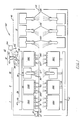
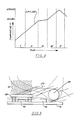
- Reflow apparatus 30 ⁇ is dividied into a preheat zone comprising plurality of functional heat management zones, indicated by the Roman Numerals I to IV which correspond to the heat management zones and description temperature graph of Fig. 4 as will be described hereinbelow, and a reflow zone indicated by Roman Numeral V.
- dividing the reflow apparatus 30 ⁇ into a plurality of heat management zones permits controlled heating whereby to provide a desired temperature ramping, and stabilization of temperature whereby to avoid overheating and/or underheating of individual components.
- heating is primarily effected by means of an infra-red (IR) heat source, with little or no supplimental convective gas heating.
- IR heating is supplemented with a relatively low velocity hot gas convective heating whereas to maintain the increasing temperature ramp, while levelling, in part, the temperature differences resulting from IR absorption rates due to reflectivity, shadowing and nesting of components relative to one another.
- preheating Zone III heating is primarily achieved by means of relatively low velocity heated gas convective heating with IR heating optional.
- Preheating Zone III contributes to the increasing temperature ramp, while further levelling component temperature differences and achieving an efficiency balance between component temperature to air temperature.
- Preheating Zone IV comprises additional relatively low velocity hot gas convection heating means for heating the circuit board and components to just below the reflow of the temperature of the solder.
- heating is achieved by means of one or a plurality of hot gas knives which produce a relatively high velocity convective gas stream for heating the components and circuit board top side surface to a temperature above the reflow temperature of the solder.
- the apparatus comprises an electrically powered, variable speed blower 38 connected between its inlet pipe 40 and an air supply plenum 42 which, in turn, is connected to supply air to various smaller plenums and nozzles to be described in detail below.
- a control system 44 is connected to receive temperature inputs from sensors within the enclosure 46 of reflow station 30 ⁇ as typified by the sensor indicated at 48.
- Temperature sensors will be located within the individual plenums. Temperature sensors and the types of control systems employing them are well known in the art and are available commercially and, therefore, in the interest of simplicity and avoiding redundancy herein, they will not be described in detail.
- Control system 44 is operatively connected to control the speed of the blower 38, a damper 50 controlling the mixture of outside air 52 and recirculated enclosure air 54 from within the enclosure 46 being pumped to the plenum 42, one or more dampers or valves (not shown) for controlling the volume and temperature of heated air directed to the various air outlet nozzles as will be described in detail hereinafter, and (optionally) an in-line heater 56 for adding heat to the system when the enclosure air 54 alone is of insufficient temperature to affect the desired objectives.
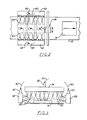
- a typical arrangement for preheating Zones I, II and III is shown in top view in Fig. 2 and in end view in Fig. 3.
- Pairs of spaced plenums 58A, 58B, 58C are disposed above and below conveyor 12 carrying the printed circuit boards 14 thereon.
- Plenums 58A, 58B, 58C are connected to receive convection air 60 through inlets 59 from the air supply plenum 42 and contain a plurality of upwardly and downwardly facing nozzles 61 through which the heated air 60 emerges to flow across the broad surfaces of a printed circuit board 14 passing therebetween.
- nozzles 61 are disposed between banks of spaced IR heaters 28A, 28B, 28C.
- the latter preferably comprise quartz-lamp, high mass type heaters as are conventionally employed as IR preheaters in mass soldering systems.
- side plenums 63A, 63B, 63C are disposed on opposite sides of the conveyor 12 and are also connected to receive convection air 60 through inlets 62 from the heated air supply plenum 42. Heated air may be recaptured and recycled by suitable return means (not shown) adjacent the ends of enclosure 46. Alternatively, the side plenums may be plumbed as returns.
- the preheating Zone comprises six separately controlled banks of IR heaters disposed three banks above and three banks below the travel path of the circuit boards.
- plenums 58A, 58B, 58C and 63A, 63B, 63C are arranged so that the air flow and temperature of air emanating from these plenums may be separately controlled.
- the temperature of the air emanating from the first in-line plenums 58A and 63A is adjusted to run slightly cooler than the temperatures expected to be reached by the circuit board and components so as to force temperature leveling.
- the temperature of the air emanating from the plenums may be at or slightly above the preheat target temperature for the board and components.
- Low profile components 66 are shadowed by higher profile components 68 from receiving the IR radiation indicated by the lines 70.
- the convection air 60 as indicated by the dashed lines so numbered, passes over, under, around and through the components 66, 68 picking up heat from and cooling the overheated, radiating components and transferring the heat to the cooler, underheated components.
- the overall effect is a stabilizing of the entire temperature profile of the board 14 and components 66, 68 to a temperature approximating that of the temperature of the air 60.
- a desired temperature profile can be achieved.
- one or more adjustable nozzle assemblies 74 connected to receive heated air 60 optionally can be provided for selectively directing air flow against particularly troublesome components during a specific soldering operation.
- selected components could be selectively cooled or heated, whereby to achieve a more level and consistent temperature of the various components on the board, thus compensatong for the individual components' different IR absorption rates due to reflectivity, shadowing and nesting.
- the apparatus for each of preheating Zones I, II and IV could be separately pumped, mixed and/or heated under separate temperature control as may be required for the particular operation.
- the hot air knife 76 of preheating Zone III preferably produces a higher velocity stream of heated air 60 than that employed in preheating Zones I, II and IV, and may also incorporate a separate heater within its supply plenum 78, if desired.
- Zone V comprises the reflow section of the soldering system made in accordance with the present invention.
- Zone V comprises three separately controlled hot air knives 80, 82 and 84, similar in construction to the hot air knives taught in U.S. Patent No. 4,410,126 to Harold T. O'Rourke, assigned to the common assignee.
- Hot air knives 80, 82 and 84 are operated at higher temperature and flow rates than the hot air nozzles in preheating Zones I to IV previously described.
- the hot air knives in preheater Zone V are designed and operated primarily to input sufficient additional heat to substantially uniformly raise the temperature of the board and components sufficiently high to reflow the solder cream or paste and/or solder preforms on the board.
- the air employed in preheating Zones I to IV generally may be at a temperature ranging from about ambient to about 350°F
- the hot air employed in reflow Zone V should be at a temperature in the range of about 350°F to about 900°°F, or higher.
- the air employed in preheating Zones I to IV may in certain applications be at somewhat higher temperatures, e.g. up to about 500°F or even higher. However, due to the relatively low air flow rates employed in preheating Zones I to IV the heat input from operating at such higher temperatures generally will not be sufficient to effect reflow in Zones I to IV. Air flow rates may be adjusted emperically in Zones I to IV to achieve the desired temperature leveling and in Zone V to achieve the desired reflow. Actual flow rates depend on a number of variables including target temperatures, heat input from IR heaters, number, size, configurations and spacing of air nozzles or air knives, ambient temperatures and work load.
- thermal levelling of the present invention can improve the process throughout from the normal 1.0 to 1.5 fpm for a pure IR reflow system to at least 2.5 to 3.5 fpm. Moreover, as can be readily appreciated from the description hereinbefore, the thermal levelling accomplished in the preheating Zones I to IV virtually eliminates the possibility of component or board damage due to thermal shock and/or overheating.
- the heated convective gas in the preheating zone or zones is flooded or flowed, at relatively low velocity, in conjunction with the infra-red preheating.
- the low pressure, low velocity flow of heated convective air produces an improved distribution of component and board surface temperature.
- the convective gas flow in preheating Zones I to IV should be flowed over the circuit board and components at a velocity sufficient to more evenly distribute surface temperatures, but not so high as to disturb the components. The convective air flow thus lowers the temperature of high IR absorption components and raises the temperature of lower IR absorption components.
- a feature and advantage of the present invention is that the system utilizes normally wasted thermal heat by re-circulating IR derived heat within the system enclosure. However, should the recirculated air reach a steady state higher than desired range for preheat or reflow soldering, ambient makeup air readily can be added through a thermistor controlled dampened inlet. Additional heat can be provided, if required, by a heat source within the air manifold.
- the reflow Zone V comprises one or a plurality of heated air knives, fluid jets, slots, nozzles or the like indicated at 80, 82, 84, from which a relatively high pressure heated fluid stream such as air is directed to the top side surface of the board.
- a single air knife can be used under certain circumstances; however, it has been found that a minimum of two and preferably three air knives are preferred in order to achieve desired enhancement of thermal levelling, and at the same time achieve good solder reflow.
- a plurality of hot air knives is employed in reflow Zone V, it is found that operating the first hot air knife just about at the normal reflow temperature of the solder or even slightly below the reflow temperature may further enhance thermal levelling.
- the remaining air knife or air knives 82, 84 should be adapted to preheat the air to a temperature above about 400°C so as to provide the necessary heat input to achieve reflow temperature.
- Air flow from hot air knives 82 and 84 should, of course, be at a velocity sufficient to provide the desired heat transfer so as to provide adequate heat input to effect reflow soldering and will depend on component density, etc.
- the target operating temperatures also will vary depending on the particular solder alloy employed.
- conveyor system 12 is of conventional construction and typically comprises a pair of spaced conveyor rails and suitable drive means (not shown).
- conveyor system 12 operates substantially in the horizontal plane so that boards being processed are carrried by conveyor 12 along a substantially horizontal travel path. Operating in the horizontal mode minimizes possible problems of component shifting on the board top surface and also simplifies loading and unloading transitions.
- a particular feature and advantage of the present invention is the ability to create substantially uniform heating of the component surface temperature of a circuit board in a reflow process independent of temperature and color charcteristics of components' reflectivity, shadowing and nesting, and the like, thus providing more uniform heating and soldering of the components and eliminating possible thermal damage to individual components.
- Other features and advantages of the present invention include enhanced energy efficiency due to capture and recirculation of IR heated air, and elimination of expensive and potentially dangerous chemicals as are required for vapor reflow soldering systems.
- the present invention permits emergency shutdown under conditions which would eliminate or at least substantially reduce the possibility of damage to boards, permits easy and rapid maintenance and repair, and permits rapid adjustment in overall system temperatures so that warm-up and product changeovers may be accomplished quickly and easily.
- the rapidity of the reflow accomplished by the focused convection heated air in accordance with the present invention minimizes intermetallic growth in the joints, since exposure times at reflow temperatures are extremely short.
- IR heaters could be included in the reflow Zone V for providing additional heat input.
- the combination of IR and convective heating also may be advantageously employed for temperature leveling in the mass soldering system of Comerford, U.S. Patent 4,600,137.
- forced cooling means may be included immediately following the reflow Zone V.
Landscapes
- Engineering & Computer Science (AREA)
- Mechanical Engineering (AREA)
- Manufacturing & Machinery (AREA)
- Microelectronics & Electronic Packaging (AREA)
- Electric Connection Of Electric Components To Printed Circuits (AREA)
- Lining Or Joining Of Plastics Or The Like (AREA)
- Manufacturing Of Electrical Connectors (AREA)
Priority Applications (1)
| Application Number | Priority Date | Filing Date | Title |
|---|---|---|---|
| AT88301182T ATE87253T1 (de) | 1987-02-20 | 1988-02-12 | Verfahren und vorrichtung zum aufschmelzloeten mittels fokussierter konvektion. |
Applications Claiming Priority (2)
| Application Number | Priority Date | Filing Date | Title |
|---|---|---|---|
| US17327 | 1987-02-20 | ||
| US07/017,327 US4771929A (en) | 1987-02-20 | 1987-02-20 | Focused convection reflow soldering method and apparatus |
Publications (3)
| Publication Number | Publication Date |
|---|---|
| EP0279604A2 true EP0279604A2 (fr) | 1988-08-24 |
| EP0279604A3 EP0279604A3 (en) | 1989-08-30 |
| EP0279604B1 EP0279604B1 (fr) | 1993-03-24 |
Family
ID=21781972
Family Applications (1)
| Application Number | Title | Priority Date | Filing Date |
|---|---|---|---|
| EP88301182A Expired - Lifetime EP0279604B1 (fr) | 1987-02-20 | 1988-02-12 | Méthode et appareil pour la soudure par refusion par convection focalisée |
Country Status (9)
| Country | Link |
|---|---|
| US (1) | US4771929A (fr) |
| EP (1) | EP0279604B1 (fr) |
| JP (1) | JPS63215371A (fr) |
| KR (1) | KR970004026B1 (fr) |
| CN (1) | CN88100726A (fr) |
| AT (1) | ATE87253T1 (fr) |
| BR (1) | BR8800682A (fr) |
| DE (1) | DE3879529T2 (fr) |
| IE (1) | IE880283L (fr) |
Cited By (11)
| Publication number | Priority date | Publication date | Assignee | Title |
|---|---|---|---|---|
| EP0332567A1 (fr) * | 1988-03-11 | 1989-09-13 | Lothar Himmelreich | Four de soudage à infra-rouge pour le soudage à fusion d'éléments de construction électroniques sur des plaques à circuit imprimé |
| FR2647294A1 (fr) * | 1989-05-18 | 1990-11-23 | Applic Gles Electricite Me | Procede de soudage de composants electriques sur un circuit conducteur imprime sur un substrat metallise isole |
| FR2693829A1 (fr) * | 1992-07-17 | 1994-01-21 | Navarra Componentes Electronic | Procédé de fabrication de potentiomètres en continu. |
| ES2048664A2 (es) * | 1992-07-17 | 1994-03-16 | Navarra Componentes Electro | Procedimiento para la union de terminales a pistas resistivas de potenciometros. |
| WO1998020720A1 (fr) * | 1996-11-01 | 1998-05-14 | Speedline Technologies, Inc. | Element chauffant de systeme a bande transporteuse |
| US5878941A (en) * | 1995-07-27 | 1999-03-09 | U.S. Philips Corporation | Method of soldering components on a carrier foil |
| EP1176629A3 (fr) * | 2000-07-28 | 2004-04-07 | Planner Plc. | Procédé et dispositif pour le traitement thermique d'un substrat |
| US6768083B2 (en) * | 2002-09-19 | 2004-07-27 | Speedline Technologies, Inc. | Reflow soldering apparatus and method for selective infrared heating |
| EP1121799A4 (fr) * | 1998-10-13 | 2004-08-04 | Intel Corp | Detecteur d'image monte par refusion de masse |
| WO2005043758A3 (fr) * | 2003-10-30 | 2005-08-11 | Rehm Anlagenbau Gmbh | Procede et dispositif de brasage par fusion a commande de debit volumetrique |
| US10500662B2 (en) | 2013-09-09 | 2019-12-10 | Ersa Gmbh | Device for feeding a stream of hot gas |
Families Citing this family (63)
| Publication number | Priority date | Publication date | Assignee | Title |
|---|---|---|---|---|
| JPH0773790B2 (ja) * | 1985-10-11 | 1995-08-09 | ソニー株式会社 | リフロー半田付装置 |
| JPH0677830B2 (ja) * | 1987-12-25 | 1994-10-05 | 松下電器産業株式会社 | 基板加熱方法 |
| KR910005959B1 (ko) * | 1988-01-19 | 1991-08-09 | 니혼 덴네쯔 게이기 가부시끼가이샤 | 리플로우 납땜 방법 및 그 장치 |
| JPH06268B2 (ja) * | 1988-02-23 | 1994-01-05 | エイティックテクトロン株式会社 | リフロー半田付け方法及び装置 |
| JPH0248132Y2 (fr) * | 1988-09-16 | 1990-12-18 | ||
| US5046658A (en) * | 1989-07-27 | 1991-09-10 | At&T Bell Laboratories | Method and apparatus for soldering articles |
| JPH0763839B2 (ja) * | 1989-10-06 | 1995-07-12 | 日立テクノエンジニアリング株式会社 | リフローはんだ付け装置 |
| US5048746A (en) * | 1989-12-08 | 1991-09-17 | Electrovert Ltd. | Tunnel for fluxless soldering |
| US5180096A (en) * | 1990-07-25 | 1993-01-19 | Nihon Den-Netsu Keiki Co., Ltd. | Method and apparatus for reflow-soldering of printed circuit boards |
| JPH04111388A (ja) * | 1990-08-30 | 1992-04-13 | Fujitsu Ltd | 半導体装置の製造方法および加熱炉 |
| US5128506A (en) * | 1990-10-30 | 1992-07-07 | Westinghouse Electric Corp. | Method and apparatus for selective infrared soldering using shielding fixtures |
| DE4039844A1 (de) * | 1990-12-13 | 1992-06-17 | Cooper Ind Inc | Temperaturregeleinrichtung fuer loet- und entloetgeraete |
| JP2624411B2 (ja) * | 1991-10-15 | 1997-06-25 | 松下電器産業株式会社 | 光加熱装置 |
| US5249733A (en) * | 1992-07-16 | 1993-10-05 | At&T Bell Laboratories | Solder self-alignment methods |
| US5345061A (en) * | 1992-09-15 | 1994-09-06 | Vitronics Corporation | Convection/infrared solder reflow apparatus utilizing controlled gas flow |
| US5234157A (en) * | 1992-11-02 | 1993-08-10 | At&T Bell Laboratories | Soldering method and apparatus |
| US5433368A (en) * | 1992-11-10 | 1995-07-18 | Spigarelli; Donald J. | Soldering system |
| US5607609A (en) * | 1993-10-25 | 1997-03-04 | Fujitsu Ltd. | Process and apparatus for soldering electronic components to printed circuit board, and assembly of electronic components and printed circuit board obtained by way of soldering |
| US5577658A (en) * | 1995-06-23 | 1996-11-26 | Electrovert Usa Corp. | Gas knife cooling system |
| US5639010A (en) * | 1995-08-31 | 1997-06-17 | Ford Motor Company | Simultaneous process for surface mount adhesive cure and solder paste reflow for surface mount technology devices |
| US5577657A (en) * | 1995-09-01 | 1996-11-26 | Ford Motor Company | Method of improved oven reflow soldering |
| US6145734A (en) * | 1996-04-16 | 2000-11-14 | Matsushita Electric Industrial Co., Ltd. | Reflow method and reflow device |
| DE19615338C2 (de) * | 1996-04-18 | 1998-08-20 | Helmut W Leicht | Verfahren zum Abkühlen von Lötgut |
| JP3330037B2 (ja) * | 1996-11-29 | 2002-09-30 | 富士通株式会社 | チップ部品の接合方法および装置 |
| US5911486A (en) * | 1997-02-26 | 1999-06-15 | Conceptronic, Inc. | Combination product cooling and flux management apparatus |
| JP2812675B2 (ja) * | 1997-04-10 | 1998-10-22 | アルプス電気株式会社 | リフロー半田付け装置 |
| JPH1154903A (ja) * | 1997-07-31 | 1999-02-26 | Fujitsu Ltd | リフローソルダリング方法及びリフロー炉 |
| US5993500A (en) * | 1997-10-16 | 1999-11-30 | Speedline Technololies, Inc. | Flux management system |
| JP3348639B2 (ja) | 1997-10-20 | 2002-11-20 | 富士通株式会社 | リフロー炉内のハンダバンプの温度制御方法 |
| US6059170A (en) * | 1998-06-24 | 2000-05-09 | International Business Machines Corporation | Method and apparatus for insulating moisture sensitive PBGA's |
| US6347734B1 (en) * | 2000-03-27 | 2002-02-19 | Emc Corporation | Methods and apparatus for installing a module on a circuit board using heating and cooling techniques |
| JP3441067B2 (ja) * | 2000-08-03 | 2003-08-25 | 株式会社大進工業研究所 | ろう付装置 |
| JP2002172459A (ja) * | 2000-09-26 | 2002-06-18 | Sony Corp | はんだ付け装置 |
| JP2002185122A (ja) * | 2000-12-12 | 2002-06-28 | Sharp Corp | リフロー装置 |
| US6403934B1 (en) * | 2001-04-09 | 2002-06-11 | Northrop Grumman Corporation | Thermstrate reflow process |
| US6386422B1 (en) * | 2001-05-03 | 2002-05-14 | Asm Assembly Automation Limited | Solder reflow oven |
| US6642485B2 (en) * | 2001-12-03 | 2003-11-04 | Visteon Global Technologies, Inc. | System and method for mounting electronic components onto flexible substrates |
| JP3895169B2 (ja) * | 2001-12-21 | 2007-03-22 | 株式会社日立製作所 | 鉛フリーはんだを用いたフローはんだ付け装置 |
| US6720195B2 (en) * | 2002-05-15 | 2004-04-13 | Micron Technology, Inc. | Methods employing elevated temperatures to enhance quality control in microelectronic component manufacture |
| US7084353B1 (en) | 2002-12-11 | 2006-08-01 | Emc Corporation | Techniques for mounting a circuit board component to a circuit board |
| US6906924B2 (en) * | 2003-05-16 | 2005-06-14 | Hewlett-Packard Development Company, L.P. | Temperature-controlled rework system |
| US6979348B2 (en) * | 2003-06-04 | 2005-12-27 | Medtronic Vascular, Inc. | Reflowed drug-polymer coated stent and method thereof |
| US6919224B2 (en) * | 2003-09-30 | 2005-07-19 | Intel Corporation | Modified chip attach process and apparatus |
| US20070254255A1 (en) * | 2006-03-28 | 2007-11-01 | Neville James E | System, apparatus and methods for board cooling |
| DE102006026948B3 (de) * | 2006-06-09 | 2007-12-06 | Rewatronik Gmbh | Beheizungseinrichtung |
| US7681776B2 (en) * | 2006-08-01 | 2010-03-23 | Raytheon Company | Methods and apparatus for efficiently generating profiles for circuit board work/rework |
| US20080164300A1 (en) * | 2007-01-08 | 2008-07-10 | Endicott Interconnect Technologies, Inc. | Method of making circuitized substrate with solder balls having roughened surfaces, method of making electrical assembly including said circuitized substrate, and method of making multiple circuitized substrate assembly |
| DE102008033225B3 (de) * | 2008-07-15 | 2009-12-17 | Ersa Gmbh | Vorrichtung zur thermischen Behandlung von Werkstücken |
| US8947249B1 (en) | 2009-03-26 | 2015-02-03 | Safezone Safety Systems, LLC | Apparatus and method for conducting hot work |
| DE202010014074U1 (de) * | 2010-10-11 | 2012-01-12 | Illinois Tool Works Inc. | Heizeinrichtung für eine Lötanlage |
| CN103286408B (zh) * | 2012-02-24 | 2017-03-01 | 联想企业解决方案(新加坡)私人有限公司 | 一种热源系统 |
| DE102012022873A1 (de) * | 2012-11-22 | 2014-05-22 | Compact Dynamics Gmbh | Verfahren zum Verlöten von Ständer und Kühler und Ständer mit Lotverbindung zum Ständerträger |
| EP3009220B1 (fr) * | 2014-10-17 | 2018-12-19 | Rehm Thermal Systems GmbH | Installation et procédé de fabrication bobine à bobine pour processus de traitement régulés, continus et discontinus |
| JP6188671B2 (ja) * | 2014-12-12 | 2017-08-30 | 株式会社Ssテクノ | 水蒸気リフロー装置及び水蒸気リフロー方法 |
| KR20170043936A (ko) * | 2015-10-14 | 2017-04-24 | 현대자동차주식회사 | 블랭크 가열 장치 |
| US10518301B1 (en) | 2015-12-18 | 2019-12-31 | SafeZone Safety Systems, L.L.C. | Isolation enclosure and method for conducting hot work |
| WO2017189655A1 (fr) | 2016-04-26 | 2017-11-02 | Ccl Label, Inc. | Dépôt de brasure tendre à grande vitesse et refusion pour un support électronique flexible imprimé |
| DE102016110040A1 (de) * | 2016-05-31 | 2017-11-30 | Endress + Hauser Gmbh + Co. Kg | Fertigungslinie zum Löten |
| CN106304682A (zh) * | 2016-08-16 | 2017-01-04 | 成都俱进科技有限公司 | 用于smt生产工艺的回流焊接装置 |
| CN106061137A (zh) * | 2016-08-16 | 2016-10-26 | 成都俱进科技有限公司 | Smt贴片打样机 |
| DE102019213511A1 (de) * | 2019-09-05 | 2021-03-11 | Rehm Thermal Systems Gmbh | Reflow-Lötanlage zum kombinierten Konvektionslöten und Kondensationslöten |
| CN112002650A (zh) * | 2020-08-20 | 2020-11-27 | 上海应用技术大学 | 一种真空回流共晶焊接的工艺方法 |
| DE102021129122B4 (de) * | 2021-11-09 | 2024-03-07 | Ersa Gmbh | Lötanlage, insbesondere Reflowlötanlage mit Abdeckhaube und schaltbarem Absaugkanal |
Family Cites Families (18)
| Publication number | Priority date | Publication date | Assignee | Title |
|---|---|---|---|---|
| GB1102621A (en) * | 1965-04-07 | 1968-02-07 | Electrovert Mfg Company Ltd | Method and apparatus for fluxing and soldering connections on printed circuit boards |
| US3515330A (en) * | 1968-01-30 | 1970-06-02 | Collins Radio Co | Continuous flow mass pin-to-board hot air soldering device |
| US3604611A (en) * | 1969-01-07 | 1971-09-14 | Dee Electric Co | Soldering apparatus |
| BE754415A (fr) * | 1969-09-22 | 1971-01-18 | Chausson Usines Sa | Procede pour le brasage de faisceaux de radiateurs en aluminiumet installation pour l'execution de ce brasage |
| DE2254769C3 (de) * | 1972-11-09 | 1985-06-05 | Vereinigte Aluminium-Werke AG, 1000 Berlin und 5300 Bonn | Durchlaufofen zum flußmittellosen Löten von Aluminiumwerkstoffen unter Schutzgas |
| DE2611832A1 (de) * | 1976-03-19 | 1977-09-22 | Linde Ag | Verfahren und vorrichtung zum flussmittellosen loeten |
| JPS549852U (fr) * | 1977-06-24 | 1979-01-23 | ||
| GB1555698A (en) * | 1977-08-25 | 1979-11-14 | Thermal Hire Ltd | Ethod of pre-heating |
| EP0023107B1 (fr) * | 1979-07-09 | 1983-09-07 | Electrovert Ltd. | Procédé et appareil pour le soudage en phase vapeur |
| DE3309648A1 (de) * | 1983-03-15 | 1984-09-20 | Siemens AG, 1000 Berlin und 8000 München | Verfahren zum loeten plattenfoermiger schaltungstraeger innerhalb einer schutzgasloeteinrichtung |
| JPH063816B2 (ja) * | 1983-09-09 | 1994-01-12 | 株式会社日立製作所 | 半導体素子のはんだ付け装置 |
| US4565917B1 (en) * | 1984-01-18 | 1999-06-08 | Vitronics Corp | Multi-zone thermal process system utilizing nonfocused infared panel emitters |
| US4688031A (en) * | 1984-03-30 | 1987-08-18 | Wang Laboratories, Inc. | Monochromatic representation of color images |
| JPS6125461A (ja) * | 1984-07-16 | 1986-02-04 | Yoshihiro Ishibashi | 蓮根の成分体を含有する錠剤 |
| US4600137A (en) * | 1985-02-21 | 1986-07-15 | Hollis Automation, Inc. | Method and apparatus for mass soldering with subsequent reflow soldering |
| JPH0828569B2 (ja) * | 1985-06-18 | 1996-03-21 | 松下電器産業株式会社 | リフロー装置 |
| US4664308A (en) * | 1985-10-30 | 1987-05-12 | Hollis Automation, Inc. | Mass soldering system providing an oscillating air blast |
| JPH064188B2 (ja) * | 1987-01-21 | 1994-01-19 | エイティックテクトロン株式会社 | リフロ−半田付け方法及び装置 |
-
1987
- 1987-02-20 US US07/017,327 patent/US4771929A/en not_active Expired - Lifetime
-
1988
- 1988-02-02 IE IE880283A patent/IE880283L/xx unknown
- 1988-02-12 EP EP88301182A patent/EP0279604B1/fr not_active Expired - Lifetime
- 1988-02-12 AT AT88301182T patent/ATE87253T1/de not_active IP Right Cessation
- 1988-02-12 DE DE8888301182T patent/DE3879529T2/de not_active Expired - Fee Related
- 1988-02-15 CN CN198888100726A patent/CN88100726A/zh active Pending
- 1988-02-19 BR BR8800682A patent/BR8800682A/pt unknown
- 1988-02-19 KR KR1019880001757A patent/KR970004026B1/ko not_active Expired - Fee Related
- 1988-02-20 JP JP63036515A patent/JPS63215371A/ja active Pending
Cited By (12)
| Publication number | Priority date | Publication date | Assignee | Title |
|---|---|---|---|---|
| EP0332567A1 (fr) * | 1988-03-11 | 1989-09-13 | Lothar Himmelreich | Four de soudage à infra-rouge pour le soudage à fusion d'éléments de construction électroniques sur des plaques à circuit imprimé |
| FR2647294A1 (fr) * | 1989-05-18 | 1990-11-23 | Applic Gles Electricite Me | Procede de soudage de composants electriques sur un circuit conducteur imprime sur un substrat metallise isole |
| FR2693829A1 (fr) * | 1992-07-17 | 1994-01-21 | Navarra Componentes Electronic | Procédé de fabrication de potentiomètres en continu. |
| ES2048664A2 (es) * | 1992-07-17 | 1994-03-16 | Navarra Componentes Electro | Procedimiento para la union de terminales a pistas resistivas de potenciometros. |
| US5878941A (en) * | 1995-07-27 | 1999-03-09 | U.S. Philips Corporation | Method of soldering components on a carrier foil |
| WO1998020720A1 (fr) * | 1996-11-01 | 1998-05-14 | Speedline Technologies, Inc. | Element chauffant de systeme a bande transporteuse |
| EP1121799A4 (fr) * | 1998-10-13 | 2004-08-04 | Intel Corp | Detecteur d'image monte par refusion de masse |
| EP1176629A3 (fr) * | 2000-07-28 | 2004-04-07 | Planner Plc. | Procédé et dispositif pour le traitement thermique d'un substrat |
| US6768083B2 (en) * | 2002-09-19 | 2004-07-27 | Speedline Technologies, Inc. | Reflow soldering apparatus and method for selective infrared heating |
| WO2005043758A3 (fr) * | 2003-10-30 | 2005-08-11 | Rehm Anlagenbau Gmbh | Procede et dispositif de brasage par fusion a commande de debit volumetrique |
| US7581668B2 (en) | 2003-10-30 | 2009-09-01 | Rehm Thermal Systems Gmbh | Method and device for reflow soldering with volume flow control |
| US10500662B2 (en) | 2013-09-09 | 2019-12-10 | Ersa Gmbh | Device for feeding a stream of hot gas |
Also Published As
| Publication number | Publication date |
|---|---|
| IE880283L (en) | 1988-08-20 |
| DE3879529T2 (de) | 1993-08-26 |
| ATE87253T1 (de) | 1993-04-15 |
| EP0279604A3 (en) | 1989-08-30 |
| BR8800682A (pt) | 1988-10-04 |
| CN88100726A (zh) | 1988-08-31 |
| EP0279604B1 (fr) | 1993-03-24 |
| US4771929A (en) | 1988-09-20 |
| DE3879529D1 (de) | 1993-04-29 |
| KR880010645A (ko) | 1988-10-10 |
| JPS63215371A (ja) | 1988-09-07 |
| KR970004026B1 (ko) | 1997-03-24 |
Similar Documents
| Publication | Publication Date | Title |
|---|---|---|
| US4771929A (en) | Focused convection reflow soldering method and apparatus | |
| EP0169885B1 (fr) | Systeme de procede thermique a zones multiples utilisant des emetteurs de panneaux a infra-rouges non focalises | |
| US8807416B2 (en) | Reflow soldering system | |
| US4725716A (en) | Infrared apparatus for infrared soldering components on circuit boards | |
| US5515605A (en) | Apparatus and process for soldering component onto boards | |
| EP0469788B1 (fr) | Méthode et appareil pour le soudage à reflux de plaquettes à circuits imprimés | |
| KR19980018079A (ko) | 리플로우방법 및 리플로우장치 | |
| JPH033541B2 (fr) | ||
| US4915624A (en) | Continuous oven for soldering electronic components | |
| US5203487A (en) | Reflow soldering method and system therefor | |
| JPH0828569B2 (ja) | リフロー装置 | |
| JPH0665434B2 (ja) | リフロ−半田付け装置 | |
| JPH04296092A (ja) | リフロー装置 | |
| JPH055581B2 (fr) | ||
| JPH05245624A (ja) | ハンダリフロー装置及びハンダリフロー方法 | |
| JPS62144876A (ja) | 電子部品の半田付け装置 | |
| JP2001308511A (ja) | リフローはんだ付け方法およびその装置 | |
| JP3171179B2 (ja) | リフロー装置とリフロー装置内の温度制御方法 | |
| JPH0380581B2 (fr) | ||
| Prasad | Soldering of Surface Mounted Components | |
| JPH0377772A (ja) | 赤外線加熱式リフローハンダ付け方法および赤外線加熱式リフローハンダ付け装置 | |
| JP2551693B2 (ja) | リフローはんだ付け方法およびその装置 | |
| Hwang | Soldering Methodologies | |
| Linman | Vapor-Phase Soldering | |
| Hutchins | Technical Considerations in Vapor Phase and Infrared Solder Reflow Processes |
Legal Events
| Date | Code | Title | Description |
|---|---|---|---|
| PUAI | Public reference made under article 153(3) epc to a published international application that has entered the european phase |
Free format text: ORIGINAL CODE: 0009012 |
|
| AK | Designated contracting states |
Kind code of ref document: A2 Designated state(s): AT BE CH DE FR GB IT LI NL SE |
|
| PUAL | Search report despatched |
Free format text: ORIGINAL CODE: 0009013 |
|
| AK | Designated contracting states |
Kind code of ref document: A3 Designated state(s): AT BE CH DE FR GB IT LI NL SE |
|
| 17P | Request for examination filed |
Effective date: 19890922 |
|
| 17Q | First examination report despatched |
Effective date: 19901122 |
|
| GRAA | (expected) grant |
Free format text: ORIGINAL CODE: 0009210 |
|
| AK | Designated contracting states |
Kind code of ref document: B1 Designated state(s): AT BE CH DE FR GB IT LI NL SE |
|
| PG25 | Lapsed in a contracting state [announced via postgrant information from national office to epo] |
Ref country code: SE Effective date: 19930324 Ref country code: LI Effective date: 19930324 Ref country code: CH Effective date: 19930324 Ref country code: AT Effective date: 19930324 |
|
| REF | Corresponds to: |
Ref document number: 87253 Country of ref document: AT Date of ref document: 19930415 Kind code of ref document: T |
|
| ITF | It: translation for a ep patent filed | ||
| REF | Corresponds to: |
Ref document number: 3879529 Country of ref document: DE Date of ref document: 19930429 |
|
| NLR1 | Nl: opposition has been filed with the epo |
Opponent name: SIEMENS AG |
|
| REG | Reference to a national code |
Ref country code: CH Ref legal event code: PL |
|
| ET | Fr: translation filed | ||
| REG | Reference to a national code |
Ref country code: FR Ref legal event code: TP |
|
| PLBE | No opposition filed within time limit |
Free format text: ORIGINAL CODE: 0009261 |
|
| STAA | Information on the status of an ep patent application or granted ep patent |
Free format text: STATUS: NO OPPOSITION FILED WITHIN TIME LIMIT |
|
| REG | Reference to a national code |
Ref country code: GB Ref legal event code: 732E |
|
| NLT1 | Nl: modifications of names registered in virtue of documents presented to the patent office pursuant to art. 16 a, paragraph 1 |
Owner name: HOLLIS AUTOMATION CO. TE NASHUA, NEW HAMPSHIRE, VE |
|
| 26N | No opposition filed | ||
| ITPR | It: changes in ownership of a european patent |
Owner name: CESSIONE;ELECTROVERT U.S.A. CORPORATION |
|
| BECH | Be: change of holder |
Free format text: 940624 *ELECTROVERT U.S.A. CORP. |
|
| NLS | Nl: assignments of ep-patents |
Owner name: ELECTROVERT U.S.A. CORPORATION A DELAWARE CORPORAT |
|
| REG | Reference to a national code |
Ref country code: GB Ref legal event code: IF02 |
|
| PGFP | Annual fee paid to national office [announced via postgrant information from national office to epo] |
Ref country code: NL Payment date: 20030228 Year of fee payment: 16 |
|
| PGFP | Annual fee paid to national office [announced via postgrant information from national office to epo] |
Ref country code: GB Payment date: 20040130 Year of fee payment: 17 |
|
| PGFP | Annual fee paid to national office [announced via postgrant information from national office to epo] |
Ref country code: BE Payment date: 20040216 Year of fee payment: 17 |
|
| PGFP | Annual fee paid to national office [announced via postgrant information from national office to epo] |
Ref country code: FR Payment date: 20040223 Year of fee payment: 17 |
|
| PGFP | Annual fee paid to national office [announced via postgrant information from national office to epo] |
Ref country code: DE Payment date: 20040507 Year of fee payment: 17 |
|
| PG25 | Lapsed in a contracting state [announced via postgrant information from national office to epo] |
Ref country code: NL Free format text: LAPSE BECAUSE OF NON-PAYMENT OF DUE FEES Effective date: 20040901 |
|
| NLV4 | Nl: lapsed or anulled due to non-payment of the annual fee |
Effective date: 20040901 |
|
| PG25 | Lapsed in a contracting state [announced via postgrant information from national office to epo] |
Ref country code: IT Free format text: LAPSE BECAUSE OF NON-PAYMENT OF DUE FEES;WARNING: LAPSES OF ITALIAN PATENTS WITH EFFECTIVE DATE BEFORE 2007 MAY HAVE OCCURRED AT ANY TIME BEFORE 2007. THE CORRECT EFFECTIVE DATE MAY BE DIFFERENT FROM THE ONE RECORDED. Effective date: 20050212 Ref country code: GB Free format text: LAPSE BECAUSE OF NON-PAYMENT OF DUE FEES Effective date: 20050212 |
|
| PG25 | Lapsed in a contracting state [announced via postgrant information from national office to epo] |
Ref country code: BE Free format text: LAPSE BECAUSE OF NON-PAYMENT OF DUE FEES Effective date: 20050228 |
|
| BERE | Be: lapsed |
Owner name: *ELECTROVERT U.S.A. CORP. Effective date: 20050228 |
|
| PG25 | Lapsed in a contracting state [announced via postgrant information from national office to epo] |
Ref country code: DE Free format text: LAPSE BECAUSE OF NON-PAYMENT OF DUE FEES Effective date: 20050901 |
|
| GBPC | Gb: european patent ceased through non-payment of renewal fee |
Effective date: 20050212 |
|
| PG25 | Lapsed in a contracting state [announced via postgrant information from national office to epo] |
Ref country code: FR Free format text: LAPSE BECAUSE OF NON-PAYMENT OF DUE FEES Effective date: 20051031 |
|
| REG | Reference to a national code |
Ref country code: FR Ref legal event code: ST Effective date: 20051031 |
|
| BERE | Be: lapsed |
Owner name: *ELECTROVERT U.S.A. CORP. Effective date: 20050228 |