EP0310899A2 - Méthode de production de pâte à pain - Google Patents
Méthode de production de pâte à pain Download PDFInfo
- Publication number
- EP0310899A2 EP0310899A2 EP88115756A EP88115756A EP0310899A2 EP 0310899 A2 EP0310899 A2 EP 0310899A2 EP 88115756 A EP88115756 A EP 88115756A EP 88115756 A EP88115756 A EP 88115756A EP 0310899 A2 EP0310899 A2 EP 0310899A2
- Authority
- EP
- European Patent Office
- Prior art keywords
- dough
- suspension
- temperature
- water
- cereal grains
- Prior art date
- Legal status (The legal status is an assumption and is not a legal conclusion. Google has not performed a legal analysis and makes no representation as to the accuracy of the status listed.)
- Granted
Links
Images
Classifications
-
- A—HUMAN NECESSITIES
- A21—BAKING; EDIBLE DOUGHS
- A21C—MACHINES OR EQUIPMENT FOR MAKING OR PROCESSING DOUGHS; HANDLING BAKED ARTICLES MADE FROM DOUGH
- A21C1/00—Mixing or kneading machines for the preparation of dough
- A21C1/006—Methods
Definitions
- the dough For the second method, which is also known as the ice method, it is necessary to cool the dough, in particular to stabilize its gas holding capacity.
- the cooling can be done either directly by adding ice to the dough or indirectly by cooling the dough with a heat exchanger. In both cases the dough is cooled to a temperature of approx. 2-8 ° C.
- Medium grain wholegrain pellets are mostly used as regrind, which are produced by dry grinding grain kernels over several milling passages. The specified fineness is required to give the dough a soft, velvety consistency.
- the ice cream crispbreads are particularly popular among these baked goods because of their mild taste and high digestibility.
- the present invention therefore relates less to this last-mentioned product group, although it is possible due to the variation of the working parameters of the method according to the invention to produce crispbreads in a non-fermentative way, which in most of their characteristic quality features correspond to or are largely similar to those produced from fermented doughs could be.
- the state of the art also states that it is known to influence the degradation of the pentosans and their oxidative gelation, especially in doughs from rye ground products, by suitable dough management measures so that after fermentative loosening of the dough, long-life bakery products with appealing sensory quality characteristics can be baked (Meuser , F. and Suckow, P .: "Technical Baking Effect of Rye Pentosans", Cereals, Flour and Bread 40 (1986), 332-336).
- the dough management measures primarily improve the properties of the dough ingredients, which result in hard, dense and splintery pastries result in changes so that delicate and voluminous pastries are created.
- rye baked goods are concerned, they also taste less bitter than baked goods that are produced using previously known processes. The lowering of the bitter taste is also related to the ongoing enzymatic and oxidative changes in the dough ingredients.
- the invention has for its object to further develop the generic method in such a way that the foam dough mass used in particular for crispbread production can be given a defined viscosity with an adjustable air or gas content with controlled oxidation of the cereal components.
- this object is achieved in that the cereal grains are introduced into a protective liquid, preferably consisting essentially of water, which essentially seals them against ambient air, before they are finely comminuted, and in this Suspension after and / or with the metered addition of a loosening gas adjustable composition finely crushed and processed into the foam dough.
- a protective liquid preferably consisting essentially of water, which essentially seals them against ambient air, before they are finely comminuted, and in this Suspension after and / or with the metered addition of a loosening gas adjustable composition finely crushed and processed into the foam dough.
- a further embodiment of the invention proposes that the pre-comminution takes place in the wet grinding process.
- the high pressure homogenization takes place under a pressure of 50 to 150 bar.
- Another embodiment of the invention proposes that the high pressure homogenization takes place at a temperature of 5 to 45 ° C.
- the suspension is enriched with loosening gas before being introduced into the high-pressure homogenizer.
- the procedure can also be such that the pH of the suspension is adjusted to a range from 5.2 to 5.5.
- the invention also proposes that the suspension be finely comminuted by a dwell time to be led.
- the procedure can also be such that the suspension has a temperature of 50 to 55 ° C. over a residence time of 30 to 60 minutes.
- a further embodiment of the invention is characterized in that the suspension is cooled to a temperature of 35 to 45 ° C after being kept at a temperature of 50 to 55 ° C and is kept at this temperature for a further residence time of 5 to 11 hours.
- the suspension has a temperature of 35 to 45 ° C over a residence time of 6 to 12 hours.
- a further embodiment of the invention proposes that the suspension is cooled to a temperature of 5 to 45 ° C. before the high pressure homogenization.
- the procedure according to the invention can also be such that the cereal grains are subjected to pressure swelling with water at a temperature of 40 to 60 ° C. for 3 to 12 hours.
- the invention also proposes that the pH of the spring water be lowered by lactic acid bacteria.
- the cereal components are then further protected in the homogenizer against inordinately strong oxidation by supplying the loosening gas defined as a protective gas, for example only with an oxygen content of approx. 5%, the composition and the amount of the protective or loosening gas being selected in this way that a targeted, defined oxidation of the cereal components takes place in the dough to be produced, which in turn results in a defined viscosity and a defined air or gas content of the finished foam dough mass. If the high-pressure homogenization takes place under sufficiently high pressure, the dough can be pressed out of split nozzles, for example, as is the subject of the earlier patent application P 37 02 332.2-41.
- a protective gas for example only with an oxygen content of approx. 5%
- the invention is based on the surprising finding that the solids content of a pumpable suspension of coarsely pre-comminuted cereal grains and water in a high disintegration valve is successful to shred the pressure homogenizer, digest it and pass it through with gas so that a voluminous, gas-loosened dough is formed in which gas bubbles are completely homogeneous and finely distributed.
- the crushing and disintegration of the pre-shredded cereal grain mass is so complete that the dough assumes the desired velvety consistency. This depends on the size of the particles formed and their swelling state, both of which can be influenced within wide limits by the choice of working parameters in the overall process.
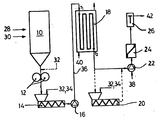
- the drawing shows a system that can be used to continuously produce dough (500 kg / h) from whole grain (rye), water and other ingredients.
- the system has a storage container 10, a dry or wet mill 12, a first mixer 14, a pump 16, a fermenter 18, a second mixer 20, a further pump 22, a mixing element 24 and a homogenizer 26.
- Wet rye grains (220 kg / h) 28 are the storage container 10, which in the DE-PS 29 21 682 described manner as an activation container or, as in Meuser, F. Wittig, J., Huster, H. u. Holley, W. "New procedural ways to obtain starch from raw materials containing starch", Intern.
- the suspension can be mixed with further recipe constituents, such as liquid 32 and flour, salt etc. 34 in the downstream mixer 14. It is then passed through the tube fermenter 18 with the aid of the pump 16. By controlling the temperature and the residence time of the mass in the fermenter it is achieved that the desired enzymatic reactions can take place.
- the fermenter can also have a different construction than the tube fermenter described here. For example, it can consist of tanks connected in series.
- the extent of the enzymatic reactions depends primarily on the enzyme activity present in the raw material. If this is high, the dwell time in the fermenter can be short, and vice versa if the enzyme is low choose long activity. For example, for the hydrolysis of the phytic acid to about 20% of the initial value, a residence time of max. 60 min at 55 ° C. In contrast, the degradation of the pentosans with the granular pentosanases advantageously takes place at around 40 ° C., the hydrolytic degradation required to achieve a high level of delicacy in the pastry structure may require a residence time of up to 12 hours. At the same time, low-polymer carbohydrates and protein breakdown products are also accumulated, also caused by enzymatic degradation, which has a positive effect on the flavor formation during baking.
- the working parameters can be varied within wide limits with regard to the formation of certain quality features of the baked goods.
- the temperature control of the suspension in the fermenter (T1" after "T2") can be made variable by sectioning the temperature jacket.
- the suspension Before leaving the fermenter, the suspension is only cooled to such an extent that the dough formed from it after high-pressure homogenization can easily be processed further.
- the enrichment of the suspension with gas and its high-pressure homogenization represents the last step in the preparation of the dough.
- the suspension is first pumped through the mixing element 24 using the pump 22.
- the delivery rate of the pump 22 upstream of the mixing element 24 is somewhat greater than that of the pump 16 upstream of the tube fermenter 18, so that according to the teaching gas described in CH-PS 417 506 is introduced into the suspension 36.
- the fine distribution of the gas in the suspension takes place in the sense of forming a fine-pored foam together with the further comminution of the grain particles in the valve of the homogenizer 26 at about 100 bar.
- the density of the resulting gas-loosened dough 42 can be set depending on the desired pastry structure; for example, it can be 0.4 g / ml.
- a further mixer can be fitted behind the tube fermenter, the temperature of the jacket of the high-pressure homogenizer being controllable by means of a temperature control medium 40.
- a particular advantage of the invention is that the high-pressure homogenization comminutes and disintegrates the solid particles in the suspension to the extent that they are mixed with gas (air, nitrogen, carbon dioxide) to produce a homogeneous, gas-loosened dough with a velvety consistency.
- gas air, nitrogen, carbon dioxide
- crispbreads and similar long-life baked goods can be baked from the dough, which are characterized by a fragile crumb, a mild aromatic taste and advantageous nutritional properties.
- the comminution of the raw material and the dough formation take place in a single closed reaction environment, in which reactions that can be catalyzed by the grain's own enzymes are used to improve the end product quality by choosing the working parameters residence time, solids concentration, Recipe composition and temperature can be targeted. The entire process can be carried out practically in the absence of atmospheric oxygen, so that undesirable oxidation reactions are largely excluded.
Landscapes
- Life Sciences & Earth Sciences (AREA)
- Engineering & Computer Science (AREA)
- Food Science & Technology (AREA)
- Bakery Products And Manufacturing Methods Therefor (AREA)
Applications Claiming Priority (2)
| Application Number | Priority Date | Filing Date | Title |
|---|---|---|---|
| DE3733689 | 1987-10-06 | ||
| DE19873733689 DE3733689A1 (de) | 1987-10-06 | 1987-10-06 | Verfahren zum herstellen eines brotteiges |
Publications (3)
| Publication Number | Publication Date |
|---|---|
| EP0310899A2 true EP0310899A2 (fr) | 1989-04-12 |
| EP0310899A3 EP0310899A3 (fr) | 1991-05-15 |
| EP0310899B1 EP0310899B1 (fr) | 1993-12-08 |
Family
ID=6337678
Family Applications (1)
| Application Number | Title | Priority Date | Filing Date |
|---|---|---|---|
| EP88115756A Expired - Lifetime EP0310899B1 (fr) | 1987-10-06 | 1988-09-24 | Méthode de production de pâte à pain |
Country Status (2)
| Country | Link |
|---|---|
| EP (1) | EP0310899B1 (fr) |
| DE (2) | DE3733689A1 (fr) |
Families Citing this family (3)
| Publication number | Priority date | Publication date | Assignee | Title |
|---|---|---|---|---|
| FI98039C (fi) * | 1993-06-18 | 1997-04-10 | Vaasanmylly Oy | Menetelmä puolivalmisteen, erityisesti täysjyvätaikinan valmistamiseksi viljasta elintarvikkeita ja vastaavia varten ja kantaja leivontalisäaineseoksia varten |
| RU2034473C1 (ru) * | 1993-08-30 | 1995-05-10 | Дирекция государственной инновационной программы "Развитие Минусинской котловины" | Способ производства ржаного или ржано-пшеничного хлеба |
| DE19624229A1 (de) * | 1996-06-18 | 1998-01-02 | Werner & Pfleiderer Lebensmitt | Schüttwasser-Anreicherungs-Gerät für einen Teigkneter |
Family Cites Families (7)
| Publication number | Priority date | Publication date | Assignee | Title |
|---|---|---|---|---|
| DE87572C (fr) * | ||||
| DE74423C (de) * | F. J. GELINCK in Riga | Verfahren und Ma<ichi ne zur Herstellung von Teig aus Korn | ||
| DE556943C (de) * | 1930-05-25 | 1932-08-17 | Efraim Rabinowitsch | Verfahren und Vorrichtung zum Aktivieren der enzymatisch wirkenden Bestandteile der Zerealien und zum Aufschliessen dieser fuer Back- und Teigzwecke |
| US2326134A (en) * | 1939-12-15 | 1943-08-10 | Standard Brands Inc | Manufacture of baked goods |
| CH417506A (de) * | 1964-06-11 | 1966-07-31 | Batscheider Knaeckebrotfabrik | Verfahren und Einrichtung zum Erzeugen von mit einem Gas aufgelockertem Teig, insbesondere Knäckebrotteig |
| DE2812544C2 (de) * | 1978-03-22 | 1980-02-28 | Achimer Simonsbrot-Fabrik Fritz Lieken Gmbh, 2807 Achim | Vorquellen von zur Brotherstellung dienenden ganzen Getreidekörnern |
| DE2928250A1 (de) * | 1979-07-12 | 1981-01-29 | Leslie Palyi | Verfahren und anlage zur herstellung von mehl, insbesondere weizenmehl zum brotbacken |
-
1987
- 1987-10-06 DE DE19873733689 patent/DE3733689A1/de active Granted
-
1988
- 1988-09-24 DE DE88115756T patent/DE3886161D1/de not_active Expired - Fee Related
- 1988-09-24 EP EP88115756A patent/EP0310899B1/fr not_active Expired - Lifetime
Also Published As
| Publication number | Publication date |
|---|---|
| EP0310899B1 (fr) | 1993-12-08 |
| EP0310899A3 (fr) | 1991-05-15 |
| DE3733689A1 (de) | 1989-04-20 |
| DE3886161D1 (de) | 1994-01-20 |
| DE3733689C2 (fr) | 1992-10-15 |
Similar Documents
| Publication | Publication Date | Title |
|---|---|---|
| DE2906082C2 (fr) | ||
| DE3779788T2 (de) | Herstellung von bier. | |
| DE60012573T2 (de) | Verfahren und vorrichtung zur herstellung von mehl aus ozon-behandelten getreidekörnern | |
| CH719199B1 (de) | Texturiertes Pflanzenprotein mit hohem Feuchtigkeitsgehalt aus Biertreber. | |
| EP1366668B1 (fr) | Concentré de pâte pour produits de boulangerie à pâte levée | |
| EP0310899B1 (fr) | Méthode de production de pâte à pain | |
| CH720720A1 (de) | Back-vorprodukt | |
| DE2950927C2 (de) | Kontinuierliches Verfahren zur Herstellung von altem Brot, das sich zum Zerkleinern eignet | |
| EP2251406B1 (fr) | Procédé de fabrication de malt touraillé et son utilisation | |
| DE3716227A1 (de) | Verfahren zur herstellung von kakaopulveragglomeraten | |
| DE4494352C2 (de) | Verfahren zur Herstellung eines Halbfertigprodukts, insbesondere eines Vollkornteiges, aus Getreide für Nahrungsmittel und dergleichen | |
| DE102017222096B3 (de) | Verfahren und Vorrichtung zur kontinuierlichen Herstellung formstabiler aufgeschäumter Lebensmittel | |
| DE2622748C2 (de) | Behandlung von getreidemehl oder getreidekorn | |
| DD223331A5 (de) | Verfahren und anlage zur herstellung einer gezuckerten bierwuerze | |
| DE3504686A1 (de) | Verfahren zur herstellung einer lagerfaehigen gebrauchsfertigen sauerteig-mehl-mischung | |
| EP0609548A2 (fr) | Procédé de production d'aliments à partir de drêche | |
| DE19900446B4 (de) | Trockenbackhefe | |
| EP1153549B1 (fr) | Procédé de préparation d'un produit naturel par fermentation | |
| EP1675467B1 (fr) | Concentre de pre-pate pour produits a cuire au four que l'on a fait lever completement ou partiellement avec de la levure | |
| EP0008036A1 (fr) | Procédé de fabrication d'un pain aux herbes | |
| DE2316389A1 (de) | Druckmahlverfahren und vorrichtung zu seiner durchfuehrung | |
| EP1670317B1 (fr) | Concentré de levain pour pains blancs et foncés et méthode pour sa préparation | |
| DE4322421A1 (de) | Keks mit Weizenmehl, Fett, Vollmilch, Salz und einem Backtriebmittel | |
| DE10107730A1 (de) | Starterzubereitung für die Herstellung von Brot und Backwaren | |
| DE3323081A1 (de) | Verfahren und vorrichtung zur herstellung eines sauerteiges fuer die bereitung von brot- und backwaren unter verwendung von restbrot |
Legal Events
| Date | Code | Title | Description |
|---|---|---|---|
| PUAI | Public reference made under article 153(3) epc to a published international application that has entered the european phase |
Free format text: ORIGINAL CODE: 0009012 |
|
| AK | Designated contracting states |
Kind code of ref document: A2 Designated state(s): CH DE FR GB LI SE |
|
| RIN1 | Information on inventor provided before grant (corrected) |
Inventor name: HARTWIG, MANFRED Inventor name: FLUESS, HERMANN Inventor name: SCHAEFER, ROLAND |
|
| PUAL | Search report despatched |
Free format text: ORIGINAL CODE: 0009013 |
|
| AK | Designated contracting states |
Kind code of ref document: A3 Designated state(s): CH DE FR GB LI SE |
|
| 17P | Request for examination filed |
Effective date: 19911018 |
|
| 17Q | First examination report despatched |
Effective date: 19930303 |
|
| GRAA | (expected) grant |
Free format text: ORIGINAL CODE: 0009210 |
|
| AK | Designated contracting states |
Kind code of ref document: B1 Designated state(s): CH DE FR GB LI SE |
|
| ET | Fr: translation filed | ||
| GBT | Gb: translation of ep patent filed (gb section 77(6)(a)/1977) |
Effective date: 19931216 |
|
| REF | Corresponds to: |
Ref document number: 3886161 Country of ref document: DE Date of ref document: 19940120 |
|
| PLBE | No opposition filed within time limit |
Free format text: ORIGINAL CODE: 0009261 |
|
| STAA | Information on the status of an ep patent application or granted ep patent |
Free format text: STATUS: NO OPPOSITION FILED WITHIN TIME LIMIT |
|
| 26N | No opposition filed | ||
| EAL | Se: european patent in force in sweden |
Ref document number: 88115756.4 |
|
| PGFP | Annual fee paid to national office [announced via postgrant information from national office to epo] |
Ref country code: FR Payment date: 19960910 Year of fee payment: 9 |
|
| PGFP | Annual fee paid to national office [announced via postgrant information from national office to epo] |
Ref country code: GB Payment date: 19960916 Year of fee payment: 9 |
|
| PG25 | Lapsed in a contracting state [announced via postgrant information from national office to epo] |
Ref country code: GB Free format text: LAPSE BECAUSE OF NON-PAYMENT OF DUE FEES Effective date: 19970924 |
|
| PG25 | Lapsed in a contracting state [announced via postgrant information from national office to epo] |
Ref country code: FR Free format text: THE PATENT HAS BEEN ANNULLED BY A DECISION OF A NATIONAL AUTHORITY Effective date: 19970930 |
|
| GBPC | Gb: european patent ceased through non-payment of renewal fee |
Effective date: 19970924 |
|
| REG | Reference to a national code |
Ref country code: FR Ref legal event code: ST |
|
| PGFP | Annual fee paid to national office [announced via postgrant information from national office to epo] |
Ref country code: SE Payment date: 20000906 Year of fee payment: 13 |
|
| PG25 | Lapsed in a contracting state [announced via postgrant information from national office to epo] |
Ref country code: SE Free format text: LAPSE BECAUSE OF NON-PAYMENT OF DUE FEES Effective date: 20010925 |
|
| EUG | Se: european patent has lapsed |
Ref document number: 88115756.4 |
|
| PGFP | Annual fee paid to national office [announced via postgrant information from national office to epo] |
Ref country code: DE Payment date: 20020916 Year of fee payment: 15 |
|
| PGFP | Annual fee paid to national office [announced via postgrant information from national office to epo] |
Ref country code: CH Payment date: 20021001 Year of fee payment: 15 |
|
| PG25 | Lapsed in a contracting state [announced via postgrant information from national office to epo] |
Ref country code: LI Free format text: LAPSE BECAUSE OF NON-PAYMENT OF DUE FEES Effective date: 20030930 Ref country code: CH Free format text: LAPSE BECAUSE OF NON-PAYMENT OF DUE FEES Effective date: 20030930 |
|
| PG25 | Lapsed in a contracting state [announced via postgrant information from national office to epo] |
Ref country code: DE Free format text: LAPSE BECAUSE OF NON-PAYMENT OF DUE FEES Effective date: 20040401 |
|
| REG | Reference to a national code |
Ref country code: CH Ref legal event code: PL |