EP0311240B1 - Procédé de production de pâte congelée - Google Patents
Procédé de production de pâte congelée Download PDFInfo
- Publication number
- EP0311240B1 EP0311240B1 EP88307446A EP88307446A EP0311240B1 EP 0311240 B1 EP0311240 B1 EP 0311240B1 EP 88307446 A EP88307446 A EP 88307446A EP 88307446 A EP88307446 A EP 88307446A EP 0311240 B1 EP0311240 B1 EP 0311240B1
- Authority
- EP
- European Patent Office
- Prior art keywords
- dough
- rollers
- bread
- frozen
- baking
- Prior art date
- Legal status (The legal status is an assumption and is not a legal conclusion. Google has not performed a legal analysis and makes no representation as to the accuracy of the status listed.)
- Expired - Lifetime
Links
Images


Classifications
-
- A—HUMAN NECESSITIES
- A21—BAKING; EDIBLE DOUGHS
- A21D—TREATMENT OF FLOUR OR DOUGH FOR BAKING, e.g. BY ADDITION OF MATERIALS; BAKING; BAKERY PRODUCTS
- A21D6/00—Other treatment of flour or dough before baking, e.g. cooling, irradiating or heating
-
- A—HUMAN NECESSITIES
- A21—BAKING; EDIBLE DOUGHS
- A21D—TREATMENT OF FLOUR OR DOUGH FOR BAKING, e.g. BY ADDITION OF MATERIALS; BAKING; BAKERY PRODUCTS
- A21D6/00—Other treatment of flour or dough before baking, e.g. cooling, irradiating or heating
- A21D6/001—Cooling
-
- A—HUMAN NECESSITIES
- A21—BAKING; EDIBLE DOUGHS
- A21C—MACHINES OR EQUIPMENT FOR MAKING OR PROCESSING DOUGHS; HANDLING BAKED ARTICLES MADE FROM DOUGH
- A21C3/00—Machines or apparatus for shaping batches of dough before subdivision
- A21C3/02—Dough-sheeters; Rolling-machines; Rolling-pins
- A21C3/025—Dough-sheeters; Rolling-machines; Rolling-pins with one or more rollers moving perpendicularly to its rotation axis, e.g. reciprocally
- A21C3/027—Dough-sheeters; Rolling-machines; Rolling-pins with one or more rollers moving perpendicularly to its rotation axis, e.g. reciprocally with multiple rollers moving in a closed loop, e.g. in an orbital path; Planetary roller systems
-
- A—HUMAN NECESSITIES
- A23—FOODS OR FOODSTUFFS; TREATMENT THEREOF, NOT COVERED BY OTHER CLASSES
- A23B—PRESERVATION OF FOODS, FOODSTUFFS OR NON-ALCOHOLIC BEVERAGES; CHEMICAL RIPENING OF FRUIT OR VEGETABLES
- A23B40/00—Preservation of flour or dough before baking
- A23B40/10—Preservation of flour or dough before baking by cooling
Definitions
- This invention relates to a method of producing frozen dough for baking or frying to form bread.
- Japanese Patent Laid-open Publication No. 49-41556 discloses a method for freezing dough for bread, doughnuts, or the like.
- dough shaped into a desired form is rapidly frozen after a fermentation step.
- This publication describes avoiding the problem of insufficient expansion of dough by applying a chemical intumescent agent (an expansion agent) to the dough.
- Japanese Patent Laid-open Publication No. 61-205437 discloses a method for producing frozen dough in which dough is frozen after a fermentation step. This publication describes avoiding the problem of insufficient expansion of dough by applying water, milk, or beaten eggs to the surface of the dough after the fermentation step so that the dough can expand sufficiently during the baking step. But neither of these methods can provide bread of a satisfactory quality, and thus they have no practical use.
- the conventional automated bread production method comprises the steps of: (1) mixing the necessary ingredients and kneading them to make a dough mass, (2) measuring and dividing said dough mass into small pieces of a uniform size, (3) shaping said pieces into balls, (4) resting the dough ball for about 25 minutes, (5) degassing the dough ball, (6) shaping the ball into a desired form, (7) fermenting the shaped dough, and (8) baking the shaped dough. Therefore, at least eight steps are required for baking bread. In this method, the dough is rested or left to stand for about 25 minutes after the dividing step so that the gluten network, which was broken during the preceding dividing step, can be restored.
- an oxidizing agent such as ascorbic acid and/or potassium bromate is generally mixed with the materials used for the dough. This leads to bread of a good quality. However, freezing such dough for preservation does not given good quality bread when it is baked after preservation.
- the quality of the bread obtained by baking is considerably lower than bread made from dough which is baked immediately after the fermentation step but without preservation.
- a specific volume of at least from 4 to 4.5 cm3/g is generally attained when croissant dough is baked without freezing, while a specific volume of only from 2.5 to 3 cm3/g is obtained when the dough is baked after being frozen and preserved. This results in an inferior product which is harder than ordinary bread.
- the dough is subjected to a fermentation time shorter than the time of the conventional condition. For instance, if the dough is for a croissant, the dough is fermented for 30 minutes instead of the conventional time period, 50 minutes. In this case, dough expands less than the dough fermented for the conventional time period. Thus, the dough is deflated less than that of the conventional fermentation period and its surface becomes less wrinkled and smoother.
- the finished bread from such dough does not expand as much as the regular bread baked from the dough of the conventional fermentation step even though it expands a little during the baking step.
- the inventors of this invention have discovered that the damage to the gluten network in dough is the cause for the deflation during the freezing step and the inferior expansion during the baking step.
- a method of producing frozen dough for baking or frying to form bread comprising the steps of:
- the invention also provides a method of making bread using the frozen dough produced by such a method, comprising preserving the frozen dough for a desired length of time and baking or frying the dough.
- no resting step is required after the dividing step. Because no divider apparatus to divide the dough mass into dough portions is used, in which apparatus a high pressure is inevitably imparted to the dough, this method does not damage the gluten network structure of dough during the dividing step. Since dough is first stretched by imparting to it a tension while maintaining the dough's elasticity, and then cut into a desired shape, no high pressure damaging the gluten is imparted to the dough during the stretching and dividing step. In the stretching step, pressure is applied to dough in the form of vibrations. When dough is subjected to vibrations a thixotropy effect appears in the dough and thus it is readily stretched by imparting to it a tension lower than the yield point of the dough elasticity.
- the dough is cut after it is stretched, the area being affected by cutting is effectively minimized as compared to the prior art in which dough balls are forcibly divided from the dough mass.
- the step of resting nor the step for applying an oxidizing agent to the dough to accelerate its expansion is required after dividing the dough material.
- dough is stretched by applying pressure which is within a range where the elasticity of the dough is not lost, to avoid damage to the gluten network structure.
- dough mass (4) is produced by mixing and kneading various materials such as yeast, water, butter, sugar, flour, or the like, which are required for producing French bread.
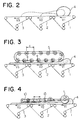
- the dough mass (4) is stretched, as shown in Figs. 1, 3, and 4, while it is subjected to vibrations.
- a roller mechanism having a plurality of rollers (5) freely rotatable about their axes in the direction designated by the arrow a and movable along an endless roller path in the direction designated by the arrow b is arranged above the conveying path of the conveyors (1, 2, 3) shown in Fig. 2.
- the roller mechanism may be mounted to a base in any conventional way.
- the rollers (5) are mounted by means of bearings around their shafts so as to be freely rotatable. The movement of the rollers in the direction b is faster than the movement of any of the conveyors.
- rollers (5) are arranged in a way in which the distance c between any adjacent pair of the rollers (5) is short enough so that uniform vibrations are always provided throughout the area of dough between the conveyors (1, 2, 3) and the roller mechanism.
- roller mechanism is disclosed in U.S. Patent No. 3,973,895.
- the dough mass (4) is pressed by the moving rollers against the conveying path, and is effectively stretched by the conveyors, while rotating and moving the rollers (5) in the directions of the arrows a and b .
- the dough mass (4) is continuously subjected to vibrations and tension.
- Such a phenomenon is called a thixotropy effect, and the area of the dough mass is stretched and permanently becomes thinner without pressure higher than the yield point of the elasticity of the dough having been imparted. Thus no high pressure that might damage the gluten network structure of the dough is provided to the dough in this invention.
- Fig. 4 shows another roller mechanism to stretch the dough without subjecting it to pressure greater than the yield point of its elasticity.
- This roller mechanism includes a plurality of rollers (15) freely rotatable about their axes along a straight path. These rollers (15) are connected by a pair of connecting arms (10) at both their ends. At the upstream end of each of both arms (10) a disc (11) is provided to move the rollers (15) back and forth along the straight path.
- a roller mechanism is disclosed in U.S. Patent No. 4,692,110.
- Fig. 7 shows still another roller mechanism to stretch the dough without subjecting it to pressure greater than the yield point of its elasticity.
- This mechanism is mounted to a base in any conventional way and includes a supply conveyor (21), a pair of supply rollers (25, 26) , a pair of discharge rollers (29, 30), a plurality of upper rollers (27), and a plurality of lower rollers (28).
- the plurality of upper and lower rollers (27, 28) are disposed between the pair of supply rollers (25, 26) and the pair of discharge rollers (29, 30).
- the plurality of upper rollers (27) are connected by a pair of connecting arms (not shown) at both their ends and are freely rotatable about their axes.
- the upper rollers are raised or lowered, as indicated by the vertical arrows in Fig. 7. by a pair of air cylinder mechanisms which are mounted on the base and connected to the respective ends of the arms.
- the lower rollers (28) are vertically juxtaposed with the respective upper rollers (27).
- the lower supply roller (26), the plurality of lower rollers (28), and the lower discharge roller (30), are driven in the direction c .
- the speeds of the lower supply conveyor (26), the first to sixth rollers of the plural lower rollers (28), and the lower discharge roller (30), are represented by V1, V2, V3, V4, V5, V6, V7, and V8, respectively, as shown in Fig. 7, the relation among the speeds of these rollers is: V1 ⁇ V2 ⁇ V3 ⁇ V4 ⁇ V5 ⁇ V6 ⁇ V7 ⁇ V8
- the pair of supply rollers are vertically juxtaposed.
- the upper roller (25) is driven in the direction b so that the pair of supply rollers (25, 26) moves in the same direction at the area where they face each other and at the same speed V1.
- the pair of discharge rollers (29, 30) are vertically juxtaposed and driven so that they move in the same direction at the area where they face each other and at the same speed V8.
- the belt of the supply conveyor (21) is driven at the same speed as the peripheral rotation speed of the pair of supply rollers (25, 26).
- the belt of the discharge conveyor (23) is driven at the same speed as the peripheral rotation speed by the pair of discharge rollers (29, 30).
- the pair of supply rollers (25, 26), the plurality of upper and lower rollers (27, 28), and the pair of discharge rollers (29, 30) are so arranged that a gap formed between the straight line defined by the lowermost parts of the upper rollers (25, 27, 29) and the straight line defined by the uppermost parts of the lower rollers (26, 28, 30) becomes progressively narrow in the downstream direction.
- the plurality of upper rollers (27) are repeatedly raised and lowered to impart to the dough uniform vibrations throughout the area between the plurality of upper rollers (27) and the plurality of lower rollers (28).
- the dough is stretched because of the thixotropy effect caused by the vibrations and the speed differences among the lower rollers (26, 28, 30).
- Fig. 1 the dough stretched is then cut and shaped into a desired form.
- the stretched dough sheet (6) is cut into pieces (7) having any desired dimensions and then rolled into roll bars (8).
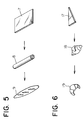
- Fig. 5 the steps for shaping a dough piece (7) into the form of French bread are shown.
- a rectangular dough piece (7) is rolled into a roll bar (8) and shaped into a long spindle form. Then some incisions are provided, resulting in dough in the form of French bread (9).
- Fig. 6 shows the steps for shaping a dough piece into the dough of a croissant form.
- the dough mass is produced by mixing and kneading ingredients and then is stretched into a sheet.
- the following example shows typical ingredients for producing croissant dough:
- a fat layer is applied on the surface of the dough sheet (6).
- the dough sheet (6) is then folded to sandwich the fat layer, thereby producing pastry dough having many fat layers.
- such a dough sheet (6) is stretched and cut into triangular dough pieces (17).
- the dough piece (17) is rolled up into a spindle shape (18) and then shaped into an arched form (19).
- the next step is a fermentation step.
- the dough for a croissant shaped into a desired form (8) is subjected to a temperature of 34°C and a humidity of 80 % for 50 minutes. These are conventional conditions for fermentation of croissant dough.
- the step to rest the dough is not necessary after the stretching or cutting dough.
- bread of good quality can be produced without resting the dough after stretching or dividing dough, or applying an oxidizing agent to the dough.
- the dough (8) is then put in a freezing room and subjected to a temperature of about -40°C, to freeze it rapidly.
- the frozen dough is preserved in a freezing room or freezer for a desired length of time.
- the dough thus preserved can be sold to consumers, who can continue preserving the dough in their own freezers.
- the dough is taken out of the freezing room or freezer and baked.
- the finished croissant produced form the frozen dough fermented under the conventional conditions attains a specific volume of 4.5-5.5 cm3/g and has a satisfying quality.
- the dough is deflated less than that of the prior art method during the freezing step. It expands sufficiently during the baking step and becomes puffy and tasty bread. Such bread has almost the same good quality as that produced from dough without preservation.
- the dough may be fermented under special conditions in which the temperature is lower and the time period is longer than for the conventional method.
- the dough is for a croissant
- the dough is subjected to a temperature of about 30°C, and humidity of about 80%, for about 70 minutes.
- the dough expands more than dough fermented under the conventional conditions. Such extra expansion can compensate for the slight deflation of the dough during the freezing step.
- finished bread of an improved quality can be produced.
- the finished croissant produced from the dough fermented under these special conditions attains a specific volume of 5.5-6 cm3/g.
- dough for each type of bread may have its own special conditions for sufficient expansion.
- the dough is preferably subjected to a temperature of about 32°C, and a humidity of about 80 %, for about 90 minutes. (The conventional conditions: 34°C, 80 % for 70 min.)
- the dough is deflated less than that of the prior art during the freezing step, as is readily understood from Table 1.
- Table 1 Specific volumes of Croissant Dough After the fermentation step After the freezing step After the baking step 1
- the dough of the prior art method 2.8 cm3/g 2.3 cm3/g 2.5-3 cm3/g 2 example of dough of this invention fermented under conventional conditions 2.8 cm3/g 2.5-2.7 cm3/g 4.5-5.5cm3/g 3 example of dough of this invention fermented under the special conditions 3 cm3/g 2.7 cm3/g 5.5-6 cm3/g
- the surface of the frozen dough does not become cracked or uneven, and remains smooth.
- the dough of the examples expands far more than that of the prior art, as is shown in Table 1.
- bread as good as that produced from dough without preservation can be obtained.
- the preferred method of this invention does not need a step for resting after the dividing step, the time required for producing the frozen dough can be reduced.
- the inventors have discovered that the finished bread produced from examples of dough of this invention which was preserved for one year maintained its quality. However, it is expected that bread produced by dough produced by the preferred methods of this invention that is preserved for more than one year will also maintain its quality.
- the finished bread produced from the examples of dough fermented under the special conditions attains a larger specific volume than that of dough fermented under the conventional conditions.
- the increased expansion caused by the fermentation under the special conditions can compensate for the slight deflation of the dough during the freezing step.
- finished bread of an improved quality can be obtained.
- fresh bread of good quality can be easily baked at any time by merely baking the dough which is frozen (e.g. quickly) to preserve the dough.
- this invention provides a method of producing frozen dough for baking or frying to form bread, wherein: the dough expands at the same rate as bread baked from dough which has not been frozen; the dough is produced without any damage to the gluten network structure therein; the dough expands more than the bread made from frozen and preserved by conventional methods; the finished bread is of good quality, without applying an oxidizing agent; and the dough for preservation by freezing can be obtained without requiring the step of resting after the dividing step.
Landscapes
- Life Sciences & Earth Sciences (AREA)
- Engineering & Computer Science (AREA)
- Food Science & Technology (AREA)
- Physics & Mathematics (AREA)
- Thermal Sciences (AREA)
- Wood Science & Technology (AREA)
- Zoology (AREA)
- Chemical & Material Sciences (AREA)
- Polymers & Plastics (AREA)
- Bakery Products And Manufacturing Methods Therefor (AREA)
- Freezing, Cooling And Drying Of Foods (AREA)
- Manufacturing And Processing Devices For Dough (AREA)
Claims (10)
- Procédé de production de pâte congelée à faire cuire ou frire pour former du pain, comprenant les étapes qui consistent :a) à mélanger et pétrir diverses matières telles que de la levure, de l'eau, du sucre ou de la farine, nécessaires pour produire un type souhaité de pain, afin d'obtenir une pâte ayant un réseau de gluten,b) à étirer ladite pâte tout en la soumettant à des vibrations communiquées mécaniquement afin qu'un effet de thixotropie apparaisse dans la pâte et que le réseau de gluten dans la pâte ne soit pas endommagé durant cette étape,c) à découper et façonner ladite pâte en une forme souhaitée,d) à fermenter ladite pâte, ete) à congeler ladite pâte.
- Procédé selon la revendication 1, comprenant en outre une étape consistant à appliquer une matière grasse sur la surface de la pâte étirée pour former une couche de matière grasse sur une couche de pâte et à plier ladite pâte pour prendre en sandwich les couches de matière grasse entre les couches de pâte pliées, afin de produire une pâte de patisserie.
- Procédé selon la revendication 1 ou 2, dans lequel ledit étirage est réalisé en tirant ladite pâte dans une certaine zone tout en soumettant ladite zone à des vibrations, afin qu'une pression sensiblement égale ou inférieure à 70 g/cm² soit appliquée à ladite zone.
- Procédé selon l'une quelconque des revendications 1, 2 ou 3, dans lequel ladite étape de fermentation est effectuée à une température d'environ 30°C et à une humidité d'environ 80 % pendant environ 70 minutes, et dans lequel ledit pain est un croissant.
- Procédé selon l'une quelconque des revendications 1, 2 ou 3, dans lequel ladite étape de fermentation est effectuée à une température d'environ 32°C et à une humidité d'environ 80 % pendant environ 90 minutes et dans lequel ledit pain est du pain français.
- Procédé selon l'une quelconque des revendications précédentes, dans lequel ladite étape d'étirage consiste à placer ladite pâte sur plusieurs transporteurs disposés en série et entraînés à des vitesses différentes afin que l'un quelconque des transporteurs soit plus rapide que son transporteur d'amont, tandis que ladite pâte est maintenue sur le trajet de transport desdits transporteurs à l'aide d'un mécanisme à rouleaux ayant plusieurs rouleaux placés au-dessus dudit trajet de transport pour étirer ladite pâte.
- Procédé selon la revendication 6, dans lequel lesdits rouleaux peuvent tourner librement sur leurs axes et sont mobiles le long d'un trajet sans fin pour rouleaux, les périphéries des rouleaux en mouvement formant une enveloppe fermée.
- Procédé selon la revendication 6, dans lequel lesdits rouleaux peuvent tourner librement sur un trajet rectiligne de rouleaux et sont mobiles en va-et-vient ensemble sur ledit trajet rectiligne.
- Procédé selon l'une quelconque des revendications 1 à 5, dans lequel ladite étape d'étirage comprend l'étape qui consiste à placer ladite pâte sur un premier groupe de rouleaux disposés en série et entraînés à des vitesses différentes de manière que la vitesse périphérique de l'un quelconque des rouleaux soit plus rapide que celle de son rouleau d'amont, tandis que ladite pâte est maintenue sur le trajet de transport défini entre les parties supérieures des rouleaux et un second groupe de rouleaux disposés au-dessus dudit premier groupe de rouleaux, de façon que l'intervalle formé entre les lignes droites définies par les parties les plus hautes du premier groupe de rouleaux et les parties les plus basses du second groupe de rouleaux devienne progressivement étroit vers l'aval, ledit second groupe de rouleaux étant destiné à être élevé et abaissé de façon répétée.
- Procédé de production de pain utilisant la pâte congelée produite par un procédé selon l'une quelconque des revendications précédentes, consistant à conserver la pâte congelée pendant un intervalle de temps souhaité, et à faire cuire ou frire la pâte.
Priority Applications (1)
| Application Number | Priority Date | Filing Date | Title |
|---|---|---|---|
| AT88307446T ATE81749T1 (de) | 1987-08-11 | 1988-08-11 | Verfahren zur herstellung von tiefgefrorenen teigprodukten. |
Applications Claiming Priority (2)
| Application Number | Priority Date | Filing Date | Title |
|---|---|---|---|
| JP62200454A JPH0640793B2 (ja) | 1987-08-11 | 1987-08-11 | パン類の成形保存方法 |
| JP200454/87 | 1987-08-11 |
Publications (3)
| Publication Number | Publication Date |
|---|---|
| EP0311240A2 EP0311240A2 (fr) | 1989-04-12 |
| EP0311240A3 EP0311240A3 (en) | 1989-12-06 |
| EP0311240B1 true EP0311240B1 (fr) | 1992-10-28 |
Family
ID=16424573
Family Applications (1)
| Application Number | Title | Priority Date | Filing Date |
|---|---|---|---|
| EP88307446A Expired - Lifetime EP0311240B1 (fr) | 1987-08-11 | 1988-08-11 | Procédé de production de pâte congelée |
Country Status (11)
| Country | Link |
|---|---|
| US (1) | US4946699A (fr) |
| EP (1) | EP0311240B1 (fr) |
| JP (1) | JPH0640793B2 (fr) |
| KR (1) | KR900007828B1 (fr) |
| CN (1) | CN1027342C (fr) |
| AT (1) | ATE81749T1 (fr) |
| AU (1) | AU593169B2 (fr) |
| CA (1) | CA1313975C (fr) |
| DE (1) | DE3875579T2 (fr) |
| ES (1) | ES2035925T3 (fr) |
| NZ (1) | NZ224922A (fr) |
Cited By (1)
| Publication number | Priority date | Publication date | Assignee | Title |
|---|---|---|---|---|
| EP2103217A2 (fr) | 2008-03-19 | 2009-09-23 | Fritsch GmbH | Système de l'étirage transversal de la pâte |
Families Citing this family (40)
| Publication number | Priority date | Publication date | Assignee | Title |
|---|---|---|---|---|
| JPH01206942A (ja) * | 1988-02-15 | 1989-08-21 | Rheon Autom Mach Co Ltd | パン生地等の延展成形方法及び装置 |
| JPH0640794B2 (ja) * | 1988-07-26 | 1994-06-01 | レオン自動機株式会社 | パンまたはペーストリーの成形保存方法 |
| NL8900436A (nl) * | 1989-02-22 | 1990-09-17 | Albro Bakkerijen Bv | Werkwijze voor het bereiden van broodprodukten. |
| US5171590A (en) * | 1989-02-22 | 1992-12-15 | Ahold Retail Services A.G. | Method of preparing frozen pieces of dough and of preparing dough products |
| DK161555C (da) * | 1989-04-13 | 1991-12-30 | Arie Albertus Walter | Fremgangsmaade til afspaending af faerdigudvalsede, laminerede dejprodukter, hvori der optraeder uoenskede spaendinger |
| JPH0795910B2 (ja) * | 1989-07-28 | 1995-10-18 | レオン自動機株式会社 | 生地延展方法及び装置 |
| JPH0697934B2 (ja) * | 1990-01-16 | 1994-12-07 | レオン自動機株式会社 | 生地延展方法および装置 |
| JPH0824526B2 (ja) * | 1990-02-16 | 1996-03-13 | アホールド リテイル サービセス アーゲー | 冷凍パン生地片製造方法およびパン製品製造方法 |
| JPH0655101B2 (ja) * | 1990-02-20 | 1994-07-27 | レオン自動機株式会社 | 発酵冷凍パンの製造方法 |
| JPH044837A (ja) * | 1990-04-23 | 1992-01-09 | Rheon Autom Mach Co Ltd | ベイキング生地シートの製造方法及び装置 |
| US5084284A (en) * | 1991-01-07 | 1992-01-28 | The Pillsbury Company | Container for refrigerated dough and method of forming a refrigerated dough product |
| US5310569A (en) * | 1992-12-03 | 1994-05-10 | Rykaart, Inc. | Method for producing a stress free continuous dough stream |
| IT1262814B (it) * | 1993-12-22 | 1996-07-04 | Giampietro Zaltron | Impianto di calandratura per laminazione di pasta alimentare |
| JP2917002B2 (ja) * | 1995-05-02 | 1999-07-12 | レオン自動機株式会社 | パン生地等の延展方法および装置 |
| TW313513B (fr) * | 1995-05-22 | 1997-08-21 | Reon Zidoki Kk | |
| JP2750843B2 (ja) | 1996-01-09 | 1998-05-13 | レオン自動機株式会社 | 分割されたパン生地の連結供給方法および装置 |
| MY115084A (en) * | 1996-05-22 | 2003-03-31 | Rheon Automatic Machinery Co | Method and apparatus for continuously and quantitatively supplying bread dough |
| KR100231004B1 (ko) * | 1997-06-24 | 1999-11-15 | 윤종용 | 포장박스 자동공급장치 |
| US6117472A (en) | 1997-11-25 | 2000-09-12 | Rheon Automatic Machinery Co., Inc. | Process for preparing dough pieces |
| US6579554B2 (en) | 2000-04-14 | 2003-06-17 | The Pillsbury Company | Freezer-to-oven, laminated, unproofed dough and products resulting therefrom |
| WO2003063595A1 (fr) * | 2002-01-31 | 2003-08-07 | Rich Products Corporation | Pate et produits cuits congeles |
| US20040052908A1 (en) * | 2002-09-18 | 2004-03-18 | Boyle Janet L | Tender laminated biscuits |
| MXPA05004101A (es) * | 2002-10-18 | 2005-10-18 | Maple Leaf Bakery Inc | Composicion para masa y metodo para hornear productos congelados de pan fermentados con levadura. |
| US6896916B2 (en) | 2002-10-18 | 2005-05-24 | Maple Leaf Baker Inc. | Method of baking yeast-fermented frozen bread products |
| DE602004008943T2 (de) * | 2003-09-11 | 2008-06-12 | Csm Nederland B.V. | Verfahren zum backen von gefrorenen teigstücken |
| US20050158439A1 (en) * | 2003-11-26 | 2005-07-21 | Dave Zhang | Non-sheeted freezer-to-oven dough with a simplified leavening system |
| US7704535B2 (en) * | 2004-03-12 | 2010-04-27 | Rich Products Corporation | Freezer to retarder to oven dough |
| US7806045B2 (en) * | 2005-05-24 | 2010-10-05 | Moffat Pty Limited | Scheduling and tracking system and method for bakery products |
| EP1883307A4 (fr) * | 2005-05-24 | 2010-04-28 | Moffat Pty Ltd | Systeme et procede de programmation et de suivi destines a la production de produits de boulangerie |
| US20070298143A1 (en) * | 2006-06-22 | 2007-12-27 | Graves John | Retarder-to-oven laminated dough |
| CN104663773A (zh) * | 2007-10-15 | 2015-06-03 | 敷岛面包株式会社 | 面包的制造方法 |
| US20110265622A1 (en) * | 2010-05-03 | 2011-11-03 | Berger Thomas G | Dough Feeding System |
| FR2982459A1 (fr) * | 2011-11-15 | 2013-05-17 | Michelina Marotta | Procede industriel de panification dit pret a cuire, avec fermentation complete avant surgelation et produits surgeles obtenus |
| ES2405535B1 (es) * | 2011-11-29 | 2014-04-07 | Investment Trust Pbs, S.L. | Procedimiento para la fabricación de un producto alimentario y producto alimentario obtenido |
| CA2883723A1 (fr) * | 2012-10-19 | 2014-04-24 | Nestec S.A. | Poudre pour dorer la surface d'aliments |
| KR101346154B1 (ko) * | 2013-10-11 | 2014-01-02 | 정윤서 | 고리형 다층 빵의 제조방법 |
| CN107691546B (zh) * | 2017-08-10 | 2019-07-19 | 宁波北仑思行硅胶制品有限公司 | 一种揉面装置及揉面方法 |
| KR102059067B1 (ko) * | 2018-06-24 | 2019-12-24 | 주식회사 에스제이뺑오르방 | 슬라이스 파이 및 그의 제조방법 |
| KR102555289B1 (ko) * | 2022-09-01 | 2023-07-13 | 주식회사 가람에프엔비 | 휴면 생지 제조 방법 및 이를 이용한 크로플 제조 방법 |
| CN117717100A (zh) * | 2024-01-18 | 2024-03-19 | 简阳高架面食品有限公司 | 一种压面搓条机 |
Family Cites Families (14)
| Publication number | Priority date | Publication date | Assignee | Title |
|---|---|---|---|---|
| CH325442A (de) * | 1957-04-15 | 1957-11-15 | Baumann Arthur | Bäckereimaschine |
| FR1572241A (fr) * | 1968-02-16 | 1969-06-27 | ||
| US3973895A (en) * | 1971-01-13 | 1976-08-10 | Torahiko Hayashi | Apparatus for forming dough pieces |
| JPS4941556A (fr) * | 1972-08-29 | 1974-04-18 | ||
| JPS529753B2 (fr) * | 1974-02-25 | 1977-03-18 | ||
| US4093749A (en) * | 1974-11-20 | 1978-06-06 | Sternberg George P | Preparation of yeast leavened dough products |
| US4192636A (en) * | 1975-08-22 | 1980-03-11 | Rheon Automatic Machinery Co., Ltd. | Apparatus for stretching dough material |
| JPS54991A (en) * | 1977-06-06 | 1979-01-06 | Panafacom Ltd | Semiconductor ic |
| US4406911A (en) * | 1980-06-30 | 1983-09-27 | General Foods Corporation | Method of producing and baking frozen yeast leavened dough |
| JPS6028248A (ja) * | 1983-07-27 | 1985-02-13 | Toshiba Corp | 半導体装置の製造方法 |
| FR2569334B1 (fr) * | 1984-08-21 | 1987-01-02 | Dough Process International Sa | Laminoir pour pate a table vibrante |
| JPS6163231A (ja) * | 1984-08-31 | 1986-04-01 | レオン自動機株式会社 | 可塑性生地の延展装置 |
| NL8602872A (nl) * | 1986-03-26 | 1987-10-16 | Rijkaart Machinefab | Walsinrichting voor het vormen van een doorgaande band deeg of een soortgelijke plastische stof. |
| ES8801877A1 (es) * | 1986-06-25 | 1988-03-16 | Sermont Sa | Procedimiento para la fabricacion de laminado en continuo de masa de pasta para panaderia y bolleria. |
-
1987
- 1987-08-11 JP JP62200454A patent/JPH0640793B2/ja not_active Expired - Fee Related
-
1988
- 1988-06-07 NZ NZ224922A patent/NZ224922A/en unknown
- 1988-06-17 KR KR1019880007294A patent/KR900007828B1/ko not_active Expired
- 1988-06-30 US US07/213,753 patent/US4946699A/en not_active Expired - Lifetime
- 1988-06-30 AU AU18595/88A patent/AU593169B2/en not_active Ceased
- 1988-08-09 CN CN88104873A patent/CN1027342C/zh not_active Expired - Fee Related
- 1988-08-10 CA CA000574276A patent/CA1313975C/fr not_active Expired - Fee Related
- 1988-08-11 ES ES198888307446T patent/ES2035925T3/es not_active Expired - Lifetime
- 1988-08-11 AT AT88307446T patent/ATE81749T1/de not_active IP Right Cessation
- 1988-08-11 DE DE8888307446T patent/DE3875579T2/de not_active Revoked
- 1988-08-11 EP EP88307446A patent/EP0311240B1/fr not_active Expired - Lifetime
Cited By (3)
| Publication number | Priority date | Publication date | Assignee | Title |
|---|---|---|---|---|
| EP2103217A2 (fr) | 2008-03-19 | 2009-09-23 | Fritsch GmbH | Système de l'étirage transversal de la pâte |
| DE102008000763A1 (de) | 2008-03-19 | 2009-09-24 | Fritsch Gmbh | Teig-Querstrecksystem |
| DE102008000763B4 (de) * | 2008-03-19 | 2020-03-12 | Fritsch Bakery Technologies GmbH & Co. KG | Teig-Querstrecksystem |
Also Published As
| Publication number | Publication date |
|---|---|
| AU593169B2 (en) | 1990-02-01 |
| NZ224922A (en) | 1995-03-28 |
| KR900007828B1 (ko) | 1990-10-20 |
| AU1859588A (en) | 1989-04-27 |
| JPH0640793B2 (ja) | 1994-06-01 |
| KR890003288A (ko) | 1989-04-14 |
| EP0311240A3 (en) | 1989-12-06 |
| US4946699A (en) | 1990-08-07 |
| DE3875579T2 (de) | 1993-04-08 |
| EP0311240A2 (fr) | 1989-04-12 |
| DE3875579D1 (de) | 1992-12-03 |
| CN1031312A (zh) | 1989-03-01 |
| JPS6443147A (en) | 1989-02-15 |
| CA1313975C (fr) | 1993-03-02 |
| ATE81749T1 (de) | 1992-11-15 |
| CN1027342C (zh) | 1995-01-11 |
| ES2035925T3 (es) | 1993-05-01 |
Similar Documents
| Publication | Publication Date | Title |
|---|---|---|
| EP0353036B1 (fr) | Procédé de préparation d'une pâte | |
| EP0311240A2 (fr) | Procédé de production de pâte congelée | |
| US4276317A (en) | Method for processing bread dough | |
| US4904491A (en) | Method for producing dough for bread or pastry | |
| EP0920805B1 (fr) | Procédé pour la préparation de pain | |
| AU761300B2 (en) | Method for preparing bakery goods having edible particles on a top surface and bakery goods prepared thereby | |
| US5824349A (en) | Stress-free dough sheeter with pneumatically assisted release | |
| US5272962A (en) | Method and apparatus for producing a sheet of dough | |
| CN109805062B (zh) | 一种预发酵丹麦酥速冻面团的生产工艺 | |
| CN109699704B (zh) | 一种预发酵牛角速冻面团的生产工艺 | |
| CN106061270B (zh) | 用来生产基于发酵生面团,发酵松饼生面团或松饼生面团的食物的方法 | |
| US20170150729A1 (en) | Method of producing a piece of laminated dough, a piece of laminated dough, and a method of baking a piece of laminated dough | |
| US5906764A (en) | Method of and apparatus for baking dough | |
| EP0443807B1 (fr) | Méthode de production de pain avec pâte conservée | |
| JP3016247B2 (ja) | パンの製造方法 | |
| JP3020832B2 (ja) | ツイストパイ及びその製造方法 | |
| JPS63188342A (ja) | 孔あき食品生地の製造方法および装置 | |
| KR100439559B1 (ko) | 닉스타말라이징 처리된 옥수수 생반죽으로 된 소형토틸라를 타코 형상으로 제조하는 장치 | |
| JP6304959B2 (ja) | ハード系パンの成型方法 | |
| JPS62224231A (ja) | 包餅の製造装置 | |
| JPH067068A (ja) | スライスパンの製造方法 | |
| DD290795A5 (de) | Verfahren zur herstellung von zwieback |
Legal Events
| Date | Code | Title | Description |
|---|---|---|---|
| PUAI | Public reference made under article 153(3) epc to a published international application that has entered the european phase |
Free format text: ORIGINAL CODE: 0009012 |
|
| AK | Designated contracting states |
Kind code of ref document: A2 Designated state(s): AT BE CH DE ES FR GB IT LI NL SE |
|
| PUAL | Search report despatched |
Free format text: ORIGINAL CODE: 0009013 |
|
| AK | Designated contracting states |
Kind code of ref document: A3 Designated state(s): AT BE CH DE ES FR GB IT LI NL SE |
|
| 17P | Request for examination filed |
Effective date: 19900214 |
|
| 17Q | First examination report despatched |
Effective date: 19910410 |
|
| GRAA | (expected) grant |
Free format text: ORIGINAL CODE: 0009210 |
|
| AK | Designated contracting states |
Kind code of ref document: B1 Designated state(s): AT BE CH DE ES FR GB IT LI NL SE |
|
| REF | Corresponds to: |
Ref document number: 81749 Country of ref document: AT Date of ref document: 19921115 Kind code of ref document: T |
|
| ITF | It: translation for a ep patent filed | ||
| REF | Corresponds to: |
Ref document number: 3875579 Country of ref document: DE Date of ref document: 19921203 |
|
| ET | Fr: translation filed | ||
| REG | Reference to a national code |
Ref country code: ES Ref legal event code: FG2A Ref document number: 2035925 Country of ref document: ES Kind code of ref document: T3 |
|
| PLBI | Opposition filed |
Free format text: ORIGINAL CODE: 0009260 |
|
| 26 | Opposition filed |
Opponent name: A. FRITSCH GMBH & CO. KG Effective date: 19930721 |
|
| NLR1 | Nl: opposition has been filed with the epo |
Opponent name: A. FRITSCH GMBH & CO. KG |
|
| EAL | Se: european patent in force in sweden |
Ref document number: 88307446.0 |
|
| APAE | Appeal reference modified |
Free format text: ORIGINAL CODE: EPIDOS REFNO |
|
| PLBQ | Unpublished change to opponent data |
Free format text: ORIGINAL CODE: EPIDOS OPPO |
|
| PLAB | Opposition data, opponent's data or that of the opponent's representative modified |
Free format text: ORIGINAL CODE: 0009299OPPO |
|
| R26 | Opposition filed (corrected) |
Opponent name: A. FRITSCH GMBH & CO. KG Effective date: 19930721 |
|
| NLR1 | Nl: opposition has been filed with the epo |
Opponent name: A. FRITSCH GMBH & CO. KG |
|
| PGFP | Annual fee paid to national office [announced via postgrant information from national office to epo] |
Ref country code: ES Payment date: 19990803 Year of fee payment: 12 |
|
| PGFP | Annual fee paid to national office [announced via postgrant information from national office to epo] |
Ref country code: SE Payment date: 19990804 Year of fee payment: 12 |
|
| PGFP | Annual fee paid to national office [announced via postgrant information from national office to epo] |
Ref country code: FR Payment date: 19990810 Year of fee payment: 12 |
|
| PGFP | Annual fee paid to national office [announced via postgrant information from national office to epo] |
Ref country code: GB Payment date: 19990811 Year of fee payment: 12 Ref country code: CH Payment date: 19990811 Year of fee payment: 12 |
|
| PGFP | Annual fee paid to national office [announced via postgrant information from national office to epo] |
Ref country code: AT Payment date: 19990812 Year of fee payment: 12 |
|
| PGFP | Annual fee paid to national office [announced via postgrant information from national office to epo] |
Ref country code: DE Payment date: 19990816 Year of fee payment: 12 |
|
| PGFP | Annual fee paid to national office [announced via postgrant information from national office to epo] |
Ref country code: NL Payment date: 19990830 Year of fee payment: 12 |
|
| PGFP | Annual fee paid to national office [announced via postgrant information from national office to epo] |
Ref country code: BE Payment date: 19991013 Year of fee payment: 12 |
|
| APAC | Appeal dossier modified |
Free format text: ORIGINAL CODE: EPIDOS NOAPO |
|
| RDAH | Patent revoked |
Free format text: ORIGINAL CODE: EPIDOS REVO |
|
| RDAG | Patent revoked |
Free format text: ORIGINAL CODE: 0009271 |
|
| STAA | Information on the status of an ep patent application or granted ep patent |
Free format text: STATUS: PATENT REVOKED |
|
| 27W | Patent revoked |
Effective date: 20000203 |
|
| GBPR | Gb: patent revoked under art. 102 of the ep convention designating the uk as contracting state |
Free format text: 20000203 |
|
| REG | Reference to a national code |
Ref country code: CH Ref legal event code: PL |
|
| NLR2 | Nl: decision of opposition | ||
| APAH | Appeal reference modified |
Free format text: ORIGINAL CODE: EPIDOSCREFNO |
|
| PLAB | Opposition data, opponent's data or that of the opponent's representative modified |
Free format text: ORIGINAL CODE: 0009299OPPO |