EP0313858A2 - Elément analytique - Google Patents
Elément analytique Download PDFInfo
- Publication number
- EP0313858A2 EP0313858A2 EP88116201A EP88116201A EP0313858A2 EP 0313858 A2 EP0313858 A2 EP 0313858A2 EP 88116201 A EP88116201 A EP 88116201A EP 88116201 A EP88116201 A EP 88116201A EP 0313858 A2 EP0313858 A2 EP 0313858A2
- Authority
- EP
- European Patent Office
- Prior art keywords
- layer
- substance
- diffusible
- analyzing element
- type chemical
- Prior art date
- Legal status (The legal status is an assumption and is not a legal conclusion. Google has not performed a legal analysis and makes no representation as to the accuracy of the status listed.)
- Withdrawn
Links
- 239000000126 substance Substances 0.000 claims abstract description 122
- 238000006243 chemical reaction Methods 0.000 claims abstract description 65
- 239000000758 substrate Substances 0.000 claims abstract description 53
- 102000004190 Enzymes Human genes 0.000 claims abstract description 50
- 108090000790 Enzymes Proteins 0.000 claims abstract description 50
- 238000010521 absorption reaction Methods 0.000 claims abstract description 24
- 230000000694 effects Effects 0.000 claims abstract description 21
- 239000007788 liquid Substances 0.000 claims abstract description 18
- 230000003595 spectral effect Effects 0.000 claims abstract description 15
- 238000004458 analytical method Methods 0.000 claims abstract description 8
- 150000001875 compounds Chemical class 0.000 claims description 49
- 238000003892 spreading Methods 0.000 claims description 28
- 230000007480 spreading Effects 0.000 claims description 27
- 150000004676 glycans Chemical class 0.000 claims description 4
- 239000005017 polysaccharide Substances 0.000 claims description 4
- 239000003795 chemical substances by application Substances 0.000 claims description 3
- 230000003247 decreasing effect Effects 0.000 claims description 3
- 230000002255 enzymatic effect Effects 0.000 claims description 3
- 230000000269 nucleophilic effect Effects 0.000 claims description 3
- 229920001282 polysaccharide Polymers 0.000 claims description 3
- NEAQRZUHTPSBBM-UHFFFAOYSA-N 2-hydroxy-3,3-dimethyl-7-nitro-4h-isoquinolin-1-one Chemical class C1=C([N+]([O-])=O)C=C2C(=O)N(O)C(C)(C)CC2=C1 NEAQRZUHTPSBBM-UHFFFAOYSA-N 0.000 claims description 2
- 150000004703 alkoxides Chemical class 0.000 claims description 2
- 150000002429 hydrazines Chemical class 0.000 claims description 2
- 150000002443 hydroxylamines Chemical class 0.000 claims description 2
- 150000002923 oximes Chemical class 0.000 claims description 2
- 150000003141 primary amines Chemical class 0.000 claims description 2
- 150000003335 secondary amines Chemical class 0.000 claims description 2
- 150000003573 thiols Chemical class 0.000 claims description 2
- 239000010410 layer Substances 0.000 description 198
- 229940088598 enzyme Drugs 0.000 description 46
- 239000000975 dye Substances 0.000 description 40
- 239000003153 chemical reaction reagent Substances 0.000 description 22
- 238000000034 method Methods 0.000 description 19
- 239000011248 coating agent Substances 0.000 description 18
- 238000000576 coating method Methods 0.000 description 18
- 239000003446 ligand Substances 0.000 description 17
- 239000000243 solution Substances 0.000 description 17
- 238000012360 testing method Methods 0.000 description 15
- CSCPPACGZOOCGX-UHFFFAOYSA-N Acetone Chemical compound CC(C)=O CSCPPACGZOOCGX-UHFFFAOYSA-N 0.000 description 12
- XLYOFNOQVPJJNP-UHFFFAOYSA-N water Substances O XLYOFNOQVPJJNP-UHFFFAOYSA-N 0.000 description 12
- 239000007795 chemical reaction product Substances 0.000 description 11
- 239000000203 mixture Substances 0.000 description 11
- LFQSCWFLJHTTHZ-UHFFFAOYSA-N Ethanol Chemical compound CCO LFQSCWFLJHTTHZ-UHFFFAOYSA-N 0.000 description 10
- 108010010803 Gelatin Proteins 0.000 description 10
- 239000000427 antigen Substances 0.000 description 10
- 102000036639 antigens Human genes 0.000 description 10
- 108091007433 antigens Proteins 0.000 description 10
- 239000004744 fabric Substances 0.000 description 10
- 229920000159 gelatin Polymers 0.000 description 10
- 239000008273 gelatin Substances 0.000 description 10
- 235000019322 gelatine Nutrition 0.000 description 10
- 235000011852 gelatine desserts Nutrition 0.000 description 10
- 239000011230 binding agent Substances 0.000 description 9
- 229920001477 hydrophilic polymer Polymers 0.000 description 9
- 238000004519 manufacturing process Methods 0.000 description 9
- 238000005259 measurement Methods 0.000 description 9
- 230000003287 optical effect Effects 0.000 description 8
- 238000003018 immunoassay Methods 0.000 description 7
- -1 polymethacrylamide Polymers 0.000 description 7
- 229920002554 vinyl polymer Polymers 0.000 description 7
- 239000000178 monomer Substances 0.000 description 6
- 125000000391 vinyl group Chemical group [H]C([*])=C([H])[H] 0.000 description 6
- 239000004382 Amylase Substances 0.000 description 5
- 108010065511 Amylases Proteins 0.000 description 5
- 102000013142 Amylases Human genes 0.000 description 5
- 230000009471 action Effects 0.000 description 5
- 235000019418 amylase Nutrition 0.000 description 5
- 238000009739 binding Methods 0.000 description 5
- 229920001577 copolymer Polymers 0.000 description 5
- 238000001914 filtration Methods 0.000 description 5
- 239000012434 nucleophilic reagent Substances 0.000 description 5
- 229920000139 polyethylene terephthalate Polymers 0.000 description 5
- 239000005020 polyethylene terephthalate Substances 0.000 description 5
- 229920000642 polymer Polymers 0.000 description 5
- FAPWRFPIFSIZLT-UHFFFAOYSA-M Sodium chloride Chemical class [Na+].[Cl-] FAPWRFPIFSIZLT-UHFFFAOYSA-M 0.000 description 4
- 235000010724 Wisteria floribunda Nutrition 0.000 description 4
- 238000001514 detection method Methods 0.000 description 4
- 238000007598 dipping method Methods 0.000 description 4
- 238000006911 enzymatic reaction Methods 0.000 description 4
- 235000019441 ethanol Nutrition 0.000 description 4
- 239000000835 fiber Substances 0.000 description 4
- 238000010324 immunological assay Methods 0.000 description 4
- 239000000463 material Substances 0.000 description 4
- 229920002401 polyacrylamide Polymers 0.000 description 4
- 230000008569 process Effects 0.000 description 4
- MEKOFIRRDATTAG-UHFFFAOYSA-N 2,2,5,8-tetramethyl-3,4-dihydrochromen-6-ol Chemical compound C1CC(C)(C)OC2=C1C(C)=C(O)C=C2C MEKOFIRRDATTAG-UHFFFAOYSA-N 0.000 description 3
- QTBSBXVTEAMEQO-UHFFFAOYSA-N Acetic acid Chemical compound CC(O)=O QTBSBXVTEAMEQO-UHFFFAOYSA-N 0.000 description 3
- WEVYAHXRMPXWCK-UHFFFAOYSA-N Acetonitrile Chemical compound CC#N WEVYAHXRMPXWCK-UHFFFAOYSA-N 0.000 description 3
- 229920000945 Amylopectin Polymers 0.000 description 3
- XEKOWRVHYACXOJ-UHFFFAOYSA-N Ethyl acetate Chemical compound CCOC(C)=O XEKOWRVHYACXOJ-UHFFFAOYSA-N 0.000 description 3
- OKKJLVBELUTLKV-UHFFFAOYSA-N Methanol Chemical compound OC OKKJLVBELUTLKV-UHFFFAOYSA-N 0.000 description 3
- FXHOOIRPVKKKFG-UHFFFAOYSA-N N,N-Dimethylacetamide Chemical compound CN(C)C(C)=O FXHOOIRPVKKKFG-UHFFFAOYSA-N 0.000 description 3
- HEMHJVSKTPXQMS-UHFFFAOYSA-M Sodium hydroxide Chemical compound [OH-].[Na+] HEMHJVSKTPXQMS-UHFFFAOYSA-M 0.000 description 3
- 229920002472 Starch Polymers 0.000 description 3
- GWEVSGVZZGPLCZ-UHFFFAOYSA-N Titan oxide Chemical compound O=[Ti]=O GWEVSGVZZGPLCZ-UHFFFAOYSA-N 0.000 description 3
- ZMANZCXQSJIPKH-UHFFFAOYSA-N Triethylamine Chemical compound CCN(CC)CC ZMANZCXQSJIPKH-UHFFFAOYSA-N 0.000 description 3
- 239000012790 adhesive layer Substances 0.000 description 3
- 239000012736 aqueous medium Substances 0.000 description 3
- 239000001913 cellulose Substances 0.000 description 3
- 229920002678 cellulose Polymers 0.000 description 3
- 230000008859 change Effects 0.000 description 3
- 238000004040 coloring Methods 0.000 description 3
- 230000000052 comparative effect Effects 0.000 description 3
- 239000013078 crystal Substances 0.000 description 3
- 238000003745 diagnosis Methods 0.000 description 3
- 239000012153 distilled water Substances 0.000 description 3
- 229960004756 ethanol Drugs 0.000 description 3
- 125000002791 glucosyl group Chemical group C1([C@H](O)[C@@H](O)[C@H](O)[C@H](O1)CO)* 0.000 description 3
- FQPSGWSUVKBHSU-UHFFFAOYSA-N methacrylamide Chemical compound CC(=C)C(N)=O FQPSGWSUVKBHSU-UHFFFAOYSA-N 0.000 description 3
- 238000002360 preparation method Methods 0.000 description 3
- 125000006239 protecting group Chemical group 0.000 description 3
- 102000004169 proteins and genes Human genes 0.000 description 3
- 108090000623 proteins and genes Proteins 0.000 description 3
- 230000035945 sensitivity Effects 0.000 description 3
- 239000008107 starch Substances 0.000 description 3
- 235000019698 starch Nutrition 0.000 description 3
- 238000003756 stirring Methods 0.000 description 3
- 125000001424 substituent group Chemical group 0.000 description 3
- 239000004094 surface-active agent Substances 0.000 description 3
- OGIDPMRJRNCKJF-UHFFFAOYSA-N titanium oxide Inorganic materials [Ti]=O OGIDPMRJRNCKJF-UHFFFAOYSA-N 0.000 description 3
- 239000002759 woven fabric Substances 0.000 description 3
- IXPNQXFRVYWDDI-UHFFFAOYSA-N 1-methyl-2,4-dioxo-1,3-diazinane-5-carboximidamide Chemical compound CN1CC(C(N)=N)C(=O)NC1=O IXPNQXFRVYWDDI-UHFFFAOYSA-N 0.000 description 2
- SMZOUWXMTYCWNB-UHFFFAOYSA-N 2-(2-methoxy-5-methylphenyl)ethanamine Chemical compound COC1=CC=C(C)C=C1CCN SMZOUWXMTYCWNB-UHFFFAOYSA-N 0.000 description 2
- NIXOWILDQLNWCW-UHFFFAOYSA-N 2-Propenoic acid Natural products OC(=O)C=C NIXOWILDQLNWCW-UHFFFAOYSA-N 0.000 description 2
- HRPVXLWXLXDGHG-UHFFFAOYSA-N Acrylamide Chemical compound NC(=O)C=C HRPVXLWXLXDGHG-UHFFFAOYSA-N 0.000 description 2
- 229920000936 Agarose Polymers 0.000 description 2
- 102000002260 Alkaline Phosphatase Human genes 0.000 description 2
- 108020004774 Alkaline Phosphatase Proteins 0.000 description 2
- IJGRMHOSHXDMSA-UHFFFAOYSA-N Atomic nitrogen Chemical compound N#N IJGRMHOSHXDMSA-UHFFFAOYSA-N 0.000 description 2
- 108010059892 Cellulase Proteins 0.000 description 2
- HEDRZPFGACZZDS-UHFFFAOYSA-N Chloroform Chemical compound ClC(Cl)Cl HEDRZPFGACZZDS-UHFFFAOYSA-N 0.000 description 2
- VEXZGXHMUGYJMC-UHFFFAOYSA-N Hydrochloric acid Chemical compound Cl VEXZGXHMUGYJMC-UHFFFAOYSA-N 0.000 description 2
- 239000004354 Hydroxyethyl cellulose Substances 0.000 description 2
- 229920000663 Hydroxyethyl cellulose Polymers 0.000 description 2
- CSNNHWWHGAXBCP-UHFFFAOYSA-L Magnesium sulfate Chemical compound [Mg+2].[O-][S+2]([O-])([O-])[O-] CSNNHWWHGAXBCP-UHFFFAOYSA-L 0.000 description 2
- OFOBLEOULBTSOW-UHFFFAOYSA-N Propanedioic acid Natural products OC(=O)CC(O)=O OFOBLEOULBTSOW-UHFFFAOYSA-N 0.000 description 2
- JUJWROOIHBZHMG-UHFFFAOYSA-N Pyridine Chemical compound C1=CC=NC=C1 JUJWROOIHBZHMG-UHFFFAOYSA-N 0.000 description 2
- 239000000654 additive Substances 0.000 description 2
- 125000000217 alkyl group Chemical group 0.000 description 2
- 108090000637 alpha-Amylases Proteins 0.000 description 2
- 102000004139 alpha-Amylases Human genes 0.000 description 2
- 229940024171 alpha-amylase Drugs 0.000 description 2
- 239000003963 antioxidant agent Substances 0.000 description 2
- 230000003078 antioxidant effect Effects 0.000 description 2
- 125000003118 aryl group Chemical group 0.000 description 2
- TZCXTZWJZNENPQ-UHFFFAOYSA-L barium sulfate Chemical compound [Ba+2].[O-]S([O-])(=O)=O TZCXTZWJZNENPQ-UHFFFAOYSA-L 0.000 description 2
- 230000008033 biological extinction Effects 0.000 description 2
- 210000004369 blood Anatomy 0.000 description 2
- 239000008280 blood Substances 0.000 description 2
- 238000006664 bond formation reaction Methods 0.000 description 2
- 125000003178 carboxy group Chemical group [H]OC(*)=O 0.000 description 2
- 229940106157 cellulase Drugs 0.000 description 2
- 238000001816 cooling Methods 0.000 description 2
- 230000000875 corresponding effect Effects 0.000 description 2
- 238000007766 curtain coating Methods 0.000 description 2
- 238000009792 diffusion process Methods 0.000 description 2
- 238000003618 dip coating Methods 0.000 description 2
- 235000019447 hydroxyethyl cellulose Nutrition 0.000 description 2
- 238000002372 labelling Methods 0.000 description 2
- 238000010030 laminating Methods 0.000 description 2
- 125000005647 linker group Chemical group 0.000 description 2
- VZCYOOQTPOCHFL-UPHRSURJSA-N maleic acid Chemical compound OC(=O)\C=C/C(O)=O VZCYOOQTPOCHFL-UPHRSURJSA-N 0.000 description 2
- 239000011976 maleic acid Substances 0.000 description 2
- 239000002609 medium Substances 0.000 description 2
- 239000012046 mixed solvent Substances 0.000 description 2
- 229920003023 plastic Polymers 0.000 description 2
- 239000004033 plastic Substances 0.000 description 2
- 229920001495 poly(sodium acrylate) polymer Polymers 0.000 description 2
- 229920002338 polyhydroxyethylmethacrylate Polymers 0.000 description 2
- 239000001267 polyvinylpyrrolidone Substances 0.000 description 2
- 229920000036 polyvinylpyrrolidone Polymers 0.000 description 2
- 235000013855 polyvinylpyrrolidone Nutrition 0.000 description 2
- 239000000843 powder Substances 0.000 description 2
- 239000000047 product Substances 0.000 description 2
- 239000000985 reactive dye Substances 0.000 description 2
- 230000009257 reactivity Effects 0.000 description 2
- 239000000661 sodium alginate Substances 0.000 description 2
- 235000010413 sodium alginate Nutrition 0.000 description 2
- 229940005550 sodium alginate Drugs 0.000 description 2
- NNMHYFLPFNGQFZ-UHFFFAOYSA-M sodium polyacrylate Chemical compound [Na+].[O-]C(=O)C=C NNMHYFLPFNGQFZ-UHFFFAOYSA-M 0.000 description 2
- 239000002904 solvent Substances 0.000 description 2
- 125000000020 sulfo group Chemical group O=S(=O)([*])O[H] 0.000 description 2
- 238000003786 synthesis reaction Methods 0.000 description 2
- VZCYOOQTPOCHFL-UHFFFAOYSA-N trans-butenedioic acid Natural products OC(=O)C=CC(O)=O VZCYOOQTPOCHFL-UHFFFAOYSA-N 0.000 description 2
- AVQQQNCBBIEMEU-UHFFFAOYSA-N 1,1,3,3-tetramethylurea Chemical compound CN(C)C(=O)N(C)C AVQQQNCBBIEMEU-UHFFFAOYSA-N 0.000 description 1
- GFNKTLQTQSALEJ-UHFFFAOYSA-N 1-isocyanato-4-nitrobenzene Chemical compound [O-][N+](=O)C1=CC=C(N=C=O)C=C1 GFNKTLQTQSALEJ-UHFFFAOYSA-N 0.000 description 1
- XNWFRZJHXBZDAG-UHFFFAOYSA-N 2-METHOXYETHANOL Chemical compound COCCO XNWFRZJHXBZDAG-UHFFFAOYSA-N 0.000 description 1
- QKNYBSVHEMOAJP-UHFFFAOYSA-N 2-amino-2-(hydroxymethyl)propane-1,3-diol;hydron;chloride Chemical compound Cl.OCC(N)(CO)CO QKNYBSVHEMOAJP-UHFFFAOYSA-N 0.000 description 1
- QTBSBXVTEAMEQO-UHFFFAOYSA-M Acetate Chemical compound CC([O-])=O QTBSBXVTEAMEQO-UHFFFAOYSA-M 0.000 description 1
- 208000023275 Autoimmune disease Diseases 0.000 description 1
- 108010001682 Dextranase Proteins 0.000 description 1
- 108010073178 Glucan 1,4-alpha-Glucosidase Proteins 0.000 description 1
- 102100022624 Glucoamylase Human genes 0.000 description 1
- 239000006173 Good's buffer Substances 0.000 description 1
- 102000001554 Hemoglobins Human genes 0.000 description 1
- 108010054147 Hemoglobins Proteins 0.000 description 1
- DGAQECJNVWCQMB-PUAWFVPOSA-M Ilexoside XXIX Chemical compound C[C@@H]1CC[C@@]2(CC[C@@]3(C(=CC[C@H]4[C@]3(CC[C@@H]5[C@@]4(CC[C@@H](C5(C)C)OS(=O)(=O)[O-])C)C)[C@@H]2[C@]1(C)O)C)C(=O)O[C@H]6[C@@H]([C@H]([C@@H]([C@H](O6)CO)O)O)O.[Na+] DGAQECJNVWCQMB-PUAWFVPOSA-M 0.000 description 1
- 229910019142 PO4 Inorganic materials 0.000 description 1
- 239000004372 Polyvinyl alcohol Substances 0.000 description 1
- PMZURENOXWZQFD-UHFFFAOYSA-L Sodium Sulfate Chemical compound [Na+].[Na+].[O-]S([O-])(=O)=O PMZURENOXWZQFD-UHFFFAOYSA-L 0.000 description 1
- 235000002595 Solanum tuberosum Nutrition 0.000 description 1
- 244000061456 Solanum tuberosum Species 0.000 description 1
- WETWJCDKMRHUPV-UHFFFAOYSA-N acetyl chloride Chemical compound CC(Cl)=O WETWJCDKMRHUPV-UHFFFAOYSA-N 0.000 description 1
- 239000012346 acetyl chloride Substances 0.000 description 1
- 239000013543 active substance Substances 0.000 description 1
- 125000002252 acyl group Chemical group 0.000 description 1
- 239000000853 adhesive Substances 0.000 description 1
- 230000001070 adhesive effect Effects 0.000 description 1
- 125000001931 aliphatic group Chemical group 0.000 description 1
- 102000013529 alpha-Fetoproteins Human genes 0.000 description 1
- 108010026331 alpha-Fetoproteins Proteins 0.000 description 1
- 125000000129 anionic group Chemical group 0.000 description 1
- 239000007864 aqueous solution Substances 0.000 description 1
- 125000004391 aryl sulfonyl group Chemical group 0.000 description 1
- 239000000987 azo dye Substances 0.000 description 1
- 230000008901 benefit Effects 0.000 description 1
- 108010019077 beta-Amylase Proteins 0.000 description 1
- 102000005936 beta-Galactosidase Human genes 0.000 description 1
- 108010005774 beta-Galactosidase Proteins 0.000 description 1
- 230000015572 biosynthetic process Effects 0.000 description 1
- 210000000601 blood cell Anatomy 0.000 description 1
- 150000001642 boronic acid derivatives Chemical class 0.000 description 1
- 239000000872 buffer Substances 0.000 description 1
- 239000007853 buffer solution Substances 0.000 description 1
- 150000004649 carbonic acid derivatives Chemical class 0.000 description 1
- 239000001768 carboxy methyl cellulose Substances 0.000 description 1
- 235000010948 carboxy methyl cellulose Nutrition 0.000 description 1
- 239000008112 carboxymethyl-cellulose Substances 0.000 description 1
- 229940105329 carboxymethylcellulose Drugs 0.000 description 1
- 229920006317 cationic polymer Polymers 0.000 description 1
- 229920002301 cellulose acetate Polymers 0.000 description 1
- 125000003636 chemical group Chemical group 0.000 description 1
- 239000003086 colorant Substances 0.000 description 1
- 239000000470 constituent Substances 0.000 description 1
- 238000007796 conventional method Methods 0.000 description 1
- 238000010908 decantation Methods 0.000 description 1
- 239000012954 diazonium Substances 0.000 description 1
- 150000001989 diazonium salts Chemical class 0.000 description 1
- 208000028659 discharge Diseases 0.000 description 1
- 238000002845 discoloration Methods 0.000 description 1
- 201000010099 disease Diseases 0.000 description 1
- 208000037265 diseases, disorders, signs and symptoms Diseases 0.000 description 1
- 239000006185 dispersion Substances 0.000 description 1
- 229940079593 drug Drugs 0.000 description 1
- 239000003814 drug Substances 0.000 description 1
- 238000000921 elemental analysis Methods 0.000 description 1
- 239000003248 enzyme activator Substances 0.000 description 1
- 125000001301 ethoxy group Chemical group [H]C([H])([H])C([H])([H])O* 0.000 description 1
- 239000000706 filtrate Substances 0.000 description 1
- 239000003365 glass fiber Substances 0.000 description 1
- 230000002209 hydrophobic effect Effects 0.000 description 1
- 125000002887 hydroxy group Chemical group [H]O* 0.000 description 1
- 230000001900 immune effect Effects 0.000 description 1
- 230000031700 light absorption Effects 0.000 description 1
- 229910052943 magnesium sulfate Inorganic materials 0.000 description 1
- 235000019341 magnesium sulphate Nutrition 0.000 description 1
- 239000012528 membrane Substances 0.000 description 1
- 238000012986 modification Methods 0.000 description 1
- 230000004048 modification Effects 0.000 description 1
- 229920005615 natural polymer Polymers 0.000 description 1
- 230000007935 neutral effect Effects 0.000 description 1
- 229910052757 nitrogen Inorganic materials 0.000 description 1
- 239000004745 nonwoven fabric Substances 0.000 description 1
- 230000000414 obstructive effect Effects 0.000 description 1
- 239000006259 organic additive Substances 0.000 description 1
- 239000002245 particle Substances 0.000 description 1
- 230000001575 pathological effect Effects 0.000 description 1
- 239000012466 permeate Substances 0.000 description 1
- 235000021317 phosphate Nutrition 0.000 description 1
- 150000003013 phosphoric acid derivatives Chemical class 0.000 description 1
- 238000005375 photometry Methods 0.000 description 1
- 150000004804 polysaccharides Polymers 0.000 description 1
- 229940068984 polyvinyl alcohol Drugs 0.000 description 1
- 235000019422 polyvinyl alcohol Nutrition 0.000 description 1
- 239000002244 precipitate Substances 0.000 description 1
- UMJSCPRVCHMLSP-UHFFFAOYSA-N pyridine Natural products COC1=CC=CN=C1 UMJSCPRVCHMLSP-UHFFFAOYSA-N 0.000 description 1
- 238000004445 quantitative analysis Methods 0.000 description 1
- 125000001453 quaternary ammonium group Chemical group 0.000 description 1
- 238000000926 separation method Methods 0.000 description 1
- 210000002966 serum Anatomy 0.000 description 1
- 239000011734 sodium Substances 0.000 description 1
- 229910052708 sodium Inorganic materials 0.000 description 1
- 239000011780 sodium chloride Substances 0.000 description 1
- JVBXVOWTABLYPX-UHFFFAOYSA-L sodium dithionite Chemical compound [Na+].[Na+].[O-]S(=O)S([O-])=O JVBXVOWTABLYPX-UHFFFAOYSA-L 0.000 description 1
- 229910052938 sodium sulfate Inorganic materials 0.000 description 1
- 235000011152 sodium sulphate Nutrition 0.000 description 1
- 238000001179 sorption measurement Methods 0.000 description 1
- 238000002798 spectrophotometry method Methods 0.000 description 1
- 238000003860 storage Methods 0.000 description 1
- 239000000979 synthetic dye Substances 0.000 description 1
- 229920002994 synthetic fiber Polymers 0.000 description 1
- 239000012209 synthetic fiber Substances 0.000 description 1
- 230000001225 therapeutic effect Effects 0.000 description 1
- 238000002560 therapeutic procedure Methods 0.000 description 1
- 125000004149 thio group Chemical group *S* 0.000 description 1
- 238000002834 transmittance Methods 0.000 description 1
- 210000002700 urine Anatomy 0.000 description 1
- 238000005406 washing Methods 0.000 description 1
- 210000002268 wool Anatomy 0.000 description 1
Images
Classifications
-
- G—PHYSICS
- G01—MEASURING; TESTING
- G01N—INVESTIGATING OR ANALYSING MATERIALS BY DETERMINING THEIR CHEMICAL OR PHYSICAL PROPERTIES
- G01N33/00—Investigating or analysing materials by specific methods not covered by groups G01N1/00 - G01N31/00
- G01N33/48—Biological material, e.g. blood, urine; Haemocytometers
- G01N33/50—Chemical analysis of biological material, e.g. blood, urine; Testing involving biospecific ligand binding methods; Immunological testing
- G01N33/52—Use of compounds or compositions for colorimetric, spectrophotometric or fluorometric investigation, e.g. use of reagent paper and including single- and multilayer analytical elements
- G01N33/525—Multi-layer analytical elements
-
- C—CHEMISTRY; METALLURGY
- C09—DYES; PAINTS; POLISHES; NATURAL RESINS; ADHESIVES; COMPOSITIONS NOT OTHERWISE PROVIDED FOR; APPLICATIONS OF MATERIALS NOT OTHERWISE PROVIDED FOR
- C09B—ORGANIC DYES OR CLOSELY-RELATED COMPOUNDS FOR PRODUCING DYES, e.g. PIGMENTS; MORDANTS; LAKES
- C09B29/00—Monoazo dyes prepared by diazotising and coupling
- C09B29/06—Monoazo dyes prepared by diazotising and coupling from coupling components containing amino as the only directing group
- C09B29/095—Amino naphthalenes
-
- C—CHEMISTRY; METALLURGY
- C09—DYES; PAINTS; POLISHES; NATURAL RESINS; ADHESIVES; COMPOSITIONS NOT OTHERWISE PROVIDED FOR; APPLICATIONS OF MATERIALS NOT OTHERWISE PROVIDED FOR
- C09B—ORGANIC DYES OR CLOSELY-RELATED COMPOUNDS FOR PRODUCING DYES, e.g. PIGMENTS; MORDANTS; LAKES
- C09B29/00—Monoazo dyes prepared by diazotising and coupling
- C09B29/24—Monoazo dyes prepared by diazotising and coupling from coupling components containing both hydroxyl and amino directing groups
- C09B29/28—Amino naphthols
-
- C—CHEMISTRY; METALLURGY
- C12—BIOCHEMISTRY; BEER; SPIRITS; WINE; VINEGAR; MICROBIOLOGY; ENZYMOLOGY; MUTATION OR GENETIC ENGINEERING
- C12Q—MEASURING OR TESTING PROCESSES INVOLVING ENZYMES, NUCLEIC ACIDS OR MICROORGANISMS; COMPOSITIONS OR TEST PAPERS THEREFOR; PROCESSES OF PREPARING SUCH COMPOSITIONS; CONDITION-RESPONSIVE CONTROL IN MICROBIOLOGICAL OR ENZYMOLOGICAL PROCESSES
- C12Q1/00—Measuring or testing processes involving enzymes, nucleic acids or microorganisms; Compositions therefor; Processes of preparing such compositions
- C12Q1/34—Measuring or testing processes involving enzymes, nucleic acids or microorganisms; Compositions therefor; Processes of preparing such compositions involving hydrolase
- C12Q1/40—Measuring or testing processes involving enzymes, nucleic acids or microorganisms; Compositions therefor; Processes of preparing such compositions involving hydrolase involving amylase
-
- G—PHYSICS
- G01—MEASURING; TESTING
- G01N—INVESTIGATING OR ANALYSING MATERIALS BY DETERMINING THEIR CHEMICAL OR PHYSICAL PROPERTIES
- G01N33/00—Investigating or analysing materials by specific methods not covered by groups G01N1/00 - G01N31/00
- G01N33/48—Biological material, e.g. blood, urine; Haemocytometers
- G01N33/50—Chemical analysis of biological material, e.g. blood, urine; Testing involving biospecific ligand binding methods; Immunological testing
- G01N33/52—Use of compounds or compositions for colorimetric, spectrophotometric or fluorometric investigation, e.g. use of reagent paper and including single- and multilayer analytical elements
- G01N33/521—Single-layer analytical elements
- G01N33/523—Single-layer analytical elements the element being adapted for a specific analyte
Definitions
- the present invention relates to an analyzing element useful for measurement of enzyme activity in an aqueous liquid, especially humor, as well as for immunological assays by employing enzyme labeling.
- the amount of the reaction product formed by reaction of the component in a test sample with a reagent contained in the analyzing element or the amount of a non-reacted component is measured optically, for example, by spectrophotometry on the basis of the coloration, discoloration, fluorescence or light-emission from the reaction product or the non-reacted component, whereby the amount of the component to be detected is determined.
- the dry-type analyzing element therefore, it is possible to analyze a particular component, for example, a biochemically active substance in a humor, simply, rapidly and highly accurately.
- a dry-type analyzing element is also useful for measurement of enzyme activity, as disclosed, for example, in Analytical Chemistry , Vol.55, No.4, pages 504A and 506A (April, 1983); and JP-A-55-124499 (U.S. Patent 4,269,938), 58-155100 (U.S. Patent 4,450,232), 60-43400, 57-40649 (British Patent 2,085,159), 57-144996 (U.S. Patent 4,503,145), 57-208998, 59-30063, 59-42897, 60-95349, 61-110058 (European Patent Application 0182179A).
- JP-A as used herein means an "unexamined published Japanese patent application".
- a dry-type analyzing element is useful also for immunological assays.
- a dry-type analyzing element of the kind described in JP-A-49-53888 (U.S. Patent 3,992,158), 59-77356, 59-102388, U.S. Patent 4,459,358, etc. are known.
- the antigen-antibody reaction used in an immunological assay is a reaction where an antigen or antibody specifically reacts with only the corresponding antibody or antigen, respectively, and thereby is bound thereto, and such is being widely utilized for diagnosis of autoimmune diseases or for detection of minor constituents in the living body.
- Enzyme immunoassay (EIA) is known as a method of immunological assay having a relatively high detection sensitivity.
- JP-B-53-27763 U.S. Patents 3,817,837 and 3,852,157
- JP-B as used herein means an "examined Japanese patent publication”
- an enzyme is bound to an antibody or a derivative thereof to form an enzyme-labeled antibody and the antigen in the test liquid is assayed by the measurement of the effect of the antigen to the enzyme activity.
- the dry-type analyzing element described in JP-A-53-131089 is a multi-layer analyzing element which comprises a reagent layer containing a non-diffusible substance formed by previously binding a chromophore-containing group having a detectable spectral absorption, such as that of a dye, to a substrate of an enzyme, such as a starch, and a detecting layer which accepts the diffusible reaction product formed by the action of the substance to be detected, such as an enzyme.
- the optical density of the absorption of the colored chemical group, such as that of a dye, of the resulting reaction product given in accordance with the amount of the reaction product as accepted by the detecting display layer of the analyzing element, is measured to thereby determine the amount of the substance to be detected.
- JP-A-53-131089 U.S. Patent 4,144,306 has proposed one embodiment for the optical discrimination in which a light-shielding layer containing titanium oxide particles or the like is provided between the reagent layer containing the non-diffusible non-reacted substrate and the detecting display layer which accepts the diffusible reaction product.
- the analyzing element having such a layer constitution is used for quantitative analysis, the time required for the diffusible reaction product formed in the reagent layer to sufficiently diffuse to the detecting layer through the light-shielding layer must be taken into consideration, and such time apparently deteriorates the advantage in the dry-type chemical analysis characterized by a rapid quantitative determination capacity.
- the object of the present invention is to overcome the above-mentioned problems and to provide an improved dry-type multilayer chemical analyzing element in which a non-diffusible substance capable of releasing a detectable diffusible compound by enzymatic reaction is utilized for determination of enzymatic activity of the enzyme of an enzyme-labeled body whereby a rapid analysis is possible and high analytical sensitivity and analytical accuracy can be obtained.
- the present invention relates to an improved dry-type analyzing element based on the above-mentioned principle, which is characterized in that no light-shielding layer is required between the layer containing the non-diffusible substance and the layer accepting the diffusible compound and accordingly the diffusion of the diffusible compound formed is accele rated. Furthermore, the non-diffusible substance releases a diffusible compound which can easily diffuse in accordance with the activity or amount of the substance to be detected, and can form a substance having a spectral wavelength which can be easily distinguished from those of the non-diffusible substance, and a high extinction coefficient at the detection wavelength.
- the object of the present invention can be attained by a multi-layer dry-type chemical analyzing element comprising at least two water-permeable layers and which is capable of quantitative determination of an enzyme contained in an aqueous liquid sample or of a substance capable of forming or decreasing an enzyme-carrying substance in accordance with the content of the substance in an aqueous liquid sample, wherein one of the at least two water-permeable layers is a substrate layer containing a substrate of the enzyme and the other water-permeable layer is a color reaction layer, the substrate is chemically bound with a dye moiety with a temporarily hypsochromically-shifted spectral absorption maximum to form a non-diffusible substance which reacts with a substance having an enzyme activity to form a diffusible compound having a dye moiety with a temporarily shifted spectral absorption maximum in the molecule, and the color reaction layer contains a reactive substance which reacts with the diffusible compound to thereby lengthen the wavelength of the maximum spectral absorption of
- the constitution and composition of the multi-layer chemical analyzing element of the present invention is explained hereafter.
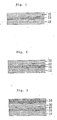
- the multi-layer chemical analyzing element of Fig. 1 is composed of a color reaction layer (20) and a substrate layer (30) laminated on a light-transmissible and water-impermeable support (10) in order.
- the substrate layer (30) contains a non-diffusible substance derived by binding a substrate with a dye moiety with a temporarily shortened maximum absorption wavelength.
- the non-diffusible substance forms a diffusible compound capable of diffusing through a water-permeable medium in the presence of water by the action of the substance to be tested which is an enzyme, or by the action of an enzyme-carrying substance (enzyme-bound substance) to be formed or decreased in accordance with the amount of the substance to be tested.
- the diffusible compound contains a dye moiety with a temporarily shortened maximum absorption wavelength released from the non-diffusible substance.
- the color reaction layer (20) accepts the diffusible compound having a dye moiety with a temporarily shortened maximum absorption wavelength and contains a reagent which reacts with the dye moiety of the diffusible compound so as to change the shortened maximum absorption wavelength to a longer wavelength to render the diffusible compoun colored.
- the substrate layer and the color reaction layer each may be a non-porous layer comprising a hydrophilic binder.
- the hydrophilic binder for the two layers may be the same or different.
- a suitable hydrophilic binder can be selected for each layer.
- a separating layer (40) so as to prevent contact between the non-diffusible substance and the color restoration reagent may be provided between the substrate layer (30) and the color reaction layer (20), as shown in Fig. 2.
- Fig. 3 shows a sectional view of another preferred embodiment of the analyzing element of the present invention, which is composed of a color reaction layer (20), a separating layer (40), a substrate layer (30) and a spreading layer (50) laminated on a light-transmissible and water-impermeable support (10) in this order.
- the function of the analyzing element (processes for analysis with the element) of the present invention will be explained.
- the sample is spread nearly uniformly on the spreading layer and permeates into the substrate layer (30).
- a diffusible compound is released from the non-diffusible substance in the substrate layer (30) by the action of the substance to be tested (e.g., enzyme) as contained in the sample or of an enzyme-carrying substance to be formed or decomposed in accordance with the amount of the substance to be tested in the sample, and the thus formed diffusible compound then diffuses from the substrate layer (30) to the color reaction layer (20) through the separating layer (40).
- the substance to be tested e.g., enzyme
- the diffusible compound which is the reaction product has a non-diffusible substance-derived and temporarily absorption-shifted dye moiety bound thereto, this immediately reacts with the color restoration reagent, when the color reaction layer (20) is reached, so as to be converted to a longer wavelength color.
- the shifting width in the wavelength by the reaction preferably falls within the range of from 30 nm to 150 nm, and more preferably from 50 nm to 150 nm. The details of the technique of using a temporarily absorption-shifted dye and then rapidly color restoring by lengthening the wavelength is described hereunder.
- the aforesaid substance to be tested may be either an enzyme which directly reacts with the non-diffusible substance or an enzyme-carrying substance which is formed or decomposed as a result of a specific protein-bonding reaction with a substance to be tested (typically immunological antigen-antibody reactions), for example, an enzyme-labeled antigen or antibody which may indirectly react with the substrate by the enzyme reaction thereof.
- a protein so labeled that the action to the substrate is modified as a result of the competing protein-binding reaction between the substance to be tested (test substance) and the analogues of the test substance can also be used.
- the enzyme-carrying substance may be previously formed in an aqueous medium outside the analyzing element, or alternatively, this may be formed in a suitable layer in the multi-layer chemical analyzing element of the present invention.
- a reaction layer for forming an enzyme or an enzyme-carrying substance from the substance to be tested may additionally be provided in the analyzing element of the present invention.
- the layer may be integrated with the analyzing element or may be temporarily contacted with the element.
- the non-diffusible substance remains in the substrate layer (30), and only the diffusible compound resulting from the enzyme reaction diffuses into the color reaction layer (20) and color is formed therein. Since the change in the amount of the diffusible compound depends upon the enzyme activity with the non-diffusible substance, the compound is rendered colored as a result, in accordance with the enzyme activity so that the enzyme activity can be determined by measurement of the amount of the colored compound.
- the substance to be tested is not an enzyme but a substance which forms or decomposed an enzyme-carrying substance in accodance with the amount of the substance to be tested, the enzyme activity of the enzyme-carrying substance can be determined by the process of the present invention and the amount of the substance to be tested can thereby be determined.
- a method of optical measurement in trms of the transmittance or reflection in the absorption wavelength range of the colored substance is suitable, but in some cases the amount can be judged visually with the naked eye in accordance with the object and the accuracy required.
- the reaction is based upon a phenomenon of a so-called halochromism, that is, the absorption maximum value of wavelength of the dye of which the auxochrome is the dissociated state changes when the auxochrome converts into the non-dissociated state.
- the maximum absorption wavelength of the dye moiety to be used for the detection is preferably from 450 nm to 650 nm, more preferably from 500 nm to 650 nm.
- dyes used in the present invention include an azo dye, an oxonol dye, a xantene dye, and a azomethine dye.
- the auxochrome in the dye moiety to be used in the present invention must be able to dissociate, for example, under neutral aqueous conditions, after the color reaction. Accordingly, the auxochrome desirably has a pKa value of 6.0 or less. The limitation, however, does not apply to the case where the color reaction layer or the detecting layer contains a mordant.
- any group may be used which can be released by attack of a nucleophilic reagent.
- the group can be selected from those described, for example, in J.F.W. Macormy, Protective Group in Organic Chemistry (published by Plenum Press Co., 1973) and T.W. Green, Protective Group in Organic Synthesis (published by Willey Interscience Co., 1981).
- Examples for such group include an aliphatic or aromatic acyl group, an alkyl or aryl sulfonyl group and PO(OR)2- group (wherein R represents H, an alkyl group or an aryl group).
- any compound having a nucleophilic group can be used.
- primary amines, secondary amines, thiols, alkoxides and the like compounds as well as so-called " ⁇ effect-having" nucleophilic reagents having a higher nucleophilic force than that to be expected from a general pKa value, such as hydroxamic acids, oximes, hydrazines and hydroxylamines.
- ⁇ effect is described in detail in G. Cropmann, Chemical Activity and Reaction Paths (published by Willey Interscience Co., 1974), pages 203 to 221.
- the nucleophilic reagents can be used directly as such or can be used in the polymerized form.
- the reagent may be previously dissolved in a hydrophobic oily substance or locally incorporated into grains and then dispersed in a hydrophilic binder.
- a typical substrate which is used for preparation of the non-diffusible substance is a naturaly occurring polymeric polysaccharide.
- a conventional technique for "reactive dyes" which is well known in the dye industry can be employed.
- a chemical bond is formed between the fibers and the dye molecule to attain a better dyed state.
- the dyes suitable for such chemical bond formation are reactive dyes described in detail in K. Venkatarman, The Chemistry of Synthetic Dyes , Vol. VI (published by Academic Press Co., 1972).
- linking groups having the function of binding molecules of polysaccharides which are natural polymers, such as cellulose or starch, as well as protein fibers, such as wool or silk, to dye molecules are described in greater detail in the literature, and the synthesis of the non-diffusible substance for use in the present invention can be performed by reference to these techniques.
- the non-diffusible substance having protected dye moiety is required to become a substance having a lower molecular weight, by enzyme reaction, for example, so as to diffuse from the substrate layer to the color reaction layer through a hydrophilic medium
- the non-diffusible substance is desired to have a soluble group, for example, a sulfo group, a carboxyl group, a hydroxyl group or a quaternary ammonium group.
- the soluble group may be introduced either in a part of the linking group or in the protective group of the auxochrome.
- One dye moiety is introduced, for example, to a polysaccharide composed of glucose units, preferably per 5 to 500, more preferably 20 to 200 of glucose units.
- the amount of the non-diffusible substance in the analyzing element is preferably from 0.1 to 50 g/m2, more preferably, from 2 to 20 g/m2.
- a crystal of compound (2) (15 g, 8.39 mmol) was added to a solution comprising sodium hydroxide (5 g) and water (104 ml). After stirring for 1.5 hours at room temperature, a saturated sodium chloride solution (500 ml) was added thereto and then acetic acid (10 ml) was dropwise added thereto. A dark red crystal precipitated was taken out by filtration and dried in a desiccator to obtain compound (3) (10.95 g, 87%). m.p. > 250°
- Amylopectin (derived from potato, by Sigma Co.) (14 g) and p-nitrophenylisocyanate (2.45 g) were added to pyridine (240 ml) and stirred for 20 hours at 100°C. After cooling, acetone (1 liter) was added and the resulting mixture was filtered. The residue obtained was well washed with acetone ( 1 liter) and ethnol (1 liter) and then dried with a vacuum pump to obtain a nitroamylopectin (15 g). By elemental analysis (nitrogen content) it was found that the product contained one substituent per 40 glucose units.
- the animoamylopectin, (820 mg) was added to a mixed solvent comprising dimethylacetamide (DMAC) (16 ml) and water (1 ml) and well stirred.
- DMAC dimethylacetamide
- a DMAC solution (2 ml) of the compound (5) (320 mg) was added to the resulting solution whereby an yellow substance precipitated out.
- the precipitate was taken out by filtration and then well washed with methanolic chloroform (70 v/v%)). After being dried, a temporarily short-shifted amylopectin (corresponding to the above-mentioned compound (6)) (300 mg) was obtained.
- nucleophilic reagents to be used in the present invention for re-coloring the temporarily short-shifted dye moiety-containing diffusible compound to a substance with a long wavelength absorption are shown below.
- the substrate layer may be the uppermost layer of the element or may be between the uppermost layer and the color reaction layer.
- the substrate layer may be formed by coating.
- the substrate layer since the substrate itself is a polymer substance, the substrate layer may also be formed merely by coating a binder-free substrate-containing liquid composition.
- the non-diffusible substance is dissolved or dispersed in a liquid comprising one or more hydrophilic polymers and the resulting solution or dispersion is coated and dried.
- hydrophilic polymers for use in coating the substrate layer there may be mentioned, for example, gelatin and derivatives thereof (such as phthalated gelatin), cellulose derivatives (such as carboxymethyl cellulose, hydroxyethyl cellulose), agarose, sodium alginate, polyacrylamide, polymethacrylamide, copolymers of acrylamide or methacrylamide and various vinyl monomers, polyhydroxyethyl methacrylate, polyvinyl alcohol, polyvinyl pyrrolidone, sodium polyacrylate, copolymers of acrylic acid and various vinyl monomers, copolymers of maleic acid and various vinyl monomers, etc.
- Suitable polymers can be selected from among them, in consideration of the charactersitics of the sample liquid and the substance to be tested, the reaction system, the
- the substrate layer may additionally contain an enzyme activator, a co-enzyme, a surfactant, a pH adjusting reagent, a fine powder, an antioxidant as well as other various inorganic or organic additives, for the purpose of improving the coating property as well as the diffusiveness, reactivity, storage stability and other various properties of the diffusible compound to be formed in the layer.
- the substrate layer may be porous.
- the porous layer may be fibrous or non-fibrous.
- the layer may be made of anyone of a natural fiber cloth, a synthetic or semi-synthetic fiber cloth, a non-woven fabric, paper, a membrane filter of cellulose acetate, etc. as well as an inorganic or organic grain-bound substance.
- the fibrous layers described in JP-A-55-164356 U.S. Patent 4,292,272
- 60-222769, etc. as well as the porous layers described in JP-A-49-53888 (U.S.
- the porous layer may be a liquid-spreading layer (hereinafter often referred to as a "spreading layer") having a so-called metering function of spreading the liquid applied thereto to the area which is almost in proportion to the amount of the said liquid.
- a liquid-spreading layer (hereinafter often referred to as a "spreading layer") having a so-called metering function of spreading the liquid applied thereto to the area which is almost in proportion to the amount of the said liquid.
- the non-diffusible substance is previously applied to paper, cloth or a porous film made of polymers by dipping or coating and the resulting product is adhered to a water-permeable layer, for example, a color reaction layer formed on a support, using the method described in the above-mentioned JP-A-55-164356 (U.S. Patent 4,292,272).
- a porous layer containing the non-diffusible substance which has previously been applied by dipping or coating is adhered to a porous layer, such as a color reaction layers formed on a support, using the method described in the above-mentioned JP-A-61-4959.
- a conventional known method can be utilized for applying the substrate to the porous layer by dipping or coating.
- coating for example, dip coating, doctor coating, hopper coating, curtain coating or the like can properly be selected and used.
- the thickness of the substrate layer is not specifically limited.
- the thickness thereof is preferably from 1 ⁇ m to 50 ⁇ m or so, more preferably from 2 ⁇ m to 30 ⁇ m or so.
- the thickness may broadly vary in the range, generally, of from 30 ⁇ m to 800 ⁇ m or so.
- the color reaction layer in the analyzing element of the present invention there can be used a substantially uniform layer having a hydrophilic polymer as a binder as well as other porous layers described, for example, in JP-A-58-70163 (U.S. Patent 4,486,537), 61-4959, 62-116258, 62-138756, 62-138757, 62-138758, etc.
- hydrophilic polymer there can be used, for example, gelatin and derivatives thereof (such as phthalated gelatin), cellulose derivatives (such as hydroxyethyl cellulose), agarose, sodium alginate, acrylamide polymers, methacrylamide polymers, copolymers of acrylamide or meth acrylamide and various vinyl monomers, polyhydroxyethyl methacrylate, polyvinyl, alcohol, polyvinyl pyrrolidone, sodium polyacrylate, copolymers of maleic acid and various vinyl monomers, copolymers of acrylic acid and various vinyl monomers, etc.
- gelatin and derivatives thereof such as phthalated gelatin
- cellulose derivatives such as hydroxyethyl cellulose
- agarose sodium alginate
- acrylamide polymers methacrylamide polymers, copolymers of acrylamide or meth acrylamide and various vinyl monomers
- polyhydroxyethyl methacrylate polyvinyl
- alcohol polyvinyl pyrrolidone
- a known method can be utilized for applying a recoloring reagent to a porous layer by dipping or coating.
- coating for example, dip coating, doctor coating, hopper coating, curtain coating, etc. can be utilized.
- the thickness of the color reaction layer is preferably from 0.1 to 50 ⁇ m, more preferably from 0.2 to 20 ⁇ m, and the amount of the color restoration agent in the analyzing element is preferably from 0.1 to 30 g/m2, more preferably from 0.2 to 10 g/m2.
- the color reaction layer may further contain, in addition to the hydrophilic binder, a surfactant, a pH adjusting reagent, a fine powder, an antioxidant as well as other various organic or inorganic additives, for the purpose of improving the coating property and the diffusiveness, reactivity, storability and other various properties of the diffusible compound accepted by the layer.
- buffers which can be incorporated into the color reaction layer include carbonates, borates, phosphates as well as Good's buffers described in Biochemistry , Vol. 5, No. 2, pages 467 to 477 (1966), etc.
- the material used for preparation of the separating layer is hydrophilic, and can be selected from the materials which are recited hereinabove as hydrophilic polymers used in the substrate layer or the color reaction layer. Additives for improving the coating property and the mobility of the diffusible compound may also be added to this layer.
- the thickness of the separating layer is perferably from 1 to 30 ⁇ m, more preferably from 2 to 20 ⁇ m.
- an enzyme immunoassay is an effective means for measurement.
- the analyzing element of the present invention is useful for measuring the activity of an enzyme-labeled substance (or the amount thereof present) in an enzyme immunoassay, and thus the amount of the ligand present in a test sample can be measured by the use of the analyzing element of the present invention.
- the enzyme-labeled substance may be bound to the ligand or a derivative thereof, or may be bound to an antibody specific to the ligand.
- the ligand derivatives mean derivatives formed by introducing an optionally substituted amino, carboxyl or thio group into the ligand.
- 17- ⁇ -hydroxyprogestrone-4-carboxyethylthioether is a derivative of 17- ⁇ -hydroxyprogestrone.
- Examples of ligand derivatives are described in E. Ishikawa, Enzyme Immunoassy , 2nd Ed. (published by Igaku Shoin, Japan, 1982).
- enzymes can be selected for the labeling.
- the enzymes are selected in consideration of the possibility of obtaining a sufficiently high enzyme activity, the stability of the enzymes, the influence of the bond-formation (between enzyme and antibody or antigen) on the enzymatic activitiy, etc.
- enzyme can be selected from those described in Table 1 and Table 2 in JP-A-56-500901 (U.S. Patent 4,287,300).
- ⁇ -D-galactosidase alkaline phosphatase (ALP), ⁇ -amylase, ⁇ -amylase, glucoamylase, cellulase, dextranase, etc.
- one preferred embodiment is as follows:
- a sample which is expected to contain a ligand, a ligand or derivative thereof bound to an enzyme (labeled ligand) and an antibody specific to the ligand are previously reacted in an aqueous medium, and then a small portion of the resulting reaction solution is spotted to the analyzing element of the present invention.
- This process may further include a step of separating the labeled ligand bound or not bound to the antibody. The method for the separation is described, for example, in E. Ishikawa, et al., Enzyme Immunoassay (published by Igaku Shoin, 1982).
- a sample which is expected to contain a ligand is previously reacted with an antibody specific to the ligand or a derivative thereof bound to an enzyme (labeled antibody) in an aqueous medium, and thereafter a small lportion of the resulting reaction solution is spotted to the analyzing element of the present invention.
- the process may also include a step of separating the labeled antibody bound or not bound to the ligand.
- all or a part of the above-mentioned labeled ligand and antibody to the ligand or labeled antibody may be incorporated into an appropriate layer of the analyzing element of the present invention.
- an additional layer containing the same may be provided over the analyzing element of the present invention just before use thereof for analysis.
- the present invention can be applied to various known dry-type analyzing elements.
- the element may have a multi-layered constitution comprising a porous layer, a reagent layer (i.e., substrate layer and color reaction layer) and additionally a support, a spreading layer, a detecting layer, a light-shielding layer, an adhesive layer, a filter layer (for filtering obstructive substances such as blood corpuscles), a water-absorbing layer, a subbing layer and other various layers.
- a reagent layer i.e., substrate layer and color reaction layer
- the practical constitution of the dry-type analyzing element of the present invention includes the following embodiment:
- the color reaction layer may comprise plural layers.
- a water-absorbing layer may be provided between the color reaction layer or the detecting layer and the support.
- a light-reflective layer may be provided between the substrate layer and the spreading layer.
- a filter layer may be provided between the substrate layer and the spreading layer or the color reaction layer.
- a filter layer may also be provided between the light-reflective layer and the spreading layer.
- the detecting layer generally means a layer in which the dye or the like as formed in the presence of a component to be tested diffuses and is optically detected through the light-transmissible support, and this may be made of a hydrophilic polymer.
- This may contain a mordant agent, for example, a cationic polymer to an anionic dye.
- the water-absorbing layer substantially does not permit the dye formed in the presence of a component to be tested to diffuse therein, and this may be made of a swellable hydrophilic polymer.
- polyethylene terephthalate is preferred.
- a subbing layer is coated on the support or hydrophilicity is imparted to the support so that the said hydrophilic layer may strongly be adhered to the support.
- this layer is desirably has a fluid-metering function.
- the fluid-metering function of the spreading layer means that the liquid sample as spotwise applied to the surface of the layer may be spread over the surface thereof almost in a constant volume per unit area in the direction of the plane, without substantially localizing the components contained in the sample.
- the spreading layer or other porous layers there are filter paper, unwoven fabric, woven fabrics (e.g., plane weave fabric), knitted fabrics (e.g., tricot fabric , glass fibers, filter paper, etc. Preferred materials are woven fabrics and knitted fabrics. Woven fabrics may be processed by glow-discharge treatment, as described in JP-A-57-66359 (British Patent 2,087,074).
- the spreading layer may contain the hydrophilic polymer or surfactant described in JP-A-60-222770 (European Patent Application 162,301A), Japanese Patent Application Nos. 61-122875, 61-122876, so as to properly control the area to be spreaded, the spreading speed, etc.
- An adhesive layer for adhering and laminating a porous layer may be provided on the color reaction layer, light-reflective layer, filter layer, water-absorbing layer, etc.
- the adhesive layer desirably is made of a hydrophilic polymer which may be adhesive to a layer when swollen with water, for example, galatin, gelatin derivatives, polyacrylamide, starch, etc.
- the light-reflective layer has the function of shielding the color of the liquid sample as spotwise applied to the spreading layer, in particular, the red color of hemoglobin in a whole blood sample, in the reflection photometry of the detectable variation (color change, coloration, etc.) as yielded in the detecting layer or the reagent layer, from the side of the support, and further has the function of a background layer.
- the light-reflecting layer is preferred to be a water-permeable layer containing light-reflective fine grains of titanium oxide, barium sulfate or the like dispersed in a hydrophilic polymer used as a binder.
- the binder is preferably selected from gelatin, galatin derivatives and polyacrylamide.
- light-reflective grains such as titanium oxide or the like can be incorporated into at least one of the spreading layer, substrate layer, color reaction layer, detecting layer, etc., in place of providing the light-reflective layer or in addition thereto.
- a liquid composition (A) comprising the components mentioned below was coated over a gelatin-subbed, colorless, transparent and smooth polyethylene terephthalate film (180 ⁇ m thick) to form a coat (coloring reagent layer) having a dry thickness of 12 ⁇ m and then dried.
- aqueous 5% gelatin solution was overcoated on the reagent layer in a dry thickness of 2 ⁇ m and dried to form a timing layer (separating layer).
- the reagent layer and the timing layer were wetted with about 30 g/m2 of water and then a tricot fabric made of polyethylene terephthalate spun yarns (36 gauge) was adhered thereto under pressure and dried to form a spreading layer.
- the thus prepared color reaction test film was cut into a size of 15 ⁇ 15 mm and this was fitted to a 24 ⁇ 28 mm plastic frame having a window with a diameter of 10 mm.
- a color reaction test element (1) was prepared.
- a comparative color reaction test element (2) was also prepared in the same manner as above except that the composition (A) not containing the Compound N-5 was used.
- a liquid composition (A) comprising the components mentioned below was coated over a gelatin-subbed, colorless, transparent and smooth polyethylene terephthalate film (180 ⁇ m thick) to form a coat (reagent layer) having a dry thickness of 12 ⁇ m and then dried.
- aqueous 5% gelatin solution was overcoated on the reagent layer in a dry thickness of 2 ⁇ m and then dried (timing layer).
- the reagent layer and the timing layer were wetted with about 30 g/m2 of water and then a tricot fabric made of polyethylene terephthalate spun yarns (36 gauge) was adhered thereto under pressure and dried to form a spreading layer.
- a liquid composition (B) having the components mentioned below was overcoated on the spreading layer in an amount of 120 ml/m2 and then dried.
- the thus prepared color reaction test film was cut into a size of 15 x 15 mm and this was fitted to a 24 x 28 mm plastic frame having a window with a diameter of 10 mm.
- a dry-type analyzing element (a) for amylase activity measurement was obtained.
- a comparative analyzing element (b) was also prepared in the same manner as above except that composition (A) not containing Compound N-5 was used.
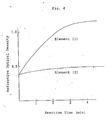
- amylase activity-analyzing element of the present invention yielded a distinct coloration (re-coloration) to the amylase activity of from 250 to 1000 units/ml.
- Table 1 Amylase Activity* Element (1) of the Invention Comparative Element (2) 0 0.42 0.42 250 0.53 0.41 500 0.65 0.43 1000 0.87 0.40 * International Unit/ml
Landscapes
- Health & Medical Sciences (AREA)
- Life Sciences & Earth Sciences (AREA)
- Chemical & Material Sciences (AREA)
- Engineering & Computer Science (AREA)
- Immunology (AREA)
- Hematology (AREA)
- Organic Chemistry (AREA)
- Molecular Biology (AREA)
- Biomedical Technology (AREA)
- Urology & Nephrology (AREA)
- General Health & Medical Sciences (AREA)
- Biotechnology (AREA)
- Microbiology (AREA)
- Physics & Mathematics (AREA)
- Analytical Chemistry (AREA)
- Biochemistry (AREA)
- Food Science & Technology (AREA)
- General Physics & Mathematics (AREA)
- Pathology (AREA)
- Medicinal Chemistry (AREA)
- Zoology (AREA)
- Wood Science & Technology (AREA)
- Cell Biology (AREA)
- Proteomics, Peptides & Aminoacids (AREA)
- Biophysics (AREA)
- Genetics & Genomics (AREA)
- General Engineering & Computer Science (AREA)
- Bioinformatics & Cheminformatics (AREA)
- Measuring Or Testing Involving Enzymes Or Micro-Organisms (AREA)
- Investigating Or Analysing Biological Materials (AREA)
- Investigating Or Analyzing Non-Biological Materials By The Use Of Chemical Means (AREA)
Applications Claiming Priority (2)
| Application Number | Priority Date | Filing Date | Title |
|---|---|---|---|
| JP24874887A JPH0191795A (ja) | 1987-10-01 | 1987-10-01 | 分析要素 |
| JP248748/87 | 1987-10-01 |
Publications (2)
| Publication Number | Publication Date |
|---|---|
| EP0313858A2 true EP0313858A2 (fr) | 1989-05-03 |
| EP0313858A3 EP0313858A3 (fr) | 1990-10-31 |
Family
ID=17182782
Family Applications (1)
| Application Number | Title | Priority Date | Filing Date |
|---|---|---|---|
| EP19880116201 Withdrawn EP0313858A3 (fr) | 1987-10-01 | 1988-09-30 | Elément analytique |
Country Status (2)
| Country | Link |
|---|---|
| EP (1) | EP0313858A3 (fr) |
| JP (1) | JPH0191795A (fr) |
Cited By (4)
| Publication number | Priority date | Publication date | Assignee | Title |
|---|---|---|---|---|
| EP0347839A3 (fr) * | 1988-06-24 | 1991-05-15 | Fujirebio Kabushiki Kaisha | Elément analytique de type sec pour essai immunologique |
| EP0443161A3 (en) * | 1990-02-19 | 1992-04-29 | Boehringer Mannheim Gmbh | Test carrier for analysis of a sample fluid |
| WO2000037934A1 (fr) * | 1998-12-22 | 2000-06-29 | Toxin Alert, Inc. | Procede et appareillage destines a la detection selective de materiaux biologiques |
| US6841392B2 (en) | 1998-12-22 | 2005-01-11 | Toxin Alert, Inc. | Method and apparatus for selective biological material detection |
Family Cites Families (4)
| Publication number | Priority date | Publication date | Assignee | Title |
|---|---|---|---|---|
| US4042335A (en) * | 1975-07-23 | 1977-08-16 | Eastman Kodak Company | Integral element for analysis of liquids |
| CA1095819A (fr) * | 1977-01-14 | 1981-02-17 | Eastman Kodak Company | Element pour l'analyse des liquides |
| US4231754A (en) * | 1979-05-23 | 1980-11-04 | Miles Laboratories, Inc. | Chemiluminescent analytical device |
| JPH0229986B2 (ja) * | 1980-08-22 | 1990-07-03 | Fuji Photo Film Co Ltd | Tasokagakubunsekizairyo |
-
1987
- 1987-10-01 JP JP24874887A patent/JPH0191795A/ja active Pending
-
1988
- 1988-09-30 EP EP19880116201 patent/EP0313858A3/fr not_active Withdrawn
Cited By (6)
| Publication number | Priority date | Publication date | Assignee | Title |
|---|---|---|---|---|
| EP0347839A3 (fr) * | 1988-06-24 | 1991-05-15 | Fujirebio Kabushiki Kaisha | Elément analytique de type sec pour essai immunologique |
| US5093081A (en) * | 1988-06-24 | 1992-03-03 | Fuji Photo Film Co., Ltd. | Dry-type analytical element for immunoassay |
| EP0443161A3 (en) * | 1990-02-19 | 1992-04-29 | Boehringer Mannheim Gmbh | Test carrier for analysis of a sample fluid |
| US5188966A (en) * | 1990-02-19 | 1993-02-23 | Boehringer Mannheim Gmbh | Test carrier with separation means for analyzing a sample fluid |
| WO2000037934A1 (fr) * | 1998-12-22 | 2000-06-29 | Toxin Alert, Inc. | Procede et appareillage destines a la detection selective de materiaux biologiques |
| US6841392B2 (en) | 1998-12-22 | 2005-01-11 | Toxin Alert, Inc. | Method and apparatus for selective biological material detection |
Also Published As
| Publication number | Publication date |
|---|---|
| JPH0191795A (ja) | 1989-04-11 |
| EP0313858A3 (fr) | 1990-10-31 |
Similar Documents
| Publication | Publication Date | Title |
|---|---|---|
| JP3214854B2 (ja) | カード上での微量分析 | |
| US4959305A (en) | Reversible immobilization of assay reagents in a multizone test device | |
| US4363874A (en) | Multilayer analytical element having an impermeable radiation nondiffusing reflecting layer | |
| US4442204A (en) | Homogeneous specific binding assay device and preformed complex method | |
| EP0069281B1 (fr) | Elément d'analyse à plusieurs couches; procédé pour sa préparation et son emploi dans des procédés analytiques | |
| EP0119623A2 (fr) | Elément d'analyse à plusieurs couches pour examen non-isotopique | |
| JPS6151264B2 (fr) | ||
| EP0236768B1 (fr) | Elément à couches multiples pour l'analyse quantitative de réactifs immunologiques | |
| EP0451848B1 (fr) | Elément d'essai immunologique et procédé pour essai immunologique | |
| US4990457A (en) | Whole blood dry analysis element | |
| EP0051213B1 (fr) | Dispositif d'essai des liaisons homogènes spécifiques, procédé pour sa préparation et méthode analytique faisant usage du dispositif | |
| JPH0665987B2 (ja) | 分析要素 | |
| JPH0721455B2 (ja) | 液体試料中の特定成分を分析するための用具および方法 | |
| GB2085159A (en) | Multilayer element for use in quantitative chemical analysis | |
| EP0304052B1 (fr) | Elément multicouche intégral pour déterminer l'albumine | |
| US5266460A (en) | Method of preparing immunological analytical element | |
| EP0791829A2 (fr) | Appareil d'épreuve pour essayer un composant dans un échantillon fluide | |
| US7820402B2 (en) | Immunoassay element | |
| CA1289872C (fr) | Immobilisation reversible de reactifs d'essai dans un dispositif multizones | |
| JPH07197A (ja) | 無機燐定量用試薬及び乾式分析要素 | |
| JPH0191795A (ja) | 分析要素 | |
| JP2576913B2 (ja) | 免疫分析要素および免疫分析方法 | |
| JPS62298A (ja) | 乾式多層分析要素 | |
| USH1664H (en) | Analytical element for immunoassay and method for its preparation | |
| JPS62297A (ja) | 多層分析要素 |
Legal Events
| Date | Code | Title | Description |
|---|---|---|---|
| PUAI | Public reference made under article 153(3) epc to a published international application that has entered the european phase |
Free format text: ORIGINAL CODE: 0009012 |
|
| AK | Designated contracting states |
Kind code of ref document: A2 Designated state(s): DE FR GB |
|
| PUAL | Search report despatched |
Free format text: ORIGINAL CODE: 0009013 |
|
| AK | Designated contracting states |
Kind code of ref document: A3 Designated state(s): DE FR GB |
|
| 17P | Request for examination filed |
Effective date: 19910425 |
|
| 17Q | First examination report despatched |
Effective date: 19921215 |
|
| STAA | Information on the status of an ep patent application or granted ep patent |
Free format text: STATUS: THE APPLICATION IS DEEMED TO BE WITHDRAWN |
|
| 18D | Application deemed to be withdrawn |
Effective date: 19940120 |