EP0322731A2 - Polymères à base de vinylcyclohexane et leur procédé de préparation - Google Patents
Polymères à base de vinylcyclohexane et leur procédé de préparation Download PDFInfo
- Publication number
- EP0322731A2 EP0322731A2 EP88121376A EP88121376A EP0322731A2 EP 0322731 A2 EP0322731 A2 EP 0322731A2 EP 88121376 A EP88121376 A EP 88121376A EP 88121376 A EP88121376 A EP 88121376A EP 0322731 A2 EP0322731 A2 EP 0322731A2
- Authority
- EP
- European Patent Office
- Prior art keywords
- vinylcyclohexane
- unit
- based polymer
- vinyl
- group
- Prior art date
- Legal status (The legal status is an assumption and is not a legal conclusion. Google has not performed a legal analysis and makes no representation as to the accuracy of the status listed.)
- Granted
Links
Images


Classifications
-
- C—CHEMISTRY; METALLURGY
- C08—ORGANIC MACROMOLECULAR COMPOUNDS; THEIR PREPARATION OR CHEMICAL WORKING-UP; COMPOSITIONS BASED THEREON
- C08F—MACROMOLECULAR COMPOUNDS OBTAINED BY REACTIONS ONLY INVOLVING CARBON-TO-CARBON UNSATURATED BONDS
- C08F8/00—Chemical modification by after-treatment
- C08F8/04—Reduction, e.g. hydrogenation
-
- Y—GENERAL TAGGING OF NEW TECHNOLOGICAL DEVELOPMENTS; GENERAL TAGGING OF CROSS-SECTIONAL TECHNOLOGIES SPANNING OVER SEVERAL SECTIONS OF THE IPC; TECHNICAL SUBJECTS COVERED BY FORMER USPC CROSS-REFERENCE ART COLLECTIONS [XRACs] AND DIGESTS
- Y10—TECHNICAL SUBJECTS COVERED BY FORMER USPC
- Y10S—TECHNICAL SUBJECTS COVERED BY FORMER USPC CROSS-REFERENCE ART COLLECTIONS [XRACs] AND DIGESTS
- Y10S526/00—Synthetic resins or natural rubbers -- part of the class 520 series
- Y10S526/943—Polymerization with metallocene catalysts
Definitions
- the present invention relates to vinylcyclohexane-based polymers and a process for production thereof. More particularly, it is concerned with novel crystalline vinylcyclohexane-based polymers having mainly syndiotactic configuration, and a process for efficiently producing the vinylcyclohexane-based polymers.
- Amorphous polymers having atactic configuration and crystalline polymers having isotactic configuration are known as vinylcyclohexane-based polymers.
- Vinylcyclohexane-based polymers with isotactic configuration have a high melting point and are excellent in heat resistance, which can be prepared by polymerizing vinylcyclohexane in the presence of a Ziegler-Natta catalyst (J. Polym. Sci., A2, 5029 (1964)).
- Vinylcyclohexane to be used as starting monomer is expensive and is not easily available, which is a big problem in industrial production of vinylcyclohexane-based polymers.
- An object of the present invention is to provide a novel vinylcyclohexane-based polymer.
- Another object of the present invention is to provide a crystalline vinylcyclohexane-based polymer having syndiotactic configuration.
- Still another object of the present invention is to provide a process for efficiently producing the above crystalline vinylcyclohexane-based polymer having syndiotactic configuration.
- the present invention relates to a vinylcyclohexane-based polymer having a repeating unit represented by the general formula(I): (wherein R is a hydrogen atom or an alkyl group having 1 to 6 carbon atoms, n is an integer of 1 to 5, and when n is not less than 2, Rs may be identical or different), and a degree of polymerization of at least 5, and further having mainly syndiotactic configuration.
- the present invention further provides a process for producing the above vinylcyclohexane-based polymer having mainly syndiotactic configuration which comprises hydrogenating a styrene-based polymer having a repeating unit represented by the general formula (II): (wherein R and n are the same as above) and a degree of polymerization of at least 5, and further having mainly syndiotactic configuration.
- a process for producing the above vinylcyclohexane-based polymer having mainly syndiotactic configuration which comprises hydrogenating a styrene-based polymer having a repeating unit represented by the general formula (II): (wherein R and n are the same as above) and a degree of polymerization of at least 5, and further having mainly syndiotactic configuration.
- the vinylcyclohexane-based polymer of the present invention has, as described above, a repeating unit represented by the general formula (I).
- R is a hydrogen atom or an alkyl group having 1 to 6 carbon atoms.
- repeating unit (I) are a vinylcyclohexane unit, a 1-vinyl-2-methylcyclohexane unit, a 1-vinyl-3-methylcyclohexane unit, a 1-vinyl-4-methylcyclohexane unit, a 1-vinyl-2,4-dimethylcyclohexane unit, a 1-vinyl-2,5-dimethylcyclohexane unit, a 1-vinyl-3,4-dimethylcyclohexane unit, a 1-vinyl-3,4,5-trimethylcyclohexane unit, a 1-vinyl-2-ethylcyclohexane unit, a 1-vinyl-3-ethylcyclohexane unit, a 1-vinyl-4-ethylcyclohexane unit, a 1-vinyl-4-tert-butylcyclohexane unit, and mixtures thereof.
- the vinylcyclohexane-based polymer of the present invention has a degree of polymerization of at least 5, preferably 10 to 40,000 and more preferably 15 to 8,000 (a number average molecular weight of at least 550, preferably 1,100 to 4,400,000 and more preferably 1,650 to 880,000), and a stereoregularity that is mainly syndiotactic; i.e., a stereostructure in which cyclohexane or substituted cyclohexane rings as side chains are located alternately in the opposite directions relative to the polymer chain comprising carbon-carbon bonds.
- the syndiotacticity is quantitatively measured by the nuclear magnetic resonance (NMR) method.
- the tacticity measured by the NMR method is indicated in the proportions of a plurality of continuous repeating units, for example, diad in which two repeating units are linked together, triad in which three repeating units are linked together, and pentad in which five repeating units are linked together.
- the vinylcyclohexane-based polymer of the present invention generally has such a syndiotactic configuration that the proportion of diad (racemidiad) is at least 75% and preferably at least 85%, or the proportion of pentad (racemipentad) is at least 30% and preferably at least 50%.
- the degree of syndiotacticity however, somewhat varies with the type of the substituent and so forth.
- the vinylcyclohexane-based polymer of the present invention is a novel polymer having a specific stereostructure that has not been discovered. This polymer can be efficiently produced by the process of the present invention.
- the process of the present invention uses, as the starting material, a styrene-based polymer having a repeating unit represented by the general formula (II), a degree of polymerization of at least 5, preferably 10 to 40,000 and more preferably 15 to 8,000 (a number average molecular weight of 520, preferably 1,040 to 4,160,000 and more preferably 1,560 to 832,000), and such a stereostructure that is mainly syndiotactic.
- a styrene-based polymer having a repeating unit represented by the general formula (II) a degree of polymerization of at least 5, preferably 10 to 40,000 and more preferably 15 to 8,000 (a number average molecular weight of 520, preferably 1,040 to 4,160,000 and more preferably 1,560 to 832,000), and such a stereostructure that is mainly syndiotactic.
- the syndiotacticity of the styrene-based polymer varies with the syndiotacticity of the vinylcyclohexane-based polymer to be produced, and preferably has such a syndiotactic configuration that is at least 75%, preferably at least 85% in terms of diad, or is at least 35%, preferably at least 50% in terms of pentad.
- the styrene-based polymer having syndiotactic configuration can be prepared by polymerizing the corresponding styrene-based monomer as a starting monomer in the presence of a catalyst containing (A) a titanium compound and (B) aluminoxane as main components.
- a catalyst containing (A) a titanium compound and (B) aluminoxane as main components can be used as the component (A).
- At least one compound selected from the group consisting of titanium compounds and titanium chelate compounds represented by the general formula (III) or (IV) is used: TiR1 a R2 b R3 c R4 4-(a+b+c) (III) TiR1 d R2 e R3 3-(d+e) (IV) wherein R1, R2, R3 and R4 are each a hydrogen atom, an alkyl group having 1 to 20 carbon atoms, an alkoxy group having 1 to 20 carbon atoms, an aryl group having 6 to 20 carbon atoms, an alkylaryl group, an arylalkyl group, an acyloxy group having 1 to 20 carbon atoms, a cyclopentadienyl group, substituted cyclopentadienyl group, an indenyl group, or a halogen atom, a, b and c are each an integer of 0 to 4, and d and e are each an integer of 0 to 3.
- R1, R2, R3 and R4 of the general formulae (III) and (IV) are each a hydrogen atom, an alkyl group having 1 to 20 carbon atoms (specifically, a methyl group, an ethyl group, a propyl group, a butyl group, an amyl group, an isoamyl group, an isobutyl group, an octyl group, and a 2-ethylhexyl group), an alkoxy group having 1 to 20 carbon atoms (specifically, a methoxy group, an ethoxy group, a propoxy group, a butoxy group, an amyloxy group, a hexyloxy group, a 2-ethylhexyloxy group, and the like), an aryl group having 6 to 20 carbon atoms, an alkylaryl group, an arylalkyl group (specifically, a phenyl group, a tolyl group, a xylyl group,
- a, b and c are each an integer of 0 to 4, and d and e are each an integer of 0 to 3.
- tetravalent titanium compound and titanium chelate compound represented by the general formula (III) are methyltitanium trichloride, titanium tetramethoxide, titanium tetraethoxide, titanium monoisopropoxy trichloride, titanium diisopropoxy dichloride, titanium triisopropoxy monochloride, tetra(2-ethylhexyloxy)titanium, cyclopentadienyltitanium trichloride, biscyclopentadienyltitanium dichloride, cyclopentadienyltitanium trimethoxide, cyclopentadienyl trimethyltitanium, pentamethylcyclopentadienyltitanium trimethoxide, pentamethylcyclopentadienyl trimethyltitanium, titanium tetrachloride, titanium tetrabromide, bis(2,4-pentanedionat
- a condensed titanium compound represented by the general formula (V): (wherein R5 and R6 are each a halogen atom, an alkoxy group having 1 to 20 carbon atoms, or an acyloxy group having 1 to 20 carbon atoms, and k is 2 to 20) may be used.
- the above titanium compound may be used in the form of complexes with esters, ethers and the like.
- Typical examples of the trivalent titanium compound represented by the general formula (IV) to be used as the component (A) are titanium trihalide such as titanium trichloride and cyclopentadienyl titanium compounds such as cyclopentadienyltitanium dichloride.
- titanium trihalide such as titanium trichloride
- cyclopentadienyl titanium compounds such as cyclopentadienyltitanium dichloride.
- compounds resulting from reduction of tetravalent titanium-compounds can be used.
- These trivalent titanium compounds may be used in the form of complexes with esters, ethers and the like.
- Aluminoxane is used as the component (B) in combination with the component (A). More specifically, alkylaluminoxane represented by the general formula (VI): (wherein R7 is an alkyl group having 1 to 8 carbon atoms, and p is 2 to 50) can be used.
- This aluminoxane can be prepared by various methods, e.g., (1) a method in which alkylaluminum is dissolved in an organic solvent and then contacted with water; (2) a method in which alkylaluminum is first added at the time of polymerization, and then water is added; and (3) a method in which alkylaluminum is reacted with water of crystallization as contained in metal salts and the like, or water absorbed on inorganic or organic compounds.
- the above water may contain ammonia, amine such as ethylamine, sulfur compounds such as hydrogen sulfide, phosphorous compounds such as phosphorous ester, and so on in the proportion of less than 20%.
- the catalyst to be used in production of the styrene-based polymer having syndiotactic configuration contains the above components (A) and (B) as main components. If necessary, the catalyst may further contain other catalyst components, e.g., trialkylaluminum represented by the general formula: A1R83 (wherein R8 is an alkyl group having 1 to 8 carbon atoms) and other organometallic compounds.
- A1R83 wherein R8 is an alkyl group having 1 to 8 carbon atoms
- the ratio of the component (A) to the component (B) in the catalyst varies with various conditions and cannot be determined unconditionally, the ratio of aluminum in the component (B) to titanium in the component (A), i.e., aluminum/titanium (by mol) is 1:1 to 1x10⁶:1 and preferably 10 :1 to 1x10⁴:1.
- the styrene-based polymer is prepared by polymerizing the styrene-based monomer in the presence of the catalyst containing the components (A) and (B) as main components.
- This polymerization may be bulk polymerization or may be carried out in a solvent, e.g., aliphatic hydrocarbon such as pentane, hexane and heptane, alicyclic hydrocarbon such as cyclohexane, or aromatic hydrocarbon such as benzene, toluene and xylene.
- the polymerization temperature is not critical, and it is usually 0 to 90°C and preferably 20 to 70°C.
- the molecular weight of the styrene-based polymer can be effectively controlled by polymerizing in the presence of hydrogen.
- the styrene-based polymer thus obtained is of high syndiotacticity.
- de-ashing treatment is applied using a washing solution containing hydrochloride acid, for example, after polymerization, rinsing is applied using a solvent such as methyl ethyl ketone after washing and drying under reduced pressure to remove a soluble content, and further the resulting insoluble portion is treated with chloroform, for example; there can be obtained a high purity styrene-based polymer having a high syndiotacticity.
- the styrene-based polymer having mainly syndiotactic configuration is hydrogenated to produce the desired vinylcyclohexane-based polymer.
- This hydrogenation results in hydrogenation of the benzene ring while maintaining the syndiotactic configuration of the styrene-based polymer and thus the vinylcyclohexane-based polymer can be obtained.
- Hydrogenation of the styrene-based polymer can be carried out under various conditions. Usually it is carried out in the presence of a hydrogenation catalyst, e.g., transition metal salts-alkylalumium catalysts (specifically, nickel (II)-2-ethylhexanate-triethylaluminum), ruthenium-carbon, palladium-carbon, nickel-diatomaceous earth, and nickel-alumina catalyst in a solvent, e.g., alicyclic hydrocarbon such as cyclohexane and dekalin, aliphatic hydrocarbon such as hexane, heptane, octane, and decane, or aromatic hydrocarbon such as benzene, toluene, and xylene under a hydrogen pressure of 50 to 200 kg/cm2 at a temperature of 100 to 300°C for 10 minutes to 10 hours.
- a hydrogenation catalyst e.g., transition metal salts-alkylalumium
- aromatic hydrocarbon such as xylene itself is hydrogenated although it acts as a solvent and, therefore, alicyclic hydrocarbon such as decalin is preferably used as the solvent in that it has a high solubility of the starting polymer and it is not hydrogenated.
- the syndiotactic vinylcyclohexane-based polymer having the repeating unit of the general formula (I) can be obtained.
- the vinylcyclohexane-based polymer of the present invention is a novel crystalline resin having syndiotactic configuration which is excellent in heat resistance and chemical resistance. Thus it is expected to be widely used as a material for moldings in applications where heat resistance and chemical resistance are required.
- the above vinylcyclohexane-based polymer having a desired molecular weight can be efficiently produced, and thus the process is of high industrial value.
- the copper sulfate was filtered off from the reaction mixture and the toluene was distilled away to obtain 12.4 g of methylaluminoxane.
- the molecular weight of the methylaluminoxane as determined by the benzene freezing point depression method was 721.
- the polystyrene was extracted with methyl ethyl ketone as an extraction solvent in a Soxhlet extraction apparatus for 4 hours, and the insoluble content of the polystyrene was 98% by weight.
- the melting point of the methyl ethyl ketone-insoluble polystyrene was 266°C.
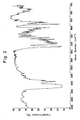
- a 13C-NMR analysis confirmed that the polystyrene was syndiotactic polystyrene (syndiotacticity in racemi pentad: 98%).
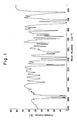
- the reaction product thus obtained was crystalline and had a melting point of 351°C which was much higher than that of the syndiotactic polystyrene as the starting material.
- Polystyrene was produced in the same manner as in Example 1 (2) except that 15 mmol as aluminum atom of methylaluminoxane and 15 mmol of triisobutylaluminum were used in place of 30 mmol as aluminum atom of methylaluminoxane, the amount of styrene was changed to 90 g, and the polymerization was carried out at 60°C for 2 hours.
- syndiotactic polystyrene (syndiotacticity in racemi pentad: 92%) having a weight average molecular weight of 9,380, a number average molecular weight of 4,680 and a melting point of 248°C was obtained in a yield of 14.7 g.
- Example 2 (1) Hydrogenation was carried out in the same manner as in Example 1 (3) except that as the syndiotactic polystyrene obtained in Example 2 (1) was used.
- syndiotactic polyvinylcyclohexane having a weight average molecular weight of 4,900, a number average molecular weight of 2,160 and a melting point of 303°C was obtained in a yield of 4.2 g.
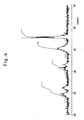
- atactic polystyrene (Idemitsu Styrol HF-10, produced by Idemitsu Petrochemical Co., Ltd.) was hydrogenated in the same manner as in Example 1 (3) to obtain atactic polyvinylcyclohexane.
- a 13C-NMR spectrum of the atactic polyvinylcyclohexane is shown in Fig. 4.
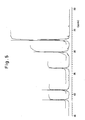
- Isotactic polystyrene produced by the use of a Ziegler-Natta catalyst (TiCl3-Al(C2H5)2Cl) was hydrogenated in the same manner as in Example 1 (3) to obtain isotactic polyvinylcyclohexane.
- a 13C-NMR spectrum of the isotactic polyvinylcyclohexane is shown in Fig. 5.
- Vinylcyclohexane was polymerized at 60°C for 2 hours by the use of a Ziegler-Natta catalyst (TiCl3-Al(i-Bu)3) to produce isotactic polyvinylcyclohexane.
- TiCl3-Al(i-Bu)3 a Ziegler-Natta catalyst
- Fig. 6 A 13C-NMR spectrum of the isotactic polyvinylcyclohexane is shown in Fig. 6.
- the peak of the main chain considered to reflect the conformation is sharp and is of high regularity as compared with that of the atactic polymer.
- the methine group is completely distinguishable in the isotactic polyvinylcyclohexane, while on the other hand in the polymer obtained in Example 1 (3), both the methine groups in the main chain and the side chain are in the nearly same magnetic field circumstance.
- the polymer of the Fig. 4 is atactic polyvinylcyclohexane.
- the polymers of Figs. 5 and 6 are isotactic polyvinylcyclohexanes (Figs. 5 and 6 are in agreement with each other).
- the polymer of Fig. 3 has a high melting point and is crystalline.
- the polymer of Fig. 3 i.e., the polymer obtained in Example 2 (2) is novel syndiotactic polyvinylcyclohexane.
Landscapes
- Chemical & Material Sciences (AREA)
- General Chemical & Material Sciences (AREA)
- Health & Medical Sciences (AREA)
- Chemical Kinetics & Catalysis (AREA)
- Medicinal Chemistry (AREA)
- Polymers & Plastics (AREA)
- Organic Chemistry (AREA)
- Addition Polymer Or Copolymer, Post-Treatments, Or Chemical Modifications (AREA)
- Transition And Organic Metals Composition Catalysts For Addition Polymerization (AREA)
Applications Claiming Priority (2)
| Application Number | Priority Date | Filing Date | Title |
|---|---|---|---|
| JP62335893A JP2597375B2 (ja) | 1987-12-29 | 1987-12-29 | ビニルシクロヘキサン系重合体およびその製造方法 |
| JP335893/87 | 1987-12-29 |
Publications (3)
| Publication Number | Publication Date |
|---|---|
| EP0322731A2 true EP0322731A2 (fr) | 1989-07-05 |
| EP0322731A3 EP0322731A3 (en) | 1990-10-10 |
| EP0322731B1 EP0322731B1 (fr) | 1993-04-14 |
Family
ID=18293549
Family Applications (1)
| Application Number | Title | Priority Date | Filing Date |
|---|---|---|---|
| EP88121376A Expired - Lifetime EP0322731B1 (fr) | 1987-12-29 | 1988-12-21 | Polymères à base de vinylcyclohexane et leur procédé de préparation |
Country Status (4)
| Country | Link |
|---|---|
| US (1) | US4997898A (fr) |
| EP (1) | EP0322731B1 (fr) |
| JP (1) | JP2597375B2 (fr) |
| DE (1) | DE3880291T2 (fr) |
Cited By (4)
| Publication number | Priority date | Publication date | Assignee | Title |
|---|---|---|---|---|
| US5814710A (en) * | 1994-03-14 | 1998-09-29 | Neste Oy | Process for selective hydrogenation of unsaturated polymers |
| WO1999032528A1 (fr) * | 1997-12-18 | 1999-07-01 | Bayer Aktiengesellschaft | Polymeres a base de vinylcyclohexane |
| WO2000049057A1 (fr) * | 1999-02-19 | 2000-08-24 | Bayer Aktiengesellschaft | Polymeres a base de vinylcyclohexane |
| EP1174443A4 (fr) * | 1999-04-14 | 2002-07-17 | Idemitsu Petrochemical Co | Polymere styrene et objet moule obtenu par moulage du polymere |
Families Citing this family (31)
| Publication number | Priority date | Publication date | Assignee | Title |
|---|---|---|---|---|
| DE19756369A1 (de) | 1997-12-18 | 1999-07-01 | Bayer Ag | Verfahren zur Hydrierung aromatischer Polymere |
| DE19833095A1 (de) | 1998-07-23 | 2000-01-27 | Bayer Ag | Verfahren zur Hydrierung aromatischer Polymere in Gegenwart von sauerstoffenthaltenden Kohlenwasserstoffen |
| DE19833094A1 (de) | 1998-07-23 | 2000-01-27 | Bayer Ag | Verfahren zur Hydrierung aromatischer Polymere in Gegenwart spezieller Katalysatoren |
| DE19855062A1 (de) | 1998-11-28 | 2000-05-31 | Bayer Ag | Blockcopolymere auf Vinylcyclohexanbasis |
| US6235863B1 (en) | 1998-12-03 | 2001-05-22 | Shell Oil Company | Production of saturated siloxane polymers from aromatic monomers |
| DE19904612A1 (de) | 1999-02-05 | 2000-08-10 | Bayer Ag | Verfahren zur Hydrierung aromatischer Polymere in Gegenwart spezieller Katalysatoren |
| US20030099837A1 (en) * | 1999-12-22 | 2003-05-29 | Dirk Mockel | Thermoplastic multi-layered film with a layer of vinylcyclohexane-based polymer |
| DE60108631T2 (de) * | 2000-03-23 | 2006-01-05 | Dow Global Technologies, Inc., Midland | Hydrierte monovinylaromatische Polymerzusammensetzungen |
| KR100366424B1 (ko) | 2000-08-14 | 2003-01-09 | 삼성종합화학주식회사 | 내충격특성이 우수한 신디오탁틱 폴리스티렌의 리액터얼로이 |
| US20050121360A1 (en) * | 2003-12-08 | 2005-06-09 | The Lubrizol Corporation | Traction fluids by coupling of cyclic hydrocarbon monomers with olefins |
| US7619803B2 (en) | 2005-05-31 | 2009-11-17 | Konica Minolta Holdings, Inc. | Electrochromic display element and full-color electrochromic display element |
| WO2007010653A1 (fr) | 2005-07-19 | 2007-01-25 | Konica Minolta Holding, Inc. | Sel fondu a temperature ambiante et dispositif d'affichage |
| EP1975692A4 (fr) | 2006-01-19 | 2009-01-14 | Konica Minolta Holdings Inc | Element d'affichage |
| ATE456820T1 (de) | 2006-06-02 | 2010-02-15 | Konica Minolta Holdings Inc | Anzeigeelement |
| WO2007145100A1 (fr) | 2006-06-15 | 2007-12-21 | Konica Minolta Holdings, Inc. | Élément d'affichage |
| JP5678405B2 (ja) | 2006-07-12 | 2015-03-04 | コニカミノルタ株式会社 | エレクトロクロミック表示素子 |
| JPWO2008023551A1 (ja) | 2006-08-22 | 2010-01-07 | コニカミノルタホールディングス株式会社 | 表示素子 |
| EP2058699A4 (fr) | 2006-09-08 | 2010-07-21 | Konica Minolta Holdings Inc | Élément d'affichage |
| US7880959B2 (en) | 2006-09-20 | 2011-02-01 | Konica Minolta Holdings, Inc. | Display element |
| EP2081082A4 (fr) | 2006-11-08 | 2010-12-08 | Konica Minolta Holdings Inc | Élément d'affichage |
| EP2096490A4 (fr) | 2006-12-21 | 2014-01-22 | Konica Minolta Holdings Inc | Élément d'affichage et procédé de commande de celui-ci |
| JPWO2008087790A1 (ja) | 2007-01-17 | 2010-05-06 | コニカミノルタホールディングス株式会社 | 表示素子及び表示素子の駆動方法 |
| WO2008102604A1 (fr) | 2007-02-21 | 2008-08-28 | Konica Minolta Holdings, Inc. | Procédé de commande d'élément optique |
| JP5347960B2 (ja) | 2007-05-25 | 2013-11-20 | コニカミノルタ株式会社 | 表示素子の製造方法 |
| WO2008149850A1 (fr) | 2007-06-08 | 2008-12-11 | Konica Minolta Holdings, Inc. | Processus de production d'un élément d'affichage électrochimique et élément d'affichage électrochimique |
| JP5801532B2 (ja) | 2009-11-30 | 2015-10-28 | 帝人株式会社 | 高絶縁性フィルム |
| CN102858877B (zh) | 2010-03-08 | 2015-04-29 | 宇部兴产株式会社 | 聚酰胺树脂组合物 |
| EP2712883B1 (fr) | 2011-04-26 | 2016-02-24 | Teijin Limited | Film très isolant |
| WO2016043124A1 (fr) | 2014-09-17 | 2016-03-24 | 日本ゼオン株式会社 | Plaque polarisante circulaire, plaque λ/4 à large bande et dispositif d'affichage à électroluminescence organique |
| WO2018106398A1 (fr) * | 2016-12-05 | 2018-06-14 | Exxonmobil Chemical Patents Inc. | Polymères poly(vinylbiphényle) et poly(vinylcyclohexylstyrène) et articles associés |
| JP7828423B1 (ja) * | 2024-12-05 | 2026-03-11 | 株式会社ダイセル | 離型フィルム |
Family Cites Families (9)
| Publication number | Priority date | Publication date | Assignee | Title |
|---|---|---|---|---|
| FR1312895A (fr) * | 1961-01-28 | 1962-12-21 | Basf Ag | Procédé pour la production de polymères du vinylcyclohexane |
| JPS5159989A (ja) * | 1974-11-21 | 1976-05-25 | Mitsui Petrochemical Ind | Ketsushoseihoribinirushikurohekisanno seizohoho |
| US4226965A (en) * | 1978-09-28 | 1980-10-07 | Grigoriev Vasily A | Method for preparing polymers and copolymers of higher α-olefines |
| JPS617308A (ja) * | 1984-06-20 | 1986-01-14 | Sumitomo Chem Co Ltd | 結晶性ポリブテン−1組成物 |
| CA1276748C (fr) * | 1985-07-29 | 1990-11-20 | Michitake Uoi | Polymere de styrene |
| JPS62104818A (ja) * | 1985-07-29 | 1987-05-15 | Idemitsu Kosan Co Ltd | スチレン系重合体 |
| JPH083008B2 (ja) * | 1987-11-17 | 1996-01-17 | 三井東圧化学株式会社 | ポリプロピレン樹脂組成物 |
| DE3912242A1 (de) * | 1989-04-14 | 1990-10-18 | Gurit Essex Ag | Vorrichtungen zum maschinellen aufbringen von flexiblen, einseitig klebbaren schichtkoerpern auf werkstuecke und verwendung derselben |
| JPH07100723A (ja) * | 1993-09-30 | 1995-04-18 | Toshiba Corp | 物品搬送装置 |
-
1987
- 1987-12-29 JP JP62335893A patent/JP2597375B2/ja not_active Expired - Fee Related
-
1988
- 1988-12-08 US US07/281,470 patent/US4997898A/en not_active Expired - Lifetime
- 1988-12-21 DE DE8888121376T patent/DE3880291T2/de not_active Expired - Fee Related
- 1988-12-21 EP EP88121376A patent/EP0322731B1/fr not_active Expired - Lifetime
Cited By (7)
| Publication number | Priority date | Publication date | Assignee | Title |
|---|---|---|---|---|
| US5814710A (en) * | 1994-03-14 | 1998-09-29 | Neste Oy | Process for selective hydrogenation of unsaturated polymers |
| WO1999032528A1 (fr) * | 1997-12-18 | 1999-07-01 | Bayer Aktiengesellschaft | Polymeres a base de vinylcyclohexane |
| DE19756368A1 (de) * | 1997-12-18 | 1999-07-01 | Bayer Ag | Vinylcyclohexan basierende Polymere |
| WO2000049057A1 (fr) * | 1999-02-19 | 2000-08-24 | Bayer Aktiengesellschaft | Polymeres a base de vinylcyclohexane |
| AU769875B2 (en) * | 1999-02-19 | 2004-02-05 | Bayer Aktiengesellschaft | Polymers based on vinylcyclohexane |
| RU2248375C2 (ru) * | 1999-02-19 | 2005-03-20 | Байер Акциенгезльшафт | Полимеры на основе винилциклогексана |
| EP1174443A4 (fr) * | 1999-04-14 | 2002-07-17 | Idemitsu Petrochemical Co | Polymere styrene et objet moule obtenu par moulage du polymere |
Also Published As
| Publication number | Publication date |
|---|---|
| DE3880291D1 (de) | 1993-05-19 |
| EP0322731B1 (fr) | 1993-04-14 |
| US4997898A (en) | 1991-03-05 |
| JP2597375B2 (ja) | 1997-04-02 |
| DE3880291T2 (de) | 1993-08-05 |
| EP0322731A3 (en) | 1990-10-10 |
| JPH01178505A (ja) | 1989-07-14 |
Similar Documents
| Publication | Publication Date | Title |
|---|---|---|
| EP0322731B1 (fr) | Polymères à base de vinylcyclohexane et leur procédé de préparation | |
| EP0224097B1 (fr) | Procédé de préparation de polymères de styrène | |
| US5023222A (en) | Catalyst for producing syndiotactic configuration styrene-based polymers | |
| EP0311099B1 (fr) | Copolymères de styrène et procédé de production de ce copolymère | |
| DE69224353T2 (de) | Verfahren zur herstellung von styrol-polymeren und katalysator dafür | |
| JPH0693009A (ja) | 芳香族ビニル化合物重合用触媒 | |
| US4990580A (en) | Process for production of styrene polymers | |
| US5420089A (en) | Catalyst for the production of styrene-based polymers | |
| US5502133A (en) | Syndiotactic styrene polymers | |
| JPH04296306A (ja) | スチレン系重合体の製造方法及びその触媒 | |
| EP0389981B1 (fr) | Procédé de préparation d'un polymère à base de styrène | |
| EP0299391A1 (fr) | Procédé de production de polymères à base de styrène | |
| US5321122A (en) | Process for purification of styrene polymer | |
| EP0333878B1 (fr) | Procede de production d'un polymere styrenique | |
| JP3178620B2 (ja) | スチレン系重合体の精製方法 | |
| USRE35289E (en) | Process for production of styrene polymers | |
| CA1305825B (fr) | Procede de production de styrene-polymere | |
| JPH02252705A (ja) | スチレン系重合体の製造方法及びその触媒 | |
| JPH0359011A (ja) | スチレン系重合体の精製法 | |
| JPH0822884B2 (ja) | スチレン系重合体の製造方法 | |
| JPH0813853B2 (ja) | スチレン系重合体の製造方法とその触媒 | |
| JPH0813851B2 (ja) | スチレン系重合体の製造方法とその触媒 |
Legal Events
| Date | Code | Title | Description |
|---|---|---|---|
| PUAI | Public reference made under article 153(3) epc to a published international application that has entered the european phase |
Free format text: ORIGINAL CODE: 0009012 |
|
| AK | Designated contracting states |
Kind code of ref document: A2 Designated state(s): BE CH DE FR GB IT LI NL SE |
|
| PUAL | Search report despatched |
Free format text: ORIGINAL CODE: 0009013 |
|
| AK | Designated contracting states |
Kind code of ref document: A3 Designated state(s): BE CH DE FR GB IT LI NL SE |
|
| 17P | Request for examination filed |
Effective date: 19901215 |
|
| 17Q | First examination report despatched |
Effective date: 19920609 |
|
| GRAA | (expected) grant |
Free format text: ORIGINAL CODE: 0009210 |
|
| AK | Designated contracting states |
Kind code of ref document: B1 Designated state(s): BE CH DE FR GB IT LI NL SE |
|
| REF | Corresponds to: |
Ref document number: 3880291 Country of ref document: DE Date of ref document: 19930519 |
|
| ET | Fr: translation filed | ||
| ITF | It: translation for a ep patent filed | ||
| PLBE | No opposition filed within time limit |
Free format text: ORIGINAL CODE: 0009261 |
|
| STAA | Information on the status of an ep patent application or granted ep patent |
Free format text: STATUS: NO OPPOSITION FILED WITHIN TIME LIMIT |
|
| 26N | No opposition filed | ||
| EAL | Se: european patent in force in sweden |
Ref document number: 88121376.3 |
|
| PGFP | Annual fee paid to national office [announced via postgrant information from national office to epo] |
Ref country code: SE Payment date: 19971218 Year of fee payment: 10 |
|
| PGFP | Annual fee paid to national office [announced via postgrant information from national office to epo] |
Ref country code: CH Payment date: 19980109 Year of fee payment: 10 |
|
| PGFP | Annual fee paid to national office [announced via postgrant information from national office to epo] |
Ref country code: BE Payment date: 19980217 Year of fee payment: 10 |
|
| PG25 | Lapsed in a contracting state [announced via postgrant information from national office to epo] |
Ref country code: SE Free format text: LAPSE BECAUSE OF NON-PAYMENT OF DUE FEES Effective date: 19981222 |
|
| PG25 | Lapsed in a contracting state [announced via postgrant information from national office to epo] |
Ref country code: LI Free format text: LAPSE BECAUSE OF NON-PAYMENT OF DUE FEES Effective date: 19981231 Ref country code: CH Free format text: LAPSE BECAUSE OF NON-PAYMENT OF DUE FEES Effective date: 19981231 Ref country code: BE Free format text: LAPSE BECAUSE OF NON-PAYMENT OF DUE FEES Effective date: 19981231 |
|
| BERE | Be: lapsed |
Owner name: IDEMITSU KOSAN CY LTD Effective date: 19981231 |
|
| REG | Reference to a national code |
Ref country code: CH Ref legal event code: PL |
|
| PGFP | Annual fee paid to national office [announced via postgrant information from national office to epo] |
Ref country code: FR Payment date: 20011212 Year of fee payment: 14 |
|
| REG | Reference to a national code |
Ref country code: GB Ref legal event code: IF02 |
|
| PG25 | Lapsed in a contracting state [announced via postgrant information from national office to epo] |
Ref country code: FR Free format text: LAPSE BECAUSE OF NON-PAYMENT OF DUE FEES Effective date: 20030901 |
|
| REG | Reference to a national code |
Ref country code: FR Ref legal event code: ST |
|
| PGFP | Annual fee paid to national office [announced via postgrant information from national office to epo] |
Ref country code: NL Payment date: 20031205 Year of fee payment: 16 |
|
| PGFP | Annual fee paid to national office [announced via postgrant information from national office to epo] |
Ref country code: GB Payment date: 20031217 Year of fee payment: 16 |
|
| PGFP | Annual fee paid to national office [announced via postgrant information from national office to epo] |
Ref country code: DE Payment date: 20040102 Year of fee payment: 16 |
|
| PG25 | Lapsed in a contracting state [announced via postgrant information from national office to epo] |
Ref country code: GB Free format text: LAPSE BECAUSE OF NON-PAYMENT OF DUE FEES Effective date: 20041221 |
|
| PG25 | Lapsed in a contracting state [announced via postgrant information from national office to epo] |
Ref country code: NL Free format text: LAPSE BECAUSE OF NON-PAYMENT OF DUE FEES Effective date: 20050701 Ref country code: DE Free format text: LAPSE BECAUSE OF NON-PAYMENT OF DUE FEES Effective date: 20050701 |
|
| GBPC | Gb: european patent ceased through non-payment of renewal fee |
Effective date: 20041221 |
|
| NLV4 | Nl: lapsed or anulled due to non-payment of the annual fee |
Effective date: 20050701 |
|
| PG25 | Lapsed in a contracting state [announced via postgrant information from national office to epo] |
Ref country code: IT Free format text: LAPSE BECAUSE OF NON-PAYMENT OF DUE FEES Effective date: 20051221 |