EP0330355B1 - Cathode pour tube électronique - Google Patents
Cathode pour tube électronique Download PDFInfo
- Publication number
- EP0330355B1 EP0330355B1 EP89301345A EP89301345A EP0330355B1 EP 0330355 B1 EP0330355 B1 EP 0330355B1 EP 89301345 A EP89301345 A EP 89301345A EP 89301345 A EP89301345 A EP 89301345A EP 0330355 B1 EP0330355 B1 EP 0330355B1
- Authority
- EP
- European Patent Office
- Prior art keywords
- electron
- layer
- cathode
- emissive
- oxide
- Prior art date
- Legal status (The legal status is an assumption and is not a legal conclusion. Google has not performed a legal analysis and makes no representation as to the accuracy of the status listed.)
- Expired - Lifetime
Links
Images


Classifications
-
- H—ELECTRICITY
- H01—ELECTRIC ELEMENTS
- H01J—ELECTRIC DISCHARGE TUBES OR DISCHARGE LAMPS
- H01J29/00—Details of cathode-ray tubes or of electron-beam tubes of the types covered by group H01J31/00
- H01J29/02—Electrodes; Screens; Mounting, supporting, spacing or insulating thereof
- H01J29/04—Cathodes
-
- H—ELECTRICITY
- H01—ELECTRIC ELEMENTS
- H01J—ELECTRIC DISCHARGE TUBES OR DISCHARGE LAMPS
- H01J1/00—Details of electrodes, of magnetic control means, of screens, or of the mounting or spacing thereof, common to two or more basic types of discharge tubes or lamps
- H01J1/02—Main electrodes
- H01J1/13—Solid thermionic cathodes
- H01J1/14—Solid thermionic cathodes characterised by the material
- H01J1/142—Solid thermionic cathodes characterised by the material with alkaline-earth metal oxides, or such oxides used in conjunction with reducing agents, as an emissive material
-
- H—ELECTRICITY
- H01—ELECTRIC ELEMENTS
- H01J—ELECTRIC DISCHARGE TUBES OR DISCHARGE LAMPS
- H01J1/00—Details of electrodes, of magnetic control means, of screens, or of the mounting or spacing thereof, common to two or more basic types of discharge tubes or lamps
- H01J1/02—Main electrodes
- H01J1/13—Solid thermionic cathodes
- H01J1/14—Solid thermionic cathodes characterised by the material
Definitions
- This invention relates to cathodes for electron tubes such as cathode-ray tubes of TV sets and particularly to an improvement in electron emission characteristics of an oxide-coated cathode.
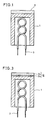
- Fig. 1 is a sectional view schematically showing a conventional oxide-coated cathode for use in a cathode-ray tube or an image pickup tube for a TV system.
- an electron-emissive substance layer 2 made of alkaline earth metal oxides containing at least Ba and further containing Sr and/or Ca is formed on a cylindrical base 1 made of Ni as a major element containing a small amount of a reducing element such as Si or Mg.
- a heater 3 is provided inside the base 1 and the electron-emissive layer 2 is heated by the heater 3 to emit thermal electrons. At this time, main donors for the emission of thermal electrons are free Ba reduced by Si, Mg or the like.
- Such a conventional cathode is manufactured by a process as described below.
- a suspension of carbonates of alkaline earth metals (Ba, Sr, Ca, etc.) is applied on the base 1 and heated in vacuum by the heater 3.
- the alkaline earth metal carbonates are converted to oxides.
- the alkaline earth metal oxides are partially reduced at a high temperature of 900 to 1100 o C so that they are activated to have a semiconductive property, whereby the electron-emissive layer 2 made of alkaline earth metal oxide is formed on the base 1.
- reducing elements such as Si and Mg contained in the base 1 diffuse to move toward the interface between the alkaline earth metal oxide layer 2 and the base 1, and then react with the alkaline earth metal oxides.
- the alkaline earth metal oxide is barium oxide (BaO)
- the reaction is expressed by the following formula (1) or (2).
- BaO + 1/2 Si Ba + 1/2 SiO2
- BaO + Mg Ba + MgO (2)
- the alkaline earth metal oxide layer 2 formed on the base 1 is partially reduced to become a semiconductor of an oxygen deficient type. Consequently, an emission current of 0.5 to 0.8 A/cm2 is obtained under the normal condition at an operation temperature of 700 to 800 o C.
- an interface layer of oxides or composite oxides such as SiO2, MgO, and BaO.SiO2 is formed in the interface region between the base 1 and the alkaline earth metal oxide layer 2 as is obvious from the formulas (1) and (2).
- the interface layer tends to be formed at nickel crystal grain boundaries near the interface region and at a position of about 10 ⁇ m from the interface into the electron-emissive layer 2.
- This interface layer is a layer of a high resistance which obstructs flow of current.
- the interface layer prevents the reducing element in the base 1 from diffusing into the electron-emissive layer 2, and thus, prevents formation of a sufficient amount of Ba for emitting thermal electrons.
- EP-A-0 210 805 discloses a cathode comprising a base 1 of Ni containing a rare earth metal of 0.1 to 0.5 wt.%.
- oxidation of the base 1 is prevented when alkaline earth metal carbonates are decomposed to form the electron-emissive layer 2 or when barium oxide is reduced during operation of the cathode.
- an interface layer of composite oxides is prevented from being formed in a concentrated manner near the interface between the base 1 and the electron-emissive layer 2, and the composite oxides is formed in a diffused manner in the electron-emissive layer 1. Accordingly, a moderate diffusion of the reducing element such as Si or Mg is maintained. As a result, there is less deterioration of the electron emission characteristics in operation of the cathode even at a high current density of about 1 to 2 A/cm2.
- EP-A-0 210 805 also discloses a cathode comprising an electron-emissive layer 2 containing a rare earth metal oxide of 0.1 to 20 wt.%. Also in this cathode, oxidation of the base 1 is prevented and formation of an interface layer is prevented. The electron emission characteristics of this cathode are little deteriorated in operation even at a high current density of 2A/cm2 as in the above mentioned cathode. However, a further improvement is still required. More specifically, if the cathode after the normal activation process is operated at a high current density of more than 2A/cm2, it happens that free Ba is considerably evaporated to deteriorate the electron emission characteristics.
- EP-A-0 210 805 discloses a cathode having an electron-emissive layer comprising, as a principal component, an alkaline earth metal oxide containing at least barium, and also comprising a rare earth metal oxide, such as scandium oxide, or a rare earth metal such as scandium.
- the cathode base contains nickel as a major element upon which the electron-emissive layer is formed.
- the present invention provides an oxide-coated cathode for an electron tube, having stable emission characteristics in operation at a current density higher than 2A/cm2.
- An oxide-coated cathode for an electron tube comprises: a base containing Ni as a major element; a reducing agent contained in the base; an electron-emissive substance layer formed on part of the external surface of the base, containing (a) an alkaline earth metal oxide as a principal component containing at least Ba, (b) Scandium oxide, and (c) at least one heat-resisting oxide selected from the group consisting of oxides of Al, Si, Ti, V, Cr, Fe, Zr, Nb, Hf, Ta, Mo, and W; and a heater for heating the electron-emissive layer.
- An oxide-coated cathode for an electron tube comprises: a base containing Ni as a major element; a reducing agent contained in the base; a first electron-emissive layer formed on a part of the external surface of the base containing (a) an alkaline earth metal oxide as a principal component containing at least Ba, and (b) scandium oxide; a second electron-emissive layer formed on the first electron-emissive layer, containing (c) an alkaline earth metal oxide as a principal component containing at least Ba and (d) at least one heat-resisting oxide selected from the group consisting of oxides of Al, Si, Ti, V, Cr, Fe, Zr, Nb, Hf, Ta, Mo and W; and a heater for heating the first and second electron-emissive layers.
- Fig. 1 is a schematic sectional view illustrating a structure of an oxide-coated cathode for an electron tube.
- Fig. 2 is a graph showing relation between the life test period and the emission current in cathodes according to an embodiment of the invention.
- Fig. 3 is a schematic sectional view illustrating a structure of a cathode according to another embodiment of the invention.
- Fig. 4 is a graph showing the relation between the life test period and the emission current in cathodes having the structure of Fig. 3.
- a cathode comprises a base 1 including Ni as a major element containing a small amount of a reducing element such as Si or Mg, and a heater 3 in the same manner as in the conventional cathodes.
- An electron-emissive layer 2 in the cathode of this embodiment contains not only triple alkaline earth metal oxides of Ba, Sr and Ca and a scandium oxide, but also at least one heat-resisting oxide selected from the group consisting of oxides of Al, Si, Ti, V, Cr, Fe, Zr, Nb, Hf, Ta, Mo and W.
- Those alkaline earth metal oxides are formed by decomposing carbonates as in the prior art and the oxides thus obtained are partially reduced and activated.
- Fig. 2 there are shown deterioration curves of electron emission characteristics of cathodes according to the embodiment.
- Those cathodes are incorporated in diode bulbs so as to be subjected to life tests at a high current density of 2.5 A/cm2 and changes in the emission current under the normal condition after the tests were examined.
- the curve A represents a deterioration of the electron emission characteristics in a cathode comprising an electron-emissive layer 2 of an alkaline earth metal oxide of Ba, Sr, and Ca containing scandium oxide (Sc2O3) of 4 wt.% and heat-resisting titanium oxide (TiO2) of 4 wt.%.
- Sc2O3 scandium oxide
- TiO2 heat-resisting titanium oxide
- the curve B represents a deterioration of the electron emission characteristics in a cathode containing heat-resisting chromium oxide (Cr2O3) of 4 wt.% in place of TiO2.
- the curve C represents a deterioration of the electron-emissive characteristics of a cathode containing Sc2O3 of 4 wt.% but not containing TiO2 nor Cr2O3
- the curve D represents a deterioration of the electron emission characteristics of a cathode not containing any of Sc2O3, TiO2 and Cr2O3.
- the cathodes containing the heat-resisting oxide Ti2O3 or Cr2O3 in addition to Sc2O3 exhibit less deterioration in the electron emission characteristics during operation at a high current density, compared with the cathodes of the prior art. It is believed that this improvement is obtained because added TiO2 or Cr2O3 prevents evaporation of free Ba as donor for thermionic emission.
- the addition amounts are preferably 0.1 to 20 wt.% for Sc2O3 and 0.5 to 10 wt.% for TiO2 and/or Cr2O3. More specifically, if the amount of Sc2O3 exceeds 20 wt.%, the initial emission current is lowered and if it is less than 0.1 wt.%, an interface layer can not be effectively prevented from being formed. If TiO2 or Cr2O3 exceeds 10 wt.%, the initial emission current is also lowered and if it is less than 0.5 wt.% conversely, evaporation of Ba can not be effectively prevented.
- Al2O3, SiO2, V2O5, Fe2O3, ZrO2, Nb2O5, HfO2, Ta2O5, MoO3 or WO3 for example may be used in place of TiO2 and/or Cr2O3.
- FIG. 3 there is shown a structure of a cathode according to another embodiment of the invention.
- the cathode of Fig. 3 is similar to that of Fig. 1, except that the electron-emissive layer 2 in Fig. 3 includes a first sub layer 2a and a second sub layer 2b.
- a first suspension is prepared by adding and mixing scandium oxide of 50 wt.% (wt.% after barium carbonate has been converted to an oxide) into a carbonate of Ba. This suspension is applied on the base 1 to a thickness of about 10 ⁇ m by using a spray.
- a second suspension is prepared by mixing TiO2 or Cr2O3 of 4 wt.% into carbonates of Ba, Sr and Ca. This second suspension is applied on the first suspension layer to a thickness of about 90 ⁇ m.
- the carbonates are decomposed in vacuum and an activation process is applied, whereby the cathode of Fig. 3 is completed.
- Fig. 4 shows the results of life test at a high current density of 2.5 A/cm2 for cathodes thus manufactured.
- the curve E represents a deterioration of the electron emission characteristics in the cathode including the first sub layer of BaO-50wt.%Sc2O3 and the second sub layer of (Ba ⁇ Sr ⁇ Ca)O-4wt.%TiO2.
- the curve F represents a deterioration of the electron emission characteristics in the cathode including the second sub layer of (Ba ⁇ Sr ⁇ Ca)O-4wt.%Cr2O3 in place of (Ba ⁇ Sr ⁇ Ca)O-4wt.%TiO2.
- the curves C and D in Fig. 4 are the same as in Fig. 2. As is clear from Fig. 4, it is understood that the cathodes as shown in Fig. 3 exhibit less deterioration in the electron emission characteristics during operation at a high current density compared with the conventional cathodes.
- the first sub layer may contain an alkaline earth metal oxide containing at least Ba, and Sc2O3 and accordingly it may further contain an oxide of Sr or Ca.
- the thickness of the first sub layer is preferably less than 50 ⁇ m and more preferably 10 to 20 ⁇ m. This is because if the first sub layer 2a has a large thickness, the distance for the reducing agents Si and/or Mg in the base 1 to migrate to the second sub layer becomes long.
- the first sub layer is sufficiently thin and a sufficient amount of free Ba is formed in the second sub layer, the initial emission current is not lowered even if Sc2O3 of more than 20 wt.% is contained in the first sub layer.
- the heat-resisting oxide in the second sub layer is contained preferably in the range from 0.05 to 10 wt.% in order to avoid lowering of the initial emission current.
- a small amount of metal powder of Ni, Co, Fe, Al, Ti, Zr, Hf, Nb, Ta, Mo, W, Mg, Re, Os, Ir, Pt, Pd, Rh, Au, V, Cr, Mn, Cu, Zn, Bi and the like may be added into the electron-emissive layers 2a and 2b and then conductivity of the electron-emissive layers can be improved.
Landscapes
- Solid Thermionic Cathode (AREA)
Claims (10)
- Une cathode revêtue d'oxydes pour un tube électronique, comprenant :
une base (1) contenant Ni à titre d'élément principal, cette base ayant une surface externe;
un agent réducteur contenu dans la base (1);
une couche (2) d'une substance émettrice d'électrons formée sur une partie de la surface externe et contenant(a) un oxyde de métal alcalino-terreux à titre de composant principal, contenant au moins Ba, et(b) un oxyde de scandium; etun élément chauffant (3) pour chauffer la couche (2) de la substance émettrice d'électrons,
caractérisée en ce que la couche émettrice d'électrons (2) comprend :
au moins un oxyde résistant à la chaleur sélectionné dans le groupe qui comprend les oxydes d'Al, Si, Ti, V, Cr, Fe, Zr, Nb, Hf, Ta, Mo et W. - La cathode de la revendication 1, dans laquelle
l'oxyde de scandium consiste en Sc₂O₃ dans la plage de 0,1 à 20% en masse. - La cathode de la revendication 1, dans laquelle
l'oxyde résistant à la chaleur est présent dans la plage de 0,05 à 10% en masse. - La cathode de la revendication 1, dans laquelle
la couche de la substance émettrice d'électrons contient une faible quantité de poudre de métal pour améliorer la conductivité. - Une cathode revêtue d'oxydes pour un tube électronique, comprenant :
une base (1) contenant Ni à titre d'élément principal, cette base ayant une surface externe;
un agent réducteur contenu dans la base (1);
une couche (2a, 2b) d'une substance émettrice d'électrons formée sur une partie de la surface externe; et
un élément chauffant (3) pour chauffer la couche (2a, 2b) de la substance émettrice d'électrons;
la couche émettrice d'électrons comprenant :
une première sous-couche émettrice d'électrons (2a) formée sur une partie de la surface externe et contenant(a) un oxyde de métal alcalino-terreux contenant au moins B; et(b) un oxyde de scandium;
une seconde sous-couche émettrice d'électrons (2b) formée sur la première sous-couche émettrice d'électrons (2a) et contenant(c) un oxyde de métal alcalino-terreux à titre de composant principal, contenant au moins Ba;
caractérisée en ce que la seconde sous-couche émettrice d'électrons (2b) comprend :(d) au moins un oxyde résistant à la chaleur sélectionné dans le groupe qui comprend les oxydes d'Al, Si, Ti, V, Cr, Fe, Zr, Nb, Hf, Ta, Mo et W. - La cathode de la revendication 5, dans laquelle
la première couche émettrice d'électrons a une épaisseur inférieure à 50 µm. - La cathode de la revendication 6, dans laquelle
la première couche émettrice d'électrons a une épaisseur dans la plage de 10 à 20 µm. - La cathode de la revendication 5, dans laquelle
l'oxyde résistant à la chaleur est présent dans la seconde couche émettrice d'électrons dans la plage de 0,05 à 10% en masse. - La cathode de la revendication 5, dans laquelle
l'une au moins des couches parmi la première couche émettrice d'électrons et la seconde couche émettrice d'électrons contient une faible quantité de poudre de métal pour améliorer la conductivité. - Un tube électronique comprenant une cathode revêtue d'oxydes, cette cathode étant conforme à l'une quelconque des revendications précédentes.
Applications Claiming Priority (8)
| Application Number | Priority Date | Filing Date | Title |
|---|---|---|---|
| JP4031888A JPH0787070B2 (ja) | 1988-02-23 | 1988-02-23 | 電子管用陰極 |
| JP40318/88 | 1988-02-23 | ||
| JP49083/88 | 1988-03-01 | ||
| JP4908388A JPH06105585B2 (ja) | 1988-03-01 | 1988-03-01 | 電子管用陰極 |
| JP62121/88 | 1988-03-15 | ||
| JP6212188A JPH0787071B2 (ja) | 1988-03-15 | 1988-03-15 | 電子管用陰極 |
| JP9787388A JPH0787072B2 (ja) | 1988-04-19 | 1988-04-19 | 電子管用陰極 |
| JP97873/88 | 1988-04-19 |
Publications (3)
| Publication Number | Publication Date |
|---|---|
| EP0330355A2 EP0330355A2 (fr) | 1989-08-30 |
| EP0330355A3 EP0330355A3 (en) | 1990-08-22 |
| EP0330355B1 true EP0330355B1 (fr) | 1994-08-03 |
Family
ID=27460888
Family Applications (1)
| Application Number | Title | Priority Date | Filing Date |
|---|---|---|---|
| EP89301345A Expired - Lifetime EP0330355B1 (fr) | 1988-02-23 | 1989-02-13 | Cathode pour tube électronique |
Country Status (5)
| Country | Link |
|---|---|
| US (1) | US4924137A (fr) |
| EP (1) | EP0330355B1 (fr) |
| KR (1) | KR910009660B1 (fr) |
| CA (1) | CA1327145C (fr) |
| DE (1) | DE68917174T2 (fr) |
Families Citing this family (29)
| Publication number | Priority date | Publication date | Assignee | Title |
|---|---|---|---|---|
| NL8803047A (nl) * | 1988-12-13 | 1990-07-02 | Philips Nv | Oxydekathode. |
| US4986788A (en) * | 1989-11-02 | 1991-01-22 | Samsung Electron Devices Co., Ltd. | Process of forming an impregnated cathode |
| KR940011717B1 (ko) * | 1990-10-05 | 1994-12-23 | 가부시기가이샤 히다찌세이사구쇼 | 전자관음극 |
| US5298830A (en) * | 1992-04-03 | 1994-03-29 | The United States Of America As Represented By The Secretary Of The Army | Method of preparing an impregnated cathode with an enhanced thermionic emission from a porous billet and cathode so prepared |
| US5828164A (en) * | 1992-04-03 | 1998-10-27 | The United States Of America As Represented By The Secretary Of The Army | Thermionic cathode using oxygen deficient and fully oxidized material for high electron density emissions |
| KR100291903B1 (ko) * | 1993-08-23 | 2001-09-17 | 김순택 | 전자관용산화물음극 |
| US5841219A (en) * | 1993-09-22 | 1998-11-24 | University Of Utah Research Foundation | Microminiature thermionic vacuum tube |
| KR100200661B1 (ko) * | 1994-10-12 | 1999-06-15 | 손욱 | 전자관용 음극 |
| KR960025915A (ko) * | 1994-12-28 | 1996-07-20 | 윤종용 | 열전자 방출성 산화물 음극 및 그 제조방법 |
| US5545945A (en) * | 1995-03-29 | 1996-08-13 | The United States Of America As Represented By The Secretary Of The Army | Thermionic cathode |
| JPH09147735A (ja) * | 1995-09-21 | 1997-06-06 | Matsushita Electron Corp | 陰極線管用エミッタ材料及びその製造方法 |
| TW375753B (en) * | 1995-12-27 | 1999-12-01 | Mitsubishi Electric Corp | Electron tube cathode |
| WO1997032330A1 (fr) * | 1996-02-29 | 1997-09-04 | Matsushita Electronics Corporation | Cathode de tube electronique |
| US5955828A (en) * | 1996-10-16 | 1999-09-21 | University Of Utah Research Foundation | Thermionic optical emission device |
| KR100259420B1 (ko) * | 1996-10-25 | 2000-06-15 | 구자홍 | 음극선관용 음극의 전자방사물질 조성물 |
| US5925976A (en) * | 1996-11-12 | 1999-07-20 | Matsushita Electronics Corporation | Cathode for electron tube having specific emissive material |
| JP2876591B2 (ja) * | 1996-11-29 | 1999-03-31 | 三菱電機株式会社 | 電子管用陰極 |
| KR19990043956A (ko) * | 1997-11-30 | 1999-06-25 | 김영남 | 브라운관용 전극재료 |
| KR100249714B1 (ko) * | 1997-12-30 | 2000-03-15 | 손욱 | 전자총용 음극 |
| US6118215A (en) * | 1998-08-07 | 2000-09-12 | Omnion Technologies, Inc. | Flat internal electrode for luminous gas discharge display and method of manufacture |
| JP2000357464A (ja) * | 1999-06-14 | 2000-12-26 | Hitachi Ltd | 陰極線管 |
| US6362563B1 (en) * | 1999-10-05 | 2002-03-26 | Chunghwa Picture Tubes, Ltd. | Two-layer cathode for electron gun |
| FR2808377A1 (fr) * | 2000-04-26 | 2001-11-02 | Thomson Tubes & Displays | Cathode a oxydes pour tube a rayons cathodiques |
| JP2001345041A (ja) * | 2000-06-01 | 2001-12-14 | Mitsubishi Electric Corp | 電子管用陰極 |
| FR2810446A1 (fr) * | 2000-06-14 | 2001-12-21 | Thomson Tubes & Displays | Cathodes a oxyde amelioree et son procede de fabrication |
| ATE370515T1 (de) * | 2000-09-19 | 2007-09-15 | Koninkl Philips Electronics Nv | Oxidkathode |
| DE10121442B4 (de) * | 2000-09-19 | 2010-04-08 | Philips Intellectual Property & Standards Gmbh | Kathodenstrahlröhre mit Oxidkathode |
| US6995502B2 (en) | 2002-02-04 | 2006-02-07 | Innosys, Inc. | Solid state vacuum devices and method for making the same |
| US7005783B2 (en) | 2002-02-04 | 2006-02-28 | Innosys, Inc. | Solid state vacuum devices and method for making the same |
Family Cites Families (7)
| Publication number | Priority date | Publication date | Assignee | Title |
|---|---|---|---|---|
| DE1120605B (de) * | 1960-09-21 | 1961-12-28 | Siemens Ag | Oxydkathode |
| US3719856A (en) * | 1971-05-19 | 1973-03-06 | O Koppius | Impregnants for dispenser cathodes |
| US3760218A (en) * | 1972-04-10 | 1973-09-18 | Spectramat Inc | Thermionic cathode |
| NL7905542A (nl) * | 1979-07-17 | 1981-01-20 | Philips Nv | Naleveringskathode. |
| JPS60160851A (ja) * | 1984-01-31 | 1985-08-22 | Akio Sato | 真空調理方法及び真空調理用器具 |
| JPS60229303A (ja) * | 1984-04-27 | 1985-11-14 | セイコーエプソン株式会社 | 非線型抵抗素子 |
| CA1270890A (fr) * | 1985-07-19 | 1990-06-26 | Keiji Watanabe | Cathode de tube electronique |
-
1988
- 1988-12-19 KR KR1019880016941A patent/KR910009660B1/ko not_active Expired
-
1989
- 1989-02-08 US US07/307,709 patent/US4924137A/en not_active Expired - Lifetime
- 1989-02-13 EP EP89301345A patent/EP0330355B1/fr not_active Expired - Lifetime
- 1989-02-13 DE DE68917174T patent/DE68917174T2/de not_active Expired - Fee Related
- 1989-02-21 CA CA000591597A patent/CA1327145C/fr not_active Expired - Fee Related
Also Published As
| Publication number | Publication date |
|---|---|
| EP0330355A3 (en) | 1990-08-22 |
| DE68917174D1 (de) | 1994-09-08 |
| KR910009660B1 (ko) | 1991-11-25 |
| CA1327145C (fr) | 1994-02-22 |
| DE68917174T2 (de) | 1995-01-05 |
| US4924137A (en) | 1990-05-08 |
| KR890013695A (ko) | 1989-09-25 |
| EP0330355A2 (fr) | 1989-08-30 |
Similar Documents
| Publication | Publication Date | Title |
|---|---|---|
| EP0330355B1 (fr) | Cathode pour tube électronique | |
| EP0210805B1 (fr) | Cathode pour tube électronique | |
| JPS6148207B2 (fr) | ||
| JPS645417B2 (fr) | ||
| US4274030A (en) | Thermionic cathode | |
| US5548184A (en) | Oxide cathode employing Ba evaporation restraining layer | |
| US4291252A (en) | Electron tube cathode | |
| US5747921A (en) | Impregnation type cathode for a cathodic ray tube | |
| DE69313845T2 (de) | Oxydkathode für Elektronenröhre | |
| JPH02288043A (ja) | 電子管用陰極 | |
| KR900003175B1 (ko) | 전자관용음극 | |
| JPS6288239A (ja) | 電子管用陰極 | |
| JPH01213932A (ja) | 電子管用陰極 | |
| JPS63314741A (ja) | 電子管用陰極 | |
| JPH02288042A (ja) | 電子管用陰極 | |
| JPH0787072B2 (ja) | 電子管用陰極 | |
| JPH0787071B2 (ja) | 電子管用陰極 | |
| JPH0743995B2 (ja) | 電子管用陰極 | |
| JPS6290819A (ja) | 電子管用陰極 | |
| JPH0546652B2 (fr) | ||
| JPH0129008B2 (fr) | ||
| JPH01213933A (ja) | 電子管用陰極 | |
| JPH02297831A (ja) | 電子管用陰極 | |
| JPS6216490B2 (fr) | ||
| JPH0765695A (ja) | 酸化物陰極 |
Legal Events
| Date | Code | Title | Description |
|---|---|---|---|
| PUAI | Public reference made under article 153(3) epc to a published international application that has entered the european phase |
Free format text: ORIGINAL CODE: 0009012 |
|
| AK | Designated contracting states |
Kind code of ref document: A2 Designated state(s): DE FR GB NL |
|
| PUAL | Search report despatched |
Free format text: ORIGINAL CODE: 0009013 |
|
| AK | Designated contracting states |
Kind code of ref document: A3 Designated state(s): DE FR GB NL |
|
| 17P | Request for examination filed |
Effective date: 19901008 |
|
| 17Q | First examination report despatched |
Effective date: 19930128 |
|
| GRAA | (expected) grant |
Free format text: ORIGINAL CODE: 0009210 |
|
| AK | Designated contracting states |
Kind code of ref document: B1 Designated state(s): DE FR GB NL |
|
| REF | Corresponds to: |
Ref document number: 68917174 Country of ref document: DE Date of ref document: 19940908 |
|
| ET | Fr: translation filed | ||
| PLBE | No opposition filed within time limit |
Free format text: ORIGINAL CODE: 0009261 |
|
| STAA | Information on the status of an ep patent application or granted ep patent |
Free format text: STATUS: NO OPPOSITION FILED WITHIN TIME LIMIT |
|
| 26N | No opposition filed | ||
| REG | Reference to a national code |
Ref country code: GB Ref legal event code: 746 Effective date: 19971202 |
|
| REG | Reference to a national code |
Ref country code: FR Ref legal event code: D6 |
|
| REG | Reference to a national code |
Ref country code: GB Ref legal event code: IF02 |
|
| PGFP | Annual fee paid to national office [announced via postgrant information from national office to epo] |
Ref country code: FR Payment date: 20060220 Year of fee payment: 18 |
|
| PGFP | Annual fee paid to national office [announced via postgrant information from national office to epo] |
Ref country code: GB Payment date: 20070104 Year of fee payment: 19 |
|
| PGFP | Annual fee paid to national office [announced via postgrant information from national office to epo] |
Ref country code: NL Payment date: 20070215 Year of fee payment: 19 |
|
| PGFP | Annual fee paid to national office [announced via postgrant information from national office to epo] |
Ref country code: DE Payment date: 20070220 Year of fee payment: 19 |
|
| REG | Reference to a national code |
Ref country code: FR Ref legal event code: ST Effective date: 20071030 |
|
| PG25 | Lapsed in a contracting state [announced via postgrant information from national office to epo] |
Ref country code: FR Free format text: LAPSE BECAUSE OF NON-PAYMENT OF DUE FEES Effective date: 20070228 |
|
| GBPC | Gb: european patent ceased through non-payment of renewal fee |
Effective date: 20080213 |
|
| NLV4 | Nl: lapsed or anulled due to non-payment of the annual fee |
Effective date: 20080901 |
|
| PG25 | Lapsed in a contracting state [announced via postgrant information from national office to epo] |
Ref country code: NL Free format text: LAPSE BECAUSE OF NON-PAYMENT OF DUE FEES Effective date: 20080901 |
|
| PG25 | Lapsed in a contracting state [announced via postgrant information from national office to epo] |
Ref country code: DE Free format text: LAPSE BECAUSE OF NON-PAYMENT OF DUE FEES Effective date: 20080902 |
|
| PG25 | Lapsed in a contracting state [announced via postgrant information from national office to epo] |
Ref country code: GB Free format text: LAPSE BECAUSE OF NON-PAYMENT OF DUE FEES Effective date: 20080213 |