EP0348767A2 - Agent pour modifier le comportement des plantes vis-à-vis du stress - Google Patents
Agent pour modifier le comportement des plantes vis-à-vis du stress Download PDFInfo
- Publication number
- EP0348767A2 EP0348767A2 EP89111040A EP89111040A EP0348767A2 EP 0348767 A2 EP0348767 A2 EP 0348767A2 EP 89111040 A EP89111040 A EP 89111040A EP 89111040 A EP89111040 A EP 89111040A EP 0348767 A2 EP0348767 A2 EP 0348767A2
- Authority
- EP
- European Patent Office
- Prior art keywords
- plants
- compounds
- iib
- weight
- parts
- Prior art date
- Legal status (The legal status is an assumption and is not a legal conclusion. Google has not performed a legal analysis and makes no representation as to the accuracy of the status listed.)
- Withdrawn
Links
Images
Classifications
-
- A—HUMAN NECESSITIES
- A01—AGRICULTURE; FORESTRY; ANIMAL HUSBANDRY; HUNTING; TRAPPING; FISHING
- A01N—PRESERVATION OF BODIES OF HUMANS OR ANIMALS OR PLANTS OR PARTS THEREOF; BIOCIDES, e.g. AS DISINFECTANTS, AS PESTICIDES OR AS HERBICIDES; PEST REPELLANTS OR ATTRACTANTS; PLANT GROWTH REGULATORS
- A01N49/00—Biocides, pest repellants or attractants, or plant growth regulators, containing compounds containing the group, wherein m+n>=1, both X together may also mean —Y— or a direct carbon-to-carbon bond, and the carbon atoms marked with an asterisk are not part of any ring system other than that which may be formed by the atoms X, the carbon atoms in square brackets being part of any acyclic or cyclic structure, or the group, wherein A means a carbon atom or Y, n>=0, and not more than one of these carbon atoms being a member of the same ring system, e.g. juvenile insect hormones or mimics thereof
Definitions
- the invention relates to agents for improving the behavior of plants towards abiotic stress, which contain a mixture of active ingredients with a synergistic effect, and to methods for improving the plant stress behavior.
- Abiotic stress factors such as lack of water, salinization and temperatures that are too low or too high limit the productivity of agricultural and horticultural plants to a considerable extent. But even with herbaceous ornamental plants and ornamental trees, unfavorable climatic conditions and also artificially caused stress conditions such as Transplant shock or large amounts of road salt in the root area lead to significant economic losses.
- the damage described above can be avoided or reduced by physical methods: In addition to eliminating the actual cause of the damage, such as water supply when there is a lack of water or heating when there is a risk of frost, film-forming substances, e.g. against water loss or light reflecting compounds, e.g. against excessive heating of the sprout parts.
- film-forming substances e.g. against water loss or light reflecting compounds, e.g. against excessive heating of the sprout parts.
- ABA abscisic acid
- Ecoscisic acid see Römpps Chemie-Lexikon, 8th edition, pp. 26 and 27, 1979
- Plants can adapt to a certain extent by changing their endogenous ABA content to the stress situation that has already occurred. Accordingly, an artificial addition of ABA can be used to adjust plants to anticipate stressful situations. In this way, excessive water consumption can be avoided, for example, and thus a predetermined amount of water can be used more efficiently.
- using the ABA in agricultural practice stands in the way of its very high price and insufficient duration of action.
- growth retardants is generally understood to mean compounds which reduce the length of the shoot without causing plant damage. With a few exceptions, the use of growth retardants against damage caused by abiotic stress has not been successful in agricultural practice. The main obstacle here is too high uncertainty in the success of treatment.
- the invention was based on the object of finding a more effective means of improving plant stress behavior.
- a synergistic mixture of at least one active ingredient from the group of abscisic acid and its analogs with at least one active ingredient from the group of growth retardants is particularly suitable for regulating the behavior of plants against abiotic stress.
- analogous compounds In addition to abscisic acid I from the first group analogous compounds, ie those compounds which are comparable in their action to abscisic acid, are also very suitable.
- Such analogous compounds are, for example, the acetylenic compounds listed in EP-B1-078 509, in particular those of structure (II) wherein R1 is hydrogen or the OR2 radical, the radical R2 is C1-C6-alkyl or in which R1 is the radical ORS and R5 together with R2 is an alkylene chain - (CH2) n -, which by one or two C1-C4 -Alkyl groups can be substituted, where n is 2, 3 or 4. From this, the compounds IIa and IIb are particularly preferred:
- the active substances contained in the agents according to the invention can be brought into the habitat of plants together or in succession. This can be done by seed dressing, application over the substrate (through the root) or through a shoot treatment.
- the application rate of the individual active ingredients is varied depending on the desired effect, type of application, plant species, stage of development of the plants to be treated and agents to be used.
- amounts of active compound of 0.001 to 50 g per kilogram of seed, preferably 0.01 to 10 g, are generally required.
- doses of 0.01 to 10 kg / ha, preferably 0.05 to 3 kg / ha are generally considered sufficient.
- the ratio of abscisic acid or analogues to growth retardants can vary within wide limits.
- a weight ratio of 0.1: 1 to 1000: 1 has proven itself.
- the compounds IIb: Va or VIIa to Xa can preferably be used in a ratio of 5: 1 to 1000: 1, in particular 5: 1 to 100: 1.
- a weight ratio of 100: 1 to 1: 100 has proven itself.
- the compounds IIa: Va or VIIa to Xa in a ratio of 50: 1 to 1:50, in particular 10: 1 to 1:10 can be used.
- weight ratios of 100: 1 to 1: 1000 have proven successful.
- the compounds IIb: IIIa can preferably be used in a ratio of 1: 1 to 1: 500, in particular 1: 1 to 1: 100.
- the piperidinium chloride IIIa is applied over the soil and the leaf treatment is carried out with IIb.
- the agents according to the invention can be used in the form of customary formulations, such as solutions, emulsions, suspensions, dusts, powders, pastes and granules.
- the application forms depend entirely on the purposes; in any case, they should ensure a fine and even distribution of the active substance.
- the formulations are prepared in a known manner, for example by stretching the active ingredient with solvents and / or carriers, if appropriate using emulsifiers and dispersants, and if water is used as the diluent, organic solvents other than Auxiliary solvents can be used.
- auxiliaries solvents such as aromatics (e.g. xylene, benzene), chlorinated aromatics (e.g.
- chlorobenzenes paraffins (e.g. petroleum fractions), alcohols (e.g. methanol, butanol), amines (e.g. ethanolamine), N, N- Dimethylformamide and water; solid carriers such as natural stone powder (eg kaolins, clays, talc, chalk) and synthetic stone powder (eg highly disperse silica, silicates); Emulsifiers or other surface-active agents, such as nonionic and anionic emulsifiers (for example polyoxyethylene fatty alcohol ethers, alkyl sulfonates) and dispersants such as lignin sulfite waste liquors and methyl cellulose.
- paraffins e.g. petroleum fractions
- alcohols e.g. methanol, butanol
- amines e.g. ethanolamine
- solid carriers such as natural stone powder (eg kaolins, clays, talc, chalk) and synthetic stone
- the compounds according to the invention are preferably used in aqueous solution, if appropriate with the addition of water-miscible organic solvents such as methanol or other lower alcohols, acetone, N, N-dimethylformamide or N-methylpyrrolidone.
- the formulations generally contain between 0.1 and 95% by weight of active ingredients, preferably between 0.5 and 90% by weight.
- formulations or the ready-to-use preparations produced therefrom such as solutions, emulsions, suspensions, powders, dusts, pastes or granules, are used in a known manner, for example in the pre-emergence process, in the post-emergence process or as a mordant.
- the agents according to the invention can also be present together with other active ingredients, such as e.g. Herbicides, insecticides, other bioregulators and fungicides, or also mixed with fertilizers and applied.
- active ingredients such as e.g. Herbicides, insecticides, other bioregulators and fungicides, or also mixed with fertilizers and applied.
- S.R. Colby (Weeds 15, 20) calculates the value E that can be expected if the individual active ingredients are only additive.
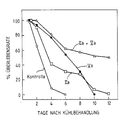
- Cucumber plants of the delicacy variety were pre-cultivated for 15 days at 30 ° C in the climatic chamber.
- the active ingredients IIa and Va were sprayed as 10
- the molar aqueous solutions to the dripping wet on the plants (100 per test variant).
- the cucumber plants were exposed to a temperature of + 2 ° C. for 10 hours in order to then continue to be cultivated as before.
- the survival rate of the plants was then determined two days apart by visual assessment. The results found are shown in FIG. 1.
- Maize plants of the variety formerly Goldblu were pre-cultivated in the climate chamber at 30 ° C for 10 days.
- the active ingredients IIa and Va were sprayed onto the plants as 10 ticaß molar aqueous solutions until dripping wet (approx. 100 each per test variant).
- the maize plants were exposed to a temperature of + 2 ° C. for 24 hours in order to then continue to be cultivated as before.
- the survival rate of the plants was determined after a further 15 days by visual assessment. The results found are shown in Table 2.
- Maize plants of the Dea variety were grown in 500 ml plastic containers with a peat culture substrate under greenhouse conditions. After 7 days, soil treatment with active ingredient IIIa (N, N-dimethylpiperidinium chloride, 36 mg / pot) was carried out. 12 days later, active ingredient IIb was sprayed onto the plants as an aqueous emulsion (0.17 mg / jar). After an exposure time of 2 days, the plants were exposed to a temperature of + 1.5 ° C for 6 days. The plants were then cultivated further in the greenhouse for 12 days. Plants damaged by the cold died during this period. Plants protected by the active substances continued to grow during this time, so that differences in fresh weight represent a suitable measure of cooling damage.
- active ingredient IIIa N, N-dimethylpiperidinium chloride, 36 mg / pot
- Table 3 shows that the combination of active ingredients IIb and IIIa leads to a synergistic reduction in cooling damage.
- Table 3 Effect of cooling stress on maize plants under the influence of active ingredients IIb and IIIa Active substance (s) applied amount [mg] Fresh weight increase compared to control [%] - - 0 IIb 0.17 114 IIIa 36 38 IIb + IIIa 0.17 + 36 177
Landscapes
- Life Sciences & Earth Sciences (AREA)
- Agronomy & Crop Science (AREA)
- Insects & Arthropods (AREA)
- Pest Control & Pesticides (AREA)
- Plant Pathology (AREA)
- Health & Medical Sciences (AREA)
- Engineering & Computer Science (AREA)
- Dentistry (AREA)
- General Health & Medical Sciences (AREA)
- Wood Science & Technology (AREA)
- Zoology (AREA)
- Environmental Sciences (AREA)
- Agricultural Chemicals And Associated Chemicals (AREA)
Applications Claiming Priority (2)
| Application Number | Priority Date | Filing Date | Title |
|---|---|---|---|
| DE19883821520 DE3821520A1 (de) | 1988-06-25 | 1988-06-25 | Mittel zur verbesserung des pflanzlichen stressverhaltens |
| DE3821520 | 1988-06-25 |
Publications (2)
| Publication Number | Publication Date |
|---|---|
| EP0348767A2 true EP0348767A2 (fr) | 1990-01-03 |
| EP0348767A3 EP0348767A3 (fr) | 1991-05-22 |
Family
ID=6357267
Family Applications (1)
| Application Number | Title | Priority Date | Filing Date |
|---|---|---|---|
| EP19890111040 Withdrawn EP0348767A3 (fr) | 1988-06-25 | 1989-06-19 | Agent pour modifier le comportement des plantes vis-à-vis du stress |
Country Status (2)
| Country | Link |
|---|---|
| EP (1) | EP0348767A3 (fr) |
| DE (1) | DE3821520A1 (fr) |
Cited By (4)
| Publication number | Priority date | Publication date | Assignee | Title |
|---|---|---|---|---|
| WO2004082379A1 (fr) * | 2003-03-17 | 2004-09-30 | Basf Aktiengesellschaft | Derives d'acylcyclo-hexanedione utilises pour ameliorer la tolerance des plantes au froid et/ou au gel |
| WO2003096806A3 (fr) * | 2002-05-17 | 2009-03-26 | Globachem Nv | Nouveaux stimulants vegetaux a base de phytohormones a utiliser dans la culture ou l'agriculture, de preference dans la fruticulture ou la viticulture |
| EP2168434A1 (fr) * | 2008-08-02 | 2010-03-31 | Bayer CropScience AG | Utilisation d'azoles destinés à l'augmentation de la résistance de plantes ou de parties de plantes contre le stress abiotique |
| WO2012038935A3 (fr) * | 2010-09-23 | 2012-06-21 | Globachem | Utilisation d'une composition pour augmenter le rendement des cultures |
Families Citing this family (3)
| Publication number | Priority date | Publication date | Assignee | Title |
|---|---|---|---|---|
| EP2255626A1 (fr) | 2009-05-27 | 2010-12-01 | Bayer CropScience AG | Utilisation d'inhibiteurs de succinate déhydrogénase destinés à l'augmentation de la résistance de plantes ou de parties de plantes contre le stress abiotique |
| WO2013050324A1 (fr) | 2011-10-06 | 2013-04-11 | Bayer Intellectual Property Gmbh | Combinaison, destinée à réduire le stress abiotique de plantes, contenant de l'acide 4-phénylbutyrique (4-pba) ou un de ses sels (composant (a)) et un ou plusieurs autres composés agronomiquement actifs sélectionnés (composant(s) (b) |
| AU2013289301A1 (en) | 2012-07-11 | 2015-01-22 | Bayer Cropscience Ag | Use of fungicidal combinations for increasing the tolerance of a plant towards abiotic stress |
Family Cites Families (1)
| Publication number | Priority date | Publication date | Assignee | Title |
|---|---|---|---|---|
| EP0078509B1 (fr) * | 1981-11-04 | 1985-07-17 | BASF Aktiengesellschaft | Dérivés d'acétylène, leur procédé de préparation et leur utilisation pour la régulation de la croissance des plantes |
-
1988
- 1988-06-25 DE DE19883821520 patent/DE3821520A1/de not_active Withdrawn
-
1989
- 1989-06-19 EP EP19890111040 patent/EP0348767A3/fr not_active Withdrawn
Cited By (11)
| Publication number | Priority date | Publication date | Assignee | Title |
|---|---|---|---|---|
| WO2003096806A3 (fr) * | 2002-05-17 | 2009-03-26 | Globachem Nv | Nouveaux stimulants vegetaux a base de phytohormones a utiliser dans la culture ou l'agriculture, de preference dans la fruticulture ou la viticulture |
| WO2004082379A1 (fr) * | 2003-03-17 | 2004-09-30 | Basf Aktiengesellschaft | Derives d'acylcyclo-hexanedione utilises pour ameliorer la tolerance des plantes au froid et/ou au gel |
| US7686975B2 (en) | 2003-03-17 | 2010-03-30 | Basf Aktiengesellschaft | Use of acylcyclohexanedione derivatives for improving the tolerance of plants to cold and/or frost |
| EP2168434A1 (fr) * | 2008-08-02 | 2010-03-31 | Bayer CropScience AG | Utilisation d'azoles destinés à l'augmentation de la résistance de plantes ou de parties de plantes contre le stress abiotique |
| WO2010015337A3 (fr) * | 2008-08-02 | 2010-07-08 | Bayer Cropscience Ag | Utilisation d'azoles pour augmenter la résistance de plantes ou de parties de plantes aux stress abiotiques |
| JP2011529863A (ja) * | 2008-08-02 | 2011-12-15 | バイエル・クロツプサイエンス・アクチエンゲゼルシヤフト | 植物又は植物の部分の非生物的ストレス抵抗性を増加させるためのアゾール類の使用 |
| US8614168B2 (en) | 2008-08-02 | 2013-12-24 | Monheim | Use of azoles for increasing the abiotic stress resistance of plants or plant parts |
| EA019605B1 (ru) * | 2008-08-02 | 2014-04-30 | Байер Кропсайенс Аг | Применение азолов для повышения устойчивости растений к абиотическим стрессовым факторам, распыляемый раствор для обработки растений и его применение для повышения устойчивости растений к абиотическим стрессовым факторам |
| AU2009278319B2 (en) * | 2008-08-02 | 2015-05-07 | Bayer Intellectual Property Gmbh | Use of azoles for increasing the abiotic stress resistance of plants or plant parts |
| WO2012038935A3 (fr) * | 2010-09-23 | 2012-06-21 | Globachem | Utilisation d'une composition pour augmenter le rendement des cultures |
| BE1019682A5 (nl) * | 2010-09-23 | 2012-09-04 | Globachem | Gebruik van een samenstelling voor het verhogen van de opbrengst van gewassen. |
Also Published As
| Publication number | Publication date |
|---|---|
| DE3821520A1 (de) | 1989-12-28 |
| EP0348767A3 (fr) | 1991-05-22 |
Similar Documents
| Publication | Publication Date | Title |
|---|---|---|
| DE69531218T2 (de) | Verbesserung des ertrages von pflanzen | |
| EP0001979A1 (fr) | N-(chloro-2-pyridyl-4)-N'-phénylurées, leur procédé de préparation et régulateurs de croissance des plantes les contenant | |
| DD220219A5 (de) | Fungizide und/oder bactericide mittel fuer den pflanzenschutz | |
| EP0017946A1 (fr) | Sels d'alpha-aminoacétanilides, procédé pour leur préparation et leur utilisation comme régulateurs de la croissance des plantes | |
| DE1745906B2 (de) | Pyrazolderivate und mittel zur foerderung der fruchtreife und des fruchtansatzes sowie zur selektiven unkrautbekaempfung | |
| DE2837819C2 (de) | 2-Hydroxybenzamidderivate und fungizide Zusammensetzung | |
| DE2646406C2 (de) | Verwendung von Alkalisalzen zur Pflanzenwuchsregelung | |
| DE3821520A1 (de) | Mittel zur verbesserung des pflanzlichen stressverhaltens | |
| EP0190561A1 (fr) | Agent pour la régulation de la croissance des plantes | |
| EP0009740B1 (fr) | Oximes bêta-triazolyles, les régulateurs de croissance des plantes les contenant et leur application | |
| DE1964996C3 (de) | 9-Azolyl-fluoren-9-carbonsäure-Derivate, Verfahren zu ihrer Herstellung und diese Verbindungen enthaltende Mittel zur Regulierung des Pflanzenwachstums | |
| DE3133917A1 (de) | 1-amino-cyclopropancarbonsaeure-metallkomplexverbindungen, verfahren zu deren herstellung und deren verwendung als pflanzenwachstumsregulatoren | |
| DE2706839A1 (de) | Mittel zur regulierung des pflanzenwachstums | |
| DE102013012498A1 (de) | Verwendung von einfachen 1,2,4-Triazol-Derivaten als Mittel zur Verbesserung der Trockenstresstoleranz | |
| DE1542960C3 (de) | Pflanzenmorphoregulatorisch wirksame Mittel | |
| DE2619861C2 (de) | 1-(2-Pyridyl)-3-(1,2,3-thiadiazol-5-yl)-harnstoff sowie diesen enthaltende Mittel zur Wachstumsregulierung und zur Entlbätterung von Pflanzen | |
| DE1567131A1 (de) | Herbizide Komposition und Verfahren zu ihrer Anwendung | |
| DD252115A5 (de) | Fungizides mittel und seine verwendung | |
| DD262992A5 (de) | Nematizide und insektizide zusammensetzung | |
| DE3144526C2 (fr) | ||
| DE2504052C3 (de) | 1-Propyl-ω-sulfonsäure-benzimidazol-2-carbaminsäuremethylester | |
| DD254877A5 (de) | Zusammensetzung und verfahren zur regulierung des pflanzenwachstums | |
| DE3321529A1 (de) | Mittel zur regulierung des pflanzenwachstums | |
| DE2362333C3 (de) | Thionophosphorsäureesteramide, Verfahren zu deren Herstellung und Verwendung derselben | |
| DD241821A3 (de) | Mittel zur beeinflussung von wachstums-,entwicklungs- und stoffwechselprozessen in pflanzen |
Legal Events
| Date | Code | Title | Description |
|---|---|---|---|
| PUAI | Public reference made under article 153(3) epc to a published international application that has entered the european phase |
Free format text: ORIGINAL CODE: 0009012 |
|
| AK | Designated contracting states |
Kind code of ref document: A2 Designated state(s): BE CH DE FR GB LI NL SE |
|
| 17P | Request for examination filed |
Effective date: 19901227 |
|
| PUAL | Search report despatched |
Free format text: ORIGINAL CODE: 0009013 |
|
| AK | Designated contracting states |
Kind code of ref document: A3 Designated state(s): BE CH DE FR GB LI NL SE |
|
| 17Q | First examination report despatched |
Effective date: 19920318 |
|
| STAA | Information on the status of an ep patent application or granted ep patent |
Free format text: STATUS: THE APPLICATION HAS BEEN WITHDRAWN |
|
| 18W | Application withdrawn |
Withdrawal date: 19920901 |