EP0351742A2 - Abtastbare Register-/Verriegelungsschaltung - Google Patents
Abtastbare Register-/Verriegelungsschaltung Download PDFInfo
- Publication number
- EP0351742A2 EP0351742A2 EP89113016A EP89113016A EP0351742A2 EP 0351742 A2 EP0351742 A2 EP 0351742A2 EP 89113016 A EP89113016 A EP 89113016A EP 89113016 A EP89113016 A EP 89113016A EP 0351742 A2 EP0351742 A2 EP 0351742A2
- Authority
- EP
- European Patent Office
- Prior art keywords
- pair
- master
- transistor
- coupled
- terminal
- Prior art date
- Legal status (The legal status is an assumption and is not a legal conclusion. Google has not performed a legal analysis and makes no representation as to the accuracy of the status listed.)
- Granted
Links
Images



Classifications
-
- H—ELECTRICITY
- H03—ELECTRONIC CIRCUITRY
- H03K—PULSE TECHNIQUE
- H03K3/00—Circuits for generating electric pulses; Monostable, bistable or multistable circuits
- H03K3/02—Generators characterised by the type of circuit or by the means used for producing pulses
- H03K3/26—Generators characterised by the type of circuit or by the means used for producing pulses by the use, as active elements, of bipolar transistors with internal or external positive feedback
- H03K3/28—Generators characterised by the type of circuit or by the means used for producing pulses by the use, as active elements, of bipolar transistors with internal or external positive feedback using means other than a transformer for feedback
- H03K3/281—Generators characterised by the type of circuit or by the means used for producing pulses by the use, as active elements, of bipolar transistors with internal or external positive feedback using means other than a transformer for feedback using at least two transistors so coupled that the input of one is derived from the output of another, e.g. multivibrator
- H03K3/286—Generators characterised by the type of circuit or by the means used for producing pulses by the use, as active elements, of bipolar transistors with internal or external positive feedback using means other than a transformer for feedback using at least two transistors so coupled that the input of one is derived from the output of another, e.g. multivibrator bistable
- H03K3/288—Generators characterised by the type of circuit or by the means used for producing pulses by the use, as active elements, of bipolar transistors with internal or external positive feedback using means other than a transformer for feedback using at least two transistors so coupled that the input of one is derived from the output of another, e.g. multivibrator bistable using additional transistors in the input circuit
- H03K3/2885—Generators characterised by the type of circuit or by the means used for producing pulses by the use, as active elements, of bipolar transistors with internal or external positive feedback using means other than a transformer for feedback using at least two transistors so coupled that the input of one is derived from the output of another, e.g. multivibrator bistable using additional transistors in the input circuit the input circuit having a differential configuration
-
- H—ELECTRICITY
- H03—ELECTRONIC CIRCUITRY
- H03K—PULSE TECHNIQUE
- H03K3/00—Circuits for generating electric pulses; Monostable, bistable or multistable circuits
- H03K3/02—Generators characterised by the type of circuit or by the means used for producing pulses
- H03K3/26—Generators characterised by the type of circuit or by the means used for producing pulses by the use, as active elements, of bipolar transistors with internal or external positive feedback
- H03K3/28—Generators characterised by the type of circuit or by the means used for producing pulses by the use, as active elements, of bipolar transistors with internal or external positive feedback using means other than a transformer for feedback
- H03K3/281—Generators characterised by the type of circuit or by the means used for producing pulses by the use, as active elements, of bipolar transistors with internal or external positive feedback using means other than a transformer for feedback using at least two transistors so coupled that the input of one is derived from the output of another, e.g. multivibrator
- H03K3/286—Generators characterised by the type of circuit or by the means used for producing pulses by the use, as active elements, of bipolar transistors with internal or external positive feedback using means other than a transformer for feedback using at least two transistors so coupled that the input of one is derived from the output of another, e.g. multivibrator bistable
- H03K3/289—Generators characterised by the type of circuit or by the means used for producing pulses by the use, as active elements, of bipolar transistors with internal or external positive feedback using means other than a transformer for feedback using at least two transistors so coupled that the input of one is derived from the output of another, e.g. multivibrator bistable of the primary-secondary type
Definitions
- This invention relates to electronic circuits, and in particular to an electronic circuit which at the option of the user will function as a register, a latch, or a scan path circuit depending upon control signals supplied thereto.
- latch Individual circuits for providing latches are well known.
- data present at an input terminal is "latched” onto an output terminal at the time a control signal changes state.
- the data latched onto the output terminal remains there for as long as the control signal remains in that state, regardless of whether new data are presented to the input terminal.
- a typical application for a latch is "debouncing" switch signals in which an output signal is latched onto an output terminal after transients dissipate from a sensing node.
- circuits for flip-flops In a flip-flop the circuitry is capable of being in one of two stable states which may be used to represent a stored 0 or 1, respectively. In a D-type flip-flop, the output Q after a clock pulse is equal to the input D before the pulse. Thus, a D-type flip-flop is a binary device used to provide a one-bit delay. Flip-flops find wide application as registers in digital circuits.
- a scan path allows a sequence of storage elements individually coupled to other data processing elements to be individually accessed and tested.
- Using a scan path in conjunction with other processing circuitry enables a high degree of testability of that circuitry. For example, in circuits with scan path elements, if the circuitry is disabled and the scan path enabled, desired data may be scanned into various locations in the processing circuitry. Then the scan path is disabled and the processing circuitry enabled for one or more cycles. The processing circuitry then may be disabled and the scan path reenabled to scan out the data produced by the cycle(s) of operation of the processing circuitry to verify the correctness of the processing operation performed. This procedure may be repeated as necessary to provide a complete test of every processing element to which a scan path element is coupled.
- the present invention relates to a scannable register/latch circuit, which depending upon control signals supplied to it, may operate in several different modes -- as a transparent latch where the output follows the data, as a latch where the data is latched at the time a control signal changes state, as a D-type flip-flop, and as a scan path element circuit.
- This circuitry allows the user of this invention to select the mode in which he wishes the circuit to function by application of the control signals.
- circuits of the prior art required a dedicated circuit to provide each of the above functions, thereby requiring the user to maintain an inventory of different circuits, and necessitating fabrication of different circuits by the integrated circuit manufacturer.
- this circuit for supplying an input signal to an output terminal includes a master circuit connected to receive the input signal, and a slave circuit connected to the output terminal and connected to receive the input signal, and selectively connectable to the master circuit.
- a first set of control signals disables the master circuit and cause the slave circuit to provide the input signal directly to the output terminal
- a second set of control signals disables the master circuit and causes the slave circuit to latch the input signal onto the output terminal at a time when one of the second set of control signals changes state.
- a third set of control signals causes the slave circuit to receive data from the master circuit and supply that data to the output terminal.
- Figure 1A is a schematic of a preferred embodiment of the scannable register/latch circuit of my invention.
- the circuit itself is described below, followed by a description of its operation as a scannable register/latch.
- the circuit shown in Figure 1A includes a master latch and a slave latch comprising a master/slave type flip-flop.
- the master portion includes a first master latch mode (MSL) pair of transistors Q5 and Q6 having emitters commonly-coupled to the collector of MLM select transistor Q10.
- MSL master latch mode
- a second register mode (RM) pair of emitter-coupled devices Q4 and Q7 are connected to the collector of RM select transistor Q11, while a third scan mode (SM) pair of emitter-coupled devices Q3 and Q8 are connected to the collector of SM select transistor Q12.
- the collectors of Q3, Q4, and Q5 are coupled to a master left hand side (LHS) terminal and the collectors of Q6, Q7, and Q8 are coupled to a master right hand side (RHS) terminal.
- LHS master left hand side
- RHS master right hand side
- An emitter follower consisting of transistor Q1 and resistor R5 is connected to the base of transistor Q6, while a similar emitter follower consisting of transistor Q2 and resistor R4 is connected to the base of transistor Q5.
- These emitter followers are controlled by the signals applied to the bases of transistors Q1 and Q2.
- a reference voltage V R applied to transistor Q13, in ,conjunction with resistor R3, provides a master current source for the emitters of transistors Q10, Q11, and Q12.
- a similar current source comprising transistor Q41 and resistor R40 is coupled to the emitters of transistors Q40 and Q42.
- Resistor 28 provides an apparent threshold shift for certain clock signals, as will be discussed below.
- a reference source V CC of 0 volts is coupled through resistor R1 to the commonly-connected collectors of transistors Q3, Q4, Q5.
- a similar arrangement connects potential V CC through resistor R2 to the collectors of transistors Q6, Q7 and Q8.
- a similar potential V CA is connected to the collectors of Q1 and Q2.
- Potentials V CA and V TT are reference sources used for the current sources to minimize the effect of device switching on the stability of the other reference sources.
- Reference source V EE is approximately -4.5 volts, while V TT is -2.0 volts.
- V C and V B are each slightly more negative than V CC .
- An input data signal D is applied to the base of transistor Q7 for comparison with reference potential V B .
- True and complementary scan data input signals, SD and SD are applied to the bases of transistors Q8 and Q3, respectively.
- the scan clock signal SCLK is applied to the base of transistor Q12, while the clock signal CLK is applied to the base of transistor Q40.
- a scan enable signal SE is applied to the base of transistor Q42.
- the transistors Q40 and Q42 function as an OR gate having an output signal, MCLK, coupled to the bases of the MLM select transistor Q10 and an STM select transistor Q24.
- the signal LE is coupled to the base of transistor Q43 which generates an LCLK signal coupled to the base of an LEM select transistor Q22.
- the circuitry of the slave latch includes a fourth slave latch mode (SLM) pair of transistors Q18 and Q19 having emitters commonly coupled to the collector of a first and second SLM select transistors Q25 and Q26.
- SLM slave latch mode
- a fifth slave transparent mode (STM) pair of emitter coupled devices Q17 and Q20 are connected to the collector of STM select transistor Q24 while a sixth latch enable mode (LEM) pair of emitter-coupled transistors Q16 and Q21 are coupled to the collector of LEM select transistor Q22.
- SLM slave latch mode
- STM slave transparent mode
- LEM latch enable mode
- the data signal D drives the base of transistor Q16 for comparison, again, with potential V B on the base of transistor Q21.
- the scan clock signal SCLK is coupled to the base of transistor Q26, and a latch enable signal LE controls transistor Q43.
- the true output signal Q is generated at an RHS output terminal coupled to the common collectors of transistors Q19, Q20 and Q21, while the complementary output signal Q is generated at an LHS output terminal coupled to the common collectors of transistors Q16, Q17 and Q18.
- the circuitry depicted in Figure 1A is capable of operating in four different modes. In a first mode it operates as a transparent latch where the output Q, Q follows the data D. In a second mode the circuit operates as a latch where the output is latched to whatever the data was at the time the latch enable signal LE was turned off.
- the third mode of operation is as a conventional D-type flip-flop in which a rising edge on the clock line captures the data.
- the final mode of operation is as a scan path in which the scan data inputs SD and SD are transferred through a sequence of daisy-chained circuits, each one of which is of the type depicted in Figure 1.
- This mode allows desired data to be scanned in or scanned out of a set of daisy-chained circuits thereby enabling complete testability of associated circuitry.
- the specific operation of each mode is discussed further below.
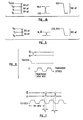
- Figure 1B depicts the signal levels of the MCLK, LCLK, and SCLK signals.
- the technique utilized to get essentially three levels of series gating functionality in just two levels is to run SCLK at an expanded swing.
- SCLK high overrides MCLK high so that SCLK swing around MCLK while MCLK swings around the reference V C .
- the control signal generating unit 20 includes ECL circuitry for generating the signal voltage levels V CL , V C , V CH , V SCLKH and for clocking the control signals LE, CLK, SE, and SCLK according to the timing requirements described below.
- the circuitry for implementing the functionality is well-known in the art and not part of the present invention.
- the circuit acts as a transparent latch in which the Q and Q output signals follow the data.
- the clock signal CLK on the base of transistor Q40 is off so that the MCLK signal is at V CL and the latch enable signal LE on the base of transistor Q43 is on so that LCLK is at V CH .
- the scan enable signal SE and the scan clock signal SCLK are also off to prevent the state of the output lines Q and Q from being affected by the master side of the circuit.
- the signal on transistor Q43 in an emitter follower configuration, controls the LEM select transistor Q22 and turns it on. Transistor Q22 draws its collector current through either transistor 16 or transistor Q21 depending upon the state of the data signal coupled to the base of transistor Q16.
- the circuit of Figure 1A functions as a latch where the data latched onto the Q and Q outputs is determined by the state of the data signal at the time the latch enable signal LE is turned off.
- both the clock signal CLK and scan enable SE signals are low to prevent the master side of the flip-flop from influencing the Q and Q output lines.
- the collector current for transistor Q22 will be supplied by either transistor Q16 or transistor Q21 depending upon the state of the data D.
- the latch enable signal goes low, whatever current was flowing through transistor Q22 must then flow through transistor Q25, because transistors 24 and Q26 are off.
- the current through transistor 25 must flow from either transistor Q18 or transistor Q19. If at the instant the latch enable signal LE was turned off, the true output Q was high, then transistor Q18 will turn on and pull the Q output low while the Q output remains high. On the other hand, if the Q output was low at the time control signal LE went off, then transistor Q19 is turned on to pull the output Q low while output Q goes high. In either case, the resultant output signals Q and Q are in a latched state which now is independent of the data input D.
- the circuitry depicted operates as a conventional D-type flip-flop.
- the output Q after a clock pulse will be the same as the input D before the clock pulse.
- the circuit is placed in a D-type flip-flop configuration by turning off the latch enable LE and scan enable SE control signals.
- the scan clock signal SCLK also remains off.
- one of the master or slave circuits functions like a latch, while the other behaves in a transparent mode.
- the condition of the latch circuit in this regard is controlled by the clock signal CLK.
- MCLK is set to V CH . From Figure 1B, Q24 is turned on harder than Q22, Q25, or Q26 so that Q17 and Q20 conduct.
- the slave obtains data from the master, which is in a latch mode.
- MCLK is set to V CL .
- Q11 is turned on harder than Q10 or Q12 so that Q4 and Q7 conduct and the master latch responds to the register data D.
- Q25 is also turned on harder than Q22 or Q24 so that Q18 and Q19 conduct and the slave latch is in a latch mode.
- the master latches the data, and the slave transfers the data to output lines Q and Q .
- the STM select transistor Q24 is on, and the slave is functioning in a transparent mode with the collector of the STM select transistor Q24 drawing current through either transistor Q17 or transistor Q20, depending upon the state of the master. During this period the master side is not affected by the state of the data bit, so the data may change.
- the clock signal CLK goes low, the master is placed into a transparent mode because the MLM select transistor Q10 is turned off. In this condition the current through the collector of RM select transistor Q11 will be controlled by comparison of potentials V B and the signal D to the base of Q7.
- the slave flip-flop is placed in a latch mode (as described above for the mode in which LE is off).
- the fourth mode of operation is the scan mode in which the data input to nodes SD and SD , the bases of transistors Q8 and Q3, respectively, is transferred to the output lines Q and Q .
- This mode is achieved by turning on the scan enable transistor Q42 which sets MCLK to V CH .
- the scan clock signal SCLK applied to the base of the SM select transistor Q12 then turns it on, with its collector current being supplied by whichever of transistors Q3 and Q8 is on. From Figure 1B, when SCLK is at SCLKH the SM select transistor Q12 is turned on harder than Q10 or Q11 so that Q3 and Q8 conduct and the master latch responds to the scan inputs S and S .
- the second SLM select transistor Q26 is turned on harder than Q22, Q24, or Q25 so that Q18 and Q19 conduct and the slave latch is in a latched state.
- the high scan clock signal SCLK places the slave circuit in a latch mode by turning on transistor Q26.
- the circuit now becomes a negative edge triggered D-type flip-flop controlled by the scan data signals SD and SD instead of the data signal D.
- the scan enable signal SE keeps the master circuit in a latched state and the slave circuit in a transparent state when the SCLK signal is low.
- Resistor R28 provides an apparent threshold shift for the master clocks (CLK, SE, SCLK) versus the slave clocks (CLK, SE, SCLK). This allows the same clock signals to be applied to both the master and slave, but nullifies the race condition inherent in a master/slave flip-flop.
- the master When in the positive edge triggered D-type flip-flop mode, the master has a clock threshold lower than the slave. Therefore, on the falling edge of the clock signal the data from the master is latched into the slave before the master switches to transparent mode. Conversely, in the negative edge triggered scan flip-flop mode, the master has a scan clock threshold higher than the slave. Therefore, on the rising edge of the scan clock signal, the data from the master is latched into the slave before the master switches to transparent.
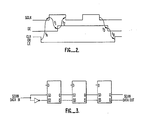
- the circuit of Figure 1 requires observance of certain clock timing rules in conjunction with the scan capability.
- the scan clock SCLK and scan enable SE signals must follow certain timing rules.
- the scan clock SCLK must go high prior to the scan enable SE going high. This insures that the data in the slave portion of the register is saved when the circuit enters scan mode.
- the delay between scan enable going high and scan clock going high is termed t1 in Figure 2.
- the scan clock SCLK must wait until after the scan enable signal SE goes high. This set-up time is labeled t2 on Figure 2.
- the third timing requirement is that the scan enable signal SE must not switch low until after the scan clock SCLK goes low. This condition assures that the scan data SD on the input node is saved when exiting the scan mode.
- the necessary time delay is labeled t3 in Figure 2.
- the clock CLK and latch enable LE signals are forced low prior to the entering of scan mode and remain low until the scan mode is complete.
- the delay following the clock CLK or latch enable LE signals going low before the scan clock may go high is designated tA in Figure 2, while the delay time before the clock CLK or latch enable LE may switch high after the scan enable SE goes low is designated time tB in Figure 2.
- the separation between the various voltage levels depicted is typically on the order of 300 mV. Accordingly, the full voltage swing between V CL and V SCLKH is on the order of 900 mV. Standard ECL voltage drivers provide for only a 600 mV, swing and thus a special driver is required to provide the extra 300 mV. to generate V SCLKH . Further, because the scan mode utilizes negative edge triggering, extra clock circuitry is required to implement the timing restrictions depicted in Figure 2 during transition between the positive edge triggered register mode and the negative edge triggered scan mode.
- FIG. 4 An alternative embodiment is depicted in Figure 4.
- transistors having the same function as the transistors of Figure 1 are assigned the same reference numerals.
- the primary structural differences are the lack of a second SLM select transistor Q26 and the lack of the MCLK and LCLK generating transistors Q40, Q41, Q42, Q43, and Q44.
- the control signals are applied directly to the bases of the various select transistors with appropriate ECL voltage levels.
- the CLK/SCLK signal is applied to the MLM and STM transistors (Q10 and Q24), the SE signal is applied to the RM select transistor (Q11), the SE signal is applied to the SM select transistor (Q12), and the LE signal is applied to the LEM select transistor (Q22).
- SE , SE, and CLK/SCLK Prior to entering the latch mode, SE , SE, and CLK/SCLK are switched low isolate the slave latch from the MQ, M Q outputs of the master latch.
- CLK/SCLK When CLK/SCLK is low the STM transistor Q24 is off so no current is supplied to Q17 or Q20.
- LE When LE is low the outputs remain latched at a previously extablished level.
- the LEM transistor (Q22) conducts and the outputs of the slave latch follow the level of the slave D signal and is transparant.
- the MLM transistor (Q10) When CLK/SCLK is low, the MLM transistor (Q10) is off so the master latch is transparent and the master latch outputs, MQ and M Q , follow the selected inputs. Additionally, the STM select transistor (Q24) is off so that the slave latch outputs are latched to a previously established value.
- the SE/ SE signals are not switched until a predetermined time after the CLK/SCLK signal is switched low. This timing assures that the slave latch is latched prior to switching the master latch outputs between the data input levels and the scan input levels. Thus, the transition between these levels is not reflected at slave latch outputs until CLK/SCLK is switched.
- this embodiment requires only three independent control signals to operate in the three modes. Further, the levels of the control signals are standard ECL levels and no special driver circuits are needed. A single clock signal, CLK/SCLK, is used in both the register and scan modes and all modes are positive edge triggering.
Landscapes
- Engineering & Computer Science (AREA)
- Power Engineering (AREA)
- Tests Of Electronic Circuits (AREA)
- Control Of Indicators Other Than Cathode Ray Tubes (AREA)
Applications Claiming Priority (2)
| Application Number | Priority Date | Filing Date | Title |
|---|---|---|---|
| US221701 | 1988-07-20 | ||
| US07/221,701 US4975595A (en) | 1987-06-12 | 1988-07-20 | Scannable register/latch circuit |
Publications (3)
| Publication Number | Publication Date |
|---|---|
| EP0351742A2 true EP0351742A2 (de) | 1990-01-24 |
| EP0351742A3 EP0351742A3 (en) | 1990-11-28 |
| EP0351742B1 EP0351742B1 (de) | 1994-03-09 |
Family
ID=22828968
Family Applications (1)
| Application Number | Title | Priority Date | Filing Date |
|---|---|---|---|
| EP89113016A Expired - Lifetime EP0351742B1 (de) | 1988-07-20 | 1989-07-15 | Abtastbare Register-/Verriegelungsschaltung |
Country Status (5)
| Country | Link |
|---|---|
| US (1) | US4975595A (de) |
| EP (1) | EP0351742B1 (de) |
| JP (1) | JPH02141120A (de) |
| CA (1) | CA1319400C (de) |
| DE (1) | DE68913610T2 (de) |
Cited By (2)
| Publication number | Priority date | Publication date | Assignee | Title |
|---|---|---|---|---|
| US7551475B2 (en) | 2006-04-03 | 2009-06-23 | International Business Machines Corporation | Data shifting through scan registers |
| US8405419B1 (en) | 2011-09-15 | 2013-03-26 | International Business Machines Corporation | Digital test system and method for value based data |
Families Citing this family (31)
| Publication number | Priority date | Publication date | Assignee | Title |
|---|---|---|---|---|
| EP0576749B1 (de) * | 1992-06-30 | 1999-06-02 | Discovision Associates | Datenpipelinesystem |
| GB9405914D0 (en) * | 1994-03-24 | 1994-05-11 | Discovision Ass | Video decompression |
| US5173619A (en) * | 1988-05-26 | 1992-12-22 | International Business Machines Corporation | Bidirectional buffer with latch and parity capability |
| US5172011A (en) * | 1989-06-30 | 1992-12-15 | Digital Equipment Corporation | Latch circuit and method with complementary clocking and level sensitive scan capability |
| US5078678A (en) * | 1990-03-02 | 1992-01-07 | Jefferson Katims | Method and apparatus for locating a catheter adjacent to a pacemaker node of the heart |
| US5228040A (en) * | 1990-03-09 | 1993-07-13 | At&T Bell Laboratories | Testable implementations of finite state machines and methods for producing them |
| US5257223A (en) * | 1991-11-13 | 1993-10-26 | Hewlett-Packard Company | Flip-flop circuit with controllable copying between slave and scan latches |
| JP2748069B2 (ja) * | 1992-05-19 | 1998-05-06 | 三菱電機株式会社 | フリップフロップ回路 |
| US6067417A (en) * | 1992-06-30 | 2000-05-23 | Discovision Associates | Picture start token |
| US5809270A (en) * | 1992-06-30 | 1998-09-15 | Discovision Associates | Inverse quantizer |
| US5784631A (en) * | 1992-06-30 | 1998-07-21 | Discovision Associates | Huffman decoder |
| US6079009A (en) * | 1992-06-30 | 2000-06-20 | Discovision Associates | Coding standard token in a system compromising a plurality of pipeline stages |
| US6112017A (en) * | 1992-06-30 | 2000-08-29 | Discovision Associates | Pipeline processing machine having a plurality of reconfigurable processing stages interconnected by a two-wire interface bus |
| US6435737B1 (en) | 1992-06-30 | 2002-08-20 | Discovision Associates | Data pipeline system and data encoding method |
| US5768561A (en) * | 1992-06-30 | 1998-06-16 | Discovision Associates | Tokens-based adaptive video processing arrangement |
| US7095783B1 (en) | 1992-06-30 | 2006-08-22 | Discovision Associates | Multistandard video decoder and decompression system for processing encoded bit streams including start codes and methods relating thereto |
| US6047112A (en) * | 1992-06-30 | 2000-04-04 | Discovision Associates | Technique for initiating processing of a data stream of encoded video information |
| US6330665B1 (en) | 1992-06-30 | 2001-12-11 | Discovision Associates | Video parser |
| US5699544A (en) * | 1993-06-24 | 1997-12-16 | Discovision Associates | Method and apparatus for using a fixed width word for addressing variable width data |
| US5805914A (en) * | 1993-06-24 | 1998-09-08 | Discovision Associates | Data pipeline system and data encoding method |
| US5861894A (en) * | 1993-06-24 | 1999-01-19 | Discovision Associates | Buffer manager |
| US5835792A (en) * | 1993-06-24 | 1998-11-10 | Discovision Associates | Token-based adaptive video processing arrangement |
| US5416362A (en) * | 1993-09-10 | 1995-05-16 | Unisys Corporation | Transparent flip-flop |
| CA2145365C (en) * | 1994-03-24 | 1999-04-27 | Anthony M. Jones | Method for accessing banks of dram |
| CA2145379C (en) * | 1994-03-24 | 1999-06-08 | William P. Robbins | Method and apparatus for addressing memory |
| CA2145363C (en) * | 1994-03-24 | 1999-07-13 | Anthony Mark Jones | Ram interface |
| JP3229164B2 (ja) * | 1994-07-28 | 2001-11-12 | インターナショナル・ビジネス・マシーンズ・コーポレーション | ラッチ回路 |
| US5491436A (en) * | 1994-07-29 | 1996-02-13 | International Business Machines Corp. | Compensated CMOS driver circuit with reduced DC losses |
| US5541545A (en) * | 1995-06-07 | 1996-07-30 | International Business Machines Corporation | High speed bipolar D latch circuit with reduced latch clocking output corruption |
| JP3047808B2 (ja) * | 1996-03-28 | 2000-06-05 | 日本電気株式会社 | フリップフロップ回路 |
| US5818293A (en) * | 1997-02-26 | 1998-10-06 | Advanced Micro Devices, Inc. | High speed analog flip-flop with embedded logic and phase-locked-loop circuit employing the same |
Family Cites Families (15)
| Publication number | Priority date | Publication date | Assignee | Title |
|---|---|---|---|---|
| GB2030807B (en) * | 1978-10-02 | 1982-11-10 | Ibm | Latch circuit |
| JPS5925421A (ja) * | 1982-08-03 | 1984-02-09 | Toshiba Corp | 同期式論理回路 |
| US4528465A (en) * | 1982-11-15 | 1985-07-09 | Advanced Micro Devices, Inc. | Semiconductor circuit alternately operative as a data latch and a logic gate |
| US4540903A (en) * | 1983-10-17 | 1985-09-10 | Storage Technology Partners | Scannable asynchronous/synchronous CMOS latch |
| US4628217A (en) * | 1984-03-22 | 1986-12-09 | Sperry Corporation | Fast scan/set testable latch using two levels of series gating with one current source |
| JPS60261211A (ja) * | 1984-06-08 | 1985-12-24 | Nec Corp | マスタ−・スレ−ブ型フリツプ・フロツプ |
| US4628216A (en) * | 1984-07-09 | 1986-12-09 | Advanced Micro Devices, Inc. | Merging of logic function circuits to ECL latch or flip-flop circuit |
| DD231465A1 (de) * | 1984-10-15 | 1985-12-24 | Mikroelektronik Zt Forsch Tech | Master-slave-flip-flop-schaltung |
| JPH0648779B2 (ja) * | 1985-07-18 | 1994-06-22 | 富士通株式会社 | フリップフロップ回路 |
| US4697279A (en) * | 1985-11-04 | 1987-09-29 | Hughes Aircraft Company | Test/master/slave triple latch flip-flop |
| JPH0659028B2 (ja) * | 1985-11-22 | 1994-08-03 | 日本電気株式会社 | 論理回路 |
| JPS62143513A (ja) * | 1985-12-18 | 1987-06-26 | Hitachi Ltd | マスタスレ−ブ・フリツプフロツプ |
| US4686394A (en) * | 1986-02-25 | 1987-08-11 | Fairchild Semiconductor | ECL circuit with current-splitting network |
| JPS6329276A (ja) * | 1986-07-23 | 1988-02-06 | Hitachi Ltd | 論理lsi |
| US4725979A (en) * | 1986-12-05 | 1988-02-16 | Monolithic Memories, Inc. | Emitter coupled logic circuit having fuse programmable latch/register bypass |
-
1988
- 1988-07-20 US US07/221,701 patent/US4975595A/en not_active Expired - Lifetime
-
1989
- 1989-07-15 EP EP89113016A patent/EP0351742B1/de not_active Expired - Lifetime
- 1989-07-15 DE DE68913610T patent/DE68913610T2/de not_active Expired - Fee Related
- 1989-07-19 JP JP1184836A patent/JPH02141120A/ja active Pending
- 1989-07-19 CA CA000606097A patent/CA1319400C/en not_active Expired - Fee Related
Cited By (2)
| Publication number | Priority date | Publication date | Assignee | Title |
|---|---|---|---|---|
| US7551475B2 (en) | 2006-04-03 | 2009-06-23 | International Business Machines Corporation | Data shifting through scan registers |
| US8405419B1 (en) | 2011-09-15 | 2013-03-26 | International Business Machines Corporation | Digital test system and method for value based data |
Also Published As
| Publication number | Publication date |
|---|---|
| US4975595A (en) | 1990-12-04 |
| JPH02141120A (ja) | 1990-05-30 |
| EP0351742A3 (en) | 1990-11-28 |
| CA1319400C (en) | 1993-06-22 |
| EP0351742B1 (de) | 1994-03-09 |
| DE68913610T2 (de) | 1994-09-15 |
| DE68913610D1 (de) | 1994-04-14 |
Similar Documents
| Publication | Publication Date | Title |
|---|---|---|
| EP0351742B1 (de) | Abtastbare Register-/Verriegelungsschaltung | |
| US4560888A (en) | High-speed ECL synchronous logic circuit with an input logic circuit | |
| JP3553988B2 (ja) | 同期ディジタル論理回路 | |
| EP0105685A2 (de) | Elektronische Schaltungseinrichtung | |
| EP0342129A2 (de) | Master-Slave-Flipflopschaltung | |
| US4779009A (en) | Master-slave type flip-flop circuit | |
| US4156819A (en) | Master-slave flip-flop circuit | |
| JPH0773208B2 (ja) | 論理回路 | |
| US4622475A (en) | Data storage element having input and output ports isolated from regenerative circuit | |
| US3617776A (en) | Master slave flip-flop | |
| US5900760A (en) | Low voltage ECL latch and flip-flop | |
| US3912950A (en) | Bistable multivibrator circuit | |
| US4309625A (en) | Flip-flop circuit | |
| US5170079A (en) | Collector dot and circuit with latched comparator | |
| US3437840A (en) | Gated storage elements for a semiconductor memory | |
| US4727265A (en) | Semiconductor circuit having a current switch circuit which imparts a latch function to an input buffer for generating high amplitude signals | |
| US3539836A (en) | Clocked delay type flip flop | |
| JPH02268515A (ja) | Bicmosロジツク回路 | |
| US5661426A (en) | Logic circuit | |
| US4626706A (en) | Digital signal level translation/master-slave flip flop with look-ahead | |
| US3444395A (en) | J-k flip-flop | |
| JPS6316047B2 (de) | ||
| US4277698A (en) | Delay type flip-flop | |
| US5541545A (en) | High speed bipolar D latch circuit with reduced latch clocking output corruption | |
| JPS6026325B2 (ja) | 同期形論理回路 |
Legal Events
| Date | Code | Title | Description |
|---|---|---|---|
| PUAI | Public reference made under article 153(3) epc to a published international application that has entered the european phase |
Free format text: ORIGINAL CODE: 0009012 |
|
| AK | Designated contracting states |
Kind code of ref document: A2 Designated state(s): DE FR GB IT NL |
|
| PUAL | Search report despatched |
Free format text: ORIGINAL CODE: 0009013 |
|
| AK | Designated contracting states |
Kind code of ref document: A3 Designated state(s): DE FR GB IT NL |
|
| 17P | Request for examination filed |
Effective date: 19910316 |
|
| 17Q | First examination report despatched |
Effective date: 19921124 |
|
| GRAA | (expected) grant |
Free format text: ORIGINAL CODE: 0009210 |
|
| AK | Designated contracting states |
Kind code of ref document: B1 Designated state(s): DE FR GB IT NL |
|
| REF | Corresponds to: |
Ref document number: 68913610 Country of ref document: DE Date of ref document: 19940414 |
|
| ET | Fr: translation filed | ||
| ITF | It: translation for a ep patent filed | ||
| PGFP | Annual fee paid to national office [announced via postgrant information from national office to epo] |
Ref country code: GB Payment date: 19940622 Year of fee payment: 6 |
|
| PGFP | Annual fee paid to national office [announced via postgrant information from national office to epo] |
Ref country code: FR Payment date: 19940713 Year of fee payment: 6 |
|
| PGFP | Annual fee paid to national office [announced via postgrant information from national office to epo] |
Ref country code: NL Payment date: 19940731 Year of fee payment: 6 |
|
| PLBE | No opposition filed within time limit |
Free format text: ORIGINAL CODE: 0009261 |
|
| STAA | Information on the status of an ep patent application or granted ep patent |
Free format text: STATUS: NO OPPOSITION FILED WITHIN TIME LIMIT |
|
| 26N | No opposition filed | ||
| PG25 | Lapsed in a contracting state [announced via postgrant information from national office to epo] |
Ref country code: GB Effective date: 19950715 |
|
| PG25 | Lapsed in a contracting state [announced via postgrant information from national office to epo] |
Ref country code: NL Effective date: 19960201 |
|
| GBPC | Gb: european patent ceased through non-payment of renewal fee |
Effective date: 19950715 |
|
| NLV4 | Nl: lapsed or anulled due to non-payment of the annual fee |
Effective date: 19960201 |
|
| PG25 | Lapsed in a contracting state [announced via postgrant information from national office to epo] |
Ref country code: FR Effective date: 19960430 |
|
| REG | Reference to a national code |
Ref country code: FR Ref legal event code: ST |
|
| REG | Reference to a national code |
Ref country code: FR Ref legal event code: ST |
|
| REG | Reference to a national code |
Ref country code: FR Ref legal event code: ST |
|
| PG25 | Lapsed in a contracting state [announced via postgrant information from national office to epo] |
Ref country code: IT Free format text: LAPSE BECAUSE OF NON-PAYMENT OF DUE FEES;WARNING: LAPSES OF ITALIAN PATENTS WITH EFFECTIVE DATE BEFORE 2007 MAY HAVE OCCURRED AT ANY TIME BEFORE 2007. THE CORRECT EFFECTIVE DATE MAY BE DIFFERENT FROM THE ONE RECORDED. Effective date: 20050715 |
|
| PGFP | Annual fee paid to national office [announced via postgrant information from national office to epo] |
Ref country code: DE Payment date: 20070131 Year of fee payment: 18 |
|
| PG25 | Lapsed in a contracting state [announced via postgrant information from national office to epo] |
Ref country code: DE Free format text: LAPSE BECAUSE OF NON-PAYMENT OF DUE FEES Effective date: 20080201 |