EP0351797B1 - Silikonzusammensetzung, elastischer Drehkörper und diesen verwendende Fixiervorrichtung - Google Patents
Silikonzusammensetzung, elastischer Drehkörper und diesen verwendende Fixiervorrichtung Download PDFInfo
- Publication number
- EP0351797B1 EP0351797B1 EP19890113181 EP89113181A EP0351797B1 EP 0351797 B1 EP0351797 B1 EP 0351797B1 EP 19890113181 EP19890113181 EP 19890113181 EP 89113181 A EP89113181 A EP 89113181A EP 0351797 B1 EP0351797 B1 EP 0351797B1
- Authority
- EP
- European Patent Office
- Prior art keywords
- parts
- vinyl group
- dimethylsilicone
- composition according
- silica powder
- Prior art date
- Legal status (The legal status is an assumption and is not a legal conclusion. Google has not performed a legal analysis and makes no representation as to the accuracy of the status listed.)
- Expired - Lifetime
Links
- 239000000203 mixture Substances 0.000 title claims description 171
- 229920001296 polysiloxane Polymers 0.000 title claims description 79
- VYPSYNLAJGMNEJ-UHFFFAOYSA-N Silicium dioxide Chemical compound O=[Si]=O VYPSYNLAJGMNEJ-UHFFFAOYSA-N 0.000 claims description 115
- 125000000391 vinyl group Chemical group [H]C([*])=C([H])[H] 0.000 claims description 115
- 125000004435 hydrogen atom Chemical group [H]* 0.000 claims description 71
- 239000000843 powder Substances 0.000 claims description 63
- 229910052710 silicon Inorganic materials 0.000 claims description 59
- XUIMIQQOPSSXEZ-UHFFFAOYSA-N Silicon Chemical group [Si] XUIMIQQOPSSXEZ-UHFFFAOYSA-N 0.000 claims description 58
- 239000000377 silicon dioxide Substances 0.000 claims description 54
- 239000000463 material Substances 0.000 claims description 47
- 229920001971 elastomer Polymers 0.000 claims description 36
- 239000003054 catalyst Substances 0.000 claims description 34
- 238000006757 chemical reactions by type Methods 0.000 claims description 30
- -1 alkylsilane compound Chemical class 0.000 claims description 28
- 239000003921 oil Substances 0.000 claims description 25
- 229920005645 diorganopolysiloxane polymer Polymers 0.000 claims description 24
- 239000004205 dimethyl polysiloxane Substances 0.000 claims description 20
- 235000013870 dimethyl polysiloxane Nutrition 0.000 claims description 20
- 229920000435 poly(dimethylsiloxane) Polymers 0.000 claims description 20
- 229910000077 silane Inorganic materials 0.000 claims description 20
- 238000010438 heat treatment Methods 0.000 claims description 18
- FWDBOZPQNFPOLF-UHFFFAOYSA-N ethenyl(triethoxy)silane Chemical compound CCO[Si](OCC)(OCC)C=C FWDBOZPQNFPOLF-UHFFFAOYSA-N 0.000 claims description 14
- 125000002496 methyl group Chemical group [H]C([H])([H])* 0.000 claims description 13
- 239000002245 particle Substances 0.000 claims description 13
- 239000003795 chemical substances by application Substances 0.000 claims description 10
- 125000005375 organosiloxane group Chemical group 0.000 claims description 10
- IJOOHPMOJXWVHK-UHFFFAOYSA-N chlorotrimethylsilane Chemical compound C[Si](C)(C)Cl IJOOHPMOJXWVHK-UHFFFAOYSA-N 0.000 claims description 6
- 238000002156 mixing Methods 0.000 claims description 5
- 230000009257 reactivity Effects 0.000 claims description 5
- 125000000217 alkyl group Chemical group 0.000 claims description 4
- 125000001495 ethyl group Chemical group [H]C([H])([H])C([H])([H])* 0.000 claims description 4
- FFUAGWLWBBFQJT-UHFFFAOYSA-N hexamethyldisilazane Chemical compound C[Si](C)(C)N[Si](C)(C)C FFUAGWLWBBFQJT-UHFFFAOYSA-N 0.000 claims description 4
- BFXIKLCIZHOAAZ-UHFFFAOYSA-N methyltrimethoxysilane Chemical compound CO[Si](C)(OC)OC BFXIKLCIZHOAAZ-UHFFFAOYSA-N 0.000 claims description 4
- XSDCTSITJJJDPY-UHFFFAOYSA-N chloro-ethenyl-dimethylsilane Chemical compound C[Si](C)(Cl)C=C XSDCTSITJJJDPY-UHFFFAOYSA-N 0.000 claims description 3
- YLJJAVFOBDSYAN-UHFFFAOYSA-N dichloro-ethenyl-methylsilane Chemical compound C[Si](Cl)(Cl)C=C YLJJAVFOBDSYAN-UHFFFAOYSA-N 0.000 claims description 3
- LIKFHECYJZWXFJ-UHFFFAOYSA-N dimethyldichlorosilane Chemical compound C[Si](C)(Cl)Cl LIKFHECYJZWXFJ-UHFFFAOYSA-N 0.000 claims description 3
- MBGQQKKTDDNCSG-UHFFFAOYSA-N ethenyl-diethoxy-methylsilane Chemical compound CCO[Si](C)(C=C)OCC MBGQQKKTDDNCSG-UHFFFAOYSA-N 0.000 claims description 3
- ZLNAFSPCNATQPQ-UHFFFAOYSA-N ethenyl-dimethoxy-methylsilane Chemical compound CO[Si](C)(OC)C=C ZLNAFSPCNATQPQ-UHFFFAOYSA-N 0.000 claims description 3
- NUFVQEIPPHHQCK-UHFFFAOYSA-N ethenyl-methoxy-dimethylsilane Chemical compound CO[Si](C)(C)C=C NUFVQEIPPHHQCK-UHFFFAOYSA-N 0.000 claims description 3
- 125000003709 fluoroalkyl group Chemical group 0.000 claims description 3
- GQIUQDDJKHLHTB-UHFFFAOYSA-N trichloro(ethenyl)silane Chemical compound Cl[Si](Cl)(Cl)C=C GQIUQDDJKHLHTB-UHFFFAOYSA-N 0.000 claims description 3
- 239000005051 trimethylchlorosilane Substances 0.000 claims description 3
- 239000005050 vinyl trichlorosilane Substances 0.000 claims description 3
- ZBSKZKPSSKTLNE-UHFFFAOYSA-N 4-methylpent-3-enoxysilane Chemical compound CC(=CCCO[SiH3])C ZBSKZKPSSKTLNE-UHFFFAOYSA-N 0.000 claims description 2
- JJQZDUKDJDQPMQ-UHFFFAOYSA-N dimethoxy(dimethyl)silane Chemical compound CO[Si](C)(C)OC JJQZDUKDJDQPMQ-UHFFFAOYSA-N 0.000 claims description 2
- YYLGKUPAFFKGRQ-UHFFFAOYSA-N dimethyldiethoxysilane Chemical compound CCO[Si](C)(C)OCC YYLGKUPAFFKGRQ-UHFFFAOYSA-N 0.000 claims description 2
- RSIHJDGMBDPTIM-UHFFFAOYSA-N ethoxy(trimethyl)silane Chemical compound CCO[Si](C)(C)C RSIHJDGMBDPTIM-UHFFFAOYSA-N 0.000 claims description 2
- POPACFLNWGUDSR-UHFFFAOYSA-N methoxy(trimethyl)silane Chemical compound CO[Si](C)(C)C POPACFLNWGUDSR-UHFFFAOYSA-N 0.000 claims description 2
- 239000005055 methyl trichlorosilane Substances 0.000 claims description 2
- JLUFWMXJHAVVNN-UHFFFAOYSA-N methyltrichlorosilane Chemical compound C[Si](Cl)(Cl)Cl JLUFWMXJHAVVNN-UHFFFAOYSA-N 0.000 claims description 2
- CPUDPFPXCZDNGI-UHFFFAOYSA-N triethoxy(methyl)silane Chemical compound CCO[Si](C)(OCC)OCC CPUDPFPXCZDNGI-UHFFFAOYSA-N 0.000 claims description 2
- UKRDPEFKFJNXQM-UHFFFAOYSA-N vinylsilane Chemical compound [SiH3]C=C UKRDPEFKFJNXQM-UHFFFAOYSA-N 0.000 claims description 2
- 229940126062 Compound A Drugs 0.000 claims 1
- NLDMNSXOCDLTTB-UHFFFAOYSA-N Heterophylliin A Natural products O1C2COC(=O)C3=CC(O)=C(O)C(O)=C3C3=C(O)C(O)=C(O)C=C3C(=O)OC2C(OC(=O)C=2C=C(O)C(O)=C(O)C=2)C(O)C1OC(=O)C1=CC(O)=C(O)C(O)=C1 NLDMNSXOCDLTTB-UHFFFAOYSA-N 0.000 claims 1
- VYSAQHMHYCPQPA-UHFFFAOYSA-N triethoxy(2-methylprop-1-enyl)silane Chemical compound CCO[Si](OCC)(OCC)C=C(C)C VYSAQHMHYCPQPA-UHFFFAOYSA-N 0.000 claims 1
- 239000000470 constituent Substances 0.000 description 185
- 239000007788 liquid Substances 0.000 description 94
- 235000012239 silicon dioxide Nutrition 0.000 description 68
- RMAQACBXLXPBSY-UHFFFAOYSA-N silicic acid Chemical compound O[Si](O)(O)O RMAQACBXLXPBSY-UHFFFAOYSA-N 0.000 description 63
- 229920002379 silicone rubber Polymers 0.000 description 48
- 239000004945 silicone rubber Substances 0.000 description 47
- BASFCYQUMIYNBI-UHFFFAOYSA-N platinum Chemical compound [Pt] BASFCYQUMIYNBI-UHFFFAOYSA-N 0.000 description 23
- 230000000052 comparative effect Effects 0.000 description 21
- 239000010410 layer Substances 0.000 description 15
- UQSXHKLRYXJYBZ-UHFFFAOYSA-N Iron oxide Chemical compound [Fe]=O UQSXHKLRYXJYBZ-UHFFFAOYSA-N 0.000 description 14
- 238000009472 formulation Methods 0.000 description 13
- 229910052697 platinum Inorganic materials 0.000 description 11
- BLRPTPMANUNPDV-UHFFFAOYSA-N Silane Chemical compound [SiH4] BLRPTPMANUNPDV-UHFFFAOYSA-N 0.000 description 10
- 229910052751 metal Inorganic materials 0.000 description 10
- 239000002184 metal Substances 0.000 description 10
- NTHWMYGWWRZVTN-UHFFFAOYSA-N sodium silicate Chemical compound [Na+].[Na+].[O-][Si]([O-])=O NTHWMYGWWRZVTN-UHFFFAOYSA-N 0.000 description 10
- 230000002093 peripheral effect Effects 0.000 description 9
- XEEYBQQBJWHFJM-UHFFFAOYSA-N Iron Chemical compound [Fe] XEEYBQQBJWHFJM-UHFFFAOYSA-N 0.000 description 8
- 239000011248 coating agent Substances 0.000 description 8
- 238000000576 coating method Methods 0.000 description 8
- 238000011417 postcuring Methods 0.000 description 8
- 239000011369 resultant mixture Substances 0.000 description 8
- 239000011247 coating layer Substances 0.000 description 7
- 229910052681 coesite Inorganic materials 0.000 description 7
- 229910052906 cristobalite Inorganic materials 0.000 description 7
- 239000013013 elastic material Substances 0.000 description 7
- JEIPFZHSYJVQDO-UHFFFAOYSA-N iron(III) oxide Inorganic materials O=[Fe]O[Fe]=O JEIPFZHSYJVQDO-UHFFFAOYSA-N 0.000 description 7
- 230000002787 reinforcement Effects 0.000 description 7
- 229910052682 stishovite Inorganic materials 0.000 description 7
- 229910052905 tridymite Inorganic materials 0.000 description 7
- 229910052731 fluorine Inorganic materials 0.000 description 5
- 229910052739 hydrogen Inorganic materials 0.000 description 5
- 239000001257 hydrogen Substances 0.000 description 5
- JLGNHOJUQFHYEZ-UHFFFAOYSA-N trimethoxy(3,3,3-trifluoropropyl)silane Chemical compound CO[Si](OC)(OC)CCC(F)(F)F JLGNHOJUQFHYEZ-UHFFFAOYSA-N 0.000 description 5
- UFHFLCQGNIYNRP-UHFFFAOYSA-N Hydrogen Chemical compound [H][H] UFHFLCQGNIYNRP-UHFFFAOYSA-N 0.000 description 4
- 229910052782 aluminium Inorganic materials 0.000 description 4
- XAGFODPZIPBFFR-UHFFFAOYSA-N aluminium Chemical compound [Al] XAGFODPZIPBFFR-UHFFFAOYSA-N 0.000 description 4
- 238000006243 chemical reaction Methods 0.000 description 4
- 230000003247 decreasing effect Effects 0.000 description 4
- 239000007789 gas Substances 0.000 description 4
- 229910052742 iron Inorganic materials 0.000 description 4
- 230000000717 retained effect Effects 0.000 description 4
- 239000010703 silicon Substances 0.000 description 4
- 238000005507 spraying Methods 0.000 description 4
- YCKRFDGAMUMZLT-UHFFFAOYSA-N Fluorine atom Chemical compound [F] YCKRFDGAMUMZLT-UHFFFAOYSA-N 0.000 description 3
- 150000001343 alkyl silanes Chemical class 0.000 description 3
- 238000004132 cross linking Methods 0.000 description 3
- 239000011737 fluorine Substances 0.000 description 3
- 238000003825 pressing Methods 0.000 description 3
- 239000011347 resin Substances 0.000 description 3
- 229920005989 resin Polymers 0.000 description 3
- 229920002545 silicone oil Polymers 0.000 description 3
- 230000032683 aging Effects 0.000 description 2
- AZDRQVAHHNSJOQ-UHFFFAOYSA-N alumane Chemical group [AlH3] AZDRQVAHHNSJOQ-UHFFFAOYSA-N 0.000 description 2
- 125000004432 carbon atom Chemical group C* 0.000 description 2
- 210000000078 claw Anatomy 0.000 description 2
- 238000004140 cleaning Methods 0.000 description 2
- 229940125773 compound 10 Drugs 0.000 description 2
- 229920001577 copolymer Polymers 0.000 description 2
- 125000000118 dimethyl group Chemical group [H]C([H])([H])* 0.000 description 2
- 230000000694 effects Effects 0.000 description 2
- 239000000945 filler Substances 0.000 description 2
- 125000001153 fluoro group Chemical group F* 0.000 description 2
- 229910021485 fumed silica Inorganic materials 0.000 description 2
- 229910052736 halogen Inorganic materials 0.000 description 2
- 150000002367 halogens Chemical class 0.000 description 2
- 230000002209 hydrophobic effect Effects 0.000 description 2
- ZLVXBBHTMQJRSX-VMGNSXQWSA-N jdtic Chemical compound C1([C@]2(C)CCN(C[C@@H]2C)C[C@H](C(C)C)NC(=O)[C@@H]2NCC3=CC(O)=CC=C3C2)=CC=CC(O)=C1 ZLVXBBHTMQJRSX-VMGNSXQWSA-N 0.000 description 2
- 230000000704 physical effect Effects 0.000 description 2
- 239000011164 primary particle Substances 0.000 description 2
- 125000001436 propyl group Chemical group [H]C([*])([H])C([H])([H])C([H])([H])[H] 0.000 description 2
- 239000010453 quartz Substances 0.000 description 2
- 238000000926 separation method Methods 0.000 description 2
- 125000005372 silanol group Chemical group 0.000 description 2
- 229910001220 stainless steel Inorganic materials 0.000 description 2
- 239000010935 stainless steel Substances 0.000 description 2
- 239000000758 substrate Substances 0.000 description 2
- LZMNXXQIQIHFGC-UHFFFAOYSA-N 3-[dimethoxy(methyl)silyl]propyl 2-methylprop-2-enoate Chemical compound CO[Si](C)(OC)CCCOC(=O)C(C)=C LZMNXXQIQIHFGC-UHFFFAOYSA-N 0.000 description 1
- 229910002012 Aerosil® Inorganic materials 0.000 description 1
- 229910004674 SiO0.5 Inorganic materials 0.000 description 1
- YKTSYUJCYHOUJP-UHFFFAOYSA-N [O--].[Al+3].[Al+3].[O-][Si]([O-])([O-])[O-] Chemical compound [O--].[Al+3].[Al+3].[O-][Si]([O-])([O-])[O-] YKTSYUJCYHOUJP-UHFFFAOYSA-N 0.000 description 1
- 238000005299 abrasion Methods 0.000 description 1
- 239000002253 acid Substances 0.000 description 1
- 238000007259 addition reaction Methods 0.000 description 1
- 239000002390 adhesive tape Substances 0.000 description 1
- PNEYBMLMFCGWSK-UHFFFAOYSA-N aluminium oxide Inorganic materials [O-2].[O-2].[O-2].[Al+3].[Al+3] PNEYBMLMFCGWSK-UHFFFAOYSA-N 0.000 description 1
- 125000004429 atom Chemical group 0.000 description 1
- 239000000378 calcium silicate Substances 0.000 description 1
- 229910052918 calcium silicate Inorganic materials 0.000 description 1
- OYACROKNLOSFPA-UHFFFAOYSA-N calcium;dioxido(oxo)silane Chemical compound [Ca+2].[O-][Si]([O-])=O OYACROKNLOSFPA-UHFFFAOYSA-N 0.000 description 1
- 239000003086 colorant Substances 0.000 description 1
- 238000007906 compression Methods 0.000 description 1
- 230000006835 compression Effects 0.000 description 1
- 238000011109 contamination Methods 0.000 description 1
- 229910052593 corundum Inorganic materials 0.000 description 1
- 230000007423 decrease Effects 0.000 description 1
- KPUWHANPEXNPJT-UHFFFAOYSA-N disiloxane Chemical class [SiH3]O[SiH3] KPUWHANPEXNPJT-UHFFFAOYSA-N 0.000 description 1
- 239000000428 dust Substances 0.000 description 1
- 230000007613 environmental effect Effects 0.000 description 1
- 229920005560 fluorosilicone rubber Polymers 0.000 description 1
- 230000005484 gravity Effects 0.000 description 1
- 230000020169 heat generation Effects 0.000 description 1
- 239000008240 homogeneous mixture Substances 0.000 description 1
- 238000000034 method Methods 0.000 description 1
- 239000002985 plastic film Substances 0.000 description 1
- 150000003058 platinum compounds Chemical class 0.000 description 1
- 229920001343 polytetrafluoroethylene Polymers 0.000 description 1
- 239000004810 polytetrafluoroethylene Substances 0.000 description 1
- 230000002250 progressing effect Effects 0.000 description 1
- BYOIQYHAYWYSCZ-UHFFFAOYSA-N prop-2-enoxysilane Chemical compound [SiH3]OCC=C BYOIQYHAYWYSCZ-UHFFFAOYSA-N 0.000 description 1
- 238000005488 sandblasting Methods 0.000 description 1
- 150000004756 silanes Chemical class 0.000 description 1
- 238000005245 sintering Methods 0.000 description 1
- 239000007787 solid Substances 0.000 description 1
- 238000001179 sorption measurement Methods 0.000 description 1
- 238000003756 stirring Methods 0.000 description 1
- 239000000126 substance Substances 0.000 description 1
- 239000002344 surface layer Substances 0.000 description 1
- 238000004804 winding Methods 0.000 description 1
- 230000037303 wrinkles Effects 0.000 description 1
- 229910001845 yogo sapphire Inorganic materials 0.000 description 1
Images


Classifications
-
- G—PHYSICS
- G03—PHOTOGRAPHY; CINEMATOGRAPHY; ANALOGOUS TECHNIQUES USING WAVES OTHER THAN OPTICAL WAVES; ELECTROGRAPHY; HOLOGRAPHY
- G03G—ELECTROGRAPHY; ELECTROPHOTOGRAPHY; MAGNETOGRAPHY
- G03G15/00—Apparatus for electrographic processes using a charge pattern
- G03G15/20—Apparatus for electrographic processes using a charge pattern for fixing, e.g. by using heat
- G03G15/2003—Apparatus for electrographic processes using a charge pattern for fixing, e.g. by using heat using heat
- G03G15/2014—Apparatus for electrographic processes using a charge pattern for fixing, e.g. by using heat using heat using contact heat
- G03G15/2053—Structural details of heat elements, e.g. structure of roller or belt, eddy current, induction heating
- G03G15/2057—Structural details of heat elements, e.g. structure of roller or belt, eddy current, induction heating relating to the chemical composition of the heat element and layers thereof
-
- B—PERFORMING OPERATIONS; TRANSPORTING
- B29—WORKING OF PLASTICS; WORKING OF SUBSTANCES IN A PLASTIC STATE IN GENERAL
- B29B—PREPARATION OR PRETREATMENT OF THE MATERIAL TO BE SHAPED; MAKING GRANULES OR PREFORMS; RECOVERY OF PLASTICS OR OTHER CONSTITUENTS OF WASTE MATERIAL CONTAINING PLASTICS
- B29B7/00—Mixing; Kneading
- B29B7/74—Mixing; Kneading using other mixers or combinations of mixers, e.g. of dissimilar mixers ; Plant
- B29B7/7476—Systems, i.e. flow charts or diagrams; Plants
- B29B7/7495—Systems, i.e. flow charts or diagrams; Plants for mixing rubber
-
- C—CHEMISTRY; METALLURGY
- C08—ORGANIC MACROMOLECULAR COMPOUNDS; THEIR PREPARATION OR CHEMICAL WORKING-UP; COMPOSITIONS BASED THEREON
- C08K—Use of inorganic or non-macromolecular organic substances as compounding ingredients
- C08K9/00—Use of pretreated ingredients
- C08K9/04—Ingredients treated with organic substances
- C08K9/06—Ingredients treated with organic substances with silicon-containing compounds
-
- C—CHEMISTRY; METALLURGY
- C08—ORGANIC MACROMOLECULAR COMPOUNDS; THEIR PREPARATION OR CHEMICAL WORKING-UP; COMPOSITIONS BASED THEREON
- C08L—COMPOSITIONS OF MACROMOLECULAR COMPOUNDS
- C08L83/00—Compositions of macromolecular compounds obtained by reactions forming in the main chain of the macromolecule a linkage containing silicon with or without sulfur, nitrogen, oxygen or carbon only; Compositions of derivatives of such polymers
- C08L83/04—Polysiloxanes
-
- C—CHEMISTRY; METALLURGY
- C08—ORGANIC MACROMOLECULAR COMPOUNDS; THEIR PREPARATION OR CHEMICAL WORKING-UP; COMPOSITIONS BASED THEREON
- C08L—COMPOSITIONS OF MACROMOLECULAR COMPOUNDS
- C08L83/00—Compositions of macromolecular compounds obtained by reactions forming in the main chain of the macromolecule a linkage containing silicon with or without sulfur, nitrogen, oxygen or carbon only; Compositions of derivatives of such polymers
- C08L83/04—Polysiloxanes
- C08L83/08—Polysiloxanes containing silicon bound to organic groups containing atoms other than carbon, hydrogen and oxygen
-
- G—PHYSICS
- G03—PHOTOGRAPHY; CINEMATOGRAPHY; ANALOGOUS TECHNIQUES USING WAVES OTHER THAN OPTICAL WAVES; ELECTROGRAPHY; HOLOGRAPHY
- G03G—ELECTROGRAPHY; ELECTROPHOTOGRAPHY; MAGNETOGRAPHY
- G03G15/00—Apparatus for electrographic processes using a charge pattern
- G03G15/20—Apparatus for electrographic processes using a charge pattern for fixing, e.g. by using heat
- G03G15/2003—Apparatus for electrographic processes using a charge pattern for fixing, e.g. by using heat using heat
- G03G15/2014—Apparatus for electrographic processes using a charge pattern for fixing, e.g. by using heat using heat using contact heat
- G03G15/206—Structural details or chemical composition of the pressure elements and layers thereof
-
- C—CHEMISTRY; METALLURGY
- C08—ORGANIC MACROMOLECULAR COMPOUNDS; THEIR PREPARATION OR CHEMICAL WORKING-UP; COMPOSITIONS BASED THEREON
- C08G—MACROMOLECULAR COMPOUNDS OBTAINED OTHERWISE THAN BY REACTIONS ONLY INVOLVING UNSATURATED CARBON-TO-CARBON BONDS
- C08G77/00—Macromolecular compounds obtained by reactions forming a linkage containing silicon with or without sulfur, nitrogen, oxygen or carbon in the main chain of the macromolecule
- C08G77/04—Polysiloxanes
- C08G77/12—Polysiloxanes containing silicon bound to hydrogen
-
- C—CHEMISTRY; METALLURGY
- C08—ORGANIC MACROMOLECULAR COMPOUNDS; THEIR PREPARATION OR CHEMICAL WORKING-UP; COMPOSITIONS BASED THEREON
- C08G—MACROMOLECULAR COMPOUNDS OBTAINED OTHERWISE THAN BY REACTIONS ONLY INVOLVING UNSATURATED CARBON-TO-CARBON BONDS
- C08G77/00—Macromolecular compounds obtained by reactions forming a linkage containing silicon with or without sulfur, nitrogen, oxygen or carbon in the main chain of the macromolecule
- C08G77/04—Polysiloxanes
- C08G77/20—Polysiloxanes containing silicon bound to unsaturated aliphatic groups
-
- C—CHEMISTRY; METALLURGY
- C08—ORGANIC MACROMOLECULAR COMPOUNDS; THEIR PREPARATION OR CHEMICAL WORKING-UP; COMPOSITIONS BASED THEREON
- C08G—MACROMOLECULAR COMPOUNDS OBTAINED OTHERWISE THAN BY REACTIONS ONLY INVOLVING UNSATURATED CARBON-TO-CARBON BONDS
- C08G77/00—Macromolecular compounds obtained by reactions forming a linkage containing silicon with or without sulfur, nitrogen, oxygen or carbon in the main chain of the macromolecule
- C08G77/04—Polysiloxanes
- C08G77/22—Polysiloxanes containing silicon bound to organic groups containing atoms other than carbon, hydrogen and oxygen
- C08G77/24—Polysiloxanes containing silicon bound to organic groups containing atoms other than carbon, hydrogen and oxygen halogen-containing groups
-
- Y—GENERAL TAGGING OF NEW TECHNOLOGICAL DEVELOPMENTS; GENERAL TAGGING OF CROSS-SECTIONAL TECHNOLOGIES SPANNING OVER SEVERAL SECTIONS OF THE IPC; TECHNICAL SUBJECTS COVERED BY FORMER USPC CROSS-REFERENCE ART COLLECTIONS [XRACs] AND DIGESTS
- Y10—TECHNICAL SUBJECTS COVERED BY FORMER USPC
- Y10T—TECHNICAL SUBJECTS COVERED BY FORMER US CLASSIFICATION
- Y10T428/00—Stock material or miscellaneous articles
- Y10T428/13—Hollow or container type article [e.g., tube, vase, etc.]
- Y10T428/1352—Polymer or resin containing [i.e., natural or synthetic]
- Y10T428/1386—Natural or synthetic rubber or rubber-like compound containing
-
- Y—GENERAL TAGGING OF NEW TECHNOLOGICAL DEVELOPMENTS; GENERAL TAGGING OF CROSS-SECTIONAL TECHNOLOGIES SPANNING OVER SEVERAL SECTIONS OF THE IPC; TECHNICAL SUBJECTS COVERED BY FORMER USPC CROSS-REFERENCE ART COLLECTIONS [XRACs] AND DIGESTS
- Y10—TECHNICAL SUBJECTS COVERED BY FORMER USPC
- Y10T—TECHNICAL SUBJECTS COVERED BY FORMER US CLASSIFICATION
- Y10T428/00—Stock material or miscellaneous articles
- Y10T428/13—Hollow or container type article [e.g., tube, vase, etc.]
- Y10T428/1352—Polymer or resin containing [i.e., natural or synthetic]
- Y10T428/139—Open-ended, self-supporting conduit, cylinder, or tube-type article
-
- Y—GENERAL TAGGING OF NEW TECHNOLOGICAL DEVELOPMENTS; GENERAL TAGGING OF CROSS-SECTIONAL TECHNOLOGIES SPANNING OVER SEVERAL SECTIONS OF THE IPC; TECHNICAL SUBJECTS COVERED BY FORMER USPC CROSS-REFERENCE ART COLLECTIONS [XRACs] AND DIGESTS
- Y10—TECHNICAL SUBJECTS COVERED BY FORMER USPC
- Y10T—TECHNICAL SUBJECTS COVERED BY FORMER US CLASSIFICATION
- Y10T428/00—Stock material or miscellaneous articles
- Y10T428/25—Web or sheet containing structurally defined element or component and including a second component containing structurally defined particles
- Y10T428/259—Silicic material
-
- Y—GENERAL TAGGING OF NEW TECHNOLOGICAL DEVELOPMENTS; GENERAL TAGGING OF CROSS-SECTIONAL TECHNOLOGIES SPANNING OVER SEVERAL SECTIONS OF THE IPC; TECHNICAL SUBJECTS COVERED BY FORMER USPC CROSS-REFERENCE ART COLLECTIONS [XRACs] AND DIGESTS
- Y10—TECHNICAL SUBJECTS COVERED BY FORMER USPC
- Y10T—TECHNICAL SUBJECTS COVERED BY FORMER US CLASSIFICATION
- Y10T428/00—Stock material or miscellaneous articles
- Y10T428/29—Coated or structually defined flake, particle, cell, strand, strand portion, rod, filament, macroscopic fiber or mass thereof
- Y10T428/2982—Particulate matter [e.g., sphere, flake, etc.]
- Y10T428/2991—Coated
- Y10T428/2993—Silicic or refractory material containing [e.g., tungsten oxide, glass, cement, etc.]
- Y10T428/2995—Silane, siloxane or silicone coating
-
- Y—GENERAL TAGGING OF NEW TECHNOLOGICAL DEVELOPMENTS; GENERAL TAGGING OF CROSS-SECTIONAL TECHNOLOGIES SPANNING OVER SEVERAL SECTIONS OF THE IPC; TECHNICAL SUBJECTS COVERED BY FORMER USPC CROSS-REFERENCE ART COLLECTIONS [XRACs] AND DIGESTS
- Y10—TECHNICAL SUBJECTS COVERED BY FORMER USPC
- Y10T—TECHNICAL SUBJECTS COVERED BY FORMER US CLASSIFICATION
- Y10T428/00—Stock material or miscellaneous articles
- Y10T428/31504—Composite [nonstructural laminate]
- Y10T428/31652—Of asbestos
- Y10T428/31663—As siloxane, silicone or silane
Definitions
- the present invention relates to an addition reaction-type dimethylsilicone composition containing silica fine powder surface-treated with a fluoroalkylsilane, an alkylsilane compound, fluorosilicone, dimethylsilicone oil or a mixture thereof, and a silane compound including an unsaturated group having a reactivity with an addition reaction-type silicone; a dimethylsilicone rubber composition formed from the silicone composition; an elastic revolution body (or body of revolution) including an elastic body having a surface layer formed from the dimethylsilicone rubber composition; and a fixing device including the elastic revolution body.
- the silicone rubber composition according to the present invention is particularly suitable for an elastic coating material of an elastic revolution body which is used for a conveyor roller for conveying a sheet transfer material (or recording material) or a fixing roller in an image forming apparatus such as electrophotographic copying machine and printer.
- conveying ability, releasability and durability are generally required for the conveyer roller for conveying a sheet transfer material (or recording material) in the form of a sheet such as plain paper along a prescribed conveying path. Further, conveying ability, releasability, abrasion resistance, fixing characteristics and durability are also required under severer conditions with respect to a fixing device comprising a fixing roller and a pressure roller, which applies heat to an unfixed toner image formed on a transfer paper under pressure, and must convey the transfer paper to the prescribed conveying path while preventing an offset phenomenon due to sintering or melted toner.
- the fixing device of this type comprises at least a fixing roller and a pressure roller which contacts the fixing roller under pressure and rotates corresponding to the rotation thereof.
- the fixing roller comprises a hollow core bar (or cylinder) formed of a metal such as aluminum and iron, and a layer of a material having good releasability such as silicone rubber and fluorine-containing resin including polytetrafluoroethylene, tetrafluoroethylene-fluoroalkoxyethylene copolymer, etc., which covers the core bar.
- a heater such as halogen lamp is disposed as desired, thereby to elevate the surface temperature of the fixing roller to a temperature suitable for the fixing.
- the above-mentioned surface temperature of the fixing roller is controlled by means of a sensor so that it is set to a prescribed temperature. Further, around the peripheral surface of the fixing roller, there is sometimes disposed a cleaner for removing the offset toner and paper dust, or a separation claw for preventing a transfer material or image-carrying material from winding about the fixing roller.
- the pressure roller comprises a core bar formed of a metal such as iron and stainless steel, and an elastic layer having releasability and comprising a material such as silicone rubber, which covers the core bar.
- the pressure roller is caused to contact the fixing roller under pressure by a pressure-applying means such as spring.
- the image-supporting material carrying thereon an unfixed toner image is sandwiched between and conveyed by the above-mentioned fixing roller and pressure roller under pressure, whereby the unfixed toner image is fixed to the image-carrying material under pressure, or under heating and pressure.
- the fixing roller covered with the silicone rubber is capable of providing good fixability of an unfixed toner image to an image-carrying material such as plain paper and good image quality of the resultant fixed image (e.g., capable of providing a fixed image having a reduced gloss), but has a problem such that it is inferior to a fixing roller covered with a fluorine-containing resin in releasability and durability.
- Image forming apparatus such as electrophotographic copying machine tend to employ the fixing roller covered with a silicone rubber which is inferior to that covered with a fluorine-containing resin in releasability and durability but is capable of providing an excellent image quality of a fixed image because the latter is more important to the above-mentioned image forming apparatus. Accordingly, the releasability and durability of a silicone rubber material has been desired to be improved.
- silicic acid such as synthetic hydrous silicic acid and synthetic anhydrous silicic acid is added to a silicone rubber material as a reinforcement in order to improve the durability.
- synthetic hydrous silicic acid the reinforcement effect thereof is not substantially achieved unless it is added to a silicone rubber material in a considerable large amount of 20 - 50 wt. parts per 100 wt. parts of the silicone rubber material. Further, such addition causes a problem such that the releasability of the silicone rubber material is considerably decreased.
- the composition is prepared by merely blending these components uniformly.
- the EP-A-0 062 408 discloses a curable organopolysiloxane composition for heat fixing rolls, the composition comprising a diorganopolysiloxane with a siloxane unit containing a vinyl group; an organopolysiloxane with a siloxane unit containing a hydrogen atom; a siliceous filler such as fumed silica of surface area of 200 m2/g and quartz powder of average paticle size of 5»m; and a platinum group catalyst.
- An object of the present invention is to provide an addition reaction-type dimethylsilicone composition and an addition reaction-type dimethylsilicone rubber composition which are excellent in mechanical strength and have good releasability.
- Another object of the present invention is to provide an elastic revolution body which is excellent in mechanical strength and has good releasability.
- a further object of the present invention is to provide an elastic revolution body which excellent in durability.
- a still further object of the present invention is to provide fixing device which is excellent in durability I have earnestly researched on a silicone rubber composition excellent in both releasability and durability which may be used as a coating material for an elastic revolution body for conveying a sheet transfer material or recording material such as plain paper and fixing an unfixed toner image to form a fixed image, in an image forming apparatus such as electrophotographic copying machine and printer.
- a silicone rubber composition having a good balance between reinforcement and releaseability can be obtained by incorporating, in an addition reaction-type dimethylsilicone composition, silica powder (IV) having a BET specific surface area of 40 to 500 m2/g, whose surface has been treated with (or modified by) (IV-1) a fluoroalkylsilane, an alkylsilane compound, fluorosilicone oil, dimethylsilicone oil or a mixture thereof, and (IV-2) a silane compound containing an unsaturated group having a reactivity to an organopolysiloxane containing an active hydrogen atom (II) which is also incorporated into the composition, said unsaturated group of the silane compound (IV-2) being in a form suitable to be introduced onto the surface of the silica powder; and the durability of a fixing roller is remarkably improved by using the above-mentioned silicone rubber composition as a coating layer thereof.
- the addition reaction-type dimethylsilicone composition according to the present invention is based on the above discovery and comprises:
- the present invention also provides a dimethylsilicone rubber composition obtained by heating a platinum-type catalyst; and an addition reaction-type dimethylsilicone composition as specified above.
- the present invention also provides an elastic revolution body comprising an elastic layer formed from a dimethylsilicone rubber composition; the dimethylsilicone rubber composition being obtained by heating a platinum-type catalyst and an addition reaction-type dimethylsilicone composition as specified above.
- the present invention further provides a fixing device, comprising at least a pair of rollers between which a toner image-supporting material carrying an unfixed toner image is passed under pressure to fix the toner image to the toner image-supporting material; wherein at least one of the pair of rollers comprises an elastic layer formed from a dimethylsilicone rubber composition; the dimethylsilicone rubber composition being obtained by heating a platinum-type catalyst and an addition reaction-type dimethylsilicone composition as specified above.
- sica powder (IV) means one which is solid at normal or room temperature and also includes a silicic acid compound such as orthosilicic acid.
- the addition reaction-type dimethylsilicone composition according to the present invention comprises, at least, a component (I), a component (II) and a component (IV) as described below, and may further compirses a component (III) as described below.
- organopolysiloxane component (I) containing a reactive vinyl group connected to a silicon atom may include: an organopolysiloxane such as a reactive vinyl group-containing dimethylpolysiloxane having a vinyl group at the end thereof, which is represented by the following general formula: or a diorganopolysiloxane such as a reactive vinyl group-containing dimethylpolysiloxane having a methyl group at the end thereof and having a vinyl group in the side chain thereof, which is represented by the following general formula: or wherein m and k respectively denote 0 or a positive integer, (m+k) may preferably be 50 - 2,000, and n may preferably be an integer of 1 - 10; or a vinyl group-containing dimethylpolysiloxane comprising two or more species of the above-mentioned polysiloxane, and l may preferably be 50 - 2,000.
- an organopolysiloxane such as a
- the component (I) may preferably have a viscosity of 500 - 5x10⁶ centistoke at room temperature.
- l , m and n respectively denote a positive integer.
- component (I) may include an organopolysiloxane copolymer (a) which includes an organosiloxane unit represented by and a fluoroalkyl group-containing organosiloxane unit represented by and has a vinyl group at the end of its molecular chain.
- R1 and R2 used herein respectively denote an alkyl group (preferably having 1 - 3 carbon atoms) such as methyl, ethyl, and propyl.
- the organopolysiloxane copolymer (a) may preferably contain the CF3CH2CH2(CH3)SiO- unit in an amount of 10 - 60 mol. %, more preferably 20 - 40 mol. %.
- the active hydrogen-containing organopolysiloxane component (II) may for example be a methylhydrogenpolysiloxane represented by the following general formulas: wherein p and r denotes 0 or a positive integer, and q denotes a positive integer. (p+q) may preferably be 50 - 500, and q may preferably be an integer of 1 - 10.
- This organopolysiloxane contains at least one active hydrogen atom connected (or bonded) to a silicon atom (-Si-H) per unit molecule.
- component (II) may be one which includes at least one hydrogen atom connected to a silicon atom, on the average, per one molecule, and includes an organosiloxane unit represented by and an organosiloxane unit represented by R3 and R4 used herein respectively denote an alkyl group (preferably having 1 - 3 carbon atoms) such as methyl, ethyl, and propyl.
- Such a component (II) may for example have the following formula: wherein p , q and r are as denoted above and x denotes a positive integer, except that p and r cannot be simultaneously zero.
- the component (III) used in the present invention is a platinum-type catalyst such as platinum and a platinum compound.
- the platinum-type catalyst component (III) is one which is effective in catalyzing a reaction between an active hydrogen connected to a silicon atom, and a vinyl group.
- An optimum addition amount of the catalyst may be determined in consideration of a length of pot-life, but may preferably be 100 - 5,000 ppm.
- the surface-treated silica fine powder component (IV) may include surface-modified silica powder, having a BET specific surface area of 40-500 m2/g, obtained by treating the surface of silica powder such as synthetic anhydrous silica powder and synthetic hydrous silica powder, with (IV-1) fluoroalkylsilane, an alkylsilane compound, fluorosilicone, dimethylsilicone oil, or a mixture thereof, and (IV-2) a silane compound having an unsaturated group which has a reactivity to an active hydrogen-containing organopolysiloxane (II), said unsaturated group being in a form suitable to be introduced onto the surface of the silica powder.
- silica powder such as synthetic anhydrous silica powder and synthetic hydrous silica powder
- (IV-2)
- the addition reaction-type dimethylsilicone rubber composition according to the present invention is a hardenable (or curable) composition comprising a homogeneous mixture of the above-mentioned silicone composition.
- Each of the components (I), (II) and (III) per se constituting the composition may be one which is known as that constituting a liquid addition reaction-type dimethylsilicone composition.
- the unsaturated group of the treated silica fine powder (IV) constituting the composition according to the present invention reacts with the hydrogen atom connected to a silicon atom of the component (II) and forms a chemical bond.
- a desired mechanical strength which has not been obtained in the prior art until a large amount of synthetic silicic acid is used, may be obtained by adding a relatively small amount of the component (IV).
- the increase in the surface energy due to the addition of a large amount of filler such as synthetic silicic acid can be prevented or suppressed.
- silica powder having a BET specific surface area of 40 - 500 m2/g is used.
- the silica powder preferably has a primary particle size of 7 - 100 nm (milli-micron).
- hydrous silicic acid or anhydrous silicic acid having a primary particle size of 5 - 50 nm (more preferably 7 - 25 nm) and a BET specific surface area of 70 - 400 m2/g (more preferably 100 - 300 m2/g) may more preferably be used.
- the surface-treating agent (IV-1) may include: fluoroalkylsilanes represented by C n F 2n+1 CH2CH2SiR m (OR') 3-m , or C n F 2n+1 CH2CH2SiR m Cl 3-m wherein n denotes an integer of 1 - 8, m denotes 0 or 1, and R and R' respectively denote methyl or ethyl group; alkysilanes such as trimethylmethoxysilane, trimethylethoxysilane, dimethyldimethoxysilane, dimethyldiethoxysilane, methyltrimethoxysilane, methyltriethosysilane, trimethylchlorosilane, dimethyldichlorosilane, methyltrichlorosilane, and hexamethyldisilazane; fluorosilicone oil; and diemthylsilicone oil.
- fluoroalkylsilanes represented by C n F 2
- a reactive unsaturated group-containing silane may include: vinylsilanes such as vinyltriethoxysilane, dimethylvinylmethoxysilane, dimethylvinylethoxysilane, methylvinyldimethoxysilane, methylvinyldiethoxysilane, vinyltrichlorosilane, dimethylvinylchlorosilane, and methylvinyldichlorosilane; and silane compounds having a methacryloxypropyl group such as ⁇ -metharyloxypropyltrimethoxysilane, and ⁇ -methacryloxypropylmethyldimethoxysilane.
- the surface of the silica powder may be treated with the above-mentioned treating agent in a known treating process.
- a treating agent (IV-1) comprising fluoroalkylsilane, alkylsilane, fluorosilicone oil, or dimethylsilicone oil or a mixture thereof may preferably be used for treatment in an amount of 1 - 30 wt. parts, more preferably 3 - 25 wt. parts, per 100 wt. parts of silica powder.
- the fluoroalkylsilane, or alkylsilane in view of the specific surface area, 30 - 90 %, more preferably 40 - 80 % of the surface area of the silica powder may preferably be covered with the treating agent.
- the amount of total silanol groups present at the surface of the silica powder is represented by 100 %
- 30 - 90 % (or 40 - 80 %) of the silanol groups may preferably react with the silane compound.
- 100 wt. parts of silica powder may preferably be coated with 1 - 30 wt. parts, more preferably 5 - 25 wt. parts of an unsaturated group-containing silane (IV-2).
- 10 - 60 % (more preferably 20 - 60 %, particularly preferably 30 - 50 %) of the surface area of the silica powder may preferably be covered with the treating agent (IV-2).
- the surface-treated synthetic silica powder may preferably added in an amount of 5 - 30 wt. parts, more preferably 5 - 20 wt. parts particularly, 6 - 15 wt. parts per 100 wt. parts of the components (I), (II) and (III) in total.
- the mol ratio of (hydrogen atom connected to silicon atom)/(unsaturated group) may preferably be adjusted to 0.6 - 1.5, more preferably 0.8 - 1.2, before the reaction.
- the above-mentioned mol ratio is about 1.0 (e.g., 0.95 - 1.05), i.e., these numbers of moles are substantially equal to each other, the mechanical strength, hardness, impact resilience and releasability become particularly good.
- composition according to the present invention may further contain a colorant, a heat-resistance improver, a permanent compression set-improver, and/or a thioxatropic agent.
- the silicone rubber composition according to the present invention shows much better releasability and durability as compared with the conventional silicone rubber material which has been used as a coating material for a heat fixing roller in an electrophotographic copying machine.
- the reason for this is not necessarily clear, but may be considered that, since an unreacted component does not substantially remain in the cured silicone rubber product, the mechanical strength and viscoelasticity characteristic are improved, the surface energy increase of the cured product is prevented or suppressed, and further the adsorption of a toner to the cured product surface, which may be attributable to the presence of the unreacted component, is obviated.
- such an explanation should not limit the present invention at all.
- 5 - 30 wt. parts of silica powder may be added to 100 wt. parts of silicone rubber, but the releasability decreases as the addition amount of the silica powder increases.
- the surface of the fine powder has been treated with a low-surface energy material (IV-1) such as fluoroalkylsilane, alkylsilane, fluorosilicone oil, and dimethylsilicone oil, whereby the surface energy increase in the silicone rubber composition may be suppressed.
- a low-surface energy material such as fluoroalkylsilane, alkylsilane, fluorosilicone oil, and dimethylsilicone oil
- the silica powder (IV) is treated with an unsaturated group-containing silane (IV-2), a reactive group is introduced into the surface of synthetic silicic acid, and the reactive group may react with a hydrogen atom connected to a silicon atom of the component (II) (e.g., to cause a crosslinking reaction), whereby the mechanical strength may be enhanced simultaneously.
- the silicone rubber composition according to the present invention may provide a coating material for a roller for heating and pressure fixing to be used in an electrophotographic copying machine, etc., which is excellent in releasability, strength and durability.
- the composition according to the present invention may be prepared by simply mixing the respective components (I), (II), (IV) and, optionally, (III).
- an A -liquid comprising the components (I), (III) and (IV), and a B -liquid comprising the components (II) and (IV); or an A -liquid comprising the components (I), (III) and (IV), and B -liquid comprising the components (I), (II) and (IV) are separately prepared, and the two components of the thus prepared A -liquid and B -liquid are mixed at a prescribed mixing ratio when the resultant composition is converted into a cured product.
- the three componentns of the unsaturated group-containing component, -Si-H group-containing component, and platinum-type catalyst must not be included in the same package, in order to prevent a reaction from gradually progressing at room temperature.
- the amounts of the components (I), (II) and (IV) are mixed so that the total amount of the unsaturated groups contained in the components (I) and (IV) is substantially equal to the amount of the hydrogen atom connected to the silicon atom of the component (II), i.e., the mol ratio therebetween is 0.95 - 1.05.
- the addition reaction-type dimethylsilicone rubber composition is suitably used for an elastic coating material of an elastic revolution body which is used for conveying a sheet transfer material such as plain paper or plastic sheet, and/or for fixing an unfixed toner image to form a permanent image in various image forming apparatus such as electrophotographic copying machine and printer.
- the elastic revolution body comprises a substrate and an elastic (or elastomeric) coating layer.
- the substrate may preferably be a pipe or bar (preferably having a diameter of 5 - 100 mm) comprising a metal such as aluminum, iron and stainless steel.
- the elastic coating layer may preferably have a thickness of 0.1 - 10 mm.
- FIG 4 is a schematic side sectional view showing an embodiment of the fixing device according to the present invention.
- a heat roller (hereinafter, referred to as “fixing roller”) 1 and a pressure roller 2 are disposed so that they contact each other under an appropriate pressure, and are supported by bearings (not shown) so that they are disposed in upper and lower positions in parallel with each other.
- Fixing roller a heat roller
- pressure roller 2 are supported by bearings (not shown) so that they are disposed in upper and lower positions in parallel with each other.
- Each of these rollers 1 and 2 is rotated in the direction of an arrow shown in the figure.
- the fixing roller 1 comprises a core of a hollow roller 11 formed of a metal such as aluminum, of which peripheral surface is covered with an elastic coating layer 12 comprising the addition reaction-type dimethylsilicone composition according to the present invention.
- a heater 13 such as halogen heater bar is disposed in the inner space of the core 11, and the core 11 is heated by heat generation due to the heater 13.
- the current applied to the heater 13 is controlled on and off, or the amount of the current is controlled by an automatic temperature control means (not shown), whereby the temperature of the outer peripheral surface is always controlled at a prescribed constant temperature.
- the pressure roller 2 comprises a core 21 of a metal roller comprising iron, aluminum, etc., and a relatively thick layer 22 of an elastic material such as rubber covering the outer peripheral surface of the core 21.
- "Relatively thick" layer 22 means that layer 22 is thicker than layer 12 of the fixing roller 1.
- the addition reaction-type demethylsilicone rubber composition according to the present invention can be used for the elastic material layer 22.
- the fixing device shown in Figure 4 further comprises a device 3 for applying a releasing aid or assistant such as dimethylsilicone oil onto the outer peripheral surface of the fixing roller 1.
- the application device 3 used in this embodiment comprises a continuous web member 31, a feed shaft 32, a wind-up shaft 33 and a pressing roller 34.
- the web member 31 is preliminarily impregnated with a releasing aid having a considerably high viscosity of, e.g., about 10,000 mPa ⁇ s 10,000 cs) at 25°C, is formed into a roll, and is loaded on the feed shaft 32.
- the free end of the roll web member 31 is hooked on the wind-up shaft 33 and the intermediate portion thereof disposed between the feed shaft 32 and wind-up shaft 33 is pressed to the surface of the fixing roller 1 by means of the pressing roller 34.
- the roll web member 31 on the feed shaft 32 side is gradually wound around the wind-up shaft 33, whereby the releasing aid which has soaked into the web member 31 is applied onto the outer peripheral surface of the fixing roller 1.
- the web member 31 may also function as a cleaning member for cleaning the outer surface of the fixing roller 1.
- an image-supporting material 5 such as transfer material, electro-fax paper and electrostatic printing paper on which an unfixed toner image T has been formed and carried by an image-forming mechanism (not shown) such as electrophotography and electrostatic recording, is introduced into and passed through a nip portion 4 disposed between the above-mentioned two rollers so that the toner image-carrying surface of the image-supporting material 5 contacts the fixing roller 1.
- the toner image T is sequentially fixed onto the image-supporting material 5 under heat due to the fixing roller 1 and pressing force due to the fixing roller 1 and pressure roller 2 contacting each other, whereby a permanent fixed image is formed on the image-supporting material 5.
- a separation claw member 6 for surely separating the image-supporting material 5 from the surface of the fixing roller 1, and a sensor 7 for detecting the temperature of the outer peripheral surface of the fixing roller 1 to regulate the temperature thereof.
- W denotes the width (in the moving direction of the image-supporting material 5) of the contact portion at which the fixing roller 1 and pressure roller 2 contact each other.
- the layer 12 of a releasing material 12 covering the peripheral surface of the core 11 of the fixing roller 1 may generally be caused to have a considerably small thickness (e.g., about 0.5 mm or smaller), in order to rapidly supply heat due to the heater 13 to the outer surface of the above-mentioned layer 12 (i.e., the outer peripheral surface of the fixing roller 1) by heat conduction.
- the addition reaction-type dimethylsilicone rubber composition according to the present invention is used for the coating layer 12 of the fixing roller 1
- the cured product of the composition is an elastic material
- the outer surface of the elastic coating layer 12 is deformed faithfully corresponding to the surface unevenness of the supporting material 5 per se and the unevenness of the toner image T disposed on the supporting material 5, whereby the outer surface uniformly contacts the respective portions of the uneven toner image T.
- the fixability of the toner image T to the surface of the image-supporting material 5 is entirely improved and the resultant fixed image entirely becomes good (i.e., the image quality of the fixed image is enhanced).
- the deformation or distortion of an image, gloss, and toner scattering, which have occurred when a rigid coating layer is used is reduced or obviated.
- a silicone composition according to the present invention was prepared by using the following components (I), (II) and (IV) as main components.
- Constituent (i) An organopolysiloxane copolymer of the Component (I) wherein the end of the molecular chain was blocked by vinyl group and the number of the vinyl group was 6.00x10 ⁇ 5 mol/g 100 wt.
- parts Constituent (ii) An organopolysiloxane of the Component (II) containing a hydrogen atom connected to a silicon atom, wherein the number of the hydrogen atom connected to the silicon atom was 2.46x10 ⁇ 3 mol/g 5 wt.
- parts Constituent (iii) A platinum-type catalyst component (III) 0.001 wt.
- parts Constituent (v) Iron oxide (red iron oxide) 5 wt. parts
- the above-mentioned Constituents (i), (ii), (iii), (iv) and (v) were those constituting a composition according to the present invention, which was prepared so that the total amount of the vinyl group contained therein was substantially equal to that of the hydrogen atom connected to the silicon atom (12.3x10 ⁇ 3 mol per 5 g of the Component (II)), i.e., the mol ratio therebetween was 1.0.
- the respective constituents were packed in the following manner so as to prepare a two-pack (or two-component) type of formulation.
- the above-mentioned components were uniformly mixed to prepare the A-liquid and B-liquid, respectively.
- the thus prepared A -liquid and B -liquid were mixed at a wt. ratio of 100:100, degassed, and heated in a heat press at 180 °C for 10 min., whereby a silicone rubber-like elastic body was obtained.
- Modified synthetic hydrous silicic acid as a Component (IV) was prepared in the following manner.
- a silicon rubber elastic body was prepared in the same manner as in Example 1 by using the following silicone composition.
- Constituent (i) An organopolysiloxane copolymer of the Component (I) wherein the end of the molecular chain was blocked by vinyl group and the number of the vinyl group was 6.00x10 ⁇ 5 mol/g 100 wt.
- Constituent (ii) An organopolysiloxane of the Component (II) containing a hydrogen atom connected to a silicon atom, wherein the number of the hydrogen atom connected to the silicon atom was 2.46x10 ⁇ 3 mol/g 5 wt.
- Constituent (iii) A platinum catalyst component (III) 0.001 wt.
- Constituent (v) Iron oxide 5 wt. parts
- the above-mentioned Constituents (i) to (v) were those constituting a composition according to the present invention, which was prepared so that the total amount of the vinyl group contained therein was substantially equal to that of the hydrogen atom connected to the silicon atom.
- the respective constituents were packed in the following manner so as to prepare a two-pack type of formulation.
- the above-mentioned components were uniformly mixed to prepare the A-liquid and B-liquid, respectively.
- the thus prepared A -liquid and B -liquid were mixed at a wt. ratio of 100:100, degassed, and heated in a heat press at 180 °C for 10 min., whereby a silicone rubber-like elastic body.
- a silicon rubber-like elastic body was prepared in the same manner as in Example 1 by using the following silicone composition.
- Constituent (i) An organopolysiloxane copolymer of the Component (I) wherein the end of the molecular chain was blocked by vinyl group and the number of the vinyl group was 6.00x10 ⁇ 5 mol/g 100 wt.
- Constituent (ii) An organopolysiloxane of the Component (II) containing a hydrogen atom connected to a silicon atom, wherein the number of the hydrogen atom connected to the silicon atom was 2.46x10 ⁇ 3 mol/g 2.44 wt.
- Constituent (iii) Platinum-type catalyst 0.001 wt.
- Constituent (v) Iron oxide 5 wt. parts
- composition was prepared so that the total amount (mol) of the vinyl group contained therein was substantially equal to that of the hydrogen atom connected to the silicon atom.
- the respective constituents were packed in the following manner so as to prepare a two-pack type of formulation.
- the above-mentioned components were uniformly mixed to prepare the A-liquid and B-liquid, respectively.
- the thus prepared A -liquid and B -liquid were mixed at a wt. ratio of 100:100, degassed, and heated in a heat press at 180 °C for 10 min., whereby a silicone rubber-like elastic body.
- a silicon rubber-like elastic body was prepared in the same manner as in Example 1 by using the following silicone composition.
- Constituent (i) An organopolysiloxane copolymer of the Component (I) wherein the end of the molecular chain was blocked by vinyl group and the number of the vinyl group was 6.00x10 ⁇ 5 mol/g 100 wt. parts
- Constituent (ii) An organopolysiloxane of the Component (II) containing a hydrogen atom connected to a silicon atom, wherein the number of the hydrogen atom connected to the silicon atom was 2.46x10 ⁇ 3 mol/g 2.44 wt. parts.
- Constituent (iii) Platinum catalyst 0.001 wt.
- Constituent (v) Iron oxide 5 wt. parts
- composition was prepared so that the total amount of the vinyl group contained therein was substantially equal to that of the hydrogen atom connected to the silicon atom.
- the respective constituents were packed in the following manner so as to prepare a two-pack type of formulation.
- the above-mentioned components were uniformly mixed to prepare the A-liquid and B-liquid, respectively.
- the thus prepared A -liquid and B -liquid were mixed at a wt. ratio of 100:100, degassed, and heated in a heat press at 180 °C for 10 min., whereby a silicone rubber-like elastic body.
- Modified synthetic hydrous silicic acid as a Component (IV) was prepared in the following manner.
- a silicon rubber-like elastic body was prepared in the same manner as in Example 1 by using the following silicone composition.
- Constituent (i) An organopolysiloxane copolymer of the Component (I) wherein the end of the molecular chain was blocked by vinyl group and the number of the vinyl group was 6.00x10 ⁇ 5 mol/g 100 wt.
- Constituent (ii) An organopolysiloxane of the Component (II) containing a hydrogen atom connected to a silicon atom, wherein the number of the hydrogen atom connected to the silicon atom was 2.46x10 ⁇ 3 mol/g 5 wt.
- Constituent (iii) Platinum catalyst 0.001 wt.
- composition was prepared so that the total amount of the vinyl group contained therein was substantially equal to that of the hydrogen atom connected to the silicon atom.
- the respective constituents were packed in the following manner so as to prepare a two-pack type of formulation.
- the above-mentioned components were uniformly mixed to prepare the A-liquid and B-liquid, respectively.
- the thus prepared A -liquid and B -liquid were mixed at a wt. ratio of 100:100, degassed, and heated in a heat press at 180 °C for 10 min., whereby a silicone rubber-like elastic body.
- Modified synthetic hydrous silicone rubber as a Component (IV) was prepared in the following manner. 100 g of synthetic hydrous silicic acid (trade name: Nipsil N 300A, mfd. by Nihon Silica K.K.) having a particle size of 0.1 - 7 microns and a specific surface area of 170 m2/g was charged into a mixer. While the silicic acid was forcibly stirred by means of the mixer, 12 g of 3,3,3-trifluoropropyltrimethoxysilane was added thereto by spraying by use of N2 gas, and the resultant mixture was subjected to heat treatment at 100 °C for one hour, whereby the above-mentioned modified silicic acid was prepared.
- synthetic hydrous silicic acid trade name: Nipsil N 300A, mfd. by Nihon Silica K.K.
- a silicon rubber-like elastic body was prepared in the same manner as in Example 1 by using the following silicone composition.
- Constituent (i) An organopolysiloxane copolymer of the Component (I) wherein the end of the molecular chain was blocked by vinyl group and the number of the vinyl group was 6.00x10 ⁇ 5 mol/g 100 wt.
- Constituent (ii) An organopolysiloxane of the Component (II) containing a hydrogen atom connected to a silicon atom, wherein the number of the hydrogen atom connected to the silicon atom was 2.46x10 ⁇ 3 mol/g 2.44 wt.
- Constituent (iii) platinum catalyst 0.001 wt.
- composition was prepared so that the total amount of the vinyl group contained therein was substantially equal to that of the hydrogen atom connected to the silicon atom.
- the respective constituents were packed in the following manner so as to prepare a two-pack type of formulation.
- the above-mentioned components were uniformly mixed to prepare the A-liquid and B-liquid, respectively.
- the thus prepared A -liquid and B -liquid were mixed at a wt. ratio of 100:100, degassed, and heated in a heat press at 180 °C for 10 min., whereby a silicone rubber-like elastic body.
- Modified synthetic hydrous silicic acid as a Component (IV) was prepared in the following manner.
- Synthetic hydrous silicic acid (trade name: Nipsil SS-30P, mfd. by Nihon Silica K.K.) having a particle size of 8.6 microns and a specific surface area of 114 m2/g (after the treatment) treated with dimethylsilicone oil alone.
- a silicone rubber-like elastic body was prepared in the same manner as in Example 1 by using the following silicone composition.
- Constituent (i) An organopolysiloxane copolymer of the Component (I) wherein the end of the molecular chain was blocked by vinyl group and the number of the vinyl group was 6.00x10 ⁇ 5 mol/g 100 wt.
- Constituent (ii) An organopolysiloxane of the Component (II) containing a hydrogen atom connected to a silicon atom, wherein the number of the hydrogen atom connected to the silicon atom was 2.46x10 ⁇ 3 mol/g 2.44 wt.
- Constituent (iii) platinum catalyst 0.001 wt.
- part Constituent (iv) Surface-modified synthetic hydrous silicic acid of the Component (IV) modified only by the dimethylsilicone oil 2.44 wt.
- Constituent (v) Iron oxide 5 wt. parts
- composition was prepared so that the total amount of the vinyl group contained therein was substantially equal to that of the hydrogen atom connected to the silicon atom.
- the respective constituents were packed in the following manner so as to prepare a two-pack type of formulation.
- the above-mentioned components were uniformly mixed to prepare the A-liquid and B-liquid, respectively.
- the thus prepared A -liquid and B -liquid were mixed at a wt. ratio of 100:100, degassed, and heated in a heat press at 180 °C for 10 min., whereby a silicone rubber-like elastic body.
- 50 circular toner images having a diameter of 2 mm and a thickness of 50 microns were formed on a sample rubber piece (20 mm x 60 mm x 15 mm), and the toner images were heat-melted at an environmental temperature of 180 °C for 30 min., and then cooled to room temperature to be solidified.
- An adhesive tape (Union-A tape mfd. by Union Kogyo K.K.) was attached to the toner images, and along the tape, a rigid roller was reciprocated ten times, and then the tape was peeled.
- the thus obtained peeling conditions of the toner images were classified into five classes, and the numbers of the toner images allotted to the classes were respectively measured and marked. The sums of the thus obtained marks were calculated and divided by the total marks to obtain percentages. The toner releasability was represented by the thus obtained percentage.
- the peeling conditions of the toner images were classified in the following manner.
- the above-mentioned sample piece was used after it was subjected to aging at 200 °C for 4 hours.
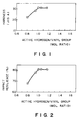
- Example 1 While the addition amount of the Component (IV) used in Example 1, i.e., the surface-modified synthetic hydrous silicic acid containing a reactive group which had been modified by 3,3,3-trifluoropropyltrimethoxysilane and vinyltriethoxysilane was 10 wt. % based on the total amount of the composition, and the mole of the vinyl group (hereinafter, referred to as "Vi") contained in the Component (I), and the hydrogen atom (hereinafter, referred to "H") bonded to the silicon atom of the Component (II) were changed.
- the mole ratio between the hydrogen atom bonded to the silicon atom (H) and the reactive vinyl group (Vi) was represented by H/Vi. More specifically, 100 wt. parts of the Component (I) was used and the proportion of the Component (II) to be mixed therewith was changed, whereby the mol ratio of H/Vi was changed.
- the addition reaction-type silicone rubber compositions A and B obtained in Example 1 were uniformly mixed at a weight ratio of 100:100, and then degassed to prepare a liquid mixture.
- the mixture was injected into a cylindrical metal mold in which an aluminum core bar for a heat-fixing roller to be used in an electrophotographic copying machine with an outside diameter of 60 mm coated with a siloxane-type primer had been disposed in advance and had preliminarily been heated up to 150 °C, and kept at the same temperature for 5 min. thereby to cure and mold the mixture.
- the thus formed fixing roller covered with the silicone rubber was taken out from the metal mold.
- the silicone rubber covering layer had a thickness of 0.5 mm.
- the thus obtained fixing roller was disposed in a heat fixing device as shown in Figure 4, and a fixing test was conducted while sheets of paper were continuously passed through the fixing device under the following conditions.
- Controlled temperature of fixing roller 1 surface 175 - 185 °C
- Oil application device 3 A web-type application device including a paper web (trade name: Normex Web, mfd. by Japan Vilene Co., Ltd.) impregnated with a silicone oil (KP96H, mfd. by Shinetsu Kagaku K.K.) having a viscosity of 10,000 mPa ⁇ s (10,000 cs) at 25 °C Web feed speed: 1 m per 10,000 sheets of paper supply (A-4 size) Supplied paper: A4 size transfer paper (plain paper) on which an unfixed toner image corresponding to a test pattern was formed. Paper supply speed: 50 sheets/min.
- Nip width (W) between the fixing roller 1 and pressure roller 2 9 - 10 mm
- a fixing roller was prepared in the same manner as in Example 4 except that the liquid addition reaction-type silicone rubber obtained in Example 2 was used, and was subjected to a fixing test while sheets of paper were continuously passed through the fixing device.
- the fixing roller 1 retained good releasability, and considerable toner offset or sheet jamming trouble due to the toner offset, which was practically problematic, did not occur, and the image quality of the fixed image was well retained. Further, the durability of the roller was excellent (i.e., roller life was considerably long).
- Fixing rollers were prepared in the same manner as in Example 4 except that the silicone compositions (the liquid addition reaction-type silicone rubber compositions) obtained in Comparative Examples 1 - 5 were used, and were subjected to a fixing test while sheets of paper were continuously passed through the fixing device.
- a fixing roller was prepared in the same manner as in Example 4 except that the a commercially available liquid addition reaction-type silicone rubber composition providing a hardness (JIS A) of 40 was used, and was subjected to a fixing test while sheets of paper were continuously passed through the fixing device.
- JIS A hardness
- the amount of the vinyl group was about 3.8x10²⁰ groups per 1 g of the powder.
- the above-mentioned Constituents (i) to (v) were those constituting a composition according to the present invention, which was prepared so that the total amount of the vinyl group contained therein was substantially equal to that of the hydrogen atom bonded to the silicon atom.
- the respective constituents were packed in the following manner so as to prepare a two-pack (or two-component) type of formulation.
- A-liquid Constituent (I) 45.35 wt. parts Constituent (III) 0.001 wt. parts Constituent (IV) 4.23 wt. parts Constituent (V) 0.43 wt. parts
- the above-mentioned components were uniformly mixed to prepare the A-liquid and B-liquid, respectively.
- the thus prepared A -liquid and B -liquid were mixed at a wt. ratio of 100:100, degassed, and heated in a heat press at 150 °C for 10 min., whereby a silicone rubber-like elastic body formed from the silicone rubber composition.
- the rubber-like elastic body was further subjected to post curing at 200 °C for 4 hours.
- Constituent (I) A vinyl group-containing dimethylpolysiloxane comprising dimethylpolysiloxane of which end was blocked by a vinyl group, and vinyl group-containing dimethylpolysiloxane of which end is blocked by a methyl group, wherein the total number of vinyl group was 8.0x10 ⁇ 5 mol/g 100 wt.
- parts Constituent (II) A methylhydrogenpolysiloxane wherein the number of hydrogen atoms bonded to the silicon atom was 2.0x10 ⁇ 3 mol/g 7.15 wt.
- Constituent (III) Platinum catalyst 0.001 wt.
- the silicic acid was forcibly stirred by means of the stirrer, 12 g of vinyltriethoxysilane was gradually dripped thereto, the resultant mixture was then taken out from the stirrer, and thereafter was air-dried at 100 °C for one hour, whereby the above-mentioned surface-treated synthetic anhydrous silicic acid containing a vinyl group was obtained.
- the amount of the vinyl group was about 3.8x10²⁰ groups per 1 g of the powder.
- the above-mentioned Constituents (i) to (v) were those constituting a composition according to the present invention, which was prepared so that the total amount of the vinyl group contained therein was substantially equal to that of the hydrogen atom bonded to the silicon atom.
- the respective constituents were packed in the following manner so as to prepare a two-pack (or two-component) type of formulation.
- A-liquid Constituent (I) 45.35 wt. parts Constituent (III) 0.001 wt. parts Constituent (IV) 4.23 wt. parts Constituent (V) 0.43 wt. parts
- the above-mentioned components were uniformly mixed to prepare the A-liquid and B-liquid, respectively.
- the thus prepared A -liquid and B -liquid were mixed at a wt. ratio of 100:100, degassed, and heated in a heat press at 150 °C for 10 min., whereby a silicone rubber-like elastic body formed from the silicone rubber composition.
- the rubber-like elastic body was further subjected to post curing at 200 °C for 4 hours.
- a composition according to the present invention was formed from the Constituents (I), (II) and (III) used in Example 6 and Constituent (IV) prepared in the following manner.
- the powder was taken out from the stirrer, and thereafter was air-dried at 100°C for one hour, whereby the above-mentioned surface-treated synthetic hydrous silicic acid containing a vinyl group was obtained.
- the amount of the vinyl group was about 3.8x10²⁰ groups per 1 g of the powder.
- the above-mentioned Constituents (i) to (v) were those constituting a composition according to the present invention, which was prepared so that the total amount of the vinyl group contained therein was substantially equal to that of the hydrogen atom bonded to the silicon atom.
- the respective constituents were packed in the following manner so as to prepare a two-pack type of formulation.
- A-liquid Constituent (I) 45.35 wt. parts Constituent (III) 0.001 wt. parts Constituent (IV) 4.23 wt. parts Constituent (V) 0.43 wt. parts
- the above-mentioned components were uniformly mixed to prepare the A-liquid and B-liquid, respectively.
- the thus prepared A -liquid and B -liquid were mixed at a wt. ratio of 100:100, degassed, and heated in a heat press at 150 °C for 10 min., whereby a silicone rubber-like elastic body formed from the silicone rubber composition.
- the rubber-like elastic body was further subjected to post curing at 200 °C for 4 hours.
- liquid A viscosity: 80,000 mPa ⁇ s (800 poise) which comprised 100 wt. parts of a vinyl group-containing dimethylpolysiloxane, 5 wt. parts of synthetic anhydrous silicic acid, 20 wt. parts of quarts powder, 1 wt. parts of red iron oxide and a platinum-type catalyst.
- liquid B viscosity: 60,000 mPa ⁇ s (600 poise)
- mixture comprising a vinyl group - containing diorganopolysiloxane and an active hydrogen group-containing siloxane
- 5 wt. parts of synthetic anhydrous silicic acid 20 wt. parts of quartz powder
- 1 wt. parts of red iron oxide 100 wt. parts of mixture (comprising a vinyl group - containing diorganopolysiloxane and an active hydrogen group-containing siloxane)
- synthetic anhydrous silicic acid comprising a vinyl group - containing diorganopolysiloxane and an active hydrogen group-containing siloxane
- synthetic anhydrous silicic acid 20 wt. parts of quartz powder
- 1 wt. parts of red iron oxide 1 wt. parts of red iron oxide.
- the A -liquid and B -liquid were mixed at a wt. ratio of 100:100, degassed, and heated in a heat press at 150 °C for 10 min, whereby a silicone rubber-like elastic body was formed from the silicone rubber composition.
- the rubber-like elastic body was further subjected to post curing at 200 °C for 4 hours.
- a rubber-like elastic body was obtained in the same manner as in Comparative Example 12 except that 30 wt. % of the synthetic anhydrous silicic acid was used.
- Constituent (I) A vinyl group-containing dimethylpolysiloxane comprising dimethylpolysiloxane of which end was blocked by a vinyl group, and vinyl group-containing dimethylpolysiloxane of which end is blocked by a methyl group, wherein the total number of vinyl group was 8.0x10 ⁇ 5 mol/g 100 wt.
- parts Constituent II) A methylhydrogenpolysiloxane wherein the number of hydrogen atoms bonded to the silicon atom was 2.0x10 ⁇ 3 mol/g 4 wt.
- Constituent (III) Platinum catalyst 0.001 wt.
- Constituent (V) Red iron oxide 1 wt. part
- the above-mentioned Constituents (I), (II), (III) and (V) were those constituting a silicone composition which was prepared so that the total amount of the vinyl group contained therein was substantially equal to that of the hydrogen atom bonded to the silicon atom.
- the respective constituents were packed in the following manner so as to prepare a two-pack type of formulation.
- the above-mentioned components were uniformly mixed to prepare the A-liquid and B-liquid, respectively.
- the thus prepared A -liquid and B -liquid were mixed at a wt. ratio of 100:100, degassed, and heated in a heat press at 150 °C for 10 min., whereby a silicone rubber-like elastic body was formed from the silicone rubber composition.
- the rubber-like elastic body was further subjected to post curing at 200 °C for 4 hours.
- Constituent (I) A vinyl group-containing dimethylpolysiloxane comprising dimethylpolysiloxane of which end was blocked by a vinyl group, and vinyl group-containing dimethylpolysiloxane of which end is blocked by a methyl group, wherein the total number of vinyl group was 8.0x10 ⁇ 5 mol/g 100 wt.
- parts Constituent (II) A methylhydrogenpolysiloxane wherein the number of hydrogen atoms bonded to the silicon atom was 2.0x10 ⁇ 3 mol/g 7.15 wt.
- Constituent (III) Platinum catalyst 0.001 wt.
- Constituent (IV) Surface-modified synthetic hydrous silicic acid containing a vinyl group of which surface had been modified by a vinyl group-containing silane compound 10 wt.
- parts Constituent (V) Red iron oxide 1 wt. part
- the above-mentioned Constituents (I) to (V) were those constituting a silicone composition, which was prepared so that the total amount of the vinyl group contained therein was substantially equal to that of the hydrogen atom bonded to the silicon atom.
- the respective constituents were packed in the following manner so as to prepare a two-component type of formulation.
- A-liquid Constituent (I) 45.35 wt. parts Constituent (III) 0.001 wt. parts Constituent (IV) 4.23 wt. parts Constituent (V) 0.43 wt. parts
- the above-mentioned components were uniformly mixed to prepare the A-liquid and B-liquid, respectively.
- the thus prepared A -liquid and B -liquid were mixed at a wt. ratio of 100:100, degassed, and heated in a heat press at 150 °C for 10 min., whereby a silicone rubber-like elastic body was formed from the silicone rubber composition.
- the rubber-like elastic body was further subjected to post curing at 200 °C for 4 hours.
- Constituent (I) A vinyl group-containing dimethylpolysiloxane comprising dimethylpolysiloxane of which end was blocked by a vinyl group, and vinyl group-containing dimethylpolysiloxane of which end is blocked by a methyl group, wherein the total number of vinyl group was 8.0x10 ⁇ 5 mol/g 100 wt.
- parts Constituent (II) A methylhydrogenpolysiloxane wherein the number of hydrogen atoms bonded to the silicon atom was 2.0x10 ⁇ 3 mol/g 4 wt.
- Constituent (III) Platinum catalyst 0.001 wt.
- part Constituent (IV) Surface-modified synthetic hydrous silicic acid containing a vinyl group of which surface had been modified by methyltrimethoxysilane 10 wt.
- parts Constituent (V) Red iron oxide 1 wt. part
- the above-mentioned Constituents (I) to (V) were those constituting a silicone composition which was prepared so that the total amount of the vinyl group contained therein was substantially equal to that of the hydrogen atom bonded to the silicon atom.
- the respective constituents were packed in the following manner so as to prepare a two-component type of formulation.
- the above-mentioned components were uniformly mixed to prepare the A-liquid and B-liquid, respectively.
- the thus prepared A -liquid and B -liquid were mixed at a wt. ratio of 100:100, degassed, and heated in a heat press at 150 o C for 10 min., whereby a silicone rubber-like elastic body was formed from the silicone rubber composition.
- the rubber-like elastic body was further subjected to post curing at 200 °C for 4 hours.
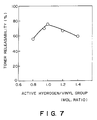
- the addition amount of the Constituent (IV) used in Example 6, i.e., the surface-modified synthetic hydrous silicic acid containing a vinyl group which had been modified by dimethylsilicone oil and vinyl group-containing silane was fixed at 10 wt. parts per 100 wt. parts of the Constituent (I) of a vinyl group-containing dimethylpolysiloxane, and the addition amount of the Constituent (II), i.e., methylhydrogenpolysiloxane was changed.
- a fixing roller having an elastic material layer formed of an addition reaction-type dimethylsilicone composition to be used for a heat and pressure fixing device was prepared in the following manner.
- an aluminum core bar having an outside diameter of 58.3 mm in the central portion thereof was subjected to sand-blasting for the purpose of decreasing, dried and then coated with a siloxane-type primer, and air-dried under heating at 130 °C for 15 min.
- the thus prepared core bar was disposed in a cylindrical metal mold which had preliminarily been heated to 150 °C.
- the addition reaction-type silicone rubber compositions A and B obtained in Example 6 were uniformly mixed at a weight ratio of 100:100, and then degassed to prepare a liquid mixture.
- the mixture was injected into the cylindrical metal mold and kept at the same temperature (150 °C) for 5 min. thereby to cure the mixture. After the curing, the thus formed fixing roller covered with the silicone rubber was taken out from the metal mold.
- the silicone rubber covering layer had a thickness of 0.5 mm.
- the thus obtained fixing roller was disposed in a heat fixing device as shown in Figure 4, and a fixing test was conducted while sheets of paper were continuously passed through the fixing device under the following conditions.
- Controlled temperature of fixing roller 1 surface 180 - 190 °C
- Oil application device 3 A web-type application device including a web (trade name: Normex Paper Web) impregnated with a dimethyl silicone oil (KP96H, mfd. by Shinetsu Kagaku K.K.) having a viscosity of 10,000 mPa ⁇ s (10,000 cs) at 25 °C Web feed speed: 1 m per 10,000 sheets of paper supply (A-4 size) Supplied paper: A4 size transfer paper (plain paper) on which an unfixed toner image corresponding to a test pattern was formed. Paper supply speed: 70 sheets/min. Nip width (W) between the fixing roller 1 and pressure roller 2: 9 - 10 mm
- a fixing roller was prepared in the same manner as in Example 10 except that the dimethyl silicone rubber composition obtained in Example 7 was used, and was subjected to a fixing test while sheets of paper were continuously passed through the fixing device in the same manner as in Example 10.
- a fixing roller was prepared in the same manner as in Example 10 except that the dimethylsilicone composition obtained in Comparative Example 12 was used, and was subjected to a fixing test while sheets of paper were continuously passed through the fixing device in the same manner as in Example 10.
- a fixing roller was prepared in the same manner as in Example 10 except that the dimethylsilicone composition obtained in Comparative Example 13 was used, and was subjected to a fixing test while sheets of paper were continuously passed through the fixing device in the same manner as in Example 10.
- the present invention provides an addition reaction-type dimethylsilicone rubber composition which is excellent in mechanical strength and has good releasability.
- the fixing device including a fixing roller comprising the dimethylsilicone rubber composition according to the present invention as a coating material can solve various problems such as paper curl, paper wrinkle, paper jamming, toner offset and contamination due to toner attachment which can occur in paper conveying or fixing operation, and can retain excellent releasability and fixing ability together with sufficient durability.
- both of the fixing and pressure rollers may use the silicone rubber composition according to the present invention as their coating material, or any one of them may use the silicone rubber composition.
Landscapes
- Chemical & Material Sciences (AREA)
- Health & Medical Sciences (AREA)
- Chemical Kinetics & Catalysis (AREA)
- Medicinal Chemistry (AREA)
- Polymers & Plastics (AREA)
- Organic Chemistry (AREA)
- Physics & Mathematics (AREA)
- General Physics & Mathematics (AREA)
- Engineering & Computer Science (AREA)
- Mechanical Engineering (AREA)
- Compositions Of Macromolecular Compounds (AREA)
- Fixing For Electrophotography (AREA)
Claims (32)
- Dimethylsiliconzusammensetzung vom Additionsreaktionstyp, die folgendes umfaßt:(I) ein Diorganopolysiloxan, das mindestens eine reaktive Vinylgruppe enthält, die an ein Siliciumatom gebunden ist,(II) ein Organopolysiloxan, das mindestens ein aktives Wasserstoffatom enthält, das an ein Siliciumatom gebunden ist, und(IV) ein Siliciumdioxidpulver mit einer spezifischen Oberfläche nach BET von 40 bis 500 m²/g, dessen Oberfläche vor dem Mischen mit (I) und (II) behandelt wurde mit(IV-1) einem Fluoralkylsilan, einer Alkylsilanverbindung, einem Fluorsiliconöl, einem Dimethylsiliconöl oder einer Mischung, daraus und(IV-2) einer Silanverbindung, die eine ungesättigte Gruppe enthält, die mit dem Organopolysiloxan (II) reagieren kann, das ein aktives Wasserstoffatom enthält, wobei die ungesättigte Gruppe in einer Form vorliegt, die geeignet ist, sie auf die Oberfläche des Siliciumdioxidpulvers aufzubringen.
- Zusammensetzung nach Anspruch 1, worin die Silanverbindung (IV-2), die eine ungesättigte Gruppe enthält, eine Vinylsilanverbindung ist.
- Zusammensetzung nach Anspruch 1, worin die Silanverbindung (IV-2), die eine ungesättigte Gruppe enthält, eine Vinylsilanverbindung ist, die aus der Gruppe ausgewählt ist, die aus Vinyltriethoxysilan, Dimethylvinylmethoxysilan, Dimethylvinyltriethoxysilan, Methylvinyldimethoxysilan, Methylvinyldiethoxysilan, Vinyltrichlorsilan, Dimethylvinylchlorsilan und Methylvinyldichlorsilan besteht.
- Zusammensetzung nach Anspruch 1, worin das Diorganopolysiloxan (I), das eine reaktive Vinylgruppe enthält, ein Diorganopolysiloxan mit Vinylgruppen an seinen beiden Enden umfaßt.
- Zusammensetzung nach Anspruch 4, worin das Diorganopolysiloxan (I), das eine reaktive Vinylgruppe enthält, eine Organosiloxaneinheit, die durch die Formel


- Zusammensetzung nach Anspruch 4, worin das Diorganopolysiloxan (I), das eine reaktive Vinylgruppe enthält, ein Diorganopolysiloxan mit Vinylgruppen an dessen beiden Enden umfaßt.
- Zusammensetzung nach Anspruch 1, worin das Diorganopolysiloxan (I), das eine reaktive Vinylgruppe enthält, eine Mischung aus einem Diorganopolysiloxan mit Vinylgruppen an dessen beiden Enden und einem Diorganopolysiloxan mit Methylgruppen an dessen beiden Enden und einer Vinylgruppe in dessen Seitenkette umfaßt.
- Zusammensetzung nach Anspruch 7, worin das Diorganopolysiloxan (I), das eine reaktive Vinylgruppe enthält, eine Mischung aus einem Dimethylpolysiloxan mit Vinylgruppen an dessen beiden Enden und einem Dimethylpolysiloxan mit Methylgruppen an dessen beiden Enden und einer Vinylgruppe in dessen Seitenkette umfaßt.
- Zusammensetzung nach Anspruch 1, worin das Diorganopolysiloxan (II), das ein aktives Wasserstoffatom enthält, ein oder mehrere Wasserstoffatome, die an ein Siliciumatom gebunden sind, pro Organopolysiloxanmolekül enthält, und eine Organosiloxaneinheit, die durch die Formel


- Zusammensetzung nach Anspruch 1, worin das Diorganopolysiloxan (II), das ein aktives Wasserstoffatom enthält, ein Methylhydropolysiloxan umfaßt, das ein oder mehrere Wasserstoffatome, die an ein Siliciumatom gebunden sind, pro Organopolysiloxanmolekül enthält.
- Zusammensetzung nach Anspruch 1, worin das Siliciumdioxidpulver (IV) eine spezifische Oberfläche nach BET voll 70 bis 400 m²/g besitzt.
- Zusammensetzung nach Anspruch 1, worin das Siliciumdioxidpulver (IV) eine Teilchengröße von 7 bis 100 m» und eine spezifische Oberfläche nach BET von 40 bis 500 m²/g besitzt.
- Zusammensetzung nach Anspruch 1, worin das Siliciumdioxidpulver (IV) eine Teilchengröße von 5 bis 50 m» und eine spezifische Oberfläche nach BET von 70 bis 400 m²/g besitzt.
- Zusammensetzung nach Anspruch 1, worin das Siliciumdioxidpulver (IV) eine Teilchengröße von 7 bis 25 m» und eine spezifische Oberfläche nach BET von 100 bis 300 m²/g besitzt.
- Zusammensetzung nach Anspruch 1, worin das Siliciumdioxidpulver (IV) behandelt wurde mit einer Silanverbindung (IV-2), die eine ungesättigte Gruppe enthält, die aus der Gruppe aus gewählt ist, bestehend aus Vinyltriethoxysilan, Dimethylvinylmethoxysilan, Dimethylvinylethoxysilan, Methylvinyldimethoxysilan, Methylvinyldiethoxysilan, Vinyltrichlorsilan, Dimethylvinylchlorsilan und Methylvinyldichlorsilan, und weiter mit einem Oberflächenbehandlungsmittel (IV-1), das aus der Gruppe ausgewählt ist, bestehend aus einem Fluoralkylsilan, das durch CnF2n+1CH₂CH₂SiRm(OR')3-m oder CnF2n+1CH₂CH₂SiRmCl3-m dargestellt wird, worin n eine ganze Zahl von 1 bis 8 bedeutet, m 0 oder 1 bedeutet und R und R' jeweils eine Methyl- oder Ethylgruppe bedeuten, Trimethylmethoxysilan, Trimethylethoxysilan, Dimethyldimethoxysilan, Dimethyldiethoxysilan, Methyltrimethoxysilan, Methyltriethoxysilan, Trimethylchlorsilan, Dimethyldichlorsilan, Methyltrichlorsilan und Hexamethyldisilazan, Fluorsiliconöl und Dimethylsiliconöl.
- Zusammensetzung nach Anspruch 15, worin das Siliciumdioxidpulver (IV) mit 1 bis 30 Gewichtsteilen der Silanverbindung (IV-2), die eine ungesättigte Gruppe enthält, und weiter mit 1 bis 30 Gewichtsteilen des Oberflächenbehandlungsmittels (IV-1) behandelt wurde, bezogen auf 100 Gewichtsteile des Siliciumdioxidpulvers (IV).
- Zusammensetzung nach Anspruch 15, worin das Siliciumdioxidpulver (IV) mit 5 bis 25 Gewichtsteilen der Silanverbindung (IV-2), die eine ungesättigte Gruppe enthält, und weiter mit 3 bis 25 Gewichtsteilen des Oberflächenbehandlungsmittels (IV-1) behandelt wurde, bezogen auf 100 Gewichtsteile des Siliciumdioxidpulvers (IV).
- Dimethylsiliconkautschukzusammensetzung, die erhalten wurde, indem ein Katalysator vom Platintyp (III) und eine Dimethylsiliconzusammensetzung nach einem der Ansprüche 1 bis 17 erhitzt wurden.
- Kautschukzusammensetzung nach Anspruch 18, die erhalten wurde, indem 5 bis 30 Gewichtsteile Siliciumdioxidpulver (IV) verwendet wurden, bezogen auf 100 Gewichtsteile einer Mischung aus dein Diorganopolysiloxan (I), das eine reaktive Vinylgruppe enthält, dein Organopolysiloxan (II), das ein aktives Wasserstoffatom enthält, und dein Katalysator vom Platintyp (III).
- Kautschukzusammensetzung nach Anspruch 18, die erhalten wurde, indem 5 bis 20 Gewichtsteile Siliciumdioxidpulver (IV) verwendet wurden, bezogen auf 100 Gewichtsteile einer Mischung aus dem Diorganopolysiloxan (I), das eine reaktive Vinylgruppe enthält, dem Organopolysiloxan (II), das ein aktives Wasserstoffatom enthält, und dein Katalysator vom Platintyp (III).
- Kautschukzusammensetzung nach Anspruch 18, die erhalten wurde, indem 6 bis 15 Gewichtsteile Siliciumdioxidpulver (IV) verwendet wurden, bezogen auf 100 Gewichtsteile einer Mischung aus dem Diorganopolysiloxan (I), das eine reaktive Vinylgruppe enthält, dein Organopolysiloxan (II), das ein aktives Wasserstoffatom enthält, und dem Katalysator vom Platintyp (III).
- Kautschukzusammensetzung nach Anspruch 18, die erhalten wurde, indem die Dimethylsiliconzusammensetzung vom Additionsreaktionstyp 0,5 bis 20 min lang auf 100 bis 180°C erhitzt wurde.
- Elastischer Umdrehungskörper, der eine elastische Schicht umfaßt, die aus einer Dimethylsiliconkautschukzusammensetzung gebildet wurde, wobei die Dimethylsiliconkautschukzusammensetzung erhalten wurde, indem ein Katalysator vom Platintyp und eine Dimethylsiliconzusammensetzung vom Additionsreaktionstyp nach einem der Ansprüche 1 bis 17 erhitzt wurde.
- Elastischer Umdrehungskörper nach Anspruch 23, worin die Dimethylsiliconkautschukzusammensetzung erhalten wurde, indem 5 bis 30 Gewichtsteile Siliciumdioxidpulver (IV) verwendet wurden, bezogen auf 100 Gewichtsteile einer Mischung aus dem Diorganopolysiloxan (I), das eine reaktive Vinylgruppe enthält, dem Organopolysiloxan (II), das ein aktives Wasserstoffatom enthält, und dem Katalysator vom Platintyp (III).
- Elastischer Umdrehungskörper nach Anspruch 23, worin die Dimethylsiliconkautschukzusammensetzung erhalten wurde, indem 5 bis 20 Gewichtsteile Siliciumdioxidpulver (IV) verwendet wurden, bezogen auf 100 Gewichtsteile einer Mischung aus dem Diorganopolysiloxan (I), das eine reaktive Vinylgruppe enthält, dem Organopolysiloxan (II), das ein aktives Wasserstoffatom enthält, und dem Katalysator vom Platintyp (III).
- Elastischer Umdrehungskörper nach Anspruch 23, worin die Dimethylsiliconkautschukzusammensetzung erhalten wurde, indem 6 bis 15 Gewichtsteile Siliciumdioxidpulver (IV) verwendet wurden, bezogen auf 100 Gewichtsteile einer Mischung aus dem Diorganopolysiloxan (I), das eine reaktive Vinylgruppe enthält, dem Organopolysiloxan (II), das ein aktives Wasserstoffatom enthält, und dein Katalysator vom Platintyp (III).
- Elastischer Umdrehungskörper nach Anspruch 23, worin die Dimethylsiliconkautschukzusammensetzung erhalten wurde, indem die Dimethylsiliconzusammensetzung vom Additionsreaktionstyp 0,5 bis 20 min lang auf 100 bis 180°C erhitzt wurde.
- Fixiervorrichtung, die mindestens ein Paar Walzen umfaßt, zwischen denen ein ein Tonerbild tragendes Material, das ein unfixiertes Tonerbild trägt, unter Druck hindurch geschickt wird, um das Tonerbild auf dem das Tonerbild tragenden Material zu fixieren, worin mindestens eine der beiden Walzen eine elastische Schicht umfaßt, die aus einer Dimethylsiliconkautschukzusammensetzung gebildet wird, wobei die Dimethylsiliconkautschukzusammensetzung durch Erhitzen eines Katalysators vom Platintyp und einer Dimethylsiliconzusammensetzung vom Additionsreaktionstyp nach einem der Ansprüche 1 bis 17 erhalten wird.
- Fixiervorrichtung nach Anspruch 28, worin die Dimethylsiliconkautschukzusammensetzung erhalten wurde, indem 5 bis 30 Gewichtsteile Siliciumdioxidpulver (IV) verwendet wurden, bezogen auf 100 Gewichtsteile einer Mischung aus dem Diorganopolysiloxan (I), das eine reaktive Vinylgruppe enthält, dem Organopolysiloxan (II), das ein aktives Wasserstoffatom enthält, und dem Katalysator vom Platintyp (III).
- Fixiervorrichtung nach Anspruch 28, worin die Dimethylsiliconkautschukzusammensetzung erhalten wurde, indem 5 bis 20 Gewichtsteile Siliciumdioxidpulver (IV) verwendet wurden, bezogen auf 100 Gewichtsteile einer Mischung aus dem Diorganopolysiloxan (I), das eine reaktive Vinylgruppe enthält, dem Organopolysiloxan (II), das ein aktives Wasserstoffatom enthält, und dem Katalysator vom Platintyp (III).
- Fixiervorrichtung nach Anspruch 28, worin die Dimethylsiliconkautschukzusammensetzung erhalten wurde, indem 6 bis 15 Gewichtsteile Siliciumdioxidpulver (IV) verwendet wurden, bezogen auf 100 Gewichtsteile einer Mischung aus dem Diorganopolysiloxan (I), das eine reaktive Vinylgruppe enthält, dem Organopolysiloxan (II), das ein aktives Wasserstoffatom enthält, und dem Katalysator vom Platintyp (III).
- Fixiervorrichtung nach Anspruch 28, worin die Dimethylsiliconkautschukzusammensetzung erhalten wurde, indem die Dimethylsiliconzusammensetzung vom Additionsreaktionstyp 0,5 bis 20 min lang auf 100 bis 180°C erhitzt wurde.
Applications Claiming Priority (4)
| Application Number | Priority Date | Filing Date | Title |
|---|---|---|---|
| JP181158/88 | 1988-07-19 | ||
| JP63181160A JP2662420B2 (ja) | 1988-07-19 | 1988-07-19 | 付加反応型シリコーンゴム組成物を有する弾性回転体及び定着装置 |
| JP181160/88 | 1988-07-19 | ||
| JP63181158A JP2662419B2 (ja) | 1988-07-19 | 1988-07-19 | シリコーンゴム組成物,該ゴム組成物を有する弾性回転体及び定着装置 |
Publications (3)
| Publication Number | Publication Date |
|---|---|
| EP0351797A2 EP0351797A2 (de) | 1990-01-24 |
| EP0351797A3 EP0351797A3 (de) | 1991-04-17 |
| EP0351797B1 true EP0351797B1 (de) | 1995-03-22 |
Family
ID=26500441
Family Applications (1)
| Application Number | Title | Priority Date | Filing Date |
|---|---|---|---|
| EP19890113181 Expired - Lifetime EP0351797B1 (de) | 1988-07-19 | 1989-07-18 | Silikonzusammensetzung, elastischer Drehkörper und diesen verwendende Fixiervorrichtung |
Country Status (3)
| Country | Link |
|---|---|
| US (2) | US5354612A (de) |
| EP (1) | EP0351797B1 (de) |
| DE (1) | DE68921808T2 (de) |
Families Citing this family (21)
| Publication number | Priority date | Publication date | Assignee | Title |
|---|---|---|---|---|
| JP2522722B2 (ja) * | 1990-09-28 | 1996-08-07 | 東レ・ダウコーニング・シリコーン株式会社 | 圧縮抵抗性シリコ―ンゴム組成物 |
| US5302632A (en) * | 1991-04-22 | 1994-04-12 | Dow Corning Corporation | High consistency organosiloxane compositions comprising fluorinated and non-fluorinated polyorganosiloxanes |
| US5532056A (en) * | 1992-12-28 | 1996-07-02 | Shin-Etsu Chemical Co., Ltd. | Fixing belt |
| DE4322644C1 (de) * | 1993-07-07 | 1994-09-29 | Billhofer Maschf Gmbh | Vorrichtung zum Auftragen wachshaltiger Dispersionen |
| JPH07331226A (ja) * | 1993-08-27 | 1995-12-19 | Asahi Glass Co Ltd | 加熱定着ロール防汚用オイル |
| EP0676450B1 (de) * | 1994-04-08 | 1999-09-22 | Shin-Etsu Chemical Co., Ltd. | Thixotrope Fluorsilicongelzusammensetzung |
| FR2733760B1 (fr) * | 1995-05-05 | 1997-08-01 | Rhone Poulenc Chimie | Composition d'organopolysiloxane elastomerique stabilisee thermiquement par des nanoparticules metalliques et elastomere transparent obtenu |
| US5623028A (en) * | 1995-12-01 | 1997-04-22 | General Electric Company | Heat cured rubbers |
| US5780530A (en) * | 1996-03-19 | 1998-07-14 | Nippon Paint Co., Ltd. | Thermosetting resin composition |
| JP3880208B2 (ja) * | 1997-07-28 | 2007-02-14 | キヤノン株式会社 | 加熱加圧定着装置およびシリコーンゴムローラ |
| JP3573191B2 (ja) | 1998-06-22 | 2004-10-06 | 信越化学工業株式会社 | フッ素ゴム組成物及びその製造方法 |
| US6148170A (en) * | 1999-09-21 | 2000-11-14 | Illbruck Gmbh | Fuser roller having a thick wearable release layer |
| US6734453B2 (en) | 2000-08-08 | 2004-05-11 | Translucent Photonics, Inc. | Devices with optical gain in silicon |
| US6377774B1 (en) * | 2000-10-06 | 2002-04-23 | Lexmark International, Inc. | System for applying release fluid on a fuser roll of a printer |
| DE10061473A1 (de) * | 2000-12-08 | 2002-07-18 | Continental Ag | Verfahren zur Herstellung einer kieselsäurehaltigen Kautschukgrundmischung |
| AU2002341866A1 (en) * | 2001-09-27 | 2003-04-07 | Henkel Corporation | Compositions having controlled flowability and thermal properties |
| JP4323911B2 (ja) * | 2002-10-18 | 2009-09-02 | キヤノン株式会社 | 定着装置 |
| JP4498369B2 (ja) * | 2006-02-14 | 2010-07-07 | キヤノン株式会社 | 像加熱装置及びこの像加熱装置に用いられる可撓性スリーブ |
| JP4835880B2 (ja) * | 2009-03-12 | 2011-12-14 | 信越化学工業株式会社 | 液状硬化性フロロシリコーン組成物の製造方法 |
| WO2016066232A1 (en) | 2014-10-31 | 2016-05-06 | Hewlett-Packard Indigo B.V. | Electrostatic printing apparatus and intermediate transfer members |
| WO2025223803A1 (de) * | 2024-04-22 | 2025-10-30 | Evonik Operations Gmbh | Beschichtungszusammensetzung mit antihaft-eigenschaft auf basis von kieselsäuren |
Family Cites Families (13)
| Publication number | Priority date | Publication date | Assignee | Title |
|---|---|---|---|---|
| US4032502A (en) * | 1975-10-10 | 1977-06-28 | Dow Corning Corporation | Organosiloxane compositions for liquid injection |
| CA1106518A (en) * | 1977-03-07 | 1981-08-04 | William R. Hays | Flame retardant heat-curable silicone compositions containing ceric hydrate |
| JPS5434362A (en) * | 1977-08-24 | 1979-03-13 | Shin Etsu Chem Co Ltd | Curable organopolysiloxane composition |
| US4360566A (en) * | 1981-03-05 | 1982-11-23 | Toray Silicone Co., Ltd. | Curable organopolysiloxane composition for heat fixing rolls |
| US4360610A (en) * | 1981-03-23 | 1982-11-23 | Dow Corning Corporation | Method of improving silicone rubber composition |
| US4454288A (en) * | 1982-12-02 | 1984-06-12 | Dow Corning Corporation | Surface treatment of inorganic fillers |
| US4500659A (en) * | 1983-08-05 | 1985-02-19 | Dow Corning Corporation | Extrudable, curable polyorganosiloxane compositions |
| JPS60166975A (ja) * | 1984-07-09 | 1985-08-30 | Hitachi Ltd | 加熱定着ロ−ル用シリコ−ンゴム組成物 |
| JPH0816193B2 (ja) * | 1985-06-03 | 1996-02-21 | ゼロツクス コ−ポレ−シヨン | 熱安定化シリコ−ンエラストマ− |
| US4711818A (en) * | 1986-05-27 | 1987-12-08 | Xerox Corporation | Fusing member for electrostatographic reproducing apparatus |
| JPS63195409A (ja) * | 1987-02-09 | 1988-08-12 | Shin Etsu Chem Co Ltd | 弾性体ロ−ル |
| US4985477A (en) * | 1988-05-13 | 1991-01-15 | Dow Corning Corporation | Method of producing treated silica filler for silicone rubber |
| US5352724A (en) * | 1992-07-16 | 1994-10-04 | Shin-Etsu Chemical Co., Ltd. | Silicone rubber composition with improved fluidity |
-
1989
- 1989-07-17 US US07/380,639 patent/US5354612A/en not_active Expired - Lifetime
- 1989-07-18 EP EP19890113181 patent/EP0351797B1/de not_active Expired - Lifetime
- 1989-07-18 DE DE68921808T patent/DE68921808T2/de not_active Expired - Fee Related
-
1994
- 1994-07-29 US US08/282,175 patent/US5643973A/en not_active Expired - Lifetime
Also Published As
| Publication number | Publication date |
|---|---|
| DE68921808T2 (de) | 1995-08-17 |
| EP0351797A3 (de) | 1991-04-17 |
| EP0351797A2 (de) | 1990-01-24 |
| DE68921808D1 (de) | 1995-04-27 |
| US5354612A (en) | 1994-10-11 |
| US5643973A (en) | 1997-07-01 |
Similar Documents
| Publication | Publication Date | Title |
|---|---|---|
| EP0351797B1 (de) | Silikonzusammensetzung, elastischer Drehkörper und diesen verwendende Fixiervorrichtung | |
| EP0374951B1 (de) | Silikonzusammensetzung, elastischer Drehkörper und diesen verwendende Fixiervorrichtung | |
| CA1162589A (en) | Fusing member for electrostatographic copiers | |
| CA1227382A (en) | Fusing member for electrostatographic copiers | |
| EP3582027B1 (de) | Fixierelement und wärmefixiervorrichtung | |
| EP0308121B1 (de) | Fixiereinrichtung | |
| EP0322099B1 (de) | Polymeres organisches Material mit antistatischer Eigenschaft und dessen Verwendung in elastischen Drehkörpen und diesen benutzenden Befestigungs- vorrichtungen | |
| US10890869B2 (en) | Fixing member, heat fixing apparatus, and image forming apparatus | |
| US4511622A (en) | Intermediate transfer member for transferring toner image on a carrier | |
| US5803887A (en) | Heat-fixing roll for fixing device | |
| KR0185525B1 (ko) | 정착 부재 및 그를 포함하는 정착 장치 | |
| JP2937622B2 (ja) | 定着ロール | |
| JP3497065B2 (ja) | シリコーンゴム被覆ロール | |
| JP3385133B2 (ja) | 熱定着ローラー用付加硬化型シリコーンゴム組成物及びそれを用いた熱定着用ローラー | |
| JP2662419B2 (ja) | シリコーンゴム組成物,該ゴム組成物を有する弾性回転体及び定着装置 | |
| JP2662420B2 (ja) | 付加反応型シリコーンゴム組成物を有する弾性回転体及び定着装置 | |
| JP3324413B2 (ja) | 導電性シリコーンゴムロール | |
| JPH11194643A (ja) | 低硬度シリコーンゴム定着用ロール | |
| JP4251309B2 (ja) | 現像装置 | |
| EP1014220A1 (de) | Schmelzeinrichtung für die Druck-Wärme-Fixierung und Schmelzübertragung von Tonerteilchen | |
| JP7822838B2 (ja) | 定着部材及び熱定着装置 | |
| JPH03100057A (ja) | シリコーンゴム組成物、該組成物から形成される成形物、弾性回転体及び定着装置 | |
| JP3600636B2 (ja) | 溶着部材及びその剥離特性改良方法 | |
| JPS63208889A (ja) | 定着ロ−ル | |
| JPS6013512A (ja) | 熱定着用ゴムロ−ラ |
Legal Events
| Date | Code | Title | Description |
|---|---|---|---|
| PUAI | Public reference made under article 153(3) epc to a published international application that has entered the european phase |
Free format text: ORIGINAL CODE: 0009012 |
|
| 17P | Request for examination filed |
Effective date: 19890718 |
|
| AK | Designated contracting states |
Kind code of ref document: A2 Designated state(s): DE FR GB IT NL |
|
| PUAL | Search report despatched |
Free format text: ORIGINAL CODE: 0009013 |
|
| AK | Designated contracting states |
Kind code of ref document: A3 Designated state(s): DE FR GB IT NL |
|
| 17Q | First examination report despatched |
Effective date: 19921201 |
|
| GRAA | (expected) grant |
Free format text: ORIGINAL CODE: 0009210 |
|
| AK | Designated contracting states |
Kind code of ref document: B1 Designated state(s): DE FR GB IT NL |
|
| REF | Corresponds to: |
Ref document number: 68921808 Country of ref document: DE Date of ref document: 19950427 |
|
| ITF | It: translation for a ep patent filed | ||
| ET | Fr: translation filed | ||
| PLBE | No opposition filed within time limit |
Free format text: ORIGINAL CODE: 0009261 |
|
| STAA | Information on the status of an ep patent application or granted ep patent |
Free format text: STATUS: NO OPPOSITION FILED WITHIN TIME LIMIT |
|
| 26N | No opposition filed | ||
| REG | Reference to a national code |
Ref country code: GB Ref legal event code: IF02 |
|
| PGFP | Annual fee paid to national office [announced via postgrant information from national office to epo] |
Ref country code: NL Payment date: 20040704 Year of fee payment: 16 |
|
| PG25 | Lapsed in a contracting state [announced via postgrant information from national office to epo] |
Ref country code: NL Free format text: LAPSE BECAUSE OF NON-PAYMENT OF DUE FEES Effective date: 20060201 |
|
| NLV4 | Nl: lapsed or anulled due to non-payment of the annual fee |
Effective date: 20060201 |
|
| PGFP | Annual fee paid to national office [announced via postgrant information from national office to epo] |
Ref country code: DE Payment date: 20070712 Year of fee payment: 19 |
|
| PGFP | Annual fee paid to national office [announced via postgrant information from national office to epo] |
Ref country code: GB Payment date: 20070718 Year of fee payment: 19 |
|
| PGFP | Annual fee paid to national office [announced via postgrant information from national office to epo] |
Ref country code: IT Payment date: 20070731 Year of fee payment: 19 |
|
| PGFP | Annual fee paid to national office [announced via postgrant information from national office to epo] |
Ref country code: FR Payment date: 20070710 Year of fee payment: 19 |
|
| GBPC | Gb: european patent ceased through non-payment of renewal fee |
Effective date: 20080718 |
|
| PG25 | Lapsed in a contracting state [announced via postgrant information from national office to epo] |
Ref country code: DE Free format text: LAPSE BECAUSE OF NON-PAYMENT OF DUE FEES Effective date: 20090203 |
|
| REG | Reference to a national code |
Ref country code: FR Ref legal event code: ST Effective date: 20090331 |
|
| PG25 | Lapsed in a contracting state [announced via postgrant information from national office to epo] |
Ref country code: GB Free format text: LAPSE BECAUSE OF NON-PAYMENT OF DUE FEES Effective date: 20080718 |
|
| PG25 | Lapsed in a contracting state [announced via postgrant information from national office to epo] |
Ref country code: IT Free format text: LAPSE BECAUSE OF NON-PAYMENT OF DUE FEES Effective date: 20080718 Ref country code: FR Free format text: LAPSE BECAUSE OF NON-PAYMENT OF DUE FEES Effective date: 20080731 |