EP0354800A2 - Procédés pour la fabrication de dispositifs semi-conducteurs - Google Patents
Procédés pour la fabrication de dispositifs semi-conducteurs Download PDFInfo
- Publication number
- EP0354800A2 EP0354800A2 EP89308168A EP89308168A EP0354800A2 EP 0354800 A2 EP0354800 A2 EP 0354800A2 EP 89308168 A EP89308168 A EP 89308168A EP 89308168 A EP89308168 A EP 89308168A EP 0354800 A2 EP0354800 A2 EP 0354800A2
- Authority
- EP
- European Patent Office
- Prior art keywords
- lead frame
- core
- resin molded
- molded item
- box
- Prior art date
- Legal status (The legal status is an assumption and is not a legal conclusion. Google has not performed a legal analysis and makes no representation as to the accuracy of the status listed.)
- Withdrawn
Links
Images
Classifications
-
- H—ELECTRICITY
- H10—SEMICONDUCTOR DEVICES; ELECTRIC SOLID-STATE DEVICES NOT OTHERWISE PROVIDED FOR
- H10W—GENERIC PACKAGES, INTERCONNECTIONS, CONNECTORS OR OTHER CONSTRUCTIONAL DETAILS OF DEVICES COVERED BY CLASS H10
- H10W95/00—Packaging processes not covered by the other groups of this subclass
-
- H—ELECTRICITY
- H10—SEMICONDUCTOR DEVICES; ELECTRIC SOLID-STATE DEVICES NOT OTHERWISE PROVIDED FOR
- H10W—GENERIC PACKAGES, INTERCONNECTIONS, CONNECTORS OR OTHER CONSTRUCTIONAL DETAILS OF DEVICES COVERED BY CLASS H10
- H10W70/00—Package substrates; Interposers; Redistribution layers [RDL]
- H10W70/01—Manufacture or treatment
- H10W70/04—Manufacture or treatment of leadframes
- H10W70/045—Cleaning
-
- H—ELECTRICITY
- H10—SEMICONDUCTOR DEVICES; ELECTRIC SOLID-STATE DEVICES NOT OTHERWISE PROVIDED FOR
- H10W—GENERIC PACKAGES, INTERCONNECTIONS, CONNECTORS OR OTHER CONSTRUCTIONAL DETAILS OF DEVICES COVERED BY CLASS H10
- H10W76/00—Containers; Fillings or auxiliary members therefor; Seals
- H10W76/60—Seals
-
- H—ELECTRICITY
- H10—SEMICONDUCTOR DEVICES; ELECTRIC SOLID-STATE DEVICES NOT OTHERWISE PROVIDED FOR
- H10W—GENERIC PACKAGES, INTERCONNECTIONS, CONNECTORS OR OTHER CONSTRUCTIONAL DETAILS OF DEVICES COVERED BY CLASS H10
- H10W72/00—Interconnections or connectors in packages
- H10W72/50—Bond wires
- H10W72/551—Materials of bond wires
- H10W72/552—Materials of bond wires comprising metals or metalloids, e.g. silver
- H10W72/5522—Materials of bond wires comprising metals or metalloids, e.g. silver comprising gold [Au]
-
- H—ELECTRICITY
- H10—SEMICONDUCTOR DEVICES; ELECTRIC SOLID-STATE DEVICES NOT OTHERWISE PROVIDED FOR
- H10W—GENERIC PACKAGES, INTERCONNECTIONS, CONNECTORS OR OTHER CONSTRUCTIONAL DETAILS OF DEVICES COVERED BY CLASS H10
- H10W72/00—Interconnections or connectors in packages
- H10W72/50—Bond wires
- H10W72/551—Materials of bond wires
- H10W72/552—Materials of bond wires comprising metals or metalloids, e.g. silver
- H10W72/5524—Materials of bond wires comprising metals or metalloids, e.g. silver comprising aluminium [Al]
-
- H—ELECTRICITY
- H10—SEMICONDUCTOR DEVICES; ELECTRIC SOLID-STATE DEVICES NOT OTHERWISE PROVIDED FOR
- H10W—GENERIC PACKAGES, INTERCONNECTIONS, CONNECTORS OR OTHER CONSTRUCTIONAL DETAILS OF DEVICES COVERED BY CLASS H10
- H10W72/00—Interconnections or connectors in packages
- H10W72/851—Dispositions of multiple connectors or interconnections
- H10W72/874—On different surfaces
- H10W72/884—Die-attach connectors and bond wires
-
- H—ELECTRICITY
- H10—SEMICONDUCTOR DEVICES; ELECTRIC SOLID-STATE DEVICES NOT OTHERWISE PROVIDED FOR
- H10W—GENERIC PACKAGES, INTERCONNECTIONS, CONNECTORS OR OTHER CONSTRUCTIONAL DETAILS OF DEVICES COVERED BY CLASS H10
- H10W74/00—Encapsulations, e.g. protective coatings
-
- H—ELECTRICITY
- H10—SEMICONDUCTOR DEVICES; ELECTRIC SOLID-STATE DEVICES NOT OTHERWISE PROVIDED FOR
- H10W—GENERIC PACKAGES, INTERCONNECTIONS, CONNECTORS OR OTHER CONSTRUCTIONAL DETAILS OF DEVICES COVERED BY CLASS H10
- H10W90/00—Package configurations
- H10W90/701—Package configurations characterised by the relative positions of pads or connectors relative to package parts
- H10W90/731—Package configurations characterised by the relative positions of pads or connectors relative to package parts of die-attach connectors
- H10W90/736—Package configurations characterised by the relative positions of pads or connectors relative to package parts of die-attach connectors between a chip and a stacked lead frame, conducting package substrate or heat sink
-
- H—ELECTRICITY
- H10—SEMICONDUCTOR DEVICES; ELECTRIC SOLID-STATE DEVICES NOT OTHERWISE PROVIDED FOR
- H10W—GENERIC PACKAGES, INTERCONNECTIONS, CONNECTORS OR OTHER CONSTRUCTIONAL DETAILS OF DEVICES COVERED BY CLASS H10
- H10W90/00—Package configurations
- H10W90/701—Package configurations characterised by the relative positions of pads or connectors relative to package parts
- H10W90/751—Package configurations characterised by the relative positions of pads or connectors relative to package parts of bond wires
- H10W90/756—Package configurations characterised by the relative positions of pads or connectors relative to package parts of bond wires between a chip and a stacked lead frame, conducting package substrate or heat sink
-
- Y—GENERAL TAGGING OF NEW TECHNOLOGICAL DEVELOPMENTS; GENERAL TAGGING OF CROSS-SECTIONAL TECHNOLOGIES SPANNING OVER SEVERAL SECTIONS OF THE IPC; TECHNICAL SUBJECTS COVERED BY FORMER USPC CROSS-REFERENCE ART COLLECTIONS [XRACs] AND DIGESTS
- Y10—TECHNICAL SUBJECTS COVERED BY FORMER USPC
- Y10T—TECHNICAL SUBJECTS COVERED BY FORMER US CLASSIFICATION
- Y10T29/00—Metal working
- Y10T29/49—Method of mechanical manufacture
- Y10T29/49002—Electrical device making
- Y10T29/49117—Conductor or circuit manufacturing
- Y10T29/49121—Beam lead frame or beam lead device
Definitions
- This invention relates to processes for producing semiconductor devices, and more particularly to processes for producing hermetically sealed semiconductor devices in which electrical connection between a lead frame and a semiconductor element can be improved by removal of resin flash build up on the lead frame without damaging a resin molded section.
- the invention relates to hermetically sealed semiconductor devices having good adhesion between a lead frame and a core-box resin molded section, excellent humidity resistance and high reliability.
- Hermetically sealed semiconductor devices as referred to above, such as solid state image sensing devices, photosensors or ultraviolet erasable EP-ROM, generally have a box-core hollow resin molded item, a lead frame, a semiconductor chip, bonding wires and a covering member.
- such hermetically sealed semiconductor devices as mentioned above are produced hitherto by a so-called insert molding technique wherein a lead frame is first embedded in a mold and the lead frame is then integrated with a core-box hollow resin molded item by meas of a resin which is injection or transfer molded in the mold.
- the present invention is intended to solve such problems as mentioned above, and to make it possible to produce semiconductor devices, by which resinous flash formed on a lead frame can be removed therefrom without damaging the resin molded section and thereby to improve electrical connection between the lead frame and semiconductor element and, at the same time, in which removal of resinous flash formed in a plurality of semiconductor devices can effectively be performed simultaneously.
- the invention can provide a more reliable semiconductor device requiring less complicated production process, having better adhesion between the lead frame and core-box hollow resin molded item and improved humidity resistance.
- the first process according to the invention comprises involving the following steps in sequence; a step of obtaining the core-box resin molded item integrated with the lead frame by coating the portions of said lead frame expected to be in non-contact with said core-box resin molded item with an organic high molecular substance having a melting or softening point higher than a molding temperature of the resin of the core-box resin molded item and soluble in a solvent which does not dissolve said core-box resin molded item, placing said lead frame in position within a mold, and injecting said resin into said mold thereby carrying out injection or transfer molding, a step of immersing the core-box resin molded item equipped with the lead frame obtained in
- the second precess according to the invention comprises involving the following steps in sequence; a step of obtaining the core-box resin molded item integrated with the lead frame by placing said lead frame in position within the mold and injecting the resin into said mold thereby carrying out injection or transfer molding, a step of immersing the core-box resin molded item equipped with the lead frame in a liquid and subjecting it to ultrasonic vibration treatment and thereby to remove particles attached to said core-box resin molded item and flashes formed on said lead frame, a step of die bonding said semiconductor element to an island of said lead frame and then wire bonding electrodes of said semiconductor element to said lead frame, and a
- a first semiconductor device comprises a semiconductor element, a lead frame and bonding wires electrically connecting the electrodes of said semiconductor element and said lead frame, and further comprises a core-box resin molded item having a concavity in which said semiconductor element is received and a covering member sealing hermetically the whole concavity of said core-box resin molded item, wherein a difference in linear expansion coefficient between said lead frame and core-box resin molded item is less than 100 x 10 ⁇ 7 cm/cm. o C.
- the first semiconductor device can be prepared by a process which comprises involving the following steps in sequence: a step of obtaining a lead frame bearing core-box resin molded item having a difference in linear expansion coefficient between said lead frame and said lead frame bearing core-box resin molded item of less than 100 x 10 ⁇ 7 cm/cm ⁇ o C by placing in position a lead frame having a linear expansion coefficient of from 50 x 10 ⁇ 7 to 200 x 10 ⁇ 7 cm/cm ⁇ o C within a mold, and injection molding the resin into the mold, a step of die bonding said semiconductor element to an island of the lead frame and then wire bonding the electrodes of said semiconductor element to said lead frame, and a step of adhesively or fusion bonding the covering member to the concavity of said core-box resin molded item to seal hermetically the whole concavity of said core-box resin molded item.
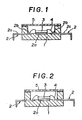
- Fig. 1 is a diagram showing a construction of the semiconductor device obtained by the first process for producing semiconductor devices of the present invention.
- a core-box resin molded item 1 integrated with a lead frame 2 is first obtained by an insert molding technique, but before or after placing the lead frame 2 in position within a mold, portions 2a, 2b and 2c of the lead frame 2 desired to be in non-contact with the core-box resin molded item 1 are coated with an organic high molecular substance soluble in a solvent which does not dissolve the core-box resin molded item 1, and then a resin is injected into the mold thereby carrying out injection or transfer molding.
- thermolyplastic resins such as polysulfones (PS), polyether sulfones, polyether ether ketones, polyphenylene oxides, polyvinyl alcohols, acrylic resins and cellulose derivatives; thermosetting resins such as epoxy resins, polyimide resins and phenolic resins or precured products of these thermosetting resins.
- thermosetting resins such as epoxy resins, polyimide resins and phenolic resins or precured products of these thermosetting resins.
- the coating operation may be carried out, for example, by screen printing or by means of computer-controlled dispensers.
- Typical resins for constituting the core-box resin molded item 1 are thermosetting resins having good adhesion to the lead frame 2, for example, epoxy resins of such types as bisphenol A, novolak and glycidylamine, and imide resins such as polyaminobismaleimide and polypyromellitic imide. These resins may contain curing agents, curing accelerators, fillers and the like.
- the aforesaid insert molding is carried out usually under conditions as a pressure of 10-500 kg/cm2 and a temperature of 150-250 o C, though these conditions may vary depending upon the kind of resin used.
- the lead frame bearing core-box resin molded item 1 obtained in the foregoing step is immersed in the aforesaid solvent to dissolve and remove the organic high molecular substance coated on the lead frame 2.
- the solvent used dissolves the organic high molecular substance coated on the lead frame 2 without dissolving the core-box resin molded item 1 obtained by insert molding.
- solvent examples include toluene, xylene, ethyl acetate, butyl acetate, acetone, methyl ethyl ketone, methylene chloride, trichloroethylene, dimethylformamide, N-methyl pyrrolidone and the like.
- the solvent used is suitably selected from among those illustrated above according to the kind of the resin used for constituting the core-box resin molded item and of the organic high molecular substance coated on the lead frame.
- methylene chloride or trichloroethylene is suitable as the solvent when the resin constituting the core-box resin molded item is polyaminobismaleimide and the organic high molecular substance is polysulfone.
- the core-box resin molded item 1 when the core-box resin molded item 1 is prepared by insert molding, flashes of the resin formed thereby come to be placed on the organic high molecular substance coated in advance on the lead frame 2, or this organic high molecular substance as coated in advance will act as a sealing agent to prevent the formation of said flashes. Accordingly, the flashes can be removed without damaging the resin molded portion by removal of the organic high molecular substance coated in advance on the lead frame 2.
- a semiconductor element 3 is die bonded to an island 2a of the lead frame and then electrodes of the semiconductor 3 are wire bonded to the lead frame 2.
- the island 2a of the lead frame and the semiconductor element 3 are electrically connected to each other, and by virtue of the above-mentioned wire bonding, each of the electrodes of the semiconductor element 3 and the lead frame 2 are electrically connected to each other via a bonding wire 4 which may be composed of gold or aluminum.
- a covering member 5 is adhesively bonded to the aforesaid core-box resin molded item 1 so as to seal hermetically the whole concavity.
- the covering member 5 used in the present invention can be one of those conventionally known such as a transparent covering member of e.g. quartz glass plate, sapphire plate, transparent alumina plate, transparent plastic plate, etc., or an opaque cov ering member such as colored glass plate, ceramics plate such as alumina, colored plastics plate, etc.
- a transparent covering member of e.g. quartz glass plate, sapphire plate, transparent alumina plate, transparent plastic plate, etc.
- an opaque cov ering member such as colored glass plate, ceramics plate such as alumina, colored plastics plate, etc.
- Adhesives suitable for use in the present invention for bonding the above-mentioned covering member 5 to the core-box resin molded item 1 include, for example, epoxy adhesives, imide adhesives and acrylic adhesives. These adhesives also have function as a sealing agent.
- a lead frame and core-box resin molded item where the difference in linear expansion coefficient therebetween is less than 100 x 10 ⁇ 7 cm/cm ⁇ o C, and that a linear expansion coefficient of the lead frame used is from 50 x 10 ⁇ 7 to 200 x 10 ⁇ 7 cm/cm ⁇ o C and that of the core-box resin molded item used is from 100 x 10 ⁇ 7 to 250 x 10 ⁇ 7 cm/cm ⁇ o C.
- ultrasonic vibration treatment may be applied thereto under such conditions as will be mentioned later.
- good electrical connection between the lead frame and semiconductor element can be accomplished be easily removing any resin flashes from the lead frame without damaging the resin molded portion, or by suppressing the formation of such flashes.
- Fig. 2 is a diagram showing a construction of semiconductor device obtained by the second process of the present invention.
- a core-box resin molded item integrated with a lead frame 2 is obtained by insert molding.
- the procedures and conditions employed in the insert molding are the same as in the first process mentioned above.
- the core-box resin molded item 1 is terminated at a stage when the aforementioned thermosetting resin reaches a degree of cure in the range of 10-70%, preferably 20-50%.
- postcure of the core-box resin molded item 1 is carried out in an oven after the completion of a second step of this process.
- degree of cure as used in the present specification is meant a percentage of torque value of the core-box resin molded item 1 at a given molding time to the maximum torque value reached at the time when said core-box resin molded item 1 is measured at a given molding temperature by means of a curastometer.
- the lead frame bearing core-box resin molded item 1 obtained in the foregoing step is immersed in a liquid and subjected to ultrasonic vibration treatment to remove particles attached to this core-box resin molded item 1 and flashes formed on the lead frame 2.
- the liquid used in the second step above is an inert solvent which does not dissolve the thermosetting resin constituting the core-box resin molded item 1, and this liquid plays the role of a rinsing liquid in the ultrasonic vibration treatment.
- the liquid mentioned above include water, alcohols such as methanol, ethanol, propanol, etc., ketones such as acetone, methyl ethyl ketone, methyl isobutyl ketone, or halogenated hydrocarbons such as trichloroethane, trichloroethylene, perchloroethylene, trichlorotrifloroethane, tetrachlorodifloroethane, etc.
- the liquid is suitably selected from among these solvents mentioned above according to the kind of resin constituting the core-box resin molded item.
- trichloroethylene or the like is suitable when the resin constituting the core-box resin molded item is polyaminobismaleimide, and methyl ethyl ketone or the like is suitable when said resin is an epoxy resin.
- the frequency of the ultrasonic wave used in the above-mentioned ultrasonic vibration treatment is from 10 to 2,000 kHz, and it is desirable that an ultrasonic wave having a frequency of 10-100 kHz is used in a first stage of ultrasonic vibration treatment, and an ultrasonic wave having a frequency of 500-2,000 kHz is used in a second stage of ultrasonic vibration treatment.
- the conditions under which the above-mentioned ultrasonic vibration treatment is carried out are such that the output is 10-100 W per 1 liter of the volume of the treatment bath, the temperature of the aforementioned rinsing liquid can range from room temperature up to a boiling point of said liquid, and the treatment bath used is capable of circulation filtering said rinsing liquid by using a precision filter membrane having a pore diameter of 0.1-1 ⁇ m at a rate of 10-50% of the capacity of the treatment bath per minute.
- a semiconductor element 3 is die bonded to an island 2a of the lead frame, and then electrodes of said semiconductor element 3 are wire bonded to the lead frame 2 in the same manner as in the first process mentioned above.
- the above-mentioned electrical connection is carried out after molding the core-box resin molded item 1, and hence the semiconductor element 3 will not undergo high temperature and impact at the time of molding the core-box resin molded item 1 as in the case of the prior art processes.
- the semiconductor element 3 can retain and exhibit its essential functions as expected.
- a covering member 5 is adhesively or fusion bonded to said core-box resin molded item 1 to seal hermetically the whole concavity of the core-box resin molded item 1.
- the removal treatment method in the present invention because the method does not require complicated steps, flashes of resin and particles (dust or resin or the like) attached to the core-box resin molded item in a plurality of semiconductor devices can be removed at a time.
- the first semiconductor device of the present invention is as shown in Fig. 2, in which the lead frame 2 used is a metallic lead frame having a linear expansion coefficient of from 50 x 10 ⁇ 7 to 200 x 10 ⁇ 7 cm/cm ⁇ o C, preferably from 70 x 10 ⁇ 7 to 180 x 10 ⁇ 7 cm/cm ⁇ o C.
- the metallic lead frame as referred to above can be, e.g., one of those of iron-copper alloys having a linear expansion coefficient of 160 x 10 ⁇ 7 to 170 x 10 ⁇ 7 cm/cm ⁇ o C, those of copper alloys such as phosphor bronze, having a linear expansion coefficient of 170 x 10 ⁇ 7 to 180 x 10 ⁇ 7 cm/cm ⁇ o C, and those of iron alloys, for example, that of 42 nickel-iron having a linear expansion coefficient of 70 x 10 ⁇ 7 cm/cm ⁇ o C and that of 52 nickel-iron having a linear expansion coefficient of 100 x 10 ⁇ 7 cm/cm ⁇ o C but lead frames of copper alloys are preferable.
- the bonding wire 3 used can be, for example, a gold wire or aluminum wire.
- the first semiconductor device of the invention comprises the core-box resin molded item 1 having a concavity in which the semi-conductor element 3 is received, and said core-box resin molded item 1 used in clude those having a linear expansion coefficient of from 100 x 10 ⁇ 7 to 250 x 10 ⁇ 7 cm/cm ⁇ o C, for example, core-box resin molded items molded from epoxy resins or imide resins containing fillers such as silica and alumina.
- the lead frame 2 and the core-box resin molded item 1 used are selected so that the difference in linear expansion coefficient between said lead frame 2 and said core-box resin molded item 1 is less than 100 x 10 ⁇ 7 cm/cm ⁇ o C, preferably less than 50 x 10 ⁇ 7 cm/cm ⁇ o C.
- the device Because the difference in linear expansion coefficient between the lead frame 2 and the core-box resin molded item 1 is less than 100 x 10 ⁇ 7 cm/cm ⁇ o C, the device has good adhesion between the lead frame 2 and the core-box resin molded item 1, good moisture resistance and high reliability.
- the covering member used can be one of those as mentioned previously.
- a resin is injected into a mold where a lead frame 2 having a linear expansion coefficient of from 50 x 10 ⁇ 7 to 200 x 10 ⁇ 7 cm/cm ⁇ o C is placed in position and thereby to obtain a lead frame bearing core-box resin molded item 1 having a difference in linear expansion coefficient between the lead frame 2 and said core-box resin molded item 1.
- the above-mentioned core-box resin molded item 1 is formed usually at a pressure of 1-500 kg/cm2 and a temperature of 100-250 o C, though these conditions may vary according to the kind of the resin used therefor.
- a semiconductor element 3 is die bonded to an island 2a of the lead frame 2, and then electrodes of said semiconductor element 3 are wire bonded to the lead frame 2.
- the island 2a of the lead frame 2 and the semiconductor element 3 are electrically connected to each other, and by virtue of the above mentioned wire bonding, each of the electrodes of the semiconductor element 3 and the lead frame 2 are electrically connected to each other via the bonding wire such as a gold wire or aluminum wire.
- a covering member 5 is adhesively bonded to the core-box resin molded item 1 so as to seal hermetically the whole concavity of said core-box resin molded item 1.
- the adhesive used in bonding the covering member 5 to the core-box resin molded item 1 can include epoxy adhesives, imide adhesives and acrylic adhesives.
- the first semiconductor device of the present invention produced by the third process has a good adhesion between the lead frame and the core-box resin molded item, excellent humidity resistance and high reliability, because said semiconductor device comprises the lead frame having a specific linear expansion coefficient and the core-box resin molded item having a specific linear expansion coefficient, wherein the difference in linear expansion coefficient between said lead frame and said core-box resin molded item is less than 100 x 10 ⁇ 7 cm/cm ⁇ o C.
- a highly reliable semiconductor device having a good adhesion between a lead frame and a core-box resin molded item and excellent humidity resistance is obtained without deteriorat ing moldability of the resin used and without complicating the production step, because the lead frame bearing core-box resin molded item is designed to be formed from the lead frame having a specific linear expansion coefficient and the core-box resin molded item having a specific linear expansion coefficient.
- a semiconductor device excellent in humidity resistance is obtained when it is produced by the following process.
- a core-box resin molded item was obtained by transfer molding an epoxy type molding material having a linear expansion coefficient of 160 x 10 ⁇ 7 cm/cm ⁇ o C under conditions of 170 o C, 60 kg/cm2 and 3 minutes in a mold where a lead frame made of a copper alloy (JIS Alloy No. C19400) having a linear expansion coefficient of 177 x 10 ⁇ 7 cm/cm ⁇ o C had been placed in position. Subsequently, the core-box resin molded item integrated with the lead frame was cured at 170 o C for 4 hours in an oven, and thereafter a solid image forming element was die bonded to an island of the lead frame, followed by wire bonding of electrodes of the element to the lead frame.
- JIS Alloy No. C19400 JIS Alloy No. C19400
- a transparent glass covering member coated with an epoxy adhesive was pressed to fix to the core-box resin molded item so as to seal the concavity of the core-box resin molded item, followed by curing the adhesive by heating in an oven at 120 o C for 60 minutes and then at 150 o C for 90 minutes.
- the solid stage image sensing device thus obtained was submitted to a pressure cooker test (PCT) in saturated water vapor of 121 o C and 2 kg/cm2, whereby sweating took place on the inner wall of the concavity of the core-box resin molded item after the lapse of 340 hours.
- PCT pressure cooker test
- a solid image forming device was produced by the same procedure as above except that the lead frame used was a lead frame made of nickel-cobalt-iron alloy having a linear expansion coefficient of 46 x 10 ⁇ 7 cm/cm/ o C.
- This solid state image sensing device was also submitted to PCT in the same manner as above, whereby sweating took place on the inner wall of the concavity of the core-box resin molded item after the lapse of 48 hours.
Landscapes
- Encapsulation Of And Coatings For Semiconductor Or Solid State Devices (AREA)
- Lead Frames For Integrated Circuits (AREA)
- Structures Or Materials For Encapsulating Or Coating Semiconductor Devices Or Solid State Devices (AREA)
Applications Claiming Priority (6)
| Application Number | Priority Date | Filing Date | Title |
|---|---|---|---|
| JP201464/88 | 1988-08-12 | ||
| JP63201464A JPH0251260A (ja) | 1988-08-12 | 1988-08-12 | 半導体装置の製造方法 |
| JP219488/88 | 1988-08-31 | ||
| JP63219488A JPH0266964A (ja) | 1988-08-31 | 1988-08-31 | 半導体装置の製造方法 |
| JP228957/88 | 1988-09-13 | ||
| JP63228957A JP2807472B2 (ja) | 1988-09-13 | 1988-09-13 | 半導体装置およびその製造方法 |
Publications (2)
| Publication Number | Publication Date |
|---|---|
| EP0354800A2 true EP0354800A2 (fr) | 1990-02-14 |
| EP0354800A3 EP0354800A3 (fr) | 1990-12-27 |
Family
ID=27327951
Family Applications (1)
| Application Number | Title | Priority Date | Filing Date |
|---|---|---|---|
| EP19890308168 Withdrawn EP0354800A3 (fr) | 1988-08-12 | 1989-08-11 | Procédés pour la fabrication de dispositifs semi-conducteurs |
Country Status (5)
| Country | Link |
|---|---|
| US (1) | US5070041A (fr) |
| EP (1) | EP0354800A3 (fr) |
| KR (1) | KR920008249B1 (fr) |
| CA (1) | CA1319763C (fr) |
| MY (1) | MY104152A (fr) |
Cited By (4)
| Publication number | Priority date | Publication date | Assignee | Title |
|---|---|---|---|---|
| EP0471507A3 (en) * | 1990-08-08 | 1993-02-03 | Texas Instruments Incorporated | Plastic cavity package lid seal process |
| EP0620589A1 (fr) * | 1993-03-30 | 1994-10-19 | AT&T Corp. | Structure d'un cadre de connexion pour des boîtiers formés par moulage |
| EP0620590A1 (fr) * | 1993-03-30 | 1994-10-19 | AT&T Corp. | Fabrication d'un cadre de connexion pour les boîtiers formés par moulage |
| DE102018207401B4 (de) | 2018-05-14 | 2026-02-26 | Schaeffler Technologies AG & Co. KG | Verfahren zur Haftverbesserung von eine elektronische Komponente umgebenden, mehrschichtigen Duroplastspritzlingen, sowie Verwendung des Verfahrens zur Umspritzung eines Getriebesteuergeräts |
Families Citing this family (37)
| Publication number | Priority date | Publication date | Assignee | Title |
|---|---|---|---|---|
| US5205036A (en) * | 1988-10-17 | 1993-04-27 | Semiconductor Energy Laboratory Co., Ltd. | Method of manufacturing a semiconductor device with selective coating on lead frame |
| US5264393A (en) * | 1988-11-25 | 1993-11-23 | Fuji Photo Film Co., Ltd. | Solid state image pickup device and method of manufacturing the same |
| JPH0760839B2 (ja) * | 1990-03-15 | 1995-06-28 | 株式会社東芝 | 半導体装置 |
| JP2548625B2 (ja) * | 1990-08-27 | 1996-10-30 | シャープ株式会社 | 半導体装置の製造方法 |
| JPH04262560A (ja) * | 1991-02-18 | 1992-09-17 | Mitsubishi Electric Corp | 樹脂封止電界効果型半導体装置およびその製造方法 |
| US5436492A (en) * | 1992-06-23 | 1995-07-25 | Sony Corporation | Charge-coupled device image sensor |
| US5280413A (en) * | 1992-09-17 | 1994-01-18 | Ceridian Corporation | Hermetically sealed circuit modules having conductive cap anchors |
| US5441918A (en) * | 1993-01-29 | 1995-08-15 | Lsi Logic Corporation | Method of making integrated circuit die package |
| AUPM345994A0 (en) * | 1994-01-21 | 1994-02-10 | Commonwealth Scientific And Industrial Research Organisation | Surface treatment of polymers |
| AUPM349094A0 (en) * | 1994-01-25 | 1994-02-17 | Commonwealth Scientific And Industrial Research Organisation | Surface treatment of substrates |
| US5550403A (en) * | 1994-06-02 | 1996-08-27 | Lsi Logic Corporation | Improved laminate package for an integrated circuit and integrated circuit having such a package |
| JP3417079B2 (ja) * | 1994-08-31 | 2003-06-16 | ソニー株式会社 | 半導体装置の製造方法 |
| US5961860A (en) * | 1995-06-01 | 1999-10-05 | National University Of Singapore | Pulse laser induced removal of mold flash on integrated circuit packages |
| US5877042A (en) * | 1996-08-28 | 1999-03-02 | Motorola, Inc. | Glass/Metal package and method for producing the same |
| JPH1123613A (ja) * | 1997-07-04 | 1999-01-29 | Tokai Rika Co Ltd | ダイアフラム式センサチップを利用したセンサ |
| US6143581A (en) | 1999-02-22 | 2000-11-07 | Micron Technology, Inc. | Asymmetric transfer molding method and an asymmetric encapsulation made therefrom |
| US6537853B1 (en) | 1999-02-22 | 2003-03-25 | Micron Technology, Inc. | Overmolding encapsulation process |
| US6274927B1 (en) | 1999-06-03 | 2001-08-14 | Amkor Technology, Inc. | Plastic package for an optical integrated circuit device and method of making |
| TW445608B (en) | 2000-05-19 | 2001-07-11 | Siliconware Precision Industries Co Ltd | Semiconductor package and manufacturing method thereof of lead frame without flashing |
| US6353257B1 (en) | 2000-05-19 | 2002-03-05 | Siliconware Precision Industries Co., Ltd. | Semiconductor package configuration based on lead frame having recessed and shouldered portions for flash prevention |
| US6643919B1 (en) | 2000-05-19 | 2003-11-11 | Siliconware Precision Industries Co., Ltd. | Method of fabricating a semiconductor device package having a core-hollowed portion without causing resin flash on lead frame |
| TW466720B (en) * | 2000-05-22 | 2001-12-01 | Siliconware Precision Industries Co Ltd | Semiconductor package with flash-prevention structure and manufacture method |
| US6291263B1 (en) * | 2000-06-13 | 2001-09-18 | Siliconware Precision Industries Co., Ltd. | Method of fabricating an integrated circuit package having a core-hollowed encapsulation body |
| TW490826B (en) * | 2001-05-02 | 2002-06-11 | Siliconware Precision Industries Co Ltd | Semiconductor package device and its manufacture method |
| US6511866B1 (en) * | 2001-07-12 | 2003-01-28 | Rjr Polymers, Inc. | Use of diverse materials in air-cavity packaging of electronic devices |
| US6861720B1 (en) | 2001-08-29 | 2005-03-01 | Amkor Technology, Inc. | Placement template and method for placing optical dies |
| TW508703B (en) * | 2001-10-09 | 2002-11-01 | Advanced Semiconductor Eng | Manufacturing method of semiconductor chip package structure |
| US6784534B1 (en) | 2002-02-06 | 2004-08-31 | Amkor Technology, Inc. | Thin integrated circuit package having an optically transparent window |
| SG157957A1 (en) * | 2003-01-29 | 2010-01-29 | Interplex Qlp Inc | Package for integrated circuit die |
| US6874227B2 (en) * | 2003-06-03 | 2005-04-05 | Kingpak Technology Inc. | Method for packaging an image sensor |
| US8092734B2 (en) * | 2004-05-13 | 2012-01-10 | Aptina Imaging Corporation | Covers for microelectronic imagers and methods for wafer-level packaging of microelectronics imagers |
| US20080112037A1 (en) * | 2006-11-10 | 2008-05-15 | Spatial Photonics, Inc. | Hermetic sealing of micro devices |
| US7915717B2 (en) * | 2008-08-18 | 2011-03-29 | Eastman Kodak Company | Plastic image sensor packaging for image sensors |
| US9386687B2 (en) * | 2011-12-20 | 2016-07-05 | Kyocera Corporation | Electronic component housing package and electronic apparatus |
| MY184608A (en) * | 2013-12-10 | 2021-04-07 | Carsem M Sdn Bhd | Pre-molded integrated circuit packages |
| DE102015120824A1 (de) * | 2015-12-01 | 2017-06-01 | Hesse Gmbh | Betriebsverfahren für einen Ultraschalldrahtbonder |
| US10830656B2 (en) | 2018-06-01 | 2020-11-10 | Sensata Technologies, Inc. | Overmolded lead frame assembly for pressure sensing applications |
Family Cites Families (13)
| Publication number | Priority date | Publication date | Assignee | Title |
|---|---|---|---|---|
| JPS553611A (en) * | 1978-06-21 | 1980-01-11 | Hitachi Ltd | Resin flash eliminating method |
| JPS5662347A (en) * | 1979-10-26 | 1981-05-28 | Hitachi Ltd | Production of resin molded ic |
| JPS5694636A (en) * | 1979-12-27 | 1981-07-31 | Hitachi Ltd | Manufacture of semiconductor device sealed by resin |
| KR840003533A (ko) * | 1982-01-07 | 1984-09-08 | 리챠드 에이취. 스케르벤 | 반도체용 플라스틱 패키지 리이드(package leads)위의 수지번짐을 화학적으로 제거하는 방법 |
| JPS60152033A (ja) * | 1984-01-20 | 1985-08-10 | Hitachi Ltd | ばり取り装置 |
| JPS6128313A (ja) * | 1984-07-19 | 1986-02-08 | 井関農機株式会社 | 移動農機 |
| JPS61283134A (ja) * | 1985-06-10 | 1986-12-13 | Sharp Corp | 樹脂封止型半導体装置の製造方法 |
| DE3525235C1 (de) * | 1985-07-15 | 1986-11-27 | Gkss - Forschungszentrum Geesthacht Gmbh, 2054 Geesthacht | Verfahren zur Herstellung und Erhoehung der Selektivitaet einer integralasymmetrischen Membran |
| US4729010A (en) * | 1985-08-05 | 1988-03-01 | Hitachi, Ltd. | Integrated circuit package with low-thermal expansion lead pieces |
| GB2178894B (en) * | 1985-08-06 | 1988-07-27 | Gen Electric Co Plc | Preparation of fragile devices |
| JPS6317243A (ja) * | 1986-07-03 | 1988-01-25 | 株式会社神戸製鋼所 | 鋼滓処理方法 |
| EP0273556A1 (fr) * | 1986-12-22 | 1988-07-06 | Trw Inc. | Construction d'un boîtier pour dispositif à circuit intégrés |
| JPS63172432A (ja) * | 1987-01-09 | 1988-07-16 | Mitsubishi Electric Corp | 樹脂成型品のばり取り方法 |
-
1989
- 1989-08-10 MY MYPI89001095A patent/MY104152A/en unknown
- 1989-08-10 US US07/391,986 patent/US5070041A/en not_active Expired - Fee Related
- 1989-08-11 CA CA000608088A patent/CA1319763C/fr not_active Expired - Fee Related
- 1989-08-11 EP EP19890308168 patent/EP0354800A3/fr not_active Withdrawn
- 1989-08-12 KR KR1019890011512A patent/KR920008249B1/ko not_active Expired
Cited By (4)
| Publication number | Priority date | Publication date | Assignee | Title |
|---|---|---|---|---|
| EP0471507A3 (en) * | 1990-08-08 | 1993-02-03 | Texas Instruments Incorporated | Plastic cavity package lid seal process |
| EP0620589A1 (fr) * | 1993-03-30 | 1994-10-19 | AT&T Corp. | Structure d'un cadre de connexion pour des boîtiers formés par moulage |
| EP0620590A1 (fr) * | 1993-03-30 | 1994-10-19 | AT&T Corp. | Fabrication d'un cadre de connexion pour les boîtiers formés par moulage |
| DE102018207401B4 (de) | 2018-05-14 | 2026-02-26 | Schaeffler Technologies AG & Co. KG | Verfahren zur Haftverbesserung von eine elektronische Komponente umgebenden, mehrschichtigen Duroplastspritzlingen, sowie Verwendung des Verfahrens zur Umspritzung eines Getriebesteuergeräts |
Also Published As
| Publication number | Publication date |
|---|---|
| CA1319763C (fr) | 1993-06-29 |
| MY104152A (en) | 1994-02-28 |
| KR900004007A (ko) | 1990-03-27 |
| KR920008249B1 (ko) | 1992-09-25 |
| US5070041A (en) | 1991-12-03 |
| EP0354800A3 (fr) | 1990-12-27 |
Similar Documents
| Publication | Publication Date | Title |
|---|---|---|
| EP0354800A2 (fr) | Procédés pour la fabrication de dispositifs semi-conducteurs | |
| US8101527B2 (en) | Dicing film having shrinkage release film and method for manufacturing semiconductor package using the same | |
| US5155068A (en) | Method for manufacturing an IC module for an IC card whereby an IC device and surrounding encapsulant are thinned by material removal | |
| US5424249A (en) | Method of making mold-packaged pressure sensing semiconductor device | |
| US6417028B2 (en) | Method and apparatus for removing contaminants on electronic devices | |
| US5579573A (en) | Method for fabricating an undercoated chip electrically interconnected to a substrate | |
| WO2003062779A1 (fr) | Capteur de pression, element electronique de debitmetre et procede de fabrication associe | |
| JPH02209739A (ja) | 半導体装置の製造方法 | |
| JPH05166985A (ja) | 電子部品搭載装置の製造方法 | |
| JP3112022B2 (ja) | 半導体装置の製造方法 | |
| JP2810309B2 (ja) | 半導体装置用箱型樹脂成形体の製造方法 | |
| CN117801699A (zh) | 一种用于半导体密封成型的热塑型热熔胶带及其制备方法和应用 | |
| JPH03201463A (ja) | キャビティ型パッケージ半導体装置の製造方法 | |
| JPH07226420A (ja) | 半導体装置の製造方法 | |
| JPH0251260A (ja) | 半導体装置の製造方法 | |
| JPS6215142B2 (fr) | ||
| JP3014873B2 (ja) | 半導体装置の製造方法 | |
| JP2668727B2 (ja) | 箱型樹脂成形体成形用金型およびこの金型を用いた半導体装置の製造方法 | |
| KR0144314B1 (ko) | 테스트용 패키지 및 그 제조방법 | |
| CN118448279A (zh) | 基于扇出型封装的智能卡的制造方法及智能卡 | |
| EP0620591A1 (fr) | Encapsulation en silicone d'un dispositif à flip-chip | |
| JPH04199661A (ja) | 半導体装置の製造方法 | |
| JPS61113243A (ja) | 混成集積回路の実装方法 | |
| JPH0653570A (ja) | 弾性表面波デバイスの製造方法 | |
| JPH04280658A (ja) | 窓を有する集積回路用ケースおよび製造法 |
Legal Events
| Date | Code | Title | Description |
|---|---|---|---|
| PUAI | Public reference made under article 153(3) epc to a published international application that has entered the european phase |
Free format text: ORIGINAL CODE: 0009012 |
|
| AK | Designated contracting states |
Kind code of ref document: A2 Designated state(s): AT BE CH DE ES FR GB GR IT LI LU NL SE |
|
| PUAL | Search report despatched |
Free format text: ORIGINAL CODE: 0009013 |
|
| AK | Designated contracting states |
Kind code of ref document: A3 Designated state(s): AT BE CH DE ES FR GB GR IT LI LU NL SE |
|
| 17P | Request for examination filed |
Effective date: 19901120 |
|
| 17Q | First examination report despatched |
Effective date: 19930916 |
|
| RAP1 | Party data changed (applicant data changed or rights of an application transferred) |
Owner name: MITSUI CHEMICALS, INC. |
|
| STAA | Information on the status of an ep patent application or granted ep patent |
Free format text: STATUS: THE APPLICATION IS DEEMED TO BE WITHDRAWN |
|
| 18D | Application deemed to be withdrawn |
Effective date: 19980508 |