EP0355008A2 - Organosilylalkyl- oder -alkenyl- Verbindungen, Verfahren zu ihrer Herstellung und ihre Verwendung in flüssigkristallinen Mischungen - Google Patents
Organosilylalkyl- oder -alkenyl- Verbindungen, Verfahren zu ihrer Herstellung und ihre Verwendung in flüssigkristallinen Mischungen Download PDFInfo
- Publication number
- EP0355008A2 EP0355008A2 EP89114603A EP89114603A EP0355008A2 EP 0355008 A2 EP0355008 A2 EP 0355008A2 EP 89114603 A EP89114603 A EP 89114603A EP 89114603 A EP89114603 A EP 89114603A EP 0355008 A2 EP0355008 A2 EP 0355008A2
- Authority
- EP
- European Patent Office
- Prior art keywords
- mol
- phenyl
- mixture
- pyrimidine
- ether
- Prior art date
- Legal status (The legal status is an assumption and is not a legal conclusion. Google has not performed a legal analysis and makes no representation as to the accuracy of the status listed.)
- Granted
Links
- 239000000203 mixture Substances 0.000 title claims description 139
- 239000004973 liquid crystal related substance Substances 0.000 title claims description 12
- 238000000034 method Methods 0.000 title claims description 6
- 238000002360 preparation method Methods 0.000 title claims description 4
- -1 pyrimidine-2,5-diyl Chemical group 0.000 claims abstract description 126
- 150000001875 compounds Chemical class 0.000 claims abstract description 34
- 125000005353 silylalkyl group Chemical group 0.000 claims abstract description 10
- 125000001140 1,4-phenylene group Chemical group [H]C1=C([H])C([*:2])=C([H])C([H])=C1[*:1] 0.000 claims abstract description 5
- 125000001424 substituent group Chemical group 0.000 claims abstract description 3
- 125000004432 carbon atom Chemical group C* 0.000 claims description 18
- 239000007788 liquid Substances 0.000 claims description 17
- 125000003342 alkenyl group Chemical group 0.000 claims description 14
- 125000000217 alkyl group Chemical group 0.000 claims description 13
- 239000003513 alkali Substances 0.000 claims description 5
- 125000004429 atom Chemical group 0.000 claims description 5
- 229910052801 chlorine Inorganic materials 0.000 claims description 5
- 239000004990 Smectic liquid crystal Substances 0.000 claims description 4
- 229910052760 oxygen Inorganic materials 0.000 claims description 4
- 125000002496 methyl group Chemical group [H]C([H])([H])* 0.000 claims description 3
- 229910052717 sulfur Inorganic materials 0.000 claims description 3
- 125000005714 2,5- (1,3-dioxanylene) group Chemical group [H]C1([H])OC([H])([*:1])OC([H])([H])C1([H])[*:2] 0.000 claims description 2
- 125000004450 alkenylene group Chemical group 0.000 claims description 2
- 125000002947 alkylene group Chemical group 0.000 claims description 2
- 239000002585 base Substances 0.000 claims description 2
- 229910052799 carbon Inorganic materials 0.000 claims description 2
- 125000004786 difluoromethoxy group Chemical group [H]C(F)(F)O* 0.000 claims description 2
- 229910052736 halogen Inorganic materials 0.000 claims description 2
- 150000002367 halogens Chemical class 0.000 claims description 2
- 125000000896 monocarboxylic acid group Chemical group 0.000 claims description 2
- 150000004756 silanes Chemical class 0.000 claims description 2
- 125000005407 trans-1,4-cyclohexylene group Chemical group [H]C1([H])C([H])([H])[C@]([H])([*:2])C([H])([H])C([H])([H])[C@@]1([H])[*:1] 0.000 claims description 2
- 239000002253 acid Substances 0.000 abstract description 6
- 125000005741 alkyl alkenyl group Chemical group 0.000 abstract 2
- 125000003118 aryl group Chemical group 0.000 abstract 1
- 125000000753 cycloalkyl group Chemical group 0.000 abstract 1
- 125000000524 functional group Chemical group 0.000 abstract 1
- 125000001072 heteroaryl group Chemical group 0.000 abstract 1
- RTZKZFJDLAIYFH-UHFFFAOYSA-N Diethyl ether Chemical compound CCOCC RTZKZFJDLAIYFH-UHFFFAOYSA-N 0.000 description 95
- 238000000819 phase cycle Methods 0.000 description 54
- 239000012071 phase Substances 0.000 description 52
- 238000002844 melting Methods 0.000 description 46
- 230000008018 melting Effects 0.000 description 46
- 125000001181 organosilyl group Chemical group [SiH3]* 0.000 description 35
- 238000002425 crystallisation Methods 0.000 description 13
- 230000008025 crystallization Effects 0.000 description 13
- ZMXDDKWLCZADIW-UHFFFAOYSA-N N,N-Dimethylformamide Chemical compound CN(C)C=O ZMXDDKWLCZADIW-UHFFFAOYSA-N 0.000 description 12
- 230000010287 polarization Effects 0.000 description 12
- IBYIRCIVTGUDNK-UHFFFAOYSA-N 2-(4-butoxyphenyl)-5-octoxypyrimidine Chemical compound N1=CC(OCCCCCCCC)=CN=C1C1=CC=C(OCCCC)C=C1 IBYIRCIVTGUDNK-UHFFFAOYSA-N 0.000 description 11
- HOAGGFRICQSSLG-UHFFFAOYSA-N 2-(4-hexoxyphenyl)-5-octoxypyrimidine Chemical compound N1=CC(OCCCCCCCC)=CN=C1C1=CC=C(OCCCCCC)C=C1 HOAGGFRICQSSLG-UHFFFAOYSA-N 0.000 description 11
- IETWSNMXSKALFY-UHFFFAOYSA-N 5-octoxy-2-(4-octoxyphenyl)pyrimidine Chemical compound C1=CC(OCCCCCCCC)=CC=C1C1=NC=C(OCCCCCCCC)C=N1 IETWSNMXSKALFY-UHFFFAOYSA-N 0.000 description 11
- 239000002019 doping agent Substances 0.000 description 11
- XYGUNTNTTDQAGL-UHFFFAOYSA-N 2-(4-decoxyphenyl)-5-octoxypyrimidine Chemical compound C1=CC(OCCCCCCCCCC)=CC=C1C1=NC=C(OCCCCCCCC)C=N1 XYGUNTNTTDQAGL-UHFFFAOYSA-N 0.000 description 10
- YMWUJEATGCHHMB-UHFFFAOYSA-N Dichloromethane Chemical compound ClCCl YMWUJEATGCHHMB-UHFFFAOYSA-N 0.000 description 10
- 125000001997 phenyl group Chemical group [H]C1=C([H])C([H])=C(*)C([H])=C1[H] 0.000 description 9
- HEDRZPFGACZZDS-UHFFFAOYSA-N Chloroform Chemical compound ClC(Cl)Cl HEDRZPFGACZZDS-UHFFFAOYSA-N 0.000 description 8
- VLKZOEOYAKHREP-UHFFFAOYSA-N n-Hexane Chemical compound CCCCCC VLKZOEOYAKHREP-UHFFFAOYSA-N 0.000 description 8
- 0 *CC1CCCC1 Chemical compound *CC1CCCC1 0.000 description 7
- CZPWVGJYEJSRLH-UHFFFAOYSA-N Pyrimidine Chemical compound C1=CN=CN=C1 CZPWVGJYEJSRLH-UHFFFAOYSA-N 0.000 description 7
- 238000001816 cooling Methods 0.000 description 7
- 239000000243 solution Substances 0.000 description 7
- 230000002269 spontaneous effect Effects 0.000 description 7
- KFZMGEQAYNKOFK-UHFFFAOYSA-N Isopropanol Chemical compound CC(C)O KFZMGEQAYNKOFK-UHFFFAOYSA-N 0.000 description 6
- OKKJLVBELUTLKV-UHFFFAOYSA-N Methanol Chemical compound OC OKKJLVBELUTLKV-UHFFFAOYSA-N 0.000 description 6
- VYPSYNLAJGMNEJ-UHFFFAOYSA-N Silicium dioxide Chemical compound O=[Si]=O VYPSYNLAJGMNEJ-UHFFFAOYSA-N 0.000 description 6
- WYURNTSHIVDZCO-UHFFFAOYSA-N Tetrahydrofuran Chemical compound C1CCOC1 WYURNTSHIVDZCO-UHFFFAOYSA-N 0.000 description 6
- 150000002148 esters Chemical class 0.000 description 6
- 230000002349 favourable effect Effects 0.000 description 6
- 239000000126 substance Substances 0.000 description 5
- NZNICZRIRMGOFG-UHFFFAOYSA-N 4-decoxybenzoic acid Chemical compound CCCCCCCCCCOC1=CC=C(C(O)=O)C=C1 NZNICZRIRMGOFG-UHFFFAOYSA-N 0.000 description 4
- CSNNHWWHGAXBCP-UHFFFAOYSA-L Magnesium sulfate Chemical compound [Mg+2].[O-][S+2]([O-])([O-])[O-] CSNNHWWHGAXBCP-UHFFFAOYSA-L 0.000 description 4
- 125000002887 hydroxy group Chemical group [H]O* 0.000 description 4
- RIOQSEWOXXDEQQ-UHFFFAOYSA-N triphenylphosphine Chemical compound C1=CC=CC=C1P(C=1C=CC=CC=1)C1=CC=CC=C1 RIOQSEWOXXDEQQ-UHFFFAOYSA-N 0.000 description 4
- QQGCYEYOCMPRCB-UHFFFAOYSA-N 2-(4-dodecoxyphenyl)-5-octylpyrimidine Chemical compound C1=CC(OCCCCCCCCCCCC)=CC=C1C1=NC=C(CCCCCCCC)C=N1 QQGCYEYOCMPRCB-UHFFFAOYSA-N 0.000 description 3
- OXPDQFOKSZYEMJ-UHFFFAOYSA-N 2-phenylpyrimidine Chemical class C1=CC=CC=C1C1=NC=CC=N1 OXPDQFOKSZYEMJ-UHFFFAOYSA-N 0.000 description 3
- 230000008901 benefit Effects 0.000 description 3
- 238000006243 chemical reaction Methods 0.000 description 3
- 239000000460 chlorine Substances 0.000 description 3
- 229910052681 coesite Inorganic materials 0.000 description 3
- 229910052906 cristobalite Inorganic materials 0.000 description 3
- 239000013078 crystal Substances 0.000 description 3
- 150000001564 phenyl benzoates Chemical class 0.000 description 3
- 238000001953 recrystallisation Methods 0.000 description 3
- 239000000377 silicon dioxide Substances 0.000 description 3
- 235000012239 silicon dioxide Nutrition 0.000 description 3
- 229910052682 stishovite Inorganic materials 0.000 description 3
- 238000003786 synthesis reaction Methods 0.000 description 3
- YLQBMQCUIZJEEH-UHFFFAOYSA-N tetrahydrofuran Natural products C=1C=COC=1 YLQBMQCUIZJEEH-UHFFFAOYSA-N 0.000 description 3
- 229910052905 tridymite Inorganic materials 0.000 description 3
- GHYOCDFICYLMRF-UTIIJYGPSA-N (2S,3R)-N-[(2S)-3-(cyclopenten-1-yl)-1-[(2R)-2-methyloxiran-2-yl]-1-oxopropan-2-yl]-3-hydroxy-3-(4-methoxyphenyl)-2-[[(2S)-2-[(2-morpholin-4-ylacetyl)amino]propanoyl]amino]propanamide Chemical compound C1(=CCCC1)C[C@@H](C(=O)[C@@]1(OC1)C)NC([C@H]([C@@H](C1=CC=C(C=C1)OC)O)NC([C@H](C)NC(CN1CCOCC1)=O)=O)=O GHYOCDFICYLMRF-UTIIJYGPSA-N 0.000 description 2
- DCKBKOTWLPKZBD-UHFFFAOYSA-N 2-(4-dodecoxyphenyl)-5-octoxypyrimidine Chemical compound C1=CC(OCCCCCCCCCCCC)=CC=C1C1=NC=C(OCCCCCCCC)C=N1 DCKBKOTWLPKZBD-UHFFFAOYSA-N 0.000 description 2
- YSLLSTYBZAIXMY-UHFFFAOYSA-N 2-(4-octoxyphenyl)-5-octylpyrimidine Chemical compound C1=CC(OCCCCCCCC)=CC=C1C1=NC=C(CCCCCCCC)C=N1 YSLLSTYBZAIXMY-UHFFFAOYSA-N 0.000 description 2
- OKGMOHVZKYWVHL-UHFFFAOYSA-N 4-(5-octoxypyrimidin-2-yl)phenol Chemical compound N1=CC(OCCCCCCCC)=CN=C1C1=CC=C(O)C=C1 OKGMOHVZKYWVHL-UHFFFAOYSA-N 0.000 description 2
- IALWCYFULVHLEC-UHFFFAOYSA-N 4-(octyloxy)benzoic acid Chemical compound CCCCCCCCOC1=CC=C(C(O)=O)C=C1 IALWCYFULVHLEC-UHFFFAOYSA-N 0.000 description 2
- XOILUCSJTXOMTE-UHFFFAOYSA-N 5-octoxy-2-(4-pentoxyphenyl)pyrimidine Chemical compound N1=CC(OCCCCCCCC)=CN=C1C1=CC=C(OCCCCC)C=C1 XOILUCSJTXOMTE-UHFFFAOYSA-N 0.000 description 2
- 239000005046 Chlorosilane Substances 0.000 description 2
- 229910002621 H2PtCl6 Inorganic materials 0.000 description 2
- 238000006959 Williamson synthesis reaction Methods 0.000 description 2
- MLGVTNXGUIYHNS-UHFFFAOYSA-N [4-[4-[butyl(dimethyl)silyl]butoxy]phenyl] 4-decoxybenzoate Chemical compound C1=CC(OCCCCCCCCCC)=CC=C1C(=O)OC1=CC=C(OCCCC[Si](C)(C)CCCC)C=C1 MLGVTNXGUIYHNS-UHFFFAOYSA-N 0.000 description 2
- RBAJWIKIHUWOPH-HEYJASKDSA-N [4-[5-(4-dimethylsilyloctoxy)pyrimidin-2-yl]phenyl] (2R,3R)-3-propyloxirane-2-carboxylate Chemical compound C(CCC)C(CCCOC=1C=NC(=NC1)C1=CC=C(C=C1)OC(=O)[C@@H]1O[C@@H]1CCC)[SiH](C)C RBAJWIKIHUWOPH-HEYJASKDSA-N 0.000 description 2
- 150000007513 acids Chemical class 0.000 description 2
- 229910052784 alkaline earth metal Inorganic materials 0.000 description 2
- 230000005540 biological transmission Effects 0.000 description 2
- 230000015572 biosynthetic process Effects 0.000 description 2
- 230000008859 change Effects 0.000 description 2
- 125000001309 chloro group Chemical group Cl* 0.000 description 2
- KOPOQZFJUQMUML-UHFFFAOYSA-N chlorosilane Chemical compound Cl[SiH3] KOPOQZFJUQMUML-UHFFFAOYSA-N 0.000 description 2
- 238000011097 chromatography purification Methods 0.000 description 2
- 238000005352 clarification Methods 0.000 description 2
- 229940125797 compound 12 Drugs 0.000 description 2
- 239000000470 constituent Substances 0.000 description 2
- 238000010276 construction Methods 0.000 description 2
- LZCLXQDLBQLTDK-UHFFFAOYSA-N ethyl 2-hydroxypropanoate Chemical compound CCOC(=O)C(C)O LZCLXQDLBQLTDK-UHFFFAOYSA-N 0.000 description 2
- PCZFABIYVMFGRX-UHFFFAOYSA-N ethyl-dimethyl-[6-[4-(5-octoxypyrimidin-2-yl)phenoxy]hexyl]silane Chemical compound N1=CC(OCCCCCCCC)=CN=C1C1=CC=C(OCCCCCC[Si](C)(C)CC)C=C1 PCZFABIYVMFGRX-UHFFFAOYSA-N 0.000 description 2
- 239000005262 ferroelectric liquid crystals (FLCs) Substances 0.000 description 2
- 238000010438 heat treatment Methods 0.000 description 2
- MNWFXJYAOYHMED-UHFFFAOYSA-N hexane carboxylic acid Natural products CCCCCCC(O)=O MNWFXJYAOYHMED-UHFFFAOYSA-N 0.000 description 2
- 229910052943 magnesium sulfate Inorganic materials 0.000 description 2
- 235000019341 magnesium sulphate Nutrition 0.000 description 2
- 229910052757 nitrogen Inorganic materials 0.000 description 2
- 230000003287 optical effect Effects 0.000 description 2
- 239000012074 organic phase Substances 0.000 description 2
- 230000000704 physical effect Effects 0.000 description 2
- 125000004528 pyrimidin-5-yl group Chemical group N1=CN=CC(=C1)* 0.000 description 2
- 239000002904 solvent Substances 0.000 description 2
- 125000006850 spacer group Chemical group 0.000 description 2
- 230000007704 transition Effects 0.000 description 2
- BEAFUCLMTVSTFN-UHFFFAOYSA-N (2-butoxy-4-butyl-5-decan-4-yloxy-3-dimethylsilylphenyl) benzoate Chemical compound C(C1=CC=CC=C1)(=O)OC1=C(C(=C(C(=C1)OC(CCC)CCCCCC)CCCC)[SiH](C)C)OCCCC BEAFUCLMTVSTFN-UHFFFAOYSA-N 0.000 description 1
- QFLWZFQWSBQYPS-AWRAUJHKSA-N (3S)-3-[[(2S)-2-[[(2S)-2-[5-[(3aS,6aR)-2-oxo-1,3,3a,4,6,6a-hexahydrothieno[3,4-d]imidazol-4-yl]pentanoylamino]-3-methylbutanoyl]amino]-3-(4-hydroxyphenyl)propanoyl]amino]-4-[1-bis(4-chlorophenoxy)phosphorylbutylamino]-4-oxobutanoic acid Chemical compound CCCC(NC(=O)[C@H](CC(O)=O)NC(=O)[C@H](Cc1ccc(O)cc1)NC(=O)[C@@H](NC(=O)CCCCC1SC[C@@H]2NC(=O)N[C@H]12)C(C)C)P(=O)(Oc1ccc(Cl)cc1)Oc1ccc(Cl)cc1 QFLWZFQWSBQYPS-AWRAUJHKSA-N 0.000 description 1
- JBMARNOUPBCWIL-UHFFFAOYSA-N (4-hexoxyphenyl) 4-decoxybenzoate Chemical compound C1=CC(OCCCCCCCCCC)=CC=C1C(=O)OC1=CC=C(OCCCCCC)C=C1 JBMARNOUPBCWIL-UHFFFAOYSA-N 0.000 description 1
- DJNRDDUZOGKMIC-UHFFFAOYSA-N (4-hexoxyphenyl) 4-octoxybenzoate Chemical compound C1=CC(OCCCCCCCC)=CC=C1C(=O)OC1=CC=C(OCCCCCC)C=C1 DJNRDDUZOGKMIC-UHFFFAOYSA-N 0.000 description 1
- BHPDRSWPIXUZFU-UHFFFAOYSA-N (4-undecoxyphenyl) 4-octoxybenzoate Chemical compound C1=CC(OCCCCCCCCCCC)=CC=C1OC(=O)C1=CC=C(OCCCCCCCC)C=C1 BHPDRSWPIXUZFU-UHFFFAOYSA-N 0.000 description 1
- ZCQWMSJCLVJQEE-DEOSSOPVSA-N (4R)-2,2-dimethyl-4-[4-(5-octylpyrimidin-2-yl)phenyl]-1,3-dioxolane-4-carboxylic acid Chemical compound C(CCCCCCC)C=1C=NC(=NC=1)C1=CC=C(C=C1)[C@]1(OC(OC1)(C)C)C(=O)O ZCQWMSJCLVJQEE-DEOSSOPVSA-N 0.000 description 1
- PSBWJAXAUZVVCG-UHFFFAOYSA-N 1-[2-[2-(4-dimethylsilyloctyl)-4-(5-octoxypyrimidin-2-yl)phenoxy]-5-(5-octoxypyrimidin-2-yl)phenyl]octan-4-yl-dimethylsilane Chemical compound C(CCC)C(CCCC1=C(C=CC(=C1)C1=NC=C(C=N1)OCCCCCCCC)OC1=C(C=C(C=C1)C1=NC=C(C=N1)OCCCCCCCC)CCCC(CCCC)[SiH](C)C)[SiH](C)C PSBWJAXAUZVVCG-UHFFFAOYSA-N 0.000 description 1
- VHAPEWOKWBJHBQ-UHFFFAOYSA-N 1-bromoheptyl(dimethyl)silane Chemical compound C(CCC)CCC(Br)[SiH](C)C VHAPEWOKWBJHBQ-UHFFFAOYSA-N 0.000 description 1
- ZOSBAYFWABIRBV-UHFFFAOYSA-N 1-pentylcyclohexane-1-carboxylic acid Chemical compound CCCCCC1(C(O)=O)CCCCC1 ZOSBAYFWABIRBV-UHFFFAOYSA-N 0.000 description 1
- OIWIYLWZIIJNHU-UHFFFAOYSA-N 1-sulfanylpyrazole Chemical compound SN1C=CC=N1 OIWIYLWZIIJNHU-UHFFFAOYSA-N 0.000 description 1
- BOPCKWAMNQXCEV-UHFFFAOYSA-N 2-(4-butoxyphenyl)-5-cyclopropylpyrimidine Chemical compound C1=CC(OCCCC)=CC=C1C1=NC=C(C2CC2)C=N1 BOPCKWAMNQXCEV-UHFFFAOYSA-N 0.000 description 1
- CZVGOAPQSLSDNN-UHFFFAOYSA-N 2-(4-decoxyphenyl)-5-octylpyrimidine Chemical compound C1=CC(OCCCCCCCCCC)=CC=C1C1=NC=C(CCCCCCCC)C=N1 CZVGOAPQSLSDNN-UHFFFAOYSA-N 0.000 description 1
- WSTRYHDQRWAJAU-UHFFFAOYSA-N 2-(4-ethoxyphenyl)-5-octoxypyrimidine Chemical compound N1=CC(OCCCCCCCC)=CN=C1C1=CC=C(OCC)C=C1 WSTRYHDQRWAJAU-UHFFFAOYSA-N 0.000 description 1
- ATZLPEPWPJQANQ-UHFFFAOYSA-N 2-(4-hexoxyphenyl)-5-octylpyrimidine Chemical compound N1=CC(CCCCCCCC)=CN=C1C1=CC=C(OCCCCCC)C=C1 ATZLPEPWPJQANQ-UHFFFAOYSA-N 0.000 description 1
- AJUBHDNZOOWZEE-UHFFFAOYSA-N 2-[4-(9-cyclopropylnonoxy)phenyl]-5-octylpyrimidine Chemical compound N1=CC(CCCCCCCC)=CN=C1C(C=C1)=CC=C1OCCCCCCCCCC1CC1 AJUBHDNZOOWZEE-UHFFFAOYSA-N 0.000 description 1
- RTRTWCIWPQFYDU-UHFFFAOYSA-N 4-decylbenzoic acid Chemical compound CCCCCCCCCCC1=CC=C(C(O)=O)C=C1 RTRTWCIWPQFYDU-UHFFFAOYSA-N 0.000 description 1
- RVLAXPQGTRTHEV-UHFFFAOYSA-N 4-pentylcyclohexane-1-carboxylic acid Chemical compound CCCCCC1CCC(C(O)=O)CC1 RVLAXPQGTRTHEV-UHFFFAOYSA-N 0.000 description 1
- AWPNFXRMNNPKDW-UHFFFAOYSA-N 4-phenylthiadiazole Chemical class S1N=NC(C=2C=CC=CC=2)=C1 AWPNFXRMNNPKDW-UHFFFAOYSA-N 0.000 description 1
- MDJXWYVEZHDNPO-UHFFFAOYSA-N 4-trimethylsilylbutan-1-ol Chemical compound C[Si](C)(C)CCCCO MDJXWYVEZHDNPO-UHFFFAOYSA-N 0.000 description 1
- POLXSYLXJNDXCF-UHFFFAOYSA-N 5-(4-hexylphenyl)-2-(4-octylphenyl)pyrimidine Chemical compound C1=CC(CCCCCCCC)=CC=C1C1=NC=C(C=2C=CC(CCCCCC)=CC=2)C=N1 POLXSYLXJNDXCF-UHFFFAOYSA-N 0.000 description 1
- YHQOKFPEPNWEQH-ONJSCSTBSA-N 5-[4-[(5S)-3-methoxy-1,4-dioxaspiro[4.5]decan-6-yl]phenyl]-2-octoxypyrimidine Chemical compound COC1O[C@@]2(C(CCCC2)C2=CC=C(C=C2)C=2C=NC(=NC=2)OCCCCCCCC)OC1 YHQOKFPEPNWEQH-ONJSCSTBSA-N 0.000 description 1
- QCXHUTILGUPCNM-UHFFFAOYSA-N 5-octyl-2-(4-undec-10-enoxyphenyl)pyrimidine Chemical compound N1=CC(CCCCCCCC)=CN=C1C1=CC=C(OCCCCCCCCCC=C)C=C1 QCXHUTILGUPCNM-UHFFFAOYSA-N 0.000 description 1
- YSTAIQAKOQJIES-UHFFFAOYSA-N 8-[2-[2-(4-butoxybutoxy)phenyl]pyrimidin-5-yl]oxyoctan-3-yl-dimethylsilane Chemical compound C(CCC)OCCCCOC1=C(C=CC=C1)C1=NC=C(C=N1)OCCCCCC([SiH](C)C)CC YSTAIQAKOQJIES-UHFFFAOYSA-N 0.000 description 1
- NLXLAEXVIDQMFP-UHFFFAOYSA-N Ammonia chloride Chemical compound [NH4+].[Cl-] NLXLAEXVIDQMFP-UHFFFAOYSA-N 0.000 description 1
- 239000005711 Benzoic acid Substances 0.000 description 1
- CWXXENWXEYDKAE-UHFFFAOYSA-N C(C)C(CCCCOC=1C=NC(=NC1)C1=CC=C(C=C1)OC(CCCCCCCC)=O)[SiH](C)C Chemical compound C(C)C(CCCCOC=1C=NC(=NC1)C1=CC=C(C=C1)OC(CCCCCCCC)=O)[SiH](C)C CWXXENWXEYDKAE-UHFFFAOYSA-N 0.000 description 1
- AFHLSBOKZCQIJA-UHFFFAOYSA-N C(CCC)C1=CC(=C(C=C1)C1=NC=C(C=N1)C1=CC=C(C=C1)OCCCCCC)OCCCC[SiH](C)C Chemical compound C(CCC)C1=CC(=C(C=C1)C1=NC=C(C=N1)C1=CC=C(C=C1)OCCCCCC)OCCCC[SiH](C)C AFHLSBOKZCQIJA-UHFFFAOYSA-N 0.000 description 1
- SGILBPXLCJTTEY-UHFFFAOYSA-N C(CCC)C=1C(=C(C=CC1)C1=NC=C(C=N1)OCCCCCCCC)OCCCC[SiH](C)C Chemical compound C(CCC)C=1C(=C(C=CC1)C1=NC=C(C=N1)OCCCCCCCC)OCCCC[SiH](C)C SGILBPXLCJTTEY-UHFFFAOYSA-N 0.000 description 1
- ZGSNLMXCQYMMNB-UHFFFAOYSA-N C(CCC)C=1C(=C(C=CC1)C1=NC=NC=C1)OCCCC[SiH](C)C Chemical compound C(CCC)C=1C(=C(C=CC1)C1=NC=NC=C1)OCCCC[SiH](C)C ZGSNLMXCQYMMNB-UHFFFAOYSA-N 0.000 description 1
- YGAWFPNQHKFLIZ-RPLLCQBOSA-N C(CCC)C=1C(=NC(=NC1)C1=CC=C(C=C1)O[C@@]1(O[C@H]1CCCC)C)OCCCC[SiH](C)C Chemical compound C(CCC)C=1C(=NC(=NC1)C1=CC=C(C=C1)O[C@@]1(O[C@H]1CCCC)C)OCCCC[SiH](C)C YGAWFPNQHKFLIZ-RPLLCQBOSA-N 0.000 description 1
- SDAOHQOVNSCJAX-UHFFFAOYSA-N C(CCC)C=1C(=NC(=NC1[SiH](C)C)C1=CC=C(C=C1)OC(C1=CC=C(C=C1)OCCCCCCCC)=O)OCCCC Chemical compound C(CCC)C=1C(=NC(=NC1[SiH](C)C)C1=CC=C(C=C1)OC(C1=CC=C(C=C1)OCCCCCCCC)=O)OCCCC SDAOHQOVNSCJAX-UHFFFAOYSA-N 0.000 description 1
- NRMMSJWYPSNFDI-UHFFFAOYSA-N C(CCCCCCC)OC1=C(C=CC=C1)C1=NC=NC=C1 Chemical compound C(CCCCCCC)OC1=C(C=CC=C1)C1=NC=NC=C1 NRMMSJWYPSNFDI-UHFFFAOYSA-N 0.000 description 1
- OGIHDXZCQHDMCX-UHFFFAOYSA-N C(CCCCCCC)OC=1C=NC(=NC1)C1=CC=C(C=C1)OO Chemical compound C(CCCCCCC)OC=1C=NC(=NC1)C1=CC=C(C=C1)OO OGIHDXZCQHDMCX-UHFFFAOYSA-N 0.000 description 1
- FCAWXWGFZYRQJZ-JCNLHEQBSA-N C1C[C@@H](CCCCC)CC[C@@H]1C1=CC=CC=C1 Chemical compound C1C[C@@H](CCCCC)CC[C@@H]1C1=CC=CC=C1 FCAWXWGFZYRQJZ-JCNLHEQBSA-N 0.000 description 1
- UFZWYOALCMXFLS-FBSWEULCSA-N CCCCCCCCCCC1=CN=C(C2=CC=C([C@H]3CC[C@H](CCCCC)CC3)C=C2)N=C1 Chemical compound CCCCCCCCCCC1=CN=C(C2=CC=C([C@H]3CC[C@H](CCCCC)CC3)C=C2)N=C1 UFZWYOALCMXFLS-FBSWEULCSA-N 0.000 description 1
- DSLUEFOATLJFDZ-NXHUDGGCSA-N CCCCCCCCO/C(/C)=N/CC(C=N)C(C=C1)=CCC1O Chemical compound CCCCCCCCO/C(/C)=N/CC(C=N)C(C=C1)=CCC1O DSLUEFOATLJFDZ-NXHUDGGCSA-N 0.000 description 1
- DSNYFFJTZPIKFZ-UHFFFAOYSA-N CCCOc1ccccc1 Chemical compound CCCOc1ccccc1 DSNYFFJTZPIKFZ-UHFFFAOYSA-N 0.000 description 1
- LCGLNKUTAGEVQW-UHFFFAOYSA-N Dimethyl ether Chemical compound COC LCGLNKUTAGEVQW-UHFFFAOYSA-N 0.000 description 1
- 238000006751 Mitsunobu reaction Methods 0.000 description 1
- 239000004642 Polyimide Substances 0.000 description 1
- 239000002262 Schiff base Substances 0.000 description 1
- 150000004753 Schiff bases Chemical class 0.000 description 1
- BLRPTPMANUNPDV-UHFFFAOYSA-N Silane Chemical compound [SiH4] BLRPTPMANUNPDV-UHFFFAOYSA-N 0.000 description 1
- KEAYESYHFKHZAL-UHFFFAOYSA-N Sodium Chemical compound [Na] KEAYESYHFKHZAL-UHFFFAOYSA-N 0.000 description 1
- FAPWRFPIFSIZLT-UHFFFAOYSA-M Sodium chloride Chemical class [Na+].[Cl-] FAPWRFPIFSIZLT-UHFFFAOYSA-M 0.000 description 1
- GTFCISJGVFFHIM-UHFFFAOYSA-N [1-cyclohexyl-4-[4-(5-octylpyrimidin-2-yl)phenoxy]butyl]-dimethylsilane Chemical compound C(CCCCCCC)C=1C=NC(=NC=1)C1=CC=C(C=C1)OCCCC([SiH](C)C)C1CCCCC1 GTFCISJGVFFHIM-UHFFFAOYSA-N 0.000 description 1
- YLVLZNWLLYTGSR-IFMALSPDSA-N [2-(4-octoxypyrimidin-2-yl)phenyl] (2r,3r)-3-propyloxirane-2-carboxylate Chemical compound CCCCCCCCOC1=CC=NC(C=2C(=CC=CC=2)OC(=O)[C@H]2[C@H](O2)CCC)=N1 YLVLZNWLLYTGSR-IFMALSPDSA-N 0.000 description 1
- UNSASAAIXDIMQQ-FGZHOGPDSA-N [4-(2-octoxypyrimidin-5-yl)phenyl] (2r,3r)-3-propyloxirane-2-carboxylate Chemical compound C1=NC(OCCCCCCCC)=NC=C1C(C=C1)=CC=C1OC(=O)[C@H]1[C@@H](CCC)O1 UNSASAAIXDIMQQ-FGZHOGPDSA-N 0.000 description 1
- UBUCVQHQLRSHRK-UHFFFAOYSA-N [4-(2-octoxypyrimidin-5-yl)phenyl] 4-(3-dimethylsilylheptoxy)-2,3-difluorobenzoate Chemical compound FC1=C(C(=O)OC2=CC=C(C=C2)C=2C=NC(=NC2)OCCCCCCCC)C=CC(=C1F)OCCC(CCCC)[SiH](C)C UBUCVQHQLRSHRK-UHFFFAOYSA-N 0.000 description 1
- CVZIPDPBXKXCKE-UHFFFAOYSA-N [4-(5-octoxypyrimidin-2-yl)phenyl] 4-(3-dimethylsilylheptoxy)-2,3-difluorobenzoate Chemical compound FC1=C(C(=O)OC2=CC=C(C=C2)C2=NC=C(C=N2)OCCCCCCCC)C=CC(=C1F)OCCC(CCCC)[SiH](C)C CVZIPDPBXKXCKE-UHFFFAOYSA-N 0.000 description 1
- BZWBBPXYWJXPEH-UHFFFAOYSA-N [4-(5-octylpyrimidin-2-yl)phenyl] 4-(3-dimethylsilylheptoxy)-2,3-difluorobenzoate Chemical compound FC1=C(C(=O)OC2=CC=C(C=C2)C2=NC=C(C=N2)CCCCCCCC)C=CC(=C1F)OCCC(CCCC)[SiH](C)C BZWBBPXYWJXPEH-UHFFFAOYSA-N 0.000 description 1
- KQHDFDFYYHSIBI-HSZRJFAPSA-N [4-[5-[4-[butyl(dimethyl)silyl]butoxy]pyrimidin-2-yl]phenyl] (2r)-oxolane-2-carboxylate Chemical compound N1=CC(OCCCC[Si](C)(C)CCCC)=CN=C1C(C=C1)=CC=C1OC(=O)[C@@H]1OCCC1 KQHDFDFYYHSIBI-HSZRJFAPSA-N 0.000 description 1
- SOUPRIPKVNZSBG-UHFFFAOYSA-N [4-[6-[ethyl(dimethyl)silyl]hexoxy]phenyl] 4-decoxybenzoate Chemical compound C1=CC(OCCCCCCCCCC)=CC=C1C(=O)OC1=CC=C(OCCCCCC[Si](C)(C)CC)C=C1 SOUPRIPKVNZSBG-UHFFFAOYSA-N 0.000 description 1
- ZHUSTTJQQBOTMM-UHFFFAOYSA-N [SiH3]C1=NC(=NC=C1)C1=CC=CC=C1 Chemical class [SiH3]C1=NC(=NC=C1)C1=CC=CC=C1 ZHUSTTJQQBOTMM-UHFFFAOYSA-N 0.000 description 1
- 235000019270 ammonium chloride Nutrition 0.000 description 1
- 239000007864 aqueous solution Substances 0.000 description 1
- 238000000149 argon plasma sintering Methods 0.000 description 1
- 125000000051 benzyloxy group Chemical group [H]C1=C([H])C([H])=C(C([H])=C1[H])C([H])([H])O* 0.000 description 1
- 235000010290 biphenyl Nutrition 0.000 description 1
- 150000004074 biphenyls Chemical class 0.000 description 1
- 239000012267 brine Substances 0.000 description 1
- VOSBYEXIPDYPON-UHFFFAOYSA-N butyl-[4-[2-[2-(6-cyclopropylhexoxy)phenyl]pyrimidin-5-yl]oxybutyl]-dimethylsilane Chemical compound N1=CC(OCCCC[Si](C)(C)CCCC)=CN=C1C1=CC=CC=C1OCCCCCCC1CC1 VOSBYEXIPDYPON-UHFFFAOYSA-N 0.000 description 1
- LOLHEKLQQGZTKH-UHFFFAOYSA-N butyl-[4-[4-(2-decoxypyrimidin-5-yl)phenoxy]butyl]-dimethylsilane Chemical compound C1=NC(OCCCCCCCCCC)=NC=C1C1=CC=C(OCCCC[Si](C)(C)CCCC)C=C1 LOLHEKLQQGZTKH-UHFFFAOYSA-N 0.000 description 1
- CXTQOSVCSHXNNG-UHFFFAOYSA-N butyl-[4-[4-(2-heptoxypyrimidin-5-yl)phenoxy]butyl]-dimethylsilane Chemical compound C1=NC(OCCCCCCC)=NC=C1C1=CC=C(OCCCC[Si](C)(C)CCCC)C=C1 CXTQOSVCSHXNNG-UHFFFAOYSA-N 0.000 description 1
- XBFXXPUCMARJLF-UHFFFAOYSA-N butyl-[4-[4-(2-hexoxypyrimidin-5-yl)phenoxy]butyl]-dimethylsilane Chemical compound C1=NC(OCCCCCC)=NC=C1C1=CC=C(OCCCC[Si](C)(C)CCCC)C=C1 XBFXXPUCMARJLF-UHFFFAOYSA-N 0.000 description 1
- IJOZISJGVIQJPR-UHFFFAOYSA-N butyl-[4-[4-[butyl(dimethyl)silyl]butoxy]butyl]-dimethylsilane Chemical compound C(CCC)[Si](CCCCOCCCC[Si](CCCC)(C)C)(C)C IJOZISJGVIQJPR-UHFFFAOYSA-N 0.000 description 1
- GBJBCASGQKVHKN-UHFFFAOYSA-N butyl-dimethyl-[3-[4-(5-octoxypyrimidin-2-yl)phenoxy]propyl]silane Chemical compound N1=CC(OCCCCCCCC)=CN=C1C1=CC=C(OCCC[Si](C)(C)CCCC)C=C1 GBJBCASGQKVHKN-UHFFFAOYSA-N 0.000 description 1
- VXGGOLNCAUVPHJ-UHFFFAOYSA-N butyl-dimethyl-[3-[4-(5-octylpyrimidin-2-yl)phenoxy]propyl]silane Chemical compound N1=CC(CCCCCCCC)=CN=C1C1=CC=C(OCCC[Si](C)(C)CCCC)C=C1 VXGGOLNCAUVPHJ-UHFFFAOYSA-N 0.000 description 1
- FESINWXUWSEBPR-UHFFFAOYSA-N butyl-dimethyl-[4-[2-(4-octoxyphenyl)pyrimidin-5-yl]oxybutyl]silane Chemical compound C1=CC(OCCCCCCCC)=CC=C1C1=NC=C(OCCCC[Si](C)(C)CCCC)C=N1 FESINWXUWSEBPR-UHFFFAOYSA-N 0.000 description 1
- XGZSNDAEXHQYFG-UHFFFAOYSA-N butyl-dimethyl-[4-[4-(2-nonoxypyrimidin-5-yl)phenoxy]butyl]silane Chemical compound C1=NC(OCCCCCCCCC)=NC=C1C1=CC=C(OCCCC[Si](C)(C)CCCC)C=C1 XGZSNDAEXHQYFG-UHFFFAOYSA-N 0.000 description 1
- MPQJIMCOSXIVFC-UHFFFAOYSA-N butyl-dimethyl-[4-[4-(2-octoxypyrimidin-5-yl)phenoxy]butyl]silane Chemical compound C1=NC(OCCCCCCCC)=NC=C1C1=CC=C(OCCCC[Si](C)(C)CCCC)C=C1 MPQJIMCOSXIVFC-UHFFFAOYSA-N 0.000 description 1
- XGEIQZPCIMQBLL-UHFFFAOYSA-N butyl-dimethyl-[4-[4-(2-octylpyrimidin-5-yl)phenoxy]butyl]silane Chemical compound C1=NC(CCCCCCCC)=NC=C1C1=CC=C(OCCCC[Si](C)(C)CCCC)C=C1 XGEIQZPCIMQBLL-UHFFFAOYSA-N 0.000 description 1
- FBTYZVDXMMRIQL-UHFFFAOYSA-N butyl-dimethyl-[4-[4-(5-octoxypyrimidin-2-yl)phenoxy]butyl]silane Chemical compound N1=CC(OCCCCCCCC)=CN=C1C1=CC=C(OCCCC[Si](C)(C)CCCC)C=C1 FBTYZVDXMMRIQL-UHFFFAOYSA-N 0.000 description 1
- RCCMGFSODAQDDT-UHFFFAOYSA-N butyl-dimethyl-[4-[4-(5-octylpyrimidin-2-yl)phenoxy]butyl]silane Chemical compound N1=CC(CCCCCCCC)=CN=C1C1=CC=C(OCCCC[Si](C)(C)CCCC)C=C1 RCCMGFSODAQDDT-UHFFFAOYSA-N 0.000 description 1
- 150000001735 carboxylic acids Chemical class 0.000 description 1
- 239000003054 catalyst Substances 0.000 description 1
- 239000003153 chemical reaction reagent Substances 0.000 description 1
- YGHUUVGIRWMJGE-UHFFFAOYSA-N chlorodimethylsilane Chemical compound C[SiH](C)Cl YGHUUVGIRWMJGE-UHFFFAOYSA-N 0.000 description 1
- 230000003098 cholesteric effect Effects 0.000 description 1
- 150000001840 cholesterol esters Chemical class 0.000 description 1
- 150000001851 cinnamic acid derivatives Chemical class 0.000 description 1
- 229940125810 compound 20 Drugs 0.000 description 1
- 238000009833 condensation Methods 0.000 description 1
- 230000005494 condensation Effects 0.000 description 1
- 238000007796 conventional method Methods 0.000 description 1
- 150000001923 cyclic compounds Chemical class 0.000 description 1
- 125000004122 cyclic group Chemical group 0.000 description 1
- PJGLPSIURKJALR-UHFFFAOYSA-N cyclohexyl-dimethyl-[4-[4-(2-octoxypyrimidin-5-yl)phenoxy]butyl]silane Chemical compound C1=NC(OCCCCCCCC)=NC=C1C(C=C1)=CC=C1OCCCC[Si](C)(C)C1CCCCC1 PJGLPSIURKJALR-UHFFFAOYSA-N 0.000 description 1
- ZXXGZVGEVMPKSE-UHFFFAOYSA-N cyclohexyl-dimethyl-[4-[4-(5-octylpyrimidin-2-yl)phenoxy]butyl]silane Chemical compound N1=CC(CCCCCCCC)=CN=C1C(C=C1)=CC=C1OCCCC[Si](C)(C)C1CCCCC1 ZXXGZVGEVMPKSE-UHFFFAOYSA-N 0.000 description 1
- IGARGHRYKHJQSM-UHFFFAOYSA-N cyclohexylbenzene Chemical class C1CCCCC1C1=CC=CC=C1 IGARGHRYKHJQSM-UHFFFAOYSA-N 0.000 description 1
- 239000003989 dielectric material Substances 0.000 description 1
- FAMRKDQNMBBFBR-BQYQJAHWSA-N diethyl azodicarboxylate Substances CCOC(=O)\N=N\C(=O)OCC FAMRKDQNMBBFBR-BQYQJAHWSA-N 0.000 description 1
- WTVVASQVVZZDQI-UHFFFAOYSA-N dimethyl-[3-[4-(5-octoxypyrimidin-2-yl)phenoxy]propyl]-pentylsilane Chemical compound N1=CC(OCCCCCCCC)=CN=C1C1=CC=C(OCCC[Si](C)(C)CCCCC)C=C1 WTVVASQVVZZDQI-UHFFFAOYSA-N 0.000 description 1
- ABYMDJOYXXAMMA-UHFFFAOYSA-N dimethyl-[3-[4-(5-octylpyrimidin-2-yl)phenoxy]propyl]-pentylsilane Chemical compound N1=CC(CCCCCCCC)=CN=C1C1=CC=C(OCCC[Si](C)(C)CCCCC)C=C1 ABYMDJOYXXAMMA-UHFFFAOYSA-N 0.000 description 1
- 230000000694 effects Effects 0.000 description 1
- FAMRKDQNMBBFBR-UHFFFAOYSA-N ethyl n-ethoxycarbonyliminocarbamate Chemical compound CCOC(=O)N=NC(=O)OCC FAMRKDQNMBBFBR-UHFFFAOYSA-N 0.000 description 1
- FTRNFXWIKCTMTP-UHFFFAOYSA-N ethyl-dimethyl-[4-[4-(2-octylpyrimidin-5-yl)phenoxy]butyl]silane Chemical compound C1=NC(CCCCCCCC)=NC=C1C1=CC=C(OCCCC[Si](C)(C)CC)C=C1 FTRNFXWIKCTMTP-UHFFFAOYSA-N 0.000 description 1
- HZJQSQDHMKYPTL-UHFFFAOYSA-N ethyl-dimethyl-[4-[4-(5-octoxypyrimidin-2-yl)phenoxy]butyl]silane Chemical compound N1=CC(OCCCCCCCC)=CN=C1C1=CC=C(OCCCC[Si](C)(C)CC)C=C1 HZJQSQDHMKYPTL-UHFFFAOYSA-N 0.000 description 1
- FDUPACZERUQTIZ-UHFFFAOYSA-N ethyl-dimethyl-[4-[4-(5-octylpyrimidin-2-yl)phenoxy]butyl]silane Chemical compound N1=CC(CCCCCCCC)=CN=C1C1=CC=C(OCCCC[Si](C)(C)CC)C=C1 FDUPACZERUQTIZ-UHFFFAOYSA-N 0.000 description 1
- LZFKOAXGRZYANN-UHFFFAOYSA-N ethyl-dimethyl-[6-[2-(4-octoxyphenyl)pyrimidin-5-yl]oxyhexyl]silane Chemical compound C1=CC(OCCCCCCCC)=CC=C1C1=NC=C(OCCCCCC[Si](C)(C)CC)C=N1 LZFKOAXGRZYANN-UHFFFAOYSA-N 0.000 description 1
- 239000012530 fluid Substances 0.000 description 1
- 239000011521 glass Substances 0.000 description 1
- 229910021480 group 4 element Inorganic materials 0.000 description 1
- 150000004820 halides Chemical class 0.000 description 1
- 150000002366 halogen compounds Chemical class 0.000 description 1
- 150000002390 heteroarenes Chemical class 0.000 description 1
- 230000007062 hydrolysis Effects 0.000 description 1
- 238000006460 hydrolysis reaction Methods 0.000 description 1
- 238000010348 incorporation Methods 0.000 description 1
- NXPHGHWWQRMDIA-UHFFFAOYSA-M magnesium;carbanide;bromide Chemical compound [CH3-].[Mg+2].[Br-] NXPHGHWWQRMDIA-UHFFFAOYSA-M 0.000 description 1
- 238000005259 measurement Methods 0.000 description 1
- QLNWXBAGRTUKKI-UHFFFAOYSA-N metacetamol Chemical compound CC(=O)NC1=CC=CC(O)=C1 QLNWXBAGRTUKKI-UHFFFAOYSA-N 0.000 description 1
- 125000000956 methoxy group Chemical group [H]C([H])([H])O* 0.000 description 1
- 238000002156 mixing Methods 0.000 description 1
- 229910000510 noble metal Inorganic materials 0.000 description 1
- 239000003960 organic solvent Substances 0.000 description 1
- 150000002902 organometallic compounds Chemical class 0.000 description 1
- 125000002524 organometallic group Chemical group 0.000 description 1
- DRYBEAFNKKGQSO-UHFFFAOYSA-N pentan-2-yl cyclohexanecarboxylate Chemical compound CCCC(C)OC(=O)C1CCCCC1 DRYBEAFNKKGQSO-UHFFFAOYSA-N 0.000 description 1
- 150000002989 phenols Chemical class 0.000 description 1
- FCJSHPDYVMKCHI-UHFFFAOYSA-N phenyl benzoate Chemical compound C=1C=CC=CC=1C(=O)OC1=CC=CC=C1 FCJSHPDYVMKCHI-UHFFFAOYSA-N 0.000 description 1
- 229920001721 polyimide Polymers 0.000 description 1
- 125000006239 protecting group Chemical group 0.000 description 1
- 125000000246 pyrimidin-2-yl group Chemical group [H]C1=NC(*)=NC([H])=C1[H] 0.000 description 1
- WAMFYUNFWSIQEM-UHFFFAOYSA-N pyrimidin-2-ylsilane Chemical class [SiH3]C1=NC=CC=N1 WAMFYUNFWSIQEM-UHFFFAOYSA-N 0.000 description 1
- 150000003230 pyrimidines Chemical class 0.000 description 1
- 230000035484 reaction time Effects 0.000 description 1
- 230000009467 reduction Effects 0.000 description 1
- 238000010992 reflux Methods 0.000 description 1
- 230000008439 repair process Effects 0.000 description 1
- 229920006395 saturated elastomer Polymers 0.000 description 1
- 238000004904 shortening Methods 0.000 description 1
- 229910000077 silane Inorganic materials 0.000 description 1
- 229910052710 silicon Inorganic materials 0.000 description 1
- 150000003377 silicon compounds Chemical class 0.000 description 1
- 229910000104 sodium hydride Inorganic materials 0.000 description 1
- 239000012312 sodium hydride Substances 0.000 description 1
- HPALAKNZSZLMCH-UHFFFAOYSA-M sodium;chloride;hydrate Chemical compound O.[Na+].[Cl-] HPALAKNZSZLMCH-UHFFFAOYSA-M 0.000 description 1
- 238000010561 standard procedure Methods 0.000 description 1
- 125000000472 sulfonyl group Chemical group *S(*)(=O)=O 0.000 description 1
- 150000001911 terphenyls Chemical class 0.000 description 1
- 150000004867 thiadiazoles Chemical class 0.000 description 1
- CUESDEBMCXIIGD-UHFFFAOYSA-N trimethyl-[4-[4-(2-octylpyrimidin-5-yl)phenoxy]butyl]silane Chemical compound C1=NC(CCCCCCCC)=NC=C1C1=CC=C(OCCCC[Si](C)(C)C)C=C1 CUESDEBMCXIIGD-UHFFFAOYSA-N 0.000 description 1
- RDJHOGJVGKFBJJ-UHFFFAOYSA-N trimethyl-[4-[4-(5-octoxypyrimidin-2-yl)phenoxy]butyl]silane Chemical compound N1=CC(OCCCCCCCC)=CN=C1C1=CC=C(OCCCC[Si](C)(C)C)C=C1 RDJHOGJVGKFBJJ-UHFFFAOYSA-N 0.000 description 1
- XRCLDEZKLMLQAB-UHFFFAOYSA-N trimethyl-[4-[4-(5-octylpyrimidin-2-yl)phenoxy]butyl]silane Chemical compound N1=CC(CCCCCCCC)=CN=C1C1=CC=C(OCCCC[Si](C)(C)C)C=C1 XRCLDEZKLMLQAB-UHFFFAOYSA-N 0.000 description 1
- IPLXXHLOERRUBV-UHFFFAOYSA-N trimethyl-[6-[2-(4-octoxyphenyl)pyrimidin-5-yl]oxyhexyl]silane Chemical compound C1=CC(OCCCCCCCC)=CC=C1C1=NC=C(OCCCCCC[Si](C)(C)C)C=N1 IPLXXHLOERRUBV-UHFFFAOYSA-N 0.000 description 1
- LDKIHGLXPQJHRE-UHFFFAOYSA-N trimethyl-[6-[4-(5-octylpyridin-2-yl)phenoxy]hexyl]silane Chemical compound N1=CC(CCCCCCCC)=CC=C1C1=CC=C(OCCCCCC[Si](C)(C)C)C=C1 LDKIHGLXPQJHRE-UHFFFAOYSA-N 0.000 description 1
- XLYOFNOQVPJJNP-UHFFFAOYSA-N water Substances O XLYOFNOQVPJJNP-UHFFFAOYSA-N 0.000 description 1
Classifications
-
- C—CHEMISTRY; METALLURGY
- C07—ORGANIC CHEMISTRY
- C07F—ACYCLIC, CARBOCYCLIC OR HETEROCYCLIC COMPOUNDS CONTAINING ELEMENTS OTHER THAN CARBON, HYDROGEN, HALOGEN, OXYGEN, NITROGEN, SULFUR, SELENIUM OR TELLURIUM
- C07F7/00—Compounds containing elements of Groups 4 or 14 of the Periodic Table
- C07F7/02—Silicon compounds
- C07F7/08—Compounds having one or more C—Si linkages
-
- C—CHEMISTRY; METALLURGY
- C07—ORGANIC CHEMISTRY
- C07F—ACYCLIC, CARBOCYCLIC OR HETEROCYCLIC COMPOUNDS CONTAINING ELEMENTS OTHER THAN CARBON, HYDROGEN, HALOGEN, OXYGEN, NITROGEN, SULFUR, SELENIUM OR TELLURIUM
- C07F7/00—Compounds containing elements of Groups 4 or 14 of the Periodic Table
- C07F7/02—Silicon compounds
- C07F7/08—Compounds having one or more C—Si linkages
- C07F7/0803—Compounds with Si-C or Si-Si linkages
- C07F7/081—Compounds with Si-C or Si-Si linkages comprising at least one atom selected from the elements N, O, halogen, S, Se or Te
- C07F7/0812—Compounds with Si-C or Si-Si linkages comprising at least one atom selected from the elements N, O, halogen, S, Se or Te comprising a heterocyclic ring
-
- C—CHEMISTRY; METALLURGY
- C07—ORGANIC CHEMISTRY
- C07F—ACYCLIC, CARBOCYCLIC OR HETEROCYCLIC COMPOUNDS CONTAINING ELEMENTS OTHER THAN CARBON, HYDROGEN, HALOGEN, OXYGEN, NITROGEN, SULFUR, SELENIUM OR TELLURIUM
- C07F7/00—Compounds containing elements of Groups 4 or 14 of the Periodic Table
- C07F7/02—Silicon compounds
- C07F7/08—Compounds having one or more C—Si linkages
- C07F7/0803—Compounds with Si-C or Si-Si linkages
- C07F7/081—Compounds with Si-C or Si-Si linkages comprising at least one atom selected from the elements N, O, halogen, S, Se or Te
-
- C—CHEMISTRY; METALLURGY
- C09—DYES; PAINTS; POLISHES; NATURAL RESINS; ADHESIVES; COMPOSITIONS NOT OTHERWISE PROVIDED FOR; APPLICATIONS OF MATERIALS NOT OTHERWISE PROVIDED FOR
- C09K—MATERIALS FOR MISCELLANEOUS APPLICATIONS, NOT PROVIDED FOR ELSEWHERE
- C09K19/00—Liquid crystal materials
- C09K19/04—Liquid crystal materials characterised by the chemical structure of the liquid crystal components, e.g. by a specific unit
- C09K19/40—Liquid crystal materials characterised by the chemical structure of the liquid crystal components, e.g. by a specific unit containing elements other than carbon, hydrogen, halogen, oxygen, nitrogen or sulfur, e.g. silicon, metals
- C09K19/406—Liquid crystal materials characterised by the chemical structure of the liquid crystal components, e.g. by a specific unit containing elements other than carbon, hydrogen, halogen, oxygen, nitrogen or sulfur, e.g. silicon, metals containing silicon
Definitions
- the object of the present invention is to provide new, chemically stable and mesogenic silicon compounds which are not hydrolyzable in the above sense and which can be combined with many other components to form LC mixtures.
- the connections defined below solve this task:
- Preferred compounds are those in which in the general formula (I) the grouping (-A1) j (-M1) k (-A2) l (-M2) m (-A3) n - means:
- the new silylalkyl or alkenyl compounds are chemically, photochemically and thermally stable and have good mixing compatibility.
- Particularly preferred among the compounds of the general formula (I) are those in which at least one of the radicals A1, A2, A3 is 1,4-phenylene and a further pyrimidine-2,5-diyl.
- the silyl compounds are distinguished by the fact that the substances sometimes have substantially lower melting points than the analog alkyl compounds.
- the melting point depends crucially on the position of the dimethylsilyl group in the chain. It has been shown that particularly low melting points and wide liquid-crystalline phase ranges are obtained if the alkyl chains G or G1 and R7 (see formula I) independently of one another contain between 2 and 8 particularly preferably 4 to 5 -CH2 units. For low melting points, a total number of the -CH2 unit in the silyl-substituted chain between 7 and 12 is advantageous, particularly favorable properties are obtained in chains with 8 or 9 -CH2 chain links.
- silyl compounds An outstanding feature of the silyl compounds is their good properties in mixtures. They not only have good mixture compatibility, they also have a special influence on the melting point of mixtures. It was observed on the one hand that at room temperature almost insoluble substance classes, when using dimethyl-substituted compounds up to 25 and more mol% in solution in the liquid-crystalline mixture and partly lead to a considerable lowering of the melting point and / or to a likewise advantageous shift of the crystallization temperature to very low temperatures. These properties make the silyl compounds particularly interesting as constituents of liquid-crystalline mixtures. The use of silyl-substituted compounds of phenylpyrimidines, phenylbenzoates and phenylthiadiazoles in mixtures is particularly preferred.
- the chain length of the silyl component and the position of the dimethylsilyl group also play an important role in lowering the melting point.
- a total number of -CH2-links in the silyl-substituted chain between 7 and 12 is favorable, the total length of 8 to 10 CH2 groups being preferred.
- the chain links G or G1 and R7 contain between 2 and 6 CH2 groups, but preferably 4 to 5 -CH2 groups.
- the silyl compounds of phenylbenzoates are particularly suitable for lowering the melting point.
- the use of silyl components brings further special advantages, especially for ferroelectric mixtures.
- silyl compounds can lead to a significant reduction in switching times. Another advantage is that silyl-substituted dopants have significantly higher spontaneous polarizations compared to the unsubstituted dopants. In addition, it could be demonstrated that, compared to the corresponding alkyl compounds, silyl compounds bring about a higher effective switching angle and thus better transmission of the bright state in the electro-optical switching element.
- Preferred silyl components for increasing the effective switching angle are the phenyl benzoates and the 5-phenyl-pyrimidin-2-yl compounds.
- a further solution to the problem is a liquid crystal mixture containing at least one liquid crystalline compound which contains at least one compound of the general formula (I) as the liquid crystalline compound.
- the liquid crystal mixtures consist of 2 to 20, preferably 2 to 15 components, including at least one of the compounds claimed according to the invention.
- the other constituents are preferably selected from the known compounds with nematic, cholesteric and / or inclined-smectic phases, these include, for example, Schiff bases, biphenyls, terphenyls, phenylcyclohexanes, cyclohexylbiphenyls, pyrimidines, cinnamic acid esters, cholesterol esters, variously bridged, terminal-polar multinuclear esters of p-alkylbenzoic acids.
- the commercially available liquid crystal mixtures are present as mixtures of various components, at least one of which is mesogenic, ie before the addition of the compound (s) according to the invention.
- H. as a compound, in derivatized form or in a mixture with certain co-components a liquid crystal phase shows [ at least one enantiotropic (clarification temperature> melting temperature) or monotropic (clarification repair ⁇ melting temperature) mesophase formation can be expected].
- the liquid crystal mixtures generally contain 0.01 to 70% by weight, in particular 0.05 to 50% by weight, of the compound (s) according to the invention.
- mesogenic hydroxy or mercapto compounds can be linked to organosilyl alkanols in the presence of triphenylphosphine / azodicarboxylic acid diester (Mitsunobu reaction, for example in J. Chem. Soc. Perkin Trans. 1975 , 461).
- the separately or intermediately produced alkali or alkaline earth metal salts of these mesogenic hydroxy or mercapto compounds can be reacted with halogen, toluenesulfonyloxy or methylsulfonyloxy organosilylalkyl or alkenyl compounds (Williamson reaction, e.g. in Patai , The Chemistry of the Ether Linkage, Interscience, Publishers, New York 1967, pp. 446-468).
- organosilyl compounds required for the linkage are produced by methods known per se (e.g. BC Eaborn et al. In Organometallic Compounds of the Group IV Elements, Vol. 1, Part 1, Dekker New York-1968; E. Lukevics et al. in J. Organomet. Chem. Libr. 5 , 1 (1977) or R. Heumer et al. in Houben-Weyl Methods of Organic Chemistry, E 18/2, p. 685 ff, Thieme-Verlag Stuttgart-New York, 1986).
- a noble metal catalyst e.g. H2PtCl6 in isopropanol
- chlorosilane ZC n H 2n -SiR7R8-Cl is treated with an organometallic reagent such as R6MgHal or R6Li in a suitable inert organic solvent at temperatures between -78 ° C and + 100 ° C.
- organometallic reagent such as R6MgHal or R6Li
- halogen compounds ZC n H 2n -Hal can be converted into the Grignard compound and reacted with chlorosilanes of the formula ClSiR6R7R8. If Z corresponds to a benzyloxy or TBDMS-oxy group, this group is converted into an OH group using standard methods (e.g. W. Greene, Protective Groups in Organic Synthesis, Wiley-New York, 1981).
- silanes HSiR7R8Cl or ClSiR6R7R8 with compounds of the type ZC n H 2n-1 or ZC n H 2n -Hal can be converted directly to the compounds of the general formula (I) if Z does not have the meaning given above, but that of R1 ( -A1) j (-M1) k (-A2) l (-M2) m (-A3) n .
- the P s values are determined according to the method of H.Diamant et al. (Rev. Sci. Instr., 28 , 30, 1957), measuring cells with 2 ⁇ m electrode spacing and rubbed polyimide being used as an orientation layer.
- the measuring cell is attached to the turntable of a polarizing microscope between the crossed analyzer and polarizer.
- the position of the table is determined with minimal light passage for the two switching states in the cell.
- the difference between the two positions on the turntable is equal to twice the effective tilt angle.
- the switching time ⁇ is determined by measuring the rise time of the light signal from 10 to 90% signal level.
- the switching voltage consists of rectangular pulses and is ⁇ 10 V / ⁇ m.
- phase transition temperatures are determined on heating using a polarizing microscope based on the texture changes. The determination of the melting point, however, was carried out with a DSC device.
- the indication of the phase transition temperatures between the phases Nematic (N or N *) Smectic-C (S c or S c *) Smectic-A (S A or S A *) Crystalline (X or K) takes place in ° C and the values are between the phase names in the phase sequence.
- silyl-substituted compound has a much lower melting point and a wider S c phase range.
- a comparison with Examples 39 and 21 shows that with constant total chain length, the example compound 11 is preferred and has particularly low melting points. Furthermore, the comparison with the example compounds 1,5 and 42 shows that the melting point with a total chain length of 8 -CH2-Ketton links is particularly favorable.
- a 5-octyl-2 (4-octyloxyphenyl) pyrimidine can be used, which has the following phase sequence: K 29 S C 55 S A 62 N 69 I
- Compound 12 according to the invention has a lower melting point than the unsubstituted phenylpyrimidine.
- Examples 24 and 48 can be used as a comparison for connection with the dimethylsilyl group in another position. Both compounds have higher melting points, so compound 12 is preferred.
- the compound according to the invention has a significantly lower melting point.
- the comparison with the compound from Example 26 also shows that the position of the dimethylsilyl group used here is particularly suitable for the same chain length with regard to the melting point.
- the component according to the invention has a melting point which is 4 ° C. lower.
- the comparison with Examples 4, 49, 52 and 37 shows that an extension and a shortening of the spacer leads to an increase in the melting temperature and that a total length of 7 -CH2 units is particularly favorable.
- the mixture according to the invention has a melting point which is 6 ° C. lower.
- Nonanoic acid [4- (5- (5-ethyldimethylsilylpentyloxy) pyrimidin-2-yl) phenyl] ester
- connection 4- (Butyldimethylsilyl-butyl- [4- (5-octyloxypyrimidin-2-yl) phenyl] ether has the phase sequence K 16.5 S C 63.1 S A 64 I and thus compares to 5-Octyloxy-2- (4-decyloxyphenyl) pyrimidine with the phase sequence K 50 S C 89 S A 99 a much lower melting point and thus a wider S C phase range.
- liquid-crystalline mixture which differs from the above-mentioned mixture only in that it contains no silyl component, has the following phase ranges X 5.1 S C 68 S A 83 N 85 I
- Example 7a shows that the component chosen in Example 7a is considerably cheaper, ie chain length and position of the dimethylsilyl group have a decisive influence. Obviously, the butyl dimethyl silyl component is particularly cheap.
- Example 7a Under the same conditions as in Example 7a, the sample crystallizes at a temperature of 10 ° C.
- the mixture 7a according to the invention has the advantage that the substance crystallizes out only at much lower temperatures.
- the crystallization temperature at a cooling rate of 10 ° C min ⁇ 1 is -26 ° C.
- phase ranges of a mixture were measured which differ from the above only in that they contain no silyl component.
- This comparison mixture has the following phase ranges X -3.5 S c 69 S A 80 N 92 I
- the crystallization temperature under the above cooling conditions is -19 ° C.
- the silyl component obviously leads to a lowering of the melting point and the crystallization temperature.
- a ferroelectric mixture consist of 94 mol% of the mixture from Example 8a 6 mol% of 5- (nonyloxypyrimidin-5-yl) phenyl- (2S, 3S) -2-chloro-3-methylpentanoic acid ester has the following phase areas: X -14 S C * 61 S A * 74 N * 80 I
- the effective tilt angle of this mixture is 8.4 °.
- the effective tilt angle of this mixture is 7.2 °.
- liquid-crystalline mixture claimed in DE 3831226.3 which differs from the above-mentioned mixture only in that it contains no phenyl ester, has the following phase ranges X 21.5 S C 85 S A 95 N 97.5 I
- the mixture crystallizes at 12 ° C.
- the silyl compound according to the invention leads both to a lowering of the melting point and to a drastic lowering of the crystallization temperature.
- a mixture of 80 mol% mixture Example 13a and 20 mol% of 4-decyloxy- (4'-butyldimethylsilyl-butyloxyphenyl) benzoate has the following phases X 0 S c 65 S A 78 N 91 I
- silylphenylpyrimidines are particularly suitable for the preparation of liquid-crystalline mixtures with low melting points.
- a comparison mixture which differs from mixture 17a in that it contains no silyl component has the following phase ranges.
- liquid-crystalline mixture claimed in DE 38 31 226.3 which differs from the above-mentioned mixture only in that it contains no silyl compound, has the following phase ranges X 13 S c 81 S A 95 N 98 I
- liquid-crystalline mixture claimed in DE 38 31 226.3 which differs from the above-mentioned mixture only in that it contains no silyl compound, has the following phase ranges X 13 S c 81 S A 95 N 98 I
- liquid-crystalline mixture claimed in DE 38 31 226.3 which differs from the above-mentioned mixture only in that it contains no silyl compound, has the following phase ranges X 13 S c 81 S A 85 N 98 I
- a mixture of 80 mol% of the mixture 8b and 20 mol% of 4-octyloxybenzoic acid [4 ′ - (5-butyldimethylsilyl-butyloxypyrimidin-2-yl) phenyl] ester has the following phase ranges X-8 S C 59 N 100 I
- the crystallization temperature at a cooling rate of 10 ° C min ⁇ 1 is -30 ° C.
- liquid-crystalline mixture claimed in DE 38 31 226.3 which differs from the above-mentioned mixture only in that it contains no silyl component, has the following phase ranges X 5 S c 68 S A 83 N 86 I
- a further comparison mixture contains 20% of the following component 5-octyl-2- [4- (ethyl-dimethylsilylhexyloxylphenyl] pyrimidine in the mixture 23b and has the following phase sequence X 6.5 S c 5.6 S A 78 I
- a liquid crystalline mixture consists of the following components 4-decyloxybenzoic acid (4'-hexyloxyphenyl) ester 22.0 mol% 4-octyloxybenzoic acid (4'-hexyloxyphenyl) ester 26.8 mol% 4-octyloxybenzoic acid (4'-undecyloxyphenyl) ester 16.2 mol% 4-Decyloxybenzoic acid 4 ′ - (butyldimethylsilyl-butyloxy) phenyl ester 35.0 mol% X 25 S x 31 S c 63.5 S A 75 N 79 I
- the comparable mixture without silyl component has the following phases: X 37.4 S c 72 S A 74 N 88 I
- the silyl component therefore also leads to a melting point lowering of 12 ° C. in a phenyl benzoate mixture.
- the crystallization temperature at a cooling rate of 10 ° C min ⁇ 1 is -28 ° C.
- phase ranges of a mixture were measured which differ from the above only in that they contain no silyl component.
- This comparison mixture has the following phase ranges X -9 S c 73 S A 77 N 96 I
- the crystallization temperature under the above cooling conditions is -17 ° C. Obviously, the silyl component leads to a lowering of the melting point and the crystallization temperature.
- a ferroelectric mixture consists of 92.66 mol% of the mixture from Example 25 4.02 mol% of 2R, 3R-3-propyl-oxirane-2-carboxylic acid [4 (2-octyloxypyrimidin-5-yl) phenyl] ester 3.32 mol% (S) -4- (2-octyloxypyrimidin-5-yl) phenyl spiro (1,3-dioxolane-2,1-cyclohexane) -4-yl) methyl ether and has the following phase areas X -19 S c * 60 S A * 73 N * 82 I
- the mixture has a spontaneous polarization of 10.5 nC cm ⁇ 2 at a temperature of 25 ° C and switches in a field of 10 V ⁇ m ⁇ 1 with a switching time ⁇ of 102 ⁇ s.
- a liquid crystalline mixture consists of 60 mol% of the mixture 25 b 40 mol% 4-decylbenzoic acid 4 '- (butyl-dimethyl) -silylbutyloxy) phenyl ester and has the following phase areas X -29 S c 48 S A 71 N 73 I
- the crystallization temperature at a cooling rate of 10 ° C min ⁇ 1 is -39 ° C.
- a liquid crystalline mixture consists of 80 mol% of the mixture 25b 20 mol% of 4-octyloxybenzoic acid [4 ′ - (5 ⁇ -butyl-dimethylsilylbutyloxy-pyrimdin-2 ⁇ -yl) phenyl] ester X-17 S c 58 N 101 I
- a comparison with the data of mixture 25 b shows that the silyl compounds according to the invention in mixtures lead to a lowering of the melting point.
- a ferroelectric liquid-crystalline mixture consists of 6 components 5-octyloxy-2- (4-butyloxyphenyl) pyrimidine 24 mol% 5-octyloxy-2- (4-hexyloxyphenyl) pyrimidine 22.8 mol% 5-octyloxy-2- (4-oxyloxyphenyl) pyrimidine 10.8 mol% 5-octyloxy-2- (4-dexyloxyphenyl) pyrimidine 19.2 mol% [4- (5-decyl-pyrimidin-2-yl)] phenyl trans-4-pentyl-cyclohexane carboxylic acid 13.5 mol% (2S, 3S) -2 [4- (5-butyldimethylsilylbutyloxypyrimidin-2-yl) phenyloxy] methyl 3-butyloxirane 10 mol% shows the following liquid crystalline phase ranges: X 6.3 S c * 81 N * 98 I and has
- liquid-crystalline mixture claimed in DE 3831226 which differs from the above-mentioned ferroelectric mixture only in that it contains no dopant, has the following phase ranges X 9 S c 84 S A 93 N 105 I
- the ferroelectric mixture has a melting point which is 3 ° C lower.
- the silyl compounds are also suitable as dopants in ferroelectric mixtures.
- a mixture consists of 80 mol% of the mixture from application example 25b 20 mol% of 4 (butyldimethylsilyl) butyl [4- (5- (4-decylphenyl-1,3,4-thiadiazol-2yl) phenyl] ether X-11 S c 72 S A 83 N 93 I
- a ferroelectric mixture consists of 90 mol% of the mixture from application example 29b 10 mol% (2R, 3R) -3-propyl-oxirane-2-carboxylic acid- [4- (5- (4-butyldimethylsilylbutyloxy) pyrimidin-2-yl) phenyl] -ester
- This mixture has a polarization of 97 nC ⁇ cm ⁇ 2 at a temperature of 20 ° C and switches in a field of 10V ⁇ m ⁇ 1 in 67 ⁇ s.
- the dopant mixture with 10 mol% (2R, 3R) -3-propyloxirane-2-carboxylic acid - [(octyloxypyrimidin2-yl) phenyl] ester has a polarization of 37 nCcm ⁇ 2 at a temperature of 20 ° C.
- the dimethylsilyl-containing dopant is evident in that it induces a spontaneous polarization in mixtures which is 2.6 times higher than that of the comparable dopant mixture.
- the silyl component thus leads to a lowering of the melting point by 25 ° C.
Landscapes
- Chemical & Material Sciences (AREA)
- Organic Chemistry (AREA)
- Crystallography & Structural Chemistry (AREA)
- Engineering & Computer Science (AREA)
- Materials Engineering (AREA)
- Liquid Crystal Substances (AREA)
- Liquid Crystal (AREA)
- Pharmaceuticals Containing Other Organic And Inorganic Compounds (AREA)
Abstract
Description
- Die ungewöhnliche Kombination von anisotropem und fluidem Verhalten der Flüssigkristalle hat zu ihrer Verwendung in einer Vielzahl von elektro-optischen Schalt- und Anzeigevorrichtungen geführt. Dabei können ihre elektrischen, magnetischen, elastischen und/oder thermischen Eigenschaften zu Orientierungsänderungen benutzt werden. Optische Effekte lassen sich dann beispielsweise mit Hilfe der Doppelbrechung, der Einlagerung dichroitisch absorbierender Farbstoffmoleküle ("guest-host mode") oder der Lichtstreuung erzielen.
- Zur Erfüllung der ständig steigenden Praxisanforderungen auf den verschiedenen Anwendungsgebieten besteht laufend ein Bedarf an neuen verbesserten Flüssigkristall ("liquid crystal")-Mischungen und somit auch an einer Vielzahl mesogener Verbindungen unterschiedlichster Struktur. Dies gilt sowohl für die Gebiete, bei denen nematische LC-Phasen (z. B. TN = "twisted nematic", STN = "supertwisted nematic", SBE = "supertwisted birefringence effect", ECB = "electrically controlled birefringence") verwendet werden, als auch für solche mit smektischen LC-Phasen (z. B. ferroelektrische, elektrokline).
- Viele der für LC-Mischungen geeigneten Verbindungen lassen sich durch ein Aufbauprinzip (Bauschema) beschreiben [siehe z. B. J. Am. Chem. Soc. 108, 4736 (1986), Struktur I; Science 231, 350 (1986), Fig. 1 A; J. Am. Chem. Soc. 108, 5210 (1986), Fig. 3], bei dem Kerne aus cyclischen Verbindungen - Aromaten, Heteroaromaten, aber auch gesättigte Ringsysteme - mit geradkettigen oder in der Kette durch kleine Gruppen (z. B. Methyl, Chlor) substituierten und somit verzweigten Alkylseitenketten verknüpft sind.
- Verbindungen, die eine terminal-silyl-substituierte Alkylkette als Teilstruktur aufweisen, sind z. B. aus der EP-A 0 136 501, den DE-A 35 21 201 und 36 01 742 bekannt. In diesen Molekülen befinden sich am Si-Atom leichthydrolisierbare Substituenten, welche diese Verbindungen insbesondere zur Erzeugung einer homöotropen Orientierung flüssigkristalliner Phasen auf Oberflächen befähigen sollen. Über ein flüssigkristallines Verhalten der Verbindungen wird nicht berichtet, lediglich über ihre Verwendung als Komponenten flüssigkristalliner Dielektrika.
- Aufgabe der vorliegenden Erfindung ist es, neue, im obigen Sinn nicht-hydrolisierbare, chemisch stabile und mesogene Silicium-Verbindungen zur Verfügung zu stellen, die mit vielen anderen Komponenten zu LC-Mischungen kombiniert werden können. Die nachstehend definierten Verbindungen lösen diese Aufgabe:
- Flüssigkristalline Silylalkyl- oder -alkenyl-Verbindungen der allgemeinen Formel (I)

R¹ geradkettiges oder verzweigtes (mit oder ohne asymmetrisches C-Atom) Alkyl oder Alkenyl mit 2 bis 16 C-Atomen, wobei auch eine oder zwei nicht-benachbarte -CH₂-Gruppen durch -O-, -S-, -CO-, -CO-O-, -O-CO- oder -O-CO-O ersetzt sein können und wobei auch H durch F ersetzt sein kann,
oder einer der nachfolgenden Reste OCF₃, OCHF₂
M¹,M² gleich oder verschieden CO-O, O-CO, CO-S, S-CO, CH₂-O, O-CH₂, C≡C, CH=CH
G,G¹ geradkettiges oder verzweigtes Alkylen mit 1 bis 16 C-Atomen oder Alkenylen mit 2 bis 16 C-Atomen, bei dem auch eine oder zwei nicht-benachbarte -CH₂-Gruppen durch -O-, -S-, -O-CO-, -CO-O-, -S-CO- oder -CO-S- ersetzt sein können, mit der Maßgabe, daß Si nur an ein C gebunden ist, das H und/oder C als Nachbaratome hat,
R²,R³,R⁴ H oder geradkettiges oder verzweigtes Alkyl mit 1 bis 16 oder Alkenyl mit 2 bis 16 C-Atomen, bei dem auch eine -CH₂-Gruppe durch -O-, -CO-O- oder -O-CO- ersetzt sein kann, oder cyclisches Alkyl mit 3 bis 8 C-Atomen
R⁶,R⁷,R⁸ geradkettiges oder verzweigtes Alkyl mit 1 bis 16 C-Atomen oder Alkenyl mit 2 bis 16 C-Atomen, bei denen auch eine oder zwei nicht-benachbarte -CH₂-Gruppen durch -O-, -CO-O- oder -O-CO- ersetzt sein können, mit der Maßgabe, daß sie nur an ein C gebunden ist, das H und/oder C als Nachbaratome hat, oder cyclisches Alkyl mit 3 bis 8 C-Atomen, oder gemeinsam mit dem Si auch
p 3 bis 7
mit der Maßgabe, daß j+l+n=2 oder 3. - Bevorzugt sind solche Verbindungen, bei denen in der allgemeinen Formel (I) die Gruppierung (-A¹)j(-M¹)k(-A²)l(-M²)m(-A³)n- bedeutet:


- Die neuen Silylalkyl- oder -alkenyl-Verbindungen sind chemisch, photochemisch und thermisch stabil und verfügen über eine gute Mischungskompatibilität. Besonders bevorzugt sind unter den Verbindungen der allgemeinen Formel (I) solche, bei denen mindestens einer der Reste A¹, A², A³ 1,4-Phenylen und ein weiterer Pyrimidin-2,5-diyl bedeuten.
- Die Silylverbindungen zeichnen sich dadurch aus, daß die Substanzen im Vergleich zu den analogen Alkylverbindungen teilweise wesentlich niedrige Schmelzpunkte aufweisen. Der Schmelzpunkt hängt dabei entscheidend von der Stellung der Dimethylsilylgruppe in der Kette ab. Es hat sich gezeigt, daß man besonders niedrige Schmelzpunkte und breite flüssigkristalline Phasenbereiche erhält, wenn die Alkylketten G bzw. G¹ und R⁷ (siehe Formel I) unabhängig voneinander zwischen 2 und 8 besonders bevorzugt 4 bis 5 -CH₂-Einheiten enthalten. Für niedrige Schmelzpunkte ist eine Gesamtzahl der -CH₂-Einheit in der Silyl-substituierten Kette zwischen 7 und 12 von Vorteil, besonders günstige Eigenschaften erhält man in Ketten mit 8 oder 9 -CH₂-Kettengliedern.
- Ein herausragendes Merkmal der Silylverbindungen sind ihre guten Eigenschaften in Mischungen. So verfügen sie nicht nur über eine gute Mischungskompatibilität sondern beeinflussen in besonderer Weise den Schmelzpunkt von Mischungen. So konnte einerseits beobachtet werden, daß bei Raumtemperatur nahezu unlösliche Substanzklassen, bei der Verwendung von dimethylsubstituierten Verbindungen bis zu 25 und mehr Mol-% in der flüssigkristallinen Mischung in Lösung gehen und dabei teilweise zu einer beachtlichen Schmelzpunkterniedrigung und/oder zu einer ebenfalls vorteilhaften Verschiebung der Kristallisationstemperatur zu sehr niedrigen Temperaturen führen.
Diese Eigenschaften machen die Silylverbindungen als Bestandteile flüssigkristalliner Mischungen besonders interessant. Besonders bevorzugt ist dabei die Verwendung von silylsubstituierten Verbindungen der Phenylpyrimidine der Phenylbenzoate und der Phenylthiadiazole in Mischungen. Auch bei der Erniedrigung des Schmelzpunktes spielt die Kettenlänge der Silylkomponente und die Stellung der Dimethylsilylgruppe eine wesentliche Rolle. Hierbei ist eine Gesamtzahl der -CH₂-Glieder in der Silyl-substituierten Kette zwischen 7 und 12 günstig, wobei die Gesamtlänge von 8 bis 10 CH₂-Gruppen bevorzugt ist. Die Kettenglieder G bzw. G¹ und R⁷ enthalten dabei zwischen 2 und 6 CH₂-Gruppen, bevorzugt aber 4 bis 5 -CH₂-Gruppen. Für die Erniedrigung des Schmelzpunktes sind vor allem die Silylverbindungen der Phenylbenzoate geeignet. Spezielle für ferroelektrische Mischungen bringt die Verwendung von Silylkomponenten neben den günstigen Eigenschaften bezüglich der Löslichkeit (u.a. auch der Dotierstoffe) und der Erniedrigung sowohl der Kristallatisations - als auch der Schmelztemperatur weitere besondere Vorteile.
So konnte beobachtet werden, daß die Verwendung von Silylverbindungen zum Teil zu einer deutlichen Verkürzung der Schaltzeiten führen kann. Ein weiterer Vorteil liegt darin, daß silylsubstituierte Dotierstoffe im Vergleich zu den unsubstituierten Dotierstoffen wesentlich höhere spontane Polarisationen aufweisen.
Außerdem konnte nachgewiesen werden, daß Silylverbindungen im Vergleich zu den entsprechenden Alkylverbindungen eine höheren effektiven Schaltwinkel und damit eine bessere Transmission des Hellzustandes in dem elektrooptischen Schaltelement bewirken. - Bevorzugte Silylkomponenente für die Erhöhung des effektiven Schaltwinkels sind die Phenylbenzoate und die 5-Phenyl-pyrimidin-2-yl-verbindungen.
- Eine weitere Lösung der gestellten Aufgabe ist eine Flüssigkristall-Mischung mit einem Gehalt an mindestens einer flüssigkristallinen Verbindung, die als flüssigkristalline Verbindung mindestens eine Verbindung der allgemeinen Formel (I) enthält.
- Die Flüssigkristall-Mischungen bestehen aus 2 bis 20, vorzugsweise 2 bis 15 Komponenten, darunter mindestens einer der erfindungsgemäß beanspruchten Verbindungen. Die anderen Bestandteile werden vorzugsweise ausgewählt aus den bekannten Verbindungen mit nematischen, cholesterischen und/oder geneigt-smektischen Phasen, dazu gehören beispielsweise Schiffsche Basen, Biphenyle, Terphenyle Phenylcyclohexane, Cyclohexylbiphenyle, Pyrimidine, Zimtsäureester, Cholesterinester, verschieden überbrückte, terminal-polare mehrkernige Ester von p-Alkylbenzoesäuren. Im allgemeinen liegen die im Handel erhältlichen Flüssigkristall-Mischungen bereits vor der Zugabe der erfindungsgemäßen Verbindung(en) als Gemische verschiedenster Komponenten vor, von denen mindestens eine mesogen ist, d. h. als Verbindung, in derivatisierter Form oder im Gemisch mit bestimmten Cokomponenten eine Flüssigkristall-Phase zeigt [= mindestens eine enantiotrope (Klärtemperatur > Schmelztemperatur) oder monotrope (Klärtemparatur < Schmelztemperatur) Mesophasenbildung erwarten läßt].
- Von der oder den erfindungsgemäßen Verbindung(en) enthalten die Flüssigkristall-Mischungen im allgemeinen 0,01 bis 70 Gew.-%, insbesondere 0,05 bis 50 Gew.-%.
- Die erfindungsgemäßen Verbindungen können nach an sich bekannten Standardreaktionen aus mesogenen Grundkörpern wie Phenolen der allgemeinen Formel (II) mit X=OH oder O-Alkali
R¹(-A¹)j(-M¹)₁₂(-A²)l(-M²)m(-A³)n-X (II)
und den monofunktionell-reaktionsfähigen Silylalkyl- oder -alkenyl-Verbindungen der allgemeinen Formel (III)
- So können beispielsweise mesogene Hydroxy- oder Mercapto-Verbindungen mit Organosilyl-alkanolen in Anwesenheit von Triphenylphosphin/Azodicarbonsäurediester (Mitsunobu-Reaktion, z. B. in J. Chem. Soc. Perkin Trans. 1975, 461) verknüpft werden. Es können auch die separat oder intermediär erzeugten Alkali- oder Erdalkalisalze dieser mesogenen Hydroxy- oder Mercapto-Verbindungen mit Halogen-, Toluolsulfonyloxy- oder Methylsulfonyloxy-Organosilyl-alkyl- oder alkenyl-Verbindungen umgesetzt werden (Williamson-Reaktion, z. B. in Patai, The Chemistry of the Ether Linkage, Interscience, Publishers, New York 1967, S. 446 - 468).
- Es können aber auch mesogene Carbonsäuren X=COOH in Formel (II)] mit Organosilyl-alkanolen unter Kondensationsbedingungen (z. B. in March, Advanced Organic Chemistry, 2nd Ed., Mc. Graw-Hill Kogakuska Ltd., Tokyo 1977, S. 363 - 365) oder unter Bedingungen der Williamson-Reaktion [X=COO-Alkyl in Formel (II) ] mit Organosilylalkyl-halogeniden oder -sulfonylverbindungen umgesetzt werden. In gleicher Weise ist dies auch mit mesogenen Hydroxy- oder Mercapto-Verbindungen und Organosilyl-alkansäuren möglich.
- Die zur Verknüpfung erforderlichen Organosilyl-Verbindungen werden nach an sich bekannten Methoden hergestellt (z. B. C. Eaborn et al. in Organometallic Compounds of the Group IV Elements, Vol. 1, Part 1, Dekker New York-1968; E. Lukevics et al. in J. Organomet. Chem. Libr. 5, 1 (1977) oder R. Heumer et al. in Houben-Weyl Methoden der org. Chemie, E 18/2, S. 685 ff, Thieme-Verlag Stuttgart-New York, 1986).
- Sie können beispielsweise hergestellt werden, indem man ungesättigte Verbindungen Z-CnH2n-1 (Z=Benzyloxy, TBDMS-oxy, Hal) mit Dialkylchlorsilanen HSiR⁷R⁸Cl in Gegenwart eines Edelmetallkatalysators (z. B. H₂PtCl₆ in Isopropanol) und gegebenenfalls in Anwesenheit eines inerten organischen Lösemittels bei Temperaturen zwischen 0° und 150°C umsetzt, wobei das Silan vorteilhaft im Überschuß eingesetzt wird. Daran anschließend wird das entstandene Chlorsilan Z-CnH2n-SiR⁷R⁸-Cl mit einem organometallischen Reagens wie R⁶MgHal oder R⁶Li in einem geeigneten inerten organischen Lösemittel bei Temperaturen zwischen -78°C und + 100°C behandelt. In einer weiteren Variante können Halogenverbindungen Z-CnH2n-Hal in die Grignardverbindung überführt und mit Chlorsilanen der Formel ClSiR⁶R⁷R⁸ umgesetzt werden. Sofern Z einer Benzyloxy- oder TBDMS-oxy-Gruppe entspricht, wird diese Gruppe nach Standardmethoden (z.B. W. Greene, Protective Groups in Organic Synthesis, Wiley-New York, 1981) in eine OH-Gruppe umgewandelt.
- Weiterhin können Silane HSiR⁷R⁸Cl oder ClSiR⁶R⁷R⁸ mit Verbindungen des Typs Z-CnH2n-1 bzw. Z-CnH2n-Hal direkt zu den Verbindungen der allgemeinen Formel (I) umgesetzt werden, wenn Z nicht die vorstehen aufgeführte Bedeutung, sondern die von R¹(-A¹)j(-M¹)k(-A²)l(-M²)m(-A³)n hat.
- Für die gebrauchsfertigen ferroelektrischen Flüssigkristall-Mischungen wurden die Werte für die spontane Polarisation Ps [nC/cm²], die optische Schaltzeit τ [µs], und den effektiven Schaltwinkel ϑeff [°] wie folgt bestimmt:
- Die Ps-Werte werden nach der Methode von H.Diamant et al. (Rev. Sci. Instr., 28, 30, 1957) gemessen, wobei Meßzellen mit 2 µm Elektrodenabstand und geriebenem Polyimid als Orientierungsschicht verwendet werden.
- Zur Bestimmung von τ und ϑeff wird die Meßzelle auf dem Drehtisch eines Polarisationsmikroskops zwischen gekreuztem Analysator und Polarisator befestigt.
- Durch Drehen des Tisches wird die Position des Tisches mit minimalen Lichtdurchgang für die beiden Schaltzustände in der Zelle bestimmt. Die Differenz der beidne Positionen am Drehtisch ist gleich dem doppeltem effektiven Tiltwinkel.
- Mit Hilfe einer Photodiode erfolgt die Bestimmung der Schaltzeit τ, indem die Anstiegszeit des Lichtsignals von 10 auf 90 % Signalhöhe gemessen wird. Die Schaltspannung besteht aus Rechteckpulsen und beträgt ± 10 V/µm.
- Die Phasenumwandlungstemperaturen werden bei Aufheizen mit Hilfe eines Polarisationsmikroskops anhand der Texturänderungen bestimmt. Die Bestimmung des Schmelzpunkts wurde hingegen mit einem DSC-Gerät durchgeführt. Die Angabe der Phasenumwandlungstemperaturen zwischen den Phasen
Nematisch (N bzw. N*)
Smektisch-C (Sc bzw. Sc*)
Smektisch-A (SA bzw. SA*)
Kristallin (X bzw. K)
erfolgt in °C und die Werte stehen zwischen den Phasenbezeichnungen in der Phasenfolge. -

- Zur Lösung von 0,46 ml (3 mmol) Diethylazodicarboxylat und 790 mg (3 mmol) Triphenylphosphin in 15 ml trockenem Tetrahydrofuran werden 439 mg (3 mmol) 4-(Trimethylsilyl) butan-1-ol und 901 mg (3 mmol)
4-(5-n-Octyloxypyrimidin-2-yl)-phenol gegeben. Nach einer Reaktionszeit von 15 h wird das Lösemittel abdestilliert und der Rückstand chromatographisch (SiO₂/CH₂Cl₂) gereinigt. Nach Umkristallisation aus n-Hexan werden 790 mg farblose Kristalle erhalten.
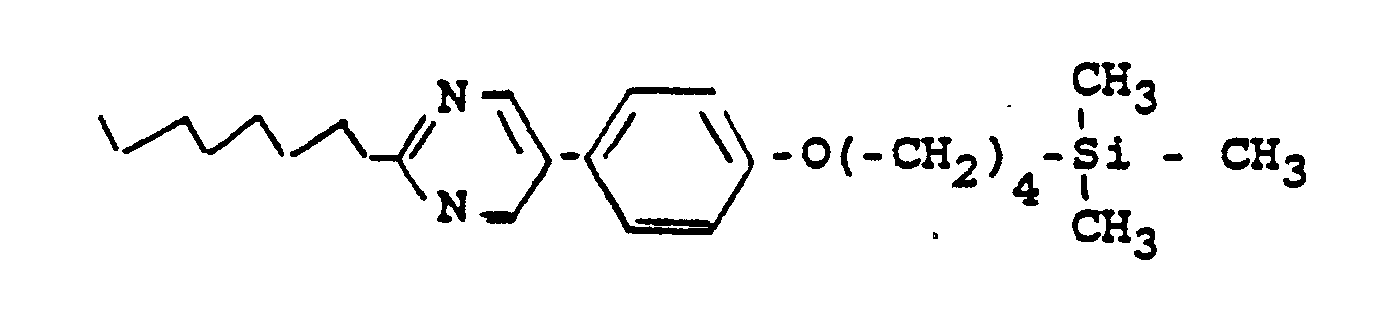
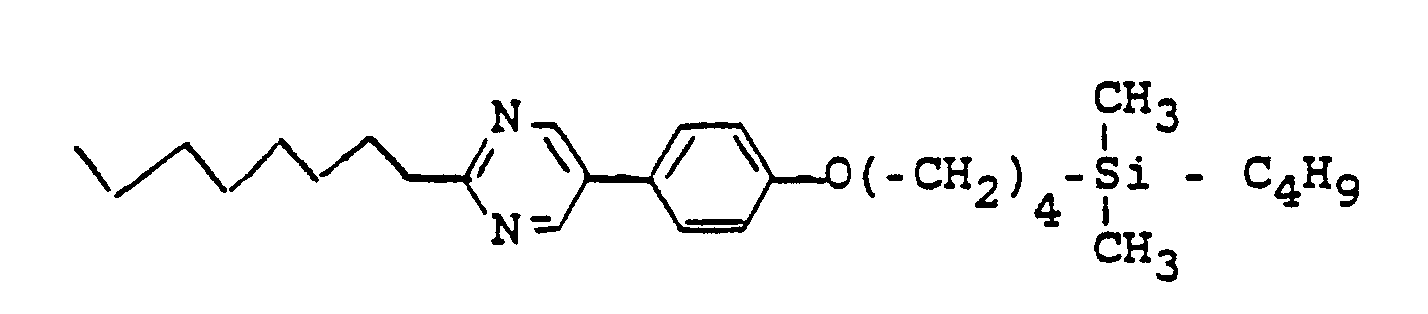
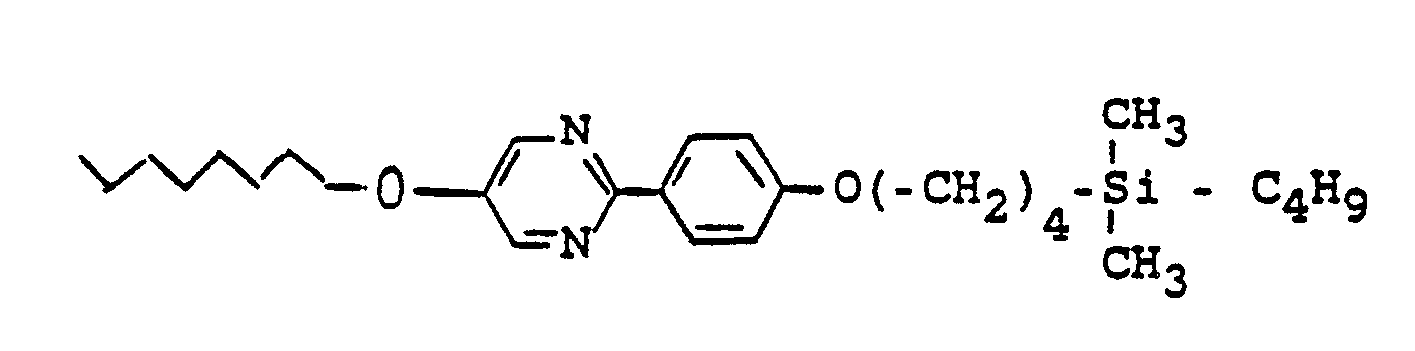
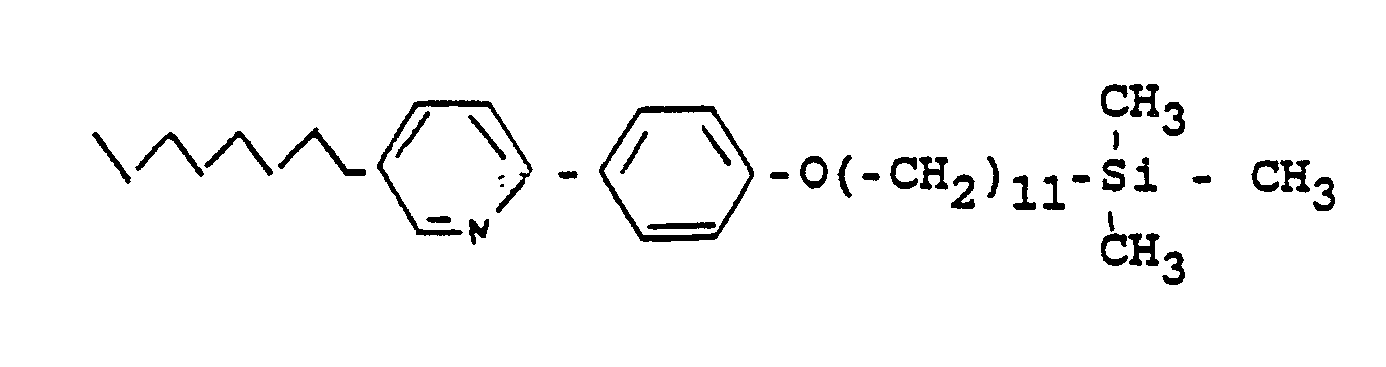
Phasenfolge: K 68,5 Sc 77,6 SA 77,6 - 78,3 I - Die nachfolgenden Synthesen werden nach den Angaben des Beispiels 1 mit entsprechender Mengenanpassung durchgeführt.
-

-
-

-

-

-

-

-

-
-
- Zum Vergleich bieten sich die beiden unsubstituierten Phenylpyrimidine an
5-Octyloxy-2(4-ocyloxyphenyl)pyrimdin
Phasenfolge: K 50,7 Sc 92 SA 99 N 100 I
5-Octyloxy-2(4-dexyloxyphenyl)pyrimidin
Phasenfolge: K 50,2 Sc 89 SA 99 I - Man erkennt, daß die silylsubstituierte Verbindung einen wesentlich niedrigeren Schmelzpunkt und einen breitren Sc-Phasenbereich aufweist.
- Ein Vergleich mit den Beispielen 39 und 21 zeigt, daß bei konstanter Gesamtkettenlänge die Beispielverbindung 11 bevorzugt ist und besonders niedrige Schmelzpunkte aufweist. Desweiteren zeigt der Vergleich mit den Beispielsverbindungen 1,5 und 42, daß der Schmelzpunkt bei einer Gesamtkettenlänge von 8 -CH₂-Kettonglieder besonders günstig ist.
-

- Zum Vergleich bietet sich ein 5-octyl-2(4-Octyloxyphenyl)-pyrimidin an, das folgende Phasenfolge aufweist:
K 29 SC 55 SA 62 N 69 I - Die erfingunsgemäße Verbindung 12 weist einen niedrigeren Schmelzpunkt auf als das unsubstituierte Phenylpyrimidin. Als Vergleich für Verbindung mit der Dimethylsilylgruppe in einer anderen Position, können die Beispiel 24 und 48 herangezogen werden. Beide Verbindungen haben höhere Schmelzpunkte, sodaß die Verbindung 12 bevorzugt wird.
-

- Für einen Vergleich bietet sich ein 4′-Nonyloxyphenyl-4-dexyloxy-benzoesäureester mit den folgenden Phasbenbereichen an:
K 75 Sc 87 SA 89 N 91 I - Die erfindungsgemäße Verbindung weist im Vergleich dazu einen wesentlich niedrigeren Schmelzpuntk auf. Der Vergleich mit der Verbindung aus Beispiel 26 zeigt außerdem, daß die hier verwendete Position der Dimethylsilylgruppe bei gleicher Kettenlänge bezüglich des Schmelzpunktes besonders geeignet ist.
-

-

-

-

- Im Vergleich zu der unsubstituierten Verbindung 5-Octyl-2(4-(Octyloxyphenyl)-pyrimidin mit den Phasenbereichen
K 29 Sc 55 SA 62 N 69 I
weist die erfindungsgemäße Komponente einen um 4 °C niedrigeren Schmelzpunkt auf.
Der Vergleich mit den Beispielen 4, 49, 52 und 37 zeigt, daß eine Verlängerung und eine Verkürzung des Spacers zu einer Erhöhung der Schmelztemperatur führt und daß eine Gesamtlänge von 7 -CH₂-Einheiten besonders günstig ist. -

-

-

-

-

-

-

- Im Vergleich zu den unsubstituierten 5-Octyl-2(4′-octyloxyphenyl)pyrimdin mit der Phasenfolge
K 29 Sc 55 SA 62 N 69 I
weist die erfindungsgemäße Mischung einen um 6 °C niedrigeren Schmelzpunkt auf. - Der Vergleich mit den Beispielsverbindungen 8, 50, 53 und 33 zeigt, daß der Schmelzpunkt sowohl mit längeren als auch mit kürzerem Spacer ansteigt und offensichtlich bei einer Gesamtlänge von 8 -CH₂-Einheiten ein Minimum aufweist.
-

-

-

-

-

-
-

-

-

-

-

-

-

- 2 g (4,6 mmol) 10-Undecenyl-[4-(5-octylpyrimidin-2-yl) phenyl]-ether, 6 g (63,4 mmol) Chlordimethylsilan und 0,1 ml einer 0,1 molaren Lösung von H₂PtCl₆ in Isopropanol werden währen 8 h im geschlossenen Glasrohr auf 100 °C erhitzt. Nach Öffnung des Rohres wird eingeengt, in 10 ml trockenem Tetrahydrofuran aufgenommen und mit 50 ml einer 1 molaren Lösung von Methylmagnesiumbromid in Tetrahydrofuran versetzt. Nach 2stündigem Erhitzen am Rückfluß wird das Gemenge in einer gesättigten wäßrigen NH₄Cl-Lösung hydrolysiert und die wäßrige Lösung mit Diethylether mehrfach extrahiert. Die vereinigten organischen Phasen werden mit gesättigter NaCl-Lösung gewaschen, über MgSO₄ getrocknet und im Vakuum eingeengt. Nach chromatographischer Reinigung (SiO₂, CH₂Cl₂/Hexan 3/1) und Umkristallisieren aus Methanol erhält man 700 mg farbloser Kristalle.
Phasenfolge: K 56,7 Sc 63,8 I -

- 0,3 g (10 mmol) 80 proz. Natriumhydrid in 2 ml Dimethylformamid (DMF) werden nacheinander tropfenweise versetzt mit 1,42 g (5 mmol) 2-(4-Hydroxyphenyl)-5-octyloxypyrimidin in 10 ml DMF sowie mit 3-Butyldimethylsilyl-1-brompropan in 5 ml DMF und 2 Stunden bis 60 °C gerührt. Nach Hydrolyse mit 0,5 ml Methanol wird die Reaktionslösung in 40 ml eiskaltem Wasser aufgenommen, mit 1N HCl auf pH 6-7 gestellt und mit Dichlormethan extrahiert. Die organische Phase wird mit Kochsalzlösung gewaschen, über Magnesiumsulfat getrocknet und im Vakuum eingeengt. Nach chromatographischer Reinigung (SiO₂, Hexan (Dichlormethan 1:1) und Umkristallisieren aus Isopropanol erhält man 1,28 g farbloser Kristalle
K₂ 34(23) K50 Sc 65 SA 68 I - Analog wurden erhalten:
-

-

-

-

-

-

-

-

-

-

-

-

-

-

-

-

-

-

-

-

-

-

-

-

(α) = -13,2 ° (c=2, CHCl₃) -

(α) = -15,6 ° (c=2, CHCl₃) -

-

-

-

-

-

-

-

-

-

-

-
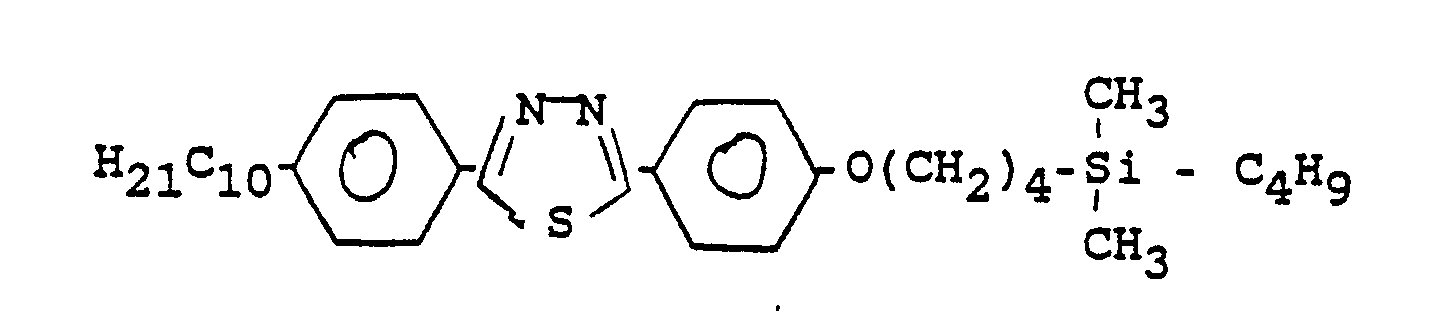
-

-

-

-

- Eine binäre Mischung aus einer Alkyl- und einer Silylverbindung
5-Octyloxy-2-(4-pentyloxyphenyl)-pyrimidin (56 mol-%)
4-(Ethyldimethylsilyl)butyl-[4-(5-octyloxypyrimidin-2-yl)phenyl]-ether (44 mol-%) weist die Phasenfolge
K 16 SC 76,8 SA 84,4 I auf. - Diese Mischung weist im Vergleich zur analogen Alkylmischung
5-Octyloxy-2(4-pentyloxyphenyl)-pyrimidin (52 mol-%)
5-Octyloxy-2(4-octyloxyphenyl)-pyrimidin (48 mol-%)
K 25 SC 85 SA 95 N 97 I einen niedrigeren Schmelzpunkt auf. - Eine binäre Mischung aus zwei Silylverbindungen (gleiche mol-%)
4-(Butyldimethylsilyl)-butyl-[4-(4-decyloxybenzoyloxy)-phenyl]-ether und 6-(Trimethylsilyl)hexyl-[2-(4-octyloxyphenyl) pyrimidin-5-yl]-ether weist die Phasenfolge
K 9 SC 47 SA 50 I auf. - Die binäre Mischung aus zwei Silylverbindungen
6-(Ethyldimethylsilyl)-hexyl-[2-(4-octyloxyphenyl)pyrimidin-5-yl]-ether (45 mol-%)
4-(Ethyldimethylsilyl)-butyl-[4-(5-octyloxypyrimidin-2-yl)phenyl]-ether (55 mol-%) weist die Phasenfolge
K 12,5 SC 63 I auf. - Eine Mischung aus
6-(Ethyldimethylsilyl)-hexyl[4-(5-octyloxypyrimidin-2-yl)-phenyl]-ether (47 mol-%)
trans-4-Pentylcyclohexancarbonsäure[4-(5-dodecyloxy-pyrimidin-2-yl)]-phenylester (18 mol-%)
trans-4-Pentylcyclohexancarbonsäure[4-(5-octyloxy-pyrimidin-2-yl)]-phenylester (22 mol-%)
5-Octyloxy-2(4-ethyloxy-phenyl)-pyrimidin (13 mol-%) weist die Phasenfolge
K 17 SC 91 SA 101 N 115 I auf. -
*) - C. Escher, H.-R. Dübal, W. Hemmerling, I. Müller, D. Ohlendorf und R. Wingen, vorgetragen auf 1st International Symposium on Ferroelectric Liquid Crystals, Arcachon-Bordeaux-France, 21-23. Sept. 1987, handelsübliche Mischung der Hoechst Aktiengesellschaft - - Eine ferroelektrische Multikomponentenmischung, die 7,5 mol-% 4-(Ethyldimethylsilyl)-butyl-[4-(5-octyloxypyrimidin-2-yl)phenyl]-ether und 17,5 mol-%
4-(Butyldimethylsilyl)butyl-[4-(5-octyloxypyrimidin-2-yl) phenyl]-ether in "Felix-001"*) (75 mol-%) enthält, weist folgende Phasenfolge auf
K -5 S

- Die Mischung ist nach konventionellen Methoden gut orientierbar.
Im Vergleich zu "Felix 001" weist diese Mischung z.B. bei 25 °C trotz niedrigerer Spontanpolarisation (Ps = 4,5 nC/cm²), eine kürzere Schaltzeit (τ0-90 = 135 µs) (τ10-90 = 75 µs), eine niedrigere Viskosität, einen höheren effektiven Tiltwinkel (2ϑeff = 19°) und damit einen sehr guten Kontrast auf. - Die Verbindung
4-(Butyldimethylsilyl-butyl-[4-(5-octyloxypyrimidin-2-yl)phenyl]ether weist die Phasenfolge
K 16,5 SC 63,1 SA 64 I auf und weist damit im Vergleich zu
5-Octyloxy-2-(4-decyloxyphenyl)-pyrimidin mit der Phasenfolge
K 50 SC 89 SA 99
einen wesentlich niedrigeren Schmelzpunkt und damit einen breiteren SC-Phasenbereich auf. - a) Eine Mischung aus den 6 Komponenten
5-Octyloxy-2-(4-hexyloxy-phenyl)-pyrimidin 16,7 Mol-% 5-Octyloxy-2-(4-octyloxy-phenyl)-pyrimidin 7,7 Mol-% 5-Octyloxy-2-(4-butyloxy-phenyl)-pyrimidin 17,6 Mol-% 5-Octyloxy-2-(4-decyloxy-phenyl)-pyrimidin 14 Mol-% 5-Octyl-2-(4-(-9-cyclopropyl-nonyloxy)phenyl)-pyrimidin 24 Mol-% 5-Octyloxy-2-(4-(Butyl-dimethylsilyl-butyloxy-phenyl)-pyrimidin 20 Mol-%
X 2,6 Sc 59 SA 82 I - b) Im Vergleich dazu weist die flüssigkristalline Mischung, die sich von der obengenannten Mischung nur dadurch unterscheidet, daß sie keine Silylkomponente enthält, folgende Phasenbereiche auf
X 5,1 SC 68 SA 83 N 85 I - Die Zugabe der Silylkomponente führt also offensichtlich zu einer Erniedrigung des Schmelzpunktes um 2,5 °C.
- c) Für einen Vergleich bietet sich auch die folgende Mischung an, die sich von der der Mischung 7a nur dadurch unterscheidet, daß sie anstelle der oben genannten Silylverbindung 20 Mol-%
5-Octyloxy-2-(4-(ethyl-dimethylsilyl-butyloxy)-phenyl)-pyrimdin 20 Mol-%
X 7,4 Sc 49,5 SA 87 I - Dieses Beispiel zeigt, daß die in Beispiel 7a gewählte Komponente wesentlich günstiger ist, d.h. Kettenlänge und Stellung der Dimethylsilylgruppe haben einen entscheidenden Einfluß.
Offensichtlich ist die Butyl-dimethyl-silylkomponente besonders günstig. - c) Eine weitere Vergleichsmischung, die in der Mischung 7b an Stelle der Silyl-Verbindung 25 Mol-%, trans-4-Pentyl-cyclohexancarbonsäure[5-nonyloxypyrimidin-2yl]-phenylester enthält weist die folgenden Phasen auf.
X 27 Sc 88 N 116 I - Unter den gleichen Bedingungen wie in Beispiel 7a kristallisiert die Probe bei einer Temperatur von 10 °C. Die erfindungsgemäße Mischung 7a hat den Vorteil, daß die Substanz erst bei viel tieferen Temperaturen auskristallisiert.
- a) Eine flüssigkristalline Mischung aus den folgenden neun Komponenten
5-Octyloxy-2-(4-hexyloxy-phenyl)-pyrimidin 12 Mol-% 5-Octyloxy-2-(4-octyloxy-phenyl)-pyrimidin 48 Mol-% 5-Octyloxy-2-(4-butyloxy-phenyl)-pyrimidin 12 Mol-% 5-Octyloxy-2-(4-decyloxy-phenyl)-pyrimidin 6,4 Mol-% 5-Octyloxy-2-(4-dodecyloxy-phenyl)pyrimidin 6,4 Mol-% 5-Octyl-2-(4-dodecyloxy-phenyl)-pyrimidin 11,2 Mol-% trans-4-Pentyl-cyclohexoncarbonsäure-[4-(5-decylpyrimidin-2-yl)]-phenylester 11,2 Mol-% Heptansäure-(4-[5-Octylpyrimidin-2-yl])-phenylester 16 Mol-% 4-Decyloxy-benzoesäure-4-(butyl-dimethylsilyl-butyloxy)-Phenylester 20 Mol-%
X -5 Sc 60 SA 76,5 N 83 I - Die Kristallisationstemperatur bei einer Abkühlrate von 10 °C min⁻¹ liegt bei -26 °C.
- b) für den Vergleich der physikalischen Eigenschaften wurden die Phasenbereiche einer Mischung gemessen die sich von der obengenannten nur dadurch unterscheidet, daß sie keine Silylkomponente enthält.
Diese Vergleichsmischung weist folgenden Phasenbereiche auf
X -3,5 Sc 69 SA 80 N 92 I - Die Kristallisationstemperatur bei der obengenannten Abkühlbedingungen liegt bei -19 °C. Offensichtlich führt die Silylkomponente zu einer Erniedrigung des Schmelzpunktes und der Kristallisatonstemperatur.
- a) Eine ferroelektrische Mischung bestehen aus
94 Mol-% der Mischung aus Beispiel 8a
6 Mol-% 5-(Nonyloxypyrimidin-5-yl)-phenyl-(2S,3S)-2-chlor-3-methylpentansäureester
weist die folgenden Phasenbereiche auf:
X -14 SC* 61 SA* 74 N* 80 I - Bei einer Temperatur von 25 °C weist diese Mischung eine Polarisation von -5,7 nC/cm² auf und schaltet bei einer Spannung von 10 Vµm⁻¹ mit τ = 116,1 µs.
Der effektive Tiltwinkel dieser Mischung ist 8,4 °. - b) Eine Vergleichsmischung mit 94 Mol-% der Mischung aus Beispiel 8b weist die folgenden Phasenbereiche auf.
X -6 Sc 71 SA 77 N 89 I - Bei einer Temperatur von 25 °C weist diese Mischung eine Polarisation von -9 nC·cm⁻² und schaltet bei einer Spannung von 10 V µm⁻¹ mit τ = 43 µs.
Der effektive Tiltwinkel dieser Mischung ist 7,2 °. - Durch den Vergleich der Beispiele 9a mit 9b erkennt man, daß die Silylkomponente in ferroelektrischen Mischungen den Schmelzpunkt erniedrigt, der effektiven Winkel und damit die Transmission des Hellzustandes erhöht.
- c) Um den Einfluß der Silylkomponente auf die Schaltzeit zu beurteilen, braucht man eine Mischung, die die gleichen Komponenten wie die Mischung in Beispiel 9b enthält, aber anstelle von 6 % genau 4 % des Dotierstoffes enthält. Diese Mischung weist bei einer Temperatur von 25 °C eine Polarisation von -5,8 nC·cm⁻² auf und schaltet bei einem Feld von 10 Vµm⁻¹ mit einer Schaltzeit von 180 µs. Da die spontane Polarisation dieser Mischung genauso groß ist wie in der Mischung 9a sind die beiden Schaltzeiten dieser ferroelektrischen Mischungen vergleichbar und man erkennt, daß die Mischung mit der erfindugnsgemäßen Komponente deutlich schneller schaltet.
- a) Eine Mischung aus den 4 Komponenten
5-Octyloxy-2-(4-hexyloxy-phenyl)-pyrimidin 30 Mol-% 5-Octyloxy-2-(4-octyloxy-phenyl)-pyrimidin 20 Mol-% 5-Octyloxy-2-(4-butyloxy-phenyl)-pyrimidin 25 Mol-% trans-4-Pentyl-cyclohexancarbonsäure-[5-(butyldimethylsilyl)-butyloxy)pyrimidin-2-yl]-phenylester 25 Mol-%
X 19 Sc 79 SA N 102 I - Bei einer Abkühlrate von 10 °C min⁻¹ kristallisiert die Substanz bei einer Temperatur von -3 °C.
- b) Im Vergleich dazu weist die, in DE 3831226.3 beanspruchte flüssigkristalline Mischung, die sich von der obengenannten Mischung nur dadurch unterscheidet, daß sie keinen Phenylester enthält, folgende Phasenbereiche auf
X 21,5 SC 85 SA 95 N 97,5 I - Unter den obengenannten Bedingungen kristallisiert die Mischung bei 12 °C. Die erfindungsgemäße Silylverbindung führt sowohl zu einer Erniedrigung des Schmelzpunktes als auch zu einer drastischen Erniedrigung der Kristallisationstemperatur.
- a) Eine flüssigkristalline Mischung aus den folgenden Komponenten
5-Octyloxy-2-(4-hexyloxy-phenyl)-pyrimidin 12 Mol-% 5-Octyloxy-2-(4-octyloxy-phenyl)-pyrimidin 4,8 Mol-% 5-Octyloxy-2-(4-butyloxy-phenyl)-pyrimidin 12 Mol-% 5-Octyloxy-2-(4-decyloxy-phenyl)-pyrimidin 6,4 Mol-% 5-Octyloxy-2-(4-dodecyloxy-phenyl)-pyrimidin 6,4 Mol-% 5-Octyl-2-(4-dodecyloxy-phenyl)-pyrimidin 11,2 Mol-% trans-4-Pentyl-cyclohexylcarbonsäure-[4-(5-decylpyrimidin-2-yl]-phenylester 11,2 Mol-% Heptansäure-[4-(5-octylpyrimidin-2-yl)]-phenylester 16 Mol-% 2-(4-Butyl-dimethylsilyl-butyloxy-phenyl)-5-(4-hexyloxyphenyl)-pyrimidin 20 Mol-%
X -3 Sc 82 SA 110 I - Bei dem Versuch eine Vergleichsmischung herzustellen, die anstelle der Silylverbindung 20 Mol-% 2-(4′-Octyloxyphenyl)-5-(4˝-hexyloxyphenyl)-pyrimidin enthält, konnte beobachtet werden, daß diese Verbindung in Gegensatz zu der obengenannten bei Raumtemperatur nicht löslich ist. Die Einführung der Dimethylsilylgruppe in die Kette führt also zu einer Erhöhung der Löslichkeit dieser Verbindung in flüssigkristallinen Mischungen.
- a) Eine Mischung aus den drei Komponenten
5-(4′-Hexylphenyl)-2-(4′-Octylphenyl)-pyrimidin 36,6 Mol-% 5-(4′-Pentyloxyphenyl)-2-(4˝-hexylphenyl)-pyrimidin 23,4 Mol-% 5-(4′-Hexyloxyphenyl)-2-(4˝-butyl-dimethylsilyl-butyloxy-phenyl)pyrimidin 40 Mol-%
X 27 SF 43 Sc 95 SA 192 I - b) Im Vergleich dazu weist die folgende binäre Mischung welche sich nur dadurch unterscheidet, daß sie keine Silylkomponente enthält die folgenden Phasenbereiche auf
X 58 SF 100 Sc 131 SA 198 I - Offensichtlich führt die Zugabe der erfindungsgemäßen Komponente zu einer erheblichen Erniedrigung des Schmelzpunktes.
- a) Eine Mischung bestehend aus den folgenden vier Substanzen
5-Octyloxy-2-(4′-butyloxyphenyl)-pyrimidin 39,6 Mol-% 5-Cyclopropyl-2-(4′-butyloxyphenyl)-pyrimidin 32,4 Mol-% trans-4-Pentyl-cyclohexylcarbonsäure-[4-(5-decyloxyprimidin-2-yl)]-phenylester 18 Mol-% 5-Octyloxy-2-(butyl-dimethylsilyl-butyloxyphenyl)-pyrimidin 10 Mol-%
X 15 Sc 79 SA 85 N 98 I - b) Im Vergleich dazu weist die Mischung, die sich nur dadurch unterscheidet, daß sie keine Silylkomponente enthält folgende Phasenbereiche auf.
X 20 Sc 79,5 SA 87 N 108 I - Die Zugabe der Silylkomponente führt offensichtlich zu einer Erniedrigung des Schmelzpunktes.
- Eine Mischung bestehend aus
80 Mol-% Mischung Beispiel 13a und
20 Mol-% 4-Decyloxy-(4′-butyldimethylsilyl-butyloxyphenyl) benzoat weist die folgenden Phasen auf
X 0 Sc 65 SA 78 N 91 I - Der Vergleich mit der Mischung aus Beispiel 13a zeigt, daß diese Silylkomponente den Schmelzpunkt um 15 °C erniedrigt hat.
- a) eine ferroelektrische Mischung besteht zu
92,66 Mol-% der Mischung Beispiel 14
4,02 Mol-% 2R,3R-3-Propyl-oxiran-2-carbonsäure-[4(2-octyloxy-pyrimidin-5-yl)phenyl]-ester
3,32 Mol-% (S)-4-(2-Octyloxy-pyrimidin-5-yl)phenyl-[spiro-(1,3-dioxolan-2,1′-cyclohexan)-4yl]-methyl-ether
und weist folgende Phasenfolge auf
X Sc 65 SA 77 N 85 I - Die Mischung weist bei 25 °C eine Polerisation von 17 nC cm⁻² auf und schaltet bei einem Feld von 10 Vµm⁻¹ mit einer Schaltzeit τ = 102 µs.
- Eine binäre Mischung aus den beiden Komponenten
2-(Butyl-dimethylsilyl-butyloxyphenyl)-5-oxtyloxypyrimidin 68 Mol-% 2-(Butyloxybutyloxyphenyl)-5-(ethyl-dimethylsilylhexyloxy) pyrimidin 32 Mol-%
X 0 Sc 55 I - Dieses Beispiel belegt, daß Silylphenylpyrimidine in ganz besonderer Weise zur Herstellung von flüssigkristallinen Mischungen mit niedrigen Schmelzpunkten geeignet sind.
- a) Eine Mischung aus der folgenden Komponenten
trans-4-Pentyl-cyclohexancarbonsäure-[4-(5-dodexyloxy-pyrimidin-2yl)]-phenylester 28 Mol-% trans-4-(Pentyl-cyclohexancarbonsäure-[4-(5-octyloxy-pyrimidin-2yl)]-phenylester 42 Mol-% 4-Decyloxybenzoesäure-4-(butyl-dimethylisilyl-butyloxy)-phenylester 30 Mol-%
X 16 Sc 64,5 SA 81 N 92 I - b) Eine Vergleichsmischung die sich von der Mischungs 17a dadurch unterscheidet, daß sie keine Silylkomponente enthält, weist die folgenden Phasenbereiche auf.
X 42 S₂ 58 Sc 116 N 186 I - Die Zugabe der Silylverbindung führt aber zu einer Erniedrigung des Schmelzpunktes um 26 °C.
- a) Eine Mischung aus den Komponenten
5-Octyloxy-2-(4-hexyloxy-phenyl)-pyrimidin 23,8 Mol-% 5-Octyloxy-2-(4-octyloxy-phenyl)-pyrimidin 11 Mol-% 5-Octyloxy-2-(4-butyloxy-phenyl)-pyrimidin 25,2 Mol-% 5-Octyloxy-2-(4-decyloxy-phenyl)-pyrimidin 20 Mol-% 4-Decyloxybenzoesäure-4′-(ethyl-dimethylsilyl-hexyloxy)-phenylester 20 Mol-%
X 9 SC 54 SA : 88 I - b) Im Vergleich dazu weist die, in DE 38 31 226.3 beanspruchte flüssigkristalline Mischung, die sich von der obengenannten Mischung nur dadurch unterscheidet, daß sie keine Silylverbindung enthält, folgende Phasenbereiche auf
X 13 Sc 81 SA 95 N 98 I - Die Zugabe der Silylverbindung führt zu einer Erniedrigung des Schmelzpunktes.
- a) Eine Mischung aus den Komponenten
5-Octyloxy-2-(4-hexyloxy-phenyl)-pyrimidin 23,8 Mol-% 5-Octyloxy-2-(4-octyloxy-phenyl)-pyrimidin 11 Mol-% 5-Octyloxy-2-(4-butyloxy-phenyl)-pyrimidin 25,2 Mol-% 5-Octyloxy-2-(4-decyloxy-phenyl)-pyrimidin 20 Mol-% 4-Decyloxybenzoesäure-4′-(butyl-dimethylsilylbutyloxy)phenylester 20 Mol-%
X 10 Sc 40 SA 85 I - b) Im Vergleich dazu weist die, in DE 38 31 226.3 beanspruchte flüssigkristalline Mischung, die sich von der obengenannten Mischung nur dadurch unterscheidet, daß sie keine Silylverbindung enthält, folgende Phasenbereiche auf
X 13 Sc 81 SA 95 N 98 I - Die Zugabe der Silylverbindung führt also zu einer Erniedrigung des Schmelzpunktes.
- a) Eine Mischung aus den Komponenten
5-Octyloxy-2-(4-hexyloxy-phenyl)-pyrimidin 23,8 Mol-% 5-Octyloxy-2-(4-octyloxy-phenyl)-pyrimidin 11 Mol-% 5-Octyloxy-2-(4-butyloxy-phenyl)-pyrimidin 25,2 Mol-% 5-Octyloxy-2-(4-decyloxy-phenyl)-pyrimidin 20 Mol-% 5-Octyl-2-[4(Cyclohexyl-dimethylsilyl-butyloxy)phenyl]-pyrimidin 20 Mol-%
X 8 Sc 59 SA 83 I - b) Im Vergleich dazu weist die, in DE 38 31 226.3 beanspruchte flüssigkristalline Mischung, die sich von der obengenannten Mischung nur dadurch unterscheidet, daß sie keine Silylvebrindung enthält, folgende Phasenbereiche auf
X 13 Sc 81 SA 85 N 98 I - Die Zugabe dieser Silylverbindung führt zu einer Erniedrigung des Schmelzpunktes von 5°C.
- Eine Mischung aus 80 Mol-% der Mischung 8b und 20 Mol-% 4-Octyloxybenzoesäure-[4′-(5-butyldimethylsilyl-butyloxypyrimidin-2-yl)phenyl]-ester weist die folgenden Phasenbereiche auf
X-8 SC 59 N 100 I - Die Kristallisationstemperatur bei einer Abkühlrate von 10°C min⁻¹ liegt bei -30°C.
- Vergleicht man diese Phasenbereiche mit dem Phasenbereich der Mischung 8b, so stellt man fest, daß die Zugabe der Silylkomponente zu einer Erniedrigung des Schmelzpunktes um 4,5°C und zu einer Verzögerung der Kristallisationstemperatur um 11°C führt.
- a) Um den Einfluß der Silylpyrimidinverbindungen auf den effektiven Tiltwinkel zu untersuchen, wurden jeweils 10 % verschiedener Komponenten in der folgenden ferroelektrischen Mischung gelöst
5-Octyloxy-2(4-hexyloxy-phenyl)-pyrimidin 10,5 Mol-% 5-Octyloxy-2(4-octyloxy-phenyl)-pyrimidin 4,8 Mol-% 5-Octyloxy-2(4-butyloxy-phenyl)-pyrimdin 11,1 Mol-% 5-Octyloxy-2(4-decyloxy-phenyl)-pyrimidin 8,8 Mol-% trans-4-Pentyl-cyclohexancarbonsäure-[4(5-dodecylpyrimidin-2-yl)]-phenylester 16,6 Mol-% 5-Octyl-2(4-decyloxy-phenyl)-pyrimidin 11,2 Mol-% 5-Octyl-2(4-octyloxy-phenyl)-pyrimidin 15,2 Mol-% 5-Octyl-2(4-hexyloxyphenyl)-pyrimidin 16,8 Mol-% (2R,3R)-3-Propyl-oxiran-2-carbonsäure-[4(2-octyloxy-pyrimidin-5-yl)phenyl]-ester 0,9 Mol-% (R)-4-(5-n-Octyl-pyrimidin-2-yl)-phenyl-2,2-dimethyl-1,3-dioxolan-4-carbonsäureester 4,1 Mol-% - Die Struktur der Komponenten und die Änderung des Kontrastes sind in der nachfolgenden Tabelle angegeben.
- Die in der Tabelle I dargestellten Meßergebnisse zeigen daß die Verwendung von Silylverbindung (Beispiele: 22d, 22e, 22f) im Vergleich zu den analogen Alkylverbindungen zu einer Erhöhung des effektiven Tiltwinkels führt.

- a) Eine Mischung aus den Komponenten
5-Octyloxy-2-(4-hexyloxy-phenyl)-pyrimidin 23,8 Mol-% 5-Octyloxy-2-(4-octyloxy-phenyl)-pyrimidin 11,0 Mol-% 5-Octyloxy-2-(4-butyloxy-phenyl)-pyrimidin 25,2 Mol-% 5-Octyloxy-2-(4-decyloxy-phenyl)-pyrimidin 20 Mol-% 5-Octyl-2-[4-(ethyl-dimethylsilyl)-hexyloxy)-phenyl]-pyrimidin 20 Mol-%
X 6,5 Sc 67 SA 83 N : 86 I - b) Im Vergleich dazu weist die, in DE 38 31 226.3 beanspruchte flüssigkristalline Mischung, die sich von der obengenannten Mischung nur dadurch unterscheidet, daß sie keine Silylkomponente enthält, folgende Phasenbereiche auf
X 5 Sc 68 SA 83 N 86 I - c) Eine weitere Vergleichsmischung enthält 20 % der folgenden Komponente 5-Octyl-2-[4-(ethyl-dimethylsilylhexyloxyl-phenyl]-pyrimidin in der Mischung 23b und weist die folgende Phasenfolge auf
X 6,5 Sc 5,6 SA 78 I - Bei dem Vergleich mit der Mischung Beispiel 23a zeigt sich, daß die Lage der Dimethylsilylgruppe einen Einfluß auf den Schmelzpunkt hat. Offensichtlich ist eine mittlere Stellung der Dimethylsilylgruppe in der Kette günstiger.
- Eine flüssigkristalline Mischung besteht aus den folgenden Komponenten
4-Decyloxybenzoesäure-(4′-hexyloxyphenyl)-ester 22,0 Mol-% 4-Octyloxybenzoesäure-(4′-hexyloxyphenyl)-ester 26,8 Mol-% 4-Octyloxybenzoesäure-(4′-undecyloxyphenyl)-ester 16,2 Mol-% 4-Decyloxybenzoesäure-4′-(butyldimethylsilyl-butyloxy)phenylester 35,0 Mol-% - Die vergleichbare Mischung ohne Silylkomponente weist folgende Phasen auf:
X 37,4 Sc 72 SA 74 N 88 I - Die Silylkomponente führt also auch in einer Phenylbenzoat-Mischung zu einer Schmelzpunkterniedrigung von 12°C.
- a) Eine flüssigkristalline Mischung aus den folgenden neun Komponenten
5-Octyloxy-2-(4-hexyloxy-phenyl)-pyrimidin 12,1 Mol-% 5-Octyloxy-2-(4-octyloxy-phenyl)-pyrimidin 4,1 Mol-% 5-Octyloxy-2-(4-butyloxy-phenyl)-pyrimidin 13,3 Mol-% 5-Octyloxy-2-(4-decyloxy-phenyl)-pyrimidin 7,4 Mol-% 5-Octyl-2-(4-dodecyloxy-phenyl)-pyrimidin 10,8 Mol-% trans-4-Pentyl-cyclohexancarbonsäure-[4-(5-decylpyrimidin-2-yl)]-phenylester 17,2 Mol-% Heptansäure-(4-(5-octylpyrimidin-2-yl))-phenylester 18,1 Mol-% 4-Decyloxybenzoesäure-4′-(butyl-dimethylsilyl-butyloxy)phenylester 17,0 Mol-%
X -16 Sc 60 SA 75 N 84 I - Die Kristallisationstemperatur bei einer Abkühlrate von 10 °C min⁻¹ liegt bei -28 °C.
- b) für den Vergleich der physikalischen Eigenschaften wurden die Phasenbereiche einer Mischung gemessen die sich von der obengenannten nur dadurch unterscheidet, daß sie keine Silylkomponente enthält.
Diese Vergleichsmischung weist folgende Phasenbereiche auf
X -9 Sc 73 SA 77 N 96 I - Die Kristallisationstemperatur bei der obengenannten Abkühlbedingungen liegt bei -17 °C. Offensichtlich führt die Silylkomponente zu einer Erniedrigung des Schmelzpunktes und der Kristallisationstemperatur.
- Eine ferroelektrische Mischung besteht aus
92,66 Mol-% der Mischung aus Beispiel 25
4,02 Mol-% 2R,3R-3-Propyl-oxiran-2-carbonsäure-[4(2-octyloxy-pyrimidin-5-yl)-phenyl]-ester
3,32 Mol-% (S)-4-(2-Octyloxy-pyrimidin-5-yl)phenyl-spiro-(1,3-dioxolan-2,1-cyclohexan)-4-yl)-methyl-ether
und weist folgende Phasenbereiche auf
X -19 Sc* 60 SA* 73 N* 82 I - Die Mischung hat bei einer Temperatur von 25 °C eine spontane Polarisation von 10,5 nC cm⁻² auf und schaltet bei einem Feld von 10 V µm⁻¹ mit einer Schaltzeit τ von 102 µs.
- Eine flüssigkristalline Mischung besteht aus
60 Mol-% der Mischung 25 b
40 Mol-% 4-Decylbenzoesäure-4′-(butyl-dimethyl)-silylbutyloxy)phenylester
und weist folgende Phasenbereiche auf
X -29 Sc 48 SA 71 N 73 I - Die Kristallisationstemperatur bei einer Abkühlrate von 10 °C min⁻¹ liegt bei -39 °C.
- Der Vergleich mit den Daten der Mischung 25b belegt, daß die erfindungsgemäße Verbindung in der Mischung zu einer erheblichen Schmelzpunkterniedrigung und zu einer starken Absenkung der Kristallisationstemperatur führt.
- Eine flüssigkristalline Mischung besteht aus
80 Mol-% der Mischung 25b
20 Mol-% 4-Octyloxybenzoesäure-[4′-(5˝-butyl-dimethylsilylbutyloxy-pyrimdin-2˝-yl)phenyl]-ester
X -17 Sc 58 N 101 I - Der Vergleich mit den Daten der Mischung 25 b belegt, daß die erfindungsgemäßen Silylverbindungen in Mischungen zu einer Erniedrigung des Schmelzpunktes führen.
- a) Eine ferroelektrische flüssigkristalline Mischung besteht aus 6 Komponenten
5-Octyloxy-2-(4-butyloxy-phenyl)-pyrimidin 24 Mol-% 5-Octyloxy-2-(4-hexyloxy-phenyl)-pyrimidin 22,8 Mol-% 5-Octyloxy-2-(4-oxtyloxy-phenyl)-pyrimidin 10,8 Mol-% 5-Octyloxy-2-(4-dexyloxy-phenyl)-pyrimidin 19,2 Mol-% trans-4-Pentyl-cyclohexancarbonsäure-[4-(5-decyl-pyrimidin-2-yl)]-phenylester 13,5 Mol-% (2S,3S)-2[4-(5-Butyldimethylsilyl-butyloxy-pyrimidin-2-yl)-phenyloxy]-methyl-3-butyloxiran 10 Mol-%
X 6,3 Sc* 81 N* 98 I
und weist bei 20 °C eine spontane Polyrisation von 26 nC·cm]-2 und eine Schaltzeit von 174 µs auf. - b) Im Vergleich dazu weist die, in DE 3831226 beanspruchte flüssigkristalline Mischung, die sich von der obengenannten ferroelektrischen Mischung nur dadurch unterscheidet, daß sie keinen Dotierstoff enthält, folgende Phasenbereiche auf
X 9 Sc 84 SA 93 N 105 I - Die ferroelektrische Mischung weist dazu im Verlgeich einem um 3 °C niedrigeren Schmelzpunkt auf.
Dieses Beispiel belgt, daß die Silylverbindungen auch als Dotierstoffe in ferroelektrischen Mischungen geeignet sind. - Eine Mischung besteht aus
80 Mol-% der Mischung aus Anwendungsbeispiel 25b
20 Mol-% 4(Butyldimethylsilyl)butyl[4-(5-(4-decylphenyl-1,3,4-thiadiazol-2yl)phenyl]-ether
X-11 Sc 72 SA 83 N 93 I - Ein Vergleich mit den Daten der Mischung aus den Anwendungsbeispiel 25 b zeigt, daß die Zugabe der Silylverbindung dieses Thiadiazols zu einer Erniedrigung des Schmelzpunktes um 2 °C führt.
- a) Eine ferroelektrische Mischung besteht aus
90 Mol-% der Mischung aus dem Anwendungsbeispiel 29b 10 Mol-% (2R,3R)-3-Propyl-oxiran-2-carbonsäure-[4-(5-(4-butyldimethylsilylbutyloxy)-pyrimidin-2-yl)phenyl]-ester - Diese Mischung weist bei einer Temperatur von 20 °C eine Polarisation von 97 nC·cm⁻² auf und schaltet bei einem Feld von 10Vµm⁻¹ in 67 µs.
- b) Zum Vergleich bietet sich eine 10 % Dotierstoffmischung ausgehend von der Mischung 29b an, bei der sich der Dotierstoff nur durch die Dimethylsilylgruppe unterscheidet. Die Dotierstoffmischung mit
10 Mol-% (2R,3R)-3-Propyloxiran-2-carbonsäure-[(octyloxypyrimidin2-yl)phenyl]-ester
weist bei einer Temperatur von 20 °C eine Polarisation von 37 nCcm⁻² auf.
Offensichtlich zeichnet sich der dimethylsilyl-haltige Dotierstoff dadurch aus, daß er in Mischungen eine spontane Polarisation induziert, die 2,6 mal höher liegt als bei der vergleichbaren Dotierstoffmischung. - a) Eine Mischung aus folgenden drei Komponenten
2 Octyl-5-[4-decyloxyphenyl]-1,3,4 thiodiazol 26,4 Mol-% 5-[4-trans-Hexylcycloheyl]-2-[4-decylphenyl]-1,3,4 thiadiazol 33,6 Mol-% 4-(Butyldimethylsilyl)butyl-[4-(5-(4-decylphenyl)-1,3,4 thiadiazol-2-yl)phenyl]-ether 40 Mol-%
X 22 Sc 116 I - b) Im Vergleich dazu weist eine flüssigkristalline Mischung, die sich von der oben genannten nur dadurch unterscheidet, daß sie keine Silyl-Komponente enthält, folgende Phasenfolge auf
X 47 Sc 111 SA 120 - Die Silyl-Komponente führt also zu einer Schmelzpunkterniedrigung von 25 °C.
Claims (10)

R¹ geradkettiges oder verzweigtes (mit oder ohne asymmetrisches C-Atom) Alkyl oder Alkenyl mit 2 bis 16 C-Atomen, wobei auch eine oder zwei nicht-benachbarte -CH₂-Gruppen durch -O-, -S-, -CO-, -CO-O-, -O-CO- oder -O-CO-O ersetzt sein können und wobei auch H durch F ersetzt sein kann,
oder einer der nachfolgenden Reste OCF₃, OCHF₂

M¹,M² gleich oder verschieden CO-O, O-CO, CO-S, S-CO, CH₂-O, O-CH₂, C≡C, CH=CH
G,G¹ geradkettiges oder verzweigtes Alkylen mit 1 bis 16 C-Atomen oder Alkenylen mit 2 bis 16 C-Atomen, bei dem auch eine oder zwei nicht-benachbarte -CH₂-Gruppen durch -O-, -S-, -O-CO-, -CO-O-, -S-CO- oder -CO-S- ersetzt sein können, mit der Maßgabe, daß Si nur an ein C gebunden ist, das H und/oder C als Nachbaratome hat,
R²,R³,R⁴,R⁵ H oder geradkettiges oder verzweigtes Alkyl mit 1 bis 16 oder Alkenyl mit 2 bis 16 C-Atomen, bei dem auch eine -CH₂-Gruppe durch -O-, -CO-O- oder -O-CO- ersetzt sein kann, oder cyclisches Alkyl mit 3 bis 8 C-Atomen
R⁶,R⁷,R⁸ geradkettiges oder verzweigtes Alkyl mit 1 bis 16 C-Atomen oder Alkenyl mit 2 bis 16 C-Atomen, bei denen auch eine oder zwei nicht-benachbarte CH₂-Gruppen durch -O-, -CO-O oder -O-CO- ersetzt sein können, mit der Maßgabe, daß sie nur an ein C gebunden ist, das H und/oder C als Nachbaratome hat, oder cyclisches Alkyl mit 3 bis 8 C-Atomen, oder gemeinsam mit dem Si auch

p 3 bis 7
mit der Maßgabe, daß j+l+n=2 oder 3.

R¹(-A¹)j(-M¹)k(-A²)l(-M²)m(-A³)n-x (II)

Priority Applications (1)
| Application Number | Priority Date | Filing Date | Title |
|---|---|---|---|
| AT89114603T ATE104301T1 (de) | 1988-08-13 | 1989-08-08 | Organosilylalkyl- oder -alkenyl- verbindungen, verfahren zu ihrer herstellung und ihre verwendung in fluessigkristallinen mischungen. |
Applications Claiming Priority (2)
| Application Number | Priority Date | Filing Date | Title |
|---|---|---|---|
| DE3827600A DE3827600A1 (de) | 1988-08-13 | 1988-08-13 | Organosilylalkyl- oder -alkenyl-verbindungen, verfahren zu ihrer herstellung und ihre verwendung in fluessigkristallinen mischungen |
| DE3827600 | 1988-08-13 |
Publications (3)
| Publication Number | Publication Date |
|---|---|
| EP0355008A2 true EP0355008A2 (de) | 1990-02-21 |
| EP0355008A3 EP0355008A3 (de) | 1991-01-09 |
| EP0355008B1 EP0355008B1 (de) | 1994-04-13 |
Family
ID=6360846
Family Applications (1)
| Application Number | Title | Priority Date | Filing Date |
|---|---|---|---|
| EP89114603A Expired - Lifetime EP0355008B1 (de) | 1988-08-13 | 1989-08-08 | Organosilylalkyl- oder -alkenyl- Verbindungen, Verfahren zu ihrer Herstellung und ihre Verwendung in flüssigkristallinen Mischungen |
Country Status (7)
| Country | Link |
|---|---|
| US (1) | US5348684A (de) |
| EP (1) | EP0355008B1 (de) |
| JP (5) | JP2716538B2 (de) |
| KR (1) | KR0151132B1 (de) |
| AT (1) | ATE104301T1 (de) |
| DE (2) | DE3827600A1 (de) |
| NO (1) | NO893242L (de) |
Cited By (21)
| Publication number | Priority date | Publication date | Assignee | Title |
|---|---|---|---|---|
| EP0404140A3 (de) * | 1989-06-22 | 1991-05-29 | Consortium für elektrochemische Industrie GmbH | Silylierte Benzoesäurederivate II |
| EP0458320A1 (de) * | 1990-05-23 | 1991-11-27 | Canon Kabushiki Kaisha | Mesomorphe Verbindung, Flüssigkristallzusammensetzung, Flüssigkristalapparat, Anzeigevorrichtung und Anzeigeverfahren |
| EP0476567A1 (de) * | 1990-09-17 | 1992-03-25 | Canon Kabushiki Kaisha | Mesomorphverbindung, flüssigkristalline Zusammensetzung, flüssigkristalline Vorrichtung, Display-Apparat und Display-Verfahren |
| EP0632044A1 (de) * | 1993-06-28 | 1995-01-04 | Shin-Etsu Chemical Co., Ltd. | Eine Silacyclohexanverbindung, deren Herstellung und diese enthaltende Flüssigkristallzusammensetzungen |
| EP0648773A1 (de) * | 1993-10-14 | 1995-04-19 | Shin-Etsu Chemical Co., Ltd. | Eine Silacyclohexan-Verbindung, ein Verfahren zu ihrer Herstellung und eine sie enthaltende flüssigkristalline Mischung |
| EP0650969A1 (de) * | 1993-11-01 | 1995-05-03 | Shin-Etsu Chemical Co., Ltd. | Eine Silacyclohexanverbindung deren Herstellung und diese enthaltende Flüssigkristallzusammensetzung |
| EP0657460A1 (de) * | 1993-12-07 | 1995-06-14 | Shin-Etsu Chemical Co., Ltd. | Silacyclohexanverbindung, Verfahren zu deren Herstellung und diese enthaltende Flüssigkristallzusammensetzung |
| EP0659753A1 (de) * | 1993-12-24 | 1995-06-28 | Shin-Etsu Chemical Co., Ltd. | Eine Silacyclohexanverbindung, deren Herstellung und diese enthaltende Flüssigkristallzusammensetzungen |
| EP0665232A1 (de) * | 1994-01-28 | 1995-08-02 | Shin-Etsu Chemical Co., Ltd. | Eine Silacyclohexanverbindung, ein Verfahren zu deren Herstellung und eine diese enthaltende flüssigkristalline Zusammensetzung |
| EP0668284A1 (de) * | 1994-02-04 | 1995-08-23 | Shin-Etsu Chemical Co., Ltd. | Eine Silacyclohexanverbindung, deren Herstellung und diese enthaltende Flüssigkristallzusammensetzungen |
| EP0668286A1 (de) * | 1994-02-18 | 1995-08-23 | Shin-Etsu Chemical Co., Ltd. | Silacyclohexanverbindung, Verfahren zu deren Herstellung und diese enthaltende Flüssigkristallzusammensetzung |
| EP0670322A1 (de) * | 1994-03-01 | 1995-09-06 | Shin-Etsu Chemical Co., Ltd. | Silacyclohexan Verbindungen, Verfahren zu ihrer Herstellung und Flüssigkristallzusammensetzungen, die sie enthalten |
| EP0699683A1 (de) * | 1994-09-02 | 1996-03-06 | Shin-Etsu Chemical Co., Ltd. | Neue silacyclohexan Verbindungen, eine sie enthaltende flüssigkristalline Zusammensetzung und eine die Zusammensetzung enthaltende flüssigkristalline Vorrichtung |
| EP0708106A1 (de) * | 1994-10-20 | 1996-04-24 | Shin-Etsu Chemical Co., Ltd. | Neue Silacyclohexanverbindung, eine sie enthaltende flüssigkristalline Zusammensetzung und eine die Zusammensetzung enthaltende flüssigkristalline Vorrichtung |
| EP0708107A1 (de) * | 1994-10-20 | 1996-04-24 | Shin-Etsu Chemical Co., Ltd. | Neue Silacyclohexanverbindungen, eine sie enthaltende Flüssigkristallinezusammensetzung und eine die Zusammensetzung enthaltende flüssigkristalline Vorrichtung |
| EP0872484A4 (de) * | 1995-07-27 | 1998-12-23 | Chisso Corp | Organosilikonverbindungen, flüssigkristallzusammensetzungen und flüssigkristallanzeigeelemente |
| WO1999005236A1 (de) | 1997-07-25 | 1999-02-04 | Aventis Research & Technologies Gmbh & Co Kg | Chipkarte mit bistabiler anzeige |
| US5868961A (en) * | 1993-06-28 | 1999-02-09 | Shin-Etsu Chemical Co., Ltd. | Silacyclohexane compound, a method of preparing it and a liquid crystal composition containing it |
| EP0684246B1 (de) * | 1994-04-11 | 2001-10-17 | Kashima Oil Company | Optisch aktive Tetrahydropyranderivate, flüssigkristalline Zusammensetzung und diese enthaltende Flüssigkristall-Vorrichtung. |
| US6682785B2 (en) | 2001-09-17 | 2004-01-27 | Clariant Finance (Bvi) Limited | Fluorinated anthracenes, and their use in liquid-crystal mixtures |
| EP1935961A1 (de) * | 2006-12-19 | 2008-06-25 | Sony Corporation | Flüssigkristallmolekül, Flüssigkristallanzeigevorrichtung und optisch-räumliche Flüssigkristallmodulationsvorrichtung |
Families Citing this family (11)
| Publication number | Priority date | Publication date | Assignee | Title |
|---|---|---|---|---|
| CA2019380C (en) * | 1989-06-22 | 1995-01-10 | Wolfgang Haas | Silylated benzoic acid derivatives |
| DE4140352A1 (de) * | 1991-12-06 | 1993-06-09 | Consortium Fuer Elektrochemische Industrie Gmbh, 8000 Muenchen, De | Fluessigkristalle mit (mehrfachsila)alkylfluegelgruppen |
| DE4434754A1 (de) * | 1993-09-30 | 1995-04-06 | Hoechst Ag | Neue Verbindungen zur Verwendung in Flüssigkristallmischungen |
| US5495037A (en) * | 1994-09-09 | 1996-02-27 | National Science Council | Liquid crystalline polymer having a polysiloxane backbone |
| DE59707681D1 (de) * | 1996-10-28 | 2002-08-14 | Rolic Ag Zug | Vernetzbare, photoaktive Silanderivate |
| JP2007523237A (ja) * | 2004-02-11 | 2007-08-16 | ディスプレイテック,インコーポレイテッド | シリルテール基を有する液晶材料 |
| US7648645B2 (en) * | 2006-11-08 | 2010-01-19 | 3M Innovative Properties Company | Pre-polymer formulations for liquid crystal displays |
| US7781555B2 (en) * | 2007-09-03 | 2010-08-24 | Shin-Etsu Chemical Co., Ltd. | Microcontact printing stamp |
| KR101030111B1 (ko) * | 2008-06-20 | 2011-04-20 | 주식회사 엘지화학 | 신규의 겔화제, 이를 포함하는 겔액정, 및 상기 겔액정을 함유하는 액정 소자 |
| KR101156322B1 (ko) * | 2008-06-20 | 2012-06-13 | 주식회사 엘지화학 | 신규의 겔화제를 이용한 광학 필름 및 이를 포함하는 소자 |
| JP6047435B2 (ja) * | 2013-03-15 | 2016-12-21 | 東洋ゴム工業株式会社 | 有機シラン及びその製造方法 |
Citations (4)
| Publication number | Priority date | Publication date | Assignee | Title |
|---|---|---|---|---|
| EP0136501A2 (de) | 1983-09-01 | 1985-04-10 | MERCK PATENT GmbH | Trialkanoyloxysilane |
| DE3521201A1 (de) | 1985-06-13 | 1986-12-18 | Merck Patent Gmbh, 6100 Darmstadt | Organosiliciumverbindungen |
| DE3601742A1 (de) | 1985-06-13 | 1987-07-23 | Merck Patent Gmbh | Organosiliciumverbindungen |
| DE3831226A1 (de) | 1987-09-19 | 1989-03-30 | Hoechst Ag | Fluessigkristalline, insbesondere ferroelektrische fluessigkristalline mischungen |
Family Cites Families (11)
| Publication number | Priority date | Publication date | Assignee | Title |
|---|---|---|---|---|
| DE2944591A1 (de) * | 1979-11-05 | 1981-05-14 | Wacker-Chemie GmbH, 8000 München | Fluessigkristalline phasen aufweisende zusammensetzungen |
| US4367924A (en) * | 1980-01-08 | 1983-01-11 | Clark Noel A | Chiral smectic C or H liquid crystal electro-optical device |
| US4316041A (en) * | 1980-02-19 | 1982-02-16 | Union Carbide Corporation | Liquid crystal silanes |
| CH648832A5 (en) * | 1981-07-31 | 1985-04-15 | Hoffmann La Roche | Pyridazines |
| JPS60252486A (ja) * | 1984-05-28 | 1985-12-13 | Toray Silicone Co Ltd | 液晶性有機けい素化合物 |
| FR2612195B1 (fr) | 1987-03-10 | 1989-06-16 | Rhone Poulenc Chimie | Polymeres thermostables a base de maleimides dont eventuellement un bismaleimide siloxane et de diamines siloxanes et leurs procedes de preparation |
| JP2513742B2 (ja) * | 1987-12-01 | 1996-07-03 | 株式会社東芝 | 液晶材料 |
| CA2019380C (en) * | 1989-06-22 | 1995-01-10 | Wolfgang Haas | Silylated benzoic acid derivatives |
| EP0404140B1 (de) * | 1989-06-22 | 1996-03-20 | Consortium für elektrochemische Industrie GmbH | Silylierte Benzoesäurederivate II |
| DE3935638A1 (de) * | 1989-10-26 | 1991-05-02 | Consortium Elektrochem Ind | Organosilylalkylaromaten |
| JPH04124190A (ja) * | 1990-09-17 | 1992-04-24 | Canon Inc | 液晶性化合物、それを含有する液晶組成物およびそれを使用した液晶素子 |
-
1988
- 1988-08-13 DE DE3827600A patent/DE3827600A1/de not_active Withdrawn
-
1989
- 1989-08-08 AT AT89114603T patent/ATE104301T1/de not_active IP Right Cessation
- 1989-08-08 EP EP89114603A patent/EP0355008B1/de not_active Expired - Lifetime
- 1989-08-08 DE DE58907440T patent/DE58907440D1/de not_active Expired - Fee Related
- 1989-08-11 NO NO89893242A patent/NO893242L/no unknown
- 1989-08-11 JP JP1207093A patent/JP2716538B2/ja not_active Expired - Lifetime
- 1989-08-12 KR KR1019890011501A patent/KR0151132B1/ko not_active Expired - Fee Related
-
1992
- 1992-08-20 US US07/932,644 patent/US5348684A/en not_active Expired - Fee Related
-
1995
- 1995-07-12 JP JP7176496A patent/JPH0881476A/ja active Pending
- 1995-07-12 JP JP7176495A patent/JPH0892260A/ja active Pending
-
1997
- 1997-09-12 JP JP9248409A patent/JP2955257B2/ja not_active Expired - Lifetime
- 1997-09-12 JP JP9248408A patent/JP2955256B2/ja not_active Expired - Lifetime
Patent Citations (4)
| Publication number | Priority date | Publication date | Assignee | Title |
|---|---|---|---|---|
| EP0136501A2 (de) | 1983-09-01 | 1985-04-10 | MERCK PATENT GmbH | Trialkanoyloxysilane |
| DE3521201A1 (de) | 1985-06-13 | 1986-12-18 | Merck Patent Gmbh, 6100 Darmstadt | Organosiliciumverbindungen |
| DE3601742A1 (de) | 1985-06-13 | 1987-07-23 | Merck Patent Gmbh | Organosiliciumverbindungen |
| DE3831226A1 (de) | 1987-09-19 | 1989-03-30 | Hoechst Ag | Fluessigkristalline, insbesondere ferroelektrische fluessigkristalline mischungen |
Non-Patent Citations (12)
| Title |
|---|
| C. ESCHER ET AL., SYMPOSIUM ON FERROELECTRIC LIQUID CRYSTALS, September 1987 (1987-09-01), pages 21 - 23 |
| E. LUKEVICS ET AL., J. ORGANOMET. CHEM., vol. 5, 1977, pages 1 |
| EABORN ET AL.: "Organometallic Compounds of the Group IV Elements", vol. 1, 1968, DEKKER |
| H.DIAMANT ET AL.: "Ps-Werte werden nach der Methode", REV. SCI. INSTR., vol. 28, 1957, pages 30 |
| HEUMER ET AL.: "Houben-Weyl Methoden der org. Chemie, E", vol. 18/2, 1986, THIEME-VERLAG, pages: 685 |
| J. AM. CHEM. SOC., vol. 108, 1986, pages 4736 |
| J. AM. CHEM. SOC., vol. 108, 1986, pages 5210 |
| J. CHEM. SOC. PERKIN TRANS, 1975, pages 461 |
| MARCH: "Advanced Organic Chemistry", 1977, MC. GRAW-HILL KOGAKUSKA LTD., pages: 363 - 365 |
| PATAI: "The Chemistry of the Ether Linkage", 1967, INTERSCIENCE PUBLISHERS, pages: 446 - 468 |
| STRUKTUR I, SCIENCE, vol. 231, 1986, pages 350 |
| W. GREENE: "Protective Groups in Organic Synthesis", 1981, WILEY |
Cited By (34)
| Publication number | Priority date | Publication date | Assignee | Title |
|---|---|---|---|---|
| EP0404140A3 (de) * | 1989-06-22 | 1991-05-29 | Consortium für elektrochemische Industrie GmbH | Silylierte Benzoesäurederivate II |
| EP0458320A1 (de) * | 1990-05-23 | 1991-11-27 | Canon Kabushiki Kaisha | Mesomorphe Verbindung, Flüssigkristallzusammensetzung, Flüssigkristalapparat, Anzeigevorrichtung und Anzeigeverfahren |
| US5188762A (en) * | 1990-05-23 | 1993-02-23 | Canon Kabushiki Kaisha | Mesomorphic compound, liquid crystal composition, liquid crystal device, display apparatus and display method |
| EP0476567A1 (de) * | 1990-09-17 | 1992-03-25 | Canon Kabushiki Kaisha | Mesomorphverbindung, flüssigkristalline Zusammensetzung, flüssigkristalline Vorrichtung, Display-Apparat und Display-Verfahren |
| US5217645A (en) * | 1990-09-17 | 1993-06-08 | Canon Kabushiki Kaisha | Mesomorphic compound, liquid crystal composition, liquid crystal device, display apparatus and display method |
| US5868961A (en) * | 1993-06-28 | 1999-02-09 | Shin-Etsu Chemical Co., Ltd. | Silacyclohexane compound, a method of preparing it and a liquid crystal composition containing it |
| EP0632044A1 (de) * | 1993-06-28 | 1995-01-04 | Shin-Etsu Chemical Co., Ltd. | Eine Silacyclohexanverbindung, deren Herstellung und diese enthaltende Flüssigkristallzusammensetzungen |
| EP0648773A1 (de) * | 1993-10-14 | 1995-04-19 | Shin-Etsu Chemical Co., Ltd. | Eine Silacyclohexan-Verbindung, ein Verfahren zu ihrer Herstellung und eine sie enthaltende flüssigkristalline Mischung |
| US5547606A (en) * | 1993-10-14 | 1996-08-20 | Shin-Etsu Chemical Co., Ltd. | Silacyclohexane compound, a method of preparing it and a liquid crystal composition containing it |
| EP0650969A1 (de) * | 1993-11-01 | 1995-05-03 | Shin-Etsu Chemical Co., Ltd. | Eine Silacyclohexanverbindung deren Herstellung und diese enthaltende Flüssigkristallzusammensetzung |
| EP0657460A1 (de) * | 1993-12-07 | 1995-06-14 | Shin-Etsu Chemical Co., Ltd. | Silacyclohexanverbindung, Verfahren zu deren Herstellung und diese enthaltende Flüssigkristallzusammensetzung |
| US5496501A (en) * | 1993-12-07 | 1996-03-05 | Shin-Etsu Chemical Co., Ltd. | Silacyclohexane compound, a method of preparing it and a liquid crystal composition containing it |
| EP0659753A1 (de) * | 1993-12-24 | 1995-06-28 | Shin-Etsu Chemical Co., Ltd. | Eine Silacyclohexanverbindung, deren Herstellung und diese enthaltende Flüssigkristallzusammensetzungen |
| US5573705A (en) * | 1993-12-24 | 1996-11-12 | Shin-Etsu Chemical Co., Ltd. | Silacyclohexane compound, a method of preparing it and a liquid crystal composition containing it |
| US5498737A (en) * | 1994-01-28 | 1996-03-12 | Shin-Etsu Chemical Co., Ltd. | Silacyclohexane compound, a method of preparing it and a liquid crystal composition containing it |
| EP0665232A1 (de) * | 1994-01-28 | 1995-08-02 | Shin-Etsu Chemical Co., Ltd. | Eine Silacyclohexanverbindung, ein Verfahren zu deren Herstellung und eine diese enthaltende flüssigkristalline Zusammensetzung |
| EP0668284A1 (de) * | 1994-02-04 | 1995-08-23 | Shin-Etsu Chemical Co., Ltd. | Eine Silacyclohexanverbindung, deren Herstellung und diese enthaltende Flüssigkristallzusammensetzungen |
| US5567350A (en) * | 1994-02-04 | 1996-10-22 | Shin-Etsu Chemical Co., Ltd. | Silacyclohexane compound, a method of preparing it and a liquid cyrstal composition containing it |
| EP0668286A1 (de) * | 1994-02-18 | 1995-08-23 | Shin-Etsu Chemical Co., Ltd. | Silacyclohexanverbindung, Verfahren zu deren Herstellung und diese enthaltende Flüssigkristallzusammensetzung |
| US5523440A (en) * | 1994-02-18 | 1996-06-04 | Shin-Etsu Chemical Co., Ltd. | Silacyclohexane compound, a method of preparaing it and a liquid crystal composition containing it |
| US5582764A (en) * | 1994-03-01 | 1996-12-10 | Shin-Etsu Chemical Co., Ltd. | Silacyclohexane compound, a method of preparing it and a liquid crystal composition containing it |
| EP0670322A1 (de) * | 1994-03-01 | 1995-09-06 | Shin-Etsu Chemical Co., Ltd. | Silacyclohexan Verbindungen, Verfahren zu ihrer Herstellung und Flüssigkristallzusammensetzungen, die sie enthalten |
| EP0684246B1 (de) * | 1994-04-11 | 2001-10-17 | Kashima Oil Company | Optisch aktive Tetrahydropyranderivate, flüssigkristalline Zusammensetzung und diese enthaltende Flüssigkristall-Vorrichtung. |
| US5595686A (en) * | 1994-09-02 | 1997-01-21 | Shin-Etsu Chemical Co., Ltd. | Silacyclohexane compounds, a liquid crystal composition comprising the same and a liquid crystal device comprising the composition |
| EP0699683A1 (de) * | 1994-09-02 | 1996-03-06 | Shin-Etsu Chemical Co., Ltd. | Neue silacyclohexan Verbindungen, eine sie enthaltende flüssigkristalline Zusammensetzung und eine die Zusammensetzung enthaltende flüssigkristalline Vorrichtung |
| EP0708107A1 (de) * | 1994-10-20 | 1996-04-24 | Shin-Etsu Chemical Co., Ltd. | Neue Silacyclohexanverbindungen, eine sie enthaltende Flüssigkristallinezusammensetzung und eine die Zusammensetzung enthaltende flüssigkristalline Vorrichtung |
| US5624601A (en) * | 1994-10-20 | 1997-04-29 | Shin-Etsu Chemical Co., Ltd. | Silacyclohexane compounds, a liquid crystal composition comprising the same and a liquid crystal device comprising the composition |
| US5650092A (en) * | 1994-10-20 | 1997-07-22 | Shin-Etsu Chemical Co., Ltd. | Silacyclohexane compounds, a liquid crystal composition comprising the same and a liquid crystal device comprising the composition |
| EP0708106A1 (de) * | 1994-10-20 | 1996-04-24 | Shin-Etsu Chemical Co., Ltd. | Neue Silacyclohexanverbindung, eine sie enthaltende flüssigkristalline Zusammensetzung und eine die Zusammensetzung enthaltende flüssigkristalline Vorrichtung |
| EP0872484A4 (de) * | 1995-07-27 | 1998-12-23 | Chisso Corp | Organosilikonverbindungen, flüssigkristallzusammensetzungen und flüssigkristallanzeigeelemente |
| WO1999005236A1 (de) | 1997-07-25 | 1999-02-04 | Aventis Research & Technologies Gmbh & Co Kg | Chipkarte mit bistabiler anzeige |
| US6682785B2 (en) | 2001-09-17 | 2004-01-27 | Clariant Finance (Bvi) Limited | Fluorinated anthracenes, and their use in liquid-crystal mixtures |
| EP1935961A1 (de) * | 2006-12-19 | 2008-06-25 | Sony Corporation | Flüssigkristallmolekül, Flüssigkristallanzeigevorrichtung und optisch-räumliche Flüssigkristallmodulationsvorrichtung |
| US7615165B2 (en) | 2006-12-19 | 2009-11-10 | Sony Corporation | Liquid crystal molecule, liquid crystal display and liquid crystal optical spatial modulation device |
Also Published As
| Publication number | Publication date |
|---|---|
| JP2955256B2 (ja) | 1999-10-04 |
| JPH0892260A (ja) | 1996-04-09 |
| KR0151132B1 (ko) | 1998-10-15 |
| ATE104301T1 (de) | 1994-04-15 |
| JP2955257B2 (ja) | 1999-10-04 |
| JP2716538B2 (ja) | 1998-02-18 |
| KR900003180A (ko) | 1990-03-23 |
| JPH0881476A (ja) | 1996-03-26 |
| DE58907440D1 (de) | 1994-05-19 |
| JPH10158271A (ja) | 1998-06-16 |
| DE3827600A1 (de) | 1990-02-15 |
| US5348684A (en) | 1994-09-20 |
| JPH0291080A (ja) | 1990-03-30 |
| JPH10168086A (ja) | 1998-06-23 |
| NO893242L (no) | 1990-02-14 |
| NO893242D0 (no) | 1989-08-11 |
| EP0355008A3 (de) | 1991-01-09 |
| EP0355008B1 (de) | 1994-04-13 |
Similar Documents
| Publication | Publication Date | Title |
|---|---|---|
| EP0355008B1 (de) | Organosilylalkyl- oder -alkenyl- Verbindungen, Verfahren zu ihrer Herstellung und ihre Verwendung in flüssigkristallinen Mischungen | |
| EP0318423B1 (de) | Flüssigkristalline Cyclopropyl-alkyl- oder -alkenyl-Heterocyclen, Verfahren zu ihrer Herstellung und ihre Verwendung in flüssig-kristallinen Mischungen | |
| EP0292954B1 (de) | Verwendung von optisch aktiven Oxiran-2-carbonsäureestern als Dotierstoffe in Flüssigkristallmischungen, diese enthaltende Flüssigkristallmischungen und neue optisch aktive Oxiran-2-carbonsäureester | |
| EP0541081B1 (de) | Verbindungen mit nur einer Seitenkette zur Verwendung in Flüssigkristallmischungen | |
| EP0351746B1 (de) | Optisch aktive, in 4-Stellung einen mesogenen Rest tragende 1,3-Dioxolan-Derivate, ein Verfahren zu ihrer Herstellung und ihre Verwendung als Dotierstoffe in Flüssigkristallmischungen | |
| EP0398155B1 (de) | Cyclopropylalkyl oder -alkenylverbindungen, Verfahren zu ihrer Herstellung und ihre Verwendung in flüssigkristallinen Mischungen | |
| EP0217239A2 (de) | Chirale Phenolester mesogener Carbonsäuren und ihre Verwendung als Dotierstoff in Flüssigkristal-Phasen | |
| EP0573878B1 (de) | 3-Fluorpyridine, Verfahren zu ihrer Herstellung und ihre Verwendung in Flüssigkristallmischungen | |
| EP0563146A1 (de) | 2-fluorpyridine, verfahren zu ihrer herstellung und ihre verwendung in flüssigkristallmischungen | |
| EP0288813B1 (de) | Verwendung von optisch aktiven 1,3-Dioxolan-4-carbonsäureestern als Dotierstoffe in Flüssigkristallmischungen, diese enthaltende Flüssigkristallmischungen und neue optisch aktive 1,3-Dioxolan-4-carbonsäureester | |
| EP0618914B1 (de) | Chirale oxiranylmethyl-ether und ihre verwendung als dotierstoffe in flüssigkristallmischungen | |
| DE4030579A1 (de) | Cyclohexylphenylpyrimidine, verfahren zu ihrer herstellung und ihre verwendung in fluessigkristallinen mischungen | |
| EP0883618B1 (de) | Difluorphenylpyrimidylpyridin-derivate und ihre verwendung in flüssigkristallinen mischungen | |
| EP0361272B1 (de) | Optische aktive Ester der 5-Ethyl- und der 5-Vinyl-1,3-dioxolan-4-carbonsäure, ihre Verwendung als Dotierstoffe in Flüssigkristallmischungen und die Ester enthaltende Flüssigkristallmischungen | |
| EP0639189B1 (de) | Pyridylpyrimidine, verfahren zu ihrer herstellung und ihre verwendung in flüssigkristallinen mischungen | |
| EP0475444B1 (de) | Die Verwendung von 4-Fluor-pyrimidin-Derivaten als Komponente für ferroelektrische Flüssigkristallmischungen und ihre Herstellung | |
| EP0532916B1 (de) | 2-Fluorpyrazine, Verfahren zu ihrer Herstellung und ihre Verwendung in flüssigkristallinen Mischungen | |
| EP0365820B1 (de) | Verwendung optisch aktiver Carbonsäureester von Sauerstoff enthaltenden Heterocyclen als Dotierstoffe in Flüssigkristallmischungen und diese enthaltende Flüssigkristallmischungen | |
| EP0464058B1 (de) | Ferroelektrische flüssigkristalline mischungen | |
| EP0513069A1 (de) | Geminale dimethylalkyl-verbindungen, verfahren zu ihrer herstellung und ihre verwendung in flüssigkristallinen mischungen | |
| DE4116751A1 (de) | Cyclohexylphenylpyrimidine, verfahren zu ihrer herstellung und ihre verwendung in fluessigkristallinen mischungen | |
| WO1993020069A1 (de) | Chirale oxiranderivate und ihre verwendung als dotierstoffe in flüssigkristallmischungen |
Legal Events
| Date | Code | Title | Description |
|---|---|---|---|
| PUAI | Public reference made under article 153(3) epc to a published international application that has entered the european phase |
Free format text: ORIGINAL CODE: 0009012 |
|
| AK | Designated contracting states |
Kind code of ref document: A2 Designated state(s): AT BE CH DE FR GB IT LI NL SE |
|
| PUAL | Search report despatched |
Free format text: ORIGINAL CODE: 0009013 |
|
| AK | Designated contracting states |
Kind code of ref document: A3 Designated state(s): AT BE CH DE FR GB IT LI NL SE |
|
| 17P | Request for examination filed |
Effective date: 19901221 |
|
| 17Q | First examination report despatched |
Effective date: 19930416 |
|
| GRAA | (expected) grant |
Free format text: ORIGINAL CODE: 0009210 |
|
| AK | Designated contracting states |
Kind code of ref document: B1 Designated state(s): AT BE CH DE FR GB IT LI NL SE |
|
| REF | Corresponds to: |
Ref document number: 104301 Country of ref document: AT Date of ref document: 19940415 Kind code of ref document: T |
|
| REF | Corresponds to: |
Ref document number: 58907440 Country of ref document: DE Date of ref document: 19940519 |
|
| ITF | It: translation for a ep patent filed | ||
| GBT | Gb: translation of ep patent filed (gb section 77(6)(a)/1977) |
Effective date: 19940621 |
|
| PG25 | Lapsed in a contracting state [announced via postgrant information from national office to epo] |
Ref country code: AT Effective date: 19940808 |
|
| PG25 | Lapsed in a contracting state [announced via postgrant information from national office to epo] |
Ref country code: SE Effective date: 19940809 |
|
| ET | Fr: translation filed | ||
| PG25 | Lapsed in a contracting state [announced via postgrant information from national office to epo] |
Ref country code: BE Effective date: 19940831 |
|
| EAL | Se: european patent in force in sweden |
Ref document number: 89114603.7 |
|
| PLBE | No opposition filed within time limit |
Free format text: ORIGINAL CODE: 0009261 |
|
| STAA | Information on the status of an ep patent application or granted ep patent |
Free format text: STATUS: NO OPPOSITION FILED WITHIN TIME LIMIT |
|
| BERE | Be: lapsed |
Owner name: HOECHST A.G. Effective date: 19940831 |
|
| PG25 | Lapsed in a contracting state [announced via postgrant information from national office to epo] |
Ref country code: NL Effective date: 19950301 |
|
| 26N | No opposition filed | ||
| NLV4 | Nl: lapsed or anulled due to non-payment of the annual fee | ||
| EUG | Se: european patent has lapsed |
Ref document number: 89114603.7 |
|
| PGFP | Annual fee paid to national office [announced via postgrant information from national office to epo] |
Ref country code: CH Payment date: 19950725 Year of fee payment: 7 |
|
| PG25 | Lapsed in a contracting state [announced via postgrant information from national office to epo] |
Ref country code: LI Effective date: 19960831 Ref country code: CH Effective date: 19960831 |
|
| REG | Reference to a national code |
Ref country code: CH Ref legal event code: PL |
|
| PGFP | Annual fee paid to national office [announced via postgrant information from national office to epo] |
Ref country code: GB Payment date: 19980713 Year of fee payment: 10 |
|
| PGFP | Annual fee paid to national office [announced via postgrant information from national office to epo] |
Ref country code: FR Payment date: 19980720 Year of fee payment: 10 |
|
| PG25 | Lapsed in a contracting state [announced via postgrant information from national office to epo] |
Ref country code: GB Free format text: LAPSE BECAUSE OF NON-PAYMENT OF DUE FEES Effective date: 19990808 |
|
| GBPC | Gb: european patent ceased through non-payment of renewal fee |
Effective date: 19990808 |
|
| PG25 | Lapsed in a contracting state [announced via postgrant information from national office to epo] |
Ref country code: FR Free format text: LAPSE BECAUSE OF NON-PAYMENT OF DUE FEES Effective date: 20000428 |
|
| REG | Reference to a national code |
Ref country code: FR Ref legal event code: ST |
|
| PGFP | Annual fee paid to national office [announced via postgrant information from national office to epo] |
Ref country code: DE Payment date: 20040619 Year of fee payment: 16 |
|
| PG25 | Lapsed in a contracting state [announced via postgrant information from national office to epo] |
Ref country code: IT Free format text: LAPSE BECAUSE OF NON-PAYMENT OF DUE FEES;WARNING: LAPSES OF ITALIAN PATENTS WITH EFFECTIVE DATE BEFORE 2007 MAY HAVE OCCURRED AT ANY TIME BEFORE 2007. THE CORRECT EFFECTIVE DATE MAY BE DIFFERENT FROM THE ONE RECORDED. Effective date: 20050808 |
|
| PG25 | Lapsed in a contracting state [announced via postgrant information from national office to epo] |
Ref country code: DE Free format text: LAPSE BECAUSE OF NON-PAYMENT OF DUE FEES Effective date: 20060301 |