EP0370958A2 - Microorganisme producteur d'héparinase appartenant au genre Bacillus, nouvelle héparinase et procédé pour produire celle-ci - Google Patents
Microorganisme producteur d'héparinase appartenant au genre Bacillus, nouvelle héparinase et procédé pour produire celle-ci Download PDFInfo
- Publication number
- EP0370958A2 EP0370958A2 EP89810894A EP89810894A EP0370958A2 EP 0370958 A2 EP0370958 A2 EP 0370958A2 EP 89810894 A EP89810894 A EP 89810894A EP 89810894 A EP89810894 A EP 89810894A EP 0370958 A2 EP0370958 A2 EP 0370958A2
- Authority
- EP
- European Patent Office
- Prior art keywords
- heparinase
- heparin
- activity
- microorganism
- ferm
- Prior art date
- Legal status (The legal status is an assumption and is not a legal conclusion. Google has not performed a legal analysis and makes no representation as to the accuracy of the status listed.)
- Granted
Links
Images

Classifications
-
- C—CHEMISTRY; METALLURGY
- C12—BIOCHEMISTRY; BEER; SPIRITS; WINE; VINEGAR; MICROBIOLOGY; ENZYMOLOGY; MUTATION OR GENETIC ENGINEERING
- C12N—MICROORGANISMS OR ENZYMES; COMPOSITIONS THEREOF; PROPAGATING, PRESERVING, OR MAINTAINING MICROORGANISMS; MUTATION OR GENETIC ENGINEERING; CULTURE MEDIA
- C12N9/00—Enzymes; Proenzymes; Compositions thereof; Processes for preparing, activating, inhibiting, separating or purifying enzymes
- C12N9/88—Lyases (4.)
-
- C—CHEMISTRY; METALLURGY
- C12—BIOCHEMISTRY; BEER; SPIRITS; WINE; VINEGAR; MICROBIOLOGY; ENZYMOLOGY; MUTATION OR GENETIC ENGINEERING
- C12N—MICROORGANISMS OR ENZYMES; COMPOSITIONS THEREOF; PROPAGATING, PRESERVING, OR MAINTAINING MICROORGANISMS; MUTATION OR GENETIC ENGINEERING; CULTURE MEDIA
- C12N1/00—Microorganisms; Compositions thereof; Processes of propagating, maintaining or preserving microorganisms or compositions thereof; Processes of preparing or isolating a composition containing a microorganism; Culture media therefor
- C12N1/20—Bacteria; Culture media therefor
- C12N1/205—Bacterial isolates
-
- C—CHEMISTRY; METALLURGY
- C12—BIOCHEMISTRY; BEER; SPIRITS; WINE; VINEGAR; MICROBIOLOGY; ENZYMOLOGY; MUTATION OR GENETIC ENGINEERING
- C12R—INDEXING SCHEME ASSOCIATED WITH SUBCLASSES C12C - C12Q, RELATING TO MICROORGANISMS
- C12R2001/00—Microorganisms ; Processes using microorganisms
- C12R2001/01—Bacteria or Actinomycetales ; using bacteria or Actinomycetales
- C12R2001/07—Bacillus
Definitions
- This invention relates to a biologically pure culture of a new microorganism belonging to the genus Bacillus characterized by the ability to degrade heparin and heparitin and by the production of extracellular heparinase.
- This invention further relates to a new extracellular heparinase and a process for producing the same.
- Heparinase is an enzyme which cleaves certain glycosidic linkages in heparin, a sulfated mucopolysaccharide having the major repeating unit: -4)-2-deoxy-2-sulfamino- ⁇ -D-glucopyranose-o-sulfate-(1-4)- ⁇ -L-idopyranosyluronic acid-2-sulfate-(1- .
- the products of this enzyme activity are chain-shortened fragments of heparin.
- Heparinase also cleaves heparitin (otherwise known as heparin monosulfate or heparan sulfate), a sulfated mucopolysaccharide having a chemical structure similar to that of heparin, producing chain-shortened fragments of heparitin.
- heparitin otherwise known as heparin monosulfate or heparan sulfate
- mucopolysaccharide having a chemical structure similar to that of heparin, producing chain-shortened fragments of heparitin.
- heparin The substrate, heparin, is widely used as an anticoagulant drug and consequently heparinase has numerous applications in the study of heparin structure, investigation of the blood coagulation mechanism, and in bioassays for detection of heparin in body tissues and fluids. Heparinase also has use in the preparation of low molecular weight heparin fragments which have potential therapeutic value as anti-thrombotic or anti-tumour agents.
- Heparinase derived from microorganisms of the genus Bacillus is new. Previously, enzymes capable of degrading heparin have been detected only in cultures of Flavobacterium heparium, Flavobacterium sp., Bacteroides sp., Bacteroides heparinolyticus, Peptostreptococcus and Eubacterium. These heparinases are disclosed in Journal of Biochemistry [Vol. 233, p. 853 (1956)] Experientia [Vol. 41, p. 1541 (1985)] Matsumoto Dental School Journal (Japan) [Vol. 8, p. 15 (1982)] Journal of Applied and Environmental Microbiology [Vol. 46, p. 1252 (1983)] Journal of Clinical Microbiology [vol. 26, p. 1070 (1988)], Journal of the South African Veterinary Association [Vol. 53, p. 214 (1982)].
- heparinases all have one or more disadvantages, such as high cost of enzyme production and recovery, and low stability during purification, storage and use, which limit their practical use. At present, only heparinase from Flavobacterium heparinum is commercially available.
- heparinases produced by bacteria of the genera Flavobacterium and Bacteroides are cell-bound enzymes that are not released into the culture medium. Consequently, recovery of such heparinase requires cell disruption which adds considerable cost to the purification of the enzymes.
- An extracellular heparinase which is released into the fermentation culture medium does not require cell disruption for recovery and so is advantageous to achieve less costly enzyme recovery and purification.
- thermostable heparinase which retains activity at temperatures up to 50°C is advantageous because it exhibits greater stability during purification, storage and use at temperatures below 37°C and it can be used at even higher temperatures, up to 50°C, to achieve more rapid reaction rates.
- heparinase having the following physicochemical properties:
- a biologically pure culture of a microorganism having substantially the identifying characteristics of Bacillus sp . BH100 (FERM BP-2613 (FERM P10408)), said microorganism having utility to product heparinase extracellularly.
- a biologically pure culture of a microorganism being a strain of genus Bacillus having the taxonomic properties hereafter given in Table 1.
- a process for production of a form of heparinase characterized by culturing in an aqueous nutrient medium a microorganism of the genus Bacillus capable of producing said form of heparinase extracellularly, accumulating the said heparinase in the culture medium, and recovering the same.
- microorganisms were isolated from soils by selection for growth at 45°C in a liquid medium containing mineral salts, trace amounts of vitamins, and heparin as the major nutrient. From those samples which exhibited evidence of microbial growth after one week of cultivation, the microorganisms were isolated in biologically pure form and tested for production of heparinase having activity at 45°C. Accordingly, one bacterial isolate was discovered which produced the desired heparinase activity and which furthermore released the heparinase into the culture medium. This new heparinase-producing isolate was designated strain BH100.
- strain BH100 The taxonomic properties of strain BH100 were examined in accordance with methods described in Bergey's Manual of Systematic Bacteriology, Volume 2, and the strain was found to be Gram-positive, spore-forming, rod-shaped, facultatively anaerobic, motile, catalase-positive and had a growth temperature range of 20 to 55°C, from which it was clear that the strain was a microorganism belonging to the genus Bacillus .
- strain BH100 In comparison with known species of the genus Bacillus , the taxonomic properties of strain BH100 were found to resemble those of the species Bacillus circulans in some respects. However, strain BH100 differed from Bacillus circulans in several important properties, most notably, growth at 55°C, pH in VP-broth above 6.0, guanine plus cytosine content of DNA within the range 56-58%, and the ability to degrade heparin and heparitin. Accordingly, strain BH100 was judged to be a new species, different from known species belonging to the genus Bacillus .
- the present inventors deposited strain BH100 in the Fermentation Research Institute, Agency of Industrial Science and Technology of Japan where the strain was given the deposit number (FERM BP-2613 (FERM P-10408)).
- the taxonomic properties of this strain are given in Table 1.
- an ordinary medium containing a carbon source, nitrogen source, and inorganic salts is used.
- a carbon source any of those which can be assimilated can be used, for example, D-glucose, maltose, D-xylose, sucrose, heparin, citrate, succinate, glutamate, tryptone, or peptone can be enumerated as typical examples.
- a nitrogen source various conventional materials can be used, for example, yeast extract, peptone, meat extract, corn steep liquor, amino acid solution, etc. or inorganic nitrogen such as ammonium sulfate, ammonium chloride, etc. can be enumerated as readily available sources.
- inorganic salts such as as magnesium sulfate, magnesium chloride, potassium phosphate, sodium phosphate, potassium chloride, calcium chloride, etc.
- Vitamins and other growth factors are not essential but it is possible to add such materials as folic acid, calcium pantothenate, biotin, riboflavin, thiamine, etc.
- a gelling agent such as agar, gelatin, gellan gum, etc. if desired.
- the medium is adjusted to a final pH of 5.5 to 8.5, preferably pH 6.5 to 8.0, by addition of an acid or base as is appropriate.
- Heparinase synthesis by strain BH100 is induced by the presence of heparin in the culture medium.
- heparin is added to the culture medium at 0.05 to 10.0 grams per liter, preferably 1.0 to 2.0 grams per liter.
- a liquid medium containing (per liter) 10 g of tryptone, 1.0 g of yeast extract, 3.5 g of K2HPO4, 2.0 g of MgCl2 ⁇ 6H2O, and 1.0 g of heparin and having the pH adjusted to pH 8.0 with NaOH can be enumerated.
- the strain BH100 is cultured preferably under aerobic conditions at 30 to 50°C.
- the strain producing the present enzyme is cultured in any suitable medium, such as is described above, containing heparin as inducer at 0.05 to 10 grams per liter, preferably at 1.0 to 2.0 grams per liter, and incubated aerobically at 30 to 50°C for 12 to 72 hours.
- Isolation and purification of the present enzymes can be carried out, for example, as follows.
- Cells are removed from the liquid culture medium which contains most of the heparinase activity by centrifugation, microfiltration, or other conventional methods.
- the crude heparinase can be concentrated using conventional methods such as precipitation with ammonium sulfate or acetone, dialysis with polyethylene glycol, or ultrafiltration.
- the crude heparinase can be further processed without such a concentration step.
- the crude heparinase activity is applied to chromatographic media such as usual ion-exchange and gel filtration media, and/or, fractionated by various other conventional methods well known to those skilled in the art of enzyme purification such as chromatofocusing, preparative isoelectofocusing, electophoresis, etc., thereby obtaining the present enzyme.
- chromatographic media such as usual ion-exchange and gel filtration media, and/or, fractionated by various other conventional methods well known to those skilled in the art of enzyme purification such as chromatofocusing, preparative isoelectofocusing, electophoresis, etc., thereby obtaining the present enzyme.
- a preferable method for acquiring the present enzyme can be exemplified as follows. Bacillus sp . strain BH100 is cultured in a suitable medium as indicated above, containing heparin as inducer at a concentration of 1 to 2 grams per liter, and incubated aerobically at 40 to 45°C for 36 to 40 hours. The obtained culture is centrifuged at 8000xg at 10°C for 30 minutes so as to remove the cells from the culture supernatant. Solid ammonium sulfate is added to the culture supernatant to 70% of saturation and the solution is allowed to stand at 5°C for 3 hours so as to form a precipitate containing the crude heparinase.
- the precipitate is collected by centrifugation at 8000xg at 10°C for 30 minutes and dissolved in 10 mM HEPES buffer pH 7.8.
- the crude heparinase solution is dialysed for 24 hours at 5°C against 100 volumes (2 changes) of 10 mM HEPES buffer pH 7.8.
- the dialysate is centrifuged at 12000xg at 10°C for 30 minutes and the precipitated protein is discarded.
- the crude heparinase solution is loaded onto a column of DEAE-TOYOPEARL equilibrated with 10 mM HEPES buffer pH 7.8 and eluted with the same buffer.
- the eluate is collected as a single active fraction and this enzyme solution is loaded onto a column of CELLULOFINE-SULFATE equilibrated with the same buffer.
- the enzyme is eluted with a linear concentration gradient of 0 to 0.3 M NaCl in 10 mM HEPES buffer, pH 7.8.
- the active fractions which are eluted at about 0.19 M NaCl are collected and concentrated by ultrafiltration using an Amicon PM10 membrane.
- treated enzyme solution is subjected to gel filtration using a column of SHODEX WS-2003 equilibrated with 100 mM NaCl in 50 mM HEPES buffer pH 7.4 and eluted with the same buffer.
- the active fractions thus obtained are combined and contain only the purified heparinase as indicated by a single protein band upon examination by sodium dodecyl sulfate-polyacrylamide gel electrophoresis.
- the enzymological properties of the present enzyme produced according to the present process are as follows:
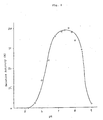
- Optimum pH for activity is 7.2 to 7.8 as shown in Figure 1. Stable within the pH range of pH 7.0 to 8.0 under the condition of 24 hour retention of activity at 30°C.
- Optimum temperature for activity in the presence of 5.0 mM CaCl2 is 45°C (30 minute assay; Figure 2) or 50°C (10 minute assay), depending upon the duration of the assay period used.
- the enzymatic activity is increased by about 50% in the presence of 2.5 mM chloride salts of Ca2+, Mg2+ or Ba2+.
- the activity is increased by about 100% in the presence of an optimum concentration of 5 mM Ca2+.
- the activity is lowered in the presence of 0.5 mM chloride salts of Co2+, Zn2+, Cu2+, Ni2+ and Pb2+ by about 38%, 66%, 90% 80%, and 100%, respectively.
- Chloride salts of Fe2+, Mn2+ and Li2+ ions at 2.5 mM do not influence the activity.
- NaCl inhibits the activity to the extent of about 10%, 44%, 88% and 100% at concentrations of 30 mM, 100 mM, 200 mM, 300 mM respectively.
- the molecular weight of the present enzyme is about 120000 as estimated by sodium dodecyl sulfate-polyacrylamide gel electrophoresis using a 4 to 20% linear gradient gel with reference to molecular weight standard proteins.
- Reaction mixtures containing 20 ⁇ l of the present enzyme solution (suitably diluted), 80 ⁇ l of 50 mM HEPES buffer, pH, 7.4 and 20 ⁇ l of 100 ug per ml of heparin (sodium salt) are sealed to prevent evaporation and held at 45°C for 30 minutes.
- 20 ⁇ l of 0.025 mg/ml toluidene blue solution is added and the absorbance of the solution is determined at 620 nm.
- the total amount of heparin remaining in the reaction mixtures is calculated from their absorbance by reference to a series of standard solutions of known heparin concentration.
- One Unit of enzyme activity is taken as the amount required to degrade 1.0 mg of heparin per hour at 45°C.
- One International Unit. (I.U.) of enzyme activity is taken as the amount of enzyme required to generate 1 micromole of double bonds per minute at 45°C, based on a molar extinction coefficient of 5100 cm ⁇ 1 M ⁇ 1 for the degradation products.
- a newly discovered strain designated Bacillus sp . strain BH100 (FERM BP-2613 (FERM P-10408)), was isolated from soil as follows. About 0.1 g of soil sample was added to 1.5 ml of medium which consisted of (per liter): 2.0 g of heparin, 0.35 g of K2HPO4, 0.27 g of NH4Cl, 0.2 g of MgCl2 ⁇ 6H2O, 0.001 g of each of lysine, histidine, and methionine, 0.0025 mg of ferrous citrate, 0.1 ml of trace element solution [containing (per liter): 0.12 g of ZnSO4, 0.5 g of MnSO4, 0.13 g of H3BO3, 0.004 g of CuSO4, 0.006 g of NA2MoO4, and 0.012 g of CoCl2 ⁇ 6H2O], and 0.1 ml of vitamin solution [containing (per liter): 10 mg each of folic
- the cultures were held in sterile 24-well microtiter trays, sealed with plastic wrap to minimize evaporation, at 45°C, without shaking. From those samples which exhibited evidence of microbial growth after one week of cultivation, the microorganisms were isolated in biologically pure form by repeated subculture of cells on a solid medium containing (per liter): 2.0 g of heparin, 0.1 g of K2HPO4, 1.0 g of MgCl2 ⁇ 6H2O and 8.0 g of gellan gum, at pH 8.0, with incubation at 45°C.
- the biologically pure isolates obtained as indicated in Example 1 were tested for production of heparinase activity by culturing the cells in 20 ml of liquid medium containing (per liter): 14 g of tryptone, 1.0 g of yeast extract, 3.5 g of K2HPO4, 2 g of MgCl2, and 1.0 g of heparin, adjusted to pH 8.0 with NaOH.
- the cultures were incubated at 45°C, with rotary shaking at 65 rpm. After 72 hours of cultivation, the cells were collected by centrifugation at 8000xg for 20 minutes and the supernatant was tested for residual heparin by the Toluidene Blue Metachromatic Assay.
- the culture containing Bacillus sp In the culture containing Bacillus sp .
- Bacillus sp . strain BH100 (FERM BP-2613 (P-10408)) was cultured in 20 ml of medium containing (per liter): 7.0 g of HEPES buffer, 2.0 g of yeast extract, 0.5 g of K2HPO4, 1.0 g of MgCl2, 1.0 g of heparin, and 10 g of carbon source as indicated below, adjusted to pH 8.0 with NaOH. The cultures were incubated at 45°C with rotary shaking at 65 rpm.
- strain BH100 (FERM BP-2613 (FERM P-10408) was examined as follows.
- Strain BH100 was cultured in 20 ml of liquid medium containing (per liter): 10 g of tryptone, 1.0 g of yeast extract, 3.5 g of K2HPO4, 2.0 g of MgCl2 ⁇ 6H2O, and chondroitin A, chondroitin B, Chondroitin C, hyaluronic acid, polygalacturonic acid, dextran sulfate, glucosamine or glucuronic acid, each at 1 g per liter, or heparin at the concentration as indicated below.
- heparinase synthesis by Bacillus sp . strain BH100 is induced by the presence of heparin in the growth medium. Production of the enzyme is not induced by the presence of chondroitins A, B or C, hyaluronic acid, polygalacturonic acid, dextran sulfate, glucosamine, or glucuronic acid.
- Bacillus sp . strain BH100 (FERM BP-2613 (FERM P-10408) was cultured from a 5% inoculum in 6.0 liters of liquid medium containing (per liter): 10 g of tryptone, 1.0 g of yeast extract, 3.5 g of K2HPO4, 2.0 g of MgCl2 ⁇ 6H2O, and 2.0 g of heparin, adjusted to pH 7.4 with NaOH, and incubated aerobically at 40°C for 36 hours. The obtained culture was centrifuged at 8000xg at 10°C for 30 minutes so as to remove the cells form the culture supernatant.
- the dialysate was centrifuged at 12000xg at 10°C for 30 minutes and the precipitated protein was discarded. Further purification was performed at room temperature, that is, at about 22°C. Heparinase activity was monitored at each step using the Ultraviolet Absorbance Assay.
- the crude heparinase solution was loaded onto a column of DEAE-TOYOPEARL equilibrated with 10 mM HEPES buffer pH 7.8 and eluted with the same buffer.
- the eluate was collected as a single active fraction and this enzyme solution was loaded onto a column of CELLULOFINE-SULFATE equilibrated with the same buffer.
- the enzyme was eluted with a linear concentration gradient of 0 to 0.3 M NaCl in 10 mM HEPES buffer, pH, 7.8.
- the active fractions which eluted at about 0.19 M NaCl were collected and concentrated by ultrafiltration using an Amicon PM10 membrane.
- treated enzyme solution was subjected to gel filtration using a column of SHODEX WS-2003 equilibrated with 100 mM NaCl in 50 mM HEPES buffer pH 7.4 and eluted with the same buffer.
- the active fractions thus obtained were combined and found to contain only the purified heparinase as indicated by a single protein band upon examination by sodium dodecyl sulfatepolyacrylamide gel electrophoresis.
Landscapes
- Health & Medical Sciences (AREA)
- Life Sciences & Earth Sciences (AREA)
- Chemical & Material Sciences (AREA)
- Engineering & Computer Science (AREA)
- Organic Chemistry (AREA)
- Zoology (AREA)
- Bioinformatics & Cheminformatics (AREA)
- Wood Science & Technology (AREA)
- Genetics & Genomics (AREA)
- Biotechnology (AREA)
- Microbiology (AREA)
- Biomedical Technology (AREA)
- Biochemistry (AREA)
- General Engineering & Computer Science (AREA)
- General Health & Medical Sciences (AREA)
- Medicinal Chemistry (AREA)
- Molecular Biology (AREA)
- Tropical Medicine & Parasitology (AREA)
- Virology (AREA)
- Enzymes And Modification Thereof (AREA)
- Micro-Organisms Or Cultivation Processes Thereof (AREA)
- Preparation Of Compounds By Using Micro-Organisms (AREA)
Applications Claiming Priority (2)
| Application Number | Priority Date | Filing Date | Title |
|---|---|---|---|
| JP63297807A JPH0693836B2 (ja) | 1988-11-25 | 1988-11-25 | バチルス属に属するヘパリナーゼ生産微生物、新規ヘパリナーゼ及びその製法 |
| JP297807/88 | 1988-11-25 |
Publications (3)
| Publication Number | Publication Date |
|---|---|
| EP0370958A2 true EP0370958A2 (fr) | 1990-05-30 |
| EP0370958A3 EP0370958A3 (fr) | 1991-05-29 |
| EP0370958B1 EP0370958B1 (fr) | 1994-07-20 |
Family
ID=17851424
Family Applications (1)
| Application Number | Title | Priority Date | Filing Date |
|---|---|---|---|
| EP89810894A Expired - Lifetime EP0370958B1 (fr) | 1988-11-25 | 1989-11-22 | Microorganisme producteur d'héparinase appartenant au genre Bacillus, nouvelle héparinase et procédé pour produire celle-ci |
Country Status (5)
| Country | Link |
|---|---|
| US (3) | US5145778A (fr) |
| EP (1) | EP0370958B1 (fr) |
| JP (1) | JPH0693836B2 (fr) |
| AT (1) | ATE108826T1 (fr) |
| DE (2) | DE68916915T2 (fr) |
Cited By (6)
| Publication number | Priority date | Publication date | Assignee | Title |
|---|---|---|---|---|
| EP0502496A3 (en) * | 1991-03-06 | 1992-10-07 | Seikagaku Kogyo Kabushiki Kaisha (Seikagaku Corporation) | Novel heparitinase, process for producing the same and bacteria producing the same |
| WO1992017203A1 (fr) * | 1991-04-04 | 1992-10-15 | Ibex Technologies, Inc. | Neutralisation enzymatique d'heparine |
| US7691612B2 (en) | 2005-11-03 | 2010-04-06 | Momenta Pharmaceuticals, Inc. | Heparan sulfate glycosaminoglycan lyase and uses thereof |
| US7691613B2 (en) | 2006-11-03 | 2010-04-06 | Momenta Pharmaceuticals, Inc. | Glycosaminoglycan lyase IV and uses thereof |
| US7767420B2 (en) | 2005-11-03 | 2010-08-03 | Momenta Pharmaceuticals, Inc. | Heparan sulfate glycosaminoglycan lyase and uses thereof |
| EP3266868A4 (fr) * | 2015-03-05 | 2018-08-08 | Shenzhen Hepalink Pharmaceutical Group Co., Ltd. | Héparinases obtenues à partir de sphingobacterium daejeonense, leur procédé de préparation et leur application |
Families Citing this family (10)
| Publication number | Priority date | Publication date | Assignee | Title |
|---|---|---|---|---|
| JPH0693836B2 (ja) * | 1988-11-25 | 1994-11-24 | 新技術事業団 | バチルス属に属するヘパリナーゼ生産微生物、新規ヘパリナーゼ及びその製法 |
| US5599659A (en) * | 1993-03-11 | 1997-02-04 | Breonics, Inc. | Preservation solution for ex vivo, warm preservation of tissues, explants,organs and vascular endothelial cells comprising retinal-derived fibroblast growth factor, cyclodextrin and chondroitin sulfate |
| US6198958B1 (en) | 1998-06-11 | 2001-03-06 | Beth Israel Deaconess Medical Center, Inc. | Method and apparatus for monitoring a magnetic resonance image during transcranial magnetic stimulation |
| JP2003527822A (ja) * | 1998-08-27 | 2003-09-24 | マサチューセッツ インスティテュート オブ テクノロジー | ヘパリナーゼiおよびii由来の合理的に設計されたヘパリナーゼ |
| CA2402160C (fr) * | 2000-03-08 | 2012-02-14 | Massachusetts Institute Of Technology | Heparinase iii et ses utilisations |
| DE60334220D1 (de) * | 2002-06-03 | 2010-10-28 | Massachusetts Inst Technology | Rationell konstruierte, von chondroitinase b abgeleitete lyasen |
| US20050277826A1 (en) * | 2004-06-10 | 2005-12-15 | Conopco, Inc. | Apparatus and method for reducing interference |
| CN102586217A (zh) * | 2011-12-16 | 2012-07-18 | 深圳市海普瑞药业股份有限公司 | 肝素黄杆菌肝素酶ⅰ、ⅱ、ⅲ的冻干保存方法 |
| EP3561048A4 (fr) | 2016-12-22 | 2020-08-12 | Shenzhen Hepalink Pharmaceutical Group Co., Ltd. | Souche de pseudomonas stutzeri produisant de l'héparinase et héparinase dérivée de celle-ci |
| CN113249277B (zh) * | 2021-07-05 | 2021-09-24 | 广东海洋大学 | 一株贝雷斯芽孢杆菌在水产品肝素提取中的应用 |
Family Cites Families (2)
| Publication number | Priority date | Publication date | Assignee | Title |
|---|---|---|---|---|
| US4341869A (en) * | 1980-08-25 | 1982-07-27 | Massachusetts Institute Of Technology | Process for producing heparinase |
| JPH0693836B2 (ja) * | 1988-11-25 | 1994-11-24 | 新技術事業団 | バチルス属に属するヘパリナーゼ生産微生物、新規ヘパリナーゼ及びその製法 |
-
1988
- 1988-11-25 JP JP63297807A patent/JPH0693836B2/ja not_active Expired - Lifetime
-
1989
- 1989-11-22 DE DE68916915T patent/DE68916915T2/de not_active Expired - Fee Related
- 1989-11-22 US US07/440,061 patent/US5145778A/en not_active Expired - Fee Related
- 1989-11-22 DE DE198989810894T patent/DE370958T1/de active Pending
- 1989-11-22 AT AT89810894T patent/ATE108826T1/de not_active IP Right Cessation
- 1989-11-22 EP EP89810894A patent/EP0370958B1/fr not_active Expired - Lifetime
-
1991
- 1991-11-27 US US07/799,597 patent/US5362645A/en not_active Expired - Fee Related
-
1994
- 1994-08-03 US US08/285,383 patent/US5455162A/en not_active Expired - Fee Related
Cited By (10)
| Publication number | Priority date | Publication date | Assignee | Title |
|---|---|---|---|---|
| EP0502496A3 (en) * | 1991-03-06 | 1992-10-07 | Seikagaku Kogyo Kabushiki Kaisha (Seikagaku Corporation) | Novel heparitinase, process for producing the same and bacteria producing the same |
| US5290695A (en) * | 1991-03-06 | 1994-03-01 | Seikagaku Kogyo Kabushiki Kaisha | Heparitinase, process for producing the same and bacteria producing the same |
| US5405759A (en) * | 1991-03-06 | 1995-04-11 | Seikagaku Kogyo Kabushiki Kaisha | Heparitinase, process for producing the same and bacteria producing the same |
| WO1992017203A1 (fr) * | 1991-04-04 | 1992-10-15 | Ibex Technologies, Inc. | Neutralisation enzymatique d'heparine |
| US7691612B2 (en) | 2005-11-03 | 2010-04-06 | Momenta Pharmaceuticals, Inc. | Heparan sulfate glycosaminoglycan lyase and uses thereof |
| US7767420B2 (en) | 2005-11-03 | 2010-08-03 | Momenta Pharmaceuticals, Inc. | Heparan sulfate glycosaminoglycan lyase and uses thereof |
| US7888072B2 (en) | 2005-11-03 | 2011-02-15 | Momenta Pharmaceuticals, Inc. | Heparan sulfate glycosaminoglycan lyase and uses thereof |
| US8198050B2 (en) | 2005-11-03 | 2012-06-12 | Momenta Pharmaceuticals, Inc. | Heparan sulfate glycosaminoglycan lyase and uses thereof |
| US7691613B2 (en) | 2006-11-03 | 2010-04-06 | Momenta Pharmaceuticals, Inc. | Glycosaminoglycan lyase IV and uses thereof |
| EP3266868A4 (fr) * | 2015-03-05 | 2018-08-08 | Shenzhen Hepalink Pharmaceutical Group Co., Ltd. | Héparinases obtenues à partir de sphingobacterium daejeonense, leur procédé de préparation et leur application |
Also Published As
| Publication number | Publication date |
|---|---|
| ATE108826T1 (de) | 1994-08-15 |
| DE68916915T2 (de) | 1994-11-03 |
| US5362645A (en) | 1994-11-08 |
| DE68916915D1 (de) | 1994-08-25 |
| EP0370958B1 (fr) | 1994-07-20 |
| US5455162A (en) | 1995-10-03 |
| US5145778A (en) | 1992-09-08 |
| JPH0693836B2 (ja) | 1994-11-24 |
| DE370958T1 (de) | 1990-11-08 |
| JPH02142470A (ja) | 1990-05-31 |
| EP0370958A3 (fr) | 1991-05-29 |
Similar Documents
| Publication | Publication Date | Title |
|---|---|---|
| EP0370958B1 (fr) | Microorganisme producteur d'héparinase appartenant au genre Bacillus, nouvelle héparinase et procédé pour produire celle-ci | |
| US5476775A (en) | Hemicellulase active at PH and temperature extremes | |
| US5290695A (en) | Heparitinase, process for producing the same and bacteria producing the same | |
| JPWO1996016166A1 (ja) | 新規なケラタン硫酸分解酵素 | |
| JP3026857B2 (ja) | 新規プルラナーゼおよびその製造法 | |
| EP0558036B1 (fr) | Enzyme de débranchement et procédé pour sa préparation | |
| CN100575478C (zh) | 一种新的弧菌科弧菌属菌株及其应用 | |
| JP2824508B2 (ja) | N−アセチルグルコサミン6−リン酸デアセチラーゼ | |
| JP2926249B2 (ja) | アルギン酸リアーゼの製造法 | |
| JPH03247296A (ja) | 低分子量コンドロイチン硫酸の製造方法 | |
| JP2809438B2 (ja) | 耐熱性コンドロイチナーゼ及びその製造方法 | |
| US5110734A (en) | Purified cyclodextrinase | |
| JPH0440988B2 (fr) | ||
| EP0292158B1 (fr) | Procédé de préparation d'endo-alpha-N-acétylgalactosaminidase par des micro-organismes | |
| JP3055041B2 (ja) | α−1,2−マンノシダーゼ、その製造方法およびその生産菌 | |
| JPH0632611B2 (ja) | γ―サイクロデキストリン合成酵素及びその製造法 | |
| JP3117691B1 (ja) | 新規ヘパリチナーゼ及びその製造法 | |
| JP3027449B2 (ja) | 新規シクロマルトデキストリナーゼ、その製造法及び該酵素を生産する微生物 | |
| JP3110425B2 (ja) | 新規ヘパリチナーゼ及びその製造法 | |
| JP3110426B2 (ja) | 新規ヘパリチナーゼ及びその製造法 | |
| JPH072116B2 (ja) | ジフルクト−ス、ジアンヒドリド▲iii▼の製造法 | |
| JPH0761264B2 (ja) | 新規なシクロマルトデキストリナーゼ及びその製造方法 | |
| JPH04141090A (ja) | アルギン酸リアーゼの製造方法 | |
| JPH03108486A (ja) | ヘパリナーゼをコードするプラスミド、このプラスミドを保持するヘパリナーゼ生産株及びヘパリナーゼの製造法 | |
| JPH07184647A (ja) | α−L−フコシダーゼ、その製造方法およびアルカリジェネス・デニトリフィカンス サブsp. デニトリフィカンス KSF−0901菌株 |
Legal Events
| Date | Code | Title | Description |
|---|---|---|---|
| PUAI | Public reference made under article 153(3) epc to a published international application that has entered the european phase |
Free format text: ORIGINAL CODE: 0009012 |
|
| AK | Designated contracting states |
Kind code of ref document: A2 Designated state(s): AT BE CH DE ES FR GB GR IT LI LU NL SE |
|
| DET | De: translation of patent claims | ||
| EL | Fr: translation of claims filed | ||
| PUAL | Search report despatched |
Free format text: ORIGINAL CODE: 0009013 |
|
| AK | Designated contracting states |
Kind code of ref document: A3 Designated state(s): AT BE CH DE ES FR GB GR IT LI LU NL SE |
|
| 17P | Request for examination filed |
Effective date: 19911014 |
|
| RAP1 | Party data changed (applicant data changed or rights of an application transferred) |
Owner name: RESEARCH DEVELOPMENT CORPORATION OF JAPAN Owner name: RIKAGAKU KENKYUSHO |
|
| 17Q | First examination report despatched |
Effective date: 19930302 |
|
| GRAA | (expected) grant |
Free format text: ORIGINAL CODE: 0009210 |
|
| AK | Designated contracting states |
Kind code of ref document: B1 Designated state(s): AT BE CH DE ES FR GB GR IT LI LU NL SE |
|
| PG25 | Lapsed in a contracting state [announced via postgrant information from national office to epo] |
Ref country code: IT Free format text: LAPSE BECAUSE OF FAILURE TO SUBMIT A TRANSLATION OF THE DESCRIPTION OR TO PAY THE FEE WITHIN THE PRESCRIBED TIME-LIMIT;WARNING: LAPSES OF ITALIAN PATENTS WITH EFFECTIVE DATE BEFORE 2007 MAY HAVE OCCURRED AT ANY TIME BEFORE 2007. THE CORRECT EFFECTIVE DATE MAY BE DIFFERENT FROM THE ONE RECORDED. Effective date: 19940720 Ref country code: BE Effective date: 19940720 Ref country code: ES Free format text: THE PATENT HAS BEEN ANNULLED BY A DECISION OF A NATIONAL AUTHORITY Effective date: 19940720 Ref country code: GR Free format text: LAPSE BECAUSE OF FAILURE TO SUBMIT A TRANSLATION OF THE DESCRIPTION OR TO PAY THE FEE WITHIN THE PRESCRIBED TIME-LIMIT Effective date: 19940720 Ref country code: LI Effective date: 19940720 Ref country code: CH Effective date: 19940720 Ref country code: NL Effective date: 19940720 Ref country code: AT Effective date: 19940720 |
|
| REF | Corresponds to: |
Ref document number: 108826 Country of ref document: AT Date of ref document: 19940815 Kind code of ref document: T |
|
| REF | Corresponds to: |
Ref document number: 68916915 Country of ref document: DE Date of ref document: 19940825 |
|
| ET | Fr: translation filed | ||
| PG25 | Lapsed in a contracting state [announced via postgrant information from national office to epo] |
Ref country code: SE Effective date: 19941020 |
|
| REG | Reference to a national code |
Ref country code: CH Ref legal event code: PL |
|
| PG25 | Lapsed in a contracting state [announced via postgrant information from national office to epo] |
Ref country code: LU Free format text: LAPSE BECAUSE OF NON-PAYMENT OF DUE FEES Effective date: 19941130 |
|
| NLV1 | Nl: lapsed or annulled due to failure to fulfill the requirements of art. 29p and 29m of the patents act | ||
| PLBE | No opposition filed within time limit |
Free format text: ORIGINAL CODE: 0009261 |
|
| STAA | Information on the status of an ep patent application or granted ep patent |
Free format text: STATUS: NO OPPOSITION FILED WITHIN TIME LIMIT |
|
| 26N | No opposition filed | ||
| PGFP | Annual fee paid to national office [announced via postgrant information from national office to epo] |
Ref country code: FR Payment date: 19980724 Year of fee payment: 10 |
|
| PGFP | Annual fee paid to national office [announced via postgrant information from national office to epo] |
Ref country code: GB Payment date: 19981127 Year of fee payment: 10 |
|
| PGFP | Annual fee paid to national office [announced via postgrant information from national office to epo] |
Ref country code: DE Payment date: 19990129 Year of fee payment: 10 |
|
| PG25 | Lapsed in a contracting state [announced via postgrant information from national office to epo] |
Ref country code: GB Free format text: LAPSE BECAUSE OF NON-PAYMENT OF DUE FEES Effective date: 19991122 |
|
| GBPC | Gb: european patent ceased through non-payment of renewal fee |
Effective date: 19991122 |
|
| PG25 | Lapsed in a contracting state [announced via postgrant information from national office to epo] |
Ref country code: FR Free format text: LAPSE BECAUSE OF NON-PAYMENT OF DUE FEES Effective date: 20000731 |
|
| PG25 | Lapsed in a contracting state [announced via postgrant information from national office to epo] |
Ref country code: DE Free format text: LAPSE BECAUSE OF NON-PAYMENT OF DUE FEES Effective date: 20000901 |
|
| REG | Reference to a national code |
Ref country code: FR Ref legal event code: ST |