EP0390218A2 - Optisches Anti-Reflektionselement - Google Patents
Optisches Anti-Reflektionselement Download PDFInfo
- Publication number
- EP0390218A2 EP0390218A2 EP90106204A EP90106204A EP0390218A2 EP 0390218 A2 EP0390218 A2 EP 0390218A2 EP 90106204 A EP90106204 A EP 90106204A EP 90106204 A EP90106204 A EP 90106204A EP 0390218 A2 EP0390218 A2 EP 0390218A2
- Authority
- EP
- European Patent Office
- Prior art keywords
- film
- reflection
- resistance
- lens
- optical element
- Prior art date
- Legal status (The legal status is an assumption and is not a legal conclusion. Google has not performed a legal analysis and makes no representation as to the accuracy of the status listed.)
- Granted
Links
Images

Classifications
-
- G—PHYSICS
- G02—OPTICS
- G02B—OPTICAL ELEMENTS, SYSTEMS OR APPARATUS
- G02B1/00—Optical elements characterised by the material of which they are made; Optical coatings for optical elements
- G02B1/10—Optical coatings produced by application to, or surface treatment of, optical elements
- G02B1/11—Anti-reflection coatings
- G02B1/113—Anti-reflection coatings using inorganic layer materials only
- G02B1/115—Multilayers
Definitions
- the present invention relates to an optical element used as an optical lens (e.g. opthalmic lens, camera lens), a filter, a polarizer, a semitransparent mirror, etc. and particularly to an anti-reflection optical element with reduced surface reflection.
- an optical lens e.g. opthalmic lens, camera lens
- a filter e.g. a polarizer, a semitransparent mirror, etc.
- an anti-reflection optical element with reduced surface reflection e.g. opthalmic lens, camera lens
- plastics As the material for optical element, there have conventionally been used mainly inorganic glasses. In recent years, however, plastics have gained wide acceptance as said material, because they are lightweight and superior in impact resistance, tintability, etc. Plastics are being increasingly used particularly as a material for opthalmic lens because they have excellent tintability and can meet a requirement in fashion aspect, of using a large-sized frame and a color lens in combinatiuon.
- the resins obtained by cast-polymerizing diethylene glycol bis(allyl carbonate) are in general use.
- Polyurethanes which have a higher refractive index than the refractive index (1.500) (these refractivfe indexes are relative to the d-line of Fraunhofer lines and hereinafter referred to as nd) of the DAC resins and are lightweight, are also in use as a material for lens, as described in, for example, Japanese Patent Publication Kokai (Laid-Open) No. 199016/1985.
- the polyurethanes have excellent impact resistance, good tintability, a high nd (1.56-1.64) and a small specific gravity (1.22-1.44), and accordingly are suitable as a material for thin and light optical lens.
- optical elements made of an inorganic glass as well as those made of a plastic have, in many cases, an anti-reflection film thereon to reduce the surface reflection.
- an anti-reflection film is formed usually on an abrasion resistance film provided on an optical component in order to improve the mar resistance.
- a foundation layer is provided as necessary between the abrasion resistance film and the anti-reflection film in order to improve the adhesion between the two films. Also there is a case wherein a foundation layer is provided on an optical component and an anti-reflection film is provided on the foundation layer.
- Such an anti-reflection film is formed usually as a vapor-deposited film of metal(s) or metal oxide(s), and is largely divided into a single-layered anti-reflection film and a multi-layered anti-reflection film, the latter being obtained by laminating a low refractive index film layer and a high refractive index film layer by turns.
- Both the single-layered anti-reflection film and the multi-layered anti-reflection film are required to have excellent optical properties (e.g. desired refractive index, optical uniformity, excellent transparency), excellent mechanical properties (e.g. excellent mar resistance), excellent adhesion) and excellent chemical properties (e.g. excellent acid resistance, excellent heat resistance).
- the anti-reflection film provided on an optical element made of an inorganic glass there are known, for example, a multi-layered anti-reflection film comprising a high refractive index vapor-deposited film layer obtained from a mixed material consisting of Zr and Ta (at least one of them takes an oxide form), disclosed in Japanese Patent Publication Kokai (Laid-Open) No. 4759/1971; a multi-layered anti-reflection film comprising a high refractive index vapor-deposited film layer obtained from a mixed material consisting of Ta2O5 and ZrO2, disclosed in Japanese Patent Publication Kokai (Laid-Open) No.
- the multi-layered anti-reflection film comprising a high refractive index vapor-deposited film layer obtained by using ZrO2 as a material.
- the multi-layered anti-reflection film comprising a high refractive index vapor-deposited film layer obtained by using ZrO2 as a material is in main use.
- an anti-reflection film cannot be conducted at high optical component temperatures as in optical elements made of an inorganic glass, and there are used a multi-layered anti-reflection film comprising a high refractive index vapor-deposited film layer obtained by using ZrO2 as a material, because the multi-layered anti-reflection film, even when formed at low temperatures, has excellent transparency and a high refractive index as disclosed in Japanese Patent Publication Kokai (Laid-Open) No. 116003/1981.
- the multi-layered anti-reflection film comprising a high refractive index vapor-deposited film layer obtained by using ZrO2 as a material, when formed on an optical component (e.g. plastic) whose temperature cannot be raised relatively high, shows practically unacceptable decrease in heat resistance with the lapse of time.
- an optical component e.g. plastic
- the object of the present invention is to solve the above problem and provide an anti-reflection optical element whose optical component is made of a plastic and which possesses excellent optical, mechanical and chemical properties as well as improved duraibility in said properties.
- the anti-reflection optical element of the present invention comprises (i) an optical component made of a plastic and (ii) a multi-layered anti-reflection film provided directly or indirectly on said optical component and comprising at least one high refractive index film layer which is a film of mixed metal oxides comprising tantalum oxide, zirconium oxide and yttrium oxide, deposited by evaporation process.
- the anti-reflection optical element of the present invention comprises (i) an optical component made of a plastic and (ii) a multi-layered anti-reflection film provided directly or indirectly on said optical component and comprising at least one high refractive index film layer which is a film of mixed metal oxides comprising tantalum oxide, zirconium oxide and yttrium oxide, deposited by evaporation process.
- the plastic consitituting the optical component on which a multi-layered anti-reflection film is provided has no particular restriction as long as it can be used as a material for optical element, but typically includes the followings.
- the polyurethanes (1) are most preferable because of their high refractive index and high impact resistance.
- the polyisocyanate used as a monomer for production of the polyurethanes (1) has no particular restriction, and includes polyisocyanate compounds such as tolylene diisocyanate, diphenylmethane diisocyanate, polymeric diphenylmethane diisocyanate, naphthylene diisocyanate, hexamethylene diisocyanate, isophorone diioscyanate, hydrogenated xylylene diisocyanate, hydrogenated diphenylmethane diisocyanate, lysine diisocyanate, triphenylmethane triisocyanate, tris(isocyanatophenyl) thiophosphate, trans-cyclohexane-1,4-diisocyanate, p-phenylene diisocyanate, tetramethylene diisocyanate, 1,6,11-undecane triisocyanate, 1,8-diisocyanate-4-isocyanate methylo
- polyisocyanate there can also be mentioned o-xylylene diisocyanate, m-xylylene diisocyanate, p-xylylene diisocyanate, tetramethyl-p-xylylene diisocyanate, tetramethyl-m-xylylene diisocyanate, and their nucleus-chlorinated, brominated, methylated, or ethylated products such as 4-chloro-m-xylylene diisocyanate, 4,5-dichloro-m-xylylene diisocyanate, 2,3,5,6-tetrabromo-p-xylylene diisocyanate, 4-methyl-m-xylylene diisocyanate, 4-ethyl-m-xylylene diisocyanate and the like.
- These polyisocyanates can be used alone or in combination of two or more.
- the compounds (A) to be reacted with the polyisocyanate there can be mentioned, for example, ethanedithiol, propanedithiol, propanetrithiol, butanedithiol, pentanedithiol, hexanedithiol, heptanedithiol, octanedithiol, cyclohexanedithiol, cycloheptanedithiol, 2,5-dichlorobenzene-1,3-dithiol, xylylenedithiol, benzenedithiol, pentaerythritol tetrakis-3-mercaptopropionate, pentaerythritol tetrakisthioglycolate, trimethylolpropane tris(mercaptopropionate), trimethylolethane tris(mercaptopropionate), dichloroneopentyl glycol bis(mercapto)
- dihydric alcohols such as ethylene glycol, dihydroxydimethyl sulfide and dihydroxydiethyl sulfide
- trihydric alcohols such as trihyroxybutane, trihydroxypentane, glycerol trimethyolpropane, tris(2-hydroxyethyl) isocyanurate and the like
- tetrahydric alcohols such as tetrahydroxyhexane, pentaerythritol, diglycerol and the like
- higher hydric alcohols such as dipentaerythritol and the like.
- the compounds (C) there can be mentioned, for example. mercaptohydroxyethane, glycerol di(mercaptoacetate), 2-mercaptoethanol, 1-hydroxy-4-mercaptocyclohexane, 4-mercaptophenol and 2,4-dimercaptophenol.
- the compounds (C) there may also be used a compound (c1) having p hydroxyl groups (p is 0 or an integer of 1 or more) and q mercapto groups (q is an integer of 1 or more) wherein the sum of the number of hydroxyl groups and the sum of mercapto groups, i.e.
- (p + q) is 3 or more, and 6 or less carbon atoms exist between the furthest two of said groups (furthest two hydroxyl groups, furthest two mercapto groups or furthest hydroxyl and mercapto groups).
- the compound (c1) there can be mentioned, for example, monothioglycerol, dimercaptopropanol, 1-mercaptomethyl-1,1-dihydroxymethylpropane, 1,4-dimercapto-2,3-hydroxybutane, mercapto-susbstituted pentaerythritol and mercapto-substituted sorbitol.
- the compound (C) can be used alone or in combiation of two or more.
- tin compounds such as dibutyltin dilaurate, dibutyltin dimaleate and the like are preferable.
- the polymerization is effected preferably in such a way that the initial temperature is 5-40°C and then temperature elevation is made to 100-130°C in 10-70 hours.
- the initial temperature is lower than 5°C
- the polymerization takes a longer time, which is inefficient.
- the initial temperature is higher than 40°C, the resulting lens tends to be optically nonuniform.
- the final temperature is lower than 100°C, unreacted monomers tend to remain, and the resulting polymer has a low polymerization degree and insufficient properties.
- the final temperature is higher than 130°C, the resulting lens has yellowing.
- the monomer mixture can contain, as necessary, various additives such as light stabilizer, ultraviolet absorber, anti-oxidant, anti-static agent, anti-foaming agent and the like.
- the polymerization for obtaining a polyurethane (1) may be copolymerization with a radical-polymerizable monomer in order to improve the properties of polyurethane (1).
- DAC-containing copolymer (3) e.g. DAC-benzyl (meth)acrylate copolymer
- DAC-containing copolymer (3) e.g. DAC-benzyl (meth)acrylate copolymer
- it can be apropriately determined depending upon desired reaction conditions (temperature, time, etc.).
- an initiator preferable are, for example, 1,1-azobiscyclohexanecarbonate, diisopropyl peroxycarbonate, 1,1′-azobiscyclohexanenitrate and di-tert-butyl peroxide.
- Various ultraviolet absorbers can also be used in the above production. There are preferably used, for example, 2,2′-dihydroxy-4-methoxybenzophenone and 2-(2′-hydroxy-5′-tert-octylphenyl)benzotriazole.
- the multi-layered anti-reflection film provided on the optical component made of a plastic is obtained by laminating a low refractive index film layer and a high refractive index film layer by turns.
- the high refractive index film layer is a film of mixed metal oxides comprising tantalum oxide, zirconium oxide and yttrium oxide deposited by evaporation process.
- the low refractive index film layer is preferably a silicon oxide film, preferably a vapor-deposited film obtained by using SiO2 as a material, in view of the heat resistance.
- the film of mixed metal oxides comprising tantalum oxide, zirconium oxide and yttrium oxide, depoisted by evaporation process is preferably obtained by mixing a ZrO2 powder, a Ta2O5 powder and a Y2O3 powder, pelletizing the mixture by mechanical pressing and sintering, and subjecting the pellets to electron beam heating to effect vapor deposition.
- the thus obtained vapor-deposited film is very stable chemically similarly to Ta2O5, as compared with ZrO2, and has a transparency almost equal to that of ZrO2. Moreover, the film has a high refractive index of, for examle, 2.05 and is useful from the standpoint of film designing.
- the amount of Ta2O5 is less than 0.8 mole or more than 1.8 moles per mole of ZrO2, the resulting vapor-deposited film tends to show absorption.
- the amount of Y2O3 is more than 0.3 mole per mole of ZrO2, the rate of vapor deosition is large, the resulting vapor-deposited film tends to show absorption, and the materials for vapor deposition tends to cause splashing, thus making it difficult to control the production of vapor-depoisted film.
- the multi-layered anti-reflection film preferably consists of two film layers of ⁇ /2 and ⁇ /4, or three film layers of ⁇ /4, ⁇ /4 and ⁇ /4 or ⁇ /4, ⁇ /2 and ⁇ /4, for practical purpose.
- it may consist of four or more film layers for required reflection property.
- the first layer (seen from the optical component side) of ⁇ /4 in the three-layered film may be a three-layered symmetric equivalent film or a two-layered equivalent film, said two equivalent films being formed using the above-mentioned vapor-deposited film of metal oxides and the SiO2 film.
- the multi-layered anti-relfection film can also be obtained by employing, in place of the above mentioned vacuum deposition process, a sputtering process using the same sintered material as a target, an ion plating process, or the like.
- the multi-layered anti-reflection film can be provided directly on the optical component made of a plastic, or can be provided by firstly providing an abrasion resistance film on the optical component and then providing a multi-layered anti-reflection film on the abrasion resistnace film, to obtain an anti-reflection optical element with improved mar resistance.
- the abrasion resistnace film there is preferred one comprising an organosilicon polymer, because it can be formed at relatively low temperatures.
- the abrasion resistance film comprising an organosilicon polymer can be formed by forming, on the optical component, a layer of a compound selected from compounds having the following general formula and/or their hydrolyzates by a method such as dipping, coating or the like and then curing the layer: (R1) a (R2) b Si(OR3) 4-(a+b) wherein R1 and R2 are independently an alkyl group of 1-10 carbon atoms, an aryl group, a halogenated alkyl group, a halogenated aryl group, an alkenyl group, an epoxy group, a (meth)acryloxy group, a mercapto group, or an cyano group-containing organic group and are bonded to Si in the form of Si-C bond; R3 is an alkyl group of 1-6 carbon atoms, an alkoxyalkyl group or an acyl group; a and b are independently 0, 1 or 2; and (a + b) is 1 or 2.
- trialkoxysilanes or triacyloxysilanes such as methyltrimethoxysilane, methyltriethoxysilane, methyltrimethoxyethoxysilane, methyltriacetoxysilane, methyltripropoxysilane, methyltributoxysilane, ethyltrimethoxysilane, ethyltriethoxysilane, vinyltrimethoxysilane, vinyltriethoxysilane, vinyltriacetoxysilane, vinyltrimethoxyethoxysilane, phenyltrimethoxysilane, phenyltriethoxysilane, phenyltriacetoxysilane, gamma-chloropropyltrimethoxysilane, gamma-chloropropyltriethoxysilane, gamma-chloropropyltripropoxysilane, 3,3,3-tri
- organosilicon compounds can be used alone or in combination of two or more.
- tetraalkoxysilanes examples include methyl silicate, ethyl silicate, n-propyl silicate, isopropyl silicate, n-butyl silicate, sec-butyl silicate and tert-butyl silicate.
- organosilicon compounds can be cured in the absence of catalyst, but various catalysts may be used to promote their curing.
- catalysts there can be used, for exmaple, various acids and their salts including Lewis acids and their salts; metal salts, particularly alkali metal salts and ammonium salts of organic carboxylic acids, chromic acid, hypochlorous acid, boric acid, hydrobromic acid, selenious acid, thiosulfuric acid, orthosilicic acid, thiocyanic acid, nitrous acid, aluminic acid, carbonic acid and the like; and alkoxides of aluminum, zirconium or titanium, or their complex compounds.
- organosilicon polymers may be used in combination with other organic sustances.
- organic substances there can be mentioned, for exmaple, epoxy resins, acrylic copolymers and hydroxyl group-containing polymers (e.g. polyvinyl alcohol).
- an abrasion resistance film comprising an organosilicon polymer and then providing thereon a multi-layered anti-reflection film
- an anti-reflection optical element with improved mar resistance.
- a foundation layer between the abrasion resistance film and the multi-layered anti-reflection film
- the adhesion between the two films can be improved.
- the foundation layer there can be used a silicon oxide film, for exmaple, a vapor-deposited film obtained from SiO2. It is also possible that a foundation layer be provided on the optical component and a multi-layered anti-reflection film be provided on the foundation layer.
- an anti-reflection optical element of the present invention which is lightweight, has excellent impact resistance and excellent optical, mechanical and chemical properties, and has improved durability in said properties.
- the deaerated mixture was casted into a mold assembly consisting of a glass-made mold for lens production and a resin-made gasket.
- the temperature of the mixture was then continuously elevated from 25°C to 120°C in 20 hours and kept at 120°C for 2 hours to effect polymerization.
- the gasket was removed and the mold and the formed polymer were separated to obtain a high refractive index polyurethane lens as an optical component.
- the lens had a nd of 1.592 and a ⁇ d of 36 and thus had good optical properties.
- an antimony pentoxide sol antioxidants
- DENACOL EX-521 epoxy compound, i.e. polyglycerol polyglycidyl ether manufactured by Nagase Kasei K.K.
- the mixture was stirred for 5 hours.
- 6.8 parts by weight of dibutyltin laurate was added as a curing catalyst, and the resulting mixture was aged for 100 hours to obtain a coating solution.
- the high refractive index polyurethane lens prepared above was dipped in a 10% aqueous NaOH solution of 50°C for 5 minutes and then washed thoroughly.
- Sintered SiO2 was used as a mateial for vapor-deposited foundation layer or vapor-deposited low refractive index film layer.
- a material for vapor-deposited high refractive index material film layer there was used pellets obtained by mixing a ZrO2 powder, a Ta2O5 powder and a Y2O3 powder at a molar ratio of 1 : 1.3 : 0.2, press-molding the mixture, sintering the mold at 1,200°C and pelletizing the sintered material.
- the polyurethane lens having an abrasion resistance film thereon, obtained in (2) above was placed in a chamber for vapor deposition, and heated to 85°C while the chamber inside was made vacuum to 2 x 10 ⁇ 5 Torr.
- the above materials were vapor-deposited in order by an electron beam heating method, whereby as shown in Table 1, there was firstly formed a foundation layer consisting of a silicon oxide and then there were formed a first low refractive index film layer consisting of a composite equivalent film of a mixed material and a silicon oxide, a second high refractive index film layer consisting of a mixed material and a third low refractive index film layer consisting of a silicon oxide in this order to obtain a multi-layered anti-reflection film on the foundation layer.
- the foundation layer is desirable because it can increase adhesion of the anti-reflection film to the optical component.
- the above-obtained anti-reflection high refractive index plastic lens was measured for absorption ratios at wavelength region of visible light.
- the results are shown in Table 2.
- the absorption ratio (%) in Table 2 was obtained by measuring the reflectances (R) and transmittances (T) of said anti-reflection high refractive index plastic lens at various wavelengths between 380 nm and 780 nm by a recording spectrophotometer (Model 340 manufactured by Hitachi, Ltd.) and using the following formula.
- Absorption ratio (%) 100 - (R + T)
- the anti-reflection high refractive index plastic lens obtained in this Example shows low absorption ratios over the entire wavelength region of visible light and has excellent optical properties.
- the above plastic lens was measured for appearance, luminous reflectance, mar resistance, impact resistance, adhesion, heat resistance, alkali resistance, acid resistance and weather resistance according to the following test methods.
- the lens was measured for reflectance at a wavelength region of 380-780 nm using a recording spectrophotometer (Model 340 manufactured by Hitachi, Ltd.), and there was obtained a luminous reflectance of the lens from the reflectance and the luminous efficacy curve.
- the lens was visually examined for extent of mar when the surface of its multi-layered anti-reflection film was rubbed with a steel wool #0000. The following evaluation criterion was used.
- a 16-g steel ball was dropped on the center of the anti-reflection high refractive index plastic lens from a height of 127 cm to examine the extent of lens breakage.
- the surface of the anti-refletion high refractive index plastic lens was cross-cut at intervals of 1 mm; a cellophane tape was strongly attached thereon; the tape was peeled rapidly; thereby, the extent of peeling of the multi-layered anti-reflection film, foundation layer and abrasion resistance film of the lens was examined.
- the anti-reflection high refractive index plastic lens was placed in an oven for 1 hour to examine the formation of cracks. Heating was started from 70°C, the oven inside temperature was increased at intervals of 5°C, and the temperature of first crack appearance was examined, and the level of that temperature was used as a yardstick of heat resistance.
- the anti-reflection high refractive index plastic lens was immersed in a 10 wt. % aqueous NaOH solution for 24 hours to observe the corrosion state on the multi-layered anti-reflection film of the lens.
- the anti-reflection high refractive index plastic lens was immersed in a 10 wt. % aqueous HCl solution and a 10 wt. % aqueous H2SO4 solution for 24 hours to observe the corrosion state on the multi-layered anti-reflection film of the lens.
- the anti-reflection high refractive index plastic lens was subjectd to outdoor exposure for one month, and the resulting lens was evaluated or measured for appearance, luminous reflectance, mar resistance, impact resistance, adhesion, heat resistance, alkali resistance and acid resistance according to the same test methods as given above.
- the anti-reflection high refractive index plastic lens of the present Example 1 gave good evaluation or measurement results in all the test items and was excellent in optical, mechanical and chemical properties as well as in durabilities of the same test items.
- results of 8 test items i.e. appearance, luminous reflectance, mar resistance, impact resistance, adhesion, heat resistance, alkali resistance and acid resistance are shown in Table 3; and the results of weather resistance, i.e. the results of the same 8 test items after one-month outdoor exposure are shown in Table 4.
- Example 1 Eight polyurethane lenses each having an abrasion resistance film thereon were prepared in the same manner as in Example 1. On each abrasion resistance film was formed a foundation layer in the same manner as in Example 1. Then, on each foundation layer was formed a multi-layered anti-reflection film having the same consitution as the multi-layered anti-reflection film of Example 1, except that in formation of the mixed material film consituting the first low refractive index film layer (two-layered composite equivalent film) as well as in formation of the second high refractive index film layer of mixed material, the molar ratios of ZrO2 powder, Ta2O5 powder and Y2O3 powder used as mixed raw materials were changed from 1 : 1.3 : 0.2 (Example 1) to 1 : 1 : 0.1 (Exmple 2), 1 : 1 : 0.2 (Example 3), 1 : 1 : 0.3 (Example 4), 1 : 1.3 : 0.1 (Example 5), 1 : 1.3 : 0.3 (
- the resulting anti-refletion high refractive index plastic lens was measured for absorption ratios at various wavelengths of visible light in the same manner as in Example 1.
- the lens showed low absorption ratios at the entire wavelength region of visible light and had excellent optical properties.
- the measurement results are shown in Table 2.
- the lens was also evaluated and measured for appearance, luminuous reflectance, mar resistance, impact resistance, adhesion, heat resistance, alkali resistance, acid resistance and weather resistance in the same manners as in Example 1. Good evaluation and measurement results were obtained in all the test items, and the lens was superior in optical, mechanical and chemical properties as well as in durability in said test items.
- the results of 8 test items i.e. appearance, luminous reflectance, mar resistance, impact resistance, adhesion, heat resistance, alkali resistance and acid resistance are shown in Table 3; and the results of weather resistance, i.e. the results of the same test items after one-month outdoor exposure are shown in Table 4.
- m-XDI optical component m-Xylylene diisocyanate
- PETMP Pentaerythritol tetrakis(mercaptopropionate)
- DMP Dimercaptopropanol
- DBTL Dibutytin dilaurate (polymerization catalyst)
- the mixture of the above four materials was stirred at room temperature for 30 minutes and deaerated for 60 minutes under vacuum (1 mmHg).
- the resulting mixture was casted into a mold assembly consisting of a glass-made mold and a polyethylene gasket, and was polymerized by heating it at 25°C for 5 hours, at 40°C for 5 hours, at 60°C for 7 hours, at 80°C for 3 hours and at 120°C for 2 hours.
- the resulting lens was taken out of the mold assembly.
- the lens had a nd of 1.61 and a ⁇ d of 36 and thus had good optical properties.
- An abrasion resistance film was formed on the lens obtained in (1) above, in the same manner as in Example 1 except that there was used, as an optical component, the lens obtained in (1) above.
- a foundation layer and a multi-layered anti-reflection film were formed in this order on the abrasion resistance film formed in (2) above, in the same manner as in Example 1.
- the resulting anti-reflection high refractive index plastic lens was measured for absorption ratios at various wavelengths of visible light in the same manner as in Example 1.
- the lens showed low absorption ratios at the entire wavelength region of visible light and had excellent opptical properties.
- the measurement results are shown in Table 2.
- the lens were also evaluated and measured for appearance, luminous reflectance, mar resistance, impact resistance, adhesion, heat resistance, alkali resistance, acid resistance and weather resistance in the same manner as in Example 1. Good evaluation and measurement results were obtained in all the test items, and the lens was superior in optical, mechanical and chemical properties as well as in durability in said test items.
- the results of 8 test items i.e. appearance, luminous reflectance, mar resistance, impact resistance, adhesion, heat resistance, alkali resistance and acid resistance are shown in Table 3; and the results of weather resistance, i.e. the results of the same test items after one-month outdoor exposure are shown in Table 4.
- the resulting lens had a nd of 1.60 and a ⁇ d of 36 and had good optical properties.
- An abrasion resistance film was formed on the lens obtained in (1) above, in the same manner as in Example 1 except that there was used, as an optical component, the lens obtained in (1) above.
- a foundation layer and a multi-layered anti-reflection film were formed in this order on the abrasion resistance layer obtained in (2) above, in the same maner as in Example 1.
- the resulting anti-reflection high refractive index plastic lens was measured for absorption ratios at various wavelengths of visible light in the same manner as in Example 1.
- the lens showed low absorption ratios at the entire wavelength region of visible light and had excellent optical properties.
- the lens were also evaluated and measured for appearance, luminous reflectance, mar resistance, impact resistance, adhesion, heat resistance, alkali resistance, acid resistance and weather resistance in the same manners as in Example 1. Good evaluation and measurement results were obtained in all the test items, and the lens was superior in optical, mechanical and chemical properties as well as in durability in said test items.
- the results of 8 test items i.e. appearance, luminous reflectance, mar resistance, impact resistance, adhesion, heat resistance, alkali resistance and acid resistance are shown in Table 3; and the results of weather resistance, i.e. the results of the same test items after one-month outdoor exposure are shown in Table 4.
- TMXDI Tetramethylxylylene diisocyanate
- PETMP 610 Monothioglycerol
- TG 180 parts by weight
- Formate TK-1 polymerization catalyst manufactured by Takeda Chemical Industries, Ltd.
- the lens had a nd of 1.57 and a ⁇ d of 39 and had good optical properties.
- An abrasion resistance film was formed on the lens obtained in (1) above in the same manner as in Example 1 except that there was used, as an optical component, the lens obtained in (1) above.
- a foundation layer and a multi-layered anti-reflection film were formed in this order on the abrasion resistance film obtained in (2) above, in the same manner as in Example 1.
- the resulting anti-reflection high refractive index plastic lens was measured for absorption ratios at various wavelengths of visible light in the same manner as in Example 1.
- the lens showed low absorption ratios at the entire wavelength region of visible light and had excellent optical properties.
- the lens were also evaluated and measured for appearance, luminous reflectance, mar resistance, impact resistance, adhesion, heat resistance, alkali resistance, acid resistance and weather resistance in the same manners as in Example 1. Good evaluation and measurement results were obtained in all the test items, and the lens was superior in optical, mechanical and chemical properties as well as in durability in said test items.
- test items i.e. appearance, luminous reflectance, mar resistnce, impact resistance, adhesion, heat resistance, alkali resistance and acid resistance are shown in Table 3; and the results of weather resistance, i.e. the reuslts of the same test items after one-month outdoor exposure are shown in Table 4.
- the lens had a nd of 1.57 and ⁇ d of 39 and had good optical properties.
- An abrasion resistance film was formed on the lens obtained in (1) above in the same manner as in Example 1 except that there was used, as an optical component, the lens obtained in (1) above.
- a foundation layer and a multi-layered anti-reflection film were formed in this order on the abrasion resistance film obtained in (2) above, in the same manner as in Example 1.
- the resulting anti-reflection high refractive index plastic lens was measured for absorption ratios at various wavelengths of visible light in the same manner as in Example 1.
- the lens showed low absorption ratios at the entire wavelength region of visible light and had excellent optical properties.
- the lens were also evaluated and measured for appearance, luminous reflectance, mar resistance, impact resistance, adhesion, heat resistance, alkali resistance, acid resistance and weather resistance in the same manner as in Example 1. Good evaluation and measurement results were obtained in all the test items, and the lens was superior in optical, mechanical and chemical properties as well as in durability in said test items.
- the results of 8 test items i.e. appearance, luminous reflectance, mar resistance, impact resistance, adhesion, heat resistance, alkali resistance and acid resistance are shown in Table 3; and the results of weather resistance, i.e. the results of the same test items after one-month outdoor exposure are shown in Table 4.
- the lens had a nd of 1.57 and a ⁇ d of 39 and had good optical properties.
- An abrasion resistance film was formed on the lens obtained in (1) above in the same manner as in Example 1 except that there was used, as an optical component, the lens obtained in (1) above.
- a foundation layer and a multi-layered anti-reflection film were formed in this order on the abrasion resistance film obtained in (2) above, in the same manner as in Example 1.
- the resulting anti-reflection high refractive index plastic lens was measured for absorption ratios at various wavelengths of visible light in the same manner as in Example 1.
- the lens showed low absorption ratios at the entire wavelength region of visible light and had excellent optical properties.
- the lens was also evaluated and measured for appearance, luminous reflectance, mar resistance, impact resistance, adhesion, heat resistance, alkali resistance, acid resistance and weather resistance in the same manners as in Example 1. Good evaluation and measurement results were obtained in all the test items, and the lens was superior in optical, mechanical and chemical properties as well as in durability of said test items.
- the results of 8 test items i.e. appearance, luminous reflectance, mar resistance, impact resistance, adhesion, heat resistance, alkali resistance and acid resistance are shown in Table 3; and the results of weather resistance, i.e. the results of the same test items after one-month outdoor exposure are shown in Table 4.
- the lens had a nd of 1.59 and a ⁇ d of 36 and had good optical properties.
- An abrasion resistance film was formed on the lens obtained in (1) above, in the same manner as in Example 1 except that there was used, as an optical component, the lens obtained in (1) above.
- a foundation layer and a multi-layered anti-reflection film were formed in this order on the abrasion resistance film formed in (2) above, in the same manner as in Example 1.
- the resulting anti-reflection high refractve index plastic lens was measured for absorption ratios at various wavelengths of visible light in the same manner as in Example 1.
- the lens showed low absorption ratios at the entire wavelength region of visible light and had excellent optical properties.
- the lens was also evaluated and measured for appearance, luminous reflectance, mar resistance, impact resistance, adhesion, heat resistance, alkali resistance, acid resistance and weather resistance in the same manner as in Example 1. Good evaluation and measurement results were obtained in all the test items, and the lens was superior in optical, mechanical and chemical properties as well as in durability in said test items.
- the lens had a nd of 1.59 and a ⁇ d of 36 and had good optical properties.
- An abrasion resistance film was formed on the lens obtained in (1) above, in the same manner as in Example 1 except that there was used, as an optical component, the lens obtained in (1) above.
- a foundation layer and a multi-layered anti-reflection film were formed in this order on the abrasion resistance film formed in (2) above, in the same manner as in Example 1.
- the resulting anti-reflection high refractive index plastic lens was measured for absorption ratios at various wavelengths of visible light in the same manner as in Example 1.
- the lens showed low absorption ratios at the entire wavelength region of visible light and had excellent optical properties.
- the lens was also evaluated and measured for appearance, luminous reflectance, mar resistance, impact resistance, adhesion, heat resistance, alkali resistance, acid resistance and weather resistance in the same manners as in Example 1. Good evaluation and measurement results were obtained in all the test items, and the lens was superior in optical, mechanical and chemical properties as well as in durability of said test items.
- the lens had a nd of 1.59 and a ⁇ d of 36 and had good optical properties.
- An abrasion resistance film was formed on the lens obtained in (1) above, in the same manner as in Example 1 except that there was used, as an optical component, the lens obtained in (1) above.
- a foundation layer and a multi-layered anti-reflection film were formed in this order on the abrasion resistance film obtained in (2) above, in the same manner as in Example 1.
- the resulting anti-reflection high refractive index plastic lens was measured for absorption ratios at various wavelengths of visible light in the same manner as in Example 1.
- the lens showed low absorption ratios at the entire wavelength region of visible light and had excellent optical properties.
- the lens was also evaluated and measured for appearance, luminous reflectance, mar resistance, impact resistance, adhesion, heat resistance, alkali resistance, acid resistance and weather resistance in the same manners as in Example 1. Good evaluation and measurement results were obtained in all the test items, and the lens was superior in optical, mechanical and chemical properties as well as in durability of said test items.
- the results of 8 test items i.e. appearance, luminous reflectance, mar resistance, impact resistance, adhesion, heat resistance, alkali resistance and acid resistance are shown in Table 3; and the results of weather resistance, i.e. the results of the same test items after one-month outdoor exposure are shown in Table 4.
- a monomer mixture was prepared by mixing 30 parts by weight of diethylene glycol bis(allyl carbonate) (DAC), 20 parts by weight of benzyl methacrylate, 45 parts by weight of diallyl terephthalate, 5 parts by weight of methyl methacrylate and 3 parts by weight of diisopropyl peroxycarbonate (polymerization initiator).
- This monomer mixture contained no releasing agent.
- the mixture was poured into a mold assembly consisting of two glass molds and a resin gasket. In this case, the monomer mixture adhered to the outer surfaces of the molds.
- the mixutre was heated from 40°C to 90°C in 4 hours to polymerize the monomers.
- the monomer mixture adhering to the outer surfaces of the molds caused partial polymerization and became a viscous fluid.
- the gasket was removed and the molds were immersed in a methylene chloride-alkali mixed cleaning solution to remove the viscous fluid adhering to the outer surfaces of the molds.
- the adhesion between the molds and the copolymers obtained was good; therefore, there was no separation of the molds and the copolymer and accordingly no penetration of the cleaning solution between the molds and the copolymer.
- the plastic lens consisting of a cured quadripolymer was taken out of the molds and then heat-treated at 120°C for 1 hour.
- the plastic lens had a nd of 1.549, was free from cloudiness, surface roughening and stria, and was suitable for use as such.
- a coating solution comprising, as silicon compounds, 80 mole % of colloidal silica and 20 mole % of gamma-glycidoxypropyltrimethoxysilane was coated on the surface of the lens obtained in (1) above to form an abrasion resistance film.
- a foundation layer and a multi-layered anti-reflection film were formed in this order on the abrasion resistance film formed in (2) above, in the same manner as in Example 1.
- the thus obtained anti-reflection plastic lens was measured for reflectances at both sides of lens at a wavelength region of 380-780 nm, using a recording spectrophotometer (Model 340 manufactured by Hitachi, Ltd.).
- the lens had excellent anti-reflection properties as shown in the spectral reflectance curve of Fig. 1.
- the lens was also evaluated and measured for appearance, mar resistnace, adhesion, heat resistance, alkali resistance, acid resistance and weather resistance in the same manners as in Example 1. The results were good in all the test items, and the lens was superior in optical, mechanical and chemical properties as well as in durabilities in said test items.
- acid resistance was evaluated by immersing the lens in a 10 wt. % aqueous HCl solution and a 10 wt. % aqueous H2SO4 solution for 3 hours to observe the corrosion condition on the multi-layered anti-reflection film of the lens.
- plastic lens composed mainly of a DAC resin and having a nd of 1.499.
- a foundation layer On the surface of this plastic lens were formed a foundation layer and a multi-layered anti-reflection film in the same manners as in Example 1.
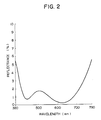
- the thus obtained anti-reflection plastic lens was measured for reflectances at both sides of lens at a wavelength region of 380-780 nm in the same manner as in Example 19. As shown in the spectral reflectance curve of Fig. 2, the lens had excellent anti-reflection properties.
- the lens was also measured for appearance, mar resistance, heat resistance, alkali resistance, acid resistance and weather resistance in the same manners as in Example 1. Good evaluation and measurement results were obtaiend in all the test items, and the lens was superior in optical, mechanical and chemical properties as well as in durability in said test items.
- the anti-reflection optical element of the present invention is superior in optical, mechanical and chemical properties as well as in durabilities of said properties.
- an anti-reflection optical element which can maintain optical prooerties at high levels over a long period of time and which is lightweight.
Landscapes
- Physics & Mathematics (AREA)
- Chemical & Material Sciences (AREA)
- Inorganic Chemistry (AREA)
- General Physics & Mathematics (AREA)
- Optics & Photonics (AREA)
- Surface Treatment Of Optical Elements (AREA)
- Laminated Bodies (AREA)
Applications Claiming Priority (4)
| Application Number | Priority Date | Filing Date | Title |
|---|---|---|---|
| JP83391/89 | 1989-03-31 | ||
| JP1083391A JPH07119843B2 (ja) | 1989-03-31 | 1989-03-31 | 反射防止性高屈折率プラスチックレンズ |
| JP1111499A JP2561955B2 (ja) | 1989-04-28 | 1989-04-28 | プラスチックレンズ用多層反射防止膜 |
| JP111499/89 | 1989-04-28 |
Publications (3)
| Publication Number | Publication Date |
|---|---|
| EP0390218A2 true EP0390218A2 (de) | 1990-10-03 |
| EP0390218A3 EP0390218A3 (de) | 1991-11-06 |
| EP0390218B1 EP0390218B1 (de) | 1995-08-09 |
Family
ID=26424418
Family Applications (1)
| Application Number | Title | Priority Date | Filing Date |
|---|---|---|---|
| EP19900106204 Expired - Lifetime EP0390218B1 (de) | 1989-03-31 | 1990-03-30 | Optisches Anti-Reflektionselement |
Country Status (3)
| Country | Link |
|---|---|
| EP (1) | EP0390218B1 (de) |
| DE (1) | DE69021420T2 (de) |
| ES (1) | ES2075084T3 (de) |
Cited By (3)
| Publication number | Priority date | Publication date | Assignee | Title |
|---|---|---|---|---|
| FR2721720A1 (fr) * | 1994-06-27 | 1995-12-29 | Essilor Int | Lentille ophtalmique en verre organique à intercouche anti-chocs et son procédé de fabrication. |
| EP1205774A3 (de) * | 2000-11-13 | 2004-06-09 | Hoya Corporation | Zusammensetzung für Dampfabscheidung, deren Verwendung in Verfahren zur Bildung einer entspiegelnden Beschichtung, und optisches Element |
| EP1810609A4 (de) * | 2004-10-01 | 2008-12-31 | Hoya Corp | Linse zur intraokularen beobachtung und kontaktlinse für glaskörperoperation |
Family Cites Families (2)
| Publication number | Priority date | Publication date | Assignee | Title |
|---|---|---|---|---|
| US4609267A (en) * | 1980-12-22 | 1986-09-02 | Seiko Epson Corporation | Synthetic resin lens and antireflection coating |
| CA1293655C (en) * | 1985-04-30 | 1991-12-31 | Takashi Taniguchi | Anti-reflection optical article and process for preparation thereof |
-
1990
- 1990-03-30 ES ES90106204T patent/ES2075084T3/es not_active Expired - Lifetime
- 1990-03-30 DE DE1990621420 patent/DE69021420T2/de not_active Expired - Lifetime
- 1990-03-30 EP EP19900106204 patent/EP0390218B1/de not_active Expired - Lifetime
Cited By (7)
| Publication number | Priority date | Publication date | Assignee | Title |
|---|---|---|---|---|
| FR2721720A1 (fr) * | 1994-06-27 | 1995-12-29 | Essilor Int | Lentille ophtalmique en verre organique à intercouche anti-chocs et son procédé de fabrication. |
| WO1996000403A1 (fr) * | 1994-06-27 | 1996-01-04 | Essilor International - Compagnie Generale D'optique | Lentille ophtalmique en verre organique a intercouche anti-chocs et son procede de fabrication |
| EP1205774A3 (de) * | 2000-11-13 | 2004-06-09 | Hoya Corporation | Zusammensetzung für Dampfabscheidung, deren Verwendung in Verfahren zur Bildung einer entspiegelnden Beschichtung, und optisches Element |
| US7106515B2 (en) | 2000-11-13 | 2006-09-12 | Hoya Corporation | Composition for vapor deposition, method for forming an antireflection film, and optical element |
| EP1801621A3 (de) * | 2000-11-13 | 2009-12-02 | Hoya Corporation | Zusammensetzung zur Aufdampfung, Verfahren zur Herstellung einer Antireflexschicht damit und optisches Element |
| EP1810609A4 (de) * | 2004-10-01 | 2008-12-31 | Hoya Corp | Linse zur intraokularen beobachtung und kontaktlinse für glaskörperoperation |
| US8007105B2 (en) | 2004-10-01 | 2011-08-30 | Hoya Corporation | Lens for intraocular observation and contact lens for vitreous surgery |
Also Published As
| Publication number | Publication date |
|---|---|
| ES2075084T3 (es) | 1995-10-01 |
| EP0390218A3 (de) | 1991-11-06 |
| DE69021420T2 (de) | 1996-03-07 |
| EP0390218B1 (de) | 1995-08-09 |
| DE69021420D1 (de) | 1995-09-14 |
Similar Documents
| Publication | Publication Date | Title |
|---|---|---|
| US5181141A (en) | Anti-reflection optical element | |
| US4975328A (en) | Process for producing polyurethane lens | |
| AU2002238996B9 (en) | Transparent molded article, optical member, plastic lens, and methods of manufacturing same | |
| KR0162502B1 (ko) | 플라스틱 렌즈의 제조법 | |
| CN100590460C (zh) | 塑料透镜以及制造塑料透镜的方法 | |
| JP2000162403A (ja) | プラスチックレンズの干渉縞を防止する方法 | |
| CN101498794A (zh) | 光学物品和光学物品的制造方法 | |
| KR20020042425A (ko) | 증착 조성물의 제조방법, 증착 조성물 및 반사방지막을갖는 광학부품의 제조방법 | |
| US20020034630A1 (en) | Ophthalmic lens made of organic glass with a shockproof intermediate layer, and method for making same | |
| JPH07119843B2 (ja) | 反射防止性高屈折率プラスチックレンズ | |
| EP0390218B1 (de) | Optisches Anti-Reflektionselement | |
| JPH07316250A (ja) | 眼鏡用プラスチックレンズ | |
| JP3379120B2 (ja) | プラスチックレンズ | |
| EP0699926B1 (de) | Kunststofflinse mit haftschicht | |
| JP3491164B2 (ja) | 反射防止性プラスチックレンズ | |
| JPH05142401A (ja) | プラスチツクレンズ | |
| JP2983237B2 (ja) | 高屈折率プラスチックレンズ | |
| JP2577486B2 (ja) | プラスチックレンズ | |
| CN100575418C (zh) | 透明成形体及其制造方法 | |
| JP2628589B2 (ja) | ポリウレタンレンズ用反射防止膜 | |
| JPH10260301A (ja) | プラスチックレンズ | |
| JPH02230103A (ja) | 高屈折率プラスチックレンズ | |
| JPH04110918A (ja) | 光学部品 | |
| JPH02230102A (ja) | 高屈折率プラスチックレンズ | |
| JPH03144501A (ja) | プラスチックレンズ用反射防止膜 |
Legal Events
| Date | Code | Title | Description |
|---|---|---|---|
| PUAI | Public reference made under article 153(3) epc to a published international application that has entered the european phase |
Free format text: ORIGINAL CODE: 0009012 |
|
| AK | Designated contracting states |
Kind code of ref document: A2 Designated state(s): DE ES FR GB IT NL SE |
|
| PUAL | Search report despatched |
Free format text: ORIGINAL CODE: 0009013 |
|
| AK | Designated contracting states |
Kind code of ref document: A3 Designated state(s): DE ES FR GB IT NL SE |
|
| 17P | Request for examination filed |
Effective date: 19920122 |
|
| 17Q | First examination report despatched |
Effective date: 19931112 |
|
| GRAA | (expected) grant |
Free format text: ORIGINAL CODE: 0009210 |
|
| AK | Designated contracting states |
Kind code of ref document: B1 Designated state(s): DE ES FR GB IT NL SE |
|
| RAP1 | Party data changed (applicant data changed or rights of an application transferred) |
Owner name: HOYA CORPORATION |
|
| REF | Corresponds to: |
Ref document number: 69021420 Country of ref document: DE Date of ref document: 19950914 |
|
| REG | Reference to a national code |
Ref country code: ES Ref legal event code: FG2A Ref document number: 2075084 Country of ref document: ES Kind code of ref document: T3 |
|
| ITF | It: translation for a ep patent filed | ||
| ET | Fr: translation filed | ||
| PLBE | No opposition filed within time limit |
Free format text: ORIGINAL CODE: 0009261 |
|
| STAA | Information on the status of an ep patent application or granted ep patent |
Free format text: STATUS: NO OPPOSITION FILED WITHIN TIME LIMIT |
|
| 26N | No opposition filed | ||
| REG | Reference to a national code |
Ref country code: GB Ref legal event code: IF02 |
|
| PGFP | Annual fee paid to national office [announced via postgrant information from national office to epo] |
Ref country code: NL Payment date: 20090315 Year of fee payment: 20 |
|
| PGFP | Annual fee paid to national office [announced via postgrant information from national office to epo] |
Ref country code: GB Payment date: 20090325 Year of fee payment: 20 |
|
| PGFP | Annual fee paid to national office [announced via postgrant information from national office to epo] |
Ref country code: ES Payment date: 20090401 Year of fee payment: 20 |
|
| PGFP | Annual fee paid to national office [announced via postgrant information from national office to epo] |
Ref country code: IT Payment date: 20090320 Year of fee payment: 20 Ref country code: DE Payment date: 20090327 Year of fee payment: 20 Ref country code: SE Payment date: 20090306 Year of fee payment: 20 |
|
| PGFP | Annual fee paid to national office [announced via postgrant information from national office to epo] |
Ref country code: FR Payment date: 20090316 Year of fee payment: 20 |
|
| REG | Reference to a national code |
Ref country code: NL Ref legal event code: V4 Effective date: 20100330 |
|
| REG | Reference to a national code |
Ref country code: GB Ref legal event code: PE20 Expiry date: 20100329 |
|
| EUG | Se: european patent has lapsed | ||
| REG | Reference to a national code |
Ref country code: ES Ref legal event code: FD2A Effective date: 20100331 |
|
| PG25 | Lapsed in a contracting state [announced via postgrant information from national office to epo] |
Ref country code: GB Free format text: LAPSE BECAUSE OF EXPIRATION OF PROTECTION Effective date: 20100329 |
|
| PG25 | Lapsed in a contracting state [announced via postgrant information from national office to epo] |
Ref country code: NL Free format text: LAPSE BECAUSE OF EXPIRATION OF PROTECTION Effective date: 20100330 Ref country code: ES Free format text: LAPSE BECAUSE OF EXPIRATION OF PROTECTION Effective date: 20100331 |
|
| PG25 | Lapsed in a contracting state [announced via postgrant information from national office to epo] |
Ref country code: DE Free format text: LAPSE BECAUSE OF EXPIRATION OF PROTECTION Effective date: 20100330 |