EP0399362B1 - Leseverstärkerschaltung - Google Patents
Leseverstärkerschaltung Download PDFInfo
- Publication number
- EP0399362B1 EP0399362B1 EP90109264A EP90109264A EP0399362B1 EP 0399362 B1 EP0399362 B1 EP 0399362B1 EP 90109264 A EP90109264 A EP 90109264A EP 90109264 A EP90109264 A EP 90109264A EP 0399362 B1 EP0399362 B1 EP 0399362B1
- Authority
- EP
- European Patent Office
- Prior art keywords
- bit line
- excess charge
- transistor
- sense amplifier
- voltage
- Prior art date
- Legal status (The legal status is an assumption and is not a legal conclusion. Google has not performed a legal analysis and makes no representation as to the accuracy of the status listed.)
- Expired - Lifetime
Links
Images



Classifications
-
- G—PHYSICS
- G11—INFORMATION STORAGE
- G11C—STATIC STORES
- G11C16/00—Erasable programmable read-only memories
- G11C16/02—Erasable programmable read-only memories electrically programmable
- G11C16/06—Auxiliary circuits, e.g. for writing into memory
-
- G—PHYSICS
- G11—INFORMATION STORAGE
- G11C—STATIC STORES
- G11C7/00—Arrangements for writing information into, or reading information out from, a digital store
- G11C7/06—Sense amplifiers; Associated circuits, e.g. timing or triggering circuits
- G11C7/067—Single-ended amplifiers
-
- G—PHYSICS
- G11—INFORMATION STORAGE
- G11C—STATIC STORES
- G11C16/00—Erasable programmable read-only memories
- G11C16/02—Erasable programmable read-only memories electrically programmable
- G11C16/06—Auxiliary circuits, e.g. for writing into memory
- G11C16/26—Sensing or reading circuits; Data output circuits
-
- G—PHYSICS
- G11—INFORMATION STORAGE
- G11C—STATIC STORES
- G11C17/00—Read-only memories programmable only once; Semi-permanent stores, e.g. manually-replaceable information cards
- G11C17/08—Read-only memories programmable only once; Semi-permanent stores, e.g. manually-replaceable information cards using semiconductor devices, e.g. bipolar elements
- G11C17/10—Read-only memories programmable only once; Semi-permanent stores, e.g. manually-replaceable information cards using semiconductor devices, e.g. bipolar elements in which contents are determined during manufacturing by a predetermined arrangement of coupling elements, e.g. mask-programmable ROM
- G11C17/12—Read-only memories programmable only once; Semi-permanent stores, e.g. manually-replaceable information cards using semiconductor devices, e.g. bipolar elements in which contents are determined during manufacturing by a predetermined arrangement of coupling elements, e.g. mask-programmable ROM using field-effect devices
-
- G—PHYSICS
- G11—INFORMATION STORAGE
- G11C—STATIC STORES
- G11C7/00—Arrangements for writing information into, or reading information out from, a digital store
- G11C7/12—Bit line control circuits, e.g. drivers, boosters, pull-up circuits, pull-down circuits, precharging circuits, equalising circuits, for bit lines
Definitions
- the present invention relates to a sense amplifier circuit for a reading circuit of a semiconductor memory apparatus, and more particularly to a sense amplifier circuit for a read only memory.
- Recent non-volatile memories such as read-only memories (called ROM hereinafter) are required to have large capacity and to operate at high speed.
- ROM read-only memories
- the memory cell area must be decreased, even if this requires that the current-driving ability of the memory cell transistor be decreased.
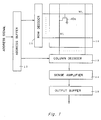
- a ROM is formed as shown in Figure 1.
- 10 is a memory cell array comprising a plurality of word lines WL and bit lines BL, and a memory cell 10a provided at respective crossing portions of these word lines WL and bit lines BL.
- Memory cell 10a comprises, for example, a MOS transistor whose gate is connected to word line WL and whose drain is connected to bit line BL.
- Memory cell 10a may comprise a bipolar transistor.
- Word lines WL are selected by row decoder 11 and bit lines BL are selected by column decoder 12, and an address signal is input to these row and column decoders through address buffer 13.
- the read output of a bit line BL selected by the column decoder 12 is amplified by sense amplifier 14 and is outputted externally through output buffer 15.
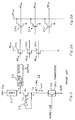
- Fig. 2 shows the general constitution of a known sense amplifier circuit.
- a sense amplifier circuit comprises a serial connection of a load 21, a transistor 21 and a memory cell 20, being connected between a power source V CC and ground GND.
- Memory cell 20 comprises a plurality of memory cells 20a, 20b.... as shown in Figures 3A and 3B.
- Figure 3A designates a serial type memory cell
- Figure 3B designates a parallel type memory cell.
- memory cells 20a, 20b... which are formed of transistors, store either "1 " or "0” depending on whether the transistor is of an enhancement type or of a depletion type.
- "1" or "0" is stored depending on whether the threshold value is high or low.
- the non-selection word line is made to level H and the selection word line is made to level L.
- the word line WLb is selected, other word lines WLa, WLc, ... are at H level and transistors 20a, 20c... are on regardless of whether the stored value is "1" or "0". Only transistor 20b, belonging to the selected word line, is turned on and off, depending on whether 1 or 0 is stored. If transistor 20b is of the depletion type it is on and if it is of the enhancement type it is off.
- the data stored in memory cell 20b is determined to be 1 or 0, and thus a current flows or does not flow in bit line BLa.
- the potential V C at the connecting point between load 21 and transistor Q1 in Figure 2 changes depending on whether or not the bit line current (i cel ) flows and voltage output circuit 22 detects potential V C and produces read out data.
- the selected word line is at H level and the non-selected word line is at L level. Accordingly, memory cells belonging to non-selected word lines are turned off regardless of whether "1" or “0” is stored, and only the memory cell belonging to the selected word line is turned on or off depending on whether “1” or “0” is stored. A current flows or does not flow in bit line BLa, depending on whether the memory cell is turned on or off, thereby changing the voltage V C . Voltage output circuit 22 then detects the voltage V C and produces the read-out data. Voltage output circuit 22 basically comprises only a line, but may be formed of a circuit for driving an output side circuit to be connected to the sense amplifier.
- a column selection gate which is turned on or off depending on the output of decoder 12, is provided between transistor Q1 and the bit line (cell group).
- the variation of the bit line voltage v a is suppressed, whether the bit line current I CEL is turned on or off.
- the voltage V C is equal to VCC-Rx icel under the condition that the resistance of load 21 is R and changes as shown in the drawing, depending on whether the cell is switched on or off.
- Figures 4A to 4H Various kinds of inverters 23 are shown in Figures 4A to 4H.
- Figure 4A shows an E-D type
- Figure 4B an E-E type
- Figure 4C and Figure 4D CMOS types in which Qa is an n-channel enhancement type MOS transistor, Qb is an n-channel depletion type MOS transistor and Qd is a p-channel type MOS transistor.
- Figures 4E to 4H show only load portions.
- the gate of p-channel type transistor Qd is connected to ground in Figures 4C and 4G, connected to input IN in Figure 4D and connected to the drain (output OUT) in Figure 4H.
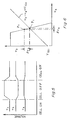
- the input-output characteristic of inverter 23 is shown in Figure 6.
- the current is divided into several steps and for binary-value logic, the two states, i.e., the state in which current flows and the state in which current does not flow, are provided. Let us explain the example of two steps in which the current flows or does not flow.
- the output of inverter 23 is fed back to the input of inverter 23 through transistor Q1.
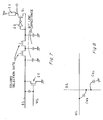
- the input-output characteristic of the inverter is abrupt. Therefore, the range of variation of v a can be made small, and v b can be changed quickly. That is, the variation of V a is made small so that the existence of a bit line capacitance shown in Figure 7 does not greatly affect the operation of the cell 20, and the range of the variation in v b is made large, thus enabling the on/off control of transistor Q1 to be conducted at high speed and with certainty.
- a column selection gate shown in Figure 7 is connected between a cell 20 and a sense amplifier comprising transistor Q1, inverter 23 and load 21 and has a relatively large capacitance.
- a parasitic capacitance C WB exists between bit line BL and word line WL.
- C BL is a parasitic capacitance existing between bit line BL and ground.
- the bit line potential is almost equal to v a .
- a change in v a means that the bit line potential changes and that the charges stored in bit line capacitances C BL and C WB change accordingly.
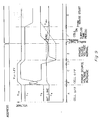
- the sense amplifier operates only after the excess charge is discharged by the cell transistor.
- the reason for the above operation is that a variation in word line potential is reflected on a bit line by a parasitic capacitance C WB between a word line and a bit line and that an operation point of a sense amplifier varies in accordance with a power source potential variation caused by a noise.
- v a increases and v b decreases, thereby providing a new stable state under the voltage V CC + ⁇ V (state C, b ⁇ c).
- V CC voltage + ⁇ V
- a time delay or a surplus time period shown in a state F′ and d ⁇ a time delay is relatively unimportant, but when the current driving capability of the cell, i.e., the current driving capability by which the input-output characteristic is driven from d to e, becomes weak because of a fine pattern of the cell, the time delay in this surplus time period F′ becomes large, greatly affecting access time.
- An object of the present invention is to make improvements regarding the above points and, by preventing excess charge-up of bit line capacitance, to realize a sense amplifier with high speed operation.
- a feature of the present invention resides in a sense amplifier circuit for use in a non-volatile memory comprising, an excess charge detecting circuit for producing a detection output when the potential of a bit line exceeds a normal value, an excess charge discharging circuit which operates in response to said excess charge detecting circuit for discharging a bit line charge and for returning the bit line potential to the normal value.
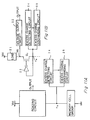
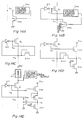
- the present invention provides a circuit 24 for detecting an excess charge up of a bit line and an excess charge discharging circuit 25 to be operated by the output of detecting circuit 24.
- excess charge up can be detected as an increase in potential.
- excess charge detecting circuit 24 receives a bit line potential v a and detects the excess charge up.
- excess charge detecting circuit 24 receives the output voltage v b (a gate voltage of transistor Q1) from inverter 23 and, as shown in Figure 11D, receives both voltages v a and v b .
- excess charge discharging circuit 25 operates to discharge the excess bit line charge.
- bit line potential decreases, deviating from the excess charge up state, and discharging circuit 25 stops the operation.
- the excess charge detecting circuit of Figures 11A, 11B and 11C detects an abnormality of v a , v b , and v b - v a .
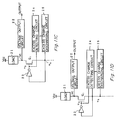
- excess charge detecting circuit 24 comprises voltage judging circuit 24a for judging the voltage v a and excess charge discharging circuit 25 comprises a transistor 25a connected between the bit line and ground.
- An inverter shown in Figure 4A to 4H or comparator CMP shown in Figure 13C can be used for voltage judging circuit 24a.
- the inverter detects an excess charge based on whether or not the voltage v a exceeds a threshold value and the comparator detects the excess charge based on whether or not the voltage v a exceeds a reference voltage REF.
- the output of voltage judging circuit 24a becomes H level and transistor 25a is turned ON, thereby discharging the bit line charge.
- the output of voltage judging circuit 24a becomes L and transistor 25a is turned OFF, thereby stopping the discharge.
- voltage judging circuit 24a observes the output of the inverter and transistor 25a turns ON when the inverter output v b decreases and becomes less than the threshold value or the reference voltage.
- Figures 14A and 14B are similar to Figures 13A and 13B.
- n-channel transistor 25a is used but in Figures 14A and 14B, p-channel transistor 25b is used. Except for this feature, Figures 14A and 14B are the same as Figures 13A and 13B.
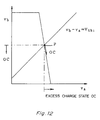
- excess charge detecting circuit 24 and excess charge discharging circuit 25 are formed of a single transistor 25c.
- This transistor 25c is diode-connected and the threshold value is determined as V th2 .
- transistor 25c turns ON, thereby discharging the charge.
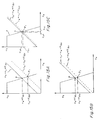
- This state is shown in Figure 15A. Although the correction is lacking by P1 - P as compared with a normal state, the circuit is made simple.
- excess charge detecting circuit 24 and excess charge discharging circuit 25 are formed of n-channel transistor 24b, 24c and 25d.
- the voltage at the serial connecting point between transistors 24b and 24c is determined as V d .
- transistor 25d turns ON and transistor 25c is normally ON, thereby discharging the excess bit-line charge.
- V d is smaller than v b by the threshold value V th3 of transistor 24b and thus, point P1 is made closer to point P than in Figure 14C.
- excess charge detecting circuit 24 is formed of n-channel MOS transistors 24b, 24d and 24c and excess charge discharging circuit 25 is formed of p-channel transistor 25b.
- transistor 25b when transistor 25b is determined to have threshold value v th2 , and then v a - v d ⁇ V th2 , transistor 25b turns ON, thereby discharging the bit-line excess charge.
- v a1 - v a0 (V thN - V thp )/(1 + A)
- v b0 - v b1 A(V thN - V thp )/(1 + A) ⁇ V thN - V thp
- VthN ⁇ Vthp (generally speaking, the difference is about 100mV), Va1 ⁇ Vao and Vpo ⁇ Vp1.
- the present invention can prevent the bit line potential from being charged up to more than the predetermined value and can decrease the sense time delay caused by an excess charge-discharge and further can sense the data at high speed even for a cell with a weak current driving capability, thereby contributing to the high density of the integration.
Landscapes
- Read Only Memory (AREA)
- Semiconductor Memories (AREA)
Claims (17)
- Leseverstärkerschaltung, die mit einer Bit-Leitung verbunden ist in einem nichtflüchtigen Speicher, der folgende Merkmale aufweist:
eine Überschußladungs-Detektoreinrichtung (24) zur Erzeugung eines Detektorausgangssignals, wenn das Potential der Bit-Leitung einen vorbestimmten Wert überschreitet,
und eine Überschußladungs-Entladeeinrichtung (25) zum Abführen der Bit-Leitungs-Ladung in Abhängigkeit von dem genannten Detektorausgangssignal, um das Potential der Bit-Leitung auf den vorbestimmten Wert zurückzuführen (Fig. 11A). - Leseverstärkerschaltung nach Anspruch 1, bei der die Überschußladungs-Detektoreinrichtung (24) einen Inverter (24a) aufweist zur Detektierung der Überschußladung auf der Basis der Schwellenspannung des Inverters.
- Leseverstärkerschaltung nach Anspruch 1, bei der die Überschußladungs-Detektoreinrichtung (24) einen Komparator (CPM) aufweist zur Detektierung der Überschußladung auf der Basis einer an den Komparator angelegten Referenzspannung.
- Nichtflüchtige Speichervorrichtung, die eine Leseverstärkerschaltung nach Anspruch 1 aufweist und ferner
eine Mehrzahl von Bit-Leitungen (BL) und
eine Mehrzahl von mit den Bit-Leitungen verbundenen Speicherzellen (10a) umfaßt, und wobei die Leseverstärkerschaltung
eine Verstärkereinrichtung (21, Q1, 23) zum Auslesen von Daten von der Bit-Leitung
und eine zwischen der Verstärkereinrichtung (21, Q1, 23) und den Bit-Leitungen (BL) angeordnete Spalten-Gatterschaltung (12) aufweist. - Nichtflüchtige Speichervorrichtung nach Anspruch 4, bei der
die Überschußladungs-Detektoreinrichtung eine Spannungsbewertungsschaltung (24a) umfaßt, die mit einem Eingang der Verstärkereinrichtung (14) verbunden ist und ein Detektorausgangssignal erzeugt, wenn das Eingangspotential das genannte vorbestimmte Potential überschreitet,
und die Überschußladungs-Entladeeinrichtung einen Entladetransistor (25b) umfaßt, der mit dem Eingang der Verstärkereinrichtung (14) verbunden und in Abhängigkeit von dem Detektorausgangssignal die Überschußladung abführt (Fig. 14A). - Leseverstärkerschaltung nach Anspruch 1,
bei der die nichtflüchtige Speichervorrichtung eine Mehrzahl von mit Bit-Leitungen (BL) verbundene Speicherzellen (10a) umfaßt,
bei der die Leseverstärkerschaltung ferner aufweist:
eine Verstärkereinrichtung mit einer Last (21), einem zwischen der Last (21) und jeder der Bit-Leitungen (BL) angeordneten Transistor (Q1) und einem Inverter (23), der zwischen jeder der Bit-Leitungen (BL) und der Gate-Elektrode des Transistors (Q1) angeordnet ist, um Daten von der Bit-Leitung (BL) auszulesen,
und bei der die Überschußladungs-Detektoreinrichtung (24) eine Überschußladung in der Verstärkereinrichtung detektiert, um die Überschußladung abzuführen, wobei die Überschußladungs-Detektoreinrichtung auf das Ausgangssignal des Inverters (23) anspricht (Fig. 11C). - Leseverstärkerschaltung nach Anspruch 1,
bei der die Überschußladungs-Detektoreinrichtung eine mit der Bit-Leitung (BL) verbundene Spannungsbewertungsschaltung (24a) umfaßt
und bei der die Überschußladungs-Entladeeinrichtung einen Transistor (25b) aufweist, dessen Drain-Elektrode mit der Bit-Leitung (BL) und dessen Gate-Elektrode mit dem Ausgang der Spannungsbewertungsschaltung (24a) verbunden ist (Fig. 14A). - Leseverstärkerschaltung nach Anspruch 1,
bei der der nichtflüchtige Speicher eine Mehrzahl von Speicherzellen (10a) umfaßt, die mit Bit-Leitungen (BL) verbunden sind,
bei der die Leseverstärkerschaltung ferner eine Verstärkereinrichtung aufweist mit einer Last (21), einem zwischen der Last (21) und jeder der Bit-Leitungen (BL) angeordneten Transistor (Q1) und einem Inverter (23), der zwischen jeder der Bit-Leitungen (BL) und der Gate-Elektrode des Transistors (Q1) angeordnet ist, um Daten von der Bit-Leitung (BL) auszulesen,
und bei der die Überschußladungs-Detektoreinrichtung (24) eine Überschußladung in der Verstärkereinrichtung detektiert, um die Überschußladung abzuführen, wobei die Überschußladungs-Detektoreinrichtung auf das Ausgangssignal des Inverters (23) und auf das Potential der Bit-Leitung (BL) anspricht (Fig. 11D). - Leseverstärkerschaltung nach Anspruch 8, bei der die Überschußladungs-Entladeeinrichtung einen als Diode geschalteten Transistor (25c) umfaßt, dessen erster Anschluß mit der Bit-Leitung (BL) und dessen zweiter Anschluß mit dem Ausgang des Inverters (23) verbunden ist, wobei dieser als Diode geschaltete Transistor (25c) leitend wird und dadurch die Bit-Leitungs-Spannung herabsetzt, wenn die Bit-Leitungs-Spannung die vorbestimmte Spannung überschreitet (Fig.14C).
- Leseverstärkerschaltung nach Anspruch 8,
bei der die Überschußladungs-Detektoreinrichtung einen ersten Transistor (24b) aufweist, dessen Gate-Elektrode mit dem Ausgang des Inverters (23) und dessen erster Anschluß mit einer Versorgungsquelle verbunden ist, so daß das Ausgangssignal des Inverters (23) um die erste Schwellenspannung des ersten Transistors (24b) verringert wird,
bei der die Überschußladungs-Entladeeinrichtung aufweist:
einen als Diode geschalteten Transistor (25d), dessen erster Anschluß mit der Bit-Leitung (BL) verbunden ist, um das Ausgangssignal des ersten Transistors (24b) um die zweite Schwellenspannung zu erhöhen, wobei dieser als Diode geschaltete Transistor (25d) leitend wird, wenn die Bit-Leitungs-Spannung die vorbestimmte Spannung überschreitet,
sowie einen zweiten Transistor (24c), dessen erster Anschluß mit dem zweiten Anschluß des ersten Transistors (24b) und dessen zweiter Anschluß mit Masse verbunden ist, wobei der zweite Anschluß des als Diode geschalteten Transistors (25d) sowohl mit dem zweiten Anschluß des ersten Transistors (24b) als auch mit dem ersten Anschluß des zweiten Transistors (24c) verbunden ist und der zweite Transistor (24c) die Überschußladung abführt (Fig. 14D). - Leseverstärkerschaltung nach Anspruch 6,
bei der die Überschußladungs-Detektoreinrichtung aufweist:
einen ersten n-Kanal-Transistor (24b) mit einem ersten Anschluß, der mit einer Versorgungsquelle verbunden ist, und einer Gate-Elektrode, die mit dem Ausgang des Inverters (23) verbunden ist, um die Ausgangspannung des Inverters (23) zu verringern,
und einen als Diode geschalteten zweiten n-Kanal-Transistor (24d) mit einem ersten Anschluß, der mit dem zweiten Anschluß des ersten n-Kanal-Transistors verbunden ist, um die Ausgangspannung des ersten n-Kanal-Transistors um seine Schwellenspannung zu verringern,
und bei der die Überschußladungs-Entladeeinrichtung aufweist:
einen p-Kanal-Transistor (25b) mit einem ersten Anschluß, der mit der Bit-Leitung (BL) verbunden ist, und einem zweiten Anschluß, der mit Masse verbunden ist, um die Bit-Leitungs-Spannung um seine Schwellenspannung zu erhöhen und das Ausgangssignal des zweiten n-Kanal-Transistor um seine Schwellenspannung zu erhöhen,
wobei die Bit-Leitungs-Überschußladung über den p-Kanal-Transistor (25b) abgeführt wird, wenn sie den vorbestimmten Wert überschreitet (Fig. 14E). - Leseverstärkerschaltung nach Anspruch 1,
bei der die Überschußladungs-Entladeeinrichtung n-Kanal- oder p-Kanal-MOS-Transistoren (25b) umfaßt, die mit der Bit-Leitung (BL) und mit Masse verbunden sind. - Leseverstärkerschaltung nach Anspruch 1,
bei der der nichtflüchtige Speicher eine Zelle umfaßt, die mit einer Bit-Leitung (BL) und einer Wortleitung (WL) verbunden ist,
und bei der die Leseverstärkerschaltung weiterhin eine Leseeinrichtung (23, Q1) aufweist zum Auslesen eines in der Bit-Leitung (BL) fließenden Stroms in Abhängigkeit von dem Betriebszustand der Zelle. - Leseverstärkerschaltung nach Anspruch 13,
bei der die Überschußladungs-Entladeeinrichtung ein Mittel (25a) aufweist, welches bewirkt, daß von der Bit-Leitung (BL) zu der genannten Leseeinrichtung (23, 01) ein Strom fließt, wenn die Bit-Leitungs-Spannung einen vorbestimmten Wert überschreitet. - Leseverstärkerschaltung nach Anspruch 14,
bei der die Überschußladungs-Detektoreinrichtung ein Mittel (24b) aufweist, um die aus der Leseeinrichtung (23, Q1) gewonnene Spannung um einen ersten vorbestimmten Betrag zu verringern,
und bei der die Überschußladungs-Entladeeinrichtung
ein Mittel (25b) aufweist, um das Ausgangssignal der Mittel zum Herabsetzen der Spannung um einen zweiten vorbestimmten Betrag zu erhöhen,
und ein Mittel (24c) zum Abführen eines Stroms, wenn die Bit-Leitungs-Spannung einen vorbestimmten Wert überschreitet (Fig. 14D). - Leseverstärkerschaltung nach Anspruch 13,
bei der die Überschußladungs-Detektoreinrichtung aufweist:
ein erstes Mittel (24b) eines bestimmten Leitfähigkeitstyps zum Herabsetzen der aus der Leseeinrichtung (23, Q1) kommenden Spannung um einen ersten vorbestimmten Betrag
und ein zweites Mittel (24d) dieses einen Leitfähigkeitstyps zum Herabsetzen des Ausgangswerts des ersten Mittels um einen zweiten vorbestimmten Betrag,
und bei der die Überschußladungs-Entladeeinrichtung aufweist:
ein drittes Mittel (25b) des anderen Leitfähigkeitstyps zum Heraufsetzen des Ausgangssignals des zweiten Mittels um einen vorbestimmten Betrag (Fig. 14E). - Leseverstärkerschaltung nach Anspruch 1,
bei der der nichtflüchtige Speicher eine Zelle aufweist, die mit einer Bit-Leitung (BL) und einer Wortleitung (WL) verbunden ist,
bei der die Leseverstärkerschaltung ferner aufweist:
eine Last (21), die mit einem Anschluß mit einer Versorgungsquelle verbunden ist,
einen Lese-Transistor (Q1) mit einem Anschluß, der mit dem anderen Anschluß der Last (21) verbunden ist, und einem anderen Anschluß, der mit der Bit-Leitung (BL) verbunden ist, um einen durch die Zelle fließenden Strom auszulesen,
sowie einen Inverter (23), der mit der Bit-Leitung (BL) verbunden ist, um die Bit-Leitungs-Spannung zu invertieren und die invertierte Spannung an die Gate-Elektrode des Lese-Transistors (Q1) anzulegen,
und bei der die Überschußladungs-Entladeeinrichtung aufweist:
einen als Diode geschalteten Transistor (25c), dessen Drain-Elektrode mit der Bit-Leitung (BL) verbunden ist, um zu verhindern, daß die Bit-Leitungs-Spannung einen vorbestimmten Wert überschreitet, indem er leitend wird, wenn die Bit-Leitungs-Spannung im Begriff steht, diesen vorbestimmten Wert zu überschreiten (Fig. 14C, D).
Applications Claiming Priority (2)
| Application Number | Priority Date | Filing Date | Title |
|---|---|---|---|
| JP121927/89 | 1989-05-16 | ||
| JP12192789A JP2583606B2 (ja) | 1989-05-16 | 1989-05-16 | センスアンプ回路 |
Publications (3)
| Publication Number | Publication Date |
|---|---|
| EP0399362A2 EP0399362A2 (de) | 1990-11-28 |
| EP0399362A3 EP0399362A3 (de) | 1991-03-20 |
| EP0399362B1 true EP0399362B1 (de) | 1995-02-15 |
Family
ID=14823368
Family Applications (1)
| Application Number | Title | Priority Date | Filing Date |
|---|---|---|---|
| EP90109264A Expired - Lifetime EP0399362B1 (de) | 1989-05-16 | 1990-05-16 | Leseverstärkerschaltung |
Country Status (5)
| Country | Link |
|---|---|
| US (1) | US5293088A (de) |
| EP (1) | EP0399362B1 (de) |
| JP (1) | JP2583606B2 (de) |
| KR (1) | KR930004174B1 (de) |
| DE (1) | DE69016829T2 (de) |
Families Citing this family (12)
| Publication number | Priority date | Publication date | Assignee | Title |
|---|---|---|---|---|
| JPH0814996B2 (ja) * | 1989-06-27 | 1996-02-14 | 株式会社東芝 | 半導体記憶装置 |
| JPH08203271A (ja) * | 1995-01-30 | 1996-08-09 | Nec Corp | 半導体記憶装置 |
| US5682496A (en) | 1995-02-10 | 1997-10-28 | Micron Quantum Devices, Inc. | Filtered serial event controlled command port for memory |
| US6108237A (en) | 1997-07-17 | 2000-08-22 | Micron Technology, Inc. | Fast-sensing amplifier for flash memory |
| US5825212A (en) * | 1996-08-15 | 1998-10-20 | Lsi Logic Corporation | High speed single ended bit line sense amplifier |
| US6654301B2 (en) | 2001-09-27 | 2003-11-25 | Sun Microsystems, Inc. | Multiple discharge capable bit line |
| US6795336B2 (en) * | 2001-12-07 | 2004-09-21 | Hynix Semiconductor Inc. | Magnetic random access memory |
| JP4052895B2 (ja) * | 2002-08-07 | 2008-02-27 | シャープ株式会社 | メモリセル情報の読み出し回路および半導体記憶装置 |
| EP1505605A1 (de) | 2003-08-06 | 2005-02-09 | STMicroelectronics S.r.l. | Verbesserte Leseanordnung für einen Halbleiterspeicher mit Bitleitungs-Vorladungs- und -Entladungsfunktionen |
| DE602005009411D1 (de) | 2004-01-29 | 2008-10-16 | Sharp Kk | Halbleiterspeichervorrichtung |
| KR100618840B1 (ko) | 2004-06-29 | 2006-09-01 | 삼성전자주식회사 | 저 전원전압 플래쉬 메모리장치의 감지회로 |
| CN109785889B (zh) * | 2018-12-29 | 2021-08-17 | 长江存储科技有限责任公司 | 一种自适应的充放电电路、方法以及设备 |
Family Cites Families (16)
| Publication number | Priority date | Publication date | Assignee | Title |
|---|---|---|---|---|
| US3789312A (en) * | 1972-04-03 | 1974-01-29 | Ibm | Threshold independent linear amplifier |
| US4044341A (en) * | 1976-03-22 | 1977-08-23 | Rca Corporation | Memory array |
| JPS5644189A (en) * | 1979-09-19 | 1981-04-23 | Hitachi Ltd | Semiconductor memory |
| DE3028754C2 (de) * | 1980-07-29 | 1982-10-28 | Siemens AG, 1000 Berlin und 8000 München | Dynamischer Leseverstärker für MOS-Halbleiterspeicher |
| US4601014A (en) * | 1982-03-19 | 1986-07-15 | Fujitsu Limited | Semiconductor memory with word line charge absorbing circuit |
| US4535259A (en) * | 1982-06-18 | 1985-08-13 | Seeq Technology, Inc. | Sense amplifier for use with a semiconductor memory array |
| JPS60136996A (ja) * | 1983-12-26 | 1985-07-20 | Toshiba Corp | 半導体記憶装置 |
| US4797857A (en) * | 1986-04-11 | 1989-01-10 | Texas Instruments Incorporated | Array discharge for biased array |
| JPS61237292A (ja) * | 1985-04-15 | 1986-10-22 | Hitachi Micro Comput Eng Ltd | 半導体記憶装置 |
| JPS62197996A (ja) * | 1986-02-24 | 1987-09-01 | Toshiba Corp | 半導体メモリのセンスアンプ |
| DD247310A1 (de) * | 1986-03-27 | 1987-07-01 | Adw Ddr | Stromflussnachweisschaltung fuer definierten stromschwellwert |
| JPS6383991A (ja) * | 1986-09-29 | 1988-04-14 | Toshiba Corp | スタテイツク型メモリ |
| JPS63138598A (ja) * | 1986-11-28 | 1988-06-10 | Mitsubishi Electric Corp | 不揮発性半導体記憶装置 |
| JP2595228B2 (ja) * | 1987-02-20 | 1997-04-02 | 株式会社日立製作所 | 半導体記憶装置 |
| WO1988009034A2 (en) * | 1987-05-15 | 1988-11-17 | Analog Devices, Inc. | Sense amplifier |
| US4939693A (en) * | 1989-02-14 | 1990-07-03 | Texas Instruments Incorporated | BiCMOS static memory with improved performance stability |
-
1989
- 1989-05-16 JP JP12192789A patent/JP2583606B2/ja not_active Expired - Fee Related
-
1990
- 1990-05-15 US US07/523,507 patent/US5293088A/en not_active Expired - Lifetime
- 1990-05-16 KR KR1019900007008A patent/KR930004174B1/ko not_active Expired - Fee Related
- 1990-05-16 EP EP90109264A patent/EP0399362B1/de not_active Expired - Lifetime
- 1990-05-16 DE DE69016829T patent/DE69016829T2/de not_active Expired - Fee Related
Also Published As
| Publication number | Publication date |
|---|---|
| DE69016829D1 (de) | 1995-03-23 |
| JP2583606B2 (ja) | 1997-02-19 |
| EP0399362A3 (de) | 1991-03-20 |
| KR930004174B1 (ko) | 1993-05-21 |
| JPH02301100A (ja) | 1990-12-13 |
| KR900019046A (ko) | 1990-12-22 |
| DE69016829T2 (de) | 1995-10-12 |
| EP0399362A2 (de) | 1990-11-28 |
| US5293088A (en) | 1994-03-08 |
Similar Documents
| Publication | Publication Date | Title |
|---|---|---|
| US6845047B2 (en) | Read circuit of nonvolatile semiconductor memory | |
| US6492863B2 (en) | Internal high voltage generation circuit capable of stably generating internal high voltage and circuit element therefor | |
| EP0136170B1 (de) | Halbleiterspeicheranordnung | |
| US5293088A (en) | Sense amplifier circuit | |
| US4876669A (en) | MOS static type RAM having a variable load | |
| JPH06215586A (ja) | 読出前にプリチャージ及び平衡化をするメモリ読出回路 | |
| US5883837A (en) | Reading circuit for semiconductor memory cells | |
| JP3537010B2 (ja) | 半導体記憶装置 | |
| US5487045A (en) | Sense amplifier having variable sensing load for non-volatile memory | |
| US6906975B2 (en) | Reference voltage generating circuit of nonvolatile ferroelectric memory device | |
| US6137732A (en) | Semiconductor memory device having voltage boosting circuit | |
| US6144600A (en) | Semiconductor memory device having first and second pre-charging circuits | |
| US5528544A (en) | Semiconductor memory device having high speed sense amplifier | |
| EP0851430B1 (de) | Halbleiterspeicheranordnung | |
| EP0431911A2 (de) | Speicherzelle mit schwebendem Gatter und ihre Anwendung für einen Halbleiterspeicher | |
| US7082058B2 (en) | Non-volatile semiconductor memory device having sense amplifier with increased speed | |
| EP0244628B1 (de) | Leseverstärker für eine Halbleiter-Speicheranordnung | |
| US4618945A (en) | Semiconductor memory device | |
| US6205050B1 (en) | Programmed circuit in a semiconductor device | |
| US6198681B1 (en) | Sense amplifier for low voltage memory arrays | |
| KR960002737B1 (ko) | 비휘발성 메모리장치용 기입회로 | |
| US7460409B2 (en) | Electrically writable nonvolatile memory | |
| US4926379A (en) | Data read circuit for use in semiconductor memory device | |
| EP0405220B1 (de) | Halbleiter-Speicher-Einrichtung | |
| EP0076139A2 (de) | Speicherzelle mit doppelter Lambda-Diode |
Legal Events
| Date | Code | Title | Description |
|---|---|---|---|
| PUAI | Public reference made under article 153(3) epc to a published international application that has entered the european phase |
Free format text: ORIGINAL CODE: 0009012 |
|
| AK | Designated contracting states |
Kind code of ref document: A2 Designated state(s): DE FR GB |
|
| PUAL | Search report despatched |
Free format text: ORIGINAL CODE: 0009013 |
|
| AK | Designated contracting states |
Kind code of ref document: A3 Designated state(s): DE FR GB |
|
| RHK1 | Main classification (correction) |
Ipc: G11C 7/06 |
|
| 17P | Request for examination filed |
Effective date: 19910619 |
|
| 17Q | First examination report despatched |
Effective date: 19931105 |
|
| GRAA | (expected) grant |
Free format text: ORIGINAL CODE: 0009210 |
|
| AK | Designated contracting states |
Kind code of ref document: B1 Designated state(s): DE FR GB |
|
| REF | Corresponds to: |
Ref document number: 69016829 Country of ref document: DE Date of ref document: 19950323 |
|
| ET | Fr: translation filed | ||
| PLBE | No opposition filed within time limit |
Free format text: ORIGINAL CODE: 0009261 |
|
| STAA | Information on the status of an ep patent application or granted ep patent |
Free format text: STATUS: NO OPPOSITION FILED WITHIN TIME LIMIT |
|
| 26N | No opposition filed | ||
| REG | Reference to a national code |
Ref country code: GB Ref legal event code: IF02 |
|
| PGFP | Annual fee paid to national office [announced via postgrant information from national office to epo] |
Ref country code: GB Payment date: 20050511 Year of fee payment: 16 Ref country code: FR Payment date: 20050511 Year of fee payment: 16 |
|
| PGFP | Annual fee paid to national office [announced via postgrant information from national office to epo] |
Ref country code: DE Payment date: 20050512 Year of fee payment: 16 |
|
| PG25 | Lapsed in a contracting state [announced via postgrant information from national office to epo] |
Ref country code: GB Free format text: LAPSE BECAUSE OF NON-PAYMENT OF DUE FEES Effective date: 20060516 |
|
| PG25 | Lapsed in a contracting state [announced via postgrant information from national office to epo] |
Ref country code: DE Free format text: LAPSE BECAUSE OF NON-PAYMENT OF DUE FEES Effective date: 20061201 |
|
| GBPC | Gb: european patent ceased through non-payment of renewal fee |
Effective date: 20060516 |
|
| REG | Reference to a national code |
Ref country code: FR Ref legal event code: ST Effective date: 20070131 |
|
| PG25 | Lapsed in a contracting state [announced via postgrant information from national office to epo] |
Ref country code: FR Free format text: LAPSE BECAUSE OF NON-PAYMENT OF DUE FEES Effective date: 20060531 |