EP0400941A2 - Vorrichtung zum Steuern der Papierzufuhr - Google Patents
Vorrichtung zum Steuern der Papierzufuhr Download PDFInfo
- Publication number
- EP0400941A2 EP0400941A2 EP19900305783 EP90305783A EP0400941A2 EP 0400941 A2 EP0400941 A2 EP 0400941A2 EP 19900305783 EP19900305783 EP 19900305783 EP 90305783 A EP90305783 A EP 90305783A EP 0400941 A2 EP0400941 A2 EP 0400941A2
- Authority
- EP
- European Patent Office
- Prior art keywords
- paper
- paper sheets
- time
- sheets
- sheet
- Prior art date
- Legal status (The legal status is an assumption and is not a legal conclusion. Google has not performed a legal analysis and makes no representation as to the accuracy of the status listed.)
- Granted
Links
Images



Classifications
-
- G—PHYSICS
- G03—PHOTOGRAPHY; CINEMATOGRAPHY; ANALOGOUS TECHNIQUES USING WAVES OTHER THAN OPTICAL WAVES; ELECTROGRAPHY; HOLOGRAPHY
- G03G—ELECTROGRAPHY; ELECTROPHOTOGRAPHY; MAGNETOGRAPHY
- G03G15/00—Apparatus for electrographic processes using a charge pattern
- G03G15/65—Apparatus which relate to the handling of copy material
- G03G15/6502—Supplying of sheet copy material; Cassettes therefor
- G03G15/6511—Feeding devices for picking up or separation of copy sheets
-
- G—PHYSICS
- G03—PHOTOGRAPHY; CINEMATOGRAPHY; ANALOGOUS TECHNIQUES USING WAVES OTHER THAN OPTICAL WAVES; ELECTROGRAPHY; HOLOGRAPHY
- G03G—ELECTROGRAPHY; ELECTROPHOTOGRAPHY; MAGNETOGRAPHY
- G03G2215/00—Apparatus for electrophotographic processes
- G03G2215/00362—Apparatus for electrophotographic processes relating to the copy medium handling
- G03G2215/00367—The feeding path segment where particular handling of the copy medium occurs, segments being adjacent and non-overlapping. Each segment is identified by the most downstream point in the segment, so that for instance the segment labelled "Fixing device" is referring to the path between the "Transfer device" and the "Fixing device"
- G03G2215/00379—Copy medium holder
- G03G2215/00383—Cassette
-
- G—PHYSICS
- G03—PHOTOGRAPHY; CINEMATOGRAPHY; ANALOGOUS TECHNIQUES USING WAVES OTHER THAN OPTICAL WAVES; ELECTROGRAPHY; HOLOGRAPHY
- G03G—ELECTROGRAPHY; ELECTROPHOTOGRAPHY; MAGNETOGRAPHY
- G03G2215/00—Apparatus for electrophotographic processes
- G03G2215/00362—Apparatus for electrophotographic processes relating to the copy medium handling
- G03G2215/00367—The feeding path segment where particular handling of the copy medium occurs, segments being adjacent and non-overlapping. Each segment is identified by the most downstream point in the segment, so that for instance the segment labelled "Fixing device" is referring to the path between the "Transfer device" and the "Fixing device"
- G03G2215/00396—Pick-up device
-
- G—PHYSICS
- G03—PHOTOGRAPHY; CINEMATOGRAPHY; ANALOGOUS TECHNIQUES USING WAVES OTHER THAN OPTICAL WAVES; ELECTROGRAPHY; HOLOGRAPHY
- G03G—ELECTROGRAPHY; ELECTROPHOTOGRAPHY; MAGNETOGRAPHY
- G03G2215/00—Apparatus for electrophotographic processes
- G03G2215/00362—Apparatus for electrophotographic processes relating to the copy medium handling
- G03G2215/00367—The feeding path segment where particular handling of the copy medium occurs, segments being adjacent and non-overlapping. Each segment is identified by the most downstream point in the segment, so that for instance the segment labelled "Fixing device" is referring to the path between the "Transfer device" and the "Fixing device"
- G03G2215/00405—Registration device
-
- G—PHYSICS
- G03—PHOTOGRAPHY; CINEMATOGRAPHY; ANALOGOUS TECHNIQUES USING WAVES OTHER THAN OPTICAL WAVES; ELECTROGRAPHY; HOLOGRAPHY
- G03G—ELECTROGRAPHY; ELECTROPHOTOGRAPHY; MAGNETOGRAPHY
- G03G2215/00—Apparatus for electrophotographic processes
- G03G2215/00362—Apparatus for electrophotographic processes relating to the copy medium handling
- G03G2215/00535—Stable handling of copy medium
- G03G2215/00556—Control of copy medium feeding
Definitions
- the present invention relates generally to a paper feeding control device for an electrophotographic copying apparatus, a printing machine or the like, and more particularly, to an improvement of a paper feeding control device capable of continuously feeding paper sheets at desired intervals.
- an electrophotographic copying apparatus is provided with a paper feeding control device for delivering paper sheets contained in a paper containing section such as a paper cassette or a paper deck sheet by sheet to feed the same to an image forming section.
- a paper feeding control device for delivering paper sheets contained in a paper containing section such as a paper cassette or a paper deck sheet by sheet to feed the same to an image forming section.
- this control has the disadvantage in that the spacing between paper sheets is decreased, causing a paper jam or causing a delay of paper feed timing of feeding paper sheets to an image forming section (so-called registration timing) if paper sheets which are being fed slip in a conveying path or the ends of the paper sheets which start to be fed are somewhat out of line with each other in a paper containing section.
- the front end of the subsequent paper sheet which is already being conveyed may, in some cases, collide with the rear end of the previous paper sheet which temporarily stops in the registration section, while the slip of the previous paper sheet is detected and the paper sheet is stopped once in the registration section to control the paper feed timing.
- An object of the present invention is to provide a paper feeding control device for feeding paper sheets contained in paper containing sections to a predetermined processing section one sheet at a time, which is suitable for such a large capacity and high speed paper feeding device that a plurality of paper sheets exist simultaneously on a conveying path.
- paper feeding control device comprises paper feeding means for delivering paper sheets contained in paper containing sections, paper detecting means provided in predetermined positions of a paper conveying path for detecting the front end and the rear end of the paper sheet delivered by the paper feeding means, time measuring means for measuring a time (tl) corresponding to a predetermined required minimum spacing between paper sheets, and paper feeding control means for initiating the operation of the time measuring means and the paper feeding means in response to the detection of the rear end of a paper sheet by the paper detecting means, stopping the paper feeding means in response to the detection by the paper detecting means of the front end of the next paper sheet and resuming the operation of the paper feeding means in response to a time-up output of the time measuring means.
- the paper sheets delivered from the paper containing sections are stopped when their front ends are detected by the paper detecting means as a result of the function of the paper feeding control means.
- the paper sheets are subsequently fed from the position at which they are stopped. Accordingly, the paper sheets always start to be fed from a regular position even if the front ends of the paper sheets are initially out of line with each other in the paper containing section.
- the subsequent paper sheet is delivered at intervals of the time (tl) corresponding to the minimum spacing between paper sheets required by the time measuring means. Accordingly, even if the spacing between paper sheets is decreased to the desired spacing or less by slip of the paper sheets during feeding, the paper sheets do not collide with each other and the paper jam or the like does not occur.
- a paper feeding control device comprises paper feeding means for delivering paper sheets contained in paper containing sections, paper detecting means provided in predetermined positions of a paper conveying path for detecting the front end and the rear end of the paper sheet delivered by the paper feeding means, first time measuring means for measuring a time (tl) corresponding to a predetermined required minimum spacing between paper sheets, second time measuring means for measuring a time (t2) corresponding to a predetermined ideal spacing with which paper sheets are fed, and paper feeding start control means for starting a time measuring operation of the second time measuring means in response to the delivery of the paper sheets by the paper feeding means, starting time measuring operation of the first time measuring means in response to the detection of the rear end of the paper sheet by the paper detecting means and delivering the subsequent paper sheet in response to a later one of time-up signals outputted from the two time measuring means.
- the first time measuring means outputs a time-up signal which is used as a basis for the spacing between paper sheets conveyed on the conveying path.
- the second time measuring means outputs a time-up signal which is used as a basis for the spacing with which paper sheets are fed.
- the paper feeding start control means starts to feed the subsequent paper sheet on the basis of the later one of both the time-up signals. Accordingly, the paper sheets to be continuously fed are always fed with constant spacing with which paper sheets are fed and with predetermined spacing between paper sheets.
- the timing of starting to feed the subsequent paper sheet is controlled by using the first time measuring means and the second time measuring means to AND two conditions, that is, the elapse of the time (t2) corresponding to the ideal spacing with which paper sheets are fed and the elapse of the time (t1) corresponding to the minimum spacing between paper sheets required. Accordingly, the spacing between paper sheets continuously conveyed is always set to the most suitable one. Consequently, even if the ends of the paper sheets are out of line with each other in the paper containing section and the paper sheets are delivered slightly earlier or later at the time of starting to feed the paper sheets or the paper sheets slip while being fed and conveyed, there occurs no paper jam or the like on the conveying path.
- the paper feeding control device can be made most suitable for a large capacity and high speed image processing apparatus.
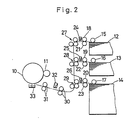
- Fig. 2 is an illustration showing the schematic construction of a paper feeding mechanism of an electrophotographic copying apparatus.
- This electrophotographic copying apparatus comprises three paper containing sections 12, 13 and 14.
- Preliminary rollers 15, 16 and 17, paper feed rollers 18, 19 and 20, retard rollers 21, 22 and 23, and paper detecting switches 24, 25 and 26 are respectively provided corresponding to the paper containing sections 12, 13 and 14.
- the preliminary rollers 15, 16 and 17 are used for delivering paper sheets respectively contained in the corresponding paper containing sections 12, 13 and 14 in descending order.
- the paper feed rollers 18, 19 and 20 are used for sending out the paper sheets delivered.
- the retard rollers 21, 22 and 23 provided so as to be paired with the paper feed rollers 18, 19 and 20 are rotated by a torque weaker than that in the paper feed rollers in the direction opposite to the corresponding paper feed rollers to prevent the overlapped sheet transfer of the paper sheets by the paper feed rollers 18, 19 and 20.
- operations of pairs of the preliminary rollers, the paper feed rollers and the retard rollers are simultaneously started and stopped by paper feed clutches (not shown), respectively.
- the pairs constitute a paper feeding mechanism.
- the front ends and the rear ends of the paper sheets delivered by the paper feeding mechanism are detected by the paper feed switches 24, 25 and 26, respectively.
- the paper sheets fed are conveyed by feed rollers 27, 28 and 29, to be fed to a registration roller 31 through a loop roller 30.
- a registration switch 32 is provided on the downstream side of the loop roller 30 in the direction in which the paper sheets are conveyed and on the upstream side of the registration roller 31. This registration switch 32 allows the paper sheets fed to the registration roller 31 to be detected.
- the registration roller 31 feeds the paper sheets to a photosensitive drum 10 in predetermined timing.
- the loop roller 30 provided on the upstream side of the registration roller 31 is used for further feeding paper sheets when the paper sheets conveyed are stopped by the collision of their ends with the registration roller 31, causing constant deflection (loop) on the paper sheets on this side of the registration roller 31. If deflection is thus caused on the paper sheets, the ends of the paper sheets can be heavily applied to the resistration roller 31, allowing oblique feeding of the paper sheets to be compensated for.
- the paper sheets fed by the registration roller 31 are in close contact with the surface of the photosensitive drum 10.
- the toner image developed by a developing device 11 is transferred by a transferring corona discharger 33.
- Fig. 3 is a block diagram showing the construction of an electrical circuit for operating the mechanism shown in Fig. 2.
- the electrical circuit has a structure comprising a CPU 34 which is a control center, a ROM 35 storing an operation program of the CPU 34, a RAM 36 for storing data or the like, and an input/output interface 37.
- the RAM 36 comprises a first timer area 361 and a third timer area 363 which are required for control as described below.
- Both outputs of the above described paper feed switches 24, 25 and 26 and an output of the above registration switch 32 are applied to the CPU 34 through the input/output interface 37.
- a control signal outputted from the CPU 34 is applied to paper feed clutches 39, 40 and 41, a loop clutch 42 and a registration clutch 43.
- the paper feed clutches 39, 40 and 41 are used for switching the start/stop of operations of the paper feeding mechanism (a pair of the preliminary roller 15, the paper feed roller 18 and the retard roller 21, a pair of the preliminary roller 16, the paper feed roller 19 and the retard roller 22 and a pair of the preliminary roller 17, the paper feed roller 20 and the retard roller 23), respectively.
- the loop clutch 42 is used for switching the start/stop of an operation of the loop roller 30.
- the registration clutch 43 is used for switching the start/stop of an operation of the registration roller 31.
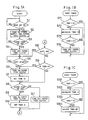
- Figs. 1A, 1B and 1C are flow charts showing a control operation of the paper feeding mechanism of this electrophotographic copying apparatus.
- Fig. 4 is a timing chart showing the operation of this electrophotographic copying apparatus, which shows the relation of the paper feed clutches 39, 40 and 41, the paper feed switches 24, 25 and 26 and timers.
- the sections corresponding to control denoted by numbers of the steps shown in Figs. 1A and 1B are given numbers put in parentheses.
- step S1 When a main switch of the electrophotographic copying apparatus is turned on (step S1), the CPU 34 turns the power supply on and turns the three paper feed clutches 39, 40 and 41 on (step S2). Then, the CPU 34 turns the corresponding paper feed clutches 39, 40 and 41 off (step S4) in response to the transition of the paper feed switches 24, 25 and 26 to the on-state (step S3).
- the CPU 34 then waits for a copying start signal to be applied by, for example, depressing a print button of a data input section (step S5). If the copying start signal is applied, the CPU 34 turns the corresponding paper feed clutch 39, 40 or 41 on so as to feed the paper sheets selected (step S6).
- a third timer for turning the paper feed clutches off is set using the third timer area 363 (step S7).
- This third timer performs a time subtracting operation as shown in the steps S71 to S73 in Fig. 1B.
- the CPU 34 turns the paper feed clutch 39, 40 or 41 off which is turned on after an elapse of constant time t3 (step S74).
- This third timer performs the function of sending the paper sheets delivered to the positions of the paper feed switches 24, 25 and 26 into the feed rollers 27, 28 and 29.
- step S6 When the paper sheets start to be fed by turning the paper feed clutch on in the above described step S6, the paper sheets are conveyed by the feed roller, 27, 28 or 29. The rear ends of the paper sheets pass through the paper feed switch 24, 25 or 26. At that time, the paper feed switch 24, 25 or 26 is turned off (step S8). Consequently, the CPU 34 turns the paper feed clutch 39, 40 or 41 on again in response to the detection of a rear edge of the paper feed switch 24, 25 or 26 (step S9) and sets predetermined time t1 in the first timer area 361 for setting the spacing between paper sheets in the RAM 36 to initiate a first timer (step S10).
- the time t1 is set to one corresponding to the minimum spacing between paper sheets required, that is, the spacing between the rear end of the previous paper sheet and the front end of the subsequent paper sheet.
- the first timer performs a time subtracting operation as shown in the steps S101 to S104 in Fig. 1C.
- step S104 the CPU 34 determines the output (step S13), to repeat the same control as described above, that is, to turn the paper feed clutch 39, 40 or 41 on (step S6) and to initiate the third timer for turning the paper feed clutches off (step S7).
- the CPU 34 turns the paper feed clutch 39, 40 or 41 off in response to the detection of a front edge at the paper feed switch 24, 25 or 26 in the step S8 (step S11).
- the foregoing control is exercised. Accordingly, the front ends of the paper sheets are previously delivered to the positions of the paper feed switches 24, 25 and 26 before the paper sheets start to be fed, and the front ends of the paper sheets are therefore always at a regular position at the time of starting to feed the paper sheets. Consequently, even if the front ends of the paper sheets are somewhat out of line with each other in the paper containing section 12, 14 or 14, the ends of the paper sheets are always at the regular position at the time of starting to feed the paper sheets.
- the subsequent paper sheet is delivered with the required spacing between paper sheets. Accordingly, even if the spacing between paper sheets is decreased to the desired spacing or less by slip of the paper sheets during feeding, the paper sheets do not collide with each other and a paper jam or the like does not occur.
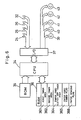
- Fig. 6 is a block diagram showing the construction of an electrical circuit according to a second embodiment for operating the mechanism shown in Fig. 2.
- the electrical circuit has a structure comprising a CPU 34 which is a control center, a ROM 35 storing an operation program of the CPU 34, a RAM 36 for storing data or the like, and an input/output interface 37.
- the RAM 36 comprises a first timer area 361, a second timer area 362, a paper feed clutch off timer area 364, a paper feed timing flag 365, and a paper spacing flag 366 which are required for control as described below.
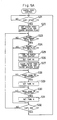
- Fig. 5A is a main flow chart showing the control operation of the paper feeding mechanism of this electrophotographic copying apparatus.
- Fig. 7 is a timing chart showing the operation of this electrophotographic copying apparatus, which shows the relation of a paper feed clutch 39, 40 or 41, a second timer, a paper feed switch 24, 25 or 26, a first timer, and an AND output of the second timer and the first timer.
- the sections corresponding to control denoted by numbers of the steps in Fig. 5A are given numbers put in parentheses.
- the CPU 34 determines the signal (step S21), to set the paper feed timing flag 365 and the paper spacing flag 366 which is an initial operation for copying on the first paper sheet (step S22).
- step S23 determines the state of the paper feed timing flag 365 (step S23), and further determines the state of the paper spacing flag 366 (step S24).
- step S24 determines the state of the paper spacing flag 366 (step S24).
- both the flags 365 and 366 have been set in the above described step S22. Accordingly, control proceeds to the step S25.
- the CPU 34 turns the paper feed clutch 39, 40 or 41 on (step S25), sets predetermined time t2 in the second timer area 362 in the RAM 36 (step S26), and clears the paper feed timing flag 365 and the paper spacing flag 366 (step S27).
- the paper feed clutch which is turned on in step S25 is the paper feed clutch 39, 40 or 41 corresponding to a paper containing section 12, 13 or 14 selected in accordance with the copy mode.
- time t2 set in the second timer area 362 is set to one corresponding to the predetermined ideal spacing with which paper sheets are fed, that is, the spacing between the end of the previous paper sheet and the end of the subsequent paper sheet.
- This time t2 differs depending on the size of the paper sheets. Accordingly, it can be determined which of the paper containing sections 12, 13 and 14 is selected to change the time t2 depending on the results of the determination.
- the CPU 34 detects a front edge at the paper feed swtich 24, 25 or 26 (step S28).
- the paper feed switch 24, 25 or 26 is changed from the off state to the on state. Accordingly, the CPU 34 detects the front edge at that time.
- the CPU 34 sets predetermined time t4 in the paper feed clutch off timer area 364 (step S29). This time t4 is set to sufficient time required to deliver one paper sheet by the paper feed clutch 39, 40 or 41.
- the CPU 34 detects a rear edge at the paper feed switch 24, 25 or 26 (step S30).
- the paper feed switch 24, 25 or 26 is changed from the on state to the off state. Accordingly, the CPU 34 detects the change.
- the CPU 34 sets predetermined time t1 in the first timer area 361 in the RAM 36 (step S31). This time t1 is set to one corresponding to the minimum spacing between paper sheets required, that is, the spacing between the rear end of the previous paper sheet and the front end of the subsequent paper sheet.
- the CPU 34 repeats the control operation in the steps S23 to S31 until it determines that copying is terminated.
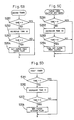
- the CPU 34 performs processing in Figs. 5B, 5C and 5D by, for example, interruption processing in parallel with the foregoing control operation.
- step S26 when the time t2 is set in the second timer area 362, the CPU 34 determines that the time is not "0" as shown in Fig. 5B (step S261), subtracts the time (step S62), and sets the paper feed timing flag 365 which is cleared in the step S27 shown in Fig. 5A (step S264).
- step S291 determines that the time is not "0" (step S291), subtracts the time (step S292), and turns the paper feed clutch 39, 40 or 41, which is turned on in the step S25 shown in Fig. 5A, off (step S294) if the time becomes "0" (step S293), as shown in Fig. 5C.
- the paper feeding mechanism is stopped by the off-state of this paper feed clutch 39, 40 or 41.
- step S311 determines that the time is not "0" (step S311), subtracts the time (step S312), and sets the paper spacing flag 366 which is cleared in the step S27 shown in Fig. 5A (step S314) if the time becomes "0" (step S313), as shown in Fig. 5D.
- the present invention was described taking an electrophotographic copying appparatus as an example. However, the present invention can be applied to another paper feeding control device such as a printing machine or an electrophotographic type facsimile.
Landscapes
- Physics & Mathematics (AREA)
- General Physics & Mathematics (AREA)
- Sheets, Magazines, And Separation Thereof (AREA)
- Controlling Sheets Or Webs (AREA)
- Paper Feeding For Electrophotography (AREA)
Applications Claiming Priority (4)
| Application Number | Priority Date | Filing Date | Title |
|---|---|---|---|
| JP1137167A JPH0795198B2 (ja) | 1989-05-29 | 1989-05-29 | 給紙制御装置 |
| JP137167/89 | 1989-05-29 | ||
| JP1141850A JP2679845B2 (ja) | 1989-06-02 | 1989-06-02 | 給紙制御装置 |
| JP141850/89 | 1989-06-02 |
Publications (3)
| Publication Number | Publication Date |
|---|---|
| EP0400941A2 true EP0400941A2 (de) | 1990-12-05 |
| EP0400941A3 EP0400941A3 (de) | 1991-03-27 |
| EP0400941B1 EP0400941B1 (de) | 1993-08-04 |
Family
ID=26470577
Family Applications (1)
| Application Number | Title | Priority Date | Filing Date |
|---|---|---|---|
| EP90305783A Expired - Lifetime EP0400941B1 (de) | 1989-05-29 | 1990-05-29 | Vorrichtung zum Steuern der Papierzufuhr |
Country Status (3)
| Country | Link |
|---|---|
| US (1) | US5072924A (de) |
| EP (1) | EP0400941B1 (de) |
| DE (1) | DE69002543T2 (de) |
Cited By (3)
| Publication number | Priority date | Publication date | Assignee | Title |
|---|---|---|---|---|
| EP0992860A3 (de) * | 1998-10-09 | 2001-04-04 | Konica Corporation | Bilderzeugungsgerät |
| DE4413238B4 (de) * | 1994-04-15 | 2008-05-15 | Anton Rodi | Verfahren zum Zu- und Abführen von zu bedruckenden/bedruckten Bogen zu/von mindestens einem Druckwerk einer Bogendruckmaschine |
| EP2863265A1 (de) * | 2013-10-17 | 2015-04-22 | Samsung Electronics Co., Ltd | Bilderzeugungsvorrichtung und Verfahren zur Steuerung derselben |
Families Citing this family (10)
| Publication number | Priority date | Publication date | Assignee | Title |
|---|---|---|---|---|
| JP2513869B2 (ja) * | 1989-12-11 | 1996-07-03 | キヤノン株式会社 | 給紙装置 |
| US5195736A (en) * | 1990-09-19 | 1993-03-23 | Oki Electric Industry Co., Ltd. | Method and apparatus for feeding sheets |
| JP4032665B2 (ja) * | 2001-05-25 | 2008-01-16 | コニカミノルタホールディングス株式会社 | 画像形成装置及び画像形成装置における給紙方法 |
| JP2004043178A (ja) * | 2002-05-23 | 2004-02-12 | Ricoh Co Ltd | 自動原稿搬送装置および画像処理装置 |
| JP4040394B2 (ja) * | 2002-08-27 | 2008-01-30 | 株式会社リコー | シート搬送装置及び画像読取装置 |
| JP4235528B2 (ja) * | 2003-10-16 | 2009-03-11 | キヤノン株式会社 | シート供給装置及び画像形成システム |
| US7178914B2 (en) * | 2004-03-03 | 2007-02-20 | Lexmark International, Inc. | Media pre-feed in intermittent printer |
| US7934718B2 (en) * | 2005-03-24 | 2011-05-03 | Xerox Corporation | Sheet feeding of faster rate printing systems with plural slower rate sheet feeders |
| JP4790568B2 (ja) * | 2006-11-06 | 2011-10-12 | 株式会社リコー | 画像形成装置 |
| JP5213579B2 (ja) * | 2008-08-08 | 2013-06-19 | キヤノン株式会社 | シート給送装置及び画像形成装置 |
Family Cites Families (7)
| Publication number | Priority date | Publication date | Assignee | Title |
|---|---|---|---|---|
| DE2758007C2 (de) * | 1977-12-24 | 1979-10-25 | Licentia Patent-Verwaltungs-Gmbh, 6000 Frankfurt | Verfahren zum Steuern des Abzugsvorgangs bei einer Einrichtung zur Abgabe vereinzelter Sendungen von unterschiedlicher Länge sowie entsprechende Einrichtung |
| JPS54139738A (en) * | 1978-04-21 | 1979-10-30 | Ricoh Co Ltd | Copying apparatus |
| JPS58216850A (ja) * | 1982-06-10 | 1983-12-16 | Fuji Xerox Co Ltd | 用紙検知装置 |
| US4589765A (en) * | 1985-05-22 | 1986-05-20 | Xerox Corporation | Sheet feeder control for reproduction machines |
| US4627711A (en) * | 1985-09-30 | 1986-12-09 | Xerox Corporation | Machine shutdown control |
| JPS62116433A (ja) * | 1985-11-15 | 1987-05-28 | Matsushita Graphic Commun Syst Inc | 自動給紙装置 |
| JPS62175359A (ja) * | 1986-01-29 | 1987-08-01 | Ricoh Co Ltd | 記録紙搬送装置 |
-
1990
- 1990-05-23 US US07/527,378 patent/US5072924A/en not_active Expired - Lifetime
- 1990-05-29 DE DE90305783T patent/DE69002543T2/de not_active Expired - Fee Related
- 1990-05-29 EP EP90305783A patent/EP0400941B1/de not_active Expired - Lifetime
Cited By (5)
| Publication number | Priority date | Publication date | Assignee | Title |
|---|---|---|---|---|
| DE4413238B4 (de) * | 1994-04-15 | 2008-05-15 | Anton Rodi | Verfahren zum Zu- und Abführen von zu bedruckenden/bedruckten Bogen zu/von mindestens einem Druckwerk einer Bogendruckmaschine |
| EP0992860A3 (de) * | 1998-10-09 | 2001-04-04 | Konica Corporation | Bilderzeugungsgerät |
| EP2863265A1 (de) * | 2013-10-17 | 2015-04-22 | Samsung Electronics Co., Ltd | Bilderzeugungsvorrichtung und Verfahren zur Steuerung derselben |
| KR20150044664A (ko) * | 2013-10-17 | 2015-04-27 | 삼성전자주식회사 | 화상 형성 장치 및 그 제어 방법 |
| US9676574B2 (en) | 2013-10-17 | 2017-06-13 | Samsung Electronics Co., Ltd. | Image forming apparatus and method of controlling the same |
Also Published As
| Publication number | Publication date |
|---|---|
| EP0400941B1 (de) | 1993-08-04 |
| EP0400941A3 (de) | 1991-03-27 |
| DE69002543T2 (de) | 1994-02-17 |
| US5072924A (en) | 1991-12-17 |
| DE69002543D1 (de) | 1993-09-09 |
Similar Documents
| Publication | Publication Date | Title |
|---|---|---|
| US5119146A (en) | Paper conveying device having variable speed rollers for a printing apparatus | |
| EP0400941B1 (de) | Vorrichtung zum Steuern der Papierzufuhr | |
| JPH0585644A (ja) | 給紙装置 | |
| JPH07277556A (ja) | プリンタ及びフィーディングシステム | |
| EP1357446B1 (de) | Blattbewegungssteuerung in einem Zweiseitigenpapierweg eines Druckers | |
| EP0892324B1 (de) | Bilderzeugungsgerät | |
| JPH0672592A (ja) | 画像形成装置の用紙供給装置 | |
| JPH031167A (ja) | 画像形成装置 | |
| JPH07267514A (ja) | 再給紙装置 | |
| JPH02158543A (ja) | 画像形成装置の紙搬送制御方法 | |
| JPS62136440A (ja) | 手差しコピ−可能複写機 | |
| JP2507826B2 (ja) | 画像形成装置 | |
| JP2679845B2 (ja) | 給紙制御装置 | |
| JP3583689B2 (ja) | 画像形成装置の用紙搬送装置 | |
| JPH0795198B2 (ja) | 給紙制御装置 | |
| JPS63247742A (ja) | 複写装置 | |
| JP2025129883A (ja) | シート搬送装置、画像読取装置、画像形成装置 | |
| JPS61123861A (ja) | 複写機における紙送り制御機構 | |
| JPH0353224B2 (de) | ||
| JP2698139B2 (ja) | 画像形成装置 | |
| JP2593075B2 (ja) | 記録用紙搬送装置 | |
| JPH02221047A (ja) | 給紙装置 | |
| JPH057711B2 (de) | ||
| JPH07315637A (ja) | シート給送装置及び画像形成装置 | |
| JPH04338766A (ja) | 複写装置 |
Legal Events
| Date | Code | Title | Description |
|---|---|---|---|
| PUAI | Public reference made under article 153(3) epc to a published international application that has entered the european phase |
Free format text: ORIGINAL CODE: 0009012 |
|
| AK | Designated contracting states |
Kind code of ref document: A2 Designated state(s): DE FR GB NL |
|
| PUAL | Search report despatched |
Free format text: ORIGINAL CODE: 0009013 |
|
| 17P | Request for examination filed |
Effective date: 19901221 |
|
| RIN1 | Information on inventor provided before grant (corrected) |
Inventor name: SUGIYAMA, TSUKASA |
|
| AK | Designated contracting states |
Kind code of ref document: A3 Designated state(s): DE FR GB NL |
|
| 17Q | First examination report despatched |
Effective date: 19921102 |
|
| GRAA | (expected) grant |
Free format text: ORIGINAL CODE: 0009210 |
|
| AK | Designated contracting states |
Kind code of ref document: B1 Designated state(s): DE FR GB NL |
|
| REF | Corresponds to: |
Ref document number: 69002543 Country of ref document: DE Date of ref document: 19930909 |
|
| ET | Fr: translation filed | ||
| PLBE | No opposition filed within time limit |
Free format text: ORIGINAL CODE: 0009261 |
|
| STAA | Information on the status of an ep patent application or granted ep patent |
Free format text: STATUS: NO OPPOSITION FILED WITHIN TIME LIMIT |
|
| 26N | No opposition filed | ||
| REG | Reference to a national code |
Ref country code: GB Ref legal event code: IF02 |
|
| PGFP | Annual fee paid to national office [announced via postgrant information from national office to epo] |
Ref country code: DE Payment date: 20080605 Year of fee payment: 19 |
|
| PGFP | Annual fee paid to national office [announced via postgrant information from national office to epo] |
Ref country code: NL Payment date: 20080501 Year of fee payment: 19 |
|
| PGFP | Annual fee paid to national office [announced via postgrant information from national office to epo] |
Ref country code: GB Payment date: 20090527 Year of fee payment: 20 |
|
| NLV4 | Nl: lapsed or anulled due to non-payment of the annual fee |
Effective date: 20091201 |
|
| PG25 | Lapsed in a contracting state [announced via postgrant information from national office to epo] |
Ref country code: NL Free format text: LAPSE BECAUSE OF NON-PAYMENT OF DUE FEES Effective date: 20091201 |
|
| REG | Reference to a national code |
Ref country code: FR Ref legal event code: ST Effective date: 20100129 |
|
| PG25 | Lapsed in a contracting state [announced via postgrant information from national office to epo] |
Ref country code: FR Free format text: LAPSE BECAUSE OF NON-PAYMENT OF DUE FEES Effective date: 20090602 |
|
| PGFP | Annual fee paid to national office [announced via postgrant information from national office to epo] |
Ref country code: FR Payment date: 20080514 Year of fee payment: 19 |
|
| PG25 | Lapsed in a contracting state [announced via postgrant information from national office to epo] |
Ref country code: DE Free format text: LAPSE BECAUSE OF NON-PAYMENT OF DUE FEES Effective date: 20091201 |
|
| PG25 | Lapsed in a contracting state [announced via postgrant information from national office to epo] |
Ref country code: GB Free format text: LAPSE BECAUSE OF EXPIRATION OF PROTECTION Effective date: 20100528 |