EP0422682A2 - Verfahren zur Herstellung eines Trägers für eine Druckplatte - Google Patents
Verfahren zur Herstellung eines Trägers für eine Druckplatte Download PDFInfo
- Publication number
- EP0422682A2 EP0422682A2 EP90119627A EP90119627A EP0422682A2 EP 0422682 A2 EP0422682 A2 EP 0422682A2 EP 90119627 A EP90119627 A EP 90119627A EP 90119627 A EP90119627 A EP 90119627A EP 0422682 A2 EP0422682 A2 EP 0422682A2
- Authority
- EP
- European Patent Office
- Prior art keywords
- aqueous solution
- aluminum plate
- acid
- neutral salt
- current
- Prior art date
- Legal status (The legal status is an assumption and is not a legal conclusion. Google has not performed a legal analysis and makes no representation as to the accuracy of the status listed.)
- Granted
Links
- 238000007639 printing Methods 0.000 title claims abstract description 31
- 238000004519 manufacturing process Methods 0.000 title claims abstract description 20
- 229910052782 aluminium Inorganic materials 0.000 claims abstract description 220
- XAGFODPZIPBFFR-UHFFFAOYSA-N aluminium Chemical compound [Al] XAGFODPZIPBFFR-UHFFFAOYSA-N 0.000 claims abstract description 214
- 239000007864 aqueous solution Substances 0.000 claims abstract description 153
- 238000011282 treatment Methods 0.000 claims abstract description 141
- 238000005868 electrolysis reaction Methods 0.000 claims abstract description 105
- 239000003792 electrolyte Substances 0.000 claims abstract description 96
- 150000003839 salts Chemical class 0.000 claims abstract description 94
- 239000002253 acid Substances 0.000 claims abstract description 91
- 230000007935 neutral effect Effects 0.000 claims abstract description 91
- 238000007743 anodising Methods 0.000 claims abstract description 28
- 238000007788 roughening Methods 0.000 claims description 119
- 238000000034 method Methods 0.000 claims description 104
- FAPWRFPIFSIZLT-UHFFFAOYSA-M sodium chloride Inorganic materials [Na+].[Cl-] FAPWRFPIFSIZLT-UHFFFAOYSA-M 0.000 claims description 55
- VEXZGXHMUGYJMC-UHFFFAOYSA-N Hydrochloric acid Chemical compound Cl VEXZGXHMUGYJMC-UHFFFAOYSA-N 0.000 claims description 44
- QAOWNCQODCNURD-UHFFFAOYSA-N Sulfuric acid Chemical compound OS(O)(=O)=O QAOWNCQODCNURD-UHFFFAOYSA-N 0.000 claims description 32
- 239000011780 sodium chloride Substances 0.000 claims description 29
- HTXDPTMKBJXEOW-UHFFFAOYSA-N dioxoiridium Chemical compound O=[Ir]=O HTXDPTMKBJXEOW-UHFFFAOYSA-N 0.000 claims description 17
- 229910000457 iridium oxide Inorganic materials 0.000 claims description 17
- VWDWKYIASSYTQR-UHFFFAOYSA-N sodium nitrate Chemical compound [Na+].[O-][N+]([O-])=O VWDWKYIASSYTQR-UHFFFAOYSA-N 0.000 claims description 17
- NBIIXXVUZAFLBC-UHFFFAOYSA-N Phosphoric acid Chemical compound OP(O)(O)=O NBIIXXVUZAFLBC-UHFFFAOYSA-N 0.000 claims description 16
- BASFCYQUMIYNBI-UHFFFAOYSA-N platinum Chemical compound [Pt] BASFCYQUMIYNBI-UHFFFAOYSA-N 0.000 claims description 14
- GRYLNZFGIOXLOG-UHFFFAOYSA-N Nitric acid Chemical compound O[N+]([O-])=O GRYLNZFGIOXLOG-UHFFFAOYSA-N 0.000 claims description 13
- 229910017604 nitric acid Inorganic materials 0.000 claims description 13
- 229910000859 α-Fe Inorganic materials 0.000 claims description 10
- 229910000147 aluminium phosphate Inorganic materials 0.000 claims description 8
- 229910001508 alkali metal halide Inorganic materials 0.000 claims description 7
- 150000008045 alkali metal halides Chemical class 0.000 claims description 7
- 229910001963 alkali metal nitrate Inorganic materials 0.000 claims description 7
- 229910052697 platinum Inorganic materials 0.000 claims description 7
- 235000010344 sodium nitrate Nutrition 0.000 claims description 7
- 239000004317 sodium nitrate Substances 0.000 claims description 7
- KRVSOGSZCMJSLX-UHFFFAOYSA-L chromic acid Substances O[Cr](O)(=O)=O KRVSOGSZCMJSLX-UHFFFAOYSA-L 0.000 claims description 6
- AWJWCTOOIBYHON-UHFFFAOYSA-N furo[3,4-b]pyrazine-5,7-dione Chemical compound C1=CN=C2C(=O)OC(=O)C2=N1 AWJWCTOOIBYHON-UHFFFAOYSA-N 0.000 claims description 6
- 229910021645 metal ion Inorganic materials 0.000 claims description 6
- 239000000243 solution Substances 0.000 claims description 5
- 239000012266 salt solution Substances 0.000 claims 1
- HEMHJVSKTPXQMS-UHFFFAOYSA-M Sodium hydroxide Chemical compound [OH-].[Na+] HEMHJVSKTPXQMS-UHFFFAOYSA-M 0.000 abstract description 54
- 238000005406 washing Methods 0.000 description 25
- XLYOFNOQVPJJNP-UHFFFAOYSA-N water Substances O XLYOFNOQVPJJNP-UHFFFAOYSA-N 0.000 description 22
- 239000011248 coating agent Substances 0.000 description 13
- 238000000576 coating method Methods 0.000 description 13
- OKTJSMMVPCPJKN-UHFFFAOYSA-N Carbon Chemical compound [C] OKTJSMMVPCPJKN-UHFFFAOYSA-N 0.000 description 12
- 239000000463 material Substances 0.000 description 11
- -1 aluminum ions Chemical class 0.000 description 10
- 238000004090 dissolution Methods 0.000 description 10
- 239000012670 alkaline solution Substances 0.000 description 9
- WNROFYMDJYEPJX-UHFFFAOYSA-K aluminium hydroxide Chemical compound [OH-].[OH-].[OH-].[Al+3] WNROFYMDJYEPJX-UHFFFAOYSA-K 0.000 description 9
- 229910052799 carbon Inorganic materials 0.000 description 9
- 238000006243 chemical reaction Methods 0.000 description 9
- 239000007921 spray Substances 0.000 description 9
- 239000004020 conductor Substances 0.000 description 8
- 238000005530 etching Methods 0.000 description 8
- NLXLAEXVIDQMFP-UHFFFAOYSA-N Ammonia chloride Chemical compound [NH4+].[Cl-] NLXLAEXVIDQMFP-UHFFFAOYSA-N 0.000 description 6
- VSCWAEJMTAWNJL-UHFFFAOYSA-K aluminium trichloride Chemical compound Cl[Al](Cl)Cl VSCWAEJMTAWNJL-UHFFFAOYSA-K 0.000 description 6
- 238000005238 degreasing Methods 0.000 description 6
- 238000007654 immersion Methods 0.000 description 6
- 239000000126 substance Substances 0.000 description 6
- 239000003513 alkali Substances 0.000 description 5
- 238000004140 cleaning Methods 0.000 description 5
- 239000010407 anodic oxide Substances 0.000 description 4
- WMWXXXSCZVGQAR-UHFFFAOYSA-N dialuminum;oxygen(2-);hydrate Chemical compound O.[O-2].[O-2].[O-2].[Al+3].[Al+3] WMWXXXSCZVGQAR-UHFFFAOYSA-N 0.000 description 4
- 238000002347 injection Methods 0.000 description 4
- 239000007924 injection Substances 0.000 description 4
- 239000010808 liquid waste Substances 0.000 description 4
- PAWQVTBBRAZDMG-UHFFFAOYSA-N 2-(3-bromo-2-fluorophenyl)acetic acid Chemical compound OC(=O)CC1=CC=CC(Br)=C1F PAWQVTBBRAZDMG-UHFFFAOYSA-N 0.000 description 3
- 229910000838 Al alloy Inorganic materials 0.000 description 3
- 229910021380 Manganese Chloride Inorganic materials 0.000 description 3
- GLFNIEUTAYBVOC-UHFFFAOYSA-L Manganese chloride Chemical compound Cl[Mn]Cl GLFNIEUTAYBVOC-UHFFFAOYSA-L 0.000 description 3
- 229960001040 ammonium chloride Drugs 0.000 description 3
- 235000019270 ammonium chloride Nutrition 0.000 description 3
- 229910002090 carbon oxide Inorganic materials 0.000 description 3
- 230000000052 comparative effect Effects 0.000 description 3
- 238000007796 conventional method Methods 0.000 description 3
- 238000004925 denaturation Methods 0.000 description 3
- 230000036425 denaturation Effects 0.000 description 3
- 238000010586 diagram Methods 0.000 description 3
- 238000001914 filtration Methods 0.000 description 3
- FBAFATDZDUQKNH-UHFFFAOYSA-M iron chloride Chemical compound [Cl-].[Fe] FBAFATDZDUQKNH-UHFFFAOYSA-M 0.000 description 3
- MVFCKEFYUDZOCX-UHFFFAOYSA-N iron(2+);dinitrate Chemical compound [Fe+2].[O-][N+]([O-])=O.[O-][N+]([O-])=O MVFCKEFYUDZOCX-UHFFFAOYSA-N 0.000 description 3
- 239000007788 liquid Substances 0.000 description 3
- 239000011565 manganese chloride Substances 0.000 description 3
- 235000002867 manganese chloride Nutrition 0.000 description 3
- 229940099607 manganese chloride Drugs 0.000 description 3
- MIVBAHRSNUNMPP-UHFFFAOYSA-N manganese(2+);dinitrate Chemical compound [Mn+2].[O-][N+]([O-])=O.[O-][N+]([O-])=O MIVBAHRSNUNMPP-UHFFFAOYSA-N 0.000 description 3
- 239000012528 membrane Substances 0.000 description 3
- 238000000926 separation method Methods 0.000 description 3
- BNGXYYYYKUGPPF-UHFFFAOYSA-M (3-methylphenyl)methyl-triphenylphosphanium;chloride Chemical compound [Cl-].CC1=CC=CC(C[P+](C=2C=CC=CC=2)(C=2C=CC=CC=2)C=2C=CC=CC=2)=C1 BNGXYYYYKUGPPF-UHFFFAOYSA-M 0.000 description 2
- KRHYYFGTRYWZRS-UHFFFAOYSA-N Fluorane Chemical compound F KRHYYFGTRYWZRS-UHFFFAOYSA-N 0.000 description 2
- 230000006866 deterioration Effects 0.000 description 2
- 230000000694 effects Effects 0.000 description 2
- 229960002050 hydrofluoric acid Drugs 0.000 description 2
- 239000010410 layer Substances 0.000 description 2
- VNWKTOKETHGBQD-UHFFFAOYSA-N methane Chemical compound C VNWKTOKETHGBQD-UHFFFAOYSA-N 0.000 description 2
- 239000000203 mixture Substances 0.000 description 2
- 238000006386 neutralization reaction Methods 0.000 description 2
- 238000007645 offset printing Methods 0.000 description 2
- 239000003921 oil Substances 0.000 description 2
- 238000002203 pretreatment Methods 0.000 description 2
- 239000010731 rolling oil Substances 0.000 description 2
- 239000004065 semiconductor Substances 0.000 description 2
- 238000007493 shaping process Methods 0.000 description 2
- 239000002344 surface layer Substances 0.000 description 2
- DGAQECJNVWCQMB-PUAWFVPOSA-M Ilexoside XXIX Chemical compound C[C@@H]1CC[C@@]2(CC[C@@]3(C(=CC[C@H]4[C@]3(CC[C@@H]5[C@@]4(CC[C@@H](C5(C)C)OS(=O)(=O)[O-])C)C)[C@@H]2[C@]1(C)O)C)C(=O)O[C@H]6[C@@H]([C@H]([C@@H]([C@H](O6)CO)O)O)O.[Na+] DGAQECJNVWCQMB-PUAWFVPOSA-M 0.000 description 1
- 229910002651 NO3 Inorganic materials 0.000 description 1
- NHNBFGGVMKEFGY-UHFFFAOYSA-N Nitrate Chemical compound [O-][N+]([O-])=O NHNBFGGVMKEFGY-UHFFFAOYSA-N 0.000 description 1
- 239000004677 Nylon Substances 0.000 description 1
- 239000004115 Sodium Silicate Substances 0.000 description 1
- 238000007792 addition Methods 0.000 description 1
- 230000001070 adhesive effect Effects 0.000 description 1
- 229910045601 alloy Inorganic materials 0.000 description 1
- 239000000956 alloy Substances 0.000 description 1
- QVGXLLKOCUKJST-UHFFFAOYSA-N atomic oxygen Chemical compound [O] QVGXLLKOCUKJST-UHFFFAOYSA-N 0.000 description 1
- 239000011230 binding agent Substances 0.000 description 1
- 238000003486 chemical etching Methods 0.000 description 1
- PYRZPBDTPRQYKG-UHFFFAOYSA-N cyclopentene-1-carboxylic acid Chemical compound OC(=O)C1=CCCC1 PYRZPBDTPRQYKG-UHFFFAOYSA-N 0.000 description 1
- 238000013016 damping Methods 0.000 description 1
- 238000009826 distribution Methods 0.000 description 1
- 230000020169 heat generation Effects 0.000 description 1
- 230000003472 neutralizing effect Effects 0.000 description 1
- 229920001778 nylon Polymers 0.000 description 1
- 229910052760 oxygen Inorganic materials 0.000 description 1
- 239000001301 oxygen Substances 0.000 description 1
- 230000000630 rising effect Effects 0.000 description 1
- 238000005096 rolling process Methods 0.000 description 1
- 229910052709 silver Inorganic materials 0.000 description 1
- 239000004332 silver Substances 0.000 description 1
- 229910052708 sodium Inorganic materials 0.000 description 1
- 239000011734 sodium Substances 0.000 description 1
- NTHWMYGWWRZVTN-UHFFFAOYSA-N sodium silicate Chemical compound [Na+].[Na+].[O-][Si]([O-])=O NTHWMYGWWRZVTN-UHFFFAOYSA-N 0.000 description 1
- 229910052911 sodium silicate Inorganic materials 0.000 description 1
- 239000000725 suspension Substances 0.000 description 1
Images


Classifications
-
- C—CHEMISTRY; METALLURGY
- C25—ELECTROLYTIC OR ELECTROPHORETIC PROCESSES; APPARATUS THEREFOR
- C25F—PROCESSES FOR THE ELECTROLYTIC REMOVAL OF MATERIALS FROM OBJECTS; APPARATUS THEREFOR
- C25F3/00—Electrolytic etching or polishing
- C25F3/02—Etching
- C25F3/04—Etching of light metals
-
- B—PERFORMING OPERATIONS; TRANSPORTING
- B41—PRINTING; LINING MACHINES; TYPEWRITERS; STAMPS
- B41N—PRINTING PLATES OR FOILS; MATERIALS FOR SURFACES USED IN PRINTING MACHINES FOR PRINTING, INKING, DAMPING, OR THE LIKE; PREPARING SUCH SURFACES FOR USE AND CONSERVING THEM
- B41N3/00—Preparing for use and conserving printing surfaces
- B41N3/03—Chemical or electrical pretreatment
- B41N3/034—Chemical or electrical pretreatment characterised by the electrochemical treatment of the aluminum support, e.g. anodisation, electro-graining; Sealing of the anodised layer; Treatment of the anodic layer with inorganic compounds; Colouring of the anodic layer
Definitions
- the present invention generally relates to a method for producing an aluminum support for a printing plate, and particularly relates to a method for electrochemically surface-roughening and electrochemically denaturing an aluminum plate (including an aluminum alloy plate). Specifically, the present invention relates to a method for producing an aluminum support for a printing plate constituted by a uniformly surface-roughened aluminum plate suitable for an offset printing plate.
- an aluminum plate has been used as a support for an offset printing plate.
- the surface of the aluminum plate is surface-roughened for the purposes of improving adhesion between the aluminum plate and a photosensitive layer provided thereon, holding damping water to be used in printing, and the like.
- a mechanical surface-roughening method such as ball graining or brush graining
- an electrolytic surface-roughening method for electrochemically surface-roughening the surface of an aluminum plate in an acid electrolyte such as hydrochloric acid or nitric acid has been used.
- an etching treat ment in an alkaline solution has been generally performed so as to remove an abrasive used in the mechanical surface-roughening and make the surface shape well.
- etching treatment in an alkaline solution has been ordinarily performed so as to remove a smut component mainly containing a generated aluminum hydroxide and to shape the surface.
- the alkaline solution generally sodium hydroxide has been used.
- Fig. 6 shows an example of the conventional process in which, after surface roughening, alkali etching and anodizing are performed so as to shape the surface-roughened support and to form an oxide coating. That is, first, a surface-roughened aluminum plate 1 is alkali-etched through ejection of an alkaline solution from spray nozzles 6 in the alkali etching step E. The remaining alkaline solution is removed through injection of clean water from spray nozzles 5 in the washing step W, and then the surface of the aluminum plate is neutralized through injection of a dilute acid aqueous solution from spray nozzles 7 in the neutralization step N.
- the aluminum plate is placed opposite to an anode of a DC power source 2 in an acid electrolyte 9 so as to be surface- electrolyzed in the cathodic electrolytic step, and then placed opposite to a cathode of the DC power source 2 so as to be surface-oxidized so that an oxide coating is formed in the anodizing step A.
- an electrolytic surface-roughening method for electrochemically surface-roughening the surface of an aluminum plate in an acid electrolyte has attracted attention.
- this electrolytic surface-roughening method an aluminum plate having a uniformly roughened surface in which the mean roughness distribution is small in comparison with a plate produced using the conventional mechanical surface-roughening method is obtained.
- the conditions for obtaining such a roughened surface are exceedingly narrow. If conditions such as the electrolyte composition, temperature, and the electrolytic condition are fixed, it is possible to easily obtain aluminum plates having extremely reduced scattering of products and having uniform performance.
- an aluminum material has been immersed in an acid aqueous solution or in an alkaline solution before an electrolytic surface-roughening treatment is performed to thereby remove processing oil, oxide, or smut and to dissolve a processed degenerated layer so that the surface is washed and made uniform.
- electrolytic surface-roughening method there are generally known methods as disclosed, for example, in the U.S. Patents Nos. 4,548,683 and 4,087,341.
- carbon electrodes are usually employed as counter electrodes for the aluminum plate to be surface-roughened.
- the carbon electrodes are dissolved because of deterioration of a binder, as described in Japanese Patent Publication No. Sho-61-48596.
- auxiliary electrodes are used and a current flowing in the main electrodes is shunted using rectifier devices such as diodes so that the quantity of the current flowing out from the main electrodes is reduced so as to be smaller than the current flowing into the main electrodes to thereby prevent the main electrodes from being dissolved.
- rectifier devices such as diodes
- Japanese Unexamined Patent Publication No. Sho-52-26904 discloses a method for electrochemically denaturing the surface of an aluminum plate by cathodic electrolysis in a neutral salt aqueous solution. It is described that in a neutral salt aqueous solution of pH 6-8, which is a particularly advantageous condition, dissolved aluminum ions can be continuously removed from the neutral salt aqueous solution by filtration or centrifugal separation because the aluminum ions are precipitated in the form of aluminum hydroxide or aluminum oxide hydrate.
- a washing treatment using sodium hydroxide is usually used for performing degreasing and removing a natural oxide coating before the electrolytic surface-roughening treatment, and a light etching treatment using sodium hvdroxide is used to remove aluminum hvdroxide generated in the electrolytic surface-roughening treatment and to shape the edge portions of formed pits after the electrolytic surface-roughening treatment.
- Both treatments involve a chemical dissolution reaction due to sodium hydroxide, and it has been therefore difficult to suppress the quantity of dissolution.
- a permeable membrane is used for removal of aluminum dissolved in the sodium hydroxide, the required liquid waste treatment cost is costly.
- a first object of the present invention is to eliminate the foregoing disadvantages in the prior art and provide a method for producing a support for a printing plate in which the conventional sodium hydroxide pretreatment such as for degreasing of an aluminum plate and smut removal is changed into an electrolytic treatment to thereby simplify liquid waste disposal.
- a part of an electrolytic surface-roughening reaction is performed by an auxiliary electrode, which has not directly contributed to the reaction in the conventional method, so that the process is further simplified to thereby improve production costs.
- a method in which the surface of an aluminum plate is electrochemically denatured by cathodic electrolysis in a neutral salt aqueous solution has been disclosed in Japanese Unexamined Patent Publication No. Sho-59-11295, as noted above.
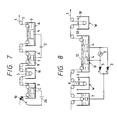
- a surface-roughened aluminum plate 1 is subject to cathodic electrolytic treatment in the cathodic electrolytic step C in a neutral salt aqueous solution 8 at between an anode 3 and the aluminum plate 1, which is energized from a DC power source 2b through a conductor roll 10, so that the roughened surface of the support is shaped.
- the thus treated aluminum plate is washed with clean water in a washing step W, and then treated in an anodizing step A, as shown in Fig. 7.
- an oxide coating is formed on the aluminum plate surface in the same manner as in the case of Fig. 6.
- a second object of the present invention is to overcome the limitations of the prior art in which a separate power supply must be provided for cathodic electrolysis, causing sparks to be generated which causes holes in the aluminum plate.
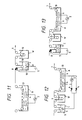
- Fig. 11 shows another example of a conventional process.
- an aluminum plate 1 which has been subject to alkali-pretreatment and washed with water is electrolytically surface-roughened in an acid electrolyte 12 between the aluminum plate and main electrodes 4 using an AC power source 2.
- the thus treated aluminum plate 1 is subject to cathodic electrolysis in a neutral salt aqueous solution between the aluminum plate and an anode 9 which is energized by a DC power source 5 through a conductor roll 8 to thereby remove aluminum hydroxide from the roughed surface.
- a third object of the present invention is to provide a method for producing a support for a printing plate in which holes are not formed in the aluminum plate due to a strong alkali used in the etching treatment.
- the above first object of the present invention is attained by a method for producing a support for a printing plate in which an aluminum plate is continuously surface-roughened, characterized in that (a) the aluminum plate is subjected to cathodic electrolysis in a neutral salt aqueous solution, (b) the treated aluminum plate is electrochemically surface-roughened in an acid electrolyte, and then (c) the treatment aluminum plate is subjected to cathodic electrolysis in an acid electrolyte.
- the above first object is also obtained by a method for producing a support for a printing plate in which an aluminum plate is continuously surface-roughened, characterized in that (a) the aluminum plate is subject to cathodic electrolysis in a neutral salt aqueous solution, (b) the thus treated aluminum plate is electrochemically surface-roughened in an acid electrolyte, and then (c) the treated aluminum plate is subject to cathodic electrolysis in a neutral salt aqueous solution.
- the second object of the present invention is attained by a method for producing a support for a printing plate in which a surface-roughened aluminum plate is electrolytically treated as a cathode in a neutral salt aqueous solution and then anodized, characterized in that a DC power source is commonly used as a power source for the cathodic electrolytic treatment and as a power source for the anodizing treatment.
- the above second object of the present invention can also be attained by the method for producing a support for a printing plate in which an aluminum plate is continuously electrochemically surface-roughened in an acid electrolyte using an AC current, characterized in that the current to be used for the surface roughening is partially shunted through rectifier devices so that the thus obtained shunted current is used for cathodic electrolysis in a neutral salt aqueous solution.
- Shunting of a part ofcurrent to be used for surface-roughened through rectifier devices as used herein refers to shunting performed using diodes, thyristors, GTOs, transistors or the like.
- the third object of the present invention can be attained by providing a method in which, after being electrolytically treated as a cathode in a neutral salt electrolyte, an aluminum plate is electrochemically surface-roughened in an acid aqueous solution.
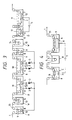
- an aluminum plate 1 is subjected to a cleaning treatment such as degreasing in a cathodic electrolysis step A, which is pretreatment.
- the thus treated aluminum plate 1 is subject to an AC surface-roughening treatment in the first (and second) step of the electrolytic surface-roughening treatment step B, and then removal of smut is performed in the cathodic electrolysis step A.
- the anodizing step C is further shown as the next step. This step, however, is not always needed in the method according to the present invention.
- a DC current shunted from an AC power source 2 through thyristor rectifying devices 3 (hereinafter, simply referred to as thyristors) is fed to an auxiliary electrode 8 to thereby DC-electrolyze the aluminum plate 1 disposed in opposition to the auxiliary electrode as a cathode in a neutral salt aqueous solution 9 so as to wash the surface of the aluminum plate.
- the thus pretreated aluminum plate 1 is washed with water from washing sprays 14 in the washing step W, and then subjected to the electrolytic surface-roughening treatment step B of the first and second steps so as to be electrolytically surface-roughened in acid electrolytes 10 by main electrodes 4 disposed in opposition to the aluminum plate 1 and fed from the AC power sources 2.
- the electrolytic surface-roughening treatment process of the two steps is shown in the accompanying drawings, only the electrolytic surface-roughening treatment process of one step is sometimes sufficient.
- the surface-roughened aluminum plate is washed with water by the washing sprays 14 in the washing step W, and then sent to the cathodic electrolysis step A.
- a DC current shunted from the AC power source 2 through thyristors 3 is fed to an auxiliary electrode 8 and the aluminum plate 1 disposed in opposition to the auxiliary electrode is subject to DC cathodic electrolysis as a cathode in an acid electrolyte 11, so that smut on the surface of the surface-roughened aluminum plate is removed and at the same time the edge portions of pits formed are shaped.
- the anodizing step C is further shown as the next step. This step, however, may be omitted.
- the anodizing step C in the acid electrolyte 11, on the other hand, is a treatment process performed between a cathode 7 fed from the DC power source 5 and the aluminum plate in the acid electrolyte so as to improve the water holding property of the surface-roughened aluminum plate.
- an anode 6 provided in a cell for the cathodic electrolysis step A which is the pre-process so that the anode 6 is fed from the DC power source for anodizing.
- the electrode 6 is illustrated for showing an example in which the electrode 6 is used together with an auxiliary electrode 8 to thereby improve the electrolytic treatment efficiency.
- the aluminum plate to be applied to the present invention a pure aluminum plate or an alloy plate containing aluminum as a principal component can be used.
- the electrochemical washing treatment for the surface of an aluminum plate as defined according to the present invention means that a DC current is fed to an electrode and an aluminum plate disposed in opposition to the electrode is subject to cathodic electrolysis as a cathode in a neutral salt aqueous solution.
- the salt aqueous solution as used in the practice of the present invention is an aqueous solution of a salt such as disclosed in Japanese Unexamined Patent Publications Nos. Sho-52- 26904 and Sho-59-11295, for example, an alkali metal halide or alkali metal nitrate, particularly preferably, sodium chloride or sodium nitrate. It is preferable to select the pH and the concentration to be 6 - 8 and 0.1 - 10%, respectively. It is preferable to select the liquid temperature to be 40-70°C.
- the electrode disposed in opposition to an aluminum plate so as to perform the cathodic electrolysis according to the present invention platinum, ferrite, iridium oxide, and the like may be used, and ferrite and iridium oxide are particularly preferable.
- the current density of the DC current to be used for the cathodic electrolysis as defined according to the present invention is selected to be in a range from 0.1 to 100 A/dm2, and the electrolytic treatment time is selected to be in a range from 1 to 90 seconds.
- a DC power source for exclusive use in the cathodic electrolysis in the neutral salt aqueous solution may be provided.
- a part of the power source to be used for the electrolytic surface-roughening may be used as the DC power source.
- a part of the current to be used for the surface roughening treatment is shunted through a rectifier and the shunted current used for the cathodic electrolysis in the neutral salt aqueous solution.
- the shunting of a part of the current used for surface-roughened through rectifier devices as defined according to the present invention means that shunting is performed by using diodes, thyristors, GTOs, transistors or the like.
- the current adjustment in the cathodic-electrolysis washing treatment in the neutral salt aqueous solution at this time can be controlled on the basis of the rat%w of the area between the main electrodes and the electrode to be used for the cathodic electrolysis or ignition timing of thyristors GTOs, or transistors.
- Electrochemical surface-roughening using an AC current in an acid electrolyte as defined according to the present invention means that an AC current is supplied across an aluminum plate and a counter electrode in an acid electrolyte containing metal ions to thereby perform electrochemical surface-roughening on the aluminum plate.
- the acid electrolyte as used in the practice of the present invention may be any of those used for electrochemical surface-roughening using ordinary AC current.
- a particularly preferable acid electrolyte is a solution containing nitric acid in an amount of 5 - 20 g/l or hydrochloric acid in an amount of 5 - 20 g/l.
- a salt group containing NO3 ⁇ or Cl ⁇ such as aluninum nitrate, aluminum chloride, ammonium nitrate, ammonium chloride, manganese nitrate, manganese chloride, iron nitrate, iron chloride, or the like, may be added to the electrolyte. It is a matter of course that metal ions dissolved from an aluminun plate may be further added to the electrolyte as a fine quantity of component in the electrolyte so as to more stably perform surface roughening.
- the electrolytic treatment time is too long or too short, an optimum roughened-surface cannot be obtained. Therefore, it is preferable to select the electrolytic treatment time to be 5 - 90 seconds. It is preferable to select the current density to be 20 - 100 A/dm2 and to select the liquid temperature to be 30 - 60°C. When a surface-roughening treatment is performed, it is preferable to use a method in which anodes and cathodes are alternately provided.
- the frequency of the power source to be used for the surface-roughening treatment can be selected to be in a wide range from 0.1 to 400 Hz in accordance with the kind of an electrolyte. It is preferable to use carbon as the counter electrode for supplying the aluminum plate with an AC current according to the present invention.
- the technique whereby an aluminum plate is subject to cathodic electrolysis in an acid electrolyte aqueous solution to remove smut after the electrolytic surface-roughening treatment as defined according to the present invention means that a DC current is supplied to an electrode and an aluminum plate disposed in opposition to the electrode is subjected to cathodic electrolysis while being employed as a cathode in an acid electrolyte aqueous solution so that smut mainly contain ing aluminum hydroxide on the surface-roughened aluminum plate is removed and at the same time the edge portions of pits in the electrolytic surface-roughening treatment are shaped.
- a current partially shunted from a current to be used for the surface-roughening treatment through rectifying devices may be utilized, or the power source to be used for anodizing may be employed. It is a matter of course that these currents may be used together. In the case of using both currents, simplicity of equipment is realized to thereby make it possible to advantageously perform production.
- the shunting of a part of the current used for surface-roughened through rectifier devices as defined according to the present invention means that shunting is performed using diodes, thyristors, GTOs, transistors or the like.
- the electrode disposed in opposition to an aluminum plate so as to perform the cathodic electrolysis platinum, ferrite, iridium oxide, and the like may be used, and ferrite and iridium oxide are particularly preferable.
- the acid aqueous solution to be used for the cathodic electrolysis it is possible to use an aqueous solution such as a phosphoric acid, a sulfuric acid, a chromic acid, a nitric acid, a hydrochloric acid, or the like. It is preferable that the type of the aqueous solution be selected so as to be the same as that of the aqueous solution used for anodizing in the next treatment process. Since, recently particularly, sulfuric acid anodizing has been generally used, it is preferable to use an aqueous solution containing a sulfuric acid by 170-400 g/l. It is preferable to select the current density to be 20-400 A/dm2.
- the acid electrolyte used for removal of smut is neutralized so as to be a neutral aqueous solution of pH 6-8, dissolved aluminum ions are precipitated in the form of an aluminum hydroxide or an aluminum oxide hydrate, and therefore the aluminum hydroxide or the aluminum oxide hydrate can be continuously removed from liquid waste by filtration or centrifugal separation.
- the current used for cathodic electrolysis may be repeatedly employed because when the linear density of current flowing into an aluminum plate is high, temperature rising of an aqueous solution surface due to heat generation owing to an electric resistor in the aluminum plate increases.
- a description has been made as to the method for producing an aluminum support for a printing plate according to the present invention including the process of electrochemically surface-roughening and electrochemically denaturing an aluminum plate (including an aluminum alloy) in the foregoing embodiment for exanple, a washing treatment using a sodium hydroxide aqueous solution may be added to the producing method according to the present invention as a pretreatment, and, alternatively, mechanical surface-roughening may be performed before the above surface-roughening process.
- a JIS 1050-H18 aluminum plate was continuously electrolytically surface-roughened in the apparatus shown in Fig. 1.
- the condition of a neutral salt a aqueous solution in pretreatment in which the surface of the aluminum plate was washed by cathodic electrolysis in the neutral salt aqueous solution was such that a 5% sodium chloride aqueous solution was used at a temperature of 60°C.
- the DC voltage to be used for the cathodic electrolysis in the sodium chloride aqueous solution was shunted using thyristors from an AC power source to be used for the electrolytic surface-roughening treatment.
- the condition of the acid electrolyte in the surface-roughening treatment process in which electrochemical surface-roughening was performed in the acid electrolyte using an alternating current was such that a 1% hydrochloric acid aqueous solution was used at a temperature of 35°C.
- Two treatment cells were used for the electrolytic surface-roughening treatment.
- the ratio of area between the electrode used for the cathodic electrolysis in the sodium chloride aqueous solution and the electrode used for the electrolytic surface-roughening treatment in the acid aqueous solution was 1:9. Iridium oxide and carbon were used as the materials of the former and latter electrodes, respectively.
- the current density in the cathodic electrolysis in the sodium chloride aqueous solution and in the electrolytic surface-roughening treatment was 25 A/dm2 and 50 A/dm2, respectively.
- the aluminum plate When the surface of the thus treated aluminum plate was observed with a scanning electron microscope, the aluminum plate had a roughened surface so uniform as to be suitable for a printing plate.
- an aluminum plate is subjected to cathodic electrolysis in a neutral salt aqueous solution, electrochemically surface-roughened in an acid aqueous solution, and then subject to cathodic electrolysis in an acid aqueous solution so as to perform smut removal so that a support for a printing plate can be produced continuously and advantageously without using sodium hydroxide.
- Fig. 2 shows a treatment process in which an aluminum plate 1 is subjected to a cleaning pretreatment in the cathodic electrolysis step A in a neutral aqueous solution, the thus treated aluminum plate 1 is subject to an AC surface-roughening treatment in the first (and second) step of the electrolytic surface-roughening treatment step B, and then removal of smut and shaping the edge portions of pits formed in the surface-roughening treatment step are performed in the cathodic electrolysis step A in a neutral aqueous solution.
- Fig. 3 further shows, as the next step in addition to the step of Fig.
- the cathodic electrolysis step D and anodizing step C performed for neutralizing the surface of an surface-roughened aluminum plate, removing smut, and improving the water holding property in acid electrolytes. These steps, however, are not always needed in the method according to the present invention.
- a DC current shunted from an AC power source 2 through thyristor rectifying devices 2 is fed to an auxiliary electrode 8 to thereby DC-electrolyte the aluminum plate 1 disposed in opposition to the auxiliary electrode as a cathode in a neutral salt aqueous solution 9 so as to wash the surface of the aluminum plate.
- the thus pretreated aluminum plate 1 is washed with water from washing sprays 14 in the washing step W, and then sent to the electrolytic surface-roughening treatment step B of the first and second steps so as to be electrolytically surface-roughened in acid electrolytes 10 by main electrodes 4 disposed in opposition to the aluminum plate 1 and fed from the AC power sources 2.
- the electrolytic surface-roughening treatment process of the two steps is shown in the accompanying drawings, only the electrolytic treatment process of one step is sufficient.
- the surface-roughened aluminum plate is sent to the cathodic electrolysis step A in a neutral salt aqueous solution.
- a DC current shunted from the AC power source 2 through thyristors 3 is fed to an auxiliary electrode 8 and the aluminum plate 1 is posed in opposition to the auxiliary electrode is subject to DC cathodic electrolysis as a cathode in a neutral salt aqueous solution 9, so that smut on the surface of the surface-roughened aluminum plate is removed and at the same time the edge portions of pits formed in the surface-roughening process are shaped.
- Fig. 3 further shows, as the next process, the washing step W and additional treatment including the cathodic electrolysis step D and anodizing step C in acid electrolytes 11, in addition to the process of Fig. 2. This process, however, may be omitted.
- the cathodic electrolysis step D in the acid electrolyte 11 is a treatment process performed between an anode 6 fed from a DC power source 5 and an aluminum plate in the acid electrolyte so as to perform neutralization and smut removal.
- the anodizing step C in the acid electrolyte 11, on the other hand, is a treatment process performed between a cathode 7 fed from the DC power source 5 and the aluminum plate in the acid electrolyte so as to improve the water holding property of the surface-roughened aluminum plate.
- FIG. 2 and 3 shows an example in which currents are shunted from the AC and DC power sources 2 and 3 to the auxiliary electrodes to thereby assign parts in reactions to the auxiliary electrodes which have not directly contributed to the reactions in the conventional method.
- An aluminum plate which has been treated by the foregoing treatment method according to the present invention can be further improved to provide support for a printing plate by further imposing it to additional treatment, for example, anodizing in an aqueous solution containing sulfuric acid or phosphoric acid and immersion into a sodium silicate aqueous solution.
- additional treatment for example, anodizing in an aqueous solution containing sulfuric acid or phosphoric acid and immersion into a sodium silicate aqueous solution.
- an aluminum plate after cathodic electrolysis in a neutral salt aqueous solution for removal of smut be washed with water, subject to cathodic electrolysis in an acid electrolyte, and anodized (the latter half treatment of Fig. 2 of the accompanying drawing).
- an aqueous solution such as phosphoric acid, sulfuric acid, chromic acid, nitric acid, hydrochloric acid, or the like can be used. It is preferable that the kind of the acid aqueous solution be selected so as to be the same as the kind of an aqueous solution used for anodizing in the next treatment process.
- a JIS 1050-H18 aluminum plate was continuously electrolyt ically surface-roughened in the apparatus shown in Fig. 2.
- the condition of a neutral salt aqueous solution in pretreatment in which the surface of the aluminum plate was washed using a cathodic electrolysis treatment in the neutral salt aqueous solution was such that a 5% sodium chloride aqueous solution was used at a temperature of 60°C.
- a DC voltage to be used for the cathodic electrolysis in the sodium chloride aqueous solution was shunted using the thyristors from an AC power source to be used for the electrolytic surface-roughening treatment.
- the condition of an acid electrolyte in the surface-roughening treatment process in which electrochemical surface-roughening was performed in the acid electrolyte by using an alternating current was such that a 1% of hydrochloric acid aqueous solution was used at a temperature of 35°C.
- Two treatment cells were used for the electrolytic surface-roughening treatment.
- the ratio of area between the electrode used for the cathodic electrolysis in the sodium chloride aqueous solution and the electrode used for the electrolytic surface-roughening treatment in the acid electrolyte was 1:9.
- Iridium oxide and carbon were used as the materials of the former and latter electrodes, respectively.
- the current density in the cathodic electrolysis in the sodium chloride aqueous solution and in the electrolytic surface-roughening treatment was 25 A/dm2 and 50 A/dm2, respectively.
- the condition of a neutral salt electrolyte in the third step treatment in which cathodic electrolysis was performed in the neutral salt aqueous solution for removing smut and the like was such that a 5% sodium chloride aqueous solution was used at a temperature of 50°C.
- a DC voltage to be used for the cathodic electrolysis in the sodium chloride aqueous solution was shunted from the AC power source used for the electrolytic surface-roughening treatment using thyristors.
- the ratio of area between an electrode to be used for the cathodic electrolysis in the sodium chloride aqueous solution and the electrode used for the electrolytic surface-roughening treatment in the acid electrolyte was 1:9.
- Iridium oxide was used as the material of the electrode.
- the current density was 25 A/dm2.
- an aluminum plate is subject to continuous cathodic electrolysis in a neutral salt aqueous solution, electrochemically surface-roughened in an acid electrolyte, and then subject to cathodic electrolysis in a neutral salt aqueous solution so as to perform smut removal so that a support for a printing plate can be produced continuously and advantageously without using sodium hydroxide.
- the electrolytical treatment of an aluminum plate as a cathode in a neutral salt electrolyte as defined according to the present invention means that electrolytically treatment is performed on an aluminum plate while a DC voltage is applied between the aluminum plate and an electrode opposite thereto.
- DC voltage means a voltage having a polarity which does not change, and includes a continuous DC current, a comb-like waveform, or a voltage obtained by rectifying an AC current through a semiconductor element.
- the neutral salt aqueous solution as defined according to the present invention is an aqueous solution of a salt such as disclosed in Japanese Unexamined Patent Publications Nos. Sho-52-26904 and Sho-59-11295, for example, an alkali metal halide or alkali metal nitrate, particularly preferably, sodium chloride or sodium nitrate. It is preferable to select the pH and the concentration to be 6 - 8 and 0.1 - 10%, respectively.
- the electrode disposed in opposition to an aluminum plate so as to perform the cathodic electrolysis according to the present invention platinum, ferrite, iridium oxide, and the like may be used.
- the electrolytic treatment time is too long or too short, an optimum roughened surface cannot be obtained. It is preferable to select the electrolytic treatment time to be in a range from 5 to 90 seconds. Further, it is preferable to select the current density of the AC current used for the cathodic electrolysis according to the present invention to be 1-100 A/dm2. It is preferable to select the electrolytic treatment time to be in a range from 5 to 90 seconds.
- the anodizing treatment as defined according to the present invention means a method in which a DC voltage is applied across an aluminum plate and an electrode opposite thereto in an electrolyte, such as sulfuric acid or phosphoric acid, so that an oxide coating is formed with the aluminum plate as an anode.
- an electrolyte such as sulfuric acid or phosphoric acid
- the surface-roughening treatment according to the present invention includes a mechanical surface-roughening method such as ball graining or brush graining, and an electrolytic surface-roughening method for electrochemically surface-roughening an aluminum plate in an acid electrolyte such as hydrochloric acid or nitric acid.
- a surface-roughened aluminum plate is subject to cathodic electrolytic treatment in a neutral salt aqueous solution at between the aluminum plate and an anode 3 of a DC power source 2 commonly used to the next anodizing step A so as to shape the roughed surface of the support in the cathodic electrolytic step C. Then, the thus treated aluminum plate is washed with water in the washing step W. Further, an anodic oxide coating is formed on the thus treated aluminum plate surface at between the aluminum plate and a cathode 4 of the DC power source 2.
- a surface-roughened aluminum plate is subject to cathodic electrolytic treatment in a neutral salt aqueous solution between the aluminum plate and an anode 3 of a DC power source 2 commonly used in the next anodizing step A so as to shape the roughened surface of the support in the cathodic electrolytic step C, similarly to the case of Fig. 4.
- a DC power source 2 commonly used in the next anodizing step A so as to shape the roughened surface of the support in the cathodic electrolytic step C, similarly to the case of Fig. 4.
- an anodic oxide coating is formed on the aluminum plate surface in two baths using an exclusive DC power source 2 in addition to the power source 2a in the same manner as in the case of Fig. 6 or 7.
- a JIS 1050-H18 aluminum plate was surface-roughened using a nylon brush and suspension of 400 meshes, and then sufficiently washed with water.
- the aluminum plate was electrolytically treated for 15 seconds at a current density of 20 A/dm2 using a 5% sodium chloride aqueous solution of 50 °C as a neutral salt aqueous solution and by using a 15% sulfuric acid aqueous solution of 33 °C as an acid electrolyte, and then washed with water.
- the aluminum plate When the surface of the aluminum plate was observed with a scanning electron microscope, the aluminum plate had a roughened surface so uniform as to be suitable for a support for a printing plate. Further, an anodic oxide coating having a thickness of 2.7 g/m2 was uniformly formed.
- a JIS 1050-H18 aluminum plate was subject to a electrolytic surface-roughening treatment in a hydrochloric acid aqueous solution at 35 °C at a current density of 40 A/dm2 for 20 seconds, and then washed with water.
- the aluminum plate was electrolytically treated for 15 seconds at a current density of 20 A/dm2 using a 5% sodium chloride aqueous solution of 50 °C as a neutral salt aqueous solution and by using a 15 % sulfuric acid aqueous solution of 33 °C as an acid electrolyte, and then washed with water.
- the aluminum plate When the surface of the aluminum plate was observed with a scanning electron microscope, the aluminum plate had a roughened surface so uniform as to be suitable for a support for a printing plate. No smut component due to the electrolytic surface-roughening in the hydrochloric acid aqueous solution was observed. Further, an anodic oxide coating having a thickness of 2.7 g/dm2 was uniformly formed.
- electrochemical surface-roughening using an AC current in an acid electrolyte as defined according to the present invention means that an AC current is supplied across an aluminum plate and a counter electrode in an acid electrolyte containing metal ions to thereby perform electrochemical surface-roughening on the aluminum plate.
- the acid electrolyte as defined according to the present invention may be any of those used for electrochemical surface-roughening using common AC current.
- a particularly preferable one is a solution containing nitric acid in an amount of 5 - 15 g/l.
- a salt group such as aluminum nitrate, aluminum chloride, ammonium nitrate, ammonium chloride, manganese nitrate, manganese chloride, iron nitrate, iron chloride, or the like, which contains NO3 ⁇ or Cl ⁇ , may be added to the electrolyte.
- the material of the counter electrode for supplying the aluminum plate with AC current as defined according to the present invention it is preferable to use carbon.
- the neutral salt aqueous solution as defined according to the present invention is an aqueous solution of such a salt as disclosed in Japanese Unexamined Patent Publications Nos. Sho-52-26904 and Sho-59-11295, for example, an alkali metal halide or alkali metal nitrate, particularly preferably, sodium chloride or sodium nitrate. It is preferable to select the pH and the concentration to be 6 - 8 and 0.1 - 10%, respectively.
- platinum, ferrite, iridium oxide, and the like may be used, and, of them, ferrite and iridium oxide are particularly preferable.
- the electrolytic treatment time is too long or too short, an optimum roughened surface cannot be obtained. It is preferable to select the electrolytic treatment time to be in a range from 5 to 90 seconds. Further, it is preferable to select the current density of the AC current used for the cathodic electrolysis according to the present invention to be 1 - 100 A/dm2. It is preferable to select the electrolytic treatment time to be in a range from 5 to 90 seconds.
- immersion of the aluminum plate in a sodium hydroxide, a sulfuric acid, a phosphoric acid, a nitric acid, a hydrochloric acid, a fluoric acid, a chromic acid, or the like may be performed for the purpose of chemically washing the surface of the aluminum plate before the electrochemical surface-roughening treatment.
- the cathodic electrolysis treatment process according to the present invention is provided as the electrochemical preprocess as shown in Fig. 9 or 10 in embodying the present invention, particularly, degreasing and dissolution of an aluminum plate surface layer are performed by a surface denaturation effect, and in many cases therefore the chemical washing treatment for electrolytic surface-roughening can be omitted.
- Fig. 8 shows a method wherein in a cathodic electrolysis pretreatment in which an aluminum plate 1 is subject to pretreatment by cathodic electrolysis treatment in a neutral salt aqueous solution 11 between the aluminum plate 1 and an anode in place of the conventional pretreatment washing step such as alkali treatment or the like for an aluminum plate, a shunted DC current obtained by rectifying an AC current from an AC power source 2 through thyristors 3 is supplied to an auxiliary electrode 7 disposed in opposition to the aluminum plate 1.
- the aluminum plate which has been electrolyzed and washed in the cathodic electrolysis step A is washed with water through injection of cleaning water from spray nozzles 9, and then sent to the next electrolytic surface-roughening step B.
- the aluminum plate 1 is electrolytically surface-roughened in an acid electrolyte 12 between the aluminum plate and main electrodes 4 using AC current supplied from the AC power source 2. Then, the AC electrolytically surface-roughened aluminum plate is sent to the washing step W.
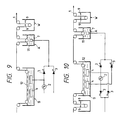
- FIG. 8 shows a process diagram in which after-treatment including removal of aluminum hydroxide on the roughened surface of an electrolytically surface-roughened aluminum plate and well shaping of edge portions of formed pits is performed utilizing a shunted current obtained by rectifying, through thyristors 3, an AC current which is supplied from an AC power source 2 so as to be used in the electrolytic surface-roughening step B.
- an aluminum plate 1 is AC-electrolytically surface-roughened in an acid electrolyte 12 between the aluminum plate 1 and main electrodes 4 by power supplied from the AC power source 2 in the electrolytic surface- roughening step B.
- the aluminum plate 1 is subject to cathodic electrolysis in a neutral salt aqueous solution 11 between the aluminum plate and an auxiliary electrode 7 by supplying a shunted DC current obtained by rectifying, through the thyristors 3, an AC current supplied from the AC power source 2 in the cathodic electrolysis step A.
- the aluminum plate 1 which has been subject to treatment such as removal of an aluminum hydroxide and the like in the cathodic electrolysis step A is sent to the washing step W so as to be washed with cleaning water from spray nozzles 9.
- Fig. 10 is an explanatory view in the case where the cathodic electrolysis treatment of Fig. 1 using a rectified shunted current from the AC power source 2 which is performed as the pretreatment process and the cathodic electrolysis after-treatment of Fig. 9 for the aluminum plate 1 using a rectified shunted current supplied also from the AC power source are simultaneously carried out, and in the pretreatment and the after-treatment cathodic electrolysis treatment is performed in a neutral salt aqueous solution 11 between an auxiliary electrode 7 and an aluminum plate by supplying a shunted DC current obtained by rectifying, through thyristors 3, an AC current supplied from an AC power source 2 for performing the electrolytic surface-roughening step B.
- a detailed description of Fig. 10 is apparent from the descriptions of Figs. 8 and 9.
- Current adjustment in the cathodic electrolysis washing treatment in a neutral salt aqueous solution according to the present invention can be controlled on the basis of the ratio of the area between main electrodes and an electrode to be used for the cathodic electrolysis or the ignition timing of thyristors, GTOs, or transistors.
- a JIS 1050-H18 aluminum plate was continuously electrolytically surface-roughened in the apparatus shown in Fig. 8.
- the condition of a neutral salt electrolyte at this time was such that a 5% sodium chloride aqueous solution was used at a temperature of 50°C.
- the condition of the acid electrolyte was such that a 1% hydrochloric acid aqueous solution was used at a temperature of 35°C.
- the area ratio of an electrode used for the cathodic electrolysis to that used for the electrolytic surface-roughening in the acid aqueous solution was 2:8. Carbon and iridium oxide were used as the materials of the former and latter electrodes, respectively.
- Thyristors were used as the rectifier devices for performing shunting from a current to be used for the surface roughening.
- the current density in the electrolytic surface-roughening treatment and the cathodic electrolytic treatment were 50 A/dm2 and 25 A/dm2 respectively.
- the aluminum plate was immersed for 60 seconds in an aqueous solution at 60°C containing sulfuric acid in an amount of 360 g/l and then washed with water so as to remove a smut component generated in the electrolytic surface-roughen ing. When the aluminum plate surface was observed with a scanning electron microscope, the aluminum plate was uniformly surface-roughened.
- a JIS 1050-H18 aluminum plate with its surface dissolve-washed by 2 g/m2 in a sodium hydroxide aqueous solution was continuously electrolytically surface-roughened in the apparatus of Fig.9.
- the condition of a neutral salt electrolyte at that time was that a 5% sodium chloride aqueous solution was used at a temperature of 50°C.
- the condition of an acid electrolyte was that a 1% hydrochloric acid aqueous solution was used at a temperature of 35°C.
- the area ratio of the electrode to be used for the cathodic electrolysis to the electrodes to be used for the electrolytic surface-roughening in the acid aqueous solution was 2:8.
- a JIS 1050-H18 aluminum plate was continuously electrolytically surface-roughened in the apparatus shown in Fig. 12.
- the condition of a neutral salt electrolyte at this time was such that a 5% sodium chloride aqueous solution was used at a temperature of 50°C.
- the condition of an acid electrolyte was such that a 1% hydrochloric acid aqueous solution was used at a temperature of 35°C.
- the area ratio of an electrode used for the cathodic electrolysis to that used for the electrolytic surface-roughening in the acid aqueous solution was 2:8. Carbon and iridium oxide were used as the materials of the former and latter electrodes, respectively.
- Thyristors were used as the rectifier devices for performing shunting from a current to be used for the surface roughening.
- the current density in the electrolytic surface-roughening treatment and the cathodic electrolytic treatment were 50 A/dm2 and 25 A/dm2, respectively.
- the surface of the aluminum plate after the cathodic electrolysis and washing treatment and before the electrolytic surface-roughening was oxidized silver, and no rolling oil or the like was observed. When the surface of the aluminum plate after the electrolytic surface-roughening was observed, no surface unevenness which was apt to be generated when etching treatment in an alkaline solution was omitted was generated.
- the aluminum plate was surface-roughened so uniformly as to be suitable for a support for a printing plate.
- An aluminum plate (including an aluminum alloy plate) is electrolytically treated as a cathode in the neutral salt electrolyte and electrochemically surface-roughened in the acid aqueous solution so that a support for a printing plate can be advantageously produced.
- a JIS 1050-H18 aluminum plate was continuously electrolytically surface-roughened in the apparatus shown in Figs. 11 and 13.
- the condition of a neutral salt electrolyte at this time was such that a 5% sodium chloride aqueous solution was used at a temperature of 50°C.
- the condition of the acid electrolyte was such that a 1% hydrochloric acid aqueous solution was used at a temperature of 35°C.
- Iridium oxide and carbon were used as the material of an electrode to be used in the neutral salt electrolyte and the material of main electrodes to be used in the acid electrolyte respectively.
- the current density was adjusted so as to be 50 A/dm2 in the electrolytic surface-roughening treatment and 25 A/dm2 in the cathodic electrolytic treatment. As a result, it was recognized that sparks were generated on the surface of the treated aluminum plate and carbon constituting the main electrodes was dissolved so that the acid electrolyte had become almost black.
- the neutral salt aqueous solution as defined according to the present invention is an aqueous solution of such a salt as disclosed in Japanese Unexamined Patent Publications Nos. Sho-52-26904 and Sho-59-11295, for example, an alkali metal halide or alkali metal nitrate, particularly preferably, sodium chloride or sodium nitrate. It is preferable to select the pH and the concentration to be 6 - 8 and 0.1 - 10%, respectively.
- the electrode disposed in opposition to an aluminum plate so as to perform the cathodic electrolysis according to the present invention platinum, ferrite, iridium oxide, and the like may be used.
- the continuous electrolytical treatment of an aluminum plate as a cathode in a neutral salt electrolyte means that electrolytically treatment is performed on the aluminum material while a DC voltage is applied between the aluminum plate and an electrode opposite thereto.
- DC voltage means a voltage having a polarity which does not change, and includes a continuous DC current, a comb-like waveform, a voltage obtained by rectifying an AC current through a semiconductor element or the like.
- a voltage to be supplied for cathodic electrolysis may be obtained by providing a DC power source as shown in Fig. 13.
- a DC power source as shown in Fig. 13
- the current to be used for the surface roughening may be partially shunted through rectifier devices so that the thus obtained shunted current is used for cathodic electrolysis in a neutral salt aqueous solution.
- pretreatment for an aluminum plate is performed by cathodic electrolysis of the aluminum plate made opposite to an anode 5 of a DC power source 3 in a neutral salt aqueous solution 9 in the cathodic electrolysis step C as shown in Fig. 13.
- power supply to the aluminum plate is performed with a conductor roll 8.
- Fig. 12 is a schematic view showing another embodiment of the present invention.
- Pretreatment (cleaning) of an aluminum plate is performed in the cathodic electrolysis step C in such a manner that a part of a current from an AC power source 2 (rectified by thyristors 4) is supplied to an anode 5 and the surface of the aluminum plate 1 disposed in opposition to the anode 5 is subject to cathodic electrolysis in a neutral salt aqueous solution 9. Further, the thus treated aluminum plate is washed with water through injection of water by means of spray nozzles in the washing step W, and then anodized in an acid electrolyte 10 using an AC current supplied from the AC power source 2 in the anodizing step A.
- the electrochemical surface-roughening in an acid electrolyte means that a voltage is supplied between an aluminum plate and a counter electrode to thereby electrochemically surface-roughen the aluminum plate.
- An AC voltage or a DC voltage may be used as the voltage in this case, and almost all the known electrochemical surface-roughening methods can be applied.
- the acid electrolyte as defined according to the present invention may be any of those used for electrochemical surface-roughening using a usual AC current.
- a particularly preferable one is a solution containing a nitric acid by 5-15 (g/l).
- salt group such as aluminum nitrate, aluminum chloride, ammonium nitrate, ammonium chloride, manganese nitrate, manganese chloride, iron nitrate, iron chloride, or the like, which contains NO3 ⁇ or Cl ⁇ , may be added to the electrolyte.
- the density of a DC current to be used for the cathodic electrolysis as defined according to the present invention is 1 - 100 A/dm2. It is preferable to select the electrolytic treatment time to be in a range from 0.1 to 90 seconds.
- a neutral salt aqueous solution of pH 6 - 8 which is a particularly advantageous condition, dissolved aluminum ions can be continuously removed from the neutral salt aqueous solution by filtration or centrifugal separation because the aluminum ions are precipitated in the form of an aluminum hydroxide or an aluminum oxide hydrate.
- immersion treatment of an aluminum plate in a sodium hydroxide, a sulfuric acid, a phosphoric acid, a nitric acid, a hydrochloric acid, a fluoric acid, a chromic acid, or the like may be performed for the purpose of chemically washing the surface of the aluminum plate before or after the cathodic electrolysis treatment in the neutral salt electrolyte.
- Sufficient degreasing and sufficient dissolution of an aluminum plate surface layer are performed by a surface denaturation effect by the cathodic electrolysis treatment according to the present invention, and it is therefore possible to omit a chemical washing treatment for electrolytic surface-roughening.
Landscapes
- Chemical & Material Sciences (AREA)
- Chemical Kinetics & Catalysis (AREA)
- Electrochemistry (AREA)
- Engineering & Computer Science (AREA)
- Materials Engineering (AREA)
- Metallurgy (AREA)
- Organic Chemistry (AREA)
- Printing Plates And Materials Therefor (AREA)
Applications Claiming Priority (10)
| Application Number | Priority Date | Filing Date | Title |
|---|---|---|---|
| JP1265288A JP2614118B2 (ja) | 1989-10-13 | 1989-10-13 | 印刷版用支持体の製造方法 |
| JP26528789A JPH03126899A (ja) | 1989-10-13 | 1989-10-13 | 印刷版用支持体の製造方法 |
| JP26528689A JPH03126891A (ja) | 1989-10-13 | 1989-10-13 | 印刷版用支持体の製造方法 |
| JP265288/89 | 1989-10-13 | ||
| JP265287/89 | 1989-10-13 | ||
| JP265286/89 | 1989-10-13 | ||
| JP31345789A JPH03173800A (ja) | 1989-12-04 | 1989-12-04 | 印刷版支持体の製造方法 |
| JP31345889A JPH03177600A (ja) | 1989-12-04 | 1989-12-04 | 印刷版支持体の製造方法 |
| JP313457/89 | 1989-12-04 | ||
| JP313458/89 | 1989-12-04 |
Publications (3)
| Publication Number | Publication Date |
|---|---|
| EP0422682A2 true EP0422682A2 (de) | 1991-04-17 |
| EP0422682A3 EP0422682A3 (en) | 1991-09-18 |
| EP0422682B1 EP0422682B1 (de) | 1995-02-08 |
Family
ID=27530446
Family Applications (1)
| Application Number | Title | Priority Date | Filing Date |
|---|---|---|---|
| EP90119627A Expired - Lifetime EP0422682B1 (de) | 1989-10-13 | 1990-10-12 | Verfahren zur Herstellung eines Trägers für eine Druckplatte |
Country Status (3)
| Country | Link |
|---|---|
| US (1) | US5152877A (de) |
| EP (1) | EP0422682B1 (de) |
| DE (1) | DE69016735T2 (de) |
Cited By (10)
| Publication number | Priority date | Publication date | Assignee | Title |
|---|---|---|---|---|
| EP0536531A3 (en) * | 1991-09-09 | 1993-04-28 | Hoechst Aktiengesellschaft | Process for graining of aluminum and aluminum alloys respectively for supports for printing plates and a printing plate |
| EP0701908A3 (de) * | 1994-08-30 | 1997-05-07 | Fuji Photo Film Co Ltd | Aluminium-Träger für eine Flachdruckplatte, Verfahren zu ihrer Herstellung und Aufrauhung |
| EP0730979A3 (de) * | 1995-03-06 | 1997-08-20 | Fuji Photo Film Co Ltd | Träger für lithographische Druckplatten, Herstellungsverfahren desselben und Vorrichtung zur elektrochemischen Aufrauhung |
| EP0812705A1 (de) * | 1996-06-12 | 1997-12-17 | Konica Corporation | Verfahren zur Herstellung eines Trägers für Flachdruckplatten |
| EP0924101A3 (de) * | 1997-12-16 | 1999-11-10 | Fuji Photo Film Co., Ltd. | Verfahren zur Herstellung eines Aluminiumträgers für eine Flachdruckplatte |
| EP1013468A1 (de) * | 1998-12-21 | 2000-06-28 | Agfa-Gevaert AG | Verfahren und Vorrichtung zum Aufrauhen eines Trägers für lichtempfindliche Schichten |
| EP1063103A3 (de) * | 1999-06-25 | 2001-03-28 | Fuji Photo Film Co., Ltd. | Elektrolytisches Behandlungsverfahren |
| EP1046514A3 (de) * | 1999-04-22 | 2001-09-12 | Fuji Photo Film Co., Ltd. | Verfahren zur Herstellung eines Aluminiumträgers für lithographische Druckplatten |
| US6344131B1 (en) | 1994-08-30 | 2002-02-05 | Fuji Photo Film Co., Ltd. | Method of producing aluminum support for planographic printing plate |
| EP2098376A1 (de) | 2008-03-04 | 2009-09-09 | Agfa Graphics N.V. | Verfahren zur Herstellung eines Lithographiedruckplattenträgers |
Families Citing this family (4)
| Publication number | Priority date | Publication date | Assignee | Title |
|---|---|---|---|---|
| EP0585586B1 (de) * | 1992-07-20 | 1997-01-29 | Fuji Photo Film Co., Ltd. | Verfahren zur elektrolytischen Behandlung |
| US6249965B1 (en) * | 1997-10-15 | 2001-06-26 | Huntington Medical Research Institutes | Methods for making small-diameter iridium electrodes |
| US6780305B2 (en) * | 2001-02-20 | 2004-08-24 | Fuji Photo Film Co., Ltd. | Method for producing support for planographic printing plate, support for planographic printing plate, and planographic printing plate precursor |
| JP2004307917A (ja) * | 2003-04-04 | 2004-11-04 | Fuji Photo Film Co Ltd | 電解処理液の濃度制御方法及び装置 |
Family Cites Families (11)
| Publication number | Priority date | Publication date | Assignee | Title |
|---|---|---|---|---|
| GB1392191A (en) * | 1971-07-09 | 1975-04-30 | Alcan Res & Dev | Process for electrograining aluminium |
| US3935080A (en) * | 1974-10-02 | 1976-01-27 | Polychrome Corporation | Method of producing an aluminum base sheet for a printing plate |
| US4166015A (en) * | 1975-08-25 | 1979-08-28 | Hoechst Aktiengesellschaft | Process for the manufacture of aluminum supports for planographic printing plates by electrochemical roughening of the plate surfaces |
| DE3222967A1 (de) * | 1982-06-19 | 1983-12-22 | Hoechst Ag, 6230 Frankfurt | Verfahren zur abtragenden modifizierung von elektrochemisch aufgerauhten traegermaterialien aus aluminium nd deren verwendung bei der herstellung von offsetdruckplatten |
| US4332651A (en) * | 1981-05-20 | 1982-06-01 | Sprague Electric Company | AC Etching of aluminum capacitor foil |
| DE3217552A1 (de) * | 1982-05-10 | 1983-11-10 | Hoechst Ag, 6230 Frankfurt | Verfahren zur elektrochemischen aufrauhung von aluminium fuer druckplattentraeger |
| DE3416867A1 (de) * | 1984-05-08 | 1985-11-14 | Hoechst Ag, 6230 Frankfurt | Einstufiges elektrochemisches bilderzeugungsverfahren fuer reproduktionsschichten |
| US4502925A (en) * | 1984-06-11 | 1985-03-05 | American Hoechst Corporation | Process for aluminum surface preparation |
| DE3635303A1 (de) * | 1986-10-17 | 1988-04-28 | Hoechst Ag | Verfahren zur abtragenden modifizierung von mehrstufig aufgerauhten traegermaterialien aus aluminium oder dessen legierungen und deren verwendung bei der herstellung von offsetdruckplatten |
| JP2514032B2 (ja) * | 1987-05-08 | 1996-07-10 | ペルメレック電極 株式会社 | 金属の電解処理方法 |
| JPH0637716B2 (ja) * | 1987-08-21 | 1994-05-18 | 富士写真フイルム株式会社 | 電解処理方法 |
-
1990
- 1990-10-05 US US07/593,928 patent/US5152877A/en not_active Expired - Lifetime
- 1990-10-12 DE DE69016735T patent/DE69016735T2/de not_active Expired - Fee Related
- 1990-10-12 EP EP90119627A patent/EP0422682B1/de not_active Expired - Lifetime
Cited By (20)
| Publication number | Priority date | Publication date | Assignee | Title |
|---|---|---|---|---|
| EP0536531A3 (en) * | 1991-09-09 | 1993-04-28 | Hoechst Aktiengesellschaft | Process for graining of aluminum and aluminum alloys respectively for supports for printing plates and a printing plate |
| US5304298A (en) * | 1991-09-09 | 1994-04-19 | Hoechst Aktiengesellschaft | Process for roughening aluminum or aluminum alloys |
| EP0701908A3 (de) * | 1994-08-30 | 1997-05-07 | Fuji Photo Film Co Ltd | Aluminium-Träger für eine Flachdruckplatte, Verfahren zu ihrer Herstellung und Aufrauhung |
| US6344131B1 (en) | 1994-08-30 | 2002-02-05 | Fuji Photo Film Co., Ltd. | Method of producing aluminum support for planographic printing plate |
| US6024858A (en) * | 1994-08-30 | 2000-02-15 | Fuji Photo Film Co., Ltd. | Method of producing an aluminum support for a planographic plate |
| US5837345A (en) * | 1995-03-06 | 1998-11-17 | Fuji Photo Film Co., Ltd. | Support for lithographic printing plate, process for the preparation thereof and electrochemical roughening apparatus |
| EP0730979A3 (de) * | 1995-03-06 | 1997-08-20 | Fuji Photo Film Co Ltd | Träger für lithographische Druckplatten, Herstellungsverfahren desselben und Vorrichtung zur elektrochemischen Aufrauhung |
| US6015649A (en) * | 1996-06-12 | 2000-01-18 | Konica Corporation | Method of manufacturing support for planographic printing plate |
| EP0812705A1 (de) * | 1996-06-12 | 1997-12-17 | Konica Corporation | Verfahren zur Herstellung eines Trägers für Flachdruckplatten |
| US6264821B1 (en) | 1997-12-16 | 2001-07-24 | Fuji Photo Film Co., Ltd. | Process for producing aluminum support for lithographic printing plate |
| EP0924101A3 (de) * | 1997-12-16 | 1999-11-10 | Fuji Photo Film Co., Ltd. | Verfahren zur Herstellung eines Aluminiumträgers für eine Flachdruckplatte |
| US6682645B2 (en) | 1997-12-16 | 2004-01-27 | Fuji Photo Film Co., Ltd. | Process for producing aluminum support for lithographic printing plate |
| US6261438B1 (en) | 1998-12-21 | 2001-07-17 | Agfa-Gevaert Nv | Method and apparatus for roughening a support for radiation-sensitive coatings |
| EP1013468A1 (de) * | 1998-12-21 | 2000-06-28 | Agfa-Gevaert AG | Verfahren und Vorrichtung zum Aufrauhen eines Trägers für lichtempfindliche Schichten |
| EP1046514A3 (de) * | 1999-04-22 | 2001-09-12 | Fuji Photo Film Co., Ltd. | Verfahren zur Herstellung eines Aluminiumträgers für lithographische Druckplatten |
| US6533917B1 (en) | 1999-04-22 | 2003-03-18 | Fuji Photo Film Co., Ltd. | Method for producing aluminum support for lithographic printing plate |
| EP1063103A3 (de) * | 1999-06-25 | 2001-03-28 | Fuji Photo Film Co., Ltd. | Elektrolytisches Behandlungsverfahren |
| US6340426B1 (en) | 1999-06-25 | 2002-01-22 | Fuji Photo Film Co., Ltd. | Electrolytic treatment method |
| EP2098376A1 (de) | 2008-03-04 | 2009-09-09 | Agfa Graphics N.V. | Verfahren zur Herstellung eines Lithographiedruckplattenträgers |
| WO2009109319A1 (en) * | 2008-03-04 | 2009-09-11 | Agfa Graphics Nv | A method for making a lithographic printing plate support |
Also Published As
| Publication number | Publication date |
|---|---|
| DE69016735T2 (de) | 1995-06-01 |
| EP0422682A3 (en) | 1991-09-18 |
| US5152877A (en) | 1992-10-06 |
| DE69016735D1 (de) | 1995-03-23 |
| EP0422682B1 (de) | 1995-02-08 |
Similar Documents
| Publication | Publication Date | Title |
|---|---|---|
| US6143158A (en) | Method for producing an aluminum support for a lithographic printing plate | |
| EP0422682B1 (de) | Verfahren zur Herstellung eines Trägers für eine Druckplatte | |
| US5141605A (en) | Process for producing aluminum support of a printing plate | |
| EP0701908B1 (de) | Aluminium-Träger für eine Flachdruckplatte, Verfahren zu ihrer Herstellung und Aufrauhung | |
| JP3217194B2 (ja) | 平版印刷版用支持体の製造方法 | |
| JPH03257199A (ja) | 印刷版用アルミニウム支持体の製造方法 | |
| JP4038041B2 (ja) | 電解処理装置 | |
| JPH03267400A (ja) | 平版印刷版支持体の製造方法 | |
| JP2000017499A (ja) | 帯状金属板の電解装置 | |
| JPH03173800A (ja) | 印刷版支持体の製造方法 | |
| JP2614118B2 (ja) | 印刷版用支持体の製造方法 | |
| JPH04289200A (ja) | 平版印刷版用支持体の製造方法 | |
| JP2759382B2 (ja) | 平版印刷版用支持体の製造方法 | |
| US6344131B1 (en) | Method of producing aluminum support for planographic printing plate | |
| JPH03191100A (ja) | 印刷版用支持体の製造方法 | |
| JPH10183400A (ja) | アルミニウム板の粗面化方法 | |
| JP2759388B2 (ja) | 印刷版用支持体の製造方法 | |
| JPH04247900A (ja) | 印刷版用支持体の製造方法 | |
| JPH03177600A (ja) | 印刷版支持体の製造方法 | |
| JP2707339B2 (ja) | 平版印刷版用支持体の製造方法 | |
| JPH03173799A (ja) | 印刷版用アルミニウム支持体の製造方法 | |
| JPH03126899A (ja) | 印刷版用支持体の製造方法 | |
| JPH03126891A (ja) | 印刷版用支持体の製造方法 | |
| JPH05301477A (ja) | 平版印刷版用支持体の製造方法 | |
| JPH05294085A (ja) | 平版印刷版用支持体の製造方法 |
Legal Events
| Date | Code | Title | Description |
|---|---|---|---|
| PUAI | Public reference made under article 153(3) epc to a published international application that has entered the european phase |
Free format text: ORIGINAL CODE: 0009012 |
|
| AK | Designated contracting states |
Kind code of ref document: A2 Designated state(s): DE NL |
|
| PUAL | Search report despatched |
Free format text: ORIGINAL CODE: 0009013 |
|
| AK | Designated contracting states |
Kind code of ref document: A3 Designated state(s): DE NL |
|
| 17P | Request for examination filed |
Effective date: 19920131 |
|
| 17Q | First examination report despatched |
Effective date: 19921113 |
|
| GRAA | (expected) grant |
Free format text: ORIGINAL CODE: 0009210 |
|
| AK | Designated contracting states |
Kind code of ref document: B1 Designated state(s): DE NL |
|
| PG25 | Lapsed in a contracting state [announced via postgrant information from national office to epo] |
Ref country code: NL Effective date: 19950208 |
|
| REF | Corresponds to: |
Ref document number: 69016735 Country of ref document: DE Date of ref document: 19950323 |
|
| NLV1 | Nl: lapsed or annulled due to failure to fulfill the requirements of art. 29p and 29m of the patents act | ||
| PLBE | No opposition filed within time limit |
Free format text: ORIGINAL CODE: 0009261 |
|
| STAA | Information on the status of an ep patent application or granted ep patent |
Free format text: STATUS: NO OPPOSITION FILED WITHIN TIME LIMIT |
|
| 26N | No opposition filed | ||
| PGFP | Annual fee paid to national office [announced via postgrant information from national office to epo] |
Ref country code: DE Payment date: 20041007 Year of fee payment: 15 |
|
| PG25 | Lapsed in a contracting state [announced via postgrant information from national office to epo] |
Ref country code: DE Free format text: LAPSE BECAUSE OF NON-PAYMENT OF DUE FEES Effective date: 20060503 |