EP0425708B1 - Verfahren zur kontinuierlichen herstellung von elastischen polyestern - Google Patents
Verfahren zur kontinuierlichen herstellung von elastischen polyestern Download PDFInfo
- Publication number
- EP0425708B1 EP0425708B1 EP90907463A EP90907463A EP0425708B1 EP 0425708 B1 EP0425708 B1 EP 0425708B1 EP 90907463 A EP90907463 A EP 90907463A EP 90907463 A EP90907463 A EP 90907463A EP 0425708 B1 EP0425708 B1 EP 0425708B1
- Authority
- EP
- European Patent Office
- Prior art keywords
- extruder
- process according
- aromatic polyester
- screw
- polyester
- Prior art date
- Legal status (The legal status is an assumption and is not a legal conclusion. Google has not performed a legal analysis and makes no representation as to the accuracy of the status listed.)
- Revoked
Links
- 229920000728 polyester Polymers 0.000 title claims abstract description 128
- 238000000034 method Methods 0.000 title claims description 66
- 238000010924 continuous production Methods 0.000 title 1
- 125000003118 aryl group Chemical group 0.000 claims abstract description 54
- 238000004898 kneading Methods 0.000 claims abstract description 11
- 238000002844 melting Methods 0.000 claims abstract description 10
- 230000008018 melting Effects 0.000 claims abstract description 10
- -1 lactone compound Chemical class 0.000 claims description 88
- 229920001707 polybutylene terephthalate Polymers 0.000 claims description 29
- 238000006243 chemical reaction Methods 0.000 claims description 27
- 239000003054 catalyst Substances 0.000 claims description 15
- 150000001875 compounds Chemical class 0.000 claims description 12
- 229910052698 phosphorus Inorganic materials 0.000 claims description 11
- 150000002148 esters Chemical group 0.000 claims description 10
- 229920000642 polymer Polymers 0.000 claims description 10
- 238000001125 extrusion Methods 0.000 claims description 9
- 239000011574 phosphorus Substances 0.000 claims description 9
- 125000003700 epoxy group Chemical group 0.000 claims description 7
- 238000002360 preparation method Methods 0.000 claims description 7
- ISPYQTSUDJAMAB-UHFFFAOYSA-N 2-chlorophenol Chemical compound OC1=CC=CC=C1Cl ISPYQTSUDJAMAB-UHFFFAOYSA-N 0.000 claims description 3
- ZYDGQQTXLBNSGJ-UHFFFAOYSA-N oxonan-2-one Chemical compound O=C1CCCCCCCO1 ZYDGQQTXLBNSGJ-UHFFFAOYSA-N 0.000 claims description 3
- 239000002904 solvent Substances 0.000 claims description 3
- 125000004437 phosphorous atom Chemical group 0.000 claims description 2
- 238000012384 transportation and delivery Methods 0.000 claims description 2
- 230000000694 effects Effects 0.000 abstract description 6
- 230000035484 reaction time Effects 0.000 abstract description 6
- 150000002596 lactones Chemical class 0.000 abstract description 4
- 229920001971 elastomer Polymers 0.000 abstract description 2
- 238000006116 polymerization reaction Methods 0.000 description 20
- 230000000052 comparative effect Effects 0.000 description 10
- 230000000704 physical effect Effects 0.000 description 8
- 239000008188 pellet Substances 0.000 description 7
- BVFSYZFXJYAPQJ-UHFFFAOYSA-N butyl(oxo)tin Chemical compound CCCC[Sn]=O BVFSYZFXJYAPQJ-UHFFFAOYSA-N 0.000 description 6
- 238000002156 mixing Methods 0.000 description 6
- 239000000203 mixture Substances 0.000 description 6
- XLYOFNOQVPJJNP-UHFFFAOYSA-N water Substances O XLYOFNOQVPJJNP-UHFFFAOYSA-N 0.000 description 6
- 239000002253 acid Substances 0.000 description 5
- 239000006229 carbon black Substances 0.000 description 5
- 229910052751 metal Inorganic materials 0.000 description 5
- 239000002184 metal Substances 0.000 description 5
- 238000003756 stirring Methods 0.000 description 5
- 239000004593 Epoxy Substances 0.000 description 4
- 238000004140 cleaning Methods 0.000 description 4
- 230000007062 hydrolysis Effects 0.000 description 4
- 238000006460 hydrolysis reaction Methods 0.000 description 4
- 238000001746 injection moulding Methods 0.000 description 4
- 239000000155 melt Substances 0.000 description 4
- 239000000843 powder Substances 0.000 description 4
- 238000005070 sampling Methods 0.000 description 4
- WVLBCYQITXONBZ-UHFFFAOYSA-N trimethyl phosphate Chemical compound COP(=O)(OC)OC WVLBCYQITXONBZ-UHFFFAOYSA-N 0.000 description 4
- XZZNDPSIHUTMOC-UHFFFAOYSA-N triphenyl phosphate Chemical compound C=1C=CC=CC=1OP(OC=1C=CC=CC=1)(=O)OC1=CC=CC=C1 XZZNDPSIHUTMOC-UHFFFAOYSA-N 0.000 description 4
- 150000007513 acids Chemical class 0.000 description 3
- 150000002739 metals Chemical class 0.000 description 3
- KKEYFWRCBNTPAC-UHFFFAOYSA-L terephthalate(2-) Chemical compound [O-]C(=O)C1=CC=C(C([O-])=O)C=C1 KKEYFWRCBNTPAC-UHFFFAOYSA-L 0.000 description 3
- SEFYJVFBMNOLBK-UHFFFAOYSA-N 2-[2-[2-(oxiran-2-ylmethoxy)ethoxy]ethoxymethyl]oxirane Chemical compound C1OC1COCCOCCOCC1CO1 SEFYJVFBMNOLBK-UHFFFAOYSA-N 0.000 description 2
- OYPRJOBELJOOCE-UHFFFAOYSA-N Calcium Chemical compound [Ca] OYPRJOBELJOOCE-UHFFFAOYSA-N 0.000 description 2
- VTYYLEPIZMXCLO-UHFFFAOYSA-L Calcium carbonate Chemical compound [Ca+2].[O-]C([O-])=O VTYYLEPIZMXCLO-UHFFFAOYSA-L 0.000 description 2
- DGAQECJNVWCQMB-PUAWFVPOSA-M Ilexoside XXIX Chemical compound C[C@@H]1CC[C@@]2(CC[C@@]3(C(=CC[C@H]4[C@]3(CC[C@@H]5[C@@]4(CC[C@@H](C5(C)C)OS(=O)(=O)[O-])C)C)[C@@H]2[C@]1(C)O)C)C(=O)O[C@H]6[C@@H]([C@H]([C@@H]([C@H](O6)CO)O)O)O.[Na+] DGAQECJNVWCQMB-PUAWFVPOSA-M 0.000 description 2
- FYYHWMGAXLPEAU-UHFFFAOYSA-N Magnesium Chemical compound [Mg] FYYHWMGAXLPEAU-UHFFFAOYSA-N 0.000 description 2
- NBIIXXVUZAFLBC-UHFFFAOYSA-N Phosphoric acid Chemical compound OP(O)(O)=O NBIIXXVUZAFLBC-UHFFFAOYSA-N 0.000 description 2
- ZLMJMSJWJFRBEC-UHFFFAOYSA-N Potassium Chemical compound [K] ZLMJMSJWJFRBEC-UHFFFAOYSA-N 0.000 description 2
- VYPSYNLAJGMNEJ-UHFFFAOYSA-N Silicium dioxide Chemical compound O=[Si]=O VYPSYNLAJGMNEJ-UHFFFAOYSA-N 0.000 description 2
- KKEYFWRCBNTPAC-UHFFFAOYSA-N Terephthalic acid Chemical compound OC(=O)C1=CC=C(C(O)=O)C=C1 KKEYFWRCBNTPAC-UHFFFAOYSA-N 0.000 description 2
- WNLRTRBMVRJNCN-UHFFFAOYSA-N adipic acid Chemical compound OC(=O)CCCCC(O)=O WNLRTRBMVRJNCN-UHFFFAOYSA-N 0.000 description 2
- 150000001412 amines Chemical class 0.000 description 2
- ADCOVFLJGNWWNZ-UHFFFAOYSA-N antimony trioxide Chemical compound O=[Sb]O[Sb]=O ADCOVFLJGNWWNZ-UHFFFAOYSA-N 0.000 description 2
- ZXOATMQSUNJNNG-UHFFFAOYSA-N bis(oxiran-2-ylmethyl) benzene-1,3-dicarboxylate Chemical class C=1C=CC(C(=O)OCC2OC2)=CC=1C(=O)OCC1CO1 ZXOATMQSUNJNNG-UHFFFAOYSA-N 0.000 description 2
- IISBACLAFKSPIT-UHFFFAOYSA-N bisphenol A Chemical compound C=1C=C(O)C=CC=1C(C)(C)C1=CC=C(O)C=C1 IISBACLAFKSPIT-UHFFFAOYSA-N 0.000 description 2
- 229920001400 block copolymer Polymers 0.000 description 2
- YHWCPXVTRSHPNY-UHFFFAOYSA-N butan-1-olate;titanium(4+) Chemical compound [Ti+4].CCCC[O-].CCCC[O-].CCCC[O-].CCCC[O-] YHWCPXVTRSHPNY-UHFFFAOYSA-N 0.000 description 2
- WERYXYBDKMZEQL-UHFFFAOYSA-N butane-1,4-diol Chemical compound OCCCCO WERYXYBDKMZEQL-UHFFFAOYSA-N 0.000 description 2
- 239000011575 calcium Substances 0.000 description 2
- 229910052791 calcium Inorganic materials 0.000 description 2
- OSGAYBCDTDRGGQ-UHFFFAOYSA-L calcium sulfate Chemical compound [Ca+2].[O-]S([O-])(=O)=O OSGAYBCDTDRGGQ-UHFFFAOYSA-L 0.000 description 2
- 239000007795 chemical reaction product Substances 0.000 description 2
- 239000003795 chemical substances by application Substances 0.000 description 2
- 239000000498 cooling water Substances 0.000 description 2
- GYZLOYUZLJXAJU-UHFFFAOYSA-N diglycidyl ether Chemical compound C1OC1COCC1CO1 GYZLOYUZLJXAJU-UHFFFAOYSA-N 0.000 description 2
- 238000005886 esterification reaction Methods 0.000 description 2
- YBMRDBCBODYGJE-UHFFFAOYSA-N germanium dioxide Chemical compound O=[Ge]=O YBMRDBCBODYGJE-UHFFFAOYSA-N 0.000 description 2
- 238000010438 heat treatment Methods 0.000 description 2
- 238000009863 impact test Methods 0.000 description 2
- 230000002401 inhibitory effect Effects 0.000 description 2
- 239000011777 magnesium Substances 0.000 description 2
- 229910052749 magnesium Inorganic materials 0.000 description 2
- 238000004519 manufacturing process Methods 0.000 description 2
- 238000000465 moulding Methods 0.000 description 2
- 239000012299 nitrogen atmosphere Substances 0.000 description 2
- 239000011591 potassium Substances 0.000 description 2
- 229910052700 potassium Inorganic materials 0.000 description 2
- 239000000047 product Substances 0.000 description 2
- CXMXRPHRNRROMY-UHFFFAOYSA-N sebacic acid Chemical compound OC(=O)CCCCCCCCC(O)=O CXMXRPHRNRROMY-UHFFFAOYSA-N 0.000 description 2
- 239000011734 sodium Substances 0.000 description 2
- 229910052708 sodium Inorganic materials 0.000 description 2
- 239000007787 solid Substances 0.000 description 2
- 239000007790 solid phase Substances 0.000 description 2
- 239000000243 solution Substances 0.000 description 2
- 238000009864 tensile test Methods 0.000 description 2
- 229920002725 thermoplastic elastomer Polymers 0.000 description 2
- RIOQSEWOXXDEQQ-UHFFFAOYSA-N triphenylphosphine Chemical compound C1=CC=CC=C1P(C=1C=CC=CC=1)C1=CC=CC=C1 RIOQSEWOXXDEQQ-UHFFFAOYSA-N 0.000 description 2
- 239000001993 wax Substances 0.000 description 2
- XHRNRGJBLGSHHE-UHFFFAOYSA-N (4-methylphenyl)phosphinic acid Chemical compound CC1=CC=C(P(O)=O)C=C1 XHRNRGJBLGSHHE-UHFFFAOYSA-N 0.000 description 1
- LYNDWSARZJHIKU-UHFFFAOYSA-N (4-methylphenyl)phosphonic acid Chemical compound CC1=CC=C(P(O)(O)=O)C=C1 LYNDWSARZJHIKU-UHFFFAOYSA-N 0.000 description 1
- KUBDPQJOLOUJRM-UHFFFAOYSA-N 2-(chloromethyl)oxirane;4-[2-(4-hydroxyphenyl)propan-2-yl]phenol Chemical compound ClCC1CO1.C=1C=C(O)C=CC=1C(C)(C)C1=CC=C(O)C=C1 KUBDPQJOLOUJRM-UHFFFAOYSA-N 0.000 description 1
- LKMJVFRMDSNFRT-UHFFFAOYSA-N 2-(methoxymethyl)oxirane Chemical compound COCC1CO1 LKMJVFRMDSNFRT-UHFFFAOYSA-N 0.000 description 1
- DNSDAPMTVRGGLR-UHFFFAOYSA-N 2-methylpropylphosphinic acid Chemical compound CC(C)CP(O)=O DNSDAPMTVRGGLR-UHFFFAOYSA-N 0.000 description 1
- HAEFDDOAYBQRGK-UHFFFAOYSA-N 2-methylpropylphosphonic acid Chemical compound CC(C)CP(O)(O)=O HAEFDDOAYBQRGK-UHFFFAOYSA-N 0.000 description 1
- LQRUKKGYJWLGBA-UHFFFAOYSA-N 4-(oxiran-2-ylmethoxy)benzoic acid Chemical compound C1=CC(C(=O)O)=CC=C1OCC1OC1 LQRUKKGYJWLGBA-UHFFFAOYSA-N 0.000 description 1
- 125000005274 4-hydroxybenzoic acid group Chemical group 0.000 description 1
- TYFJTEPDESMEHE-UHFFFAOYSA-N 6,8-dihydroxy-3-[2-(4-methoxyphenyl)ethyl]-3,4-dihydroisochromen-1-one Chemical compound C1=CC(OC)=CC=C1CCC1OC(=O)C2=C(O)C=C(O)C=C2C1 TYFJTEPDESMEHE-UHFFFAOYSA-N 0.000 description 1
- QGZKDVFQNNGYKY-UHFFFAOYSA-O Ammonium Chemical compound [NH4+] QGZKDVFQNNGYKY-UHFFFAOYSA-O 0.000 description 1
- OGBVRMYSNSKIEF-UHFFFAOYSA-N Benzylphosphonic acid Chemical compound OP(O)(=O)CC1=CC=CC=C1 OGBVRMYSNSKIEF-UHFFFAOYSA-N 0.000 description 1
- LCFVJGUPQDGYKZ-UHFFFAOYSA-N Bisphenol A diglycidyl ether Chemical compound C=1C=C(OCC2OC2)C=CC=1C(C)(C)C(C=C1)=CC=C1OCC1CO1 LCFVJGUPQDGYKZ-UHFFFAOYSA-N 0.000 description 1
- UPWGGXLAZRGSTI-UHFFFAOYSA-N CCCC[Zr](CCCC)(CCCC)CCCC Chemical compound CCCC[Zr](CCCC)(CCCC)CCCC UPWGGXLAZRGSTI-UHFFFAOYSA-N 0.000 description 1
- 229920000049 Carbon (fiber) Polymers 0.000 description 1
- 229920001634 Copolyester Polymers 0.000 description 1
- YCKRFDGAMUMZLT-UHFFFAOYSA-N Fluorine atom Chemical compound [F] YCKRFDGAMUMZLT-UHFFFAOYSA-N 0.000 description 1
- WHXSMMKQMYFTQS-UHFFFAOYSA-N Lithium Chemical compound [Li] WHXSMMKQMYFTQS-UHFFFAOYSA-N 0.000 description 1
- PWHULOQIROXLJO-UHFFFAOYSA-N Manganese Chemical compound [Mn] PWHULOQIROXLJO-UHFFFAOYSA-N 0.000 description 1
- 229910019142 PO4 Inorganic materials 0.000 description 1
- ISWSIDIOOBJBQZ-UHFFFAOYSA-N Phenol Chemical compound OC1=CC=CC=C1 ISWSIDIOOBJBQZ-UHFFFAOYSA-N 0.000 description 1
- FQYUMYWMJTYZTK-UHFFFAOYSA-N Phenyl glycidyl ether Chemical compound C1OC1COC1=CC=CC=C1 FQYUMYWMJTYZTK-UHFFFAOYSA-N 0.000 description 1
- OAICVXFJPJFONN-UHFFFAOYSA-N Phosphorus Chemical compound [P] OAICVXFJPJFONN-UHFFFAOYSA-N 0.000 description 1
- 239000004698 Polyethylene Substances 0.000 description 1
- ATJFFYVFTNAWJD-UHFFFAOYSA-N Tin Chemical compound [Sn] ATJFFYVFTNAWJD-UHFFFAOYSA-N 0.000 description 1
- GWEVSGVZZGPLCZ-UHFFFAOYSA-N Titan oxide Chemical compound O=[Ti]=O GWEVSGVZZGPLCZ-UHFFFAOYSA-N 0.000 description 1
- RTAQQCXQSZGOHL-UHFFFAOYSA-N Titanium Chemical compound [Ti] RTAQQCXQSZGOHL-UHFFFAOYSA-N 0.000 description 1
- HCHKCACWOHOZIP-UHFFFAOYSA-N Zinc Chemical compound [Zn] HCHKCACWOHOZIP-UHFFFAOYSA-N 0.000 description 1
- QCWXUUIWCKQGHC-UHFFFAOYSA-N Zirconium Chemical compound [Zr] QCWXUUIWCKQGHC-UHFFFAOYSA-N 0.000 description 1
- UKLDJPRMSDWDSL-UHFFFAOYSA-L [dibutyl(dodecanoyloxy)stannyl] dodecanoate Chemical compound CCCCCCCCCCCC(=O)O[Sn](CCCC)(CCCC)OC(=O)CCCCCCCCCCC UKLDJPRMSDWDSL-UHFFFAOYSA-L 0.000 description 1
- 239000006096 absorbing agent Substances 0.000 description 1
- 239000000654 additive Substances 0.000 description 1
- 239000000853 adhesive Substances 0.000 description 1
- 230000001070 adhesive effect Effects 0.000 description 1
- 239000001361 adipic acid Substances 0.000 description 1
- 235000011037 adipic acid Nutrition 0.000 description 1
- 229920003232 aliphatic polyester Polymers 0.000 description 1
- 150000004703 alkoxides Chemical class 0.000 description 1
- 125000000217 alkyl group Chemical group 0.000 description 1
- 229910052782 aluminium Inorganic materials 0.000 description 1
- XAGFODPZIPBFFR-UHFFFAOYSA-N aluminium Chemical compound [Al] XAGFODPZIPBFFR-UHFFFAOYSA-N 0.000 description 1
- 229910000147 aluminium phosphate Inorganic materials 0.000 description 1
- 229910052787 antimony Inorganic materials 0.000 description 1
- WATWJIUSRGPENY-UHFFFAOYSA-N antimony atom Chemical compound [Sb] WATWJIUSRGPENY-UHFFFAOYSA-N 0.000 description 1
- 239000003963 antioxidant agent Substances 0.000 description 1
- 229910052788 barium Inorganic materials 0.000 description 1
- DSAJWYNOEDNPEQ-UHFFFAOYSA-N barium atom Chemical compound [Ba] DSAJWYNOEDNPEQ-UHFFFAOYSA-N 0.000 description 1
- 239000011324 bead Substances 0.000 description 1
- 238000005452 bending Methods 0.000 description 1
- RWCCWEUUXYIKHB-UHFFFAOYSA-N benzophenone Chemical compound C=1C=CC=CC=1C(=O)C1=CC=CC=C1 RWCCWEUUXYIKHB-UHFFFAOYSA-N 0.000 description 1
- 239000012965 benzophenone Substances 0.000 description 1
- PHIBEYMUALDAQI-UHFFFAOYSA-N benzylphosphinic acid Chemical compound OP(=O)CC1=CC=CC=C1 PHIBEYMUALDAQI-UHFFFAOYSA-N 0.000 description 1
- 229910052793 cadmium Inorganic materials 0.000 description 1
- BDOSMKKIYDKNTQ-UHFFFAOYSA-N cadmium atom Chemical compound [Cd] BDOSMKKIYDKNTQ-UHFFFAOYSA-N 0.000 description 1
- 229910000019 calcium carbonate Inorganic materials 0.000 description 1
- 125000004432 carbon atom Chemical group C* 0.000 description 1
- 239000004917 carbon fiber Substances 0.000 description 1
- 239000004927 clay Substances 0.000 description 1
- 229910052570 clay Inorganic materials 0.000 description 1
- 229910017052 cobalt Inorganic materials 0.000 description 1
- 239000010941 cobalt Substances 0.000 description 1
- 229940011182 cobalt acetate Drugs 0.000 description 1
- GUTLYIVDDKVIGB-UHFFFAOYSA-N cobalt atom Chemical compound [Co] GUTLYIVDDKVIGB-UHFFFAOYSA-N 0.000 description 1
- QAHREYKOYSIQPH-UHFFFAOYSA-L cobalt(II) acetate Chemical compound [Co+2].CC([O-])=O.CC([O-])=O QAHREYKOYSIQPH-UHFFFAOYSA-L 0.000 description 1
- 239000003086 colorant Substances 0.000 description 1
- 238000011437 continuous method Methods 0.000 description 1
- 125000000753 cycloalkyl group Chemical group 0.000 description 1
- 125000000113 cyclohexyl group Chemical group [H]C1([H])C([H])([H])C([H])([H])C([H])(*)C([H])([H])C1([H])[H] 0.000 description 1
- ILYLJTAIQODOTI-UHFFFAOYSA-N cyclohexylphosphinic acid Chemical compound OP(=O)C1CCCCC1 ILYLJTAIQODOTI-UHFFFAOYSA-N 0.000 description 1
- FBSFTJQYCLLGKH-UHFFFAOYSA-N cyclohexylphosphonic acid Chemical compound OP(O)(=O)C1CCCCC1 FBSFTJQYCLLGKH-UHFFFAOYSA-N 0.000 description 1
- 238000010586 diagram Methods 0.000 description 1
- JGFBRKRYDCGYKD-UHFFFAOYSA-N dibutyl(oxo)tin Chemical compound CCCC[Sn](=O)CCCC JGFBRKRYDCGYKD-UHFFFAOYSA-N 0.000 description 1
- NJLLQSBAHIKGKF-UHFFFAOYSA-N dipotassium dioxido(oxo)titanium Chemical compound [K+].[K+].[O-][Ti]([O-])=O NJLLQSBAHIKGKF-UHFFFAOYSA-N 0.000 description 1
- 239000006185 dispersion Substances 0.000 description 1
- 239000000975 dye Substances 0.000 description 1
- 239000000806 elastomer Substances 0.000 description 1
- 230000032050 esterification Effects 0.000 description 1
- 125000001495 ethyl group Chemical group [H]C([H])([H])C([H])([H])* 0.000 description 1
- GATNOFPXSDHULC-UHFFFAOYSA-N ethylphosphonic acid Chemical compound CCP(O)(O)=O GATNOFPXSDHULC-UHFFFAOYSA-N 0.000 description 1
- 239000000835 fiber Substances 0.000 description 1
- 239000000945 filler Substances 0.000 description 1
- 239000003063 flame retardant Substances 0.000 description 1
- 239000011737 fluorine Substances 0.000 description 1
- 229910052731 fluorine Inorganic materials 0.000 description 1
- 229910052732 germanium Inorganic materials 0.000 description 1
- GNPVGFCGXDBREM-UHFFFAOYSA-N germanium atom Chemical compound [Ge] GNPVGFCGXDBREM-UHFFFAOYSA-N 0.000 description 1
- 229940119177 germanium dioxide Drugs 0.000 description 1
- 239000011521 glass Substances 0.000 description 1
- 239000003365 glass fiber Substances 0.000 description 1
- 238000002347 injection Methods 0.000 description 1
- 239000007924 injection Substances 0.000 description 1
- QQVIHTHCMHWDBS-UHFFFAOYSA-N isophthalic acid Chemical group OC(=O)C1=CC=CC(C(O)=O)=C1 QQVIHTHCMHWDBS-UHFFFAOYSA-N 0.000 description 1
- 239000007788 liquid Substances 0.000 description 1
- 229910052744 lithium Inorganic materials 0.000 description 1
- 230000014759 maintenance of location Effects 0.000 description 1
- 229910052748 manganese Inorganic materials 0.000 description 1
- 239000011572 manganese Substances 0.000 description 1
- 150000002736 metal compounds Chemical class 0.000 description 1
- VNWKTOKETHGBQD-UHFFFAOYSA-N methane Chemical compound C VNWKTOKETHGBQD-UHFFFAOYSA-N 0.000 description 1
- 125000002496 methyl group Chemical group [H]C([H])([H])* 0.000 description 1
- BCDIWLCKOCHCIH-UHFFFAOYSA-N methylphosphinic acid Chemical compound CP(O)=O BCDIWLCKOCHCIH-UHFFFAOYSA-N 0.000 description 1
- YACKEPLHDIMKIO-UHFFFAOYSA-N methylphosphonic acid Chemical compound CP(O)(O)=O YACKEPLHDIMKIO-UHFFFAOYSA-N 0.000 description 1
- 150000007522 mineralic acids Chemical class 0.000 description 1
- 239000012778 molding material Substances 0.000 description 1
- 235000013872 montan acid ester Nutrition 0.000 description 1
- 239000002667 nucleating agent Substances 0.000 description 1
- 125000001997 phenyl group Chemical group [H]C1=C([H])C([H])=C(*)C([H])=C1[H] 0.000 description 1
- MLCHBQKMVKNBOV-UHFFFAOYSA-N phenylphosphinic acid Chemical compound OP(=O)C1=CC=CC=C1 MLCHBQKMVKNBOV-UHFFFAOYSA-N 0.000 description 1
- 235000021317 phosphate Nutrition 0.000 description 1
- 150000003003 phosphines Chemical class 0.000 description 1
- ACVYVLVWPXVTIT-UHFFFAOYSA-N phosphinic acid Chemical compound O[PH2]=O ACVYVLVWPXVTIT-UHFFFAOYSA-N 0.000 description 1
- 150000003009 phosphonic acids Chemical class 0.000 description 1
- 150000003013 phosphoric acid derivatives Chemical class 0.000 description 1
- OJMIONKXNSYLSR-UHFFFAOYSA-N phosphorous acid Chemical compound OP(O)O OJMIONKXNSYLSR-UHFFFAOYSA-N 0.000 description 1
- 150000003018 phosphorus compounds Chemical class 0.000 description 1
- 239000000049 pigment Substances 0.000 description 1
- 239000004014 plasticizer Substances 0.000 description 1
- 229920000573 polyethylene Polymers 0.000 description 1
- 229920000139 polyethylene terephthalate Polymers 0.000 description 1
- 239000005020 polyethylene terephthalate Substances 0.000 description 1
- ATLPLEZDTSBZQG-UHFFFAOYSA-N propan-2-ylphosphonic acid Chemical compound CC(C)P(O)(O)=O ATLPLEZDTSBZQG-UHFFFAOYSA-N 0.000 description 1
- 125000001436 propyl group Chemical group [H]C([*])([H])C([H])([H])C([H])([H])[H] 0.000 description 1
- 230000009257 reactivity Effects 0.000 description 1
- 150000003839 salts Chemical class 0.000 description 1
- 239000000377 silicon dioxide Substances 0.000 description 1
- 229920002545 silicone oil Polymers 0.000 description 1
- 239000007858 starting material Substances 0.000 description 1
- 239000000454 talc Substances 0.000 description 1
- 229910052623 talc Inorganic materials 0.000 description 1
- 229920001169 thermoplastic Polymers 0.000 description 1
- 150000003568 thioethers Chemical class 0.000 description 1
- 229910052718 tin Inorganic materials 0.000 description 1
- 150000003606 tin compounds Chemical class 0.000 description 1
- 239000010936 titanium Substances 0.000 description 1
- 229910052719 titanium Inorganic materials 0.000 description 1
- OGIDPMRJRNCKJF-UHFFFAOYSA-N titanium oxide Inorganic materials [Ti]=O OGIDPMRJRNCKJF-UHFFFAOYSA-N 0.000 description 1
- YJGJRYWNNHUESM-UHFFFAOYSA-J triacetyloxystannyl acetate Chemical compound [Sn+4].CC([O-])=O.CC([O-])=O.CC([O-])=O.CC([O-])=O YJGJRYWNNHUESM-UHFFFAOYSA-J 0.000 description 1
- IFXORIIYQORRMJ-UHFFFAOYSA-N tribenzylphosphane Chemical compound C=1C=CC=CC=1CP(CC=1C=CC=CC=1)CC1=CC=CC=C1 IFXORIIYQORRMJ-UHFFFAOYSA-N 0.000 description 1
- TUQOTMZNTHZOKS-UHFFFAOYSA-N tributylphosphine Chemical compound CCCCP(CCCC)CCCC TUQOTMZNTHZOKS-UHFFFAOYSA-N 0.000 description 1
- MCULRUJILOGHCJ-UHFFFAOYSA-N triisobutylaluminium Chemical compound CC(C)C[Al](CC(C)C)CC(C)C MCULRUJILOGHCJ-UHFFFAOYSA-N 0.000 description 1
- 229910052725 zinc Inorganic materials 0.000 description 1
- 239000011701 zinc Substances 0.000 description 1
- XOOUIPVCVHRTMJ-UHFFFAOYSA-L zinc stearate Chemical class [Zn+2].CCCCCCCCCCCCCCCCCC([O-])=O.CCCCCCCCCCCCCCCCCC([O-])=O XOOUIPVCVHRTMJ-UHFFFAOYSA-L 0.000 description 1
- 229910052726 zirconium Inorganic materials 0.000 description 1
Images


Classifications
-
- B—PERFORMING OPERATIONS; TRANSPORTING
- B01—PHYSICAL OR CHEMICAL PROCESSES OR APPARATUS IN GENERAL
- B01J—CHEMICAL OR PHYSICAL PROCESSES, e.g. CATALYSIS OR COLLOID CHEMISTRY; THEIR RELEVANT APPARATUS
- B01J19/00—Chemical, physical or physico-chemical processes in general; Their relevant apparatus
- B01J19/18—Stationary reactors having moving elements inside
- B01J19/20—Stationary reactors having moving elements inside in the form of helices, e.g. screw reactors
-
- C—CHEMISTRY; METALLURGY
- C08—ORGANIC MACROMOLECULAR COMPOUNDS; THEIR PREPARATION OR CHEMICAL WORKING-UP; COMPOSITIONS BASED THEREON
- C08G—MACROMOLECULAR COMPOUNDS OBTAINED OTHERWISE THAN BY REACTIONS ONLY INVOLVING UNSATURATED CARBON-TO-CARBON BONDS
- C08G63/00—Macromolecular compounds obtained by reactions forming a carboxylic ester link in the main chain of the macromolecule
- C08G63/78—Preparation processes
-
- C—CHEMISTRY; METALLURGY
- C08—ORGANIC MACROMOLECULAR COMPOUNDS; THEIR PREPARATION OR CHEMICAL WORKING-UP; COMPOSITIONS BASED THEREON
- C08G—MACROMOLECULAR COMPOUNDS OBTAINED OTHERWISE THAN BY REACTIONS ONLY INVOLVING UNSATURATED CARBON-TO-CARBON BONDS
- C08G63/00—Macromolecular compounds obtained by reactions forming a carboxylic ester link in the main chain of the macromolecule
- C08G63/02—Polyesters derived from hydroxycarboxylic acids or from polycarboxylic acids and polyhydroxy compounds
- C08G63/60—Polyesters derived from hydroxycarboxylic acids or from polycarboxylic acids and polyhydroxy compounds derived from the reaction of a mixture of hydroxy carboxylic acids, polycarboxylic acids and polyhydroxy compounds
-
- C—CHEMISTRY; METALLURGY
- C08—ORGANIC MACROMOLECULAR COMPOUNDS; THEIR PREPARATION OR CHEMICAL WORKING-UP; COMPOSITIONS BASED THEREON
- C08G—MACROMOLECULAR COMPOUNDS OBTAINED OTHERWISE THAN BY REACTIONS ONLY INVOLVING UNSATURATED CARBON-TO-CARBON BONDS
- C08G63/00—Macromolecular compounds obtained by reactions forming a carboxylic ester link in the main chain of the macromolecule
- C08G63/78—Preparation processes
- C08G63/785—Preparation processes characterised by the apparatus used
Definitions
- the present invention relates to a process for the preparation of an elastic polyester comprising an aromatic polyester as a hard segment and an aliphatic polyester as a soft segment.
- a polyester-polyester type block copolymer comprising hard segments composed of an aromatic polyester such as polybutylene terephthalate and soft segments composed of a polylactone is widely used as a thermoplastic elastomer having excellent tensile strength, tear strength, flexural fatigue resistance and heat resistance for the production of automobile parts, electric and electronic parts and machine parts.
- This polyester-polyester block copolymer type elastic polyester is prepared by melt-mixing and reacting a crystalline aromatic polyester with a lactone compound in a reaction vessel, and preparative processes are known from JP-B-48-4116, JP-B-52-49037, JP-A-61-281124 (and EP-A-0208131), JP-A-61-283619, JP-A-61-287922, JP-A-62-20525, JP-A-62-27425 and JP-A-62-53336.
- EP-A-0208131 and JP-A-62-20525 disclose continuous methods in which the aromatic polyester and lactone flow through a bath stirred by rotating paddles.
- a process for the continuous preparation of an elastic polyester which comprises continuously supplying an aromatic polyester and a lactone compound selected from ⁇ -caprolactone, enantholactone and caprylolactone into an extruder which has (A) a cylinder having dimensions which satisfy the equation: 3 ⁇ L/D ⁇ 70 (where L represents the length of the cylinder and D represents the inner diameter of the cylinder) and (B) at least one screw, and wherein (C) the occupancy ratio of the space in the inner volume of the cylinder in the screw attached state is not larger than 70%, and reacting the aromatic polyester with the lactone compound while performing melting, delivery and kneading in the extruder, whereby an elastic polyester is continuously prepared.
- the aromatic polyester used in the process of the present invention is a polymer containing at least one aromatic group and an ester bond in the main recurring unit.
- Specific examples are polyethylene terephthalate, polybutylene terephthalate, poly-1,4-cyclohexylenedimethylene terephthalate, polyethylene-2,6-naphthalate and polybutylene-2,6-napthalate.
- Mixtures of two or more of these polyesters and copolyesters prepared by copolymerising these polyesters with isophthalic acid units, units of aliphatic dicarboxylic acids such as adipic acid, sebacic acid and dodecadionic acid, or p-hydroxybenzoic acid units can also be used.
- polybutylene terephthalate is especially preferably used in the present invention because this polyester has an excellent crystallinity.
- the relative viscosity ( ⁇ r) of the aromatic polyester used in the process of the present invention is a value measured at 25°C with respect to a 0.5% by weight polymer solution in o-chlorophenol as the solvent, and is in the range of from 1.20 to 2.00, preferably from 1.30 to 1.80. If an aromatic polyester having a high degree of polymerisation, that is, a high relative viscosity, is used, the degree of polymerisation of the resultant elastic polyester is also high and the mechanical strength is improved.
- lactone compound used in the process of the present invention are ⁇ -caprolactone, enantholactone and caprylolactone, but in view of the reactivity with the aromatic polyester and the elastic characteristics of the obtained elastic polyester, ⁇ -caprolactone is especially preferably used.
- the extruder used in the process of the present invention is an extruder characterised in that is has (A) a cylinder having dimensions which satisfy the equation: 3 ⁇ L/D ⁇ 70 (where L represents the length of the cylinder and D represents the inner diameter of the cylinder) and (B) at least one screw, and (C) the occupancy ratio, as defined above, is not larger than, and preferably lower than, 70%.
- extruder of this type are a single-screw extruder, a twin-screw extruder and an extruder marketed under the tradename of "Kno-Kneader" by BUSS, which is characterised in that (a) a screw having many discontinued ridges makes one reciprocating motion in the axial direction during one revolution is disposed in (b) a cylinder having, on the inner surface thereof, teeth engagable with discontinued ridges of the screw (a), or an extruder characterised in that (a) two screws having a plurality of plate-shaped paddles attached for rotation therewith are disposed in parallel to each other, (b) the section of the paddle vertical to the longitudinal direction has a shape selected from a convex lens-like shape, an ellipsoidal shape and a pseudopolygonal shape in which respective vertices are inscribed with an imaginary circle, and (c) the paddle of one screw is rotated with a slight clearance from the paddle of the other screw and the inner face of
- L/D (L represents the cylinder length and D represents the inner diameter of the cylinder) of the extruder used in the present invention must be at least 3. Furthermore, in view of the processing precision of the extruder and the operation stability against bending of the screw shaft, L/D must be 70 or smaller. Preferably the relation of 5 ⁇ L/D ⁇ 60, especially 5 ⁇ L/D ⁇ 50, is established.
- the occupancy ratio of the space in the inner volume of the cylinder in the screw-attached state must be not larger than 70%, preferably in the range of from 5 to 50%. If this occupancy ratio of the space is larger than 70%, the revolution rate of the screw cannot be increased because of the resistance of the melt in the cylinder, and the kneadability becomes poor.
- the extruder can be arranged so that the screw shaft of the extruder extends in the horizontal direction, or the extruder is arranged so that the screw shaft has a certain angle to the horizontal direction to prevent the liquid lactone compound from taking a short path. In each case, the object of the present invention can be attained.
- the method of the continuous supply of the aromatic polyester and lactone compound is not particularly critical.
- a method in which the lactone compound and the aromatic polyester in the solid state are simultaneously supplied from the same supply opening (2) a method in which the lactone compound and the aromatic polyester in the solid state are supplied from different supply openings, (3) a method in which the lactone compound and the aromatic polyester in the melted state are simultaneously supplied from one supply opening, and (4) a method in which the lactone compound and the aromatic polyester in the melted state are supplied from different supply openings.
- the cylinder temperature is preferably maintained at 210 to 300°C, especially 215 to 250°C.
- the time elapsing from the point of the supply of the aromatic polyester and lactone compound into the extruder to the point of the extrusion of the elastic polyester is preferably 30 seconds to 30 minutes, especially 3 minutes to 20 minutes.
- the final molded product has a lactone smell. Accordingly, preferably the unreacted lactone compound is continuously removed.
- An example of the method of removing the unreacted lactone compound is that in which a vent opening is formed at the top end portion of the extruder, and the unreacted lactone compound is continuously removed from the elastic polyester under a reduced pressure not higher than 50 Torr, preferably not higher than 10 Torr.
- the ratio of the aromatic polyester and lactone compound supplied into the extruder is preferably from 99/1 to 20/80, especially preferably from 98/2 to 30/70, as the aromatic polyester/lactone compound weight ratio, from the viewpoint of the mechanical properties of the obtained elastic polyester.
- a compound having at least one epoxy group in the molecule can be supplied to the extruder together with the aromatic polyester and lactone compound.
- the compound having at least one epoxy group in the molecule there can be mentioned methyl glycidyl ether, phenyl glycidyl ether, diethylene glycol diglycidyl ether, hydrogenated diglycidyl isophthalate, bisphenol A diglycidyl ether and p-glycidyloxybenzoate glycidyl ether.
- the epoxy group-containing compound is preferably added in an amount of 0.01 to 0.27% by weight, especially 0.10 to 0.25% by weight, based on the sum of the aromatic polyester and lactone compound. If the amount added is smaller than 0.01% by weight, no substantial effect is attained by the addition, and if the amount added is larger than 0.27% by weight, with certain epoxy group-containing compounds, the melt viscosity of the elastic polyester is increased while in the molten state, for example, during the molding, and hence, good molding material cannot be obtained.
- a catalyst can be added, or the aromatic polyester can be reacted with the lactone compound in the absence of a catalyst.
- ester exchange catalysts can be used.
- metals such as lithium, potassium, sodium, magnesium, calcium, barium, zinc, aluminum, titanium, cobalt, germanium, tin, lead, antimony, cadmium, manganese and zirconium, and organic metal compounds, organic acid salts, alcoholates and alkoxides of these metals.
- Tin compounds such as stannous diacyl, stannic tetraacyl, monobutyltin oxide, dibutyltin oxide, dibutyltin laurate and tin tetraacetate, and triisobutylaluminum, tetrabutyl titanate, tetrabutylzirconium, germanium dioxide, antimony trioxide and cobalt acetate are especially preferably used. Two or more of these catalysts can be used in combination.
- Methods of adding the catalyst are a method in which the catalyst is added in advance at the preparation of the aromatic polyester, and a method in which the catalyst is added when the aromatic polyester and the lactone compound are supplied to the extruder.
- the amount added of the catalyst is preferably not larger than 0.3% by weight, especially preferably 0.001 to 0.2% by weight, based on the sum of the aromatic polyester and the lactone compound. If the catalyst is added in an amount larger than 0.3% by weight, the ester exchange reaction between the aromatic polyester and the lactone compound is excessively advanced and the mechanical characteristics of the obtained elastic polyester are degraded.
- a phosphorus compound can be added from the top end portion of the extruder.
- the phosphorus compound exerts a function of substantially deactivating the ester exchange catalyst present in the reaction system or inhibiting the activity thereof. Accordingly, addition of the phosphorus compound is effective if the addition is conducted at the stage where the reaction between the aromatic polyester and the lactone compound is appropriately advanced. If the phosphorus compound is added, there can be attained an effect of inhibiting the reduction of the physical properties of the elastic polyester by the subsequent randomization.
- Typical examples of the phosphorus compounds are inorganic acids such as phosphoric acid, phosphorus acid and hypophosphorous acid, phosphinic acids such as methylphosphinic acid, ethylphosphinic acid, isobutylphosphinic acid, benzylphosphinic acid, phenylphosphinic acid, cyclohexylphosphinic acid and 4-methylphenylphosphinic acid, phosphonic acids such as methylphosphonic acid, ethylphosphonic acid, isopropylphosphonic acid, isobutylphosphonic acid, benzylphosphonic acid, cyclohexylphosphonic acid and 4-methylphenylphosphonic acid, esters of these acids with alkyl, cycloalkyl and aryl having 1 to 20 carbon atoms, such as methyl, ethyl, propyl, cyclohexyl, phenyl and benzyl ester, partial esters thereof, salts of these acids
- a high effect is attained if the phosphorus compound is added in an amount such that the number of the phosphorus atom is at least 1 per molecule of the eater exchange catalyst.
- releasing agents such as fluorine-containing polymers, silicone oils, metal stearates, metal montanates, montanic acid ester waxes
- thermoplastic polymer or thermoplastic elastomer can be incorporated.
- additives or polymers can be incorporated before the reaction between the aromatic polyester and the lactone compound, or can be incorporated into the elastic polyester after the reaction.
- dumbbell specimens of ASTM No. 1 and Izod impact test pieces were injection-molded at a cylinder temperature of 240°C and a mold temperature of 80°C while adjusting the molding cycle to 40 seconds.
- the surface hardness was determined according to the method of ASTM D-2240 using dumbbell specimens of ASTM No. 1 obtained by the above injection molding.
- the MI value was measured at a temperature of 240°C under a load of 2,160 g according to the method of ASTM D-1238.
- the melting point was measured at a temperature-elevating rate of 10°C/min by DSC (differential scanning calorimeter).
- the tensile test was carried out according to the method of ASTM D-638 using dumbbell specimens of ASTM No. 1 obtained by the above injection molding. Furthermore, the impact strength was measured according to the method of ASTM D-256 by using Izod impact test pieces.
- Dumbbell specimens of ASTM No. 1 obtained by the above injection molding were immersed in warm water at 100°C for 5 days, and then, the specimens were subjected to the tensile test according to the method of ASTM D-638 and the hydrolysis resistance was evaluated based on the retention ratio of the elongation at break, which is defined as the ratio of the elongation at break after the warm water treatment to the elongation at break before the warm water treatement (100%).
- An esterification vessel equipped with a rectifying column and a helical ribbon stirring vane was charged with 100 parts of terephthalic acid, 110 parts of 1,4-butanediol and 0.1 part of tetrabutyl titanate, and esterification reaction was carried out at 220°C for 2 hours in a nitrogen atmosphere under normal pressure with stirring while causing water formed by the reaction to flow out.
- the reaction product was transferred into a polymerization vessel and polymerization reaction was carried out at 250°C under 0.5 Torr for 2 hours.
- the reaction product was extruded into water in the form of strands, and the strands were cut to obtain polybutylene terephthalate (A-1).
- the relative viscosity ( ⁇ r) of the obtained polybutylene terephthalate was 1.47, and the melting point was 225°C.
- Solid phase polymerization of this polybutylene terephthalate (A-1) was carried out at 190°C under 0.5 Torr. By adopting different solid phase polymerization times, there were obtained polybutylene terephthalate (A-2) having a relative viscosity ( ⁇ r) of 1.60 and polybutylene terephthalate (A-3) having a relative viscosity ( ⁇ r) of 1.77.
- the melting point of each of the polybutylene terephthalates (A-2) and (A-3) was 225°C.
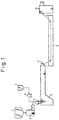
- pellets of poiybutylene terephthalate (A-2) having a relative viscosity ( ⁇ r) of 1.60 were fed at a rate of 1,400 g/hr to a supply opening of a single-screw extruder 6 provided with a screw having an inner diameter of 30 mm and L/D of 40 and having kneading units 10 having a length of 200 mm, as shown in Fig. 2, in the intermediate and top end portions.
- ⁇ -caprolactone was fed at a rate of 600 g/hr from a store tank 2 to the supply opening 5 of the single-screw extruder 6 by a metering pump 4.
- this single-screw extruder 6 the occupancy ratio of the space in the volume of the cylinder in the screw-attached state was 45%.
- the cylinder portion of this single-screw extruder was divided into three parts heated by three heaters. The temperatures were set at 190°C, 230°C and 240°C at the parts closer to the supply opening 5 in sequence, and the temperature of the die portion was set at 240°C and the screw speed was adjusted to 30 rpm and reaction was carried out in this state. Carbon black powder was added from the supply opening 5 and and the average residence time was measured. It was found that the average residence time was 10 minutes.
- Polymerization was continuously carried out for 5 hours, and sampling was conducted at an interval of 1 hour. Samples were injection-molded and the surface hardness was measured.
- A-2 polybutylene terephthalate
- ⁇ r relative viscosity
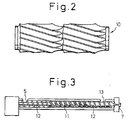
- the screw arrangement was such that convex lens-shaped kneading disc paddles were arranged in the intermediate portion (kneading disc zone 11) and the top end portion close to the extrusion orifice, screw type paddles were arranged in another screw zone 12 and the occupancy ratio of the space in the inner volume of the cylinder was 33% in the screw-attached state.
- the cylinder portion of TEX44H was divided into 12 parts heated by 12 electric heaters, and the temperatures of these parts closer to the supply opening in sequence were set at 190°C, 220°C, 230°C, 230°C, 230°C, 230°C, 230°C, 230°C, 230°C and 230°C and the temperature of the die portion was set at 230°C.
- Reaction was carried out at a screw speed of 100 rpm while a vent opening 13 was kept closed. Carbon black powder was added from the supply opening 5 and the average residence time was measured. It was found that the average residence time was 7 minutes. Under these conditions, the formed polymer was extruded in the form of a strand from an extrusion orifice 7, and the strand was water-cooled and cut to obtain an elastic polyester (B-2).
- Polymerization was continuously carried out for 5 hours and sampling was performed at an interval of 1 hour. The samples were injection-molded and the surface hardness was measured.
- pellets of polybutylene terephthalate (A-2) having a relative viscosity ( ⁇ r) of 1.60 were fed at a rate of 4 kg/hr to a supply opening of Ko-Kneader PR-46B/GS70B marketed by BUSS, and by using a metering pump, ⁇ -caprolactone was fed at a rate of 1 kg/hr to the supply opening of Ko-Kneader PR-46B/GS70B.
- Ko-Kneader PR-46B/GS70B has a structure in which pelletizer GS70B is connected to kneader PR-46B. As shown in Fig.
- kneader PR-46B comprises a cylinder 14 and a screw 15, and the inner diameter is 46.6 mm and L/D is 15. The occupancy ratio of the space in the inner volume of the cylinder in the screw-attached state is 40%.
- pelletizer GS70B the inner diameter is 70 mm and L/D is 6.
- Pelletizer GS70B was attached in the T-figured form to kneader PR-46B.
- the cylinder of kneader PR-46B was divided into 3 parts, which were heated by 3 jackets in which a heating medium was circulated.
- the temperatures of these parts closer to the supply opening in sequence were set at 210°C, 230°C and 230°C, and the temperature of the cylinder portion of GS70B was set at 230°C. Reaction was carried out at a screw speed of 100 rpm. Carbon black powder was added from the supply opening whereby the average residence time was measured. It was found that the average residence time was 12 minutes. Under these conditions, the formed polymer was extruded in the form of a strand, and the strand was water-cooled and cut to obtain an elastic polyester (B-3).
- Polymerization was continuously conducted for 5 hours and sampling was conducted at an interval of 1 hour. Samples were injection-molded, and the surface hardness was measured.
- pellets of polybutylene terephthalate (A-2) having a relative viscosity ( ⁇ r) of 1.60 were fed at a rate of 14 kg/hr to a supply opening 5 by a metering feeder and ⁇ -caprolactone was fed at a rate of 6 kg/hr to the supply opening 5 by a metering pump.
- the inner diameter of the reactor was 100 mm and L/D was 15. Paddles 17 having a convex lens-shaped section were mounted on a rotation axis 16 of the reactor, as shown in Fig. 6(A). An ordinary screw was arranged below the supply opening 5 and above the extrusion orifice 7. In the self-cleaning twin-screw extruder, the occupancy ratio of the space in the inner volume of the cylinder in the screw-attached state was 55%.
- the rotation axes were rotated in the same direction, and the revolution rate was set at 100 rpm.
- the temperature of a heating medium in the jacket of the reactor was set at 230°C. Carbon black powder was added from the supply opening 6 and the average residence time was measured. It was found that the average residence time was 10 minutes.
- the formed polymer was extruded into water in the form of a strand from the extrusion orifice 7 and was then cut to obtain an elastic polyester (B-4).
- Polymerization was continuously carried out for 5 hours and sampling was conducted at an interval of 1 hour. Samples were injection-molded and the surface hardness was measured.
- an elastic polyester (B-9) was obtained under condition such that the revolution rate of the rotating shaft 16 was 5 rpm, the temperature was 230°C and the average residence time was 120 minutes (Comparative Example 2).
- an elastic polyester (B-1 through B-7) having a stable quality can be prepared in a short time.
- Example 13 The reaction was carried out in the same manner as described in Example 4 except that a mixture formed by mixing ⁇ -caprolactone with a diglycidyl ether of bisphenol A (Epikote 828 supplied by Yuka-Shell Epoxy) in an amount of 0.25 part per 100 parts of the sum of polybutylene terephthalate (A-2) having a relative viscosity ( ⁇ r) of 1.60 and ⁇ -caprolactone was fed at a rate of 6 kg/hr, whereby an elastic polyester (B-16) was obtained (Example 13).
- A-2 diglycidyl ether of bisphenol A
- ⁇ r polybutylene terephthalate
- B-16 an elastic polyester
- Example 14 The reaction was carried out in the same manner as described in Example 4 except that a mixture formed by mixing ⁇ -caprolactone with diethylene glycol diglycidyl ether (Denacol 851 supplied by Nagase Kasei Kogyo) in an amount of 2.5 parts per 100 parts of the sum of polybutylene terephthalate (A-2) having a relative viscosity ( ⁇ r) of 1.60 and ⁇ -caprolactone was fed at a rate of 6 kg/hr, whereby an elastic polyester (B-17) was obtained (Example 14).
- Denacol 851 supplied by Nagase Kasei Kogyo
- Example 14 When the results obtained in Examples 12 and 13 are compared with the results obtained in Example 4, it is seen that by addition of a compound having an epoxy group, the hydrolysis resistance of the elastic polyester is improved and the melt viscosity is increased. However, as shown in Example 14, if an excessive amount of the epoxy compound is added, the unreacted epoxy compound remaining reacts with the elastic polyester, and then the melt viscosity of the elastic polyester increases during the residence in the molten state.
- Example 2 The reaction was carried out in the same manner as described in Example 2 except that a composition formed by dry-blending polybutylene terephthalate (A-2) having a relative viscosity ( ⁇ r) of 1.60 with monobutyltin oxide in an amount of 0.04 part per 100 parts of the sum of polybutylene terephthalate (A-2) and ⁇ -caprolactone was fed at a rate of 15 kg/hr to a twin-screw extruder having a vent opening 13 formed on the top end portion thereof as shown in Fig.
- A-2 polybutylene terephthalate
- ⁇ r relative viscosity
- Example 16 The reaction was carried out in the same manner as described in Example 4 except that a composition formed by dry-blending polybutylene terephthalate (A-2) having a relative viscosity ( ⁇ r) of 1.60 with monobutyltin oxide in an amount of 0.03 part per 100 parts of the sum of polybutylene terephthalate (A-2) and ⁇ -caprolactone was fed at a rate of 14 kg/hr to a self-cleaning twin-screw extruder having a vent opening formed on the top end portion thereof, the residence time was adjusted to 5 minutes, and triphenylphosphate was continuously added from the vent opening by a microfeeder so that the amount of triphenylphosphate was 3 moles per mole of monobutyltin oxide, whereby an elastic polyester (B-19) was obtained (Example 16).
- A-2 polybutylene terephthalate
- ⁇ r relative viscosity
- An elastic polyester (B-20) was obtained by carrying out the reaction in the same manner as described in Example 15 except that trimethyl phosphate was not added (Example 17).
- An elastic polyester (B-21) was prepared in the same manner as described in Example 16 except that triphenylphosphate was not added (Example 18).
- Examples 15 and 16 are compared with Examples 17 and 18 with respect to the melting point after 30 minutes' residence at 230°C, it is seen that the catalyst is deactivated by the phosphorus compound and the randomization by the ester exchange reaction is inhibited.
- An elastic polyester (B-22) was prepared by carrying out the reaction in the same manner as described in Example 1 except that a vent opening was formed in the top end portion of the single-screw extruder and the removal of unreacted ⁇ -caprolactone was conducted under a vacuum of 5 Torr (Example 19).
- An elastic polyester (B-23) was prepared by carrying out the reaction in the same manner as described in Example 3 except that a vent opening was formed in the top end portion of the PR-46B kneader and the removal of unreacted ⁇ -caprolactone was conducted under a vacuum of 5 Torr (Example 20).
- the obtained elastic polyesters (B-22 and B-23) had no smell and as shown in Table 5, these elastic polyesters had excellent physical properties comparable with store of the elastic polyesters obtained in Examples 1 and 3 (B-1 and B-3).
- the elastic polyester prepared according to the process of the present invention has an excellent durability represented by heat resistance and weatherability and an excellent rubbery elasticity and mechanical properties. Accordingly, this elastic polyester can be widely used for the production of parts such as automobile parts, electric and electronic parts and machine parts.
Landscapes
- Chemical & Material Sciences (AREA)
- Chemical Kinetics & Catalysis (AREA)
- Organic Chemistry (AREA)
- Health & Medical Sciences (AREA)
- Medicinal Chemistry (AREA)
- Polymers & Plastics (AREA)
- Polyesters Or Polycarbonates (AREA)
- Processing And Handling Of Plastics And Other Materials For Molding In General (AREA)
Claims (23)
- Verfahren zur kontinuierlichen Herstellung von elastischem Polyester, das das kontinuierliche Zuführen eines aromatischen Polyesters und einer Lactonverbindung, ausgewählt aus ξ-Caprolacton, Enantholacton und Caprylolacton, in einen Extruder, der (A) einen Zylinder mit Abmessungen, die die Gleichung 3 ≤ L/D ≤ 70 erfüllen (worin L die Länge des Zylinders und D den Innendurchmesser des Zylinders darstellen) und (B) mindestens eine Schnecke aufweist, und wobei (C) das Verhältnis der Inanspruchnahme des Raums im Innenvolumen bei angebrachter Schnecke nicht mehr als 70 % beträgt, und das Umsetzen des aromatischen Polyesters mit der Lactonverbindung umfaßt, wobei das Schmelzen, Zuführen und Kneten im Extruder erfolgen, wodurch der elastische Polyester kontinuierlich hergestellt wird.
- Verfahren nach Anspruch 1, wobei der Extruder ein Einzelschneckenextruder mit einer Schnecke ist.
- Verfahren nach Anspruch 1, wobei der Extruder ein Doppelschneckenextruder mit zwei Schnecken ist.
- Verfahren nach Anspruch 1, wobei der Extruder (a) eine Schnecke mit einer Anzahl unterbrochener Rippen aufweist, die während der Extrusion innerhalb von einer Umdrehung eine Hin- und Herbewegung in axialer Richtung vornimmt und (b) in einem Zylinder angeordnet ist, der auf seiner Innenoberfläche Zähne aufweist, die in die unterbrochenen Rippen der Schnecke (a) eingreifen.
- Verfahren nach Anspruch 1, wobei (a) der Extruder zwei Schnecken aufweist, die jeweils eine Anzahl zur gemeinsamen Rotation angebrachter plattenförmiger Schaufeln aufweisen und parallel zueinander angeordnet sind, (b) der senkrecht zur Längsrichtung der Schaufel vorgenommene Schnitt eine Form aufweist, die aus einer der Konvexlinse ähnlichen Form, einer Ellipsoidform und einer pseudopolygonalen Form ausgewählt ist, worin entsprechende Scheitelpunkte mit einem imaginären Kreis einbeschrieben sind, und (c) die Schaufel einer Schnecke mit einem geringen Abstand zur Schaufel der anderen Schnecke und zur Innenfläche des Zylinders drehbar ist.
- Verfahren nach Anspruch 1, wobei der Extruder mindestens eine Schnecke aufweist, deren Abmessungen die Anforderung 5 ≤ LD ≤ 60 erfüllen, wobei L und D wie in Anspruch 1 definiert sind.
- Verfahren nach einem der vorstehenden Ansprüche, wobei der Extruder ein Verhältnis der Inanspruchnahme, wie in Anspruch definiert, von 5 bis 50 % aufweist.
- Verfahren nach einem der vorstehenden Ansprüche, wobei die Zylindertemperatur des Extruders im Bereich von 210 bis 300°C liegt.
- Verfahren nach Anpruch 8, wobei die Zylindertemperatur des Extruders im Bereich von 215 bis 250°C liegt.
- Verfahren nach einem der vorstehenden Ansprüche, wobei die Zeit, die vom Zeitpunkt der Zufuhr des aromatischen Polyesters und der Lactonverbindung zum Extruder bis zum Zeitpunkt der Extrusion des elastischen Polymers vergeht, 30 Sekunden bis 30 Minuten beträgt.
- Verfahren nach Anspruch 10, wobei die vergehende Zeit 3 bis 20 Minuten beträgt.
- Verfahren nach einem der vorstehenden Ansprüche, wobei die unreagierte Lactonverbindung kontinuierlich aus dem elastischen Polyester entfernt wird, der durch Reaktion zwischen dem aromatischen Polyester und der Lactonverbindung erhalten wird.
- Verfahren nach Anspruch 12, wobei im oberen Endabschnitt des Extruders eine Entlüftungsöffnung ausgebildet ist und die unreagierte Lactonverbindung bei einem Vakuum von nicht mehr als 50 Torr kontinuierlich aus dem elastischen Polyester entfernt wird.
- Verfahren nach einem der vorstehenden Ansprüche, wobei die relative Viskosität (ηr) des aromatischen Polyesters, die bei 25°C in einer Lösung des Polymers in o-Chlorophenol als Lösungsmittel mit 0,5 Gew.-% gemessen wird, 1,20 bis 2,00 beträgt.
- Verfahren nach Anspruch 14, wobei die relative Viskosität (ηr) des aromatischen Polyesters 1,30 bis 1,80 beträgt.
- Verfahren nach einem der vorstehenden Ansprüche, wobei der aromatische Polyester Polybutylenterephthalat ist.
- Verfahren nach einem der vorstehenden Ansprüche, wobei der aromatische Polyester und die Lactonverbindung mit einem Gewichtsverhältnis von aromatischem Polyester/Lactonverbindung von 99/1 bis 20/80 zugeführt werden.
- Verfahren nach Anspruch 17, wobei der aromatische Polyester und die Lactonverbindung bei einem Gewichtsverhältnis von aromatischem Polyester/Lactonverbindung von 98/2 bis 30/70 zugeführt werden.
- Verfahren nach einem der vorstehenden Ansprüche, wobei zumindest eine Verbindung mit mindestens einer Epoxygruppe im Molekül zusammen mit dem aromatischen Polyester und der Lactonverbindung dem Extruder in einer Menge von 0,01 bis 0,27 Gew.-% auf der Basis der Summe von aromatischer Polyesterverbindung und Lactonverbindung zugeführt wird.
- Verfahren nach Anspruch 19, wobei die zumindest eine Verbindung dem Extruder in einer Menge von 0,10 bis 0,25 Gew.-% auf der Basis der Summe von aromatischer Polyesterverbindung und Lactonverbindung zugeführt wird.
- Verfahren nach einem der Ansprüche 1 bis 19, wobei ein Esteraustauschkatalysator zusammen mit dem aromatischen Polyester und der Lactonverbindung dem Extruder zugeführt wird und dem erhaltenen elastischen Polyester vom oberen Endabschnitt des Extruders kontinuierlich eine Phosphorverbindung zugesetzt wird.
- Verfahren nach Anspruch 21, wobei die Menge des zugesetzten Esteraustauschkatalysators 0,001 bis 0,3 Gew.-% auf der Basis der Summe von aromatischem Polyester und Lactonverbindung beträgt.
- Verfahren nach Anspruch 21 oder Anspruch 22, wobei die Menge der zugesetzten Phosphorverbindung derart ist, daß mindestens ein Phosphoratom pro Molekül des Esteraustauschkatalysators enthalten ist.
Applications Claiming Priority (9)
| Application Number | Priority Date | Filing Date | Title |
|---|---|---|---|
| JP125074/89 | 1989-05-17 | ||
| JP125076/89 | 1989-05-17 | ||
| JP125077/89 | 1989-05-17 | ||
| JP1125074A JPH0776263B2 (ja) | 1989-05-17 | 1989-05-17 | 弾性ポリエステルの製造方法 |
| JP12507789A JPH0733435B2 (ja) | 1989-05-17 | 1989-05-17 | 弾性ポリエステルの製造方法 |
| JP12507689A JPH0733434B2 (ja) | 1989-05-17 | 1989-05-17 | 弾性ポリエステルの製造方法 |
| JP12507589A JPH02302434A (ja) | 1989-05-17 | 1989-05-17 | 弾性ポリエステルの製造方法 |
| JP125075/89 | 1989-05-17 | ||
| PCT/JP1990/000626 WO1990014376A1 (en) | 1989-05-17 | 1990-05-17 | Method of continuous production of elastic polyester |
Publications (3)
| Publication Number | Publication Date |
|---|---|
| EP0425708A1 EP0425708A1 (de) | 1991-05-08 |
| EP0425708A4 EP0425708A4 (en) | 1993-02-10 |
| EP0425708B1 true EP0425708B1 (de) | 1996-11-06 |
Family
ID=27471080
Family Applications (1)
| Application Number | Title | Priority Date | Filing Date |
|---|---|---|---|
| EP90907463A Revoked EP0425708B1 (de) | 1989-05-17 | 1990-05-17 | Verfahren zur kontinuierlichen herstellung von elastischen polyestern |
Country Status (6)
| Country | Link |
|---|---|
| US (1) | US5225497A (de) |
| EP (1) | EP0425708B1 (de) |
| KR (1) | KR920701304A (de) |
| CA (1) | CA2033095C (de) |
| DE (1) | DE69029078T2 (de) |
| WO (1) | WO1990014376A1 (de) |
Families Citing this family (15)
| Publication number | Priority date | Publication date | Assignee | Title |
|---|---|---|---|---|
| DE4429524C2 (de) * | 1994-08-19 | 1997-12-18 | Inventa Ag | Verfahren zur Herstellung von linearen omega-Hydroxycarbonsäureeinheiten enthaltenden Copolyestern |
| US5869582A (en) * | 1997-01-22 | 1999-02-09 | Alliedsignal Inc. | Diblock polyester copolymer and process for making |
| US5889127A (en) * | 1997-11-18 | 1999-03-30 | Daicel Chemical Industries, Ltd. | Continuous process for the preparation of a polyester-based polymer |
| US6228488B1 (en) * | 1998-05-22 | 2001-05-08 | Alliedsignal Inc. | Process for making load limiting yarn |
| US6071835A (en) * | 1998-06-16 | 2000-06-06 | Alliedsignal Inc. | Load limiting webbing |
| TW585880B (en) * | 1999-08-05 | 2004-05-01 | Daicel Chem | Process for producing polyester block copolymer |
| KR20040054764A (ko) * | 2001-11-13 | 2004-06-25 | 허니웰 인터내셔날 인코포레이티드 | 고분자량 중합체 및 이의 제조 방법 |
| US6794462B2 (en) * | 2001-11-14 | 2004-09-21 | Honeywell International Inc. | High-molecular weight polymers and methods of manufacture |
| JP4039855B2 (ja) * | 2001-12-28 | 2008-01-30 | ダイセル化学工業株式会社 | ε−カプロラクトン重合物の連続製造方法 |
| MY135206A (en) * | 2002-01-11 | 2008-02-29 | Daicel Chem | Process of continuously producing polyester-based polymer |
| JP3590385B2 (ja) * | 2002-01-11 | 2004-11-17 | ダイセル化学工業株式会社 | ポリエステル系ポリマーの処理方法及び低沸成分含有量の少ないポリエステル系ポリマー |
| EP1964889A1 (de) * | 2005-12-21 | 2008-09-03 | Daicel Chemical Industries, Ltd. | Polyesterharzzusammensetzung und formkörper |
| DE102009055009A1 (de) | 2009-12-18 | 2011-06-22 | Evonik Degussa GmbH, 45128 | Verfahren zur Herstellung von Poly(meth)acrylat-pfropf-polylacton-Polymeren |
| IT1406769B1 (it) * | 2010-08-05 | 2014-03-07 | Maris Flli Spa | Procedimento per il recupero e la de-vulcanizzazione di gomma |
| CN114380990A (zh) * | 2022-01-06 | 2022-04-22 | 彤程化学(中国)有限公司 | 一种生物降解共聚酯及其制备和应用 |
Family Cites Families (9)
| Publication number | Priority date | Publication date | Assignee | Title |
|---|---|---|---|---|
| BE638627A (de) * | 1962-10-15 | |||
| DE1495730B2 (de) * | 1963-07-24 | 1971-03-18 | Farbenfabriken Bayer AG, 5090 Le verkusen | Verfahren zum herstellen thermoplastischer polykondensations produkte |
| US3630689A (en) * | 1969-10-30 | 1971-12-28 | Baker Perkins Inc | Apparatus for reacting and devolatilizing prepolymer and like materials |
| JPS5315753B2 (de) * | 1973-08-08 | 1978-05-26 | ||
| JPS58162654A (ja) * | 1982-03-19 | 1983-09-27 | Toyobo Co Ltd | ポリエステル型ブロツク共重合体組成物 |
| JPH0627248B2 (ja) * | 1984-02-15 | 1994-04-13 | 東レ株式会社 | ポリエステルブロツク共重合体組成物 |
| US4680345A (en) * | 1985-06-05 | 1987-07-14 | Toyo Boseki Kabushiki Kaisha | Continuous production of elastic polyesters |
| JPH089661B2 (ja) * | 1985-06-05 | 1996-01-31 | 東洋紡績株式会社 | 弾性ポリエステルの連続的製造法 |
| JPS6220525A (ja) * | 1985-07-18 | 1987-01-29 | Toyobo Co Ltd | 弾性ポリエステルの製造法 |
-
1990
- 1990-05-17 EP EP90907463A patent/EP0425708B1/de not_active Revoked
- 1990-05-17 KR KR1019910700064A patent/KR920701304A/ko not_active Withdrawn
- 1990-05-17 WO PCT/JP1990/000626 patent/WO1990014376A1/ja not_active Ceased
- 1990-05-17 US US07/640,356 patent/US5225497A/en not_active Expired - Fee Related
- 1990-05-17 DE DE69029078T patent/DE69029078T2/de not_active Revoked
- 1990-05-17 CA CA002033095A patent/CA2033095C/en not_active Expired - Fee Related
Also Published As
| Publication number | Publication date |
|---|---|
| KR920701304A (ko) | 1992-08-11 |
| DE69029078T2 (de) | 1997-04-03 |
| WO1990014376A1 (en) | 1990-11-29 |
| EP0425708A4 (en) | 1993-02-10 |
| EP0425708A1 (de) | 1991-05-08 |
| CA2033095A1 (en) | 1990-11-18 |
| US5225497A (en) | 1993-07-06 |
| DE69029078D1 (de) | 1996-12-12 |
| CA2033095C (en) | 1997-01-14 |
Similar Documents
| Publication | Publication Date | Title |
|---|---|---|
| EP0425708B1 (de) | Verfahren zur kontinuierlichen herstellung von elastischen polyestern | |
| EP0057415B1 (de) | Polyesterharz-Zusammensetzung | |
| JP4736260B2 (ja) | ポリカーボネート樹脂組成物及びそれを用いた成形品 | |
| BRPI0810803B1 (pt) | Blenda polimérica de poliéster com tenacidade em baixas temperaturas | |
| JP7507153B2 (ja) | 樹脂組成物及びその製造方法 | |
| JP3650557B2 (ja) | 難燃性ポリエステル樹脂組成物、その成形品およびその製造方法 | |
| JP3674934B2 (ja) | 弾性ポリエステル及びその製造方法 | |
| JP2003012781A (ja) | ポリブチレンテレフタレート樹脂及び成形品 | |
| JP2004075756A (ja) | ポリブチレンテレフタレート樹脂組成物及び成形品 | |
| JP2004091583A (ja) | 難燃性ポリブチレンテレフタレート樹脂組成物及び成形品 | |
| JP2003246918A (ja) | ポリブチレンテレフタレート系樹脂組成物 | |
| JP3144972B2 (ja) | ポリエステル樹脂組成物 | |
| JPH02147624A (ja) | ポリエステルカーボネートの製造方法 | |
| JPH09316183A (ja) | ポリブチレンテレフタレート及びその製造方法 | |
| JPH02302434A (ja) | 弾性ポリエステルの製造方法 | |
| JP2002322352A (ja) | ポリブチレンテレフタレート樹脂組成物及び成形品 | |
| JP2004143209A (ja) | ポリブチレンテレフタレート樹脂組成物及び成形品 | |
| JP5055665B2 (ja) | ポリカーボネート樹脂組成物 | |
| JP4721592B2 (ja) | ポリカーボネート樹脂組成物 | |
| JPH02302429A (ja) | 弾性ポリエステルの製造方法 | |
| JP2004143211A (ja) | ポリブチレンテレフタレート樹脂組成物及びそれを用いたコネクター | |
| JPH0776263B2 (ja) | 弾性ポリエステルの製造方法 | |
| WO2007139104A1 (ja) | ポリエステルブロック共重合体の製造方法 | |
| JPH0733434B2 (ja) | 弾性ポリエステルの製造方法 | |
| JP2901273B2 (ja) | ポリカーボネート組成物及びその製造方法 |
Legal Events
| Date | Code | Title | Description |
|---|---|---|---|
| PUAI | Public reference made under article 153(3) epc to a published international application that has entered the european phase |
Free format text: ORIGINAL CODE: 0009012 |
|
| 17P | Request for examination filed |
Effective date: 19910211 |
|
| AK | Designated contracting states |
Kind code of ref document: A1 Designated state(s): DE FR GB IT |
|
| A4 | Supplementary search report drawn up and despatched |
Effective date: 19921221 |
|
| AK | Designated contracting states |
Kind code of ref document: A4 Designated state(s): DE FR GB IT |
|
| 17Q | First examination report despatched |
Effective date: 19950327 |
|
| GRAH | Despatch of communication of intention to grant a patent |
Free format text: ORIGINAL CODE: EPIDOS IGRA |
|
| GRAH | Despatch of communication of intention to grant a patent |
Free format text: ORIGINAL CODE: EPIDOS IGRA |
|
| GRAH | Despatch of communication of intention to grant a patent |
Free format text: ORIGINAL CODE: EPIDOS IGRA |
|
| GRAH | Despatch of communication of intention to grant a patent |
Free format text: ORIGINAL CODE: EPIDOS IGRA |
|
| GRAA | (expected) grant |
Free format text: ORIGINAL CODE: 0009210 |
|
| AK | Designated contracting states |
Kind code of ref document: B1 Designated state(s): DE FR GB IT |
|
| REF | Corresponds to: |
Ref document number: 69029078 Country of ref document: DE Date of ref document: 19961212 |
|
| ET | Fr: translation filed | ||
| ITF | It: translation for a ep patent filed | ||
| PLBQ | Unpublished change to opponent data |
Free format text: ORIGINAL CODE: EPIDOS OPPO |
|
| PLBI | Opposition filed |
Free format text: ORIGINAL CODE: 0009260 |
|
| PLBF | Reply of patent proprietor to notice(s) of opposition |
Free format text: ORIGINAL CODE: EPIDOS OBSO |
|
| 26 | Opposition filed |
Opponent name: BASF AKTIENGESELLSCHAFT, LUDWIGSHAFEN Effective date: 19970806 |
|
| PLBF | Reply of patent proprietor to notice(s) of opposition |
Free format text: ORIGINAL CODE: EPIDOS OBSO |
|
| PGFP | Annual fee paid to national office [announced via postgrant information from national office to epo] |
Ref country code: FR Payment date: 19990511 Year of fee payment: 10 |
|
| PGFP | Annual fee paid to national office [announced via postgrant information from national office to epo] |
Ref country code: GB Payment date: 19990512 Year of fee payment: 10 |
|
| PGFP | Annual fee paid to national office [announced via postgrant information from national office to epo] |
Ref country code: DE Payment date: 19990514 Year of fee payment: 10 |
|
| RDAH | Patent revoked |
Free format text: ORIGINAL CODE: EPIDOS REVO |
|
| RDAH | Patent revoked |
Free format text: ORIGINAL CODE: EPIDOS REVO |
|
| RDAH | Patent revoked |
Free format text: ORIGINAL CODE: EPIDOS REVO |
|
| RDAG | Patent revoked |
Free format text: ORIGINAL CODE: 0009271 |
|
| STAA | Information on the status of an ep patent application or granted ep patent |
Free format text: STATUS: PATENT REVOKED |
|
| 27W | Patent revoked |
Effective date: 19990926 |
|
| GBPR | Gb: patent revoked under art. 102 of the ep convention designating the uk as contracting state |
Free format text: 990926 |