EP0436217A2 - Schmerzstillendes und entzündungshemmendes Pflaster - Google Patents
Schmerzstillendes und entzündungshemmendes Pflaster Download PDFInfo
- Publication number
- EP0436217A2 EP0436217A2 EP90125524A EP90125524A EP0436217A2 EP 0436217 A2 EP0436217 A2 EP 0436217A2 EP 90125524 A EP90125524 A EP 90125524A EP 90125524 A EP90125524 A EP 90125524A EP 0436217 A2 EP0436217 A2 EP 0436217A2
- Authority
- EP
- European Patent Office
- Prior art keywords
- acid
- drug
- patch
- reserver
- weight
- Prior art date
- Legal status (The legal status is an assumption and is not a legal conclusion. Google has not performed a legal analysis and makes no representation as to the accuracy of the status listed.)
- Granted
Links
Images


Classifications
-
- A—HUMAN NECESSITIES
- A61—MEDICAL OR VETERINARY SCIENCE; HYGIENE
- A61K—PREPARATIONS FOR MEDICAL, DENTAL OR TOILETRY PURPOSES
- A61K9/00—Medicinal preparations characterised by special physical form
- A61K9/70—Web, sheet or filament bases ; Films; Fibres of the matrix type containing drug
-
- A—HUMAN NECESSITIES
- A61—MEDICAL OR VETERINARY SCIENCE; HYGIENE
- A61K—PREPARATIONS FOR MEDICAL, DENTAL OR TOILETRY PURPOSES
- A61K9/00—Medicinal preparations characterised by special physical form
- A61K9/70—Web, sheet or filament bases ; Films; Fibres of the matrix type containing drug
- A61K9/7023—Transdermal patches and similar drug-containing composite devices, e.g. cataplasms
- A61K9/703—Transdermal patches and similar drug-containing composite devices, e.g. cataplasms characterised by shape or structure; Details concerning release liner or backing; Refillable patches; User-activated patches
- A61K9/7038—Transdermal patches of the drug-in-adhesive type, i.e. comprising drug in the skin-adhesive layer
- A61K9/7046—Transdermal patches of the drug-in-adhesive type, i.e. comprising drug in the skin-adhesive layer the adhesive comprising macromolecular compounds
- A61K9/7053—Transdermal patches of the drug-in-adhesive type, i.e. comprising drug in the skin-adhesive layer the adhesive comprising macromolecular compounds obtained by reactions only involving carbon to carbon unsaturated bonds, e.g. polyvinyl, polyisobutylene, polystyrene
- A61K9/7061—Polyacrylates
-
- A—HUMAN NECESSITIES
- A61—MEDICAL OR VETERINARY SCIENCE; HYGIENE
- A61K—PREPARATIONS FOR MEDICAL, DENTAL OR TOILETRY PURPOSES
- A61K31/00—Medicinal preparations containing organic active ingredients
- A61K31/185—Acids; Anhydrides, halides or salts thereof, e.g. sulfur acids, imidic, hydrazonic or hydroximic acids
- A61K31/19—Carboxylic acids, e.g. valproic acid
-
- A—HUMAN NECESSITIES
- A61—MEDICAL OR VETERINARY SCIENCE; HYGIENE
- A61K—PREPARATIONS FOR MEDICAL, DENTAL OR TOILETRY PURPOSES
- A61K47/00—Medicinal preparations characterised by the non-active ingredients used, e.g. carriers or inert additives; Targeting or modifying agents chemically bound to the active ingredient
- A61K47/06—Organic compounds, e.g. natural or synthetic hydrocarbons, polyolefins, mineral oil, petrolatum or ozokerite
- A61K47/08—Organic compounds, e.g. natural or synthetic hydrocarbons, polyolefins, mineral oil, petrolatum or ozokerite containing oxygen, e.g. ethers, acetals, ketones, quinones, aldehydes, peroxides
- A61K47/12—Carboxylic acids; Salts or anhydrides thereof
-
- A—HUMAN NECESSITIES
- A61—MEDICAL OR VETERINARY SCIENCE; HYGIENE
- A61K—PREPARATIONS FOR MEDICAL, DENTAL OR TOILETRY PURPOSES
- A61K47/00—Medicinal preparations characterised by the non-active ingredients used, e.g. carriers or inert additives; Targeting or modifying agents chemically bound to the active ingredient
- A61K47/06—Organic compounds, e.g. natural or synthetic hydrocarbons, polyolefins, mineral oil, petrolatum or ozokerite
- A61K47/16—Organic compounds, e.g. natural or synthetic hydrocarbons, polyolefins, mineral oil, petrolatum or ozokerite containing nitrogen, e.g. nitro-, nitroso-, azo-compounds, nitriles, cyanates
- A61K47/18—Amines; Amides; Ureas; Quaternary ammonium compounds; Amino acids; Oligopeptides having up to five amino acids
-
- A—HUMAN NECESSITIES
- A61—MEDICAL OR VETERINARY SCIENCE; HYGIENE
- A61K—PREPARATIONS FOR MEDICAL, DENTAL OR TOILETRY PURPOSES
- A61K9/00—Medicinal preparations characterised by special physical form
- A61K9/0012—Galenical forms characterised by the site of application
- A61K9/0014—Skin, i.e. galenical aspects of topical compositions
-
- A—HUMAN NECESSITIES
- A61—MEDICAL OR VETERINARY SCIENCE; HYGIENE
- A61P—SPECIFIC THERAPEUTIC ACTIVITY OF CHEMICAL COMPOUNDS OR MEDICINAL PREPARATIONS
- A61P29/00—Non-central analgesic, antipyretic or antiinflammatory agents, e.g. antirheumatic agents; Non-steroidal antiinflammatory drugs [NSAID]
Definitions
- This invention relates to an anti-inflammatory analgesic patch. More specifically the invention relates to an anti-inflammatory analgesic patch containing 4-biphenylylacetic acid as the effective ingredient and crotamiton as an absorption assistant.
- 4-Biphenylylacetic acid is an active metabolite of fenbufen which is an oral non-steroidal anti-inflammatory, analgesic drug, and is itself known to exhibit strong anti-inflammatory and analgesic actions. It is also known, however, that oral administration of 4-biphenylylacetic acid may sometimes be accompanied by ulceration or bleeding of digestive organs. Hence, in spite of its excellent anti-inflammatory and analgesic activities, it has not yet been used in clinical therapy as an oral administration drug.
- the present inventors therefore conducted an extensive study for formulating a practical patch which will allow full exhibition of the strong anti-inflammatory and analgesic effects of 4-biphenylylacetic acid.
- Those patches which are normally referred to as cataplasms conventionally contain as the chief component an inorganic matter like kaolin which contain such ingredients of the base as shape-retaining agents like purified gelatin; humectants like glycerin and propylene glycol; thickeners like carboxymethylcellulose sodium (CMC-Na) and sodium polyacrylate, etc.
- the base is then blended with an active component as the chief drug and the blend is spread on knitted or non-woven fabric.
- the active component is simply blended with such conventional patch base, it is adsorbed by the inorganic matter like kaolin and cannot be released, which markedly reduces the transdermal absorption of the component.
- the CMC-Na or sodium polyacrylate blended as a thickener reacts with the 4-biphenylylacetic acid to harden the drug reserver. Consequently tackiness of the drug reserver layer is impaired to lose its function as a transdermal patch.
- the practice only provided an unsatisfactory transdermal patch containing 4-biphenylylacetic acid.
- the present inventors found that if no inorganic matter like kaolin is used as an ingredient of the base and a homo- and/or co-polymer of acrylic acid is used as the thickener, such base is blended with 4-biphenylylacetic acid and crotamiton and furthermore if pH of the drug reserver is adjusted to a range of 6 to 8 with a water-soluble organic amine and an organic acid, said homo- and/or co-polymer exhibit stable gel property to provide an anti-inflammatory analgesic patch excelling in durability of medical efficacy of 4-biphenylylacetic acid and allowing quantitative administeration. Furthermore the patch itself exhibits stable tackiness and causes little skin-irritation.
- the present invention was whereupon completed.
- the present invention provides an anti-inflammatory analgesic patch containing 4-biphenylylacetic acid having an excellent anti-inflammatory and analgesic activities as the effective medical component.
- the present invention provides an anti-inflammatory analgesic patch having a drug reserver layer composed of 4-biphenylylacetic acid as the effective ingredient, homo- and/or co-polymer of acrylic acid as a thickener and other ordinary adjuvants like shape-retaining agent, humectant, etc., said patch being characterized in that the drug reserver layer further contains crotamiton and pH of the drug reserver layer is adjusted within a range from 6 to 8 with a water-soluble organic amine and organic acid.
- the anti-inflammatory analgesic patch of the present invention exhibits stable and good gel property because the polyacrylic acid and/or polyacrylate copolymer contained as a base ingredient is neutralized with a water-soluble organic amine.
- the neutralization furthermore imparts excellent tackiness to the drug reserver itself.
- the crotamiton contained as an absorption assistant promotes release of 4-biphenylylacetic acid which is the active component, and consequently allows the patch to exhibit superior anti-inflammatory and analgesic effect over many hours.
- Polyacrylic acid and/or polyacrylate copolymer blended as a base ingredient of the patch of the present invention serve as a thickener for imparting tackiness to the drug reserver itself.
- polyacrylic acids examples include water-soluble acrylic acid homopolymers having a number average molecular weight of about 30,000 to about 500,000.
- Polyacrylate copolymers useful for the present invention include water-soluble carbonyl-containing copolymers of acrylic acid with other vinyl monomers copolymerizable therewith, such as the alkenylethers obtained by allylating polyhydroxy alcohols like sucrose, oligose, aldohexose, ketohexose, butane-triol, etc.
- Such copolymers can have a number average molecular weight of about 1,000,000 to about 3,000,000, specific examples including HIVISWAKO® ⁇ 103, 104 or 105 (products of WAKO JUNYAKU KOGYO Co. Ltd.), CARBOPOL®-934, 940 or 941 (products of GOODRICH Co. Ltd.).
- polyacrylic acids and polyacrylate copolymers can be each singly blended to impart tackiness to the drug reserver, while it is likewise possible to use them concurrently to secure the intended tackiness. It was found that the single use of polyacrylic acid or concurrent use of a large amount of polyacrylic acid increases the tackiness of the drug reserver, while single use or concurrent use of a large amount of polyacrylate copolymer increases shape-retaining property of the drug reserver per se.
- the tackiness and shape retaining property of the drug reserver can vary depending on the amount of polyacrylic acid and/or polyacrylate copolymer.
- the amount of polyacrylic acid, when used alone, is 0.2 to 10%, preferably 0.5 to 6%, more preferably 1 to 4%, based on the weight of the drug reserver, while that of polyacrylate copolymer, when used alone, can range from 0.5 to 10%, preferably 1.5 to 8%, more preferably 2 to 5%, based on the weight of the drug reserver, the percentages being by weight.
- polyacrlyic acid and polyacrylate copolymer When both polyacrlyic acid and polyacrylate copolymer are used, their respective amount may be within the above-specified range, to make the total 1 to 10%, preferably 1.5 to 8%, more preferably 2 to 5%, the percentages being by weight, based on the weight of the drug reserver.
- polyacrylic acid and polyacrylate copolymer When polyacrylic acid and polyacrylate copolymer are used concurrently, their blend ratio is not critical, but generally polyacrylic acid/polyacrylate copolymer, by weight ratio, can range conveniently from 5/1 to 1/5, preferably from 3/1 to 1/3.
- the stable gel properties desirable for drug reserver of the patch of the present invention can be still improved by neutralizing the polyacrylic acid and/or polyacrylate copolymer blended as one of the base ingredients with water-soluble organic amines.
- Illustrative of the water-soluble organic amines used in the patch of the invention are mono(lower alkanol)amines such as monomethanolamine, monoethanolamine, monopropanolamine and monoisopropanolamine; di(lower alkanol)amines such as dimethanolamine, diethanolamine, dipropanolamine, diisopropanolamine, dibutanolamine, diisobutanolamine and di-sec-butanolamine; tri(lower alkanol)amines such as trimethanolamine, triethanolamine, tripropanolamine, triisopropanolamine, tributanolamine, triisobutanolamine and tri-sec-butanolamine; mono(lower alkyl)amines such as methylamine, ethylamine, propylamine and isopropylamine; di(lower alkyl)amines such as dimethylamine, diethylamine, dipropylamine diisopropyl
- the water-soluble organic amine is used in an amount larger than that required to neutralize the polyacrylic acid and/or polyacrylate copolymer in the drug reserver, which amount can conveniently range from 0.5 to 15%, preferably from 0.5 to 10%, more preferably from 1 to 7%, the percentages being by weight, based on the weight of the drug reserver, although it may vary depending on the kind of specific amine or amines used, the amount of 4-biphenylylacetic acid and the amount of the polyacrylic acid and/or polyacrylate copolymer.
- the pH of the drug reserver layer of the patch of the invention is adjusted to a range 6-8, preferably 6.3-7.5, more preferably 6.5-7.3, by concurrent use of an organic acid or acids with the water-soluble organic amine or amines. This adjustment is essential for reducing skin irritation when the patch is stuck on skin, improving stability of the formulation and maintaining tackiness of the drug reserver layer.
- organic acids examples include malic acid, oleic acid, tartaric acid, lactic acid, gluconic acid and citric acid.
- the amount of these organic acids is not critical, but for adjusting the pH of the drug reserver to afore-specified range, it may normally be from 0.1 to 5%, preferably from 0.1 to 3%, more preferably from 0.2 to 1%, the percentages being by weight, based on the weight of the drug reserver.
- the amount of 4-biphenylylacetic acid, the effective ingredient of the anti-inflammatory analgesic patch of the present invention, to be blended is not subject to a generic limitation, it being sufficient that the amount be enough for the patch to exhibit the intended anti-inflammatory and analgesic effect. Normally, however, it is suitably from 0.1 to 5%, preferably from 0.3 to 3%, more preferably from 0.4 to 2%, the percentages being by weight, based on the total weight of the drug reserver.
- crotamiton is blended in the drug reserver with a view to promoting the transdermal absorption of particularly 4-biphenylylacetic acid as the active component. While crotamiton has been conventionally used as a dissolution promotor, it has been found to act as a transdermal absorption assistant for 4-biphenylylacetic acid in the patch of the present invention (cf. Comparative test given later).
- the amount of crotamiton as an absorption assistant may conveniently be in the range of 0.05-10 parts, preferably 0.07-5 parts, per 100 parts of 4-biphenylylacetic acid, the parts being by weight, although it may vary depending on the amount of 4-biphenylylacetic acid in the drug reserver layer.
- the anti-inflammatory analgesic patch of the invention can further contain other ordinary adjuvants such as shape-retaining agent, humectant, etc.
- the patch can optionally contain such humectants as glycerin, sorbitol, propylene glycol, polyethylene glycol, 1,3-butanediol, etc. in addition to the foregoing components.
- humectants can be used either singly or in combination, whereby to keep the patch in moist state and maintain favorable mobility of 4-biphenylylacetic acid in the drug reserver layer and to increase duration of its absorption.
- Generally preferred amount of such humectant or humectants is from 10 to 60% by weight, more preferably from 20 to 50% by weight, based on the weight of the drug reserver.
- the patch of the invention can furthermore optionally contain a shape-retaining agent such as purified gelatin, carboxymethylcellulose sodium (CMC-Na), etc.
- a shape-retaining agent such as purified gelatin, carboxymethylcellulose sodium (CMC-Na), etc.
- the amount of such shape-retaining agent can generally range from 0.1 to 10% by weight, particularly from 0.5 to 5% by weight, based on the weight of the drug reserver.
- the transdermal patch of the invention may further contain other pharmaceutically acceptable thickeners such as carboxymethylcellulose sodium or sodium polyacrylate; or pharmaceutically acceptable preservatives such as esters of paraoxybenzoic acid or sorbic acids in appropriate combination.
- pharmaceutically acceptable thickeners such as carboxymethylcellulose sodium or sodium polyacrylate
- preservatives such as esters of paraoxybenzoic acid or sorbic acids in appropriate combination.
- the drug reserver layer in the patch of the invention allows stable dissolution of the effective component, 4-biphenylylacetic acid, in the drug reserver, preventing its precipitation thereinto as crystals. Consequently, the bioavailability of the effecive component in the patch is extremely high.
- the drug reserver containing 4-biphenylylacetic acid is spread on a surface of a sheet-formed backing like fabric, paper, etc. While the spreading method and thickness of the spread layer are subject to no critical limitation, it is preferred to make the drug reserver in the patch relatively thick, eg., at least 0.5 mm, because in such a case the drug reserver layer itself exhibits an ODT (occlusion dressing technique) effect and improves the bioavailability of 4-biphenylylacetic acid.
- ODT occlusion dressing technique
- the material to be used as the sheet-formed backing neither is critical, but any of those ordinarily used for transdermal patches can be used.
- the transdermal patch containing 4-biphenylylacetic acid of the present invention improved the releasing ability and durability of 4-biphenylylacetic acid by blending as a base ingredient of the patch polyacrylic acid and/or polyacrylate copolymer which have been heretofore used for base component of gel ointment and known to have good releasing ability of medical ingredient, and by regulating the pH of the drug reserver to 6-8, whereby improving the stability and adhesiveness of the patch.
- crotamiton is blended to achieve the effect of promoting transdermal absorption of 4-biphenylylacetic acid.
- bioavailability of 4-biphenylylacetic acid is markedly improved compared to the case of simply blending it with conventional base ingredients of transdermal patch.
- the dose of 4-biphenylylacetic acid to be administered can be determined easily and with certainty from the surface area of the patch, and by suitably cutting the patch to the size appropriate for individual patient's condition and applying it to the patient's skin, the active ingredient can be quantitatively administered. Again, because it can be administered by intimately adhering the patch to the affected part, the action of 4-biphenylylacetic acid can be maintained over a prolonged period.
- the polyacrylate copolymer was dissolved in 30 g of purified water. Separately, purified gelatin and polyvinyl alcohol were dissolved in the rest of purified water, and the solution was stirred at 60°C. The above two solutions were mixed. To the resultant solution, a mixture of crotamiton, diisopropanol amine and 4-biphenylylacetic acid was added. The mixture was kneaded sufficiently. To the mixture, D-sorbitol solution was added and then, glycerin in which aluminum hydroxide hydrate, sodium polyacrylate, tartaric acid, methylparaben and propylparaben were dispersed was added. The mixture was kneaded sufficiently until it became uniform to give a drug reserver.
- the drug reserver was spread on a sheet of non-woven fabric at 1,000 g/m2, and was covered with a protective film. Then, it was cut into an appropriate size to make transdermal patches (pH 7.2).
- the polyacrylate copolymer and polyacrylic acid were dissolved in 50 g of purified water. Separately, purified gelatin was dissolved in the rest of purified water, and the solution was stirred at 60°C. The above two solutions were mixed. To the resultant solution, a mixture of crotamiton, diethanolamine, 4-biphenylylacetic acid and oleic acid was added. The mixture was kneaded sufficiently. To the mixture, propylene glycol was added and then, glycerin in which sodium polyacrylate, aluminum acetate, methylparaben and propylparaben were dispersed was added. The mixture was kneaded sufficiently until it became uniform to give a drug reserver.
- the drug reserver was spread on a sheet of non-woven fabric at 1,000 g/m2 , and was covered with a protective film. Then, it was cut into an appropriate size to make transdermal patches (pH 7.0).
- the polyacrylate copolymer and polyacrylic acid were dissolved in 40 g of purified water. Separately, polyvinyl alcohol was dissolved in the rest of purified water by heating. The above two solutions were mixed until it became uniform. To the resultant solution, a mixture of 4-biphenylylacetic acid, cortamiton, triethanolamine and propylene glycol was added. The mixture was kneaded sufficiently. To the mixture, D-sorbitol soltuion was added, and then, glycerin in which CMC-Na, sodium polyacrylate, aluminum chloride, tartaric acid, methylparaben and propylparaben were dispersed was added. The mixture was kneaded sufficiently until it became uniform to give a drug reserver.
- the drug reserver was spread on a sheet of non-woven fabric at 1,000 g/m2, and was covered with a protective film. Then, it was cut into an appropriate size to make transdermal patches (pH 7.1).
- the polyacrylate copolymer was swollen in a mixture of 20 g of purified water and the ethanol. Separately, diisopropanolamine and 4-biphenylacetic acid were dissolved in 10 g of purified water. The above two solutions were mixed, and the rest of purified water was added. The mixture was stirred until it became uniform to give a gel-type ointment.
- the drug reserver was spread on a sheet of non-woven fabric at 1,000 g/m2 , and was covered with a protective film. Then, it was cut into an appropriate size to make transdermal patches (see referenced Japanese Patent Publication No. 85913/1989).
- a drug reserver without crotamiton was prepared in substantially the same manner as described in Example 1.
- the drug reserver was spread on a sheet of non-woven fabric at 1,000 g/m2, and was covered with a protective film. Then, it was cut into an appropriate size to make transdermal patches (pH 7.2).
- Wister strain male rats (body weight: 140-160 g), 10 per group.
- transdermal patches prepared in Examples 1, 2, 3 and Comparative Example 2 (3 x 3 cm2 in size) were administered to the experimental animals (one per animal).
- the gel-type ointment prepared in Comparative Example 1 was administered at a rate of 200 mg per test animal.
- the volume of the left hind paw of each rat was measured with a plethysmometer.
- test patches were applied to the left hind paw of each rat.
- a 0.1 ml carrageenin solution (1 %) as an inflammation inducer was injected subcutaneously at the application site to induce paw edema.
- the volume of the paw of the rat was measured at 2, 3 and 4 hours after the carrageenin injection.
- the endema rate is expressed by the % increase in the paw volume.
- the rats of the gel-type ointment-applied group were administered the ointment at 2 and 4 hours before the injection of carragenin.
- the test results are shown in FIG. 1.
- the transdermal patches of this invention showed a significantly superior edema inhibitive effect to that of the conventional patch (the product of Comparative Example 2).
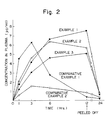
- Test 2 The measurement of 4-biphenylylacetic acid concentration in rat plasma (1)
- Wister strain male rats (body weight: 140-160 g), 5 per group.
- transdermal patches prepared in Examples 1, 2, 3 and Comparative Example 2 (3 x 3 cm2 in size) were administered to the test animals (one per animal).
- the gel-type ointment prepared in Comparative Example 1 was administered to another group of the test animals at a rate of 100 mg per animal.
- transdermal patch or gel-type ointment was applied to the epilated back of those rats. Then 4-biphenylylacetic acid concentration in their plasma was measured by HPLC method immediately thereafter, and at 1, 3, 6, 12 and 24 hours after the application.
- the patches were removed at 12 hours after the application, while the gel-type ointment was left intact.
- Wister strain male rats (body weight: 140-160 g), 5 per group.
- Example 1 The patches prepared in Example 1 and Comparative Example 3, (3 x 3 cm2 in size) were administered to the experimental animals (one per animal).
- the gel-type ointment prepared in Comparative Example 1 was administered at a rate of 200 mg per test animal.
- the 4-biphenylylacetic acid concentration in rat plasma was measured in substantially the same manner as described in Test 2.
- the test results are shown in FIG. 3.
- the patches of Comparative Example 3 contained no crotamiton.
- the patch containing crotamiton (Example 1) showed higher concentration of 4-biphenylylacetic acid in plasma of the experimental rats compared with that of the rats applied with the patch without crotamiton (Comparative Example 3).
- Test samples were stored at 40° C, 75 % (humidity) for 0, 1, 2 and 4 months, and the changes in their adhesive strength was examined.
- the adhesive strength was tested by the method described in "DRUG APPROVAL AND LICENSING PROCEDURES IN JAPAN 1989", p62.
- the adhesive strength was evaluated on the basis of diameter of steel balls which stopped on the adhesive surface of each test sample.
- the patches prepared in Examples 1 to 3 of this invention showed excellent adhesive strength after storage at 40°C, 75 % (humidity) for 4 months.
Landscapes
- Health & Medical Sciences (AREA)
- Chemical & Material Sciences (AREA)
- Life Sciences & Earth Sciences (AREA)
- General Health & Medical Sciences (AREA)
- Public Health (AREA)
- Medicinal Chemistry (AREA)
- Pharmacology & Pharmacy (AREA)
- Veterinary Medicine (AREA)
- Animal Behavior & Ethology (AREA)
- Epidemiology (AREA)
- Engineering & Computer Science (AREA)
- Bioinformatics & Cheminformatics (AREA)
- Dermatology (AREA)
- Chemical Kinetics & Catalysis (AREA)
- General Chemical & Material Sciences (AREA)
- Oil, Petroleum & Natural Gas (AREA)
- Proteomics, Peptides & Aminoacids (AREA)
- Pain & Pain Management (AREA)
- Rheumatology (AREA)
- Nuclear Medicine, Radiotherapy & Molecular Imaging (AREA)
- Organic Chemistry (AREA)
- Acyclic And Carbocyclic Compounds In Medicinal Compositions (AREA)
- Medicinal Preparation (AREA)
Applications Claiming Priority (2)
| Application Number | Priority Date | Filing Date | Title |
|---|---|---|---|
| JP332599/89 | 1989-12-25 | ||
| JP1332599A JP2839164B2 (ja) | 1989-12-25 | 1989-12-25 | 消炎鎮痛貼付剤 |
Publications (3)
| Publication Number | Publication Date |
|---|---|
| EP0436217A2 true EP0436217A2 (de) | 1991-07-10 |
| EP0436217A3 EP0436217A3 (en) | 1991-09-25 |
| EP0436217B1 EP0436217B1 (de) | 1995-04-05 |
Family
ID=18256747
Family Applications (1)
| Application Number | Title | Priority Date | Filing Date |
|---|---|---|---|
| EP90125524A Expired - Lifetime EP0436217B1 (de) | 1989-12-25 | 1990-12-27 | Schmerzstillendes und entzündungshemmendes Pflaster |
Country Status (10)
| Country | Link |
|---|---|
| US (1) | US5116621A (de) |
| EP (1) | EP0436217B1 (de) |
| JP (1) | JP2839164B2 (de) |
| KR (1) | KR0180007B1 (de) |
| AT (1) | ATE120648T1 (de) |
| CA (1) | CA2033122C (de) |
| DE (1) | DE69018424T2 (de) |
| DK (1) | DK0436217T3 (de) |
| ES (1) | ES2070261T3 (de) |
| GR (1) | GR3015812T3 (de) |
Cited By (7)
| Publication number | Priority date | Publication date | Assignee | Title |
|---|---|---|---|---|
| EP0622074A1 (de) * | 1993-04-28 | 1994-11-02 | Saitama Daiichi Pharmaceutical Co., Ltd. | Transdermale Mittel mit Butyrophenon |
| WO1998008966A1 (en) | 1996-08-26 | 1998-03-05 | Sankyo Company, Limited | Loxoprofen-containing preparation for external use |
| EP0757910A4 (de) * | 1994-04-21 | 1998-05-27 | Hisamitsu Pharmaceutical Co | Transdermal verabreichbare grundlage und daraus hergestelltes transdermal verabreichbares arzneimittel |
| US6211296B1 (en) | 1998-11-05 | 2001-04-03 | The B. F. Goodrich Company | Hydrogels containing substances |
| EP1072261A3 (de) * | 1999-07-30 | 2001-05-16 | Hisamitsu Pharmaceutical Co., Inc. | Felbinac enthaltendes Pflaster |
| EP1300143A4 (de) * | 2000-06-01 | 2005-12-07 | Teikoku Seiyaku Kk | Pflaster mit 4-biphenylessigsäure |
| EP3520783A1 (de) * | 2018-01-30 | 2019-08-07 | Nitto Denko Corporation | Präparat zur transdermalen absorption |
Families Citing this family (38)
| Publication number | Priority date | Publication date | Assignee | Title |
|---|---|---|---|---|
| US5462744A (en) * | 1989-12-01 | 1995-10-31 | Boehringer Ingelheim Kg | Transdermal system for the administration of pharmacological compounds under pH-controlled conditions |
| US5902600A (en) * | 1992-12-21 | 1999-05-11 | Healthpoint, Ltd. | Hydrogel polymer wound dressing |
| US5409691A (en) * | 1993-10-18 | 1995-04-25 | Swain; Dan E. | Solution comprising aluminum acetate and glycerin |
| US5800832A (en) * | 1996-10-18 | 1998-09-01 | Virotex Corporation | Bioerodable film for delivery of pharmaceutical compounds to mucosal surfaces |
| JPH10265374A (ja) * | 1997-03-24 | 1998-10-06 | Saitama Daiichi Seiyaku Kk | 外用剤組成物及びその製造方法 |
| US20050048102A1 (en) * | 1997-10-16 | 2005-03-03 | Virotex Corporation | Pharmaceutical carrier device suitable for delivery of pharmaceutical compounds to mucosal surfaces |
| US6698162B2 (en) * | 2000-03-23 | 2004-03-02 | Teikoku Pharma Usa, Inc. | Methods of producing a terminally sterilized topical patch preparation |
| US20030216758A1 (en) * | 2001-12-28 | 2003-11-20 | Angiotech Pharmaceuticals, Inc. | Coated surgical patches |
| TWI412570B (zh) * | 2004-04-27 | 2013-10-21 | Showa Denko Kk | Adhesive for patch and method for producing the same |
| TWI414320B (zh) * | 2004-05-13 | 2013-11-11 | 久光製藥股份有限公司 | 含有非類固醇系消炎鎮痛劑之外用經皮製劑 |
| ES2577390T3 (es) | 2006-07-21 | 2016-07-14 | Biodelivery Sciences International, Inc. | Dispositivos de administración transmucosa con mayor captación |
| KR100867262B1 (ko) | 2007-01-17 | 2008-11-06 | 대화제약 주식회사 | 펠비낙을 함유하는 플라스터 조성물 |
| US20110319399A1 (en) * | 2009-03-11 | 2011-12-29 | Kowa Co., Ltd. | External preparation containing analgesic/anti-inflammatory agent |
| US9549842B2 (en) | 2011-02-04 | 2017-01-24 | Joseph E. Kovarik | Buccal bioadhesive strip and method of treating snoring and sleep apnea |
| US8701671B2 (en) | 2011-02-04 | 2014-04-22 | Joseph E. Kovarik | Non-surgical method and system for reducing snoring |
| US11844720B2 (en) | 2011-02-04 | 2023-12-19 | Seed Health, Inc. | Method and system to reduce the likelihood of dental caries and halitosis |
| US11998479B2 (en) | 2011-02-04 | 2024-06-04 | Seed Health, Inc. | Method and system for addressing adverse effects on the oral microbiome and restoring gingival health caused by sodium lauryl sulphate exposure |
| US12257272B2 (en) | 2015-12-24 | 2025-03-25 | Seed Health, Inc. | Method and system for reducing the likelihood of developing depression in an individual |
| US11951139B2 (en) | 2015-11-30 | 2024-04-09 | Seed Health, Inc. | Method and system for reducing the likelihood of osteoporosis |
| US12533312B2 (en) | 2011-02-04 | 2026-01-27 | Seed Health, Inc. | Method and system for preventing sore throat in humans |
| US12279989B2 (en) | 2011-02-04 | 2025-04-22 | Seed Health, Inc. | Method and system for increasing beneficial bacteria and decreasing pathogenic bacteria in the oral cavity |
| US11951140B2 (en) | 2011-02-04 | 2024-04-09 | Seed Health, Inc. | Modulation of an individual's gut microbiome to address osteoporosis and bone disease |
| MX352959B (es) | 2011-08-18 | 2017-12-15 | Biodelivery Sciences Int Inc | Dispositivos mucoadhesivos resistentes al abuso para el suministro de buprenorfina. |
| US9901539B2 (en) | 2011-12-21 | 2018-02-27 | Biodelivery Sciences International, Inc. | Transmucosal drug delivery devices for use in chronic pain relief |
| JP2012144562A (ja) * | 2012-04-17 | 2012-08-02 | Teikoku Seiyaku Co Ltd | 貼付剤 |
| JP5949285B2 (ja) * | 2012-07-31 | 2016-07-06 | ライオン株式会社 | 貼付剤 |
| JP6893086B2 (ja) | 2013-03-13 | 2021-06-23 | エーブリー デニソン コーポレイション | 接着特性の向上 |
| US11833177B2 (en) | 2013-12-20 | 2023-12-05 | Seed Health, Inc. | Probiotic to enhance an individual's skin microbiome |
| US11826388B2 (en) | 2013-12-20 | 2023-11-28 | Seed Health, Inc. | Topical application of Lactobacillus crispatus to ameliorate barrier damage and inflammation |
| US11980643B2 (en) | 2013-12-20 | 2024-05-14 | Seed Health, Inc. | Method and system to modify an individual's gut-brain axis to provide neurocognitive protection |
| US11839632B2 (en) | 2013-12-20 | 2023-12-12 | Seed Health, Inc. | Topical application of CRISPR-modified bacteria to treat acne vulgaris |
| US11998574B2 (en) | 2013-12-20 | 2024-06-04 | Seed Health, Inc. | Method and system for modulating an individual's skin microbiome |
| US12005085B2 (en) | 2013-12-20 | 2024-06-11 | Seed Health, Inc. | Probiotic method and composition for maintaining a healthy vaginal microbiome |
| US12246043B2 (en) | 2013-12-20 | 2025-03-11 | Seed Health, Inc. | Topical application to treat acne vulgaris |
| US11969445B2 (en) | 2013-12-20 | 2024-04-30 | Seed Health, Inc. | Probiotic composition and method for controlling excess weight, obesity, NAFLD and NASH |
| US12329783B2 (en) | 2013-12-20 | 2025-06-17 | Seed Health, Inc. | Method and system to improve the health of a person's skin microbiome |
| JP7811853B2 (ja) * | 2021-01-29 | 2026-02-06 | 花王株式会社 | 外用剤組成物 |
| CN116723865A (zh) * | 2021-01-29 | 2023-09-08 | 花王株式会社 | 外用剂组合物 |
Family Cites Families (9)
| Publication number | Priority date | Publication date | Assignee | Title |
|---|---|---|---|---|
| JPS5842168B2 (ja) * | 1974-12-20 | 1983-09-17 | トウコウヤクヒンコウギヨウ カブシキガイシヤ | 局所用剤の製造方法 |
| JPS59222409A (ja) * | 1983-06-01 | 1984-12-14 | Nippon Redarii Kk | 消炎鎮痛ゲル軟膏剤 |
| JPS60188315A (ja) * | 1984-03-07 | 1985-09-25 | Yamanouchi Pharmaceut Co Ltd | グリチルレチン酸配合鎮痒プラスター |
| JPS60209515A (ja) * | 1984-04-03 | 1985-10-22 | Hokuriku Seiyaku Co Ltd | 消炎鎮痛クリ−ム剤 |
| US4954343A (en) * | 1986-03-29 | 1990-09-04 | Nitto Electric Industrial Co., Ltd. | Dermal pharmaceutical preparations |
| AU607172B2 (en) * | 1986-12-22 | 1991-02-28 | Cygnus, Inc. | Diffusion matrix for transdermal drug administration |
| JPH0696529B2 (ja) * | 1987-03-31 | 1994-11-30 | 積水化学工業株式会社 | ニトログリセリン貼付剤およびその製造方法 |
| EP0303445A1 (de) * | 1987-08-13 | 1989-02-15 | Walton S.A. | Pflaster zur transdermalen Applikation von Cleboprid |
| GB2217595B (en) * | 1988-04-21 | 1991-11-20 | American Cyanamid Co | Antiinflammatory gel |
-
1989
- 1989-12-25 JP JP1332599A patent/JP2839164B2/ja not_active Expired - Fee Related
-
1990
- 1990-12-24 US US07/633,146 patent/US5116621A/en not_active Expired - Lifetime
- 1990-12-24 KR KR1019900021645A patent/KR0180007B1/ko not_active Expired - Lifetime
- 1990-12-24 CA CA002033122A patent/CA2033122C/en not_active Expired - Lifetime
- 1990-12-27 DK DK90125524.0T patent/DK0436217T3/da active
- 1990-12-27 DE DE69018424T patent/DE69018424T2/de not_active Expired - Lifetime
- 1990-12-27 AT AT90125524T patent/ATE120648T1/de not_active IP Right Cessation
- 1990-12-27 EP EP90125524A patent/EP0436217B1/de not_active Expired - Lifetime
- 1990-12-27 ES ES90125524T patent/ES2070261T3/es not_active Expired - Lifetime
-
1995
- 1995-04-17 GR GR950400942T patent/GR3015812T3/el unknown
Cited By (11)
| Publication number | Priority date | Publication date | Assignee | Title |
|---|---|---|---|---|
| EP0622074A1 (de) * | 1993-04-28 | 1994-11-02 | Saitama Daiichi Pharmaceutical Co., Ltd. | Transdermale Mittel mit Butyrophenon |
| EP0757910A4 (de) * | 1994-04-21 | 1998-05-27 | Hisamitsu Pharmaceutical Co | Transdermal verabreichbare grundlage und daraus hergestelltes transdermal verabreichbares arzneimittel |
| WO1998008966A1 (en) | 1996-08-26 | 1998-03-05 | Sankyo Company, Limited | Loxoprofen-containing preparation for external use |
| EP0947584A4 (de) * | 1996-08-26 | 2002-10-23 | Lead Chem Co Ltd | Loxoprofen-enthaltende Herstellung zur äusserlichen Anwendung |
| US6211296B1 (en) | 1998-11-05 | 2001-04-03 | The B. F. Goodrich Company | Hydrogels containing substances |
| US6723781B1 (en) | 1998-11-05 | 2004-04-20 | Noveon Ip Holdings Corp. | Hydrogels containing substances |
| EP1072261A3 (de) * | 1999-07-30 | 2001-05-16 | Hisamitsu Pharmaceutical Co., Inc. | Felbinac enthaltendes Pflaster |
| EP1300143A4 (de) * | 2000-06-01 | 2005-12-07 | Teikoku Seiyaku Kk | Pflaster mit 4-biphenylessigsäure |
| US7094421B2 (en) | 2000-06-01 | 2006-08-22 | Teikoku Seiyaki Co., Ltd. | Plaster containing 4-biphenylacetic acid |
| EP3520783A1 (de) * | 2018-01-30 | 2019-08-07 | Nitto Denko Corporation | Präparat zur transdermalen absorption |
| US11253484B2 (en) | 2018-01-30 | 2022-02-22 | Nitto Denko Corporation | Transdermal absorption preparation |
Also Published As
| Publication number | Publication date |
|---|---|
| KR910011248A (ko) | 1991-08-07 |
| DE69018424D1 (de) | 1995-05-11 |
| JP2839164B2 (ja) | 1998-12-16 |
| ES2070261T3 (es) | 1995-06-01 |
| US5116621A (en) | 1992-05-26 |
| CA2033122A1 (en) | 1991-06-26 |
| CA2033122C (en) | 2003-08-19 |
| KR0180007B1 (ko) | 1999-03-20 |
| EP0436217B1 (de) | 1995-04-05 |
| DK0436217T3 (da) | 1995-05-01 |
| ATE120648T1 (de) | 1995-04-15 |
| JPH03193728A (ja) | 1991-08-23 |
| GR3015812T3 (en) | 1995-07-31 |
| EP0436217A3 (en) | 1991-09-25 |
| DE69018424T2 (de) | 1995-09-21 |
Similar Documents
| Publication | Publication Date | Title |
|---|---|---|
| EP0436217B1 (de) | Schmerzstillendes und entzündungshemmendes Pflaster | |
| JP3526887B2 (ja) | 消炎鎮痛外用貼付剤 | |
| EP0974350B1 (de) | Tranilast enthaltendes externum und verfahren zu dessen herstellung | |
| DE69524614T2 (de) | Arzneimittelbestandteile einschliesslich eines n-substituierten o-toluidinderivats und transdermal absorbierbare zubereitung | |
| US20030072814A1 (en) | Topical pharmaceutical composition for the treatment of warts | |
| WO1989009051A1 (en) | Deprenyl for systemic transdermal administration | |
| JP2011231125A (ja) | 改良された経皮的避妊薬送達系および方法 | |
| EP0101178A2 (de) | Topische antiinflammatorische Mittel | |
| LV13303B (en) | Pharmaceutical composition | |
| US4440778A (en) | Anti-inflammatory analgesic cataplasm and process for producing the same | |
| JPS60152413A (ja) | メントールにより経皮性薬剤放出の強化を行なつた局所用組成物 | |
| US6685959B1 (en) | Pharmaceutical compositions comprising 2-isoxazoles-8-aminotetralin derivatives | |
| CN101700246A (zh) | 复合避孕组合物以及含有该组合物的避孕透皮贴剂及制法 | |
| JP3170304B2 (ja) | エペリゾンまたはトルペリゾン経皮吸収製剤 | |
| US20100158990A1 (en) | Transdermal method and patch for corticosteroid administration | |
| CN1414856A (zh) | 治疗瘙痒的外用制剂 | |
| JP3193161B2 (ja) | 経皮吸収性製剤 | |
| JP3477211B2 (ja) | ケトロラック含有リザーバー型貼付剤 | |
| CN117899056A (zh) | 含利多卡因的透皮贴剂及其制备方法和用途 | |
| JP2001131085A (ja) | 経皮・経粘膜吸収用の医薬組成物 | |
| US20040197397A1 (en) | Drug delivery system for treatment of urinary incontinence | |
| KR20020037616A (ko) | 케토롤락의 경피흡수제제 | |
| KR100732948B1 (ko) | 국소마취용 패취 | |
| JP2005529150A (ja) | 気管支拡張薬を有するマトリックスタイプパッチ | |
| CN117797125B (zh) | 含有秋水仙碱的贴剂及其制备方法和应用 |
Legal Events
| Date | Code | Title | Description |
|---|---|---|---|
| PUAI | Public reference made under article 153(3) epc to a published international application that has entered the european phase |
Free format text: ORIGINAL CODE: 0009012 |
|
| AK | Designated contracting states |
Kind code of ref document: A2 Designated state(s): AT BE CH DE DK ES FR GB GR IT LI LU NL SE |
|
| PUAL | Search report despatched |
Free format text: ORIGINAL CODE: 0009013 |
|
| AK | Designated contracting states |
Kind code of ref document: A3 Designated state(s): AT BE CH DE DK ES FR GB GR IT LI LU NL SE |
|
| 17P | Request for examination filed |
Effective date: 19920228 |
|
| 17Q | First examination report despatched |
Effective date: 19920929 |
|
| GRAA | (expected) grant |
Free format text: ORIGINAL CODE: 0009210 |
|
| ITF | It: translation for a ep patent filed | ||
| RAP1 | Party data changed (applicant data changed or rights of an application transferred) |
Owner name: LEDERLE (JAPAN), LTD. Owner name: TEIKOKU SEIYAKU KABUSHIKI KAISHA |
|
| AK | Designated contracting states |
Kind code of ref document: B1 Designated state(s): AT BE CH DE DK ES FR GB GR IT LI LU NL SE |
|
| RAP1 | Party data changed (applicant data changed or rights of an application transferred) |
Owner name: LEDERLE (JAPAN), LTD. Owner name: TEIKOKU SEIYAKU CO., LTD. |
|
| REF | Corresponds to: |
Ref document number: 120648 Country of ref document: AT Date of ref document: 19950415 Kind code of ref document: T |
|
| REG | Reference to a national code |
Ref country code: DK Ref legal event code: T3 |
|
| REF | Corresponds to: |
Ref document number: 69018424 Country of ref document: DE Date of ref document: 19950511 |
|
| REG | Reference to a national code |
Ref country code: ES Ref legal event code: FG2A Ref document number: 2070261 Country of ref document: ES Kind code of ref document: T3 |
|
| REG | Reference to a national code |
Ref country code: GR Ref legal event code: FG4A Free format text: 3015812 |
|
| ET | Fr: translation filed | ||
| PLBE | No opposition filed within time limit |
Free format text: ORIGINAL CODE: 0009261 |
|
| STAA | Information on the status of an ep patent application or granted ep patent |
Free format text: STATUS: NO OPPOSITION FILED WITHIN TIME LIMIT |
|
| 26N | No opposition filed | ||
| REG | Reference to a national code |
Ref country code: FR Ref legal event code: CD |
|
| REG | Reference to a national code |
Ref country code: CH Ref legal event code: PFA Free format text: LEDERLE (JAPAN) LTD;TEIKOKU SEIYAKU KABUSHIKI KAISHA TRANSFER- TEIKOKU SEIYAKU KABUSHIKI KAISHA;WYETH LEDERLE JAPAN LTD. |
|
| NLT1 | Nl: modifications of names registered in virtue of documents presented to the patent office pursuant to art. 16 a, paragraph 1 |
Owner name: TEIKOKU SEIYAKU CO., LTD.;WYETH LEDERLE JAPAN, LTD |
|
| REG | Reference to a national code |
Ref country code: GB Ref legal event code: IF02 |
|
| REG | Reference to a national code |
Ref country code: CH Ref legal event code: PFA Owner name: TEIKOKU SEIYAKU KABUSHIKI KAISHA Free format text: TEIKOKU SEIYAKU KABUSHIKI KAISHA#567 SANBONMATSU OUCHI-CHO#OKAWA-GUN/KAGAWA-KEN (JP) $ WYETH LEDERLE JAPAN LTD.#10-3, KYOBASHI 1-CHOME#CHUO-KU, TOKYO (JP) -TRANSFER TO- TEIKOKU SEIYAKU KABUSHIKI KAISHA#567 SANBONMATSU OUCHI-CHO#OKAWA-GUN/KAGAWA-KEN (JP) $ WYETH K.K.#10-3, KYOBASHI 1-CHOME#CHUO-KU, TOKYO (JP) |
|
| BECN | Be: change of holder's name |
Owner name: *TEIKOKU SEIYAKU CO., LTD. Effective date: 20051019 Owner name: *WYETH KABUSHIKI KAISHA Effective date: 20051019 |
|
| NLT1 | Nl: modifications of names registered in virtue of documents presented to the patent office pursuant to art. 16 a, paragraph 1 |
Owner name: WYETH K.K. Owner name: TEIKOKU SEIYAKU CO., LTD. |
|
| REG | Reference to a national code |
Ref country code: FR Ref legal event code: CD |
|
| REG | Reference to a national code |
Ref country code: ES Ref legal event code: PC2A |
|
| BECN | Be: change of holder's name |
Owner name: *WYETH KABUSHIKI KAISHA Effective date: 20051019 Owner name: *TEIKOKU SEIYAKU CO., LTD. Effective date: 20051019 |
|
| PGFP | Annual fee paid to national office [announced via postgrant information from national office to epo] |
Ref country code: DK Payment date: 20091215 Year of fee payment: 20 Ref country code: CH Payment date: 20091208 Year of fee payment: 20 Ref country code: SE Payment date: 20091207 Year of fee payment: 20 Ref country code: ES Payment date: 20091203 Year of fee payment: 20 Ref country code: AT Payment date: 20091124 Year of fee payment: 20 Ref country code: LU Payment date: 20091222 Year of fee payment: 20 |
|
| PGFP | Annual fee paid to national office [announced via postgrant information from national office to epo] |
Ref country code: NL Payment date: 20091222 Year of fee payment: 20 |
|
| PGFP | Annual fee paid to national office [announced via postgrant information from national office to epo] |
Ref country code: FR Payment date: 20091221 Year of fee payment: 20 Ref country code: IT Payment date: 20091203 Year of fee payment: 20 Ref country code: GB Payment date: 20091223 Year of fee payment: 20 |
|
| PGFP | Annual fee paid to national office [announced via postgrant information from national office to epo] |
Ref country code: GR Payment date: 20091119 Year of fee payment: 20 Ref country code: DE Payment date: 20091126 Year of fee payment: 20 Ref country code: BE Payment date: 20100104 Year of fee payment: 20 |
|
| BE20 | Be: patent expired |
Owner name: *TEIKOKU SEIYAKU CO., LTD. Effective date: 20101227 Owner name: *WYETH KABUSHIKI KAISHA Effective date: 20101227 |
|
| REG | Reference to a national code |
Ref country code: NL Ref legal event code: V4 Effective date: 20101227 |
|
| REG | Reference to a national code |
Ref country code: CH Ref legal event code: PL |
|
| REG | Reference to a national code |
Ref country code: DK Ref legal event code: EUP |
|
| REG | Reference to a national code |
Ref country code: GB Ref legal event code: PE20 Expiry date: 20101226 |
|
| EUG | Se: european patent has lapsed | ||
| PG25 | Lapsed in a contracting state [announced via postgrant information from national office to epo] |
Ref country code: NL Free format text: LAPSE BECAUSE OF EXPIRATION OF PROTECTION Effective date: 20101227 Ref country code: GB Free format text: LAPSE BECAUSE OF EXPIRATION OF PROTECTION Effective date: 20101226 |
|
| PG25 | Lapsed in a contracting state [announced via postgrant information from national office to epo] |
Ref country code: DE Free format text: LAPSE BECAUSE OF EXPIRATION OF PROTECTION Effective date: 20101227 |
|
| REG | Reference to a national code |
Ref country code: ES Ref legal event code: FD2A Effective date: 20140826 |
|
| PG25 | Lapsed in a contracting state [announced via postgrant information from national office to epo] |
Ref country code: ES Free format text: LAPSE BECAUSE OF EXPIRATION OF PROTECTION Effective date: 20101228 |
|
| REG | Reference to a national code |
Ref country code: GR Ref legal event code: MA Ref document number: 950400942 Country of ref document: GR Effective date: 20101228 |