EP0442718B1 - Verfahren zum Herstellen einer Halbleitervorrichtung - Google Patents
Verfahren zum Herstellen einer Halbleitervorrichtung Download PDFInfo
- Publication number
- EP0442718B1 EP0442718B1 EP91301156A EP91301156A EP0442718B1 EP 0442718 B1 EP0442718 B1 EP 0442718B1 EP 91301156 A EP91301156 A EP 91301156A EP 91301156 A EP91301156 A EP 91301156A EP 0442718 B1 EP0442718 B1 EP 0442718B1
- Authority
- EP
- European Patent Office
- Prior art keywords
- layer
- conductive layer
- forming
- sio
- vapor deposition
- Prior art date
- Legal status (The legal status is an assumption and is not a legal conclusion. Google has not performed a legal analysis and makes no representation as to the accuracy of the status listed.)
- Expired - Lifetime
Links
Images







Classifications
-
- H—ELECTRICITY
- H10—SEMICONDUCTOR DEVICES; ELECTRIC SOLID-STATE DEVICES NOT OTHERWISE PROVIDED FOR
- H10P—GENERIC PROCESSES OR APPARATUS FOR THE MANUFACTURE OR TREATMENT OF DEVICES COVERED BY CLASS H10
- H10P14/00—Formation of materials, e.g. in the shape of layers or pillars
- H10P14/60—Formation of materials, e.g. in the shape of layers or pillars of insulating materials
- H10P14/69—Inorganic materials
- H10P14/694—Inorganic materials composed of nitrides
- H10P14/6943—Inorganic materials composed of nitrides containing silicon
- H10P14/69433—Inorganic materials composed of nitrides containing silicon the material being a silicon nitride not containing oxygen, e.g. SixNy or SixByNz
-
- H—ELECTRICITY
- H10—SEMICONDUCTOR DEVICES; ELECTRIC SOLID-STATE DEVICES NOT OTHERWISE PROVIDED FOR
- H10P—GENERIC PROCESSES OR APPARATUS FOR THE MANUFACTURE OR TREATMENT OF DEVICES COVERED BY CLASS H10
- H10P14/00—Formation of materials, e.g. in the shape of layers or pillars
- H10P14/60—Formation of materials, e.g. in the shape of layers or pillars of insulating materials
- H10P14/63—Formation of materials, e.g. in the shape of layers or pillars of insulating materials characterised by the formation processes
- H10P14/6302—Non-deposition formation processes
- H10P14/6304—Formation by oxidation, e.g. oxidation of the substrate
- H10P14/6306—Formation by oxidation, e.g. oxidation of the substrate of the semiconductor materials
- H10P14/6308—Formation by oxidation, e.g. oxidation of the substrate of the semiconductor materials of Group IV semiconductors
- H10P14/6309—Formation by oxidation, e.g. oxidation of the substrate of the semiconductor materials of Group IV semiconductors of silicon in uncombined form, i.e. pure silicon
-
- H—ELECTRICITY
- H10—SEMICONDUCTOR DEVICES; ELECTRIC SOLID-STATE DEVICES NOT OTHERWISE PROVIDED FOR
- H10P—GENERIC PROCESSES OR APPARATUS FOR THE MANUFACTURE OR TREATMENT OF DEVICES COVERED BY CLASS H10
- H10P14/00—Formation of materials, e.g. in the shape of layers or pillars
- H10P14/60—Formation of materials, e.g. in the shape of layers or pillars of insulating materials
- H10P14/63—Formation of materials, e.g. in the shape of layers or pillars of insulating materials characterised by the formation processes
- H10P14/6302—Non-deposition formation processes
- H10P14/6316—Formation by nitridation, e.g. nitridation of the substrate
-
- H—ELECTRICITY
- H10—SEMICONDUCTOR DEVICES; ELECTRIC SOLID-STATE DEVICES NOT OTHERWISE PROVIDED FOR
- H10P—GENERIC PROCESSES OR APPARATUS FOR THE MANUFACTURE OR TREATMENT OF DEVICES COVERED BY CLASS H10
- H10P14/00—Formation of materials, e.g. in the shape of layers or pillars
- H10P14/60—Formation of materials, e.g. in the shape of layers or pillars of insulating materials
- H10P14/63—Formation of materials, e.g. in the shape of layers or pillars of insulating materials characterised by the formation processes
- H10P14/6302—Non-deposition formation processes
- H10P14/6319—Formation by plasma treatments, e.g. plasma oxidation of the substrate
-
- H—ELECTRICITY
- H10—SEMICONDUCTOR DEVICES; ELECTRIC SOLID-STATE DEVICES NOT OTHERWISE PROVIDED FOR
- H10P—GENERIC PROCESSES OR APPARATUS FOR THE MANUFACTURE OR TREATMENT OF DEVICES COVERED BY CLASS H10
- H10P14/00—Formation of materials, e.g. in the shape of layers or pillars
- H10P14/60—Formation of materials, e.g. in the shape of layers or pillars of insulating materials
- H10P14/63—Formation of materials, e.g. in the shape of layers or pillars of insulating materials characterised by the formation processes
- H10P14/6326—Deposition processes
- H10P14/6328—Deposition from the gas or vapour phase
- H10P14/6334—Deposition from the gas or vapour phase using decomposition or reaction of gaseous or vapour phase compounds, i.e. chemical vapour deposition
-
- H—ELECTRICITY
- H10—SEMICONDUCTOR DEVICES; ELECTRIC SOLID-STATE DEVICES NOT OTHERWISE PROVIDED FOR
- H10P—GENERIC PROCESSES OR APPARATUS FOR THE MANUFACTURE OR TREATMENT OF DEVICES COVERED BY CLASS H10
- H10P14/00—Formation of materials, e.g. in the shape of layers or pillars
- H10P14/60—Formation of materials, e.g. in the shape of layers or pillars of insulating materials
- H10P14/63—Formation of materials, e.g. in the shape of layers or pillars of insulating materials characterised by the formation processes
- H10P14/6326—Deposition processes
- H10P14/6342—Liquid deposition, e.g. spin-coating, sol-gel techniques or spray coating
-
- H—ELECTRICITY
- H10—SEMICONDUCTOR DEVICES; ELECTRIC SOLID-STATE DEVICES NOT OTHERWISE PROVIDED FOR
- H10P—GENERIC PROCESSES OR APPARATUS FOR THE MANUFACTURE OR TREATMENT OF DEVICES COVERED BY CLASS H10
- H10P14/00—Formation of materials, e.g. in the shape of layers or pillars
- H10P14/60—Formation of materials, e.g. in the shape of layers or pillars of insulating materials
- H10P14/65—Formation of materials, e.g. in the shape of layers or pillars of insulating materials characterised by treatments performed before or after the formation of the materials
- H10P14/6516—Formation of materials, e.g. in the shape of layers or pillars of insulating materials characterised by treatments performed before or after the formation of the materials of treatments performed after formation of the materials
- H10P14/6529—Formation of materials, e.g. in the shape of layers or pillars of insulating materials characterised by treatments performed before or after the formation of the materials of treatments performed after formation of the materials by exposure to a gas or vapour
- H10P14/6532—Formation of materials, e.g. in the shape of layers or pillars of insulating materials characterised by treatments performed before or after the formation of the materials of treatments performed after formation of the materials by exposure to a gas or vapour by exposure to a plasma
-
- H—ELECTRICITY
- H10—SEMICONDUCTOR DEVICES; ELECTRIC SOLID-STATE DEVICES NOT OTHERWISE PROVIDED FOR
- H10P—GENERIC PROCESSES OR APPARATUS FOR THE MANUFACTURE OR TREATMENT OF DEVICES COVERED BY CLASS H10
- H10P14/00—Formation of materials, e.g. in the shape of layers or pillars
- H10P14/60—Formation of materials, e.g. in the shape of layers or pillars of insulating materials
- H10P14/66—Formation of materials, e.g. in the shape of layers or pillars of insulating materials characterised by the type of materials
- H10P14/662—Laminate layers, e.g. stacks of alternating high-k metal oxides
-
- H—ELECTRICITY
- H10—SEMICONDUCTOR DEVICES; ELECTRIC SOLID-STATE DEVICES NOT OTHERWISE PROVIDED FOR
- H10P—GENERIC PROCESSES OR APPARATUS FOR THE MANUFACTURE OR TREATMENT OF DEVICES COVERED BY CLASS H10
- H10P14/00—Formation of materials, e.g. in the shape of layers or pillars
- H10P14/60—Formation of materials, e.g. in the shape of layers or pillars of insulating materials
- H10P14/66—Formation of materials, e.g. in the shape of layers or pillars of insulating materials characterised by the type of materials
- H10P14/668—Formation of materials, e.g. in the shape of layers or pillars of insulating materials characterised by the type of materials the materials being characterised by the deposition precursor materials
- H10P14/6681—Formation of materials, e.g. in the shape of layers or pillars of insulating materials characterised by the type of materials the materials being characterised by the deposition precursor materials the precursor containing a compound comprising Si
-
- H—ELECTRICITY
- H10—SEMICONDUCTOR DEVICES; ELECTRIC SOLID-STATE DEVICES NOT OTHERWISE PROVIDED FOR
- H10W—GENERIC PACKAGES, INTERCONNECTIONS, CONNECTORS OR OTHER CONSTRUCTIONAL DETAILS OF DEVICES COVERED BY CLASS H10
- H10W20/00—Interconnections in chips, wafers or substrates
- H10W20/01—Manufacture or treatment
- H10W20/031—Manufacture or treatment of conductive parts of the interconnections
- H10W20/056—Manufacture or treatment of conductive parts of the interconnections by filling conductive material into holes, grooves or trenches
- H10W20/057—Manufacture or treatment of conductive parts of the interconnections by filling conductive material into holes, grooves or trenches by selectively depositing, e.g. by using selective CVD or plating
-
- H—ELECTRICITY
- H10—SEMICONDUCTOR DEVICES; ELECTRIC SOLID-STATE DEVICES NOT OTHERWISE PROVIDED FOR
- H10P—GENERIC PROCESSES OR APPARATUS FOR THE MANUFACTURE OR TREATMENT OF DEVICES COVERED BY CLASS H10
- H10P14/00—Formation of materials, e.g. in the shape of layers or pillars
- H10P14/60—Formation of materials, e.g. in the shape of layers or pillars of insulating materials
- H10P14/69—Inorganic materials
- H10P14/692—Inorganic materials composed of oxides, glassy oxides or oxide-based glasses
- H10P14/6921—Inorganic materials composed of oxides, glassy oxides or oxide-based glasses containing silicon
- H10P14/69215—Inorganic materials composed of oxides, glassy oxides or oxide-based glasses containing silicon the material being a silicon oxide, e.g. SiO2
-
- Y—GENERAL TAGGING OF NEW TECHNOLOGICAL DEVELOPMENTS; GENERAL TAGGING OF CROSS-SECTIONAL TECHNOLOGIES SPANNING OVER SEVERAL SECTIONS OF THE IPC; TECHNICAL SUBJECTS COVERED BY FORMER USPC CROSS-REFERENCE ART COLLECTIONS [XRACs] AND DIGESTS
- Y10—TECHNICAL SUBJECTS COVERED BY FORMER USPC
- Y10S—TECHNICAL SUBJECTS COVERED BY FORMER USPC CROSS-REFERENCE ART COLLECTIONS [XRACs] AND DIGESTS
- Y10S148/00—Metal treatment
- Y10S148/117—Oxidation, selective
Definitions
- the present invention relates to a semiconductor technique for realising, e.g. a transistor or a multi-layered wiring structure having a size of the order of submicrometers and, more particularly, to a semiconductor device using a self-alignment technique and a method of manufacturing the same.
- JP-1,194,440 describes a method of forming an interconnection layer and in particular to facilitate multi-layer interconnection by forming an insulation film between layers by forming a groove for the interconnection layer in the insulating film, selectively burying the interconnection material in the groove and then flattening the shape of the surface of the inter layer insulating film.
- LSI large-scale integrated circuit formed by integrating a large number of transistors or resistors on a single chip is often used in a main part of a computer or communication equipment.
- a semiconductor device e.g., a field-effect transistor which constitutes a basic element of the LSI.
- a required precision is as very strict as 10 to 20 nm which is close to a physical limit of lithography.
- a space between adjacent wiring patterns is limited by an interval between the contact holes.
- the widths of the element formation region, the contact hole, and the wiring can be the same, and so the interwiring space is not locally narrowed to effectively reduce the interwiring capacitance.
- a space can be reduced in a region where the interwiring capacitance need not be taken into consideration.
- a cell size can be decreased to realize element integration at a higher density. No practical manufacturing method, however, has been proposed so far.
- an oxide film in an isolation region grows by exudation toward an element, and bird's beaks are formed. That is, regardless of the fact that an element region is covered with a nitride film mask, an oxidizing agent exudes under the mask to progress oxidation although an oxidation rate is decreased.
- polycrystalline Si may be interposed between the nitride film and a buffer oxide film, thereby reducing the degree of bird's beaks.
- a microelement having a Submicrometer size e.g., a micro field-effect transistor (FET) having a submicrometer size has a shallow diffusion layer such as a source.drain region.
- FET micro field-effect transistor
- a junction depth required for a 0.5- ⁇ m generation device is 0.15 to 0.2 ⁇ m, and that required for a 0.2- ⁇ m generation device is 0.1 ⁇ m or less. That is, a diffusing technique with higher precision is required.
- a shallow diffusion layer As a method of forming a shallow diffusion layer, a low-acceleration ion-implantation method has been conventionally widely used, and an impurity solid-phase diffusion method is recently used.
- an impurity solid-phase diffusion method By this solid-phase diffusion method, a shallow source.drain region having a thickness of about 0.1 ⁇ m can be formed, and a depth of about 0.1 ⁇ m can be realized for an n + -p junction.
- a depth of about 0.1 ⁇ m can be achieved for a p + -n junction even after annealing for activation is performed.
- the resistance of a diffusion layer having a thickness of 0.1 ⁇ m is as high as a sheet resistance of 100 ⁇ /sq or more.
- the surface of a diffusion region must be metallized to decrease its resistance. For this reason, a selective silicidation method, so-called self-aligned silicide has been examined in recent years.
- a field oxide film 1a and a gate insulating film 2 are formed by thermal oxidation on an Si substrate 1 having (100) crystal orientation, gate electrodes 3a and 3b, an insulating film cap 4, and a side-wall insulating film 5 are formed, and a metal film 6 consisting of Ti or Co is deposited on the entire surface of the substrate.
- a silicide layer 7 is formed on only Si by lamp annealing, and a non-reacted metal film is removed by etching, thereby selectively leaving the silicide layer 7 on only Si, as shown in Fig. 1B.
- an impurity 8 having a conductivity type different from that of the substrate 1 is ion-implanted, as shown in Fig. 1C, and a diffusion region 9 is formed under the silicide layer 7, as shown in Fig. 1D.
- a sheet resistance can be reduced to be 3 to 5 ⁇ /sq.
- This method has the following problems. That is, if a natural oxide film or a surface contamination layer formed by dry etching is present on the Si surface, it is difficult to perform a uniform reaction between a metal and Si, and a nonuniform boundary structure is formed at the interface. In this case, electric field concentration locally occurs to increase a p-n junction leakage current, and a p-n junction may be destroyed accordingly. For this reason, it is very difficult to form a p-n junction having a depth of 0.1 ⁇ m or less with this method. In addition, a total thickness of 0.1 ⁇ m or less is required for a micro transistor having a design rule of 0.3 ⁇ m or less.
- the total thickness must be decreased to form a diffusion layer having a thickness of several tens nm.
- a resistance of a source ⁇ drain is increased, and p-n junction characteristics are degraded if the thickness of a diffusion layer becomes 50 nm or less.
- the reasons for this junction degradation are as follows. That is, a generation recombination center caused by metal diffusion from a metal compound adversely affects the junction characteristics and enters into a diffusion layer thickness region at which a junction leakage current starts increasing. Also, since the shape of a diffusion layer reflects projections and recesses on the silicide/Si interface when the thickness of the diffusion layer is decreased, electric field concentration easily occurs.
- a normal silicide process may be performed. Since doping cannot be perfectly performed depending on the thickness of selectively grown Si, however, a source ⁇ drain impurity diffusion layer does not reach the original substrate surface and therefore cannot serve as a source ⁇ drain. In order to form a shallow junction having a depth of 0.1 ⁇ m or less, therefore, it is required to form a metal silicide which does not erode the Si substrate and has a low resistance and to form a high-concentration impurity diffusion layer therebelow.
- a technique of forming plugs for plugging contact holes or via holes and a technique of forming an SiO 2 film having a high step coverage are required because projections and recesses are increased upon stacking wiring layers.
- a wiring layer having a low resistance and high reliability must be used.
- ozone may be added or a temperature range of 300°C to 350°C may be selected. These techniques, however, cannot be drastic measures. Therefore, a new oxide film deposition method is required for a device in a deep submicrometer region.
- an element isolation region e.g., a series of micropatterns such as a shallow p-n junction region, a silicided region of a source ⁇ drain, metal and metal/polySi gates, low-resistance wiring, and multilayered wiring.
- a mask alignment precision beyond a physical limit is required in lithography. If high-precision processing is required in etching, therefore, a degree of freedom of selection for materials is significantly decreased.
- the present invention has been made in consideration of the above situation and has as its object to provide a method of manufacturing a semiconductor device, capable of forming a wiring layer or an insulating film by using a self-aligned process without depending on a mask alignment or metal etching technique, thereby manufacturing a semiconductor device having a micropattern free from exudation.
- a micropattern such as wiring can be formed with high precision by using selective or anisotropic (directional) process techniques such as anisotropic (directional) selective CVD of SiO 2 , antisotropic (directional) or selective forming of a metal film.
- selective or anisotropic (directional) process techniques such as anisotropic (directional) selective CVD of SiO 2 , antisotropic (directional) or selective forming of a metal film.
- a method of manufacturing a semiconductor device comprising the steps of:
- Fig. 2 is a schematic sectional view showing an arrangement of a semiconductor device (multilayered wiring structure) manufactured by a method according to an embodiment of the present invention.
- metal silicide layers 12 which do not erode Si are formed in opening portions of a first insulating film 11 formed on a semiconductor substrate 10, and a first metal burying vertical wiring layer 13 is formed on each layer 12.
- a second insulating film 14 is formed on the resultant structure, and Cu wiring layers 15 having a low resistance, for example, are formed in opening portions of the film 14.
- a third insulating film 16 is formed on the resultant structure, and a second metal burying vertical wiring layer 17 is formed in an opening portion of the insulating film 16.
- a fourth insulating film 18 is formed on the resultant structure, and a second low-resistance wiring layer 19 is formed on a portion from which the insulating film 18 is removed.
- a fifth insulating film 21, a third metal burying vertical wiring layer 22, a sixth insulating film 23, and a third low-resistance wiring layer 24 are formed on the above structure, thereby completing a three-layered wiring structure.
- a 5- or 10-layered wiring structure can be formed by repeatedly forming this structure.
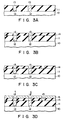
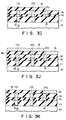
- Figs. 3A to 3K are sectional views showing the steps of the method of the present invention for manufacturing the above multilayered wiring structure.
- the first insulating film 11 is formed on the semiconductor substrate 10 having an element therein, and contact portions of the film 11 are opened.
- the metal silicide layer 12 is formed in each opening portion by a selective CVD method, and the first metal burying vertical wiring layer 13 consisting of, e.g., W or Cu is formed thereon by the selective CVD method.
- the SiO 2 film (second insulating film) 14 is formed on only the insulating film 11.
- windows are formed by lithography and etching in portions of the insulating film 14 requiring wiring.
- the first low-resistance wiring layer 15 such as a stacked structure of a barrier metal (e.g., TiN) and Cu is formed on the entire surface by an anisotropic CVD method using ions of metal atoms or molecules constituting the wiring.
- a barrier metal e.g., TiN
- Fig. 3E an unnecessary portion of the wiring layer 15 is removed by an etching-back method (a mirror-surface polishing method, reactive ion etching using a flattening agent such as a resist) or a lift-off method, thereby leaving the wiring in only a desired portion.
- etching-back method a mirror-surface polishing method, reactive ion etching using a flattening agent such as a resist
- a lift-off method thereby leaving the wiring in only a desired portion.
- the SiO 2 film (third insulating film) 16 is selectively formed on only the insulating film 14 by the selective CVD method.
- metal burying wiring layers 17a, 17b, and 17c consisting of W or Cu are formed by the selective CVD method.
- that surface of the metal burying wiring layers on which SiO 2 is to be deposited i.e., the surfaces of the wiring layers 17b and 17c are oxidized by a thickness of 10 to 20 nm.
- This oxidation may be performed by scanning an oxygen ion beam, ion-implanting oxygen. Alternatively, oxidation may be performed by oxidizing using a mask which withstands oxidation.
- the SiO 2 film (fourth insulating film) 18 is selectively grown on only the insulating film 16 and oxidized wiring layers by the selective CVD method.
- the SiO 2 film (fourth insulating film) 18 is selectively grown on only the insulating film 16 and oxidized wiring layers by the selective CVD method.
- an unnecessary portion of the insulating film 18 is removed by lithography and etching.
- the second low-resistance wiring layer 19 consisting of, e.g., Cu is formed by the anisotropic or directional CVD method.
- the wiring is left in only a desired portion by etching or lift-off as in the step shown in Fig. 3E.
- formation steps of the layers 21 to 24 shown in Fig. 2 can be similarly performed as those of the layers 16 to 19.
- the anisotropic CVD method can be replaced by the selective CVD method depending on the shape of a pattern.
- Fig. 4A shows the shape of a 0.1- ⁇ m wide wiring pattern obtained when the wiring is formed according to the present invention in an opening portion having a guide of an insulating film by the anisotropic or selective CVD method.
- Fig. 4A not only an upper surface 31 and a lower surface 32 but also a side surface 33 of the wiring are flat because they are covered with the insulating film.
- Fig. 4B shows a 0.1- ⁇ m wide pattern shape formed by conventional electron beam photolithography and metal RIE or ion milling.
- a side surface 33 is not flat but has undulations of 0.01 to 0.03 ⁇ m due to nonuniformity of etching.
- a notch as indicated by reference numeral 35 is easily formed.
- the wiring pattern buried in an opening portion of an insulating film has a shape flatter than that of the wiring pattern formed by etching because the insulating film can be etched better than a metal.
- Fig. 5A shows a structure in which wiring is formed on an element formation region by using a self-aligned process.
- a wiring width is not locally increased.
- an interwiring space is widened and an interwiring capacitance is reduced, a wiring delay time is effectively shortened and an interwiring crosstalk can be suppressed. If these effects need not be taken into consideration, the interwiring space can be narrowed to realize a large wiring width.
- a wiring resistance is decreased to suppress degradation in reliability caused by micropatterning such as stress migration, a high performance and a high density are realized.
- Fig. 6 is a sectional view for explaining a method not in accordance with the present invention, in which a MOSFET formed by selectively depositing a metal silicide on an Si substrate without eroding Si is illustrated.
- an element isolation insulating film 51 and a gate oxide film 52 are formed on a semiconductor substrate 50, and a gate electrode 53 constituted by a polycrystalline Si layer 53a, a TiN layer 53b, and a W or Cu layer 53c, and a cap insulating film 54 are formed thereon.
- an impurity diffusion region 55 having a thickness of 50 nm or less is formed, a side wall insulating film 57 is formed, and a metal silicide layer 59 is selectively formed on Si. Thereafter, a high-concentration impurity diffusion region 56 is formed.
- the element isolation insulating film 51 and the diffusion regions 55 and 56 are formed without two-dimensional exudation of the pattern and the metal silicide layer 59 is formed without eroding the Si substrate. Therefore, a very shallow p + -n or n + -p junction can be formed. Oxidation of the diffusion regions and the element isolation region is realized by applying heat and a bias to the substrate by using a dopant impurity ion or oxidation seed ion having a low energy of about 1 to 100 eV.
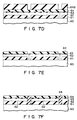
- a 300-nm thick SiO 2 film 61 is formed on an Si (100) p-type 5- to 10- ⁇ cm substrate 60.
- a seed opening portion is formed, and a natural oxide film formed on an Si-exposed surface in the opening portion is removed by wet or dry processing.
- the Si surface is H-bonded in order to obtain a high quality film, and a 100-nm thick amorphous Si film 62 having a high step coverage is formed by an LPCVD method using SiH 4 , as shown in Fig. 7C.
- the temperature is set between 500°C to 550°C so that the density of the film is maximized. Under this condition, epitaxial growth can occur in the seed portion.
- a heat treatment is performed in an Ar atmosphere of 2 ppb or less at a temperature of 500°C to 550°C for eight hours. Thereafter, high-temperature annealing is performed at 900°C to 1,000°C to obtain a high density.
- a 10-nm thick SiO 2 film 63, and a 90-nm thick Si 3 N 4 film 64 are formed by the LPCVD method, and a resist pattern 64a is formed.
- mask alignment does not require high alignment precision.
- Fig. 7E shows a structure in which the Si 3 N 4 film 64 is etched and the resist is removed by RIE. Thereafter, phosphorus and boron are doped in a p-channel transistor formation region and an n-channel transistor formation region, respectively, at a concentration of 10 17 cm -3 by field ion implantation.
- the substrate temperature is set at 900°C
- the substrate bias is set at +50 V
- a mixed ion beam (1 to 100 eV) of O 2 - or H 2 O - and O - or O 2 - is radiated to perform anisotropic oxidation, thereby forming an SiO 2 film 65, as shown in Fig. 7F.
- an alkali metal e.g., Rb, Cs, Li or the like
- the alkali metal gives electrons to oxygen because the alkali metal easily forms positive ions, and O 1 - , O 2 - and H 2 O - ions are increased.
- SiO 2 film 65 is formed by an anisotropic oxidation to form an element isolation.
- An anisotropic nitridation may be performed to form an element isolation. That is, a gas such as NH 3 is introduced and the gas molecules are positively or negatively charged. Then, the substrate is biased.
- a silicon nitride film can be anisotropically formed.
- phosphorus and boron are doped in a p-channel region 62a and an n-channel region 62b, respectively, at a concentration of 10 17 cm -3 by channel ion implantation.
- anisotropic doping can be similarly performed by applying a positive or negative bias to the substrate, and the impurities can be diffused vertically in the substrate prior to other directions.
- a resist mask (not shown) having a complementary pattern of a gate electrode is used to remove the Si nitride film 64 in a gate electrode formation region.
- anisotropic CVD conditions are as follows.
- polycrystalline Si is formed undoped (without doping an impurity), and boron and phosphorus or arsenic are doped in the p-channel region and the n-channel region, respectively, at a concentration of 10 17 cm -3 .
- Doping may be performed by an ion beam such as B + , As + , or P + having 10 to 100 eV or vapor-phase diffusion by using a mask such as a resist or by ion beam direct delineation without using a mask.
- the Si nitride film 64 is removed by dry etching.
- the etching of the Si nitride film 64 may be performed by wet etching by using, e.g., a phosphoric acid-based mixed acid.
- the polycrystalline Si, TiN, and W films are simultaneously lifted off, as shown in Fig. 7I.
- a high-concentration boron diffusion region 69 (10 18 to 10 19 cm -3 ) having a thickness of 20 to 30 nm is formed on the p-channel region
- a high-concentration arsenic diffusion region 70 (10 18 to 10 19 cm -3 ) having a thickness of 20 to 30 nm is formed on the n-channel region.
- doping is performed by using anisotropic diffusion as described above.
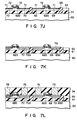
- Post-oxidation is performed in oxygen at 800°C for 20 to 30 minutes to form an SiO 2 film 7l, as shown in Fig. 7J.
- the oxidation is performed in an atmosphere in which an H 2 /H 2 O gas mixture is diluted by nitrogen so as not to oxidize W, TiN is not decomposed and W is not oxidized.
- Si 3 N 4 Si 3 N 4
- the SiO 2 film 7l on the source and drain regions are removed, and a 100-nm thick metal silicide layer 73 is formed by selective growth.
- the metal silicide an Ni silicide (NiSi or NiSi 2 ), TiSi 2 , or CoSi 2 can be selectively grown. In this selective growth, it is very important to clean the surface of the Si substrate. Immediately before the selective growth is performed, therefore, SiO 2 of the natural oxide film must be removed by SF 6 /H 2 O- or NF 3 /H 2 O-based etching.
- a chamber (pre-chamber) for cleaning the surface of the Si substrate is provided immediately before the silicide film deposition chamber, and SF 6 /H 2 O is supplied to the pre-chamber at a partial pressure ratio of 1 and a total pressure of 13-1300 Pa (0.1 to 10 Torr).
- a plasma discharge is generated by using a 2.4-GHz microwave and to a position above the semiconductor substrate separated from a discharge portion. In this plasma etching, SiO 2 on the semiconductor substrate can be selectively etched. An etching rate was 5 nm/min.
- the substrate is conveyed to a silicide CVD chamber. Gases used in silicide selective growth are a source gas of Si, a metal source gas, and a carrier gas.
- Examples of the Si source gas are SiH 4 , Si 2 H 6 , Si 3 H 8 , and SiCl 4 .
- Examples of the metal source gas of Ni are Ni(CO) 4 , NiF 2 , NiBr 2 , and NiCl 2 .
- Examples of the metal source gas of Co are Co(Co) 4 , CoF 2 , CoBr 2 , and CoCl 2 .
- Examples of the metal gas of Ti are TiCl 4 , TiBr 4 , and TiF 4 .
- a halide-based gas As a halide-based gas has a low vapor pressure, it must be heated by a heater so as not to be solidified in a piping and a chamber.
- Co 2 (CO) 8 or Ni 2 (CO) 8 (0.01 to 10 SCCM) and SiH 4 (0.1 to 10 SCCM) were used as source gases, and Ar (10 to 100 SCCM) was used as a carrier gas.
- Ar (10 to 100 SCCM) was used as a carrier gas.
- H 2 (10 to 100 SCCM) was used as a dilution gas.
- the substrate temperature was 200°C to 400°C, and the total pressure was 1 to 100 Pa. Under these conditions, a deposition rate of CoSi 2 or NiSi 2 was about 10 nm/min. A thickness to be deposited was 100 to 200 nm. Sheet resistances obtained after annealing at 700°C to 800°C were 0.75 to 1.5 ⁇ /sq and 1.8 to 3.5 ⁇ /sq.
- boron and phosphorus or arsenic are doped in the silicide of the p-channel region and the silicide of the n-channel region, respectively, and at the same time an energy beam such as a laser beam or an electron beam is radiated or lamp heating is performed to diffuse an impurity in the Si substrate at a concentration of 10 20 to 10 21 cm -3 , thereby forming a p + -type diffusion region 69a and an n + -type diffusion region 70a.
- Doping may be performed by an ion beam or vapor-phase diffusion by using a mask or by ion beam direct delineation without using a mask.
- a 1- ⁇ m thick insulating film 74 is deposed by CVD, opening portions are formed, and a W plug 75 is selectively grown in each opening portion.
- the W plug 75 can be selectively grown by the LPCVD method performed by using WF 6 , H 2 , and SiH 4 at a total pressure of 13-1300 Pa (0.1 to 10 Torr). In a structure in which contact holes having different depths are present in an underlying layer, if deep portions are perfectly buried to be flattened, shallow portions overflow from the contact holes by over filling.
- a gas mixture consisting of a gas containing F such as CF 4 , NF3, or SF 6 and O 2 is used to form a plasma, and a substrate is set in a position separated from the plasma.
- O 2 is excessively supplied or dilution by N 2 , Ar, or the like is performed so that the etching rate of W is determined by a reaction gas supply rate, thereby etching W at a pressure of 40-1300 Pa (0.3 to 10 Torr).
- the over-filled W portion naving a large solid angle with respect to the reaction gas is etched at high speed and the surface is smoothened.
- a nitride film having a thickness of about 5 nm is formed on the surface of the W plug 75 in an N 2 plasma by using 500-W RF.
- an insulating film 76 is selectively grow on the insulating film 74, and the surface of the insulating film 76 is inactivated to form an insulating film 77.
- the insulating film 74 consists of SiO 2 , it has a polarity because an electronegativity difference is large. In a gas containing molecules having a polarity, therefore, gas molecules can be adsorbed in the SiO 2 layer.
- SiH 3 Cl and N 2 O were used as gases and flowed at a total pressure of 13-1300 Pa (0.1 to 1 Torr), a substrate temperature of 400°C to 500°C, and a gas flow rate ratio of 1 : 2.
- SiO 2 was not formed on the W 2 N exposed portion but was formed on the SiO 2 layer.
- the deposition rate was 50 nm/min. Note that selective growth can be similarly realised by using molecules having a strong polarity such as SiCl 2 , SiCl 3 , or Si(CH 3 ) 3 instead of SiH 3 Cl described above. Alternatively, oxygen radicals may be introduced instead of N 2 O. Selective growth of the SiO 2 layer can also be performed by liquid phase deposition. For example, when the above substrate is dipped in an aqueous solution containing 1 mol of SiH 2 F 6 , SiO 2 can be grown on only the SiO 2 layer. The deposition rate is as low as 10 nm/min.
- a wiring formation portion of the insulating film 76 is removed by lithography and etching.
- mask alignment does not require high alignment precision. Since it is difficult to perform mask alignment if flattening of the underlying layer is satisfactorily performed upon mask alignment, one more mask is additionally used after flattening, and a pattern is formed such that the insulating film is removed by etching in a region of an alignment mark. Subsequently, a 30-nm thick TiN layer 78 and a 400-nm thick Cu layer 79 are formed by anisotropic CVD.
- TiN is deposited as follows. That is, a charge space consisting of electrons and ions is formed by using hydrogen as carrier gases and using diethylaminotitanium Ti[N(C 2 H 5 ) 2 ] 4 gas and N 2 gas, and is transported to the substrate.
- the flow rate of the hydrogen carrier gas is 30 SCCM, and that of the nitrogen carrier gas is 10 SCCM.
- a negative bias (e.g., -60 to -80 V) is applied to the substrate by a floating potential.
- the substrate temperature is 100°C to 250°C.
- HFA-Cu hexafluoroacetylacetone-copper
- the substrate bias conditions are the same as for TiN.
- TiN and Cu deposited in this manner have (111) crystal orientation.
- the oxygen concentration in the aqueous solution is reduced to be 1 ppm or less so as not to oxidize Cu.
- the etching rate of the layer 77 is high, the TiN layer 78 and the Cu layer 79 formed thereon are simultaneously lifted.
- a final structure as shown in Fig. 7N is obtained.
- a multilayered wiring structure of two or more layers can be formed by repeatedly performing the steps shown in Figs. 7L to 7N.
- the number of manufacturing steps can be reduced by 10 steps.
- 20 or more manufacturing steps can be reduced, resulting in a large cost reduction.
- not only Cu or W but also Ag, Au, or a superconductive film all of which are difficult to be etched by conventional techniques can be used as an ultra micro wiring pattern.
- a wiring pattern can be self-aligned on a contact without a clearance an interwiring space can be reduced to increase a degree of integration.
- the interwiring space need not be reduced, since a capacitance between adjacent wiring patterns can be reduced, a wiring delay time can be shortened to increase an operation speed.
- formation of the electrode or wiring pattern is performed by anisotropic CVD and lift-off.
- the pattern formation can be similarly performed by using a selective growth method.
- the present invention uses various selective or anisotropic process techniques such as anisotropic selective CVD of SiO 2 , anisotropic or selective forming of a metal film.
- the number of manufacturing steps can be decreased to realize a cost reduction, high-precision mask alignment need not be performed, a pattern free from exudation can be formed, a material which is difficult to be etched can be used, and an operation speed, a density, and reliability of an element can be improved accordingly.
Landscapes
- Internal Circuitry In Semiconductor Integrated Circuit Devices (AREA)
- Metal-Oxide And Bipolar Metal-Oxide Semiconductor Integrated Circuits (AREA)
- Insulated Gate Type Field-Effect Transistor (AREA)
- Electrodes Of Semiconductors (AREA)
- Element Separation (AREA)
Claims (13)
- Verfahren zur Herstellung einer Halbleitervorrichtung, das die folgenden Stufen umfasst:dadurch gekennzeichnet, dass die selektive Bildung der zweiten Isolierschicht (14) ohne Maskenausrichtung durch selektive chemische Gasphasenabscheidung unter Verwendung einer gasförmigen polaren Siliciumverbindung als Speisegas durchgeführt wird und die erste und zweite Isolierschicht (11, 14) aus SiO2 bestehen.Bilden einer ersten Isolierschicht (11) mit einem Loch auf einem Substrat (10);selektives Bilden einer leitenden Schicht (13) in dem Loch;selektives Bilden einer zweiten Isolierschicht (14) mit einem mit dem Loch ausgerichteten Loch auf der ersten Isolierschicht (11);Bemustern der zweiten Isolierschicht unter Bildung eines Öffnungsteils; undBilden einer Verdrahtungsschicht (15) in dem Loch und dem Öffnungsteil der bemusterten zweiten Isolierschicht (14) derart, dass eine elektrische Verbindung mit der leitenden Schicht (13) besteht;
- Verfahren nach Anspruch 1, dadurch gekennzeichnet, dass die Bildung der zweiten Isolierschicht (14) durch gerichtete selektive chemische Gasphasenabscheidung durchgeführt wird.
- Verfahren nach Anspruch 1, dadurch gekennzeichnet, dass die gasförmige polare Siliciumverbindung aus der aus SiH3Cl, SiCl2, SiCl3 und Si(CH3)3 bestehenden Gruppe ausgewählt ist.
- Verfahren nach Anspruch 1, das ferner vor der Stufe des Bildens der zweiten Isolierschicht (14) die Stufe des Behandelns der Oberflächen der ersten Isolierschicht (11) und der leitenden Schicht (13) durch ein H2-Plasma umfassst.
- Verfahren nach Anspruch 1, dadurch gekennzeichnet, dass die Stufe des Bildens der leitenden Schicht (13) durch selektive chemische Gasphasenabscheidung durchgeführt wird.
- Verfahren nach Anspruch 1, dadurch gekennzeichnet, dass die Stufe des Bildens der leitenden Schicht (13) die Teilstufen des Durchführens einer gerichteten chemischen Gasphasenabscheidung auf der gesamten Oberfläche und des Durchführens eines Spiegelglanzpolierens umfasst.
- Verfahren nach Anspruch 1, dadurch gekennzeichnet, dass die Stufe des Bildens der leitenden Schicht (13) die Teilstufen des Durchführens einer gerichteten chemischen Gasphasenabscheidung auf der gesamten Oberfläche, des Abscheidens eines planmachenden Materials auf der gesamten Oberfläche zum Einebnen der Oberfläche und des Durchführens von Rückätzen umfasst.
- Verfahren nach Anspruch 6, dadurch gekennzeichnet, dass die gerichtete chemische Gasphasenabscheidung unter Anlegen einer Vorspannung an das Substrat durchgeführt wird.
- Verfahren nach Anspruch 1, dadurch gekennzeichnet, dass die Stufe des Bildens der leitenden Schicht (13) die Teilstufen des Bildens einer Abstandsschicht auf der ersten Isolierschicht (11), des Durchführens einer gerichteten chemischen Gasphasenabscheidung auf der gesamten Oberfläche und des Entfernens der Abstandsschicht unter Hochheben eines Teils der leitenden Schicht (13) auf der Abstandsschicht umfasst.
- Verfahren nach Anspruch 1, das durch die folgenden Stufen gekennzeichnet ist:Bilden einer dritten Schicht (16) aus SiO2 mit einer Vielzahl von Löchern, die mit dem Loch und dem Öffnungsteil ausgerichtet sind, durch selektive chemische Gasphasenabscheidung unter Verwendung einer gasförmigen polaren Siliciumverbindung als Speisegas auf der bemusterten zweiten Isolierschicht (14);selektives Bilden von Teilen einer leitenden Schicht (17a, 17b, 17c) in den Löchern;Oxidieren der Oberfläche von einigen der Teile der leitenden Schicht (17b, 17c) mit Ausnahme eines Teils einer leitenden Schicht (17a), auf dem eine Verdrahtungsschicht (19) gebildet werden soll;selektives Bilden einer vierten Schicht (18) aus SiO2 auf der dritten Isolierschicht (16) und den einigen Teilen der leitenden Schicht (17b, 17c), die eine oxidierte Oberfläche aufweisen, unter Verwendung der gleichen selektiven chemischen Gasphasenabscheidung wie für die dritte Schicht aus SiO2;Bemustern der vierten Schicht aus SiO2 unter Bildung eines Öffnungsteils; undBilden einer Verdrahtungsschicht (19) in dem Öffnungsteil der bemusterten vierten Schicht (18) aus SiO2 derart, dass eine elektrische Verbindung mit dem Teil der leitenden Schicht (17a), der eine nicht-oxidierte Oberfläche aufweist, besteht.
- Verfahren nach Anspruch 10, dadurch gekennzeichnet, dass die Stufe des Oxidierens der Oberfläche von einigen der Teile der leitenden Schicht (17b, 17c) durch Bestrahlen und Rastern der Oberfläche der leitenden Schicht (17b, 17c) mit einem Sauerstoffionenstrahl durchgeführt wird.
- Verfahren nach Anspruch 10, dadurch gekennzeichnet, dass die Stufe des Oxidierens der Oberfläche von einigen der Teile der leitenden Schicht (17b, 17c) durch Implantieren von Sauerstoffionen in die leitende Schicht (17b, 17c) durch eine Maskierungsschicht durchgeführt wird.
- Verfahren nach Anspruch 10, dadurch gekennzeichnet, dass die Stufe des Oxidierens der Oberfläche von einigen der Teile der einer leitenden Schicht (17b, 17c) durch thermische Oxidation der Oberfläche der leitenden Schicht (17b, 17c) durch eine Antioxidationsmaske durchgeführt wird.
Applications Claiming Priority (6)
| Application Number | Priority Date | Filing Date | Title |
|---|---|---|---|
| JP3268990 | 1990-02-14 | ||
| JP3268990 | 1990-02-14 | ||
| JP32689/90 | 1990-02-14 | ||
| JP1658691 | 1991-02-07 | ||
| JP01658691A JP3469251B2 (ja) | 1990-02-14 | 1991-02-07 | 半導体装置の製造方法 |
| JP16586/90 | 1991-02-07 |
Publications (3)
| Publication Number | Publication Date |
|---|---|
| EP0442718A2 EP0442718A2 (de) | 1991-08-21 |
| EP0442718A3 EP0442718A3 (en) | 1993-08-11 |
| EP0442718B1 true EP0442718B1 (de) | 2003-09-24 |
Family
ID=26352955
Family Applications (1)
| Application Number | Title | Priority Date | Filing Date |
|---|---|---|---|
| EP91301156A Expired - Lifetime EP0442718B1 (de) | 1990-02-14 | 1991-02-13 | Verfahren zum Herstellen einer Halbleitervorrichtung |
Country Status (4)
| Country | Link |
|---|---|
| US (4) | US5192714A (de) |
| EP (1) | EP0442718B1 (de) |
| JP (1) | JP3469251B2 (de) |
| DE (1) | DE69133316T2 (de) |
Families Citing this family (72)
| Publication number | Priority date | Publication date | Assignee | Title |
|---|---|---|---|---|
| JP3469251B2 (ja) * | 1990-02-14 | 2003-11-25 | 株式会社東芝 | 半導体装置の製造方法 |
| JPH05102136A (ja) * | 1991-10-03 | 1993-04-23 | Toshiba Corp | 半導体集積回路装置の製造方法 |
| KR950012918B1 (ko) * | 1991-10-21 | 1995-10-23 | 현대전자산업주식회사 | 선택적 텅스텐 박막의 2단계 퇴적에 의한 콘택 매립방법 |
| EP0603461A3 (de) * | 1992-10-30 | 1996-09-25 | Ibm | Herstellung von 3-D Siliziumsilizid-Strukturen. |
| US5436173A (en) * | 1993-01-04 | 1995-07-25 | Texas Instruments Incorporated | Method for forming a semiconductor on insulator device |
| US5719447A (en) * | 1993-06-03 | 1998-02-17 | Intel Corporation | Metal alloy interconnections for integrated circuits |
| JP3404873B2 (ja) * | 1994-03-25 | 2003-05-12 | 株式会社デンソー | 半導体装置の製造方法 |
| EP0690494B1 (de) * | 1994-06-27 | 2004-03-17 | Infineon Technologies AG | Verbindungs- und Aufbautechnik für Multichip-Module |
| KR0134108B1 (ko) * | 1994-06-30 | 1998-04-20 | 김주용 | 반도체 소자의 제조방법 |
| JPH0851103A (ja) * | 1994-08-08 | 1996-02-20 | Fuji Electric Co Ltd | 薄膜の生成方法 |
| JPH08148563A (ja) * | 1994-11-22 | 1996-06-07 | Nec Corp | 半導体装置の多層配線構造体の形成方法 |
| KR0138307B1 (ko) * | 1994-12-14 | 1998-06-01 | 김광호 | 반도체 장치의 측면콘택 형성방법 |
| JP3176017B2 (ja) * | 1995-02-15 | 2001-06-11 | 株式会社東芝 | 半導体装置の製造方法 |
| JP3073906B2 (ja) * | 1995-03-27 | 2000-08-07 | 財団法人国際超電導産業技術研究センター | 超電導デバイスの製造方法 |
| US5626786A (en) * | 1995-04-17 | 1997-05-06 | Huntington; John H. | Labile bromine fire suppressants |
| US5547900A (en) * | 1995-05-26 | 1996-08-20 | United Microelectronics Corporation | Method of fabricating a self-aligned contact using a liquid-phase oxide-deposition process |
| JPH0922896A (ja) * | 1995-07-07 | 1997-01-21 | Toshiba Corp | 金属膜の選択的形成方法 |
| US5504030A (en) * | 1995-07-21 | 1996-04-02 | United Microelectronics Corporation | Process for fabricating high-density mask ROM devices |
| US5856707A (en) * | 1995-09-11 | 1999-01-05 | Stmicroelectronics, Inc. | Vias and contact plugs with an aspect ratio lower than the aspect ratio of the structure in which they are formed |
| US6069370A (en) * | 1997-03-26 | 2000-05-30 | Nec Corporation | Field-effect transistor and fabrication method thereof and image display apparatus |
| JPH09153616A (ja) * | 1995-09-28 | 1997-06-10 | Toshiba Corp | 半導体装置およびその製造方法 |
| JP2830812B2 (ja) * | 1995-12-27 | 1998-12-02 | 日本電気株式会社 | 多層プリント配線板の製造方法 |
| US5972788A (en) * | 1996-05-22 | 1999-10-26 | International Business Machines Corporation | Method of making flexible interconnections with dual-metal-dual-stud structure |
| US5846876A (en) * | 1996-06-05 | 1998-12-08 | Advanced Micro Devices, Inc. | Integrated circuit which uses a damascene process for producing staggered interconnect lines |
| US6077768A (en) * | 1996-07-19 | 2000-06-20 | Motorola, Inc. | Process for fabricating a multilevel interconnect |
| US6001420A (en) * | 1996-09-23 | 1999-12-14 | Applied Materials, Inc. | Semi-selective chemical vapor deposition |
| US6066548A (en) * | 1996-10-31 | 2000-05-23 | Micron Technology, Inc. | Advance metallization process |
| US5930669A (en) * | 1997-04-03 | 1999-07-27 | International Business Machines Corporation | Continuous highly conductive metal wiring structures and method for fabricating the same |
| US6121159A (en) * | 1997-06-19 | 2000-09-19 | Lsi Logic Corporation | Polymeric dielectric layers having low dielectric constants and improved adhesion to metal lines |
| US6704107B1 (en) | 1997-11-04 | 2004-03-09 | Micron Technology, Inc. | Method and apparatus for automated, in situ material detection using filtered fluoresced, reflected, or absorbed light |
| US7102737B2 (en) * | 1997-11-04 | 2006-09-05 | Micron Technology, Inc. | Method and apparatus for automated, in situ material detection using filtered fluoresced, reflected, or absorbed light |
| US5969805A (en) | 1997-11-04 | 1999-10-19 | Micron Technology, Inc. | Method and apparatus employing external light source for endpoint detection |
| JP3523093B2 (ja) * | 1997-11-28 | 2004-04-26 | 株式会社東芝 | 半導体装置およびその製造方法 |
| US6140235A (en) * | 1997-12-05 | 2000-10-31 | Applied Materials, Inc. | High pressure copper fill at low temperature |
| JP3123512B2 (ja) * | 1998-06-02 | 2001-01-15 | 日本電気株式会社 | 半導体装置及びその製造方法 |
| JP3431128B2 (ja) * | 1998-08-05 | 2003-07-28 | シャープ株式会社 | 半導体装置の製造方法 |
| US6207493B1 (en) * | 1998-08-19 | 2001-03-27 | International Business Machines Corporation | Formation of out-diffused bitline by laser anneal |
| US6174803B1 (en) | 1998-09-16 | 2001-01-16 | Vsli Technology | Integrated circuit device interconnection techniques |
| JP2000195814A (ja) * | 1998-12-28 | 2000-07-14 | Fujitsu Ltd | 半導体装置の製造方法 |
| KR100313510B1 (ko) * | 1999-04-02 | 2001-11-07 | 김영환 | 반도체 소자의 제조방법 |
| EP1050905B1 (de) * | 1999-05-07 | 2017-06-21 | Shinko Electric Industries Co. Ltd. | Verfahren zur Herstellung einer Halbleitervorrichtung mit isolierender Schicht |
| US6521501B1 (en) * | 1999-05-11 | 2003-02-18 | Advanced Micro Devices, Inc. | Method of forming a CMOS transistor having ultra shallow source and drain regions |
| WO2001006554A1 (de) * | 1999-07-01 | 2001-01-25 | Infineon Technologies Ag | Verfahren zur herstellung von silizierten polysiliziumkontakten in integrierten halbleiterstrukturen |
| US6395631B1 (en) * | 1999-08-04 | 2002-05-28 | Chartered Semiconductor Manufacturing Ltd. | Low dielectric constant dielectric layer fabrication method employing hard mask layer delamination |
| US6428942B1 (en) | 1999-10-28 | 2002-08-06 | Fujitsu Limited | Multilayer circuit structure build up method |
| US6869750B2 (en) * | 1999-10-28 | 2005-03-22 | Fujitsu Limited | Structure and method for forming a multilayered structure |
| US6882045B2 (en) * | 1999-10-28 | 2005-04-19 | Thomas J. Massingill | Multi-chip module and method for forming and method for deplating defective capacitors |
| KR101027485B1 (ko) * | 2001-02-12 | 2011-04-06 | 에이에스엠 아메리카, 인코포레이티드 | 반도체 박막 증착을 위한 개선된 공정 |
| JP2003023070A (ja) * | 2001-07-05 | 2003-01-24 | Mitsubishi Electric Corp | 半導体装置およびその製造方法 |
| US6383930B1 (en) * | 2001-07-12 | 2002-05-07 | Taiwan Semiconductor Manufacturing Company | Method to eliminate copper CMP residue of an alignment mark for damascene processes |
| KR100440472B1 (ko) * | 2001-12-13 | 2004-07-14 | 아남반도체 주식회사 | 반도체 소자 제조 방법 |
| JP2003224279A (ja) * | 2002-01-31 | 2003-08-08 | Oki Electric Ind Co Ltd | 電界効果トランジスタ素子 |
| US6797620B2 (en) * | 2002-04-16 | 2004-09-28 | Applied Materials, Inc. | Method and apparatus for improved electroplating fill of an aperture |
| US6593221B1 (en) * | 2002-08-13 | 2003-07-15 | Micron Technology, Inc. | Selective passivation of exposed silicon |
| US7186630B2 (en) * | 2002-08-14 | 2007-03-06 | Asm America, Inc. | Deposition of amorphous silicon-containing films |
| US7138690B2 (en) * | 2003-07-21 | 2006-11-21 | Agere Systems Inc. | Shielding structure for use in a metal-oxide-semiconductor device |
| JP4581119B2 (ja) * | 2003-09-17 | 2010-11-17 | 株式会社トリケミカル研究所 | NiSi膜形成材料およびNiSi膜形成方法 |
| JP2005217176A (ja) * | 2004-01-29 | 2005-08-11 | Tokyo Electron Ltd | 半導体装置および積層膜の形成方法 |
| US7280068B2 (en) * | 2005-07-14 | 2007-10-09 | Agilent Technologies, Inc. | System and method for microwave imaging with suppressed sidelobes using a sparse antenna array |
| US7473999B2 (en) * | 2005-09-23 | 2009-01-06 | Megica Corporation | Semiconductor chip and process for forming the same |
| US20070087573A1 (en) * | 2005-10-19 | 2007-04-19 | Yi-Yiing Chiang | Pre-treatment method for physical vapor deposition of metal layer and method of forming metal silicide layer |
| JP4703364B2 (ja) | 2005-10-24 | 2011-06-15 | 株式会社東芝 | 半導体装置及びその製造方法 |
| US20070170489A1 (en) * | 2006-01-26 | 2007-07-26 | Fang Gang-Feng | Method to increase charge retention of non-volatile memory manufactured in a single-gate logic process |
| US7382658B2 (en) * | 2006-01-26 | 2008-06-03 | Mosys, Inc. | Non-volatile memory embedded in a conventional logic process and methods for operating same |
| JP5110885B2 (ja) * | 2007-01-19 | 2012-12-26 | キヤノン株式会社 | 複数の導電性の領域を有する構造体 |
| KR100857229B1 (ko) * | 2007-05-28 | 2008-09-05 | 삼성전자주식회사 | 반도체 소자 및 그 형성방법 |
| US8551877B2 (en) * | 2012-03-07 | 2013-10-08 | Tokyo Electron Limited | Sidewall and chamfer protection during hard mask removal for interconnect patterning |
| US10453749B2 (en) * | 2017-02-14 | 2019-10-22 | Tokyo Electron Limited | Method of forming a self-aligned contact using selective SiO2 deposition |
| US10256405B2 (en) * | 2017-04-05 | 2019-04-09 | International Business Machines Corporation | Methods for fabricating artificial neural networks (ANN) based on doped semiconductor elements |
| US10586734B2 (en) * | 2017-11-20 | 2020-03-10 | Tokyo Electron Limited | Method of selective film deposition for forming fully self-aligned vias |
| CN111128708A (zh) * | 2019-12-18 | 2020-05-08 | 华虹半导体(无锡)有限公司 | 自对准金属硅化物及晶体管中接触层的形成方法 |
| US12288692B2 (en) * | 2021-04-23 | 2025-04-29 | Tokyo Electron Limited | Method of forming a FET structure by selective deposition of film on source/drain contact |
Citations (1)
| Publication number | Priority date | Publication date | Assignee | Title |
|---|---|---|---|---|
| US4923826A (en) * | 1989-08-02 | 1990-05-08 | Harris Corporation | Method for forming dielectrically isolated transistor |
Family Cites Families (25)
| Publication number | Priority date | Publication date | Assignee | Title |
|---|---|---|---|---|
| NL191683C (nl) * | 1977-02-21 | 1996-02-05 | Zaidan Hojin Handotai Kenkyu | Halfgeleidergeheugenschakeling. |
| JPS57126131A (en) * | 1981-01-28 | 1982-08-05 | Toshiba Corp | Manufacture of semiconductor device |
| US4493740A (en) * | 1981-06-01 | 1985-01-15 | Matsushita Electric Industrial Company, Limited | Method for formation of isolation oxide regions in semiconductor substrates |
| JPS584947A (ja) * | 1981-06-30 | 1983-01-12 | Nippon Telegr & Teleph Corp <Ntt> | 埋込配線層の形成法 |
| CA1200624A (en) * | 1981-08-10 | 1986-02-11 | Susumu Muramoto | Method for the manufacture of semiconductor device using refractory metal in a lift-off step |
| JPS59144151A (ja) * | 1983-02-08 | 1984-08-18 | Nec Corp | 半導体装置の製造方法 |
| JPS61137344A (ja) * | 1984-12-07 | 1986-06-25 | Toshiba Corp | 半導体装置の製造方法 |
| US5084414A (en) * | 1985-03-15 | 1992-01-28 | Hewlett-Packard Company | Metal interconnection system with a planar surface |
| DE3650077T2 (de) * | 1985-03-15 | 1995-02-23 | Hewlett Packard Co | Metallisches Verbindungssystem mit einer ebenen Fläche. |
| KR880000483B1 (ko) * | 1985-08-05 | 1988-04-07 | 재단법인 한국전자통신 연구소 | 반도체소자의 제조방법 |
| JPH0779133B2 (ja) * | 1986-06-12 | 1995-08-23 | 松下電器産業株式会社 | 半導体装置の製造方法 |
| US5069749A (en) * | 1986-07-29 | 1991-12-03 | Digital Equipment Corporation | Method of fabricating interconnect layers on an integrated circuit chip using seed-grown conductors |
| US5063175A (en) * | 1986-09-30 | 1991-11-05 | North American Philips Corp., Signetics Division | Method for manufacturing a planar electrical interconnection utilizing isotropic deposition of conductive material |
| US4746621A (en) * | 1986-12-05 | 1988-05-24 | Cornell Research Foundation, Inc. | Planar tungsten interconnect |
| US4948755A (en) * | 1987-10-08 | 1990-08-14 | Standard Microsystems Corporation | Method of manufacturing self-aligned conformal metallization of semiconductor wafer by selective metal deposition |
| US4879257A (en) * | 1987-11-18 | 1989-11-07 | Lsi Logic Corporation | Planarization process |
| US5104694A (en) * | 1989-04-21 | 1992-04-14 | Nippon Telephone & Telegraph Corporation | Selective chemical vapor deposition of a metallic film on the silicon surface |
| JPH02307221A (ja) * | 1989-05-22 | 1990-12-20 | Nec Corp | Cvd膜の成長方法 |
| US5017317A (en) * | 1989-12-04 | 1991-05-21 | Board Of Regents, The Uni. Of Texas System | Gas phase selective beam deposition |
| JP3469251B2 (ja) * | 1990-02-14 | 2003-11-25 | 株式会社東芝 | 半導体装置の製造方法 |
| US5068207A (en) * | 1990-04-30 | 1991-11-26 | At&T Bell Laboratories | Method for producing a planar surface in integrated circuit manufacturing |
| US5120572A (en) * | 1990-10-30 | 1992-06-09 | Microelectronics And Computer Technology Corporation | Method of fabricating electrical components in high density substrates |
| JP2773530B2 (ja) * | 1992-04-15 | 1998-07-09 | 日本電気株式会社 | 半導体装置の製造方法 |
| US5290358A (en) * | 1992-09-30 | 1994-03-01 | International Business Machines Corporation | Apparatus for directional low pressure chemical vapor deposition (DLPCVD) |
| US5518959A (en) * | 1995-08-24 | 1996-05-21 | Taiwan Semiconductor Manufacturing Company | Method for selectively depositing silicon oxide spacer layers |
-
1991
- 1991-02-07 JP JP01658691A patent/JP3469251B2/ja not_active Expired - Fee Related
- 1991-02-13 DE DE69133316T patent/DE69133316T2/de not_active Expired - Fee Related
- 1991-02-13 US US07/654,895 patent/US5192714A/en not_active Expired - Lifetime
- 1991-02-13 EP EP91301156A patent/EP0442718B1/de not_active Expired - Lifetime
-
1992
- 1992-11-25 US US07/981,427 patent/US5304510A/en not_active Expired - Lifetime
-
1995
- 1995-02-07 US US08/385,376 patent/US5470791A/en not_active Expired - Lifetime
- 1995-06-07 US US08/476,883 patent/US5654237A/en not_active Expired - Lifetime
Patent Citations (1)
| Publication number | Priority date | Publication date | Assignee | Title |
|---|---|---|---|---|
| US4923826A (en) * | 1989-08-02 | 1990-05-08 | Harris Corporation | Method for forming dielectrically isolated transistor |
Non-Patent Citations (1)
| Title |
|---|
| PATENT ABSTRACTS OF JAPAN vol. 13, no. 393 (E-814)31 August 1989 * |
Also Published As
| Publication number | Publication date |
|---|---|
| JPH04211121A (ja) | 1992-08-03 |
| DE69133316T2 (de) | 2004-07-22 |
| JP3469251B2 (ja) | 2003-11-25 |
| US5470791A (en) | 1995-11-28 |
| US5654237A (en) | 1997-08-05 |
| US5192714A (en) | 1993-03-09 |
| US5304510A (en) | 1994-04-19 |
| EP0442718A3 (en) | 1993-08-11 |
| DE69133316D1 (de) | 2003-10-30 |
| EP0442718A2 (de) | 1991-08-21 |
Similar Documents
| Publication | Publication Date | Title |
|---|---|---|
| EP0442718B1 (de) | Verfahren zum Herstellen einer Halbleitervorrichtung | |
| US4470189A (en) | Process for making polycide structures | |
| US4945070A (en) | Method of making cmos with shallow source and drain junctions | |
| EP0068154B1 (de) | Integrierte Schaltung mit einem Halbleitersubstrat mit Isolationszonen und elektrisch leitenden Zonen | |
| EP0083784B1 (de) | Verfahren zur Herstellung von integrierten Schaltungsanordnungen mit Zonen mit submikrometrischen Dimensionen und nach diesem Verfahren hergestellte Struktur | |
| EP0083785A2 (de) | Verfahren zur Herstellung von selbstalignierten Feldeffekttransistoren für integrierte Schaltungen | |
| JP3510924B2 (ja) | Mosトランジスタの製造方法 | |
| JPS6250969B2 (de) | ||
| JPS592187B2 (ja) | 導電層間に絶縁物を形成する方法 | |
| JPH0358173B2 (de) | ||
| JPH0480532B2 (de) | ||
| US5073510A (en) | Fabrication method of contact window in semiconductor device | |
| CN1120525C (zh) | 浅结半导体器件的制造 | |
| US4698127A (en) | Process for fabricating a self-aligned bipolar transistor | |
| US6746952B2 (en) | Diffusion barrier layer for semiconductor wafer fabrication | |
| JPH11186225A (ja) | テーパ形コンタクトホールの形成方法、テーパ形ポリシリコンプラグの形成方法並びにテーパ形ポリシリコンプラグ | |
| JPH11260935A (ja) | 2作用機能ド―ピングを与える方法およびゲ―ト構造のアレイ | |
| JPH0831602B2 (ja) | Mis型電界効果トランジスタの製造方法 | |
| JP3063276B2 (ja) | 半導体装置の製造方法 | |
| US7125775B1 (en) | Method for forming hybrid device gates | |
| KR950002169B1 (ko) | 반도체장치 및 그 제조방법 | |
| US6362061B1 (en) | Method to differentiate source/drain doping by using oxide slivers | |
| JP4005269B2 (ja) | 半導体装置の製造方法 | |
| KR100249024B1 (ko) | 플랫 셀의 제조방법 | |
| JPH06252411A (ja) | 半導体記憶装置の製造方法 |
Legal Events
| Date | Code | Title | Description |
|---|---|---|---|
| PUAI | Public reference made under article 153(3) epc to a published international application that has entered the european phase |
Free format text: ORIGINAL CODE: 0009012 |
|
| 17P | Request for examination filed |
Effective date: 19910305 |
|
| AK | Designated contracting states |
Kind code of ref document: A2 Designated state(s): DE FR GB |
|
| PUAL | Search report despatched |
Free format text: ORIGINAL CODE: 0009013 |
|
| AK | Designated contracting states |
Kind code of ref document: A3 Designated state(s): DE FR GB |
|
| 17Q | First examination report despatched |
Effective date: 19940318 |
|
| GRAH | Despatch of communication of intention to grant a patent |
Free format text: ORIGINAL CODE: EPIDOS IGRA |
|
| GRAH | Despatch of communication of intention to grant a patent |
Free format text: ORIGINAL CODE: EPIDOS IGRA |
|
| GRAA | (expected) grant |
Free format text: ORIGINAL CODE: 0009210 |
|
| RIC1 | Information provided on ipc code assigned before grant |
Ipc: 7H 01L 21/76 B Ipc: 7H 01L 21/316 B Ipc: 7H 01L 21/768 A |
|
| AK | Designated contracting states |
Kind code of ref document: B1 Designated state(s): DE FR GB |
|
| REG | Reference to a national code |
Ref country code: GB Ref legal event code: FG4D |
|
| REF | Corresponds to: |
Ref document number: 69133316 Country of ref document: DE Date of ref document: 20031030 Kind code of ref document: P |
|
| ET | Fr: translation filed | ||
| PLBE | No opposition filed within time limit |
Free format text: ORIGINAL CODE: 0009261 |
|
| STAA | Information on the status of an ep patent application or granted ep patent |
Free format text: STATUS: NO OPPOSITION FILED WITHIN TIME LIMIT |
|
| 26N | No opposition filed |
Effective date: 20040625 |
|
| PGFP | Annual fee paid to national office [announced via postgrant information from national office to epo] |
Ref country code: GB Payment date: 20070207 Year of fee payment: 17 |
|
| PGFP | Annual fee paid to national office [announced via postgrant information from national office to epo] |
Ref country code: DE Payment date: 20070208 Year of fee payment: 17 |
|
| PGFP | Annual fee paid to national office [announced via postgrant information from national office to epo] |
Ref country code: FR Payment date: 20070208 Year of fee payment: 17 |
|
| GBPC | Gb: european patent ceased through non-payment of renewal fee |
Effective date: 20080213 |
|
| REG | Reference to a national code |
Ref country code: FR Ref legal event code: ST Effective date: 20081031 |
|
| PG25 | Lapsed in a contracting state [announced via postgrant information from national office to epo] |
Ref country code: DE Free format text: LAPSE BECAUSE OF NON-PAYMENT OF DUE FEES Effective date: 20080902 |
|
| PG25 | Lapsed in a contracting state [announced via postgrant information from national office to epo] |
Ref country code: FR Free format text: LAPSE BECAUSE OF NON-PAYMENT OF DUE FEES Effective date: 20080229 |
|
| PG25 | Lapsed in a contracting state [announced via postgrant information from national office to epo] |
Ref country code: GB Free format text: LAPSE BECAUSE OF NON-PAYMENT OF DUE FEES Effective date: 20080213 |