EP0446769A2 - Appareil de traitement à système de blocage du transport de film sensible à la température - Google Patents
Appareil de traitement à système de blocage du transport de film sensible à la température Download PDFInfo
- Publication number
- EP0446769A2 EP0446769A2 EP91103384A EP91103384A EP0446769A2 EP 0446769 A2 EP0446769 A2 EP 0446769A2 EP 91103384 A EP91103384 A EP 91103384A EP 91103384 A EP91103384 A EP 91103384A EP 0446769 A2 EP0446769 A2 EP 0446769A2
- Authority
- EP
- European Patent Office
- Prior art keywords
- temperature
- developer
- inhibiting
- motor
- rollers
- Prior art date
- Legal status (The legal status is an assumption and is not a legal conclusion. Google has not performed a legal analysis and makes no representation as to the accuracy of the status listed.)
- Granted
Links
Images

Classifications
-
- G—PHYSICS
- G03—PHOTOGRAPHY; CINEMATOGRAPHY; ANALOGOUS TECHNIQUES USING WAVES OTHER THAN OPTICAL WAVES; ELECTROGRAPHY; HOLOGRAPHY
- G03D—APPARATUS FOR PROCESSING EXPOSED PHOTOGRAPHIC MATERIALS; ACCESSORIES THEREFOR
- G03D13/00—Processing apparatus or accessories therefor, not covered by groups G11B3/00 - G11B11/00
- G03D13/006—Temperature control of the developer
-
- G—PHYSICS
- G03—PHOTOGRAPHY; CINEMATOGRAPHY; ANALOGOUS TECHNIQUES USING WAVES OTHER THAN OPTICAL WAVES; ELECTROGRAPHY; HOLOGRAPHY
- G03D—APPARATUS FOR PROCESSING EXPOSED PHOTOGRAPHIC MATERIALS; ACCESSORIES THEREFOR
- G03D3/00—Liquid processing apparatus involving immersion; Washing apparatus involving immersion
- G03D3/08—Liquid processing apparatus involving immersion; Washing apparatus involving immersion having progressive mechanical movement of exposed material
- G03D3/13—Liquid processing apparatus involving immersion; Washing apparatus involving immersion having progressive mechanical movement of exposed material for long films or prints in the shape of strips, e.g. fed by roller assembly
- G03D3/132—Liquid processing apparatus involving immersion; Washing apparatus involving immersion having progressive mechanical movement of exposed material for long films or prints in the shape of strips, e.g. fed by roller assembly fed by roller assembly
Definitions
- the present invention relates to processors of film and similar photosensitive media, in general; and, in particular, to a processor including means to inhibit media transport if the processor chemicals are not within a predetermined temperature range.
- Photosensitive media processors such as the Kodak X-OMAT processors, are useful in applications such as the automatic processing of radiographic films for medical imaging purposes.
- the processors automatically transport sheets or webs of photosensitive film, paper or the like (hereafter "film") from a feed end of a film transport path, through a sequence of chemical processing tanks in which the media is developed, fixed, and washed, and then through a dryer to a discharge or receiving end.
- the processor typically has a fixed film path length, so final image quality depends on factors including transport speed which determines length of time the film strip is in solution, and the temperature and composition of the processing chemicals (the processor "chemistry").
- film transport speed is set at a constant rate and the chemistry is defined according to a preset recommended temperature, e.g. 93°F, with a specified tolerance range of +/- X°F.
- a temperature control system is provided in the processor to keep the chemicals within the specified range.
- the Kodak Model M6B X-OMAT Processor uses a thermowell located in the developer recirculation path to maintain a desired recommended developer chemical temperature.
- the thermowell has a cartridge heater inserted into one end of a hollow tubular body through which the developer is caused to flow by means of a pump.
- a thermistor protruding into the thermowell flow path serves to monitor the recirculating developer temperature and control the on-off cycle of the heater.
- the fixer whose temperature is less critical, is maintained at a temperature close to the developer temperature by directing the developer recirculation path in a loop through the fixer tank.
- a standby mode is often provided for deactivating of at least a portion of the processor heating element during periods of inactivity, in order to conserve energy. During such periods, a "wait" light or other annunciator signals deviation from recommended running parameters so that new film is not inadvertently introduced until the system has been returned to its active mode.
- processors used for radiographic image processing are traditionally configured to operate at a constant film transport speed, modifications may be made through gear changes and the like to vary the process.
- new processors are being introduced which are usable in more than one mode.
- the mode is often referred to in shorthand fashion by a nominal film transport "drop time", which may be defined as the time from entry of the leading edge of a sheet of film at the feed end until exit of the trailing edge of the same sheet of film at the discharge end.
- Conventional processors operate in standard (90 second), rapid (45 second), or "Kwik" (30 second) mode, and can be varied to operate in an extended-cycle mode, such as described in L. Taber & A. G.
- processor speed is lowered and chemistry temperature is raised to enhance image contrast for better detection of changes in density of fibrous tissue.
- the new processors will be settable as to transport speed and chemistry temperature (i.e., developer temperature) in order to be able to use the same processor for multiple processing modes.
- a processor of exposed photosensitive media having means for automatically transporting film along a path through developer, fixer, wash and dryer stations and means for regulating the temperature of processor chemistry, further comprises means responsive to user input for setting system parameters including a desirable chemistry temperature, and means for inhibiting the introduction of fresh media into the processor unless actual chemistry temperature is within an acceptable range.
- processor film transport speed and developer temperature are set according to user selection of a processor operating mode, and the film transport means is disabled after a change of mode until developer temperature is brought within the range for acceptable quality prints in the new mode.
- Means are provided to intentionally override the film transport lockout, where processing without delay is more important than processing quality.
- "wait" and/or “ready” lights are employed to signal that developer temperature is outside the recommended range.
- an annunciator is modulated at varying frequency to signal the approach of actual temperature to desirable temperature, so that a user can make a tradeoff judgment between wait time and picture quality.
- a "wait" light is made to blink faster and faster as the actual temperature approaches the desirable temperature.
- FIG. 3 The principles of the invention are illustrated, by way of example, embodied in the form of a lockout system 10 (FIG. 3) suitable for use with a processor 12 (FIGS. 1 and 2) for the automatic processing of photosensitive media in the form of sheets of film F (FIG. 2), such as for the development of radiographic images for medical diagnostic purposes.
- a lockout system 10 FIG. 3
- processor 12 FIGGS. 1 and 2
- FIG. 2 for the automatic processing of photosensitive media in the form of sheets of film F (FIG. 2), such as for the development of radiographic images for medical diagnostic purposes.
- the processor 12 includes a developing station comprising a tank 21 filled with developer chemical; a fixing station comprising a tank 22 filled with fixer chemical; and a wash station comprising a tank 23 filled with wash water or comprising some other appropriate film washing device.
- Processor 12 also includes a drying station 24 comprising oppositely-disposed pluralities of air dispensing tubes 25 or some other appropriate film drying mechanism.
- a sensor 26 Positioned proximate opening 15 is a sensor 26, such as a conventional reflective infrared sensor array which provides signal indicative of sheet width when a sheet F is presented at the entrance opening 15.
- the film width sensor 26 also provides an indication of the occurrence of passage of the leading edge and trailing edge of each sheet past point 26 of the processor 12, since the signal from the sensor 26 will change significantly as each leading and trailing edge is encountered.
- a second sensor 27, in the form of a reed switch or the like, may be provided to detect separation of the entrance rollers 28 to signal the beginning of transportation of a sheet of film along the path 16.
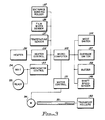
- FIG. 3 illustrates a control system usable in implementing an embodiment of the present invention.
- a microcomputer 43 is connected to direct the operation of the processor 12.
- Microcomputer 43 receives manual input from the user through a mode switch 44 as to what processor mode of operation is desired.
- the system can be configured to enable the user to select among predesignated modes, such as standard, rapid, "Kwik,” or extended modes having predetermined associated film path speed and chemistry temperature parameters; and can also be configured to permit a user to set a desired path speed and temperature directly.
- mode switch 44 is by means of an alphanumeric keypad 45 and keypad display 46 (FIG. 1) for providing programming communication between the user and the microcomputer 43.
- Microcomputer 43 is connected to receive other input information from the film width sensor 26, the entrance roller sensor 27, the developer temperature sensor 37 and, optionally, from a shaft speed sensor 48.
- Shaft speed sensor 48 which may comprise a shaft encoder mounted for rotation with drive shaft 33 and an associated encoder sensor, provides feedback information about the speed of the common shaft 33 that uniformly drives the transport rollers 30 (FIG. 2). This gives the speed with which film is driven along the film transport path 16.
- the width sensor 26 provides the microcomputer 43 with information on the leading and trailing edge occurrences and the width of a film sheet F. This can be used together with film speed from sensor 48 to give a cumulative film development area total that guides the control of chemistry replenishment.
- the entrance roller sensor 27 signals when a film sheet leading edge has been picked up by the roller path 16. This information can be used together with film speed from sensor 48 and known length of the total path 16 from entrance rollers 28 to exit rollers 50 (FIG. 2), to indicate when a sheet of film is present along the path 16.
- microcomputer 43 is shown in FIG. 3 connected to motor control circuitry 51, heater control circuitry 52, and annunciator control circuitry 53.
- Motor control circuitry 51 is connected to motor 34 to control the speed of rotation of drive shaft 33. This controls the speed of travel of a film sheet F along the film path 16 and, thus, determines the length of time sheet F spends at each of the stations (viz. controls development time).
- Heater control circuitry 52 is connected to the heater 36 to control the temperature of the developer flowing in the recirculation path 35 (FIG. 2) and, thus, the temperature of developer in tank 21, fixer in tank 22 and, optionally, wash water in tank 23.
- Annunciator control circuitry 53 is connected to annunciators in the form of "Wait” light 54 and "Ready” light 55 to control the on/off cycles of the same.
- Identical "Wait” and “Ready” lights 54, 55 may be provided on both the darkroom (not shown) and lightroom (see control panel 42 in FIG. 1) sides of the processor 12.
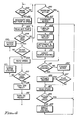
- a user-designated mode change selected at keypad 45 (FIG. 1) or other mode switch 44 (FIG. 3) is input to microcomputer 43 (100) to cause a designation (through look-up table, algorithm or the like) of reference developer temperature and transport speed parameters recommended for the selected mode (102).
- Motor and heater control circuits 51, 52 are then directed to control the motor 34 and heater 36 to bring the actual developer temperature and film path transport speed as sensed by sensors 37 and 48 into line with the designated reference temperature and speed. A change of speed can be achieved quickly; however, temperature change will take considerably longer.
- the "wait” light 54 is turned “on” (105) and the "ready” light 55 (104) is switched off (106).
- a temperature differential beyond the acceptable range also causes the transport motor 34 to be disengaged (107), thereby preventing any new film sheets F from being fed into the processor 12.
- the comparison of actual and reference temperatures continues, until the actual temperature is within an acceptable tolerance of reference temperature (101, 103, 104).
- the motor 34 is then reengaged (108) and actual motor speed (viz. film transport speed) is brought into line with the reference motor speed (109, 110, 111).
- the "wait” light 54 is then switched off (114) and the "ready” light 55 switched on (115).
- the magnitude of the difference between actual and reference temperatures is determined (116) and utilized by microcomputer 43 to direct the annunciator control circuit 53 to blink one or both of the lights 54, 55 at a frequency depending on the magnitude.
- the "wait” light 54 may, for instance, be caused to blink at a slow frequency (mostly “off”), with the “ready” light “on,” for a large differential; to blink at a medium frequency ("off” as much as it is “on”) for a smaller differential; and to blink at a very high frequency (mostly "on”) for an even smaller differential.
- the "wait" light 54 is switched completely “off” (114) and the "ready” light 55 is switched on (115).
- the microcomputer 43 can signal this at about the same time as a signal is passed to reactivate the motor (107, 108).
- the blinking circuitry can take any number of forms in accordance with known timing circuit principles, with separate circuits being activated for each different temperature differential stage, if desired.
- An override switch 57 (FIG. 3), which may be implemented by the same keypad 45 discussed above for the mode switch 44, is connected to provide microcomputer 43 with a signal flagging user preference to not deactivate the motor 34 when the conditions for temperature lockout are present.
- Activation of override switch 57 (120) causes the motor to be re-engaged, if not engaged (121, 122) and motor speed to be brought up to reference speed (123, 124, 125).
- the lights 54, 55 will still operate in the same manner as in the absence of activation of switch 57 (105, 106, 116), but the motor will remain active to transport sheets fed into the processor 12 at entrance 15 through the machine.
- annunciators such as a buzzer 58, can be connected to the microcomputer 43 to be actuated whenever sensor 26 indicates an attempt to feed a fresh sheet F at entrance 15 and a "ready" condition does not exist, i.e., actual chemistry temperature is not within an acceptable range for the selected mode (see 127, 128 in FIG. 4).
Landscapes
- Physics & Mathematics (AREA)
- General Physics & Mathematics (AREA)
- Photographic Processing Devices Using Wet Methods (AREA)
- Photographic Developing Apparatuses (AREA)
Applications Claiming Priority (2)
| Application Number | Priority Date | Filing Date | Title |
|---|---|---|---|
| US07/494,647 US4994837A (en) | 1990-03-16 | 1990-03-16 | Processor with temperature responsive film transport lockout |
| US494647 | 1995-06-23 |
Publications (3)
| Publication Number | Publication Date |
|---|---|
| EP0446769A2 true EP0446769A2 (fr) | 1991-09-18 |
| EP0446769A3 EP0446769A3 (en) | 1992-09-02 |
| EP0446769B1 EP0446769B1 (fr) | 1995-09-13 |
Family
ID=23965369
Family Applications (1)
| Application Number | Title | Priority Date | Filing Date |
|---|---|---|---|
| EP91103384A Expired - Lifetime EP0446769B1 (fr) | 1990-03-16 | 1991-03-06 | Appareil de traitement à système de blocage du transport de film sensible à la température |
Country Status (4)
| Country | Link |
|---|---|
| US (1) | US4994837A (fr) |
| EP (1) | EP0446769B1 (fr) |
| JP (1) | JP2944770B2 (fr) |
| DE (1) | DE69112872T2 (fr) |
Cited By (1)
| Publication number | Priority date | Publication date | Assignee | Title |
|---|---|---|---|---|
| EP1203997A1 (fr) * | 2000-11-03 | 2002-05-08 | Eastman Kodak Company | Traitement de matériau photographique |
Families Citing this family (22)
| Publication number | Priority date | Publication date | Assignee | Title |
|---|---|---|---|---|
| US5262816A (en) * | 1990-03-16 | 1993-11-16 | Eastman Kodak Company | Control of temperature in film processor in absence of valid feedback temperature data |
| US5245377A (en) * | 1990-03-16 | 1993-09-14 | Eastman Kodak Company | Method for detecting non-valid states in film processor temperature control system |
| US5235370A (en) * | 1990-03-16 | 1993-08-10 | Eastman Kodak Company | Method and apparatus for out-of-rate error detection in film processor temperature control system |
| US5235371A (en) * | 1990-03-16 | 1993-08-10 | Eastman Kodak Company | Modification of film processor chemistry proportional heating during replenishment |
| US5189455A (en) * | 1991-10-07 | 1993-02-23 | Eastman Kodak Company | Processor having means for indicating an error in an operating condition |
| US5313241A (en) * | 1992-11-25 | 1994-05-17 | Eastman Kodak Company | Processor diagnostics using switch settings |
| US5313242A (en) * | 1993-04-27 | 1994-05-17 | Eastman Kodak Company | Thru-wall web processing apparatus |
| US5407790A (en) * | 1994-02-04 | 1995-04-18 | Eastman Kodak Company | Radiographic system for orthopedic imaging |
| GB9415429D0 (en) * | 1994-07-30 | 1994-09-21 | Kodak Ltd | Method of processing photographic colour silver halide materials |
| JPH09265166A (ja) * | 1996-03-27 | 1997-10-07 | Fuji Photo Film Co Ltd | 自動現像装置 |
| US5701540A (en) * | 1996-09-30 | 1997-12-23 | Eastman Kodak Company | Photographic processor and improved filter assembly |
| US5781820A (en) * | 1996-09-30 | 1998-07-14 | Eastman Kodak Company | Photographic processor and method of operation |
| US5778272A (en) * | 1996-09-30 | 1998-07-07 | Eastman Kodak Company | Photographic processor and method of operation |
| US5761561A (en) * | 1996-09-30 | 1998-06-02 | Eastman Kodak Company | Photographic processor and method of operation |
| US5822644A (en) * | 1996-09-30 | 1998-10-13 | Eastman Kodak Company | Photographic processor and method of operation |
| US5771417A (en) * | 1996-09-30 | 1998-06-23 | Eastman Kodak Company | Photographic processor and method of operation |
| US5790914A (en) * | 1996-09-30 | 1998-08-04 | Eastman Kodak Company | Photographic processor and method of operation |
| US5753111A (en) * | 1996-09-30 | 1998-05-19 | Eastman Kodak Company | Photographic processor and improved filter assembly |
| US5749017A (en) * | 1996-09-30 | 1998-05-05 | Eastman Kodak Company | Photographic processor and method of operation |
| US5778274A (en) * | 1996-09-30 | 1998-07-07 | Eastman Kodak Company | Photographic processor and method of operation |
| DE19724034C2 (de) * | 1997-06-06 | 2001-02-01 | Agfa Gevaert Ag | Vorrichtung zum Behandeln von fotografischen Einzelblatt-Schichtträgern |
| US5903792A (en) * | 1998-01-12 | 1999-05-11 | Eastman Kodak Company | Photographic processor having an externally controlled heat exchange system |
Family Cites Families (9)
| Publication number | Priority date | Publication date | Assignee | Title |
|---|---|---|---|---|
| US3608454A (en) * | 1968-06-27 | 1971-09-28 | Polaroid Corp | Imbibition interval timer and annunciator |
| DE2243276C3 (de) * | 1972-09-02 | 1975-12-11 | Agfa-Gevaert Ag, 5090 Leverkusen | Entwicklungsgerät für fotografische Schichtträger |
| DE2654378C3 (de) * | 1976-12-01 | 1981-02-12 | Ernst-Adolf 3250 Hameln Sitte | Gerät zum Entwickeln von Filmmaterial |
| DE2861444D1 (en) * | 1977-08-18 | 1982-02-11 | Vickers Ltd | Apparatus and method for the controlled processing of radiation sensitive devices in dependence upon the temperature of the developer liquid |
| US4153363A (en) * | 1977-11-07 | 1979-05-08 | Cordell Engineering, Inc. | Batch developing |
| US4300828A (en) * | 1980-07-14 | 1981-11-17 | Pako Corporation | Photosensitive sheet processor |
| US4600287A (en) * | 1982-07-30 | 1986-07-15 | Dainippon Screen Seizo Kabushiki Kaisha | Method and device for automatically developing photosensitive material |
| JPS62238556A (ja) * | 1986-04-09 | 1987-10-19 | Fuji Photo Film Co Ltd | 自動現像機の暖機装置 |
| JPH01211760A (ja) * | 1988-02-19 | 1989-08-24 | Konica Corp | 自動現像機 |
-
1990
- 1990-03-16 US US07/494,647 patent/US4994837A/en not_active Expired - Lifetime
-
1991
- 1991-03-06 DE DE69112872T patent/DE69112872T2/de not_active Expired - Fee Related
- 1991-03-06 EP EP91103384A patent/EP0446769B1/fr not_active Expired - Lifetime
- 1991-03-15 JP JP3051157A patent/JP2944770B2/ja not_active Expired - Lifetime
Cited By (2)
| Publication number | Priority date | Publication date | Assignee | Title |
|---|---|---|---|---|
| EP1203997A1 (fr) * | 2000-11-03 | 2002-05-08 | Eastman Kodak Company | Traitement de matériau photographique |
| US6443640B1 (en) | 2000-11-03 | 2002-09-03 | Eastman Kodak Company | Processing photographic material |
Also Published As
| Publication number | Publication date |
|---|---|
| JP2944770B2 (ja) | 1999-09-06 |
| DE69112872T2 (de) | 1996-05-15 |
| EP0446769B1 (fr) | 1995-09-13 |
| DE69112872D1 (de) | 1995-10-19 |
| JPH04220647A (ja) | 1992-08-11 |
| US4994837A (en) | 1991-02-19 |
| EP0446769A3 (en) | 1992-09-02 |
Similar Documents
| Publication | Publication Date | Title |
|---|---|---|
| US4994837A (en) | Processor with temperature responsive film transport lockout | |
| JPH04220647A5 (fr) | ||
| EP0649060A1 (fr) | Dispositif de développement pour matériau photosensible | |
| US4300828A (en) | Photosensitive sheet processor | |
| EP0645677B1 (fr) | Système d'affichage de l'état de fonctionnement pour un système de traitement photographique | |
| EP0551497B1 (fr) | Procede et dispositif de detection d'erreurs provoquees par des vitesses anormales dans un systeme de regulation de temperature d'un processeur de films | |
| EP0557504B1 (fr) | Modification de la chauffe proportionnelle de produits chimiques dans une machine de developpement de films pendant la realimentation | |
| EP0557503B1 (fr) | Commande de temperatures dans une machine de developpement de films en l'absence de donnees thermiques de retour valables | |
| JP2951018B2 (ja) | 速度とは独立してフィルム間隔を一定に維持する処理装置 | |
| EP0557500B1 (fr) | Detection et rejet de donnees thermiques non valables dans un systeme destine a reguler la temperature d'une machine de developpement automatique de films | |
| US5023643A (en) | Automatic photo processor | |
| US4618251A (en) | Recording apparatus | |
| US6508597B2 (en) | Processing apparatus system | |
| JP2001002225A (ja) | 固形写真薬品補充装置及び感光材料処理装置 | |
| US4999667A (en) | Method of controlling drying in photographic processing apparatus | |
| US5867747A (en) | Automatic film processor | |
| US5077574A (en) | Image forming apparatus | |
| JP2700190B2 (ja) | 自動現像機の処理液自動補充装置 | |
| JP2552106Y2 (ja) | 自動現像装置付き判定用スリットカメラ | |
| JPS5936238A (ja) | 記録装置 | |
| JPH0621954B2 (ja) | 複写装置 | |
| JPH04342243A (ja) | 画像記録装置 | |
| JPH04116855U (ja) | 現像処理装置 | |
| JPH04194935A (ja) | 感材処理装置 | |
| JPH04342242A (ja) | 画像記録装置 |
Legal Events
| Date | Code | Title | Description |
|---|---|---|---|
| PUAI | Public reference made under article 153(3) epc to a published international application that has entered the european phase |
Free format text: ORIGINAL CODE: 0009012 |
|
| AK | Designated contracting states |
Kind code of ref document: A2 Designated state(s): DE FR GB IT |
|
| PUAL | Search report despatched |
Free format text: ORIGINAL CODE: 0009013 |
|
| AK | Designated contracting states |
Kind code of ref document: A3 Designated state(s): DE FR GB IT |
|
| 17P | Request for examination filed |
Effective date: 19920915 |
|
| 17Q | First examination report despatched |
Effective date: 19940330 |
|
| GRAA | (expected) grant |
Free format text: ORIGINAL CODE: 0009210 |
|
| AK | Designated contracting states |
Kind code of ref document: B1 Designated state(s): DE FR GB IT |
|
| ITF | It: translation for a ep patent filed | ||
| REF | Corresponds to: |
Ref document number: 69112872 Country of ref document: DE Date of ref document: 19951019 |
|
| ET | Fr: translation filed | ||
| PLBE | No opposition filed within time limit |
Free format text: ORIGINAL CODE: 0009261 |
|
| STAA | Information on the status of an ep patent application or granted ep patent |
Free format text: STATUS: NO OPPOSITION FILED WITHIN TIME LIMIT |
|
| 26N | No opposition filed | ||
| PGFP | Annual fee paid to national office [announced via postgrant information from national office to epo] |
Ref country code: GB Payment date: 20000204 Year of fee payment: 10 |
|
| PGFP | Annual fee paid to national office [announced via postgrant information from national office to epo] |
Ref country code: FR Payment date: 20000303 Year of fee payment: 10 |
|
| PG25 | Lapsed in a contracting state [announced via postgrant information from national office to epo] |
Ref country code: GB Free format text: LAPSE BECAUSE OF NON-PAYMENT OF DUE FEES Effective date: 20010306 |
|
| PGFP | Annual fee paid to national office [announced via postgrant information from national office to epo] |
Ref country code: DE Payment date: 20010330 Year of fee payment: 11 |
|
| GBPC | Gb: european patent ceased through non-payment of renewal fee |
Effective date: 20010306 |
|
| PG25 | Lapsed in a contracting state [announced via postgrant information from national office to epo] |
Ref country code: FR Free format text: LAPSE BECAUSE OF NON-PAYMENT OF DUE FEES Effective date: 20011130 |
|
| REG | Reference to a national code |
Ref country code: FR Ref legal event code: ST |
|
| PG25 | Lapsed in a contracting state [announced via postgrant information from national office to epo] |
Ref country code: DE Free format text: LAPSE BECAUSE OF NON-PAYMENT OF DUE FEES Effective date: 20021001 |
|
| PG25 | Lapsed in a contracting state [announced via postgrant information from national office to epo] |
Ref country code: IT Free format text: LAPSE BECAUSE OF NON-PAYMENT OF DUE FEES;WARNING: LAPSES OF ITALIAN PATENTS WITH EFFECTIVE DATE BEFORE 2007 MAY HAVE OCCURRED AT ANY TIME BEFORE 2007. THE CORRECT EFFECTIVE DATE MAY BE DIFFERENT FROM THE ONE RECORDED. Effective date: 20050306 |