EP0451526B1 - Produits photographiques couleur à l'halogénure d'argent - Google Patents
Produits photographiques couleur à l'halogénure d'argent Download PDFInfo
- Publication number
- EP0451526B1 EP0451526B1 EP91103836A EP91103836A EP0451526B1 EP 0451526 B1 EP0451526 B1 EP 0451526B1 EP 91103836 A EP91103836 A EP 91103836A EP 91103836 A EP91103836 A EP 91103836A EP 0451526 B1 EP0451526 B1 EP 0451526B1
- Authority
- EP
- European Patent Office
- Prior art keywords
- group
- groups
- carbon atoms
- same
- formula
- Prior art date
- Legal status (The legal status is an assumption and is not a legal conclusion. Google has not performed a legal analysis and makes no representation as to the accuracy of the status listed.)
- Expired - Lifetime
Links
- -1 Silver halide Chemical class 0.000 title claims description 231
- 229910052709 silver Inorganic materials 0.000 title claims description 99
- 239000004332 silver Substances 0.000 title claims description 99
- 239000000463 material Substances 0.000 title claims description 93
- 125000004432 carbon atom Chemical group C* 0.000 claims description 111
- 150000001875 compounds Chemical class 0.000 claims description 104
- 239000000839 emulsion Substances 0.000 claims description 78
- 125000003118 aryl group Chemical group 0.000 claims description 70
- 125000001931 aliphatic group Chemical group 0.000 claims description 68
- 125000000623 heterocyclic group Chemical group 0.000 claims description 68
- 238000011161 development Methods 0.000 claims description 48
- 125000001424 substituent group Chemical group 0.000 claims description 42
- 239000003795 chemical substances by application Substances 0.000 claims description 41
- 125000005843 halogen group Chemical group 0.000 claims description 31
- 125000004435 hydrogen atom Chemical group [H]* 0.000 claims description 31
- 125000000217 alkyl group Chemical group 0.000 claims description 25
- 238000005859 coupling reaction Methods 0.000 claims description 21
- IJGRMHOSHXDMSA-UHFFFAOYSA-N Atomic nitrogen Chemical compound N#N IJGRMHOSHXDMSA-UHFFFAOYSA-N 0.000 claims description 20
- ISWSIDIOOBJBQZ-UHFFFAOYSA-N Phenol Chemical compound OC1=CC=CC=C1 ISWSIDIOOBJBQZ-UHFFFAOYSA-N 0.000 claims description 15
- 125000004093 cyano group Chemical group *C#N 0.000 claims description 15
- 125000000449 nitro group Chemical group [O-][N+](*)=O 0.000 claims description 15
- 125000001997 phenyl group Chemical group [H]C1=C([H])C([H])=C(*)C([H])=C1[H] 0.000 claims description 14
- 125000004453 alkoxycarbonyl group Chemical group 0.000 claims description 13
- 238000006243 chemical reaction Methods 0.000 claims description 13
- 229910052757 nitrogen Inorganic materials 0.000 claims description 13
- 125000004430 oxygen atom Chemical group O* 0.000 claims description 13
- 125000003917 carbamoyl group Chemical group [H]N([H])C(*)=O 0.000 claims description 12
- 238000003776 cleavage reaction Methods 0.000 claims description 12
- 125000005842 heteroatom Chemical group 0.000 claims description 11
- 229910052760 oxygen Inorganic materials 0.000 claims description 11
- 229920006395 saturated elastomer Polymers 0.000 claims description 11
- 125000000472 sulfonyl group Chemical group *S(*)(=O)=O 0.000 claims description 11
- KJCVRFUGPWSIIH-UHFFFAOYSA-N 1-naphthol Chemical compound C1=CC=C2C(O)=CC=CC2=C1 KJCVRFUGPWSIIH-UHFFFAOYSA-N 0.000 claims description 10
- QVGXLLKOCUKJST-UHFFFAOYSA-N atomic oxygen Chemical compound [O] QVGXLLKOCUKJST-UHFFFAOYSA-N 0.000 claims description 10
- 125000004122 cyclic group Chemical group 0.000 claims description 10
- 230000003647 oxidation Effects 0.000 claims description 10
- 238000007254 oxidation reaction Methods 0.000 claims description 10
- 239000001301 oxygen Substances 0.000 claims description 10
- 150000003142 primary aromatic amines Chemical class 0.000 claims description 10
- 125000004434 sulfur atom Chemical group 0.000 claims description 10
- 125000002252 acyl group Chemical group 0.000 claims description 9
- 125000003545 alkoxy group Chemical group 0.000 claims description 9
- 125000001820 oxy group Chemical group [*:1]O[*:2] 0.000 claims description 9
- 229910052717 sulfur Inorganic materials 0.000 claims description 9
- 125000004105 2-pyridyl group Chemical group N1=C([*])C([H])=C([H])C([H])=C1[H] 0.000 claims description 8
- KWOLFJPFCHCOCG-UHFFFAOYSA-N Acetophenone Chemical compound CC(=O)C1=CC=CC=C1 KWOLFJPFCHCOCG-UHFFFAOYSA-N 0.000 claims description 8
- 125000004397 aminosulfonyl group Chemical group NS(=O)(=O)* 0.000 claims description 8
- 125000004104 aryloxy group Chemical group 0.000 claims description 8
- 125000001841 imino group Chemical group [H]N=* 0.000 claims description 8
- 125000005647 linker group Chemical group 0.000 claims description 8
- 125000001434 methanylylidene group Chemical group [H]C#[*] 0.000 claims description 8
- 125000001624 naphthyl group Chemical group 0.000 claims description 8
- 239000000539 dimer Substances 0.000 claims description 7
- 230000009467 reduction Effects 0.000 claims description 7
- 239000003513 alkali Substances 0.000 claims description 6
- 125000004429 atom Chemical group 0.000 claims description 6
- 125000001183 hydrocarbyl group Chemical group 0.000 claims description 6
- 230000002401 inhibitory effect Effects 0.000 claims description 6
- ZRHUHDUEXWHZMA-UHFFFAOYSA-N 1,4-dihydropyrazol-5-one Chemical compound O=C1CC=NN1 ZRHUHDUEXWHZMA-UHFFFAOYSA-N 0.000 claims description 5
- 125000003349 3-pyridyl group Chemical group N1=C([H])C([*])=C([H])C([H])=C1[H] 0.000 claims description 5
- 125000000339 4-pyridyl group Chemical group N1=C([H])C([H])=C([*])C([H])=C1[H] 0.000 claims description 5
- NINIDFKCEFEMDL-UHFFFAOYSA-N Sulfur Chemical compound [S] NINIDFKCEFEMDL-UHFFFAOYSA-N 0.000 claims description 5
- QNXSIUBBGPHDDE-UHFFFAOYSA-N indan-1-one Chemical compound C1=CC=C2C(=O)CCC2=C1 QNXSIUBBGPHDDE-UHFFFAOYSA-N 0.000 claims description 5
- 125000004433 nitrogen atom Chemical group N* 0.000 claims description 5
- 125000004076 pyridyl group Chemical group 0.000 claims description 5
- 230000007017 scission Effects 0.000 claims description 5
- 239000011593 sulfur Substances 0.000 claims description 5
- KPMVHELZNRNSMN-UHFFFAOYSA-N chembl1985849 Chemical compound N1=CC=C2NCCN21 KPMVHELZNRNSMN-UHFFFAOYSA-N 0.000 claims description 4
- MCSKRVKAXABJLX-UHFFFAOYSA-N pyrazolo[3,4-d]triazole Chemical compound N1=NN=C2N=NC=C21 MCSKRVKAXABJLX-UHFFFAOYSA-N 0.000 claims description 4
- 230000027756 respiratory electron transport chain Effects 0.000 claims description 4
- 238000010534 nucleophilic substitution reaction Methods 0.000 claims description 3
- 238000010931 ester hydrolysis Methods 0.000 claims description 2
- 229910052755 nonmetal Inorganic materials 0.000 claims description 2
- 238000006276 transfer reaction Methods 0.000 claims description 2
- 239000013638 trimer Substances 0.000 claims description 2
- 102220632001 Decorin_R41N_mutation Human genes 0.000 claims 6
- 125000004070 6 membered heterocyclic group Chemical group 0.000 claims 1
- 239000010410 layer Substances 0.000 description 142
- 238000000034 method Methods 0.000 description 59
- 238000012545 processing Methods 0.000 description 57
- 230000018109 developmental process Effects 0.000 description 47
- XLYOFNOQVPJJNP-UHFFFAOYSA-N water Substances O XLYOFNOQVPJJNP-UHFFFAOYSA-N 0.000 description 31
- 239000000203 mixture Substances 0.000 description 25
- XEKOWRVHYACXOJ-UHFFFAOYSA-N Ethyl acetate Chemical compound CCOC(C)=O XEKOWRVHYACXOJ-UHFFFAOYSA-N 0.000 description 24
- 239000000975 dye Substances 0.000 description 23
- 230000008569 process Effects 0.000 description 23
- 108010010803 Gelatin Proteins 0.000 description 22
- 239000008273 gelatin Substances 0.000 description 22
- 229920000159 gelatin Polymers 0.000 description 22
- 235000019322 gelatine Nutrition 0.000 description 22
- 235000011852 gelatine desserts Nutrition 0.000 description 22
- 238000011160 research Methods 0.000 description 22
- 229910021612 Silver iodide Inorganic materials 0.000 description 18
- 239000007844 bleaching agent Substances 0.000 description 17
- 125000001570 methylene group Chemical group [H]C([H])([*:1])[*:2] 0.000 description 17
- BQCADISMDOOEFD-UHFFFAOYSA-N Silver Chemical compound [Ag] BQCADISMDOOEFD-UHFFFAOYSA-N 0.000 description 16
- 230000000694 effects Effects 0.000 description 16
- 238000002360 preparation method Methods 0.000 description 16
- 239000000178 monomer Substances 0.000 description 15
- VLKZOEOYAKHREP-UHFFFAOYSA-N n-Hexane Chemical compound CCCCCC VLKZOEOYAKHREP-UHFFFAOYSA-N 0.000 description 15
- 238000005406 washing Methods 0.000 description 15
- 239000002253 acid Substances 0.000 description 14
- 230000015572 biosynthetic process Effects 0.000 description 14
- 239000000243 solution Substances 0.000 description 14
- 238000003786 synthesis reaction Methods 0.000 description 14
- 229910052801 chlorine Inorganic materials 0.000 description 13
- 125000002496 methyl group Chemical group [H]C([H])([H])* 0.000 description 13
- 239000003960 organic solvent Substances 0.000 description 12
- 238000004061 bleaching Methods 0.000 description 11
- 230000008878 coupling Effects 0.000 description 11
- 238000010168 coupling process Methods 0.000 description 11
- 239000002243 precursor Substances 0.000 description 10
- 239000002904 solvent Substances 0.000 description 10
- ZMXDDKWLCZADIW-UHFFFAOYSA-N N,N-Dimethylformamide Chemical compound CN(C)C=O ZMXDDKWLCZADIW-UHFFFAOYSA-N 0.000 description 9
- RAXXELZNTBOGNW-UHFFFAOYSA-N imidazole Natural products C1=CNC=N1 RAXXELZNTBOGNW-UHFFFAOYSA-N 0.000 description 9
- 230000001603 reducing effect Effects 0.000 description 9
- ZUNKMNLKJXRCDM-UHFFFAOYSA-N silver bromoiodide Chemical class [Ag].IBr ZUNKMNLKJXRCDM-UHFFFAOYSA-N 0.000 description 9
- 150000007513 acids Chemical class 0.000 description 8
- 125000001495 ethyl group Chemical group [H]C([H])([H])C([H])([H])* 0.000 description 8
- 206010001497 Agitation Diseases 0.000 description 7
- WSFSSNUMVMOOMR-UHFFFAOYSA-N Formaldehyde Chemical compound O=C WSFSSNUMVMOOMR-UHFFFAOYSA-N 0.000 description 7
- 238000009835 boiling Methods 0.000 description 7
- 125000000484 butyl group Chemical group [H]C([*])([H])C([H])([H])C([H])([H])C([H])([H])[H] 0.000 description 7
- 125000003178 carboxy group Chemical group [H]OC(*)=O 0.000 description 7
- 239000000460 chlorine Substances 0.000 description 7
- 239000000084 colloidal system Substances 0.000 description 7
- 239000003112 inhibitor Substances 0.000 description 7
- 230000002829 reductive effect Effects 0.000 description 7
- 150000003839 salts Chemical class 0.000 description 7
- 230000035945 sensitivity Effects 0.000 description 7
- 230000000087 stabilizing effect Effects 0.000 description 7
- 125000005420 sulfonamido group Chemical group S(=O)(=O)(N*)* 0.000 description 7
- QTBSBXVTEAMEQO-UHFFFAOYSA-N Acetic acid Chemical compound CC(O)=O QTBSBXVTEAMEQO-UHFFFAOYSA-N 0.000 description 6
- ZAMOUSCENKQFHK-UHFFFAOYSA-N Chlorine atom Chemical compound [Cl] ZAMOUSCENKQFHK-UHFFFAOYSA-N 0.000 description 6
- BAPJBEWLBFYGME-UHFFFAOYSA-N Methyl acrylate Chemical compound COC(=O)C=C BAPJBEWLBFYGME-UHFFFAOYSA-N 0.000 description 6
- ZMANZCXQSJIPKH-UHFFFAOYSA-N Triethylamine Chemical compound CCN(CC)CC ZMANZCXQSJIPKH-UHFFFAOYSA-N 0.000 description 6
- 238000013019 agitation Methods 0.000 description 6
- 230000000844 anti-bacterial effect Effects 0.000 description 6
- 125000001309 chloro group Chemical group Cl* 0.000 description 6
- 239000011248 coating agent Substances 0.000 description 6
- 238000000576 coating method Methods 0.000 description 6
- 229920001577 copolymer Polymers 0.000 description 6
- 239000013078 crystal Substances 0.000 description 6
- JHIVVAPYMSGYDF-UHFFFAOYSA-N cyclohexanone Chemical compound O=C1CCCCC1 JHIVVAPYMSGYDF-UHFFFAOYSA-N 0.000 description 6
- DOIRQSBPFJWKBE-UHFFFAOYSA-N dibutyl phthalate Chemical compound CCCCOC(=O)C1=CC=CC=C1C(=O)OCCCC DOIRQSBPFJWKBE-UHFFFAOYSA-N 0.000 description 6
- 239000006185 dispersion Substances 0.000 description 6
- 229910052731 fluorine Inorganic materials 0.000 description 6
- 125000002887 hydroxy group Chemical group [H]O* 0.000 description 6
- 125000001449 isopropyl group Chemical group [H]C([H])([H])C([H])(*)C([H])([H])[H] 0.000 description 6
- 239000004816 latex Substances 0.000 description 6
- 229920000126 latex Polymers 0.000 description 6
- 239000007788 liquid Substances 0.000 description 6
- 230000008961 swelling Effects 0.000 description 6
- 125000000999 tert-butyl group Chemical group [H]C([H])([H])C(*)(C([H])([H])[H])C([H])([H])[H] 0.000 description 6
- 125000002941 2-furyl group Chemical group O1C([*])=C([H])C([H])=C1[H] 0.000 description 5
- VTLYFUHAOXGGBS-UHFFFAOYSA-N Fe3+ Chemical compound [Fe+3] VTLYFUHAOXGGBS-UHFFFAOYSA-N 0.000 description 5
- PXGOKWXKJXAPGV-UHFFFAOYSA-N Fluorine Chemical compound FF PXGOKWXKJXAPGV-UHFFFAOYSA-N 0.000 description 5
- 206010034972 Photosensitivity reaction Diseases 0.000 description 5
- 239000000654 additive Substances 0.000 description 5
- 229910052794 bromium Inorganic materials 0.000 description 5
- 125000000113 cyclohexyl group Chemical group [H]C1([H])C([H])([H])C([H])([H])C([H])(*)C([H])([H])C1([H])[H] 0.000 description 5
- 239000011737 fluorine Substances 0.000 description 5
- 230000036211 photosensitivity Effects 0.000 description 5
- 229920000642 polymer Polymers 0.000 description 5
- 125000001436 propyl group Chemical group [H]C([*])([H])C([H])([H])C([H])([H])[H] 0.000 description 5
- JKFYKCYQEWQPTM-UHFFFAOYSA-N 2-azaniumyl-2-(4-fluorophenyl)acetate Chemical compound OC(=O)C(N)C1=CC=C(F)C=C1 JKFYKCYQEWQPTM-UHFFFAOYSA-N 0.000 description 4
- CPELXLSAUQHCOX-UHFFFAOYSA-M Bromide Chemical compound [Br-] CPELXLSAUQHCOX-UHFFFAOYSA-M 0.000 description 4
- WKBOTKDWSSQWDR-UHFFFAOYSA-N Bromine atom Chemical compound [Br] WKBOTKDWSSQWDR-UHFFFAOYSA-N 0.000 description 4
- SOGAXMICEFXMKE-UHFFFAOYSA-N Butylmethacrylate Chemical compound CCCCOC(=O)C(C)=C SOGAXMICEFXMKE-UHFFFAOYSA-N 0.000 description 4
- LFQSCWFLJHTTHZ-UHFFFAOYSA-N Ethanol Chemical compound CCO LFQSCWFLJHTTHZ-UHFFFAOYSA-N 0.000 description 4
- PPBRXRYQALVLMV-UHFFFAOYSA-N Styrene Chemical compound C=CC1=CC=CC=C1 PPBRXRYQALVLMV-UHFFFAOYSA-N 0.000 description 4
- 125000004423 acyloxy group Chemical group 0.000 description 4
- 125000004390 alkyl sulfonyl group Chemical group 0.000 description 4
- 125000003277 amino group Chemical group 0.000 description 4
- 125000004391 aryl sulfonyl group Chemical group 0.000 description 4
- 239000003899 bactericide agent Substances 0.000 description 4
- 239000011230 binding agent Substances 0.000 description 4
- GDTBXPJZTBHREO-UHFFFAOYSA-N bromine Substances BrBr GDTBXPJZTBHREO-UHFFFAOYSA-N 0.000 description 4
- 230000008859 change Effects 0.000 description 4
- 229910052736 halogen Inorganic materials 0.000 description 4
- 150000002367 halogens Chemical class 0.000 description 4
- 150000002688 maleic acid derivatives Chemical class 0.000 description 4
- 125000001160 methoxycarbonyl group Chemical group [H]C([H])([H])OC(*)=O 0.000 description 4
- 230000000269 nucleophilic effect Effects 0.000 description 4
- 229940045105 silver iodide Drugs 0.000 description 4
- 239000003381 stabilizer Substances 0.000 description 4
- 239000004094 surface-active agent Substances 0.000 description 4
- 125000004521 1,3,4-thiadiazol-2-yl group Chemical group S1C(=NN=C1)* 0.000 description 3
- SMZOUWXMTYCWNB-UHFFFAOYSA-N 2-(2-methoxy-5-methylphenyl)ethanamine Chemical compound COC1=CC=C(C)C=C1CCN SMZOUWXMTYCWNB-UHFFFAOYSA-N 0.000 description 3
- ZWEHNKRNPOVVGH-UHFFFAOYSA-N 2-Butanone Chemical compound CCC(C)=O ZWEHNKRNPOVVGH-UHFFFAOYSA-N 0.000 description 3
- NIXOWILDQLNWCW-UHFFFAOYSA-N 2-Propenoic acid Natural products OC(=O)C=C NIXOWILDQLNWCW-UHFFFAOYSA-N 0.000 description 3
- 125000000175 2-thienyl group Chemical group S1C([*])=C([H])C([H])=C1[H] 0.000 description 3
- CSCPPACGZOOCGX-UHFFFAOYSA-N Acetone Chemical compound CC(C)=O CSCPPACGZOOCGX-UHFFFAOYSA-N 0.000 description 3
- UHOVQNZJYSORNB-UHFFFAOYSA-N Benzene Chemical compound C1=CC=CC=C1 UHOVQNZJYSORNB-UHFFFAOYSA-N 0.000 description 3
- LSNNMFCWUKXFEE-UHFFFAOYSA-M Bisulfite Chemical compound OS([O-])=O LSNNMFCWUKXFEE-UHFFFAOYSA-M 0.000 description 3
- YMWUJEATGCHHMB-UHFFFAOYSA-N Dichloromethane Chemical compound ClCCl YMWUJEATGCHHMB-UHFFFAOYSA-N 0.000 description 3
- KCXVZYZYPLLWCC-UHFFFAOYSA-N EDTA Chemical compound OC(=O)CN(CC(O)=O)CCN(CC(O)=O)CC(O)=O KCXVZYZYPLLWCC-UHFFFAOYSA-N 0.000 description 3
- LYCAIKOWRPUZTN-UHFFFAOYSA-N Ethylene glycol Chemical compound OCCO LYCAIKOWRPUZTN-UHFFFAOYSA-N 0.000 description 3
- VEXZGXHMUGYJMC-UHFFFAOYSA-N Hydrochloric acid Chemical compound Cl VEXZGXHMUGYJMC-UHFFFAOYSA-N 0.000 description 3
- CERQOIWHTDAKMF-UHFFFAOYSA-N Methacrylic acid Chemical compound CC(=C)C(O)=O CERQOIWHTDAKMF-UHFFFAOYSA-N 0.000 description 3
- QPCDCPDFJACHGM-UHFFFAOYSA-N N,N-bis{2-[bis(carboxymethyl)amino]ethyl}glycine Chemical compound OC(=O)CN(CC(O)=O)CCN(CC(=O)O)CCN(CC(O)=O)CC(O)=O QPCDCPDFJACHGM-UHFFFAOYSA-N 0.000 description 3
- YSMRWXYRXBRSND-UHFFFAOYSA-N TOTP Chemical compound CC1=CC=CC=C1OP(=O)(OC=1C(=CC=CC=1)C)OC1=CC=CC=C1C YSMRWXYRXBRSND-UHFFFAOYSA-N 0.000 description 3
- 125000004414 alkyl thio group Chemical group 0.000 description 3
- 150000001408 amides Chemical class 0.000 description 3
- 150000001450 anions Chemical class 0.000 description 3
- 125000001797 benzyl group Chemical group [H]C1=C([H])C([H])=C(C([H])=C1[H])C([H])([H])* 0.000 description 3
- 229940006460 bromide ion Drugs 0.000 description 3
- CQEYYJKEWSMYFG-UHFFFAOYSA-N butyl acrylate Chemical compound CCCCOC(=O)C=C CQEYYJKEWSMYFG-UHFFFAOYSA-N 0.000 description 3
- 125000001951 carbamoylamino group Chemical group C(N)(=O)N* 0.000 description 3
- KRKNYBCHXYNGOX-UHFFFAOYSA-N citric acid Chemical compound OC(=O)CC(O)(C(O)=O)CC(O)=O KRKNYBCHXYNGOX-UHFFFAOYSA-N 0.000 description 3
- MTHSVFCYNBDYFN-UHFFFAOYSA-N diethylene glycol Chemical compound OCCOCCO MTHSVFCYNBDYFN-UHFFFAOYSA-N 0.000 description 3
- 238000004090 dissolution Methods 0.000 description 3
- 229960001484 edetic acid Drugs 0.000 description 3
- 230000008030 elimination Effects 0.000 description 3
- 238000003379 elimination reaction Methods 0.000 description 3
- 238000004945 emulsification Methods 0.000 description 3
- 239000000417 fungicide Substances 0.000 description 3
- 125000000959 isobutyl group Chemical group [H]C([H])([H])C([H])(C([H])([H])[H])C([H])([H])* 0.000 description 3
- 125000004170 methylsulfonyl group Chemical group [H]C([H])([H])S(*)(=O)=O 0.000 description 3
- 125000005740 oxycarbonyl group Chemical group [*:1]OC([*:2])=O 0.000 description 3
- 229960003330 pentetic acid Drugs 0.000 description 3
- CMCWWLVWPDLCRM-UHFFFAOYSA-N phenidone Chemical compound N1C(=O)CCN1C1=CC=CC=C1 CMCWWLVWPDLCRM-UHFFFAOYSA-N 0.000 description 3
- NLKNQRATVPKPDG-UHFFFAOYSA-M potassium iodide Chemical compound [K+].[I-] NLKNQRATVPKPDG-UHFFFAOYSA-M 0.000 description 3
- 125000004149 thio group Chemical group *S* 0.000 description 3
- 125000003396 thiol group Chemical class [H]S* 0.000 description 3
- DHCDFWKWKRSZHF-UHFFFAOYSA-L thiosulfate(2-) Chemical compound [O-]S([S-])(=O)=O DHCDFWKWKRSZHF-UHFFFAOYSA-L 0.000 description 3
- 125000002023 trifluoromethyl group Chemical group FC(F)(F)* 0.000 description 3
- 125000000391 vinyl group Chemical group [H]C([*])=C([H])[H] 0.000 description 3
- 229920002554 vinyl polymer Polymers 0.000 description 3
- GVEYRUKUJCHJSR-UHFFFAOYSA-N (4-azaniumyl-3-methylphenyl)-ethyl-(2-hydroxyethyl)azanium;sulfate Chemical compound OS(O)(=O)=O.OCCN(CC)C1=CC=C(N)C(C)=C1 GVEYRUKUJCHJSR-UHFFFAOYSA-N 0.000 description 2
- MYRTYDVEIRVNKP-UHFFFAOYSA-N 1,2-Divinylbenzene Chemical compound C=CC1=CC=CC=C1C=C MYRTYDVEIRVNKP-UHFFFAOYSA-N 0.000 description 2
- FCEHBMOGCRZNNI-UHFFFAOYSA-N 1-benzothiophene Chemical compound C1=CC=C2SC=CC2=C1 FCEHBMOGCRZNNI-UHFFFAOYSA-N 0.000 description 2
- OZFIGURLAJSLIR-UHFFFAOYSA-N 1-ethenyl-2h-pyridine Chemical compound C=CN1CC=CC=C1 OZFIGURLAJSLIR-UHFFFAOYSA-N 0.000 description 2
- 125000001637 1-naphthyl group Chemical group [H]C1=C([H])C([H])=C2C(*)=C([H])C([H])=C([H])C2=C1[H] 0.000 description 2
- WNWHHMBRJJOGFJ-UHFFFAOYSA-N 16-methylheptadecan-1-ol Chemical compound CC(C)CCCCCCCCCCCCCCCO WNWHHMBRJJOGFJ-UHFFFAOYSA-N 0.000 description 2
- HBEDSQVIWPRPAY-UHFFFAOYSA-N 2,3-dihydrobenzofuran Chemical group C1=CC=C2OCCC2=C1 HBEDSQVIWPRPAY-UHFFFAOYSA-N 0.000 description 2
- RNMCCPMYXUKHAZ-UHFFFAOYSA-N 2-[3,3-diamino-1,2,2-tris(carboxymethyl)cyclohexyl]acetic acid Chemical compound NC1(N)CCCC(CC(O)=O)(CC(O)=O)C1(CC(O)=O)CC(O)=O RNMCCPMYXUKHAZ-UHFFFAOYSA-N 0.000 description 2
- CDAWCLOXVUBKRW-UHFFFAOYSA-N 2-aminophenol Chemical compound NC1=CC=CC=C1O CDAWCLOXVUBKRW-UHFFFAOYSA-N 0.000 description 2
- SZTBMYHIYNGYIA-UHFFFAOYSA-N 2-chloroacrylic acid Chemical compound OC(=O)C(Cl)=C SZTBMYHIYNGYIA-UHFFFAOYSA-N 0.000 description 2
- 125000004200 2-methoxyethyl group Chemical group [H]C([H])([H])OC([H])([H])C([H])([H])* 0.000 description 2
- QCDWFXQBSFUVSP-UHFFFAOYSA-N 2-phenoxyethanol Chemical compound OCCOC1=CC=CC=C1 QCDWFXQBSFUVSP-UHFFFAOYSA-N 0.000 description 2
- WRMNZCZEMHIOCP-UHFFFAOYSA-N 2-phenylethanol Chemical compound OCCC1=CC=CC=C1 WRMNZCZEMHIOCP-UHFFFAOYSA-N 0.000 description 2
- KGIGUEBEKRSTEW-UHFFFAOYSA-N 2-vinylpyridine Chemical compound C=CC1=CC=CC=N1 KGIGUEBEKRSTEW-UHFFFAOYSA-N 0.000 description 2
- HRPVXLWXLXDGHG-UHFFFAOYSA-N Acrylamide Chemical compound NC(=O)C=C HRPVXLWXLXDGHG-UHFFFAOYSA-N 0.000 description 2
- NLHHRLWOUZZQLW-UHFFFAOYSA-N Acrylonitrile Chemical compound C=CC#N NLHHRLWOUZZQLW-UHFFFAOYSA-N 0.000 description 2
- 241000894006 Bacteria Species 0.000 description 2
- DKPFZGUDAPQIHT-UHFFFAOYSA-N Butyl acetate Natural products CCCCOC(C)=O DKPFZGUDAPQIHT-UHFFFAOYSA-N 0.000 description 2
- QFOHBWFCKVYLES-UHFFFAOYSA-N Butylparaben Chemical compound CCCCOC(=O)C1=CC=C(O)C=C1 QFOHBWFCKVYLES-UHFFFAOYSA-N 0.000 description 2
- OYPRJOBELJOOCE-UHFFFAOYSA-N Calcium Chemical compound [Ca] OYPRJOBELJOOCE-UHFFFAOYSA-N 0.000 description 2
- HEDRZPFGACZZDS-UHFFFAOYSA-N Chloroform Chemical compound ClC(Cl)Cl HEDRZPFGACZZDS-UHFFFAOYSA-N 0.000 description 2
- SNRUBQQJIBEYMU-UHFFFAOYSA-N Dodecane Natural products CCCCCCCCCCCC SNRUBQQJIBEYMU-UHFFFAOYSA-N 0.000 description 2
- DBVJJBKOTRCVKF-UHFFFAOYSA-N Etidronic acid Chemical compound OP(=O)(O)C(O)(C)P(O)(O)=O DBVJJBKOTRCVKF-UHFFFAOYSA-N 0.000 description 2
- MHAJPDPJQMAIIY-UHFFFAOYSA-N Hydrogen peroxide Chemical compound OO MHAJPDPJQMAIIY-UHFFFAOYSA-N 0.000 description 2
- QIGBRXMKCJKVMJ-UHFFFAOYSA-N Hydroquinone Chemical compound OC1=CC=C(O)C=C1 QIGBRXMKCJKVMJ-UHFFFAOYSA-N 0.000 description 2
- SIKJAQJRHWYJAI-UHFFFAOYSA-N Indole Chemical compound C1=CC=C2NC=CC2=C1 SIKJAQJRHWYJAI-UHFFFAOYSA-N 0.000 description 2
- KFZMGEQAYNKOFK-UHFFFAOYSA-N Isopropanol Chemical compound CC(C)O KFZMGEQAYNKOFK-UHFFFAOYSA-N 0.000 description 2
- JLVVSXFLKOJNIY-UHFFFAOYSA-N Magnesium ion Chemical compound [Mg+2] JLVVSXFLKOJNIY-UHFFFAOYSA-N 0.000 description 2
- YNAVUWVOSKDBBP-UHFFFAOYSA-N Morpholine Chemical group C1COCCN1 YNAVUWVOSKDBBP-UHFFFAOYSA-N 0.000 description 2
- CWNSVVHTTQBGQB-UHFFFAOYSA-N N,N-Diethyldodecanamide Chemical compound CCCCCCCCCCCC(=O)N(CC)CC CWNSVVHTTQBGQB-UHFFFAOYSA-N 0.000 description 2
- FXHOOIRPVKKKFG-UHFFFAOYSA-N N,N-Dimethylacetamide Chemical compound CN(C)C(C)=O FXHOOIRPVKKKFG-UHFFFAOYSA-N 0.000 description 2
- WHNWPMSKXPGLAX-UHFFFAOYSA-N N-Vinyl-2-pyrrolidone Chemical compound C=CN1CCCC1=O WHNWPMSKXPGLAX-UHFFFAOYSA-N 0.000 description 2
- UFWIBTONFRDIAS-UHFFFAOYSA-N Naphthalene Chemical compound C1=CC=CC2=CC=CC=C21 UFWIBTONFRDIAS-UHFFFAOYSA-N 0.000 description 2
- NBIIXXVUZAFLBC-UHFFFAOYSA-N Phosphoric acid Chemical compound OP(O)(O)=O NBIIXXVUZAFLBC-UHFFFAOYSA-N 0.000 description 2
- JUJWROOIHBZHMG-UHFFFAOYSA-N Pyridine Chemical group C1=CC=NC=C1 JUJWROOIHBZHMG-UHFFFAOYSA-N 0.000 description 2
- KAESVJOAVNADME-UHFFFAOYSA-N Pyrrole Chemical compound C=1C=CNC=1 KAESVJOAVNADME-UHFFFAOYSA-N 0.000 description 2
- 206010070834 Sensitisation Diseases 0.000 description 2
- 229910021607 Silver chloride Inorganic materials 0.000 description 2
- LSNNMFCWUKXFEE-UHFFFAOYSA-N Sulfurous acid Chemical compound OS(O)=O LSNNMFCWUKXFEE-UHFFFAOYSA-N 0.000 description 2
- WYURNTSHIVDZCO-UHFFFAOYSA-N Tetrahydrofuran Chemical compound C1CCOC1 WYURNTSHIVDZCO-UHFFFAOYSA-N 0.000 description 2
- ZMZDMBWJUHKJPS-UHFFFAOYSA-M Thiocyanate anion Chemical compound [S-]C#N ZMZDMBWJUHKJPS-UHFFFAOYSA-M 0.000 description 2
- UYXTWWCETRIEDR-UHFFFAOYSA-N Tributyrin Chemical compound CCCC(=O)OCC(OC(=O)CCC)COC(=O)CCC UYXTWWCETRIEDR-UHFFFAOYSA-N 0.000 description 2
- XTXRWKRVRITETP-UHFFFAOYSA-N Vinyl acetate Chemical compound CC(=O)OC=C XTXRWKRVRITETP-UHFFFAOYSA-N 0.000 description 2
- 239000006096 absorbing agent Substances 0.000 description 2
- 230000009102 absorption Effects 0.000 description 2
- 238000010521 absorption reaction Methods 0.000 description 2
- 125000000738 acetamido group Chemical group [H]C([H])([H])C(=O)N([H])[*] 0.000 description 2
- 125000002777 acetyl group Chemical group [H]C([H])([H])C(*)=O 0.000 description 2
- 125000005396 acrylic acid ester group Chemical group 0.000 description 2
- 150000001253 acrylic acids Chemical class 0.000 description 2
- 239000012670 alkaline solution Substances 0.000 description 2
- 125000002947 alkylene group Chemical group 0.000 description 2
- XYXNTHIYBIDHGM-UHFFFAOYSA-N ammonium thiosulfate Chemical compound [NH4+].[NH4+].[O-]S([O-])(=O)=S XYXNTHIYBIDHGM-UHFFFAOYSA-N 0.000 description 2
- 125000005161 aryl oxy carbonyl group Chemical group 0.000 description 2
- 125000005110 aryl thio group Chemical group 0.000 description 2
- DMSMPAJRVJJAGA-UHFFFAOYSA-N benzo[d]isothiazol-3-one Chemical compound C1=CC=C2C(=O)NSC2=C1 DMSMPAJRVJJAGA-UHFFFAOYSA-N 0.000 description 2
- IOJUPLGTWVMSFF-UHFFFAOYSA-N benzothiazole Chemical compound C1=CC=C2SC=NC2=C1 IOJUPLGTWVMSFF-UHFFFAOYSA-N 0.000 description 2
- QRUDEWIWKLJBPS-UHFFFAOYSA-N benzotriazole Chemical compound C1=CC=C2N[N][N]C2=C1 QRUDEWIWKLJBPS-UHFFFAOYSA-N 0.000 description 2
- 239000012964 benzotriazole Substances 0.000 description 2
- 125000003236 benzoyl group Chemical group [H]C1=C([H])C([H])=C(C([H])=C1[H])C(*)=O 0.000 description 2
- 239000011575 calcium Substances 0.000 description 2
- 229910001424 calcium ion Inorganic materials 0.000 description 2
- 239000002738 chelating agent Substances 0.000 description 2
- 229920001429 chelating resin Polymers 0.000 description 2
- 230000002860 competitive effect Effects 0.000 description 2
- 230000001808 coupling effect Effects 0.000 description 2
- 125000006165 cyclic alkyl group Chemical group 0.000 description 2
- 125000001511 cyclopentyl group Chemical group [H]C1([H])C([H])([H])C([H])([H])C([H])(*)C1([H])[H] 0.000 description 2
- 125000002704 decyl group Chemical group [H]C([H])([H])C([H])([H])C([H])([H])C([H])([H])C([H])([H])C([H])([H])C([H])([H])C([H])([H])C([H])([H])C([H])([H])* 0.000 description 2
- 230000006866 deterioration Effects 0.000 description 2
- XBDQKXXYIPTUBI-UHFFFAOYSA-N dimethylselenoniopropionate Natural products CCC(O)=O XBDQKXXYIPTUBI-UHFFFAOYSA-N 0.000 description 2
- 125000002228 disulfide group Chemical group 0.000 description 2
- 125000003438 dodecyl group Chemical group [H]C([H])([H])C([H])([H])C([H])([H])C([H])([H])C([H])([H])C([H])([H])C([H])([H])C([H])([H])C([H])([H])C([H])([H])C([H])([H])C([H])([H])* 0.000 description 2
- 150000002148 esters Chemical class 0.000 description 2
- FJKIXWOMBXYWOQ-UHFFFAOYSA-N ethenoxyethane Chemical compound CCOC=C FJKIXWOMBXYWOQ-UHFFFAOYSA-N 0.000 description 2
- 125000003754 ethoxycarbonyl group Chemical group C(=O)(OCC)* 0.000 description 2
- LZCLXQDLBQLTDK-UHFFFAOYSA-N ethyl 2-hydroxypropanoate Chemical compound CCOC(=O)C(C)O LZCLXQDLBQLTDK-UHFFFAOYSA-N 0.000 description 2
- FKRCODPIKNYEAC-UHFFFAOYSA-N ethyl propionate Chemical compound CCOC(=O)CC FKRCODPIKNYEAC-UHFFFAOYSA-N 0.000 description 2
- 238000011156 evaluation Methods 0.000 description 2
- 238000001704 evaporation Methods 0.000 description 2
- 230000008020 evaporation Effects 0.000 description 2
- 238000001914 filtration Methods 0.000 description 2
- 238000007667 floating Methods 0.000 description 2
- 239000007850 fluorescent dye Substances 0.000 description 2
- 230000000855 fungicidal effect Effects 0.000 description 2
- VKYKSIONXSXAKP-UHFFFAOYSA-N hexamethylenetetramine Chemical compound C1N(C2)CN3CN1CN2C3 VKYKSIONXSXAKP-UHFFFAOYSA-N 0.000 description 2
- FUZZWVXGSFPDMH-UHFFFAOYSA-N hexanoic acid Chemical compound CCCCCC(O)=O FUZZWVXGSFPDMH-UHFFFAOYSA-N 0.000 description 2
- 125000004051 hexyl group Chemical group [H]C([H])([H])C([H])([H])C([H])([H])C([H])([H])C([H])([H])C([H])([H])* 0.000 description 2
- XMBWDFGMSWQBCA-UHFFFAOYSA-N hydrogen iodide Chemical compound I XMBWDFGMSWQBCA-UHFFFAOYSA-N 0.000 description 2
- ZMZDMBWJUHKJPS-UHFFFAOYSA-N hydrogen thiocyanate Natural products SC#N ZMZDMBWJUHKJPS-UHFFFAOYSA-N 0.000 description 2
- 230000007062 hydrolysis Effects 0.000 description 2
- 238000006460 hydrolysis reaction Methods 0.000 description 2
- 125000005929 isobutyloxycarbonyl group Chemical group [H]C([H])([H])C([H])(C([H])([H])[H])C([H])([H])OC(*)=O 0.000 description 2
- 229910001425 magnesium ion Inorganic materials 0.000 description 2
- 229910052751 metal Inorganic materials 0.000 description 2
- 239000002184 metal Substances 0.000 description 2
- FQPSGWSUVKBHSU-UHFFFAOYSA-N methacrylamide Chemical compound CC(=C)C(N)=O FQPSGWSUVKBHSU-UHFFFAOYSA-N 0.000 description 2
- 125000005397 methacrylic acid ester group Chemical group 0.000 description 2
- 239000000693 micelle Substances 0.000 description 2
- OMNKZBIFPJNNIO-UHFFFAOYSA-N n-(2-methyl-4-oxopentan-2-yl)prop-2-enamide Chemical compound CC(=O)CC(C)(C)NC(=O)C=C OMNKZBIFPJNNIO-UHFFFAOYSA-N 0.000 description 2
- 125000002347 octyl group Chemical group [H]C([*])([H])C([H])([H])C([H])([H])C([H])([H])C([H])([H])C([H])([H])C([H])([H])C([H])([H])[H] 0.000 description 2
- 150000007524 organic acids Chemical class 0.000 description 2
- 235000005985 organic acids Nutrition 0.000 description 2
- 125000000913 palmityl group Chemical group [H]C([*])([H])C([H])([H])C([H])([H])C([H])([H])C([H])([H])C([H])([H])C([H])([H])C([H])([H])C([H])([H])C([H])([H])C([H])([H])C([H])([H])C([H])([H])C([H])([H])C([H])([H])C([H])([H])[H] 0.000 description 2
- 229960005323 phenoxyethanol Drugs 0.000 description 2
- 125000000843 phenylene group Chemical group C1(=C(C=CC=C1)*)* 0.000 description 2
- 229920000120 polyethyl acrylate Polymers 0.000 description 2
- 238000006116 polymerization reaction Methods 0.000 description 2
- IOLCXVTUBQKXJR-UHFFFAOYSA-M potassium bromide Chemical compound [K+].[Br-] IOLCXVTUBQKXJR-UHFFFAOYSA-M 0.000 description 2
- BWHMMNNQKKPAPP-UHFFFAOYSA-L potassium carbonate Chemical compound [K+].[K+].[O-]C([O-])=O BWHMMNNQKKPAPP-UHFFFAOYSA-L 0.000 description 2
- 239000003755 preservative agent Substances 0.000 description 2
- 239000011241 protective layer Substances 0.000 description 2
- 238000007142 ring opening reaction Methods 0.000 description 2
- 230000005070 ripening Effects 0.000 description 2
- 230000008313 sensitization Effects 0.000 description 2
- 230000001235 sensitizing effect Effects 0.000 description 2
- HKZLPVFGJNLROG-UHFFFAOYSA-M silver monochloride Chemical compound [Cl-].[Ag+] HKZLPVFGJNLROG-UHFFFAOYSA-M 0.000 description 2
- GEHJYWRUCIMESM-UHFFFAOYSA-L sodium sulfite Chemical compound [Na+].[Na+].[O-]S([O-])=O GEHJYWRUCIMESM-UHFFFAOYSA-L 0.000 description 2
- QHFDHWJHIAVELW-UHFFFAOYSA-M sodium;4,6-dioxo-1h-1,3,5-triazin-2-olate Chemical class [Na+].[O-]C1=NC(=O)NC(=O)N1 QHFDHWJHIAVELW-UHFFFAOYSA-M 0.000 description 2
- 230000003595 spectral effect Effects 0.000 description 2
- 230000006641 stabilisation Effects 0.000 description 2
- 238000011105 stabilization Methods 0.000 description 2
- 238000010186 staining Methods 0.000 description 2
- 125000004079 stearyl group Chemical group [H]C([*])([H])C([H])([H])C([H])([H])C([H])([H])C([H])([H])C([H])([H])C([H])([H])C([H])([H])C([H])([H])C([H])([H])C([H])([H])C([H])([H])C([H])([H])C([H])([H])C([H])([H])C([H])([H])C([H])([H])C([H])([H])[H] 0.000 description 2
- 238000003860 storage Methods 0.000 description 2
- 239000000126 substance Substances 0.000 description 2
- KZNICNPSHKQLFF-UHFFFAOYSA-N succinimide Chemical compound O=C1CCC(=O)N1 KZNICNPSHKQLFF-UHFFFAOYSA-N 0.000 description 2
- 125000000020 sulfo group Chemical group O=S(=O)([*])O[H] 0.000 description 2
- 150000003568 thioethers Chemical class 0.000 description 2
- UMGDCJDMYOKAJW-UHFFFAOYSA-N thiourea Chemical compound NC(N)=S UMGDCJDMYOKAJW-UHFFFAOYSA-N 0.000 description 2
- 150000003585 thioureas Chemical class 0.000 description 2
- 125000003944 tolyl group Chemical group 0.000 description 2
- 229920001567 vinyl ester resin Polymers 0.000 description 2
- BJEPYKJPYRNKOW-REOHCLBHSA-N (S)-malic acid Chemical compound OC(=O)[C@@H](O)CC(O)=O BJEPYKJPYRNKOW-REOHCLBHSA-N 0.000 description 1
- LOOCNDFTHKSTFY-UHFFFAOYSA-N 1,1,2-trichloropropyl dihydrogen phosphate Chemical compound CC(Cl)C(Cl)(Cl)OP(O)(O)=O LOOCNDFTHKSTFY-UHFFFAOYSA-N 0.000 description 1
- UDATXMIGEVPXTR-UHFFFAOYSA-N 1,2,4-triazolidine-3,5-dione Chemical compound O=C1NNC(=O)N1 UDATXMIGEVPXTR-UHFFFAOYSA-N 0.000 description 1
- NWUYHJFMYQTDRP-UHFFFAOYSA-N 1,2-bis(ethenyl)benzene;1-ethenyl-2-ethylbenzene;styrene Chemical compound C=CC1=CC=CC=C1.CCC1=CC=CC=C1C=C.C=CC1=CC=CC=C1C=C NWUYHJFMYQTDRP-UHFFFAOYSA-N 0.000 description 1
- IAUKWGFWINVWKS-UHFFFAOYSA-N 1,2-di(propan-2-yl)naphthalene Chemical compound C1=CC=CC2=C(C(C)C)C(C(C)C)=CC=C21 IAUKWGFWINVWKS-UHFFFAOYSA-N 0.000 description 1
- JLHMJWHSBYZWJJ-UHFFFAOYSA-N 1,2-thiazole 1-oxide Chemical class O=S1C=CC=N1 JLHMJWHSBYZWJJ-UHFFFAOYSA-N 0.000 description 1
- 125000004509 1,3,4-oxadiazol-2-yl group Chemical group O1C(=NN=C1)* 0.000 description 1
- CYSGHNMQYZDMIA-UHFFFAOYSA-N 1,3-Dimethyl-2-imidazolidinon Chemical compound CN1CCN(C)C1=O CYSGHNMQYZDMIA-UHFFFAOYSA-N 0.000 description 1
- ZOBPZXTWZATXDG-UHFFFAOYSA-N 1,3-thiazolidine-2,4-dione Chemical compound O=C1CSC(=O)N1 ZOBPZXTWZATXDG-UHFFFAOYSA-N 0.000 description 1
- CBCKQZAAMUWICA-UHFFFAOYSA-N 1,4-phenylenediamine Chemical compound NC1=CC=C(N)C=C1 CBCKQZAAMUWICA-UHFFFAOYSA-N 0.000 description 1
- IWDFHWZHHOSSGR-UHFFFAOYSA-N 1-ethylimidazole Chemical compound CCN1C=CN=C1 IWDFHWZHHOSSGR-UHFFFAOYSA-N 0.000 description 1
- MCTWTZJPVLRJOU-UHFFFAOYSA-N 1-methyl-1H-imidazole Chemical compound CN1C=CN=C1 MCTWTZJPVLRJOU-UHFFFAOYSA-N 0.000 description 1
- ZFYKDNCOQBBOST-UHFFFAOYSA-N 1-phenylbut-3-en-1-one Chemical compound C=CCC(=O)C1=CC=CC=C1 ZFYKDNCOQBBOST-UHFFFAOYSA-N 0.000 description 1
- VQNVPKIIYQJWCF-UHFFFAOYSA-N 1-tetradecylpyrrolidin-2-one Chemical compound CCCCCCCCCCCCCCN1CCCC1=O VQNVPKIIYQJWCF-UHFFFAOYSA-N 0.000 description 1
- RWKSBJVOQGKDFZ-UHFFFAOYSA-N 16-methylheptadecyl 2-hydroxypropanoate Chemical compound CC(C)CCCCCCCCCCCCCCCOC(=O)C(C)O RWKSBJVOQGKDFZ-UHFFFAOYSA-N 0.000 description 1
- HYZJCKYKOHLVJF-UHFFFAOYSA-N 1H-benzimidazole Chemical compound C1=CC=C2NC=NC2=C1 HYZJCKYKOHLVJF-UHFFFAOYSA-N 0.000 description 1
- BAXOFTOLAUCFNW-UHFFFAOYSA-N 1H-indazole Chemical compound C1=CC=C2C=NNC2=C1 BAXOFTOLAUCFNW-UHFFFAOYSA-N 0.000 description 1
- RKFDMXZZBHOLQJ-UHFFFAOYSA-N 1h-1,2,4-triazin-6-one Chemical compound O=C1C=NC=NN1 RKFDMXZZBHOLQJ-UHFFFAOYSA-N 0.000 description 1
- OPOJRMTZHYUKLY-UHFFFAOYSA-N 1h-1,3,5-triazin-2-one Chemical compound O=C1N=CN=CN1 OPOJRMTZHYUKLY-UHFFFAOYSA-N 0.000 description 1
- AAILEWXSEQLMNI-UHFFFAOYSA-N 1h-pyridazin-6-one Chemical compound OC1=CC=CN=N1 AAILEWXSEQLMNI-UHFFFAOYSA-N 0.000 description 1
- DNCYBUMDUBHIJZ-UHFFFAOYSA-N 1h-pyrimidin-6-one Chemical compound O=C1C=CN=CN1 DNCYBUMDUBHIJZ-UHFFFAOYSA-N 0.000 description 1
- YQTCQNIPQMJNTI-UHFFFAOYSA-N 2,2-dimethylpropan-1-one Chemical group CC(C)(C)[C]=O YQTCQNIPQMJNTI-UHFFFAOYSA-N 0.000 description 1
- VZYDKJOUEPFKMW-UHFFFAOYSA-N 2,3-dihydroxybenzenesulfonic acid Chemical class OC1=CC=CC(S(O)(=O)=O)=C1O VZYDKJOUEPFKMW-UHFFFAOYSA-N 0.000 description 1
- WMVJWKURWRGJCI-UHFFFAOYSA-N 2,4-bis(2-methylbutan-2-yl)phenol Chemical compound CCC(C)(C)C1=CC=C(O)C(C(C)(C)CC)=C1 WMVJWKURWRGJCI-UHFFFAOYSA-N 0.000 description 1
- JAHNSTQSQJOJLO-UHFFFAOYSA-N 2-(3-fluorophenyl)-1h-imidazole Chemical compound FC1=CC=CC(C=2NC=CN=2)=C1 JAHNSTQSQJOJLO-UHFFFAOYSA-N 0.000 description 1
- OEPOKWHJYJXUGD-UHFFFAOYSA-N 2-(3-phenylmethoxyphenyl)-1,3-thiazole-4-carbaldehyde Chemical compound O=CC1=CSC(C=2C=C(OCC=3C=CC=CC=3)C=CC=2)=N1 OEPOKWHJYJXUGD-UHFFFAOYSA-N 0.000 description 1
- QTLHLXYADXCVCF-UHFFFAOYSA-N 2-(4-amino-n-ethyl-3-methylanilino)ethanol Chemical compound OCCN(CC)C1=CC=C(N)C(C)=C1 QTLHLXYADXCVCF-UHFFFAOYSA-N 0.000 description 1
- GOXQRTZXKQZDDN-UHFFFAOYSA-N 2-Ethylhexyl acrylate Chemical compound CCCCC(CC)COC(=O)C=C GOXQRTZXKQZDDN-UHFFFAOYSA-N 0.000 description 1
- VTIMKVIDORQQFA-UHFFFAOYSA-N 2-Ethylhexyl-4-hydroxybenzoate Chemical compound CCCCC(CC)COC(=O)C1=CC=C(O)C=C1 VTIMKVIDORQQFA-UHFFFAOYSA-N 0.000 description 1
- XHZPRMZZQOIPDS-UHFFFAOYSA-N 2-Methyl-2-[(1-oxo-2-propenyl)amino]-1-propanesulfonic acid Chemical compound OS(=O)(=O)CC(C)(C)NC(=O)C=C XHZPRMZZQOIPDS-UHFFFAOYSA-N 0.000 description 1
- QQQMJWSOHKTWDZ-UHFFFAOYSA-N 2-[amino(carboxymethyl)amino]acetic acid Chemical compound OC(=O)CN(N)CC(O)=O QQQMJWSOHKTWDZ-UHFFFAOYSA-N 0.000 description 1
- XWSGEVNYFYKXCP-UHFFFAOYSA-N 2-[carboxymethyl(methyl)amino]acetic acid Chemical compound OC(=O)CN(C)CC(O)=O XWSGEVNYFYKXCP-UHFFFAOYSA-N 0.000 description 1
- BJCIHMAOTRVTJI-UHFFFAOYSA-N 2-butoxy-n,n-dibutyl-5-(2,4,4-trimethylpentan-2-yl)aniline Chemical compound CCCCOC1=CC=C(C(C)(C)CC(C)(C)C)C=C1N(CCCC)CCCC BJCIHMAOTRVTJI-UHFFFAOYSA-N 0.000 description 1
- 125000004182 2-chlorophenyl group Chemical group [H]C1=C([H])C(Cl)=C(*)C([H])=C1[H] 0.000 description 1
- 125000001731 2-cyanoethyl group Chemical group [H]C([H])(*)C([H])([H])C#N 0.000 description 1
- SVONRAPFKPVNKG-UHFFFAOYSA-N 2-ethoxyethyl acetate Chemical compound CCOCCOC(C)=O SVONRAPFKPVNKG-UHFFFAOYSA-N 0.000 description 1
- UADWUILHKRXHMM-UHFFFAOYSA-N 2-ethylhexyl benzoate Chemical compound CCCCC(CC)COC(=O)C1=CC=CC=C1 UADWUILHKRXHMM-UHFFFAOYSA-N 0.000 description 1
- 229940106004 2-ethylhexyl benzoate Drugs 0.000 description 1
- LXBGSDVWAMZHDD-UHFFFAOYSA-N 2-methyl-1h-imidazole Chemical compound CC1=NC=CN1 LXBGSDVWAMZHDD-UHFFFAOYSA-N 0.000 description 1
- CFVWNXQPGQOHRJ-UHFFFAOYSA-N 2-methylpropyl prop-2-enoate Chemical compound CC(C)COC(=O)C=C CFVWNXQPGQOHRJ-UHFFFAOYSA-N 0.000 description 1
- 125000001622 2-naphthyl group Chemical group [H]C1=C([H])C([H])=C2C([H])=C(*)C([H])=C([H])C2=C1[H] 0.000 description 1
- AGBXYHCHUYARJY-UHFFFAOYSA-N 2-phenylethenesulfonic acid Chemical compound OS(=O)(=O)C=CC1=CC=CC=C1 AGBXYHCHUYARJY-UHFFFAOYSA-N 0.000 description 1
- 125000000094 2-phenylethyl group Chemical group [H]C1=C([H])C([H])=C(C([H])=C1[H])C([H])([H])C([H])([H])* 0.000 description 1
- 125000003903 2-propenyl group Chemical group [H]C([*])([H])C([H])=C([H])[H] 0.000 description 1
- BFNNILAMSKQDRN-UHFFFAOYSA-N 2h-1,2,4-triazin-5-one Chemical compound O=C1C=NNC=N1 BFNNILAMSKQDRN-UHFFFAOYSA-N 0.000 description 1
- XRZDIHADHZSFBB-UHFFFAOYSA-N 3-oxo-n,3-diphenylpropanamide Chemical compound C=1C=CC=CC=1NC(=O)CC(=O)C1=CC=CC=C1 XRZDIHADHZSFBB-UHFFFAOYSA-N 0.000 description 1
- NYUTUWAFOUJLKI-UHFFFAOYSA-N 3-prop-2-enoyloxypropane-1-sulfonic acid Chemical compound OS(=O)(=O)CCCOC(=O)C=C NYUTUWAFOUJLKI-UHFFFAOYSA-N 0.000 description 1
- XYVMOLOUBJBNBF-UHFFFAOYSA-N 3h-1,3-oxazol-2-one Chemical compound OC1=NC=CO1 XYVMOLOUBJBNBF-UHFFFAOYSA-N 0.000 description 1
- CZWWCTHQXBMHDA-UHFFFAOYSA-N 3h-1,3-thiazol-2-one Chemical compound OC1=NC=CS1 CZWWCTHQXBMHDA-UHFFFAOYSA-N 0.000 description 1
- OSDLLIBGSJNGJE-UHFFFAOYSA-N 4-chloro-3,5-dimethylphenol Chemical compound CC1=CC(O)=CC(C)=C1Cl OSDLLIBGSJNGJE-UHFFFAOYSA-N 0.000 description 1
- 125000004801 4-cyanophenyl group Chemical group [H]C1=C([H])C(C#N)=C([H])C([H])=C1* 0.000 description 1
- KFDVPJUYSDEJTH-UHFFFAOYSA-N 4-ethenylpyridine Chemical compound C=CC1=CC=NC=C1 KFDVPJUYSDEJTH-UHFFFAOYSA-N 0.000 description 1
- 125000004203 4-hydroxyphenyl group Chemical group [H]OC1=C([H])C([H])=C(*)C([H])=C1[H] 0.000 description 1
- GCNTZFIIOFTKIY-UHFFFAOYSA-N 4-hydroxypyridine Chemical compound OC1=CC=NC=C1 GCNTZFIIOFTKIY-UHFFFAOYSA-N 0.000 description 1
- 125000004172 4-methoxyphenyl group Chemical group [H]C1=C([H])C(OC([H])([H])[H])=C([H])C([H])=C1* 0.000 description 1
- ZFIQGRISGKSVAG-UHFFFAOYSA-N 4-methylaminophenol Chemical compound CNC1=CC=C(O)C=C1 ZFIQGRISGKSVAG-UHFFFAOYSA-N 0.000 description 1
- XBTWVJKPQPQTDW-UHFFFAOYSA-N 4-n,4-n-diethyl-2-methylbenzene-1,4-diamine Chemical compound CCN(CC)C1=CC=C(N)C(C)=C1 XBTWVJKPQPQTDW-UHFFFAOYSA-N 0.000 description 1
- FFAJEKUNEVVYCW-UHFFFAOYSA-N 4-n-ethyl-4-n-(2-methoxyethyl)-2-methylbenzene-1,4-diamine Chemical compound COCCN(CC)C1=CC=C(N)C(C)=C1 FFAJEKUNEVVYCW-UHFFFAOYSA-N 0.000 description 1
- NSPMIYGKQJPBQR-UHFFFAOYSA-N 4H-1,2,4-triazole Chemical compound C=1N=CNN=1 NSPMIYGKQJPBQR-UHFFFAOYSA-N 0.000 description 1
- VHUUQVKOLVNVRT-UHFFFAOYSA-N Ammonium hydroxide Chemical compound [NH4+].[OH-] VHUUQVKOLVNVRT-UHFFFAOYSA-N 0.000 description 1
- XNJBXMYENKODEN-UHFFFAOYSA-K C(C)(=O)[O-].C(C)(=O)O.C(C)(=O)[O-].C(C)(=O)[O-].[Fe+3].C(CN)N Chemical compound C(C)(=O)[O-].C(C)(=O)O.C(C)(=O)[O-].C(C)(=O)[O-].[Fe+3].C(CN)N XNJBXMYENKODEN-UHFFFAOYSA-K 0.000 description 1
- 101100501963 Caenorhabditis elegans exc-4 gene Proteins 0.000 description 1
- 229920002284 Cellulose triacetate Polymers 0.000 description 1
- 239000005493 Chloridazon (aka pyrazone) Substances 0.000 description 1
- VEXZGXHMUGYJMC-UHFFFAOYSA-M Chloride anion Chemical compound [Cl-] VEXZGXHMUGYJMC-UHFFFAOYSA-M 0.000 description 1
- FEWJPZIEWOKRBE-JCYAYHJZSA-N Dextrotartaric acid Chemical compound OC(=O)[C@H](O)[C@@H](O)C(O)=O FEWJPZIEWOKRBE-JCYAYHJZSA-N 0.000 description 1
- 239000004803 Di-2ethylhexylphthalate Substances 0.000 description 1
- PGIBJVOPLXHHGS-UHFFFAOYSA-N Di-n-decyl phthalate Chemical compound CCCCCCCCCCOC(=O)C1=CC=CC=C1C(=O)OCCCCCCCCCC PGIBJVOPLXHHGS-UHFFFAOYSA-N 0.000 description 1
- PQUCIEFHOVEZAU-UHFFFAOYSA-N Diammonium sulfite Chemical compound [NH4+].[NH4+].[O-]S([O-])=O PQUCIEFHOVEZAU-UHFFFAOYSA-N 0.000 description 1
- VOWAEIGWURALJQ-UHFFFAOYSA-N Dicyclohexyl phthalate Chemical compound C=1C=CC=C(C(=O)OC2CCCCC2)C=1C(=O)OC1CCCCC1 VOWAEIGWURALJQ-UHFFFAOYSA-N 0.000 description 1
- 229920001174 Diethylhydroxylamine Polymers 0.000 description 1
- JIGUQPWFLRLWPJ-UHFFFAOYSA-N Ethyl acrylate Chemical compound CCOC(=O)C=C JIGUQPWFLRLWPJ-UHFFFAOYSA-N 0.000 description 1
- SXRSQZLOMIGNAQ-UHFFFAOYSA-N Glutaraldehyde Chemical compound O=CCCCC=O SXRSQZLOMIGNAQ-UHFFFAOYSA-N 0.000 description 1
- WOBHKFSMXKNTIM-UHFFFAOYSA-N Hydroxyethyl methacrylate Chemical compound CC(=C)C(=O)OCCO WOBHKFSMXKNTIM-UHFFFAOYSA-N 0.000 description 1
- AVXURJPOCDRRFD-UHFFFAOYSA-N Hydroxylamine Chemical compound ON AVXURJPOCDRRFD-UHFFFAOYSA-N 0.000 description 1
- WZELXJBMMZFDDU-UHFFFAOYSA-N Imidazol-2-one Chemical compound O=C1N=CC=N1 WZELXJBMMZFDDU-UHFFFAOYSA-N 0.000 description 1
- PEEHTFAAVSWFBL-UHFFFAOYSA-N Maleimide Chemical compound O=C1NC(=O)C=C1 PEEHTFAAVSWFBL-UHFFFAOYSA-N 0.000 description 1
- VVQNEPGJFQJSBK-UHFFFAOYSA-N Methyl methacrylate Chemical compound COC(=O)C(C)=C VVQNEPGJFQJSBK-UHFFFAOYSA-N 0.000 description 1
- GYCMBHHDWRMZGG-UHFFFAOYSA-N Methylacrylonitrile Chemical compound CC(=C)C#N GYCMBHHDWRMZGG-UHFFFAOYSA-N 0.000 description 1
- 238000006957 Michael reaction Methods 0.000 description 1
- JYXGIOKAKDAARW-UHFFFAOYSA-N N-(2-hydroxyethyl)iminodiacetic acid Chemical compound OCCN(CC(O)=O)CC(O)=O JYXGIOKAKDAARW-UHFFFAOYSA-N 0.000 description 1
- CGSLYBDCEGBZCG-UHFFFAOYSA-N Octicizer Chemical compound C=1C=CC=CC=1OP(=O)(OCC(CC)CCCC)OC1=CC=CC=C1 CGSLYBDCEGBZCG-UHFFFAOYSA-N 0.000 description 1
- 229910019142 PO4 Inorganic materials 0.000 description 1
- AVKHCKXGKPAGEI-UHFFFAOYSA-N Phenicarbazide Chemical class NC(=O)NNC1=CC=CC=C1 AVKHCKXGKPAGEI-UHFFFAOYSA-N 0.000 description 1
- 229920003171 Poly (ethylene oxide) Polymers 0.000 description 1
- 239000002202 Polyethylene glycol Substances 0.000 description 1
- WTKZEGDFNFYCGP-UHFFFAOYSA-N Pyrazole Chemical compound C=1C=NNC=1 WTKZEGDFNFYCGP-UHFFFAOYSA-N 0.000 description 1
- RWRDLPDLKQPQOW-UHFFFAOYSA-N Pyrrolidine Chemical group C1CCNC1 RWRDLPDLKQPQOW-UHFFFAOYSA-N 0.000 description 1
- PMZURENOXWZQFD-UHFFFAOYSA-L Sodium Sulfate Chemical compound [Na+].[Na+].[O-]S([O-])(=O)=O PMZURENOXWZQFD-UHFFFAOYSA-L 0.000 description 1
- 101100073357 Streptomyces halstedii sch2 gene Proteins 0.000 description 1
- QAOWNCQODCNURD-UHFFFAOYSA-L Sulfate Chemical compound [O-]S([O-])(=O)=O QAOWNCQODCNURD-UHFFFAOYSA-L 0.000 description 1
- FEWJPZIEWOKRBE-UHFFFAOYSA-N Tartaric acid Natural products [H+].[H+].[O-]C(=O)C(O)C(O)C([O-])=O FEWJPZIEWOKRBE-UHFFFAOYSA-N 0.000 description 1
- GSEJCLTVZPLZKY-UHFFFAOYSA-N Triethanolamine Chemical compound OCCN(CCO)CCO GSEJCLTVZPLZKY-UHFFFAOYSA-N 0.000 description 1
- XSQUKJJJFZCRTK-UHFFFAOYSA-N Urea Natural products NC(N)=O XSQUKJJJFZCRTK-UHFFFAOYSA-N 0.000 description 1
- NNLVGZFZQQXQNW-ADJNRHBOSA-N [(2r,3r,4s,5r,6s)-4,5-diacetyloxy-3-[(2s,3r,4s,5r,6r)-3,4,5-triacetyloxy-6-(acetyloxymethyl)oxan-2-yl]oxy-6-[(2r,3r,4s,5r,6s)-4,5,6-triacetyloxy-2-(acetyloxymethyl)oxan-3-yl]oxyoxan-2-yl]methyl acetate Chemical compound O([C@@H]1O[C@@H]([C@H]([C@H](OC(C)=O)[C@H]1OC(C)=O)O[C@H]1[C@@H]([C@@H](OC(C)=O)[C@H](OC(C)=O)[C@@H](COC(C)=O)O1)OC(C)=O)COC(=O)C)[C@@H]1[C@@H](COC(C)=O)O[C@@H](OC(C)=O)[C@H](OC(C)=O)[C@H]1OC(C)=O NNLVGZFZQQXQNW-ADJNRHBOSA-N 0.000 description 1
- SJOOOZPMQAWAOP-UHFFFAOYSA-N [Ag].BrCl Chemical compound [Ag].BrCl SJOOOZPMQAWAOP-UHFFFAOYSA-N 0.000 description 1
- XCFIVNQHHFZRNR-UHFFFAOYSA-N [Ag].Cl[IH]Br Chemical compound [Ag].Cl[IH]Br XCFIVNQHHFZRNR-UHFFFAOYSA-N 0.000 description 1
- HOLVRJRSWZOAJU-UHFFFAOYSA-N [Ag].ICl Chemical class [Ag].ICl HOLVRJRSWZOAJU-UHFFFAOYSA-N 0.000 description 1
- RPMZIXRGRVXIHP-UHFFFAOYSA-N [Ag].[Ag].IBr Chemical compound [Ag].[Ag].IBr RPMZIXRGRVXIHP-UHFFFAOYSA-N 0.000 description 1
- ACBDYWGKZYCCHK-UHFFFAOYSA-K [Fe+3].C(C)(=O)[O-].C(C)(=O)O.C(C)(=O)[O-].C(C)(=O)[O-].NCCCN Chemical class [Fe+3].C(C)(=O)[O-].C(C)(=O)O.C(C)(=O)[O-].C(C)(=O)[O-].NCCCN ACBDYWGKZYCCHK-UHFFFAOYSA-K 0.000 description 1
- 238000009825 accumulation Methods 0.000 description 1
- 238000005798 acetal elimination reaction Methods 0.000 description 1
- AJJJMKBOIAWMBE-UHFFFAOYSA-N acetic acid;propane-1,3-diamine Chemical compound CC(O)=O.CC(O)=O.CC(O)=O.CC(O)=O.NCCCN AJJJMKBOIAWMBE-UHFFFAOYSA-N 0.000 description 1
- 125000003668 acetyloxy group Chemical group [H]C([H])([H])C(=O)O[*] 0.000 description 1
- 230000002378 acidificating effect Effects 0.000 description 1
- 125000004442 acylamino group Chemical group 0.000 description 1
- 230000032683 aging Effects 0.000 description 1
- 150000001298 alcohols Chemical class 0.000 description 1
- 150000001299 aldehydes Chemical class 0.000 description 1
- 150000007933 aliphatic carboxylic acids Chemical class 0.000 description 1
- 229910000288 alkali metal carbonate Inorganic materials 0.000 description 1
- 150000008041 alkali metal carbonates Chemical class 0.000 description 1
- 125000003342 alkenyl group Chemical group 0.000 description 1
- 125000004466 alkoxycarbonylamino group Chemical group 0.000 description 1
- 125000000304 alkynyl group Chemical group 0.000 description 1
- BJEPYKJPYRNKOW-UHFFFAOYSA-N alpha-hydroxysuccinic acid Natural products OC(=O)C(O)CC(O)=O BJEPYKJPYRNKOW-UHFFFAOYSA-N 0.000 description 1
- 229920005603 alternating copolymer Polymers 0.000 description 1
- 229910000147 aluminium phosphate Inorganic materials 0.000 description 1
- 125000003368 amide group Chemical group 0.000 description 1
- 150000001412 amines Chemical class 0.000 description 1
- QGZKDVFQNNGYKY-UHFFFAOYSA-N ammonia Natural products N QGZKDVFQNNGYKY-UHFFFAOYSA-N 0.000 description 1
- 150000001448 anilines Chemical class 0.000 description 1
- 239000003957 anion exchange resin Substances 0.000 description 1
- 239000002216 antistatic agent Substances 0.000 description 1
- 239000007864 aqueous solution Substances 0.000 description 1
- 125000006615 aromatic heterocyclic group Chemical group 0.000 description 1
- 125000000732 arylene group Chemical group 0.000 description 1
- 239000002585 base Substances 0.000 description 1
- RFRXIWQYSOIBDI-UHFFFAOYSA-N benzarone Chemical compound CCC=1OC2=CC=CC=C2C=1C(=O)C1=CC=C(O)C=C1 RFRXIWQYSOIBDI-UHFFFAOYSA-N 0.000 description 1
- 150000001556 benzimidazoles Chemical class 0.000 description 1
- UADWUILHKRXHMM-ZDUSSCGKSA-N benzoflex 181 Natural products CCCC[C@H](CC)COC(=O)C1=CC=CC=C1 UADWUILHKRXHMM-ZDUSSCGKSA-N 0.000 description 1
- 150000001558 benzoic acid derivatives Chemical class 0.000 description 1
- ILMCRZOMKCLIFZ-UHFFFAOYSA-N benzonorbornene Chemical compound C12=CC=CC=C2C2CCC1C2 ILMCRZOMKCLIFZ-UHFFFAOYSA-N 0.000 description 1
- 125000004196 benzothienyl group Chemical group S1C(=CC2=C1C=CC=C2)* 0.000 description 1
- HSJKGGMUJITCBW-UHFFFAOYSA-N beta-hydroxybutyraldehyde Natural products CC(O)CC=O HSJKGGMUJITCBW-UHFFFAOYSA-N 0.000 description 1
- 239000003139 biocide Substances 0.000 description 1
- BJQHLKABXJIVAM-UHFFFAOYSA-N bis(2-ethylhexyl) phthalate Chemical compound CCCCC(CC)COC(=O)C1=CC=CC=C1C(=O)OCC(CC)CCCC BJQHLKABXJIVAM-UHFFFAOYSA-N 0.000 description 1
- SEBKNCYVSZUHCC-UHFFFAOYSA-N bis(3-ethylpentan-3-yl) benzene-1,2-dicarboxylate Chemical compound CCC(CC)(CC)OC(=O)C1=CC=CC=C1C(=O)OC(CC)(CC)CC SEBKNCYVSZUHCC-UHFFFAOYSA-N 0.000 description 1
- DTWCQJZIAHGJJX-UHFFFAOYSA-N bis[2,4-bis(2-methylbutan-2-yl)phenyl] benzene-1,2-dicarboxylate Chemical compound CCC(C)(C)C1=CC(C(C)(C)CC)=CC=C1OC(=O)C1=CC=CC=C1C(=O)OC1=CC=C(C(C)(C)CC)C=C1C(C)(C)CC DTWCQJZIAHGJJX-UHFFFAOYSA-N 0.000 description 1
- UEJPXAVHAFEXQR-UHFFFAOYSA-N bis[2,4-bis(2-methylbutan-2-yl)phenyl] benzene-1,3-dicarboxylate Chemical compound CCC(C)(C)C1=CC(C(C)(C)CC)=CC=C1OC(=O)C1=CC=CC(C(=O)OC=2C(=CC(=CC=2)C(C)(C)CC)C(C)(C)CC)=C1 UEJPXAVHAFEXQR-UHFFFAOYSA-N 0.000 description 1
- 229920001400 block copolymer Polymers 0.000 description 1
- 150000001642 boronic acid derivatives Chemical class 0.000 description 1
- 125000006226 butoxyethyl group Chemical group 0.000 description 1
- 125000004744 butyloxycarbonyl group Chemical group 0.000 description 1
- 125000004063 butyryl group Chemical group O=C([*])C([H])([H])C([H])([H])C([H])([H])[H] 0.000 description 1
- 229910052799 carbon Inorganic materials 0.000 description 1
- 150000001721 carbon Chemical group 0.000 description 1
- 125000002915 carbonyl group Chemical group [*:2]C([*:1])=O 0.000 description 1
- 125000005518 carboxamido group Chemical group 0.000 description 1
- 239000003729 cation exchange resin Substances 0.000 description 1
- 239000003638 chemical reducing agent Substances 0.000 description 1
- 125000002603 chloroethyl group Chemical group [H]C([*])([H])C([H])([H])Cl 0.000 description 1
- VZWXIQHBIQLMPN-UHFFFAOYSA-N chromane Chemical compound C1=CC=C2CCCOC2=C1 VZWXIQHBIQLMPN-UHFFFAOYSA-N 0.000 description 1
- HNEGQIOMVPPMNR-IHWYPQMZSA-N citraconic acid Chemical compound OC(=O)C(/C)=C\C(O)=O HNEGQIOMVPPMNR-IHWYPQMZSA-N 0.000 description 1
- 229940018557 citraconic acid Drugs 0.000 description 1
- 235000015165 citric acid Nutrition 0.000 description 1
- 229910017052 cobalt Inorganic materials 0.000 description 1
- 239000010941 cobalt Substances 0.000 description 1
- GUTLYIVDDKVIGB-UHFFFAOYSA-N cobalt atom Chemical compound [Co] GUTLYIVDDKVIGB-UHFFFAOYSA-N 0.000 description 1
- 230000000052 comparative effect Effects 0.000 description 1
- 239000002131 composite material Substances 0.000 description 1
- 238000007334 copolymerization reaction Methods 0.000 description 1
- LDHQCZJRKDOVOX-NSCUHMNNSA-N crotonic acid Chemical compound C\C=C\C(O)=O LDHQCZJRKDOVOX-NSCUHMNNSA-N 0.000 description 1
- 230000007547 defect Effects 0.000 description 1
- FVCOIAYSJZGECG-UHFFFAOYSA-N diethylhydroxylamine Chemical compound CCN(O)CC FVCOIAYSJZGECG-UHFFFAOYSA-N 0.000 description 1
- 238000009792 diffusion process Methods 0.000 description 1
- 150000005205 dihydroxybenzenes Chemical class 0.000 description 1
- XWVQUJDBOICHGH-UHFFFAOYSA-N dioctyl nonanedioate Chemical compound CCCCCCCCOC(=O)CCCCCCCC(=O)OCCCCCCCC XWVQUJDBOICHGH-UHFFFAOYSA-N 0.000 description 1
- VJHINFRRDQUWOJ-UHFFFAOYSA-N dioctyl sebacate Chemical compound CCCCC(CC)COC(=O)CCCCCCCCC(=O)OCC(CC)CCCC VJHINFRRDQUWOJ-UHFFFAOYSA-N 0.000 description 1
- 239000002270 dispersing agent Substances 0.000 description 1
- 238000010494 dissociation reaction Methods 0.000 description 1
- 230000005593 dissociations Effects 0.000 description 1
- 238000004821 distillation Methods 0.000 description 1
- 238000009826 distribution Methods 0.000 description 1
- DLAHAXOYRFRPFQ-UHFFFAOYSA-N dodecyl benzoate Chemical compound CCCCCCCCCCCCOC(=O)C1=CC=CC=C1 DLAHAXOYRFRPFQ-UHFFFAOYSA-N 0.000 description 1
- 229940106055 dodecyl benzoate Drugs 0.000 description 1
- KWKXNDCHNDYVRT-UHFFFAOYSA-N dodecylbenzene Chemical compound CCCCCCCCCCCCC1=CC=CC=C1 KWKXNDCHNDYVRT-UHFFFAOYSA-N 0.000 description 1
- PZZHMLOHNYWKIK-UHFFFAOYSA-N eddha Chemical compound C=1C=CC=C(O)C=1C(C(=O)O)NCCNC(C(O)=O)C1=CC=CC=C1O PZZHMLOHNYWKIK-UHFFFAOYSA-N 0.000 description 1
- 238000010556 emulsion polymerization method Methods 0.000 description 1
- 238000007720 emulsion polymerization reaction Methods 0.000 description 1
- 238000005516 engineering process Methods 0.000 description 1
- 238000003912 environmental pollution Methods 0.000 description 1
- GLVVKKSPKXTQRB-UHFFFAOYSA-N ethenyl dodecanoate Chemical compound CCCCCCCCCCCC(=O)OC=C GLVVKKSPKXTQRB-UHFFFAOYSA-N 0.000 description 1
- UIWXSTHGICQLQT-UHFFFAOYSA-N ethenyl propanoate Chemical compound CCC(=O)OC=C UIWXSTHGICQLQT-UHFFFAOYSA-N 0.000 description 1
- 125000005670 ethenylalkyl group Chemical group 0.000 description 1
- 125000001301 ethoxy group Chemical group [H]C([H])([H])C([H])([H])O* 0.000 description 1
- SUPCQIBBMFXVTL-UHFFFAOYSA-N ethyl 2-methylprop-2-enoate Chemical compound CCOC(=O)C(C)=C SUPCQIBBMFXVTL-UHFFFAOYSA-N 0.000 description 1
- 229940116333 ethyl lactate Drugs 0.000 description 1
- DEFVIWRASFVYLL-UHFFFAOYSA-N ethylene glycol bis(2-aminoethyl)tetraacetic acid Chemical compound OC(=O)CN(CC(O)=O)CCOCCOCCN(CC(O)=O)CC(O)=O DEFVIWRASFVYLL-UHFFFAOYSA-N 0.000 description 1
- 239000010408 film Substances 0.000 description 1
- 239000012530 fluid Substances 0.000 description 1
- 125000002485 formyl group Chemical group [H]C(*)=O 0.000 description 1
- 230000006870 function Effects 0.000 description 1
- 239000007789 gas Substances 0.000 description 1
- 238000007429 general method Methods 0.000 description 1
- 150000002343 gold Chemical class 0.000 description 1
- 150000002373 hemiacetals Chemical class 0.000 description 1
- 239000004312 hexamethylene tetramine Substances 0.000 description 1
- 235000010299 hexamethylene tetramine Nutrition 0.000 description 1
- 229920001519 homopolymer Polymers 0.000 description 1
- WJRBRSLFGCUECM-UHFFFAOYSA-N hydantoin Chemical compound O=C1CNC(=O)N1 WJRBRSLFGCUECM-UHFFFAOYSA-N 0.000 description 1
- 150000002429 hydrazines Chemical class 0.000 description 1
- 229930195733 hydrocarbon Natural products 0.000 description 1
- 150000002430 hydrocarbons Chemical class 0.000 description 1
- 229920001477 hydrophilic polymer Polymers 0.000 description 1
- XLYOFNOQVPJJNP-UHFFFAOYSA-M hydroxide Chemical compound [OH-] XLYOFNOQVPJJNP-UHFFFAOYSA-M 0.000 description 1
- 229910000378 hydroxylammonium sulfate Inorganic materials 0.000 description 1
- 150000002460 imidazoles Chemical class 0.000 description 1
- 125000002883 imidazolyl group Chemical group 0.000 description 1
- 125000003454 indenyl group Chemical group C1(C=CC2=CC=CC=C12)* 0.000 description 1
- PZOUSPYUWWUPPK-UHFFFAOYSA-N indole Natural products CC1=CC=CC2=C1C=CN2 PZOUSPYUWWUPPK-UHFFFAOYSA-N 0.000 description 1
- RKJUIXBNRJVNHR-UHFFFAOYSA-N indolenine Natural products C1=CC=C2CC=NC2=C1 RKJUIXBNRJVNHR-UHFFFAOYSA-N 0.000 description 1
- 150000004694 iodide salts Chemical class 0.000 description 1
- 229910052740 iodine Inorganic materials 0.000 description 1
- 150000002503 iridium Chemical class 0.000 description 1
- 159000000014 iron salts Chemical class 0.000 description 1
- 230000001788 irregular Effects 0.000 description 1
- 125000005932 isopentyloxycarbonyl group Chemical group 0.000 description 1
- 125000005928 isopropyloxycarbonyl group Chemical group [H]C([H])([H])C([H])(OC(*)=O)C([H])([H])[H] 0.000 description 1
- 238000005304 joining Methods 0.000 description 1
- PBOSTUDLECTMNL-UHFFFAOYSA-N lauryl acrylate Chemical compound CCCCCCCCCCCCOC(=O)C=C PBOSTUDLECTMNL-UHFFFAOYSA-N 0.000 description 1
- 229910000464 lead oxide Inorganic materials 0.000 description 1
- 239000003446 ligand Substances 0.000 description 1
- 238000011068 loading method Methods 0.000 description 1
- 239000000314 lubricant Substances 0.000 description 1
- 230000014759 maintenance of location Effects 0.000 description 1
- 239000001630 malic acid Substances 0.000 description 1
- 235000011090 malic acid Nutrition 0.000 description 1
- 238000005259 measurement Methods 0.000 description 1
- 150000002739 metals Chemical class 0.000 description 1
- WSFSSNUMVMOOMR-NJFSPNSNSA-N methanone Chemical compound O=[14CH2] WSFSSNUMVMOOMR-NJFSPNSNSA-N 0.000 description 1
- 125000000956 methoxy group Chemical group [H]C([H])([H])O* 0.000 description 1
- LVHBHZANLOWSRM-UHFFFAOYSA-N methylenebutanedioic acid Natural products OC(=O)CC(=C)C(O)=O LVHBHZANLOWSRM-UHFFFAOYSA-N 0.000 description 1
- 244000005700 microbiome Species 0.000 description 1
- 238000002156 mixing Methods 0.000 description 1
- ZIUHHBKFKCYYJD-UHFFFAOYSA-N n,n'-methylenebisacrylamide Chemical compound C=CC(=O)NCNC(=O)C=C ZIUHHBKFKCYYJD-UHFFFAOYSA-N 0.000 description 1
- NPKFETRYYSUTEC-UHFFFAOYSA-N n-[2-(4-amino-n-ethyl-3-methylanilino)ethyl]methanesulfonamide Chemical compound CS(=O)(=O)NCCN(CC)C1=CC=C(N)C(C)=C1 NPKFETRYYSUTEC-UHFFFAOYSA-N 0.000 description 1
- 125000004108 n-butyl group Chemical group [H]C([H])([H])C([H])([H])C([H])([H])C([H])([H])* 0.000 description 1
- 125000006126 n-butyl sulfonyl group Chemical group 0.000 description 1
- YRVUCYWJQFRCOB-UHFFFAOYSA-N n-butylprop-2-enamide Chemical compound CCCCNC(=O)C=C YRVUCYWJQFRCOB-UHFFFAOYSA-N 0.000 description 1
- 125000001280 n-hexyl group Chemical group C(CCCCC)* 0.000 description 1
- 125000004123 n-propyl group Chemical group [H]C([H])([H])C([H])([H])C([H])([H])* 0.000 description 1
- XFHJDMUEHUHAJW-UHFFFAOYSA-N n-tert-butylprop-2-enamide Chemical compound CC(C)(C)NC(=O)C=C XFHJDMUEHUHAJW-UHFFFAOYSA-N 0.000 description 1
- 230000007935 neutral effect Effects 0.000 description 1
- MGFYIUFZLHCRTH-UHFFFAOYSA-N nitrilotriacetic acid Chemical compound OC(=O)CN(CC(O)=O)CC(O)=O MGFYIUFZLHCRTH-UHFFFAOYSA-N 0.000 description 1
- 150000002828 nitro derivatives Chemical class 0.000 description 1
- QJGQUHMNIGDVPM-UHFFFAOYSA-N nitrogen group Chemical group [N] QJGQUHMNIGDVPM-UHFFFAOYSA-N 0.000 description 1
- 239000002667 nucleating agent Substances 0.000 description 1
- 125000005064 octadecenyl group Chemical group C(=CCCCCCCCCCCCCCCCC)* 0.000 description 1
- ANISOHQJBAQUQP-UHFFFAOYSA-N octyl prop-2-enoate Chemical compound CCCCCCCCOC(=O)C=C ANISOHQJBAQUQP-UHFFFAOYSA-N 0.000 description 1
- 125000004287 oxazol-2-yl group Chemical group [H]C1=C([H])N=C(*)O1 0.000 description 1
- COWNFYYYZFRNOY-UHFFFAOYSA-N oxazolidinedione Chemical compound O=C1COC(=O)N1 COWNFYYYZFRNOY-UHFFFAOYSA-N 0.000 description 1
- 125000002971 oxazolyl group Chemical group 0.000 description 1
- YEXPOXQUZXUXJW-UHFFFAOYSA-N oxolead Chemical compound [Pb]=O YEXPOXQUZXUXJW-UHFFFAOYSA-N 0.000 description 1
- 125000003854 p-chlorophenyl group Chemical group [H]C1=C([H])C(*)=C([H])C([H])=C1Cl 0.000 description 1
- NAHBVNMACPIHAH-HLICZWCASA-N p-ii Chemical compound C([C@H]1C(=O)N[C@@H](CCCNC(N)=N)C(=O)N[C@H](C(N[C@H]2CSSC[C@H](NC(=O)[C@H](CC=3C=CC=CC=3)NC(=O)CNC(=O)[C@H](CCCCN)NC(=O)[C@H](CC=3C=CC(O)=CC=3)NC2=O)C(=O)N[C@@H](CC=2C=CC(O)=CC=2)C(=O)N[C@@H](CCCNC(N)=N)C(=O)N[C@@H](CCCCN)C(=O)N[C@@H](CSSC[C@@H](C(=O)N1)NC(=O)[C@H](CC=1C2=CC=CC=C2NC=1)NC(=O)[C@H](CCCNC(N)=N)NC(=O)[C@@H](N)CCCNC(N)=N)C(=O)N[C@@H](CCCNC(N)=N)C(N)=O)=O)C(C)C)C1=CC=CC=C1 NAHBVNMACPIHAH-HLICZWCASA-N 0.000 description 1
- 125000001037 p-tolyl group Chemical group [H]C1=C([H])C(=C([H])C([H])=C1*)C([H])([H])[H] 0.000 description 1
- 239000006174 pH buffer Substances 0.000 description 1
- ZFLIKDUSUDBGCD-UHFFFAOYSA-N parabanic acid Chemical compound O=C1NC(=O)C(=O)N1 ZFLIKDUSUDBGCD-UHFFFAOYSA-N 0.000 description 1
- 125000000538 pentafluorophenyl group Chemical group FC1=C(F)C(F)=C(*)C(F)=C1F 0.000 description 1
- 125000001147 pentyl group Chemical group C(CCCC)* 0.000 description 1
- 125000001148 pentyloxycarbonyl group Chemical group 0.000 description 1
- PNJWIWWMYCMZRO-UHFFFAOYSA-N pent‐4‐en‐2‐one Natural products CC(=O)CC=C PNJWIWWMYCMZRO-UHFFFAOYSA-N 0.000 description 1
- 150000004965 peroxy acids Chemical class 0.000 description 1
- 150000002989 phenols Chemical class 0.000 description 1
- 125000000951 phenoxy group Chemical group [H]C1=C([H])C([H])=C(O*)C([H])=C1[H] 0.000 description 1
- WVDDGKGOMKODPV-ZQBYOMGUSA-N phenyl(114C)methanol Chemical compound O[14CH2]C1=CC=CC=C1 WVDDGKGOMKODPV-ZQBYOMGUSA-N 0.000 description 1
- 125000003356 phenylsulfanyl group Chemical group [*]SC1=C([H])C([H])=C([H])C([H])=C1[H] 0.000 description 1
- 125000003170 phenylsulfonyl group Chemical group C1(=CC=CC=C1)S(=O)(=O)* 0.000 description 1
- 235000021317 phosphate Nutrition 0.000 description 1
- 150000003008 phosphonic acid esters Chemical class 0.000 description 1
- ZJAOAACCNHFJAH-UHFFFAOYSA-N phosphonoformic acid Chemical class OC(=O)P(O)(O)=O ZJAOAACCNHFJAH-UHFFFAOYSA-N 0.000 description 1
- 150000003013 phosphoric acid derivatives Chemical class 0.000 description 1
- 229910052698 phosphorus Inorganic materials 0.000 description 1
- 150000003021 phthalic acid derivatives Chemical class 0.000 description 1
- XKJCHHZQLQNZHY-UHFFFAOYSA-N phthalimide Chemical compound C1=CC=C2C(=O)NC(=O)C2=C1 XKJCHHZQLQNZHY-UHFFFAOYSA-N 0.000 description 1
- 230000000704 physical effect Effects 0.000 description 1
- 125000003386 piperidinyl group Chemical group 0.000 description 1
- 239000004014 plasticizer Substances 0.000 description 1
- 150000003057 platinum Chemical class 0.000 description 1
- 229920000768 polyamine Polymers 0.000 description 1
- 229920001223 polyethylene glycol Polymers 0.000 description 1
- 229910000027 potassium carbonate Inorganic materials 0.000 description 1
- QIFCIFLDTQJGHQ-UHFFFAOYSA-M potassium;2-phenylethenesulfonate Chemical compound [K+].[O-]S(=O)(=O)C=CC1=CC=CC=C1 QIFCIFLDTQJGHQ-UHFFFAOYSA-M 0.000 description 1
- 230000002265 prevention Effects 0.000 description 1
- 238000003672 processing method Methods 0.000 description 1
- HJWLCRVIBGQPNF-UHFFFAOYSA-N prop-2-enylbenzene Chemical compound C=CCC1=CC=CC=C1 HJWLCRVIBGQPNF-UHFFFAOYSA-N 0.000 description 1
- 235000019260 propionic acid Nutrition 0.000 description 1
- PNXMTCDJUBJHQJ-UHFFFAOYSA-N propyl prop-2-enoate Chemical compound CCCOC(=O)C=C PNXMTCDJUBJHQJ-UHFFFAOYSA-N 0.000 description 1
- 125000004742 propyloxycarbonyl group Chemical group 0.000 description 1
- JEXVQSWXXUJEMA-UHFFFAOYSA-N pyrazol-3-one Chemical compound O=C1C=CN=N1 JEXVQSWXXUJEMA-UHFFFAOYSA-N 0.000 description 1
- NDGRWYRVNANFNB-UHFFFAOYSA-N pyrazolidin-3-one Chemical class O=C1CCNN1 NDGRWYRVNANFNB-UHFFFAOYSA-N 0.000 description 1
- UBQKCCHYAOITMY-UHFFFAOYSA-N pyridin-2-ol Chemical compound OC1=CC=CC=N1 UBQKCCHYAOITMY-UHFFFAOYSA-N 0.000 description 1
- GZTPJDLYPMPRDF-UHFFFAOYSA-N pyrrolo[3,2-c]pyrazole Chemical compound N1=NC2=CC=NC2=C1 GZTPJDLYPMPRDF-UHFFFAOYSA-N 0.000 description 1
- 150000003242 quaternary ammonium salts Chemical class 0.000 description 1
- IUVKMZGDUIUOCP-BTNSXGMBSA-N quinbolone Chemical compound O([C@H]1CC[C@H]2[C@H]3[C@@H]([C@]4(C=CC(=O)C=C4CC3)C)CC[C@@]21C)C1=CCCC1 IUVKMZGDUIUOCP-BTNSXGMBSA-N 0.000 description 1
- 150000004053 quinones Chemical class 0.000 description 1
- 229920005604 random copolymer Polymers 0.000 description 1
- 239000011541 reaction mixture Substances 0.000 description 1
- 230000009257 reactivity Effects 0.000 description 1
- 238000006479 redox reaction Methods 0.000 description 1
- 230000011514 reflex Effects 0.000 description 1
- 230000002441 reversible effect Effects 0.000 description 1
- 150000003283 rhodium Chemical class 0.000 description 1
- CVHZOJJKTDOEJC-UHFFFAOYSA-N saccharin Chemical compound C1=CC=C2C(=O)NS(=O)(=O)C2=C1 CVHZOJJKTDOEJC-UHFFFAOYSA-N 0.000 description 1
- 229910052594 sapphire Inorganic materials 0.000 description 1
- 239000010980 sapphire Substances 0.000 description 1
- 229910052711 selenium Inorganic materials 0.000 description 1
- 238000004904 shortening Methods 0.000 description 1
- ADZWSOLPGZMUMY-UHFFFAOYSA-M silver bromide Chemical compound [Ag]Br ADZWSOLPGZMUMY-UHFFFAOYSA-M 0.000 description 1
- RHUVFRWZKMEWNS-UHFFFAOYSA-M silver thiocyanate Chemical compound [Ag+].[S-]C#N RHUVFRWZKMEWNS-UHFFFAOYSA-M 0.000 description 1
- 229910052938 sodium sulfate Inorganic materials 0.000 description 1
- 235000011152 sodium sulphate Nutrition 0.000 description 1
- 235000010265 sodium sulphite Nutrition 0.000 description 1
- MNCGMVDMOKPCSQ-UHFFFAOYSA-M sodium;2-phenylethenesulfonate Chemical compound [Na+].[O-]S(=O)(=O)C=CC1=CC=CC=C1 MNCGMVDMOKPCSQ-UHFFFAOYSA-M 0.000 description 1
- FISGLHSNQHXMGY-UHFFFAOYSA-N sodium;aminoazanide Chemical compound [Na+].[NH-]N FISGLHSNQHXMGY-UHFFFAOYSA-N 0.000 description 1
- 239000007787 solid Substances 0.000 description 1
- 241000894007 species Species 0.000 description 1
- 150000003440 styrenes Chemical class 0.000 description 1
- 125000000547 substituted alkyl group Chemical group 0.000 description 1
- 125000005156 substituted alkylene group Chemical group 0.000 description 1
- 125000005649 substituted arylene group Chemical group 0.000 description 1
- 229960002317 succinimide Drugs 0.000 description 1
- 150000003455 sulfinic acids Chemical class 0.000 description 1
- 239000011975 tartaric acid Substances 0.000 description 1
- 235000002906 tartaric acid Nutrition 0.000 description 1
- 229910052714 tellurium Inorganic materials 0.000 description 1
- ISXSCDLOGDJUNJ-UHFFFAOYSA-N tert-butyl prop-2-enoate Chemical compound CC(C)(C)OC(=O)C=C ISXSCDLOGDJUNJ-UHFFFAOYSA-N 0.000 description 1
- 238000012360 testing method Methods 0.000 description 1
- YLQBMQCUIZJEEH-UHFFFAOYSA-N tetrahydrofuran Natural products C=1C=COC=1 YLQBMQCUIZJEEH-UHFFFAOYSA-N 0.000 description 1
- OUOJIFQQBPKAMU-UHFFFAOYSA-N tetrazol-5-one Chemical compound O=C1N=NN=N1 OUOJIFQQBPKAMU-UHFFFAOYSA-N 0.000 description 1
- 150000003536 tetrazoles Chemical class 0.000 description 1
- WJCNZQLZVWNLKY-UHFFFAOYSA-N thiabendazole Chemical compound S1C=NC(C=2NC3=CC=CC=C3N=2)=C1 WJCNZQLZVWNLKY-UHFFFAOYSA-N 0.000 description 1
- 235000010296 thiabendazole Nutrition 0.000 description 1
- 125000000437 thiazol-2-yl group Chemical group [H]C1=C([H])N=C(*)S1 0.000 description 1
- 150000003548 thiazolidines Chemical class 0.000 description 1
- 239000002562 thickening agent Substances 0.000 description 1
- 125000000858 thiocyanato group Chemical group *SC#N 0.000 description 1
- JOXIMZWYDAKGHI-UHFFFAOYSA-N toluene-4-sulfonic acid Chemical class CC1=CC=C(S(O)(=O)=O)C=C1 JOXIMZWYDAKGHI-UHFFFAOYSA-N 0.000 description 1
- 125000002088 tosyl group Chemical group [H]C1=C([H])C(=C([H])C([H])=C1C([H])([H])[H])S(*)(=O)=O 0.000 description 1
- LDHQCZJRKDOVOX-UHFFFAOYSA-N trans-crotonic acid Natural products CC=CC(O)=O LDHQCZJRKDOVOX-UHFFFAOYSA-N 0.000 description 1
- 150000003852 triazoles Chemical class 0.000 description 1
- IELLVVGAXDLVSW-UHFFFAOYSA-N tricyclohexyl phosphate Chemical compound C1CCCCC1OP(OC1CCCCC1)(=O)OC1CCCCC1 IELLVVGAXDLVSW-UHFFFAOYSA-N 0.000 description 1
- OHRVKCZTBPSUIK-UHFFFAOYSA-N tridodecyl phosphate Chemical compound CCCCCCCCCCCCOP(=O)(OCCCCCCCCCCCC)OCCCCCCCCCCCC OHRVKCZTBPSUIK-UHFFFAOYSA-N 0.000 description 1
- 125000004044 trifluoroacetyl group Chemical group FC(C(=O)*)(F)F 0.000 description 1
- 125000001889 triflyl group Chemical group FC(F)(F)S(*)(=O)=O 0.000 description 1
- SFENPMLASUEABX-UHFFFAOYSA-N trihexyl phosphate Chemical compound CCCCCCOP(=O)(OCCCCCC)OCCCCCC SFENPMLASUEABX-UHFFFAOYSA-N 0.000 description 1
- APVVRLGIFCYZHJ-UHFFFAOYSA-N trioctyl 2-hydroxypropane-1,2,3-tricarboxylate Chemical compound CCCCCCCCOC(=O)CC(O)(C(=O)OCCCCCCCC)CC(=O)OCCCCCCCC APVVRLGIFCYZHJ-UHFFFAOYSA-N 0.000 description 1
- XZZNDPSIHUTMOC-UHFFFAOYSA-N triphenyl phosphate Chemical compound C=1C=CC=CC=1OP(OC=1C=CC=CC=1)(=O)OC1=CC=CC=C1 XZZNDPSIHUTMOC-UHFFFAOYSA-N 0.000 description 1
- WTLBZVNBAKMVDP-UHFFFAOYSA-N tris(2-butoxyethyl) phosphate Chemical compound CCCCOCCOP(=O)(OCCOCCCC)OCCOCCCC WTLBZVNBAKMVDP-UHFFFAOYSA-N 0.000 description 1
- 239000006097 ultraviolet radiation absorber Substances 0.000 description 1
- 125000005065 undecenyl group Chemical group C(=CCCCCCCCCC)* 0.000 description 1
- 150000003673 urethanes Chemical class 0.000 description 1
- 150000003752 zinc compounds Chemical class 0.000 description 1
Classifications
-
- G—PHYSICS
- G03—PHOTOGRAPHY; CINEMATOGRAPHY; ANALOGOUS TECHNIQUES USING WAVES OTHER THAN OPTICAL WAVES; ELECTROGRAPHY; HOLOGRAPHY
- G03C—PHOTOSENSITIVE MATERIALS FOR PHOTOGRAPHIC PURPOSES; PHOTOGRAPHIC PROCESSES, e.g. CINE, X-RAY, COLOUR, STEREO-PHOTOGRAPHIC PROCESSES; AUXILIARY PROCESSES IN PHOTOGRAPHY
- G03C7/00—Multicolour photographic processes or agents therefor; Regeneration of such processing agents; Photosensitive materials for multicolour processes
- G03C7/30—Colour processes using colour-coupling substances; Materials therefor; Preparing or processing such materials
- G03C7/305—Substances liberating photographically active agents, e.g. development-inhibiting releasing couplers
- G03C7/30541—Substances liberating photographically active agents, e.g. development-inhibiting releasing couplers characterised by the released group
-
- Y—GENERAL TAGGING OF NEW TECHNOLOGICAL DEVELOPMENTS; GENERAL TAGGING OF CROSS-SECTIONAL TECHNOLOGIES SPANNING OVER SEVERAL SECTIONS OF THE IPC; TECHNICAL SUBJECTS COVERED BY FORMER USPC CROSS-REFERENCE ART COLLECTIONS [XRACs] AND DIGESTS
- Y10—TECHNICAL SUBJECTS COVERED BY FORMER USPC
- Y10S—TECHNICAL SUBJECTS COVERED BY FORMER USPC CROSS-REFERENCE ART COLLECTIONS [XRACs] AND DIGESTS
- Y10S430/00—Radiation imagery chemistry: process, composition, or product thereof
- Y10S430/156—Precursor compound
- Y10S430/158—Development inhibitor releaser, DIR
Definitions
- This invention concerns silver halide color photographic materials, and in particular it concerns silver halide color photographic materials which contain DIR couplers and development inhibitor releasing compounds.
- the materials have excellent sharpness and color reproduction properties and possess an excellent suitability for continuous processing, since there is a change in their properties during development processing such that development inhibitors in a developer have essentially no effect on their photographic performance.
- DIR couplers are known as a means of improving sharpness and color reproduction properties; but more recently, other compounds, including those represented by general formula (R-I) in the present application, have been proposed to improve these properties in JP-A-60-185950 and EP-A-0 318 992.
- JP-A as used herein signifies an "unexamined published Japanese patent application”.
- hydrolysis type DIR compounds and couplers which improve sharpness and color reproduction without changing the activity of the developer as indicated above have also been proposed, for example, in JP-A-57-151944, JP-A-58-205150, JP-A-1-280755, DE-A-3 209 486 and U.S. Patent 4,782,012. More precisely, the fluctuation in developer activity has been improved by means of DIR couplers and DIR compounds which release leaving groups of the type such that the development inhibitors are hydrolyzed in the developer and the development inhibiting activity is essentially lost, but their effect in this respect has still been inadequate.
- timing type DIR couplers also give rise to problems with respect to the stability of the compounds and preparative costs, and those which are eliminated from the coupler via sulfur, such as those disclosed in U.S. Patent 4,782,012 for example, have a low coupling activity, which is to say that the development inhibitor release rate is slow and so there is a problem in that an adequate improving effect on color reproduction and sharpness is not obtained.
- the aims of the present invention are firstly to provide photosensitive materials which are simultaneously satisfactory in respect of photographic speed, sharpness, color reproduction and the storage properties of the sensitive material, secondly to provide photosensitive materials with which the fluctuation in photographic performance using the method of continuous processing with replenishment of the developer is small, thirdly to provide photosensitive materials with which the uneven development which arises such as tailing off in the opposite direction to the running direction of the sensitive material when development processing with directionality as in the case of a roller transport system or a grip system is very slight, and fourthly to provide sensitive materials which contain DIR couplers which have a short synthesis route, which are cheap and have excellent compound stability, and which have a high coupling rate.
- a silver halide color photographic material comprising a support having thereon at least one photosensitive emulsion layer having included therein a DIR coupler which is represented by general formula (I) below and a compound which is represented by the general formula (R-1) below.
- A represents a coupler residual group
- n represents an integer of 0 to 1 with the proviso that when A represents a phenol type or naphthol type coupler residual group then n is 1, and when A represents some other coupler residual group then n is 0; and R represents an alkyl group which has from 1 to 4 carbon atoms or a pyridyl group.
- R-I A-(L1) v -B-(L2) w -INH-HYD
- A represents a group which reacts with the oxidized form of the developing agent and cleaves (L1)v-B-(L2)w-INH-HYD
- L1 represents a group which cleaves the bond with B after cleavage of the bond with A
- B represents a group which reacts with the oxidized form of a developing agent and cleaves (L2)w-INH-HYD
- L2 represents a group which cleaves INH-HYD after cleavage of the bond with B
- INH represents a group which has a development inhibiting capacity
- HYD represents an alkoxycarbonyl group or a group which contains an alkoxycarbonyl group
- v and w each represent an integer of value from 0 to 2 and may be the same or different, and when they represent 2, the two L1 and/or the two L2 groups may be the same or different.
- A represents a yellow coupler residual group (e.g., an open chain ketomethylene type), a magenta coupler residual group (e.g., a 5-pyrazolone type, a pyrazoloimidazole type or pyrazolotriazole type), a cyan coupler residual group (e.g., a phenol type or a naphthol type) or a non-color forming coupler residual group (e.g., an indanone type or an acetophenone type). Furthermore, it may be a coupler residual group of the heterocyclic type disclosed in U.S. Patent 4,315,070, 4,183,752, 3,961,959 or 4,171,223.
- coupler residual groups A are those represented by the general formulae (Cp-1), (Cp-2), (Cp-3), (Cp-4), (Cp-5), (Cp-6), (Cp-7), (Cp-8), (Cp-9) or (Cp-10). These couplers have high coupling rates.
- the free bond originating from the coupling position represents the location of the bond with the coupling leaving group.
- any of the above mentioned substituent groups may represent a divalent group which links the repeating units together. In this case, the range for the number of carbon atoms may be outside that specified above.
- R51 - R63, b, d and e are described in detail below.
- R41 is an aliphatic group, an aromatic group or a heterocyclic group
- R42 represents an aromatic group or a heterocyclic group
- R43, R44 and R45 same or different, are hydrogen atoms, aliphatic groups, aromatic groups or heterocyclic groups.
- R55 represents a group which has the same significance as R41, R56 and R57 each represent a group which has the same significance as R43, an R41S- group, an R43O- group, an or an R58 represents a group which has the significance as R41.
- R59 represents a group which has the same significance as R41, or represents an group, an an an group, an R41O- group, an R41S- group, a halogen atom or an Moreover, d represents from 0 to 3. When d is 2 or 3, the R59 substituent groups may be the same or different. Furthermore, the R59 groups may be divalent groups which are joined together to form ring structures.
- Typical examples of divalent groups which form ring structures include the group and the group
- f represents an integer of value from 0 to 4 and g represents an integer of value from 0 to 2
- R60 represents a group which has the same significance as R41
- R61 represents a group which has the same significance as R41
- R62 represents a group which has the same significance as R41, or represents an R41OCONH- group, an R41SO2NH- group, an group, an an R43O- group, an R41S- group, a halogen atom or an R63 represents a group which has the same significance as R41, an an an an an R41SO2- group, an R43OCO- group, an R43O-SO2- group, a halogen atom, a nitro group, a cyano group or an R43CO- group.
- e represents an integer of value from 0 to 4. When there is a plurality of R62 or R63 groups, these may each be the same or different.
- the aliphatic groups represented by R41, R43 and R44 mentioned above are saturated or unsaturated, chain like or cyclic, linear chain or branched, substituted or unsubstituted aliphatic hydrocarbyl groups which have from 1 to 32, and preferably from 1 to 22, carbon atoms.
- Typical examples include methyl, ethyl, propyl, isopropyl, butyl, tert-butyl, iso-butyl, tert-amyl, hexyl, cyclohexyl, 2-ethylhexyl, octyl, 1,1,3,3-tetramethylbutyl, decyl, dodecyl, hexadecyl and octadecyl.
- the aromatic groups represented by R41, R42, R43, R44 and R45 are substituted or unsubstituted naphthyl groups or substituted or unsubstituted phenyl groups which preferably have from 6 to 20 carbon atoms.
- the heterocyclic groups represented by R41, R42, R43, R44 and R45 are preferably three to eight membered substituted or unsubstituted heterocyclic groups which have from 1 to 20, and preferably from 1 to 7, carbon atoms and in which the hetero atoms are selected from among nitrogen, oxygen and sulfur atoms.
- Typical examples of heterocyclic groups include 2-pyridyl, 2-thienyl, 2-furyl, 1,3,4-thiadiazol-2-yl, 2,4-dioxo-1,3-imidazolidin-5-yl, 1,2,4-triazol-2-yl and 1-pyrazolyl.
- Typical substituent groups in those cases where the aforementioned aliphatic groups, aromatic groups and heterocyclic groups have substituent groups include halogen atoms, R47O- groups, R46S- groups, groups, groups, R46SO2- groups, R47OCO- groups, groups which have the same significance as R46, R46COO- groups, R47OSO2- groups, cyano groups and nitro groups.
- R46 represents an aliphatic group, an aromatic group or a heterocyclic group
- the meaning of the aliphatic groups, aromatic groups and heterocyclic groups is the same as that defined earlier.
- R51 is preferably an aliphatic group or an aromatic group in general formula (Cp-1), and in general formula (Cp-2) it is preferably a hydrogen atom or an aliphatic group.
- R52, R53 and R55 are preferably heterocyclic groups or aromatic groups.
- R54 is preferably an R41CONH- group or an R56 and R57 are preferably aliphatic groups, aromatic groups, R41O- groups or R41S- groups.
- R58 is preferably an aliphatic group or an aromatic group.
- R59 is preferably a chlorine atom, an aliphatic group or an R41CONH- group; and moreover, d is preferably 1 or 2.
- R60 is preferably an aromatic group.
- R59 is preferably an R41CONH- group.
- d is preferably 1.
- R61 is preferably an aliphatic group or an aromatic group.
- e is preferably 0 or 1.
- R62 is preferably an R41OCONH- group, an R41CONH- group or an R41SO2NH- group, and these are preferably substituted at the 5-position of the naphthol ring.
- R63 is preferably an an R41SO2NH- group, an R41NSO2- group, an R41SO2- group, an a nitro group or a cyano group.
- R63 is preferably an an R43OCO- group or an R43CO- group.
- R represents an alkyl group it is a linear chain or branched cahin, substituted or unsubstituted, alkyl group which has from 1 to 4, and preferably from 1 to 3, carbon atoms.
- R represents a pyridyl group it is a substituted or unsubstituted 2-, 3- or 4-pyridyl group.
- R represents an alkyl group it is preferably a substituted alkyl group.
- substituent groups include alkoxycarbonyl groups (which have from 2 to 6 carbon atoms, for example methoxycarbonyl, propoxycarbonyl, butoxycarbonyl, iso-butoxycarbonyl, isopropoxycarbonyl, pentyloxycarbonyl, iso-pentyloxycarbonyl, 2-methoxyethoxycarbonyl), carbamoyl groups (which have from 0 to 6 carbon atoms, for example N,N-diethylcarbamoyl, N-methyl-N-ethylcarbamoyl, pyrrolidinocarbonyl, piperidinocarbonyl), halogen atoms (for example, chlorine, fluorine), nitro group, cyan group, alkoxy groups (which have from 1 to 4 carbon atoms, for example methoxy, ethoxy, methoxyethoxy), sulfamoyl groups (
- R represents a pyridyl group
- the pyridyl group may have substituent groups, and examples of substituent groups include those described as substituent groups for the alkyl groups, and aliphatic groups (which have from 1 to 6 carbon atoms, for example methyl, ethyl).
- R is indicated below: -CH2COOC3H7, -CH2COOC4H9, -CH2COOC3H7(i), -CH2COOC4H9(i), -CH2COOC5H11, -CH2COOC5H11(i), -CH2COOC5H11(i), -CH2CH2COOC3H7, -CH2CH2COOC3H7(i), -CH2CONHC4H9, -CH2CONHC5H11, -CH2CONHC4H9(i), -CH2CHCl2, -CH2CF3, -CH2CF2CF3, -C3H7, -C4H9, -CH2CH2OC2H5, -CH2CH2NO2, and
- Compounds which can be represented by general formula (I) of the present invention can be prepared using known methods. For example, they can be prepared using the methods disclosed in JP-A-57-151944, EP 336,411A or EP 320,939A.
- Illustrative compound (D-1) was prepared via the route indicated below.
- reaction was carried out in the same way as described in the example of synthesis 1. However, an equal amount of compound (iv) was used instead of the compound (ii) used in the example of synthesis 1, and 14.8 grams of compound (iii) was used instead of compound (i). Furthermore, the target compound, illustrative compound (D-6), was recrystallized using a mixed isopropanol/ hexane solvent, and 8.5 grams was obtained.
- reaction was carried out in the same way as described in the example of synthesis 1. However, 16.5 grams of compound (v) was used instead of the compound (i) used in the example of synthesis 1, and 12.3 grams of compound (vi) was used instead of compound (ii). Furthermore, the target compound, illustrative compound (D-8), was recrystallized using a mixed ethyl acetate/hexane solvent, and 9.8 grams was obtained.
- reaction was carried out in the same way as described in the example of synthesis 1. However, 15.0 grams of compound (vii) was used instead of the compound (i) used in example of synthesis 1.
- the target compound, illustrative compound (D-9), was obtained in an amount of 12.1 grams in the same way as before.
- the couplers represented by general formula (I) may be used in any layer in a photosensitive material, but they are preferably added to photosensitive silver halide emulsion layers and/or layers adjacent thereto. Most desirably they are added to photosensitive silver halide emulsion layers, and in cases where there are two or more layers of the same color sensitivity which contain emulsion grains of the present invention which have different photographic speeds, they are most desirably added to the layer which does not have the highest photographic speed.
- the total amount of these couplers which is added to the photosensitive material is generally from 3 ⁇ 10 ⁇ 7 to 1 ⁇ 10 ⁇ 3 mol/m, preferably from 3 ⁇ 10 ⁇ 6 to 5 ⁇ 10 ⁇ 4 mol/m, and most desirably from 1 ⁇ 10 ⁇ 5 to 2 ⁇ 10 ⁇ 4 mol/m.
- the couplers represented by general formula (I) can be added to the photosensitive material in the same way as the normal couplers as described hereinafter.
- A represents a group which cleaves (L1) v -B-(L2) w -INH-HYD
- L1 represents a linking group which cleaves the bond with B after the bond with A has been cleaved
- B represents a group which reacts with the oxidized form of a developing agent and cleaves (L2) w -INH-HYD
- L2 represents a group which cleaves INH-HYD after the bond with B has been cleaved
- INH represents a group which has a development inhibiting function
- HYD represents an alkoxycarbonyl group or a group which contains a hydroxycarbonyl group
- v and w each represent an integer of value from 0 to 2 and may be the same or different, and when they each have a value of 2 the L1 groups and L2 groups may each be the same or different.
- a in general formula (R-I) is a coupler residual group for use in color development, or a residual group which can undergo oxidation/reduction and which can reduce the oxidation products of the developing agents which are present during development by cleavage during development.
- A may represent a yellow coupler residual group (e.g., of the open chain ketomethylene type), a magenta coupler residual group (e.g., of the 5-pyrazolone type, pyrazoloimidazole type or pyrazolotriazole type), a cyan coupler residual group (e.g., of the phenol type or naphthol type) or a non-color forming coupler residual group (e.g., of the indanone type or acetophenone type).
- it may be a coupler residual group of the heterocyclic type disclosed in U.S. Patent 4,315,070, 4,183,752, 3,961,959 or 4,171,223.
- a in general formula (R-I) represents a coupler residual group are those which can be represented by the general formulae (Cp-1), (Cp-2), (Cp-3), (Cp-4), (Cp-5), (Cp-6), (Cp-7), (Cp-8), (Cp-9) or (Cp-10). These couplers have a high coupling rate.
- the free bond originating from the coupling position represents the location of the bond with the coupling leaving group.
- any of the above mentioned substituent groups represents a divalent group and links together the repeating units. In this case, the range for the number of carbon atoms may be outside that specified above.
- R41 is an aliphatic group, an aromatic group or a heterocyclic group
- R42 represents an aromatic group or a heterocyclic group
- R43, R44 and R45 same or different, represent hydrogen atoms, aliphatic groups, aromatic groups or heterocyclic groups.
- R55 represents a group which has the same significance as R41.
- R56 and R57 each represent a group which has the same significance as R43, or represents an R41S- group, an R43O- group, an group or an R58 represents a group which has the significance as R41.
- R59 represents a group which has the same significance as R41, or represents an an an an an R41O- group, an R41S- group, a halogen atom or an Moreover, d represents from 0 to 3. When d is 2 or 3, the R59 substituent groups may be the same or different. Furthermore, the R59 groups may be divalent groups which are joined together to form ring structures.
- Typical examples of divalent groups which form ring structures include the group and the group
- f represents an integer of value from 0 to 4 and g represents an integer of value from 0 to 2
- R60 represents a group which has the same significance as R41
- R61 represents a group which has the same significance as R41
- e represents an integer of value from 0 to 4. When there is a plurality of R62 or R63 groups, these may each be the same or different groups.
- the aliphatic groups represented by R41, R43 and R44 mentioned above are saturated or unsaturated, chain like or cyclic, linear chain or branched, substituted or unsubstituted, aliphatic hydrocarbyl groups which have from 1 to 32, and preferably from 1 to 22, carbon atoms.
- Typical examples include methyl, ethyl, propyl, isopropyl, butyl, tert-butyl, iso-butyl, tert-amyl, hexyl, cyclohexyl, 2-ethylhexyl, octyl, 1,1,3,3-tetramethylbutyl, decyl, dodecyl, hexadecyl and octadecyl.
- the aromatic groups represetned by R41-R45 are substituted or unsubstituted phenyl groups which preferably have from 6 to 20 carbon atoms, or substituted or unsubstituted naphthyl groups.
- the heterocyclic groups represetned by R41-R45 are preferably three to eight membered substituted or unsubstituted heterocyclic groups which have from 1 to 20, and preferably from 1 to 7, carbon atoms and in which the hetero atoms are selected from among nitrogen, oxygen and sulfur atoms.
- Typical examples of heterocyclic groups include 2-pyridyl, 2-thienyl, 2-furyl, 1,3,4-thiadiazol-2-yl, 2,4-dioxo-1,3-imidazolidin-5-yl, 1,2,4-triazol-2-yl and 1-pyrazolyl.
- Typical substituent groups in those cases where the aforementioned aliphatic groups, aromatic groups and heterocyclic groups have substituent groups include halogen atoms, R47O- groups, R46S- groups, groups, groups, R46SO2- groups, R47OCO- groups, roups which have the same significance as R46, R46COO- groups, R47OSO2- groups, cyano groups and nitro groups.
- R46 represents an aliphatic group, an aromatic group or a heterocyclic group
- the meaning of the aliphatic groups, aromatic groups and heterocyclic groups is the same as that defined earlier.
- R51 is preferably an aliphatic group or an aromatic group.
- R52, R53 and R55 are preferably aromatic groups.
- R54 is preferably an R41CONH- group or an R56 and R57 are preferably aliphatic groups, aromatic groups, R41O- groups or R41S- groups.
- R58 is preferably an aliphatic group or an aromatic group.
- R59 is preferably a chlorine atom, an aliphatic group or an R41CONH- group; and moreover, d is preferably 1 or 2.
- R60 is preferably an aromatic group.
- R59 is preferably an R41CONH- group.
- d is preferably 1.
- R61 is preferably an aliphatic group or an aromatic group.
- e is preferably 0 or 1.
- R62 is preferably an R41OCONH- group, an R41CONH- group or an R41SO2NH- group, and these are preferably substituted at the 5-position of the naphthol ring.
- R63 is preferably an R41CONH- group, an R41SO2NH- group, an an R41SO2- group, an a nitro group or a cyano group.
- R63 is preferably an an R43OCO- group or an R43CO- group.
- P and Q each independently represent an oxygen atom or a substituted or unsubstituted imino group
- any one of the n individual X and Y groups represents a methine group which has -(L1)v-B-(L2) w -INH-HYD as a substituent group and the other X and Y groups present represent substituted or unsubstituted methine groups or nitrogen atoms
- n represents an integer having a value of from 1 to 3 (the n individual X groups and the n individual Y groups may each be the same or different)
- A1 and A2 each represent a hydrogen atom or a group which can be removed by means of an alkali.
- P and Q can be represented in the following way:
- * indicates the position which is bonded to A1 or A2
- the group represented by G in these formulae is preferably a chain like or cyclic, linear chain or branched, saturated or unsaturated, substituted or unsubstituted, aliphatic group which has from 1 to 32, and preferably from 1 to 22, carbon atoms (for example, methyl, ethyl, benzyl, phenoxybutyl, iso-propyl), a substituted or unsubstituted aromatic group which has from 6 to 10 carbon atoms (for example, phenyl, 4-methylphenyl, 1-naphthyl, 4-dodecyloxyphenyl), a four to seven membered heterocyclic group in which the hetero atoms are selected from among nitrogen, sulfur and oxygen atoms (for example, 1-phenyl-4-imidazolyl, 2-furyl, benzothienyl) or -O-G' (where G' has the same meaning as G).
- aliphatic group which has from 1 to 32, and preferably from 1
- P and Q in general formula (R-II) preferably each independently represent an oxygen atom or a group which can be represented by general formula (N-1).
- A1 and A2 represent groups which can be removed with alkali (referred to hereinafter as precursors), they are preferably groups of the type which can be hydrolyzed, for example acyl, alkoxycarbonyl, aryloxy-carbonyl, carbamoyl, imidoyl, oxazolyl or sulfonyl groups, precursor groups of the type with which a reverse Michael reaction is used as disclosed in U.S. Patent 4,009,029, precursor groups of the type with which an anion which has been formed after a ring opening reaction is used as an intramolecular nucleophilic group as disclosed in U.S.
- Patent 4,310,612 precursor groups with which electron transfer takes place with an anion along a conjugated system and a cleavage reaction occurs as a result of this as disclosed in U.S. Patents 3,674,478, 3,932,480 or 3,993,661, precursor groups with which a cleavage reaction occurs by means of the electron transfer of an anion which has reacted after ring opening as disclosed in U.S. Patent 4,335,200, or precursor groups with which an imidomethyl group is used as disclosed in U.S. Patents 4,363,865 and 4,410,618.
- P preferably represents an oxygen atom and A2 preferably represents a hydrogen atom in general formula (R-II).
- any one of the n individual X and Y groups represents a methine group which has -(L1) v -B-(L2) w -INH-HYD as a substituent group and the other X and Y groups represent substituted or unsubstituted methine groups.
- R64 represents a substituent group
- q represents an integer of value from 0 to 3.
- the two or more R64 groups may be the same or different, and in cases in which where there are two R64 groups substituted on adjacent carbon atoms, ther.e are also included as R64 groups divalent groups which join together and form a ring structure.
- Such a ring structure may be a benzene condensed ring structure such as a naphthalene, a benzonorbornane, a chroman, a benzothiophene, a benzofuran, a 2,3-dihydrobenzofuran or an indene ring structure, and these may have one or more substituent groups thereon.
- the preferred substituent groups in those cases where such condensed rings have substituent groups, and preferred examples of R64 when the R64 groups do not form condensed rings, are indicated below.
- the preferred substituent groups are R41, halogen atom, R43O-, R43S-, R43(R44)NCO-, R43OOC-, R43SO2-, R43(R44)NSO2-, R43CON(R43)-, R41SO2N(R43)-, R43CO-, R41COO-, R41SO-, nitro, R43(R44)NCON(R45)-, cyano, R41OCON(R43)-, R43OSO2-, R43(R44)N-, R43(R44)NSO2N(R45)-, or
- R41, R43 ad R45 have the same significance as before.
- A1 and A2 preferably represent hydrogen atoms in general formulae (R-III) and (R-IV).
- the groups represented by L1 and L2 in general formula (R-I) may or may not be used in the present invention, since they are selected appropriately according to the intended purpose. In those cases where groups represented by L1 and L2 are used, they may take the form of the known linking groups indicated below. In the formulae below, * indicates boding with A and ** indicates bonding with B, or * indicates bonding with B and ** indicates bonding with INH-HYD respectively.
- W represents an oxygen atom, a sulfur atom or an R11 and R12 represent hydrogen atoms or substituent groups
- R13 represents a substituent group
- t represents 1 or 2.
- Typical examples of R11 and R12, when they represent substituent groups, and R13 include R15, R15CO-, R15SO2-,
- R15 represents an aliphatic group, an aromatic group or a heterocyclic group
- R16 represents a hydrogen atom, an aliphatic group, an aromatic group or a heterocyclic group.
- T-1 Actual examples of groups represented by the general formula (T-1) are indicated below. and
- Nu represents a nucleophilic group, wherein oxygen and sulfur atoms are examples of nucleophilic species
- E represents an electrophilic group, being a group which is subjected to nucleophilic attack by Nu and with which the bond marked ** can be cleaved
- Link is a linking group which enables Nu and E to have a steric arrangement such that an intramolecular nucleophilic substitution reaction can occur.
- T-2 general formula
- the groups represented by B in general formula (R-I) are preferably groups which can undergo oxidation and reduction and which can reduce the oxidized form of a developing agent, or are groups which undergo a coupling reaction with the oxidized form of a developing agent and produce essentially colorless compounds.
- * indicates the position which is bonded on the left hand side in general formula (R-1) and A2', P', Q' and n' have the same respective meanings as A2, P, Q and n described in connection with general formula (R-II).
- any one of the n' X' groups and n' Y' groups is a methine group which has (L2) w -INH-HYD as a substituent group, and the other X' and Y' groups represent substituted or unsubstituted methine groups or nitrogen atoms.
- any two substituent groups of A2', P', Q', X' and Y' are divalent groups wherein ring structures are formed.
- Such cyclic structures include, for example, a benzene ring, an imidazole ring and a pyridine ring.
- P' preferably represents an oxygen atom
- Q' preferably represents an oxygen atom or a group as indicated below.
- G has the same significance as described in connection with the aforementioned general formulae (N-1) and (N-2).
- Q' is most desirably an oxygen atom or
- R13 has the same significance as R64 described earlier
- R14 and R15 each have the same significance as R41 described earlier
- l represents in integer of value from 0 to 2
- m represents an integer of value from 0 to 3
- "a" represents an integer of value 0 or 1.
- the group represented by B in general formula (R-I) is a group which undergoes a coupling reaction with the oxidized form of a developing agent and forms an essentially colorless compound it may be, for example, a phenol type or naphthol type coupler residual group, a pyrazolone type coupler residual group or an indanone type coupler residual group, and these are bonded with A-(L1) v at an oxygen atom.
- the aforementioned coupler residual groups become couplers after elimination from A-(L1) v and undergo a coupling reaction with the oxidized form of a developing agent.
- a colored dye is usually formed at this time, but if there are no nondiffusible groups and the diffusibility is suitably high, it is dissolved out into the processing baths during development processing, so that essentially none of the colored dye remains in the sensitive material.
- a colored dye is formed, if it is diffusible, then it reacts with an alkali component (for example, hydroxyl ion, sulfite ion) in the developer during development and is degraded and decolorized, so that essentially no dye remains in the sensitive material.
- an alkali component for example, hydroxyl ion, sulfite ion
- Prefered as group B are those indicated below. In these formulae * indicates the position which is bonded to A-(L1) v and ** indicates the position which is bonded to (L2) w -INH-HYD.
- R13, R14 and m are defined in the same way as described earlier and R16 has the same meaning as R43 described earlier.
- the group represented by B in general formula (R-I) is preferably a group which reduces the oxidized form of a developing agent after elimination from A-(L1) v .
- RR represents a hydrogen atom, a lower alkyl group which has from 1 to 4 carbon atoms or a chlorine atom
- A11 represents -CONH-, -NHCONH-, -NHCOO-, -COO-, -SO2-, -CO-, -NHCO-, -SO2NH-, -NHSO2-, -OCO-, -OCONH-, -NH- or -O-
- A12 represents -CONH- or -COO-
- A13 represents an unsubstituted or substituted alkylene group which has from 1 to 10 carbon atoms, an aralkylene group, or an unsubstituted or substituted arylene group, and the aralkylene group may have a linear chain or a branched chain.
- QQ represents a compound residual group represented by general formula (R-I), and this may be bonded at any of the A, L1, B and L2 positions.
- i, j and k represent 0 or 1, but i, j and k are not all 0 at the same time.
- the substituent groups of the alkylene, aralkylene and arylene groups represented by A13 may be aryl groups (for example, phenyl), nitro groups, hydroxyl groups, cyano groups, sulfo groups, alkoxy groups (for example, methoxy), aryloxy groups (for example, phenoxy), acyloxy groups (for example, acetoxy), acylamino groups (for example, acetylamino), sulfonamido groups (for example, methane-sulfonamido), sulfamoyl groups (for example methylsulfamoyl, halogen atoms (for example, fluorine, chlorine, bromine), carboxyl groups, carbamoyl groups (for example methylcarbamoyl), alkoxycarbonyl groups (for example, methoxycarbonyl) or sulfonyl groups (for example, methylsulfonyl) In those cases where there are two
- the non-color forming ethylenic monomer which does not couple with the oxidation products of primary aromatic amine developing agents may be, for example, acrylic acid, ⁇ -chloroacrylic acid, ⁇ -alkylacrylic acid or an ester or amide derived from these acrylic acids, a methylene-bis-acrylamide, a vinyl ester, acrylonitrile, an aromatic vinyl compound, a maleic acid derivative or a vinylpyridine. Two or more of these non-color forming ethylenic unsaturated monomers can be used at the same time.
- the group represented by INH in general formula (R-I) is a group which exhibits a development inhibiting action, and the groups which can be represented by the general formulae (INH-1) to (INH-12) indicated below are preferred.
- R21 in these formulae represents a hydrogen atom or a substituted or unsubstituted hydrocarbyl group (for example, methyl, ethyl, propyl, phenyl).
- * indicates the position at which the group represented by A-(L1) v -B-(L2) w - is bonded and ** indicates the position at which the group represented by HYD is bonded in general formula (R-I).
- the group represented by HYD in general formula (R-I) is, more precisely, a group which can be represented by the formula (HYD-I) indicated below.
- L3 represents a substituted or unsubstituted alkyl group or aryl group
- ry represents 0 or 1.
- R22 is an alkyl group which has from 1 to 20 carbon atoms, which preferably has from 2 to 10 carbon atoms, and which most desirably has from 3 to 7 carbon atoms.
- the compounds represented by general formula (R-I) release compounds which can be represented by INH-HYD during photographic processing, but the half life of the hydrolysis rate of the alkoxycarbonyl groups of these compounds in a processing bath is within 4 hours, preferably within 2 hours, and most desirably within 40 minutes.
- Compounds represented by general formula (R-I) can be prepared using the methods disclosed in U.S. Patents 4,618,571 and 4,770,982, JP-A-63-284159, JP-A-60-203943 or JP-A-63-23152.
- the compounds represented by general formula (R-I) are preferably added to a photosensitive silver halide emulsion layer or to a layer adjacent thereto in the photosensitive material, and they are added in amounts of from 1 ⁇ 10 ⁇ 6 to 1 ⁇ 10 ⁇ 3 mol/m, preferably of from 3 ⁇ 10 ⁇ 6 to 5 ⁇ 10 ⁇ 4 mol/m, and most desirably of from 1 ⁇ 10 ⁇ 5 to 2 ⁇ 10 ⁇ 4 mol/m.
- benzoylacetanilide based yellow couplers which can be represented by the general formula (A] indicated below is especially desirable. These couplers have a high ⁇ and so the film thickness of the photographic layer can be reduced, and consequently it is possible to improve sharpness and photographic stability with methods of continuous processing with replenishment of the developer.
- M and Q represent groups (including atoms) which can be substituted on a benzene ring
- L represents a hydrogen atom, a halogen atom or an aliphatic oxy group
- m represents an integer of value from 0 to 5
- n represents an integer of value from 0 to 4
- X represents a group which can be eliminated by a coupling reaction with the oxidized form of a primary aromatic amine developing agent.
- M, Q, L or X may be divalent, trivalent or tetravalent linking group and dimers - tetramers of the yellow couplers represented by general formula [A] may be formed.
- M and Q examples include halogen atoms (fluorine, chlorine, bromine), aliphatic groups which have from 1 to 20 carbon atoms, aromatic groups which have from 6 to 20 carbon atoms, aliphatic oxy groups which have from 1 to 20 carbon atoms, aromatic oxy groups which have from 6 to 20 carbon atoms, carbonamido groups which have from 2 to 24 carbon atoms, sulfonamido groups which have from 0 to 20 carbon atoms, carbamoyl groups which have from 1 to 24 carbon atoms, sulfamoyl groups which have from 0 to 20 carbon atoms, acyloxy groups which have from 2 to 20 carbon atoms, aliphatic oxycarbonyl groups which have from 2 to 20 carbon atoms, substituted amino groups which have from 2 to 24 carbon atoms, aliphatic thio groups which have from 1 to 24 carbon atoms, ureido groups which have from 0 to 20 carbon atoms, sulfamoy
- L represents a hydrogen atom, a halogen atom (fluorine, chlorine, bromine) or an aliphatic oxy groups which has from 1 to 24 carbon atoms.
- X is a group which can be eliminated by a coupling reaction with the oxidized form of a primary aromatic amine developing agent, and more precisely it can be represented by the general formulae [B], [C], and [D] indicated below.
- General Formula [B] -O-R' General Formula [C] -S-R"
- R' is an aromatic group which has from 2 to 30 carbon atoms, a heterocyclic group which has from 1 to 28 carbon atoms, an acyl group which has from 2 to 28 carbon atoms, an aliphatic sulfonyl group which has from 1 to 24 carbon atoms or an aromatic sulfonyl group which has from 6 to 24 carbon atoms.
- R" represents an aliphatic group which has from 1 to 30 carbon atoms, an aromatic group which has from 6 to 30 carbon atoms or a heterocyclic group which has from 1 to 28 carbon atoms.
- Y represents a group of non-metal atoms which is required, along with Q, to form a five to seven membered single ring or a condensed ring heterocyclic ring.
- heterocyclic rings which can be formed by Q and Y include pyrrole, pyrazole, imidazole, 1,2,4-triazole, tetrazole, indole, indazole, benzimidazole, benzotriazole, tetraazaindene, succinimide, phthalimide, saccharine, oxazolidin-2,4-dione, imidazolidin-2,4-dione, thiazolidin-2,4-dione, urazole, parabanic acid, maleimide, 2-pyridone, 4-pyridone, 6-pyridazone, 6-pyrimidone, 2-pyrazone, 1,3,5-triazin-2-one, 1,2,4-triazin-6-one, 1,3,
- an aliphatic group is a linear chain, branched chain or cyclic alkyl, alkenyl or alkynyl group, and these groups may be substituted groups.
- aliphatic groups include methyl, ethyl, iso-propyl, n-butyl, tert-butyl, tert-amyl, n-hexyl, cyclohexyl, n-octyl, 2-ethylhexyl, n-decyl, n-dodecyl, n-tetradecyl, n-hexadecyl, 2-hexyldecyl, n-octadecyl, allyl, benzyl, phenethyl, undecenyl, octadecenyl, trifluoromethyl, chloroethyl, cyanoethy
- a heterocyclic group is a substituted or unsubstituted single ring or condensed ring heterocyclic group and examples include, as well as the groups derived from compounds which can be represented by as mentioned earlier, 2-furyl, 2-thienyl, 2-pyridyl, 3-pyridyl, 4-pyridyl, 2-quinolyl, oxazol-2-yl, thiazol-2-yl, benzoxazol-2-yl, benzthiazol-2-yl, 1,3,4-thiadiazol-2-yl and 1,3,4-oxadiazol-2-yl group.
- an aromatic group is a substituted or unsubstituted, single ring or condensed ring aryl group, and examples include phenyl, tolyl, 4-chlorophenyl, 4-methoxyphenyl, 1-naphthyl, 2-naphthyl and 4-tert-butylphenoxy group.
- M is preferably an aliphatic group (for example, methyl, ethyl, n-propyl, tert-butyl), an aliphatic oxy group (for example, methoxy, ethoxy, n-butoxy, n-dodecyloxy), a halogen atom (fluorine, chlorine, bromine), a carbonamido group (for example, acetamido, n-butanamido, n-tetradecanamido, benzamido) or a sulfonamido group (for example, methylsulfonamido, n-butylsulfonamido, n-octylsulfonamido, n-dodecylsulfonamido, toluenesulfonamido).
- aliphatic group for example, methyl, ethyl, n-propyl, tert-but
- L is preferably a chlorine atom or an aliphatic oxy group (for example, methoxy, ethoxy, methoxyethoxy, n-octyloxy, 2-ethylhexyloxy, n-tetradecyloxy).
- Q is preferably a substituent group as described earlier for M or an aliphatic oxycarbonyl group (for example, methoxycarbonyl, ethoxycarbonyl, n-butoxycarbonyl, n-hexyloxycarbonyl, 2-ethylhexyloxycarbonyl, 1-(ethoxycarbonyl)ethyloxycarbonyl, 3-dodecyloxypropyloxycarbonyl, n-decyloxycarbonyl, n-dodecyloxycarbonyl, phenethyloxycarbonyl), or a carbamoyl group (for example, dimethylcarbamoyl, dibutylcarbamoyl, dihexylcarbamoyl, di-2-ethylhexylcarbamoyl, n-dodecylcarbamoyl).
- an aliphatic oxycarbonyl group for example, methoxycarbonyl,
- X is preferably a group in which R' in general formula [B] is an aromatic group (for example, 4-methoxycarbonylphenoxy, 4-methylsulfonylphenoxy, 4-cyanophenoxy, 4-dimethylsulfamoylphenoxy, 2-acetamido-4-ethoxycarbonylphenoxy, 4-ethoxycarbonyl-2-methylsulfonamidophenoxy) or a group which can be represented by general formula [D], and of the latter, the groups which can be represented by general formula [E] indicated below are especially desirable.
- R' in general formula [B] is an aromatic group (for example, 4-methoxycarbonylphenoxy, 4-methylsulfonylphenoxy, 4-cyanophenoxy, 4-dimethylsulfamoylphenoxy, 2-acetamido-4-ethoxycarbonylphenoxy, 4-ethoxycarbonyl-2-methylsulfonamidophenoxy) or a group which can be represented by general formula [D], and of
- V represents a substituted or unsubstituted methylene group or a substituted or unsubstituted imino group
- W represents an oxygen atom, a sulfur atom, a substituted or unsubstituted methylene group or a substituted or unsubstituted imino group.
- W may not be an oxygen atom or a sulfur atom when V is an imino group.
- Examples of the groups represented by general formula [E] include succinimido, phthalimido, l-methyl-imidazolidin-2,4-dione-3-yl, 1-benzylimidazolidin-2,4-dione-3-yl, 5-ethoxy-1-methylimidazolidin-2,4-dione-3-yl, 5-methoxy-1-methylimidazolidin-2,4-dione-3-yl, 5,5-dimethyloxazolidin-2,4-dione-3-yl, thiazolidin-2,4-dione-3-yl, 1-benzyl-2-phenyltriazolidin-3,5-dione-4-yl, 1-n-propyl-2-phenyltriazolidin-3,5-dione-4-yl and 5-ethoxy-1-benzylimidazolidin-2,4-dione-3-yl.
- the yellow couplers represented by general formula [A] may be dimeric, trimeric or tetrameric yellow couplers with any of the substituent groups M.
- Q, L or X being a two, three or four valent linking group, but monomers or dimers are preferred.
- the numbers of carbon atoms indicated earlier for M, Q, L or X do not apply when the yellow coupler represented by general formula [A] is a dimer, a trimer or a tetramer.
- the above mentioned yellow couplers can be prepared using methods known in the past. For example, they can be prepared using the methods of synthesis disclosed in the specifications of U.S. Patents 3,227,554, 3,408,194, 3,415,652, 3,447,928 and 4,401,752, British Patent 1,040,710, JP-A-47-26133, JP-A-47-37736, JP-A-48-733147, JP-A-48-94432, JP-A-48-68834, JP-A-48-68835, JP-A-48-68836, JP-A-50-34232, JP-A-51-50734, JP-A-51-102636, JP-A-55-598, JP-A-55-161239, JP-A-56-95237, JP-A-56-161543, JP-A-56-153343, JP-A-59-174839 and JP-A-60-35730.
- cyan couplers which can be represented by general formula [C] indicated below are preferred in the silver halide color photographic materials of the present invention.
- R1 represents -CONR4R5, -SO2NR4R5, -NHCOR4, -NHCOOR6, -NHSO2R6, -NHCONR4R5 or -NHSO2NR4R5,
- R2 represents a group which can be substituted on a naphthalene ring
- l represents an integer of value from 0 to 3
- R3 represents a substituent group
- X represents a hydrogen atom or a group which can be eliminated by a coupling reaction with the oxidized form of a primary aromatic amine developing agent.
- R4 and R5 may be the same or different, each representing a hydrogen atom, an alkyl group, an aryl group or a heterocyclic group
- R6 represents an alkyl group, an aryl group or a heterocyclic group.
- the R2 groups may be the same or different, or they may be joined together to form rings.
- R2 and R3, or R3 and X may be joined together to form a ring.
- dimers or larger oligomers which are joined together via a group R1, R2, R3 or X which is a divalent group or a group of valency greater than two are allowed.
- R1 represents -CONR4R5, -SO2NR4R5, -NHCOR4, -NHCOOR6, -NHSO2R6, -NHCONR4R5 or -NHSO2NR4R5, and R4, R5 and R6 each independently represent an alkyl group of which the total number of carbon atoms is from 1 to 30, an aryl group of which the total number of carbon atoms is from 6 to 30, or a heterocyclic group of which the total number of carbon atoms is from 2 to 30.
- R4 and R5 may also be hydrogen atoms.
- R2 represents a group (including atoms, same hereinbelow) which can be substituted on a naphthalene ring, and typical examples include halogen atoms (F, Cl, Br, I), hydroxyl group, carboxyl group, amino group, sulfo group, cyano group, alkyl groups, aryl groups, heterocyclic groups, carbonamido groups, sulfonamido groups, carbamoyl groups, sulfamoyl groups, ureido groups, acyl groups, acyloxy groups, alkoxy groups, aryloxy groups, alkylthio groups, arylthio groups, alkylsulfonyl groups, arylsulfonyl groups, sulfamoylamino groups, alkoxycarbonylamino groups, nitro group and amido group.
- the total number of carbon atoms in (R2) l is from 0 to 30.
- R3 represents a substituent group, and it is preferably represented by formula [C-1] indicated below.
- Y represents ⁇ NH, ⁇ CO or ⁇ SO2
- m represents an integer value of 0 or 1
- R7 represents a hydrogen atom, an alkyl group of which the total number of carbon atoms is from 1 to 30, an aryl group of which the total number of carbon atoms is from 6 to 30, a heterocyclic group of which the total number of carbon atoms is from 2 to 30, -COR8, -OR10, -CO2R10, -SO2OR10 or -SO2R10.
- R8, R9 and R10 have the same respective meahings as R4, R5 and R6 described earlier.
- R4 and R5 in or R8 and R9 in may be joined together to form a nitrogen containing heterocyclic ring (for example, a pyrrolidine ring, a piperidine ring or a morpholine ring).
- a nitrogen containing heterocyclic ring for example, a pyrrolidine ring, a piperidine ring or a morpholine ring.
- X represents a hydrogen atom or a group which can be eliminated by a coupling reaction with the oxidized form of a primary aromatic amine developing agent (known as a leaving group, and including the leaving atoms hereinbelow), and typical leaving groups include halogen atoms, -OR11, -SR11, -NHCOR11, thiocyanato group, heterocyclic groups which have a total of from 1 to 30 carbon atoms which are bonded to the coupling active site with a nitrogen atom (for example, succinimido, phthalimido, pyrazolyl, hydantoinyl, 2-benzotriazolyl).
- R11 has the same meaning as the aforementioned R6.
- an alkyl group is a linear chain, branched chain or cyclic alkyl group, and it may contain unsaturated bonds and substituent groups (for example, halogen atoms, hydroxyl group, aryl groups, heterocyclic groups, alkoxy groups, aryloxy groups, alkylsulfonyl groups, arylsulfonyl groups, alkoxycarbonyl groups, acyloxy groups and acyl groups), and typical examples include methyl, iso-propyl, iso-butyl, tert-butyl, 2-ethylhexyl, cyclohexyl, n-dodecyl, n-hexadecyl, 2-methoxyethyl, benzyl, trifluoromethyl, 3-dodecyloxypropyl and 3-(2,4-di-tert-pentylphenoxy)propyl.
- substituent groups for example, halogen atoms, hydroxyl
- aryl groups may have condensed rings (for example, naphthyl), and they may have substituent groups (for example, halogen atoms, alkyl, aryl, alkoxy, aryloxy, cyano, acyl, alkoxycarbonyl, carbonamido, sulfonamido, carbamoyl, sulfamoyl, alkylsulfonyl and arylsulfonyl groups), and typical examples include phenyl, tolyl, pentafluorophenyl, 2-chlorophenyl, 4-hydroxyphenyl, 4-cyanophenyl, 2-tetradecyloxyphenyl, 2-chloro-5-dodecyloxyphenyl and 4-tert-butylphenyl.
- substituent groups for example, halogen atoms, alkyl, aryl, alkoxy, aryloxy, cyano, acyl, alkoxycarbonyl, carbonamid
- heterocyclic groups are three to eight membered single ring or condensed ring heterocyclic groups which contain within the ring at least one O, N, S, P, Se or Te hetero atom, and they may have substituent groups (for example, halogen atoms, carboxyl groups, hydroxyl groups, nitro groups, alkyl groups, aryl groups, alkoxy groups, aryloxy groups, alkoxcarbonyl groups, aryloxycarbonyl groups, amino groups, carbamoyl groups, sulfamoyl groups, alkylsulfonyl groups, arylsulfonyl groups), and typical examples include 2-pyridyl, 4-pyridyl, 2-furyl, 4-thienyl, benzotriazol-1-yl, 5-phenyltetrazol-1-yl, 5-methylthio-1,3,4-thiadiazol-2-yl and 5-methyl-1,3,4-oxadiazol-2-yl.
- substituent groups for example,
- R1 is preferably -CONR4R5 or -SO2NR4R5, and actual examples include carbamoyl, N-n-butylcarbamoyl, N-n-dodecylcarbamoyl, N-(3-n-dodecyloxypropyl)carbamoyl, N-cyclohexylcarbamoyl, N-[3-(2,4-di-tert-pentylphenoxy)propyl]carbamoyl, N-hexadecylcarbamoyl, N-[4-(2,4-ditert-pentylphenoxy)butyl]carbamoyl, N-(3-dodecyloxy-2-methylpropyl)carbamoyl, N-[3-(4-tert-octylphenoxy)propyl]carbamoyl, N-hexadecyl-N-methylcarbam
- R2 is preferably a halogen atom, an alkyl group (for example, methyl, iso-propyl, tert-butyl, cyclopentyl), a carbonamido group (for example, acetamido, pivalinamido, trifluoroacetamido, benzamido), a sulfonamido group (for example, methanesulfonamido, toluenesulfonamido) or a cyano group.
- an alkyl group for example, methyl, iso-propyl, tert-butyl, cyclopentyl
- a carbonamido group for example, acetamido, pivalinamido, trifluoroacetamido, benzamido
- a sulfonamido group for example, methanesulfonamido, toluenesulfonamido
- X is preferably a hydrogen atom, a halogen atom, an -OR11 group [for example, alkoxy groups such as ethoxy, 2-hydroxyethoxy, 2-methoxyethoxy, 2-(2-hydroxyethoxy)ethoxy, 2-methylsulfonylethoxy, ethoxycarbonylmethoxy, carboxymethoxy, 3-carboxypropoxy, N-(2-methoxyethyl)carbamoylmethoxy, 1-carboxytridecyloxy, 2-methanesulfonamidoethoxy, 2-carboxymethylthio)ethoxy and 2-(1-carboxytridecylthio)ethoxy and aryloxy groups such as 4-cyanophenoxy, 4-carboxyphenoxy, 4-methoxyphenoxy, 4-tert-octylphenoxy, 4-nitrophenoxy, 4-(3-carboxypropanamido)phenoxy and 4-acetylamidophenoxy], or an -
- the couplers represented by general formula [C] may take the form of dimers or higher oligomers which are bonded together via a group of valency two or more in the substituent groups R1, R2, R3 and X. In this case, the number of carbon atoms may be outside the range shown for each of the aforementioned substituent groups.
- couplers represented by general formula [C] form oligomers they are typically homopolymers or copolymers of addition polymerizable ethylenic unsaturated compounds which have cyan dye forming coupler residual groups (cyan color forming monomers), and those represented by the formula [C-2] are preferred.
- Formula [C-2] -(G i ) gi -(H j ) hj -
- G i is a repeating unit derived from a color forming monomer, being a group represented by formula [C-3]
- H j is a group which provides a repeating unit derived from a non-color forming monomer
- i represents a positive integer
- j represents 0 or a positive integer
- gi and hi indicate the fractions by weight of G i and H j respectively.
- G i or H j may include a plurality of types of repeating units.
- R represents a hydrogen atom, an alkyl group which has from 1 to 4 carbon atoms or a chlorine atom
- A represents -CONH-, -COO- or a substituted or unsubstituted phenylene group
- B represents a divalent group which has a carbon atom at both ends, such as a substituted or unsubstituted alkylene group, phenylene group or oxydialkylene group
- L represents -CONH-, -NHCONH-, -NHCOO-, -NHCO-, -OCONH-, -NH-, -COO-, -OCO-, -CO-, -O-, -SO2-, -NHSO2- or -SO2NH-.
- a, b and c represent integer values of 0 or 1.
- Q represents a cyan coupler residual group for which one hydrogen atom has been removed from R1, R2, R3 or X in a compound represented by general formula [C
- Non-color forming ethylenic monomers which do not couple with the oxidation products of primary aromatic amine developing agents which provide the repeating units H j include acrylic acid, ⁇ -chloroacrylic acid, ⁇ -alkylacrylic acids (for example methacrylic acid), amides and esters derived from these acrylic acids (for example, acrylamide, methacrylamide, n-butylacrylamide, tert-butylacrylamide, diacetoneacrylamide, methyl acrylate, ethyl acrylate, n-propyl acrylate, n-butyl acrylate, tert-butyl acrylate, iso-butyl acrylate, 2-ethylhexyl acrylate, n-octyl acrylate, lauryl acrylate, methyl methacrylate, ethyl methacrylate, n-butyl methacrylate and ⁇ -hydroxyethyl methacrylate), vinyl esters (
- the acrylic acid esters, methacrylic acid esters and maleic acid esters are especially desirable.
- Two or more of the non-color forming ethylenic type monomers used here can be used conjointly.
- use can be made of methyl acrylate and butyl acrylate, butyl acrylate and styrene, butyl methacrylate and methacrylic acid, and methyl acrylate and diacetoneacrylamide.
- ethylenic unsaturated monomers for copolymerization with vinyl based monomers corresponding to the aforementioned formula [C-3] can be selected in such a way as to provide the preferred effects in respect of the form of the copolymer which is obtained, which is to say its physical properties such as whether it has a solid form, a liquid form or a micelle form, and/or its chemical properties, such as its solubility (in water or in organic solvents), its compatibility with binders such as gelatin for example for photographic colloid compositions, and flexibility, thermal stability, coupling reactivity with the oxidized form of a developing agent and fastness to diffusion in photographic colloids.
- These polymers may be random copolymers or copolymers which have a specified sequence (for example, block copolymers, alternating copolymers).
- the number average molecular weight of the cyan polymeric couplers which can be used in the present invention is generally of the order of from a few thousand to a few million, but oligomeric polymer couplers of number average molecular weight not more than 5000 can also be used.
- the cyan polymeric couplers used in the present invention may be oleophilic polymers which are soluble in organic solvents (for example, ethyl acetate, butyl acetate, ethanol, methylene chloride, cyclohexanone, dibutyl phthalate, tricresyl phosphate), hydrophilic polymers which are miscible with hydrophilic colloids such as aqueous gelatin solutions for example, or they may have a structure which can form micelles in a hydrophilic colloid.
- organic solvents for example, ethyl acetate, butyl acetate, ethanol, methylene chloride, cyclohexanone, dibutyl phthalate, tricresyl phosphate
- hydrophilic polymers which are miscible with hydrophilic colloids such as aqueous gelatin solutions for example, or they may have a structure which can form micelles in a hydrophilic colloid.
- oleophilic non-color forming ethylenic monomers for example acrylic acid esters, methacrylic acid esters, maleic acid esters, vinylbenzenes
- oleophilic couplers which are soluble in organic solvents.
- Oleophilic polymeric couplers obtained by the polymerization of vinyl based monomers which provide coupler units represented by the aforementioned general formula [C-3] may be formed by dissolution in an organic solvent and emulsification and dispersion in the form of a latex in an aqueous gelatin solution, or using a direct emulsion polymerization method.
- hydrophilic non-color forming monomer such as N-(1,1-dimethyl-2-sulfonatoethyl)acrylamide, 3-sulfonatopropyl acrylate, sodium styrenesulfonate, potassium styrenesulfonate, acrylamide, methacrylamide, acrylic acid, methacrylic acid, N-vinylpyrrolidone and N-vinylpyridine for example, as a copolymer component is desirable for obtaining hydrophilic polymeric couplers which are soluble in neutral or alkaline water.
- a hydrophilic non-color forming monomer such as N-(1,1-dimethyl-2-sulfonatoethyl)acrylamide, 3-sulfonatopropyl acrylate, sodium styrenesulfonate, potassium styrenesulfonate, acrylamide, methacrylamide, acrylic acid, methacrylic acid, N-vinylpyrrolidone
- Hydrophilic polymeric couplers can be added to a coating liquid as an aqueous solution, and they can also be added after dissolution in a mixture of water and an organic solvent which is miscible with water, such as a lower alcohol, tetrahydrofuran, acetone, vinyl acetate, cyclohexanone, ethyl lactate, dimethylformamide or dimethylacetamide. Moreover, they may be added after dissolution in an aqueous alkaline solution or an organic solvent which contains an aqueous alkali. Furthermore, a small quantity of surfactant can also be added.
- A represents a represents a cyclohexyl group, represents a cyclopentyl group, and C8H17-t represents
- cyan couplers which can be represented by formula [C] other than those aforementioned and/or methods for the preparation of these compounds have been disclosed, for example, in U.S. Patent 4,690,889, JP-A-60-237448, JP-A-61-153640, JP-A-61-145557, JP-A-63-208042, JP-A-64-31159 and West German Patent 3,823,049A.
- the cyan couplers which can be represented by formula [C] are used with a small amount of high boiling point organic solvent, and as a result the amount of binder used can be reduced so that it is possible to achieve high photographic speeds and high contrast. Moreover, the processing dependence is slight and the sharpness and the de-silvering properties are improved, which is desirable. From this viewpoint, the amount of high boiling point organic solvent such as that disclosed in JP-A-62-269958, which is to say an amount of not more than 0.3, and preferably not more than 0.1 in weight ratio, with respect to the amount of the cyan coupler can be used.
- the total amount of cyan coupler represented by formula [C] which is added is at least 30 mol%, preferably at least 50 mol%, more desirably at least 70 mol%, and most desirably at least 90 mol% of the total amount of cyan coupler.
- a photosensitive material of the present invention should have, on a support, at least one blue sensitive silver halide emulsion layer, at least one green sensitive silver halide emulsion layer and at least one red sensitive silver halide emulsion layer, but no particular limitation is imposed upon the number or order of the silver halide emulsion layers and non-photosensitive layers.
- a silver halide photographic material has, on a support, at least one photosensitive layer comprised of a plurality of silver halide emulsion layers which have essentially the same color sensitivity but different photographic speeds, the said photosensitive layer being a unit photosensitive layer which is color sensitive to blue light, green light or red light, and in a multi-layer silver halide color photographic material the arrangement of the unit photosensitive layers generally involves their establishment in the order, from the support side, of a red sensitive layer, a green sensitive layer, a blue sensitive layer. However, this order may be reversed, as required, and the layers may be arranged in such a way that a layer which has a different color sensitivity is sandwiched between layers which have the same color sensitivity.
- non-photosensitive layers such as intermediate layers, may be established between the above mentioned silver halide photosensitive layers, and as the uppermost and lowermost layers.
- the said intermediate layers may contain couplers and DIR compounds such as those disclosed in the specifications of JP-A-61-43748, JP-A-59-113438, JP-A-59-113440, JP-A-61-20037 and JP-A-61-20038, and they may also contain the generally used anti-color mixing compounds.
- the plurality of silver halide emulsion layers constituting each unit photosensitive layer is preferably a double layer structure comprised of a high speed emulsion layer and a low speed emulsion layer as disclosed in West German Patent 1,121,470 or British Patent 923,045.
- a double layer structure comprised of a high speed emulsion layer and a low speed emulsion layer as disclosed in West German Patent 1,121,470 or British Patent 923,045.
- arrangements in which the photographic speed is lower in the layer closer to the support are preferred, and non-photosensitive layers may be established between each of the silver halide emulsion layers.
- the low speed layers may be arranged on the side furthest away from the support and the high speed layers may be arranged on the side closest to the support as disclosed, for example, in JP-A-57-112751, JP-A-62-200350, JP-A-62-206541 and JP-A-62-206543.
- the arrangement may be, from the side furthest from the support as follows: low speed blue sensitive layer (BL)/high speed blue sensitive layer (BH)/high speed green sensitive layer (GH)/low speed green sensitive layer (GL)/high speed red sensitive layer (RH)/low speed red sensitive layer (RL); or BH/BL/GL/GH/RH/RL; or BH/BL/GH/GL/RL/RH.
- BL low speed blue sensitive layer
- BH high speed blue sensitive layer
- GH high speed green sensitive layer
- GL low speed green sensitive layer
- RH high speed red sensitive layer
- RL low speed red sensitive layer
- the layers can be arranged in the order, from the side furthest from the support, of blue sensitive layer/GH/RH/GL/RL as disclosed in JP-B-55-34932.
- JP-B as used herein signifies an "examined Japanese patent publication”.
- the layers can also be arranged in the order, from the side furthest away from the support, of blue sensitive layer/GL/RL/GH/RH, as disclosed in the specifications of JP-A-56-25738 and JP-A-62-63936.
- the layers in a layer of the same color sensitivity may be arranged in the order, from the side furthest from the support, of intermediate speed emulsion layer/high speed emulsion layer/low speed emulsion layer, as disclosed in the specification of JP-A-59-202464.
- the layers can be arranged in the order high speed emulsion layer/low speed emulsion layer/intermediate speed emulsion layer, or low speed emulsion layer/intermediate speed emulsion layer/high speed emulsion layer for example.
- the preferred silver halides for inclusion in the photographic emulsion layers of a photographic material used in the present invention are silver iodobromides, silver iodochlorides or silver iodochlorobromides which contain not more than about 30 mol% of silver iodide.
- the silver halide is a silver iodobromide or silver iodochlorobromide which contains from about 2 mol% to about 10 mol% of silver iodide.
- the silver halide grains in the photographic emulsion may have a regular crystalline form such as a cubic, octahedral or tetradecahedral form, an irregular crystalline form such as a spherical or plate-like form, a form which has crystal defects such as twinned crystal planes, or a form which is a composite of these forms.
- the grain size of the silver halide may be very fine at less that about 0.2 microns, or large with a projected area diameter of up to about 10 microns, and the emulsions may be poly-disperse emulsions or mono-disperse emulsions.
- Silver halide photographic emulsions which can be used in the present invention can be prepared, for example, using the methods disclosed in Research Disclosure (RD) No. 17643 (December, 1978), pages 22 - 23, "I. Emulsion Preparation and Types", Research Disclosure No. 18716 (November 1979), page 648, and Research Disclosure , No. 307105 (November 1989), pages 863 - 865, by P. Glafkides in Chimie et Physique Photographique , published by Paul Montel, 1967, by G.F. Duffin in Photographic Emulsion Chemistry , published by Focal Press, 1966, and by V.L. Zelikmann et al. in Making and Coating Photographic Emulsions , published by Focal Press, 1964.
- tabular grains which have an aspect ratio of at least about 3 can also be used in the present invention.
- Tabular grains can be prepared easily using the methods described, for example, by Gutoff in Photographic Science and Engineering , Volume 14, pages 248 - 257 (1970), and in U.S. Patents 4,434,226, 4,414,310, 4,433,048 and 4,439,520, and British Patent 2,112,157.
- the crystal structure may be uniform, or the interior and exterior parts of the grains may have different halogen compositions, or the grains may have a layer-like structure and, moreover, silver halides which have different compositions may be joined with an epitaxial junction or they may be joined with compounds other than silver halides, such as silver thiocyanate or lead oxide, for example. Furthermore, mixtures of grains which have various crystalline forms may be used.
- the above mentioned emulsions may be of the surface latent image type with which the latent image is formed principally on the surface, the internal latent image type in which the latent image is formed within the grains, or of a type with which the latent image is formed both at the surface and within the grains, but a negative type emulsion is essential.
- the emulsion may be a core/shell internal latent image type emulsion as disclosed in JP-A-63-264740.
- a method for the preparation of such a core/shell internal latent image type emulsion has been disclosed in JP-A-59-133542.
- the thickness of the shell of this emulsion differs according to the development processing for example but is preferably from 3 to 40 nm, and most desirably from 5 to 20 nm.
- the silver halide emulsions used have generally been subjected to physical ripening, chemical ripening and spectral sensitization.
- Additives which are used in such processes have been disclosed in Research Disclosure Nos. 17643, 18716 and 307105, and the locations of these disclosures are summarized in the table provided hereinafter.
- Two or more different types of emulsion which differ in terms of at least one of the characteristics of grain size, grain size distribution or halogen composition of the photosensitive silver halide emulsion, the grain form or photographic speed can be used in the form of a mixture in the same layer in a photosensitive material of the present invention.
- the silver halide in which internal nuclei of a core/shell type silver halide grain of which the grain interior has been fogged are formed may have the same halogen composition or a different halogen composition.
- the silver halide of which the interior or surface of the grains has been fogged may be a silver chloride, a silver chlorobromide, a silver iodobromide or a silver chloroiodobromide. No particular limitation is imposed upon the grain size of these fogged silver halide grains, but an average grain size of from 0.01 to 0.75 ⁇ m, and especially of from 0.05 to 0.6 ⁇ m, is preferred.
- the grains may be regular grains, and they may be poly-disperse emulsions, but mono-disperse emulsions (in which at least 95% in terms of the weight or number of silver halide grains have a grain size within ⁇ 40% of the average grain size) are preferred.
- Non-photosensitive fine grained silver halides are fine grained silver halides which are not photosensitive at the time of the imagewise exposure for obtaining the dye image and which undergo essentially no development during development processing, and those which have not been pre-fogged are preferred.
- the fine grained silver halide has a silver bromide content from 0 to 100 mol%, containing silver chloride and/or silver iodide as required. Those which have a silver iodide content of from 0.5 to 10 mol% are preferred.
- the fine grained silver halide has an average grain size (the average value of the diameters of the circles corresponding to the projected areas) preferably of from 0.01 to 0.5 ⁇ m, and most desirably of from 0.02 to 0.2 ⁇ m.
- the fine grained silver halide can be prepared using the same methods as used in general for the preparation of photosensitive silver halides.
- the surface of the silver halide grains does not need to be optically sensitized and neither is there any need for spectral sensitization.
- the pre-addition of known stabilizers such as triazole, azaindene, benzothiazolium or mercapto based compounds or zinc compounds before addition to the coating liquid is desirable.
- Colloidal silver can also be included desirably in the layer which contains these fine grained silver halide grains.
- the coated weight of silver in a photosensitive material of the present invention is preferably not more than 6.0 g/m, and most desirably not more than 4.5 g/m.
- 5-Pyrazolone based compounds and pyrazoloazole based compounds are preferred as magenta couplers, and those disclosed, for example, in U.S. Patents 4,310,619 and 4,351,897, European Patent 73,636, U.S. Patents 3,061,432 and 3,725,067, Research Disclosure No. 24220 (June 1984), JP-A-60-33552, Research. Disclosure No. 24230 (June 1984), JP-A-60-43659, JP-A-61-72238, JP-A-60-35730, JP-A-55-118034, JP-A-60-185951, U.S. Patents 4,500,630, 4,540,654 and 4,556,630, and International Patent WO 88/04795 are especially desirable.
- Phenol based and naphthol based couplers can be cited as cyan couplers, and those disclosed, for example, in U.S. Patents 4,052,212, 4,146,396, 4,228,233, 4,296,200, 2,369,929, 2,801,171, 2,772,162, 2,895,826, 3,772,002, 3,758,308, 4,334,011 and 4,327,173, West German Patent Laid Open 3,329,729, European Patents 121,365A and 249,453A, U.S. Patents 3,446,622, 4,333,999, 4,775,616, 4,451,559, 4,427,767, 4,690,889, 4,254,212 and 4,296,199, and JP-A-61-42658 are preferred.
- couplers disclosed in U.S. Patent 4,366,237, British Patent 2,125,570, European Patent 96,570 and West German Patent (Laid Open) 3,234,533 are preferred as couplers of which the colored dyes have a suitable degree of diffusibility.
- the colored couplers for correcting the unwanted absorptions of colored dyes disclosed, for example, in section VII-G of Research Disclosure No. 17643, section VII-G of Research Disclosure No. 307105, U.S.Patent 4,163,670, JP-B-57-39413, U.S. Patents 4,004,929 and 4,138,258, and British Patent 1,146,368 are preferred.
- the use of couplers which correct the unwanted absorption of colored dyes by means of fluorescent dyes which are released on coupling as disclosed in U.S. Patent 4,774,181, and couplers which have, as leaving groups, dye precursor groups which can form dyes on reaction with the developing agent as disclosed in U.S. Patent 4,777,120 is also desirable.
- couplers which release photographically useful residual groups on coupling are also desirable in the present invention.
- couplers disclosed in British Patents 2,097,140 and 2,131,188, JP-A-59-157638 and JP-A-59-170840 are preferred as couplers which release nucleating agents or development accelerators in the form of the image during development.
- the compounds which release fogging agents, development accelerators, silver halide solvents etc. by means of a redox reaction with the oxidized form of a developing agent disclosed in JP-A-60-107029, JP-A-60-252340, JP-A-1-44940 and JP-A-1-45687 are also desirable.
- Other compounds which can be used in photosensitive materials of the present invention include: the competitive couplers disclosed, for example, in U.S. Patent 4,130,427; the multi-equivalent couplers disclosed, for example, in U.S. Patents 4,283,472, 4,338,393 and 4,310,618; the DIR redox compound releasing couplers, DIR coupler releasing couplers, DIR coupler releasing redox compounds or DIR redox releasing redox compounds disclosed, for example, in JP-A-60-185950 and JP-A-62-24252; couplers which release dyes wherein the color is restored after elimination, such as disclosed in European Patents 173,302A and 313,308A; bleach accelerator releasing couplers disclosed, for example, in Research Disclosure No.
- the couplers used in the present invention can be introduced into photosensitive materials using a variety of known methods.
- phthalic acid esters for example, dibutyl phthalate, dicyclohexyl phthalate, di-2-ethylhexyl phthalate, decyl phthalate, bis(2,4-di-tert-amylphenyl)phthalate, bis(2,4-di-tert-amylphenyl)isophthalate and bis(1,1-diethylpropyl)phthalate), phosphoric acid or phosphonic acid esters (for example, triphenyl phosphate, tricresyl phosphate, 2-ethylhexyl diphenyl phosphate, tricyclohexyl phosphate, tri-2-ethylhexyl phosphate, tridodecyl phosphate, tributoxyethyl phosphate, trichloro
- organic solvents which have a boiling point above about 30°C, and preferably of at least 50°C, but below about 160°C can be used as auxiliary solvents, and typical examples of these solvents include ethyl acetate, butyl acetate, ethyl propionate, methyl ethyl ketone, cyclohexanone, 2-ethoxyethyl acetate and dimethylformamide.
- the present invention can be applied to a variety of color photosensitive materials. Typical examples include color negative films for general and cinematographic purposes, color reversal films for slides and television purposes, color papers, color positive films and color reversal papers.
- Suitable supports which can be used in the present invention have been disclosed, for example, on page 28 of the aforementioned Research Disclosure No. 17643, from the right hand column of page 647 to the left hand column of page 648 of Research Disclosure No. 18716, and on page 879 of Research Disclosure No. 307105
- the photosensitive materials of the present invention are such that the total film thickness of all the hydrophilic colloid layers on the side where the emulsion layers are located is preferably not more than 28 ⁇ m, more desirably not more than 23 ⁇ m, even more desirably not more than 18 ⁇ m, and most desirably not more than 16 ⁇ m.
- the film swelling rate T 1 ⁇ 2 is preferably not more than 30 seconds and most desirably not more than 20 seconds.
- the film thickness signifies the film thickness measured under conditions of 25°C, 55% relative humidity (2 days) and the film swelling rate T 1 ⁇ 2 is that measured using the methods well known to those in the industry. For example, measurements can be made using a swellometer of the type described by A.
- T 1 ⁇ 2 Green in Photogr. Sci. Eng. , Volume 19, Number 2, pages 124 - 129, and T 1 ⁇ 2 is defined as the time taken to reach half the saturated film thickness, taking 90% of the maximum swelled film thickness reached on processing the material for 3 minutes 15 seconds in a color developer at 30°C as the saturated film thickness.
- the film swelling rate T 1 ⁇ 2 can be adjusted by adding film hardening agents for the gelatin which is used as a binder, or by changing the ageing conditions after coating. Furthermore, a swelling factor of from 150% to 400% is preferred. The swelling factor can be calculated from the maximum swelled film thickness obtained under the conditions described above using the expression (maximum swelled film thickness minus film thickness)/film thickness.
- hydrophilic colloid layer (known as a backing layer) of total dry film thickness from 2 ⁇ m to 20 ⁇ m on the opposite side from the emulsion layers is desirable in a photosensitive material of the present invention.
- a hydrophilic colloid layer (known as a backing layer) of total dry film thickness from 2 ⁇ m to 20 ⁇ m on the opposite side from the emulsion layers is desirable in a photosensitive material of the present invention.
- the swelling factor of the backing layer is preferably from 150% to 500%.
- Color photographic materials which are in accordance with the present invention can be developed and processed using the general methods disclosed on pages 28 - 29 of the aforementioned Research Disclosure No. 17643, from the left hand column to the right hand column of page 615 of the aforementioned Research Disclosure No. 18716, and on pages 880 to 881 of Research Disclosure No. 307105.
- the color developers used for the development processing of photosensitive materials of the present invention are preferably aqueous alkaline solutions which contain a primary aromatic amine based color developing agent as the principal component.
- Aminophenol based compounds are also useful as color developing agents, but the use of p-phenylenediamine based compounds is preferred, and typical examples include 3-methyl-4-amino-N,N-diethylaniline, 3-methyl-4-amino-N-ethyl-N- ⁇ -hydroxyethylaniline, 3-methyl-4-amino-N-ethyl-N- ⁇ -methanesulfonamidoethylaniline, 3-methyl-4-amino-N-ethyl- ⁇ -methoxyethylaniline, and the sulfate, hydrochloride and p-toluenesulfonate salts of these compounds. From among these compounds, 3-methyl-4-amino-N-ethyl-N- ⁇ -hydroxyethy
- the color developer generally contains pH buffers such as alkali metal carbonates, borates or phosphates, and development inhibitors or anti-foggants such as chloride, bromide, iodide, benzimidazoles, benzothiazoles or mercapto compounds.
- pH buffers such as alkali metal carbonates, borates or phosphates
- development inhibitors or anti-foggants such as chloride, bromide, iodide, benzimidazoles, benzothiazoles or mercapto compounds.
- They may also contain, as required, various preservatives such as hydroxylamine, diethylhydroxylamine, sulfite, hydrazines such as N,N-biscarboxymethylhydrazine, phenylsemicarbazides, triethanolamine and catecholsulfonic acids, organic solvents such as ethylene glycol and diethylene glycol, development accelerators such as benzyl alcohol, polyethylene glycol, quaternary ammonium salts and amines, dye forming couplers, competitive couplers, auxiliary developing agents such as 1-phenyl-3-pyrazolidone, thickeners and various chelating agents as typified by the aminopolycarboxylic acids, aminopolyphosphonic acids, alkylphosphonic acids and phosphonocarboxylic acids, typical examples of which include ethylenediamine tetra-acetic acid, nitrilotriacetic acid, diethylenetriamine penta-acetic acid, cyclohexanediamine tetra-
- black and white developing agents including dihydroxybenzenes such as hydroquinone, 3-pyrazolidones such as 1-phenyl-3-pyrazolidone, and aminophenols such as N-methyl-p-aminophenol, for example, can be used individually, or in combinations, in the black and white developer.
- the pH of these color developers and black and white developers is generally from 9 to 12.
- the replenishment rate for these developers depends on the color photographic material which is being processed but, in general, it is not more than 3 liters per square meter of photosensitive material, and it can be set to not more than 500 ml by reducing the bromide ion concentration in the replenisher. In those cases where the replenishment rate is low it is desirable that evaporation and aerial oxidation of the liquid should be prevented by minimizing the area of contact with the air in the processing tank.
- Open Factor Processing bath and Air Contact Area (cm 2 ) Processing Bath Volume (cm 3 )
- the above mentioned open factor is preferably not more than 0.1, and most desirably from 0.001 to 0.05.
- a shielding material such as a floating lid for example on the surface of the photographic processing bath in the processing tank
- the method involving the use of a movable lid as disclosed in JP-A-1-82033 and the method involving the slit development processing disclosed in JP-A-63-216050 can be used as means of reducing the open factor.
- Reduction of the open factor is preferably applied not only to the processes of color development and black and white development but also to all the subsequent processes, such as the bleaching, bleach-fixing, fixing, water washing and stabilizing processes.
- the replenishment rate can be reduced by using some means of suppressing the accumulation of bromide ion in the development bath.
- the color development processing time is generally set between 2 and 5 minutes, but shorter processing times can be devised by increasing the pH or by increasing the concentration of the color developing agent.
- the photographic emulsion layer is generally subjected to a bleaching process after color development.
- the bleaching process may be carried out at the same time as a fixing process (in a bleach-fix process) or it may be carried out separately.
- a bleach-fix process can be carried out after a bleaching process in order to speed up processing.
- processing can be carried out in two connected bleach-fix baths, a fixing process can be carried out before a bleach-fixing process or a bleaching process can be carried out after a bleach-fix process, as required.
- Compounds of multi-valent metals, such as iron(III) for example, peracids, quinones and nitro compounds can be used as bleaching agents.
- Typical bleaching agents include organic complex salts of iron(III), for example complex salts with aminopolycarboxylic acids such as ethylenediamine tetra-acetic acid, diethylenetriamine penta-acetic acid, cyclohexanediamine tetra-acetic acid, methylimino diacetic acid, 1,3-diaminopropane tetra-acetic acid and glycol ether diamine tetra-acetic acid, or citric acid, tartaric acid or malic acid.
- aminopolycarboxylic acids such as ethylenediamine tetra-acetic acid, diethylenetriamine penta-acetic acid, cyclohexanediamine tetra-acetic acid, methylimino diacetic acid, 1,3-diaminopropane tetra-acetic acid and glycol ether diamine tetra-acetic acid, or citric acid, tartaric acid or malic acid.
- polyaminocarboxylic acid iron(III) complex salts and principally of ethylenediamine tetra-acetic acid iron(III) complex salts and 1,3-diaminopropane tetra-acetic acid iron(III) salts, is preferred from the points of view of both rapid processing and the prevention of environmental pollution.
- the aminopolycarboxylic acid iron(III) complex salts are especially useful in both bleach baths and bleach-fix baths.
- the pH value of the bleach baths and bleach-fix baths in which these aminopolycarboxylic acid iron(III) salts are used is generally from 4.0 to 8, but lower pH values can be used in order to speed up processing.
- Bleaching accelerators can be used, as required, in the bleach baths, bleach-fix baths or bleach or bleach-fix pre-baths. Actual examples of useful bleach accelerators have been disclosed in the following specifications: Thus, there are the compounds which have a mercapto group or a disulfide group disclosed, for example, in U.S.
- Patent 3,893,858 West German Patents 1,290,812 and 2,059,988, JP-A-53-32736, JP-A-53-57831, JP-A-53-37418, JP-A-53-72623, JP-A-53-95630, JP-A-53-95631, JP-A-53-104232, JP-A-53-124424, JP-A-53-141623, JP-A-53-28426, and Research Disclosure No.
- Patent 3,706,561 the iodides disclosed in West German Patent 1,127,715 and JP-A-58-16235; the polyoxyethylene compounds disclosed in West German Patents 966,410 and 2,748,430; the polyamine compounds disclosed in JP-B-45-8836; the other compounds disclosed in JP-A-49-40943, JP-A-49-59644, JP-A-53-94927, JP-A-54-35727, JP-A-55-26506 and JP-A-58-163940; and the bromide ion. From among these compounds, those which have a mercapto group or a disulfide group are preferred in view of their large accelerating effect, and the compounds disclosed in U.S.
- Patent 3,893,858, West German Patent 1,290,812 and JP-A-53-95630 are especially desirable.
- the compounds disclosed in U.S. Patent 4,552,834 are also desirable.
- These bleaching accelerators may be added to the sensitive materials. These bleaching accelerators are especially effective when bleach-fixing camera color photosensitive materials.
- organic acids as well as the compounds indicated above in the bleach baths and bleach-fix baths is desirable for preventing the occurrence of bleach staining.
- Compounds which have an acid dissociation constant (pKa) of from 2 to 5 are especially desirable for the organic acids, and in practice acetic acid and propionic acid, for example, are preferred.
- Thiosulfate, thiocyanate, thioether based compounds, thioureas and large amounts of iodide can be used, for example, as the fixing agent in a fixing bath or bleach-fix bath, but thiosulfate is generally used, and ammonium thiosulfate in particular can be used in the widest range of applications. Furthermore, the conjoint use of thiosulfate and thiocyanate, thioether compounds, thiourea etc. is also desirable. Sulfite, bisulfite, carbonyl/bisulfite addition compounds or the sulfinic acid compounds disclosed in European Patent 294,769A are preferred as preservatives for fixing baths and bleach-fix baths. Moreover, the addition of various aminopolycarboxylic acids and organophosphonic acids to the fixing baths and bleach-fixing baths is desirable for stabilizing these baths.
- a shorter total de-silvering processing time within the range where de-silvering failure does not occur is preferred.
- the de-silvering time is preferably from 1 to 3 minutes, and most desirably from 1 to 2 minutes.
- the processing temperature is from 25°C to 50°C, and preferably from 35°C to 45°C. The de-silvering rate is improved and the occurrence of staining after processing is effectively prevented within the preferred temperature range.
- Agitation as strongly as possible during the de-silvering process is desirable.
- methods of strong agitation include the methods in which a jet of processing liquid is made to impinge on the emulsion surface of the photosensitive material as disclosed in JP-A-62-183460, the method in which the agitation effect is increased using a rotary device as disclosed in JP-A-62-183461, the method in which the photosensitive material is moved with a wiper blade which is established in the bath in contact with the emulsion surface and the agitation effect is increased by the generation of turbulence at the emulsion surface, and the method in which the circulating flow rate of the processing bath as a whole is increased.
- the automatic processors which are used for photosensitive materials of the present invention preferably have photosensitive material transporting devices as disclosed in JP-A-60-191257, JP-A-60-191258 or JP-A-60-191259.
- a transporting device such as that disclosed in the aforementioned JP-A-60-191257, the carry-over of processing liquid from one bath to the next is greatly reduced and this is very effective for preventing deterioration in processing bath performance.
- These effects are especially useful for shortening the processing time in each process and for reducing the replenishment rate of each processing bath.
- the silver halide color photographic materials of this invention are generally subjected to a water washing process and/or stabilizing process after the de-silvering process.
- the amount of wash water used in the washing process can be fixed within a wide range, depending on the application and the nature (depending on the materials such as couplers which have been used for example) of the photosensitive material, the wash water temperature, the number of water washing tanks (the number of water washing stages) and the replenishment system, i.e. whether a counter flow or a sequential flow system is used, and various other conditions.
- the relationship between the amount of water used and the number of washing tanks in a multistage counter-flow system can be obtained using the method outlined on pages 248 - 253 of the Journal of the Society of Motion Picture and Television Engineers, Volume 64 (May 1955).
- isothiazolone compounds or thiabendazoles as disclosed in JP-A-57-8542
- chlorine type bactericides e.g., chlorinated sodium isocyanurate, benzotriazole
- bactericides as described in Hiroshi Horiguchi, Bokin Bobaizai no Kagaku (Chemistry of Bactericidal and Fungicidal Agents) , Sankyo Shuppan (1986); Association of Sanitary Technique (ed.), Biseibutsu no Mekkin, Sakkin, Bobaigijutsu (Bactericidal and Fungicidal Techniques to Microorganisms) , published by Association of Engineering Technology (1982); and Nippon Bactericidal and Fungicidal Association (ed.), Bokin Bobaizai Jiten (Encyclopedia of Bactericidal and Fungicidal Agents) (1986).
- the washing water has a pH value of from 4 to 9, preferably from 5 to 8.
- the temperature of the water and the washing time can be selected from broad ranges depending on the characteristics and end use of the light-sensitive material, but usually ranges from 15 to 45°C in temperature and from 20 seconds to 10 minutes in time, preferably from 25 to 40°C in temperature and from 30 seconds to 5 minutes in time.
- the light-sensitive material of the present invention may be directly processed with a stabilizer in place of the washing step.
- any of the known techniques described in JP-A-57-8543, JP-A-58-14834, and JP-A-60-220345 can be used.
- the washing step may be followed by stabilization.
- a stabilizing bath containing a dye stabilizer and a surface active agent can be used as a final bath for color light-sensitive photographic materials for camera use.
- a dye stabilizer include aldehydes (such as formalin and glutaraldehyde), N-methylol compounds, hexamethylenetetramine, and aldehyde-sulfurous acid adducts.
- the stabilizing bath may also contain various chelating agents or bactericids.
- the overflow accompanying replenishment of the washing bath and/or stabilizing bath can be reused in other steps such as desilvering.
- water is preferably supplied to the system to maintain the proper concentration.
- Silver halide color light-sensitive material of the present invention may contain a color developing agent for the purpose of simplifying and expediting processing.
- a color developing agent is preferably used in the form of a precursor.
- precursors include indoaniline compounds (as disclosed in U.S. Patent 3,342,597); Shiff's base type compounds (as disclosed in U.S. Patent 3,342,599, and Research Disclosure , No.s 14850 and 15159); aldol compound (as disclosed in Research Disclosure , No. 13924); metal complexes (as disclosed in U.S. Patent 3,719,492); and urethane compounds (as disclosed in JP-A-53-135628).
- the silver halide color light-sensitive material of the present invention may optionally comprise various 1-phenyl-3-pyrazolidones for the purpose of accelerating color development. Typical examples of such compounds are disclosed in JP-A-56-64339, JP-A-57-144547, and JP-A-58-115438.
- the various processing solutions are used at a temperature of from 10°C to 50°C.
- the standard temperature range is normally from 33°C to 38°C.
- a higher temperature range can be used to accelerate processing, thus reducing the processing time.
- a lower temperature range can be used to improve the picture quality or the stability of the processing solutions.
- processing using cobalt intensification or hydrogen peroxide intemsification as disclosed in West German Patent 2,226,770 and U.S. Patent 3,674,499 can be used.
- the silver halide photographic material of the present invention can also be used as the heat developable photosensitive materials disclosed, for example, in U.S. Patent 4,500,626, JP-A-60-133449, JP-A-59-218443, JP-A-61-238056 and European Patent 210,660A2.
- Sample 101 a multi-layer color photosensitive material comprising the layers of the compositions indicated below, was prepared on a cellulose triacetate film support on which an under-layer had been established.
- Coated weights are shown in units of grams/m as silver in the case of silver halides and colloidal silver, in units of g/m in the case of couplers, additives and gelatin, and in units of mol per mol of silver halide in the same layer in the case of the sensitizing dyes.
- the codes used for the additives have the significance indicated below. However, in those cases where a compound has several effects it is listed under just one of these effects.
- UV Ultraviolet absorber
- Solv High boiling point organic solvent
- ExF Dye
- ExS Sensitizing dye
- ExC Cyan coupler
- ExM Magenta coupler
- ExY Yellow coupler
- Cpd Additives.
- Second Layer Second Layer (Low Speed Red Sensitive Emulsion Layer) Silver iodobromide emulsion (4.0 mol% AgI, uniform AgI type, corresponding sphere diameter 0.4 ⁇ m, variation coefficient of the corresponding sphere diameter 30%, plate-like grains, diameter/thickness ratio 3.0) 0.35 coated weight as silver Silver iodobromide emulsion (6.0 mol% AgI, core/shell ratio 1 : 2 high internal AgI type, corresponding sphere diameter 0.45 ⁇ m, variation coefficient of the corresponding sphere diameter 23%, plate-like grains, diameter/thickness ratio 2.0) 0.18 coated weight as silver Gelatin 1.20 ExS-1 2.4 ⁇ 10 ⁇ 4 ExS-2 1.4 ⁇ 10 ⁇ 4 ExS-5 2.3 ⁇ 10 ⁇ 4 ExS-7 4.1 ⁇ 10 ⁇ 6 ExC-1 0.17 ExC-2 4.0 ⁇ 10 ⁇ ExC-3 2.0 ⁇ 10 ⁇ HBS-1 0.50 Third Layer (Intermediate Speed Red Sensitive Emulsion Layer) Silver iodobromide
- 1,2-benzisothiazolin-3-one (average 200 ppm with respect to the gelatin), n-butyl p-hydroxybenzoate (1,000 ppm with respect to the gelatin) and 2-phenoxyethanol (10,000 ppm with respect to the gelatin) were added to the sample prepared in this way.
- B-4, B-5, F-1, F-2, F-3, F-4, F-5, F-6, F-7, F-8, F-9, F-10, F-11, F-12, F-13 and iron salts, lead salts, gold salts, platinum salts, iridium salts and rhodium salts were included.
- the surfactants W-1, W-2 and W-3 were added to each layer as coating aids and emulsification and dispersing agents.
- Samples 102 - 104 were prepared by replacing ExC-2 in sample 101 with a 0.4 times molar amount of ExC-13 and compounds (19) and (20) of the present invention.
- Samples 105 - 116 were prepared by replacing the ExY-9, ExM-10 and ExY-12 in samples 101 - 104 with equimolar amounts of other DIR couplers as shown in table 1.
- Sample 117 was prepared by replacing the ExC-1 in the second layer of sample 116 with an equimolar amount of the preferred cyan coupler C-7/C-10 (1/1 mol ratio) of the present invention, eliminating the HBS-1 and reducing the gelatin content from 1.20 g/m2 to 0.77 g/m, by replacing the ExC-1 in the third layer with a 1/1 mixture of C-7/C-10, eliminating the HBS-1 and reducing the gelatin content from 2.1 g/m to 1.45 g/m, and by replacing the ExC-1 in the fourth layer with an equimolar amount of C-7 and the ExC-4 with an equimolar amount of the preferred coupler C-32 which can be used in the present invention.
- Sample 118 was prepared by replacing the 1.60 g/m of ExY-9 in the twelfth layer of sample 117 with 1.09 g/m of the preferred yellow coupler (Y-3) which can be used in the present invention, reducing the gelatin content from 3.10 g/m to 2.15 g/m, and by replacing the 0.30 g/m of ExY-11 in the fourteenth layer to 0.20 g/m of (Y-3).
- Y-3 preferred yellow coupler
- samples were subjected to a green imagewise exposure and then to a uniform red exposure in such a way that the cyan density on color development as described hereinafter of the green unexposed part of sample 101 was 0.8 and then the samples were developed.
- Samples 101 - 118 were cut into strips of width 35 mm and finished as 135 size 36 exposure films which were fitted into cassettes. Pictures of a gray chart of reflectance 18% were then taken under ISO 100 conditions using a single lens reflex camera using each frame and a running processing was carried out using an automatic processor as described hereinafter.
- the photographic speed, MTF and degree of color turbidity were measured on development using fresh parent baths and the photographic speed and gamma values were also obtained after running for 10 days with the development of one hundred 36-exposure films per day with each sample.
- a cine type automatic processor was used with the development processes and processing bath compositions indicated below.
- the water washing process involved a counterflow system from (2) to (1) and all the overflow from the water washing process was introduced into the fixing bath.
- Replenishment of the bleach-fix bath was achieved with a connection by means of a pipe between the top of the bleach tank and the bottom of the bleach-fix tank of the automatic processor and a connection by means of a pipe between the top of the fixer tank and the bottom of the bleach-fix tank with all of the overflow produced on replenishing the bleach tank and the fixer tank being introduced into the bleach-fix bath.
- the carry-over of developer into the bleaching process, the carry-over of bleach into the bleach-fix proces, the carry-over of bleach-fixer into the fixing process and the carry-over of fixer into the water washing process were 2.5 ml, 2.0 ml, 2.0 ml and 2.0 ml, per meter length of photosensitive material of width 35 mm respectively.
- the cross-over time was 5 seconds, and this time is included in the processing time of the previous process.
- Each processing bath was provided with a means such that a jet flow of each processing fluid was made to impinge on the emulsion surface of the sensitive material with the method disclosed in JP-A-62-183460.
- each processing bath is indicated below.
- Color Development Bath Parent Bath Replenisher (grams) (grams) Diethylenetriamine penta-acetic acid 2.0 2.2 1-Hydroxyethylidene-1,1-diphosphonic acid 3.3 3.3 Sodium sulfite 3.9 5.2 Potassium carbonate 37.5 39.0 Potassium bromide 1.4 0.4 Potassium iodide 1.3 mg - Hydroxylamine sulfate 2.4 3.3 2-Methyl-4-[N-ethyl-N-( ⁇ -hydroxyethyl)amino]aniline sulfate 4.5 6.1 Water to make up to 1.0 liter 1.0 liter pH 10.05 10.15 Bleach Bath Bleach-Fixer Parent Bath A mixture (15 : 85) of the bleach parent bath indicated above and the fixer parent bath indicated below.
- Stabilizing Bath Parent Bath Replenisher (Units: Grams) Formalin (37%) 2.0 ml Polyoxyethylene p-monononylphenyl ether (average degree of polymerization 10) 0.3
- Sample 201 was prepared by replacing the D-15 of the present invention in sample 118 with a three times molar amount of comparative coupler ExY-16, replacing the D-6 with an equimolar amount of ExY-16 and replacing the D-24 with an equimolar amount of ExM-10.
- Samples 202 - 212 were prepared by changing the DIR compounds in sample 201 as shown in table 2.
Landscapes
- Physics & Mathematics (AREA)
- General Physics & Mathematics (AREA)
- Silver Salt Photography Or Processing Solution Therefor (AREA)
Claims (22)
- Matériau photographique couleur à l'halogénure d'argent comprenant un support portant au moins une couche d'émulsion photosensible comprenant un coupleur DIR qui est représenté par la formule générale (I) ci-dessous et un composé qui est représenté par la formule générale (R-I) ci-dessous ;

Formule (R-I) A-(L₁)v-B-(L₂)w-INH-HYD
dans laquelle A représente un groupe qui réagit avec la forme oxydée de l'agent développateur et libère (L₁)v-B-(L₂)w-INH-HYD ; L₁ représente un groupe qui coupe la liaison avec B après coupure de la liaison avec A ; B représente un groupe qui réagit avec la forme oxydée de l'agent développateur et libère (L₂)w-INH-HYD ; L₂ représente un groupe qui libère INH-HYD après coupure de la liaison avec B ; INH représente un groupe qui a une capacité d'inhibition du développement ; HYD représente un groupe alcoxycarbonyle ou un groupe qui contient un groupe alcoxycarbonyle ; v et w représentent chacun un entier d'une valeur de 0 à 2 et lorsqu'ils représentent 2, les deux groupes L₁ et les deux groupes L₂ peuvent être les mêmes ou différents. - Matériau photographique couleur à l'halogénure d'argent selon la revendication 1, dans lequel le groupe résiduel de coupleur A dans la formule (I) est:
un groupe résiduel de coupleur pour jaune du type cétométhylène à chaîne ouverte ; un groupe résiduel de coupleur pour magenta du type 5-pyrazolone, du type pyrazoloimidazole ou du type pyrazolotriazole ; un groupe résiduel de coupleur pour cyan du type phénol ou du type naphtol ; un groupe résiduel de coupleur non chromogène du type indanone ou du type acétophénone ; ou un groupe résiduel de coupleur du type hétérocyclique. - Matériau photographique couleur à l'halogénure d'argent selon la revendication 1 dans lequel le groupe résiduel de coupleur A dans la formule (I) est choisi parmi ceux de formules suivantes :


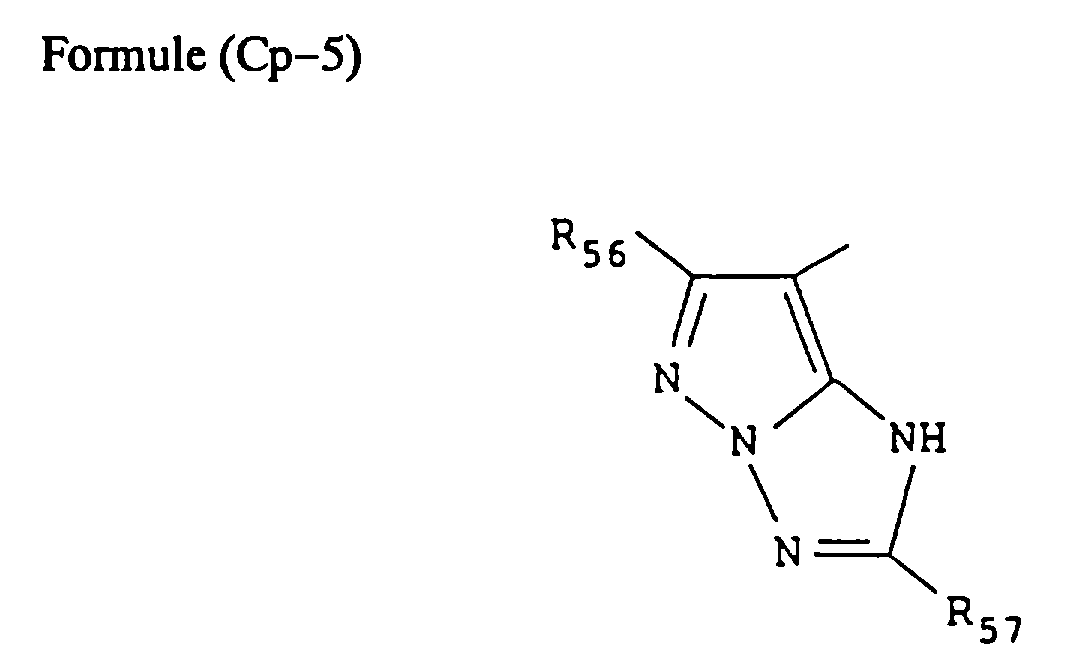


 R₄₁ est un groupe aliphatique, un groupe aromatique ou un groupe hétérocyclique ; R₄₂ est un groupe aromatique ou un groupe hétérocyclique ; et R₄₃, R₄₄ et R₄₅, identiques ou différents, sont des atomes d'hydrogène, des groupes aliphatiques, des groupes aromatiques ou des groupes hétérocycliques; R₅₁ est un groupe de même signification que R₄₁ ; b est égal à 0 ou 1; R₅₂ et R₅₃, identiques ou différents, sont chacun un groupe de même signification que R₄₂; R₅₄ est un groupe de même signification que R₄₁ ou un groupe R₄₁CON(R₄₃)-, un groupe R₄₁N(R₄₃)-, un groupe R₄₁SO₂N(R₄₃)-, un groupe R₄₁S-, un groupe R₄₃O-, un groupe R₄₅N(R₄₃)CON(R₄₄)- ou un groupe N≡C- ; R₅₅ est un groupe de même signification que R₄₁ ; R₅₆ et R₅₇, identiques ou différents, sont chacun un groupe de même signification que R₄₃ ou un groupe R₄₁S-, un groupe R₄₃O-, un groupe R₄₁CON(R₄₃)- ou un groupe R₄₁SO₂N(R₄₃)- ;R₅₈ est un groupe de même signification que R₄₁ ;R₅₉ est un groupe de même signification que R₄₁ ou un groupe R₄₁CON(R₄₃)-, un groupe R₄₁OCON(R₄₃)-, un groupe R₄₁SO₂N(R₄₃)-, un groupe R₄₃N(R₄₄)CON(R₄₅)-, un groupe R₄₁O-, un groupe R₄₁S-, un atome d'halogène ou un groupe R₄₁N(R₄₃)- ; d est un entier de 0 à 3 et lorsque d est égal à 2 ou 3, les substituants R₅₉ peuvent être les mêmes ou différents, ou peuvent être des groupes divalents qui sont reliés ensemble pour former une structure cyclique choisie parmi
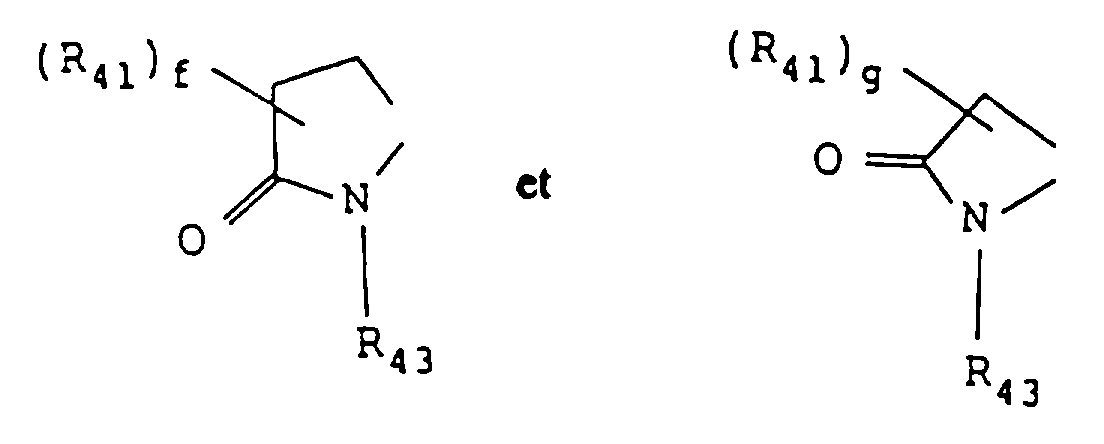 dans lesquelles f est un entier de 0 à 4 et g est un entier de 0 à 2 ;R₆₀ est un groupe de même signficiation que R₄₁ ; R₆₁ est un groupe de même signification que R₄₁ ; R₆₂ est un groupe de même signification que R₄₁ ou un groupe R₄₁OCONH-, un groupe R₄₁SO₂NH-, un groupe R₄₃N(R₄₄)CON(R₄₅)-, un groupe R₄₃N(R₄₄)SO₂N(R₄₅)-, un groupe R₄₃O-, un groupe R₄₁S-, un atome d'halogène ou un groupe R₄₁N(R₄₃)- ; et R₆₃ est un groupe de même signification que R₄₁ ou un groupe R₄₃N(R₄₄)CON(R₄₅)-, un groupe R₄₃N(R₄₄)CO-, un groupe R₄₁SO₂N(R₄₄)-, un groupe R₄₃N(R₄₄)SO₂-, un groupe R₄₁SO₂-, un groupe R₄₃OCO-, un groupe R₄₃O-SO₂-, un atome d'halogène, un groupe nitro, un groupe cyano ou un groupe R₄₃CO- ; e est un entier de 0 à 4 ; ou bien facultativementR₅₁, R₅₂, R₅₃, R₅₄, R₅₅, R₅₆, R₅₇, R₅₈, R₅₉, R₆₀, R₆₁, R₆₂ et R₆₃, identiques ou différents, peuvent être chacun un groupe non diffusible, dans lequel le nombre total d'atomes de carbone est de 9 à 40 ; ou bien facultativementlorsque A dans la formule (I) est un groupe résiduel de coupleur du type bis, du type télomère ou du type polymère, R₅₁, R52, R₅₃, R₅₄, R₅₅, R₅₆, R₅₇, R₅₈, R₅₉, R₆₀, R₆₁, R₆₂ et R₆₃, identiques ou différents, peuvent être un groupe divalent qui relie ensemble des motifs récurrents du coupleur.
- Matériau photographique couleur à l'halogénure d'argent selon la revendication 3, dans lequel :les groupes aliphatiques, identiques ou différents, sont choisis parmi les groupes hydrocarbyles aliphatiques en C₁-C₃₂ saturés ou insaturés, à chaîne droite ou ramifiée ou cyclique, substitués ou non ;les groupes aromatiques, identiques ou différents, sont choisis parmi les groupes naphtyles substitués ou non et les groupes phényles substitués ou non en C₆-C₂₀ ; etles groupes hétérocycliques, identiques ou différents, sont choisis parmi les groupes hétérocycliques à 3-8 chaînons substitués ou non, qui ont de 1 à 20 atomes de carbone et dans lesquels les hétéroatomes dans l'hétérocycle sont des atomes d'azote, d'oxygène ou de soufre.
- Matériau photographique couleur à l'halogénure d'argent selon la revendication 1, dans lequel R est:un groupe alkyle à chaîne droite ou ramifiée en C₁-C₄ ;un groupe alkyle à chaîne droite ou ramifiée en C₁-C₄, qui est substitué par un ou plusieurs substituants choisis parmi un groupe alcoxycarbonyle en C₂-C₆, un groupe carbamoyle ayant de 0 à 6 atomes de carbone, un atome d'halogène, un groupe nitro, un groupe cyano, un groupe alcoxy en C₁-C₄, un groupe sulfamoyle ayant de 0 à 6 atomes de carbone, un groupe aryloxy en C₆-C₁₀, un groupe acyle en C₂-C₆, un groupe sulfonyle en C₁-C₆, un groupe hétérocyclique à 3-6 chaînons ayant de 1 à 5 atomes de carbone et dont les hétéroatomes sont choisis parmi des atomes d'azote, d'oxygène et de soufre ou un groupe phosphoryle en C₂-C₅ ;un groupe 2-pyridyle, 3-pyridyle ou 4-pyridyle ; ouun groupe 2-pyridyle, 3-pyridiyle ou 4-pyridyle substitué par un ou plusieurs groupes aliphatiques en C₁-C₆.
- Matériau photographique couleur à l'halogénure d'argent selon la revendication 1, dans lequel A dans la formule (R-I) est un groupe résiduel de coupleur à utiliser en photographie en couleur ou un groupe résiduel de coupleur qui peut subir une oxydation ou une réduction.
- Matériau photographique couleur à l'halogénure d'argent selon la revendication 1, dans lequel A dans la formule (R-I) est :
un groupe résiduel de coupleur pour jaune du type cétométhylène à chaîne ouverte ; un groupe résiduel de coupleur pour magenta du type 5-pyrazolone, du type pyrazoloimidazole ou du type pyrazolotriazole ; un groupe résiduel de coupleur pour cyan du type phénol ou du type naphtol ; un groupe résiduel de coupleur non chromogène du type indanone ou du type acétophénone ; ou un groupe résiduel de coupleur du type hétérocyclique. - Matériau photographique couleur à l'halogénure d'argent selon la revendication 1, dans lequel A dans la formule (R-I) est un groupe résiduel de coupleur choisi parmi ceux de formules suivantes :


 R₄₁ est un groupe aliphatique, un groupe aromatique ou un groupe hétérocyclique ; R₄₂ est un groupe aromatique ou un groupe hétérocyclique ; et R₄₃, R₄₄ et R₄₅, identiques ou différents, sont des atomes d'hydrogène, des groupes aliphatiques, des groupes aromatiques ou des groupes hétérocycliques ;R₅₁ est un groupe de même signification que R₄₁ ; b est égal à 0 ou 1 ; R₅₂ et R₅₃, identiques ou différents sont chacun un groupe de même signification que R₄₂; R₅₄ est un groupe de même signification que R₄₁ ou un groupe R₄₁CON(R₄₃)-, un groupe R₄₁N(R₄₃)-, un groupe R₄₁SO₂N(R₄₃)-, un groupe R₄₁S-, un groupe R₄₃O-, un groupe R₄₅N(R₄₃)CON(R₄₄)- ou un groupe N≡C- ; R₅₅ est un groupe de même signification que R₄₁ ; R₅₆ et R₅₇, identiques ou différents, sont chacun un groupe de même signification que R₄₃ ou un groupe R₄₁S-, un groupe R₄₃O-, un groupe R₄₁CON(R₄₃)- ou un groupe R₄₁SO₂N(R₄₃)- ;R₅₈ est un groupe de même signification que R₄₁ ;R₅₉ est un groupe de même signification que R₄₁ ou un groupe R₄₁CON(R₄₃)-, un groupe R₄₁OCON(R₄₃)-, un groupe R₄₁SO₂N(R₄₃)-, un groupe R₄₃N(R₄₄)CON(R₄₅)-, un groupe R₄₁O-, un groupe R₄₁S-, un atome d'halogène ou un groupe R₄₁N(R₄₃)- ; d est un entier de 0 à 3 et lorsque d est égal à 2 ou 3, les substituants R₅₉ peuvent être les mêmes ou différents, ou peuvent être des groupes divalents qui sont reliés ensemble pour former une structure cyclique choisie parmi
 dans lesquelles f est un entier de 0 à 4 et g est un entier de 0 à 2 ;R₆₀ est un groupe de même signficiation que R₄₁ ; R₆₁ est un groupe de même signification que R₄₁ ; R₆₂ est un groupe de même signification que R₄₁ ou un groupe R₄₁OCONH-, un groupe R₄₁SO₂NH-, un groupe R₄₃N(R₄₄)CON(R₄₅)-, un groupe R₄₃N(R₄₄)SO₂N(R₄₅)-, un groupe R₄₃O-, un groupe R₄₁S-, un atome d'halogène ou un groupe R₄₁N(R₄₃)- ; et R₆₃ est un groupe de même signification que R₄₁ ou un groupe R₄₃N(R₄₄)CON(R₄₅)-, un groupe R₄₃N(R₄₄)CO-, un groupe R₄₁SO₂N(R₄₄)-, un groupe R₄₃N(R₄₄)SO₂-, un groupe R₄₁SO₂-, un groupe R₄₃OCO-, un groupe R₄₃O-SO₂-, un atome d'halogène, un groupe nitro, un groupe cyano ou un groupe R₄₃CO- ; e est un entier de 0 à 4 ; ou bien facultativementR₅₁, R₅₂, R₅₃, R₅₄, R₅₅, R₅₆, R₅₇, R₅₈, R₅₉, R₆₀, R₆₁, R₆₂ et R₆₃, identiques ou différents, peuvent être chacun un groupe non diffusible, dans lequel le nombre total d'atomes de carbone est de 8 à 40.
- Matériau photographique couleur à l'halogénure d'argent selon la revendication 8, dans lequelles groupes aliphatiques, identiques ou différents, sont choisis parmi les groupes hydrocarbyles aliphatiques en C₁-C₃₂ saturés ou insaturés, à chaîne droite ou ramifiée ou cyclique, substitués ou non ;les groupes aromatiques, identiques ou différents, sont choisis parmi les groupes naphtyles substitués ou non et les groupes phényles substitués ou non en C₆-C₂₀ ; etles groupes hétérocycliques, identiques ou différents, sont choisis parmi les groupes hétérocycliques à 3-8 chaînons substitués ou non, qui ont de 1 à 20 atomes de carbone et dans lesquels les hétéroatomes dans l'hétérocycle sont des atomes d'azote, d'oxygène ou de soufre.
- Matériau photographique couleur à l'halogénure d'argent selon la revendication 1, dans lequel lorsque le groupe A dans la formule (R-I) est un groupe résiduel qui peut subir une oxydation ou une réduction, la formule (R-I) est représentée par la formule R-II suivante
Formule (R-II) A₁-P-(X=Y)n-Q-A₂
dans laquellen est un nombre de 1 à 3 ;P et Q, identiques ou différents, sont chacun un atome d'oxygène ou un groupe imino substitué ou non ;X et Y, individuellement identiques ou différents, sont des groupes méthine ou des atomes d'azote substitués ou non, avec la condition que l'un des n groupes X individuels et des n groupes Y individuels soit substitué par -(L₁)v-B-(L₂)w-INH-HYD ;A₁ et A₂, identiques ou différents, sont chacun un atome d'hydrogène ou un groupe qui peut être séparé par un alcali ; ou bien facultativementdeux quelconques des groupes P, X, Y, Q, A₁ et A₂ peuvent être divalents et reliés pour former une structure cyclique, avec la condition que l'un des n groupes X individuels et n groupes Y individuels soit substitué par -(L₁)v-B-(L₂)w-INH-HYD. - Matériau photographique couleur à l'halogénure d'argent selon la revendication 10, dans lequel P et Q dans la formule R-II sont chacun un groupe représenté par la formule
 un groupe aliphatique à chaîne droite, ramifié ou cyclique, en C₁-C32, saturé ou insaturé, substitué ou non ;un groupe aromatique en C₆-C₁₀ substitué ou non ;un groupe hétérocyclique à 4-7 chaînons ayant de 1 à 6 atomes de carbone, dans lequel les hétéroatomes sont l'azote, l'oxygène ou le soufre ; ouun groupe de formule -O-G', où G' estun groupe aliphatique à chaîne droite, ramifié ou cyclique, en C₁-C₃₂ saturé ou non, substitué ou non.
- Matériau photographique couleur à l'halogénure d'argent selon la revendication 1, dans lequel L₁ et L₂ dans la formule R-I sont identiques ou différents et sont choisis parmi :un reste qui peut être séparé dans une réaction de coupure d'hémiacétal,un reste qui peut être séparé dans une réaction de substitution nucléophile intramoléculaire,un reste qui peut être séparé dans une réaction de transfert électronique dans un système conjugué,un reste qui peut être séparé dans une réaction d'hydrolyse d'ester etun reste qui peut être séparé dans une réaction d'iminoacétal.
- Matériau photographique couleur à l'halogénure selon la revendication 1, dans lequel B dans la formule R-I est
un groupe qui peut subir une réaction d'oxydation et de réduction et qui peut réduire la forme oxydée de l'agent développateur, ou un groupe qui subit une réaction de couplage avec la forme oxydée d'un agent développateur et produit des composés essentiellement incolores. - Matériau photographique couleur à l'halogénure d'argent selon la revendication 13, dans lequel B est un groupe qui peut réduire la forme oxydée d'un agent développateur et répond à la formule (R-V) :
Formule (R-V) * -P'-(X'=Y')n'-Q'-A₂'
dans laquellen' est un nombre de 1 à 3 ;P' et Q', identiques ou différents, sont chacun un atome d'oxygène ou un groupe imino substitué ou non ;X' et Y', individuellement identiques ou différents, sont des groupes méthine ou des atomes d'azote substitués ou non, avec la condition que l'un des n' groupes X' individuels et des n' groupes Y' individuels soit substitué par -(L₂)w-INH-HYD ;A₂' est un atome d'hydrogène ou un groupe qui peut être séparé par un alcali ; ou bien facultativementdeux quelconques des groupes P', X', Y', Q' et A₂' peuvent être divalents et reliés pour former une structure cyclique, avec la condition que l'un des n' groupes X' individuels et des n' groupes Y' individuels soit substitué par -(L₂)w-INH-HYD. - Matériau photographique couleur à l'halogénure d'argent selon la revendication 14, dans lequel Q' dans la formule R-V est un groupe représenté par la formule
 un groupe aliphatique à chaîne droite, ramifié ou cyclique, saturé ou insaturé en C₁ -C₃₂, substitué ou non ;un groupe aromatique en C₆-C₁₀ substitué ou non ;un groupe hétérocyclique à 4-7 chaînons ayant de 1 à 6 atomes de carbone, dans lequel les hétéroatomes sont l'azote, l'oxygène ou le soufre ; ouun groupe de formule -O-G', où G' estun groupe aliphatique à chaîne droite, ramifié ou cyclique, en C₁-C₃₂ saturé ou non, substitué ou non ;un groupe aromatique en C₆-C₁₀ substitué ou non ;un groupe hétérocyclique à 4-7 chaînons ayant de 1 à 6 atomes de carbone, dans lequel les hétéroatomes sont l'azote, l'oxygène ou le soufre.
- Matériau photographique couleur à l'halogénure d'argent selon la revendication 1, dans lequel le groupe INH présent dans la formule (R-I) est choisi parmi ceux de formules :


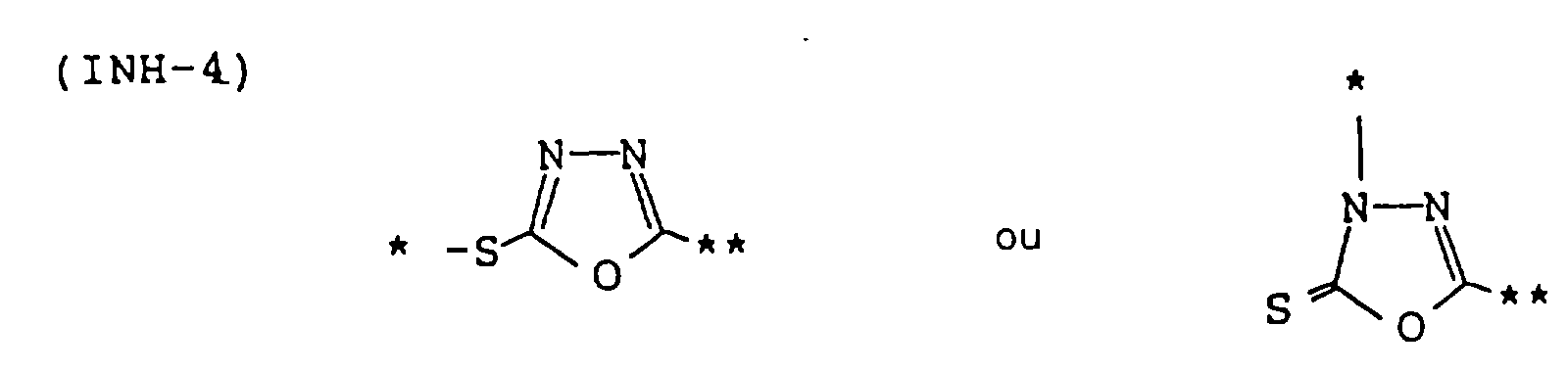


R₂₁ est un atome d'hydrogène ou un groupe hydrocarbyle substitué ou non ; * représente la position dans laquelle est lié le groupe A-(L₁)v-B-(L₂)w - dans la formule (R-I) ; et ** représente la position dans laquelle est lié le groupe HYD dans la formule (R-I). - Matériau photographique couleur à l'halogénure d'argent selon la revendication 1, dans lequel le groupe HYD dans la formule (R-I) est encore représenté par la formule (HYD-I)
Formule (HYD-I) -(L₃)ry-CO₂R₂₂
dans laquelleL₃ est un groupe choisi parmi un groupe alkyle substitué ou non ou un groupe aryle substitué ou non ;ry est égal à 0 ou 1 ; etR₂₂ est un groupe alkyle en C₁-C₂₀. - Matériau photographique couleur à l'halogénure d'argent selon la revendication 1, qui comprend en outre au moins une couche d'émulsion d'halogénure d'argent sensible au rouge qui contient un coupleur pour cyan, au moins une couche d'émulsion d'halogénure d'argent sensible au vert qui contient un coupleur pour magenta et au moins une couche d'émulsion d'halogénure d'argent sensible au bleu qui contient un coupleur pour jaune et dans lequel le coupleur pour cyan est un coupleur représenté par la formule générale (C) ci-dessous :
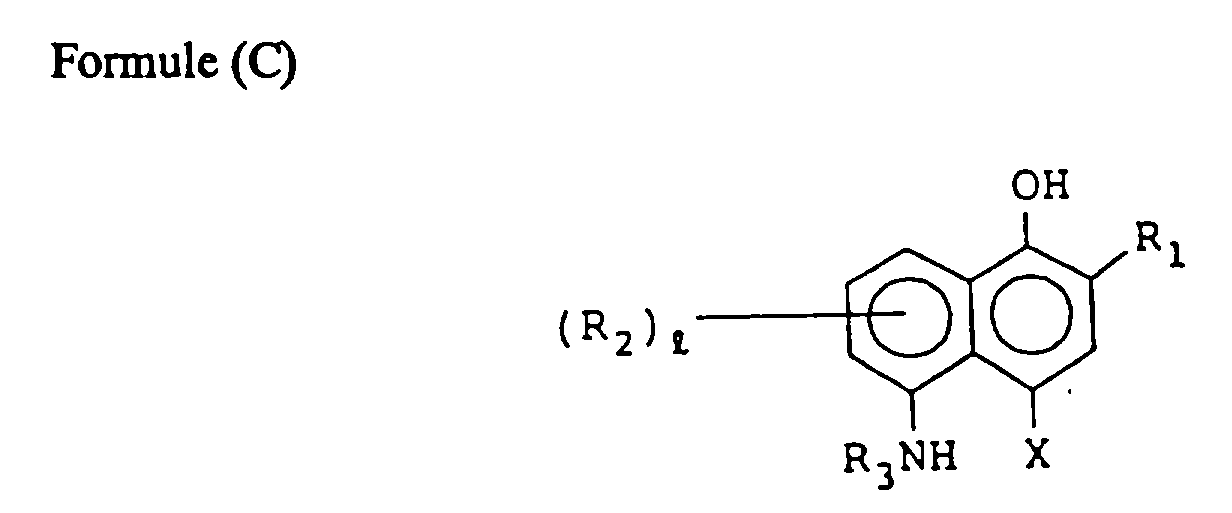 R₁ représente un groupe -CONR₄R₅, -SO₂NR₄R₅, -NHCOR₄, -NHCOOR₆, -NHSO₂R₆, -NHCONR₄R₅ ou -NHSO₂NR₄R₅ ; R₂ représente un groupe qui peut être un substituant du noyau naphtalène ; 1 représente un entier d'une valeur de 0 à 3 et lorsque 1 représente 2 ou plus, les groupes R₂ peuvent être les mêmes ou différents ou bien ils peuvent être reliés ensemble pour former une structure cyclique ; R₃ représente un substituant ; et X représente un atome d'hydrogène ou un groupe qui peut être éliminé par réaction de couplage avec la forme oxydée d'un agent développateur du type amine aromatique primaire ; ou bien R₂ et R₃ ou R₃ et X peuvent être reliés ensemble pour former une structure cyclique, ou des dimères ou oligomères supérieurs reliés ensemble par un groupe R₁, R₂, ou X qui est un groupe divalent ou un groupe de valence supérieure à 2 ;R₄ et R₅, identiques ou différents, représentent chacun un atome d'hydrogène, un groupe alkyle, un groupe aryle ou un groupe hétérocyclique ; et R₆ représente un groupe alkyle, un groupe aryle ou un groupe hétérocyclique.
- Matériau photographique couleur à l'halogénure d'argent selon la revendication 1, qui comprend au moins une couche d'émulsion d'halogénure d'argent sensible au rouge qui contient un coupleur pour cyan, au moins une couche d'émulsion d'halogénure d'argent sensible au vert qui contient un coupleur pour magenta et au moins une couche d'émulsion d'halogénure d'argent sensible au bleu qui contient un coupleur pour jaune, dans lequel le coupleur pour jaune est représenté par la formule générale (A) ci-dessous :
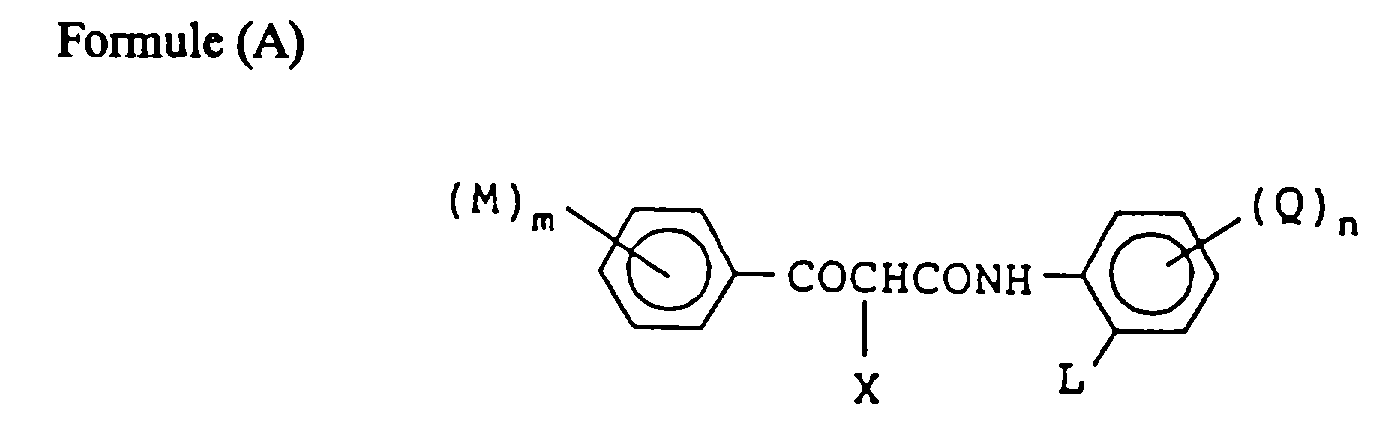
M et Q représentent des groupes (y compris des atomes) qui peuvent être des substituants du noyau benzénique ; L représente un atome d'hydrogène, un atome d'halogène ou un groupe oxy aliphatique ; m représente un entier d'une valeur de 0 à 5 et lorsque m est égal à 2 ou plus, les groupes (M)m peuvent être les mêmes ou différents ; n représente un entier d'une valeur de 0 à 4 et lorsque n est égal à 2 ou plus, les groupes (Q)n peuvent être les mêmes ou différents ; et X représente un groupe qui peut être éliminé par une réaction de couplage avec la forme oxydée d'un agent développateur du type amine aromatique primaire ; ou bien M, Q, L ou X peuvent être des groupes de liaison divalents, trivalents ou tétravalents de sorte qu'il peut se former des dimères, trimères ou tétramères des coupleurs pour jaune représentés par la formule générale (A). - Matériau photographique couleur à l'halogénure d'argent selon la revendication 19, dans lequel X dans la formule générale (A) est un groupe représenté par la formule (B) suivante :
Formule (B) -O-R'
dans laquelle
R' est un groupe aromatique en C₆-C₃₀, un groupe hétérocyclique qui a de 1 à 28 atomes de carbone, un groupe acyle en C₂-C₂₈, un groupe sulfonyle aliphatique en C₁-C₂₄ ou un groupe sulfonyle aromatique en C₆-C₂₄. - Matériau photographique couleur à l'halogénure d'argent selon la revendication 19, dans lequel X dans la formule générale (A) est un groupe représenté par la formule générale (C) suivante :
Formule (C) -S-R"
dans laquelle
R" représente un groupe aliphatique en C₁-C₃₀, un groupe aromatique en C₆-C₃₀, un groupe hétérocyclique qui a de 1 à 28 atomes de carbone. - Matériau photographique couleur à l'halogénure d'argent selon la revendication 19, dans laquelle X dans la formule générale (A) est un groupe représenté par la formule générale (D) suivante :

Y représente un groupe d'atomes non métalliques qui est nécessaire pour former avec Q un noyau monocyclique à 5-7 chaînons ou un noyau hétérocyclique condensé.
Applications Claiming Priority (2)
| Application Number | Priority Date | Filing Date | Title |
|---|---|---|---|
| JP2062180A JPH03261948A (ja) | 1990-03-13 | 1990-03-13 | ハロゲン化銀カラー写真感光材料 |
| JP62180/90 | 1990-03-13 |
Publications (3)
| Publication Number | Publication Date |
|---|---|
| EP0451526A2 EP0451526A2 (fr) | 1991-10-16 |
| EP0451526A3 EP0451526A3 (en) | 1991-11-06 |
| EP0451526B1 true EP0451526B1 (fr) | 1996-01-24 |
Family
ID=13192675
Family Applications (1)
| Application Number | Title | Priority Date | Filing Date |
|---|---|---|---|
| EP91103836A Expired - Lifetime EP0451526B1 (fr) | 1990-03-13 | 1991-03-13 | Produits photographiques couleur à l'halogénure d'argent |
Country Status (5)
| Country | Link |
|---|---|
| US (1) | US5498513A (fr) |
| EP (1) | EP0451526B1 (fr) |
| JP (1) | JPH03261948A (fr) |
| CN (1) | CN1057343A (fr) |
| DE (1) | DE69116588T2 (fr) |
Families Citing this family (5)
| Publication number | Priority date | Publication date | Assignee | Title |
|---|---|---|---|---|
| JPH04445A (ja) * | 1990-04-17 | 1992-01-06 | Fuji Photo Film Co Ltd | ハロゲン化銀カラー写真感光材料の処理方法 |
| JPH04256954A (ja) * | 1991-02-08 | 1992-09-11 | Konica Corp | 色相再現性にすぐれたハロゲン化銀カラー写真感光材料 |
| US5376214A (en) * | 1992-09-22 | 1994-12-27 | Nissan Motor Co., Ltd. | Etching device |
| DE69608613T2 (de) * | 1995-06-27 | 2000-11-30 | Fuji Photo Film Co., Ltd. | Farbphotographisches Silberhalogenidmaterial und Verfahren zur Bildherstellung |
| US6613943B2 (en) * | 2001-12-03 | 2003-09-02 | Eastman Kodak Company | 4-acylamino-2-hydroxy-5-substituted-acylanilide compounds and method of using them |
Family Cites Families (11)
| Publication number | Priority date | Publication date | Assignee | Title |
|---|---|---|---|---|
| JPS57151944A (en) * | 1981-03-16 | 1982-09-20 | Fuji Photo Film Co Ltd | Color photosensitive silver halide material |
| DE3209846C2 (de) * | 1982-03-18 | 1984-10-25 | Manfred 7022 Leinfelden-Echterdingen Malzacher | Eckverbinder für plattenförmige Körper zur Schaffung von Schaugestellen o.dgl. |
| JPS61255342A (ja) * | 1985-05-09 | 1986-11-13 | Fuji Photo Film Co Ltd | ハロゲン化銀カラ−写真感光材料 |
| US4937179A (en) * | 1985-05-27 | 1990-06-26 | Fuji Photo Film Co., Ltd. | Silver halide color photographic material |
| JPS623249A (ja) * | 1985-06-28 | 1987-01-09 | Konishiroku Photo Ind Co Ltd | 直接ポジハロゲン化銀カラ−写真感光材料 |
| JPS62125350A (ja) * | 1985-11-26 | 1987-06-06 | Fuji Photo Film Co Ltd | ハロゲン化銀カラ−写真感光材料の処理方法 |
| JPH0670711B2 (ja) * | 1986-09-29 | 1994-09-07 | 富士写真フイルム株式会社 | ハロゲン化銀カラ−ネガ写真感光材料 |
| JPH0614177B2 (ja) * | 1986-10-03 | 1994-02-23 | 富士写真フイルム株式会社 | ハロゲン化銀カラ−写真感光材料 |
| JPH026945A (ja) * | 1987-12-01 | 1990-01-11 | Fuji Photo Film Co Ltd | ハロゲン化銀カラー写真感光材料 |
| JPH07120002B2 (ja) * | 1988-02-19 | 1995-12-20 | 富士写真フイルム株式会社 | ハロゲン化銀カラー写真感光材料の処理方法 |
| US5026628A (en) * | 1990-02-22 | 1991-06-25 | Eastman Kodak Company | Photographic material and process comprising a compound capable of forming a wash-out dye |
-
1990
- 1990-03-13 JP JP2062180A patent/JPH03261948A/ja active Pending
-
1991
- 1991-03-13 DE DE69116588T patent/DE69116588T2/de not_active Expired - Fee Related
- 1991-03-13 CN CN91102359A patent/CN1057343A/zh active Pending
- 1991-03-13 EP EP91103836A patent/EP0451526B1/fr not_active Expired - Lifetime
-
1994
- 1994-07-06 US US08/267,926 patent/US5498513A/en not_active Expired - Fee Related
Also Published As
| Publication number | Publication date |
|---|---|
| CN1057343A (zh) | 1991-12-25 |
| EP0451526A2 (fr) | 1991-10-16 |
| EP0451526A3 (en) | 1991-11-06 |
| US5498513A (en) | 1996-03-12 |
| DE69116588D1 (de) | 1996-03-07 |
| JPH03261948A (ja) | 1991-11-21 |
| DE69116588T2 (de) | 1996-06-13 |
Similar Documents
| Publication | Publication Date | Title |
|---|---|---|
| EP0464612B1 (fr) | Matériaux photographiques à l'halogénure d'argent | |
| EP0482552A1 (fr) | Matériaux photographiques couleur à l'halogénure d'argent sensibles à la lumière | |
| US5071735A (en) | Silver halide color photographic material containing a compound releasing a dir command upon reaction with an oxidized developing agent | |
| US5306609A (en) | Silver halide color photographic material | |
| EP0442323B1 (fr) | Matériau photographique d'halogénure d'argent inversible en couleurs à l'effet interimage | |
| EP0440195B1 (fr) | Produit photographique couleur à l'halogénure d'argent | |
| EP0438129B1 (fr) | Produit photographique couleur à l'halogénure d'argent | |
| US5112730A (en) | Silver halide color photographic material comprising a yellow-colored cyan coupler | |
| EP0456181B1 (fr) | Produit photographique couleur à l'halogénure d'argent et méthode pour son traitement | |
| EP0446863B1 (fr) | Produit photographique couleur à l'halogénure d'argent | |
| EP0451859B1 (fr) | Matériau photographique couleur à l'halogénure d'argent sensible à la lumière | |
| US5498513A (en) | Silver halide color photographic photosensitive materials | |
| EP0513496A1 (fr) | Matériau photographique couleur à l'halogénure d'argent | |
| EP0565096A1 (fr) | Matériau photographique couleur à l'halogénure d'argent | |
| EP0436938B1 (fr) | Produit photographique couleur à l'halogénure d'argent contenant un coupleur cyan coloré en jaune | |
| US5063145A (en) | Silver halide color photographic material | |
| EP0369486B1 (fr) | Matériau photographique couleur à l'halogénure d'argent sensible à la lumière de type négatif | |
| EP0435334B1 (fr) | Produit photographique couleur à l'halogénure d'argent contenant un coupleur cyan coloré en jaune | |
| US5437965A (en) | Silver halide color photographic material | |
| US5376513A (en) | Silver halide color photographic light-sensitive materials | |
| US5312726A (en) | Silver halide color photographic material | |
| EP0423727B1 (fr) | Matériau photographique couleur à l'halogénure d'argent contenant un coupleur coloré | |
| US5447833A (en) | Silver halide photographic material and imidazole derivatives | |
| EP0503658A1 (fr) | Matériau photographique couleur à l'halogénure d'argent sensible à la lumière | |
| US5476759A (en) | Silver halide color photographic material |
Legal Events
| Date | Code | Title | Description |
|---|---|---|---|
| PUAI | Public reference made under article 153(3) epc to a published international application that has entered the european phase |
Free format text: ORIGINAL CODE: 0009012 |
|
| PUAL | Search report despatched |
Free format text: ORIGINAL CODE: 0009013 |
|
| AK | Designated contracting states |
Kind code of ref document: A2 Designated state(s): DE FR GB IT NL |
|
| AK | Designated contracting states |
Kind code of ref document: A3 Designated state(s): DE FR GB IT NL |
|
| 17P | Request for examination filed |
Effective date: 19920122 |
|
| 17Q | First examination report despatched |
Effective date: 19950314 |
|
| RBV | Designated contracting states (corrected) |
Designated state(s): DE GB |
|
| GRAA | (expected) grant |
Free format text: ORIGINAL CODE: 0009210 |
|
| AK | Designated contracting states |
Kind code of ref document: B1 Designated state(s): DE GB |
|
| REF | Corresponds to: |
Ref document number: 69116588 Country of ref document: DE Date of ref document: 19960307 |
|
| PLBE | No opposition filed within time limit |
Free format text: ORIGINAL CODE: 0009261 |
|
| STAA | Information on the status of an ep patent application or granted ep patent |
Free format text: STATUS: NO OPPOSITION FILED WITHIN TIME LIMIT |
|
| 26N | No opposition filed | ||
| REG | Reference to a national code |
Ref country code: GB Ref legal event code: IF02 |
|
| PGFP | Annual fee paid to national office [announced via postgrant information from national office to epo] |
Ref country code: GB Payment date: 20040310 Year of fee payment: 14 |
|
| PGFP | Annual fee paid to national office [announced via postgrant information from national office to epo] |
Ref country code: DE Payment date: 20040325 Year of fee payment: 14 |
|
| PG25 | Lapsed in a contracting state [announced via postgrant information from national office to epo] |
Ref country code: GB Free format text: LAPSE BECAUSE OF NON-PAYMENT OF DUE FEES Effective date: 20050313 |
|
| PG25 | Lapsed in a contracting state [announced via postgrant information from national office to epo] |
Ref country code: DE Free format text: LAPSE BECAUSE OF NON-PAYMENT OF DUE FEES Effective date: 20051001 |
|
| GBPC | Gb: european patent ceased through non-payment of renewal fee |
Effective date: 20050313 |