EP0452652B1 - Procédé et appareil pour produire une plaque d'étanchéité sur une calandre - Google Patents
Procédé et appareil pour produire une plaque d'étanchéité sur une calandre Download PDFInfo
- Publication number
- EP0452652B1 EP0452652B1 EP91103214A EP91103214A EP0452652B1 EP 0452652 B1 EP0452652 B1 EP 0452652B1 EP 91103214 A EP91103214 A EP 91103214A EP 91103214 A EP91103214 A EP 91103214A EP 0452652 B1 EP0452652 B1 EP 0452652B1
- Authority
- EP
- European Patent Office
- Prior art keywords
- roll
- temperature
- plate
- calender
- hot roll
- Prior art date
- Legal status (The legal status is an assumption and is not a legal conclusion. Google has not performed a legal analysis and makes no representation as to the accuracy of the status listed.)
- Expired - Lifetime
Links
Images
Classifications
-
- B—PERFORMING OPERATIONS; TRANSPORTING
- B29—WORKING OF PLASTICS; WORKING OF SUBSTANCES IN A PLASTIC STATE IN GENERAL
- B29C—SHAPING OR JOINING OF PLASTICS; SHAPING OF MATERIAL IN A PLASTIC STATE, NOT OTHERWISE PROVIDED FOR; AFTER-TREATMENT OF THE SHAPED PRODUCTS, e.g. REPAIRING
- B29C43/00—Compression moulding, i.e. applying external pressure to flow the moulding material; Apparatus therefor
- B29C43/22—Compression moulding, i.e. applying external pressure to flow the moulding material; Apparatus therefor of articles of indefinite length
- B29C43/24—Calendering
- B29C43/245—Adjusting calender parameters, e.g. bank quantity
-
- B—PERFORMING OPERATIONS; TRANSPORTING
- B29—WORKING OF PLASTICS; WORKING OF SUBSTANCES IN A PLASTIC STATE IN GENERAL
- B29C—SHAPING OR JOINING OF PLASTICS; SHAPING OF MATERIAL IN A PLASTIC STATE, NOT OTHERWISE PROVIDED FOR; AFTER-TREATMENT OF THE SHAPED PRODUCTS, e.g. REPAIRING
- B29C43/00—Compression moulding, i.e. applying external pressure to flow the moulding material; Apparatus therefor
- B29C43/22—Compression moulding, i.e. applying external pressure to flow the moulding material; Apparatus therefor of articles of indefinite length
- B29C43/24—Calendering
-
- B—PERFORMING OPERATIONS; TRANSPORTING
- B29—WORKING OF PLASTICS; WORKING OF SUBSTANCES IN A PLASTIC STATE IN GENERAL
- B29L—INDEXING SCHEME ASSOCIATED WITH SUBCLASS B29C, RELATING TO PARTICULAR ARTICLES
- B29L2031/00—Other particular articles
- B29L2031/26—Sealing devices, e.g. packaging for pistons or pipe joints
- B29L2031/265—Packings, Gaskets
Definitions
- the invention relates to a method and a device for producing a sealing plate on a calender, which has a heated roller of large diameter and an unheated roller of small diameter and which has a control device for the drive motors and the temperatures of the heating roller and the pressure roller, with the nip presents a raw mixture mixed with solvent and, by temperature control depending on the time, the number of heating roller revolutions and the heating roller rotation speed, builds up a plate on the heating roller which vulcanizes thereon.
- sealing plate calenders which have a heated roller on which the plates are rolled and vulcanized, and a cooled roller, which serves as a pressure roller for the assembly, are used for the production of fiber-reinforced flat seals, which are required at numerous points in technology is usually pressed hydraulically.
- the seals are made from a mixture of rubber-coated fibers and fibers, which give the strength of the finished product.
- asbestos fibers have been used as reinforcement, since the manufacture and use of panels excluded other fibers for thermal reasons.
- asbestos is increasingly undesirable due to health hazards and has recently been replaced, if possible, with high-strength and thermally resistant synthetic fibers.
- the invention avoids the disadvantages of the prior art.
- the invention has for its object to provide conditions for the control of the manufacturing process of synthetic fiber reinforced sealing plates, which is better adapted to the plate structure, in which a consistently high quality of the sealing plates produced is achieved.
- the invention achieves this in that at least one temperature measuring point is provided on the circumference of the heating roller for the surface temperature of the plate being produced on the heating roller, and in that this measured temperature is used as the basis for further decisions about all future or further control measures.
- the temperature of the surface of the plate being manufactured is constantly measured during the entire manufacturing process and in dependence thereon Temperature controls the temperature of the heating roller, the number of heating roller revolutions, the speed of rotation of the heating roller and / or the cold roller, the pressure force acting on the pressure roller, the supply of the raw mixture and / or the supply of solvent to the plate surface.
- the mass to be processed consists of a plastic mixture that can be processed using solvents and is mixed with the temperature-resistant synthetic fibers that ensure the strength in the finished plate
- the solvent evaporates when this mass is heated after application to the calender's heating roller. This process takes place during the constant rotary movement of the heating roller, in which the pressure roller ensures a compression of the mass in spite of this evaporation in accordance with the number of rollovers.
- the important phase of vulcanization of the respective plate layers only begins after the solvent particles have completely evaporated, since only then can the temperature increase necessary for vulcanization occur.
- the process is controlled as a function of the surface temperature of the plate being manufactured, the phases of the solvent evaporation and the beginning of vulcanization can be coordinated as best as possible, so that the work process can run optimally due to the surface temperature.
- the plate thickness generated is included in the regulation of the sequence of the manufacturing process.
- the workflow of the calender is regulated by a program-controlled processor, which processes the individual workflows as a function of the temperature of the surface of the plate being produced and the thickness of those being produced Plate runs out. The remaining process-determining parameters are then included in the control by the processor.
- the process data stored in the driving recipe are thus modified according to the invention according to theoretically or empirically determined functions or formulas in accordance with the respective mass surface temperature in such a way that this mass temperature assumes and maintains values that are as constant as possible at an optimal level.
- the roll speed, the speed difference of the two rolls (friction), the contact pressure and thus also the counter-bending of the process roll are particularly included in the extended process management.
- thermosensors can be advantageous to arrange several temperature sensors on a common carrier, which is arranged parallel to the heating roller surface and to the heating roller axis in the calender frame.
- irregularities can be corrected, e.g. by adding additional solvent to the surface, thereby producing sealing plates of the highest quality and uniform quality.
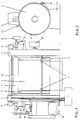
- the heating roller 2 and the pressure roller 3 are mounted in the stands 1 of the calender. In the nip a solvent-spreadable plastic mixture is inserted, which is formed into the sealing plate that builds up in layers on the heating roller 2.
- a support 5 for temperature sensors 6, which transmit the measured temperature to the processor 7, is arranged on the stands 1. This has further inputs for sensors, not shown, with which the plate thickness, the number of rolls, the speed of rotation of the rollers, etc. be measured.
- Control lines are connected to the outputs of the processor 7, which lead to the drive motors 8, 9 of the heating roller and the pressure roller and to the heating device 10 assigned to the heating roller or to a control valve assigned to this heating device and to the cooling device 11 or one possibly assigned to the pressure roller 3 control valve associated with this cooling device, lead to the pressing device 12 and the counter-bending device 13 and to any other devices that may be present, such as the loading device 14.
- the processor runs the work process depending on the temperature measured by the temperature sensors 6 and by the plate thickness measuring devices 15.
Landscapes
- Engineering & Computer Science (AREA)
- Mechanical Engineering (AREA)
- Casting Or Compression Moulding Of Plastics Or The Like (AREA)
Claims (6)
- Procédé pour fabriquer une plaque d'étanchéité dans une calandre, qui possède un cylindre chauffé de grand diamètre et un cylindre non chauffé de faible diamètre, et selon lequel on amène à la fente entre les cylindres une matière première mélangée à un solvant et grâce à une commande de la température en fonction du temps, du nombre des rotations du cylindre chauffé et de la vitesse de rotation du cylindre chauffé, on forme, sur le cylindre chauffé, une plaque qui est vulcanisée sur ce dernier,
caractérisé en ce
que pendant l'ensemble du procédé de fabrication, on mesure en permanence la température de la surface de la plaque en cours de fabrication et qu'en fonction de cette température, on règle la température du cylindre chauffé, le nombre de rotations du cylindre chauffé, la vitesse de rotation du cylindre chauffé et/ou du cylindre froid, la force de serrage agissant sur le cylindre de serrage, l'envoi de la matière première et/ou l'envoi d'un solvant à la surface de la plaque. - Procédé selon la revendication 1, caractérisé en ce qu'on introduit en tant que second paramètre déterminant, l'épaisseur obtenue de la plaque dans la régulation du déroulement du processus de fabrication.
- Procédé selon les revendications 1 et 2, caractérisé en ce qu'on règle le cycle de travail de la calandre au moyen d'un processeur commandé par un programme et qui exécute les différents cycles de travail en fonction de la température de la surface de la plaque en cours de fabrication, en tant que paramètre déterminant l'exécution du processus, et en fonction de l'épaisseur de la plaque en cours de fabrication.
- Calandre pour fabriquer une plaque d'étanchéité qui possède un cylindre chauffé de grand diamètre et un cylindre non chauffé de faible diamètre et comporte un dispositif de commande pour les moteurs d'entraînement et les températures du cylindre chauffé et du cylindre de serrage, caractérisée en ce que sur la circonférence du cylindre chauffé (2) est prévu au moins un point (6) de mesure de la température superficielle de la plaque (4) en cours de formation sur le cylindre chauffé (2).
- Calandre selon la revendication 4, caractérisée en ce que la sortie du capteur de la température (6) est raccordée à l'entrée du processeur (7).
- Calandre selon les revendications 4 et 5, caractérisée en ce que plusieurs capteurs de température (6) sont disposés sur un support commun (5), qui est disposé parallèlement à la surface du cylindre chauffé et à l'axe du cylindre chauffé dans le châssis (1) de la calandre.
Applications Claiming Priority (2)
| Application Number | Priority Date | Filing Date | Title |
|---|---|---|---|
| DE4011427A DE4011427A1 (de) | 1990-04-09 | 1990-04-09 | Verfahren und vorrichtung zur herstellung einer dichtungsplatte auf einem kalander |
| DE4011427 | 1990-04-09 |
Publications (2)
| Publication Number | Publication Date |
|---|---|
| EP0452652A1 EP0452652A1 (fr) | 1991-10-23 |
| EP0452652B1 true EP0452652B1 (fr) | 1994-01-26 |
Family
ID=6404055
Family Applications (1)
| Application Number | Title | Priority Date | Filing Date |
|---|---|---|---|
| EP91103214A Expired - Lifetime EP0452652B1 (fr) | 1990-04-09 | 1991-03-04 | Procédé et appareil pour produire une plaque d'étanchéité sur une calandre |
Country Status (4)
| Country | Link |
|---|---|
| US (1) | US5141681A (fr) |
| EP (1) | EP0452652B1 (fr) |
| JP (1) | JPH04226312A (fr) |
| DE (2) | DE4011427A1 (fr) |
Families Citing this family (6)
| Publication number | Priority date | Publication date | Assignee | Title |
|---|---|---|---|---|
| US5236640A (en) * | 1990-10-02 | 1993-08-17 | Paul Troester Maschinenfabrik | Process and calender for the production of packing sheets |
| DE4222241C2 (de) * | 1992-07-07 | 1994-08-25 | Troester Maschf Paul | Dichtungsplattenkalander |
| JP3943134B2 (ja) * | 1996-03-16 | 2007-07-11 | ブリュックナー マシーネンバウ ゲーエムベーハー | 圧延用ロールの膨張量変更法及び無限状の平面体を製造し又は加工する装置のロール膨張量変更装置 |
| US7431579B2 (en) * | 2004-08-24 | 2008-10-07 | The Goodyear Tire & Rubber Company | Calender gap control |
| JP5103732B2 (ja) * | 2005-12-14 | 2012-12-19 | 株式会社ブリヂストン | Evaフィルムの製造方法及び製造装置 |
| WO2013004640A1 (fr) | 2011-07-07 | 2013-01-10 | Dsm Ip Assets B.V. | Procédé de fabrication d'un film polymère |
Family Cites Families (8)
| Publication number | Priority date | Publication date | Assignee | Title |
|---|---|---|---|---|
| US3074114A (en) * | 1952-08-23 | 1963-01-22 | Congoleum Nairn Inc | Method for smoothing and glossing vinyl plastic sheets |
| BE625193A (fr) * | 1962-01-19 | |||
| US3599288A (en) * | 1969-01-23 | 1971-08-17 | Lab For Electronics Inc | Scan average memory control system |
| US3600747A (en) * | 1969-05-21 | 1971-08-24 | Firestone Tire & Rubber Co | System for calender control |
| DE2659529A1 (de) * | 1976-12-30 | 1978-07-06 | Harald Reimers Industriebetatu | Verfahren und vorrichtung zur stufenlosen bestimmung des vernetzungs- bzw. vulkanisationsgrades von kunststoff- bzw. kautschukmischungen |
| DE3416211C2 (de) * | 1984-05-02 | 1986-10-23 | Kleinewefers Gmbh, 4150 Krefeld | Verfahren zum Kalandrieren von einseitig mit einer Magnetschicht versehenen Bahnen und Kalander zur Durchführung dieses Verfahrens |
| US4573402A (en) * | 1984-08-08 | 1986-03-04 | Rajeeva Sharma | Caliper control system and method |
| DD231540A1 (de) * | 1984-12-21 | 1986-01-02 | Brillant Dresden Veb | Verfahren zur herstellung von folien |
-
1990
- 1990-04-09 DE DE4011427A patent/DE4011427A1/de not_active Withdrawn
-
1991
- 1991-03-04 EP EP91103214A patent/EP0452652B1/fr not_active Expired - Lifetime
- 1991-03-04 DE DE91103214T patent/DE59100927D1/de not_active Expired - Fee Related
- 1991-04-08 JP JP3103824A patent/JPH04226312A/ja active Pending
- 1991-04-08 US US07/681,996 patent/US5141681A/en not_active Expired - Fee Related
Also Published As
| Publication number | Publication date |
|---|---|
| US5141681A (en) | 1992-08-25 |
| JPH04226312A (ja) | 1992-08-17 |
| DE59100927D1 (de) | 1994-03-10 |
| DE4011427A1 (de) | 1991-10-10 |
| EP0452652A1 (fr) | 1991-10-23 |
Similar Documents
| Publication | Publication Date | Title |
|---|---|---|
| DE3131799C2 (de) | Walzenpresse für Papier- und ähnliche Bahnen, insbesondere Kalander | |
| DE68909382T2 (de) | Kontinuierliches Verfahren zum Herstellen hochfester und hochelastischer Polyolefinwerkstoffe. | |
| EP0485896B1 (fr) | Dispositif et procédé pour produire un stratifié multicouche | |
| EP0452652B1 (fr) | Procédé et appareil pour produire une plaque d'étanchéité sur une calandre | |
| EP0226946B1 (fr) | Procédé de fabrication continue de plaques pour le bâtiment | |
| DE102014117241A1 (de) | Verfahren zum optimierten Verstrecken von zumindest einem Faserband in einer Textilmaschine sowie Textilmaschine | |
| EP0733457B1 (fr) | Extrudeuse à plusieurs composants | |
| DE102005038401B4 (de) | Vorrichtung an einer Spinnereivorbereitungsmaschine, insbesondere Karde, Krempel o. dgl., mit einer Walze, z. B. Trommel, die eine zylindrische, garnierte Mantelfläche aufweist | |
| DE3416211C2 (de) | Verfahren zum Kalandrieren von einseitig mit einer Magnetschicht versehenen Bahnen und Kalander zur Durchführung dieses Verfahrens | |
| EP0451494B1 (fr) | Calandre pour la fabrication de plaques d'étanchéité | |
| EP0224683A1 (fr) | Procédé de réglage de la tension du tissu sur une laineuse | |
| EP3719186A1 (fr) | Procédé de fonctionnement d'une machine textile ainsi que machine textile | |
| DE4136706A1 (de) | Vorrichtung und verfahren zum herstellen einer anzahl von zwei- oder mehrlagigen einzelverbunden | |
| DE102016107956A1 (de) | Verfahren zum Imprägnieren von Endlosfasern zur Herstellung von faserverstärkten Halbzeugen | |
| EP0451495B1 (fr) | Dispositif de contrôle d'une calandre pour la fabrication de plaques d'étanchéité | |
| DE9004099U1 (de) | Kalander zur Herstellung einer Dichtungsplatte | |
| DE4111220C2 (de) | Vorrichtung zur Steuerung eines Kalanders für die Herstellung von Dichtungsplatten | |
| DE102010007491B4 (de) | Verfahren und Vorrichtung zur Herstellung thermoplastischer Prepregs | |
| EP0578036B1 (fr) | Calandre et procédé pour produire des plaques d'étanchéité | |
| EP0167722A1 (fr) | Machine à grande vitesse pour carder des fibres thermoplastiques | |
| DE102020006542A1 (de) | Verfahren zur Drehzahlregelung von Galetten und Vorrichtung zum Führen, Verstrecken und / oder Relaxieren von Fäden | |
| EP2548720B1 (fr) | Procédé et dispositif de fabrication d'une feuille pré-imprégnée thermoplastique | |
| DE102014119529A1 (de) | Verfahren zur Herstellung von faserverstärkten Halbzeugen | |
| DE2934631C2 (de) | Verfahren zur Herstellung und monoaxialen Verstreckung einer Schar von Folienbändern und Vorrichtung zur Durchführung des Verfahrens | |
| CH440677A (de) | Verfahren zur Herstellung und Verarbeitung von unbeschichteten oder beschichteten Kunststoff-Folien |
Legal Events
| Date | Code | Title | Description |
|---|---|---|---|
| PUAI | Public reference made under article 153(3) epc to a published international application that has entered the european phase |
Free format text: ORIGINAL CODE: 0009012 |
|
| AK | Designated contracting states |
Kind code of ref document: A1 Designated state(s): DE FR GB IT |
|
| 17P | Request for examination filed |
Effective date: 19911009 |
|
| 17Q | First examination report despatched |
Effective date: 19930618 |
|
| RTI1 | Title (correction) | ||
| GRAA | (expected) grant |
Free format text: ORIGINAL CODE: 0009210 |
|
| ITF | It: translation for a ep patent filed | ||
| AK | Designated contracting states |
Kind code of ref document: B1 Designated state(s): DE FR GB IT |
|
| GBT | Gb: translation of ep patent filed (gb section 77(6)(a)/1977) |
Effective date: 19940125 |
|
| REF | Corresponds to: |
Ref document number: 59100927 Country of ref document: DE Date of ref document: 19940310 |
|
| ET | Fr: translation filed | ||
| PLBE | No opposition filed within time limit |
Free format text: ORIGINAL CODE: 0009261 |
|
| STAA | Information on the status of an ep patent application or granted ep patent |
Free format text: STATUS: NO OPPOSITION FILED WITHIN TIME LIMIT |
|
| 26N | No opposition filed | ||
| PGFP | Annual fee paid to national office [announced via postgrant information from national office to epo] |
Ref country code: GB Payment date: 19990224 Year of fee payment: 9 |
|
| PGFP | Annual fee paid to national office [announced via postgrant information from national office to epo] |
Ref country code: FR Payment date: 19990225 Year of fee payment: 9 |
|
| PGFP | Annual fee paid to national office [announced via postgrant information from national office to epo] |
Ref country code: DE Payment date: 19990301 Year of fee payment: 9 |
|
| PG25 | Lapsed in a contracting state [announced via postgrant information from national office to epo] |
Ref country code: GB Free format text: LAPSE BECAUSE OF NON-PAYMENT OF DUE FEES Effective date: 20000304 |
|
| GBPC | Gb: european patent ceased through non-payment of renewal fee |
Effective date: 20000304 |
|
| PG25 | Lapsed in a contracting state [announced via postgrant information from national office to epo] |
Ref country code: FR Free format text: LAPSE BECAUSE OF NON-PAYMENT OF DUE FEES Effective date: 20001130 |
|
| REG | Reference to a national code |
Ref country code: FR Ref legal event code: ST |
|
| PG25 | Lapsed in a contracting state [announced via postgrant information from national office to epo] |
Ref country code: DE Free format text: LAPSE BECAUSE OF NON-PAYMENT OF DUE FEES Effective date: 20010103 |
|
| PG25 | Lapsed in a contracting state [announced via postgrant information from national office to epo] |
Ref country code: IT Free format text: LAPSE BECAUSE OF NON-PAYMENT OF DUE FEES;WARNING: LAPSES OF ITALIAN PATENTS WITH EFFECTIVE DATE BEFORE 2007 MAY HAVE OCCURRED AT ANY TIME BEFORE 2007. THE CORRECT EFFECTIVE DATE MAY BE DIFFERENT FROM THE ONE RECORDED. Effective date: 20050304 |