EP0455228B1 - Composition formant photoréserve - Google Patents
Composition formant photoréserve Download PDFInfo
- Publication number
- EP0455228B1 EP0455228B1 EP91107029A EP91107029A EP0455228B1 EP 0455228 B1 EP0455228 B1 EP 0455228B1 EP 91107029 A EP91107029 A EP 91107029A EP 91107029 A EP91107029 A EP 91107029A EP 0455228 B1 EP0455228 B1 EP 0455228B1
- Authority
- EP
- European Patent Office
- Prior art keywords
- quinone
- novolac resin
- diazide
- sulfonate
- photosensitive agent
- Prior art date
- Legal status (The legal status is an assumption and is not a legal conclusion. Google has not performed a legal analysis and makes no representation as to the accuracy of the status listed.)
- Expired - Lifetime
Links
- 229920002120 photoresistant polymer Polymers 0.000 title claims description 47
- 239000000203 mixture Substances 0.000 title claims description 31
- 229920003986 novolac Polymers 0.000 claims description 85
- 238000002360 preparation method Methods 0.000 claims description 53
- 229920005989 resin Polymers 0.000 claims description 32
- 239000011347 resin Substances 0.000 claims description 32
- WTQZSMDDRMKJRI-UHFFFAOYSA-N 4-diazoniophenolate Chemical compound [O-]C1=CC=C([N+]#N)C=C1 WTQZSMDDRMKJRI-UHFFFAOYSA-N 0.000 claims description 25
- 238000005886 esterification reaction Methods 0.000 claims description 21
- 230000032050 esterification Effects 0.000 claims description 20
- 150000001875 compounds Chemical class 0.000 claims description 18
- 239000004065 semiconductor Substances 0.000 claims description 17
- IKHGUXGNUITLKF-UHFFFAOYSA-N Acetaldehyde Chemical compound CC=O IKHGUXGNUITLKF-UHFFFAOYSA-N 0.000 claims description 14
- 239000002904 solvent Substances 0.000 claims description 14
- BDHFUVZGWQCTTF-UHFFFAOYSA-M sulfonate Chemical compound [O-]S(=O)=O BDHFUVZGWQCTTF-UHFFFAOYSA-M 0.000 claims description 14
- 238000000034 method Methods 0.000 claims description 13
- 150000002989 phenols Chemical class 0.000 claims description 13
- CSCPPACGZOOCGX-UHFFFAOYSA-N Acetone Chemical compound CC(C)=O CSCPPACGZOOCGX-UHFFFAOYSA-N 0.000 claims description 10
- 239000004793 Polystyrene Substances 0.000 claims description 8
- 229920002223 polystyrene Polymers 0.000 claims description 8
- 238000005227 gel permeation chromatography Methods 0.000 claims description 7
- 125000002887 hydroxy group Chemical group [H]O* 0.000 claims description 7
- 238000006068 polycondensation reaction Methods 0.000 claims description 5
- 125000004178 (C1-C4) alkyl group Chemical group 0.000 claims description 3
- 239000003795 chemical substances by application Substances 0.000 description 63
- RLSSMJSEOOYNOY-UHFFFAOYSA-N m-cresol Chemical compound CC1=CC=CC(O)=C1 RLSSMJSEOOYNOY-UHFFFAOYSA-N 0.000 description 48
- WSFSSNUMVMOOMR-UHFFFAOYSA-N Formaldehyde Chemical compound O=C WSFSSNUMVMOOMR-UHFFFAOYSA-N 0.000 description 45
- IWDCLRJOBJJRNH-UHFFFAOYSA-N p-cresol Chemical compound CC1=CC=C(O)C=C1 IWDCLRJOBJJRNH-UHFFFAOYSA-N 0.000 description 39
- ZMANZCXQSJIPKH-UHFFFAOYSA-N Triethylamine Chemical compound CCN(CC)CC ZMANZCXQSJIPKH-UHFFFAOYSA-N 0.000 description 36
- NKTOLZVEWDHZMU-UHFFFAOYSA-N 2,5-xylenol Chemical compound CC1=CC=C(C)C(O)=C1 NKTOLZVEWDHZMU-UHFFFAOYSA-N 0.000 description 24
- 239000007864 aqueous solution Substances 0.000 description 12
- RYHBNJHYFVUHQT-UHFFFAOYSA-N 1,4-Dioxane Chemical compound C1COCCO1 RYHBNJHYFVUHQT-UHFFFAOYSA-N 0.000 description 11
- SECXISVLQFMRJM-UHFFFAOYSA-N N-Methylpyrrolidone Chemical compound CN1CCCC1=O SECXISVLQFMRJM-UHFFFAOYSA-N 0.000 description 11
- 239000011877 solvent mixture Substances 0.000 description 11
- 239000000758 substrate Substances 0.000 description 9
- 230000000873 masking effect Effects 0.000 description 8
- GHMLBKRAJCXXBS-UHFFFAOYSA-N resorcinol Chemical compound OC1=CC=CC(O)=C1 GHMLBKRAJCXXBS-UHFFFAOYSA-N 0.000 description 8
- 230000035945 sensitivity Effects 0.000 description 8
- WGTYBPLFGIVFAS-UHFFFAOYSA-M tetramethylammonium hydroxide Chemical compound [OH-].C[N+](C)(C)C WGTYBPLFGIVFAS-UHFFFAOYSA-M 0.000 description 8
- 150000002576 ketones Chemical class 0.000 description 7
- GEVPUGOOGXGPIO-UHFFFAOYSA-N oxalic acid;dihydrate Chemical compound O.O.OC(=O)C(O)=O GEVPUGOOGXGPIO-UHFFFAOYSA-N 0.000 description 7
- TUAMRELNJMMDMT-UHFFFAOYSA-N 3,5-xylenol Chemical compound CC1=CC(C)=CC(O)=C1 TUAMRELNJMMDMT-UHFFFAOYSA-N 0.000 description 6
- 150000001299 aldehydes Chemical class 0.000 description 6
- -1 naphthoquinonediazide compound Chemical class 0.000 description 6
- QWVGKYWNOKOFNN-UHFFFAOYSA-N o-cresol Chemical compound CC1=CC=CC=C1O QWVGKYWNOKOFNN-UHFFFAOYSA-N 0.000 description 6
- 238000000059 patterning Methods 0.000 description 6
- ISWSIDIOOBJBQZ-UHFFFAOYSA-N Phenol Chemical compound OC1=CC=CC=C1 ISWSIDIOOBJBQZ-UHFFFAOYSA-N 0.000 description 5
- XUIMIQQOPSSXEZ-UHFFFAOYSA-N Silicon Chemical compound [Si] XUIMIQQOPSSXEZ-UHFFFAOYSA-N 0.000 description 5
- 229910052710 silicon Inorganic materials 0.000 description 5
- 239000010703 silicon Substances 0.000 description 5
- 230000007423 decrease Effects 0.000 description 4
- YPKJPFXVPWGYJL-UHFFFAOYSA-N naphthalene-1,4-dione;sulfuryl dichloride;diazide Chemical compound [N-]=[N+]=[N-].[N-]=[N+]=[N-].ClS(Cl)(=O)=O.C1=CC=C2C(=O)C=CC(=O)C2=C1 YPKJPFXVPWGYJL-UHFFFAOYSA-N 0.000 description 4
- 239000007858 starting material Substances 0.000 description 4
- SVONRAPFKPVNKG-UHFFFAOYSA-N 2-ethoxyethyl acetate Chemical compound CCOCCOC(C)=O SVONRAPFKPVNKG-UHFFFAOYSA-N 0.000 description 3
- XEKOWRVHYACXOJ-UHFFFAOYSA-N Ethyl acetate Chemical compound CCOC(C)=O XEKOWRVHYACXOJ-UHFFFAOYSA-N 0.000 description 3
- KWYUFKZDYYNOTN-UHFFFAOYSA-M Potassium hydroxide Chemical compound [OH-].[K+] KWYUFKZDYYNOTN-UHFFFAOYSA-M 0.000 description 3
- 239000003513 alkali Substances 0.000 description 3
- 239000011248 coating agent Substances 0.000 description 3
- 239000011247 coating layer Substances 0.000 description 3
- 238000000576 coating method Methods 0.000 description 3
- 125000001495 ethyl group Chemical group [H]C([H])([H])C([H])([H])* 0.000 description 3
- 238000001459 lithography Methods 0.000 description 3
- 229920000642 polymer Polymers 0.000 description 3
- 239000002994 raw material Substances 0.000 description 3
- 239000000243 solution Substances 0.000 description 3
- 239000004094 surface-active agent Substances 0.000 description 3
- HJIAMFHSAAEUKR-UHFFFAOYSA-N (2-hydroxyphenyl)-phenylmethanone Chemical compound OC1=CC=CC=C1C(=O)C1=CC=CC=C1 HJIAMFHSAAEUKR-UHFFFAOYSA-N 0.000 description 2
- MSSJZMBCZDLEJL-UHFFFAOYSA-N 2,5-dimethylphenol;4-methylphenol Chemical compound CC1=CC=C(O)C=C1.CC1=CC=C(C)C(O)=C1 MSSJZMBCZDLEJL-UHFFFAOYSA-N 0.000 description 2
- XLLIQLLCWZCATF-UHFFFAOYSA-N 2-methoxyethyl acetate Chemical compound COCCOC(C)=O XLLIQLLCWZCATF-UHFFFAOYSA-N 0.000 description 2
- HMNKTRSOROOSPP-UHFFFAOYSA-N 3-Ethylphenol Chemical compound CCC1=CC=CC(O)=C1 HMNKTRSOROOSPP-UHFFFAOYSA-N 0.000 description 2
- YEJRWHAVMIAJKC-UHFFFAOYSA-N 4-Butyrolactone Chemical compound O=C1CCCO1 YEJRWHAVMIAJKC-UHFFFAOYSA-N 0.000 description 2
- QUSNBJAOOMFDIB-UHFFFAOYSA-N Ethylamine Chemical compound CCN QUSNBJAOOMFDIB-UHFFFAOYSA-N 0.000 description 2
- LYCAIKOWRPUZTN-UHFFFAOYSA-N Ethylene glycol Chemical compound OCCO LYCAIKOWRPUZTN-UHFFFAOYSA-N 0.000 description 2
- CDBYLPFSWZWCQE-UHFFFAOYSA-L Sodium Carbonate Chemical compound [Na+].[Na+].[O-]C([O-])=O CDBYLPFSWZWCQE-UHFFFAOYSA-L 0.000 description 2
- HUMNYLRZRPPJDN-UHFFFAOYSA-N benzaldehyde Chemical compound O=CC1=CC=CC=C1 HUMNYLRZRPPJDN-UHFFFAOYSA-N 0.000 description 2
- 150000007942 carboxylates Chemical class 0.000 description 2
- JHIVVAPYMSGYDF-UHFFFAOYSA-N cyclohexanone Chemical compound O=C1CCCCC1 JHIVVAPYMSGYDF-UHFFFAOYSA-N 0.000 description 2
- 239000010410 layer Substances 0.000 description 2
- WSFSSNUMVMOOMR-NJFSPNSNSA-N methanone Chemical compound O=[14CH2] WSFSSNUMVMOOMR-NJFSPNSNSA-N 0.000 description 2
- OIPPWFOQEKKFEE-UHFFFAOYSA-N orcinol Chemical compound CC1=CC(O)=CC(O)=C1 OIPPWFOQEKKFEE-UHFFFAOYSA-N 0.000 description 2
- WGYKZJWCGVVSQN-UHFFFAOYSA-N propylamine Chemical compound CCCN WGYKZJWCGVVSQN-UHFFFAOYSA-N 0.000 description 2
- WQGWDDDVZFFDIG-UHFFFAOYSA-N pyrogallol Chemical compound OC1=CC=CC(O)=C1O WQGWDDDVZFFDIG-UHFFFAOYSA-N 0.000 description 2
- 230000002829 reductive effect Effects 0.000 description 2
- GETQZCLCWQTVFV-UHFFFAOYSA-N trimethylamine Chemical compound CN(C)C GETQZCLCWQTVFV-UHFFFAOYSA-N 0.000 description 2
- ZRDYULMDEGRWRC-UHFFFAOYSA-N (4-hydroxyphenyl)-(2,3,4-trihydroxyphenyl)methanone Chemical compound C1=CC(O)=CC=C1C(=O)C1=CC=C(O)C(O)=C1O ZRDYULMDEGRWRC-UHFFFAOYSA-N 0.000 description 1
- ARXJGSRGQADJSQ-UHFFFAOYSA-N 1-methoxypropan-2-ol Chemical compound COCC(C)O ARXJGSRGQADJSQ-UHFFFAOYSA-N 0.000 description 1
- KGWYICAEPBCRBL-UHFFFAOYSA-N 1h-indene-1-carboxylic acid Chemical compound C1=CC=C2C(C(=O)O)C=CC2=C1 KGWYICAEPBCRBL-UHFFFAOYSA-N 0.000 description 1
- LTMRRSWNXVJMBA-UHFFFAOYSA-L 2,2-diethylpropanedioate Chemical compound CCC(CC)(C([O-])=O)C([O-])=O LTMRRSWNXVJMBA-UHFFFAOYSA-L 0.000 description 1
- XNWFRZJHXBZDAG-UHFFFAOYSA-N 2-METHOXYETHANOL Chemical compound COCCO XNWFRZJHXBZDAG-UHFFFAOYSA-N 0.000 description 1
- JTXMVXSTHSMVQF-UHFFFAOYSA-N 2-acetyloxyethyl acetate Chemical compound CC(=O)OCCOC(C)=O JTXMVXSTHSMVQF-UHFFFAOYSA-N 0.000 description 1
- ZNQVEEAIQZEUHB-UHFFFAOYSA-N 2-ethoxyethanol Chemical compound CCOCCO ZNQVEEAIQZEUHB-UHFFFAOYSA-N 0.000 description 1
- KIZQNNOULOCVDM-UHFFFAOYSA-M 2-hydroxyethyl(trimethyl)azanium;hydroxide Chemical compound [OH-].C[N+](C)(C)CCO KIZQNNOULOCVDM-UHFFFAOYSA-M 0.000 description 1
- ZTMADXFOCUXMJE-UHFFFAOYSA-N 2-methylbenzene-1,3-diol Chemical compound CC1=C(O)C=CC=C1O ZTMADXFOCUXMJE-UHFFFAOYSA-N 0.000 description 1
- QHPQWRBYOIRBIT-UHFFFAOYSA-N 4-tert-butylphenol Chemical compound CC(C)(C)C1=CC=C(O)C=C1 QHPQWRBYOIRBIT-UHFFFAOYSA-N 0.000 description 1
- 239000004925 Acrylic resin Substances 0.000 description 1
- VHUUQVKOLVNVRT-UHFFFAOYSA-N Ammonium hydroxide Chemical compound [NH4+].[OH-] VHUUQVKOLVNVRT-UHFFFAOYSA-N 0.000 description 1
- JBRZTFJDHDCESZ-UHFFFAOYSA-N AsGa Chemical compound [As]#[Ga] JBRZTFJDHDCESZ-UHFFFAOYSA-N 0.000 description 1
- LSNNMFCWUKXFEE-UHFFFAOYSA-M Bisulfite Chemical compound OS([O-])=O LSNNMFCWUKXFEE-UHFFFAOYSA-M 0.000 description 1
- DKPFZGUDAPQIHT-UHFFFAOYSA-N Butyl acetate Natural products CCCCOC(C)=O DKPFZGUDAPQIHT-UHFFFAOYSA-N 0.000 description 1
- OKTJSMMVPCPJKN-UHFFFAOYSA-N Carbon Chemical compound [C] OKTJSMMVPCPJKN-UHFFFAOYSA-N 0.000 description 1
- LFQSCWFLJHTTHZ-UHFFFAOYSA-N Ethanol Chemical compound CCO LFQSCWFLJHTTHZ-UHFFFAOYSA-N 0.000 description 1
- YCKRFDGAMUMZLT-UHFFFAOYSA-N Fluorine atom Chemical compound [F] YCKRFDGAMUMZLT-UHFFFAOYSA-N 0.000 description 1
- DGAQECJNVWCQMB-PUAWFVPOSA-M Ilexoside XXIX Chemical compound C[C@@H]1CC[C@@]2(CC[C@@]3(C(=CC[C@H]4[C@]3(CC[C@@H]5[C@@]4(CC[C@@H](C5(C)C)OS(=O)(=O)[O-])C)C)[C@@H]2[C@]1(C)O)C)C(=O)O[C@H]6[C@@H]([C@H]([C@@H]([C@H](O6)CO)O)O)O.[Na+] DGAQECJNVWCQMB-PUAWFVPOSA-M 0.000 description 1
- 229920001665 Poly-4-vinylphenol Polymers 0.000 description 1
- 239000004115 Sodium Silicate Substances 0.000 description 1
- IKHGUXGNUITLKF-XPULMUKRSA-N acetaldehyde Chemical compound [14CH]([14CH3])=O IKHGUXGNUITLKF-XPULMUKRSA-N 0.000 description 1
- 239000002253 acid Substances 0.000 description 1
- 239000003377 acid catalyst Substances 0.000 description 1
- 150000007513 acids Chemical class 0.000 description 1
- 125000005907 alkyl ester group Chemical group 0.000 description 1
- 125000000217 alkyl group Chemical group 0.000 description 1
- QGZKDVFQNNGYKY-UHFFFAOYSA-N ammonia Natural products N QGZKDVFQNNGYKY-UHFFFAOYSA-N 0.000 description 1
- 238000004458 analytical method Methods 0.000 description 1
- 238000009835 boiling Methods 0.000 description 1
- 125000000484 butyl group Chemical group [H]C([*])([H])C([H])([H])C([H])([H])C([H])([H])[H] 0.000 description 1
- 229910052799 carbon Inorganic materials 0.000 description 1
- 239000003054 catalyst Substances 0.000 description 1
- 239000003153 chemical reaction reagent Substances 0.000 description 1
- 230000000052 comparative effect Effects 0.000 description 1
- 239000013078 crystal Substances 0.000 description 1
- 150000003997 cyclic ketones Chemical class 0.000 description 1
- 230000007547 defect Effects 0.000 description 1
- 230000006866 deterioration Effects 0.000 description 1
- WYACBZDAHNBPPB-UHFFFAOYSA-N diethyl oxalate Chemical compound CCOC(=O)C(=O)OCC WYACBZDAHNBPPB-UHFFFAOYSA-N 0.000 description 1
- HPNMFZURTQLUMO-UHFFFAOYSA-N diethylamine Chemical compound CCNCC HPNMFZURTQLUMO-UHFFFAOYSA-N 0.000 description 1
- UYAAVKFHBMJOJZ-UHFFFAOYSA-N diimidazo[1,3-b:1',3'-e]pyrazine-5,10-dione Chemical compound O=C1C2=CN=CN2C(=O)C2=CN=CN12 UYAAVKFHBMJOJZ-UHFFFAOYSA-N 0.000 description 1
- WEHWNAOGRSTTBQ-UHFFFAOYSA-N dipropylamine Chemical compound CCCNCCC WEHWNAOGRSTTBQ-UHFFFAOYSA-N 0.000 description 1
- 238000009826 distribution Methods 0.000 description 1
- 238000005516 engineering process Methods 0.000 description 1
- 150000002148 esters Chemical class 0.000 description 1
- RTZKZFJDLAIYFH-UHFFFAOYSA-N ether Substances CCOCC RTZKZFJDLAIYFH-UHFFFAOYSA-N 0.000 description 1
- 150000002170 ethers Chemical class 0.000 description 1
- 229910052731 fluorine Inorganic materials 0.000 description 1
- 239000011737 fluorine Substances 0.000 description 1
- FUZZWVXGSFPDMH-UHFFFAOYSA-M hexanoate Chemical compound CCCCCC([O-])=O FUZZWVXGSFPDMH-UHFFFAOYSA-M 0.000 description 1
- 125000004435 hydrogen atom Chemical group [H]* 0.000 description 1
- WGCNASOHLSPBMP-UHFFFAOYSA-N hydroxyacetaldehyde Natural products OCC=O WGCNASOHLSPBMP-UHFFFAOYSA-N 0.000 description 1
- 230000001771 impaired effect Effects 0.000 description 1
- 230000002401 inhibitory effect Effects 0.000 description 1
- 230000001678 irradiating effect Effects 0.000 description 1
- 230000031700 light absorption Effects 0.000 description 1
- 230000000670 limiting effect Effects 0.000 description 1
- 238000004519 manufacturing process Methods 0.000 description 1
- 239000012528 membrane Substances 0.000 description 1
- 125000002496 methyl group Chemical group [H]C([H])([H])* 0.000 description 1
- 239000000178 monomer Substances 0.000 description 1
- 239000003921 oil Substances 0.000 description 1
- 239000003960 organic solvent Substances 0.000 description 1
- QNGNSVIICDLXHT-UHFFFAOYSA-N para-ethylbenzaldehyde Natural products CCC1=CC=C(C=O)C=C1 QNGNSVIICDLXHT-UHFFFAOYSA-N 0.000 description 1
- 229940051841 polyoxyethylene ether Drugs 0.000 description 1
- 229920000056 polyoxyethylene ether Polymers 0.000 description 1
- 239000011148 porous material Substances 0.000 description 1
- 150000003141 primary amines Chemical class 0.000 description 1
- 125000001436 propyl group Chemical group [H]C([*])([H])C([H])([H])C([H])([H])[H] 0.000 description 1
- 229940116423 propylene glycol diacetate Drugs 0.000 description 1
- LLHKCFNBLRBOGN-UHFFFAOYSA-N propylene glycol methyl ether acetate Chemical compound COCC(C)OC(C)=O LLHKCFNBLRBOGN-UHFFFAOYSA-N 0.000 description 1
- 229940079877 pyrogallol Drugs 0.000 description 1
- 150000003242 quaternary ammonium salts Chemical class 0.000 description 1
- 239000011541 reaction mixture Substances 0.000 description 1
- 229920003987 resole Polymers 0.000 description 1
- 150000003335 secondary amines Chemical class 0.000 description 1
- 239000011734 sodium Substances 0.000 description 1
- 229910052708 sodium Inorganic materials 0.000 description 1
- 229910000029 sodium carbonate Inorganic materials 0.000 description 1
- NTHWMYGWWRZVTN-UHFFFAOYSA-N sodium silicate Chemical compound [Na+].[Na+].[O-][Si]([O-])=O NTHWMYGWWRZVTN-UHFFFAOYSA-N 0.000 description 1
- 229910052911 sodium silicate Inorganic materials 0.000 description 1
- 238000006467 substitution reaction Methods 0.000 description 1
- 150000003512 tertiary amines Chemical class 0.000 description 1
- 239000013638 trimer Substances 0.000 description 1
- XLYOFNOQVPJJNP-UHFFFAOYSA-N water Substances O XLYOFNOQVPJJNP-UHFFFAOYSA-N 0.000 description 1
Images
Classifications
-
- G—PHYSICS
- G03—PHOTOGRAPHY; CINEMATOGRAPHY; ANALOGOUS TECHNIQUES USING WAVES OTHER THAN OPTICAL WAVES; ELECTROGRAPHY; HOLOGRAPHY
- G03F—PHOTOMECHANICAL PRODUCTION OF TEXTURED OR PATTERNED SURFACES, e.g. FOR PRINTING, FOR PROCESSING OF SEMICONDUCTOR DEVICES; MATERIALS THEREFOR; ORIGINALS THEREFOR; APPARATUS SPECIALLY ADAPTED THEREFOR
- G03F7/00—Photomechanical, e.g. photolithographic, production of textured or patterned surfaces, e.g. printing surfaces; Materials therefor, e.g. comprising photoresists; Apparatus specially adapted therefor
- G03F7/004—Photosensitive materials
- G03F7/022—Quinonediazides
-
- G—PHYSICS
- G03—PHOTOGRAPHY; CINEMATOGRAPHY; ANALOGOUS TECHNIQUES USING WAVES OTHER THAN OPTICAL WAVES; ELECTROGRAPHY; HOLOGRAPHY
- G03F—PHOTOMECHANICAL PRODUCTION OF TEXTURED OR PATTERNED SURFACES, e.g. FOR PRINTING, FOR PROCESSING OF SEMICONDUCTOR DEVICES; MATERIALS THEREFOR; ORIGINALS THEREFOR; APPARATUS SPECIALLY ADAPTED THEREFOR
- G03F7/00—Photomechanical, e.g. photolithographic, production of textured or patterned surfaces, e.g. printing surfaces; Materials therefor, e.g. comprising photoresists; Apparatus specially adapted therefor
- G03F7/004—Photosensitive materials
- G03F7/022—Quinonediazides
- G03F7/023—Macromolecular quinonediazides; Macromolecular additives, e.g. binders
Definitions
- the present invention relates to a photoresist composition useful for the preparation of semiconductors. Particularly, it relates to a photoresist composition useful for the preparation semiconductors, which has a high resolution and is capable of presenting an excellent pattern profile after development.
- a photoresist usually comprises (1) an alkali-soluble resin, (2) a photosensitive compound and (3) a solvent.
- a photoresist for semiconductors which is commonly employed at present, there is one wherein a novolac resin is used as the alkali-soluble resin and an ester of naphthoquinonediazide sulfonyl chloride with hydroxybenzophenone is used as the photosensitive agent and such an alkali-soluble resin and a photosensitive agent are dissolved in a solvent such as ethyl cellosolve acetate (e.g. Japanese Unexamined Patent Publications No. 17112/1983 and No. 136637/1987).
- a solvent such as ethyl cellosolve acetate
- a process which comprises irradiating light (exposure) to the photoresist for semiconductors coated on a wafer of e.g. silicon or gallium arsenic single crystal and dissolving and removing the exposed areas by means of an alkaline aqueous solution as the developer.
- the mechanism of this process is based primarily on the following two principles:
- Exposure of the photoresist for semiconductors has been conducted by a g-line (wavelength: 436 nm) stepper. Recently, however, exposure by i-line (wavelength: 365 nm) has been mainly employed for such a reason that resolution can be improved and the depth of focus can thereby be made long.
- the amount of the photosensitive groups in the resist is increased to increase the masking effect thereby to improve the resolution (e.g. Japanese Unexamined Patent Publication No. 136637/1987, Japanese Journal of Applied Physics, Vol. 28, No. 10, October, 1989, p. 2,110-2,113).
- the amount of the photosensitive groups is increased, a decrease in the sensitivity is unavoidable.
- absorption of light by the photosensitive agent is substantial, whereby the decrease in the sensitivity tends to be more remarkable.
- the difference in the energy of the transmitted light between the top and the bottom of the resist layer coated on the wafer is substantial, whereby the pattern profile tends to be a trapezoid and can not be an ideal rectangle. If the amount of the photosensitive groups is reduced, the sensitivity can be improved, but no adequate masking effect can be obtained, whereby deterioration of the pattern profile will be substantial.
- a photoresist for semiconductors wherein the naphthoquinonediazide compound as a photosensitive component is bonded to a novolac resin used as an alkali-soluble resin, instead of being bonded to a hydroxybenzophenone, and the bonded naphthoquinonediazide compound is used as a photosensitive agent (e.g. US Patent 3,046, 120 and Japanese Unexamined Patent Publication No. 160444/1987).
- the novolac resin being an alkali-soluble resin itself has hydroxyl groups, and it is therefore reacted with naphthoquinonediazide sulfonyl chloride to form a product which is useful as a photosensitive agent.
- the novolac resin having the photosensitive component bonded thereto serves also as an alkali-soluble resin and thus has a large molecular weight, whereby it is impossible to obtain a high level of resolution adequate for the preparation of a highly integrated circuit.
- a photoresist containing as a photosensitive compound obtained by bonding a quinone-diazide compound as a photosensitive component to a low molecular weight novolac resin synthesized from a specific phenolic compound and a ketone or aldehyde derivative, which is independent from an alkali-soluble resin as one of the main components of the photoresist has a resolution higher than the conventional products and a practical sensitivity and is capable of providing a good pattern profile.
- the present invention has been accomplished on the basis of this discovery.
- the present invention provides a photoresist composition useful for the preparation of semiconductors and to be irradiated by light with a wavelength of from 330 to 450 nm, which comprises (1) an alkali-soluble resin, (2) a quinone-diazide type photosensitive compound and (3) a solvent, wherein
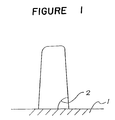
- Figure 1 is a diagrammatical view of the cross sectional shape of a pattern formed by patterning using a photoresist composition.
- reference numeral 1 indicates a substrate
- numeral 2 indicates a pattern angle.
- the alkali-soluble resin may, for example, be a novolac resin, a resol resin, a polyvinylphenol resin or a polyacrylate resin.
- the novolac resin is preferred.
- the molecular weight of this alkali-soluble resin is larger than the molecular weight of the novolac resin constituting a photosensitive compound which will be described hereinafter and is definitely distinguished therefrom.
- the weight-average molecular weight (the analytical value calculated as polystyrene by gel permeation chromatography) of the alkali-soluble resin in the photoresist composition of the present invention is usually from 3,000 to 20,000.
- the novolac resin to be used as the alkali-soluble resin.
- it is a novolac resin obtained by polycondensing a mixture of m-cresol, p-cresol and 2,5-xylenol, with formaldehyde, or a novolac resin obtained by polycondensing a mixture of m-cresol, p-cresol, 2,5-xylenol and resorcinol, with formaldehyde.
- the mixing ratio (molar ratio) of m-cresol, p-cresol, 2,5-xylenol and resorcinol is usually 1-7:3-7:0.5-5:0-1.
- the alkyl group for R may, for example, be a methyl group, an ethyl group, a propyl group or a butyl group.
- phenolic compound of the formula (A1a) examples include phenol, an alkyl phenol such as o-cresol, m-cresol, p-cresol, 3-ethylphenol, p-tert- butylphenol, 2,5-xylenol, 3,5-xylenol. If the carbon number exceeds 4, the heat resistance tends to decrease.
- phenolic compound of the formula (Al) is o-cresol, m-cresol, p-cresol, 2,5-xylenol or 3,5-xylenol.
- a method for producing a novolac resin (C) having a low molecular weight from the above phenolic compound and the ketone or aldehyde derivative it is possible to employ a method of polycondensing the raw materials mentioned above in the presence of an acid catalyst in accordance with a known method.
- the temperature for the polycondensation reaction is, for example, from 50 to 100°C.
- the molecular weight of the novolac resin may be controlled by adjusting the amount of the catalyst in the case where a ketone is used as the raw material, or by controlling the amount of the aldehyde when the aldehyde is used as the raw material.
- the weight-average molecular weight (the analytical value calculated as polystyrene by gel permeation chromatography) is within a specific range.
- the weight-average molecular weight of the novolac resin (C) is required to be from 450 to 1,800. If the molecular weight of this novolac resin is small, no adequate masking effect can be obtained, whereby no satisfactory pattern profile will be obtained. On the other hand, if the molecular weight is large, the sensitivity tends to deteriorate.
- the low molecular weight novolac resin specified by the present invention can be produced as a product having a relatively sharp molecular weight distribution, and there is no substantial difference from the value of the number average molecular weight.
- the ratio of the weight-average molecular weight to the number average molecular weight increases as the molecular weight increases, and in the present invention, the ratio is usually from 1.0 to 2.0 times.
- a good pattern profile can be obtained with a high resolution by irradiation with an ultraviolet ray having a wavelength within a range of from 330 to 450 nm.
- the esterification ratio of the quinone-diazide sulfonate of the novolac resin (C) i.e. the esterification ratio of hydroxyl groups contained in the novolac resin (C) by quinone-diazide sulfonyl groups [the substitution ratio of quinone-diazide sulfonyl groups for hydrogen atoms of the hydroxyl groups of the novolac resin (C), which is calculated by (the number of quinone-diazide sulfonyl groups per molecule of the quinone-diazide sulfonate (D) of the novolac resin (C)) ⁇ 100/(the number of hydroxyl groups per molecule of the novolac resin (C))] is from 40 to 90%.
- a preferred esterification ratio is from 45 to 80% when a compound of the formula (A1) is used as the phenolic compound as the starting material for the novolac resin (C), or from 40 to 70% when a compound of the formula (A2) is used as the phenolic compound.
- the esterification reaction of the low molecular weight novolac resin (C) is usually conducted by reacting the novolac resin with a predetermined amount of quinone-diazide sulfonic acid chloride at room temperature in an organic solvent.
- a product having a predetermined amount of the quinone-diazide type photosensitive component bonded to the low molecular weight novolac resin synthesized from the specific starting material as described above is used as a photosensitive compound.
- two or more photosensitive compounds may be used in combination.
- a certain amount of other photosensitive compounds may be mixed, so long as the technical concept of the present invention will not thereby be impaired.
- any solvent may be employed so long as it is capable of dissolving the above quinone-diazide type photosensitive compound and the alkali-soluble resin. From the viewpoint of the operation efficiency, it is preferred to employ a solvent having a boiling point of from 100 to 180°C.
- Such a solvent include, for example, ether esters such as ethyl cellosolve acetate, methyl cellosolve acetate, propylene glycol monomethyl ether acetate, ether alcohols such as ethyl cellosolve, methyl cellosolve, propylene glycol monomethyl ether, carboxylates such as ethyl acetate and butyl acetate, ketones such as ⁇ -butyrolactone, cyclic ketones such as cyclohexanone, carboxylates of dibasic acids such as diethyl oxalate and diethyl malonate, dicarboxylates of glycol such as ethylene glycol diacetate and propylene glycol diacetate, and oxycarboxylates such as ethyl 2-oxypropionate and ethyl 3-oxypropyonate.
- ether esters such as ethyl cellosolve acetate, methyl cellosolve acetate
- the concentration of the alkali-soluble resin is usually from 1 to 30% by weight.
- the concentration of the quinone-diazide type photosensitive compound is usually from 0.1 to 15% by weight.
- the proportion of the quinone-diazide type photosensitive compound to the alkali-soluble resin is usually from 0.1 to 0.5 time by weight.
- a surfactant such as a polyoxyethylene ether or a fluorine type alkyl ester may be incorporated to the photoresist composition of the present invention to overcome a coating defect such as striation.
- the amount of such a surfactant is usually not higher than 2% by weight, preferably not higher than 1% by weight.
- a dye or the like may be incorporated to minimize the influence of the irregularly reflected light from the substrate at the time of image transfer, and a sensitizer or the like may be incorporated to improve the sensitivity.
- the photoresist composition of the present invention is used in accordance with a known method which includes steps of coating onto a substrate, exposure and development.
- the substrate on which the photoresist composition is coated is a semiconductor substrate such as a silicon wafer. Coating of the photoresist composition on such a substrate is usually conducted by a spin coater, and the photoresist composition is coated usually in a layer thickness of from 0.3 to 5 ⁇ m. After the photoresist composition is coated, the substrate is usually heated on a hot plate or the like to remove the solvent and then subjected to exposure through a mask to fix a desired pattern on the substrate.
- the substrate is heated at a temperature of from about 90 to 120°C for from about 60 to 120 seconds, if necessary, and then developed with an aqueous alkali solution.
- an aqueous solution of an inorganic alkali such as potassium hydroxide, sodium carbonate, sodium silicate, sodium methasilicate or aqueous ammonia, a primary amine such as ethylamine or n-propylamine, a secondary amine such as diethylamine or di-n-propylamine, a tertiary amine such as triethylamine or trimethylamine, or a quaternary ammonium salt such as tetramethyl ammonium hydroxide or trimethylhydroxyethyl ammonium hydroxide, is preferably employed.
- an alcohol, a surfactant, etc. may be incorporated, as the case requires.
- the photoresist composition of the present invention contains a photosensitive compound obtained by reacting a quinone-diazide compound as a photosensitive component with a low molecular weight novolac resin which is synthesized from a specific phenolic compound and a ketone or aldehyde derivative and which is independent from the alkali-soluble resin as one of the main components of the photoresist, and it especially has a high resolution upon exposure to i-line and is capable of providing an excellent pattern profile. Thus, it is very useful as a photoresist for the preparation of semiconductors.
- the molecular weights of the novolac resins obtained in Novolac Resin Preparation Examples 1 to 11 and 13 to 17, are represented by the weight-average molecular weights calculated as polystyrene from the results of the analyses by gel permeation chromatography. Further, the esterification ratios of the photosensitive agents obtained in Photosensitive Agent Preparation Examples 1 to 20, were calculated from the charged amounts.
- a novolac resin (b) was obtained in the same manner as in Novolac Resin Preparation Example 1 except that in a separable flask were placed 203.5 g of m-cresol, 271.4 g of p-cresol, 249.6 g of a 37% aqueous solution of formaldehyde and 15.00 g of oxalic acid dihydrate. The molecular weight of this resin was 10,000.
- a novolac resin (c) was obtained in the same manner as in Novolac Resin Preparation Example 1 except that in a separable flask were placed 190.0 g of m-cresol, 237.5 g of p-cresol, 53.7 g of 2,5-xylenol, 254.9 g of a 37% aqueous solution of formaldehyde and 15.00 g of oxalic acid dihydrate. The molecular weight of this resin was 9,000.
- a novolac resin (d) was obtained in the same manner as in Novolac Resin Preparation Example 1 except that in a separable flask were placed 190.0 g of m-cresol, 237.5 g of p-cresol, 53.7 g of 2,5-xylenol, 246.0 g of a 37% aqueous solution of formaldehyde and 15.00 g of oxalic acid dihydrate. The molecular weight of this resin was 6,500.
- a novolac resin (e) was obtained in the same manner as in Novolac Resin Preparation Example 1 except that in a separable flask were placed 190.0 g of m-cresol, 237.5 g of p-cresol, 53.7 g of 2,5-xylenol, 9.5 g of resorcinol, 254.9 g of a 37% aqueous solution of formaldehyde and 15.00 g of oxalic acid dihydrate. The molecular weight of this resin was 8,100.
- a novolac resin (h) was obtained in the same manner as in Novolac Resin Preparation Example 1 except that in a separable flask were placed 203.5 g of m-cresol, 271.4 g of p-cresol, 213.9 g of a 37% aqueous solution of formaldehyde and 15.00 g of oxalic acid dihydrate. The molecular weight of this resin was 2,300.
- a novolac resin (i) was obtained in the same manner as in Novolac Resin Preparation Example 1 except that in a separable flask were placed 203.5 g of m-cresol, 271.4 g of p-cresol, 223.20 g of a 37% aqueous solution of formaldehyde and 15.00 g of oxalic acid dihydrate. The molecular weight of this resin was 4,000.
- a novolac resin (j) was prepared from m-cresol and acetaldehyde.
- the molecular weight of this resin was 856.
- a novolac resin (k) was prepared from m-cresol and acetaldehyde.
- the molecular weight of this resin was 1,011.
- a photosensitive agent (p-6) was prepared in the same manner as in Photosensitive Agent Preparation Example 1 except that 25.7 g of the novolac resin (j) and 40.9 g of 1,2-naphthoquinonediazide-5-sulfonyl chloride were dissolved in a solvent mixture comprising 179.0 g of 1,4-dioxane and 48.0 g of N-methylpyrrolidone, then 17.7 g of triethylamine was dropwise added thereto.
- the esterification ratio of the photosensitive agent (p-6) was 78%.
- a photosensitive agent (p-7) was obtained in the same manner as in Photosensitive Agent Preparation Example 1 except that 20.2 g of the novolac resin (k) and 20.7 g of 1,2-naphthoquinonediazide-5-sulfonyl chloride were dissolved in a solvent mixture comprising 106.0 g of 1,4-dioxane and 29.0 g of N-methylpyrrolidone, then 7.87 g of triethylamine was dropwise added thereto.
- the esterification ratio of the photosensitive agent (p-7) was 50%.
- a photosensitive agent (p-11) was obtained in the same manner as in Photosensitive Agent Preparation Example 1 except that 30.0 g of the novolac resin (h) and 33.5 g of 1,2-naphthoquinonediazide-5-sulfonyl chloride were dissolved in a solvent mixture comprising 190.0 g of 1,4-dioxane and 50.0 g of N-methylpyrrolidone, then 12.7 g of triethylamine was dropwise added thereto. The esterification ratio of the photosensitive agent (p-11) was 50%.
- a photosensitive agent (p-12) was obtained in the same manner as in Photosensitive Agent Preparation Example 1 except that 8.0 g of the trimer of p-cresol (l) and 5.5 g of 1,2-naphthoquinonediazide-5-sulfonyl chloride were dissolved in a solvent mixture comprising 60.0 g of 1,4-dioxane and 15.0 g of N-methylpyrrolidone, then 2.2 g of triethylamine was dropwise added thereto. The esterification ratio of the photosensitive agent (p-12) was 30%.
- a photosensitive agent (p-13) was prepared in the same manner as in Photosensitive Agent Preparation Example 1 from 2,3,4,4'-tetrahydroxybenzophenone and 1,2-naphthoquinonediazide-5-sulfonyl chloride.
- the esterification ratio of the photosensitive agent (p-13) was 85%.
- a photosensitive agent (p-14) was obtained in the same manner as in Photosensitive Agent Preparation Example 1 except that 7.5 g of the novolac resin (o), and 14.5 g of 1,2-naphthoquinonediazide-5-sulfonyl chloride were dissolved in a solvent mixture comprising 100.0 g of 1,4-dioxane and 25.0 g of N-methylpyrrolidone, then 6.6 g of triethylamine was dropwise added thereto.
- the esterification ratio of the photosensitive agent (p-14) was 39%.
- a photosensitive agent (p-15) was obtained in the same manner as in Photosensitive Agent Preparation Example 1 except that 7.5 g of the novolac resin (i), and 8.35 g of 1,2-naphthoquinonediazide-5-sulfonyl chloride were dissolved in a solvent mixture comprising 50.0 g of 1,4-dioxane and 12.0 g of N-methylpyrrolidone, then 3.24 g of triethylamine was dropwise added thereto. The esterification ratio of the photosensitive agent (p-15) was 50%.
- a photosensitive agent (p-16) was obtained in the same manner as in Photosensitive Agent Preparation Example 1 except that 7.5 g of the novolac resin (b), and 8.33 g of 1,2-naphthoquinonediazide-5-sulfonyl chloride were dissolved in a solvent mixture comprising 50.0 g of 1,4-dioxane and 12.0 g of N-methylpyrrolidone, then 3.23 g of triethylamine was dropwise added thereto. The esterification ratio of the photosensitive agent (p-16) was 50%.
- a photosensitive agent (p-17) was obtained in the same manner as in Photosensitive Agent Preparation Example 1 except that 7.5 g of the novolac resin (p), and 9.13 g of 1,2-naphthoquinonediazide-5-sulfonyl chloride were dissolved in a solvent mixture comprising 100.0 g of 1,4-dioxane and 25.0 g of N-methylpyrrolidone, then 4.1 g of triethylamine was dropwise added thereto. The esterification ratio of the photosensitive agent (p-17) was 25%.
- a photosensitive agent (p-18) was obtained in the same manner as in Photosensitive Agent Preparation Example 1 except that 7.5 g of di-2,3,4-trihydroxyphenyl ketone and 26.09 g of 1,2-naphthoquinonediazide-5-sulfonyl chloride were dissolved in a solvent mixture comprising 120.0 g of 1,4-dioxane and 30.0 g of N-methylpyrrolidone, then 11.9 g of triethylamine was dropwise added thereto. The esterification ratio of the photosensitive agent (p-18) was 63%.
- a photosensitive agent (p-19) was obtained in the same manner as in Photosensitive Agent Preparation Example 1 except that 7.5 g of the novolac resin (o) and 11.2 g of 1,2-naphthoquinonediazide-5-sulfonyl chloride were dissolved in a solvent mixture comprising 100.0 g of 1,4-dioxane and 25.0 g of N-methylpyrrolidone, then 5.1 g of triethylamine was dropwise added thereto.
- the esterification ratio of the photosensitive agent (p-19) was 30%.
- a photosensitive agent (p-20) was obtained in the same manner as in Photosensitive Agent Preparation Example 1 except that 7.5 g of the novolac resin (m) and 25.3 g of 1,2-naphthoquinonediazide-5-sulfonyl chloride were dissolved in a solvent mixture comprising 100.0 g of 1,4-dioxane and 25.0 g of N-methylpyrrolidone, then 11.5 g of triethylamine was dropwise added thereto.
- the esterification ratio of the photosensitive agent (p-20) was 65%.
- Photoresist compositions (PR-2) to (PR-28) were obtained in the same manner as in Photoresist Composition Preparation Example 1 except that the alkali-soluble resin and the photosensitive agent were combined in the proportions as identified in Table 2.
- Photoresist compositions (PR-1) to (PR-15) were subjected to patterning by, either one of the following patterning methods 1, 2 and 3, whereby the sensitivity, the limiting resolution, the pattern profile and the heat resistance were evaluated, and the results are shown in Table 3.
- a photoresist composition was coated by a spin coater on a silicon wafer and then heated on a hot plate of 95°C for 60 seconds to remove the solvent and to form a photoresist coating layer having a thickness of 1.17 ⁇ m.
- a photoresist composition was coated by a spin coater on a silicon wafer and then heated on a hot plate of 80°C for 90 seconds to remove the solvent and to form a photoresist coating layer having a thickness of 1.17 ⁇ m.
- NA 0.50
- a photoresist composition was coated by a spin coater on a silicon wafer and then heated on a hot plate of 70°C for 90 seconds to remove the solvent and to form a photoresist coating layer having a thickness of 1.17 ⁇ m.
Landscapes
- Physics & Mathematics (AREA)
- General Physics & Mathematics (AREA)
- Spectroscopy & Molecular Physics (AREA)
- Exposure And Positioning Against Photoresist Photosensitive Materials (AREA)
- Materials For Photolithography (AREA)
Claims (3)
- Composition de photorésist utile pour la préparation de semi-conducteurs et destinée à être irradiée avec une lumière ayant une longueur d'onde de 330 à 450 nm, qui comprend (1) une résine soluble dans un alcali, (2) un composé photosensible de type quinone-diazide et (3) un solvant, dans laquelle(a) ledit composé photosensible de type quinone-diazide comprend un quinone-diazide sulfonate d'une résine novolaque produite par polycondensation d'un composé phénolique de formule (A1a) suivante et d'au moins un élément choisi dans le groupe constitué par l'acétaldéhyde et l'acétone,(b) la masse moléculaire moyenne en poids (la valeur analytique calculée en polystyrène par chromatographie par perméation de gel) de ladite résine novolaque est de 450 à 1 800,(c) le taux d'estérification dudit quinone-diazide sulfonate (le nombre de groupes quinone-diazide sulfonyle par molécule du quinone-diazide sulfonate x 100/le nombre de groupes hydroxyle par molécule de la résine novolaque) est de 40 à 90%, et(d) le quinone-diazide sulfonate est constitué de 1,2-naphtoquinonediazide-5-sulfonate:où R' est un groupe alkyle en C1-C4, et l' vaut 1 ou 2.

- Composition de photorésist selon la revendication 1, dans laquelle la résine soluble dans un alcali est une résine novolaque ayant une masse moléculaire moyenne en poids (la valeur analytique calculée en polystyrène par chromatographie par perméation de gel) de 3 000 à 20 000.
- Procédé de formation d'un motif caractérisé par l'utilisation d'une composition de photorésist utile pour la préparation de semi-conducteurs et destinée à être irradiée avec une lumière ayant une longueur d'onde de 330 à 450 nm, qui comprend (1) une résine soluble dans un alcali, (2) un composé photosensible de type quinone-diazide et (3) un solvant, dans laquelle(a) ledit composé photosensible de type quinone-diazide comprend un quinone-diazide sulfonate d'une résine novolaque produite par polycondensation d'un composé phénolique de formule (A1a) suivante et d'au moins un élément choisi dans le groupe constitué par l'acétaldéhyde et l'acétone,(b) la masse moléculaire moyenne en poids (la valeur analytique calculée en polystyrène par chromatographie par perméation de gel) de ladite résine novolaque est de 450 à 1 800,(c) le taux d'estérification dudit quinone-diazide sulfonate (le nombre de groupes quinone-diazide sulfonyle par molécule du quinone-diazide sulfonate x 100/le nombre de groupes hydroxyle par molécule de la résine novolaque) est de 40 à 90%, et(d) le quinone-diazide sulfonate est constitué de 1,2-naphtoquinonediazide-5-sulfonate:où R' est un groupe alkyle en C1-C4, et l' vaut 1 ou 2.

Applications Claiming Priority (6)
| Application Number | Priority Date | Filing Date | Title |
|---|---|---|---|
| JP11647690 | 1990-05-02 | ||
| JP116476/90 | 1990-05-02 | ||
| JP183814/90 | 1990-07-11 | ||
| JP18381490 | 1990-07-11 | ||
| JP228950/90 | 1990-08-30 | ||
| JP22895090 | 1990-08-30 |
Publications (2)
| Publication Number | Publication Date |
|---|---|
| EP0455228A1 EP0455228A1 (fr) | 1991-11-06 |
| EP0455228B1 true EP0455228B1 (fr) | 1998-08-12 |
Family
ID=27313159
Family Applications (1)
| Application Number | Title | Priority Date | Filing Date |
|---|---|---|---|
| EP91107029A Expired - Lifetime EP0455228B1 (fr) | 1990-05-02 | 1991-04-30 | Composition formant photoréserve |
Country Status (4)
| Country | Link |
|---|---|
| US (1) | US5279918A (fr) |
| EP (1) | EP0455228B1 (fr) |
| KR (1) | KR100242148B1 (fr) |
| DE (1) | DE69129955T2 (fr) |
Families Citing this family (34)
| Publication number | Priority date | Publication date | Assignee | Title |
|---|---|---|---|---|
| US5753406A (en) * | 1988-10-18 | 1998-05-19 | Japan Synthetic Rubber Co., Ltd. | Radiation-sensitive resin composition |
| JP3064595B2 (ja) * | 1991-04-26 | 2000-07-12 | 住友化学工業株式会社 | ポジ型レジスト組成物 |
| US5372909A (en) * | 1991-09-24 | 1994-12-13 | Mitsubishi Kasei Corporation | Photosensitive resin composition comprising an alkali-soluble resin made from a phenolic compound and at least 2 different aldehydes |
| JP3466218B2 (ja) * | 1992-06-04 | 2003-11-10 | 住友化学工業株式会社 | ポジ型レジスト組成物 |
| JPH06204162A (ja) * | 1992-12-28 | 1994-07-22 | Mitsubishi Electric Corp | 半導体装置の製造方法および該方法に用いられるレジスト組成物 |
| JP3010963B2 (ja) * | 1993-02-17 | 2000-02-21 | 信越化学工業株式会社 | レジスト組成物 |
| KR100305333B1 (ko) * | 1993-10-28 | 2001-11-22 | 마티네즈 길러모 | 감광성수지조성물및이를사용한패턴의형성방법 |
| EP0660186A1 (fr) * | 1993-12-20 | 1995-06-28 | Mitsubishi Chemical Corporation | Composition de résine photosensible et procédé pour obtenir des images avec cette composition |
| EP0722120B1 (fr) * | 1994-12-27 | 2000-10-18 | Mitsubishi Chemical Corporation | Composition à base de résine photosensible et procédé de formation de motifs utilisant cette photoréserve |
| US5529880A (en) * | 1995-03-29 | 1996-06-25 | Shipley Company, L.L.C. | Photoresist with a mixture of a photosensitive esterified resin and an o-naphthoquinone diazide compound |
| US5589553A (en) * | 1995-03-29 | 1996-12-31 | Shipley Company, L.L.C. | Esterification product of aromatic novolak resin with quinone diazide sulfonyl group |
| DE69604114T2 (de) * | 1995-04-10 | 2000-03-02 | Shipley Co., L.L.C. | Gemische von photoaktiven Zusammensetzungen enthaltendes Fotoresist |
| JP3147908B2 (ja) | 1996-04-23 | 2001-03-19 | コダック ポリクローム グラフィックス カンパニー リミテッド | 感熱性組成物および該組成物を使用したリソグラフィックプリンティングフォームの作製方法 |
| JP3287234B2 (ja) * | 1996-09-19 | 2002-06-04 | 信越化学工業株式会社 | リフトオフ法用ポジ型レジスト組成物及びパターン形成方法 |
| US6117610A (en) * | 1997-08-08 | 2000-09-12 | Kodak Polychrome Graphics Llc | Infrared-sensitive diazonaphthoquinone imaging composition and element containing non-basic IR absorbing material and methods of use |
| US5858626A (en) | 1996-09-30 | 1999-01-12 | Kodak Polychrome Graphics | Method of forming a positive image through infrared exposure utilizing diazonaphthoquinone imaging composition |
| US5705308A (en) * | 1996-09-30 | 1998-01-06 | Eastman Kodak Company | Infrared-sensitive, negative-working diazonaphthoquinone imaging composition and element |
| US5705322A (en) * | 1996-09-30 | 1998-01-06 | Eastman Kodak Company | Method of providing an image using a negative-working infrared photosensitive element |
| US6063544A (en) * | 1997-03-21 | 2000-05-16 | Kodak Polychrome Graphics Llc | Positive-working printing plate and method of providing a positive image therefrom using laser imaging |
| US6090532A (en) * | 1997-03-21 | 2000-07-18 | Kodak Polychrome Graphics Llc | Positive-working infrared radiation sensitive composition and printing plate and imaging method |
| EP0953166B1 (fr) | 1997-07-05 | 2001-08-16 | Kodak Polychrome Graphics LLC | Procedes de formation de motifs |
| US6060217A (en) * | 1997-09-02 | 2000-05-09 | Kodak Polychrome Graphics Llc | Thermal lithographic printing plates |
| US6372415B1 (en) * | 1997-10-30 | 2002-04-16 | Kao Corporation | Resist developer |
| TWI221946B (en) | 1999-01-07 | 2004-10-11 | Kao Corp | Resist developer |
| JP3705332B2 (ja) * | 1999-01-11 | 2005-10-12 | 信越化学工業株式会社 | 感光性樹脂組成物及びその製造方法 |
| JP4068253B2 (ja) * | 1999-01-27 | 2008-03-26 | Azエレクトロニックマテリアルズ株式会社 | ポジ型感光性樹脂組成物 |
| US6545797B2 (en) | 2001-06-11 | 2003-04-08 | Sipix Imaging, Inc. | Process for imagewise opening and filling color display components and color displays manufactured thereof |
| US20040192876A1 (en) * | 2002-11-18 | 2004-09-30 | Nigel Hacker | Novolac polymer planarization films with high temparature stability |
| US6790582B1 (en) | 2003-04-01 | 2004-09-14 | Clariant Finance Bvi Limited | Photoresist compositions |
| US6905809B2 (en) | 2003-04-01 | 2005-06-14 | Clariant Finance (Bvi) Limited | Photoresist compositions |
| JP4426526B2 (ja) * | 2003-07-17 | 2010-03-03 | ハネウエル・インターナシヨナル・インコーポレーテツド | 最新式のマイクロエレクトロニクス用途およびデバイス用の平坦化膜およびそれらの製造方法 |
| DE102004063416A1 (de) * | 2004-12-23 | 2006-07-06 | Az Electronic Materials (Germany) Gmbh | Verfahren zur Herstellung einer Photoresistlösung |
| EP2639637B1 (fr) * | 2010-11-10 | 2017-03-22 | DIC Corporation | Composition de résine photosensible de type positif |
| IT201900022233A1 (it) * | 2019-11-27 | 2021-05-27 | Epta Inks S P A | Inchiostro fotosensibile e embossabile |
Family Cites Families (19)
| Publication number | Priority date | Publication date | Assignee | Title |
|---|---|---|---|---|
| BE506677A (fr) * | 1950-10-31 | |||
| US3635709A (en) * | 1966-12-15 | 1972-01-18 | Polychrome Corp | Light-sensitive lithographic plate |
| US4308368A (en) * | 1979-03-16 | 1981-12-29 | Daicel Chemical Industries Ltd. | Photosensitive compositions with reaction product of novolak co-condensate with o-quinone diazide |
| JPS561045A (en) * | 1979-06-16 | 1981-01-08 | Konishiroku Photo Ind Co Ltd | Photosensitive composition |
| JPS561044A (en) * | 1979-06-16 | 1981-01-08 | Konishiroku Photo Ind Co Ltd | Photosensitive composition |
| EP0054258B1 (fr) * | 1980-12-17 | 1986-03-05 | Konica Corporation | Compositions photosensibles |
| DE3100077A1 (de) * | 1981-01-03 | 1982-08-05 | Hoechst Ag, 6000 Frankfurt | Lichtempfindliches gemisch, das einen naphthochinondiazidsulfonsaeureester enthaelt, und verfahren zur herstellung des naphthochinondiazidsulfonsaeureesters |
| US4350753A (en) * | 1981-06-15 | 1982-09-21 | Polychrome Corporation | Positive acting composition yielding pre-development high visibility image after radiation exposure comprising radiation sensitive diazo oxide and haloalkyl-s-triazine with novolak and dyestuff |
| JPS58134631A (ja) * | 1982-01-08 | 1983-08-10 | Konishiroku Photo Ind Co Ltd | 感光性組成物 |
| US4460644A (en) * | 1982-12-27 | 1984-07-17 | Beecham Inc. | Polyurethane foam impregnated with or coated with fabric conditioning agent, anti-microbial agent and anti-discolorant |
| JPS59148784A (ja) * | 1983-02-10 | 1984-08-25 | Konishiroku Photo Ind Co Ltd | 5―置換―2―ハロメチル―1,3,4―オキサジアゾール化合物及び該化合物を含有する光反応開始剤 |
| JPS61185741A (ja) * | 1985-02-13 | 1986-08-19 | Mitsubishi Chem Ind Ltd | ポジ型フオトレジスト組成物 |
| JPS61205933A (ja) * | 1985-03-08 | 1986-09-12 | Konishiroku Photo Ind Co Ltd | 感光性平版印刷版 |
| JPS6210646A (ja) * | 1985-07-09 | 1987-01-19 | Kanto Kagaku Kk | ポジ型フオトレジスト組成物 |
| JPH0719049B2 (ja) * | 1985-12-04 | 1995-03-06 | コニカ株式会社 | 感光性平版印刷版材料 |
| EP0227487B1 (fr) * | 1985-12-27 | 1992-07-15 | Japan Synthetic Rubber Co., Ltd. | Composition résineuse photosensible positive |
| JPS6443045A (en) * | 1987-08-10 | 1989-02-15 | Shibaura Eng Works Ltd | Motor |
| SG48028A1 (en) * | 1988-08-10 | 1998-04-17 | Hoechst Celanese Corp | Light-sensitive novolac resins |
| JP2623778B2 (ja) * | 1988-10-18 | 1997-06-25 | 日本合成ゴム株式会社 | 感放射線性樹脂組成物 |
-
1991
- 1991-04-30 EP EP91107029A patent/EP0455228B1/fr not_active Expired - Lifetime
- 1991-04-30 US US07/693,648 patent/US5279918A/en not_active Expired - Lifetime
- 1991-04-30 DE DE69129955T patent/DE69129955T2/de not_active Expired - Fee Related
- 1991-05-02 KR KR1019910007121A patent/KR100242148B1/ko not_active Expired - Lifetime
Also Published As
| Publication number | Publication date |
|---|---|
| DE69129955D1 (de) | 1998-09-17 |
| EP0455228A1 (fr) | 1991-11-06 |
| KR100242148B1 (ko) | 2000-02-01 |
| DE69129955T2 (de) | 1998-12-24 |
| US5279918A (en) | 1994-01-18 |
| KR910020495A (ko) | 1991-12-20 |
Similar Documents
| Publication | Publication Date | Title |
|---|---|---|
| EP0455228B1 (fr) | Composition formant photoréserve | |
| JP2540640B2 (ja) | 熱安定性フエノ―ル系樹脂組成物及び感光性組成物中でのそれらの使用 | |
| JPH06345837A (ja) | 高度にオルソ−オルソ結合したノボラックバインダー樹脂および放射線感受性組成物中のその利用 | |
| US5372909A (en) | Photosensitive resin composition comprising an alkali-soluble resin made from a phenolic compound and at least 2 different aldehydes | |
| CN1085681C (zh) | 借助低温液面下强制水蒸汽蒸馏法分离可溶可熔酚醛树脂 | |
| JPH08211601A (ja) | 高コントラスト高熱安定性ポジ形ホトレジスト | |
| US5695906A (en) | Photosensitive resin composition and method for forming a pattern using the composition | |
| JP2617594B2 (ja) | 熱的に安定なフエノール樹脂組成物及び感光性組成物におけるそれらの使用 | |
| KR20040106336A (ko) | 노볼락 수지 혼합물 및 이를 포함하는 감광성 조성물 | |
| EP0907108B1 (fr) | Composition à base de résine sensible aux radiations | |
| JP2555620B2 (ja) | 感放射線性樹脂組成物 | |
| US20070020558A1 (en) | Process for the preparation of a photoresist solution | |
| US4970287A (en) | Thermally stable phenolic resin compositions with ortho, ortho methylene linkage | |
| JP3443466B2 (ja) | 感光性樹脂組成物 | |
| US5338652A (en) | Selected structurally defined novolak binder resins and their use in photoresist pattern formation | |
| US5024921A (en) | Thermally stable light-sensitive compositions with o-quinone diazide and phenolic resin used in a method of forming a positive photoresist image | |
| JP2715328B2 (ja) | ポジ型フオトレジスト組成物 | |
| JP3060583B2 (ja) | フォトレジスト組成物 | |
| JPH0534916A (ja) | フオトレジスト組成物 | |
| JPH02300752A (ja) | ポジ型フォトレジスト組成物 | |
| JP2987526B2 (ja) | ポジ型フオトレジスト組成物 | |
| JP3013529B2 (ja) | ポジ型レジスト組成物 | |
| JP3060748B2 (ja) | 感光性樹脂組成物 | |
| JP3976101B2 (ja) | キノンジアジドスルフォン酸エステルの製造方法、および該製造方法により製造したキノンジアジドスルフォン酸エステルを含有するポジ型フォトレジスト組成物 | |
| JP2000264941A (ja) | フォトレジスト用ノボラック樹脂の製造方法 |
Legal Events
| Date | Code | Title | Description |
|---|---|---|---|
| PUAI | Public reference made under article 153(3) epc to a published international application that has entered the european phase |
Free format text: ORIGINAL CODE: 0009012 |
|
| AK | Designated contracting states |
Kind code of ref document: A1 Designated state(s): DE FR GB NL |
|
| 17P | Request for examination filed |
Effective date: 19920506 |
|
| RAP1 | Party data changed (applicant data changed or rights of an application transferred) |
Owner name: MITSUBISHI CHEMICAL CORPORATION |
|
| 17Q | First examination report despatched |
Effective date: 19951020 |
|
| GRAG | Despatch of communication of intention to grant |
Free format text: ORIGINAL CODE: EPIDOS AGRA |
|
| GRAG | Despatch of communication of intention to grant |
Free format text: ORIGINAL CODE: EPIDOS AGRA |
|
| GRAG | Despatch of communication of intention to grant |
Free format text: ORIGINAL CODE: EPIDOS AGRA |
|
| GRAH | Despatch of communication of intention to grant a patent |
Free format text: ORIGINAL CODE: EPIDOS IGRA |
|
| GRAH | Despatch of communication of intention to grant a patent |
Free format text: ORIGINAL CODE: EPIDOS IGRA |
|
| GRAA | (expected) grant |
Free format text: ORIGINAL CODE: 0009210 |
|
| AK | Designated contracting states |
Kind code of ref document: B1 Designated state(s): DE FR GB NL |
|
| PG25 | Lapsed in a contracting state [announced via postgrant information from national office to epo] |
Ref country code: NL Free format text: LAPSE BECAUSE OF FAILURE TO SUBMIT A TRANSLATION OF THE DESCRIPTION OR TO PAY THE FEE WITHIN THE PRESCRIBED TIME-LIMIT Effective date: 19980812 Ref country code: FR Free format text: LAPSE BECAUSE OF FAILURE TO SUBMIT A TRANSLATION OF THE DESCRIPTION OR TO PAY THE FEE WITHIN THE PRESCRIBED TIME-LIMIT Effective date: 19980812 |
|
| REF | Corresponds to: |
Ref document number: 69129955 Country of ref document: DE Date of ref document: 19980917 |
|
| EN | Fr: translation not filed | ||
| NLV1 | Nl: lapsed or annulled due to failure to fulfill the requirements of art. 29p and 29m of the patents act | ||
| PLBE | No opposition filed within time limit |
Free format text: ORIGINAL CODE: 0009261 |
|
| STAA | Information on the status of an ep patent application or granted ep patent |
Free format text: STATUS: NO OPPOSITION FILED WITHIN TIME LIMIT |
|
| 26N | No opposition filed | ||
| REG | Reference to a national code |
Ref country code: GB Ref legal event code: IF02 |
|
| REG | Reference to a national code |
Ref country code: GB Ref legal event code: 732E |
|
| PGFP | Annual fee paid to national office [announced via postgrant information from national office to epo] |
Ref country code: GB Payment date: 20060424 Year of fee payment: 16 |
|
| GBPC | Gb: european patent ceased through non-payment of renewal fee |
Effective date: 20070430 |
|
| PG25 | Lapsed in a contracting state [announced via postgrant information from national office to epo] |
Ref country code: GB Free format text: LAPSE BECAUSE OF NON-PAYMENT OF DUE FEES Effective date: 20070430 |
|
| PGFP | Annual fee paid to national office [announced via postgrant information from national office to epo] |
Ref country code: DE Payment date: 20080602 Year of fee payment: 18 |
|
| PG25 | Lapsed in a contracting state [announced via postgrant information from national office to epo] |
Ref country code: DE Free format text: LAPSE BECAUSE OF NON-PAYMENT OF DUE FEES Effective date: 20091103 |