EP0455413A2 - Procédé pour l'obtention d'une surface plane, dans la fabrication des circuits intégrés - Google Patents
Procédé pour l'obtention d'une surface plane, dans la fabrication des circuits intégrés Download PDFInfo
- Publication number
- EP0455413A2 EP0455413A2 EP91303713A EP91303713A EP0455413A2 EP 0455413 A2 EP0455413 A2 EP 0455413A2 EP 91303713 A EP91303713 A EP 91303713A EP 91303713 A EP91303713 A EP 91303713A EP 0455413 A2 EP0455413 A2 EP 0455413A2
- Authority
- EP
- European Patent Office
- Prior art keywords
- dielectric
- layer
- integrated circuit
- sacrificial layer
- conductor
- Prior art date
- Legal status (The legal status is an assumption and is not a legal conclusion. Google has not performed a legal analysis and makes no representation as to the accuracy of the status listed.)
- Withdrawn
Links
Images
Classifications
-
- H—ELECTRICITY
- H10—SEMICONDUCTOR DEVICES; ELECTRIC SOLID-STATE DEVICES NOT OTHERWISE PROVIDED FOR
- H10W—GENERIC PACKAGES, INTERCONNECTIONS, CONNECTORS OR OTHER CONSTRUCTIONAL DETAILS OF DEVICES COVERED BY CLASS H10
- H10W20/00—Interconnections in chips, wafers or substrates
- H10W20/01—Manufacture or treatment
- H10W20/071—Manufacture or treatment of dielectric parts thereof
-
- H—ELECTRICITY
- H10—SEMICONDUCTOR DEVICES; ELECTRIC SOLID-STATE DEVICES NOT OTHERWISE PROVIDED FOR
- H10W—GENERIC PACKAGES, INTERCONNECTIONS, CONNECTORS OR OTHER CONSTRUCTIONAL DETAILS OF DEVICES COVERED BY CLASS H10
- H10W20/00—Interconnections in chips, wafers or substrates
- H10W20/01—Manufacture or treatment
- H10W20/031—Manufacture or treatment of conductive parts of the interconnections
- H10W20/056—Manufacture or treatment of conductive parts of the interconnections by filling conductive material into holes, grooves or trenches
- H10W20/058—Manufacture or treatment of conductive parts of the interconnections by filling conductive material into holes, grooves or trenches by depositing on sacrificial masks, e.g. using lift-off
-
- Y—GENERAL TAGGING OF NEW TECHNOLOGICAL DEVELOPMENTS; GENERAL TAGGING OF CROSS-SECTIONAL TECHNOLOGIES SPANNING OVER SEVERAL SECTIONS OF THE IPC; TECHNICAL SUBJECTS COVERED BY FORMER USPC CROSS-REFERENCE ART COLLECTIONS [XRACs] AND DIGESTS
- Y10—TECHNICAL SUBJECTS COVERED BY FORMER USPC
- Y10S—TECHNICAL SUBJECTS COVERED BY FORMER USPC CROSS-REFERENCE ART COLLECTIONS [XRACs] AND DIGESTS
- Y10S148/00—Metal treatment
- Y10S148/10—Lift-off masking
-
- Y—GENERAL TAGGING OF NEW TECHNOLOGICAL DEVELOPMENTS; GENERAL TAGGING OF CROSS-SECTIONAL TECHNOLOGIES SPANNING OVER SEVERAL SECTIONS OF THE IPC; TECHNICAL SUBJECTS COVERED BY FORMER USPC CROSS-REFERENCE ART COLLECTIONS [XRACs] AND DIGESTS
- Y10—TECHNICAL SUBJECTS COVERED BY FORMER USPC
- Y10S—TECHNICAL SUBJECTS COVERED BY FORMER USPC CROSS-REFERENCE ART COLLECTIONS [XRACs] AND DIGESTS
- Y10S438/00—Semiconductor device manufacturing: process
- Y10S438/942—Masking
- Y10S438/948—Radiation resist
- Y10S438/951—Lift-off
Definitions
- This invention relates to a method of integrated circuit manufacturing which includes the step of producing a planar surface.
- the topography associated with the integrated circuits also becomes more complex, i.e., deviations from surface planarity become greater.
- the complex topography causes problems in manufacturing because, e.g., several levels of dielectrics and of metallizations are now frequently used in integrated circuit fabrication, and the topography becomes more complex as the number of levels increases.
- satisfactory metallizations are frequently difficult to obtain over very complicated topography due to factors, e.g. poor step coverage, which cause discontinuities in the metallization.
- planarize dielectric surfaces as preparation for subsequent processing steps.
- mechanical polishing methods have been developed which yield generally good results but typically suffer from at least two drawbacks.
- Another method which has been developed is a planarization etchback. This method deposits a photoresist over a thick dielectric, typically a deposited oxide, and then etches back to produce a planar dielectric surface.
- the deposited photoresist has a planar surface and, because the etch has similar etch rates for the photoresist and the dielectric, the planar surface is retained by the etching process.
- the photoresist introduces sodium ions which are removed by a wet chemical etch thus adding complexity to the manufacturing process.
- the wet etch etches low density oxides more rapidly than it etches high density oxides. This creates a problem because the oxide is not usually deposited with uniform density but rather has low density regions running in substantially vertical directions. Low density regions are most likely to be present when the oxide is deposited between closely spaced metal runners, such as are present in submicron lithography. The etch produces trenches in the low density regions, thereby resulting in a nonplanar surface.
- planar surface is desired which is only partially formed by a dielectric.
- a planar surface formed by metal runners and a dielectric between the metal runners may be desired. That is, the surfaces of the dielectric and of the metal runners should be coplanar.
- a method of integrated circuit manufacturing comprising the steps of patterning a bilevel structure on a substrate to expose selected portions of said substrate, said bilevel structure comprising a first material adjacent said substrate and sacrificial material on said first material; depositing a first dielectric in a direction substantially perpendicular to the substrate surface; and lifting off said sacrificial material.
- the dielectric covers no more than a portion of the sidewalls of the sacrificial layer.
- the first material comprises a conductor, such as a metal, polysilicon, or a metal silicide.
- the sacrificial material is typically wet etchable and lifting off is by wet etching.
- the first dielectric is deposited to a thickness approximately equal to the thickness of the patterned conductor thereby producing a substantially planar surface, after lift off, formed by the coplanar metal and first dielectric surfaces.
- a second dielectric is deposited after the lift off step has been completed to produce a substantially planar dielectric surface. Regular device processing follows to complete fabrication of the integrated circuit.
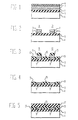
- FIGs. 1-5 depict stages of an integrated circuit manufacturing process according to this invention.
- FIG. 1 depicts a portion of an integrated circuit at an intermediate fabrication stage in one embodiment of this invention.
- silicon layer 1 Depicted are silicon layer 1, first dielectric layer 3, first material layer 5, sacrificial layer 7, and photoresist layer 9.
- the individual, active devices of the invention are fabricated in the silicon layer. These devices are well known to those skilled in the art and need not be depicted nor their fabrication described.
- substrate is used to mean a layer that lies underneath and supports an overlying layer. The term substrate is thus appropriately applied to dielectric layer 3 as it supports first material layer 5.
- Silicon layer 3 may be an epitaxial layer or it may be a wafer.
- Dielectric layer 3 typically comprises a deposited silicon oxide.
- Layer 5 comprises a conductor such as a metal, doped silicon, or a metal silicide.
- the metal may be aluminum, although the use of other metals, such as tungsten is also contemplated.
- a glue layer (not shown) may be used to improve adhesion.
- Sacrificial layer 7 is desirably wet etchable and comprises a readily available glass, such as thermal ozone TEOS, plasma enhanced TEOS with or without P or F, or a spin-on-glass (SOG).
- the sacrificial layer material must have a high etch rate differential with respect to the underlying metal and directionally deposited dielectric, and it should have a high etching rate in wet chemicals, such as an 8:1 ethylene glycol:buffered HF.
- SOG is well known to those skilled in the art and refers generally to any disposable oxide.
- the photoresist is any conventional resist. Layers 5 and 7 form a bilevel structure.
- a directional deposition technique is now used to deposit a dielectric, typically an oxide, shown as element 15 in FIG. 3.
- the deposition technique should not result in conformal deposition, and the direction of the deposition is perpendicular to the substrate surface.
- Exemplary deposition techniques include electron cyclotron resonance(ECR) and plasma enhanced chemical vapor deposition(PECVD). Those skilled in the art will readily understand and implement these techniques and will know of still other deposition techniques.
- the deposition is desirably performed at relatively low pressure to increase the directionality of the deposition by, e.g. reducing particle scattering, which, as will be readily appreciated, tends to decrease the directionality of the deposition and may result in unwanted sidewall deposition.
- the dielectric is typically deposited to a thickness that is approximately equal to the thickness of the patterned conductor layer.
- the dielectric should cover no more than a portion of the sidewalls of the sacrificial layer. Some variation from this thickness is permissible if the loss of coplanarity between the dielectric surface and the metal surface is acceptable. However, the dielectric 13 should not be so thick as to completely cover the sidewalls of the sacrificial layer 7. Monitoring of the deposition time is a convenient method for monitoring the dielectric thickness.
- etch preferably wet
- the wet etch should have a high etch rate.
- the etch rate differential is desirably at least 10: 1; i.e., the sacrificial layer should etch at a rate at least 10 times greater than the etch rate for the other materials.
- Buffered HF acid is an exemplary etchant.
- a dielectric layer 17 is now deposited to yield the structure depicted in FIG. 5.
- This dielectric may be an oxide, etc., and is deposited by any convenient technique.
- a planar dielectric surface has now been obtained and, still further, integrated circuit processing may be performed.
- the term planar is used to mean local planarity, i.e., the surface is relatively planar on a horizontal scale of 10 ⁇ m; global deviations may be present as the dielectric may not have a planar surface across the entire wafer. Local deviations from planarity are minimized by mass transfer of the deposited dielectric which fills in the low points.
- processing sequence described may be repeated two or more times during the fabrication of the integrated circuit.
- a conductor layer and a sacrificial layer may be sequentially deposited and patterned.
- a dielectric is then directionally deposited, etc. Still other variations will be thought of by those skilled in the art.
Landscapes
- Internal Circuitry In Semiconductor Integrated Circuit Devices (AREA)
- Weting (AREA)
- Formation Of Insulating Films (AREA)
- Drying Of Semiconductors (AREA)
Applications Claiming Priority (2)
| Application Number | Priority Date | Filing Date | Title |
|---|---|---|---|
| US516860 | 1990-04-30 | ||
| US07/516,860 US5068207A (en) | 1990-04-30 | 1990-04-30 | Method for producing a planar surface in integrated circuit manufacturing |
Publications (2)
| Publication Number | Publication Date |
|---|---|
| EP0455413A2 true EP0455413A2 (fr) | 1991-11-06 |
| EP0455413A3 EP0455413A3 (en) | 1992-09-16 |
Family
ID=24057400
Family Applications (1)
| Application Number | Title | Priority Date | Filing Date |
|---|---|---|---|
| EP19910303713 Withdrawn EP0455413A3 (en) | 1990-04-30 | 1991-04-24 | Method for producing a planar surface in integrated circuit manufacturing |
Country Status (3)
| Country | Link |
|---|---|
| US (1) | US5068207A (fr) |
| EP (1) | EP0455413A3 (fr) |
| JP (1) | JPH04229625A (fr) |
Cited By (1)
| Publication number | Priority date | Publication date | Assignee | Title |
|---|---|---|---|---|
| GB2307101A (en) * | 1995-11-10 | 1997-05-14 | Samsung Electronics Co Ltd | Semiconductor device |
Families Citing this family (12)
| Publication number | Priority date | Publication date | Assignee | Title |
|---|---|---|---|---|
| US5202286A (en) * | 1989-02-27 | 1993-04-13 | Mitsubishi Denki Kabushiki Kaisha | Method of forming three-dimensional features on substrates with adjacent insulating films |
| JP3469251B2 (ja) * | 1990-02-14 | 2003-11-25 | 株式会社東芝 | 半導体装置の製造方法 |
| US5219787A (en) * | 1990-07-23 | 1993-06-15 | Microelectronics And Computer Technology Corporation | Trenching techniques for forming channels, vias and components in substrates |
| US5187121A (en) * | 1991-12-18 | 1993-02-16 | International Business Machines Corporation | Process for fabrication of a semiconductor structure and contact stud |
| KR950007478B1 (ko) * | 1992-06-17 | 1995-07-11 | 금성일렉트론주식회사 | 메탈 마스크 공정시 광반사 감소방법 |
| JPH06163585A (ja) * | 1992-11-18 | 1994-06-10 | Nippon Sheet Glass Co Ltd | 薄膜トランジスタアレイの製造方法 |
| JPH088209A (ja) * | 1994-01-10 | 1996-01-12 | Cypress Semiconductor Corp | 半導体装置の製造のための除去されるポストの処理方法 |
| US5449644A (en) * | 1994-01-13 | 1995-09-12 | United Microelectronics Corporation | Process for contact hole formation using a sacrificial SOG layer |
| KR0159409B1 (ko) * | 1995-09-30 | 1999-02-01 | 배순훈 | 평탄화 방법 |
| US5893750A (en) * | 1995-11-13 | 1999-04-13 | Advanced Micro Devices, Inc. | Method for forming a highly planarized interlevel dielectric structure |
| US5723380A (en) * | 1996-03-25 | 1998-03-03 | Taiwan Semiconductor Manufacturing Company, Ltd. | Method of approach to improve metal lithography and via-plug integration |
| TW362269B (en) * | 1997-11-21 | 1999-06-21 | Promos Technologies Inc | Manufacturing method for improving the step coverage of titanium barrier capability |
Family Cites Families (11)
| Publication number | Priority date | Publication date | Assignee | Title |
|---|---|---|---|---|
| DE268085C (fr) * | ||||
| JPS559415A (en) * | 1978-07-05 | 1980-01-23 | Chiyou Lsi Gijutsu Kenkyu Kumiai | Semiconductor manufacturing method |
| JPS5621332A (en) * | 1979-07-31 | 1981-02-27 | Fujitsu Ltd | Manufacture of semiconductor device |
| JPS56161656A (en) * | 1980-05-16 | 1981-12-12 | Nec Kyushu Ltd | Manufacture of semiconductor device |
| JPS57176745A (en) * | 1981-04-21 | 1982-10-30 | Nippon Telegr & Teleph Corp <Ntt> | Manufacture of multilayer wiring |
| JPS5877247A (ja) * | 1981-11-04 | 1983-05-10 | Nippon Telegr & Teleph Corp <Ntt> | 配線構造体の製造方法 |
| US4396458A (en) * | 1981-12-21 | 1983-08-02 | International Business Machines Corporation | Method for forming planar metal/insulator structures |
| US4432134A (en) * | 1982-05-10 | 1984-02-21 | Rockwell International Corporation | Process for in-situ formation of niobium-insulator-niobium Josephson tunnel junction devices |
| JPS602835A (ja) * | 1983-06-20 | 1985-01-09 | Sanyo Electric Co Ltd | 空気調和装置 |
| JPS61288445A (ja) * | 1985-06-17 | 1986-12-18 | Matsushita Electronics Corp | 半導体装置の製造方法 |
| JPH01109749A (ja) * | 1987-10-22 | 1989-04-26 | Oki Electric Ind Co Ltd | 配線形成方法 |
-
1990
- 1990-04-30 US US07/516,860 patent/US5068207A/en not_active Expired - Lifetime
-
1991
- 1991-04-02 JP JP3094989A patent/JPH04229625A/ja active Pending
- 1991-04-24 EP EP19910303713 patent/EP0455413A3/en not_active Withdrawn
Cited By (2)
| Publication number | Priority date | Publication date | Assignee | Title |
|---|---|---|---|---|
| GB2307101A (en) * | 1995-11-10 | 1997-05-14 | Samsung Electronics Co Ltd | Semiconductor device |
| GB2307101B (en) * | 1995-11-10 | 2000-11-22 | Samsung Electronics Co Ltd | Semiconductor package device and method for calculating a parasitic capacitance generated by a molding material |
Also Published As
| Publication number | Publication date |
|---|---|
| EP0455413A3 (en) | 1992-09-16 |
| JPH04229625A (ja) | 1992-08-19 |
| US5068207A (en) | 1991-11-26 |
Similar Documents
| Publication | Publication Date | Title |
|---|---|---|
| EP0555032B1 (fr) | Structure d'un trou de contact dans un semi-conducteur et son procédé | |
| EP0545263B1 (fr) | Procédé pour former une rainure d'isolation comportant une étape de polissage et procédé pour fabriquer un dispositif semi-conducteur | |
| US5880004A (en) | Trench isolation process | |
| US4997790A (en) | Process for forming a self-aligned contact structure | |
| US7825489B2 (en) | Semiconductor device and method of producing the same | |
| US4461672A (en) | Process for etching tapered vias in silicon dioxide | |
| US5716873A (en) | Method for cleaning waste matter from the backside of a semiconductor wafer substrate | |
| US5961794A (en) | Method of manufacturing semiconductor devices | |
| EP0540446B1 (fr) | Piliers de contact autoalignés pour dispositifs semi-conducteurs | |
| JPH0650759B2 (ja) | 高度に平面化された集積回路構造を作るための方法 | |
| US6159822A (en) | Self-planarized shallow trench isolation | |
| US5068207A (en) | Method for producing a planar surface in integrated circuit manufacturing | |
| JPH09107028A (ja) | 半導体装置の素子分離方法 | |
| EP0311627B1 (fr) | Procede plan pour former des interconnexions entre couches dans des tranches de silicium | |
| US6171929B1 (en) | Shallow trench isolator via non-critical chemical mechanical polishing | |
| EP0369953B1 (fr) | Inclination des parois de trous dans des couches diélectriques pour former des contacts dans des dispositifs intégrés | |
| JPH11186225A (ja) | テーパ形コンタクトホールの形成方法、テーパ形ポリシリコンプラグの形成方法並びにテーパ形ポリシリコンプラグ | |
| EP0954022B1 (fr) | Méthode pour obtenir une tranchée d'isolation peu profonde de transistors | |
| JP4039504B2 (ja) | 半導体装置の製造方法 | |
| US6214695B1 (en) | Method of manufacturing semiconductor device | |
| US6376357B1 (en) | Method for manufacturing a semiconductor device with voids in the insulation film between wirings | |
| US6114232A (en) | Method for making an electrical contact to a node location and process for forming a conductive line or other circuit component | |
| US6214735B1 (en) | Method for planarizing a semiconductor substrate | |
| US6329744B1 (en) | Method of fabricating field emission arrays employing a hard mask to define column lines and another mask to define emitter tips and resistors | |
| US5640038A (en) | Integrated circuit structure with self-planarized layers |
Legal Events
| Date | Code | Title | Description |
|---|---|---|---|
| PUAI | Public reference made under article 153(3) epc to a published international application that has entered the european phase |
Free format text: ORIGINAL CODE: 0009012 |
|
| AK | Designated contracting states |
Kind code of ref document: A2 Designated state(s): DE ES FR GB |
|
| PUAL | Search report despatched |
Free format text: ORIGINAL CODE: 0009013 |
|
| AK | Designated contracting states |
Kind code of ref document: A3 Designated state(s): DE ES FR GB |
|
| 17P | Request for examination filed |
Effective date: 19930304 |
|
| RAP3 | Party data changed (applicant data changed or rights of an application transferred) |
Owner name: AT&T CORP. |
|
| 17Q | First examination report despatched |
Effective date: 19941017 |
|
| STAA | Information on the status of an ep patent application or granted ep patent |
Free format text: STATUS: THE APPLICATION IS DEEMED TO BE WITHDRAWN |
|
| 18D | Application deemed to be withdrawn |
Effective date: 19950428 |