EP0455465A2 - Verfahren und Gerät zum Waschen/Trocknen - Google Patents
Verfahren und Gerät zum Waschen/Trocknen Download PDFInfo
- Publication number
- EP0455465A2 EP0455465A2 EP91303898A EP91303898A EP0455465A2 EP 0455465 A2 EP0455465 A2 EP 0455465A2 EP 91303898 A EP91303898 A EP 91303898A EP 91303898 A EP91303898 A EP 91303898A EP 0455465 A2 EP0455465 A2 EP 0455465A2
- Authority
- EP
- European Patent Office
- Prior art keywords
- washing
- water
- washed
- drying
- surfactant
- Prior art date
- Legal status (The legal status is an assumption and is not a legal conclusion. Google has not performed a legal analysis and makes no representation as to the accuracy of the status listed.)
- Granted
Links
Images






Classifications
-
- B—PERFORMING OPERATIONS; TRANSPORTING
- B08—CLEANING
- B08B—CLEANING IN GENERAL; PREVENTION OF FOULING IN GENERAL
- B08B3/00—Cleaning by methods involving the use or presence of liquid or steam
- B08B3/04—Cleaning involving contact with liquid
- B08B3/08—Cleaning involving contact with liquid the liquid having chemical or dissolving effect
-
- H—ELECTRICITY
- H10—SEMICONDUCTOR DEVICES; ELECTRIC SOLID-STATE DEVICES NOT OTHERWISE PROVIDED FOR
- H10P—GENERIC PROCESSES OR APPARATUS FOR THE MANUFACTURE OR TREATMENT OF DEVICES COVERED BY CLASS H10
- H10P70/00—Cleaning of wafers, substrates or parts of devices
- H10P70/10—Cleaning before device manufacture, i.e. Begin-Of-Line process
- H10P70/15—Cleaning before device manufacture, i.e. Begin-Of-Line process by wet cleaning only
-
- B—PERFORMING OPERATIONS; TRANSPORTING
- B08—CLEANING
- B08B—CLEANING IN GENERAL; PREVENTION OF FOULING IN GENERAL
- B08B3/00—Cleaning by methods involving the use or presence of liquid or steam
- B08B3/04—Cleaning involving contact with liquid
- B08B3/10—Cleaning involving contact with liquid with additional treatment of the liquid or of the object being cleaned, e.g. by heat, by electricity or by vibration
- B08B3/12—Cleaning involving contact with liquid with additional treatment of the liquid or of the object being cleaned, e.g. by heat, by electricity or by vibration by sonic or ultrasonic vibrations
-
- B—PERFORMING OPERATIONS; TRANSPORTING
- B08—CLEANING
- B08B—CLEANING IN GENERAL; PREVENTION OF FOULING IN GENERAL
- B08B7/00—Cleaning by methods not provided for in a single other subclass or a single group in this subclass
- B08B7/0064—Cleaning by methods not provided for in a single other subclass or a single group in this subclass by temperature changes
- B08B7/0071—Cleaning by methods not provided for in a single other subclass or a single group in this subclass by temperature changes by heating
-
- B—PERFORMING OPERATIONS; TRANSPORTING
- B08—CLEANING
- B08B—CLEANING IN GENERAL; PREVENTION OF FOULING IN GENERAL
- B08B7/00—Cleaning by methods not provided for in a single other subclass or a single group in this subclass
- B08B7/02—Cleaning by methods not provided for in a single other subclass or a single group in this subclass by distortion, beating, or vibration of the surface to be cleaned
- B08B7/026—Using sound waves
- B08B7/028—Using ultrasounds
-
- C—CHEMISTRY; METALLURGY
- C11—ANIMAL OR VEGETABLE OILS, FATS, FATTY SUBSTANCES OR WAXES; FATTY ACIDS THEREFROM; DETERGENTS; CANDLES
- C11D—DETERGENT COMPOSITIONS; USE OF SINGLE SUBSTANCES AS DETERGENTS; SOAP OR SOAP-MAKING; RESIN SOAPS; RECOVERY OF GLYCEROL
- C11D1/00—Detergent compositions based essentially on surface-active compounds; Use of these compounds as a detergent
- C11D1/004—Surface-active compounds containing F
-
- C—CHEMISTRY; METALLURGY
- C11—ANIMAL OR VEGETABLE OILS, FATS, FATTY SUBSTANCES OR WAXES; FATTY ACIDS THEREFROM; DETERGENTS; CANDLES
- C11D—DETERGENT COMPOSITIONS; USE OF SINGLE SUBSTANCES AS DETERGENTS; SOAP OR SOAP-MAKING; RESIN SOAPS; RECOVERY OF GLYCEROL
- C11D1/00—Detergent compositions based essentially on surface-active compounds; Use of these compounds as a detergent
- C11D1/004—Surface-active compounds containing F
- C11D1/006—Surface-active compounds containing fluorine and phosphorus
-
- C—CHEMISTRY; METALLURGY
- C11—ANIMAL OR VEGETABLE OILS, FATS, FATTY SUBSTANCES OR WAXES; FATTY ACIDS THEREFROM; DETERGENTS; CANDLES
- C11D—DETERGENT COMPOSITIONS; USE OF SINGLE SUBSTANCES AS DETERGENTS; SOAP OR SOAP-MAKING; RESIN SOAPS; RECOVERY OF GLYCEROL
- C11D1/00—Detergent compositions based essentially on surface-active compounds; Use of these compounds as a detergent
- C11D1/66—Non-ionic compounds
- C11D1/82—Compounds containing silicon
-
- C—CHEMISTRY; METALLURGY
- C23—COATING METALLIC MATERIAL; COATING MATERIAL WITH METALLIC MATERIAL; CHEMICAL SURFACE TREATMENT; DIFFUSION TREATMENT OF METALLIC MATERIAL; COATING BY VACUUM EVAPORATION, BY SPUTTERING, BY ION IMPLANTATION OR BY CHEMICAL VAPOUR DEPOSITION, IN GENERAL; INHIBITING CORROSION OF METALLIC MATERIAL OR INCRUSTATION IN GENERAL
- C23G—CLEANING OR DE-GREASING OF METALLIC MATERIAL BY CHEMICAL METHODS OTHER THAN ELECTROLYSIS
- C23G1/00—Cleaning or pickling metallic material with solutions or molten salts
- C23G1/24—Cleaning or pickling metallic material with solutions or molten salts with neutral solutions
-
- H—ELECTRICITY
- H10—SEMICONDUCTOR DEVICES; ELECTRIC SOLID-STATE DEVICES NOT OTHERWISE PROVIDED FOR
- H10P—GENERIC PROCESSES OR APPARATUS FOR THE MANUFACTURE OR TREATMENT OF DEVICES COVERED BY CLASS H10
- H10P72/00—Handling or holding of wafers, substrates or devices during manufacture or treatment thereof
- H10P72/04—Apparatus for manufacture or treatment
- H10P72/0402—Apparatus for fluid treatment
- H10P72/0406—Apparatus for fluid treatment for cleaning followed by drying, rinsing, stripping, blasting or the like
-
- C—CHEMISTRY; METALLURGY
- C11—ANIMAL OR VEGETABLE OILS, FATS, FATTY SUBSTANCES OR WAXES; FATTY ACIDS THEREFROM; DETERGENTS; CANDLES
- C11D—DETERGENT COMPOSITIONS; USE OF SINGLE SUBSTANCES AS DETERGENTS; SOAP OR SOAP-MAKING; RESIN SOAPS; RECOVERY OF GLYCEROL
- C11D2111/00—Cleaning compositions characterised by the objects to be cleaned; Cleaning compositions characterised by non-standard cleaning or washing processes
- C11D2111/10—Objects to be cleaned
- C11D2111/12—Soft surfaces, e.g. textile
-
- C—CHEMISTRY; METALLURGY
- C11—ANIMAL OR VEGETABLE OILS, FATS, FATTY SUBSTANCES OR WAXES; FATTY ACIDS THEREFROM; DETERGENTS; CANDLES
- C11D—DETERGENT COMPOSITIONS; USE OF SINGLE SUBSTANCES AS DETERGENTS; SOAP OR SOAP-MAKING; RESIN SOAPS; RECOVERY OF GLYCEROL
- C11D2111/00—Cleaning compositions characterised by the objects to be cleaned; Cleaning compositions characterised by non-standard cleaning or washing processes
- C11D2111/10—Objects to be cleaned
- C11D2111/14—Hard surfaces
- C11D2111/22—Electronic devices, e.g. PCBs or semiconductors
-
- C—CHEMISTRY; METALLURGY
- C11—ANIMAL OR VEGETABLE OILS, FATS, FATTY SUBSTANCES OR WAXES; FATTY ACIDS THEREFROM; DETERGENTS; CANDLES
- C11D—DETERGENT COMPOSITIONS; USE OF SINGLE SUBSTANCES AS DETERGENTS; SOAP OR SOAP-MAKING; RESIN SOAPS; RECOVERY OF GLYCEROL
- C11D2111/00—Cleaning compositions characterised by the objects to be cleaned; Cleaning compositions characterised by non-standard cleaning or washing processes
- C11D2111/40—Specific cleaning or washing processes
- C11D2111/44—Multi-step processes
-
- H—ELECTRICITY
- H05—ELECTRIC TECHNIQUES NOT OTHERWISE PROVIDED FOR
- H05K—PRINTED CIRCUITS; CASINGS OR CONSTRUCTIONAL DETAILS OF ELECTRIC APPARATUS; MANUFACTURE OF ASSEMBLAGES OF ELECTRICAL COMPONENTS
- H05K3/00—Apparatus or processes for manufacturing printed circuits
- H05K3/22—Secondary treatment of printed circuits
- H05K3/26—Cleaning or polishing of the conductive pattern
-
- Y—GENERAL TAGGING OF NEW TECHNOLOGICAL DEVELOPMENTS; GENERAL TAGGING OF CROSS-SECTIONAL TECHNOLOGIES SPANNING OVER SEVERAL SECTIONS OF THE IPC; TECHNICAL SUBJECTS COVERED BY FORMER USPC CROSS-REFERENCE ART COLLECTIONS [XRACs] AND DIGESTS
- Y10—TECHNICAL SUBJECTS COVERED BY FORMER USPC
- Y10S—TECHNICAL SUBJECTS COVERED BY FORMER USPC CROSS-REFERENCE ART COLLECTIONS [XRACs] AND DIGESTS
- Y10S134/00—Cleaning and liquid contact with solids
- Y10S134/902—Semiconductor wafer
Definitions
- the present invention relates to a washing/drying method and a washing/drying apparatus suitable for a thorough washing and/or drying of a material to be washed, such as precision electronic parts and precision electronic device parts, which must be thoroughly washed in the preparation steps thereof (i.e., thorough washing) and, from the standpoint of production efficiency or corrosion resistance, in which the washing liquid after washing must be removed by drying within a short time.
- a fluorocarbon is harmless to human beings and animals but destroys the ozone layer, which has become a worldwide problem in recent years, and for environmental protection on a global scale the tendency is now towards complete abolition of the use of fluorocarbons from such a standpoint, as an alternative to the washing method using a fluorocarbon, the development of a washing water which will not need regulation in the future is now under way.
- the critical point of the thorough washing in addition to a thorough cleaning ability, is that the drying after washing can be carried out rapidly and thoroughly. Also, there should be no adverse affect on the material to be washed, as in the case of a detergent of the chlorine type mentioned above.
- the objects of the present invention are to eliminate the above-mentioned disadvantages of the prior art and to efficiently perform a thorough washing and drying, after washing of, the metallic or non-metallic material to be washed without an adverse influence on the material, by a method other than that using a fluorocarbon.
- a washing/drying method comprising dipping a material to be washed into an aqueous solution containing a surfactant having a water repellency so that at least one molecular layer of the water repellent surfactant is attached to the surface of the material to be washed and then drying the material.
- a method of drying after washing comprising dipping a material to be washed into an aqueous solution containing a surfactant having a water repellency so that at least one molecular layer of the water repellent surfactant is attached to the surface of the material to be washed; heating the material to be washed with steam at a temperature of less than 100°C, preferably 80°C to 95°C in an atmosphere reduced to a pressure such that the boiling point of water becomes less than 100°C, preferably 80°C to 95°C and drying the material.
- a method of drying after washing comprising placing a material to be washed in a vacuum chamber, heating the material to be washed with steam at a temperature of less than 100°C, preferably 80° to 95°C in an atmosphere reduced to a pressure such that the boiling point of water is less than 100°C, preferably 80°C to 95°C, subsequently blowing the material with a gas and,thereafter, vacuum drying the material.
- a method of drying after washing comprising placing a material to be washed in a vacuum chamber, heating the material to be washed with steam at a temperature of less than 100°C, preferably 80°C to 95°C in an atmosphere reduced to a pressure such that the boiling point of water is less than 100°C, preferably 80°C to 95°C, subsequently blowing the material with a gas, such as air ,and thereafter, vacuum drying the material.
- a washing/drying apparatus having a water tank for containing an aqueous solution containing a surfactant having a water repellency, a shower washing device for removing superfluous surfactant attached to the material to be washed in said water tank, and a vacuum chamber for drying the material to be washed after shower,washing:
- the vacuum chamber has a means of jetting steam so that the material to be washed can be heated with steam at a temperature of less than 100°C, preferably 80°C to 95°C, in an atmosphere reduced to a pressure such that the boiling point of water is less than 100°C, preferably 80° to 95°C, and has a gas blowing means so that the water can be drained by blowing gas.
- a drying apparatus comprising: a device for irradiating a material to be washed with electromagnetic wave irradiation as a means for heating moisture adhered to the material and at least one means selected from the group consisting of (i) a gas blowing means for blowing gas on the material to be washed to remove water, (ii) a means for evacuating or reducing pressure applied to the material so that the moisture adhered to the material is removed and (iii) a means of centrifuging the material so that the subject is spun-dried through centrifugation, all during or after heating by the electromagnetic wave-irradiation device.
- a foam-suppressing apparatus comprising; an overflow vessel receiving an overflow from a washing vessel containing a surfactant-containing washing solution therein arranged in a washing coreulation system of a washing apparatus; and a valve means provided at a liquid outlet portion of the overflow vessel for controlling a liquid level of the overflow vessel such that air is not included in the washing solution effluent from the overflow vessel.
- Figure 1 is the diagram illustrating the basic principles and steps of the washing method and the method of drying after washing.
- a material to be washed when carrying out a washing/drying during the preparation process of parts or electronic parts, a material to be washed is dipped into an aqueous solution containing a surfactant having a water repellency so that at least one molecular layer of the water repellent surfactant is attached or adhered to the surface of the material to be washed, followed by drying according to a known drying method such as vacuum drying, shaking off (e.g., centrifuging), gas (e.g., air) blowing heating and others.
- a drying method such as vacuum drying, shaking off (e.g., centrifuging), gas (e.g., air) blowing heating and others.
- washing also may be carried out by dipping the material to be washed in an aqueous solution of a water repellent surfactant, or it is sufficient to dip the material washed in another step in an aqueous solution of a water repellent surfactant so that at least one molecular layer of the water repellent surfactant is attached thereto.
- At least a molecular layer of the water repellent surfactant is attached to the surface of the material to be washed before drying according to a known drying method such as vacuum drying, shaking off, gas blowing, heating and others.
- the material to be washed is heated with steam at a temperature of less than 100°C, preferably 80°C to 95°C, in an atmosphere reduced to a pressure such that the boiling point of water is less than 100°C, preferably 80°C to 95°C, and then the material is dried by a known drying method such as vacuum drying, shaking off, gas blowing, heating and others.
- a material to be washed is dipped into an aqueous solution containing a surfactant having a water repellency so that at least one molecular layer of the water repellent surfactant is attached to the surface of the material to be washed, then the material to be washed heated with steam at a temperature of less than 100°C, preferably 80°C to 95°C, in an atmosphere reduced to a pressure such that the boiling point of water is less than 100°C, preferably 80°C to 95°C, and the material blown with air and thereafter, the material is dried by vacuum drying, shaking off, gas blowing, heating.
- the material to be washed may be placed in a vacuum kettle, then heated with steam at a temperature of less than 100°C, preferably 80°C to 95°C, in an atmosphere reduced to a pressure such that the boiling point of water is less than 100°C, preferably 80°C to 95°C. Subsequently, after blowing the material with gas such as air, the material is dried by vacuum drying. Thus, the desired washing/drying can be performed.
- This method can be applied to the case when washing with an aqueous solution other than an aqueous solution containing a surfactant having a water repellency therein.
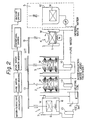
- a washing/drying apparatus for carrying out washing/drying by use of an aqueous solution of a water repellent surfactant, as shown in Fig. 2, has a water tank 6 for containing an aqueous solution of a surfactant having a water repellency, a shower washing device for removing superfluous surfactant attached to the material W to be washed in the water tank 6, and a vacuum chamber 12 for drying the material to be washed after shower washing.
- the vacuum chamber 12 has a means of jetting steam so that the material W to be washed can be heated with steam at a temperature less than 100°C, preferably 99°C or lower, more preferably 80°C to 95°C, in an atmosphere reduced to a pressure such that the boiling point of water is less than 100°C, preferably 99°C or lower, more preferably 80°C to 95°C, and further, has gas blowing means so that the water can be subsequently drained by blowing gas such as air.
- the means of jetting steam and the gas blowing (e.g., air blowing) means may commonly use a blowing means (nozzle).
- the surfactants such as hydrocarbon type surfactants having an alkyl chain length of the hydrophobic group of 12 to 18 in the hydrocarbon type, fluorine type surfactants having an alkyl chain length of the hydrophobic group of 6 to 12 in the fluorine type and a water-repellent silicone type surfactants.
- the preferable conditions may be varied depending upon the kinds of surfactants used, the preferably concentration of the surfactant in the aqueous, washing solution is 300 ppm or more, particularly 450 to 5000 ppm, the preferable temperature is 30°C to less than 100°C, particularly 40°C to 60°C, the preferable dipping time is 10 sec or more, particularly 30 sec to 2 min.
- a drying apparatus for drying, after a thorough washing of materials (or articles) such as non-metallic (e.g., plastic) precision parts, electronic parts, non-metallic (e.g., plastic) cases for accommodating parts by removing water or moisture adhered thereto by irradiating electromagnetic waves to the material to be dried to heat the moisture adhered thereto, and, during or after heating the moisture, gas blowing, vacuum drying or centrifugal drying.
- materials or articles
- materials such as non-metallic (e.g., plastic) precision parts, electronic parts, non-metallic (e.g., plastic) cases for accommodating parts by removing water or moisture adhered thereto by irradiating electromagnetic waves to the material to be dried to heat the moisture adhered thereto, and, during or after heating the moisture, gas blowing, vacuum drying or centrifugal drying.
- the water repellent surfactants and the other surfactants are added to an aqueous washing solution to enhance the detergency thereof, but this can cause problems of foaming during the above-mentioned circulating and filtering process, which comprises passing the washing solution through a fine filter and which is performed for maintaining a desired cleanliness factor of the washing solution.
- Figure 8 shows the usual washing system, i.e., a system for circulating a washing solution obtained by adding a surfactant to water.
- the washing solution 26 is pumped from a heat-exchange vessel 27 into a filter 28 and fully filtered, and then is transferred to a washing vessel 29. While the washing solution is pumped, the solution in the washing vessel 29 overflows through the upper portion thereof into an overflow vessel 30 disposed at the brim of the vessel 29, and contaminants such as oil adhered to the materials to be washed are removed, because the contaminants float on the surface of the washing solution in the washing vessel 29, since they have a specific gravity lower than that of the washing solution.
- the overflow of the washing solution 26 is performed to prevent a readhering of the contaminants to the material which has been washed, when removed from the vessel.
- the washing solution 26 overflows into the overflow vessel 30 and is returned to the heat-exchange vessel 27 through drainage piping 31, and thus the washing solution 26 is continuously recycled and filtered to maintain a desired cleanliness thereof.
- the washing solution 26 is heated to enhance the washing ability, but in this case, a part of the water is evaporated, and correspondingly, the level of the washing solution is lowered and the concentration of the surfactant cannot be maintained at a desired constant level. Therefore, it is necessary to add water to the solution in an amount corresponding to that lost through evaporation. This is effectively performed by automatically supplying water through an automatic valve 35 by the action of a level sensor 12 fitted to the heat-exchange vessel 27; 36 denotes a heater.
- Air is mixed in the washing solution 26 when the solution in the overflow vessel 30 enters the drainage piping 31, and as a result, foam 33 is generated on the surface of the solution retained in the heat-exchange vessel 27.
- the foam 33 is continuously generated, and in a short time, overflows from the heat-exchange vessel 27.
- the foregoing level sensor 32 is lifted by the action of the generated foam, and thus does not act as required.
- the above-mentioned generation of foam observed when a washing solution which is liable to cause foaming is subjected to the above-mentioned circulation can be effectively suppressed or prevented.
- the amount of washing solution 26 discharged through the drainage piping 31 is greater than that pumped into the washing vessel by the action of the circulation pump shown in Fig. 8, and accordingly, air is mixed in the washing solution 26, and therefore, foam is generated. Conversely, if the amount of washing solution 26 discharged through the drainage piping 31 is smaller than that pumped into the washing vessel by the action of the circulation pump, the water level in the overflow vessel 30 rises, and within a short time, the washing solution 26 overflows from the overflow vessel 30.
- the foaming can be effectively prevented because the overflow vessel 30 is filled with the washing solution 26, to a level at which the air is not mixed in the solution 26, and the flow rate of the washing solution 26 discharged through the drainage piping 31 is automatically controlled so that the amount thereof is equal to that pumped into the washing vessel 29 by the circulating pump.
- the first embodiment by dipping a material to be washed into an aqueous solution containing a surfactant having a water repellency (which repels water) before drying by a known drying method such as vacuum drying, shaking off, gas blowing (e.g., air blowing) and heating,at least one molecular layer of a water repellent surfactant is attached to the surface of the material to be washed.
- a drying method such as vacuum drying, shaking off, gas blowing (e.g., air blowing) and heating
- a known drying method such as vacuum drying, shaking off, gas blowing (e.g., air blowing) and heating
- a known drying method such as vacuum drying, shaking off, gas blowing (e.g., air blowing) and heating
- a known drying method such as vacuum drying, shaking off, gas blowing (e.g., air blowing) and heating
- gas blowing e.g., air blowing
- the aqueous solution containing a surfactant having a water repellency is not an excellent washing solution in itself, but will exhibit a strong washing ability when used, for example, in combination with a sonication washing.
- a sufficient washing can be carried out by using an aqueous solution of a surfactant having a water repellency as the washing solution.
- an aqueous solution containing a surfactant having a water repellency as the washing solution, after washing with an aqueous solution containing a surfactant having water repellency, when drawing up the material to be washed from the water tank, the surfactant will be attached in a state in which at least one molecular layer is aligned thereon.
- the surface of the material to be washed has a good water repellency, whereby the water becomes beaded, and by thereafter carrying out drying by a known drying method such as vacuum drying, shaking off, gas blowing (e.g., air blowing), and heating, it can be easily and rapidly dried.
- the material when the material is washed with an aqueous solution containing a surfactant having a water repellency, since the washing solution itself has a water repellency, it has a good dryability, and drying can be easily and rapidly effected by subsequently drying in a conventional manner such as shaking off, gas blowing (e.g., air blowing), and heating.
- a conventional manner such as shaking off, gas blowing (e.g., air blowing), and heating.
- the material to be washed is dipped in an aqueous solution containing a surfactant having a water repellency as a pre-treatment before drying after washing.
- drying can be rapidly carried out by a conventional drying method such as vacuum drying, shaking off, gas blowing (e.g., air blowing), and heating.
- a conventional drying method such as vacuum drying, shaking off, gas blowing (e.g., air blowing), and heating.
- said surfactant is attached as at least one molecular layer to the surface of the material to be washed, whereby the water on the surface of the material to be washed becomes beaded and can be easily removed when dried.
- drying can be insufficient when using only known drying methods such as vacuum drying, shaking off, gas blowing (e.g., air blowing), and heating.
- the present invention employs a method in which the heating is effected with steam but in an atmosphere reduced to a pressure such that the temperature does not reach 100°C.
- a reduced pressure atmosphere the boiling point of water will be lowered and becomes lower than 100°C, which is the boiling point under atmospheric pressure. Therefore, depending on the properties of the material to be washed, and so that the boiling temperature is such that the attached molecular layer of the surfactant is not removed, the pressure of the atmosphere at the steam heating treating portion is reduced.
- the material to be washed at a relatively lower temperature to an extent such that it is not damaged and the aligned molecular layer of the surfactant is not removed
- it can be dried by a conventional drying means such as vacuum drying, shaking off, gas blowing (e.g., air blowing), heating,with relative ease but will take a long time to dry, and a very complicated material becomes difficult to dry.
- a conventional drying means such as vacuum drying, shaking off, gas blowing (e.g., air blowing), heating,with relative ease but will take a long time to dry, and a very complicated material becomes difficult to dry.
- a blowing with, for example, air, or a vacuum drying is carried out.
- a sufficient drying is possible only by using a combination of heating with a low temperature steam of less than 100°C, preferably 99°C or lower, more preferably 80°C to 95°C, and blowing with, for example, air, and then vacuum drying.
- a series of these treatments can be carried out in a single vacuum chamber, and are easily workable.
- the vacuum kettle containing the material to be washed may have a reduced pressure and be heated with steam, then the feeding of steam discontinued and the nozzle switched to an air source, whereby air is blown therein. Subsequently, the air blowing is stopped, and a vacuum drying is performed to complete the series of drying treatments.
- the surfactant having a water repellency there are known the hydrocarbon type, the silicon type and the fluorine type, but the hydrocarbon type and the fluorine type are most suited for this washing and drying.
- the hydrocarbon type surfactants with a hydrophobic group having an alkyl chain length of 12 to 18, and in the fluorine type those with an alkyl chain length of 6 to 12, are preferable.
- the washing/drying apparatus of the present invention i.e., the apparatus which performs the washing and drying by using an aqueous solution of a water repellent surfactant, is provided with washing devices next to the washing vessel holding an aqueous solution of a surfactant having a water repellency, and therefore, superfluous surfactant on the material to be washed is removed by a shower washing, and thus a necessary minimum amount of the water repellent surfactant is always attached to the surface of the material to be washed, whereby the water repellent effect can be stably maintained.
- the apparatus also is provided with a vacuum chamber for drying the material to be washed after the shower washing.
- the vacuum chamber has a means for jetting steam such that the material to be washed can be heated by steam at a temperature of less than 100°C, preferably 99°C or less, more preferably 80°C to 95°C, in an atmosphere having a reduced pressure, so that the boiling point is less than 100°C, preferably 99°C or less, more preferably 80°C to 95°C, and further, has a blowing means whereby water can be removed by blowing gas (e.g., air).
- blowing gas e.g., air
- the three treatments i.e., low temperature steam heating, gas blowing and vacuum drying, are conducted continuously by a single vacuum chamber, to give a better workability and simplify the apparatus.
- the moisture adhered to the surface of the non-metallic precision parts, electronic parts and cases for accommodating the parts is heated by irradiating these materials with electromagnetic waves of 2450 MHz, without heating the subject per se.
- the temperature of the heated moisture is at highest 100°C.
- the coefficient of thermal conductivity of the materials to be washed, such as those of plastics per se, is very small.
- the material is irradiated with the electromagnetic waves while blowing, for example, air, thereon, the water drops always move over the surface of the material to be washed and the temperature of the material per se does not rise.
- the irradiation with the electromagnetic waves does not exert any detrimental influence on the material, such as thermal deformation.
- the foregoing detrimental effects can be effectively eliminated by lowering the irradiation power of the electromagnetic waves, by intermittently irradiating the material with the electromagnetic waves, or by controlling the irradiation power or the length of the irradiation time while detecting the temperature of the material to be washed, using an infrared radiation thermometer.
- the material to be washed is subjected to air blowing while heating the moisture adhered to the material through the irradiation with the electromagnetic waves, the material can be effectively dried without an adverse affect, such as heat deformation, on the material.
- the gas-blowing such as the air-blowing
- the gas-blowing after the material is heated through the irradiation with the electromagnetic waves, without an adverse affect on the material, depending on the kind of the material to be washed.
- the heat resistance of the material to be washed is very high or the material has a shape which can prevent the residence of water, and thus is not damaged by the residence thereon of water at a high temperature.
- the moisture adhered to the surface of the non-metallic precision parts, electronic parts and cases for accommodating the parts is heated by irradiating these materials with electromagnetic wave of 2450 MHz without heating the materials per se.
- the temperature of the heated moisture is at highest 100°C under the atmospheric pressure, but if the material is heated through the irradiation with the electromagnetic waves under a reduced pressure in the vacuum chamber, the boiling point of water can be arbitrarily reduced by controlling the degree of vacuum.
- the material is heated through the irradiation with the electromagnetic waves at a reduced pressure of not more than the predetermined level corresponding to the degree of vacuum which ensures that the temperature of the material is not higher than the heat-resisting temperature thereof throughout the irradiation with the electromagnetic waves, the temperature of the material per se does not rise, and thus the irradiation with the electromagnetic waves does not have an adverse affect on the materials, such as thermal deformation.
- the material to be washed is heated to remove the moisture adhered to the material through the irradiation with the electromagnetic waves under a reduced pressure in the vacuum chamber, the material can be effectively dried without an adverse affect, such as heat deformation, on the material.
- the moisture adhered to the surface of the non-metallic precision parts, electronic parts and cases for accommodating the parts is heated by irradiating these materials with electromagnetic wave of 2450 MHz, without heating the materials per se.
- the temperature of the heated moisture is at highest 100°C.
- the coefficient of thermal conductivity of the materials to be washed, such as those of plastics per se, is very small.
- the material is irradiated with the electromagnetic wave while the material is subjected to centrifugation, the water drops always move over the surface of the material to be washed and the temperature of the material per se does not rise, and thus the irradiation with the electromagnetic waves does not have an adverse affect on the materials, such as thermal deformation.
- the foregoing detrimental effects such as thermal deformation can be effectively eliminated by lowering the irradiation power of the electromagnetic waves, by intermittently irradiating the material with the electromagnetic waves, or by controlling the irradiation power or the length of the irradiation time while detecting the temperature of the material to be washed, using an infrared radiation thermometer.
- the material to be washed is heated to remove the moisture adhered to the material through the irradiation with the electromagnetic waves while the material is subjected to centrifugation, the material can be effectively dried without an adverse affect, such as heat deformation, on the material.
- Figures 2 and 3 are examples of the apparatus for performing the washing/drying method of the present invention.
- Figure 2 shows the steps of the process and a longitudinal sectional view of the apparatus.
- the apparatus is provided with a washing device or vessel 1 containing an aqueous solution containing a surfactant having a water repellency, a first shower device 2, a second shower washing device 1, a centrifugation drying device 4, and a vacuum drying device, arranged in this order.
- the washing device 1 contains an aqueous solution 7, containing a surfactant having a water repellency, in a water vessel 6, and having a sonication generation device 8 provided therein.
- the washing device 1 is adapted to recover the flow of contaminants generated by washing, heating same in the heating water vessel 9, and cleaning same with the filter 10 for reuse.
- the first shower washing device 2 and the second shower washing device 3 jet pure water against the material W to be washed, to wash off the previous washing liquid.
- the centrifugal drying device 4 removes water by centrifugal force, by rotating the basket 11 in which the material W to be washed is placed by the motor M.
- the vacuum drying device 5 removes water by suction, by reducing the pressure by a vacuum pump VP when the material W to be washed is hermetically sealed in the vacuum chamber 12.
- Numeral 13 is a conveying machine, and to perform the washing and drying when the material W to be washed is placed in the aqueous layer 6 containing the aqueous solution 7 of a surfactant having a water repellency is added, the sonication generating device 8 is driven to remove contamination and dust on the surface of the material W to be washed.
- the material W to be washed is suspended by the conveying machine 13, and conveyed to the first shower washing device 2, and the surfactant having a water repellency will be attached thereto, while aligned in at least one molecular layer on the surface of the material W to be washed, after the washing.
- the aqueous solution of the surfactant having a water repellency is washed off with pure water. If the superfluous water repellent surfactant can be removed only with the pure water jetting by the first shower washing device 2, this pure water shower washing alone will suffice as the first step, but if not, then the material W is conveyed to the second shower washing device 3 to be again washed with pure water. Accordingly, at least one molecular layer of the surfactant having a water repellency is attached to the surface of the material W to be washed.
- drying is carried out in a conventional manner. That is, in the centrifugation drying device 4, the material W to be washed is placed in a basket 11, which is rotated by a motor M, and the water is removed by centrifugal force. Alternatively, when the material W is hermetically sealed in the vacuum chamber 12, the pressure is reduced by a vacuum pump VP to aspirate the water by suction.
- superfluous surfactant can be removed by only shower washing, as described above, at least one molecular layer remains on the surface of the material W, whereby a water repellency can be maintained to repel water, and the water attached thereto is beaded.
- the water will fall off under its own weight, and therefore, compared with the case of using a surfactant having no water repellency, or when not using a surfactant, the amount of water attached will be reduced to about 1/3, and thus the load at the next drying treatment will be alleviated.
- the surface of the film on which the water repellent surfactant is attached repels water, as mentioned above, to form water beads, and these beads can be easily removed even by a conventional drying method such as centrifugal force or a vacuum aspiration.
- the vacuum chamber 12 of the vacuum drying apparatus 5 has a means of jetting steam, whereby the material W to be washed can be heated with steam at a temperature of less than 100°C in an atmosphere having a reduced pressure so that the boiling point of the water is less than 100°C, and further, has a blowing means whereby the water can be removed by blowing gas such as air.
- the material to be washed can be heated with steam at a temperature of less than 100°C, preferably 80°C to 95°C, as mentioned above.
- This steam heating lowers the surface tension of the water, and further, heats the material W to be washed to thereby make the water readily vaporizable.
- the water is then blown off by blowing a normal temperature gas (e.g., air) or hot gas (e.g., air) therein, and then the water discharged by suction under a vacuum.
- a normal temperature gas e.g., air
- hot gas e.g., air
- a vacuum chamber 12 capable of gas (e.g., air) blowing is provided, and as mentioned above, this is also effective for drying after a water washing not using an aqueous solution of a water repellent surfactant.
- gas e.g., air
- the temperature of the low temperature steam depends on the pressure, and therefore, the limit is about 40°C to about - 700mmHg, which is the capacity of a conventional vacuum pump; a further lowering of the temperature can be made by improving the capacity of the vacuum pump.
- the apparatus in Fig. 2 is intended to enhance the drying effect by performing washing with an aqueous solution of a water repellent surfactant, and utilizing the water repellent effect of the water repellent surfactant attached to the surface of the material W to be washed after washing, but in the case of a material (or article) to which oil is adhered, such as a material W to be washed after mechanical working, a proper wash can be obtained only by using the water repellent surfactant and the sonication generation apparatus in combination.
- the sonication generation device 8 in the water vessel 6 should not be driven, but when the material W to be washed after oil component is removed is to be rewashed with the aqueous solution of the water repellent surfactant, the sonication generation device 8 is driven to perform the washing.
- the subsequent procedures are as described in Fig. 2.
- the oily component washing vessel 14 has an aqueous solution 16 containing an alkaline defatting agent (e.g., fine Cleaner FC35 available from Nippon Perkarizing Co.) suitable for oil washing in the water vessel, and has the sonication generation device 8 therein.
- an alkaline defatting agent e.g., fine Cleaner FC35 available from Nippon Perkarizing Co.
- the oily component floating on the surface is recovered by the recovery device 17, and then the liquid surface portion alone is recovered by the oil collecting float 18, and thereafter, the oily component is separated and removed in the oil separating device 19.
- the surfactant having a water repellency and the washing and drying conditions, are described.
- washing with an aqueous solution containing a surfactant having a water repellency, or a drying pre-treatment after washing is practiced. Therefore, a surfactant having a strong washing effect and a water repellency is required. More specifically, it is important to use a surfactant to lower the surface tension and increase the wettability and penetrability.
- the surfactant there are known the hydrocarbon type, silicon type and fluorine type, but as a result of a study by the present inventors, the fluorine type surfactants having the following characteristics are most preferable for attaining the objects of the present invention.
- the washability is enhanced and the amount of water attached becomes smaller, whereby an enhancement of the dryability can be expected.
- the oil repellency due to the oil repellency, the oil liberated from the material to be washed can be more easily recovered by the oil separation device, and a reattachment of the oil component to the material to be washed can be prevented.
- the optimum treatment conditions for lowering the amount of water attached were investigated.
- the anionic type i.e., perfluoroalkyl carboxylate (S-113) and perfluoroalkyl phosphate (S-112)
- the nonionic type i.e., perfluoroalkylamine oxide (S-141)
- the cationic type i.e., perfluoroalkyl trimethylammonium salt (S-121)
- the sample materials to be washed were an aluminum plate (i.e., aluminum A 5052) having a size of 50 mm x 50 mm x 1 mm.
- the amount of water attached was the smallest with the anionic type, followed by the nonionic type.
- the anionic type a perfluoroalkyl carboxylate leaves a particularly small amount of water attached, and a perfluoroalkyl phosphate is substantially the same as a perfluoroalkylamine oxide.
- a perfluoroalkyl carboxylate of the anionic type was found to provide the highest water repellency.
- the amount of water attached was zero when dipped at 50°C for 90 seconds or longer, at 60°C for 60 seconds or longer, and at 70°C for 45 seconds or longer.
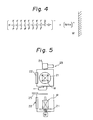
- a perfluoroalkyl carboxylate has a chain structure as shown in Fig. 4, and although the alkylcarbon chain length in this Figure is 8, an alkylcarbon length of about 6 to 12 in the water repellent surfactant of the fluorine type provided an excellent water repellency.
- the hydrocarbon type with alkylcarbon chain lengths of about 12 to 18 also had an excellent water repellency.
- the amount attached was about 30%.
- the amount of water attached was zero, and at 60°C, at a concentration of 300 ppm or more, the amount of water was zero. Therefore, at a dipping time of 1 minute and a liquid temperature of 60°C, the amount of water attached can be made zero if the concentration is made 300 ppm or higher.
- the surface tension of pure water with a perfluoroalkyl carboxylate can be lowered to about 17 dyn/cm by an addition of 300 ppm thereof, from the standpoint of the surface tension, a concentration of 300 ppm or more is desirable, but in view of the treatment margin, about 600 ppm is most preferable.
- the surface tension is 73 dyn for pure water and 20 dyn for Fron 113.
- the temperature of the jetting steam is within this range.
- vacuum drying In the case washing a material with a simple shape, vacuum drying is not always required, but in the case of a material with a complicated shape, such as one having sinks, etc., a complete drying is rendered possible only by finally effecting a vacuum aspiration.
- the vacuum drying is generally effected at an ambient temperature, but if desired, the vacuum evacuation can be carried out while heating at a temperature of less than 100°C.
- the best drying method has been determined, and depending on the kind and properties of the material to be washed, and the substance causing contamination, it is clear the material can be washed even with an aqueous solution of a water repellent surfactant for a drying pre-treatment; without the need for a special washing as shown in Fig. 3.
- an aluminum sample treated with Arosin is coated with three kinds of cutting oils, (i.e., GM5, GS5, and FW68, all available from Nippon Oil Co., Ltd) subjected to sonication washing (i.e., 28 kHz x 200W)in the above-mentioned aqueous perfluoroalkyl carboxylate solution at 60°C for 1 minute, when shower washed with pure water and dried.
- sonication washing i.e., 28 kHz x 200W
- washing with an aqueous solution of water repellent surfactant according to the present invention was found to give a better effect than washing with a conventional fluorocarbon as in the prior art, with a residual use amount of about 1/10 or less.
- the materials to be washed were two kinds of Kanizen plated products, two kinds of Arosin plated products, and one kind of battery oxidized treated product, and the corrosion resistance thereof was tested. As a result, no abnormality was found in any of the five products. Also, after Cellophane tape was adhered thereto, an adhesion test was conducted by peeling the tape from the material, but no abnormality was found in any of the five products.
- an apparatus for water-draining and drying non-metallic precision parts, electronic parts and cases for accommodating parts which have been thoroughly washed with water by blowing air or the like thereon, during or after irradiating these materials with electromagnetic waves to heat the moisture adhered thereto As shown in Fig. 5, the apparatus comprises a rotatable table 21 which makes it possible to efficiently heat the material W to be washed and an electromagnetic wave-irradiation device 22 capable of irradiating the material with electromagnetic waves of 2450 MHz, thereby heating the moisture adhered to the material, and an air-blower device 23 for blowing, for example, air onto the material to remove the heated moisture on the material, to thus water-drain or dry the same.
- the table 21 need not be rotatable, as this depends on the shape of the material W.
- Note, 25 denotes a lid.
- This rotating system can be also applied to the shower washing apparatus, whereby the water blow nozzles can be placed so that the water shower comes from only one or two directions.
- An apparatus shown in Fig. 6 is another drying apparatus for evaporating the moisture adhered to non-metallic precision parts, electronic parts and cases for accommodating the parts which have been thoroughly washed with water, to dry the materials by applying a reduced pressure to these non-metallic materials W to be washed, during or after irradiating these materials with electromagnetic waves to heat the moisture adhered thereto.
- Fig. 6 is another drying apparatus for evaporating the moisture adhered to non-metallic precision parts, electronic parts and cases for accommodating the parts which have been thoroughly washed with water, to dry the materials by applying a reduced pressure to these non-metallic materials W to be washed, during or after irradiating these materials with electromagnetic waves to heat the moisture adhered thereto.
- the apparatus comprises a rotatable table 21 which makes it possible to efficiently heat the material W to be washed, and an electromagnetic wave-irradiation device 22 capable of irradiating the material with electromagnetic waves of 2450 MHz, thereby heating the moisture adhered to the material, and a vacuum pump VP for establishing a reduced pressure or a vacuum to evaporate off and remove the heated moisture adhered to the material, to thus dry the same.
- the table 21 need not be rotatable, as this depends on the shape of the material W.
- An apparatus shown in Fig. 7 is a further drying apparatus for spin-drying non-metallic precision parts, electronic parts and cases for accommodating the parts, which have been thoroughly washed with water, by subjecting these non-metallic materials to be washed to centrifugation, during or after irradiating these materials with electromagnetic waves to heat the moisture adhered to the materials.
- the apparatus comprises a rotatable table 21 which makes it possible to efficiently heat the material W to be washed and an electromagnetic wave-irradiation device 22 capable of irradiating the material with electromagnetic waves of 2450 MHz, thereby heating the moisture adhered to the material.
- the table 21 is also capable of being rotated at a high speed, and thus the heated moisture on the material can be removed by spin-drying.
- a foam-suppressing means 36 is placed in a washing solution overflow vessel 30 in the circulating system of the washing solution 26 shown in Fig. 8.
- Various means 36 are shown in figs. 11-21.
- a foam-suppressing apparatus comprises, in a system for circulating a washing solution, a washing solution overflow vessel 30 capable of storing the solution and a valve 39 or 40 which is opened and closed by a buoyancy force exerted on a float 37 or 38; the valve 39 or 40 opening and closing at the water level in the overflow vessel 30 at which an exhaust drain 31 for the solution does not entrap air.
- valve 39 or 40 is floated at a level at which the amount of the circulated solution entering the overflow vessel 30 is balanced by the flow rate thereof drained through the valve.
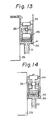
- a foam-suppressing apparatus shown in Figs. 13 and 14 comprises, in a system for circulation a washing solution, an overflow vessel 30 capable of storing the solution, an outer cylinder 41 or 42 connected to an exhaust drain 31 and having a hole through which the solution can enter the cylinder, and an internal cylinder 45 or 44 which opens and closes the hole of the outer cylinder 41 or 42 by the buoyancy force exerted on a float 43 or 44; the hole of the outer cylinder 41 or 42 being opened and closed at the water level in the overflow vessel 30 at which the exhaust drain 31 for the solution does not entrap air.
- the internal cylinder 45 or 44 is floated at a level at which the amount of the circulated solution entering the overflow vessel 30 is balanced by the flow rate thereof drained through the hole of the outer cylinder 41 or 42.
- the sizes of the holes in the outer cylinder (or sometimes, the inner cylinder) in various embodiments of the present invention can be any size such that the liquid amount overflowing from the overflow vessel 30 can be satisfactorily withdrawn therefrom.
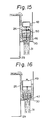
- a foam-suppressing apparatus shown in Figs. 15 and 16 comprises, in a system for circulating a solution, an overflow vessel 30 capable of storing the solution, an internal cylinder 46 or 47 connected to an exhaust drain 31 and having a hole through which the solution can enter the cylinder and an outer cylinder 50 or 49 which opens and closes the hole of the internal cylinder 46 or 47 by the buoyancy force exerted on a float 48 or 49; the hole of the internal cylinder 46 or 47 being opened and closed at the water level in the overflow vessel 30 at which the exhaust drain 31 for the washing solution does not entrap air.
- the outer cylinder 50 or 49 is floated at a level at which the amount of the circulating washing solution entering the overflow vessel 30 is balanced by the flow rate thereof drained through the hole of the internal cylinder 46 or 47.
- a foam-suppressing apparatus shown in Figs. 17 and 18 comprises, in a system for circulating a washing solution, an overflow vessel 30 capable of storing the washing solution, an internal cylinder 51 or 52 connected to an exhaust drain 31 and an outer cylinder 55 or 54 having a hole through which the washing solution can enter the cylinder and in which the hole of the outer cylinder is opened and closed by the buoyancy force exerted on a float 53 or 54; the hole of the outer cylinder 55 or 54 being opened and closed at the water level in the overflow vessel 30 at which the exhaust drain 31 for the washing solution does not entrap air.
- the outer cylinder 55 or 54 is floated at a level at which the amount of the circulated solution entering the overflow vessel 30 is balanced by the flow rate thereof drained through the hole of the outer cylinder 55 or 54.
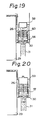
- a foam-suppressing apparatus shown in figs. 19 and 20 comprises, in a system for circulating a solution, an overflow vessel 30 capable of storing the washing solution, an outer cylinder 56 or 57 connected to an exhaust drain 31 and an internal cylinder 60 or 59 having a hole through which the solution can enter the cylinder and in which the hole of the internal cylinder is opened and closed by the buoyancy force exerted on a float 58 or 59; the hole of the internal cylinder 60 or 59 being opened and closed at the water level in the overflow vessel 30 at which the exhaust drain 31 for the solution does not entrap air.
- the internal cylinder 60 or 59 is floated at a level at which the amount of the circulating washing solution entering the overflow vessel 30 is balanced by the flow rate thereof drained through the hole of the internal cylinder 60 or 59.
- Each of the above-mentioned floats has a cavity therein and a means for exhausting the air from the cavity at the upper portion thereof, so that the buoyancy force can be controlled by introducing the washing solution into the float.
- the shapes of the above-mentioned internal and outer cylinders may be, in addition to a circle, any crosssectional shapes such as a triangle, square and polygonal.
- A is a ultrasonic washing vessel
- B a first shower washing vessel
- C a dip bubbling vessel
- D a second shower washing vessel
- E, E′ and E first, second, and third vacuum drying vessels, respectively.
- the materials/or articles contained in, for example, a basket are conveyed by an appropriate conveying means from the ultrasonic washing vessel A to the vacuum drying vessels E, E′ and E ⁇ .
- the materials to be washed are first dipped in the ultrasonic washing vessel A through which an aqueous washing solution of a fluorine type surfactant is circulated, while the materials to be washed are subjected to a ultrasonic treatment under the conditions of, for example, 60°C ⁇ 60 sec. Then, the materials to be washed are conveyed to the first shower washing vessel B in which the materials are rinsed by spraying pure water at, for example, 40°C for 60 seconds.
- a substantially one molecule layer is formed on the surfaces of the materials to be washed.
- the materials are then dipped in pure water in the dip bubbling vessel C at 40°C for 60 seconds, while clean air is bubbled, whereby the forming of a one mole layer of the surfactant is ensured even in sinks, blind tap holes or the like, and the materials are further sprayed and washed with pure water at, for example, 40°C for 60 seconds.
- the materials to be washed having a one molecular layer of a fluorine type surfactant on the surfaces thereof are, for example, (1) heated with a low temperature steam (e.g., 90°C) under, for example, 40 mmHg, (2) subjected to hot air blowing at 90°C under an atmospheric pressure, and (3) are then subjected to a vacuum drying under 40 mmHg.
- a low temperature steam e.g., 90°C
- the above-mentioned drying steps (1), (2) and (3) can be effected in series in the vacuum drying vessels E, E′ and E ⁇ , respectively, as shown by the solid line in Fig.
- all of the drying steps (1), (2) and (3) are effected in each vacuum vessel of E, E′ and E ⁇ , as shown by a dotted line of Fig. 21.
- the preferable drying time is 3 to 6 minutes, whereby the desired through washing and drying can be accomplished.
- the present invention by carrying out a washing treatment by dipping a material to be washed in an aqueous solution of a water repellent surfactant, or dipping a material to be washed, which has been first washed in another step, in an aqueous solution of a water repellent surfactant, at least one molecular layer of the water repellent surfactant is attached to the surface of the material to be washed.
- a thorough washing and drying after washing can be carried out efficiently without the use of a fluorocarbon and without adverse affects on the material to be washed.
- the materials especially those susceptible to heat, can be effectively dried after washing with water without an adverse affect due to heat.
- the generation of foam in the system can be effectively suppressed or prevented by controlling the level of the washing solution in the overflow vessel for the washing vessel, so that air is not entrapped in the washing solution effluent in the washing solution circulating system.
Landscapes
- Chemical & Material Sciences (AREA)
- Chemical Kinetics & Catalysis (AREA)
- Engineering & Computer Science (AREA)
- Organic Chemistry (AREA)
- Life Sciences & Earth Sciences (AREA)
- Oil, Petroleum & Natural Gas (AREA)
- Wood Science & Technology (AREA)
- General Chemical & Material Sciences (AREA)
- Materials Engineering (AREA)
- Mechanical Engineering (AREA)
- Metallurgy (AREA)
- Drying Of Solid Materials (AREA)
- Cleaning By Liquid Or Steam (AREA)
- Cleaning Or Drying Semiconductors (AREA)
- Detergent Compositions (AREA)
- Accessory Of Washing/Drying Machine, Commercial Washing/Drying Machine, Other Washing/Drying Machine (AREA)
Applications Claiming Priority (3)
| Application Number | Priority Date | Filing Date | Title |
|---|---|---|---|
| JP11643990 | 1990-05-01 | ||
| JP11643990 | 1990-05-01 | ||
| JP116439/90 | 1990-05-01 |
Publications (3)
| Publication Number | Publication Date |
|---|---|
| EP0455465A2 true EP0455465A2 (de) | 1991-11-06 |
| EP0455465A3 EP0455465A3 (en) | 1992-07-22 |
| EP0455465B1 EP0455465B1 (de) | 2001-11-28 |
Family
ID=14687138
Family Applications (1)
| Application Number | Title | Priority Date | Filing Date |
|---|---|---|---|
| EP91303898A Expired - Lifetime EP0455465B1 (de) | 1990-05-01 | 1991-04-30 | Verfahren zum Waschen/Trocknen |
Country Status (7)
| Country | Link |
|---|---|
| US (3) | US5203927A (de) |
| EP (1) | EP0455465B1 (de) |
| KR (1) | KR970003672B1 (de) |
| CN (1) | CN1031980C (de) |
| CA (1) | CA2040989A1 (de) |
| DE (1) | DE69132829T2 (de) |
| SG (1) | SG55009A1 (de) |
Cited By (5)
| Publication number | Priority date | Publication date | Assignee | Title |
|---|---|---|---|---|
| WO1996010463A1 (de) * | 1994-10-04 | 1996-04-11 | Kunze Concewitz Horst | Verfahren und vorrichtung zum feinstreinigen von oberflächen |
| WO1996036068A1 (de) * | 1995-05-12 | 1996-11-14 | Steag Microtech Gmbh | Verfahren und vorrichtung zur nassbehandlung von substraten in einem behälter |
| WO2001095682A1 (en) * | 2000-06-08 | 2001-12-13 | Matsushita Electric Industrial Co., Ltd. | Method and device for drying materials and method of producing circuit boards using the same |
| FR2920046A1 (fr) * | 2007-08-13 | 2009-02-20 | Alcatel Lucent Sas | Procede de post-traitement d'un support de transport pour le convoyage et le stockage atmospherique de substrats semi-conducteurs, et station de post-traitement pour la mise en oeuvre d'un tel procede |
| US7520013B2 (en) | 2004-12-17 | 2009-04-21 | University Of Florida Research Foundation, Inc. | Process for enhanced liquid extraction from fabrics |
Families Citing this family (52)
| Publication number | Priority date | Publication date | Assignee | Title |
|---|---|---|---|---|
| US5409544A (en) * | 1990-08-20 | 1995-04-25 | Hitachi, Ltd. | Method of controlling adhesion of fine particles to an object in liquid |
| JPH04132388U (ja) * | 1991-05-24 | 1992-12-08 | 千住金属工業株式会社 | 真空乾燥装置 |
| US5647143A (en) * | 1992-10-30 | 1997-07-15 | Japan Hayes Ltd. | Vacuum-degreasing cleaning method |
| JP3347814B2 (ja) * | 1993-05-17 | 2002-11-20 | 大日本スクリーン製造株式会社 | 基板の洗浄・乾燥処理方法並びにその処理装置 |
| JP3341033B2 (ja) * | 1993-06-22 | 2002-11-05 | 忠弘 大見 | 回転薬液洗浄方法及び洗浄装置 |
| DE4324432C2 (de) * | 1993-07-21 | 1996-04-25 | Multimatic Oberflaechentechnik | Verfahren zur Reinigung verschmutzter Teile |
| DE4326239C2 (de) * | 1993-07-31 | 1997-06-05 | Korsch Pressen Gmbh | Tablettier-, Dragier- oder Granuliermaschine, insbesondere Rundlauf-Tablettenpresse |
| JPH07100441A (ja) * | 1993-09-30 | 1995-04-18 | Nippon Seiki Co Ltd | 洗浄装置 |
| FR2713521B1 (fr) * | 1993-12-09 | 1996-03-22 | Lenglen Jean Luc | Procédé et machine pour le nettoyage de pièces. |
| JP2996334B2 (ja) * | 1994-03-30 | 1999-12-27 | 東北日本電気株式会社 | 超音波脱脂装置 |
| JPH07292488A (ja) * | 1994-04-25 | 1995-11-07 | Nippon Parkerizing Co Ltd | 金属表面の乾燥性に優れた水系洗浄方法 |
| US5556479A (en) * | 1994-07-15 | 1996-09-17 | Verteq, Inc. | Method and apparatus for drying semiconductor wafers |
| JPH09199467A (ja) * | 1996-01-17 | 1997-07-31 | Mitsubishi Electric Corp | 洗浄装置及びその方法 |
| US5922138A (en) * | 1996-08-12 | 1999-07-13 | Tokyo Electron Limited | Liquid treatment method and apparatus |
| KR19990010200A (ko) * | 1997-07-15 | 1999-02-05 | 윤종용 | 감압식 건조 장치를 이용하는 반도체장치 건조방법 |
| EP1074035A4 (de) | 1998-03-24 | 2002-05-29 | Corning Inc | Entladungslampe mit aussenelektroden |
| US5958143A (en) * | 1998-04-28 | 1999-09-28 | The Regents Of The University Of California | Cleaning process for EUV optical substrates |
| CA2251208A1 (en) * | 1998-11-12 | 2000-05-12 | Claude Perreault | Fully automatic plating wax collecting device and method thereof |
| JP3658257B2 (ja) * | 1998-12-24 | 2005-06-08 | キヤノン株式会社 | 洗浄方法及び洗浄装置及び電子写真感光体及び電子写真感光体の製造方法 |
| JP2000301082A (ja) * | 1999-04-20 | 2000-10-31 | Tokyo Electron Ltd | 処理装置 |
| TW434668B (en) * | 2000-01-27 | 2001-05-16 | Ind Tech Res Inst | Wafer rinse apparatus and rinse method of the same |
| US20070271812A1 (en) * | 2003-07-24 | 2007-11-29 | Werner Swoboda | Device for Hardening the Coating of an Object, Consisting of a Material That Hardens Under Electromagnetic Radiation, More Particularly an Uv Paint or a Thermally Hardening Paint |
| KR100582202B1 (ko) * | 2003-10-13 | 2006-05-23 | 엘지.필립스 엘시디 주식회사 | 박막트랜지스터 어레이 기판의 제조장치 및 방법 |
| RU2309481C2 (ru) * | 2005-07-27 | 2007-10-27 | Открытое акционерное общество "Научно-исследовательский институт полупроводникового машиностроения" (ОАО "НИИПМ") | Способ и устройство отмывки и сушки плоских стеклянных подложек |
| CN1727080A (zh) * | 2005-07-29 | 2006-02-01 | 北京中联科利技术股份有限公司 | 多流体清洗方法 |
| IT1395090B1 (it) * | 2009-04-08 | 2012-09-05 | Lasa Impianti Srl | Apparecchiatura a basso impatto ambientale per il lavaggio di particolari metallici e non metallici che necessitano di un altro grado di pulizia |
| TWM374919U (en) * | 2009-06-11 | 2010-03-01 | Wen-Der Yang | Supersonic drain cleaner for embedded water sink |
| DE102009053574A1 (de) * | 2009-11-06 | 2011-05-12 | Gebr. Schmid Gmbh & Co. | Verfahren und Anlage zur Fertigung von Leiterplatten und Halbleiterprodukten |
| CN102553852A (zh) * | 2010-12-28 | 2012-07-11 | 北京京东方光电科技有限公司 | 清洗装置 |
| CN102764742A (zh) * | 2011-05-03 | 2012-11-07 | 镇江仁德新能源科技有限公司 | 碎硅片漂洗设备 |
| US9581255B2 (en) | 2012-07-23 | 2017-02-28 | Henning, Inc. | Multiple proportion delivery systems and methods |
| CN103480622B (zh) * | 2013-09-18 | 2016-06-08 | 合肥京东方光电科技有限公司 | 基板清洗装置及其工作方法、基板清洗系统 |
| CN104588356B (zh) * | 2014-12-18 | 2017-04-19 | 吉安市优特利科技有限公司 | 一种铝壳锂电池清洗方法 |
| CN105170556A (zh) * | 2015-09-25 | 2015-12-23 | 无锡市博阳超声电器有限公司 | 一种带毛刷的超声波清洗机 |
| CN105970244A (zh) * | 2016-05-20 | 2016-09-28 | 深圳市鑫承诺环保产业股份有限公司 | 一种金银币母件高精清洗工艺 |
| DK179189B1 (en) * | 2016-07-06 | 2018-01-22 | Techsave As | Method for restoring damaged electronic devices by cleaning and apparatus |
| CN107354475B (zh) * | 2017-07-10 | 2019-06-11 | 厦门金越电器有限公司 | 一种防铜氧化碳氢清洗方法及其设备 |
| CN109273381A (zh) * | 2017-07-18 | 2019-01-25 | 东莞市鸿村环保设备制造有限公司 | 一种带有清洗风干功能的玻璃基板蚀刻装置 |
| CN107616765A (zh) * | 2017-09-20 | 2018-01-23 | 宁波创健环保科技有限公司 | 无水洗碗机及其控制方法 |
| CN108211969A (zh) * | 2018-03-07 | 2018-06-29 | 深圳市海威达科技有限公司 | 泡沫自动混比装置及洗车机 |
| CN108485831A (zh) * | 2018-04-18 | 2018-09-04 | 安徽斯瑞尔阀门有限公司 | 一种阀门表面除油清洗剂及其清洗装置 |
| CN109047109A (zh) * | 2018-07-27 | 2018-12-21 | 成都品尚农电子商务有限公司 | 一种日用品清洁处理系统 |
| CN109013517A (zh) * | 2018-08-20 | 2018-12-18 | 六安名家汇光电科技有限公司 | 一种led投光灯塑料外壳的除尘方法 |
| DE102018121915B3 (de) * | 2018-09-07 | 2020-02-13 | Dyemansion Gmbh | Verfahren zur Oberflächenbehandlung von Formteilen |
| CN111842329B (zh) * | 2020-07-30 | 2022-09-27 | 固安浩瀚光电科技有限公司 | 一种半导体零件表面清洗装置及其使用方法 |
| CN114249897A (zh) * | 2020-09-24 | 2022-03-29 | 深圳市鸿信顺电子材料有限公司 | 一种含浸液及其在片式元件的表面处理工艺方面的应用 |
| CN112808681A (zh) * | 2020-12-18 | 2021-05-18 | 华虹半导体(无锡)有限公司 | 硅片清洗供液装置 |
| CN112547666A (zh) * | 2020-12-22 | 2021-03-26 | 深圳市鑫承诺环保产业股份有限公司 | 一种汽车配件材料清洗工艺 |
| CN112678759B (zh) * | 2020-12-31 | 2023-08-01 | 浙江凯圣氟化学有限公司 | 一种超纯氢氟酸包装物清洗方法 |
| JPWO2023013378A1 (de) * | 2021-08-06 | 2023-02-09 | ||
| CN114985385B (zh) * | 2022-05-25 | 2023-08-25 | 广东美的厨房电器制造有限公司 | 饮品调制设备及其控制方法和装置、可读存储介质 |
| CN116000006A (zh) * | 2022-11-09 | 2023-04-25 | 浙江佰泰医疗科技有限公司 | 一种带自动控制型的多功能超声波清洗机 |
Family Cites Families (26)
| Publication number | Priority date | Publication date | Assignee | Title |
|---|---|---|---|---|
| US1333848A (en) * | 1916-09-15 | 1920-03-16 | Oscar E Jacobs | Process for the drying and curing of lumber |
| US1250496A (en) * | 1916-11-09 | 1917-12-18 | Emil Passburg | Process for drying grain and other coarse granular materials. |
| US3436262A (en) * | 1964-09-25 | 1969-04-01 | Dow Chemical Co | Cleaning by foam contact,and foam regeneration method |
| US3615310A (en) * | 1969-06-02 | 1971-10-26 | Ppg Industries Inc | Method for drying glass fiber forming packages |
| US3672067A (en) * | 1970-10-30 | 1972-06-27 | Envirotech Corp | Method for steam drying filter cake |
| GB1321699A (en) * | 1970-11-20 | 1973-06-27 | Atomic Energy Authority Uk | Methods of removing unwanted oxidisable substances from materials |
| US4156619A (en) * | 1975-06-11 | 1979-05-29 | Wacker-Chemitronic Gesellschaft Fur Elektronik-Grundstoffe Mbh | Process for cleaning semi-conductor discs |
| US4079522A (en) * | 1976-09-23 | 1978-03-21 | Rca Corporation | Apparatus and method for cleaning and drying semiconductors |
| US4318749A (en) * | 1980-06-23 | 1982-03-09 | Rca Corporation | Wettable carrier in gas drying system for wafers |
| US4605574A (en) * | 1981-09-14 | 1986-08-12 | Takashi Yonehara | Method and apparatus for forming an extremely thin film on the surface of an object |
| US4569695A (en) * | 1983-04-21 | 1986-02-11 | Nec Corporation | Method of cleaning a photo-mask |
| DE3374526D1 (en) * | 1983-07-06 | 1987-12-23 | Snef Electro Mecanique | Method and apparatus for cleaning big work pieces |
| US4693777A (en) * | 1984-11-30 | 1987-09-15 | Kabushiki Kaisha Toshiba | Apparatus for producing semiconductor devices |
| US4736758A (en) * | 1985-04-15 | 1988-04-12 | Wacom Co., Ltd. | Vapor drying apparatus |
| US4722355A (en) * | 1985-08-19 | 1988-02-02 | Rolf Moe | Machine and method for stripping photoresist from wafers |
| GB2182585B (en) * | 1985-11-07 | 1989-10-04 | Sony Corp | Removing coatings from cathode ray tubes or parts thereof |
| DE3611422A1 (de) * | 1986-04-05 | 1987-10-15 | Henkel Kgaa | Verfahren zur reinigung verschmutzter fester formteile |
| US4832753A (en) * | 1987-05-21 | 1989-05-23 | Tempress Measurement & Control Corporation | High-purity cleaning system, method, and apparatus |
| US4842687A (en) * | 1987-07-16 | 1989-06-27 | Texas Instruments Incorporated | Method for etching tungsten |
| US4902350A (en) * | 1987-09-09 | 1990-02-20 | Robert F. Orr | Method for rinsing, cleaning and drying silicon wafers |
| JPH073634Y2 (ja) * | 1987-12-28 | 1995-01-30 | 株式会社トムコ | ウェハ液洗乾燥装置 |
| US5158616A (en) * | 1988-07-22 | 1992-10-27 | Tokyo Electron Limited | Apparatus for cleaning a substrate |
| FI86944C (fi) * | 1989-02-02 | 1992-10-26 | Nokia Mobira Oy | Foerfarande foer tvaettning av kretsplattor och en anordning foeg anvaendning i foerfarandet |
| US5039349A (en) * | 1990-05-18 | 1991-08-13 | Veriflo Corporation | Method and apparatus for cleaning surfaces to absolute or near-absolute cleanliness |
| WO1992016314A1 (en) * | 1991-03-12 | 1992-10-01 | Haakansson Lars | A device for cleaning objects, preferably of metal |
| DE4138432C1 (de) * | 1991-11-22 | 1993-02-18 | Aichelin Gmbh, 7015 Korntal-Muenchingen, De |
-
1991
- 1991-04-23 CA CA002040989A patent/CA2040989A1/en not_active Abandoned
- 1991-04-26 US US07/691,915 patent/US5203927A/en not_active Expired - Lifetime
- 1991-04-30 EP EP91303898A patent/EP0455465B1/de not_active Expired - Lifetime
- 1991-04-30 DE DE69132829T patent/DE69132829T2/de not_active Expired - Fee Related
- 1991-04-30 SG SG1996001766A patent/SG55009A1/en unknown
- 1991-04-30 CN CN91103337A patent/CN1031980C/zh not_active Expired - Fee Related
- 1991-05-01 KR KR1019910007041A patent/KR970003672B1/ko not_active Expired - Fee Related
-
1993
- 1993-01-15 US US08/005,329 patent/US5361789A/en not_active Expired - Lifetime
-
1994
- 1994-04-12 US US08/226,675 patent/US5840126A/en not_active Expired - Fee Related
Cited By (9)
| Publication number | Priority date | Publication date | Assignee | Title |
|---|---|---|---|---|
| WO1996010463A1 (de) * | 1994-10-04 | 1996-04-11 | Kunze Concewitz Horst | Verfahren und vorrichtung zum feinstreinigen von oberflächen |
| US5964952A (en) * | 1994-10-04 | 1999-10-12 | Kunze-Concewitz; Horst | Method of cleaning surfaces with water and steam |
| WO1996036068A1 (de) * | 1995-05-12 | 1996-11-14 | Steag Microtech Gmbh | Verfahren und vorrichtung zur nassbehandlung von substraten in einem behälter |
| US5879464A (en) * | 1995-05-12 | 1999-03-09 | Steag Microtech Gmbh | Method and device for wet-processing substrates in a vessel |
| WO2001095682A1 (en) * | 2000-06-08 | 2001-12-13 | Matsushita Electric Industrial Co., Ltd. | Method and device for drying materials and method of producing circuit boards using the same |
| US6893530B2 (en) | 2000-06-08 | 2005-05-17 | Matsushita Electric Industrial Co., Ltd. | Method and system of drying materials and method of manufacturing circuit boards using the same |
| US7520013B2 (en) | 2004-12-17 | 2009-04-21 | University Of Florida Research Foundation, Inc. | Process for enhanced liquid extraction from fabrics |
| FR2920046A1 (fr) * | 2007-08-13 | 2009-02-20 | Alcatel Lucent Sas | Procede de post-traitement d'un support de transport pour le convoyage et le stockage atmospherique de substrats semi-conducteurs, et station de post-traitement pour la mise en oeuvre d'un tel procede |
| US8898930B2 (en) | 2007-08-13 | 2014-12-02 | Alcatel Lucent | Method for treating a transport support for the conveyance and atmospheric storage of semiconductor substrates, and treatment station for the implementation of such a method |
Also Published As
| Publication number | Publication date |
|---|---|
| KR910020252A (ko) | 1991-12-19 |
| CN1031980C (zh) | 1996-06-12 |
| EP0455465A3 (en) | 1992-07-22 |
| CN1057796A (zh) | 1992-01-15 |
| US5840126A (en) | 1998-11-24 |
| CA2040989A1 (en) | 1991-11-02 |
| DE69132829T2 (de) | 2002-04-04 |
| US5361789A (en) | 1994-11-08 |
| EP0455465B1 (de) | 2001-11-28 |
| DE69132829D1 (de) | 2002-01-10 |
| KR970003672B1 (ko) | 1997-03-21 |
| US5203927A (en) | 1993-04-20 |
| SG55009A1 (en) | 1998-12-21 |
Similar Documents
| Publication | Publication Date | Title |
|---|---|---|
| US5203927A (en) | Washing/drying method with an aqueous solution containing surfactant | |
| EP0496899A1 (de) | Reinigungsverfahren | |
| CZ283370B6 (cs) | Způsob zpracování obrobků a zařízení k provádění tohoto způsobu | |
| EP2042245B1 (de) | Behälterreiniger zur Reinigung von Wafer-Versandbehältern | |
| JP2870587B2 (ja) | 洗浄/乾燥方法及び装置 | |
| US5653820A (en) | Method for cleaning metal articles and removing water from metal articles | |
| JP2757884B2 (ja) | 洗浄/乾燥方法及び装置 | |
| JPH07100444A (ja) | 洗浄方法および洗浄装置 | |
| TW200824776A (en) | Drying apparatus and drying method | |
| JP4036626B2 (ja) | 超音波洗浄方法および超音波洗浄装置 | |
| JP2977922B2 (ja) | 圧力スイング洗浄方法および装置 | |
| JP2644948B2 (ja) | 被洗浄物の水分分離方法 | |
| JP3184672B2 (ja) | 金属品洗浄方法及び金属品洗浄装置 | |
| GB2104104A (en) | Cleaning of chemically treated articles | |
| JP3109871B2 (ja) | 物品の水切り・乾燥方法及び装置 | |
| JPH07171525A (ja) | 超音波洗浄装置 | |
| JPH03190131A (ja) | 半導体基板の洗浄装置 | |
| JPH06120196A (ja) | 超音波洗浄乾燥方法とその装置 | |
| JP3521136B2 (ja) | 洗浄方法 | |
| JPS60174889A (ja) | 洗浄装置 | |
| JP3289336B2 (ja) | 錆原因物質を含む多孔質品の洗浄方法及びその洗浄方法に用いる洗浄装置 | |
| JP3439243B2 (ja) | 洗浄方法および洗浄装置 | |
| JPS6353873B2 (de) | ||
| JPH08103601A (ja) | 水すすぎ後の乾燥方法 | |
| JPH05320615A (ja) | 物品の水切り乾燥兼表面保護用材料、および、その材料を使用した物品の水切り乾燥兼表面保護方法 |
Legal Events
| Date | Code | Title | Description |
|---|---|---|---|
| PUAI | Public reference made under article 153(3) epc to a published international application that has entered the european phase |
Free format text: ORIGINAL CODE: 0009012 |
|
| AK | Designated contracting states |
Kind code of ref document: A2 Designated state(s): DE ES FR GB IT NL |
|
| PUAL | Search report despatched |
Free format text: ORIGINAL CODE: 0009013 |
|
| AK | Designated contracting states |
Kind code of ref document: A3 Designated state(s): DE ES FR GB IT NL |
|
| 17P | Request for examination filed |
Effective date: 19920609 |
|
| 17Q | First examination report despatched |
Effective date: 19930922 |
|
| GRAG | Despatch of communication of intention to grant |
Free format text: ORIGINAL CODE: EPIDOS AGRA |
|
| RTI1 | Title (correction) |
Free format text: METHOD OF WASHING AND DRYING |
|
| GRAG | Despatch of communication of intention to grant |
Free format text: ORIGINAL CODE: EPIDOS AGRA |
|
| GRAH | Despatch of communication of intention to grant a patent |
Free format text: ORIGINAL CODE: EPIDOS IGRA |
|
| RBV | Designated contracting states (corrected) |
Designated state(s): DE FR GB |
|
| GRAH | Despatch of communication of intention to grant a patent |
Free format text: ORIGINAL CODE: EPIDOS IGRA |
|
| GRAA | (expected) grant |
Free format text: ORIGINAL CODE: 0009210 |
|
| AK | Designated contracting states |
Kind code of ref document: B1 Designated state(s): DE FR GB |
|
| REG | Reference to a national code |
Ref country code: GB Ref legal event code: IF02 |
|
| REF | Corresponds to: |
Ref document number: 69132829 Country of ref document: DE Date of ref document: 20020110 |
|
| ET | Fr: translation filed | ||
| PLBE | No opposition filed within time limit |
Free format text: ORIGINAL CODE: 0009261 |
|
| STAA | Information on the status of an ep patent application or granted ep patent |
Free format text: STATUS: NO OPPOSITION FILED WITHIN TIME LIMIT |
|
| 26N | No opposition filed | ||
| PGFP | Annual fee paid to national office [announced via postgrant information from national office to epo] |
Ref country code: FR Payment date: 20060410 Year of fee payment: 16 |
|
| PGFP | Annual fee paid to national office [announced via postgrant information from national office to epo] |
Ref country code: GB Payment date: 20060426 Year of fee payment: 16 |
|
| PGFP | Annual fee paid to national office [announced via postgrant information from national office to epo] |
Ref country code: DE Payment date: 20060427 Year of fee payment: 16 |
|
| GBPC | Gb: european patent ceased through non-payment of renewal fee |
Effective date: 20070430 |
|
| PG25 | Lapsed in a contracting state [announced via postgrant information from national office to epo] |
Ref country code: DE Free format text: LAPSE BECAUSE OF NON-PAYMENT OF DUE FEES Effective date: 20071101 |
|
| PG25 | Lapsed in a contracting state [announced via postgrant information from national office to epo] |
Ref country code: GB Free format text: LAPSE BECAUSE OF NON-PAYMENT OF DUE FEES Effective date: 20070430 |
|
| PG25 | Lapsed in a contracting state [announced via postgrant information from national office to epo] |
Ref country code: FR Free format text: LAPSE BECAUSE OF NON-PAYMENT OF DUE FEES Effective date: 20070430 |