EP0459950B1 - Stabilisation de teintures sur des fibres en polyamides - Google Patents
Stabilisation de teintures sur des fibres en polyamides Download PDFInfo
- Publication number
- EP0459950B1 EP0459950B1 EP91810388A EP91810388A EP0459950B1 EP 0459950 B1 EP0459950 B1 EP 0459950B1 EP 91810388 A EP91810388 A EP 91810388A EP 91810388 A EP91810388 A EP 91810388A EP 0459950 B1 EP0459950 B1 EP 0459950B1
- Authority
- EP
- European Patent Office
- Prior art keywords
- alkyl
- formula
- radical
- hydrogen
- process according
- Prior art date
- Legal status (The legal status is an assumption and is not a legal conclusion. Google has not performed a legal analysis and makes no representation as to the accuracy of the status listed.)
- Expired - Lifetime
Links
Classifications
-
- D—TEXTILES; PAPER
- D06—TREATMENT OF TEXTILES OR THE LIKE; LAUNDERING; FLEXIBLE MATERIALS NOT OTHERWISE PROVIDED FOR
- D06M—TREATMENT, NOT PROVIDED FOR ELSEWHERE IN CLASS D06, OF FIBRES, THREADS, YARNS, FABRICS, FEATHERS OR FIBROUS GOODS MADE FROM SUCH MATERIALS
- D06M13/00—Treating fibres, threads, yarns, fabrics or fibrous goods made from such materials, with non-macromolecular organic compounds; Such treatment combined with mechanical treatment
- D06M13/322—Treating fibres, threads, yarns, fabrics or fibrous goods made from such materials, with non-macromolecular organic compounds; Such treatment combined with mechanical treatment with compounds containing nitrogen
- D06M13/325—Amines
- D06M13/342—Amino-carboxylic acids; Betaines; Aminosulfonic acids; Sulfo-betaines
-
- D—TEXTILES; PAPER
- D06—TREATMENT OF TEXTILES OR THE LIKE; LAUNDERING; FLEXIBLE MATERIALS NOT OTHERWISE PROVIDED FOR
- D06M—TREATMENT, NOT PROVIDED FOR ELSEWHERE IN CLASS D06, OF FIBRES, THREADS, YARNS, FABRICS, FEATHERS OR FIBROUS GOODS MADE FROM SUCH MATERIALS
- D06M13/00—Treating fibres, threads, yarns, fabrics or fibrous goods made from such materials, with non-macromolecular organic compounds; Such treatment combined with mechanical treatment
- D06M13/322—Treating fibres, threads, yarns, fabrics or fibrous goods made from such materials, with non-macromolecular organic compounds; Such treatment combined with mechanical treatment with compounds containing nitrogen
- D06M13/402—Amides imides, sulfamic acids
- D06M13/432—Urea, thiourea or derivatives thereof, e.g. biurets; Urea-inclusion compounds; Dicyanamides; Carbodiimides; Guanidines, e.g. dicyandiamides
-
- Y—GENERAL TAGGING OF NEW TECHNOLOGICAL DEVELOPMENTS; GENERAL TAGGING OF CROSS-SECTIONAL TECHNOLOGIES SPANNING OVER SEVERAL SECTIONS OF THE IPC; TECHNICAL SUBJECTS COVERED BY FORMER USPC CROSS-REFERENCE ART COLLECTIONS [XRACs] AND DIGESTS
- Y10—TECHNICAL SUBJECTS COVERED BY FORMER USPC
- Y10S—TECHNICAL SUBJECTS COVERED BY FORMER USPC CROSS-REFERENCE ART COLLECTIONS [XRACs] AND DIGESTS
- Y10S8/00—Bleaching and dyeing; fluid treatment and chemical modification of textiles and fibers
- Y10S8/92—Synthetic fiber dyeing
- Y10S8/924—Polyamide fiber
Definitions
- the present invention relates to a method for improving the thermal and / or photochemical stability of the dyeings on the polyamide fibers and the polyamide fiber material dyed by this method.
- EP-A-0 255 481 discloses a process for the photochemical stabilization of polyamide fiber materials with the aid of water-soluble copper complex compounds.
- a in formula (1) means, for example, a monohydroxyphenyl radical in which at least one o-position to the hydroxyl group is substituted by an alkyl, cycloalkyl or aralkyl group and which optionally also carries further substituents.
- Alkyl groups in the o-position to the hydroxyl group of A can be straight or branched and contain 1-12, preferably 4-8 C atoms.
- Alpha-branched alkyl groups are preferred. These are, for example, the methyl, ethyl, iso-propyl, tert-butyl, iso-amyl, octyl, tert-octyl and dodecyl group.
- the tert-butyl group is particularly preferred.
- Cycloalkyl groups in the o-position to the hydroxyl group of A contain 6-10, preferably 6-8 carbon atoms. Examples include the cyclohexyl, methylcyclohexyl and cyclooctyl group.
- Aralkyl groups in the o-position to the hydroxyl group of A contain 7-10, preferably 8-9 carbon atoms. Examples include the ⁇ -methyl and ⁇ , ⁇ -dimethylbenzyl groups.
- the radical A can also be substituted by further alkyl, cycloalkyl or aralkyl groups, as defined above, these preferably being in the o'- or p-position to the hydroxyl group, provided that these positions are not occupied by the bond to Y. are. Furthermore, at least one m position to the hydroxyl group is advantageously unsubstituted, while the other can be substituted by lower alkyl groups, such as the methyl group.
- compounds of the formula (1) in which A is a radical of the formula (4) are particularly preferred in the R and R 1 independently represent hydrogen, methyl or tert-butyl and the sum of the carbon atoms of R and R 1 is at least 2.
- X and X 'in formulas (2) and (3) can be straight-chain or branched and contain 1 to 8, preferably 1 to 5, carbon atoms. Examples of these are the methylene, ethylene, trimethylene, propylene, 2-thia-trimethylene or the 2-oxapentamethylene radical.
- R 2 or R 3 in formulas (2) and (3) can be straight-chain or branched as an alkyl group and contain 1 to 18, preferably 1 to 8, carbon atoms. Examples include the methyl, ethyl, iso-propyl, pentyl, octyl, dodecyl and octadecyl group.
- the substituted alkyl group R 2 or R 3 is, for example, a hydroxyalkyl, alkoxyalkyl, aminoalkyl, alkylaminoalkyl or a dialkylaminoalkyl group with a total of 2 to 10, preferably 2 to 5, carbon atoms.
- Examples of this are the ⁇ -hydroxyethyl, ⁇ -methoxyethyl, ⁇ -aminoethyl, ⁇ , ⁇ '-diethylaminoethyl or the ⁇ -butylaminoethyl group.
- R 2 or R 3 can also represent an aryl group, preferably the phenyl group.
- Z in formula (1) means, for example, the residue of an unsubstituted or substituted by carboxyl groups lower alkane having at least two carbon atoms, the residue of an unsubstituted or by chlorine or bromine, C 1 -C 4 alkyl, C 1 -C 4 alkoxy , C 1 -C 4 alkoxycarbonylamino, hydroxy, carboxy, phenylethyl, styryl, phenyl, phenoxy, phenylthio, phenylsulfonyl or acylamino substituted benzene nucleus, where the group W can be bonded directly to this benzene nucleus or to a monocyclic aryl radical of one of its substituents, or it means the naphthalene or tetralin residue.
- Z can be straight-chain or branched and contain 2 to 5, preferably 2, carbon atoms. It is, for example, the ethylene, propylene, trimethylene or pentamethylene radical. This residue can optionally be substituted by carboxyl groups. An example of this is the carboxyethylene residue.
- Z in formula (1) can be further substituted.
- it may have straight-chain or branched C 1 -C 4 -alkyl radicals, for example substituted by the methyl, ethyl or isopropyl group; the methyl group is preferred.
- C 1 -C 4 alkoxy groups as substituents of a benzene radical Z are, for example, the methoxy, ethoxy or butoxy group. If Z is substituted as a benzene radical by an acylamino group, its acyl radical is derived in particular from a C 2 -C 6 -aliphatic or a monocarbocyclic aromatic carboxylic acid.
- Examples are the rest of the acetic, propionic, ⁇ -methoxypropionic, benzoic, aminobenzoic or methylbenzoic acid.
- Examples of C 1 -C 4 alkoxycarbonylamino groups as substituents of a benzene radical Z are the methoxy, ethoxy or butoxycarbonylamino radical.
- group Z contains phenylethyl, styryl, phenyl, phenoxy, phenylthio or phenylsulfonyl groups as substituents, these can optionally be substituted by chlorine or bromine, C 1 -C 4 -alkyl groups, such as the methyl or ethyl group, C 1 - C 4 alkoxy groups, such as the methoxy group, acylamino groups, such as the acetyl or benzoylamino group, or alkoxycarbonylamino groups, such as the methoxy or ethoxycarbonylamino group.
- C 1 -C 4 -alkyl groups such as the methyl or ethyl group
- C 1 - C 4 alkoxy groups such as the methoxy group
- acylamino groups such as the acetyl or benzoylamino group
- alkoxycarbonylamino groups such as the methoxy or ethoxycarbonyla
- the group Z can optionally be substituted by C 1 -C 4 -alkyl or alkoxy groups, such as the methyl or methoxy group.
- Z is the ethylene radical, a phenylene, tolylene, chlorophenylene or naphthylene radical or a divalent radical of the diphenyl ether, a methyl or a chlorodiphenyl ether, or in certain applications compounds in which Z is a trivalent radical are particularly preferred Rest of the benzene or naphthalene means.
- Compounds in which Z represents a phenyl or diphenyl ether radical show particularly good lightfastness, while compounds in which Z represents a naphthyl or phenylethylphenyl radical have excellent wash fastness properties.
- the sulfo group W in formula (1) is free, but can also preferably be present in the form of its alkali metal salts, alkaline earth metal salts, the ammonium salt or the salts of organic nitrogen bases. Because of the poor solubility of certain calcium, strontium and barium salts in aqueous media and for economic reasons, preference is given to compounds of the formula (1) in which the group W is in the form of its lithium, sodium, potassium, magnesium or ammonium salt or as the ammonium salt one organic nitrogen base is present, the cation of the formula (6) (6) N + R'R "R"'R"" corresponds to what R ', R ", R"', R "" independently of one another are hydrogen, a C 1 -C 4 -alkyl or ⁇ -hydroxy-C 1 -C 4 -alkyl radical or a cyclohexyl radical, at least two of these radicals being together can form carbocyclic or heterocyclic ring system.
- organic nitrogen bases which can form such ammonium salts with group W are: trimethylamine, triethylamine, triethanolamine, diethanolamine, ethanolamine, cyclohexylamine, dicyclohexylamine, hexamethyleneimine or morpholine.
- the group W can be present in these compounds freely or in the form of the salts defined above.
- UV absorbers can be named, for example, which e.g. in U.S.-A-2,777,828: 2,853,521; 3,259,627; 3,293,247; 3,382,183; 3,403,183; 3,423,360; 4,127,586; 4,230,867; 4,511,596 and 4,698,064.
- UV absorbers made water-soluble are preferred. Such are e.g. in U.S.-A-4,141,903, 4,230,867, 4,698,064 and 4,770,667.
- the carboxy and sulfo groups can be in free form or in salt form, for example as alkali metal, alkaline earth metal, ammonium or amine salts.
- A- (X) x -NH-R 3 wherein A, X, x and R 3 have the meaning given above are: 4-hydroxy-3,5-di-tert-butyl-aniline, 4-hydroxy-3,5-di-tert-butyl-benzylamine, ⁇ - (4-hydroxy-3,5-di-tert-butyl-phenyl ) -propylamine, 4-hydroxy-3-tert-butyl-5-methyl-aniline, 4-hydroxy-3,5-di-cyclohexyl-aniline, 4-hydroxy-3,5-di-tert.amyl-aniline, 4-hydroxy-3,5-di-cyclohexyl-benzylamine, 4-hydroxy-3-methylcyclohexyl-5-methyl-aniline, 2-hydroxy-3- ⁇ , ⁇ -dimethylbenzyl-5-methyl-benzylamine, 4-hydroxy-
- octyl-5-methyl-benzylamine 4-hydroxy-3,5-di-isopropyl-benzylamine, 4-hydroxy-3-tert-butyl-6-methyl-benzylamine, 4-hydroxy-3,5-di-tert. amyl-benzylamine, 2-hydroxy-3,5-dimethyl-aniline and 2-hydroxy-3-tert-butyl-5-methyl-benzylamine.
- Examples of starting products of formula (16) falling under formula (13) wherein A, X, x, R 2 , y and V have the meaning given above are: ⁇ - (4-Hydroxy-3,5-di-tert-butyl-phenyl) -propionic acid chloride, 4-hydroxy-3,5-di-tert-butylphenyl-acetyl chloride, 4-hydroxy-3,5-di-tert.
- butyl-benzoyl chloride 4-hydroxy-3-tert-butyl-5-methyl-phenyl-acetyl chloride, 2-hydroxy-3,5-dimethyl-benzoyl chloride, 2-hydroxy-3-tert-butyl-5-methyl-benzoyl chloride, S- (4-hydroxy-3-tert-butyl-5-methyl-benzyl) thioglycolic acid chloride, 4-hydroxy-5-tert-butylphenyl acetyl chloride, ⁇ - (4-hydroxy-3,5-di-cyclohexyl-phenyl ) -propionic acid bromide, (4-hydroxy-3,5-di-cyclohexyl-phenyl) -acetyl chloride, ⁇ - (4-hydroxy-3-benzyl-5-methyl-phenyl) -propionic acid chloride, (4-hydroxy-3-benzyl -5-methyl-phenyl) -acetyl chloride, 4-hydroxy-3,5-di-
- Examples of starting products of the formula (17) falling under formula (14) wherein W, m, Z, X ', x', R 3 and n have the meaning given above are: 2-amino-benzenesulfonic acid, 3-amino-benzenesulfonic acid, 4-amino-benzenesulfonic acid, 5-chloro-2-amino-benzenesulfonic acid, 5-methyl-4-chloro-2-amino-benzenesulfonic acid, 2-chloro-5-amino benzenesulfonic acid, 4-chloro-3-amino-benzenesulfonic acid, 5-chloro-3-methyl-3-amino-benzenesulfonic acid, 2,5-dichloro-4-amino-benzenesulfonic acid, 3-bromo-6-amino-benzenesulfonic acid, 3, 4-dichloro-6-amino-benzenesulfonic acid, 1-amino-
- Examples of starting products of the formula (18) falling under formula (14) wherein W, m, Z, X ', x', R 2 , y, V and n have the meaning given above are: 2-sulfo-benzoyl chloride, 3-sulfo-benzoyl chloride, 4-sulfo-benzoyl chloride, 3,5-disulfobenzoyl chloride, 3-sulfo-phthaloyl chloride, 3,4-disulfo-phthaloyl chloride, 4-sulfo-phenyl-acetyl chloride, ⁇ - (4th -Sulfo-phenyl) -propionic acid chloride, 3-sulfo-6-methyl-benzoyl chloride.
- the compounds of the formulas (8) and (9) can be prepared by methods known per se, e.g. in US-A-3,403,183 and US-A-4,127,586, respectively.
- the compounds of formula (10) can be prepared in a manner known per se, e.g. following the procedures described in US-A-3,259,627, 3,293,247, 3,423,360 and 4,698,064.
- the compounds of formula (11) can be prepared by methods known per se, e.g. in US-A-3 444 164 or EP-A-165 608.
- the agents used in the process according to the invention contain components (A) and (B) in an amount of 0.01 to 10, preferably 0.2 to 2% by weight in a weight ratio (A) :( B) of 95 : 5 to 5:95, preferably 60:40 to 40:60, always calculated on the material to be dyed.
- the application during dyeing can be carried out using a pull-out or continuous process.
- the liquor ratio can be within a wide range can be selected, for example 1: 3 to 1: 200, preferably 1:10 to 1:40. It is convenient to work at a temperature of 20 to 120 ° C, preferably 40 to 100 ° C.
- the liquor order is expediently 40-700, preferably 40-500% by weight.
- the fiber material is then subjected to a heat treatment process in order to fix the applied dyes and the antioxidants. This fixation can also be done using the cold-dwell method.
- the heat treatment is preferably carried out by a steaming process with treatment in a steamer with possibly superheated steam at a temperature of 98 to 105 ° C during e.g. 1-7, preferably 1-5 minutes.
- the dyes can be fixed in accordance with the cold residence process by storing the impregnated and preferably rolled-up goods at room temperature (15 to 30 ° C) e.g. during 3 to 24 hours, the cold residence time being known to depend on the dye.
- the dyeings produced are washed and dried in the customary manner.
- Dyed fiber materials with good thermal and / or photochemical stability are obtained according to the present invention.
- dyeings to be stabilized according to the invention those are suitable which are disperse, acid or metal complex dyes, in particular azo, 1: 2 metal complex dyes, e.g. 1: 2 chromium, 1: 2 cobalt complex dyes or Cu complex dyes are generated.
- Polyamide material is understood to mean synthetic polyamide, such as, for example, polyamide-6, polyamide-6,6 or polyamide-12, as well as modified polyamide, for example polyamide which can be dyed in a basic manner.
- fiber mixtures made of polyurethane and polyamide are also considered, for example tricot material made of polyamide / polyurethane in a mixing ratio of 70:30.
- the pure or mixed polyamide material can be in a wide variety of processing forms, such as fiber, yarn, woven, knitted, nonwoven or pile material.
- the liquor (1) receives no further addition, the liquor (2), however, 1% of the compound of the formula and the liquor (3) 1% of the compound (101) and additionally 1% of the compound of the formula (102), always calculated on the material to be colored.
- Dyeing is started at 40 ° C., the mixture is held at this temperature for 10 minutes and heated to 95 ° C. in 30 minutes. After a dyeing time of 20 minutes at 95 ° C, 2% acetic acid (80%) is added to each liquor and dyeing is continued for 30 minutes. The mixture is then cooled to 70 ° C., rinsed, centrifuged and the samples are dried at 80 ° C.
- the dyeings are tested for lightfastness according to SN-ISO 105-BO2 (Xenon) and DIN 75202 (Fakra).
- SN-ISO 105-BO2 Xenon
- DIN 75202 France
- samples are exposed for 216 hours in accordance with DIN 75202 and tested for their tensile strength and elongation in accordance with SN 198.461.
- Example 2 Three dyeings (4), (5) and (6) are prepared as described in Example 1, with the difference that the following 1: 2 metal complex dye of the formula (200) is used.
- Example 3 2 samples of 10 g each of a PA knitted fabric are dyed, for example in a ®Zeltex-Vistracolor dyeing machine at a liquor ratio of 1:30.
- the dye liquor 2 additionally contains 1% of the compound of the formula
- a bomb dyeing machine for example a Labomat® (Mathis company)
- a liquor ratio of 1:20 as described in Example 3
- the fleet 1 contains no further additive.
- Fleet 2 contains 1% of the compound of the formula while 31% of the compound (400) and 0.75% of the compound (102) are added to the liquor. All compounds are calculated on the weight of the carpet sample and added to the dyeing liquor in dissolved form.
- the dyeing process is carried out as described in Example 1.
- Example 5 Three 10 g samples of a polyamide 66 / Lycra® jersey (80:20) are dyed with 0.2% dye (100) as noted in Example 1. Fleet 1 is given no further addition. The liquor 2 is mixed with 1% of the compound (300) in dissolved form, the liquor 3 with 1% of the compound (300) and 0.75% of the compound (102).
- Examples 6-10 6 samples of 10 g of a PA 6 jersey are dyed according to Example 3 and dyed according to the methods noted in Example 1, but with the addition of subsequent UV absorbers, finished and according to SN-ISO 105-B02 (xenon ) and DIN 75.202 (Fakra) examined for light fastness.
- Examples 11-15 12 samples of 10 g each of a PA6 jersey are noted, dyed and tested as in Examples 6-10, but the compounds specified in the table are used in the amounts mentioned.
- Coloring no. Coloring additive LIGHT FASTNESSES xenon Fakra 144 h Fakra 216 h 1 no addition 6-7 1 H 1 H 2nd + 0.75% connection (600) 7 2nd 1-2 3rd + 1.00% connection (400) 7 2-3 2nd 4th + 1.00% + 0.75% Verb. (400) + (600) 7 4th 3rd 5 + 1.00% connection (605) 7 2-3 1-2 6 + 1.00% + 0.75% Verb.
Landscapes
- Engineering & Computer Science (AREA)
- Textile Engineering (AREA)
- Coloring (AREA)
- Treatments For Attaching Organic Compounds To Fibrous Goods (AREA)
- Organic Low-Molecular-Weight Compounds And Preparation Thereof (AREA)
Claims (15)
- Procédé pour améliorer la stabilité thermique et/ou photochimique des colorations sur fibres de polyamide, caractérisé en ce qu'on traite les fibres en bain aqueux, par un réactif qui contient:(A) un composé de formule (1)
(1) (A-Y-)nZ(-W)m
dans laquelleA représente le radical d'un phénol à encombrement stérique de la série du benzène,Y représente un radical de formule (2) ou (3)
 X et X' représentent, indépendamment l'un de l'autre, un alkylène, un oxalkylène ou un thialkylène,R2 et R3 représentent, indépendamment l'un de l'autre, un atome d'hydrogène ou un groupe alkyle éventuellement substitué, etx, x' et y représentent, indépendamment les uns des autres, O ou 1,Z représente un radical aliphatique ou un radical aromatique carbocyclique, ce dernier contenant au maximum deux noyaux mono- ou bicycliques,W représente le groupe sulfo etm et n représentent, indépendamment l'un de l'autre, 1 ou 2 et les sels solubles de ce composé, et(B) représente un absorbant des UV, et(C) un colorant de dispersion, acide ou à complexe métallique.
 - Procédé selon la revendication 1, caractérisé en ce que l'on utilise, comme constituant (A), un composé de formule (1) dans laquelle A représente un radical monohydroxyphénylique, dans lequel au moins une position o par rapport au groupe hydroxyle est substituée par un alkyle ayant de 1 à 12 atomes de carbone, un cycloalkyle ayant de 6 à 10 atomes de carbone, ou un aralkyle ayant de 7 à 10 atomes de carbone, et comporte éventuellement encore d'autres substituants.
- Procédé selon l'une des revendications 1 et 2, caractérisé en ce que l'on utilise, comme constituant (A), un composé de formule (1) dans laquelle A représente un radical de formule (4)

- Procédé selon l'une des revendications 1 à 3, dans lequel X et X' représentent un alkylène linéaire ou ramifié ayant de 1 à 8 atomes de carbone dans les composés de formule (2) et (3).
- Procédé selon l'une des revendications 1 à 4, dans lequel R2 et R3 représentent un alkyle en C1-C8, linéaire ou ramifié, dans les composés de formule (2) et (3).
- Procédé selon l'une des revendications 1 et 4, dans lequel R2 et R3 représentent un radical hydroxyalkyle, alcoxyalkyle, aminoalkyle, alkylaminoalkyle ou dialkylaminoalkyle, ayant chaque fois au total de 2 à 10 atomes de carbone, ou un radical phényle dans les composés de formule (2) et (3).
- Procédé selon la revendication 1, dans lequel, dans la formule (1), Y représente un radical de formule (5)
 R4 représente un atome d'hydrogène ou un alkyle en C1-C4 etX" représente un alkylène en C1-C4.
 - Procédé selon l'une des revendications 1 à 7, caractérisé en ce que, dans la formule (1), Z représente le radical d'un alcane avec au moins deux atomes de carbone, non substitué ou substitué par des groupes carboxyle, le radical d'un noyau benzénique non substitué ou substitué par du chlore ou du brome, un alkyle en C1-C4, un alcoxy en C1-C4, un alcoxycarbonylamino en C1-C4, un hydroxy, un carboxy, un phényléthyle, un styryle, un phényle, un phénoxy, un phénylthio, un phénylsulfonyle ou un acylamino, où le groupe W peut être lié directement à ce noyau benzénique ou à un radical aryle monocyclique d'un de ses substituants, ou bien Z représente le radical naphtalène ou tétraline.
- Procédé selon la revendication 1, caractérisé en ce que l'on utilise, comme constituant (A), un composé de formule (7)
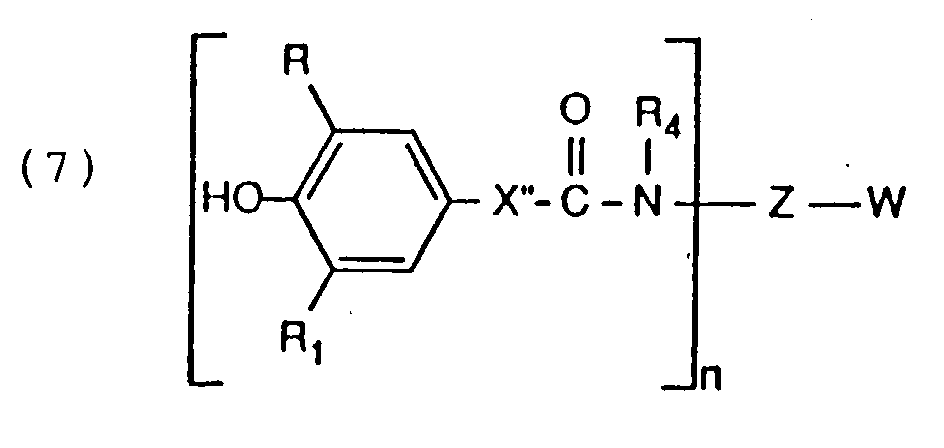 R et R1 représentent indépendamment l'un de l'autre, un radical méthyle ou tert-butyle,R4 représente un atome d'hydrogène ou un radical alkyle en C1-C4,X" représente un alkylène en C1-C4,Z le radical éthylène, un radical bi- ou trivalent du benzène ou du naphtalène ou un radical bivalent de l'éther diphénylique,W représente le groupe sulfo etn représente 1 ou 2.
 - Procédé selon la revendication 9, caractérisé en ce que l'on utilise, comme constituant (A), un composé de formule (7), dans laquelle R et R1 représentent un tert-butyle, X" un méthylène ou un éthylène, R4 un atome d'hydrogène ou un groupe méthyle ou éthyle, et Z un groupe éthylène, un o-, m- ou p-phénylène, un 1,4-naphtylène, un 1,8-natphtylène, un 2-méthoxy-1,6-natphylène, un 1,5-naphtylène, un 2,5-naphtylène, un 2,6-naphtylène, un 1,4,6-naphtalinetriyle ou les radicaux



- Procédé selon l'une des revendications 1 à 10 caractérisé en ce que l'on utilise, comme constituant (B), une 2-hydroxybenzophénone de formule
 R1 représente un atome d'hydrogène, un groupe hydroxy, alcoxy en C1-C14 ou phénoxy,R2 représente un atome d'hydrogène ou d'halogène, un groupe alkyle en C1-C4 ou sulfo,R3 représente un atome d'hydrogène ou un groupe hydroxy ou alcoxy en C1-C4 etR4 représente un atome d'hydrogène, ou un groupe hydroxy ou carboxy.
 - Procédé selon l'une des revendications 1 à 10, caractérisé en ce que l'on utilise, comme constituant (B), un 2-(2'-hydroxyphényl)-benzotriazole de formule
 R1 représente un atome d'hydrogène ou de chlore, un groupe sulfo, alkyle en C1-C12, cycloalkyle en C5-C6, (C1-C8-alkyl)phényle, C7-C9-phénylalkyle ou C7-C9-phénylalkyle sulfoné,R2 représente un atome d'hydrogène ou de chlore ou un groupe alkyle en C1-C4, alcoxy en C1-C4, hydroxy ou sulfo,R3 représente un alkyle en C1-C12, un atome de chlore ou un groupe sulfo, alcoxy en C1-C4, phényle, (C1-C8-alkyl)phényle, C5-C6-cycloalkyle, C2-C9-alcoxycarbonyle, carboxyéthyle, C7-C9-phénylalkyle ou C7-C9-phénylalkyle sulfoné,R4 représente un atome d'hydrogène ou de chlore ou un groupe alkyle en C1-C4, alcoxy en C1-C4, alcoxycarbonyle en C2-C9, carboxy ou sulfo etR5 représente un atome d'hydrogène ou de chlore,
 - Procédé selon l'une des revendications 1 à 10, caractérisé en ce que l'on utilise, comme constituant (B), une 2-(2'-hydroxyphényl)-s-triazine de formule
 R1 représente un atome d'hydrogène ou un groupe alkyle en C1-C4, alcoxy en C1-C4 ou hydroxy,R2 représente un atome d'hydrogène ou un groupe sulfo et R3 et R4 représentent, indépendamment l'un de l'autre, un alkyle en C1-C4, un alcoxy en C1-C4, un cycloalkyle en C5-C6, un phényle ou un phényle substitué par un alkyle en C1-C4 et/ou titi hydroxy.
 - Procédé selon l'une des revendications 1 à 10, caractérisé en ce que l'on utilise, comme constituant (B), un composé de la s-triazine de formule


- Procédé selon l'une des revendications 1 à 14, caractérisé en ce que l'on extrait l'agent des fibres selon un procédé d'extraction ou en continu.
Applications Claiming Priority (2)
| Application Number | Priority Date | Filing Date | Title |
|---|---|---|---|
| CH184390 | 1990-05-31 | ||
| CH1843/90 | 1990-05-31 |
Publications (2)
| Publication Number | Publication Date |
|---|---|
| EP0459950A1 EP0459950A1 (fr) | 1991-12-04 |
| EP0459950B1 true EP0459950B1 (fr) | 1997-03-12 |
Family
ID=4219910
Family Applications (1)
| Application Number | Title | Priority Date | Filing Date |
|---|---|---|---|
| EP91810388A Expired - Lifetime EP0459950B1 (fr) | 1990-05-31 | 1991-05-22 | Stabilisation de teintures sur des fibres en polyamides |
Country Status (5)
| Country | Link |
|---|---|
| US (1) | US5181935A (fr) |
| EP (1) | EP0459950B1 (fr) |
| JP (1) | JP3051494B2 (fr) |
| CA (1) | CA2043484A1 (fr) |
| DE (1) | DE59108599D1 (fr) |
Families Citing this family (48)
| Publication number | Priority date | Publication date | Assignee | Title |
|---|---|---|---|---|
| CH688013B5 (de) * | 1992-09-08 | 1997-10-31 | Ciba Geigy Ag | Stabilisierung von Faerbungen auf Polyamidfasern. |
| EP0621266A1 (fr) * | 1993-04-22 | 1994-10-26 | Ciba-Geigy Ag | Phénols à empêchement stérique et leur utilisation pour la stabilisation des fibres polyamides |
| US5733693A (en) | 1993-08-05 | 1998-03-31 | Kimberly-Clark Worldwide, Inc. | Method for improving the readability of data processing forms |
| US6211383B1 (en) | 1993-08-05 | 2001-04-03 | Kimberly-Clark Worldwide, Inc. | Nohr-McDonald elimination reaction |
| US6017661A (en) | 1994-11-09 | 2000-01-25 | Kimberly-Clark Corporation | Temporary marking using photoerasable colorants |
| US6017471A (en) | 1993-08-05 | 2000-01-25 | Kimberly-Clark Worldwide, Inc. | Colorants and colorant modifiers |
| US5645964A (en) | 1993-08-05 | 1997-07-08 | Kimberly-Clark Corporation | Digital information recording media and method of using same |
| US5773182A (en) | 1993-08-05 | 1998-06-30 | Kimberly-Clark Worldwide, Inc. | Method of light stabilizing a colorant |
| US5700850A (en) | 1993-08-05 | 1997-12-23 | Kimberly-Clark Worldwide | Colorant compositions and colorant stabilizers |
| US5721287A (en) | 1993-08-05 | 1998-02-24 | Kimberly-Clark Worldwide, Inc. | Method of mutating a colorant by irradiation |
| US5865471A (en) | 1993-08-05 | 1999-02-02 | Kimberly-Clark Worldwide, Inc. | Photo-erasable data processing forms |
| US5681380A (en) | 1995-06-05 | 1997-10-28 | Kimberly-Clark Worldwide, Inc. | Ink for ink jet printers |
| JP2705895B2 (ja) * | 1993-12-28 | 1998-01-28 | 大阪精化工業株式会社 | 繊維材料用処理剤 |
| US6071979A (en) | 1994-06-30 | 2000-06-06 | Kimberly-Clark Worldwide, Inc. | Photoreactor composition method of generating a reactive species and applications therefor |
| US6242057B1 (en) | 1994-06-30 | 2001-06-05 | Kimberly-Clark Worldwide, Inc. | Photoreactor composition and applications therefor |
| US5685754A (en) | 1994-06-30 | 1997-11-11 | Kimberly-Clark Corporation | Method of generating a reactive species and polymer coating applications therefor |
| DE59509122D1 (de) | 1994-08-25 | 2001-05-03 | Ciba Sc Holding Ag | Wasserlösliche Piperidin-Triazinverbindungen und ihre Verwendung zur Stabilisierung von Polyamidfasern |
| EP0703227A1 (fr) * | 1994-09-19 | 1996-03-27 | Ciba-Geigy Ag | Composés antioxydants solubles à l'eau, procédé pour leur préparation, et leur utilisation pour la stabilisation photochimique et thermique de fibres polyamides |
| GB9418958D0 (en) * | 1994-09-21 | 1994-11-09 | Ciba Geigy Ag | Fluorescent whitening agents |
| US6008268A (en) | 1994-10-21 | 1999-12-28 | Kimberly-Clark Worldwide, Inc. | Photoreactor composition, method of generating a reactive species, and applications therefor |
| US5786132A (en) | 1995-06-05 | 1998-07-28 | Kimberly-Clark Corporation | Pre-dyes, mutable dye compositions, and methods of developing a color |
| BR9608367A (pt) | 1995-06-05 | 1998-08-18 | Kimberly Clark Co | Pré-corantes novos |
| JP2000506550A (ja) | 1995-06-28 | 2000-05-30 | キンバリー クラーク ワールドワイド インコーポレイテッド | 新規な着色剤および着色剤用改質剤 |
| US5782963A (en) | 1996-03-29 | 1998-07-21 | Kimberly-Clark Worldwide, Inc. | Colorant stabilizers |
| US5855655A (en) | 1996-03-29 | 1999-01-05 | Kimberly-Clark Worldwide, Inc. | Colorant stabilizers |
| ES2175168T3 (es) | 1995-11-28 | 2002-11-16 | Kimberly Clark Co | Compuestos de colorantes estabilizados por la luz. |
| US6099628A (en) | 1996-03-29 | 2000-08-08 | Kimberly-Clark Worldwide, Inc. | Colorant stabilizers |
| US5891229A (en) | 1996-03-29 | 1999-04-06 | Kimberly-Clark Worldwide, Inc. | Colorant stabilizers |
| US6524379B2 (en) | 1997-08-15 | 2003-02-25 | Kimberly-Clark Worldwide, Inc. | Colorants, colorant stabilizers, ink compositions, and improved methods of making the same |
| US5834544A (en) * | 1997-10-20 | 1998-11-10 | Uniroyal Chemical Company, Inc. | Organic materials stabilized by compounds containing both amine and hindered phenol functional functionalities |
| SK1542000A3 (en) | 1998-06-03 | 2001-11-06 | Kimberly Clark Co | Neonanoplasts produced by microemulsion technology and inks for ink jet printing |
| SK1552000A3 (en) | 1998-06-03 | 2000-08-14 | Kimberly Clark Co | Novel photoinitiators and applications therefor |
| JP2002520470A (ja) | 1998-07-20 | 2002-07-09 | キンバリー クラーク ワールドワイド インコーポレイテッド | 改良されたインクジェットインク組成物 |
| BR9914123B1 (pt) | 1998-09-28 | 2010-11-30 | fotoiniciadores e aplicações para os mesmos. | |
| EP1144512B1 (fr) | 1999-01-19 | 2003-04-23 | Kimberly-Clark Worldwide, Inc. | Nouveaux colorants,stabilisateurs de colorants, compositions d'encre, et leur procedes de preparation ameliores |
| US6331056B1 (en) | 1999-02-25 | 2001-12-18 | Kimberly-Clark Worldwide, Inc. | Printing apparatus and applications therefor |
| US6294698B1 (en) | 1999-04-16 | 2001-09-25 | Kimberly-Clark Worldwide, Inc. | Photoinitiators and applications therefor |
| US6297296B1 (en) | 1999-05-19 | 2001-10-02 | Kodak Polychrome Graphics Llc | Latex complexes as stabilized colorant |
| US6368395B1 (en) | 1999-05-24 | 2002-04-09 | Kimberly-Clark Worldwide, Inc. | Subphthalocyanine colorants, ink compositions, and method of making the same |
| US6495660B2 (en) | 1999-10-20 | 2002-12-17 | Honeywell International Inc | Polyamide substrate |
| US6451887B1 (en) | 2000-08-03 | 2002-09-17 | Ciba Specialty Chemicals Corporation | Benzotriazoles containing α-cumyl groups substituted by heteroatoms and compositions stabilized therewith |
| US20090158531A1 (en) * | 2004-10-28 | 2009-06-25 | Edvard Ham | Method of improving thermal stability |
| EP1816001B1 (fr) * | 2004-11-19 | 2012-06-13 | Canon Kabushiki Kaisha | Support d'enregistrement à jet d'encre et son procédé de production |
| WO2006066987A1 (fr) * | 2004-12-22 | 2006-06-29 | Ciba Specialty Chemicals Holding Inc. | Agents antiradicaux |
| MX2008013553A (es) * | 2006-04-24 | 2008-10-31 | Huntsman Adv Mat Switzerland | Proceso para aumentar la termoestabilidad. |
| ES2463674T3 (es) | 2009-01-19 | 2014-05-28 | Basf Se | Pigmentos negros orgánicos y su preparación |
| JP6532410B2 (ja) * | 2016-01-12 | 2019-06-19 | 大日精化工業株式会社 | 顔料添加剤、顔料組成物、及び顔料着色剤 |
| JP6421132B2 (ja) * | 2016-01-12 | 2018-11-07 | 大日精化工業株式会社 | 顔料分散剤、顔料組成物、及び顔料着色剤 |
Citations (1)
| Publication number | Priority date | Publication date | Assignee | Title |
|---|---|---|---|---|
| EP0255481A1 (fr) * | 1986-07-29 | 1988-02-03 | Ciba-Geigy Ag | Procédé de stabilisation photochimique de matière fibreuse en polyamide et ses mélanges avec d'autres fibres |
Family Cites Families (9)
| Publication number | Priority date | Publication date | Assignee | Title |
|---|---|---|---|---|
| CH13164A (fr) * | 1896-11-04 | 1897-05-15 | Pierre Lormant | Appareil hydro-élévateur |
| CH433296A (de) * | 1963-02-18 | 1967-04-15 | Ciba Geigy | Verwendung neuer Hydroxyaryl-1,3,5-triazine als Ultraviolettschutzmittel für nicht-textile organische Materialien |
| CH534136A (de) * | 1967-09-20 | 1973-02-28 | Ciba Geigy Ag | Verfahren zur Herstellung wasserlöslicher nicht verfärbender phenolischer Antioxydantien |
| US4831068A (en) * | 1987-02-27 | 1989-05-16 | Ciba-Geigy Corporation | Process for improving the photochemical stability of dyeings on polyester fibre materials |
| DE58907159D1 (de) * | 1988-06-14 | 1994-04-14 | Ciba Geigy | Verfahren zum fotochemischen Stabilisieren von ungefärbten und gefärbten Polypropylenfasern. |
| US5030243A (en) * | 1989-01-05 | 1991-07-09 | Ciba-Geigy Corporation | Process for the photochemical stabilization of undyed and dyeable artificial leather with a sterically hindered amine |
| EP0417040A1 (fr) * | 1989-09-06 | 1991-03-13 | Ciba-Geigy Ag | Procédé pour teindre la laine |
| US5069681A (en) * | 1990-01-03 | 1991-12-03 | Ciba-Geigy Corporation | Process for the photochemical stabilization of dyed polyamide fibres with foamed aqueous composition of copper organic complexes |
| EP0438381B1 (fr) * | 1990-01-19 | 1995-04-05 | Ciba-Geigy Ag | Stabilisation de la teinture sur des fibres polyamides |
-
1991
- 1991-05-22 EP EP91810388A patent/EP0459950B1/fr not_active Expired - Lifetime
- 1991-05-22 DE DE59108599T patent/DE59108599D1/de not_active Expired - Fee Related
- 1991-05-24 US US07/705,429 patent/US5181935A/en not_active Expired - Fee Related
- 1991-05-29 CA CA002043484A patent/CA2043484A1/fr not_active Abandoned
- 1991-05-31 JP JP3129155A patent/JP3051494B2/ja not_active Expired - Fee Related
Patent Citations (1)
| Publication number | Priority date | Publication date | Assignee | Title |
|---|---|---|---|---|
| EP0255481A1 (fr) * | 1986-07-29 | 1988-02-03 | Ciba-Geigy Ag | Procédé de stabilisation photochimique de matière fibreuse en polyamide et ses mélanges avec d'autres fibres |
Also Published As
| Publication number | Publication date |
|---|---|
| JP3051494B2 (ja) | 2000-06-12 |
| EP0459950A1 (fr) | 1991-12-04 |
| JPH04228678A (ja) | 1992-08-18 |
| DE59108599D1 (de) | 1997-04-17 |
| US5181935A (en) | 1993-01-26 |
| CA2043484A1 (fr) | 1991-12-01 |
Similar Documents
| Publication | Publication Date | Title |
|---|---|---|
| EP0459950B1 (fr) | Stabilisation de teintures sur des fibres en polyamides | |
| EP0438381B1 (fr) | Stabilisation de la teinture sur des fibres polyamides | |
| EP0466647B1 (fr) | Procédé pour la stabilisation photochimique et thermique de matériaux fibreux en polyamides | |
| DE4209261B4 (de) | Anionische Disazoverbindungen | |
| EP0280653B1 (fr) | Procédé d'amélioration de la stabilité photochimique de teintures sur des matières fibreuses en polyester | |
| EP0255481A1 (fr) | Procédé de stabilisation photochimique de matière fibreuse en polyamide et ses mélanges avec d'autres fibres | |
| EP0245204A1 (fr) | Procédé de stabilisation photochimique de matière fibreuse en polyamide teinté ou non teinté et ses mélanges avec d'autres fibres | |
| EP0475905A1 (fr) | Procédé pour stabiliser photochimiquement la laine | |
| EP0345212A1 (fr) | Procédé pour empêcher le jaunissement de matériaux fibreux en polyamide ennoblis au moyen d'agents antisalissures | |
| EP0511166A1 (fr) | Procédé de stabilisation photochimique et thermique de matériaux fibreux au polyamide avec un complexe du cuivre affin à la fibre et un diarylamide de l'acide oxalique | |
| EP0200843A1 (fr) | Procédé de stabilisation photochimique de matière fibreuse en polyamide teinté ou non teinté et ses mélanges | |
| EP0409771A2 (fr) | Procédé de stabilisation photochimique et thermique de fibres polyamidiques pouvant être teintes par des colorants acides et basiques, ainsi que de leurs mélanges entre elles et avec d'autres fibres | |
| DE2726432A1 (de) | Verfahren zur verbesserung der farbausbeute und der echtheiten von mit anionischen farbstoffen auf cellulosefasermaterial erzeugten faerbungen, fluorhaltige verbindungen und ihre herstellung | |
| EP0613976A1 (fr) | Produit auxilaire pour les procédés d'ennoblissement textile au mouillé | |
| DE4330283B4 (de) | Stabilisierung von Färbungen auf Polyamidfasern | |
| DE2255256A1 (de) | Verfahren zur erhoehung der affinitaet fuer anionische farbstoffe von alkylierbare gruppen enthaltenden hochmolekularen, organischen verbindungen | |
| EP0621266A1 (fr) | Phénols à empêchement stérique et leur utilisation pour la stabilisation des fibres polyamides | |
| EP0651028B1 (fr) | Procédé de teinture ou d'impression en trichromie | |
| DE2252123A1 (de) | Verfahren zum faerben von synthetischen fasermaterialien aus organischen loesemitteln | |
| DE2544550B2 (de) | Phosphonsäureester und ihre Verwendung zur flammfesten Ausrüstung | |
| DE2707561B2 (de) | Mittel zum Flammfestmachen von Polyester/Baumwolle-Mischgeweben | |
| DE2707560A1 (de) | Dauerhafte, feuerhemmende appreturen fuer textilien | |
| DE2056009C (de) | Verfahren zum gleichmäßigen und streifenfreien Färben von synthetischem Polyamidfasermaterial | |
| EP0703227A1 (fr) | Composés antioxydants solubles à l'eau, procédé pour leur préparation, et leur utilisation pour la stabilisation photochimique et thermique de fibres polyamides | |
| EP0702011A1 (fr) | Composés pipéridine-triazine solubles dans l'eau et leur utilisation comme stabilisant pour des fibres de polyamide |
Legal Events
| Date | Code | Title | Description |
|---|---|---|---|
| PUAI | Public reference made under article 153(3) epc to a published international application that has entered the european phase |
Free format text: ORIGINAL CODE: 0009012 |
|
| 17P | Request for examination filed |
Effective date: 19910527 |
|
| AK | Designated contracting states |
Kind code of ref document: A1 Designated state(s): BE CH DE GB IT LI NL |
|
| 17Q | First examination report despatched |
Effective date: 19940203 |
|
| GRAG | Despatch of communication of intention to grant |
Free format text: ORIGINAL CODE: EPIDOS AGRA |
|
| GRAH | Despatch of communication of intention to grant a patent |
Free format text: ORIGINAL CODE: EPIDOS IGRA |
|
| GRAH | Despatch of communication of intention to grant a patent |
Free format text: ORIGINAL CODE: EPIDOS IGRA |
|
| RAP1 | Party data changed (applicant data changed or rights of an application transferred) |
Owner name: CIBA SC HOLDING AG |
|
| GRAA | (expected) grant |
Free format text: ORIGINAL CODE: 0009210 |
|
| AK | Designated contracting states |
Kind code of ref document: B1 Designated state(s): BE CH DE GB IT LI NL |
|
| PG25 | Lapsed in a contracting state [announced via postgrant information from national office to epo] |
Ref country code: NL Free format text: LAPSE BECAUSE OF FAILURE TO SUBMIT A TRANSLATION OF THE DESCRIPTION OR TO PAY THE FEE WITHIN THE PRESCRIBED TIME-LIMIT Effective date: 19970312 Ref country code: GB Effective date: 19970312 Ref country code: IT Free format text: LAPSE BECAUSE OF FAILURE TO SUBMIT A TRANSLATION OF THE DESCRIPTION OR TO PAY THE FEE WITHIN THE PRE;WARNING: LAPSES OF ITALIAN PATENTS WITH EFFECTIVE DATE BEFORE 2007 MAY HAVE OCCURRED AT ANY TIME BEFORE 2007. THE CORRECT EFFECTIVE DATE MAY BE DIFFERENT FROM THE ONE RECORDED.SCRIBED TIME-LIMIT Effective date: 19970312 |
|
| RAP3 | Party data changed (applicant data changed or rights of an application transferred) |
Owner name: CIBA SPECIALTY CHEMICALS HOLDING INC. |
|
| REG | Reference to a national code |
Ref country code: CH Ref legal event code: EP |
|
| REF | Corresponds to: |
Ref document number: 59108599 Country of ref document: DE Date of ref document: 19970417 |
|
| NLV1 | Nl: lapsed or annulled due to failure to fulfill the requirements of art. 29p and 29m of the patents act | ||
| GBV | Gb: ep patent (uk) treated as always having been void in accordance with gb section 77(7)/1977 [no translation filed] |
Effective date: 19970312 |
|
| PLBE | No opposition filed within time limit |
Free format text: ORIGINAL CODE: 0009261 |
|
| 26N | No opposition filed | ||
| PGFP | Annual fee paid to national office [announced via postgrant information from national office to epo] |
Ref country code: CH Payment date: 20000406 Year of fee payment: 10 |
|
| PG25 | Lapsed in a contracting state [announced via postgrant information from national office to epo] |
Ref country code: CH Free format text: LAPSE BECAUSE OF NON-PAYMENT OF DUE FEES Effective date: 20010621 Ref country code: LI Free format text: LAPSE BECAUSE OF NON-PAYMENT OF DUE FEES Effective date: 20010621 |
|
| REG | Reference to a national code |
Ref country code: CH Ref legal event code: PL |
|
| PGFP | Annual fee paid to national office [announced via postgrant information from national office to epo] |
Ref country code: DE Payment date: 20030428 Year of fee payment: 13 |
|
| PGFP | Annual fee paid to national office [announced via postgrant information from national office to epo] |
Ref country code: BE Payment date: 20030704 Year of fee payment: 13 |
|
| PG25 | Lapsed in a contracting state [announced via postgrant information from national office to epo] |
Ref country code: BE Free format text: LAPSE BECAUSE OF NON-PAYMENT OF DUE FEES Effective date: 20040531 |
|
| BERE | Be: lapsed |
Owner name: *CIBA SPECIALTY CHEMICALS HOLDING INC. Effective date: 20040531 |
|
| PG25 | Lapsed in a contracting state [announced via postgrant information from national office to epo] |
Ref country code: DE Free format text: LAPSE BECAUSE OF NON-PAYMENT OF DUE FEES Effective date: 20041201 |