EP0469828A1 - Equipement de freinage pour mécanisme d'entraînement d'une barre de contrôle - Google Patents
Equipement de freinage pour mécanisme d'entraînement d'une barre de contrôle Download PDFInfo
- Publication number
- EP0469828A1 EP0469828A1 EP91306925A EP91306925A EP0469828A1 EP 0469828 A1 EP0469828 A1 EP 0469828A1 EP 91306925 A EP91306925 A EP 91306925A EP 91306925 A EP91306925 A EP 91306925A EP 0469828 A1 EP0469828 A1 EP 0469828A1
- Authority
- EP
- European Patent Office
- Prior art keywords
- brake member
- shaft
- rotor
- brake
- tooth
- Prior art date
- Legal status (The legal status is an assumption and is not a legal conclusion. Google has not performed a legal analysis and makes no representation as to the accuracy of the status listed.)
- Withdrawn
Links
- 230000000295 complement effect Effects 0.000 claims description 4
- 230000006835 compression Effects 0.000 claims description 4
- 238000007906 compression Methods 0.000 claims description 4
- XLYOFNOQVPJJNP-UHFFFAOYSA-N water Substances O XLYOFNOQVPJJNP-UHFFFAOYSA-N 0.000 description 8
- 230000009471 action Effects 0.000 description 2
- 230000008901 benefit Effects 0.000 description 2
- 238000006073 displacement reaction Methods 0.000 description 2
- 238000003780 insertion Methods 0.000 description 2
- 230000037431 insertion Effects 0.000 description 2
- 238000012986 modification Methods 0.000 description 2
- 230000004048 modification Effects 0.000 description 2
- 230000005855 radiation Effects 0.000 description 2
- 230000000452 restraining effect Effects 0.000 description 2
- 230000002441 reversible effect Effects 0.000 description 2
- 238000004891 communication Methods 0.000 description 1
- 230000008878 coupling Effects 0.000 description 1
- 238000010168 coupling process Methods 0.000 description 1
- 238000005859 coupling reaction Methods 0.000 description 1
- 239000000446 fuel Substances 0.000 description 1
- 230000006872 improvement Effects 0.000 description 1
- 238000007689 inspection Methods 0.000 description 1
- 239000000696 magnetic material Substances 0.000 description 1
- 230000036961 partial effect Effects 0.000 description 1
- 230000001681 protective effect Effects 0.000 description 1
- 230000002829 reductive effect Effects 0.000 description 1
- 239000007787 solid Substances 0.000 description 1
Images


Classifications
-
- G—PHYSICS
- G21—NUCLEAR PHYSICS; NUCLEAR ENGINEERING
- G21C—NUCLEAR REACTORS
- G21C7/00—Control of nuclear reaction
- G21C7/06—Control of nuclear reaction by application of neutron-absorbing material, i.e. material with absorption cross-section very much in excess of reflection cross-section
- G21C7/08—Control of nuclear reaction by application of neutron-absorbing material, i.e. material with absorption cross-section very much in excess of reflection cross-section by displacement of solid control elements, e.g. control rods
- G21C7/12—Means for moving control elements to desired position
-
- Y—GENERAL TAGGING OF NEW TECHNOLOGICAL DEVELOPMENTS; GENERAL TAGGING OF CROSS-SECTIONAL TECHNOLOGIES SPANNING OVER SEVERAL SECTIONS OF THE IPC; TECHNICAL SUBJECTS COVERED BY FORMER USPC CROSS-REFERENCE ART COLLECTIONS [XRACs] AND DIGESTS
- Y02—TECHNOLOGIES OR APPLICATIONS FOR MITIGATION OR ADAPTATION AGAINST CLIMATE CHANGE
- Y02E—REDUCTION OF GREENHOUSE GAS [GHG] EMISSIONS, RELATED TO ENERGY GENERATION, TRANSMISSION OR DISTRIBUTION
- Y02E30/00—Energy generation of nuclear origin
- Y02E30/30—Nuclear fission reactors
-
- Y—GENERAL TAGGING OF NEW TECHNOLOGICAL DEVELOPMENTS; GENERAL TAGGING OF CROSS-SECTIONAL TECHNOLOGIES SPANNING OVER SEVERAL SECTIONS OF THE IPC; TECHNICAL SUBJECTS COVERED BY FORMER USPC CROSS-REFERENCE ART COLLECTIONS [XRACs] AND DIGESTS
- Y10—TECHNICAL SUBJECTS COVERED BY FORMER USPC
- Y10T—TECHNICAL SUBJECTS COVERED BY FORMER US CLASSIFICATION
- Y10T74/00—Machine element or mechanism
- Y10T74/18—Mechanical movements
- Y10T74/18568—Reciprocating or oscillating to or from alternating rotary
- Y10T74/18576—Reciprocating or oscillating to or from alternating rotary including screw and nut
- Y10T74/18696—Reciprocating or oscillating to or from alternating rotary including screw and nut including means to selectively transmit power [e.g., clutch, etc.]
Definitions
- the present invention relates generally to control rod drives used in nuclear reactors and, more specifically, to a brake assembly effective for preventing rotation of the control rod drive when engaged.
- control rods are selectively inserted and withdraw from a nuclear reactor vessel for controlling the operation thereof.
- Each of the control rods is typically positioned by a conventional control rod drive which includes a ball screw or spindle operatively engaging a ball nut for raising and lowering the ball nut as the spindle is rotated either clockwise or counterclockwise.
- a hollow piston rests upon the ball nut at one end thereof and at its other end is conventionally joined to the control rod. Displacement of the ball nut provides displacement of the piston which in turn inserts or withdraws the control rod in the reactor vessel.
- a rapid flow of high-pressure water is injected through the control rod drive past the piston for lifting the piston off the ball nut in a relatively short time for quickly inserting the control rod into the reactor vessel.
- the high-pressure water is channeled to the control rod drive through a scram line pipe attached to a high-pressure water accumulator.
- the backflow may cause a large reverse pressure on the piston which in turn provides a back force on the control rod ball nut.
- This back force can cause reverse rotation of the ball spindle with corresponding withdrawal of the control rod.
- Withdrawal of one of the control rods due to such a backflow occurrence may cause damage to adjacent fuel in the reactor vessel, requiring replacement thereof leading to undesirable down time of the reactor and economic losses.
- a conventional electromechanical brake is provided in the control rod drive for holding the ball spindle from rotating unless the brake is energized.
- the brake is sized for restraining rotation of the ball spindle against such forces due to backflow of water over the piston when the control rod drive motor is not operating.
- the motor itself is sized for providing adequate torque for resisting the forces due to the backflow of water in the event of the above-described occurrence.
- the brake is periodically tested.
- the brakes are located adjacent to the reactor vessel, which is inaccessible during operation of the reactor due to the radiation field emanating from the reactor vessel.
- the radiation field continues at reduced levels also during shutdow of the reactor, which would require inspectors to wear suitable protective clothing and limit their time in the area.
- one object of the present invention is to provide a new and improved brake assembly for preventing rotation of a shaft.
- Another object of the present invention is to provide a brake assembly effective for providing a positive rotational restraint of the shaft in one direction while allowing rotation thereof in an opposite direction.
- Another object of the present invention is to provide a relatively simple and compact brake assembly for a shaft.
- Another object of the present invention is to provide a brake assembly which is relatively easily testable.
- Another object of the present invention is to provide a brake assembly for preventing rotation of a control rod drive for a nuclear reactor and which may be actuated and tested remotely.
- a brake assembly for selectively preventing rotation of a shaft, such as a shaft used in a control rod drive for a nuclear reactor.
- the brake assembly includes a stationary base, a rotor disc fixedly connected to the shaft for rotation therewith, and a brake member disposed adjacent to the rotor disc.
- the rotor disc includes at least one rotor tooth and the brake member includes at least one braking tooth.
- Means are disclosed for selectively positioning the brake member in a deployed position for allowing the braking tooth to contact the rotor tooth for preventing rotation of the shaft in a first direction, and in a retracted position for allowing the rotor disc and shaft to rotate without restraint from the brake member.
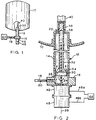
- Figure 1 is a schematic representation of a nuclear reactor vessel including a control rod drive having a brake assembly in accordance with one embodiment of the present invention.
- Figure 2 is an enlarged sectional view, partly schematic, of the control rod drive illustrated in Figure 1.
- Figure 3 is a longitudinal transverse partly sectional view of the brake assembly illustrated in Figures 1 and 2 in accordance with one embodiment of the present invention with a brake member disposed in a retracted position.
- Figure 4 is a transverse sectional view of the brake assembly illustrated in Figure 3 taken along line 4-4.
- Figure 5 is a perspective view of a portion of the rotor disc illustrated in Figure 4 taken along line 5-5.
- Figure 6 is a transverse sectional view of the brake assembly illustrated in Figure 3 taken along line 6-6.
- Figure 7 is a perspective view of a portion of the brake member illustrated in Figure 6 taken along line 7-7.
- Figure 8 is a longitudinal transverse partly sectional view of the brake assembly illustrated in Figures 1 and 2 show with the brake member disposed in a deployed position.
- FIG. 1 Illustrated in Figure 1 is an exemplary nuclear reactor vessel 10 having a plurality of fine motion control rod drives 12 (FMCRD), only one of which is shown. In one exemplary embodiment, there are 205 FMCRDs 12 extending into the vessel 10 through the bottom thereof.
- FMCRD fine motion control rod drives
- the rod drive 12 includes a tubular housing 14 extending outwardly from the vessel 10 and conventionally secured thereto.
- the housing 14 is conventionally connected to a manifold 16 which is disposed in flow communication with a scram line or conduit 18 which is conventionally selectively provided with high-pressure water 20 from a conventional high-pressure water accumulator 22 conventionally joined to the scram line 18.
- a conventional ball screw or spindle 24 Conventionally disposed inside the housing 14 is a conventional ball screw or spindle 24, which in this exemplary embodiment includes conventional right-handed threads 26.
- the control rod drive 12 includes a longitudinal centerline axis 28, with the housing 12 and spindle 24 being disposed coaxially therewith.
- a conventional ball nut 30 is positioned over the spindle 24 and is conventionally restrained from rotating therewith so that as the spindle is rotated in a clockwise direction, the ball nut is translated in a downward direction away from the vessel 10, and when the spindle is rotated in a counterclockwise direction, the ball nut 30 is translated in an upward direction toward the vessel 10.
- a conventional hollow, elongate piston 32 is disposed coaxially with the spindle 24 and includes a conical base end 34 which rests on the ball nut 30, and a tip end 36 extending through a central aperture 38 in the outer end of the housing 14 into the vessel 10. The tip end 36 is conventionally coupled to a respective control rod 40 by a bayonet coupling, for example.
- the spindle 24 extends dowwardly from the manifold 16 through a conventional electrical motor 42 which selectively rotates the spindle 24 in either the clockwise direction or counterclockwise direction.
- the motor 42 is electrically connected to a conventional control 44 by a conventional electrical line 46a for selectively controlling operation of the motor 42.
- the rod drive 12 further includes a brake assembly 48 joined to the motor 42 into which extends the spindle 24, also referred to as an input shaft 24.
- the brake assembly 48 is electrically joined to the control 44 by a conventional electrical line 46b for selectively braking and unbraking, or releasing, the input shaft 24.
- the brake assembly 48 includes an annular stationary base 50 conventionally fixedly secured to the motor 42, for example by bolts (not shown).
- the base 50 includes a central aperture 52 which receives a portion of the shaft 24 extending from the motor 42.
- an annular housing 54 of the brake assembly 48 Disposed coaxially with the shaft centerline axis 28 is an annular housing 54 of the brake assembly 48 which is conventionally fixedly secured to the base 50.
- the brake assembly 48 further includes an annular rotor disc 56 having a central aperture 58, as show in more detail in Figure 4, surrounding the shaft 24 and fixedly connected to the shaft 24 for rotation therewith by a conventional key 60.
- the rotor disc 56 has at least one and preferably a plurality of rotor teeth 62 extending circumferentially around the rotor disc 56 and extending outwardly from a first surface 64 of the rotor disc 56.
- An opposite, second surface 66 of the rotor disc 56 faces the motor 42.
- each of the rotor teeth 62 includes a locking surface 68 which extends generally perpendicularly outwardly from the first surface 64 and generally parallel to the centerline axis 28 and also in a radial direction relative to the shaft centerline axis 28 as illustrated more particularly in Figures 4 and 5.
- Each rotor tooth 62 further includes an inclined surface 70 extending from the first surface 64 to the outer end of the locking surface 68 in the circumferential direction.
- the locking surface 68 and the inclined surface 70 define a generally sawtooth profile for the rotor tooth 62.
- a nonrotating brake member 72 as shown in Figures 3, 6 and 7 is disposed adjacent to the rotor disc 56 and includes an annular base 74 having a central aperture 76 receiving the shaft 24 for rotation relative thereto.
- the brake member 72 includes a first surface 78 facing the rotor disc first surface 64, and a second, planar surface 80 facing away from the rotor disc 56.
- At least one and preferably a plurality of braking teeth 82 are formed integrally with the base 74 and extend outwardly from the first surface 78.
- Each of the braking teeth 82 has a sawtooth profile complementary to the rotor teeth 62 including a locking surface 84 extending outwardly from the first surface 78 as illustrated in more particularity in Figures 3 and 7 and generally parallel to the shaft longitudinal axis 28 and also in a radial direction relative to the shaft centerline axis 28.
- Each of the braking teeth 82 also includes an inclined surface 86 extending outwardly from the first surface 78 to the outer end of the locking surface 84 and extends in a circumferential direction at a radial position equal to the radial position of the rotor teeth 62 relative to the centerline axis 28 so that the rotor and braking teeth 62 and 82 face each other.
- the brake assembly 48 further includes means 88 for selectively positioning the brake member 72 in a deployed, locking position designated 72a, as shown in Figure 8, for allowing the braking teeth 82 to mesh with the rotor teeth 62 with the braking teeth locking surfaces 84 contacting the rotor teeth locking surfaces 68 for preventing rotation of the shaft 24 in a first, clockwise direction.
- the relative positions of the locking surfaces 68 and 84 against each other in the deployed position 72a are also show in solid and dashed lines in Figures 4 and 6.
- the positioning means 88 are also effective for positioning the brake member 72 in a retracted position designated 72b, as show in Figure 3, spaced longitudinally away from the rotor disc 56 for allowing the rotor disc 56 and the shaft 24 to rotate without restraint from the brake member 72.
- the positioning means 88 is effective for resiliently supporting the braking teeth 82 for allowing the rotor teeth inclined surfaces 70 to longitudinally displace the brake member 72 and the braking teeth inclined surfaces 86 to intermittently free the rotor teeth locking surfaces 68 from the braking teeth locking surfaces 84 for allowing the shaft 24 to rotate in a second, counterclockwise direction opposite to the first direction when the brake member 72 is in the deployed position 72a as illustrated in Figure 8.
- the positioning means 88 preferably includes a plurality of circumferentially spaced guide holes 90 extending transversely through the outer perimeter of the brake member 72, as shown in more particularity in Figures 6 and 7, which guide holes 90 are disposed parallel to the centerline axis 28.
- a plurality of complementary guide rods 92 are conventionally fixedly joined to the base 50, for example by being formed integrally therewith or being threaded therein, and extend parallel to the shaft centerline axis 28.
- the guide rods 92 are circumferentially spaced from each other with each guide rod 92 being longitudinally slidably disposed in a respective one of the guide holes 90 for allowing the brake member 72 to translate longitudinally along the guide rods 92 and parallel to the centerline axis 28.
- the guide rods 92 are also effective for preventing rotational movement of the brake member 72 relative to the shaft centerline axis 28 while allowing longitudinal movement relative thereto.
- the positioning means 88 also includes a conventional electromagnet 94 as illustrated in Figures 3 and 8 which is spaced from the brake member second surface 80 and fixedly joined to the plurality of guide rods 92 by nuts 96 for example.
- the electromagnet 94 includes a conventional wire coil 98 electrically connected to the control 44 by the electrical line 46b.
- the coil 98 is conventionally secured to an annular support plate 100 having a plurality of circumferentially spaced support holes 102 through which are received respective ends of the guide rods 92 for fixedly attaching the support plate 100 thereto using the nuts 96.
- a plurality of compression springs 104 as illustrated in Figures 3 and 8 are disposed around respective ones of the guide rods 92 and preferably between the electromagnet support plate 100 and the brake member second surface 80 for providing a deploying force on and preferably against the brake member 72 for positioning the brake member 72 in the deployed position 72a against the rotor disc 56 as illustrated in Figure 8 when the electromagnet 94 is de-energized.
- the compression springs 104 are disposed between the electromagnet support plate 100 and the brake member second surface 80 and are predeterminedly initially compressed for providing the deploying force against the brake member 72.
- the electromagnet 94 is conventionally sized for being effective for magnetically attracting the brake member 72, which is formed from a conventional magnetic material, for overcoming the deploying force and further compressing the springs 104 for positioning the brake member 72 in the retracted position 72b as illustrated in Figure 3 when the electromagnet 94 is energized.
- the springs 104 exert the deploying force against the brake member 72 which positions the brake member 72 in the deployed position 72a.
- the brake assembly 48 in accordance with the preferred embodiment, provides complementary sawtooth profiled rotor and brake teeth 62 and 82 which are effective for locking the shaft 24 and preventing rotation in preferably one direction, e.g. clockwise direction only when the electromagnet 94 is de-energized.
- This positive locking of the shaft 24 prevents rotation of the shaft 24 in a clockwise direction for preventing inadvertent withdrawal of the control rod 40 under the back flow occurrence, for example.
- the brake member 72 is retracted from the rotor disc 56 allowing the shaft 24 to rotate and then the motor 42 may be conventionally operated for predeterminedly either inserting or withdrawing the control rod 40.
- An additional advantage of the preferred positioning means 88 and teeth 62 and 82 allows for rotation of the shaft 24 in the counterclockwise direction even when the electromagnet 94 is de-energized and the brake member 72 is disposed in the deployed position 72a as illustrated in Figure 8.
- the motor 42 may be predeterminedly actuated for further inserting the control rod 40 into the vessel 10 even while the brake member 72 is in the deployed position 72b.
- the shaft 24 will be turned by the motor 42 in the counterclockwise direction causing the rotor teeth inclined surfaces 70 to longitudinally displace downward the braking teeth inclined surfaces 86, and thereby the brake member 72, by a camming action in a ratcheting fashion for intermittently freeing the rotor teeth locking surfaces 68 from the braking teeth locking surfaces 84 for allowing counterclockwise rotation of the shaft 24.
- the position of the brake member 72, initially in the deployed position 72a, due to this ratcheting action is designated 72c and is shown in dashed line in Figure 8.
- the brake member 72 is initially in the deployed position 72a and is then urged downwardly away from the rotor disc 56 by the rotor teeth 62 until the ratcheting deployed position 72c is reached at the longitudinal extent of travel of the brake member 72 due to the height of the locking surface 68.
- the rotor teeth 62 are displaced one rotor tooth position relative to the braking teeth 82 with a respective rotor tooth inclined surface 70 then facing the next succeeding braking tooth inclined surface 86 with a corresponding upward movement of the brake member 72 toward the rotor disc 56 by the springs 104.
- the rotor teeth inclined surfaces 70 will then again urge respective braking teeth inclined surfaces 86 downward until the rotor teeth 62 again ratchet one tooth relative to the braking teeth 82. Accordingly, the rotor teeth locking surfaces 68 are intermittently freed from the braking teeth locking surfaces 84 as the shaft 24 rotates counterclockwise with the brake member 72 disposed in the deployed position 72a.
- the brake assembly 48 as described above thus provides a positive lock of the shaft 24 to prevent unintentional ejection travel of the control rod 40 from the vessel 10 while allowing for both insertion of the control rod 40 while the brake member 72 is disposed in the deployed position and allowing for relatively simple testing of the brake assembly 48.
- the brake assembly 48 may be simply tested by de-energizing the electromagnet 94 for positioning the brake member 72 in the deployed position 72a and then energizing the motor 42 to allow the rotor teeth locking surfaces 68 to abut against, and be circumferentially restrained by the braking teeth locking surfaces 84 for preventing further rotation of the shaft 24. Since the motor 42 will be unable to rotate the shaft 24 relative to the brake member 72 in a clockwise direction, the motor 42 will stall, which may be conventionally observed by the control 44 for indicating the effective operation of the brake assembly 48. If the brake assembly 48 is unable to prevent the clockwise rotation of the shaft 24 during testing, the control 44 can provide a suitable indication thereof, which may then result in manual inspection of the brake assembly 48 for correcting any problem that might exist.
- the above described brake assembly 48 in accordance with the present invention provides a positive, unidirectional restraint which locks the shaft 24 from unintentional rotation in a predetermined direction which provides an improvement over a conventional friction-type brake which may allow for slippage.
- the brake assembly 48 may be tested remotely as described above so that access to the environment adjacent to the nuclear reactor vessel 10 is not required. Yet further, the brake assembly 48 may be tested relatively quickly during normal operation of the reactor vessel 10 without requiring down time of the reactor solely for testing purposes.
- the rotor and braking teeth 62 and 82 are show in the preferred embodiment as extending from the respective first surfaces 64 and 78 of the rotor disc 56 and the brake member 72, respectively, other configurations of the teeth 62, 82 may be used in accordance with the present invention.
- the rotor teeth 62 in an alternate embodiment may extend radially outwardly around the outer perimeter of the rotor disc 56 with the braking teeth 82 extending radially inwardly from an inner annulus of a brake member surrounding the rotor disc 56.
- Suitable positioning means 88 could be used in such an embodiment for positioning the braking teeth in deployed and retracted positions for locking and unlocking the shaft 24 for obtaining unidirectional restraint.
Landscapes
- Physics & Mathematics (AREA)
- Engineering & Computer Science (AREA)
- Chemical & Material Sciences (AREA)
- Chemical Kinetics & Catalysis (AREA)
- Plasma & Fusion (AREA)
- General Engineering & Computer Science (AREA)
- High Energy & Nuclear Physics (AREA)
- Braking Arrangements (AREA)
Applications Claiming Priority (2)
| Application Number | Priority Date | Filing Date | Title |
|---|---|---|---|
| US07/559,743 US5131510A (en) | 1990-07-30 | 1990-07-30 | Brake assembly for a control rod drive |
| US559743 | 1990-07-30 |
Publications (1)
| Publication Number | Publication Date |
|---|---|
| EP0469828A1 true EP0469828A1 (fr) | 1992-02-05 |
Family
ID=24234833
Family Applications (1)
| Application Number | Title | Priority Date | Filing Date |
|---|---|---|---|
| EP91306925A Withdrawn EP0469828A1 (fr) | 1990-07-30 | 1991-07-29 | Equipement de freinage pour mécanisme d'entraînement d'une barre de contrôle |
Country Status (3)
| Country | Link |
|---|---|
| US (1) | US5131510A (fr) |
| EP (1) | EP0469828A1 (fr) |
| JP (1) | JPH04232894A (fr) |
Families Citing this family (8)
| Publication number | Priority date | Publication date | Assignee | Title |
|---|---|---|---|---|
| DE102004047500A1 (de) * | 2004-09-30 | 2006-04-13 | Bosch Rexroth Aktiengesellschaft | Haltevorrichtung |
| DE102006016611A1 (de) * | 2006-04-06 | 2007-10-18 | Ortlinghaus Gmbh Gams | Sicherheitsbremse |
| KR100838025B1 (ko) * | 2007-01-19 | 2008-06-12 | 주식회사 경동나비엔 | 유량조절밸브 |
| US8485318B2 (en) * | 2009-05-15 | 2013-07-16 | Paul J. Doran | Elevator rope braking system |
| DE102010053226B4 (de) * | 2010-12-03 | 2025-04-17 | Stabilus Gmbh | Antriebseinrichtung |
| US9157528B2 (en) * | 2012-10-15 | 2015-10-13 | GM Global Technology Operations LLC | Brake mechanism for a hybrid transmission |
| CN108869581B (zh) * | 2018-07-25 | 2024-03-22 | 科益展智能装备有限公司 | 一种插销结构及其设计方法 |
| WO2021244715A1 (fr) * | 2020-06-02 | 2021-12-09 | Linak A/S | Verrouillage contre la rotation d'un moteur électrique d'un actionneur linéaire |
Citations (4)
| Publication number | Priority date | Publication date | Assignee | Title |
|---|---|---|---|---|
| DE1223070B (de) * | 1962-05-23 | 1966-08-18 | Licentia Gmbh | Regelstabantrieb fuer Kernreaktoren |
| EP0093055A1 (fr) * | 1982-04-26 | 1983-11-02 | Commissariat à l'Energie Atomique | Dispositif anti-éjection déblocable pour barres de contrôle de réacteur nucléaire |
| EP0161976A1 (fr) * | 1984-04-27 | 1985-11-21 | Commissariat A L'energie Atomique | Dispositif d'accouplement entre un organe moteur et un organe récepteur |
| EP0305719A2 (fr) * | 1987-08-31 | 1989-03-08 | General Electric Company | Frein centrifuge pour mécanisme d'entraînement d'une barre de contrôle |
Family Cites Families (19)
| Publication number | Priority date | Publication date | Assignee | Title |
|---|---|---|---|---|
| US624239A (en) * | 1899-05-02 | Car-brake apparatus | ||
| US1373077A (en) * | 1917-01-29 | 1921-03-29 | Westinghouse Electric & Mfg Co | Control apparatus |
| US1827720A (en) * | 1924-06-02 | 1931-10-13 | Frank C Lamb | Motor vehicle brake |
| US1810998A (en) * | 1930-04-28 | 1931-06-23 | Bjork Olof | Backstop for motor vehicles |
| US2080544A (en) * | 1934-10-11 | 1937-05-18 | United Shoe Machinery Corp | Starting and stopping mechanism |
| US2949172A (en) * | 1958-12-16 | 1960-08-16 | Us Electrical Motors Inc | Positive lock electromagnetic brake structure |
| US3258985A (en) * | 1964-03-23 | 1966-07-05 | Jordan Controls Inc | Control apparatus for valve actuator |
| US3410381A (en) * | 1967-05-12 | 1968-11-12 | Gen Electric | Clutch mechanism control means |
| CH513493A (de) * | 1970-03-25 | 1971-09-30 | Bbc Brown Boveri & Cie | Einrichtung zur Überwachung des Betriebes einer Antriebsvorrichtung eines in einem gasgekühlten Kernreaktor angeordneten als Regel- und Notabschaltstab dienenden Steuerstabes |
| DE2308131B2 (de) * | 1973-02-19 | 1979-02-08 | Fried. Krupp Gmbh, 4300 Essen | Greifvorrichtung einer Hubeinrichtung, insbesondere in einem Kernreaktor zum Absetzen und Aufnehmen von Brennelementen und Stäben |
| US4015696A (en) * | 1975-10-20 | 1977-04-05 | Lichti Robert D | Centrifugal braking device |
| US4119310A (en) * | 1976-03-26 | 1978-10-10 | Patterson-Williams Manufacturing Company | Playground turntable |
| US4238288A (en) * | 1978-05-24 | 1980-12-09 | Anikin Alexandr A | Drive of nuclear reactor S control element |
| FR2468976A1 (fr) * | 1979-10-31 | 1981-05-08 | Framatome Sa | Mecanisme a chaines a mouvement differentiel pour la commande d'un reacteur nucleaire |
| US4423002A (en) * | 1979-12-19 | 1983-12-27 | Framatome | Apparatus for controlling a nuclear reactor by vertical displacement of a unit absorbing neutrons |
| IT1142782B (it) * | 1981-07-21 | 1986-10-15 | Selenia Ind Elettroniche | Martinetto idraulico con blocco meccanico di sicurezza |
| US4518559A (en) * | 1982-07-08 | 1985-05-21 | General Electric Company | Control of nuclear reactors |
| JPS6263086A (ja) * | 1985-09-10 | 1987-03-19 | フアナツク株式会社 | 工業用ロボツトにおけるブレ−キ構造 |
| DE3836255A1 (de) * | 1988-10-25 | 1990-04-26 | Opel Adam Ag | Elektromotorisches stellelement |
-
1990
- 1990-07-30 US US07/559,743 patent/US5131510A/en not_active Expired - Fee Related
-
1991
- 1991-07-15 JP JP3198205A patent/JPH04232894A/ja active Pending
- 1991-07-29 EP EP91306925A patent/EP0469828A1/fr not_active Withdrawn
Patent Citations (4)
| Publication number | Priority date | Publication date | Assignee | Title |
|---|---|---|---|---|
| DE1223070B (de) * | 1962-05-23 | 1966-08-18 | Licentia Gmbh | Regelstabantrieb fuer Kernreaktoren |
| EP0093055A1 (fr) * | 1982-04-26 | 1983-11-02 | Commissariat à l'Energie Atomique | Dispositif anti-éjection déblocable pour barres de contrôle de réacteur nucléaire |
| EP0161976A1 (fr) * | 1984-04-27 | 1985-11-21 | Commissariat A L'energie Atomique | Dispositif d'accouplement entre un organe moteur et un organe récepteur |
| EP0305719A2 (fr) * | 1987-08-31 | 1989-03-08 | General Electric Company | Frein centrifuge pour mécanisme d'entraînement d'une barre de contrôle |
Also Published As
| Publication number | Publication date |
|---|---|
| US5131510A (en) | 1992-07-21 |
| JPH04232894A (ja) | 1992-08-21 |
Similar Documents
| Publication | Publication Date | Title |
|---|---|---|
| US5102613A (en) | Radial brake assembly for a control rod drive | |
| US12002593B2 (en) | Deforming a portion of a nut threaded on a guide tube end plug to lock the nut to a lower end fitting of a nuclear reactor fuel assembly | |
| US6275556B1 (en) | Method and apparatus for preventing relative rotation of tube members in a control rod drive mechanism | |
| US5131510A (en) | Brake assembly for a control rod drive | |
| US4649989A (en) | Device for testing and/or repairing steam generator tubes | |
| US4928291A (en) | Control cluster provided with removable control elements for a nuclear fuel reactor | |
| JPH0658415B2 (ja) | タイロッドナット用のばね式止め座金 | |
| EP0499406A1 (fr) | Commande de barre de contrôle | |
| JPS6266193A (ja) | 燃料集合体における再使用可能な締結装置 | |
| CA1111970A (fr) | Mecanisme de fermeture sur contenant tubulaire | |
| KR940004832B1 (ko) | 단부 노즐 제거 및 교체용 고착물 | |
| EP0465270A1 (fr) | Equipement de freinage comprenant un moniteur de couple | |
| US5085823A (en) | Latch assembly for a control rod drive | |
| US5076994A (en) | Lock assembly for a control rod drive | |
| US5517536A (en) | Magnetic coupling device for control rod drive | |
| US5069860A (en) | Rotary lock for a control rod drive | |
| JP2672715B2 (ja) | 制御棒駆動機構のブレーキ機能確認試験方法 | |
| KR20000025702A (ko) | 선형펄스모터를 이용한 제어봉구동장치 | |
| KR100441981B1 (ko) | 긴급삽입장치와 수동구동장치를 가진 볼스크류형제어봉구동장치 | |
| JP2728753B2 (ja) | 制御棒駆動機構 | |
| JPH04212095A (ja) | 高温ガス炉用後備停止装置 | |
| JPS59192993A (ja) | 制御棒駆動機構 | |
| JPH0587966A (ja) | 制御棒駆動機構 | |
| JPH03211495A (ja) | 制御棒駆動機構の取扱方法およびその取扱装置 | |
| JPH01158396A (ja) | 遮蔽プラグに回転力を与える装置 |
Legal Events
| Date | Code | Title | Description |
|---|---|---|---|
| PUAI | Public reference made under article 153(3) epc to a published international application that has entered the european phase |
Free format text: ORIGINAL CODE: 0009012 |
|
| AK | Designated contracting states |
Kind code of ref document: A1 Designated state(s): CH DE ES IT LI NL SE |
|
| 17P | Request for examination filed |
Effective date: 19911220 |
|
| STAA | Information on the status of an ep patent application or granted ep patent |
Free format text: STATUS: THE APPLICATION IS DEEMED TO BE WITHDRAWN |
|
| 18D | Application deemed to be withdrawn |
Effective date: 19940201 |