EP0477658A2 - Laminierte optische Linse - Google Patents
Laminierte optische Linse Download PDFInfo
- Publication number
- EP0477658A2 EP0477658A2 EP91115333A EP91115333A EP0477658A2 EP 0477658 A2 EP0477658 A2 EP 0477658A2 EP 91115333 A EP91115333 A EP 91115333A EP 91115333 A EP91115333 A EP 91115333A EP 0477658 A2 EP0477658 A2 EP 0477658A2
- Authority
- EP
- European Patent Office
- Prior art keywords
- mixture
- casting
- accordance
- lens structure
- curing agent
- Prior art date
- Legal status (The legal status is an assumption and is not a legal conclusion. Google has not performed a legal analysis and makes no representation as to the accuracy of the status listed.)
- Withdrawn
Links
- 239000002131 composite material Substances 0.000 title description 2
- 239000004593 Epoxy Substances 0.000 claims abstract description 34
- 238000005266 casting Methods 0.000 claims abstract description 33
- 239000004033 plastic Substances 0.000 claims abstract description 19
- 229920003023 plastic Polymers 0.000 claims abstract description 19
- 238000000034 method Methods 0.000 claims abstract description 10
- 239000000463 material Substances 0.000 claims abstract description 6
- 239000000203 mixture Substances 0.000 claims description 29
- DNIAPMSPPWPWGF-UHFFFAOYSA-N Propylene glycol Chemical compound CC(O)CO DNIAPMSPPWPWGF-UHFFFAOYSA-N 0.000 claims description 27
- 150000008064 anhydrides Chemical group 0.000 claims description 22
- 125000002887 hydroxy group Chemical group [H]O* 0.000 claims description 21
- 239000003795 chemical substances by application Substances 0.000 claims description 16
- 150000002118 epoxides Chemical class 0.000 claims description 12
- 125000001931 aliphatic group Chemical group 0.000 claims description 11
- 239000000178 monomer Substances 0.000 claims description 11
- 239000011521 glass Substances 0.000 claims description 9
- -1 aromatic epoxide Chemical class 0.000 claims description 8
- MUTGBJKUEZFXGO-OLQVQODUSA-N (3as,7ar)-3a,4,5,6,7,7a-hexahydro-2-benzofuran-1,3-dione Chemical group C1CCC[C@@H]2C(=O)OC(=O)[C@@H]21 MUTGBJKUEZFXGO-OLQVQODUSA-N 0.000 claims description 7
- IISBACLAFKSPIT-UHFFFAOYSA-N bisphenol A Chemical compound C=1C=C(O)C=CC=1C(C)(C)C1=CC=C(O)C=C1 IISBACLAFKSPIT-UHFFFAOYSA-N 0.000 claims description 7
- 229920000642 polymer Polymers 0.000 claims description 7
- KSBAEPSJVUENNK-UHFFFAOYSA-L tin(ii) 2-ethylhexanoate Chemical compound [Sn+2].CCCCC(CC)C([O-])=O.CCCCC(CC)C([O-])=O KSBAEPSJVUENNK-UHFFFAOYSA-L 0.000 claims description 4
- 239000002841 Lewis acid Substances 0.000 claims description 3
- GYZLOYUZLJXAJU-UHFFFAOYSA-N diglycidyl ether Chemical compound C1OC1COCC1CO1 GYZLOYUZLJXAJU-UHFFFAOYSA-N 0.000 claims description 3
- 150000007517 lewis acids Chemical class 0.000 claims description 3
- 229920005862 polyol Polymers 0.000 claims description 3
- 150000003077 polyols Chemical class 0.000 claims description 3
- 239000001047 purple dye Substances 0.000 claims description 3
- 239000006097 ultraviolet radiation absorber Substances 0.000 claims description 3
- NHJIDZUQMHKGRE-UHFFFAOYSA-N 7-oxabicyclo[4.1.0]heptan-4-yl 2-(7-oxabicyclo[4.1.0]heptan-4-yl)acetate Chemical compound C1CC2OC2CC1OC(=O)CC1CC2OC2CC1 NHJIDZUQMHKGRE-UHFFFAOYSA-N 0.000 claims 1
- 239000004615 ingredient Substances 0.000 abstract description 5
- 239000010410 layer Substances 0.000 description 10
- 239000003054 catalyst Substances 0.000 description 8
- 125000003118 aryl group Chemical group 0.000 description 7
- 229920005989 resin Polymers 0.000 description 7
- 239000011347 resin Substances 0.000 description 7
- 229920000647 polyepoxide Polymers 0.000 description 6
- 239000003822 epoxy resin Substances 0.000 description 5
- 230000003287 optical effect Effects 0.000 description 5
- 238000006243 chemical reaction Methods 0.000 description 3
- 239000000499 gel Substances 0.000 description 3
- 238000006116 polymerization reaction Methods 0.000 description 3
- LYCAIKOWRPUZTN-UHFFFAOYSA-N Ethylene glycol Chemical compound OCCO LYCAIKOWRPUZTN-UHFFFAOYSA-N 0.000 description 2
- ATJFFYVFTNAWJD-UHFFFAOYSA-N Tin Chemical compound [Sn] ATJFFYVFTNAWJD-UHFFFAOYSA-N 0.000 description 2
- 230000000694 effects Effects 0.000 description 2
- 238000009472 formulation Methods 0.000 description 2
- LNEPOXFFQSENCJ-UHFFFAOYSA-N haloperidol Chemical compound C1CC(O)(C=2C=CC(Cl)=CC=2)CCN1CCCC(=O)C1=CC=C(F)C=C1 LNEPOXFFQSENCJ-UHFFFAOYSA-N 0.000 description 2
- 239000006082 mold release agent Substances 0.000 description 2
- 239000004848 polyfunctional curative Substances 0.000 description 2
- 229920001296 polysiloxane Polymers 0.000 description 2
- 238000003756 stirring Methods 0.000 description 2
- YXALYBMHAYZKAP-UHFFFAOYSA-N 7-oxabicyclo[4.1.0]heptan-4-ylmethyl 7-oxabicyclo[4.1.0]heptane-4-carboxylate Chemical compound C1CC2OC2CC1C(=O)OCC1CC2OC2CC1 YXALYBMHAYZKAP-UHFFFAOYSA-N 0.000 description 1
- UFHFLCQGNIYNRP-UHFFFAOYSA-N Hydrogen Chemical compound [H][H] UFHFLCQGNIYNRP-UHFFFAOYSA-N 0.000 description 1
- 239000002879 Lewis base Substances 0.000 description 1
- 235000005811 Viola adunca Nutrition 0.000 description 1
- 240000009038 Viola odorata Species 0.000 description 1
- 235000013487 Viola odorata Nutrition 0.000 description 1
- 235000002254 Viola papilionacea Nutrition 0.000 description 1
- 239000000853 adhesive Substances 0.000 description 1
- 230000001070 adhesive effect Effects 0.000 description 1
- 230000003197 catalytic effect Effects 0.000 description 1
- 238000006555 catalytic reaction Methods 0.000 description 1
- 238000004040 coloring Methods 0.000 description 1
- 150000001875 compounds Chemical class 0.000 description 1
- 230000018109 developmental process Effects 0.000 description 1
- XXBDWLFCJWSEKW-UHFFFAOYSA-N dimethylbenzylamine Chemical compound CN(C)CC1=CC=CC=C1 XXBDWLFCJWSEKW-UHFFFAOYSA-N 0.000 description 1
- 238000001914 filtration Methods 0.000 description 1
- 239000012467 final product Substances 0.000 description 1
- 239000012530 fluid Substances 0.000 description 1
- 238000001879 gelation Methods 0.000 description 1
- 238000007527 glass casting Methods 0.000 description 1
- 238000000227 grinding Methods 0.000 description 1
- 229910052739 hydrogen Inorganic materials 0.000 description 1
- 239000001257 hydrogen Substances 0.000 description 1
- WGCNASOHLSPBMP-UHFFFAOYSA-N hydroxyacetaldehyde Natural products OCC=O WGCNASOHLSPBMP-UHFFFAOYSA-N 0.000 description 1
- 239000011229 interlayer Substances 0.000 description 1
- 230000001788 irregular Effects 0.000 description 1
- 150000007527 lewis bases Chemical class 0.000 description 1
- 239000007788 liquid Substances 0.000 description 1
- 230000007246 mechanism Effects 0.000 description 1
- 239000000155 melt Substances 0.000 description 1
- 238000002156 mixing Methods 0.000 description 1
- 229920003986 novolac Polymers 0.000 description 1
- 238000005498 polishing Methods 0.000 description 1
- 229920001451 polypropylene glycol Polymers 0.000 description 1
- 239000000047 product Substances 0.000 description 1
- 230000008929 regeneration Effects 0.000 description 1
- 238000011069 regeneration method Methods 0.000 description 1
- 238000009877 rendering Methods 0.000 description 1
- 239000007787 solid Substances 0.000 description 1
- 239000000126 substance Substances 0.000 description 1
- 238000006467 substitution reaction Methods 0.000 description 1
- 150000003512 tertiary amines Chemical class 0.000 description 1
- 229920001169 thermoplastic Polymers 0.000 description 1
- 229920001187 thermosetting polymer Polymers 0.000 description 1
- 239000004416 thermosoftening plastic Substances 0.000 description 1
- 150000003606 tin compounds Chemical class 0.000 description 1
- 238000004448 titration Methods 0.000 description 1
- XLYOFNOQVPJJNP-UHFFFAOYSA-N water Substances O XLYOFNOQVPJJNP-UHFFFAOYSA-N 0.000 description 1
- 238000004383 yellowing Methods 0.000 description 1
- CHJMFFKHPHCQIJ-UHFFFAOYSA-L zinc;octanoate Chemical compound [Zn+2].CCCCCCCC([O-])=O.CCCCCCCC([O-])=O CHJMFFKHPHCQIJ-UHFFFAOYSA-L 0.000 description 1
Images
Classifications
-
- C—CHEMISTRY; METALLURGY
- C08—ORGANIC MACROMOLECULAR COMPOUNDS; THEIR PREPARATION OR CHEMICAL WORKING-UP; COMPOSITIONS BASED THEREON
- C08J—WORKING-UP; GENERAL PROCESSES OF COMPOUNDING; AFTER-TREATMENT NOT COVERED BY SUBCLASSES C08B, C08C, C08F, C08G or C08H
- C08J3/00—Processes of treating or compounding macromolecular substances
- C08J3/24—Crosslinking, e.g. vulcanising, of macromolecules
-
- B—PERFORMING OPERATIONS; TRANSPORTING
- B32—LAYERED PRODUCTS
- B32B—LAYERED PRODUCTS, i.e. PRODUCTS BUILT-UP OF STRATA OF FLAT OR NON-FLAT, e.g. CELLULAR OR HONEYCOMB, FORM
- B32B17/00—Layered products essentially comprising sheet glass, or glass, slag, or like fibres
- B32B17/06—Layered products essentially comprising sheet glass, or glass, slag, or like fibres comprising glass as the main or only constituent of a layer, next to another layer of a specific material
- B32B17/10—Layered products essentially comprising sheet glass, or glass, slag, or like fibres comprising glass as the main or only constituent of a layer, next to another layer of a specific material of synthetic resin
- B32B17/10005—Layered products essentially comprising sheet glass, or glass, slag, or like fibres comprising glass as the main or only constituent of a layer, next to another layer of a specific material of synthetic resin laminated safety glass or glazing
- B32B17/10009—Layered products essentially comprising sheet glass, or glass, slag, or like fibres comprising glass as the main or only constituent of a layer, next to another layer of a specific material of synthetic resin laminated safety glass or glazing characterized by the number, the constitution or treatment of glass sheets
- B32B17/10018—Layered products essentially comprising sheet glass, or glass, slag, or like fibres comprising glass as the main or only constituent of a layer, next to another layer of a specific material of synthetic resin laminated safety glass or glazing characterized by the number, the constitution or treatment of glass sheets comprising only one glass sheet
-
- C—CHEMISTRY; METALLURGY
- C08—ORGANIC MACROMOLECULAR COMPOUNDS; THEIR PREPARATION OR CHEMICAL WORKING-UP; COMPOSITIONS BASED THEREON
- C08L—COMPOSITIONS OF MACROMOLECULAR COMPOUNDS
- C08L63/00—Compositions of epoxy resins; Compositions of derivatives of epoxy resins
-
- C—CHEMISTRY; METALLURGY
- C08—ORGANIC MACROMOLECULAR COMPOUNDS; THEIR PREPARATION OR CHEMICAL WORKING-UP; COMPOSITIONS BASED THEREON
- C08J—WORKING-UP; GENERAL PROCESSES OF COMPOUNDING; AFTER-TREATMENT NOT COVERED BY SUBCLASSES C08B, C08C, C08F, C08G or C08H
- C08J2363/00—Characterised by the use of epoxy resins; Derivatives of epoxy resins
-
- Y—GENERAL TAGGING OF NEW TECHNOLOGICAL DEVELOPMENTS; GENERAL TAGGING OF CROSS-SECTIONAL TECHNOLOGIES SPANNING OVER SEVERAL SECTIONS OF THE IPC; TECHNICAL SUBJECTS COVERED BY FORMER USPC CROSS-REFERENCE ART COLLECTIONS [XRACs] AND DIGESTS
- Y10—TECHNICAL SUBJECTS COVERED BY FORMER USPC
- Y10S—TECHNICAL SUBJECTS COVERED BY FORMER USPC CROSS-REFERENCE ART COLLECTIONS [XRACs] AND DIGESTS
- Y10S428/00—Stock material or miscellaneous articles
- Y10S428/913—Material designed to be responsive to temperature, light, moisture
-
- Y—GENERAL TAGGING OF NEW TECHNOLOGICAL DEVELOPMENTS; GENERAL TAGGING OF CROSS-SECTIONAL TECHNOLOGIES SPANNING OVER SEVERAL SECTIONS OF THE IPC; TECHNICAL SUBJECTS COVERED BY FORMER USPC CROSS-REFERENCE ART COLLECTIONS [XRACs] AND DIGESTS
- Y10—TECHNICAL SUBJECTS COVERED BY FORMER USPC
- Y10T—TECHNICAL SUBJECTS COVERED BY FORMER US CLASSIFICATION
- Y10T428/00—Stock material or miscellaneous articles
- Y10T428/25—Web or sheet containing structurally defined element or component and including a second component containing structurally defined particles
-
- Y—GENERAL TAGGING OF NEW TECHNOLOGICAL DEVELOPMENTS; GENERAL TAGGING OF CROSS-SECTIONAL TECHNOLOGIES SPANNING OVER SEVERAL SECTIONS OF THE IPC; TECHNICAL SUBJECTS COVERED BY FORMER USPC CROSS-REFERENCE ART COLLECTIONS [XRACs] AND DIGESTS
- Y10—TECHNICAL SUBJECTS COVERED BY FORMER USPC
- Y10T—TECHNICAL SUBJECTS COVERED BY FORMER US CLASSIFICATION
- Y10T428/00—Stock material or miscellaneous articles
- Y10T428/31504—Composite [nonstructural laminate]
- Y10T428/31511—Of epoxy ether
- Y10T428/31525—Next to glass or quartz
Definitions
- the field is glass-plastic, laminated, ophthalmic lenses wherein the plastic component is an optically clear, rigid, epoxy casting.
- United States Patent No. 4,793,703 (Fretz, Jr.) describes a three-layer, glass-plastic, laminated, ophthalmic lens. That lens is composed of (1) an inorganic glass element, preferably photochromic glass, (2) a layer of a rigid, organic plastic and (3) an interlayer of flexible, organic adhesive, either thermosetting or thermoplastic.
- the plastic layer is selected to provide a coefficient of thermal expansion in the range of 200-700x10 ⁇ 7/°C. This alleviates severe stress conditions that tend to develop with higher expansion plastics, such as CR-39, marketed by PPG Industries, Pittsburgh, Pennsylvania.
- the application may employ a rigid, epoxy layer described as "an anhydride cured epoxy, for example, a mixture of cycloaliphatic and aromatic epoxy resins cured by cycloaliphatic anhydrides such as hexahydro phthalic anhydride.”
- An epoxy resin system has many advantages as a material for the plastic element in a laminated lens. These include low coefficient of thermal expansion and a high Tg, which favors stability during thermal processing. Also, this system does not smear or flow during grinding and polishing, and permits adjustment of the refractive index to match that of the glass element.
- Striations in an epoxy casting are not readily apparent to the unaided eye, but may easily be observed by a shadow graph technique. There, a point light source is projected through a casting onto a white background. The striations appear as dark, irregular lines on the background.
- a basic purpose is to provide an optically clear, epoxy polymer casting that is essentially free of striations, or distortions.
- Another purpose is to provide an optically clear, epoxy polymer casting for assembly in a composite, glass-plastic, ophthalmic lens.
- a further purpose is to provide a method of producing an optically clear, epoxy polymer casting that is essentially free of striations.
- a still further purpose is to determine the conditions necessary to provide a stabilized, epoxy polymer casting process.
- our invention contemplates a laminated, ophthalmic lens structure comprising an inorganic glass layer and a rigid, organic plastic layer wherein the plastic layer is an optically clear, epoxy polymer cast from aliphatic and/or aromatic epoxide monomers, a curing agent, a source of active hydroxyl groups and an accelerator, the epoxide monomer selected being such as to provide a refractive index of a predetermined value, the ratio of curing agent to epoxide being between 2:5 and 5:4, the ratio of curing agent to hydroxyl source being between 2:1 and 6:1, and the accelerator being at least 0.01%, but not over 1.0%.
- the plastic layer is an optically clear, epoxy polymer cast from aliphatic and/or aromatic epoxide monomers, a curing agent, a source of active hydroxyl groups and an accelerator, the epoxide monomer selected being such as to provide a refractive index of a predetermined value, the ratio of curing agent to epoxid
- the aliphatic resin is a cycloaliphatic
- the aromatic resin is a diglycidyl ether of bisphenol A
- the hardener is hexahydro phthalic anhydride
- the source of active hydrogen is propylene glycol
- the catalyst is tin octoate.
- a preferred curing schedule calls for gelling the mixture at a temperature not over 100°C for a time of at least 2 hours and curing the gel at a temperature up to 200°C, preferably at least 150°C, for at least 2 hours.
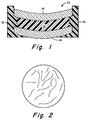
- FIGURE 1 is a side elevational view in cross-section of a casting mold 10 in which an epoxy mixture 12 is cast to be gelled and cured.
- Mold 10 is composed of glass mold sections 14 held in spaced relationship by a silicone gasket 16.
- FIGURE 2 is a schematic top view of an epoxy casting depicting striations which the invention is designed to avoid.
- the present invention is essentially an improved version of the basic laminated lens structures disclosed in the prior Fretz, Jr. patent and pending application.
- the invention provides, as the organic plastic layer therein, an optically clear, epoxy casting that is essentially free of striations.
- our studies indicate that striations tend to occur during gelling of an epoxy casting mixture. They further indicate, as explained earlier, that the striations result from thermal gradients. These give rise to areas of varying refractive index that become frozen in during gelling. Striations may also form through other mechanisms, such as incomplete mixing. Accordingly, our invention is based on establishing conditions that largely avoid movement in the cast material as it gels.
- the gelling process should be conducted as rapidly as feasible, and at as low a temperature as practical.
- the amount of accelerator, or catalyst should be controlled at a relatively high level.
- the gelling temperature needs to be maintained as low as possible, while completing the process in a reasonable time.
- a casting mixture is prepared by combining the ingredients in a limited relationship to each other to form a casting mixture. This mixture is then cast in a mold, as shown in FIGURE 1, gelled and cured to form the cast element.
- the ingredients are: an aliphatic and/or an aromatic epoxy monomer, an anhydride curing agent, a source of active hydroxyl groups and an accelerator, or catalyst.
- An aliphatic epoxy provides clarity, color and UV stability, and is responsible for most of the physical and optical characteristics.
- a member of the cycloaliphatic epoxy family is preferred, although other aliphatic epoxides should produce satisfactory results.
- a high quality, readily available cycloaliphatic epoxy is ERL 4221 available from Union Carbide. This is a 3,4 epoxycyclohexylmethyl - 3,4 epoxy - cyclohexane - carboxylate.
- An aromatic epoxy is selected primarily to provide a higher refractive index than that which is characteristic of an aliphatic epoxy.
- an aliphatic epoxy with a refractive index of 1.506 may be mixed with an aromatic epoxy having an index of 1.547 in appropriate proportions to provide a desired intermediate value.
- the index commonly sought for ophthalmic purposes is 1.523.
- a high purity diglycidyl ether of bisphenol A available from Dow Chemical Corporation under the designation DER 332, is preferred.
- other aromatic epoxies including multifunctional resins such as the novolac resins, may also be used. As with any substitution, some experimentation may be necessary to obtain a desired combination of characteristics.
- Hexahydro phthalic anhydride is the preferred curing agent for present purposes. This compound is a solid at room temperature, but melts to a water white liquid at about 45°C.
- Other anhydrides, or other curing agents, including catalytic curing agents, such as BF3, may also be employed as hardeners, or curing agents.
- the hydroxyl can also react with the epoxide group to promote homopolymerization.
- anhydride level must be adjusted to optimize the cure.
- the ratio of reactive anhydride groups to reactive epoxide groups should range between 2:5 and 5:4. This ratio is expressed in terms of moles of anhydride and epoxide as determined on the basis of molecular weights.
- the moles of anhydride are based on the anhydride molecular weight
- the moles of epoxide are based on the epoxide equivalent weight (EEW) as supplied by the manufacturer, or determined by titration.
- EW epoxide equivalent weight
- propylene glycol as a source of active hydroxyl groups.
- the amount employed affects the quality of the cure. If too much is present, the final product is poorly crosslinked, has a low Tg, and is a less tough material. When the active hydroxyl level is too low, the reaction is sluggish and an incomplete cure takes place.
- the amount of propylene glycol also affects the optical distortions, or striations, in the casting. It is observed that, as the propylene glycol increases, the striations decrease.
- the propylene glycol level also affects the release of the casting from the mold. When the glycol level is reduced, the incidence of castings sticking to molds is increased.
- the suggested anhydride to hydroxyl level is between 2 and 6. Again, the optimum ratio needs to be determined experimentally.
- a preferred formulation has a value of about 5:2.
- the ratio of anhydride to hydroxyl groups source is also a mole ratio. It is based on the reactive groups and molecular weights of the particular anhydride and hydroxyl source employed. For example, in the case of hexahydro phthalic anhydride and propylene glycol, the hydroxyl or anhydride equivalent weights are, respectively, 154 and 38.
- Propylene glycol may be replaced with other polyols, or with other sources of active hydroxyl groups.
- Such components like the bisphenol A, may modify the refractive index. Accordingly, this must be taken into consideration where index control is critical.
- the accelerator for the polymerization reaction is the final ingredient. This reduces the temperature needed to start the polymerization reaction. From that standpoint, it is desirable to increase the amount of catalyst employed. Such action is limited, however, by the need to maintain the mixture fluid long enough to permit filtering, or other intermediate steps. While as much as 1% may be tolerated in some cases, we prefer to employ levels from 0.01% to about 0.1%, based on the total mix.
- tin octoate also referred to as tin 2-ethylhexoate
- the organic tin compound appears to have a minimal coloring effect and is compatible with the resin.
- Other types of catalysts that may be used are Lewis bases, such as the the tertiary amines, e.g. benzyl dimethyl amine, and Lewis acids, such as zinc octoate. The catalyst level will depend on the catalyst selected, and will need to determined for any specific situation.
- a minute amount of a purple dye may be added as a decolorizer.
- a commercially available ultra-violet absorber package may be added to prevent yellowing with age, as well as providing eye protection.
- the rigid, epoxy lens blank is produced by casting an epoxy resin mixture, as just described, in a glass mold that is treated with a mold release agent.
- a mold release material such as Monocoat E 179, supplied by Chemtrend, Inc.
- the epoxy formulation is mixed using a mechanical stirrer. The solution is considered well mixed when no mix lines are visible while stirring.
- the epoxy resin system is homogeneous, it is poured into a glass mold treated with the mold release agent.
- a silicone gasket is used to seal the mold, as shown in FIGURE 1 of the attached drawing.
- the mold is then cured at a programmed rate: 55°C for 16 hours, then slowly increase the temperature until the oven reaches 150°C, and hold for 4 hours.
- the mold is then cooled to room temperature, and the epoxy sample is removed from the mold.
- TABLE 1 shows several casting mixtures. These mixtures were mixed, poured into molds as shown in FIGURE 1, and cured in accordance with the schedule set forth above. TABLE 1 also sets forth, for each example, the ratio of anhydride equivalent weight to epoxide equivalent weight (R1) and the ratio of andydride equivalent weight to the hydroxyl equivalent weight (R2), the refractive index (REF.IN.), of the casting, and the appearance (APP.) of the casting with respect to freedom from striations or distortions.
- R1 anhydride equivalent weight to epoxide equivalent weight
- R2 the ratio of andydride equivalent weight to the hydroxyl equivalent weight
- REF.IN. the refractive index
- APP. appearance
- the five ingredients (ING.) in the casting mixtures are aliphatic monomer (ERL 4221), aromatic monomer (DER 332), hexahydro phthalic anhydride (HHPA), propylene glycol (PROP.GLY.) and tin octoate. (SN. OCT.)
- the foregoing example may include, as a decolorizer, three ppm of a purple dye available from from PYLAM PRODUCTS CO., INC., Garden City, New York under the designation PYLAKROME Blue violet 315901. Also, approximately one percent of an ultra-violet absorber pack, available from BASF, Parsippany, New Jersey under the designation URINUL-539, may be included.
- a decolorizer three ppm of a purple dye available from from PYLAM PRODUCTS CO., INC., Garden City, New York under the designation PYLAKROME Blue violet 315901.
- approximately one percent of an ultra-violet absorber pack, available from BASF, Parsippany, New Jersey under the designation URINUL-539 may be included.
Landscapes
- Chemical & Material Sciences (AREA)
- Health & Medical Sciences (AREA)
- Chemical Kinetics & Catalysis (AREA)
- Medicinal Chemistry (AREA)
- Polymers & Plastics (AREA)
- Organic Chemistry (AREA)
- Casting Or Compression Moulding Of Plastics Or The Like (AREA)
- Epoxy Resins (AREA)
- Eyeglasses (AREA)
- Laminated Bodies (AREA)
Applications Claiming Priority (2)
| Application Number | Priority Date | Filing Date | Title |
|---|---|---|---|
| US07/589,403 US5116684A (en) | 1990-09-28 | 1990-09-28 | Composite ophthalmic lens |
| US589403 | 1990-09-28 |
Publications (2)
| Publication Number | Publication Date |
|---|---|
| EP0477658A2 true EP0477658A2 (de) | 1992-04-01 |
| EP0477658A3 EP0477658A3 (en) | 1992-08-26 |
Family
ID=24357862
Family Applications (1)
| Application Number | Title | Priority Date | Filing Date |
|---|---|---|---|
| EP19910115333 Withdrawn EP0477658A3 (en) | 1990-09-28 | 1991-09-11 | Composite opthalmic lens |
Country Status (5)
| Country | Link |
|---|---|
| US (1) | US5116684A (de) |
| EP (1) | EP0477658A3 (de) |
| JP (1) | JPH04289817A (de) |
| CA (1) | CA2050515A1 (de) |
| TW (1) | TW215476B (de) |
Cited By (5)
| Publication number | Priority date | Publication date | Assignee | Title |
|---|---|---|---|---|
| FR2687482A1 (fr) * | 1992-02-17 | 1993-08-20 | Corning Inc | Nouvelles lentilles ophtalmiques composites et leur fabrication. |
| EP0556646A1 (de) * | 1992-02-17 | 1993-08-25 | Corning Incorporated | Ophthalmische Komposit-Linsen und deren Herstellung |
| US5410375A (en) * | 1990-03-15 | 1995-04-25 | Fiala; Werner J. | Multifocal birefrigent lens with adjusted birefringence |
| WO1997022894A1 (en) * | 1995-12-18 | 1997-06-26 | Sola International Holdings Ltd. | Laminate wafers |
| EP1193535A4 (de) * | 2000-05-02 | 2002-09-11 | Yamamoto Kogaku | Transparenter optischer artikel |
Families Citing this family (27)
| Publication number | Priority date | Publication date | Assignee | Title |
|---|---|---|---|---|
| JPH0534509A (ja) * | 1991-05-21 | 1993-02-12 | Asahi Optical Co Ltd | 非球面光学素子及びその製造方法 |
| FR2679044B1 (fr) * | 1991-07-12 | 1994-06-10 | Corning Inc | Lentille ophtalmique composite. |
| US5312689A (en) * | 1993-02-22 | 1994-05-17 | Corning Incorporated | Laminated ophthalmic lens |
| GB2282600B (en) * | 1993-10-08 | 1997-08-13 | Kobe Steel Europ Ltd | Epoxy resin compositions |
| US6183083B1 (en) | 1998-09-08 | 2001-02-06 | Wesley-Jessen Corporation | Contact lens comprising a violet tint |
| US6166849A (en) * | 1998-12-15 | 2000-12-26 | Ppg Industries Ohio, Inc. | Aromatic glycidyl amine-based epoxy edge seals for electrooptic devices |
| US6619799B1 (en) * | 1999-07-02 | 2003-09-16 | E-Vision, Llc | Optical lens system with electro-active lens having alterably different focal lengths |
| US7293871B2 (en) * | 2000-11-27 | 2007-11-13 | Ophthonix, Inc. | Apparatus and method of correcting higher-order aberrations of the human eye |
| US6813082B2 (en) | 2000-11-27 | 2004-11-02 | Ophthonix, Inc. | Wavefront aberrator and method of manufacturing |
| US7217375B2 (en) * | 2001-06-04 | 2007-05-15 | Ophthonix, Inc. | Apparatus and method of fabricating a compensating element for wavefront correction using spatially localized curing of resin mixtures |
| US6682195B2 (en) * | 2001-10-25 | 2004-01-27 | Ophthonix, Inc. | Custom eyeglass manufacturing method |
| US6712466B2 (en) * | 2001-10-25 | 2004-03-30 | Ophthonix, Inc. | Eyeglass manufacturing method using variable index layer |
| US7434931B2 (en) | 2001-10-25 | 2008-10-14 | Ophthonix | Custom eyeglass manufacturing method |
| EP1478190B1 (de) * | 2002-04-26 | 2013-01-02 | NTT DoCoMo, Inc. | Bildkodierungseinrichtung, Bildkodierungsverfahren, und Bildkodierungsprogramm |
| US20040174493A1 (en) * | 2003-03-07 | 2004-09-09 | Chen Yau Ming | Multi-function shatter-proof safety eyewear glass lens |
| US20050260388A1 (en) * | 2004-05-21 | 2005-11-24 | Lai Shui T | Apparatus and method of fabricating an ophthalmic lens for wavefront correction using spatially localized curing of photo-polymerization materials |
| EP3894219A1 (de) * | 2018-12-11 | 2021-10-20 | Solutia Inc. | Polymerzwischenschichten mit reduzierter farbe |
| US11678975B2 (en) | 2019-04-05 | 2023-06-20 | Amo Groningen B.V. | Systems and methods for treating ocular disease with an intraocular lens and refractive index writing |
| US12357509B2 (en) | 2019-04-05 | 2025-07-15 | Amo Groningen B.V. | Systems and methods for improving vision from an intraocular lens in an incorrect position and using refractive index writing |
| US11564839B2 (en) | 2019-04-05 | 2023-01-31 | Amo Groningen B.V. | Systems and methods for vergence matching of an intraocular lens with refractive index writing |
| US12377622B2 (en) | 2019-04-05 | 2025-08-05 | Amo Groningen B.V. | Systems and methods for vergence matching with an optical profile and using refractive index writing |
| US11944574B2 (en) | 2019-04-05 | 2024-04-02 | Amo Groningen B.V. | Systems and methods for multiple layer intraocular lens and using refractive index writing |
| US11583388B2 (en) | 2019-04-05 | 2023-02-21 | Amo Groningen B.V. | Systems and methods for spectacle independence using refractive index writing with an intraocular lens |
| US11583389B2 (en) | 2019-04-05 | 2023-02-21 | Amo Groningen B.V. | Systems and methods for correcting photic phenomenon from an intraocular lens and using refractive index writing |
| US11529230B2 (en) | 2019-04-05 | 2022-12-20 | Amo Groningen B.V. | Systems and methods for correcting power of an intraocular lens using refractive index writing |
| CN112123684B (zh) * | 2019-06-25 | 2022-04-15 | 江苏想靓眼镜有限公司 | 一种多种变色太阳镜加工工艺 |
| TWI754919B (zh) * | 2020-04-20 | 2022-02-11 | 占暉光學股份有限公司 | 多功能防霧光學透鏡裝置 |
Family Cites Families (7)
| Publication number | Priority date | Publication date | Assignee | Title |
|---|---|---|---|---|
| US3391053A (en) * | 1964-10-29 | 1968-07-02 | Corning Glass Works | Flexible glass-plastic laminate |
| US4432832A (en) * | 1982-08-26 | 1984-02-21 | Polaroid Corporation | Method of forming contoured optical layers on glass elements |
| NL8400868A (nl) * | 1984-03-19 | 1984-10-01 | Philips Nv | Gelaagde optische component. |
| US4793703A (en) * | 1987-08-03 | 1988-12-27 | Corning Glass Works | Laminated glass lenses |
| CN1040810A (zh) * | 1988-04-30 | 1990-03-28 | 三井东圧化学株式会社 | 多硫化合物基树脂透镜及其制备方法 |
| US4957981A (en) * | 1989-02-10 | 1990-09-18 | Akzo N.V. | Interpenetrating polymer network of an aliphatic polyol(allyl carbonate) and epoxy resin |
| US5064712A (en) * | 1989-03-20 | 1991-11-12 | Corning Incorporated | Laminated lens structure |
-
1990
- 1990-09-28 US US07/589,403 patent/US5116684A/en not_active Expired - Fee Related
-
1991
- 1991-09-03 CA CA002050515A patent/CA2050515A1/en not_active Abandoned
- 1991-09-11 EP EP19910115333 patent/EP0477658A3/en not_active Withdrawn
- 1991-09-24 JP JP3242941A patent/JPH04289817A/ja not_active Withdrawn
- 1991-09-24 TW TW080107519A patent/TW215476B/zh active
Cited By (7)
| Publication number | Priority date | Publication date | Assignee | Title |
|---|---|---|---|---|
| US5410375A (en) * | 1990-03-15 | 1995-04-25 | Fiala; Werner J. | Multifocal birefrigent lens with adjusted birefringence |
| FR2687482A1 (fr) * | 1992-02-17 | 1993-08-20 | Corning Inc | Nouvelles lentilles ophtalmiques composites et leur fabrication. |
| EP0556646A1 (de) * | 1992-02-17 | 1993-08-25 | Corning Incorporated | Ophthalmische Komposit-Linsen und deren Herstellung |
| US5343260A (en) * | 1992-02-17 | 1994-08-30 | Corning Incorporated | Composite ophthalmic lenses and their manufacture |
| WO1997022894A1 (en) * | 1995-12-18 | 1997-06-26 | Sola International Holdings Ltd. | Laminate wafers |
| US6256152B1 (en) | 1995-12-18 | 2001-07-03 | Sola International Holdings Ltd. | Laminate wafers |
| EP1193535A4 (de) * | 2000-05-02 | 2002-09-11 | Yamamoto Kogaku | Transparenter optischer artikel |
Also Published As
| Publication number | Publication date |
|---|---|
| JPH04289817A (ja) | 1992-10-14 |
| CA2050515A1 (en) | 1992-03-29 |
| TW215476B (de) | 1993-11-01 |
| US5116684A (en) | 1992-05-26 |
| EP0477658A3 (en) | 1992-08-26 |
Similar Documents
| Publication | Publication Date | Title |
|---|---|---|
| US5116684A (en) | Composite ophthalmic lens | |
| US4680369A (en) | Sulfur-containing polyurethane base lens resin | |
| US4311762A (en) | Plastic components of improved hardness and scratch resistance | |
| JPH0458489B2 (de) | ||
| CA2146816A1 (en) | Process and composition for preparing a dental polymer product | |
| JP2002528613A (ja) | 塩触媒を含有するイオウ含有樹脂製造用重合性組成物およびイオウ含有樹脂成形品の製造方法 | |
| US5343260A (en) | Composite ophthalmic lenses and their manufacture | |
| WO1991019674A1 (en) | Polymers of high refractive index and high heat distortion temperature | |
| JPS5856562B2 (ja) | N,n′−ジフエニレンビスイミドを内在せる熱硬化性組成物中での該イミドの晶出防止方法 | |
| EP0556646B1 (de) | Ophthalmische Komposit-Linsen und deren Herstellung | |
| JP2000169557A (ja) | エポキシ樹脂組成物および半導体封止装置 | |
| JP3205163B2 (ja) | プラスチックレンズ用組成物およびレンズ、並びにそれらの製造方法 | |
| JPH07288330A (ja) | 光半導体装置 | |
| JP2000108219A (ja) | プラスチックレンズの製造方法 | |
| JP3205164B2 (ja) | プラスチックレンズ用組成物およびレンズ、並びにそれらの製造方法 | |
| US3607833A (en) | Prepolymer of epoxy resin and tris(hydroxymethyl) aminomethane and curable composition thereof | |
| JPH06192396A (ja) | 一液型エポキシ樹脂組成物 | |
| JPH11100435A (ja) | 光学材料用組成物およびプラスチックレンズ | |
| US20090209723A1 (en) | Polyurethane resins, a method for the production thereof and optical lenses made of said resins | |
| US4046567A (en) | Christiansen cells containing epoxy gelling agents | |
| JPH044215A (ja) | プラスチックレンズ材料およびその製造方法 | |
| JPH01272443A (ja) | プラスチック眼鏡フレーム | |
| JP2712876B2 (ja) | トランスファーモールド用透明エポキシ樹脂組成物 | |
| JP2695640B2 (ja) | プラスチック眼鏡フレーム | |
| WO2006073608A1 (en) | Optoelectronic molding compound that transmits visible light and blocks infrared light |
Legal Events
| Date | Code | Title | Description |
|---|---|---|---|
| PUAI | Public reference made under article 153(3) epc to a published international application that has entered the european phase |
Free format text: ORIGINAL CODE: 0009012 |
|
| AK | Designated contracting states |
Kind code of ref document: A2 Designated state(s): BE DE ES FR GB IT |
|
| PUAL | Search report despatched |
Free format text: ORIGINAL CODE: 0009013 |
|
| AK | Designated contracting states |
Kind code of ref document: A3 Designated state(s): BE DE ES FR GB IT |
|
| 17P | Request for examination filed |
Effective date: 19930126 |
|
| STAA | Information on the status of an ep patent application or granted ep patent |
Free format text: STATUS: THE APPLICATION IS DEEMED TO BE WITHDRAWN |
|
| 18D | Application deemed to be withdrawn |
Effective date: 19950401 |